Calcutta 5, Seen in 2018
Somehow the two-mile walk between the Writer's Building and the Victoria Memorial just keeps getting longer as the years go by. I can't figure it out. We'll try it anyway, propped up by Keith Humphrey's Calcutta Revisited and its handy list of almost 150 Calcutta street names listed alphabetically by the British name and its replacement. Of course the old names are still in use, so BBD Bagh is still Dalhousie Square. To the list of old guides (Murray's and Cotton's) we'll add John Barry's Calcutta Illustrated, undated but from about 1950. Oops! Mustn't forget Brian Paul Bach's recent Calcutta's Edifice, although it's almost as expensive as it is idiosyncratic.
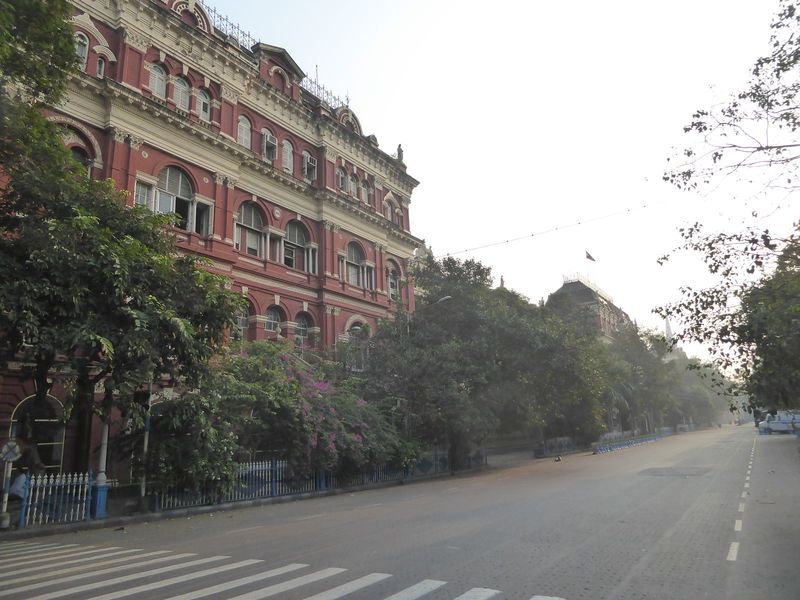
A few more years, and it will be impossible to get a photo of the Writers' Building, where all tours of the city should begin, unless you're a slave to shopping.
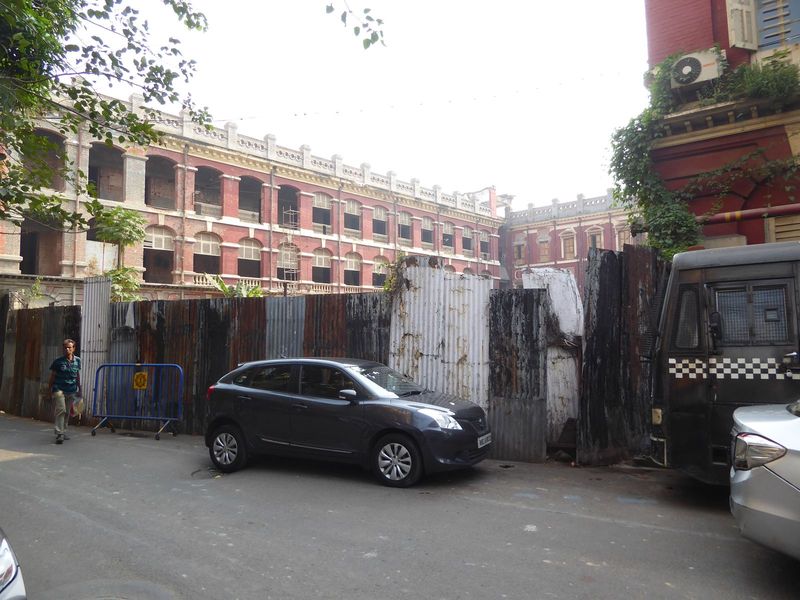
Maybe there's a better sense of Indian chaos here at the rear of the building.
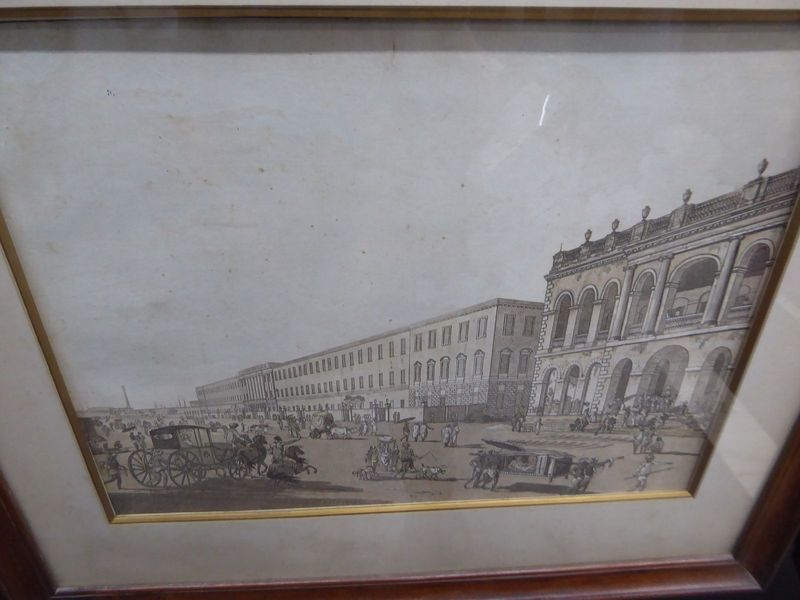
Here's what the building looked like in 1786, about a hundred years before a redo.
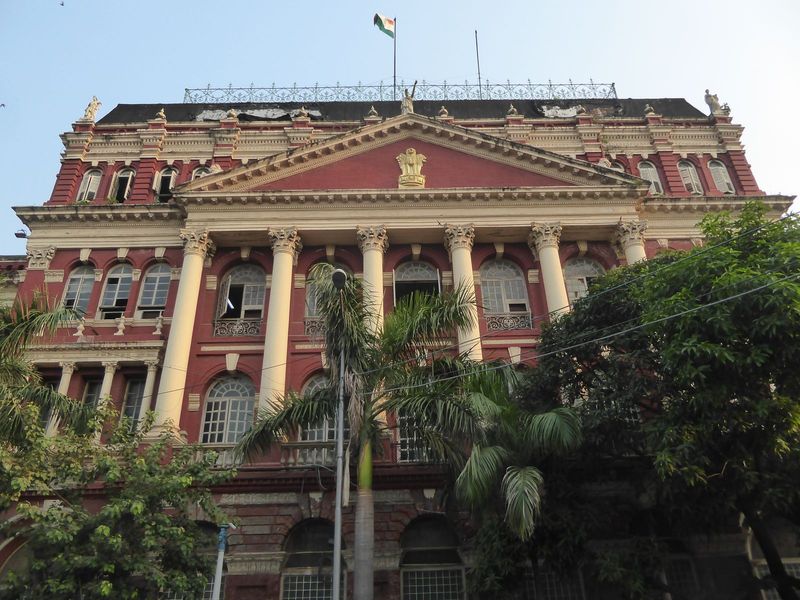
Here's one end of the facade added about 1882. The British coat-of-arms is gone, replaced by the lion capital adopted by India in 1950. And above it you can spot Minerva, waving like a politician stepping off an airplane.
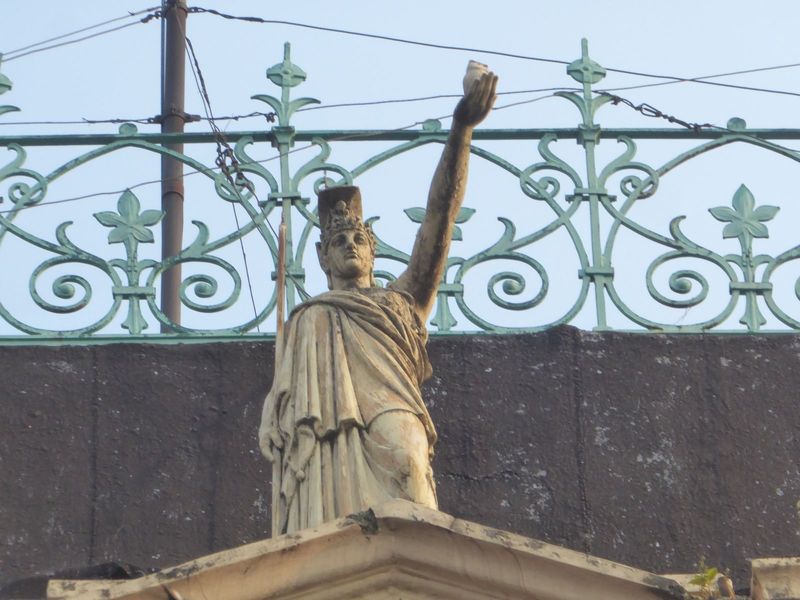
Here she is, carved either by William Fredric Woodington (1806-93) or his son of the same name (1830-1922). We should know what's in that cup, but classical education has gone to hell. Or maybe she's holding her owl! Of course she is; I obviously need glasses.
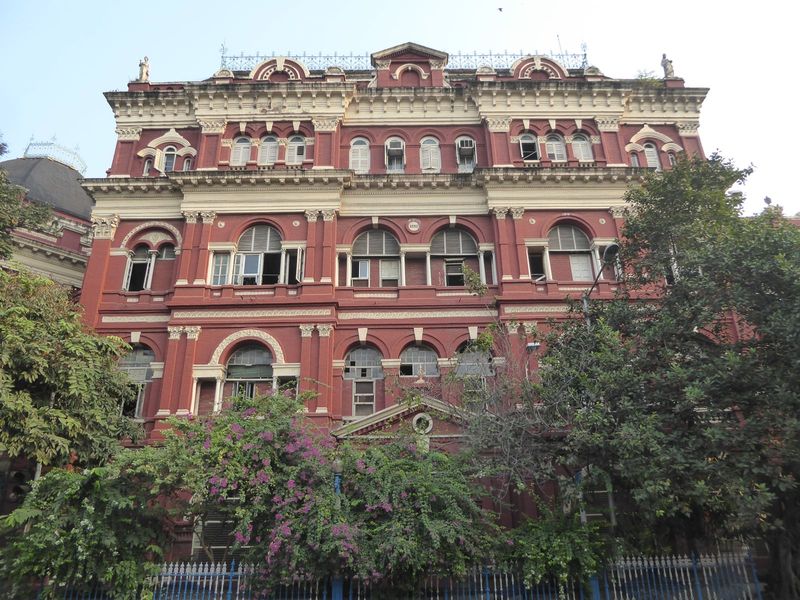
Here's the far-western block, fringed by the rotunda that once held the council chamber.
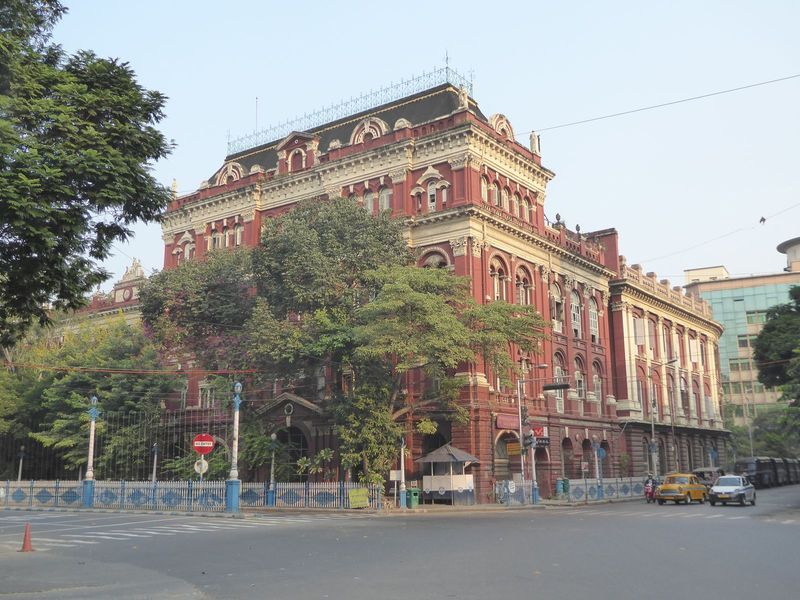
The east block. See the sculpture atop the section to its left?
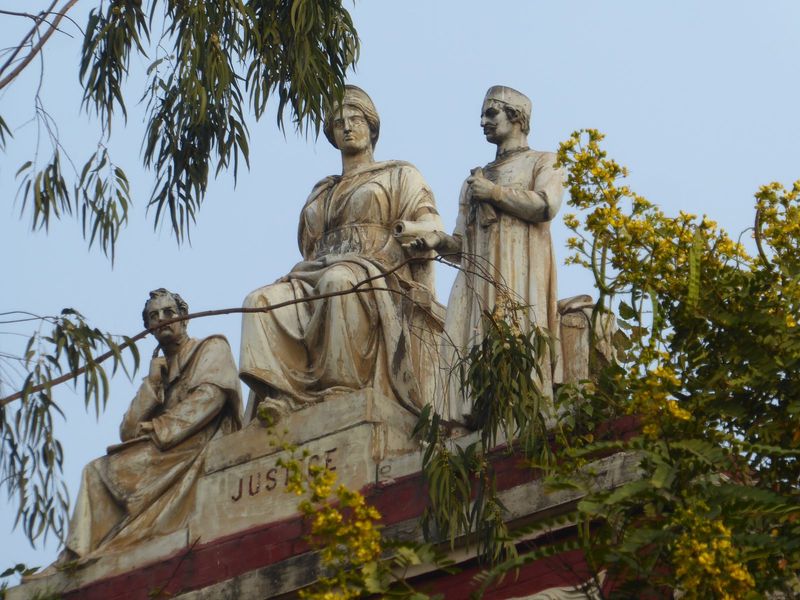
There she is, not one to be toyed with. There are three other such groupings, for Commerce, Science and Agriculture. The sculptors—still Woodington, father or son—also worked on London's Nelson Monument bronzes and on the Napier memorial in the crypt of St. Paul's. If one knew how they viewed their work, one might be able to decide how earnest the Victorians were. Somebody might have thought of it as sham.
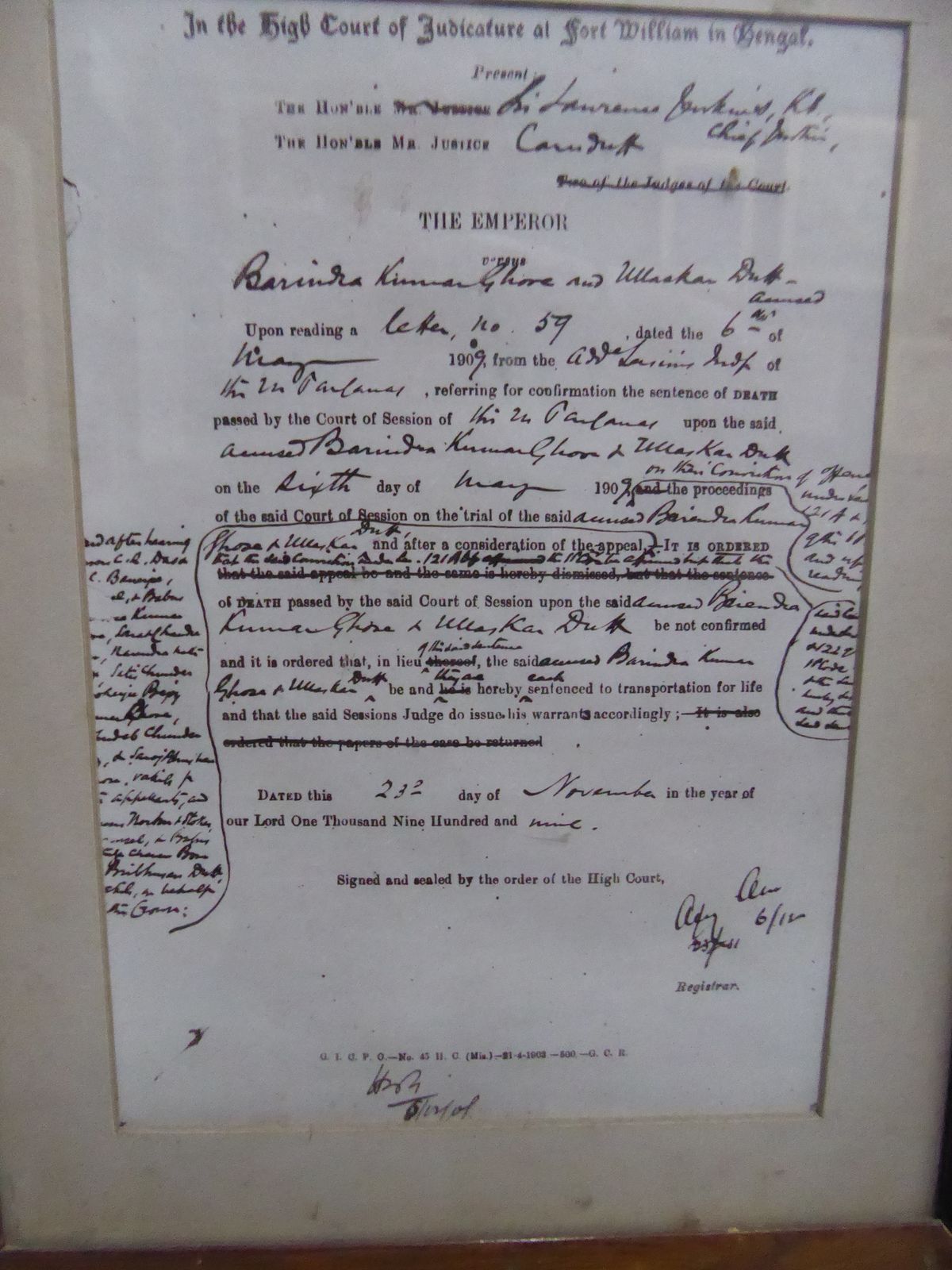
Not the judges who signed this bit of paper in 1909, commuting to transportation for life the death sentence imposed on Barindra Kumar Ghose, or Barin Ghosh, convicted in the Alipore Bomb case. Released in 1930, he survived to live in an independent India.
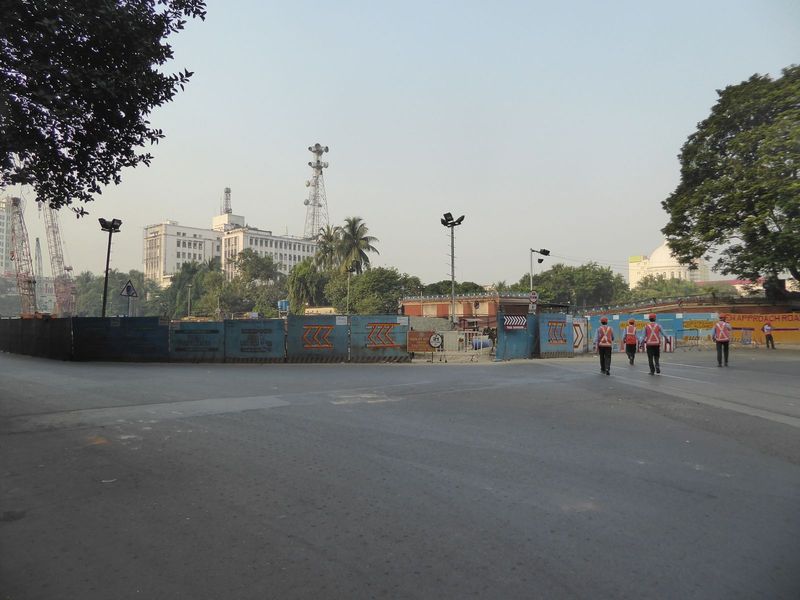
The main facade of the Writers' Building overlooks these trees, which encircle the pond at the center of BBD Bagh, until 1954 Dalhousie Square—and, earlier still, Tank Square. As of 2018, the site was torn up for the Calcutta Metro. The Martian invader belongs to Telephone Bhavan, built about 1950 with a disregard for the neighborhood. The dome of the much older post office is more polite.
The name BBD Bagh recalls the initials of the three men who entered the Writer's Building in 1930 and shot dead Norman Simpson, the inspector-general of Bengal's prisons. They died in the aftermath. Simpson's predecessor wrote a long letter to the editor of The Spectator, 3 January 1931. An extract: "Simpson was an ideal prison officer, he had a judicial mind and possessed a remarkable gift of tact which was invaluable in dealing with difficult prisoners. He was a humane man and held enlightened and very progressive views..."
That's not the way Simpson's remembered by most of the Indians who have heard of him..
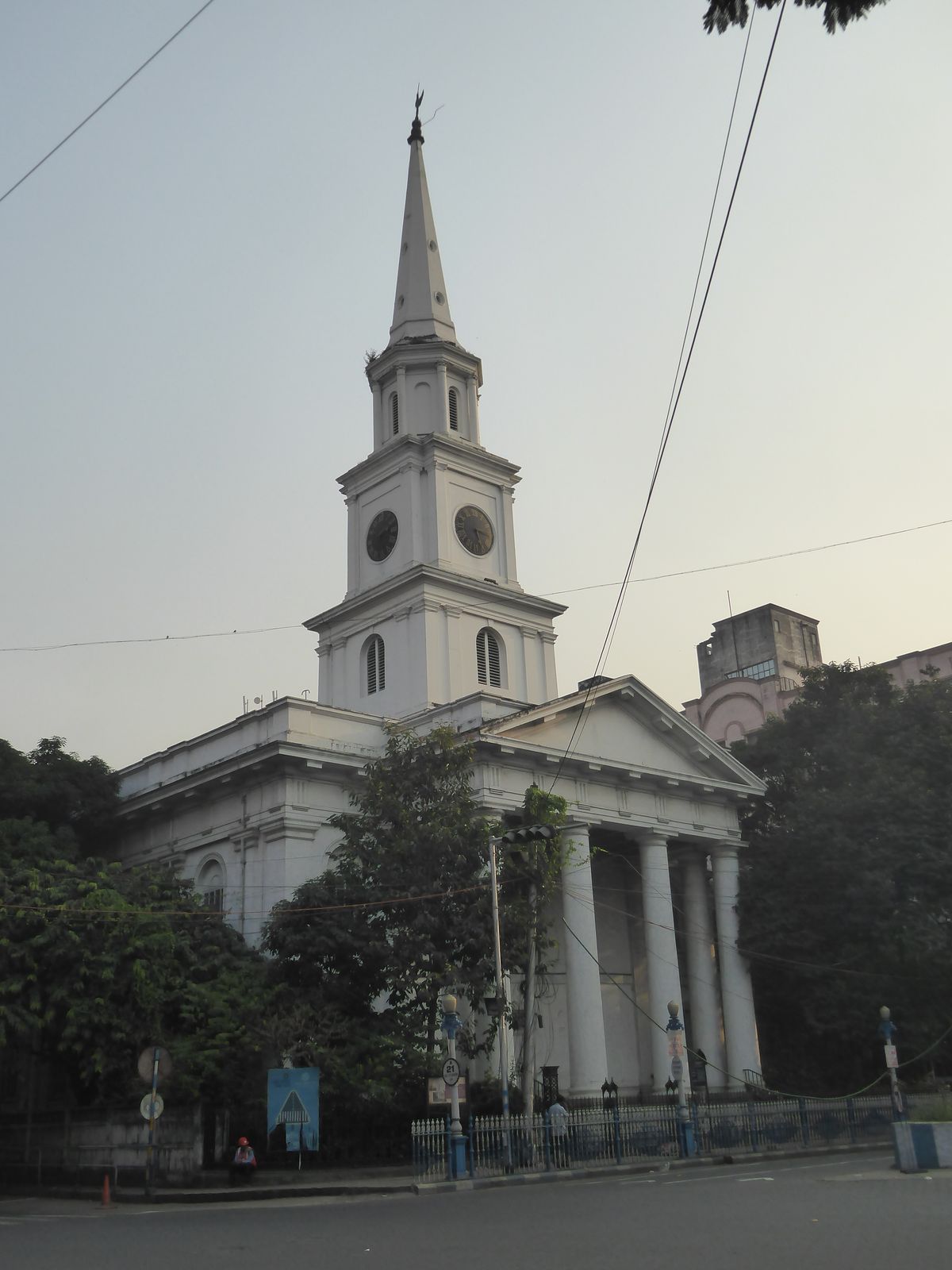
Spin 180 degrees and you see St. Andrews, the Scottish Kirk from 1818. It's based, like so many others, including St. Andrew's in Madras, on London's St. Martin-in-the-Fields.
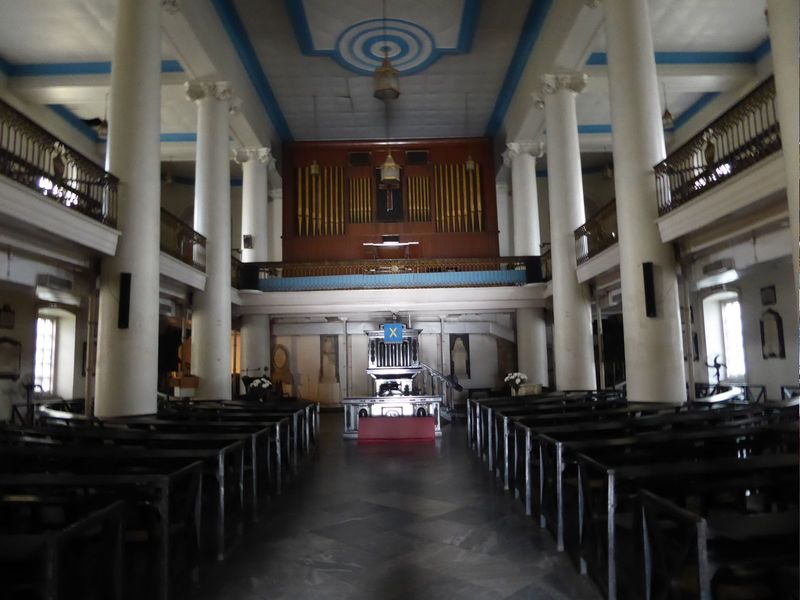
Don't you feel that you should adjust your necktie?
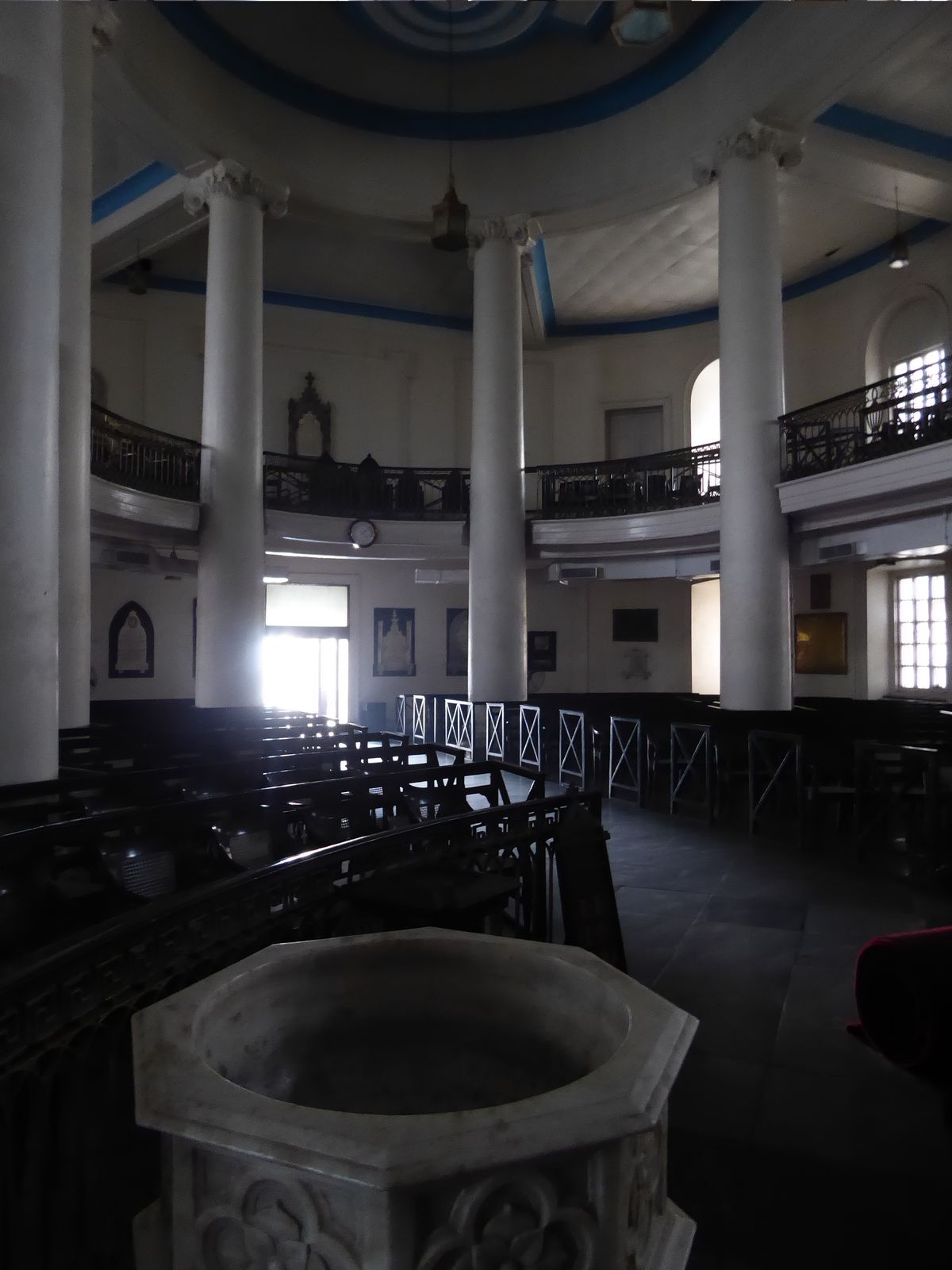
From upfront, the building doesn't seem so constricting.
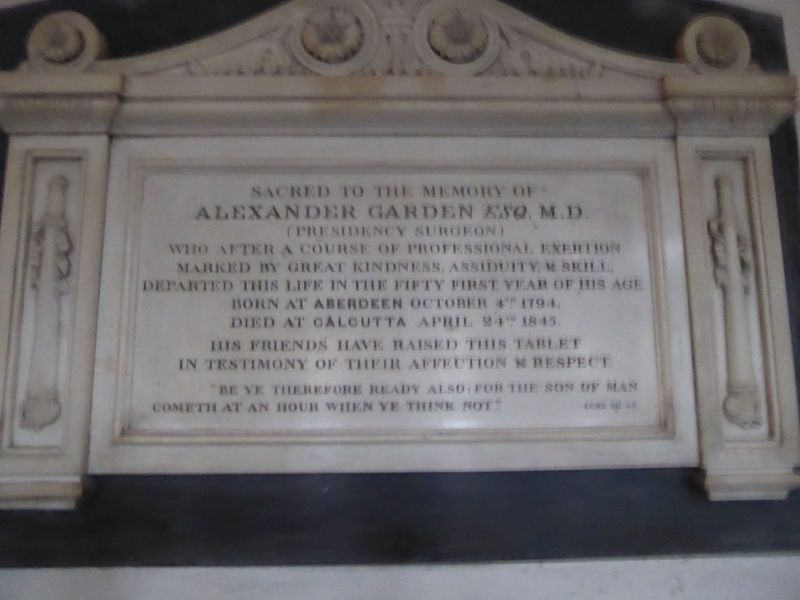
How many such plaques survive in the formerly British domains? Hundreds no doubt; thousands, possibly.
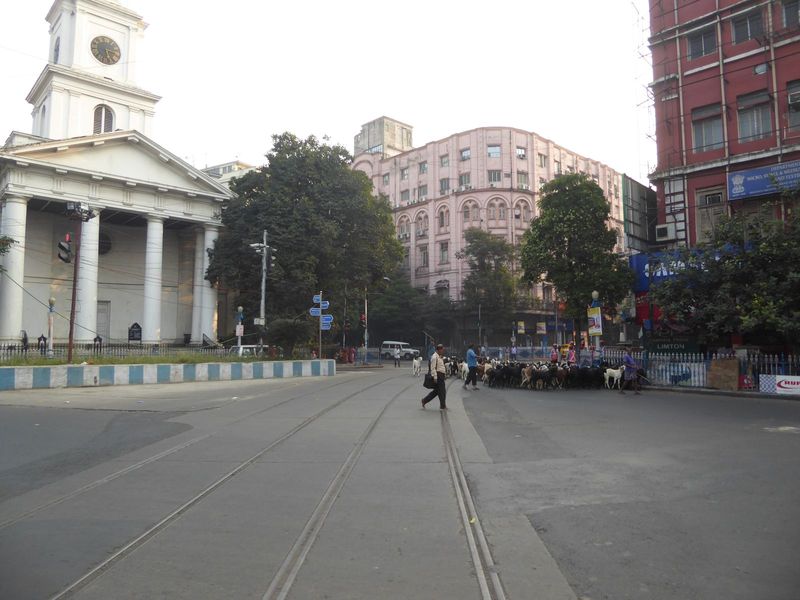
A disused tram line (no catenary is pretty good proof) rounds the curve at the northeast corner of the square and heads into Lalbazaar, a commercial neighborhood. We can look that way for a minute.
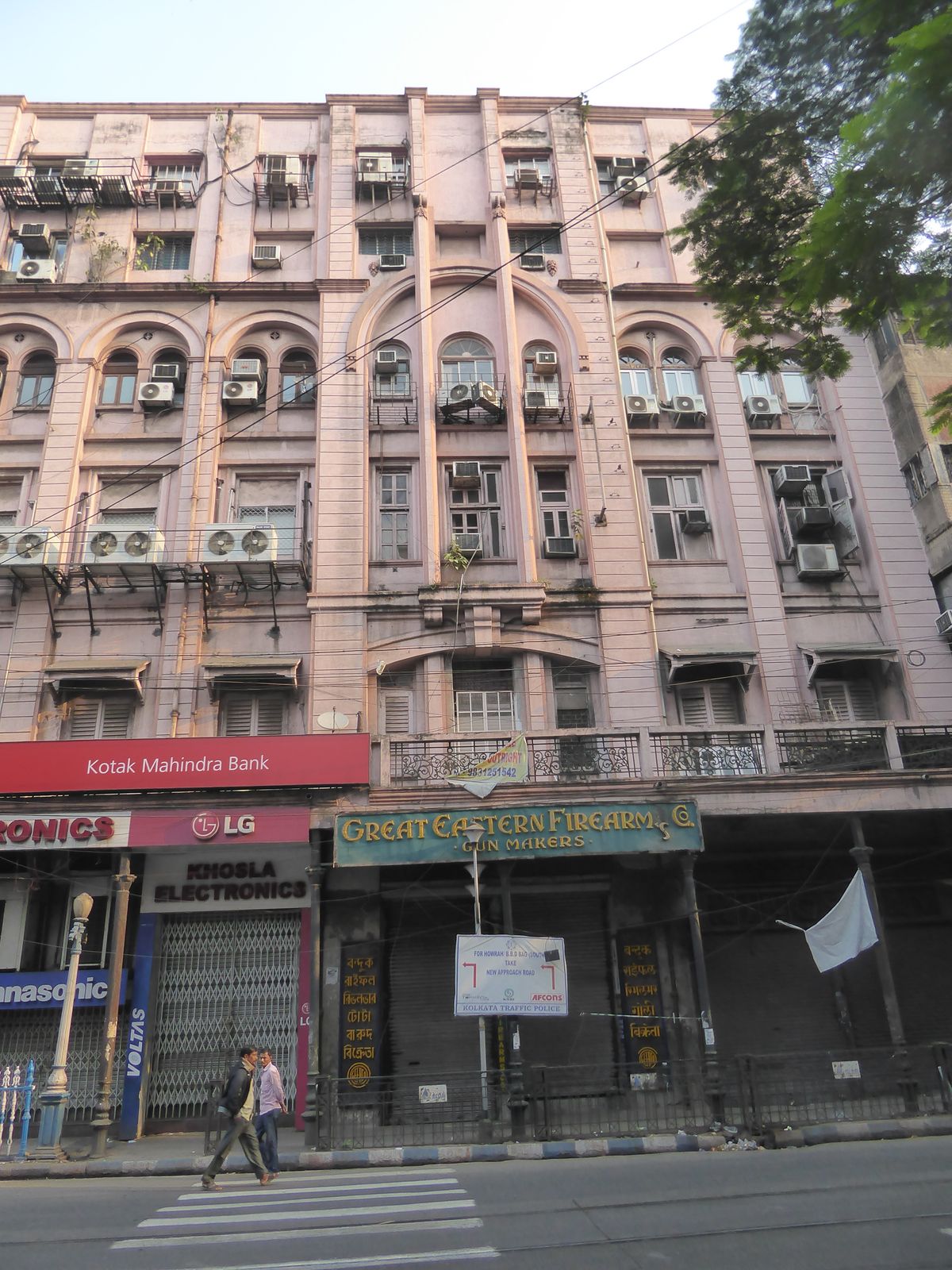
The pink building is, for some reason, called Tobacco House. When did the split-unit air conditioners arrive? Good question: probably in the 1990s.
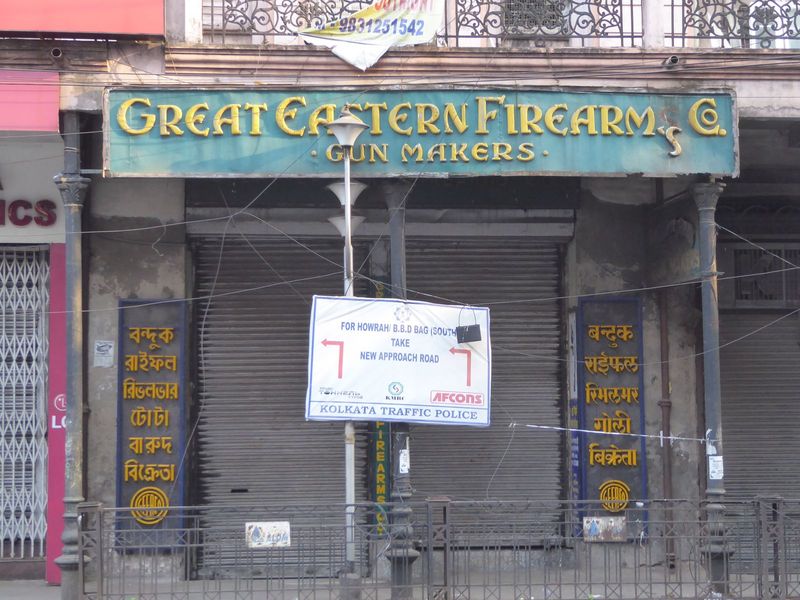
The "S" has failed, but the store is apparently still in business.
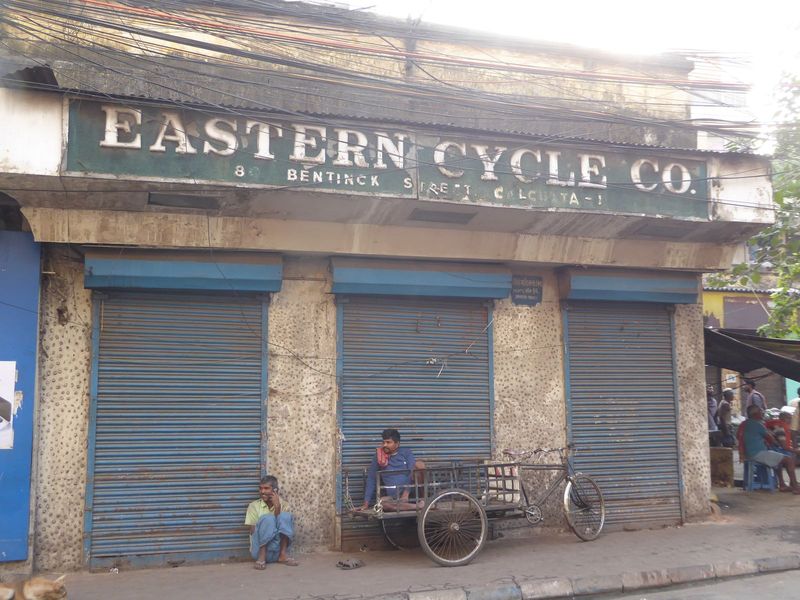
So is this one. The name Bentinck recalls William Bentinck, governor general in the 1830s and, like Dalhousie of Dalhousie Square, committed to what he saw as Indian uplift, whether Indians saw it that way or not.
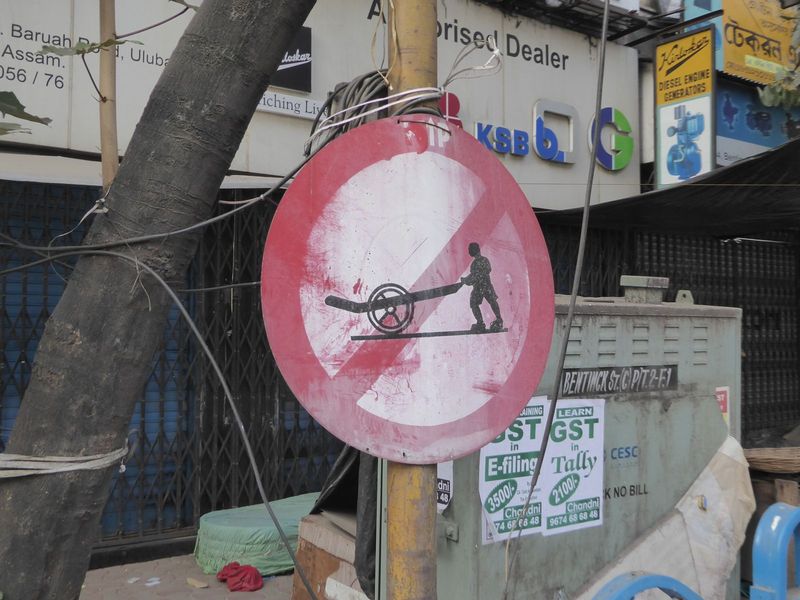
Post all the signs you want. Think they'll discourage the carts?
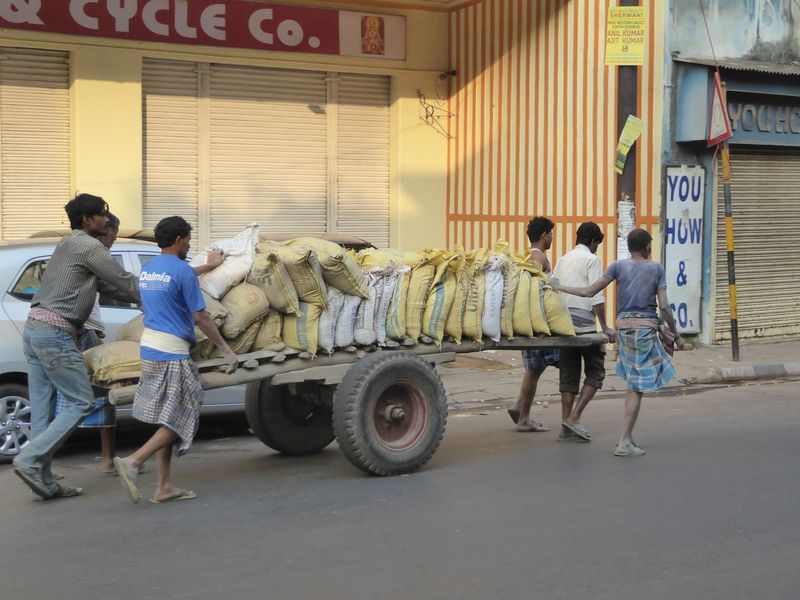
Here's the story from India Today, September 15, 1996: "The state Government has decided that after December 21, the century-old mode of transport will be phased out from the bustling metropolis."
In 2015 the government made another stab at banning non-motorized transport and again ran into objections. Here's one from change.org: "Such a ban is socially non-inclusive, inequitable and environmentally hazardous and is a suicide note for our beautiful city of joy."
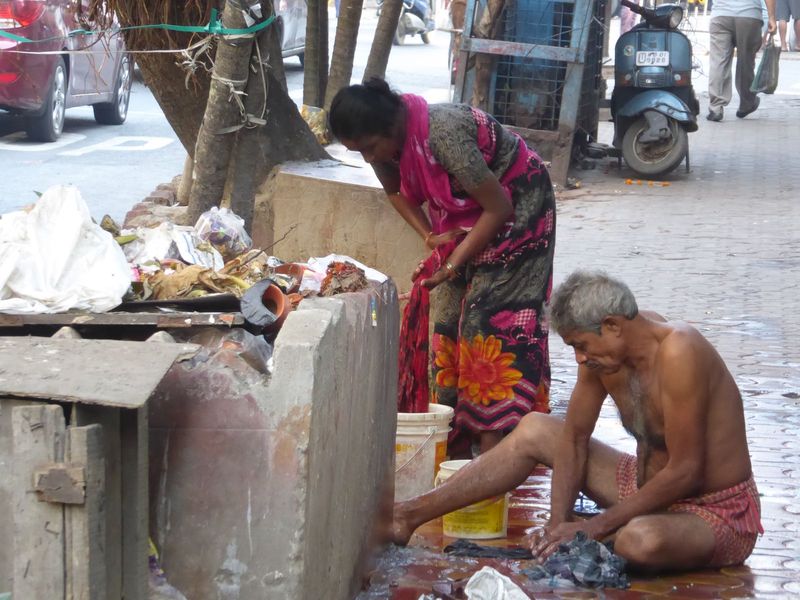
City of joy.
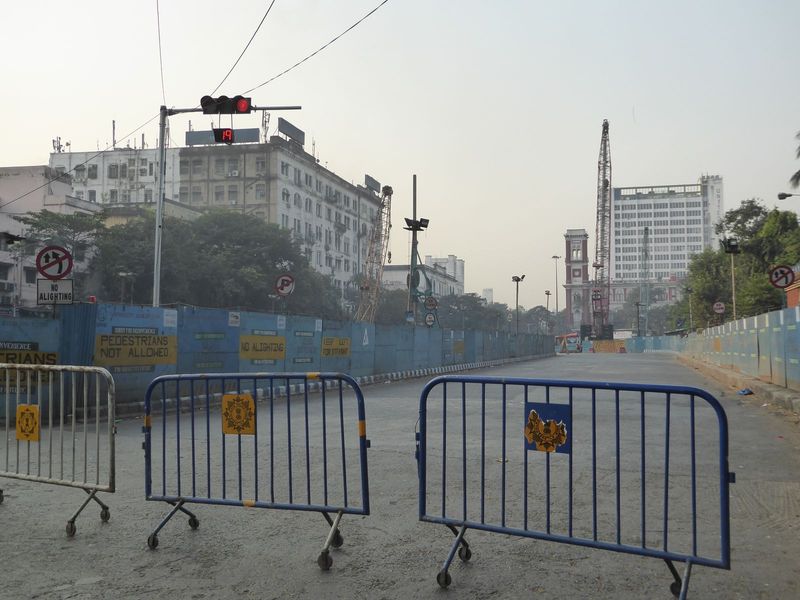
We're back at the St. Andrew's corner, with BBD Bagh on the right. Straight ahead is the old telegraph office, backed up by the United Bank building, from 1971. The only historic building on the left is under the crane hook.
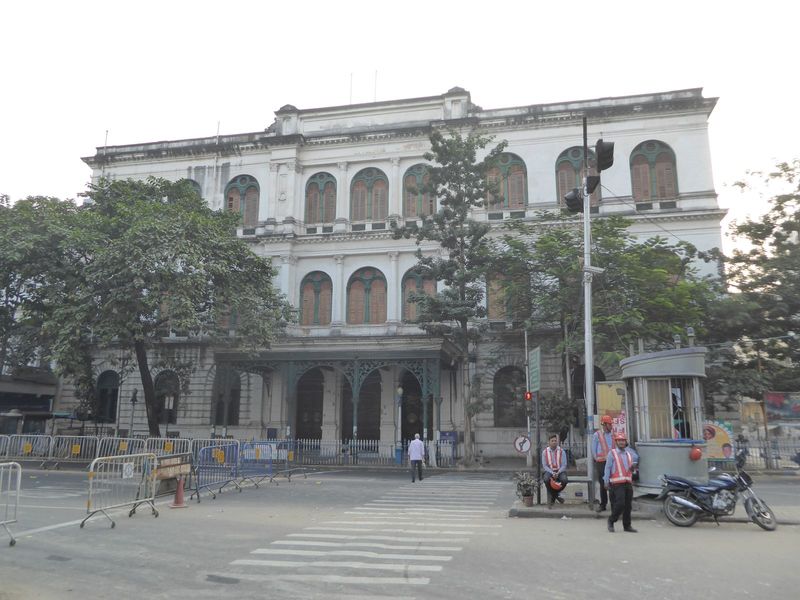
It's the Currency Building from 1833 (the wrought iron came later). Threatened with demolition, it got a heritage designation in 1998, and in 2003 the Archaeological Survey of India took over—and has an office in the back. The building's still waits restoration.
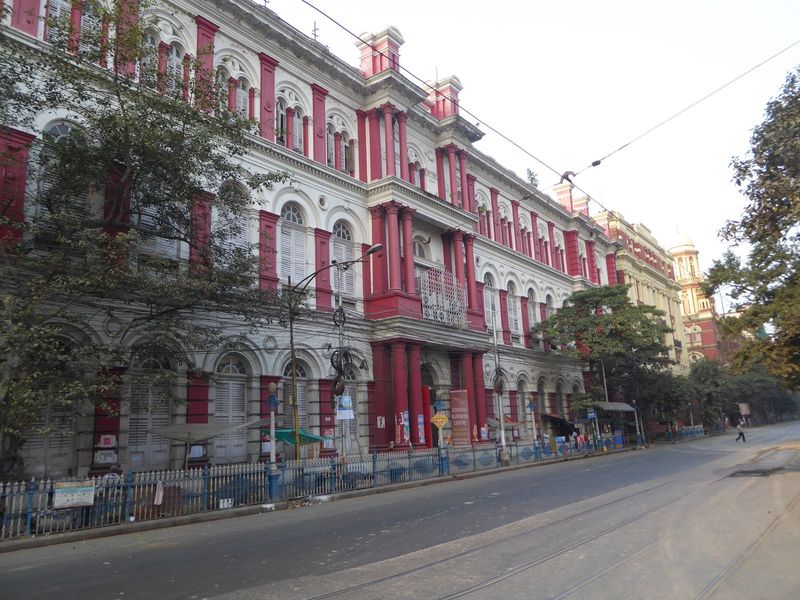
A telegraph line was opened to the United Kingdon in 1870, and this telegraph office popped up a few years later. By 1950, the building housed the Dead Letter Office.
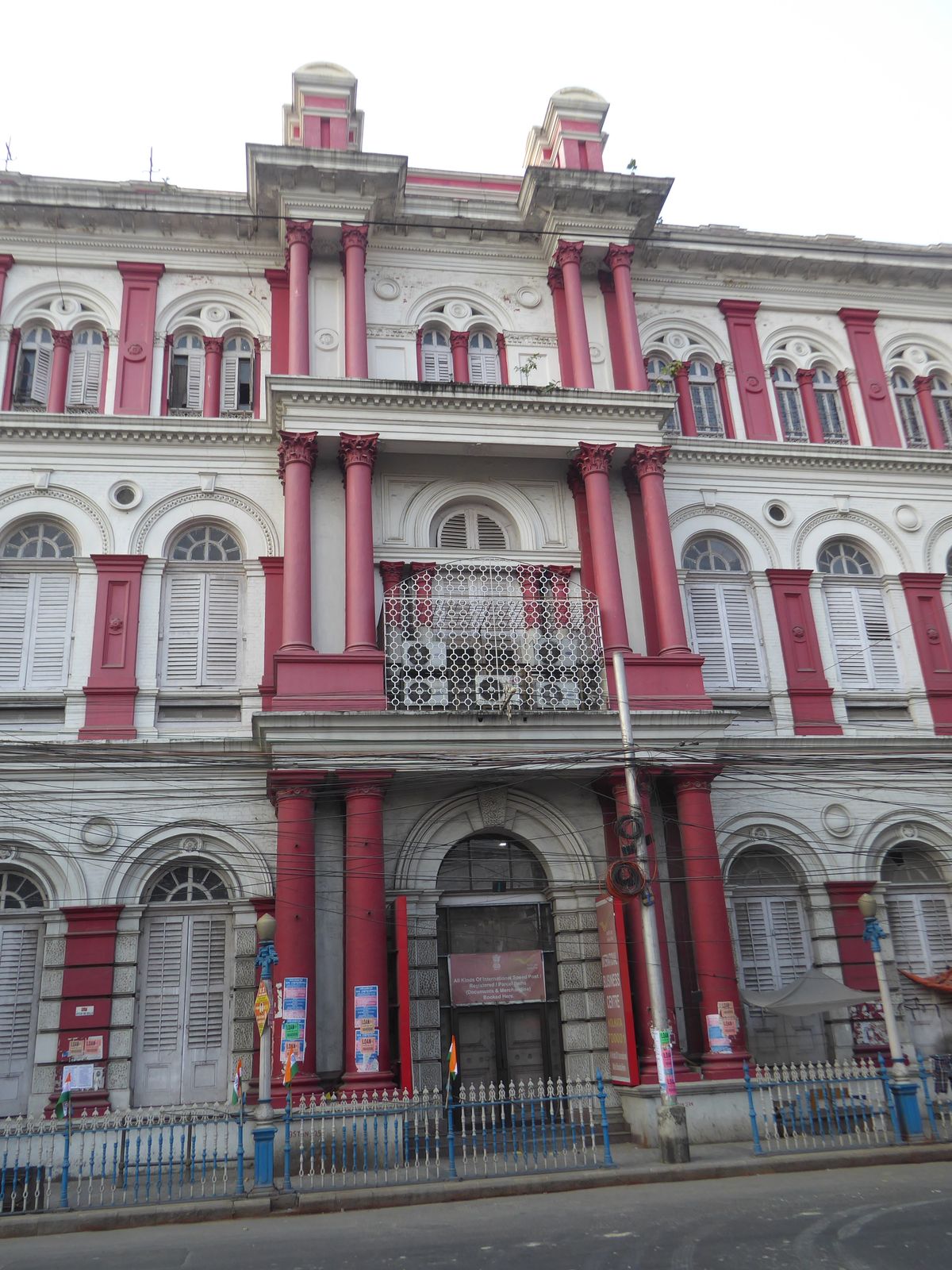
Just can't get rid of the posters.
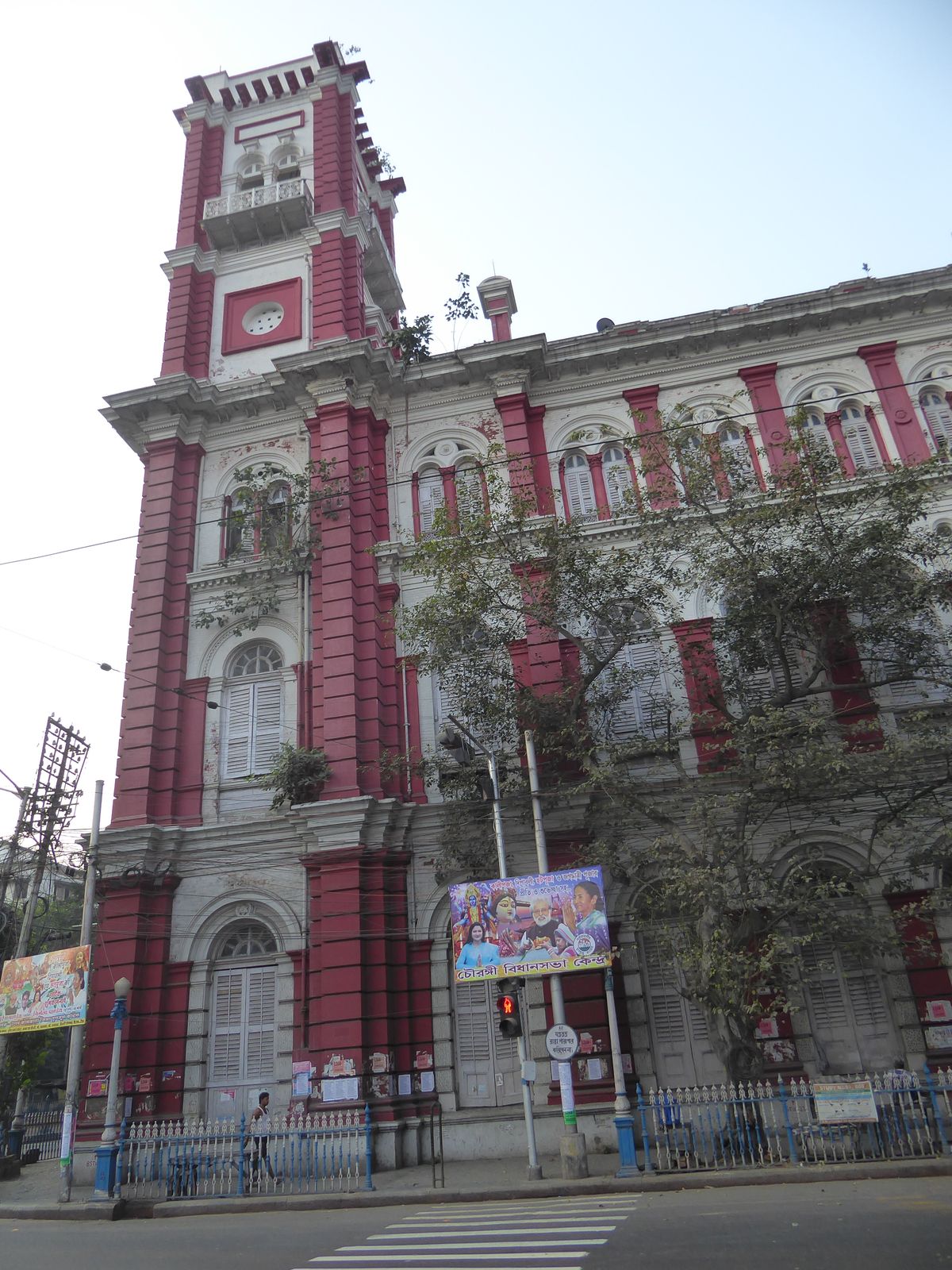
The cornice at the tower's top has been chopped back inelegantly, but the mock chimney (one of several) survives.
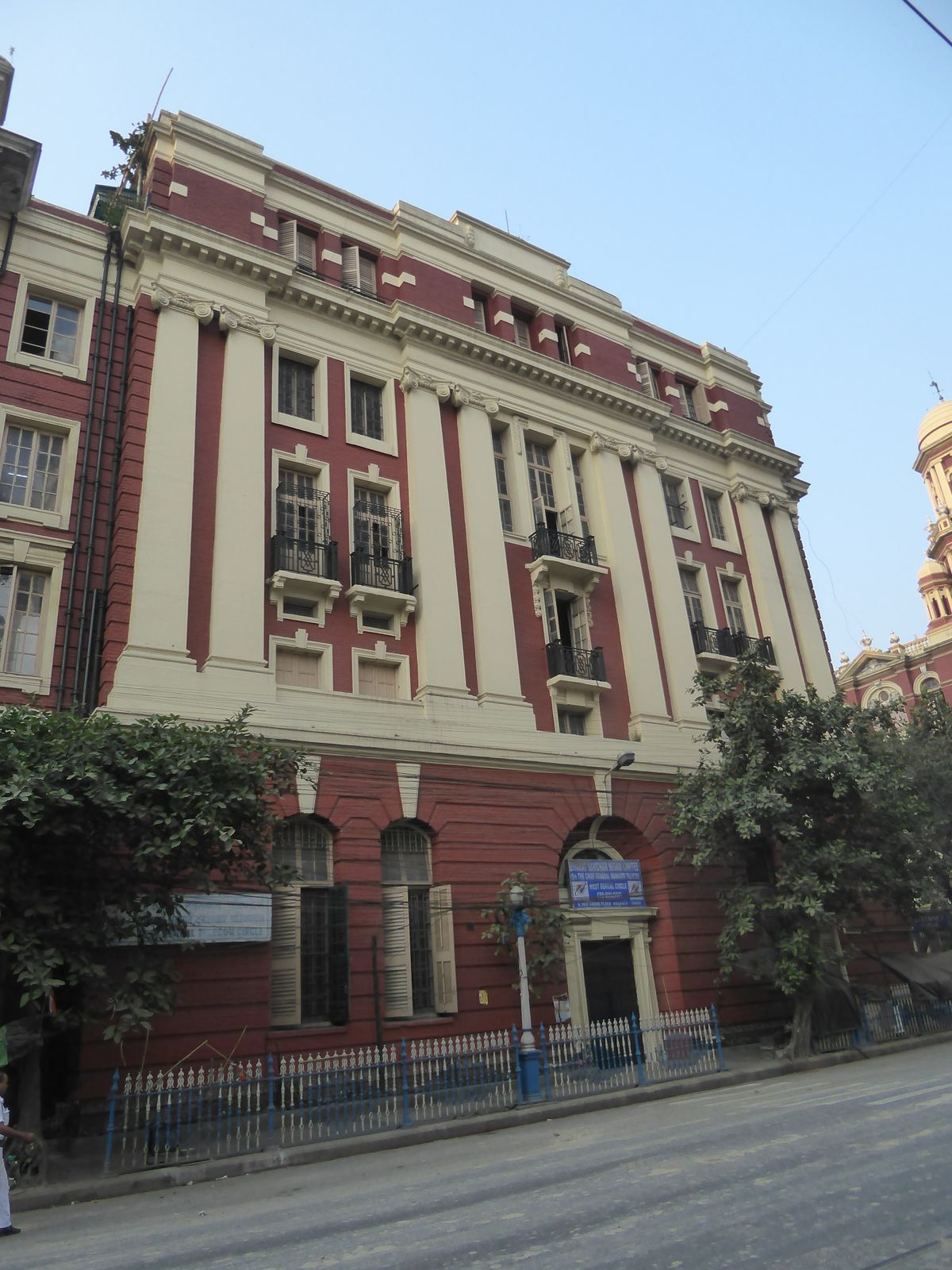
We're scooting along the south rim of the square. Here's the former Central Telegraph Office, now demoted to housing the "chief general manager" of West Bengal telecoms. That's what the sign says.
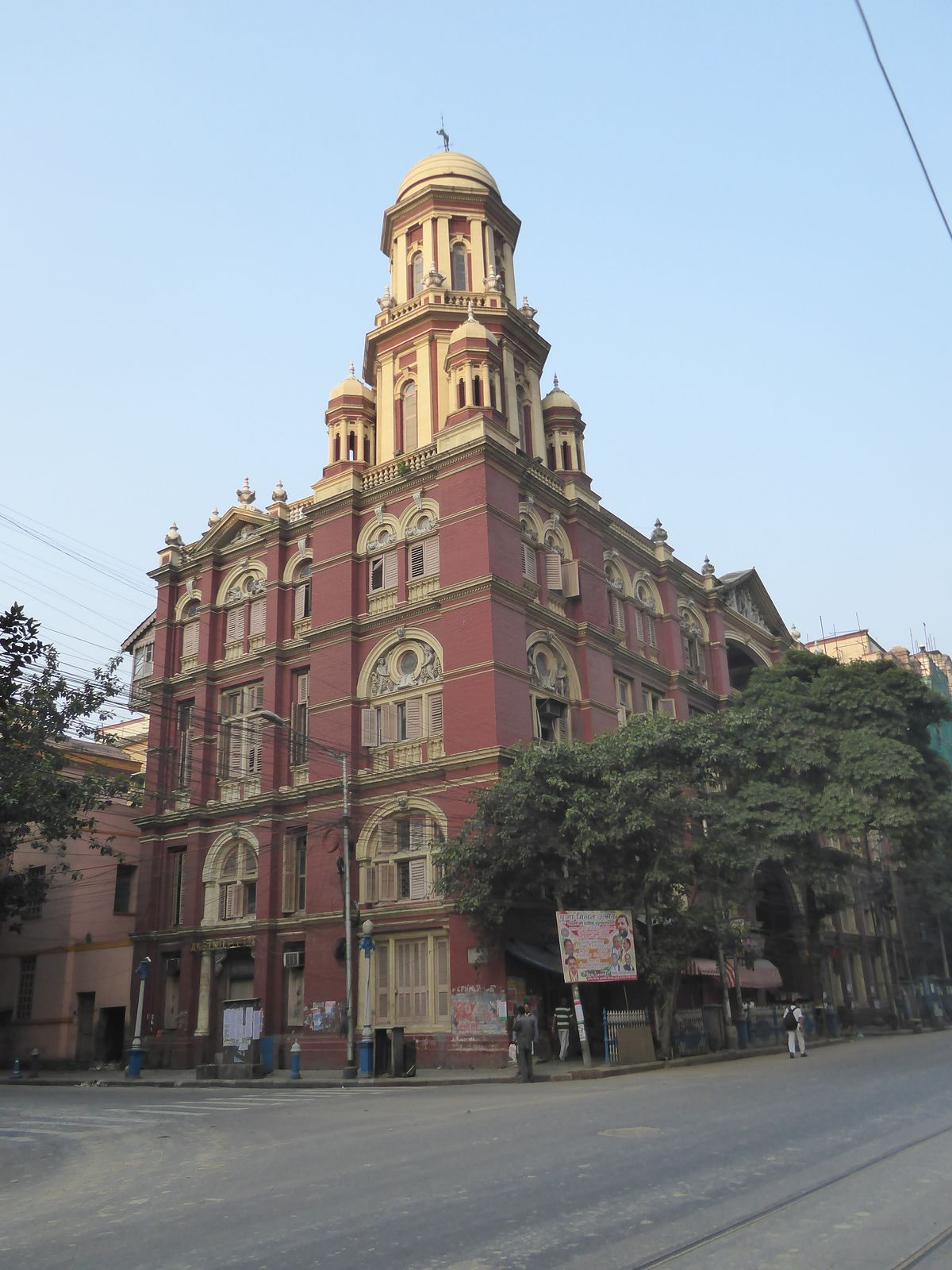
Next door, the Standard Life Assurance Company. See the archway on the right?
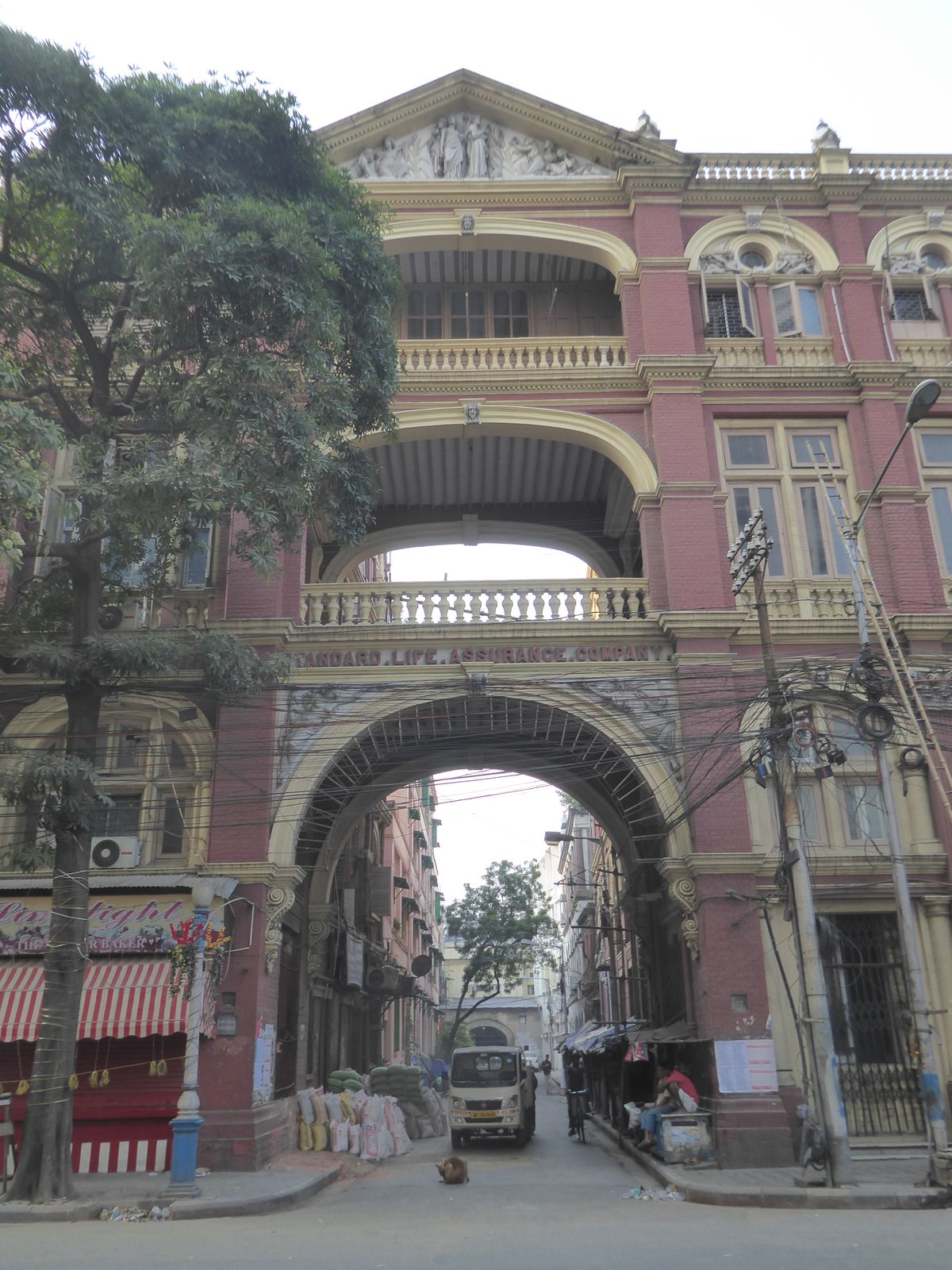
Here it is. The pediment carries the company's standard imagery of the Ten Virgins, prudent and otherwise. Puzzling? See Matthew 25.
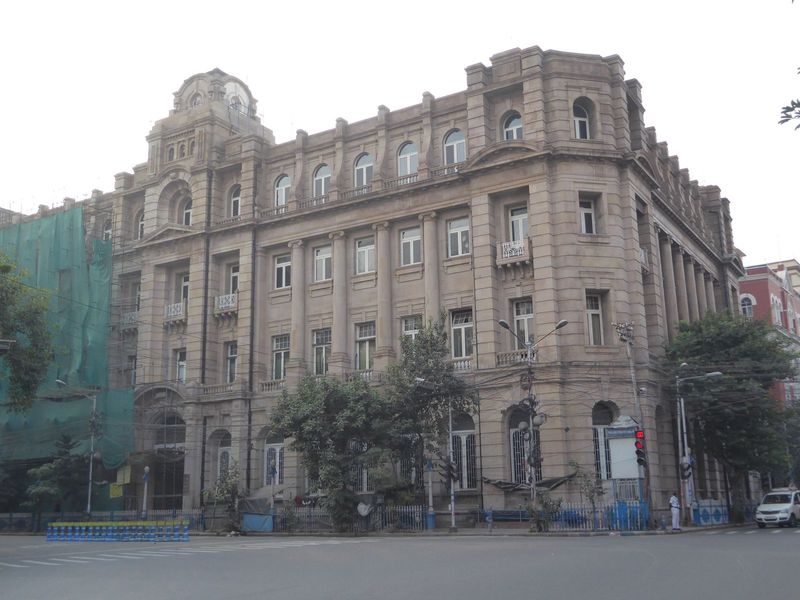
Still farther along, here's the HSBC building from 1922. Does it resemble the bank's original home office along the Shanghai Bund? It's not a duplicate, but it's way too close to be accidental.
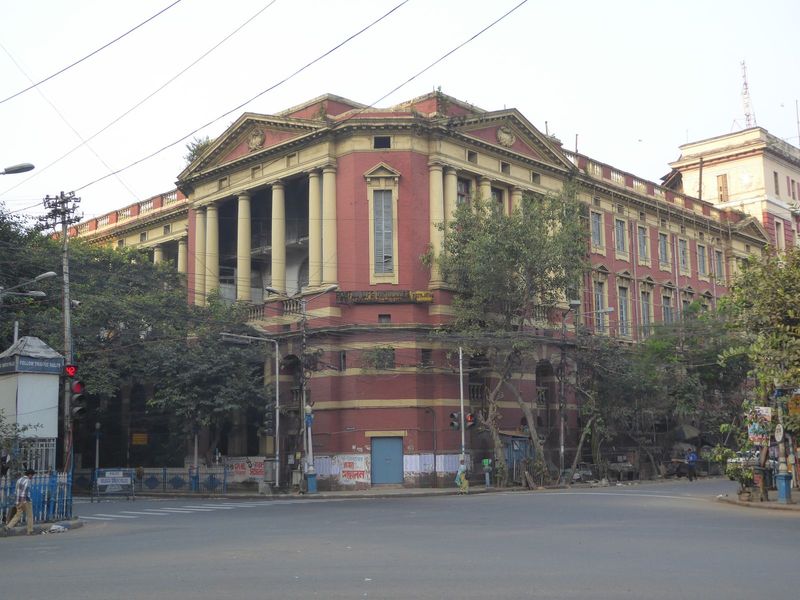
We're at the southwest corner of the square now, and at the southwest corner of the corner is this heap, which, despite the yellowing sign (which says Postal Life Insurance, established 1884), was built in 1911 to house the Imperial Department of Commerce. Not great timing, since 1911 was the year that the government announced that the capital would move to Delhi.
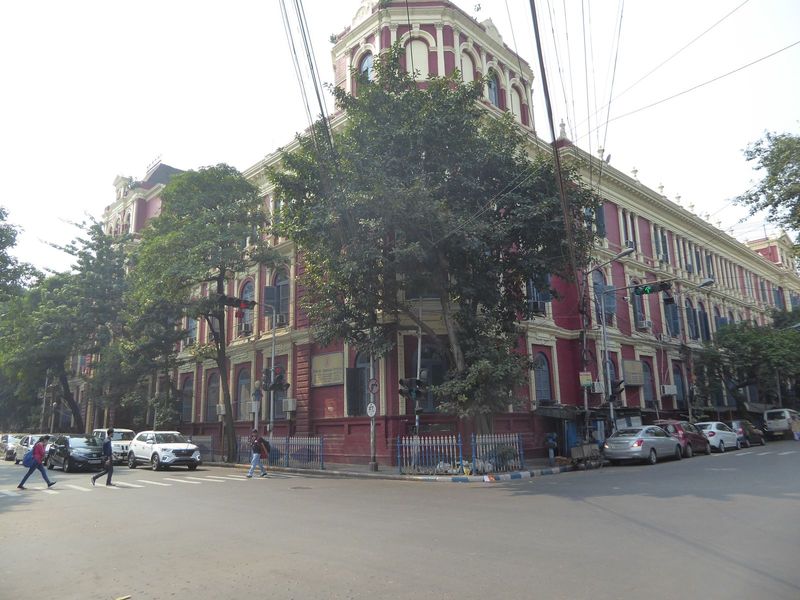
A block to the south is this huge building, generally called the Treasury Building, though early on it was the Imperial Secretariat. It's from 1882, about the same time as the Writers' Building got its upgrade. The resemblance is strong, except that in this case more attention has been paid to sprucing up the facade.
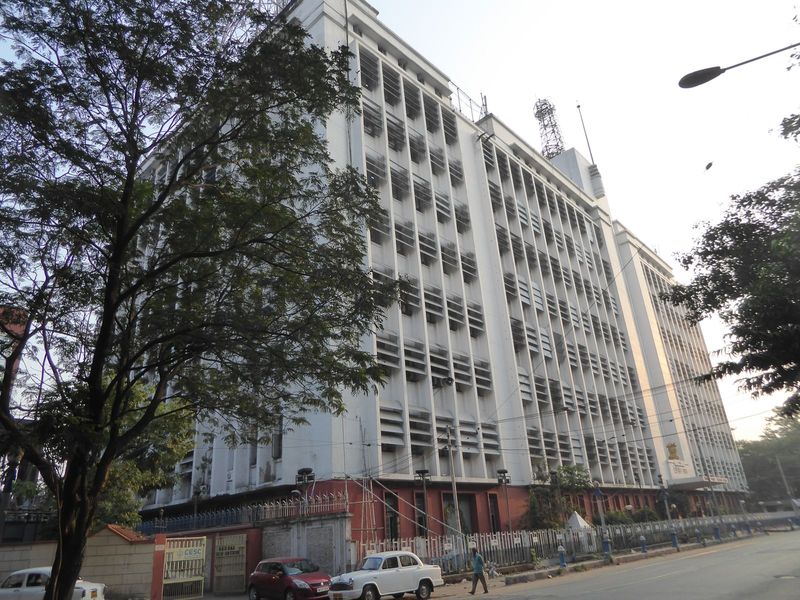
Before we turn north up the west side of the square, here's Telephone Bhavan, built on the site of the Dalhousie Institute, which once recalled an exceedingly energetic governor-general. This new building goes a long way to destroy the British atmosphere of the square, but it's hard to see Dalhousie himself objecting, deeply involved as he was in the earliest Indian railroads and telegraph lines.
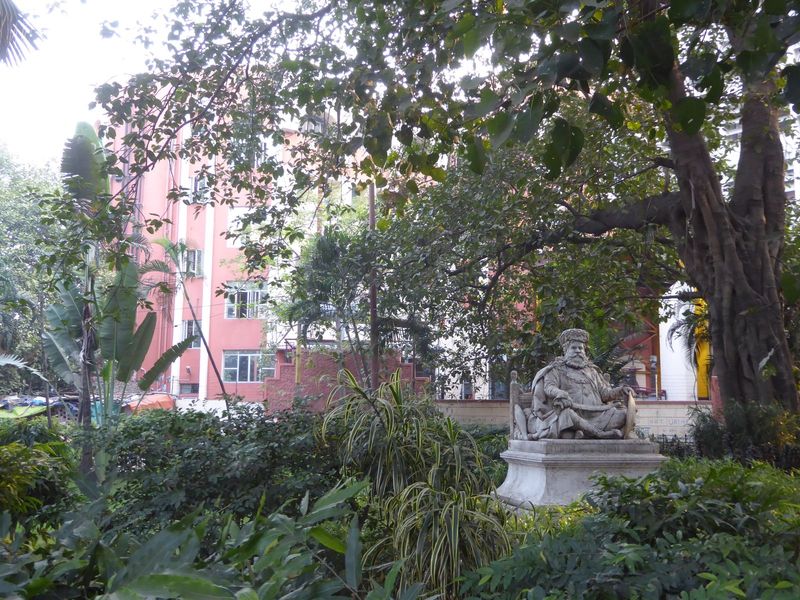
Almost lost in the shrubbery nearby is this statue of Lakshmeshwar Singh, the Maharaja of Darbhanga. The statue was placed in 1904. With scimitar and shield, not to mention a traditional throne, the maharajah looks most traditional, but in the words of H.E.A. Cotton (in Calcutta: Old and New), "few Asiatics have combined more successfully in themselves the apparently incompatible characteristics of East and West." The maharaja, who died at 43, owned 2,154 square miles of land, which gave him the means to support the Indian National Congress. The statue is by Edward Onslow Ford, an English sculptor.
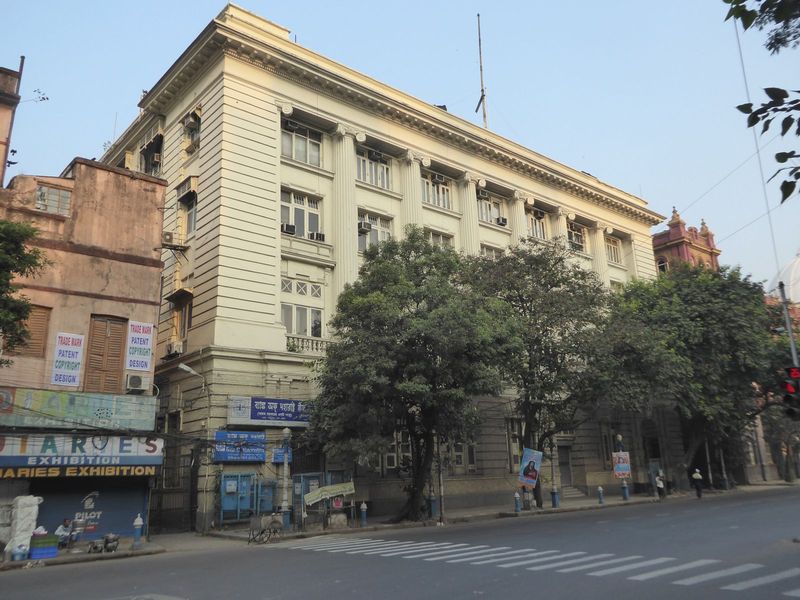
We're turning north up the west side of the square. Here's the comparatively modest—perhaps "thrifty" is the better word"—McLeod House built in 1917 to house a company that once was deep into tea, coal, rubber, indigo, and steamships. That building just to its right?
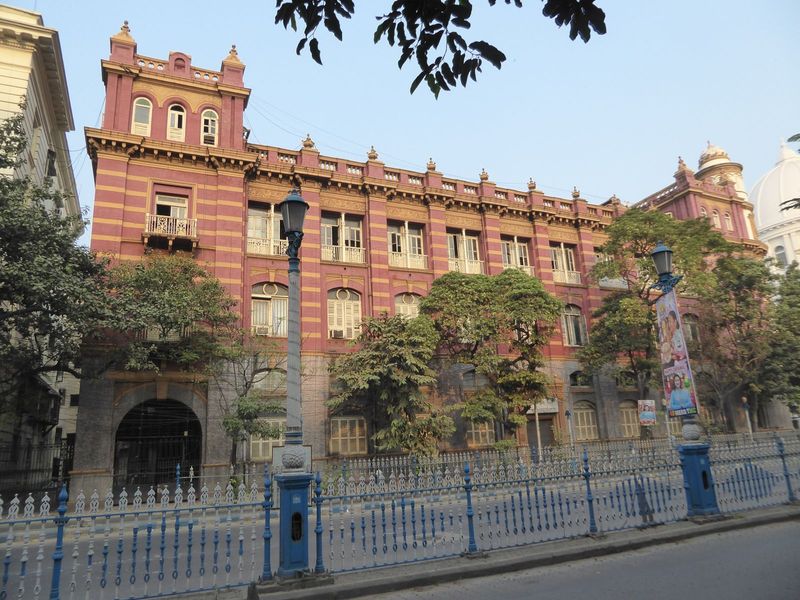
It's Royal Insurance, finished in 1918 for a company that goes back to 1845.
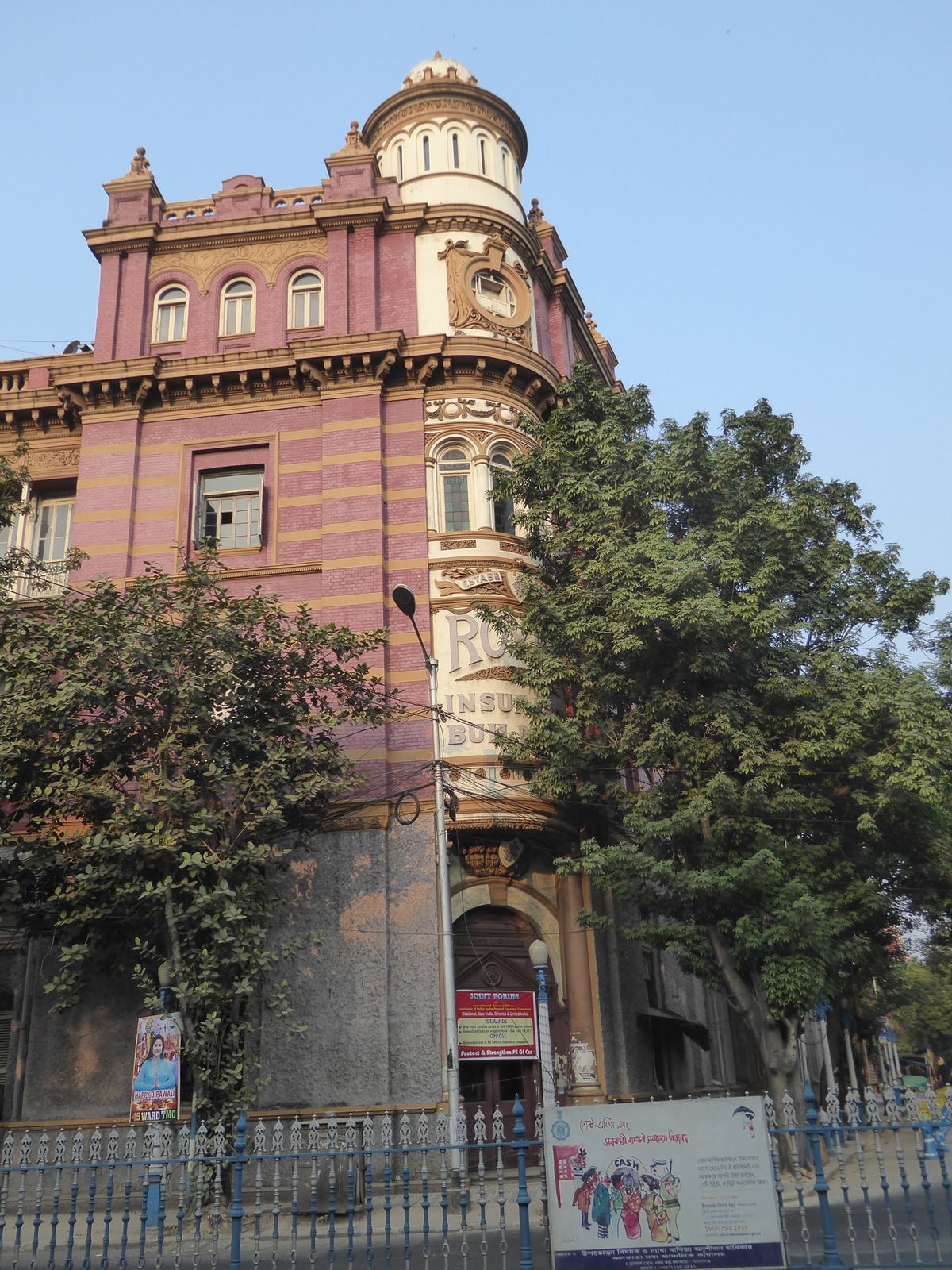
The main entrance is gradually being hidden by foliage.
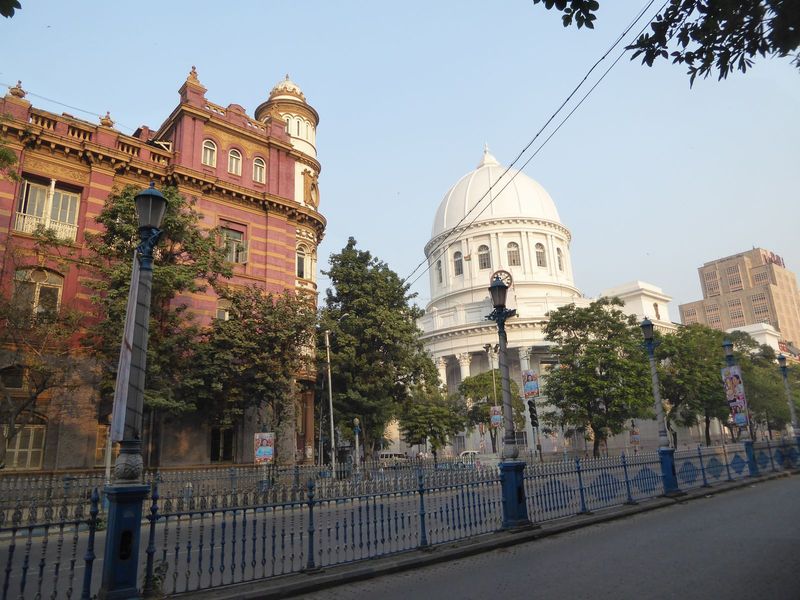
The Royal faces the city's post office, designed by government architect Walter Granville in the mid-1860s. In the dozen years he spent in India, Granville also designed the High Court and Indian Museum.
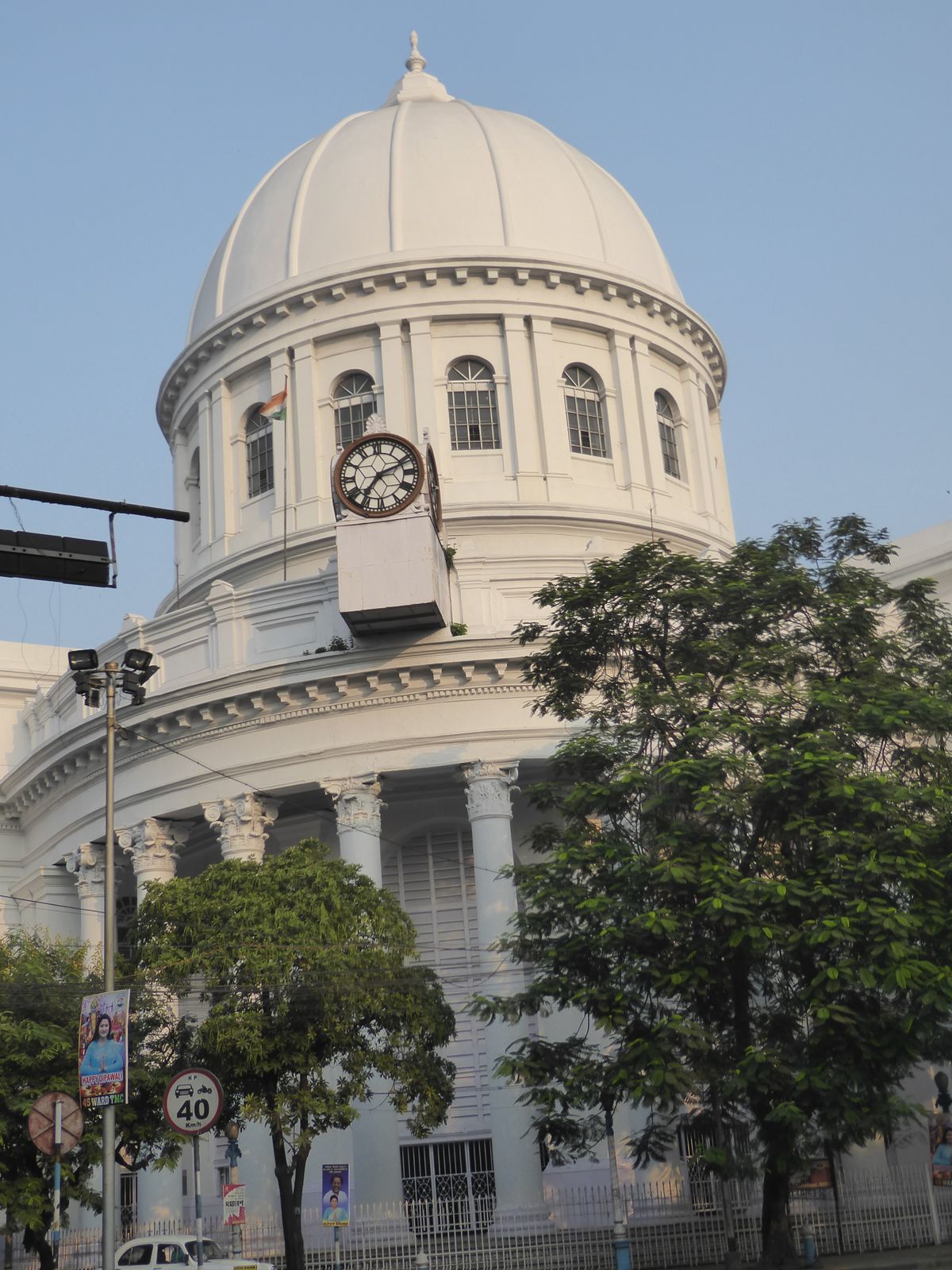
The clock was added about 30 years later—and 20 after Granville's death.
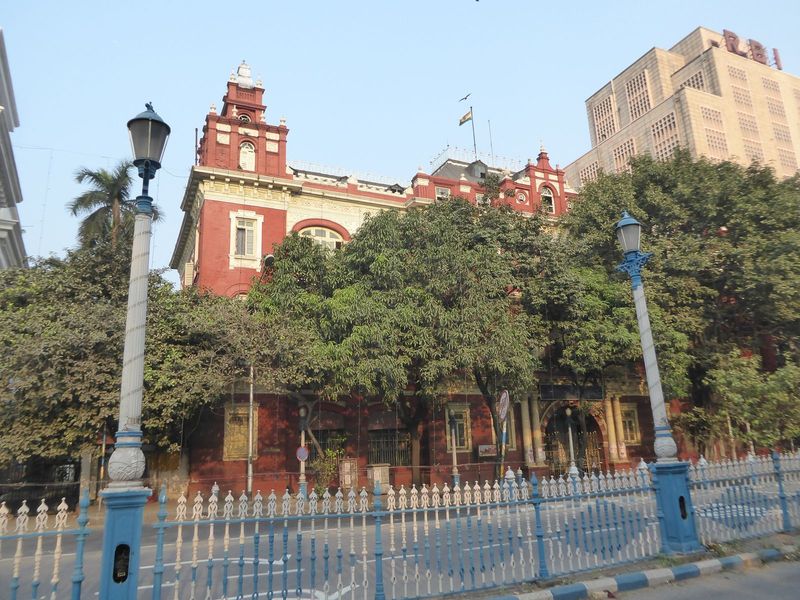
Sorry you can't see it, but behind the trees lurks the collectorate, bigger than it looks and with a courtyard through that arched entrance.
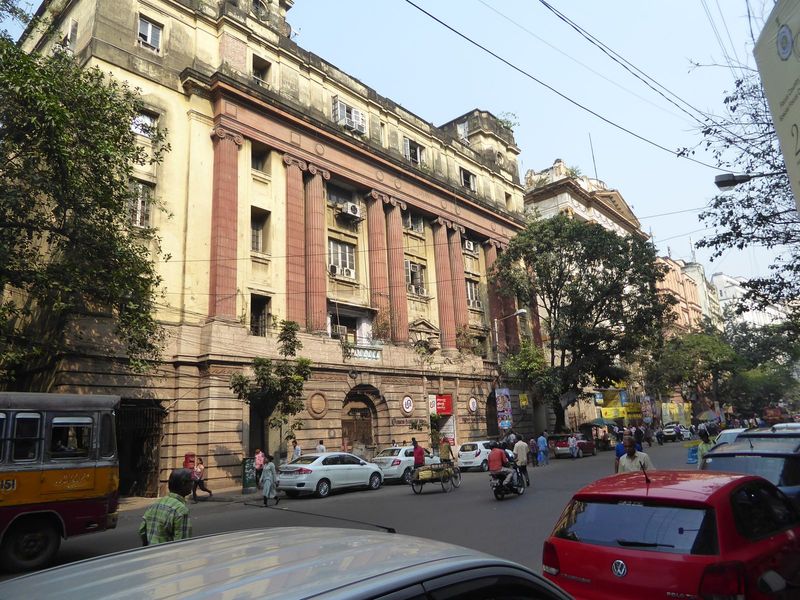
Do you like banks and such? Of course you don't. But there's a batch of them just north of the collectorate and up Clive Street. Oops! That should be Netaji Subhas Street. Here's the Bengal Chamber of Commerce, with just a few weeds.
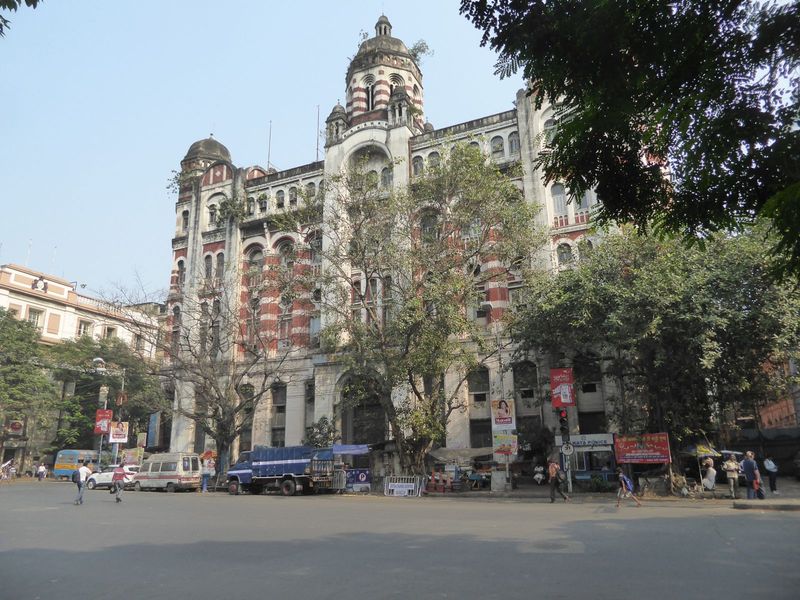
Facing the Chamber is the striped building of the Chartered Bank, which opened in India in 1858. Since a 1969 merger with South Africa's Standard Bank, it's Standard Chartered.
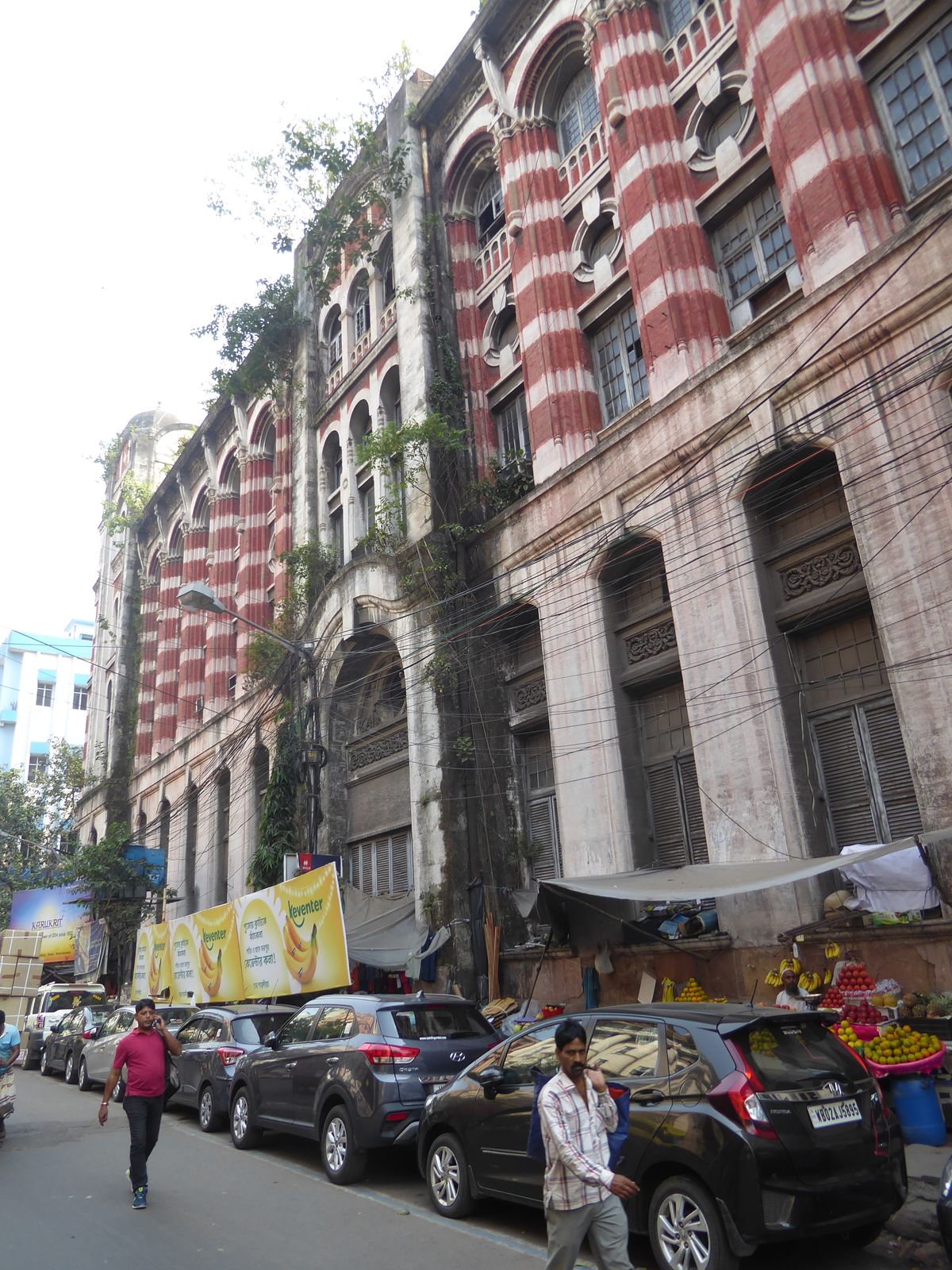
If Daphne could turn into a laurel tree, why not a bank?
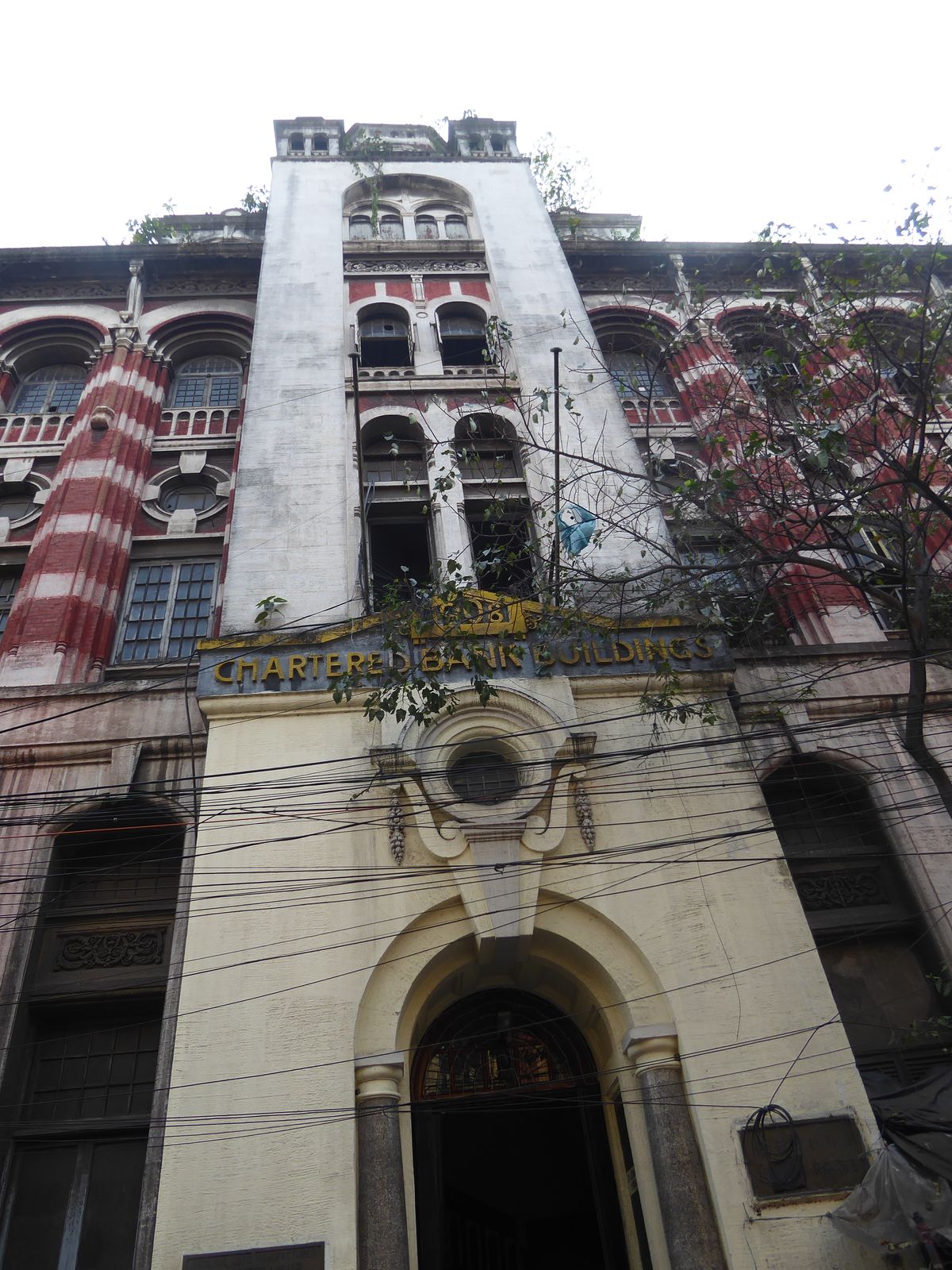
No need to hurry updating the name. It's only been wrong for 50 years.
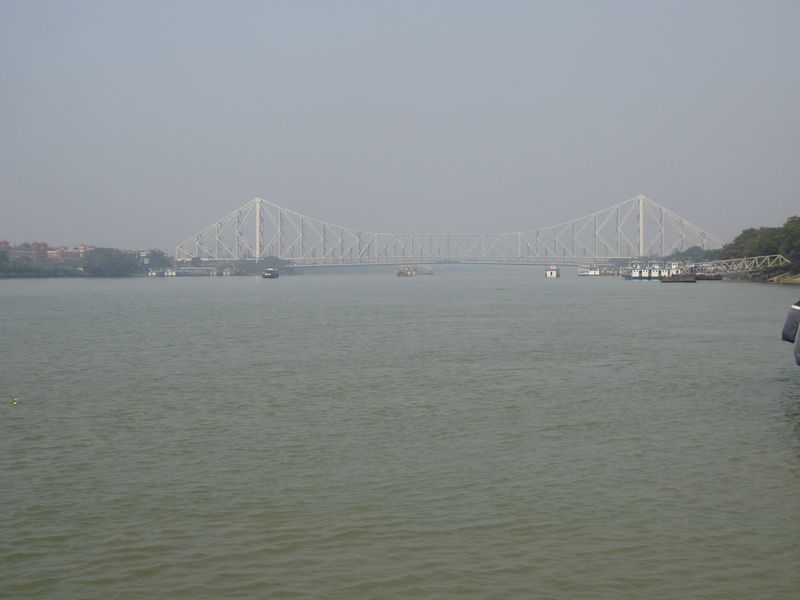
We're a five-minute walk from the river, seen here with the ungainly Howrah Bridge from 1943. I miss the old pontoon bridge from 1874, even though I never saw it.
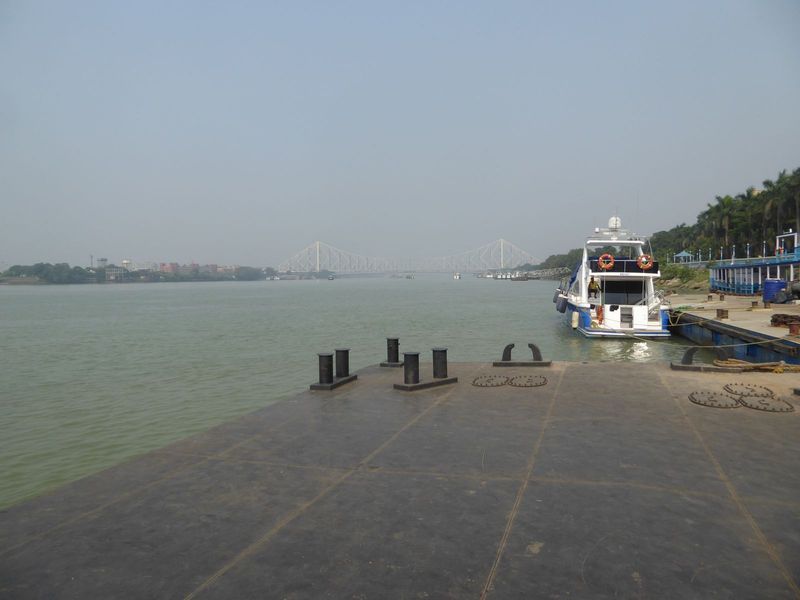
We're at the ferry dock at Millennium Park, just west of the banks. Ferries offer a shortcut from here to the rail station at the other end of the bridge.
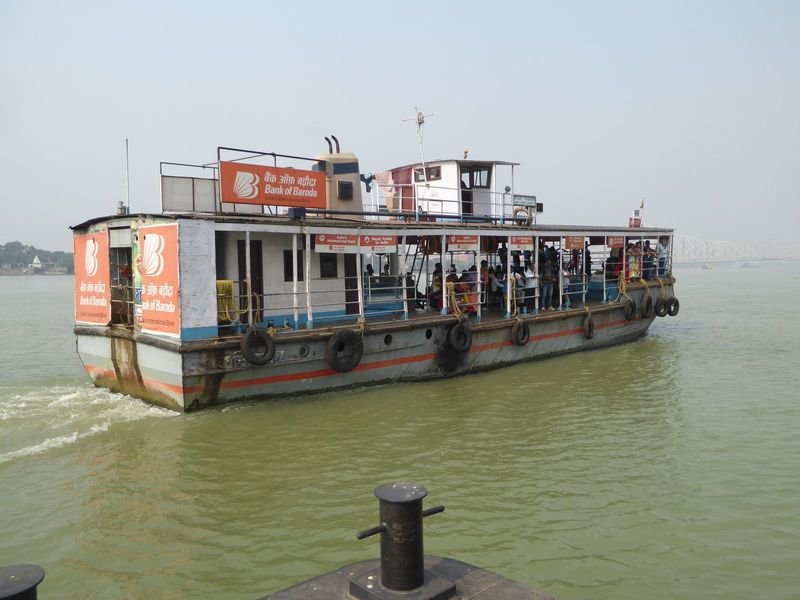
Here's one now.
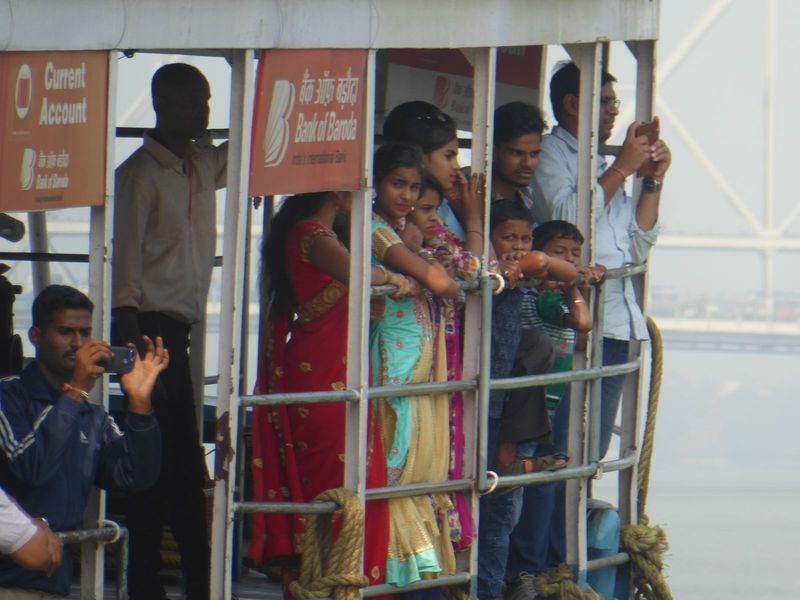
Don't let anyone, including smart-alec websites, tell you that India is stuck in the past. Not a prayer. This is one elastic country, stuck in the past while rushing into the future.
Forward-looking? Well, it's complicated.
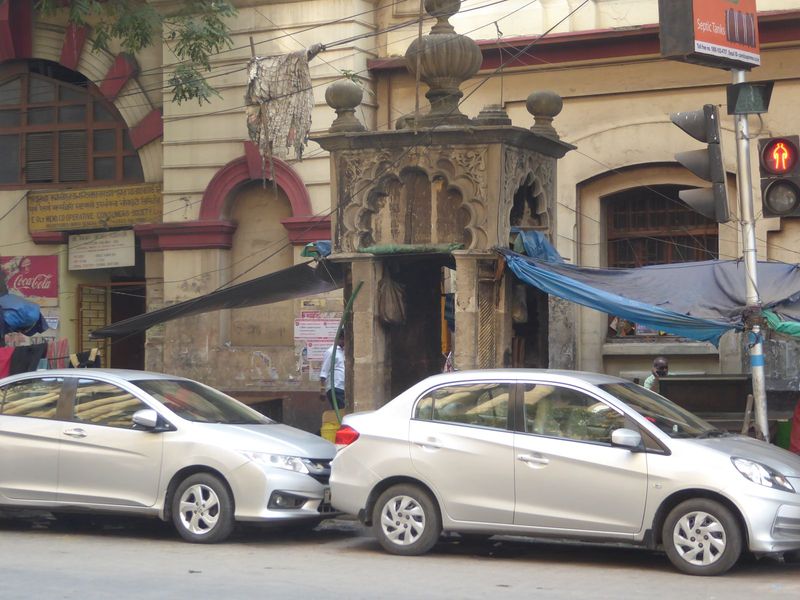
Here, on Fairlie Place and at the headquarters of the Eastern Railway, is a curious little kiosk. It's the kind of thing easy to overlook in the congestion.
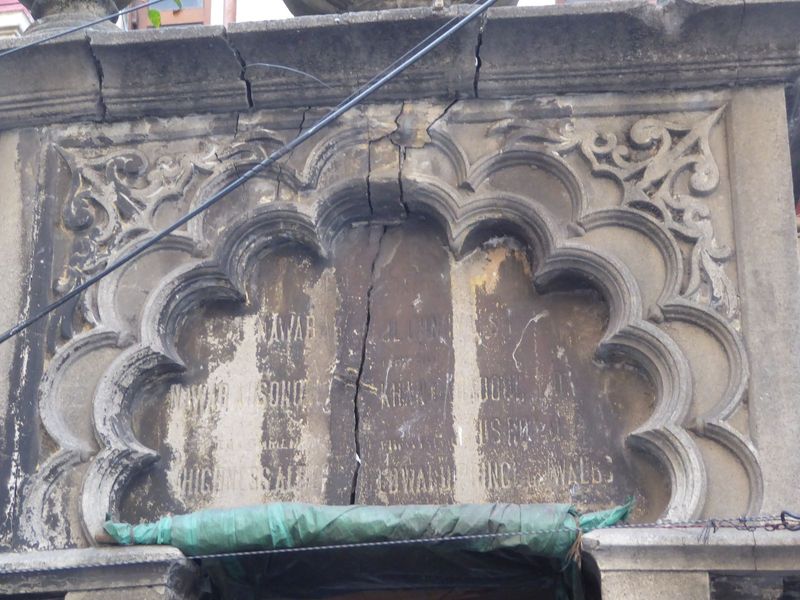
Erected by Nawab —ULunnsci and his son Nawab Ahsonoll Khan Bahadoor of Da to Commemorate of hisHighest Albert Edward Prince of Wales.
Loyal during what the British called the Great Indian Mutiny of 1857, Abdul Gunny of Dacca was given the title of Nawab during the visit of Albert Edward in 1875.
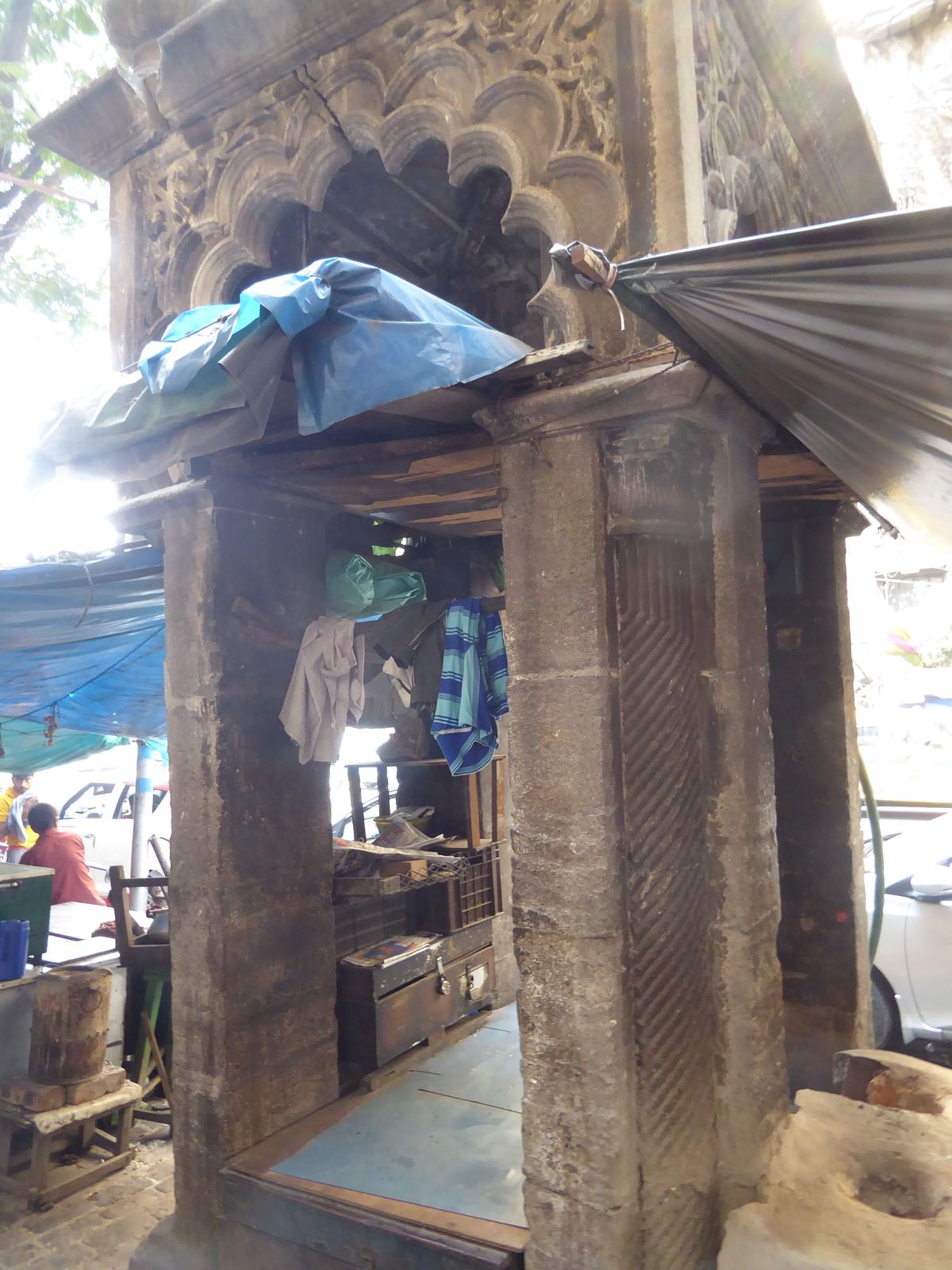
It's a tea stall now.
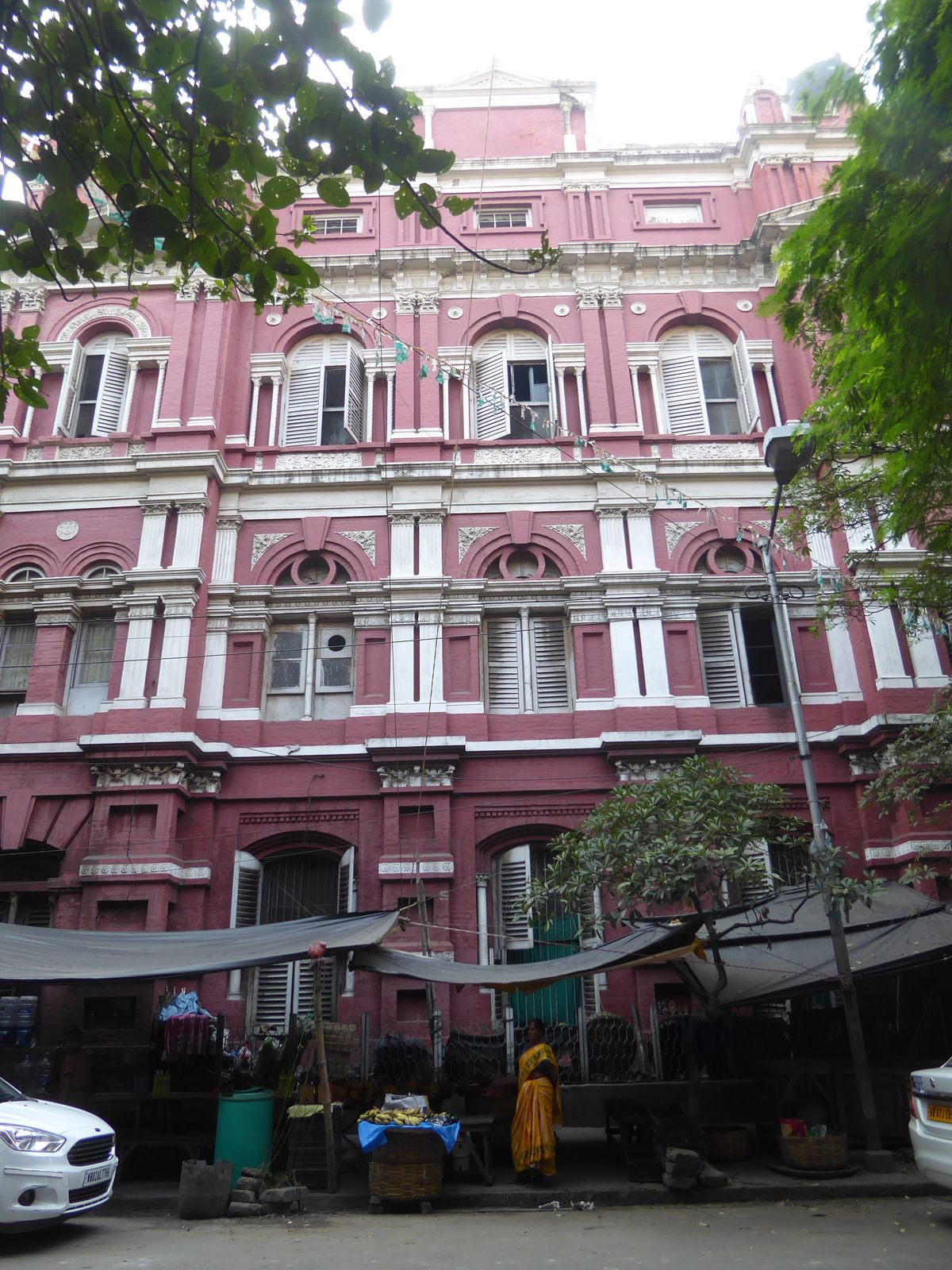
The old railway building isn't going anywhere, either.
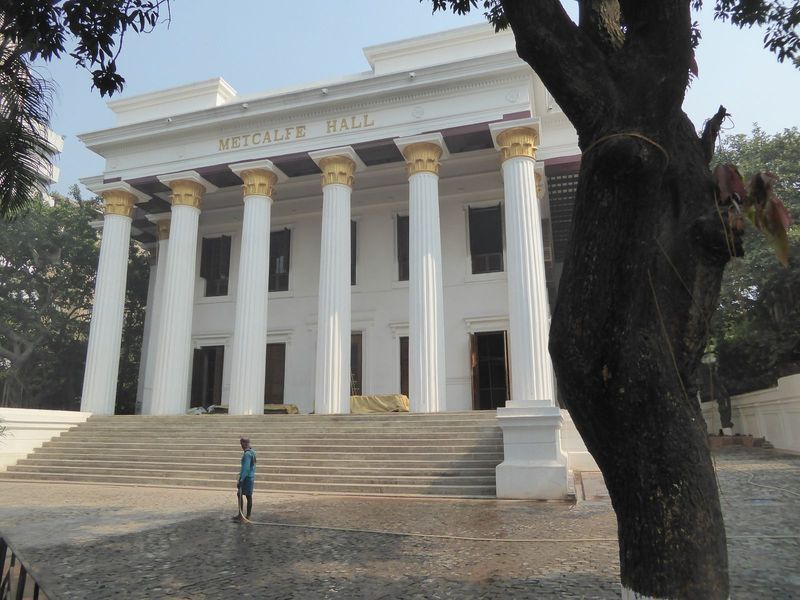
Welcome to the home in recent years of the Archaeological Survey of India. Until 1923 it was the Imperial Library, and before then it was the office of the Agri-Horticultural Society of India. Built in 1844, it's named for Charles Metcalfe who was only acting governor general—and that only for a year in the 1820s--but who's enjoyed a lasting fan club as "the liberator of the Indian Press," which is to say the indigenous-language press. His bosses back home were so unhappy that Metcalfe quit, but the damage was apparently forgotten because he was later rewarded with the post of governor-general of Canada. The snow must have been a nice change. And the ASI knows how to spruce up a building.
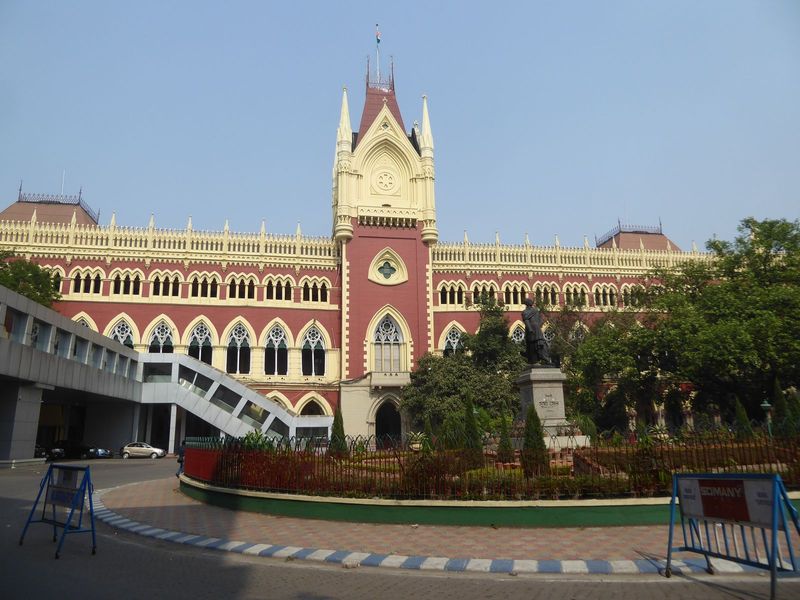
A block south, and still close to the river, we're at another Walter Granville production, this time the High Court, completed a year after Granville's death in 1871. The building is always said to be based on the cloth hall at Ypres, but some authors say it is most likely based on the Hamburg Rathaus, which was itself derived from Ypres.
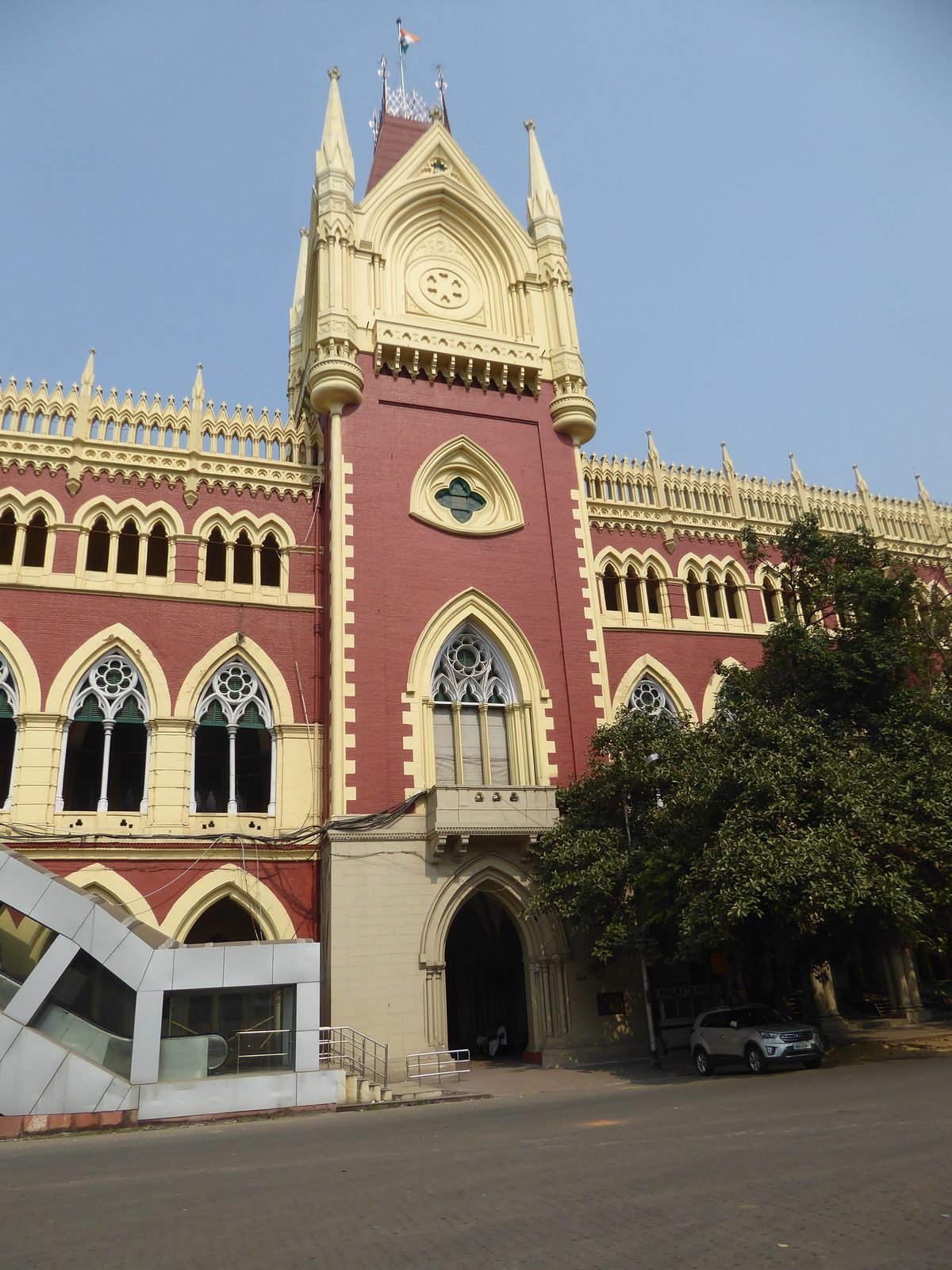
The stumpy tower is always blamed on the site's soft ground, but the Victorians knew how to drive piles. For some reason, in this case they chose not to. Nice escalator. It goes to an annex.
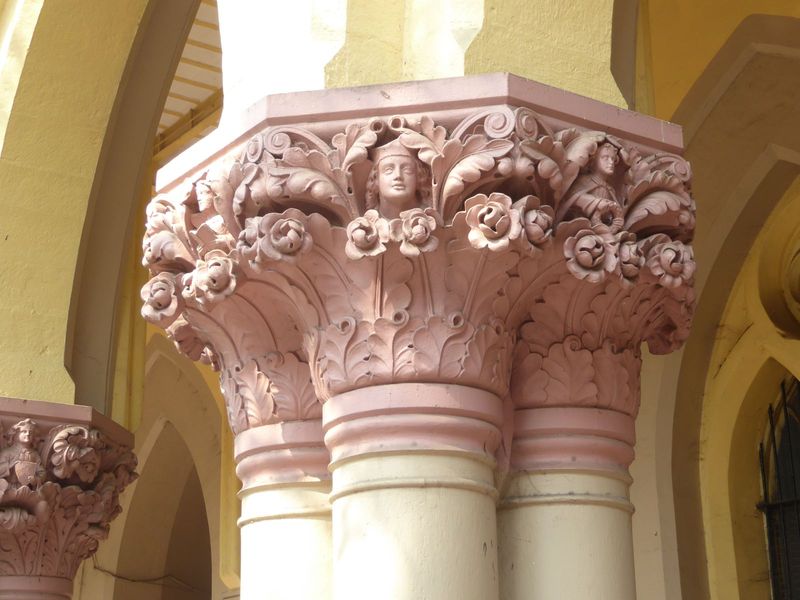
Who lurks in the acanthus? Neither the Hamburg Rathaus nor the Ypres cloth hall have such men in the weeds. I'm reminded of the old British secret service, with faux-gardeners sitting meekly in the bushes while guests at garden parties carelessly shared confidences.
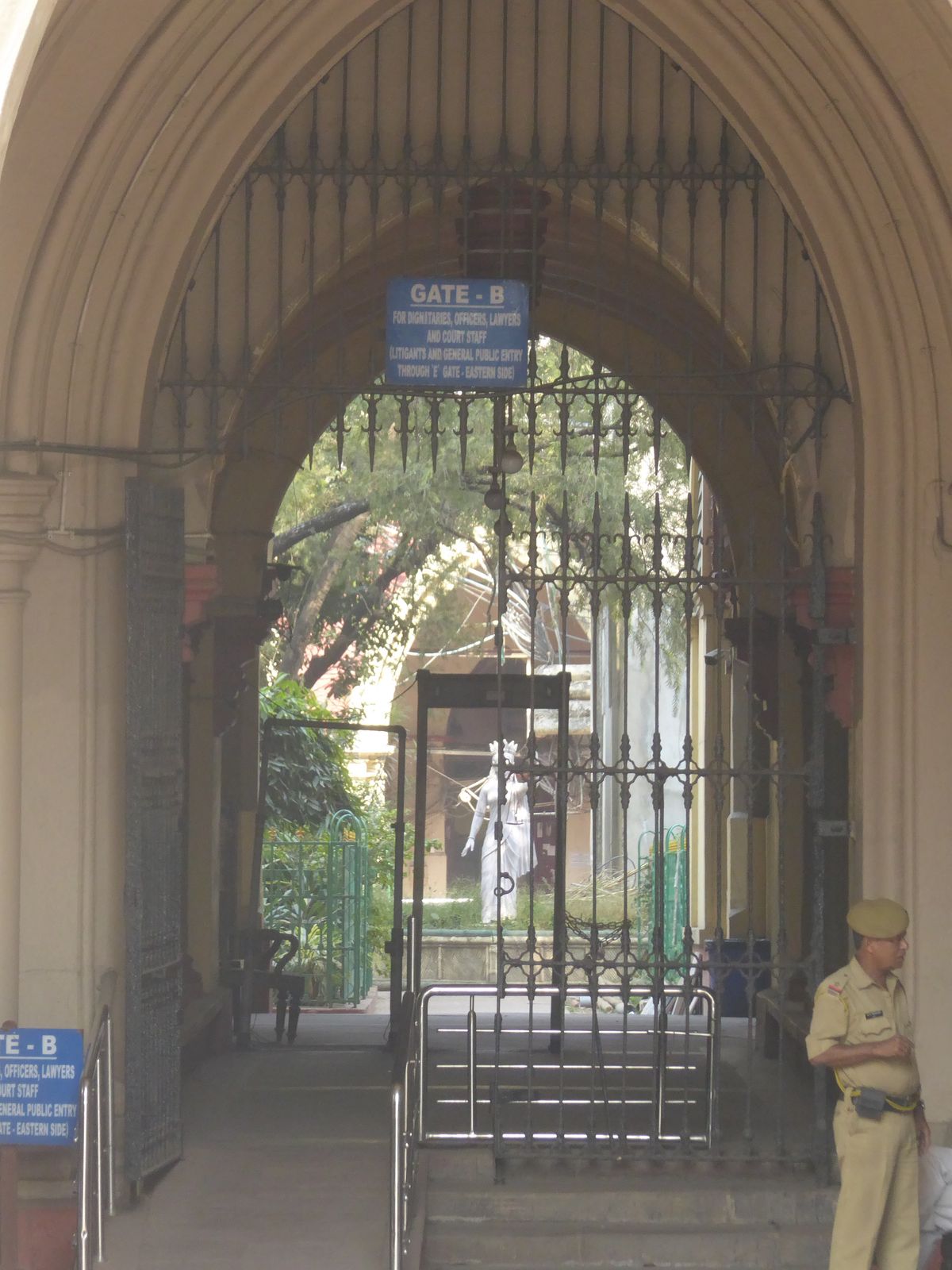
Want to go in? Maybe you'll have better luck.
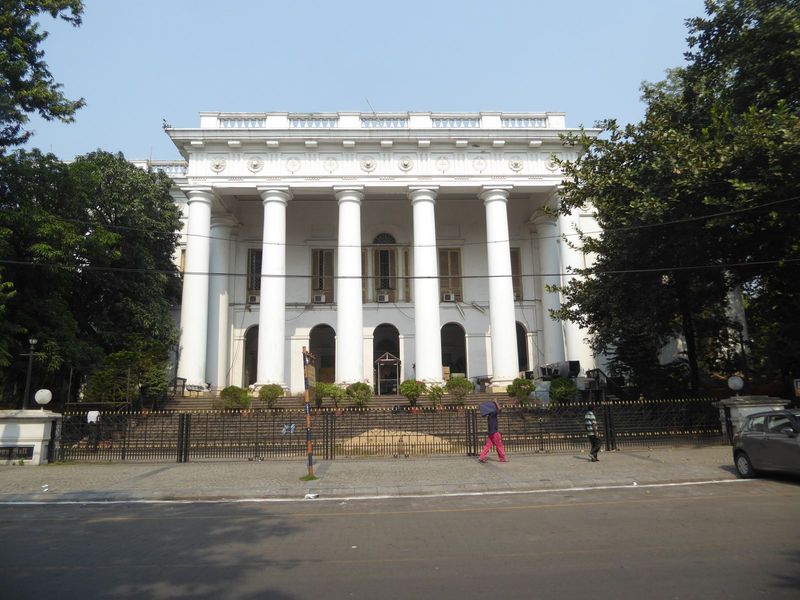
Like Metcalfe House and the old Treasury Building, the Town Hall reflects a recent appreciation of the city's monuments. Give somebody credit: it's not easy in this climate to keep these buildings spiffy. This one's old, too: built in 1814 to a design by John Garstin, who died before its completion. He had earlier designed the famously exotic Gola or granary in Patna, which, last I looked, still stands.
Though it's called the Town Hall, it hasn't hosted the municipal council for donkey's years. Back in 1950 it housed the Supplies Branch of the Food, Relief, and Supplies Department. Mundane stuff in the aftermath of Partition.
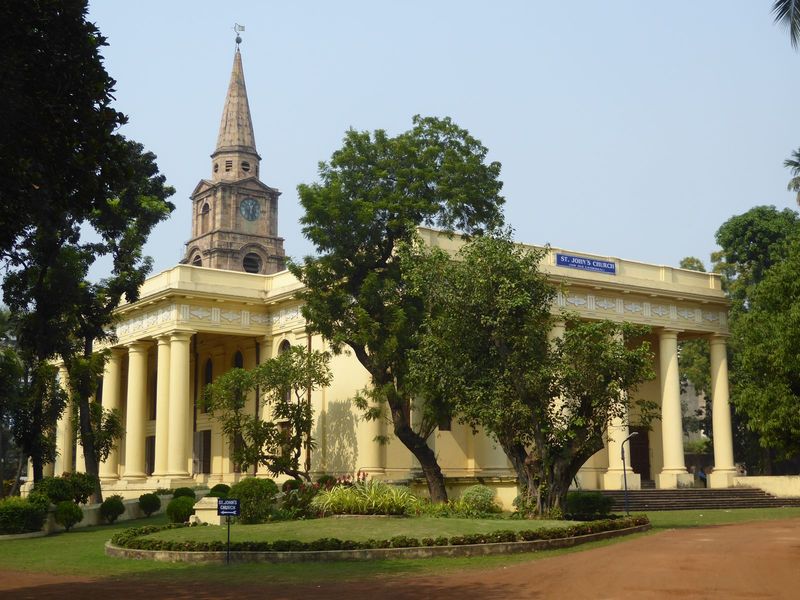
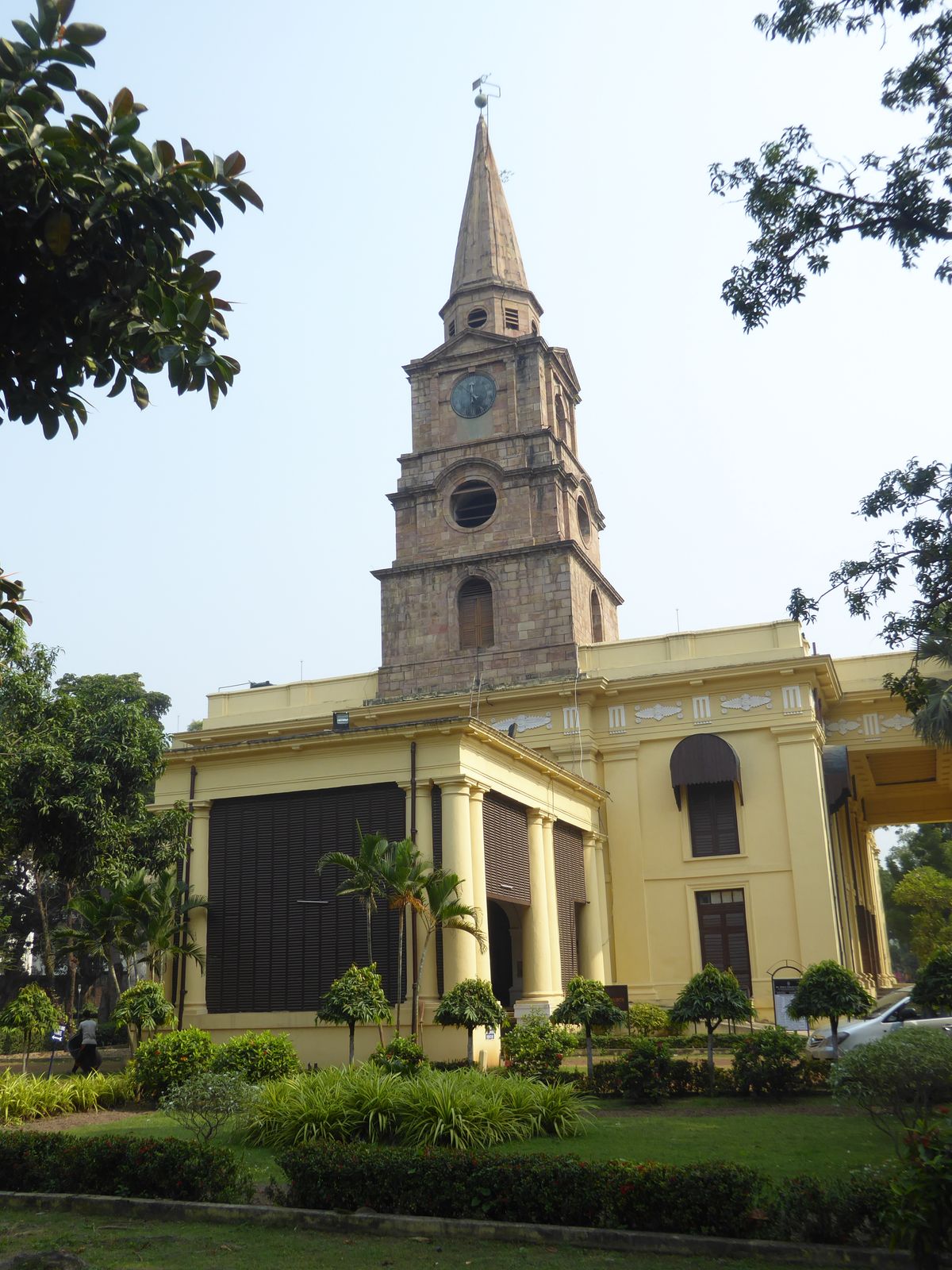
Next door is something even older, St. John's, consecrated in 1781 and, once again, pleading soft foundations as its excuse for truncating the tower.
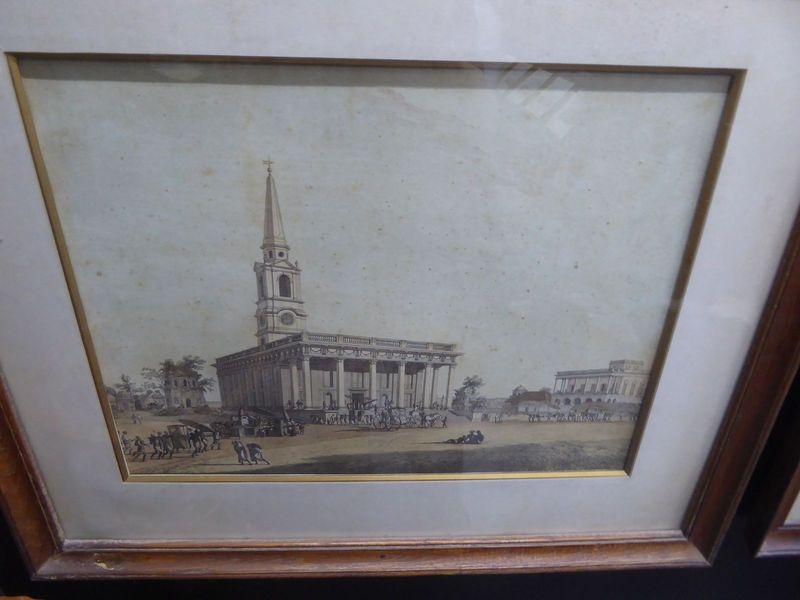
An old print shows the entrance at the side opposite the tower. Later, the entrance was moved 180 degrees around back.
Parishioners could now enter from the back of the pews.
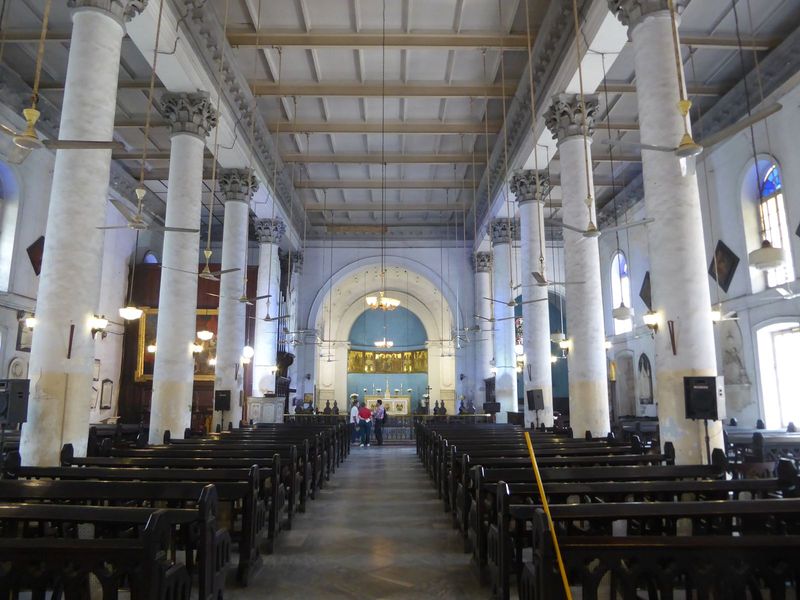
So was the entrance once by the side of the altar? We know that the columns were modified from Doric to Corinthian in 1811 and that side galleries were yanked in 1901. Now you've got me wondering. Are the columns solid stone? Just have to go back and tap ever so gently.
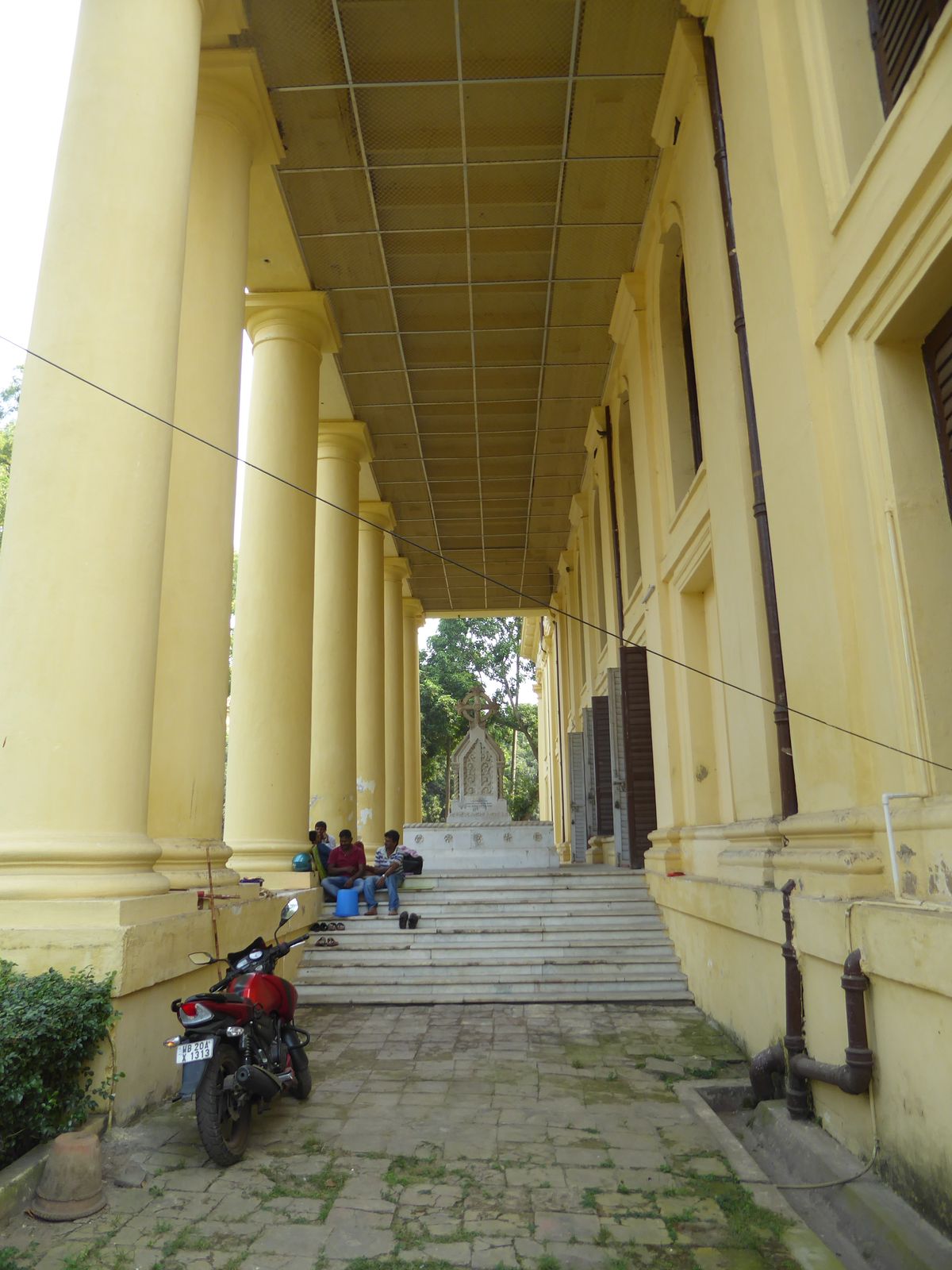
The tomb here has bounced around a bit. It used to be up river at Barrackpore. Then it was moved to St. Paul's cathedral about a mile south of here. Then it was moved again to this odd location, where at least it's sheltered. The grave itself remains at Barrackpore, and a copy of the tomb was put there, just to confuse everyone. But who is it?
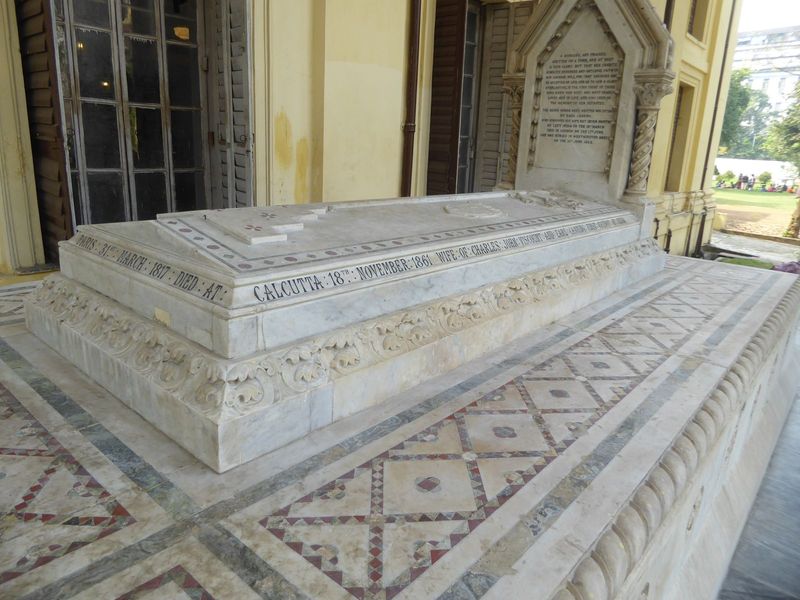
It belongs to the unhappy Charlotte Canning, a viceroy's wife. If the tomb seems very tiddly, thank the designer, no less than George Gilbert Scott.
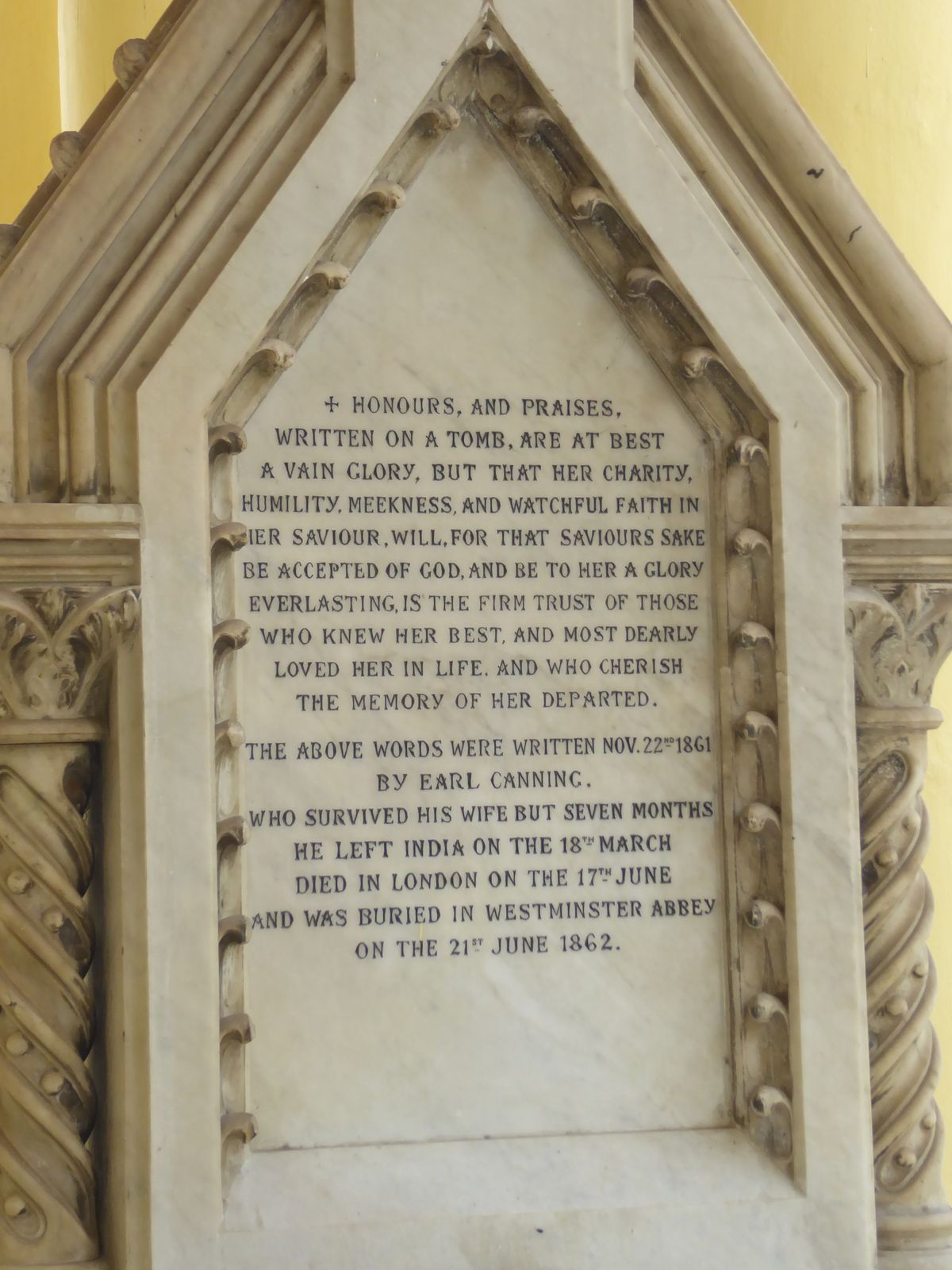
Pious eloquence hides the truth, but you can find out more if you must know of the misbehaving viceroy and his wife's austere refuge in faith.
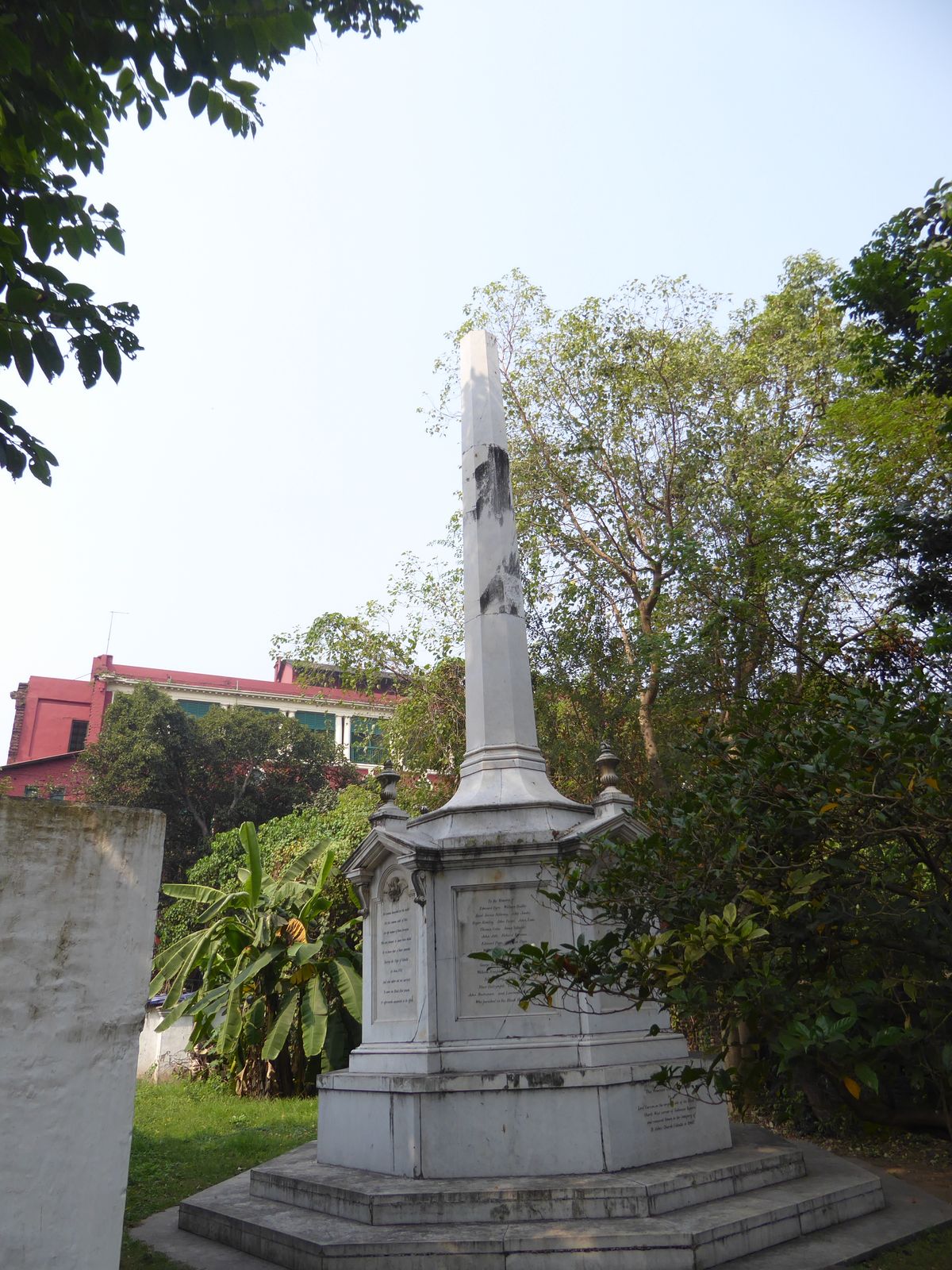
Like the well at Cawnpore, the story of Calcutta's Black Hole was once able to fire up any Britisher in need of rededication to the imperial mission. Now the monument, relegated from a spot near the Writer's Building to a quiet corner of St. John's, has retreated into the harmless annals of antiquarianism.
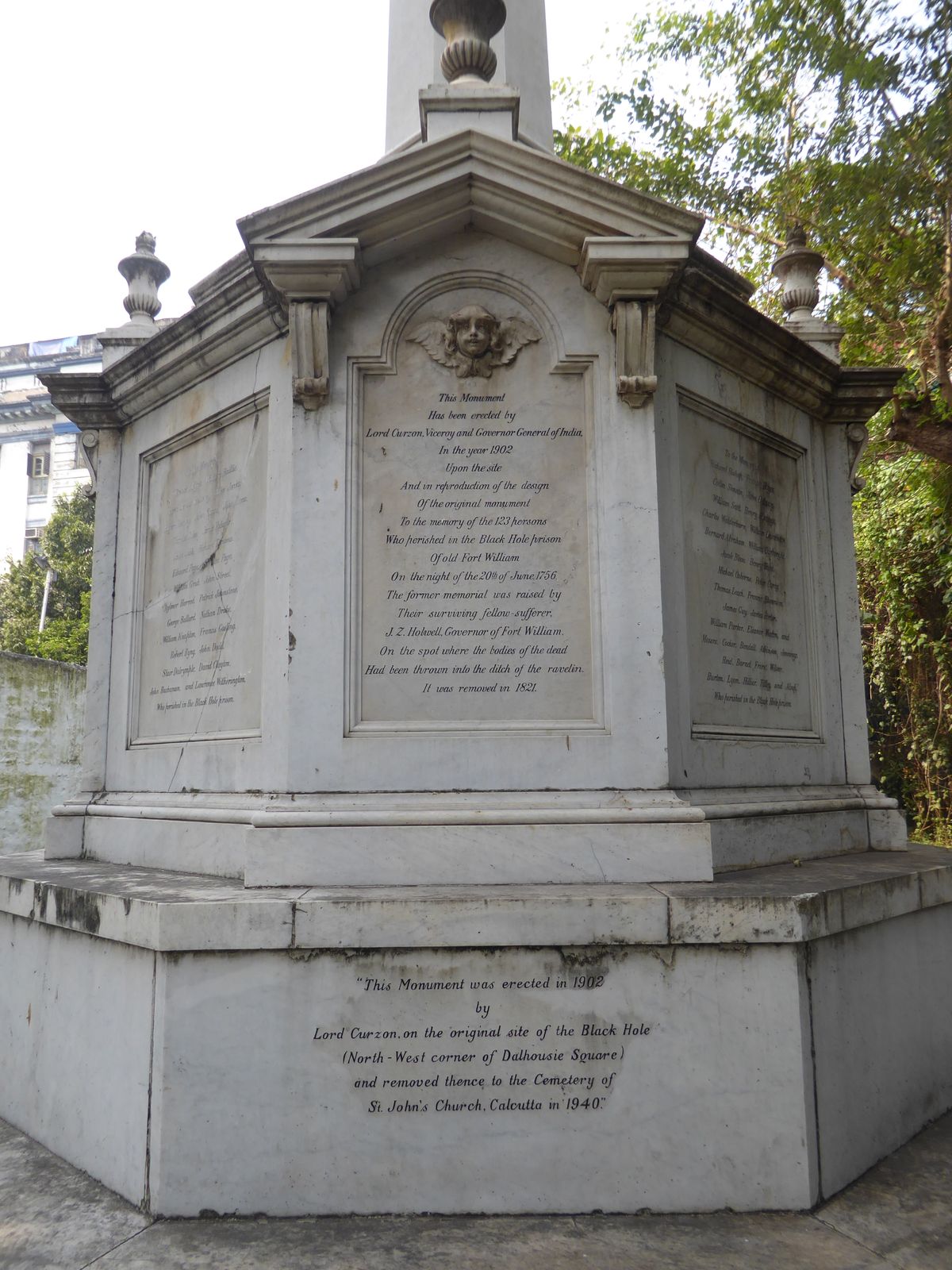
Curzon, never short on grandiose bombast, would be appalled.
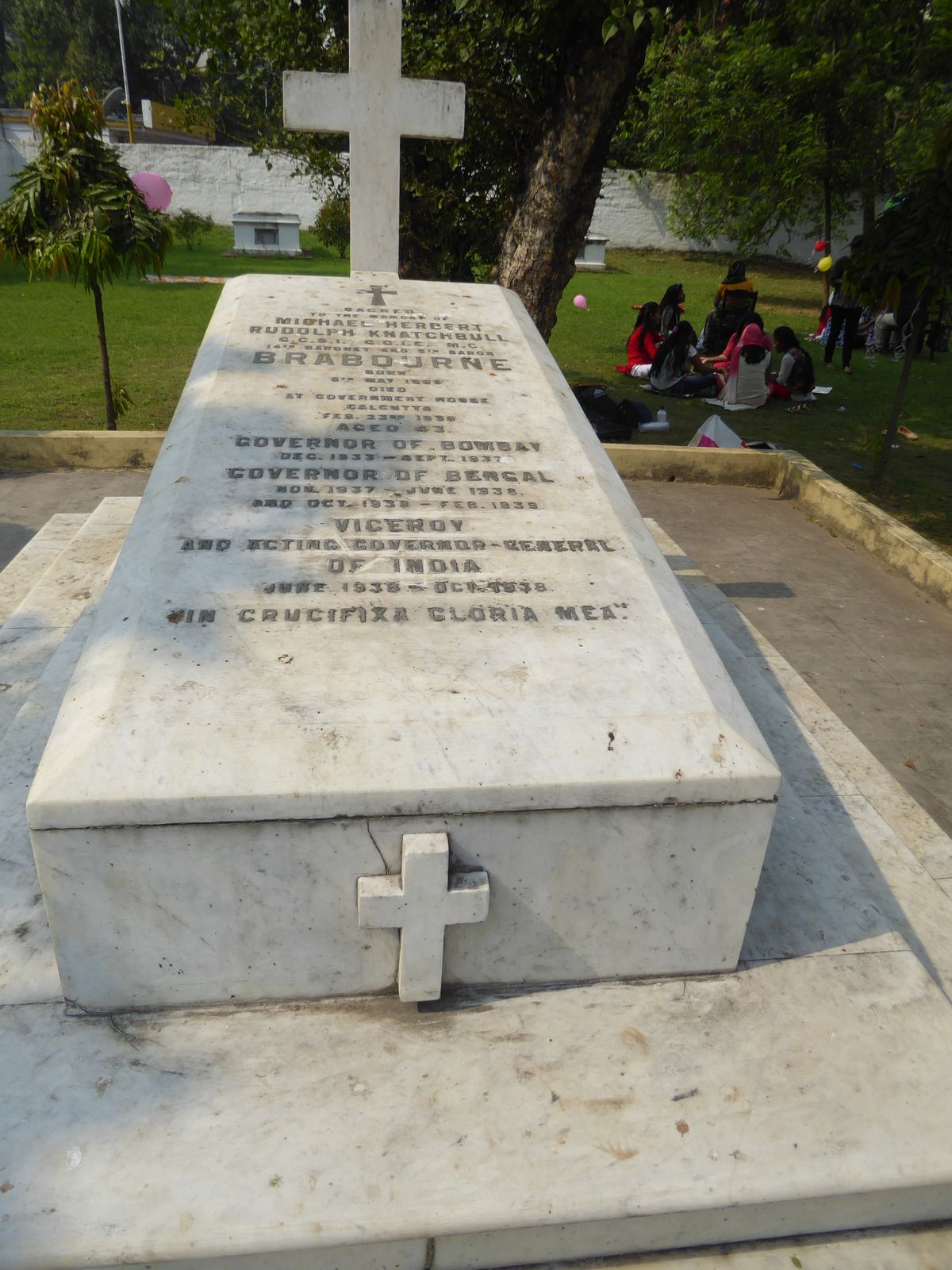
Next door, Brabourne is remembered chiefly as the father of a son who married into the the Mountbatten family and worked as the producer of films including A Passage to India.
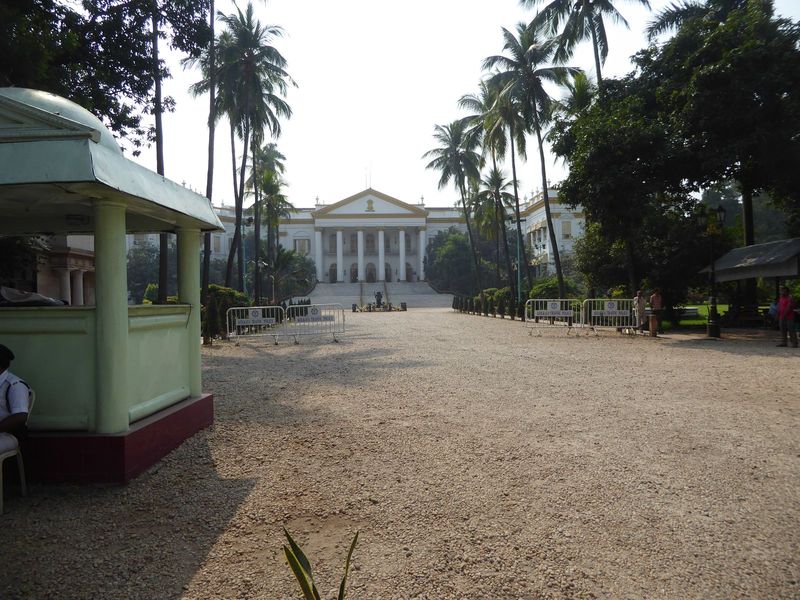
Finally, Wellesley's Government House, now Raj Bhavan and with plenty of trees. There aren't any in the equivalent shot from Thacker's 1906 guide. Once again, the coats-of-arms have been switched.
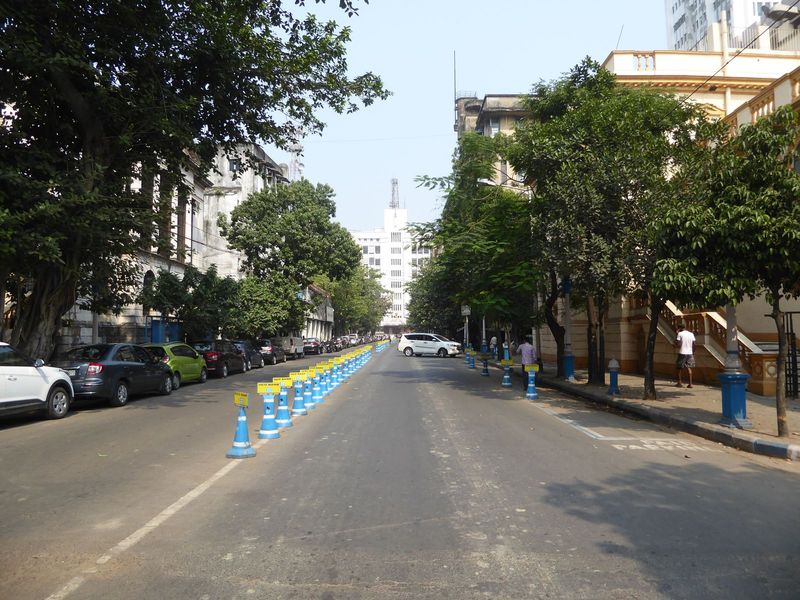
Do an about face and you look up Wellesley Street, now Red Cross Place, to Telephone Bhavan on the square.
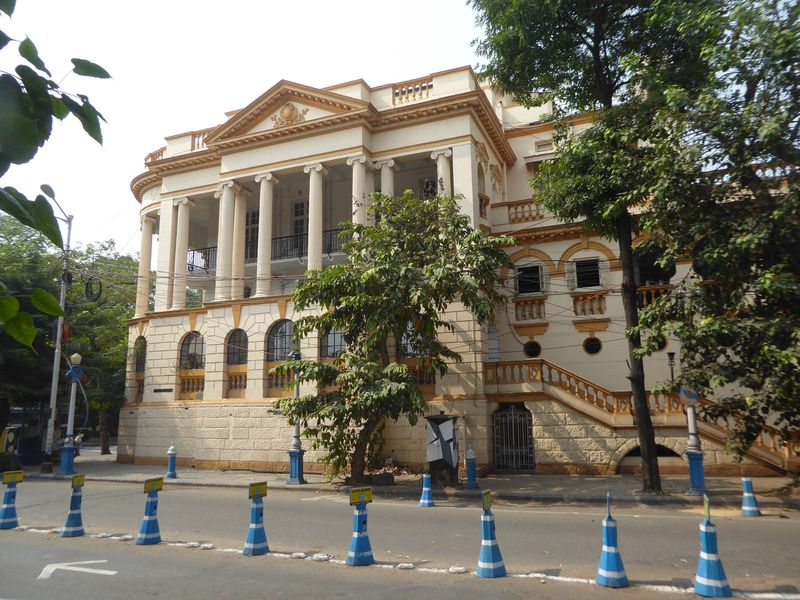
Immediately to the left, there's this.
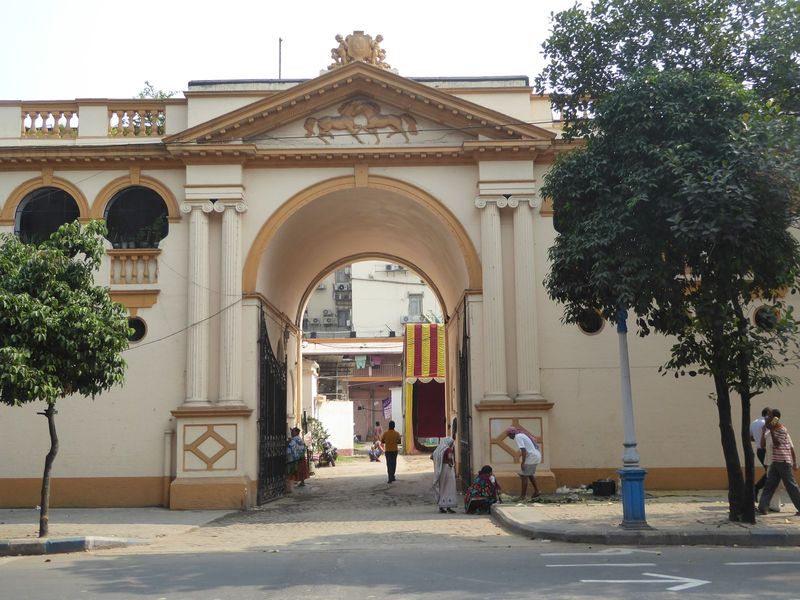
Is it apocryphal that the building was originally the government house stables?
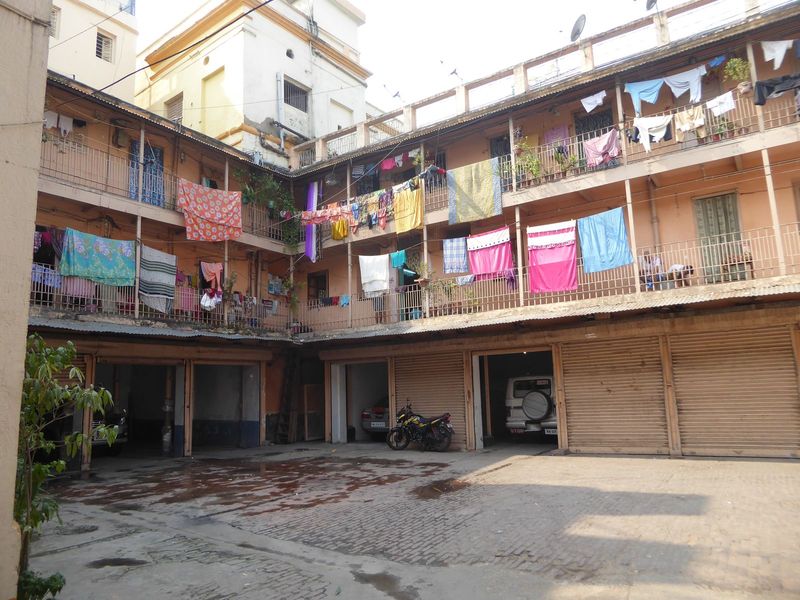
If so, the interior has had a major makeover.
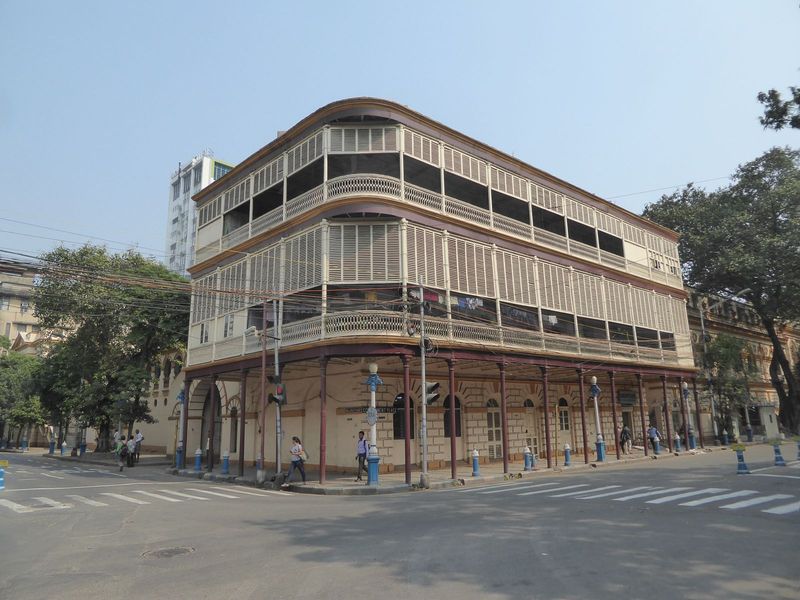
A matching building on the opposite of the street is obscured by screens but houses the Mahila Seva Samity, created in 1947 to provide relief to woman and children. It used to house the provincial headquarters of the Boy Scouts of Bengal, the St. John Ambulance Association, and the Bengal branch of the Indian Red Cross.
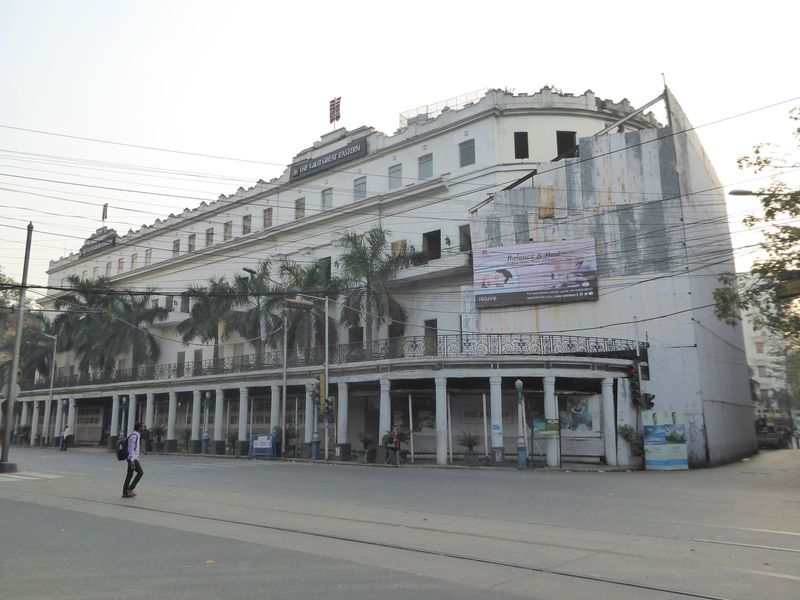
A block east, and due south of the eastern side of BBD Bagh, the sign Lalit Great Eastern replaced a much larger sign than once read Great Eastern. The hotel by the 1990s was very run down before it was sold to the Lalit chain, which built a new hotel behind the one seen here, reduced to an elaborate false front.
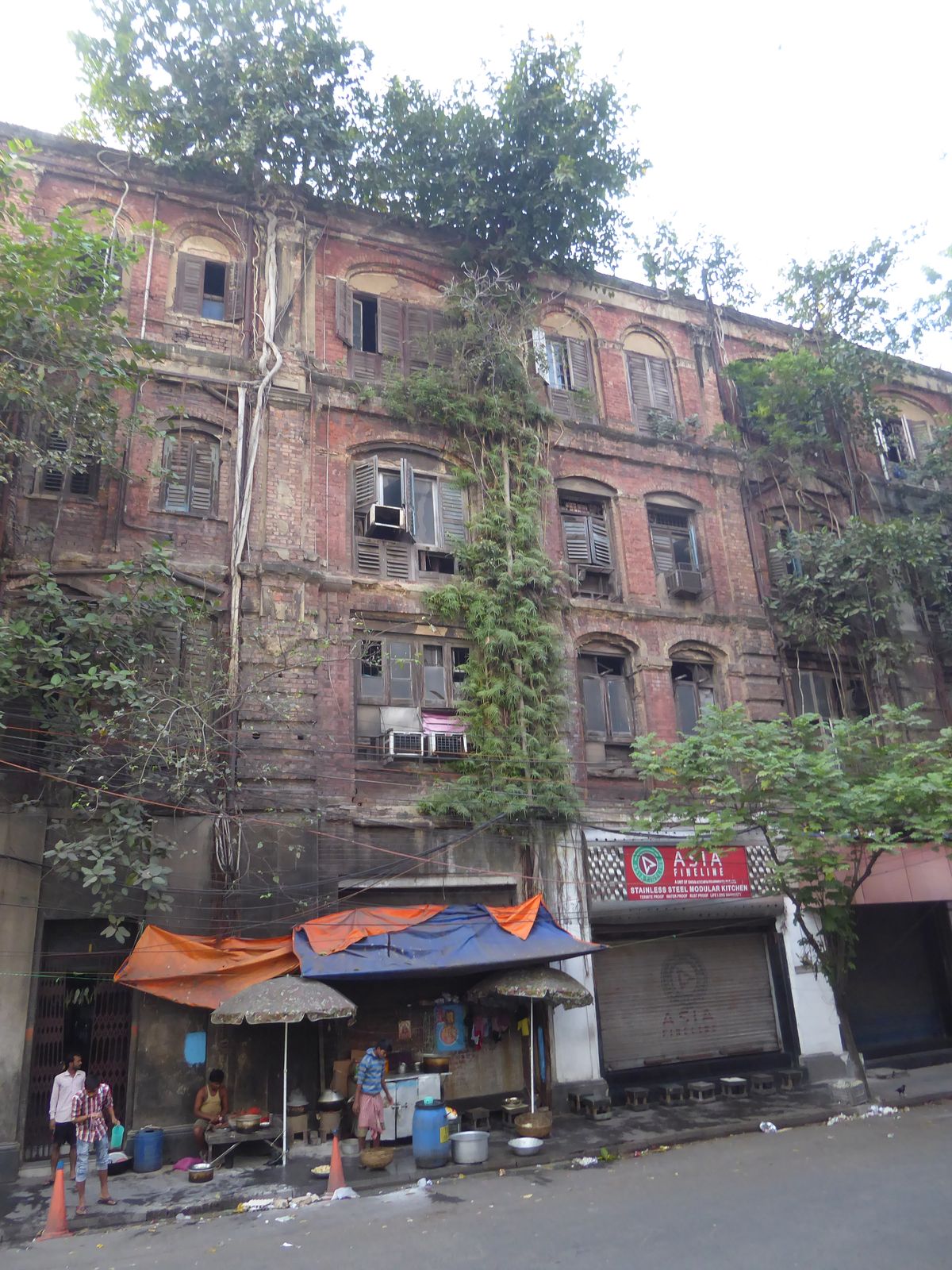
Step out of the Lalit Great Eastern and you bump into Ezra Mansion, built by one Calcutta's real-estate barons.
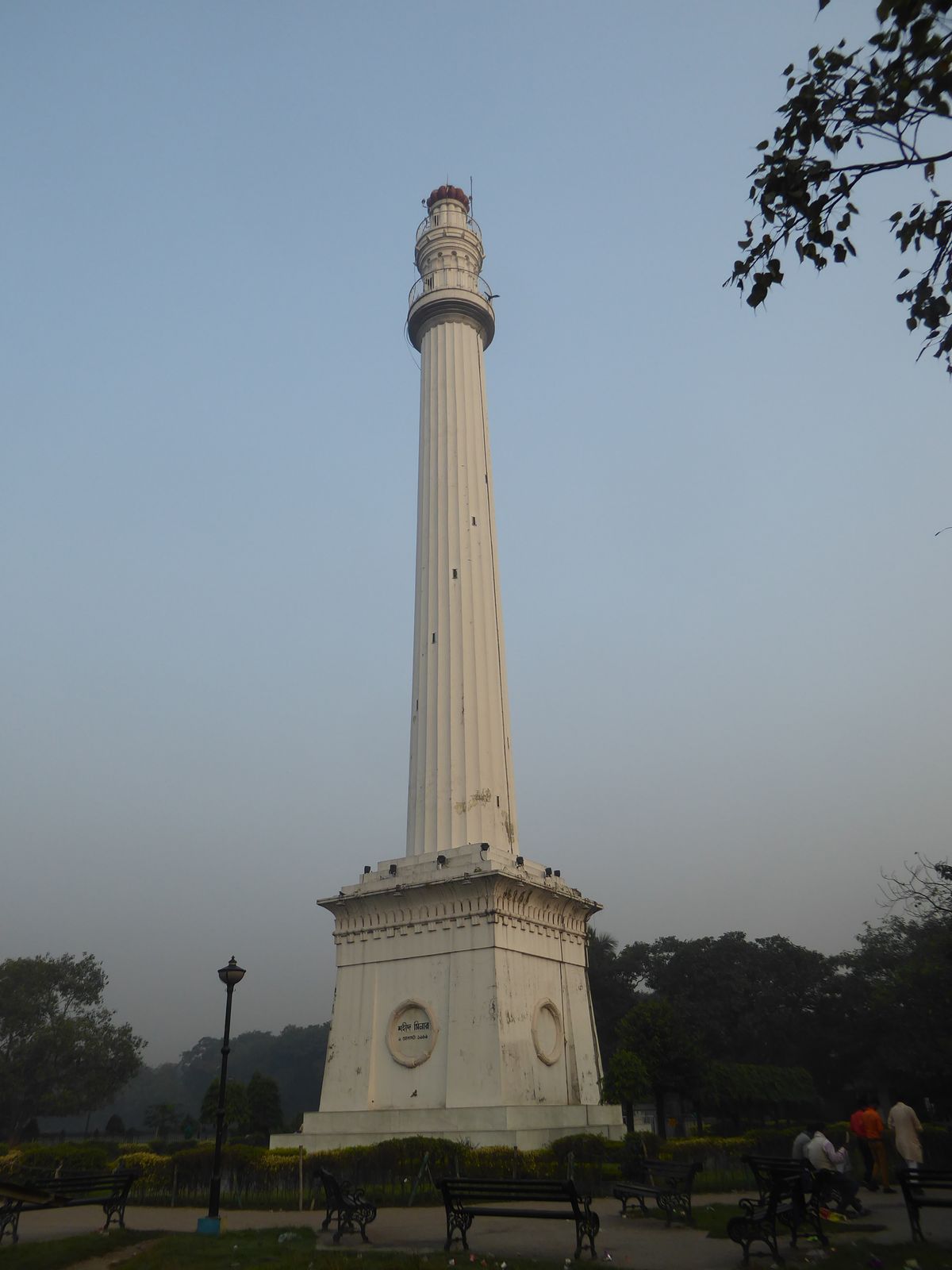
We've slipped 500 meters south to the eastern side of the huge open space called the maidan, here with its landmark Ochterlony Monument of 1828, since 1969 the Shahid Minar. Barry about 1950 says "a trip to the top is well worth the trouble entailed." By "trouble," he may mean the narrow stairs, but no matter: the tower's been closed since a 1997 suicide. Ochterlony, by the way, attended the Boston Latin School in the days before the Boston Tea Party.
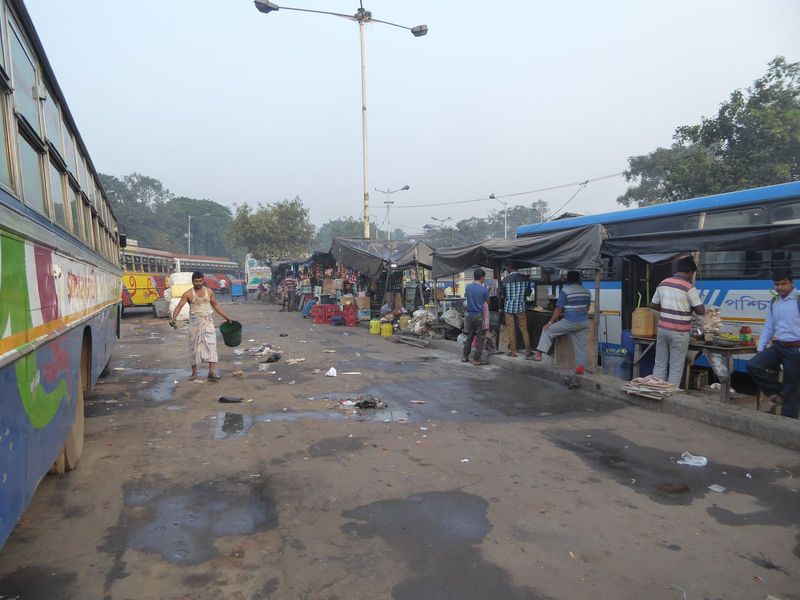
It's easy to get to the monument: the Central Bus Station is next to it.
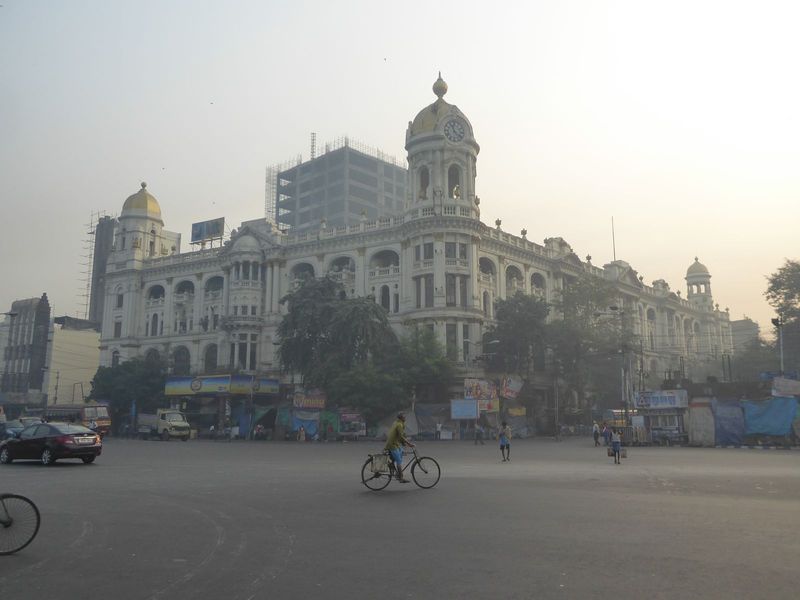
We're looking east from the tower across the expanse of the intersection of Chowringhee (the car's heading north on the street) and Banerjee Road, formerly Corporation. The building occupying this prime site? British India had two department-store chains. One was Army and Navy. This was the other, Whiteway Laidlaw, founded in 1882 and eventually with 20 stores in India, plus others in Singapore, Kuala Lumpur, and Shanghai.
The building opened in 1905 with the ground and first floor for Whiteway and the upper floors allocated to residences and offices under the name Victoria Chambers. The store closed in 1962, and the building became known as the Metropolitan from its new owner, Metropolitan Life Insurance. It's still known by that name, though the owner now is the Life Insurance Corporation of India. The ground floor is now occupied by the very busy Big Bazaar, a new chain store for a new India.
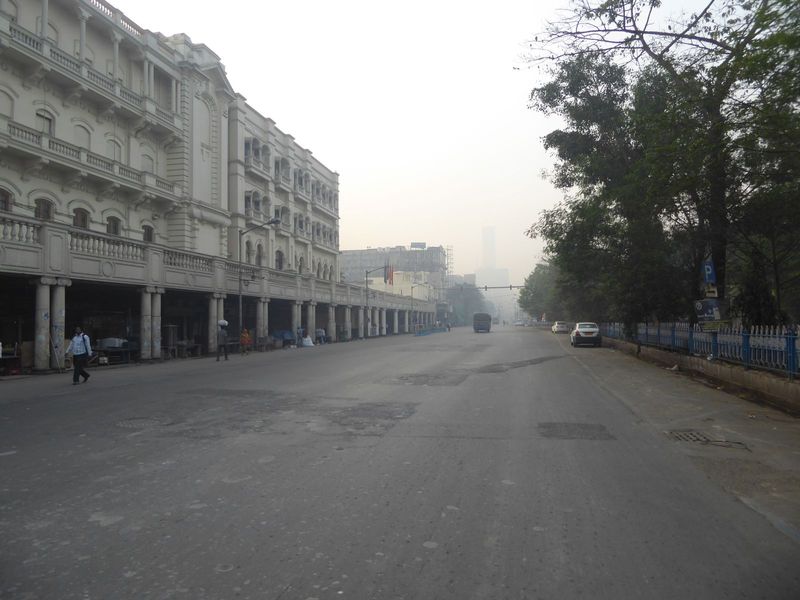
Just as the Great Eastern Hotel was reduced to a facade hiding a new hotel, so, too, the old Grand Hotel, shown here very early one morning on Chowringhee, operates now as the Oberoi Grand in a newish building hiding behind the old one, again reduced to a facade. The shady area behind the columns?
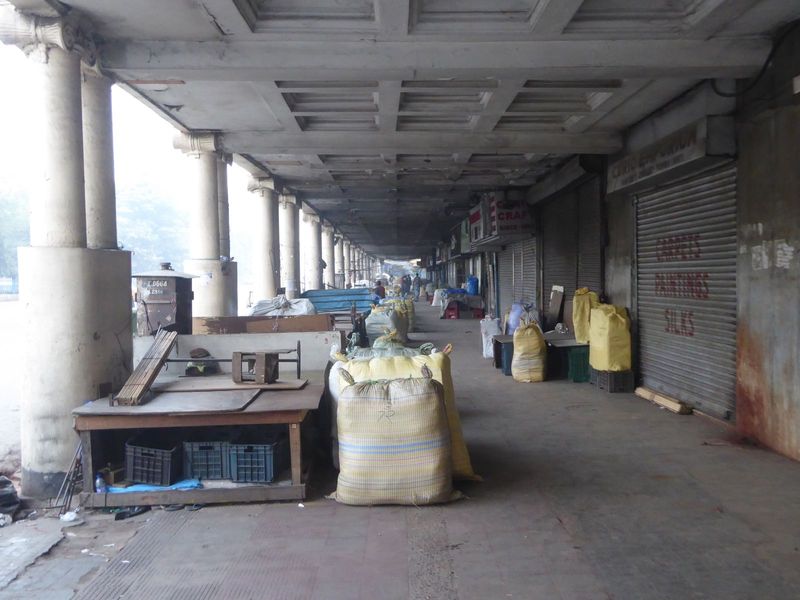
It will soon be mobbed. Right now, the goods are still bagged up. They just arrived by handcart.
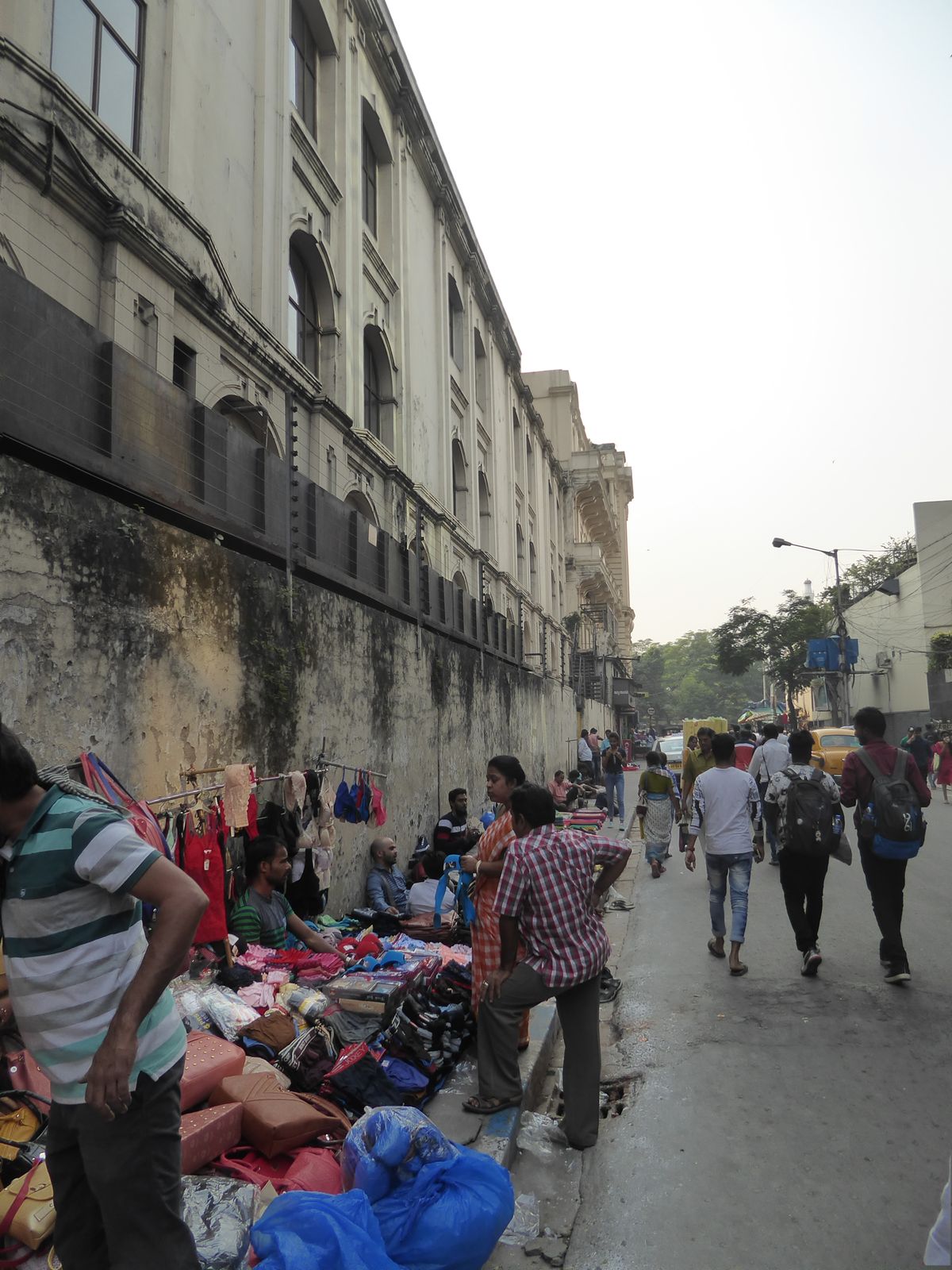
Chowringhee, and the greenery of the maidan, is up ahead. We'se stepped off the thoroughfare and are on the north side of the Oberoi, its wall apparently topped with electric fencing. No matter: vendors lean against the wall nonchalantly.
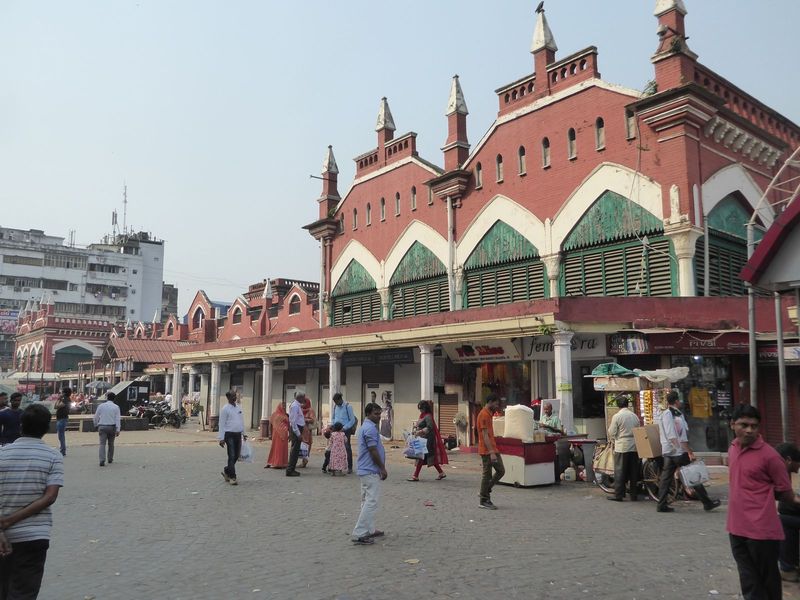
Behind the Oberoi we run into the Hogg Market. This is the original block, completed in 1874. Originally called the New Market, in 1903 it became the Sir Stuart Hogg Market, named for the man who established the detective department in the Calcutta police department. He later became the chairman of the municipal corporation.
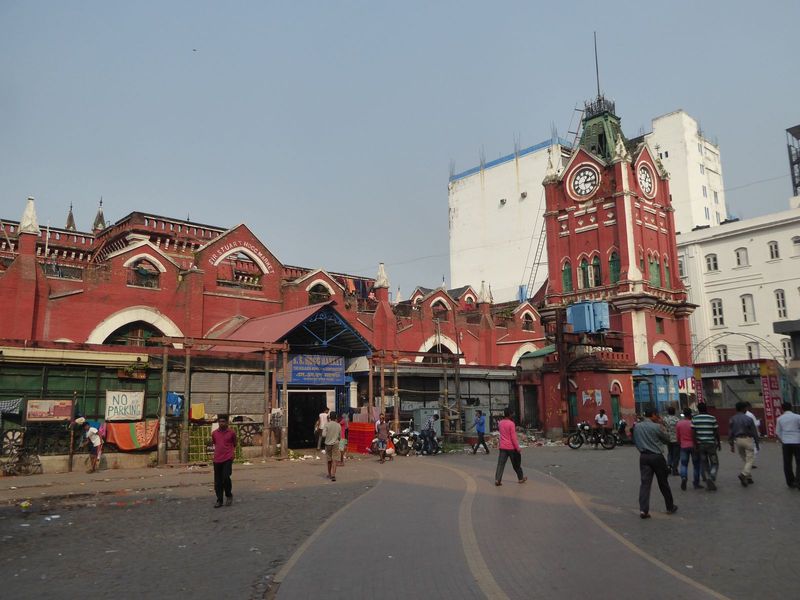
A later block, with clocktower, was completed in 1909.
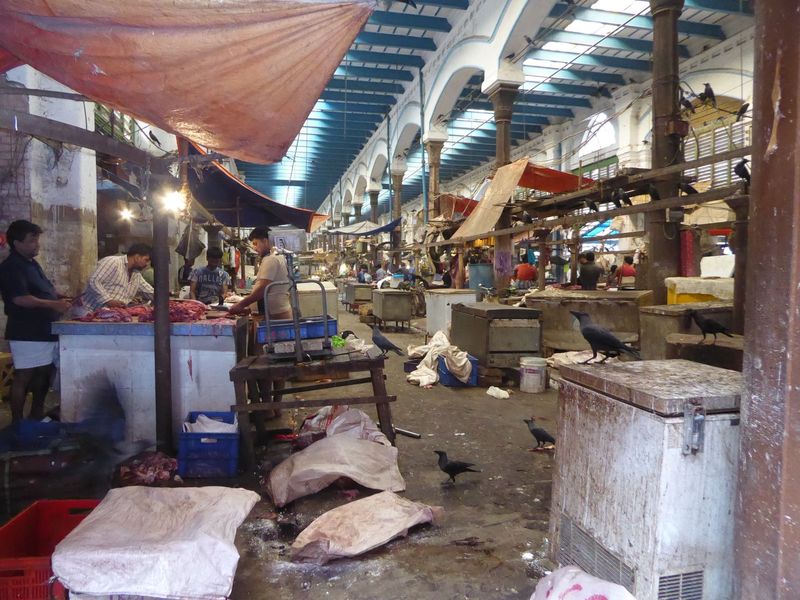
One either loves or hates these places. Here's the loving description from John Barry's Calcutta Illustrated, from about 1950: "Surely there is no similar market in the world where, in an hour's shopping, one could buy fruits from Persia, Iraq and Afghanistan, yes, and from California, Tasmania and Spain, too,—from wherever fruits are grown, textiles from Lancashire and Yorkshire; footwear from Northampton; rugs from Bokhara; aluminium ware from America; silks and curios from China and Japan; tobacco from Virginia, Cuba, and Egypt; jams and tinned fruits from Australia and New Zealand; potted delicacies from Europe; hardware and cutlery, toilet requisites and stationery, ebony and ivorywork, in fact, almost anything from anywhere."
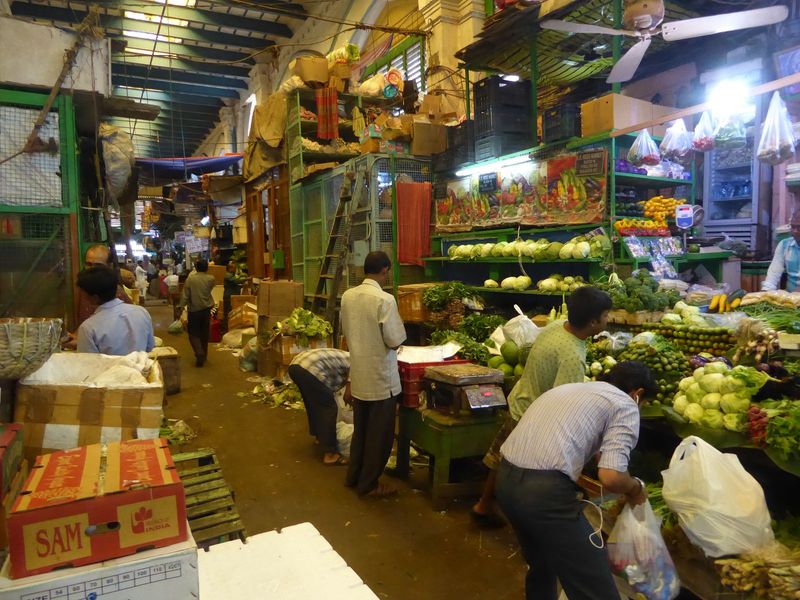
The arrangement and selection has changed over the years and probably slipped down-market.
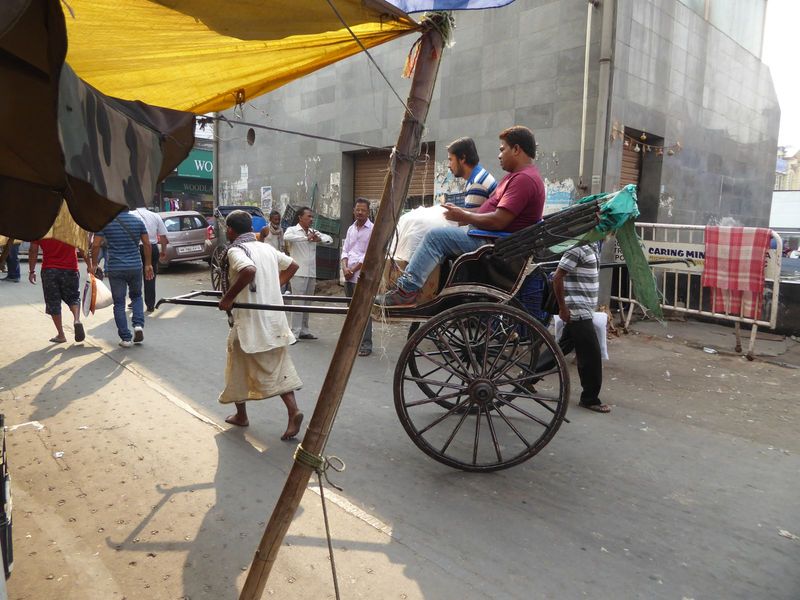
It's one of the very few places in India where you'll still find rickshaws.
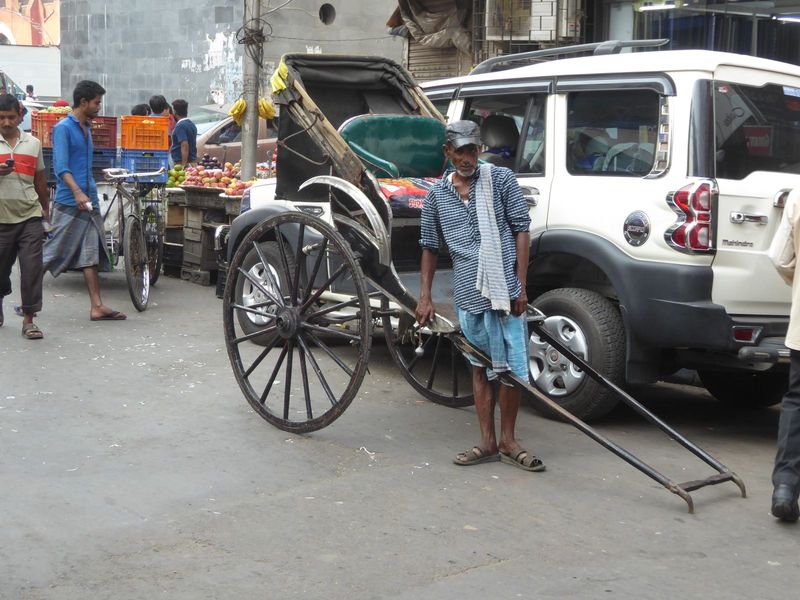
Feel guilty about jumping in? It's a problem, though the rickshaw-walla certainly wants your business.
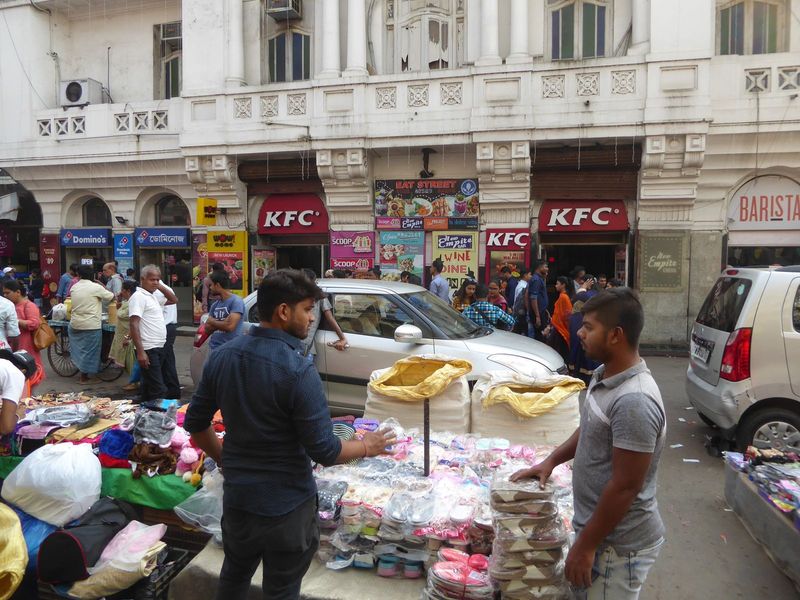
With the end of British rule, the market's stock of imported goods fell sharply, but in recent decades imported goods have come back and been joined in force by familiar international chains.
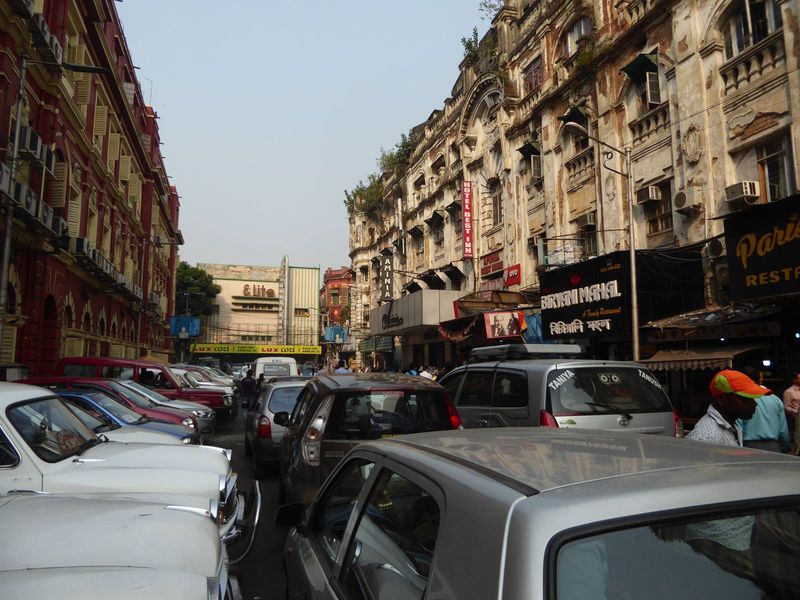
We're still close to the market. The Elite Cinema opened in 1940 with 1,200 seats and showed only English movies. That changed in 1960 with "Mughal-e-Azam," but the theater closed in 2018, killed by multiplex cinemas and online entertainment. See that fine wreck on the right?
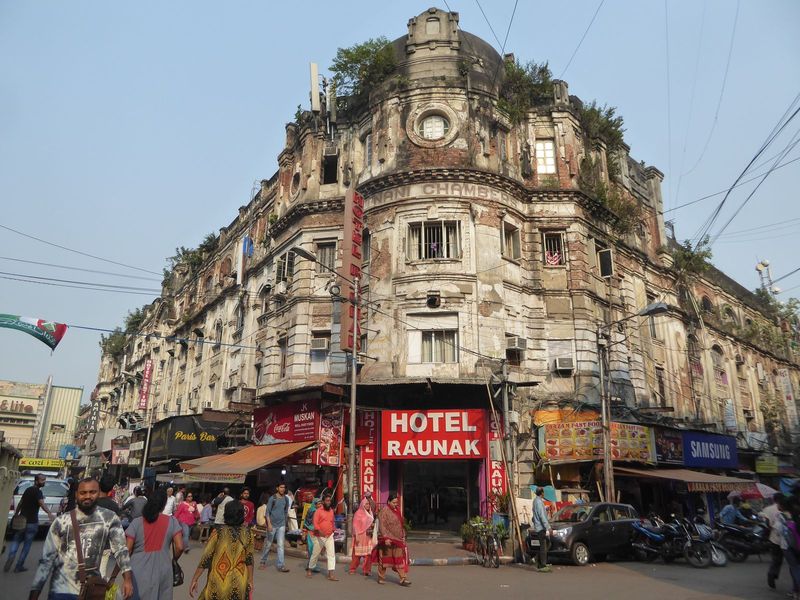
Welcome to the Futnani Chambers, named for the family that subleased the building from Hindustan Life Insurance, which in turn leased the building from the city government. The Futnanis leased space to over a hundred businesses, including Bata's India heaquarters and several hotels. The master lease ran out after 99 years, and the city in 2011 took over management once again. The main entrance, at the Hotel Raunak, used to lead to the Golden Slipper night club; the city recently demolished a balcony over the door lest it collapse. Inspectors found crumbling stairs preventing access above the first floor. Will the building survive the underground construction scheduled here for another Metro link? Stay tuned.
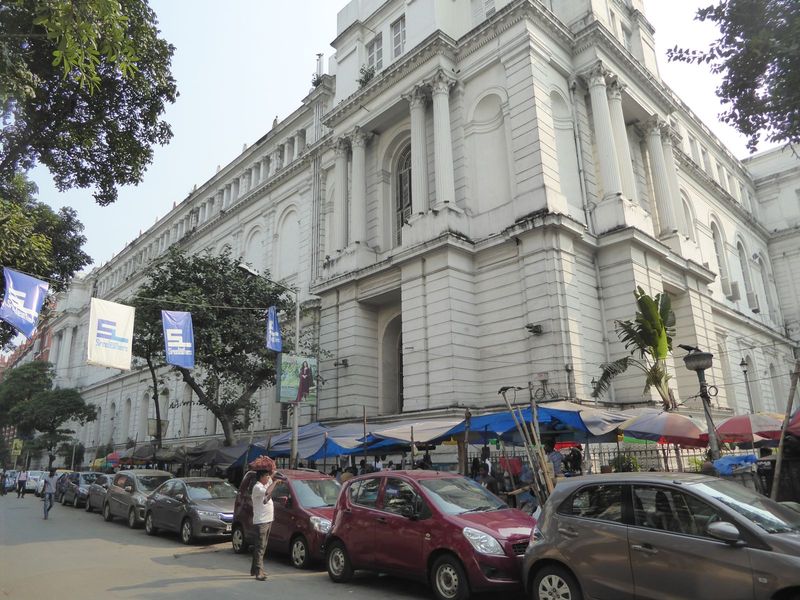
Back on Chowringhee, here's the huge bulk of the India Museum, a Walter Granville design executed in 1875, shortly after his death. Straight-on pictures of the facade are now blocked by a flyover constructed to reduce congestion on Chowringhee.
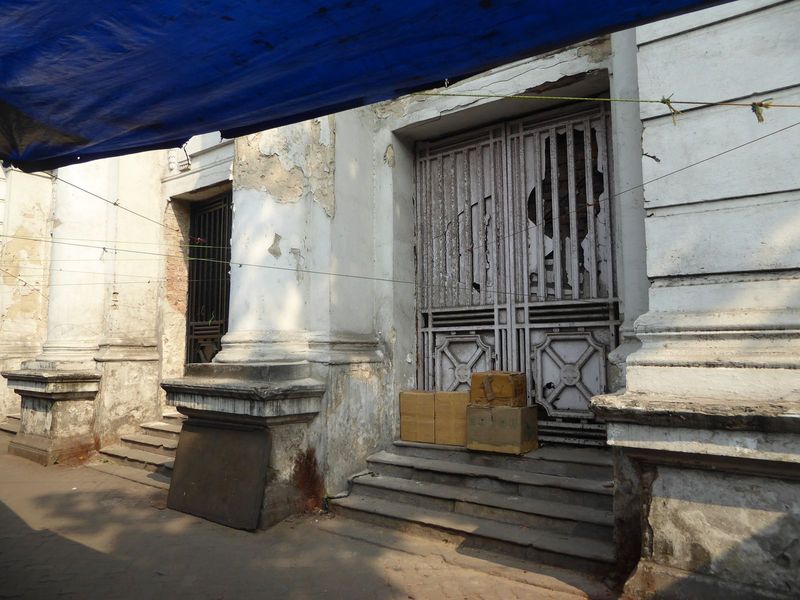
Stairs into the museum. You have to sympathize with the authorities, who have restored the Town Hall and the Treasury Building but can't keep up with all the buildings needing attention.
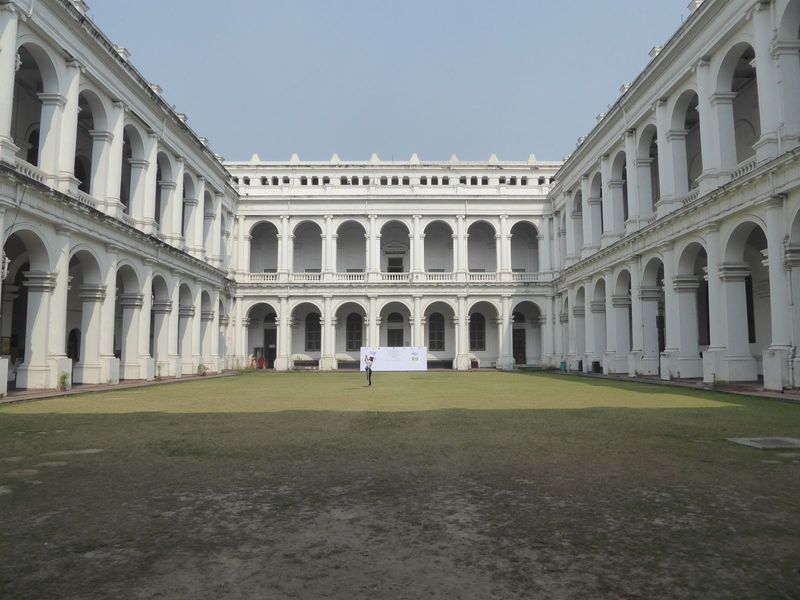
The courtyard within the museum is a little bleak but does have silence on its side.
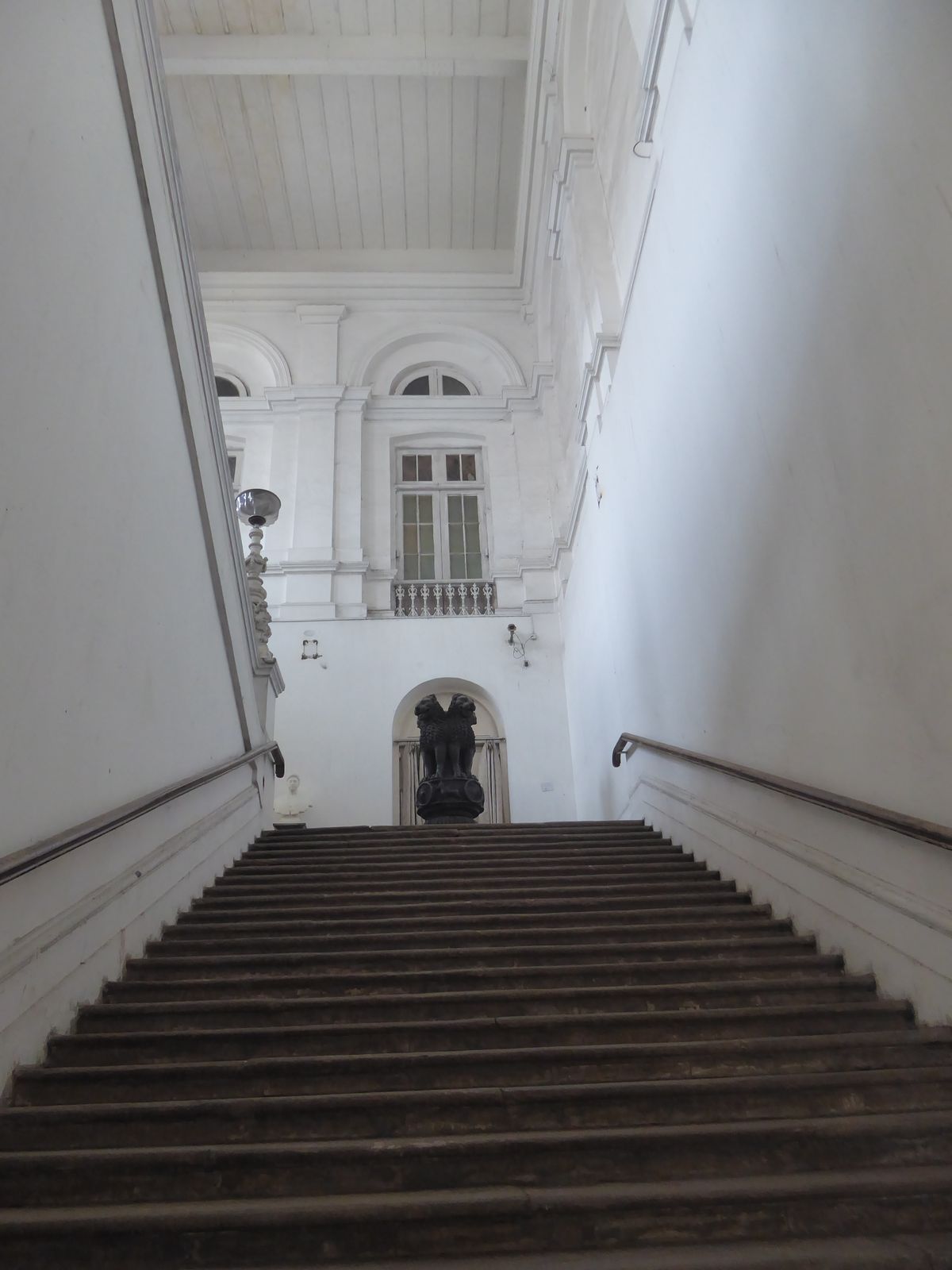
How's this for a staircase up to the first floor?
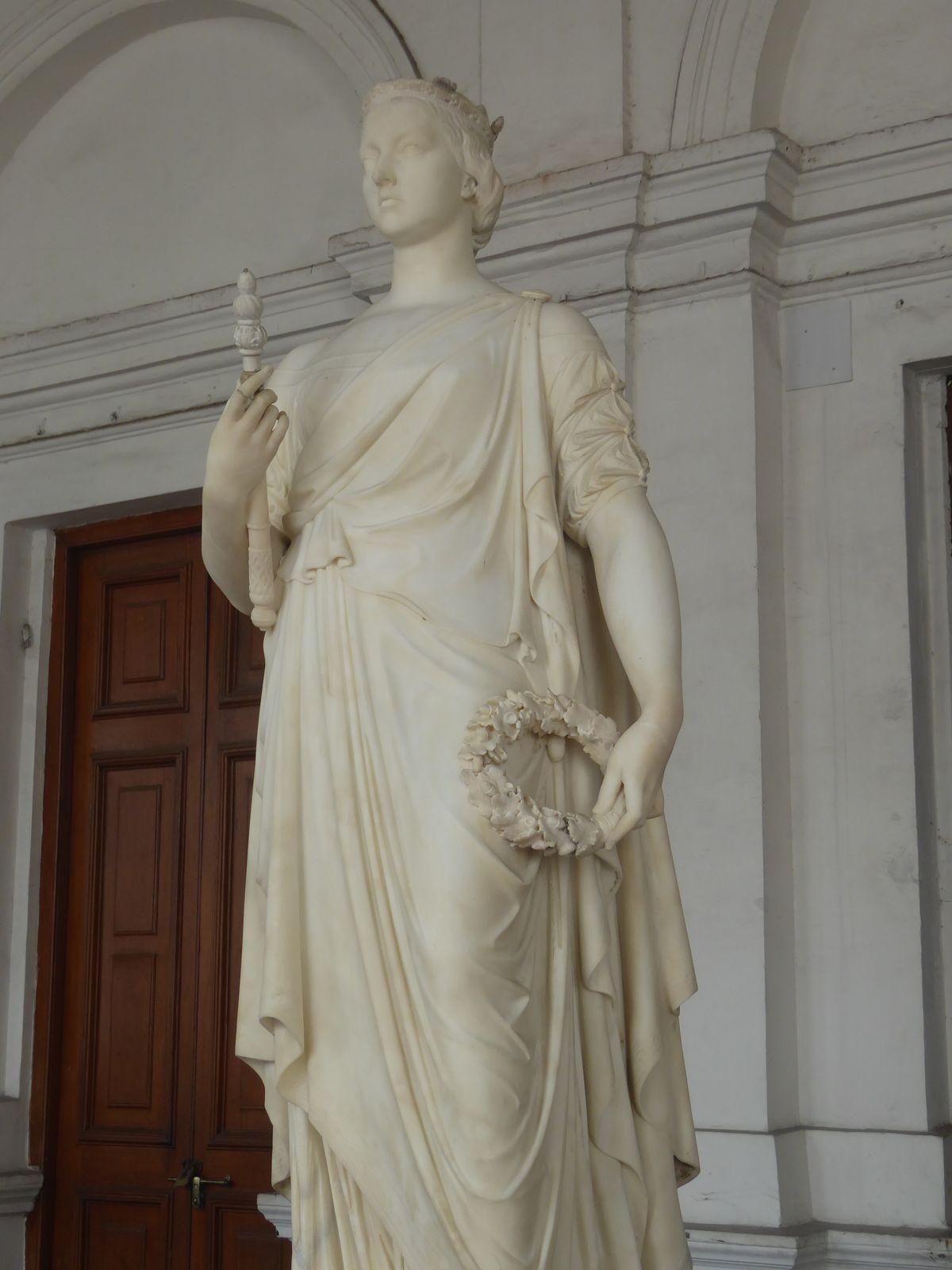
Up top, one of India's many images of you-know-who. This one, from 1874, is apparently a replica of others in the the houses of parliament in Melbourne, Ottawa, and elsewhere.
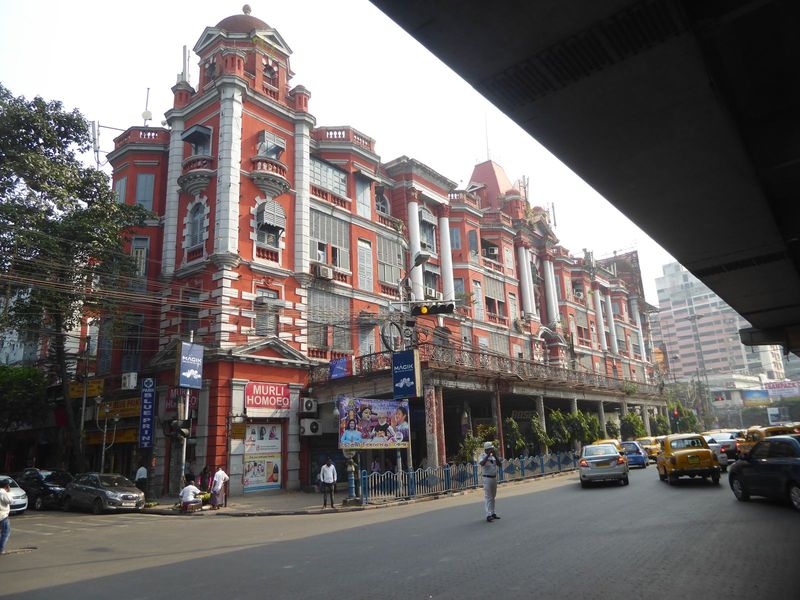
Here's a bit of the flyover for you, but the building whose tenants get a first-rate view of it is Chowringhee Mansions from 1907, a project of the same Joseph Ezra who did the Ezra Mansions facing the Great Eastern.
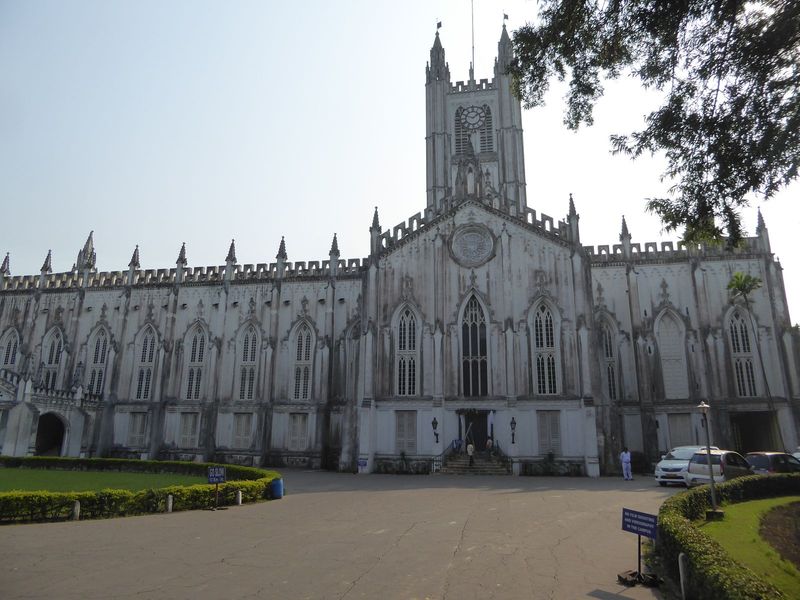
Hoof it another kilometer and a bit to the southern end of the maidan, and you arrive at St. Paul's, built and consecrated in 1847 to replace St. John's as the city's cathedral. The staining isn't the only disappointment: the tower is a poor substitute for a much higher spire lost to an earthquake in 1897. The spire was replaced but destroyed again by another quake in 1934. That's not the only change: the original plan called for the building to extend several more arches to the right. There are lots of memorials inside, of course, but photography has lately been forbidden, and sometimes it's too hard to go furtive. Ma'alesh. Some photos taken on a visit decades earlier are tucked away somewhere in the crannies of this website.
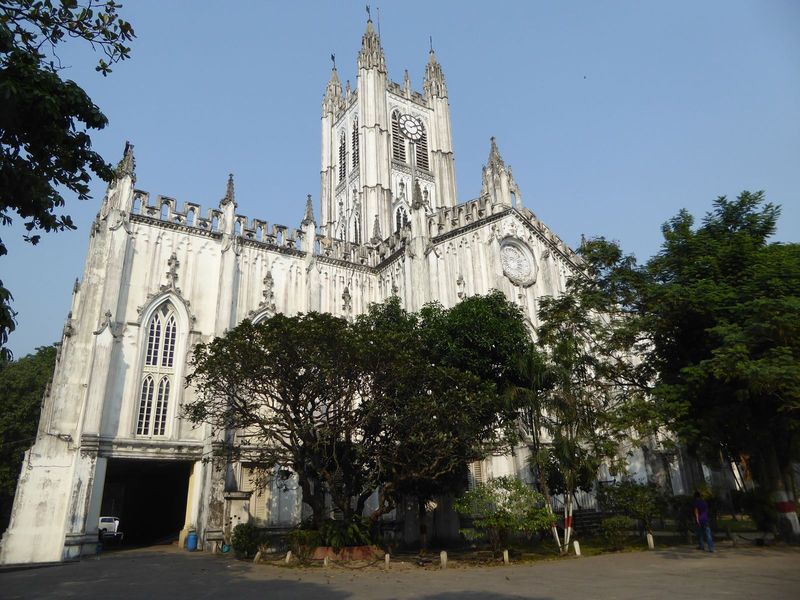
Not bad for a military engineer. He was William Nairn Forbes, assisted by C.K. Robison, who at about the same time had designed Metcalfe Hall.
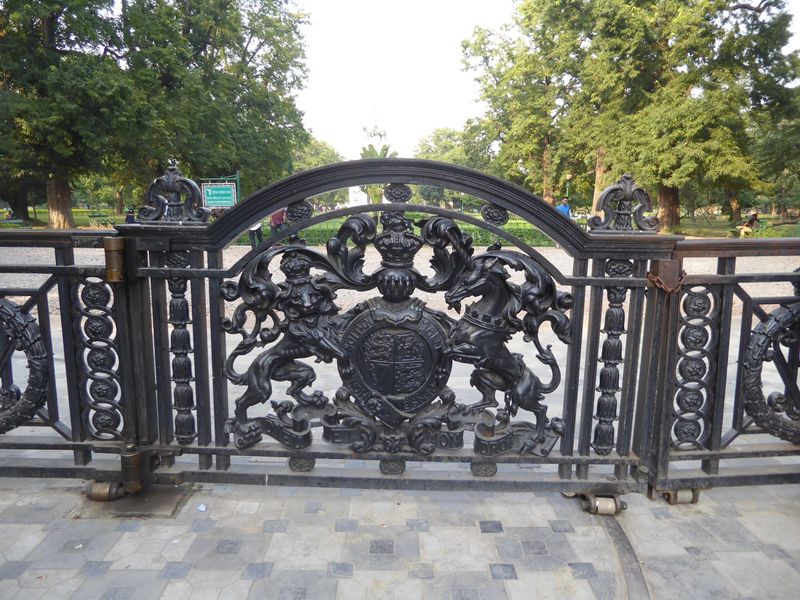
Just across the way there's something that's aged much better: its one of the gates around the Victoria Memorial. Sure, it's a small detail, but one suggesting that here the British made no small plans. The fence design is by another railway architect, Vincent Esch, serving here as assistant to William Emerson, the memorial's primary architect.
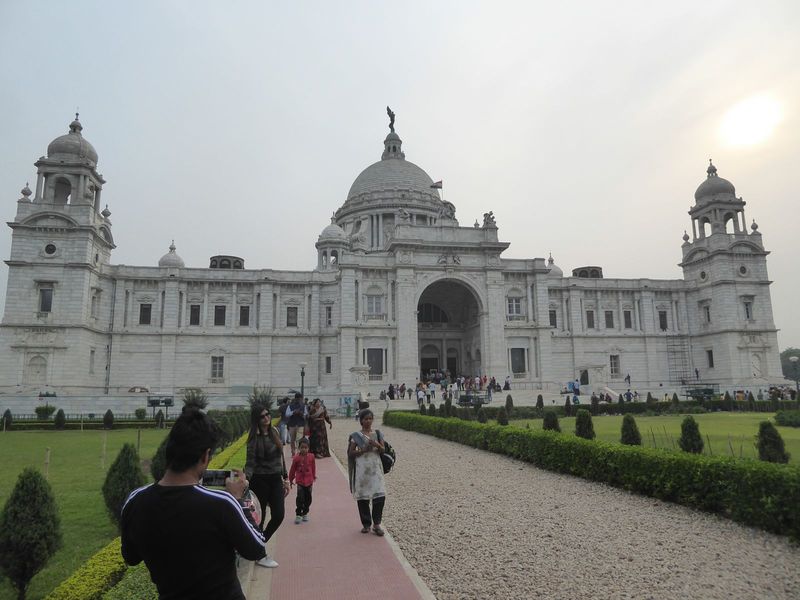
The original plan was for visitors to enter from the north and proceed to the rotunda with its statue of the queen. Instead, for some reason, the flow has been reversed, with the entrance now on the south, seen here.
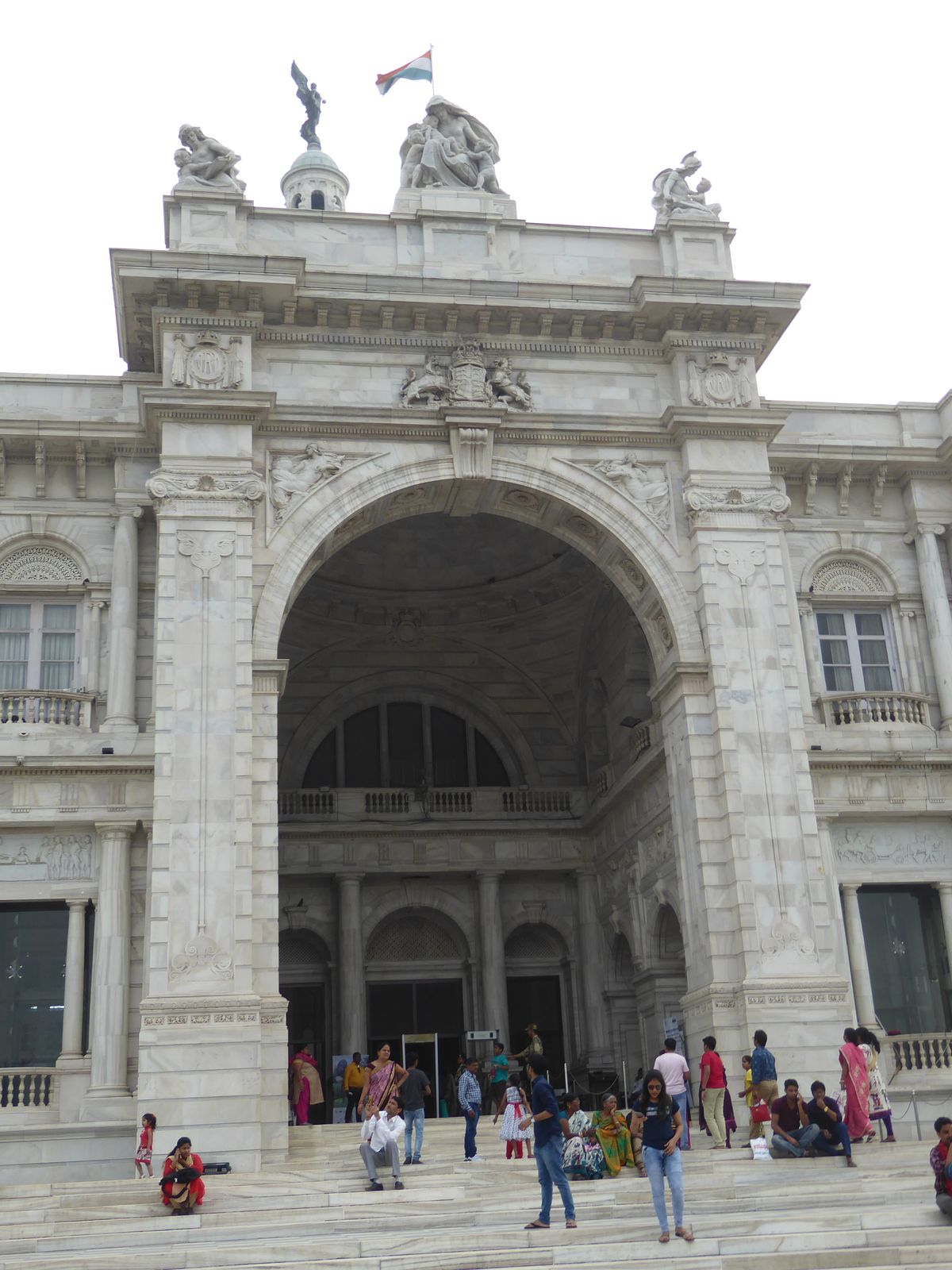
Yep, security screening.
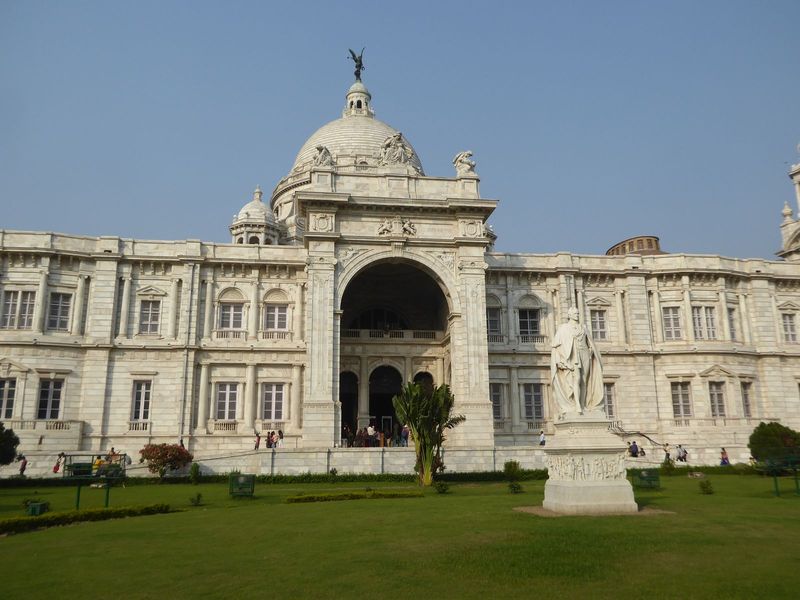
It's probably appropriate that a statue of a preening Curzon occupies an prominent spot. The memorial, after all, would not exist had he not pushed and bullied. He defended his efforts at length in print: "Bombay, which boasts itself the first city in India, went in for a purely charitable memorial, and decided to give me nothing at all. In three months they have raised in the entire Presidency less than 4,000 [pounds], and are now dry. Madras went in for a Technical Institute, and have raised in the same time exactly 3,000... Meanwhile my scheme, for which you say no enthusiasm is felt, has elicited nearly 220,000...."
The entire letter is in Curzon's self-aggrandizing British Government in India, 1925, vol. 1, p. 187.
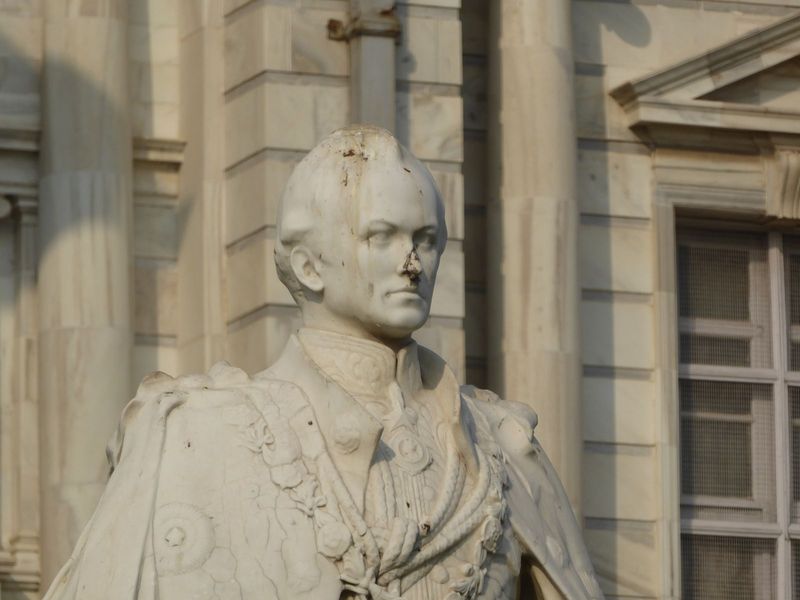
The statue, by William Frederick William Pomeroy, bears little resemblance to Curzon, apart perhaps from its stony confidence.
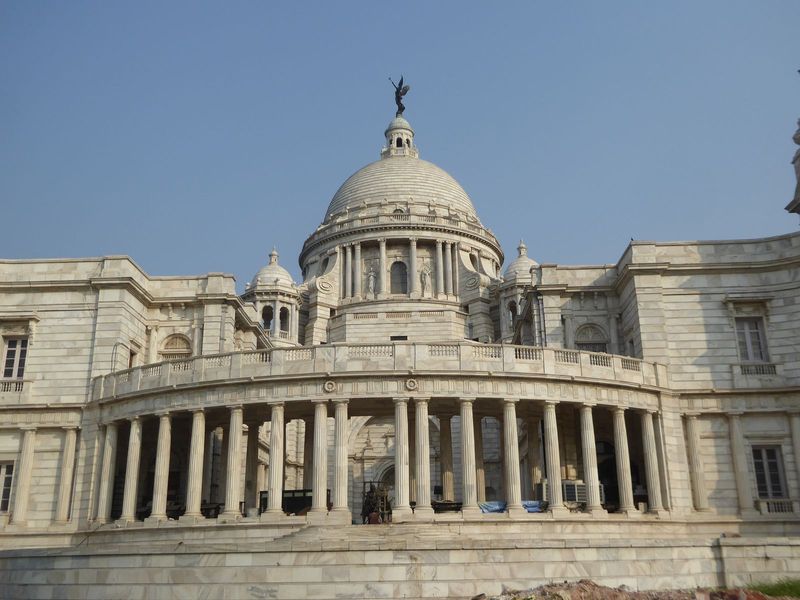
The east and west sides look like this.
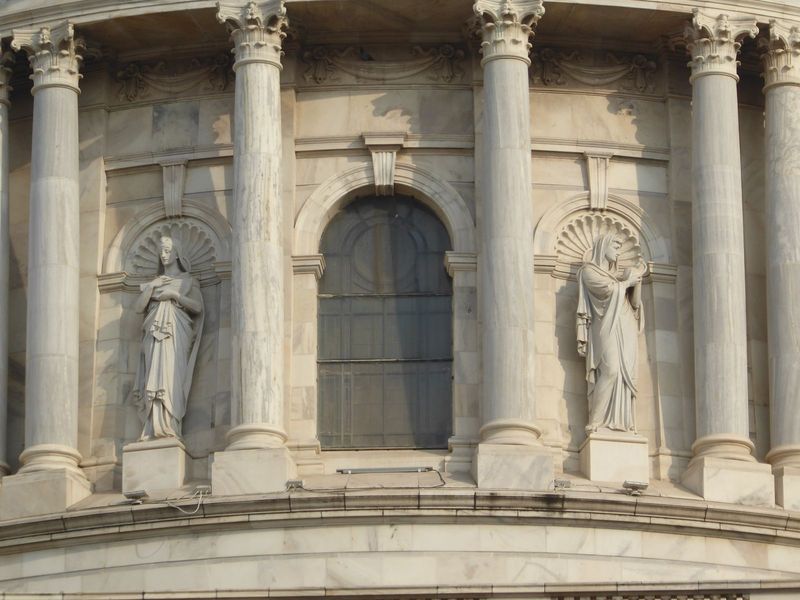
A bit of the detail of the west side.
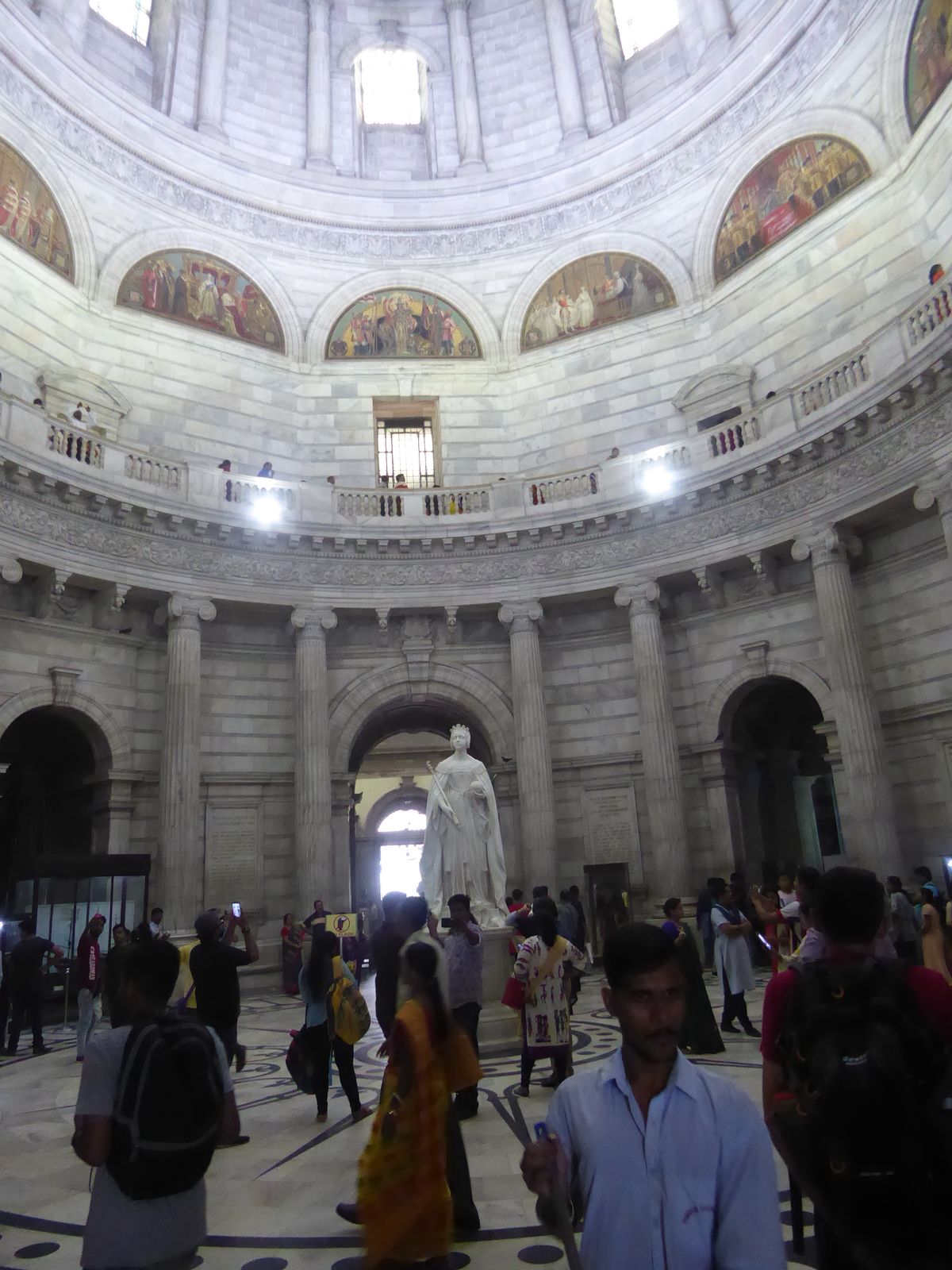
Curzon wrote, "I contemplate that no other object shall be placed but a white marble crowned statue of the queen as a young woman, raised upon a pedestal." So it is, except that the statue now looks south, rather than north, as it would have according to Curzon's original arrangement.
The statue is by Thomas Brock, of whom the DNB says, "Since his death [1922] his art historical reputation has dwindled so considerably that he has been dubbed 'London's forgotten sculptor'.... His qualities of intelligence, punctuality, consistence, care, courteousness, and cost-effectiveness count for little when the product is considered reactionary and academic. He has paid dearly for fitting so well into his age."
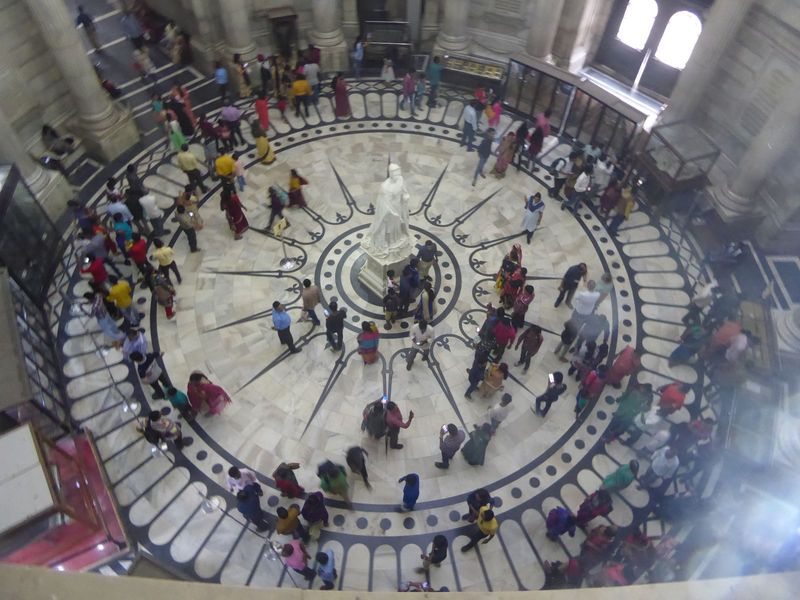
Brock, by the way, also did the big Victoria monument in front of Buckingham Palace. Edward apparently loved it so much that he asked for a sword and knighted Brock on the spot.
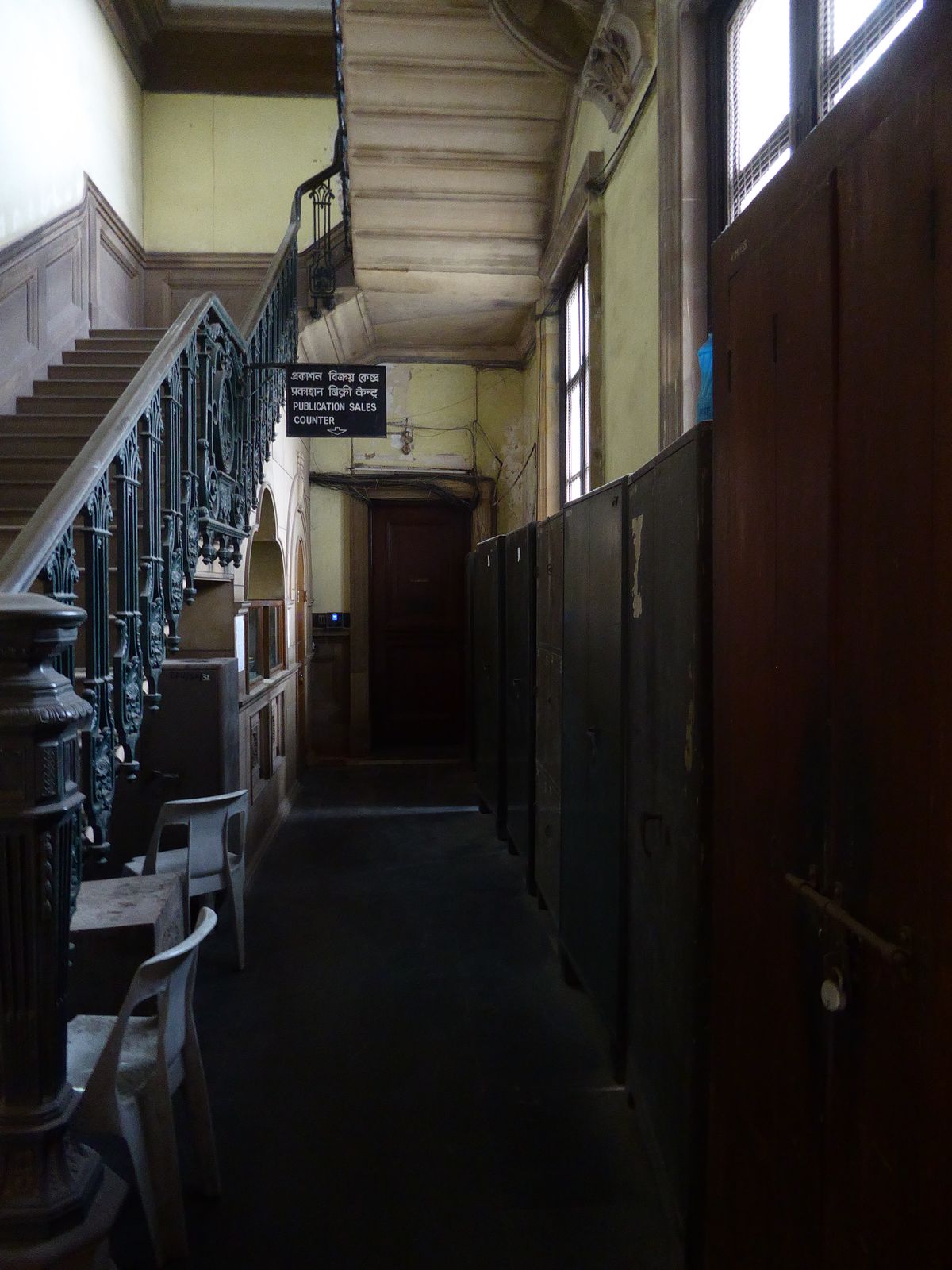
Wander off the main paths, and you can see deferred maintenance. The railings are awfully nice, though.
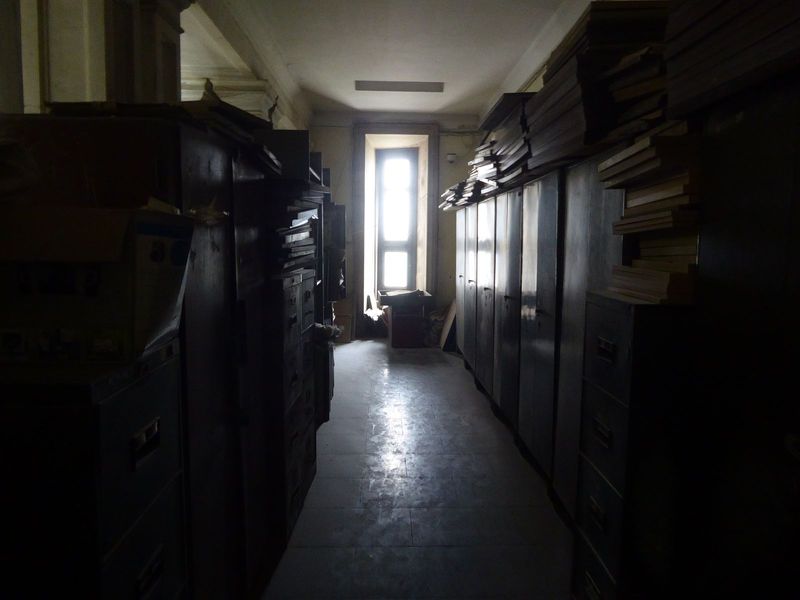
Lots of the collection is tucked away.
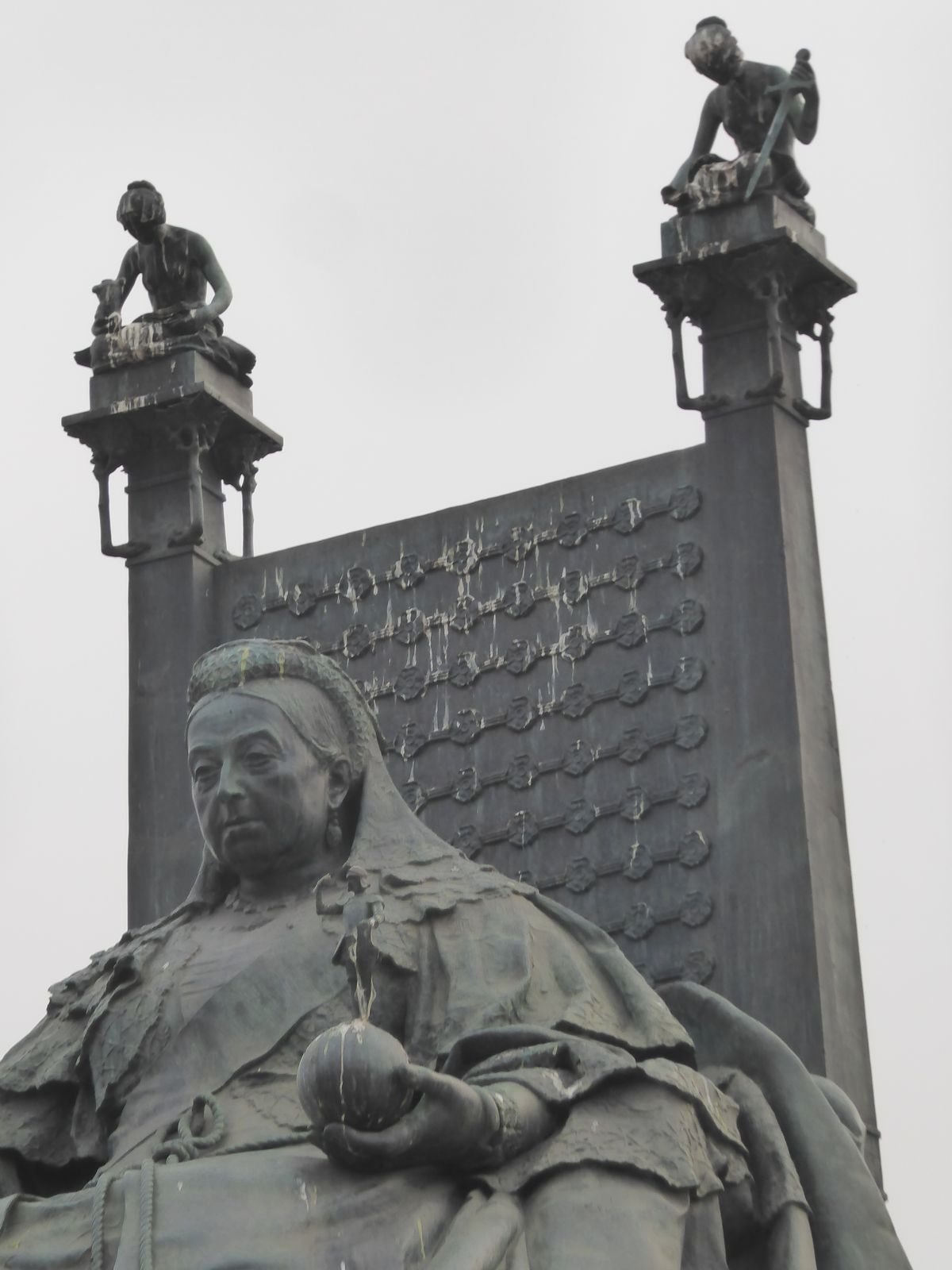
A fair amount of sculpture is still on display, including this statue outside the north entrance. Curzon had written that here Victoria "will be depicted in bronze in a sitting posture, as she was in advanced years." She holds the orb of state with a figure of St. George.
The statue was completed in 1901, the year Victoria died. Cotton says that "her late Majesty commanded the sculptor to submit a sketch model personally to herself at Osborne, allowed him one or two sittings, and suggested certain alterations and improvements in the design, finally expressing her entire satisfaction..."
The sculptor was George Frampton, better known today for London's Edith Cavell monument. He also did the W.S. Gilbert memorial on the Thames Embankment.
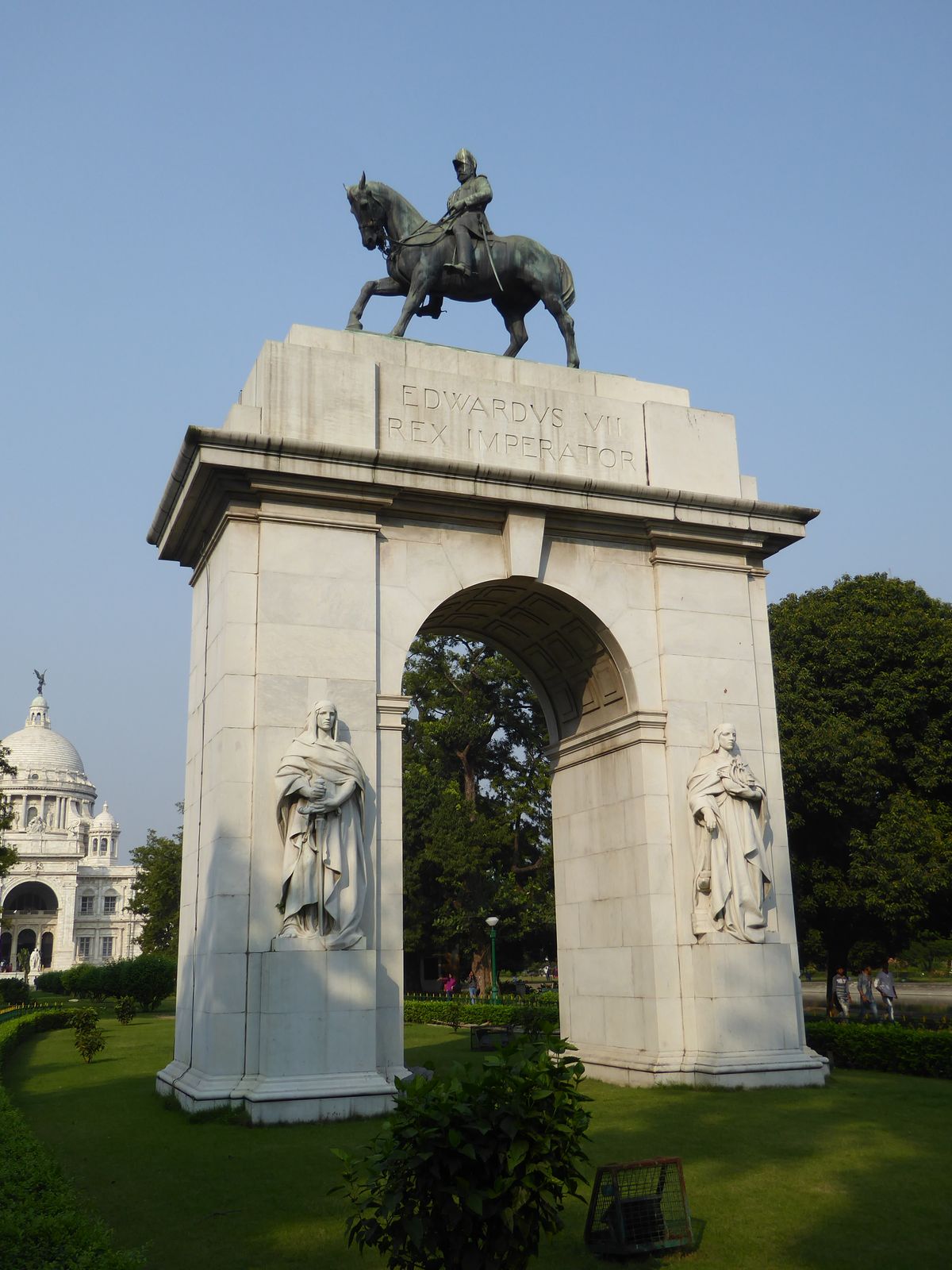
Edward is not going anywhere.
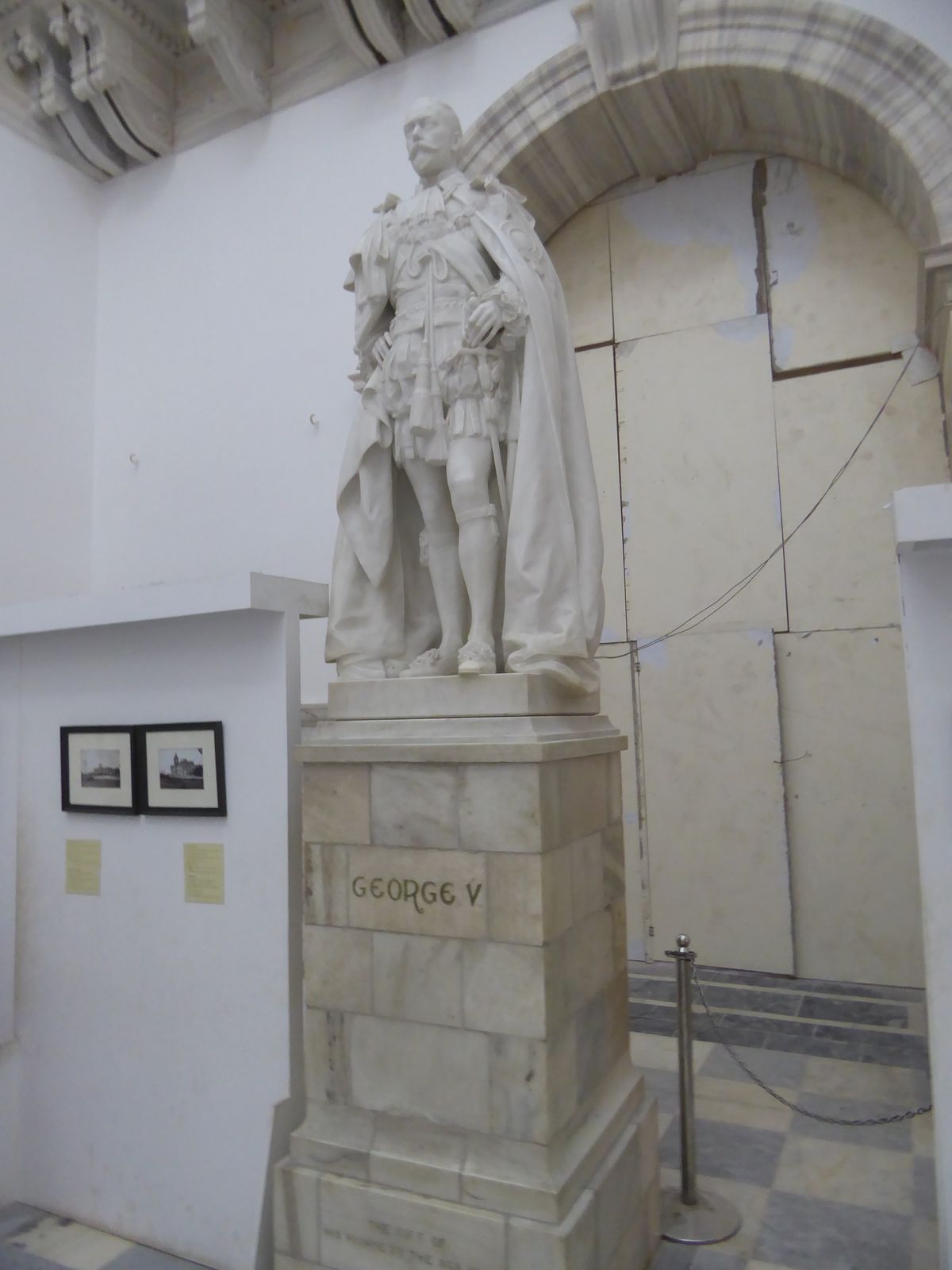
George surveys an anteroom.
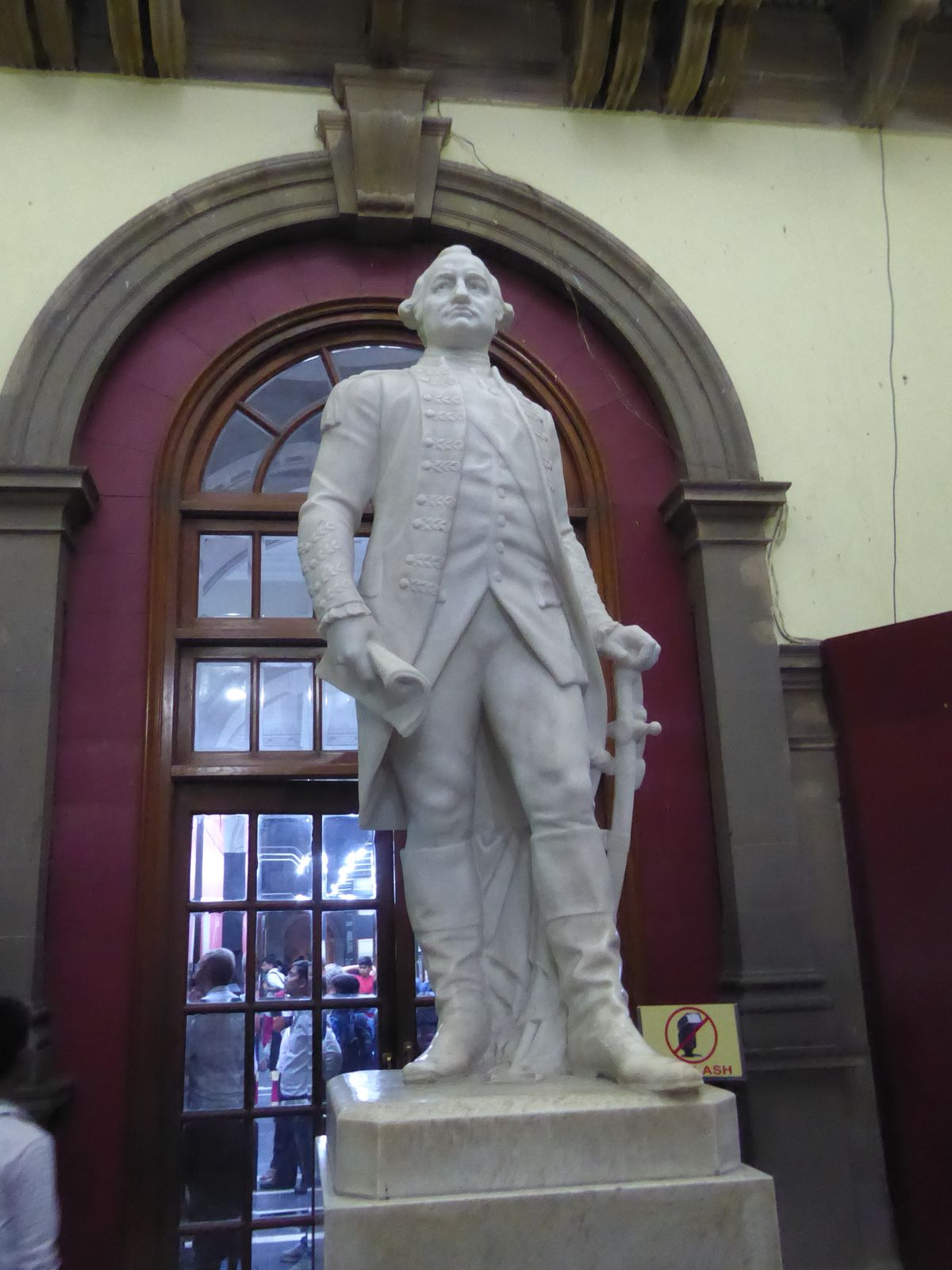
Now here's someone to reckon with—and with a much stronger tie to India. The statue is a replica of one in London. Yes, it's Robert Clive, he who said, "Mr. Chairman, at this moment I stand astonished at my own moderation!"
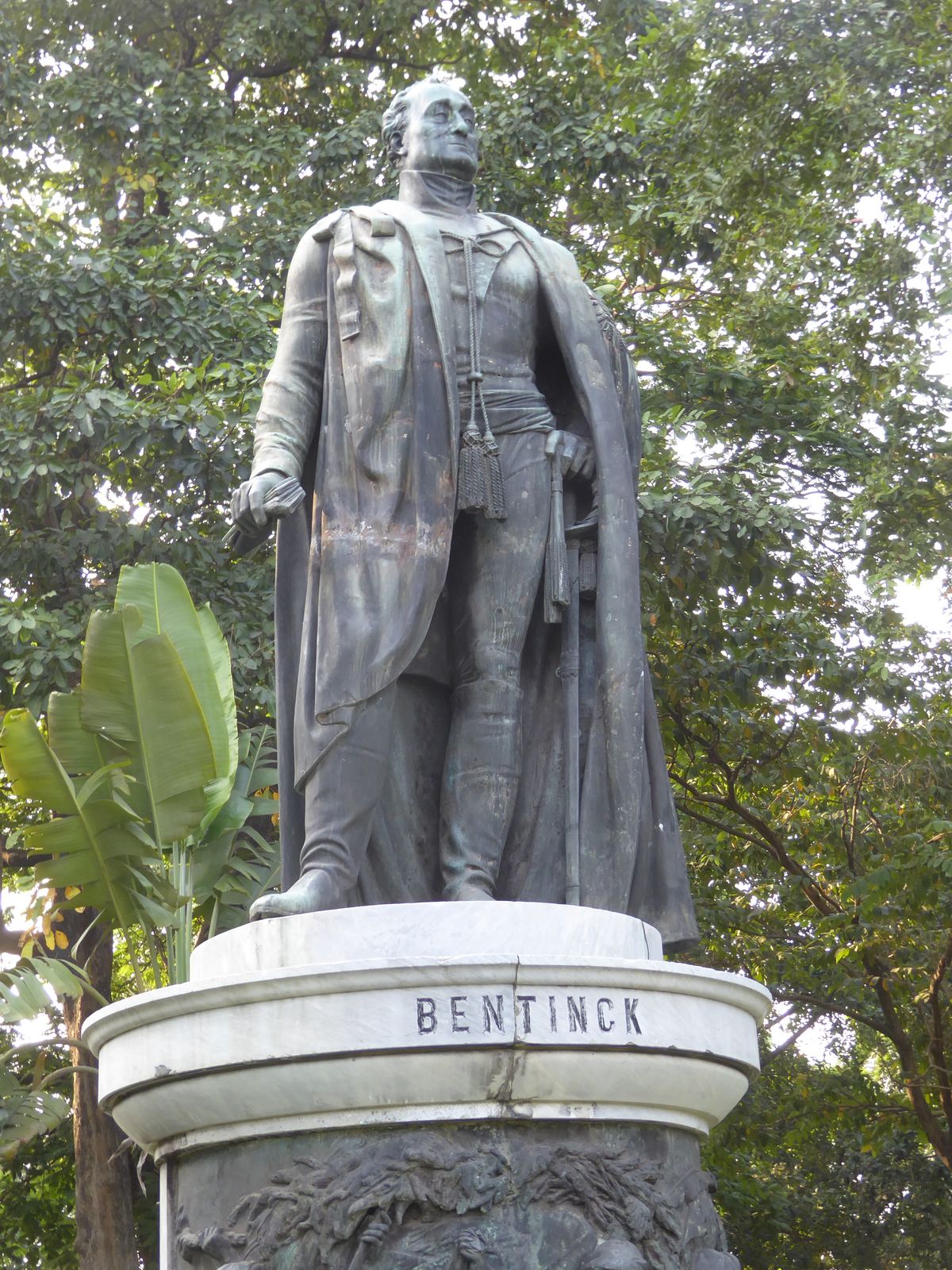
Here, exhibiting an almost unparalleled imperial hauteur, is William Bentinck, governor-general from 1828 to 1835. We met him earlier, on a street named for him near BBD Bagh. The statue, moved here from a site between Government House and the town hall, was by Richard Westmacott—whether senior or younger is unclear.
Thomas Macaulay worked for and admired Bentinck greatly. He added an inscription to the statue as follows: "To William Cavendish Bentinck, who during seven years ruled India with eminent prudence, integrity and benevolence: who, placed at the head of a great empire, never laid aside the simplicity and moderation of a private citizen; who infused into Oriental Despotism the Spirit of British Freedom; who never forgot that the end of Government is the welfare of the governed; who abolished cruel rites; who effaced humiliating distinctions; who allowed liberty to the expression of public opinion; whose constant study it was to elevate the moral and intellectual character of the nation committed to his charge." (The inscription was fading fast a century ago, when Evan Cotton recorded it.)
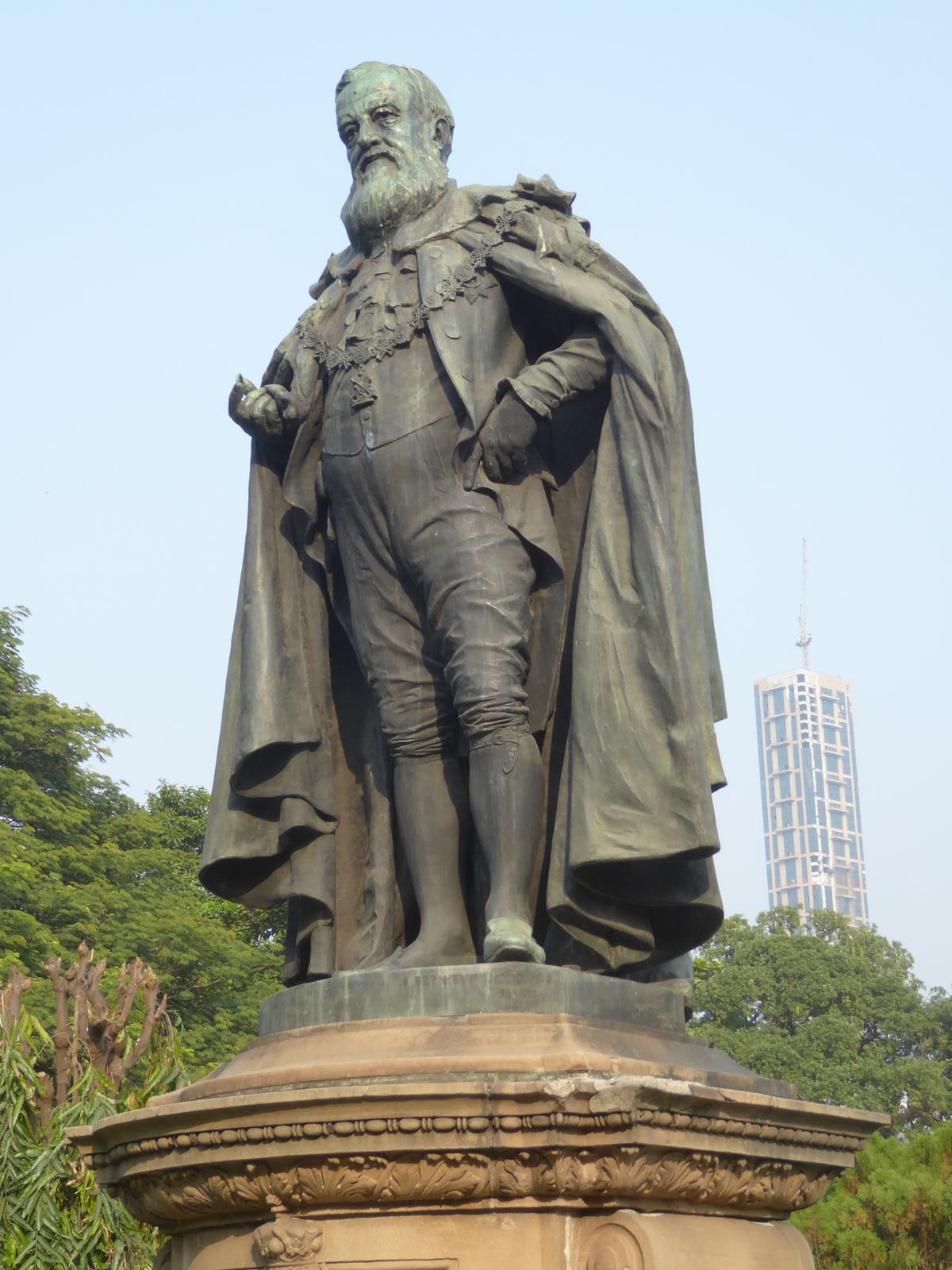
Bentinck is joined by this statue of George Robinson, alias the Earl of Ripon and viceroy in the 1880s. Popular in India, he was hated by the Europeans of the day and mocked viciously by Kipling for supporting even modest steps toward Indian self-government. The statue, by Francis Derwent Wood and unveiled in 1915, was apparently paid for by Indian donations, without help from any Europeans.
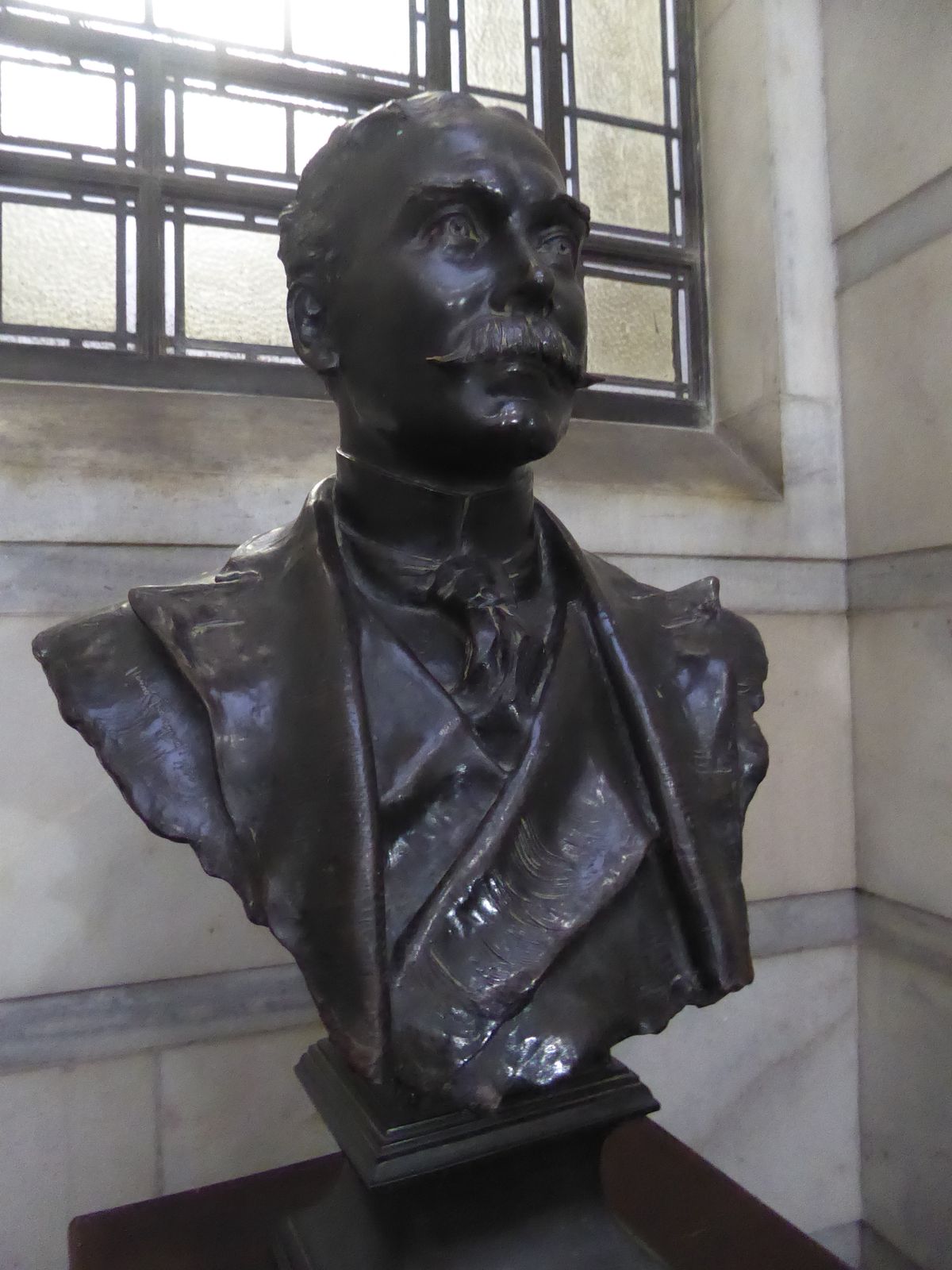
Look what we found: a bust of William Wilson Hunter, a prolific author and editor of Tthe Imperial Gazetteer of India. Hunter said of his published work that "it was my hope to make a memorial of England's work in India...."
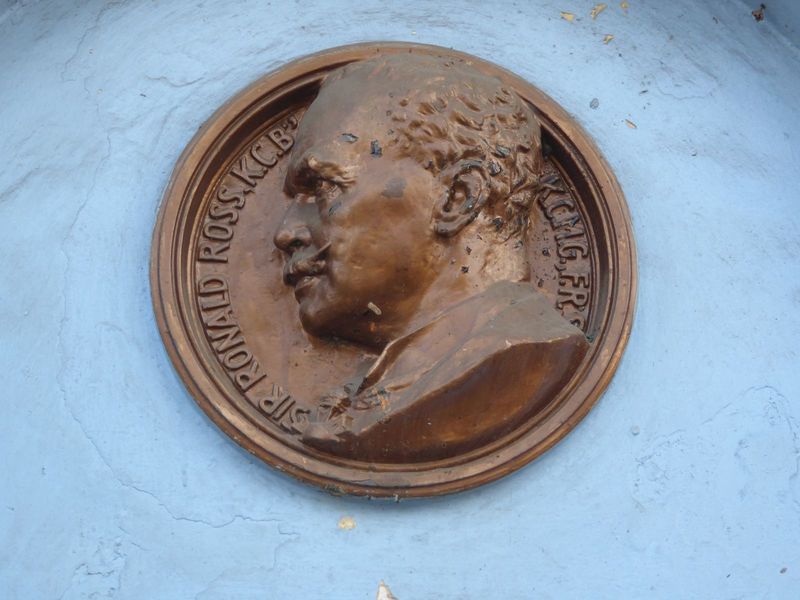
Remember him? He's across the street, somewhat lost under another flyover.
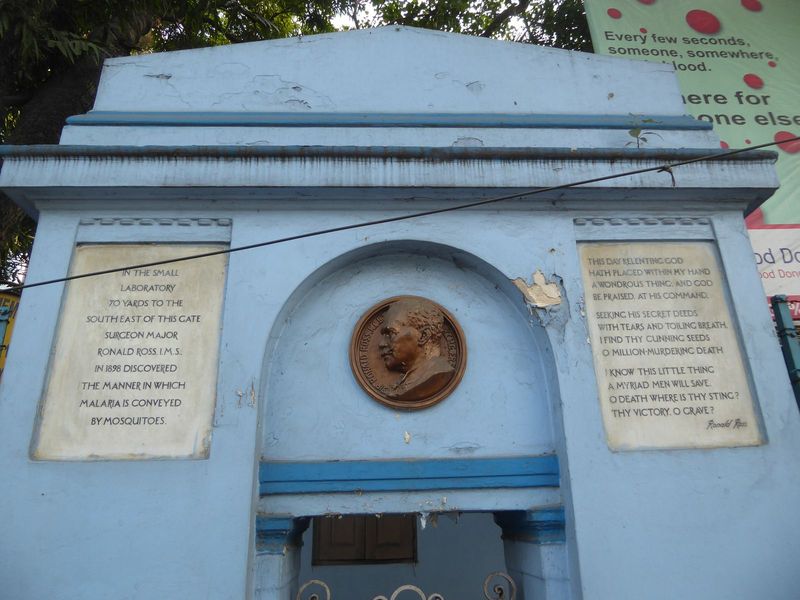
Here's the setting.
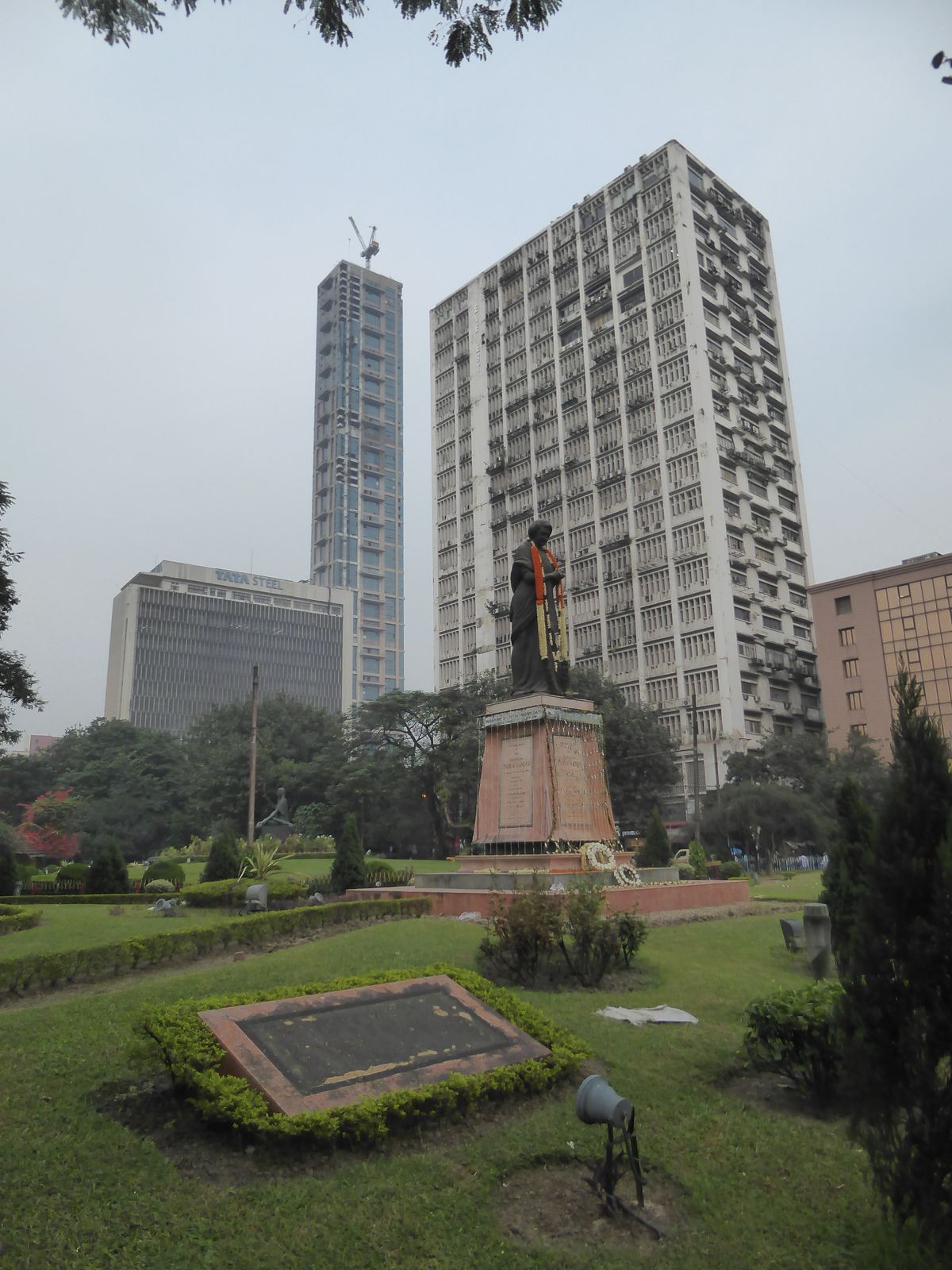
Evan Cotton a century ago wrote of Calcutta that "there is probably no city in the Empire so plentifully adorned with statues of public men erected by subscription." Independent India has gone some way toward maintaining the tradition. Here, close to the Victoria Memorial is Indira Gandhi. She stands in front to the Everest Building. To her left is the Tata building and, behind it at 879 feet, "42," the tallest building in India. Wonder about those foundations!