Kohima
A week in and around Kohima, Nagaland. For an accompanying podcast, try "The Itinerant Geographer."
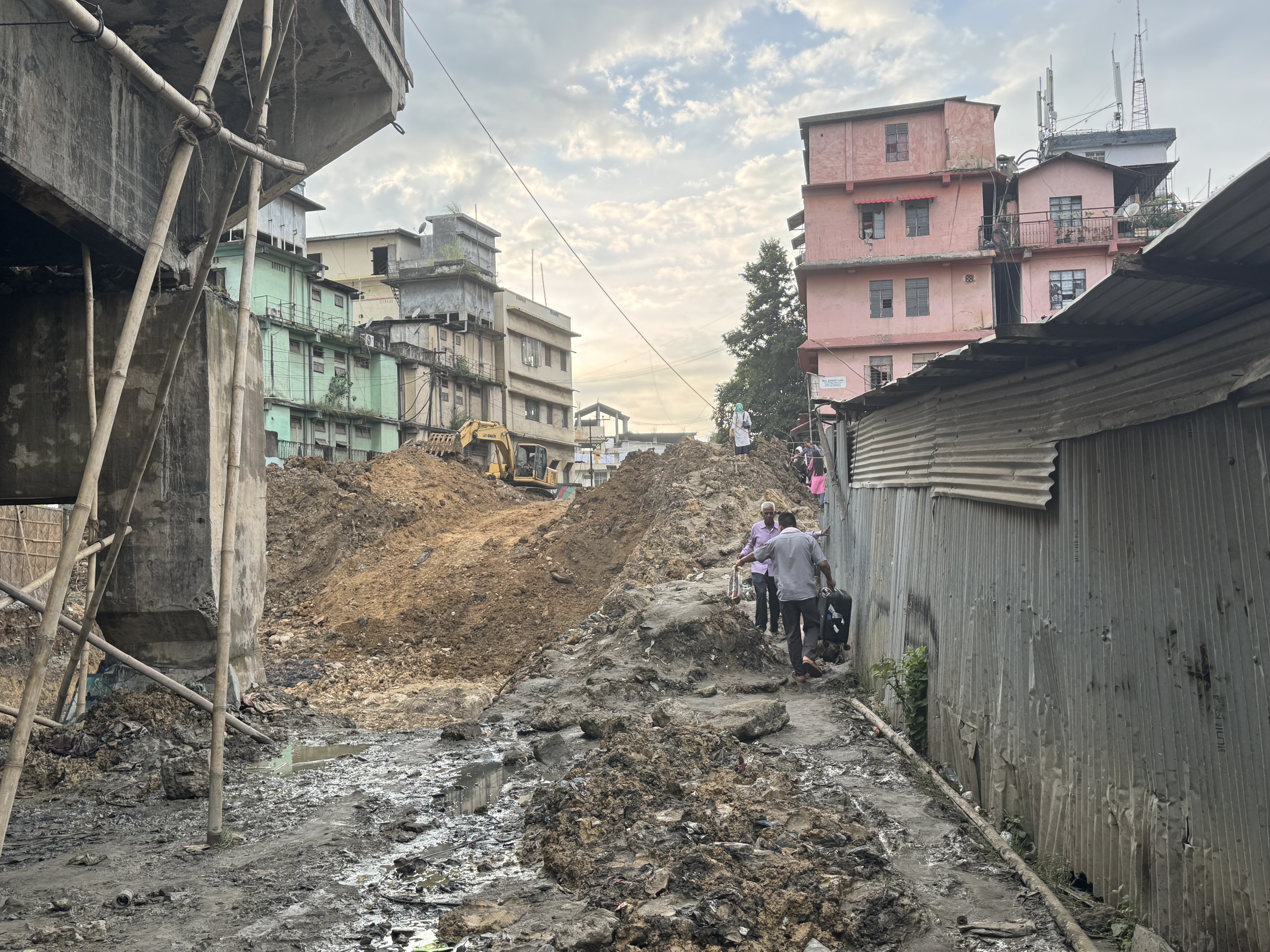
Welcome to Dimapur, the commercial capital of Nagaland State. The town, population pushing 200,000, is getting a new bridge over the Dhansiri River, a tributary of the Brahmaputra. The airport's behind us and the hotel's somewhere up the hill. Fortunately, the mud has congealed.
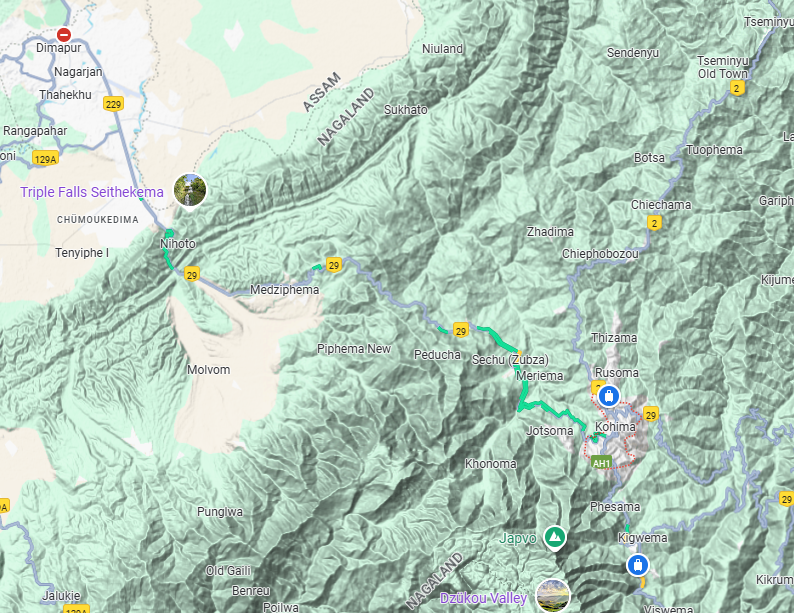
Dimapur lies at the eastern edge of the Brahmaputra Valley and immediately west of the Naga Hills. The hills form a band roughly 70 miles wide, but only the first 50 belong to India; the rest are in Burma. A railroad was built through Dimapur about 1900 to serve tea plantations farther north. That's how Dimapur, a negligible village until then, became what it is. Does your car need a muffler? Are you 40 miles away and up in the hills at the state capital, Kohima? Call Dimapur, and you'll have the muffler tomorrow.
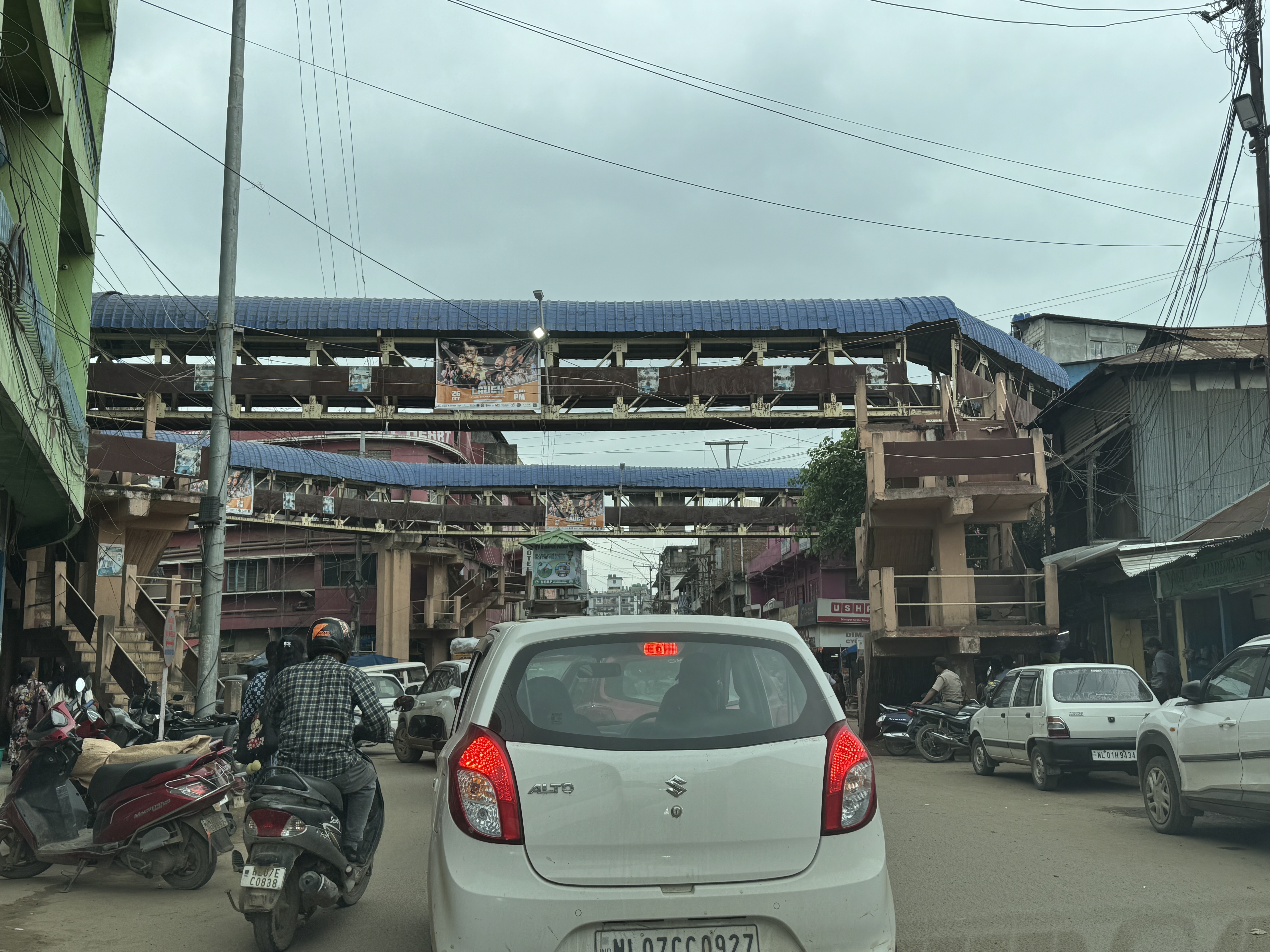
Dimapur is crowded, which is why somebody thought a pedestrian overpass was a good idea. People still jaywalk. Count the steps to see why.
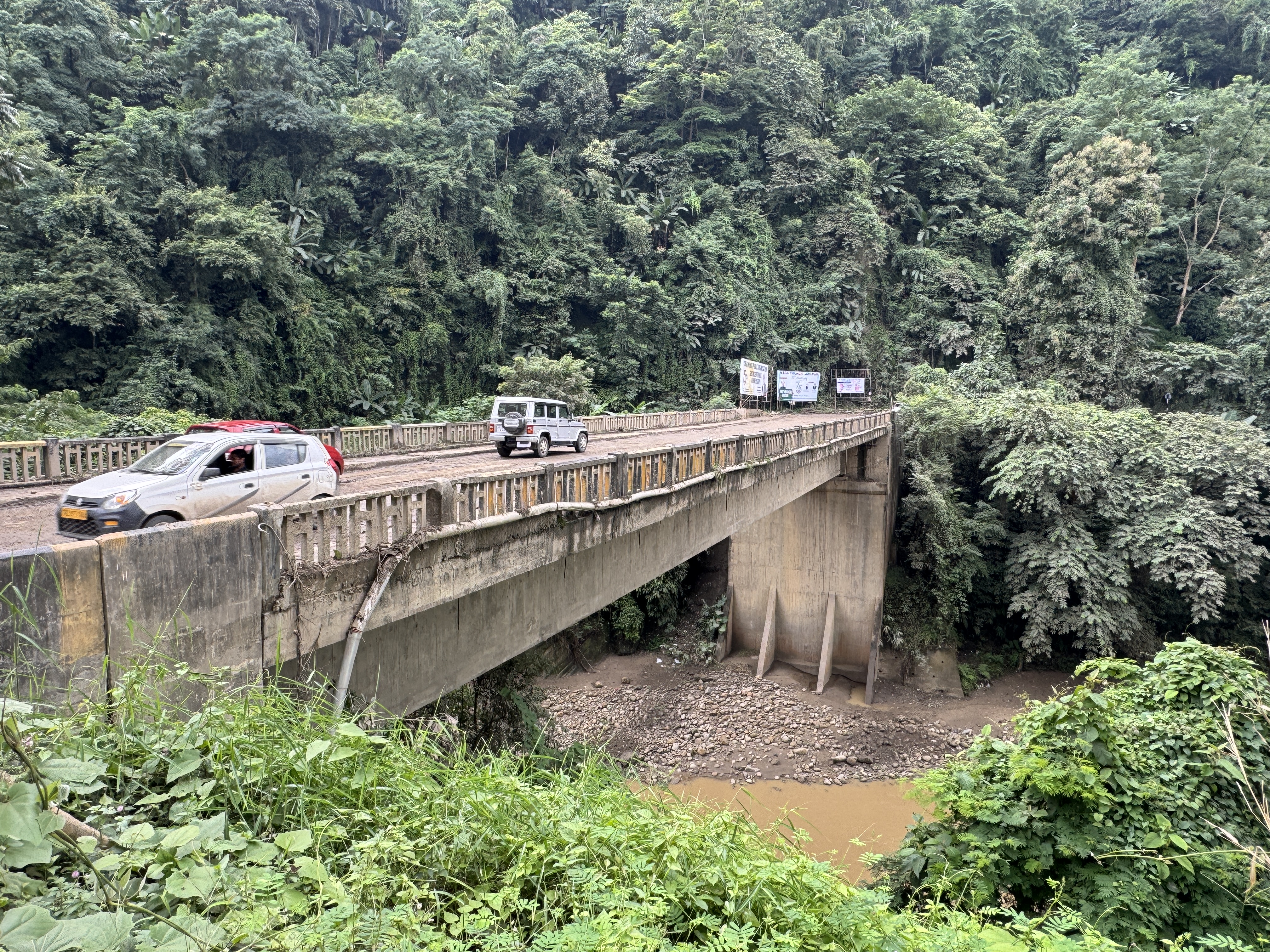
Ten miles east of Dimapur and at the Patkai Bridge over the Chathe River, the straight highway across the Brahmaputra Valley begins writhing. It never stops. The forested mountains look so impenetrable that, until the Japanese invaded during World War II, the British never worried about India's northeastern frontier. Example: a well-known plant explorer, Frank Kingdon-Ward, said in 1926, "If there was any danger of invasion on the north-east frontier of India, at whatever cost, I think a railway would be built immediately. But, as we have seen from the photographs, it is a country in which there is no fear of invasion from beyond the border on a big scale, and we may wait very many years before any railway is built." He was right about the railroad but wrong about the invasion, which he lived long enough to see. (Quoted in J.P. Mills, "The Assam-Burma Frontier," The Geographical Journal, 1926, p. 299.)
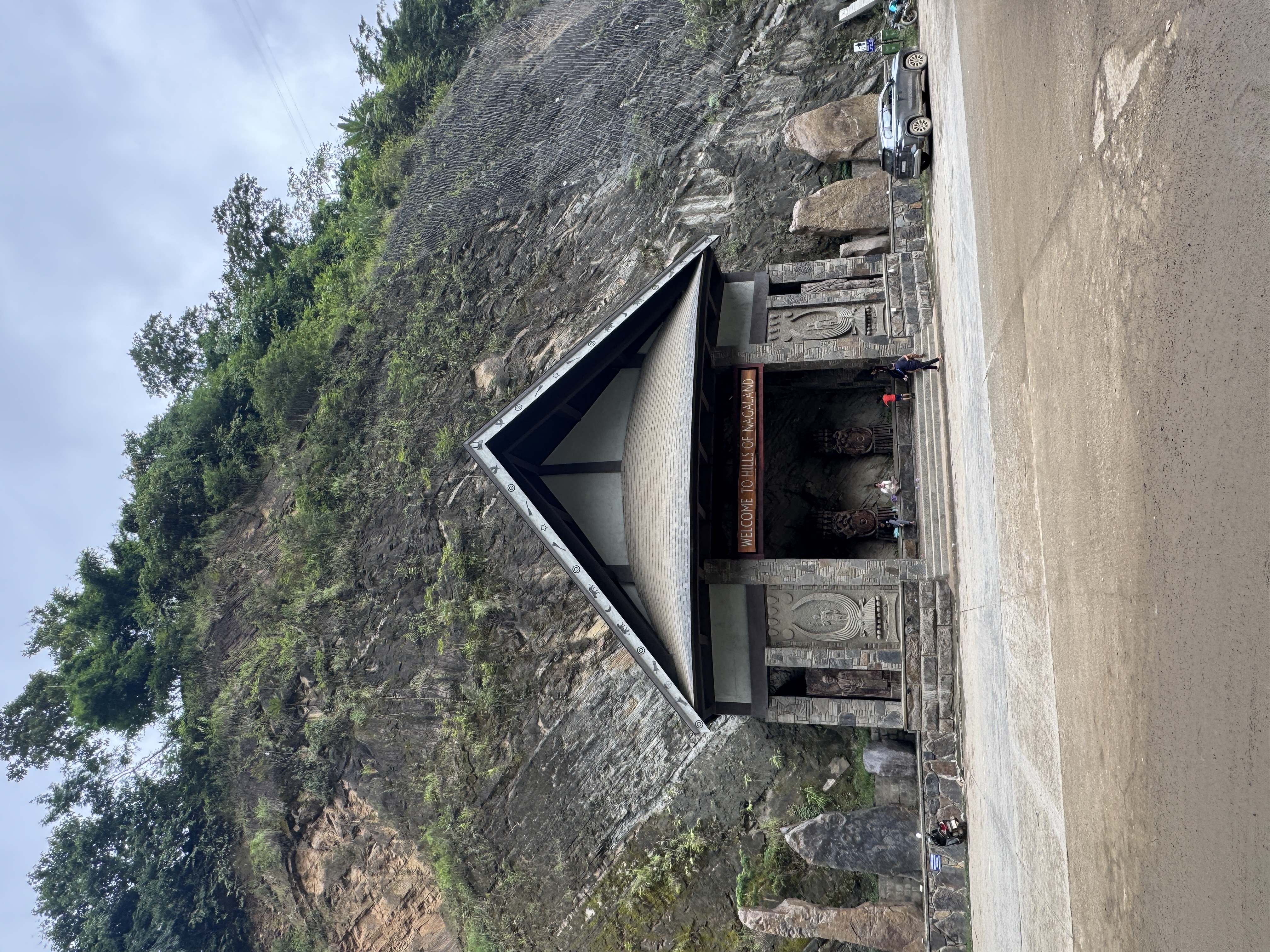
At the bridge there's a tourist-promotion installation. The monoliths to its side are genuine and one of the more intriguing features of the Hills, by which I mean not fully intelligible.
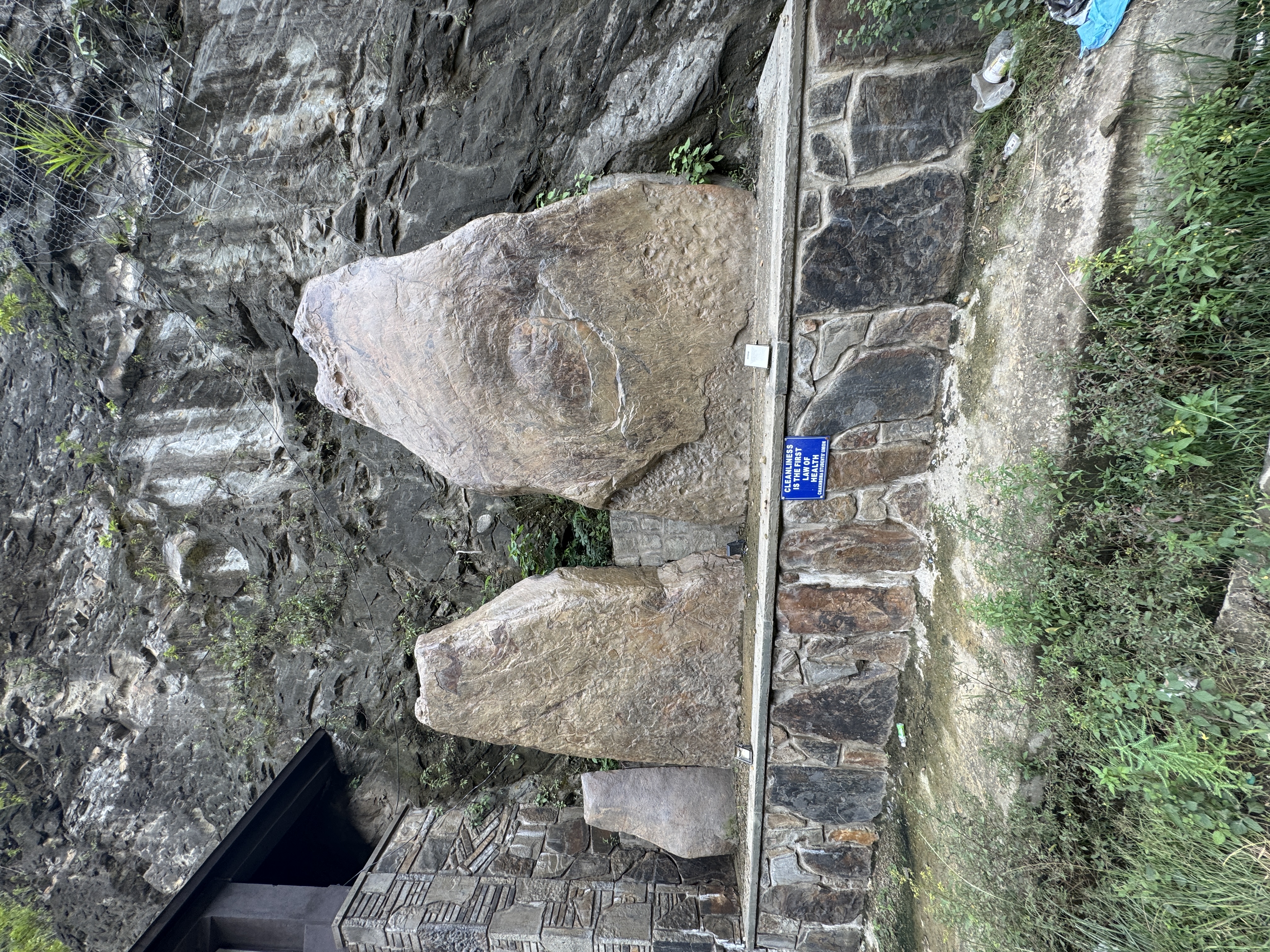
While we're at it, let's put a No Smoking sign in front of the Mona Lisa.
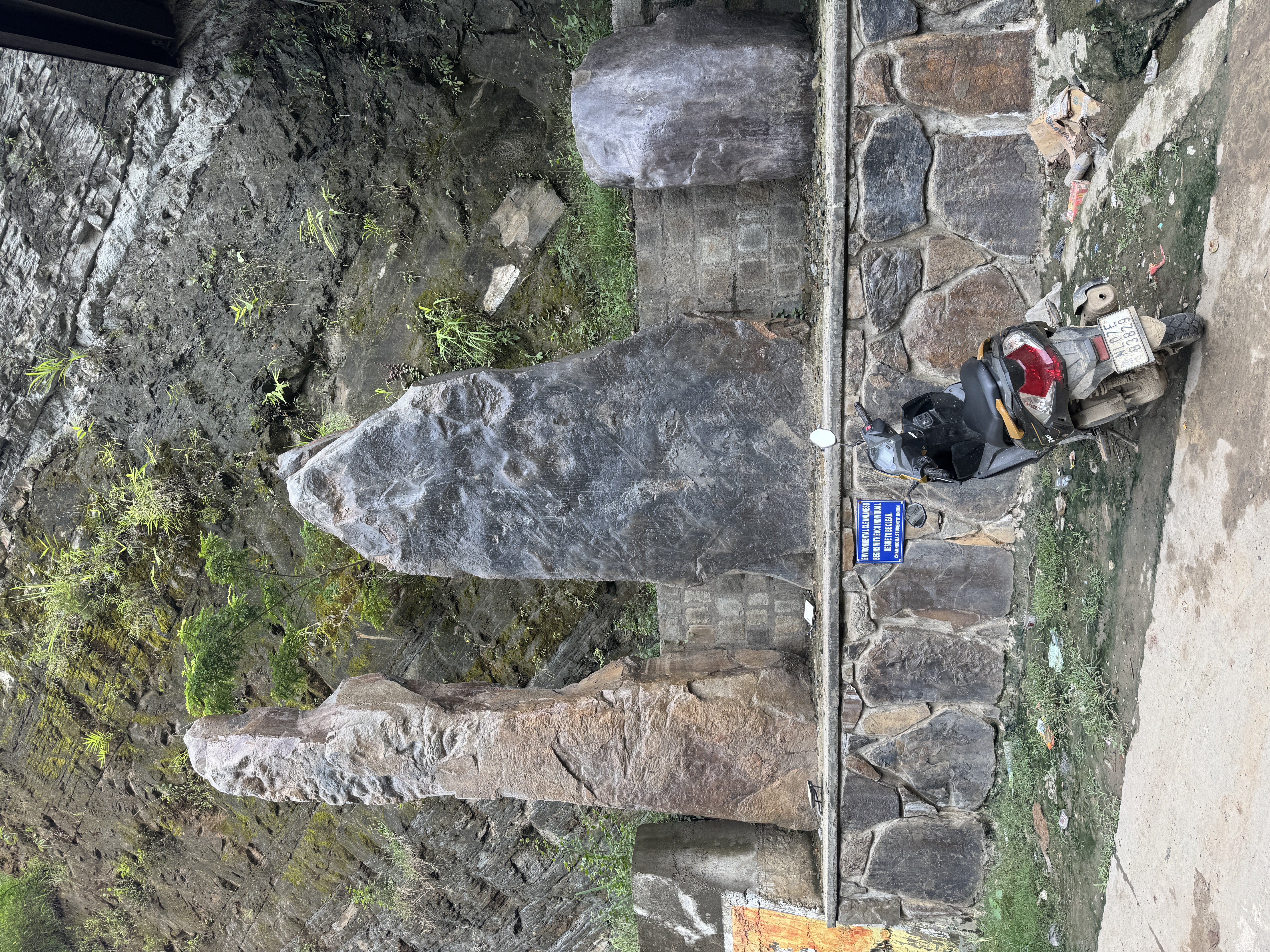
More later about monoliths. (Much later, like at the end.)
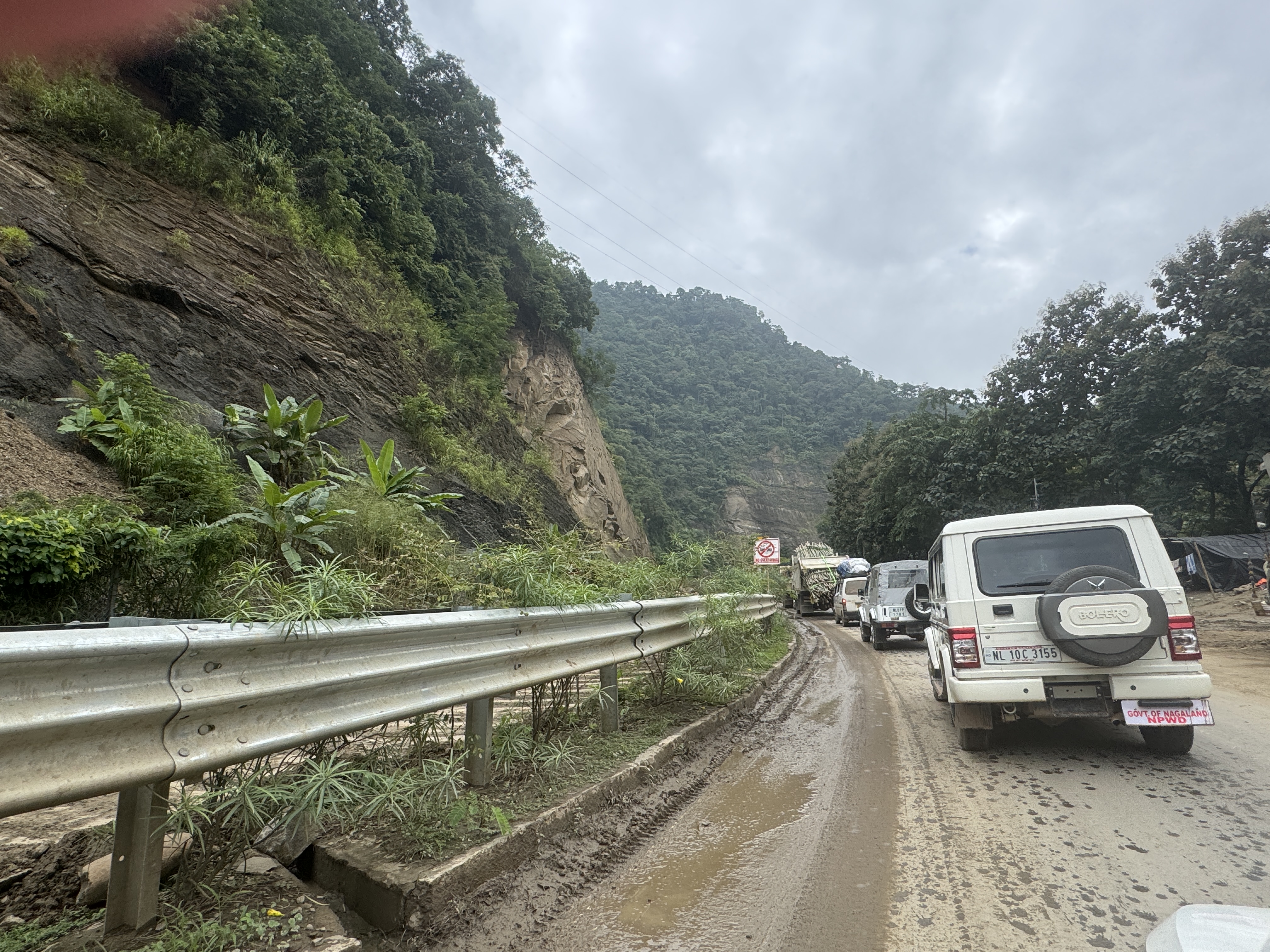
The road from Dimapur to Kohima, now National Highway 29, started out as the Manipur Road, running from Dimapur to Manipur via Kohima. In 1905, only the first 14 miles of the road were "metalled, and the unmetalled portions become almost impassable for wheeled traffic during rainy weather" (B.C. Allen, Gazetteer of Naga Hills, 1905, p. 57). Twenty years later the road had been paved throughout. Here's Murray's Handbook for Travellers in India, 1924 edition: "From Manipur Road (Dimapur) the main road to Manipur (134 m.) runs S.... The road is metalled throughout and fit for light motor traffic except after heavy rain... At Manipur Road there are a D.B. [district bungalow] and small bazar, and at Kohima (46 m.) supplies are also obtainable, but these are the only two places where anything can be procured.... Motor owners can make the trip comfortably in two days, halting for the night in Kohima" (pp. 443-444). Here's a record of someone taking the road in the 1930s: "After showing my special pass I mounted the front seat of a scarlet motor lorry, the Royal Mail to Kohima, forty-eight miles distant" (Marguerite Milward, Artist in Unknown India, p. 214). It took her four hours to make the trip, not much longer than the three it took me.
**
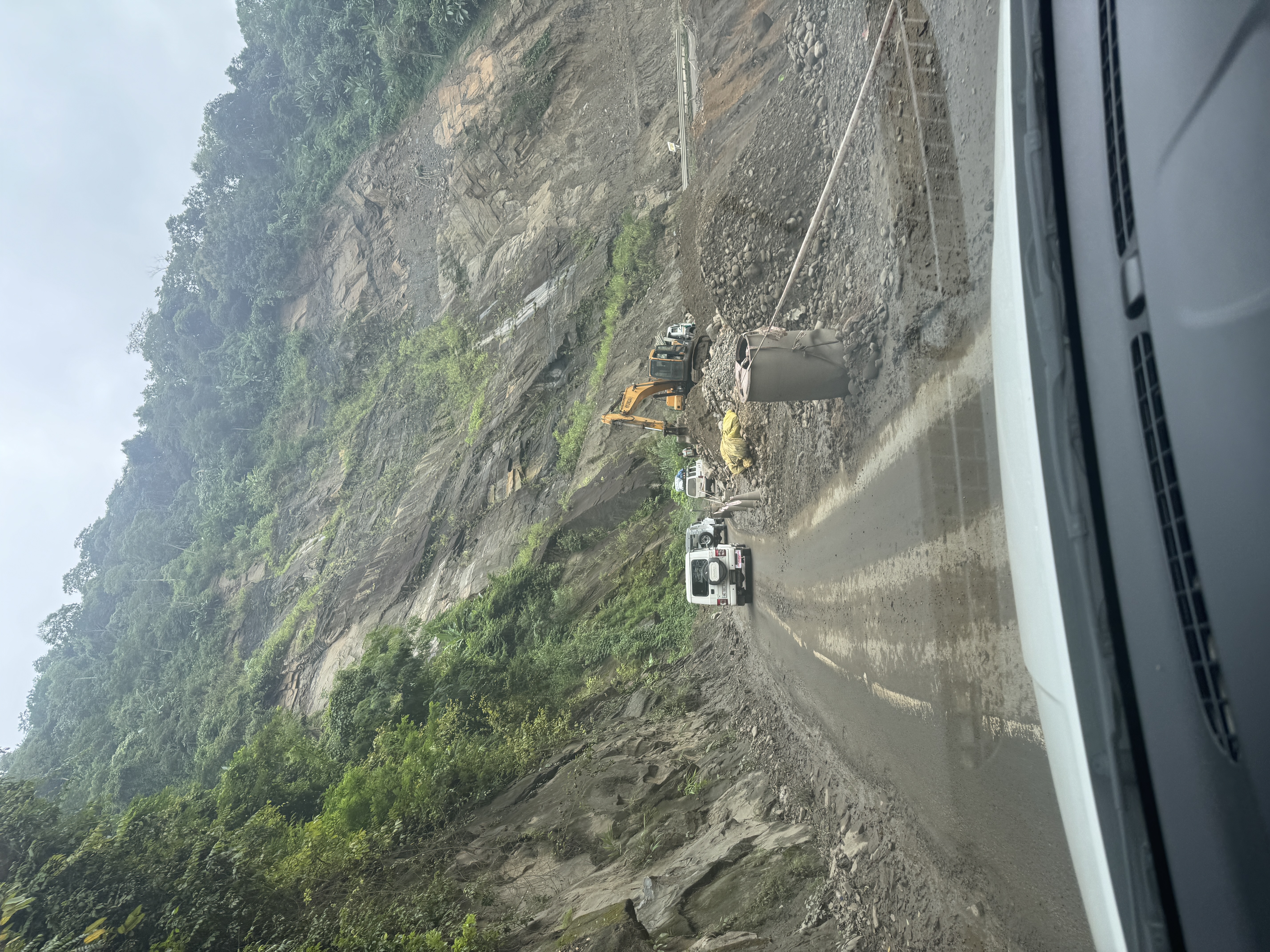
The road was quickly improved in the 1940s in response to the advancing Japanese, but it has always been plagued by landslides. "Once from a hilltop after some heavy rain I could count no fewer than thirty-six new landslips on the opposite side of the valley..." (J.P. Mills, "The Assam-Burma Frontier," in The Geographical Journal, 1926, p. 294).
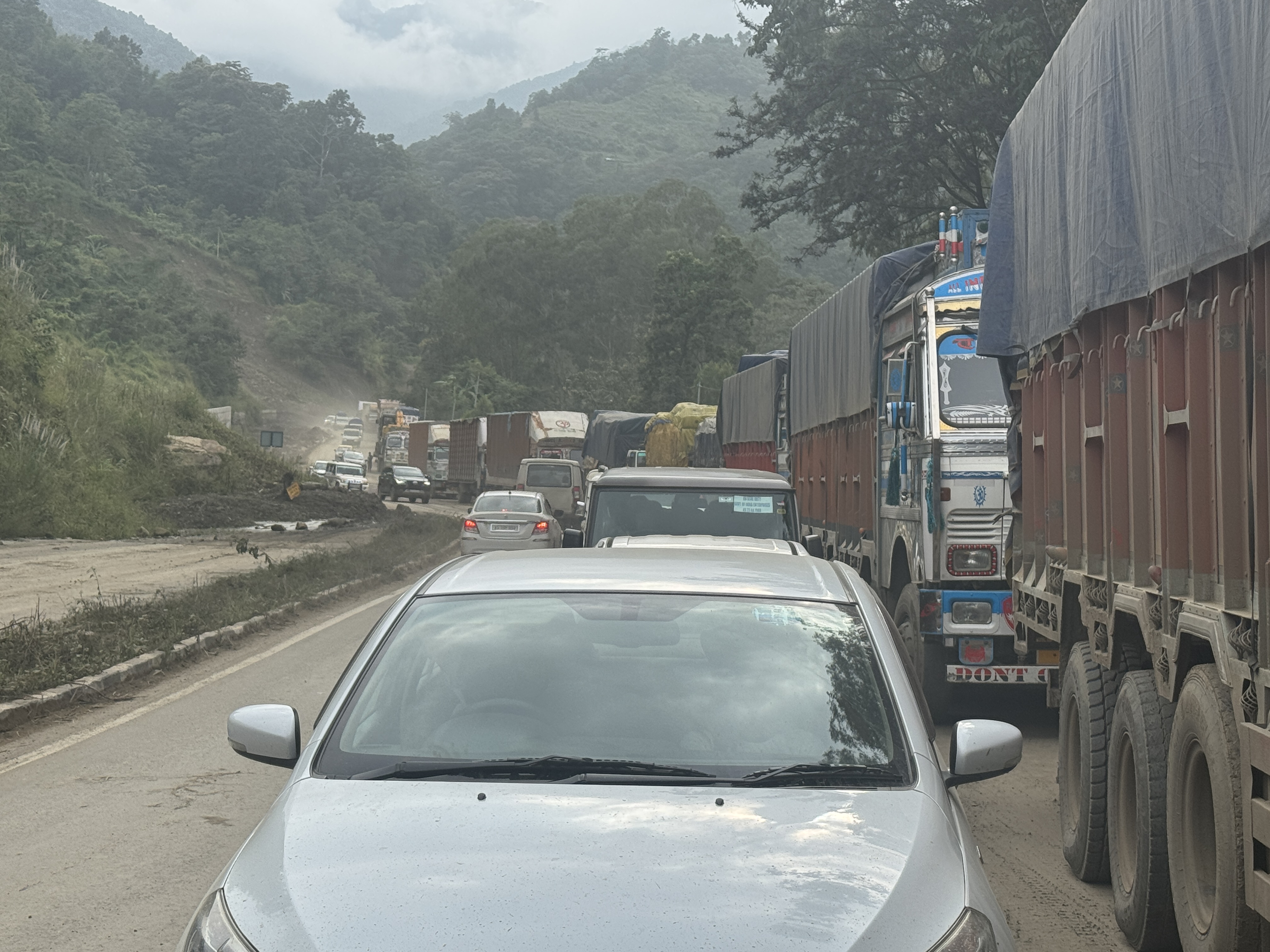
Here's a jam caused by a slide that reduced traffic to a single lane, but that's not the only reason for the jam. Kohima traffic is so intense that trucks are excluded from town during daylight. And so they wait.
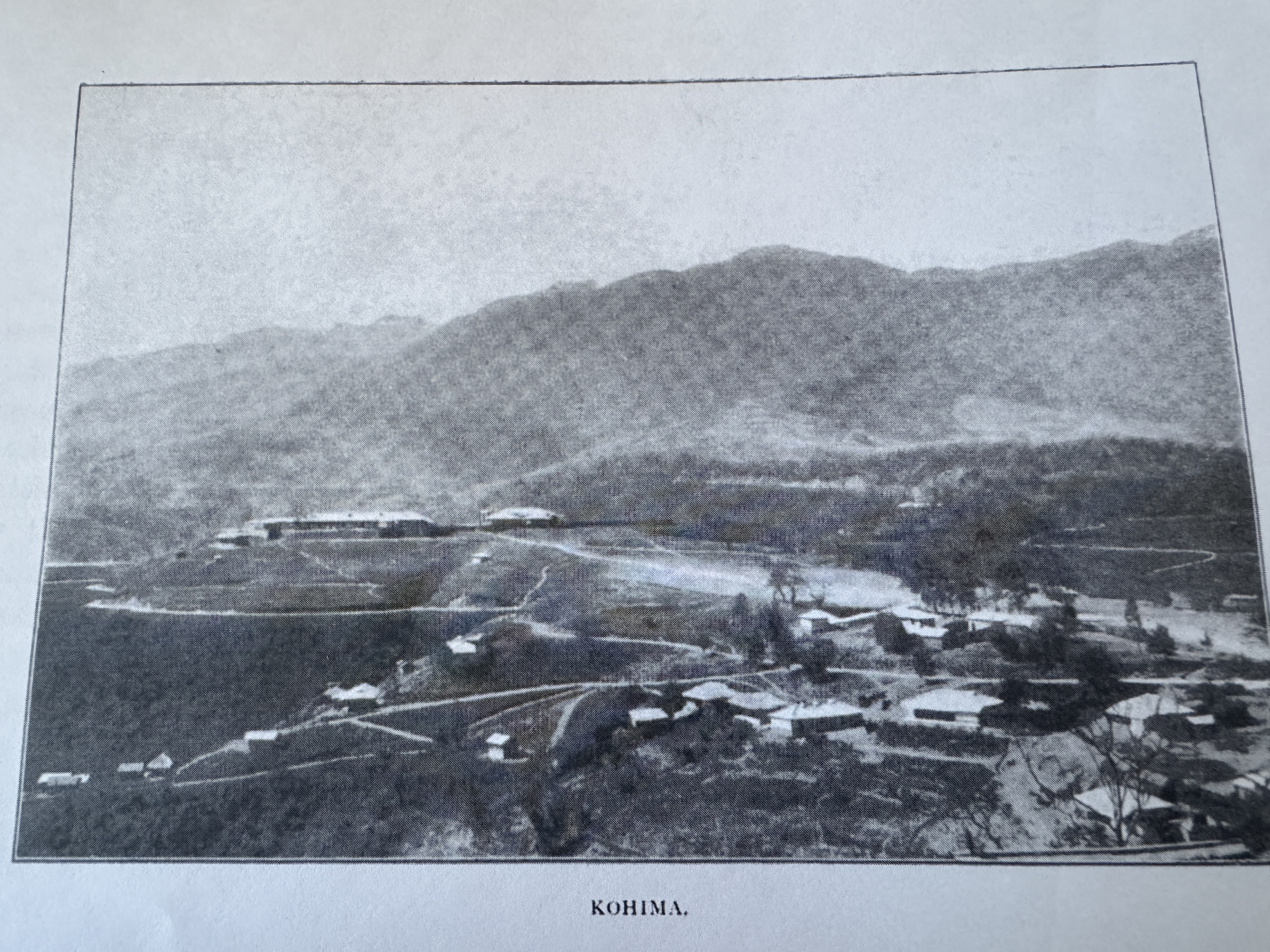
In 1878 the British chose Kohima as the heaquarters from which they would administer the Naga Hills. (Until then, and from 1866 when they decided they had to take charge of the Hills, their base had been at Chumoukedima, aka Samaguting, at the western toe of the Hills.) The photograph shows the British settlement about 1900, all neatly roofed with the corrugated metal that is now ubiquitous. The station stood apart from, and about half a mile south of, the Naga village of Kohima. (Photo from B.C. Allen, Assam District Gazetteers, Vol 9, Naga Hills and Manipur, 1905, p. 33.)
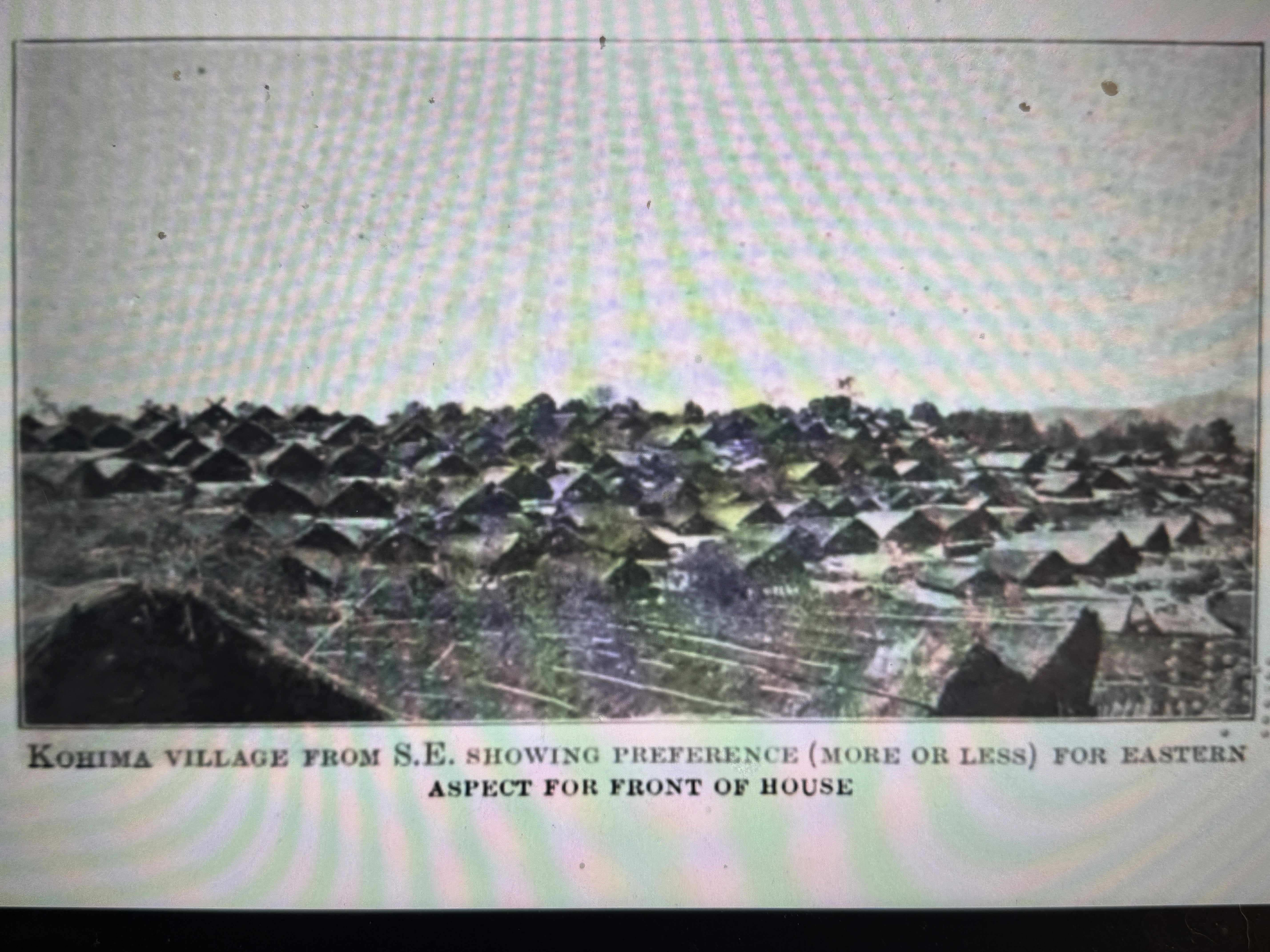
Here's the Naga village. (Photograph from J.H. Hutton, The Angami Nagas, 1922, p. 72.) Naga buildings rarely got old, partly because thatch doesn't last forever and partly because thatch burns. Some Kohima villagers had joined in an uprising against the British in 1850, for example. (This was even before the British reluctantly incorporated the Hills into the Indian Empire.) The result, in the words of a British officer, was that "Kohima, which had sent a challenge, was destroyed on February 11, 1851. In this last engagement over three hundred Nagas were killed, and our prestige thoroughly established" (James Johnstone, My Experiences in Manipur and the Naga Hills, p. 161).
Fast forward nearly a century. "In Kohima, the biggest collection of houses in the administrative area of the Naga Hills, not one house was left standing after the Japanese invasion... the timber normally available for replacing annually a proportion of the house accommodation is non-existent or destroyed... the problem of providing thatch is even more difficult to solve" (J.H. Hutton, "Problems of Reconstruction in the Assam Hills," Presidential Address to the Royal Anthropological Institute, Journal of the Institute, 1945, p. 1). "Kohima is now a ruin. Nothing remains but a cemetery of Allied soldiers who helped to stem the Japanese advance toward Delhi" (Marguerite Milward, Artist in Unknown India, 1948, p. 21). "I was one of the first to return. The entire place was strewn with corpses, rubble..." (Langalang, headmaster of the Kohima High School, quoted by Jelle J.P. Wouters in "Difficult Decolonization: Debates, Divisions, and Deaths Within the Naga Uprising, 1944-1963," Journal of North East India Studies, 2019, p. 6).
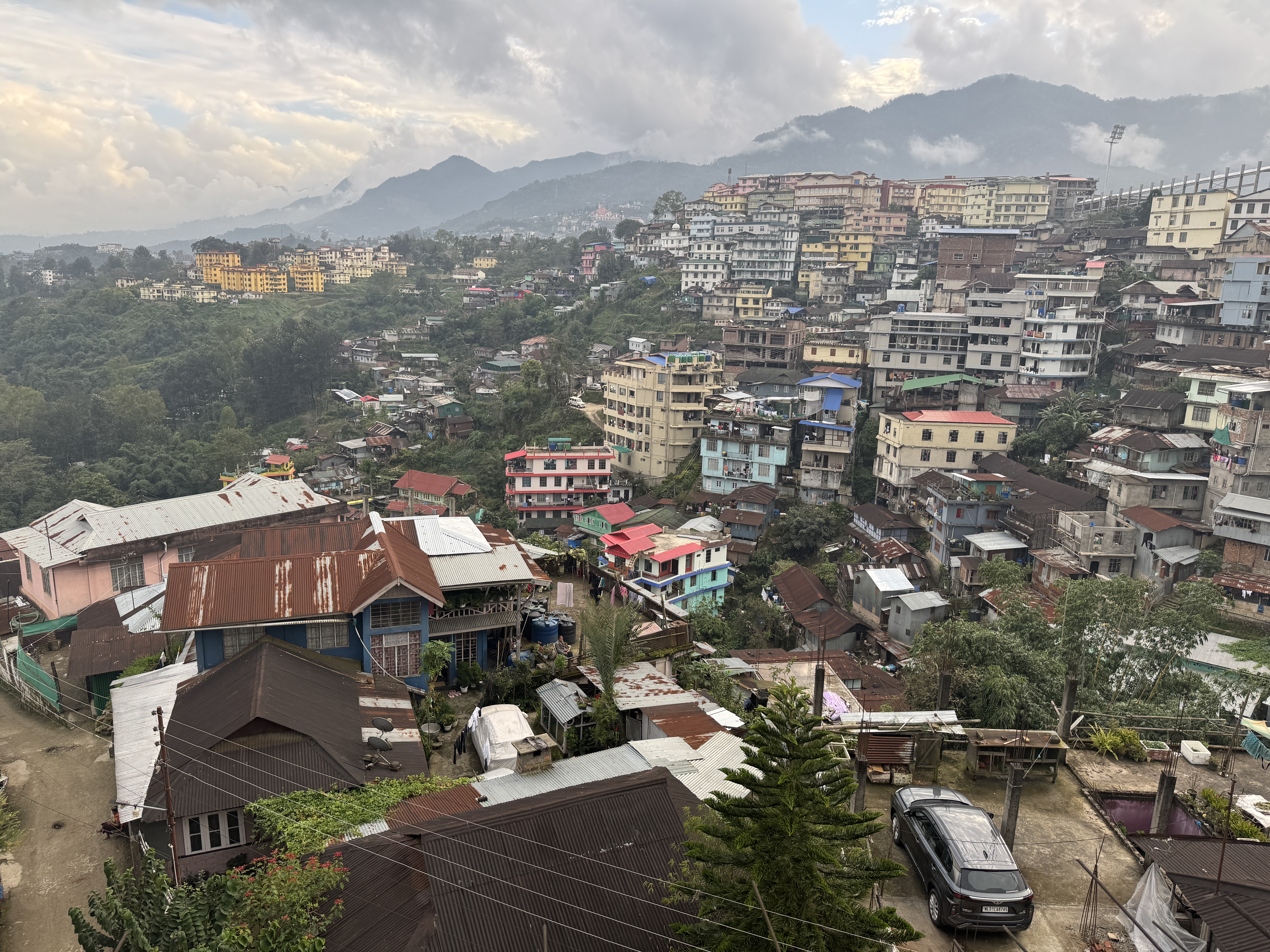
This time around, the materials chosen were harder to burn, though more vulnerable to earthquakes.
The Nagas themselves chose Kohima as the capital of the new state of Nagaland, carved out of Assam in 1963. Since then, the town's population has risen to about 140,000 people spread over four miles of a ridge.
The view here looks south along the east flank of that ridge. The yellow buildings at the upper left are part of an Assam Rifles military base, here as a reminder that the Nagas should forget the longstanding dream of an independent Nagaland. The upper corner includes a light pole illuminating the Kohima soccer field ("local ground" in the lingo).
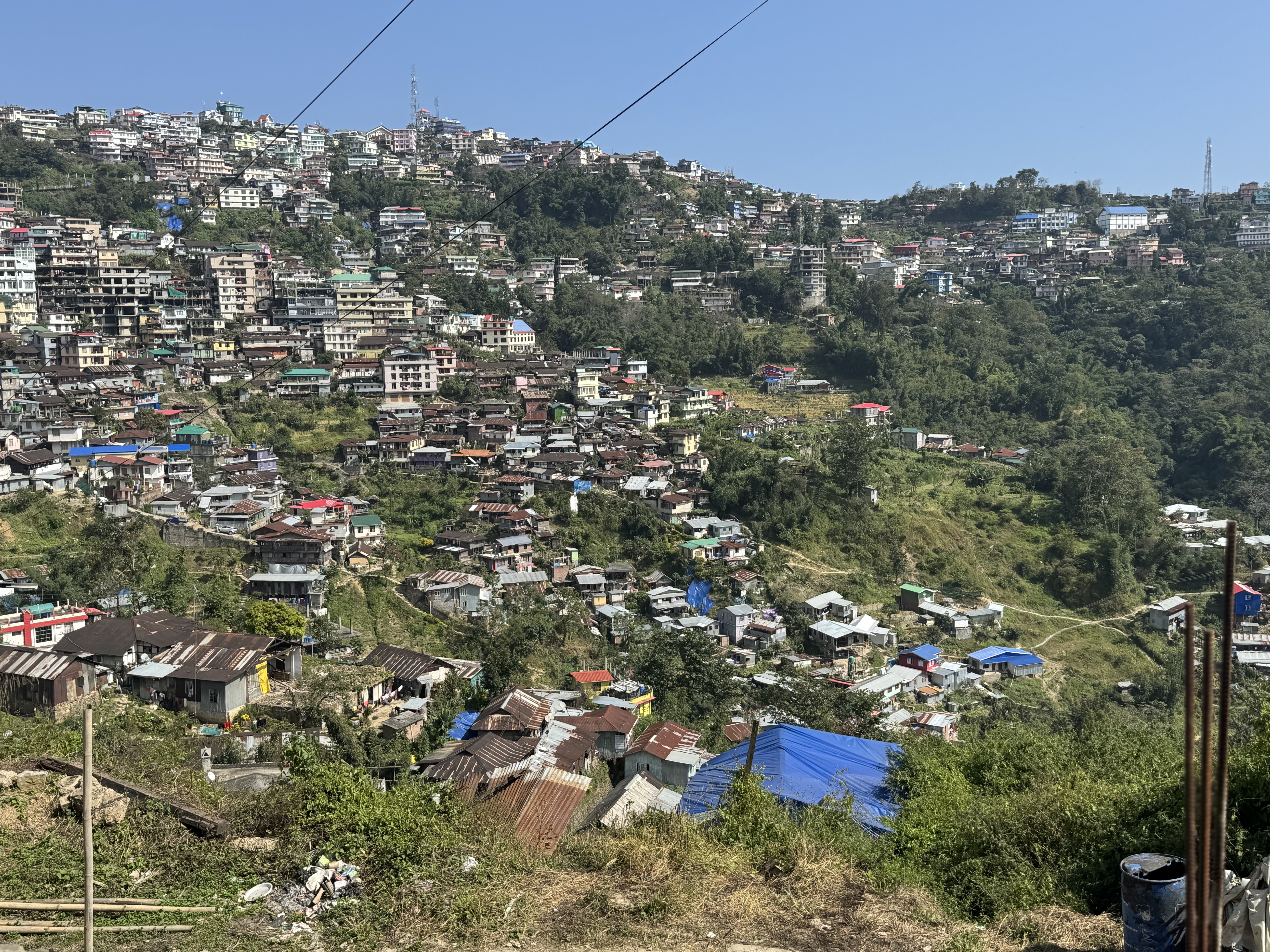
The same slope, looking the other way and suggesting that there is still room to expand. Land is very expensive.
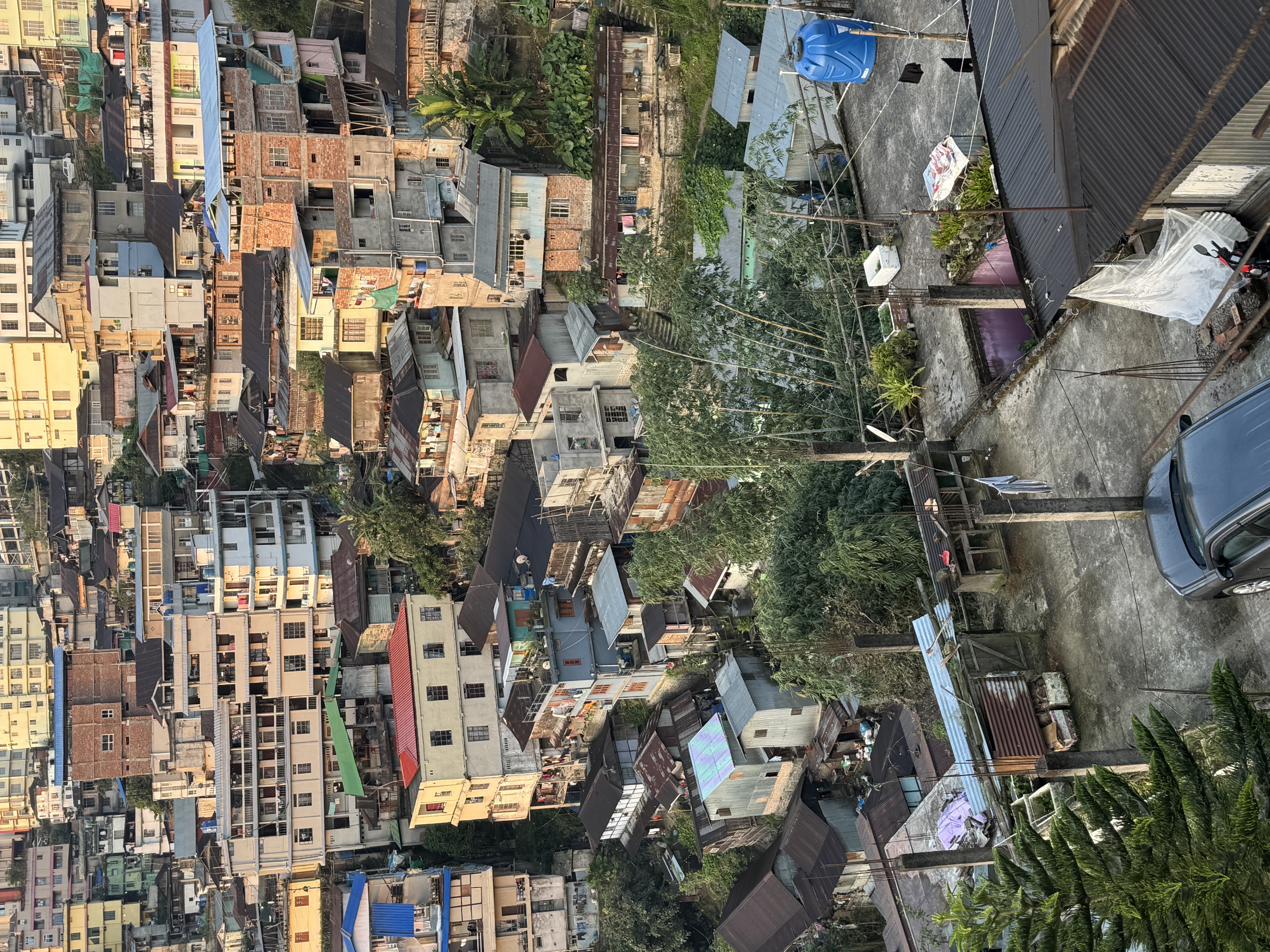
A patch of the east slope.
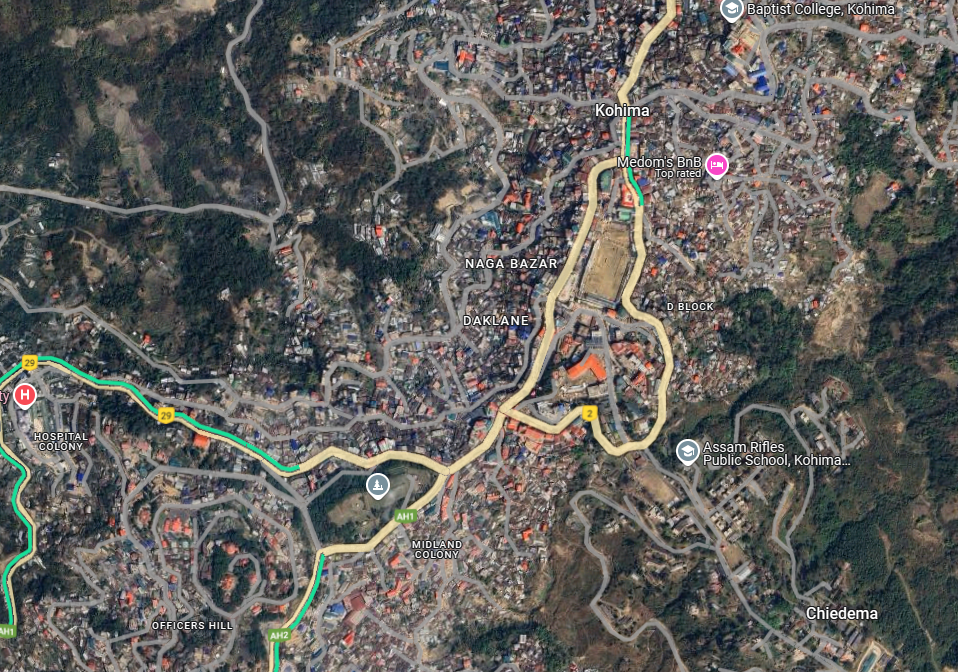
The football ground is prominent on the ridge summit. So is the Commonwealth War Graves Cemetery, which overlaps the old British settlement. The Naga village to the north is helpfully labeled.
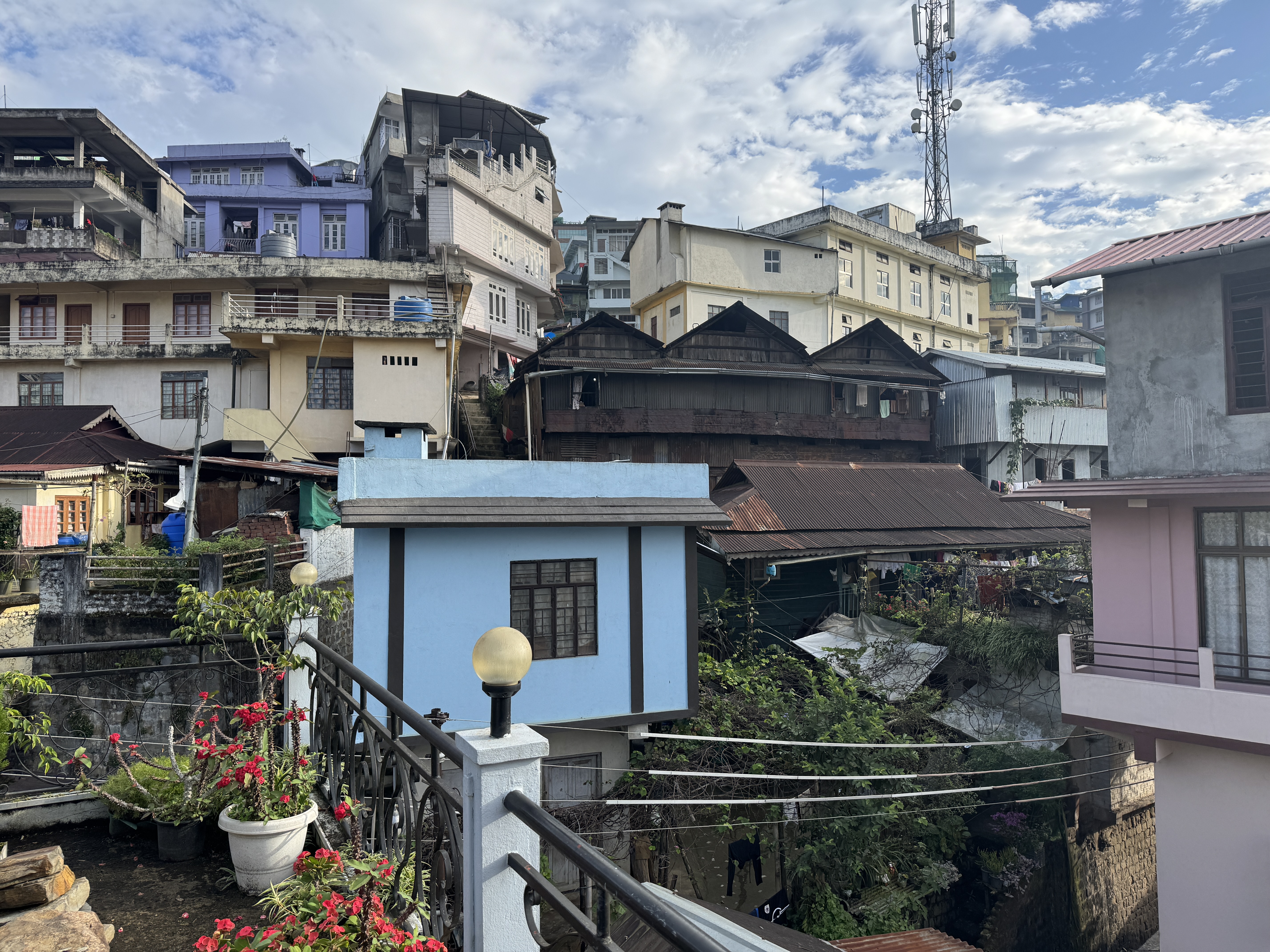
Nothing is prewar, including the rusty building. Building codes? None.
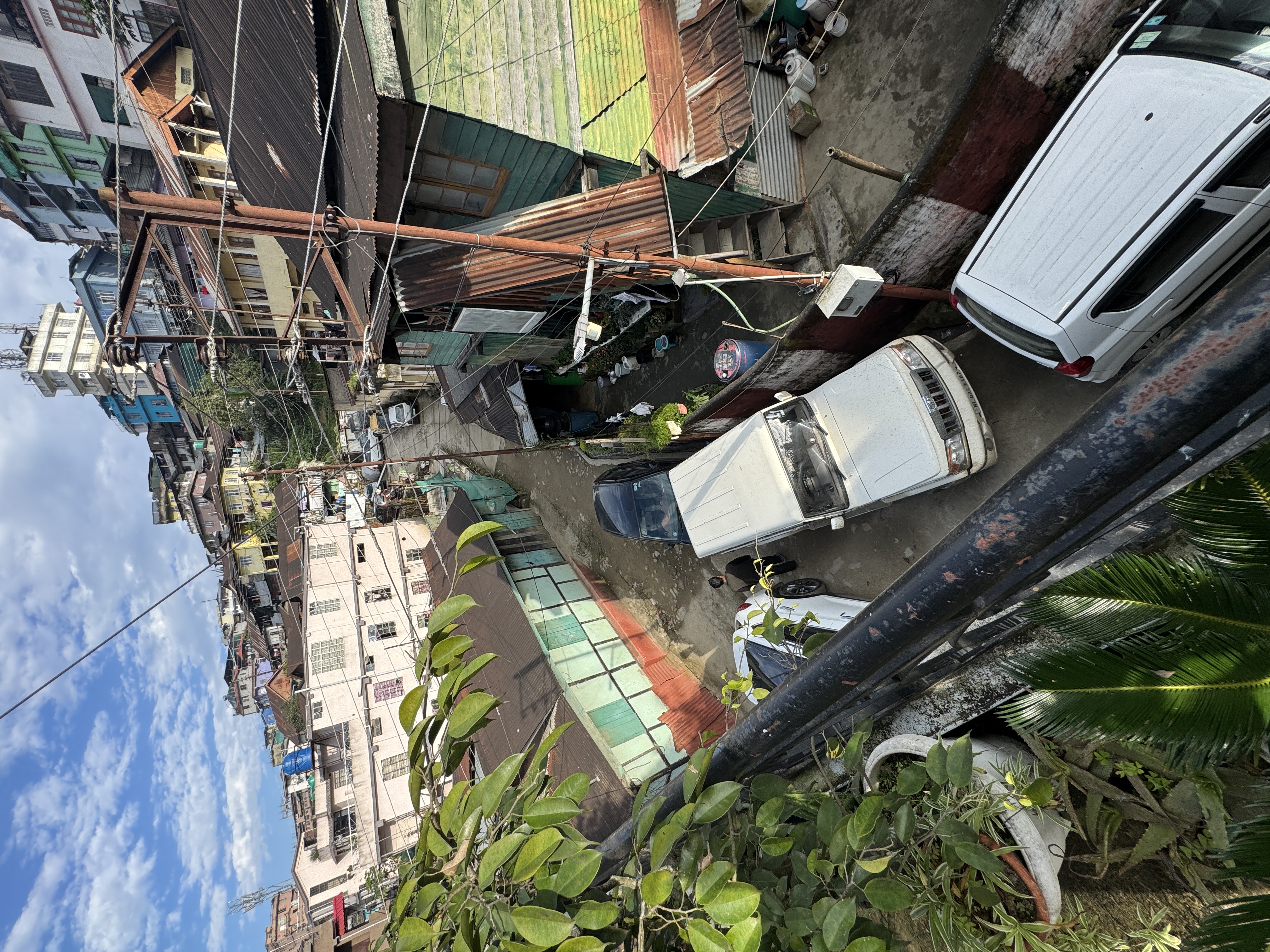
Getting around Kohima is tricky, partly because of congestion and partly because the roads are narrow.
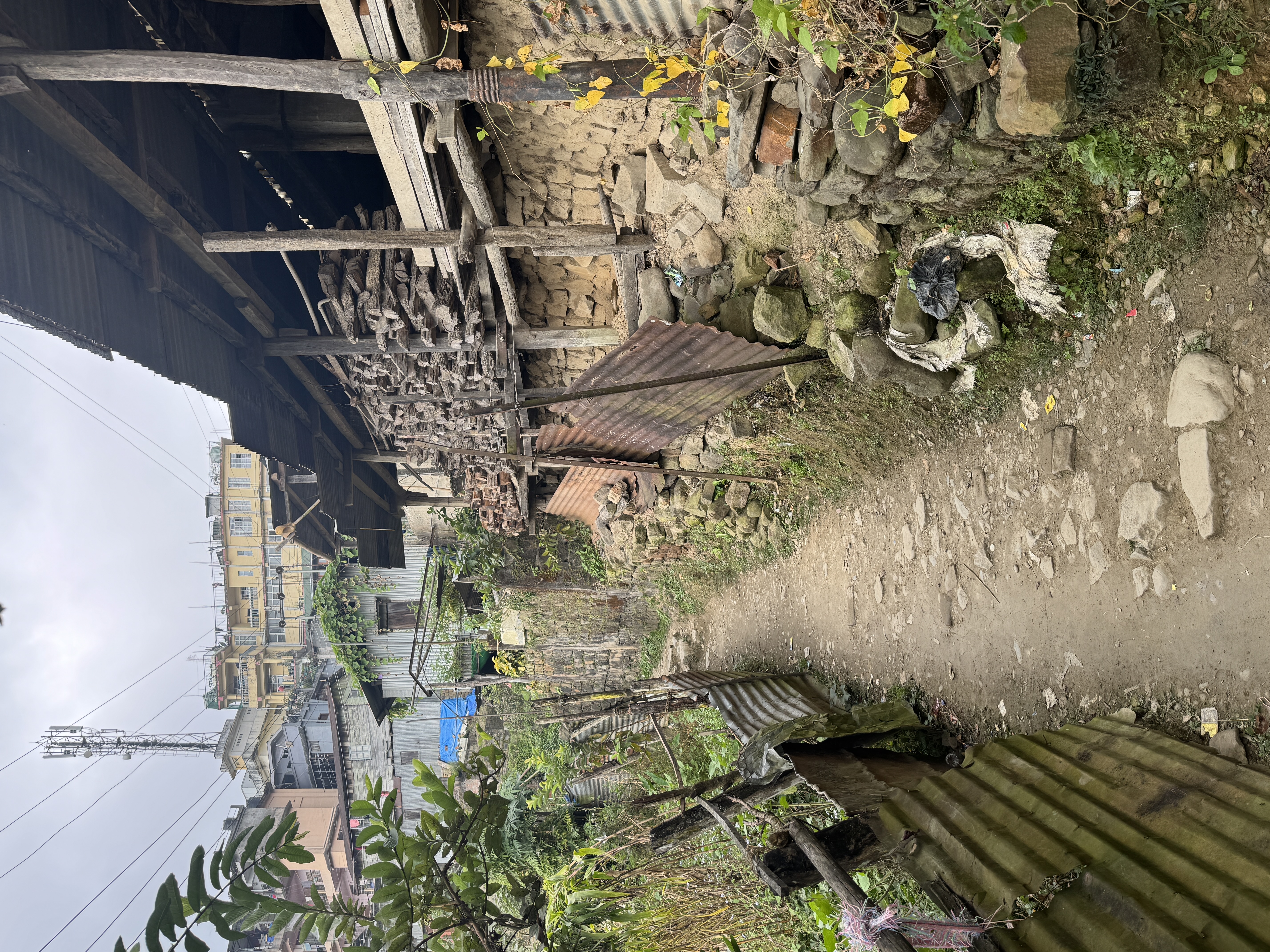
Many houses can only be reached by paths running along contours.
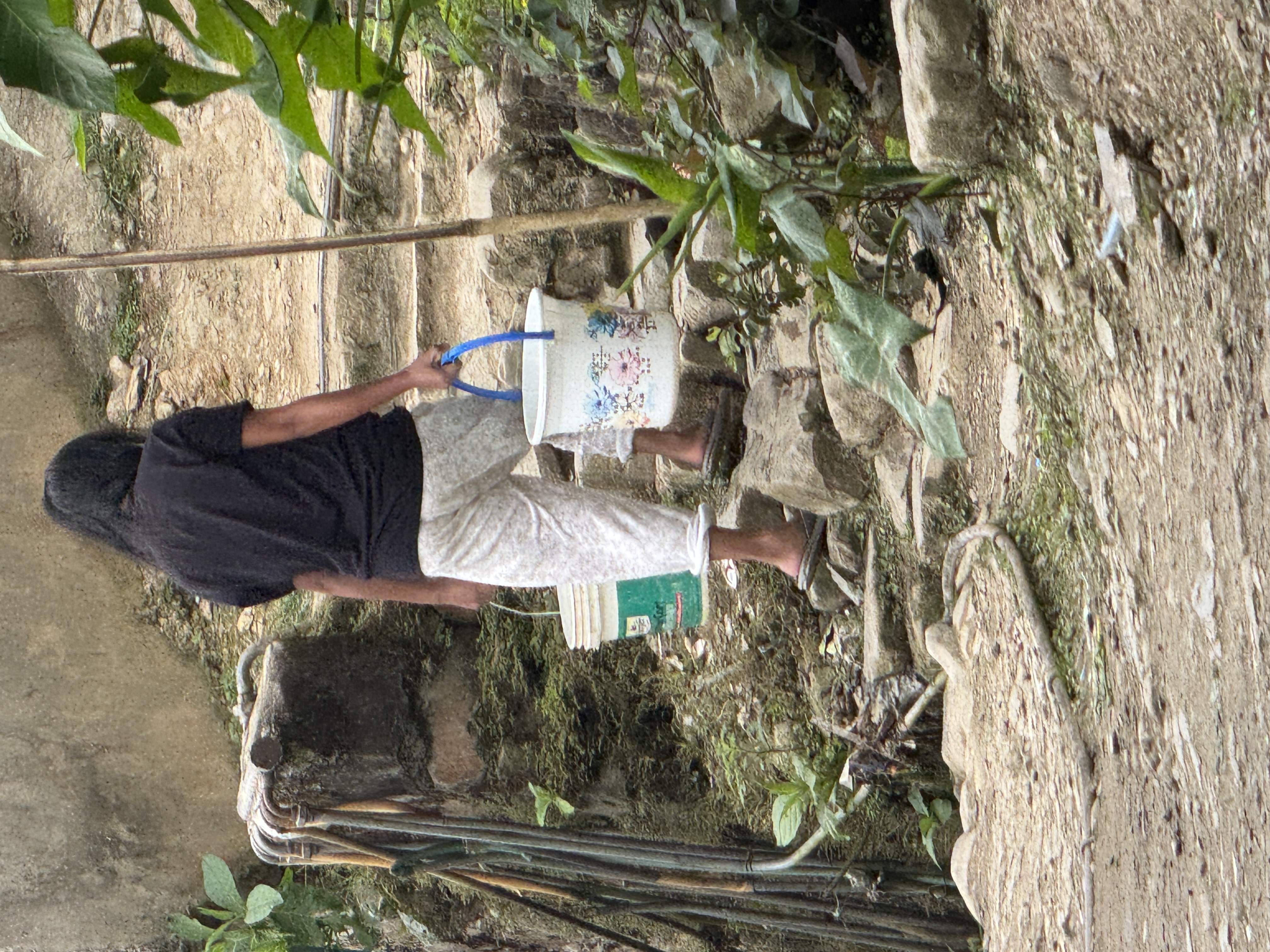
Some houses have running water; others don't.
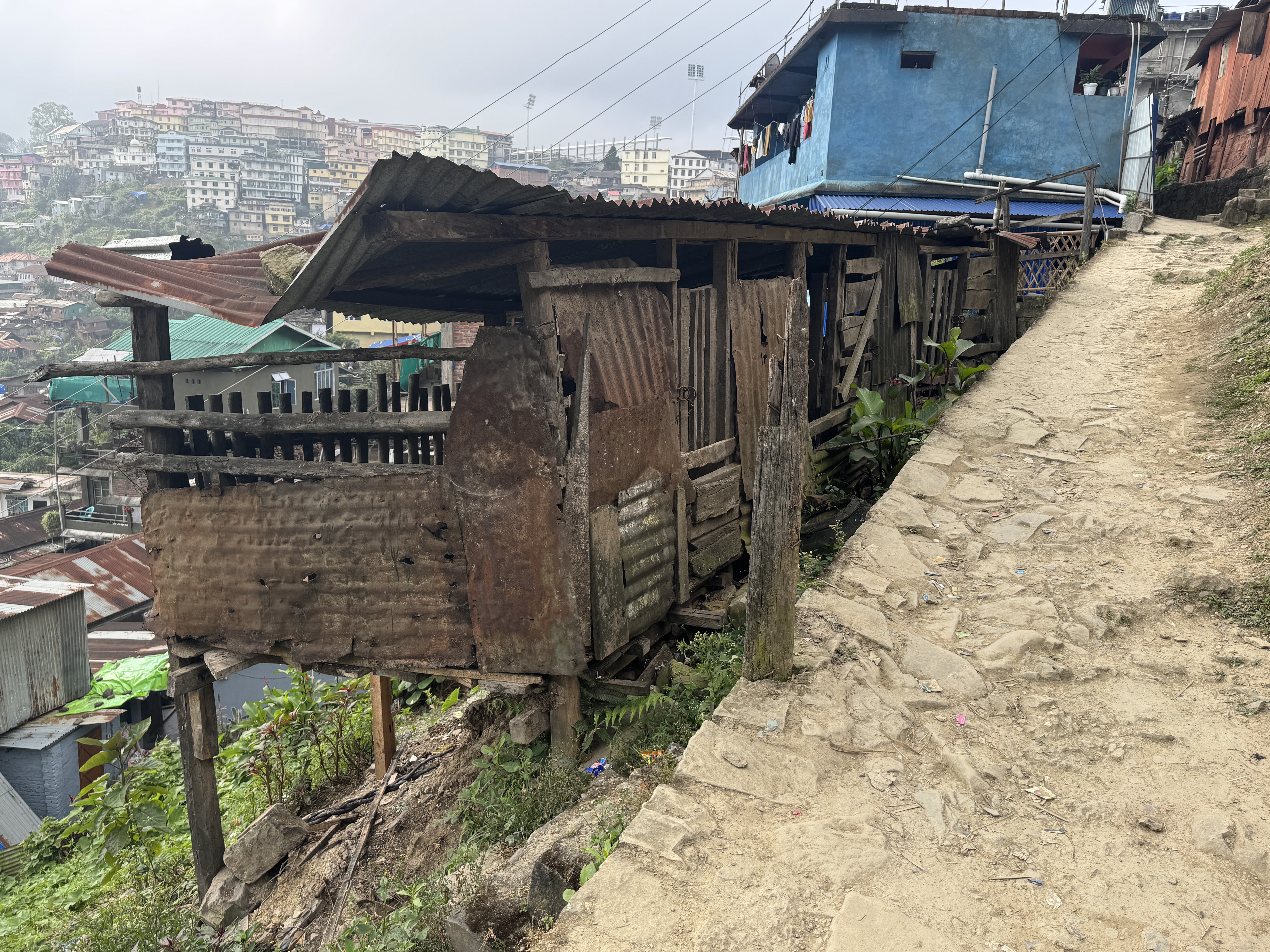
"Pigs are kept by all but the very poorest Angamis" (Hutton, The Angami Nagas, p. 81). That's no longer true, but there's still lots of pigs. You could hear them here and smell them.
This is probably the time to explain that the Naga Hills were the home of many tribes--some say 15 or 20, some even more--each with their own name and language. The Angamis were one of the larger tribes and are well known to outsiders partly because the Angamis caused the British a lot of trouble but also because their territory included Kohima. The tribes had little if any collective identity as "Nagas" until Robret Boileau Pemberton, a British officer, used the term in 1835 and wrote that this was the term applied to the tribes by Bengalis. The term was in common use later in the century, but more by outsiders than by the tribes themselves.
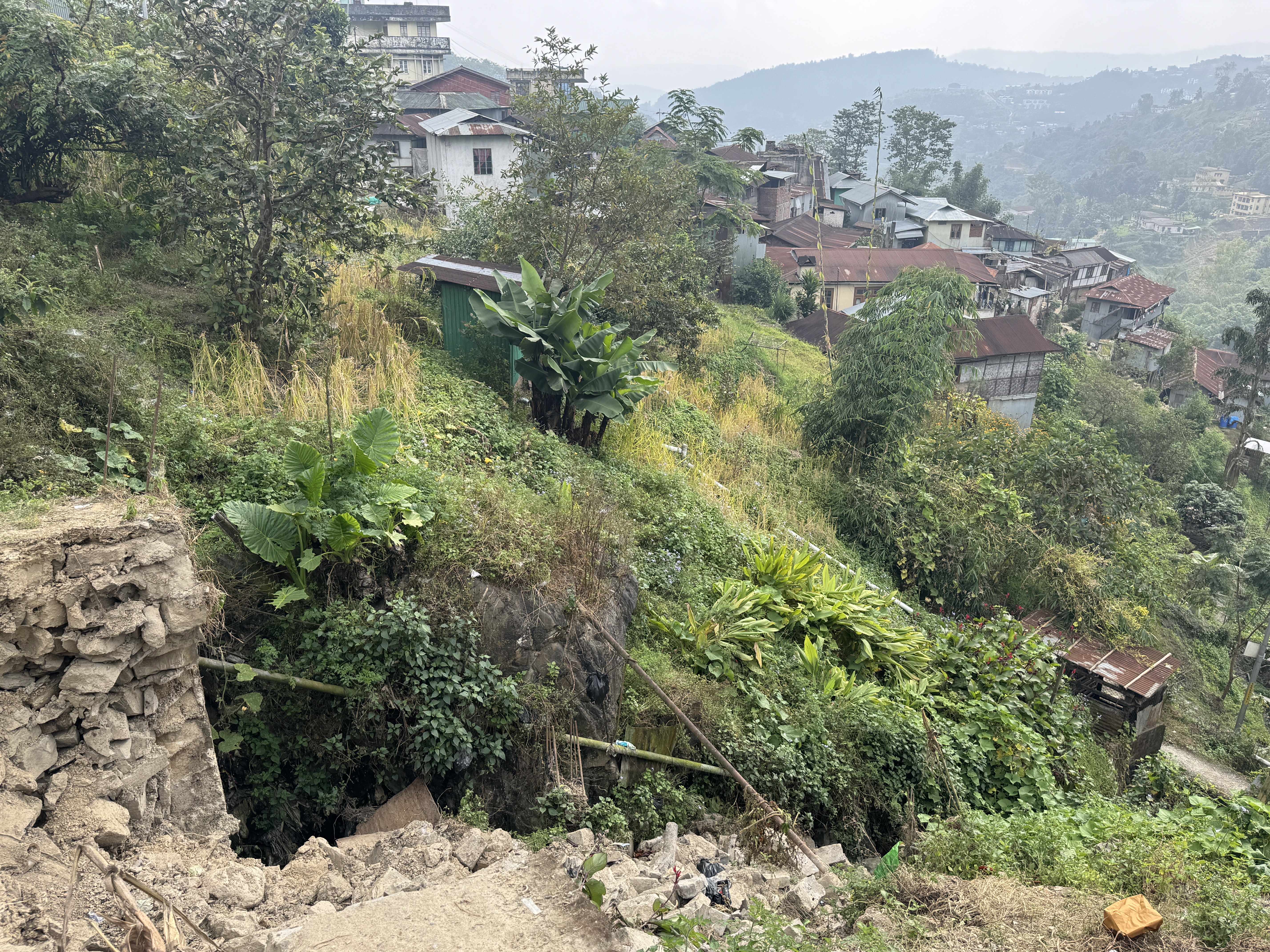
A path circumvents a gully.
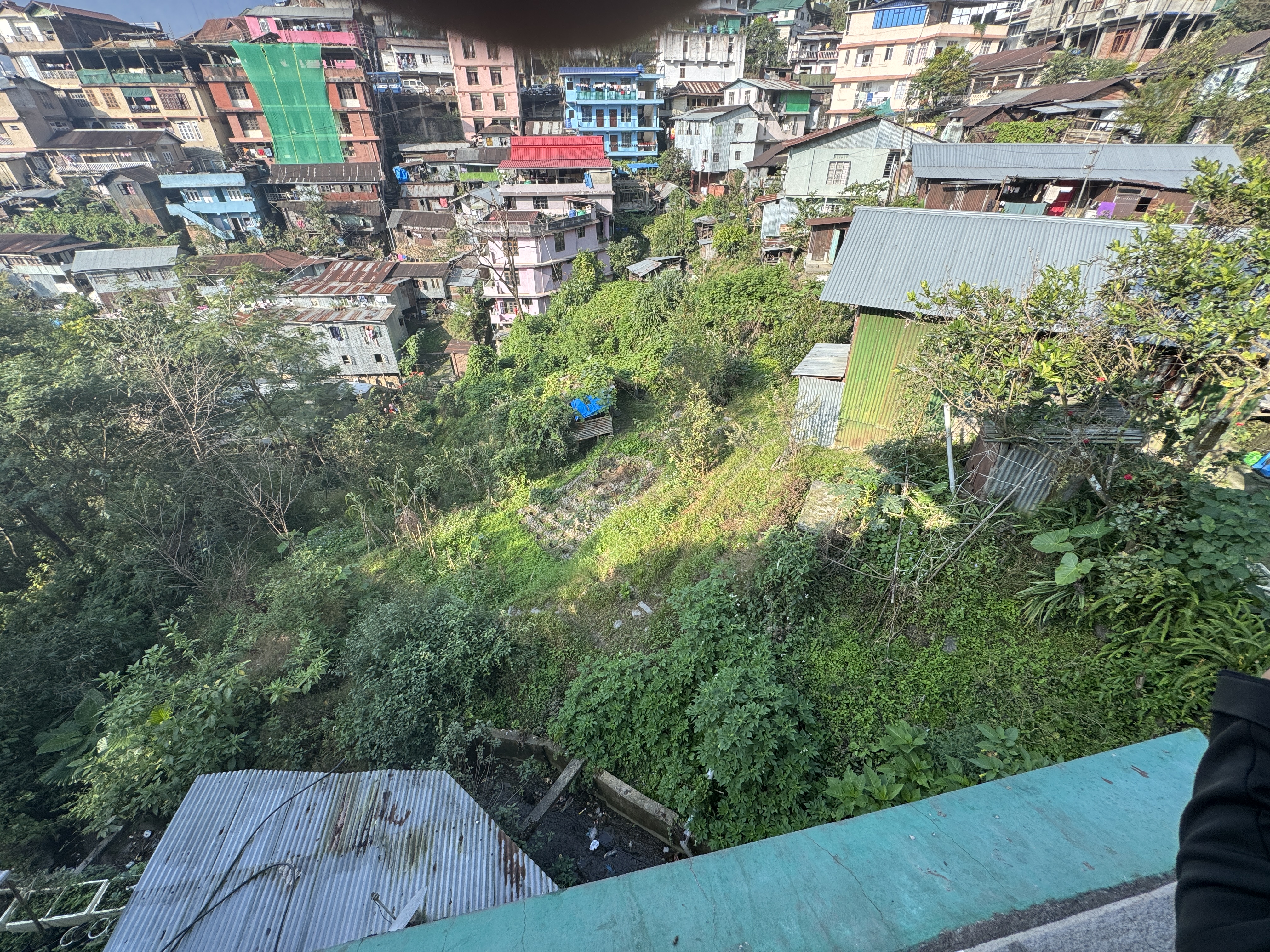
A bit of green space is put to agricultural use.
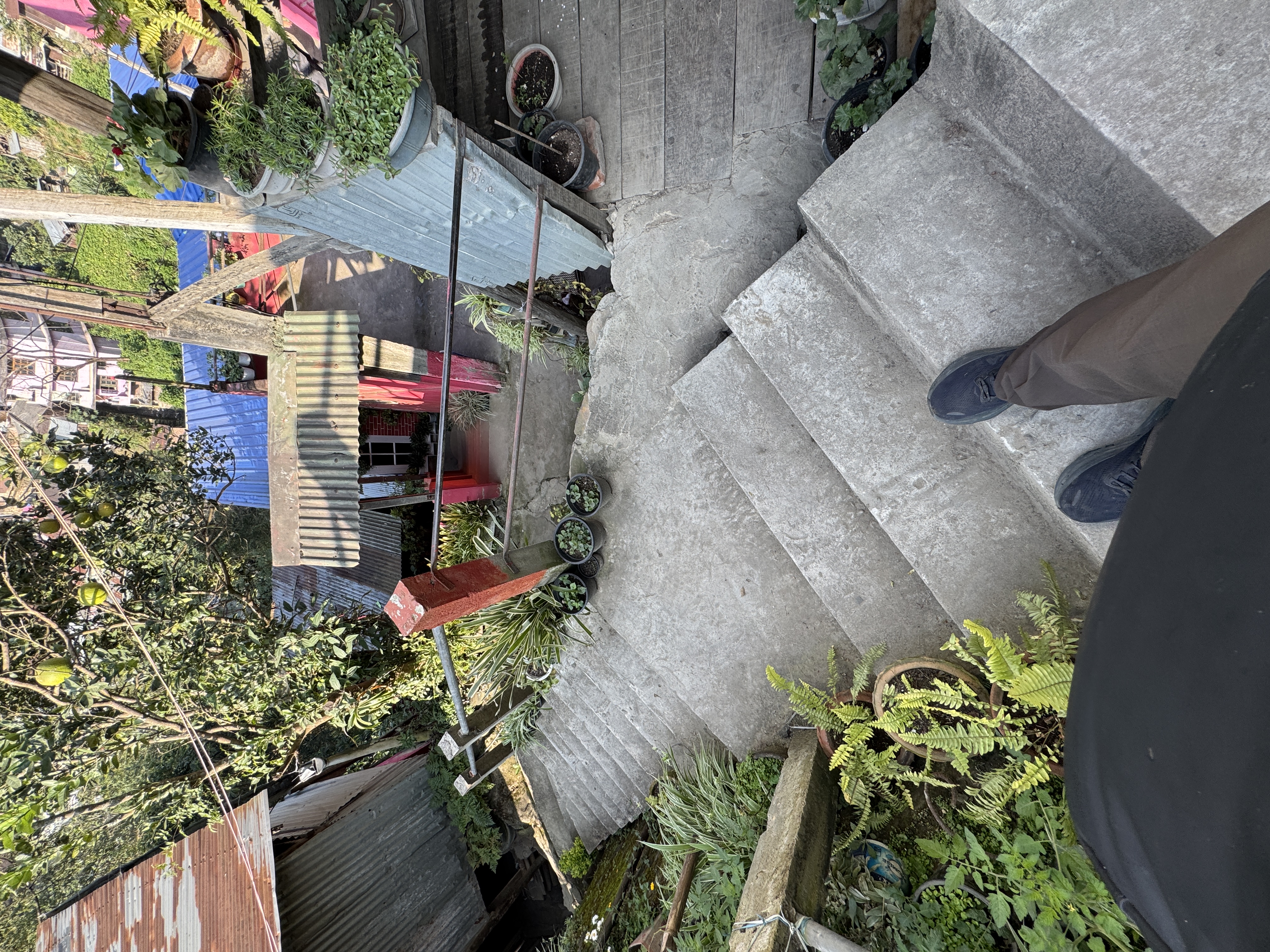
Vertical traffic uses steps.
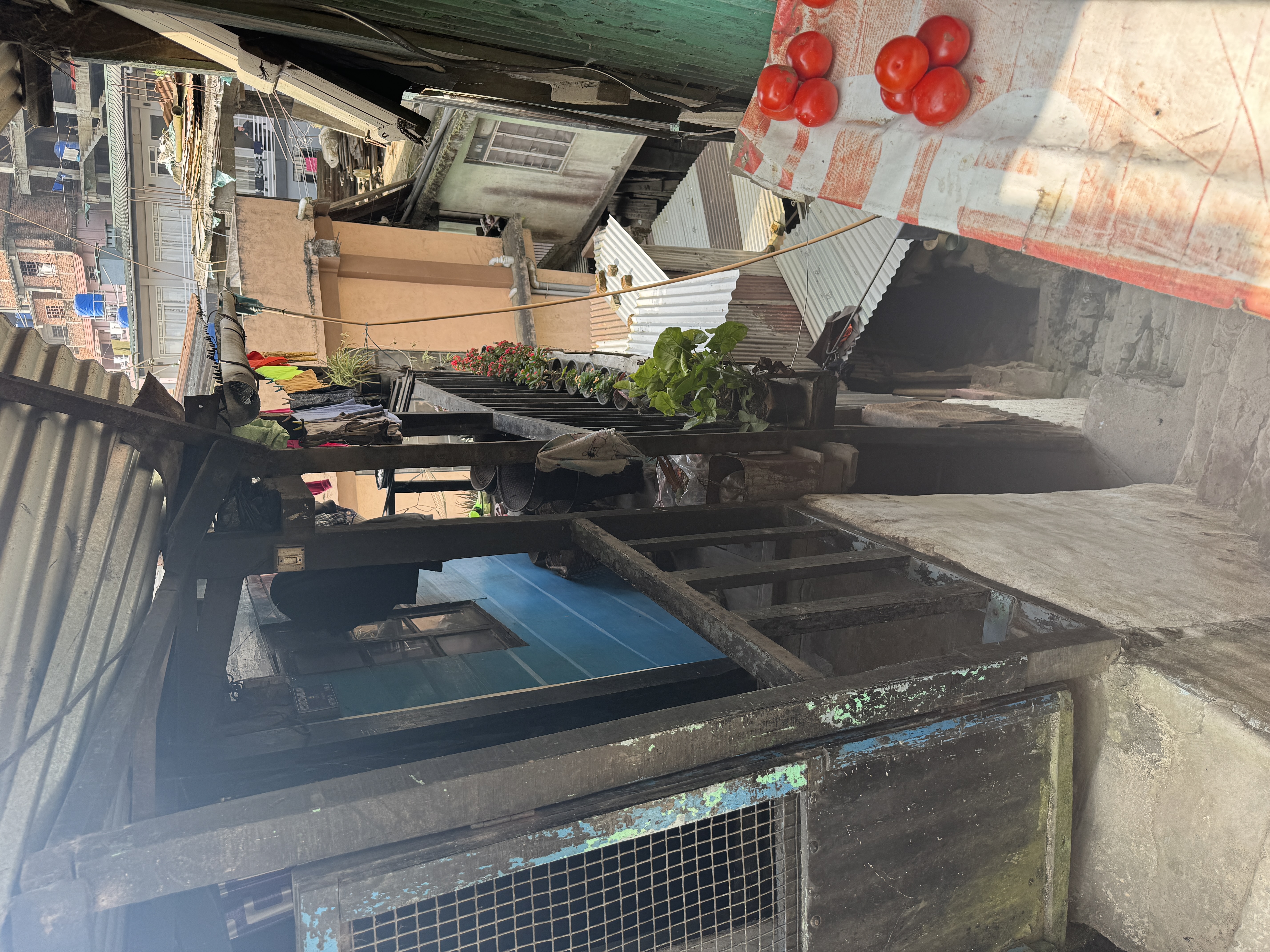
The steps here are partly roofed by sheet metal.
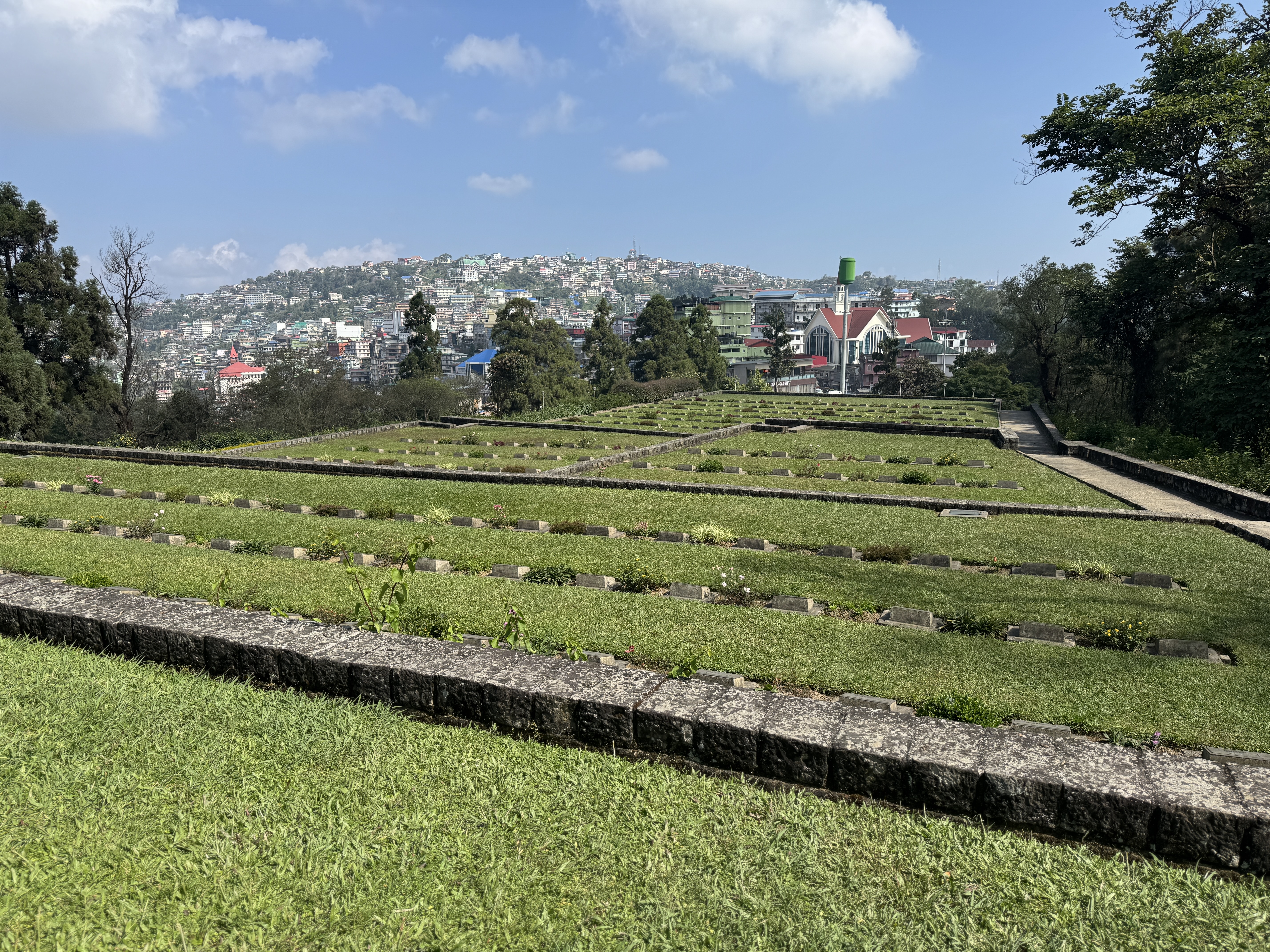
The only tidy bit of Kohima is the Commonwealth War Cemetery, scene of a ferocious battle in 1944. It contains about 1,400 graves.
Ninety percent of the Nagas are Christian, and most are Baptist, thanks to American missionaries who set up shop here in 1885, soon after the British made Kohima relatively safe. The government of independent India sent the American missionaries packing, but the tide of conversions acccelerated, so that churches today are among the most prominent buildings in Naga villages. Witness the church just beyond the cemetery. It's the Ao Baptist Church, serving the Ao's, another important tribe, originally based 50 miles north. With each tribe having its own language, the missionaries had to develop separate churches for each.
It's not entirely clear why conversions accelerated after the war, but here's Christoph von F rer-Haimendorf view. He had spent a lot of time among the Nagas in the 1930s and would become a world expert on India's tribal peoples. "Soldiers of various races passed through, lived, fought and died among the Nagas. Thus new people, new weapons, new attire, new food and above all new ideas were introduced to the Nagas and when the War came to an end they could not go back to the old secluded life" (Jelle J.P. Wouters in "Difficult Decolonization: Debates, Divisions, and Deaths Within the Naga Uprising, 1944-1963," Journal of North East India Studies, 2019, p. 6).
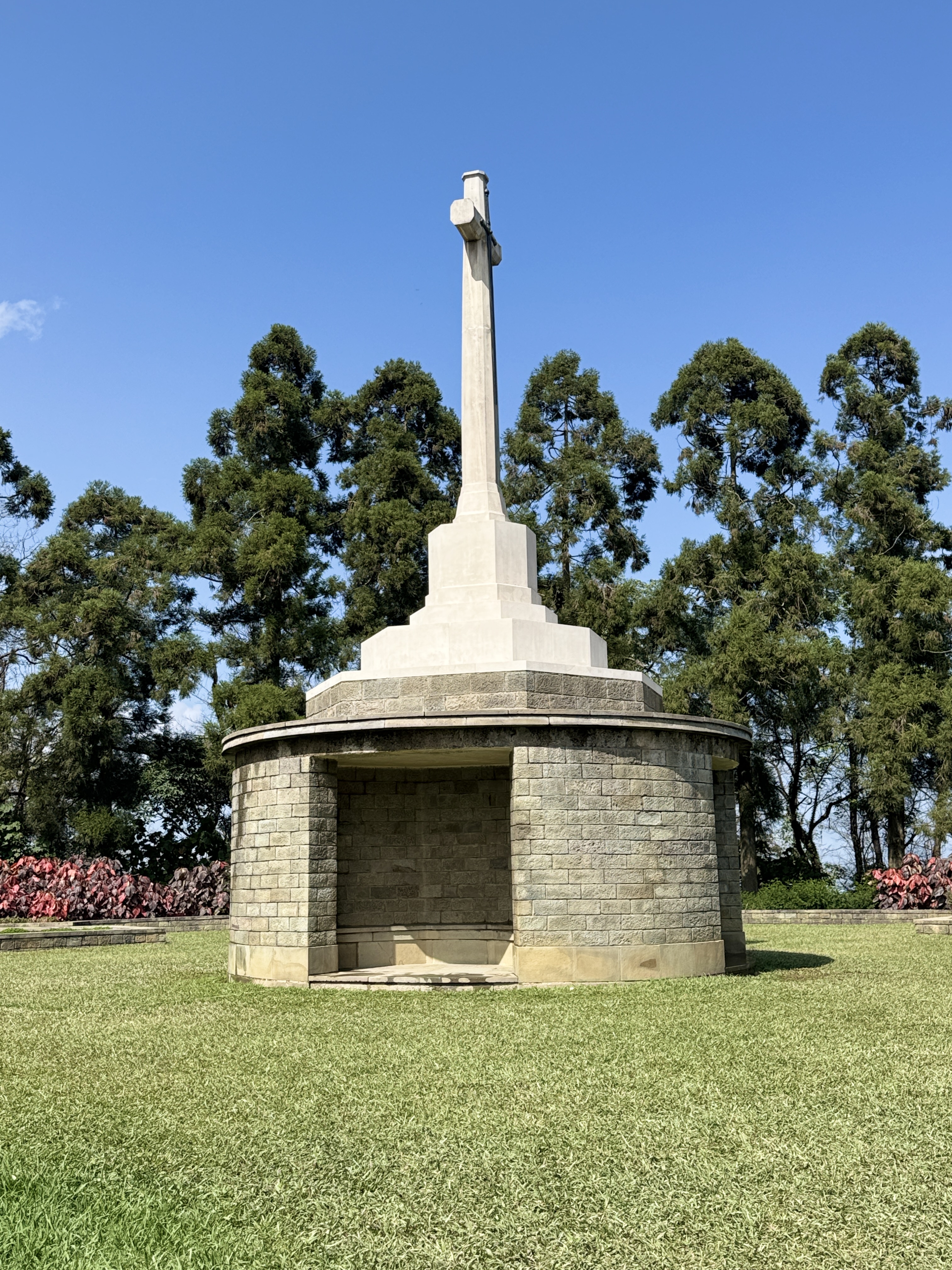
The cemetery's Cross of Sacrifice looks conventional at first.
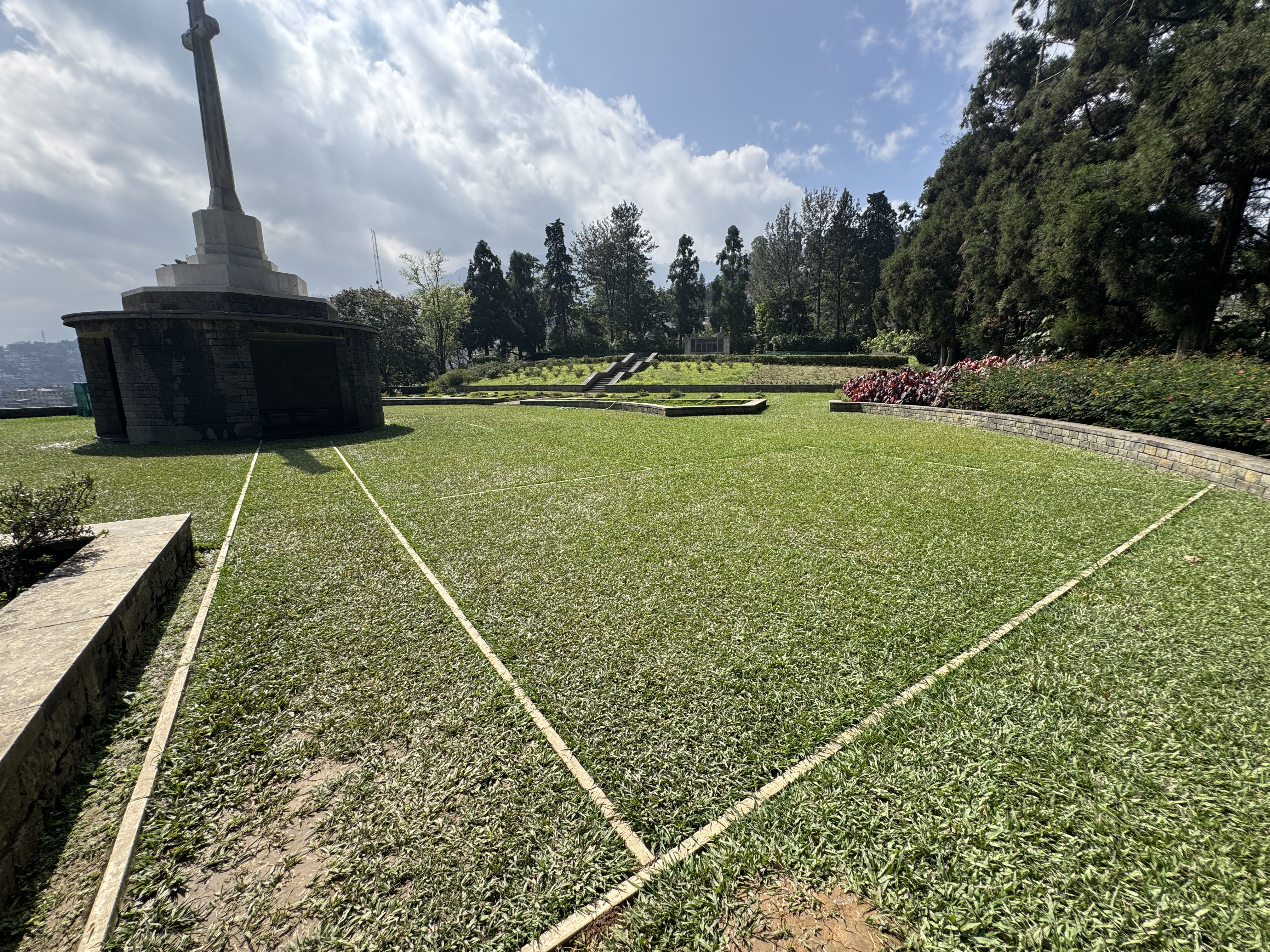
Then you notice the lines of a tennis court built for the entertainment of the local British district officer, whose bungalow adjoined it. The court has been preserved because it was the site in 1944 of particularly brutal, hand-to-hand fighting. The bungalow was obliterated.
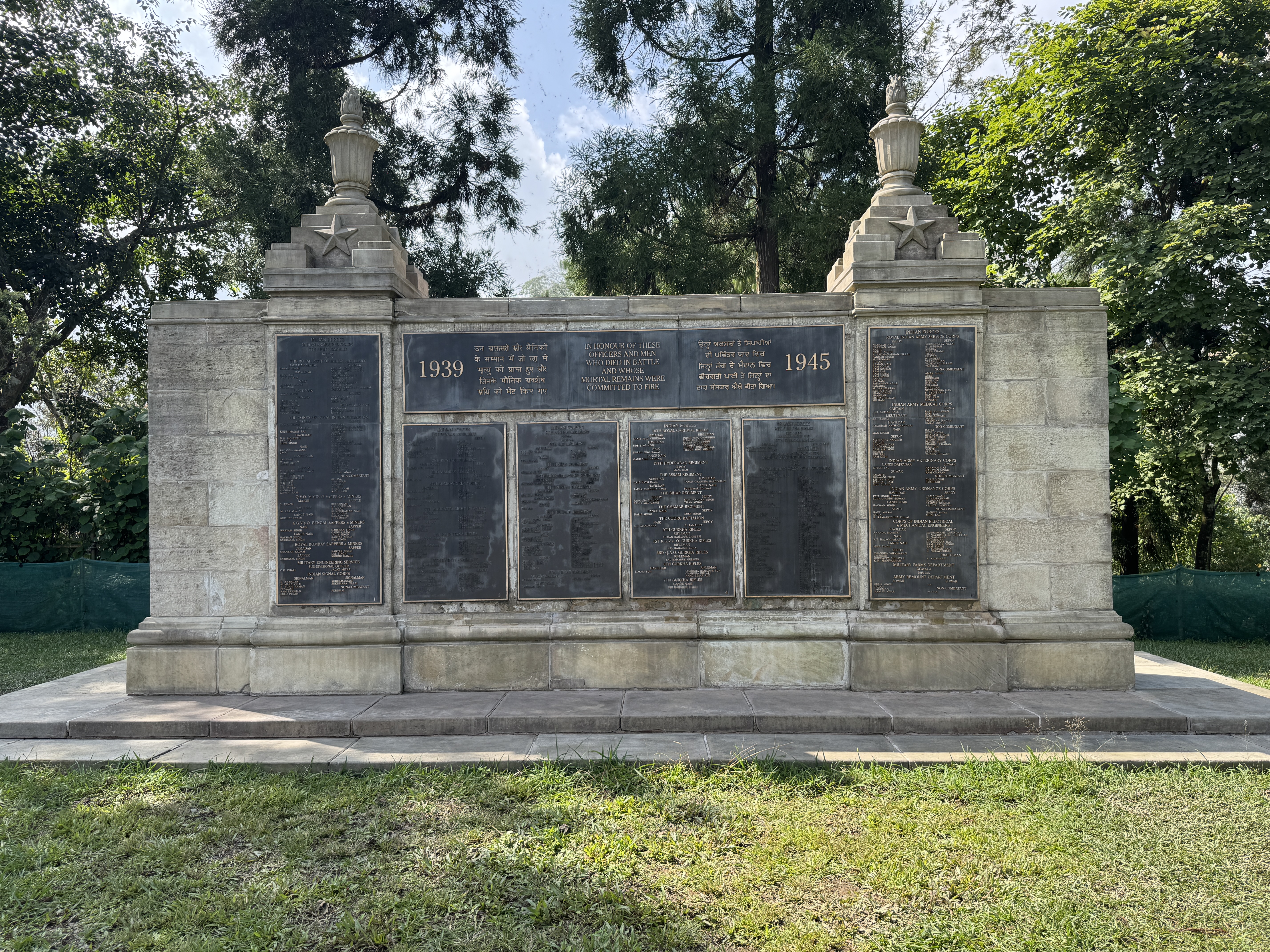
The cemetery, in addition to hundreds of graves, memorializes about a thousand Hindu and Sikh soldiers who died here and were cremated rather than buried. About half a mile to the south, a cenotaph was dedicated in 2024 to the approximately 6,000 Japanese soldiers who died here.
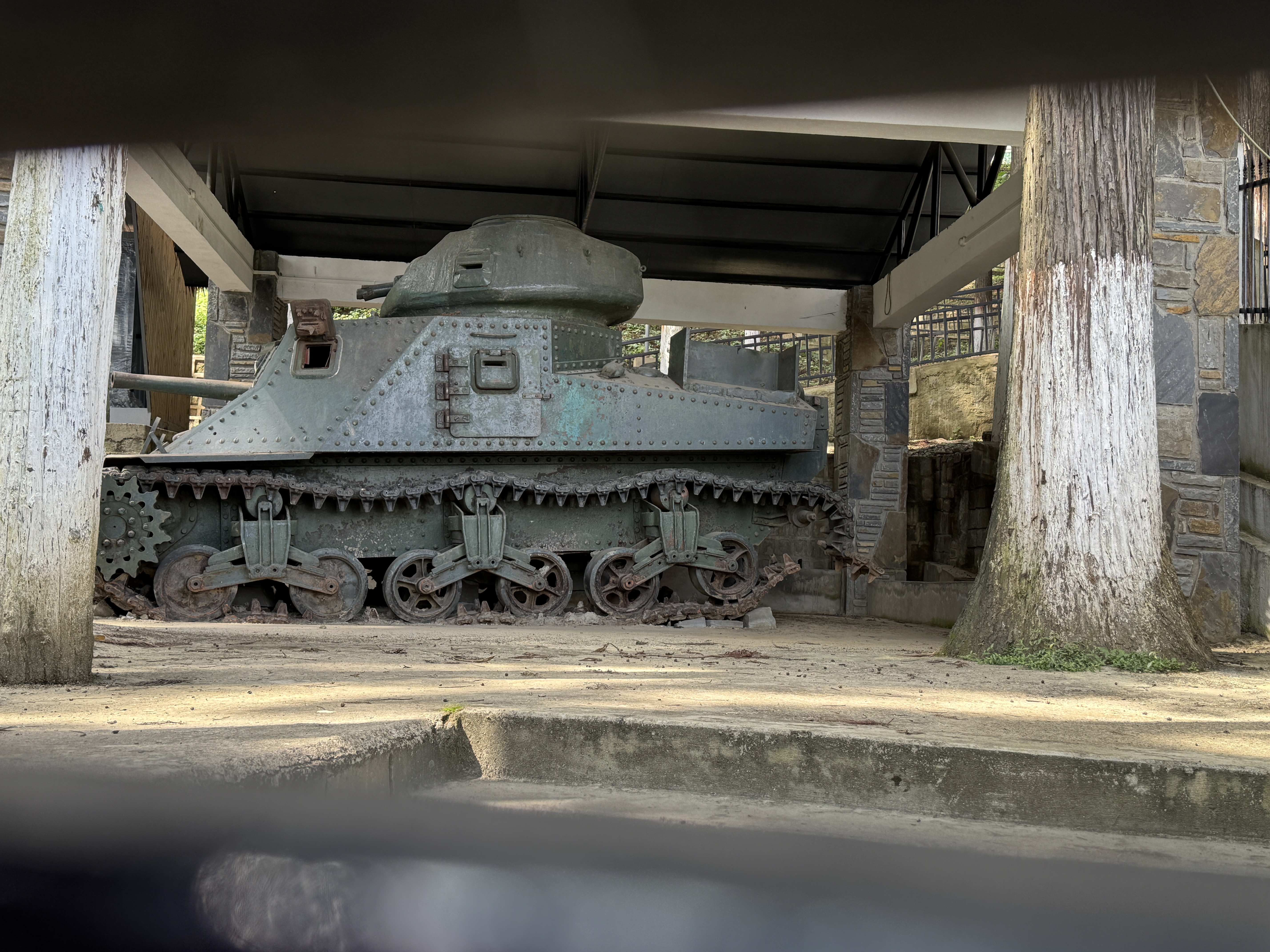
There's not much military equipment around, but here's a tank, left where it was abandoned. It got up to Kohima on a flatbed truck from Dimapur.
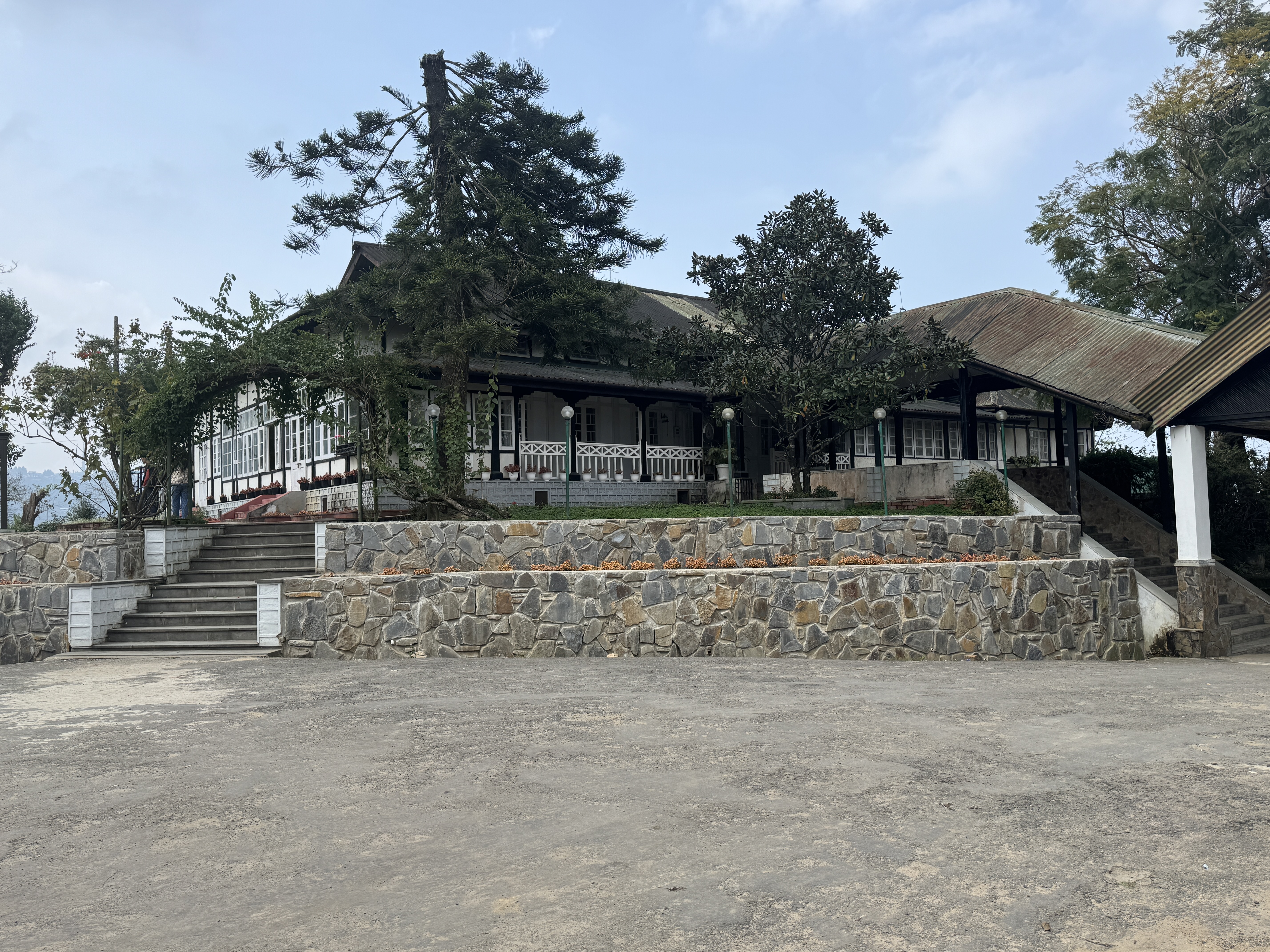
Here's a building in the style of the bungalows once built for British colonial officers.
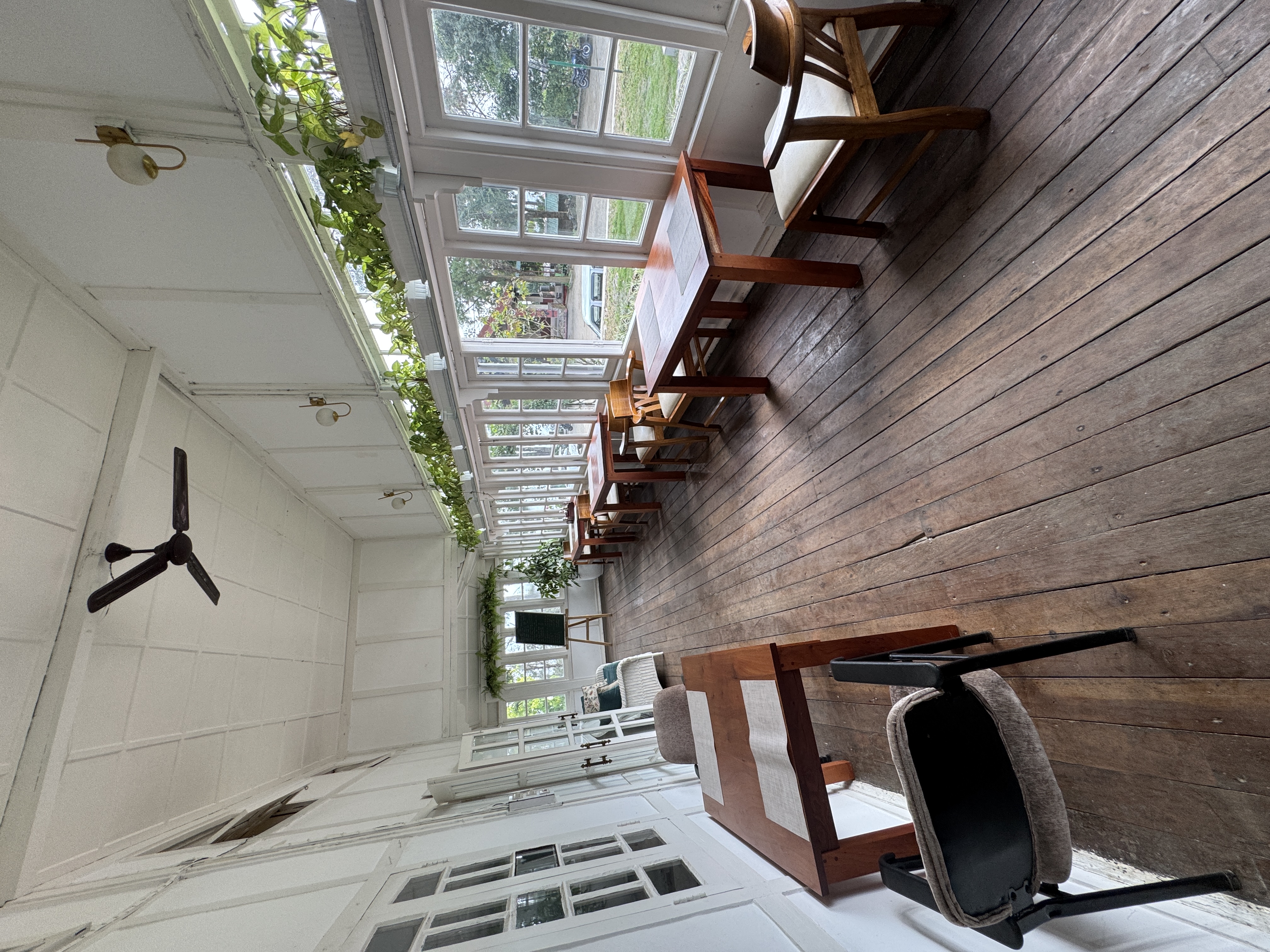
The building is the Heritage Hotel. Nobody on site knew its age, but here is the dining porch.
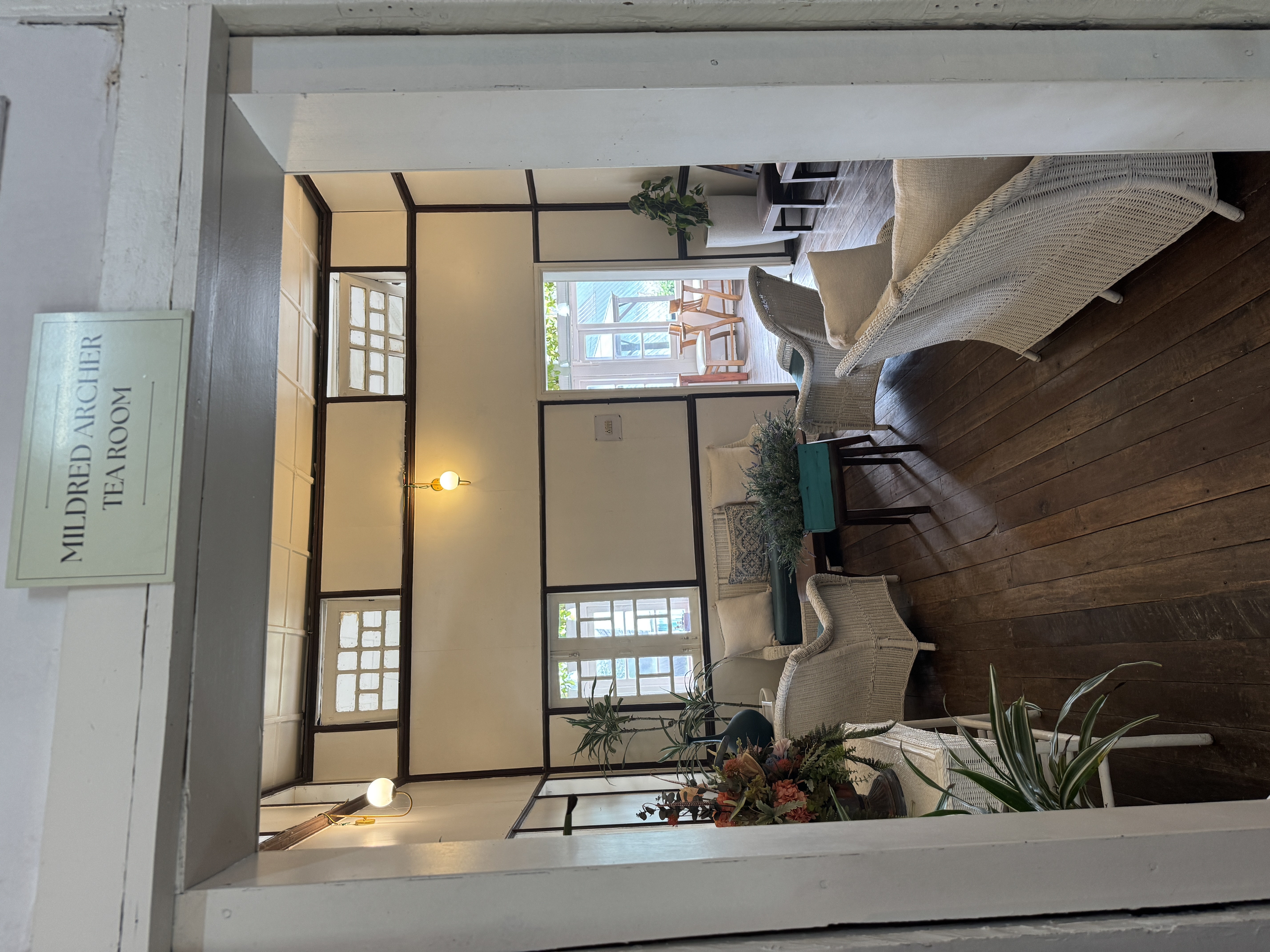
A typical room, named for the wife of a colonial officer who spent a few months in the Naga Hills in 1947 and who became in her own right an authority on British-Indian art.
The building looks flimsy, but it is a palace compared to what early British officials had: "Our house was watertight, and that was the best that could be said for it. It was thatched, with walls of split bamboo and strengthened by wooden posts; there were no glass windows, and the doors and shutters were of split bamboo tied together; the mud floor was also covered with these split bamboos" (James Johnstone, My Experiences in Manipur and the Naga Hills, p. 16). Johnstone was writing of the house he shared with his wife at Chumoukedima in about 1870.
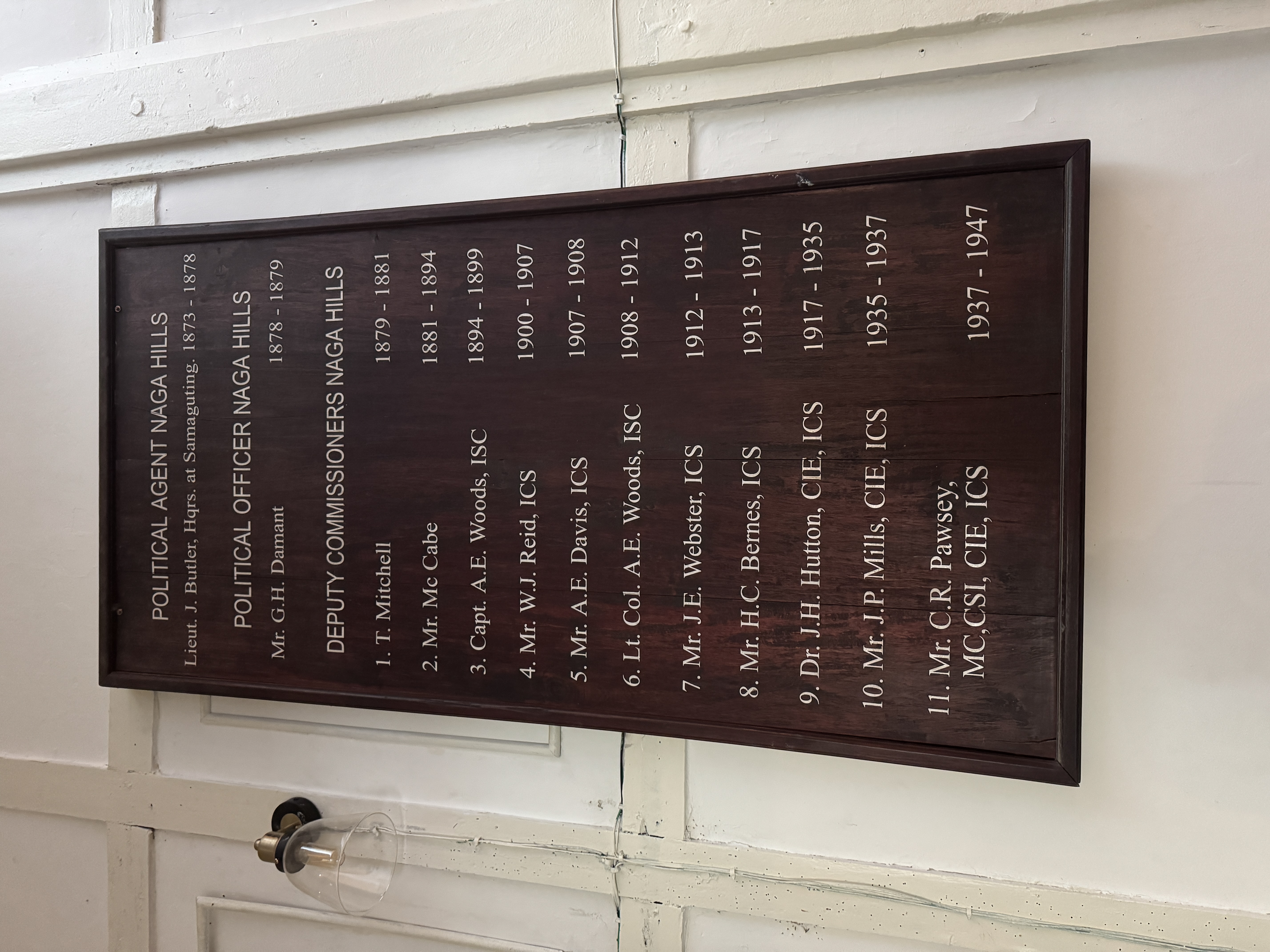
One wall has a list of the British officers in charge of the district. It includes two men, John Henry Hutton and James Philip Mills, who were so interested in the Nagas that, after retiring from the Indian Civil Service, they took up academic appointments in the UK as anthropologists. The two men at the top of the list were murdered by Nagas.
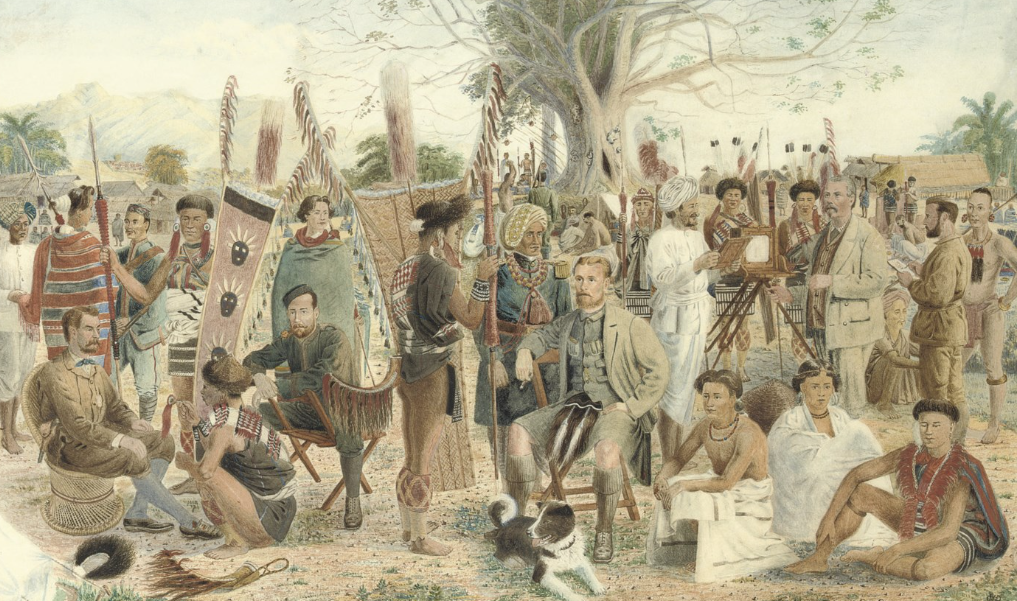
Here's the first of them, Captain John Butler, son of Major John Butler. (It's easy to get them confused, but the father retired to England and survived his son, who was ambushed and speared to death in 1875. The Nagas did not manage to get Captain Butler's head.) This sketch was made by Captain R.. Woodthorpe, and is called "Captain Butler and his Party among the Nagas." (https://www.christies.com.cn/en/lot/lot-5074977)
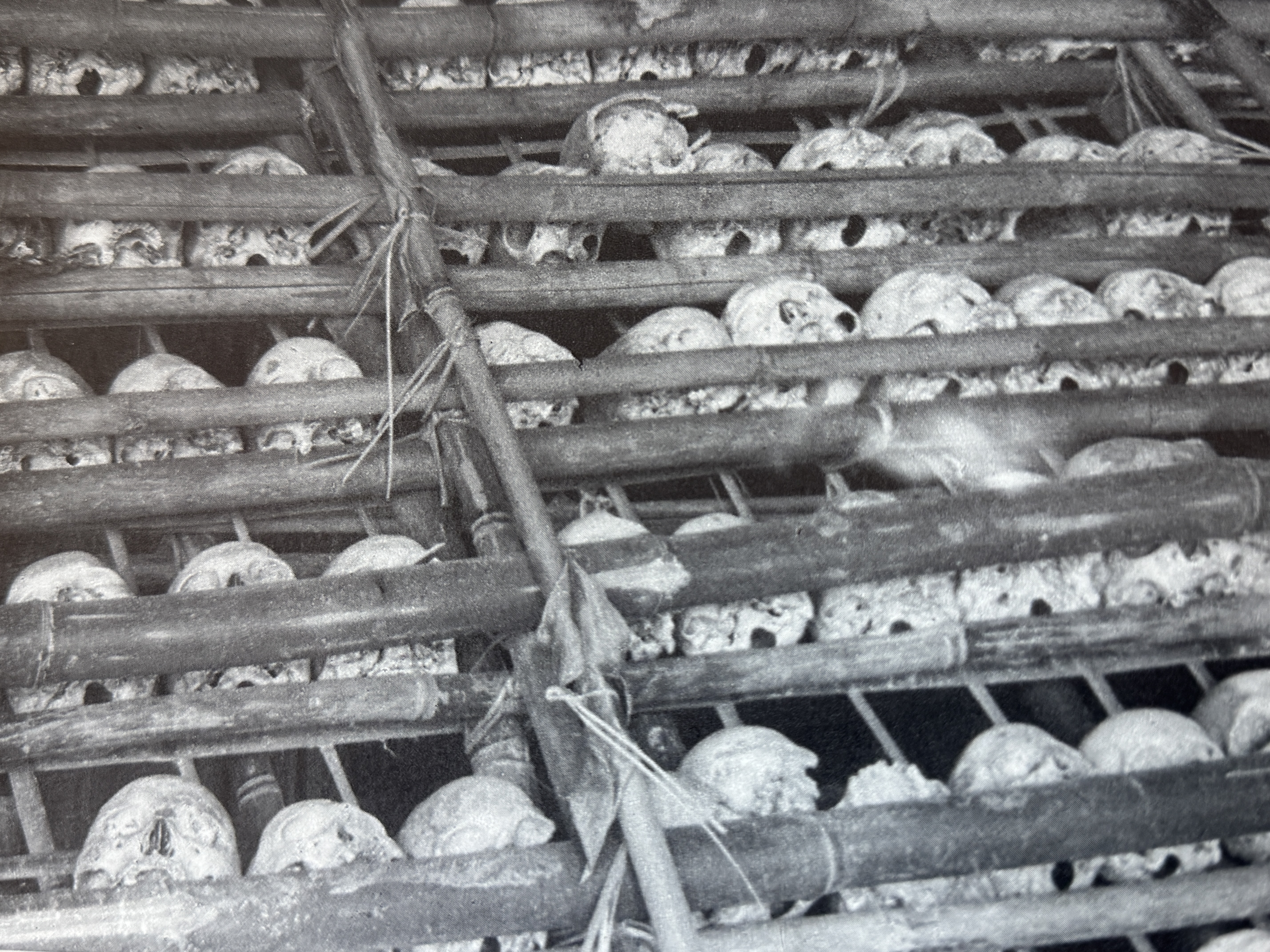
Not that they didn't want it: here's a photo of a skull rack from a Konyak Village. (The Konyaks are the most remote Naga tribe, in the far northeast of the state and against the Burmese border.) The photo was taken by the J. H. Hutton whose name is on the signboard. (Julian Jacobs, The Nagas, p. 116.)
Here's a droll comment from another of the men listed on that signboard: "Grouped in small communities of from 100 to 2,000 persons, the Nagas have remained isolated on their hill tops, only deigning to visit their immediate neighbours when a longing for the possession of their heads had become too strong to be resisted" (Robert Blair McCabe, Outline Grammar of the Angami Naga Language, p. 3; quoted by Hutton, The Angami Nagas, p. 9). Here's another: "When the Angamis have nothing to do, they sit about on the tombs in groups and pass the day in drinking spirits and gossiping and forming plans for hostile inroads on their neighbors" (A.J. Moffatt Mills, Report on the Province of Assam, 1854, p. cxli, excerpted in Verrier Elwin, The Nagas in the Nineteenth Century, p. 288).
The British might never have bothered to take control of the Naga Hills if the Nagas hadn't kept taking heads in the Brahmaputra lowlands, but, as the younger and ill-fated Captain Butler wrote, "between the years 1852 and 1862 we hear of twenty-four such atrocities being committed within the vaunted line of our outposts, and some of them were accompanied with a tigerish brutality, so intensely fiendish, that is it almost incredible that such acts could have been perpetrated by human beings" (Captain John Butler, "Rough Notes on the Angami Nagas and their Language," Journal of the Asiatic Society, 1875, p. 312).
What were the British to do? "For the annexation of their territory the Nagas are themselves responsible. The cost of the administration of the district is out of all proportion to the revenue that is obtained" (B.C. Allen, Assam District Gazetteers, vol. 9, Naga Hills and Manipur, 1905, p. 9).
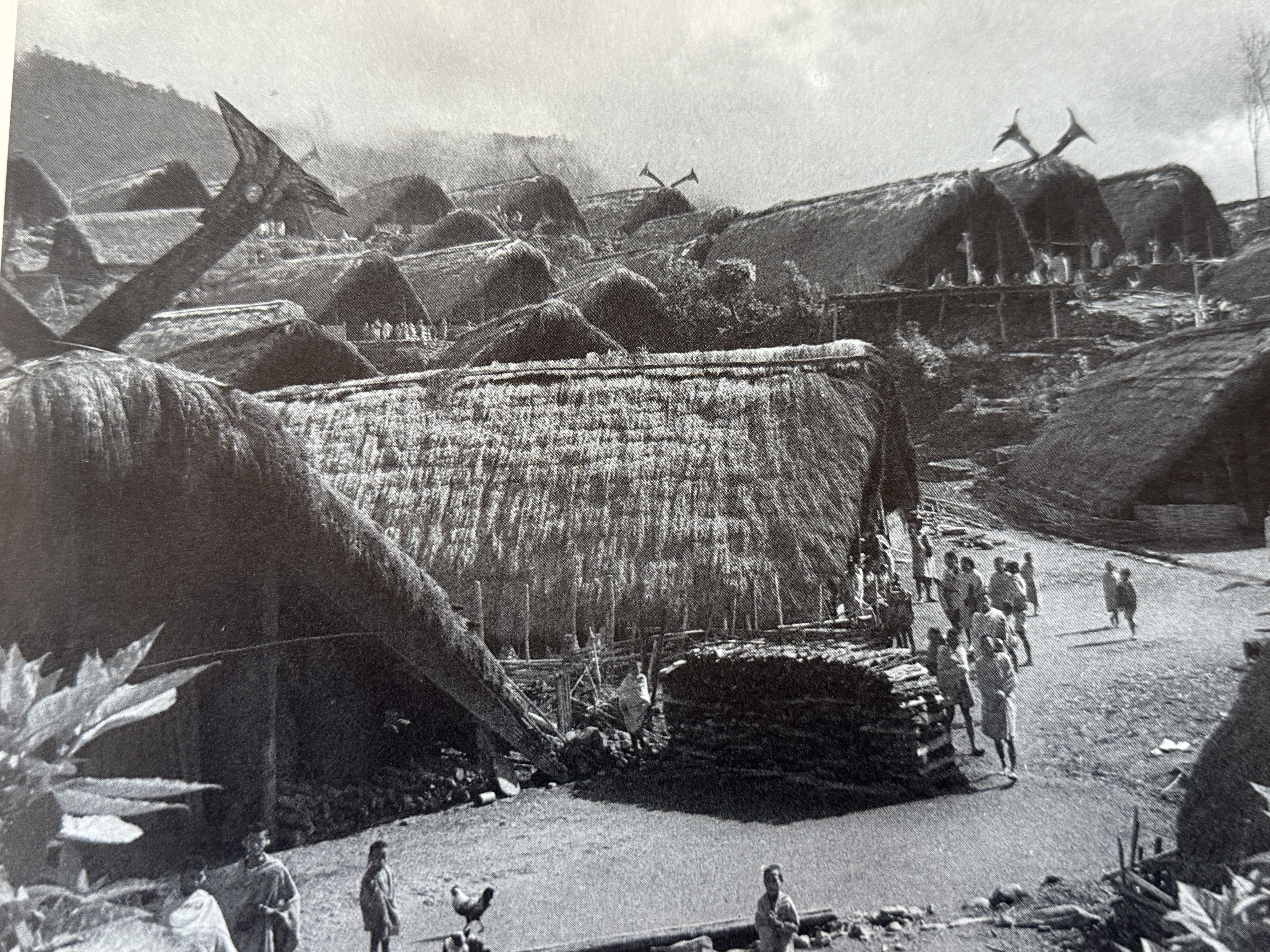
Ironically, many of the British who worked in the Hills loved the place and the people. J.P. Mills, another name on the signboard, wrote, "The people are primitive--long may they remain so--but they are exceedingly picturesque, cheerful, brave, and loyal" ("The Assam-Burma Frontier," The Geographical Journal, 1926, p. 299). Ursula Graham Bowers, "the Naga Queen" who came as a photographer but found herself leading Naga guerillas against the Japanese, wrote of Naga life as "simple and pagan and brief and happy" (Naga Path, p. 3). One of the last British administrators in Nagaland (and a man who spent his post-colonial career in MI6), wrote that the Nagas were "a happy and lovable people. May they long be spared from the terrible consequences of Western Civilization" (E.T.C. Lambert, "From the Brahmaputra to the Chindwin," The Geographical Journal, 1937, p. 323).
This photo was taken by another admirer, Christoph von F rer-Haimendorf. His classic study, published when heads were still being hunted, begins with this sentence: "Impartiality is difficult to maintain when writing of friends" (The Naked Nagas, 1939, p. vii). The village in the photo is identifed as "Sagazumi" and may be near Suthozu, about 17 airline miles or a 2-hour drive northeast of Kohima (Julian Jacobs, The Nagas, p. 41).
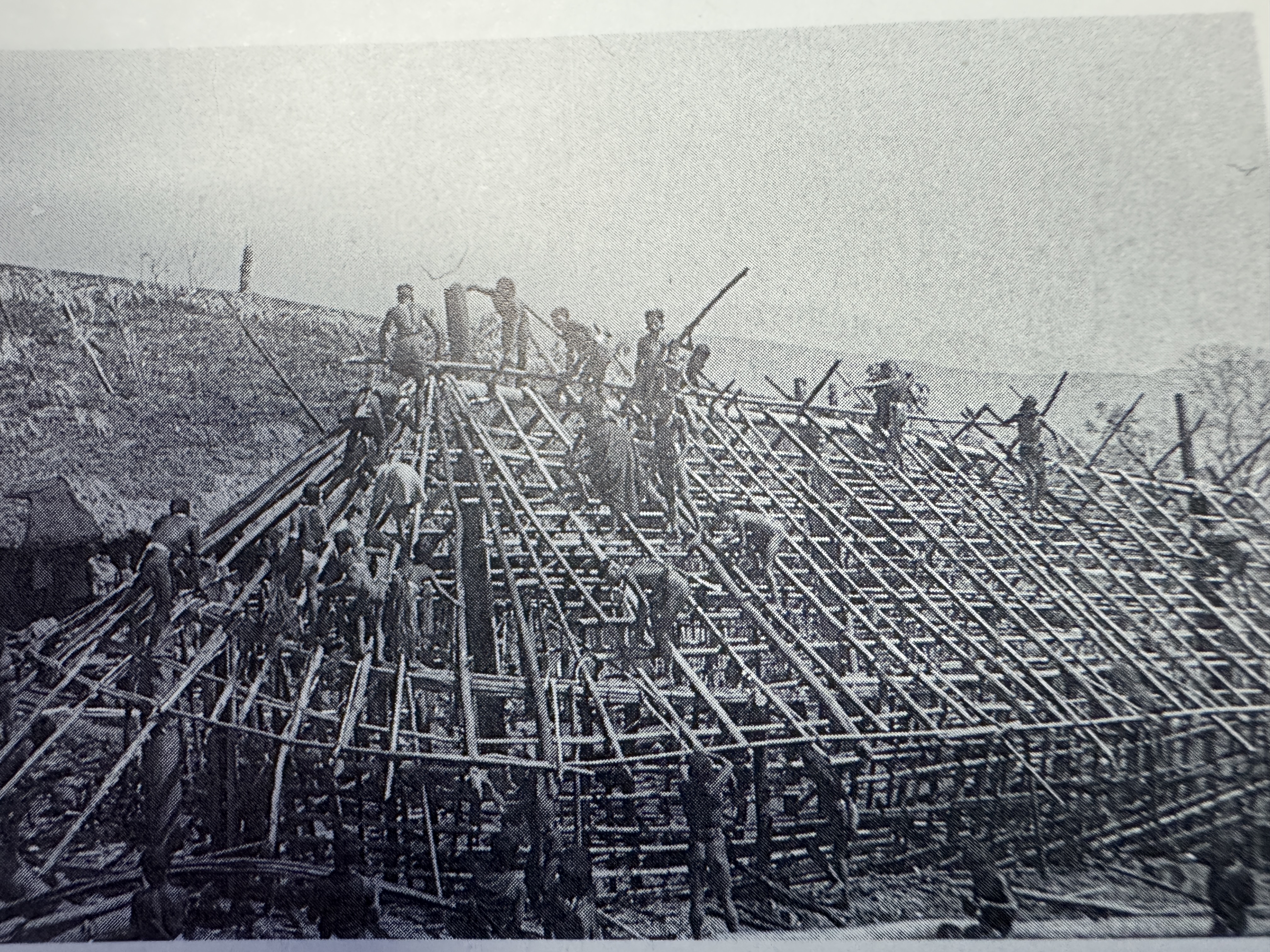
What is the appeal of this Naga house under construction? It's another von F rer-Haimendorf photo (Julian Jacobs, The Nagas, p. 29).

Perhaps the answer is implicit in this Kohima multi-story car park and shopping center, about a kilometer south of the war cemetery. It opened just about 100 years after J. H. Hutton wrote that "the spirit of change is invading and pervading every aspect of village life" (The Angami Nagas, p. vii).

Don't fret; there are pizza places, too.
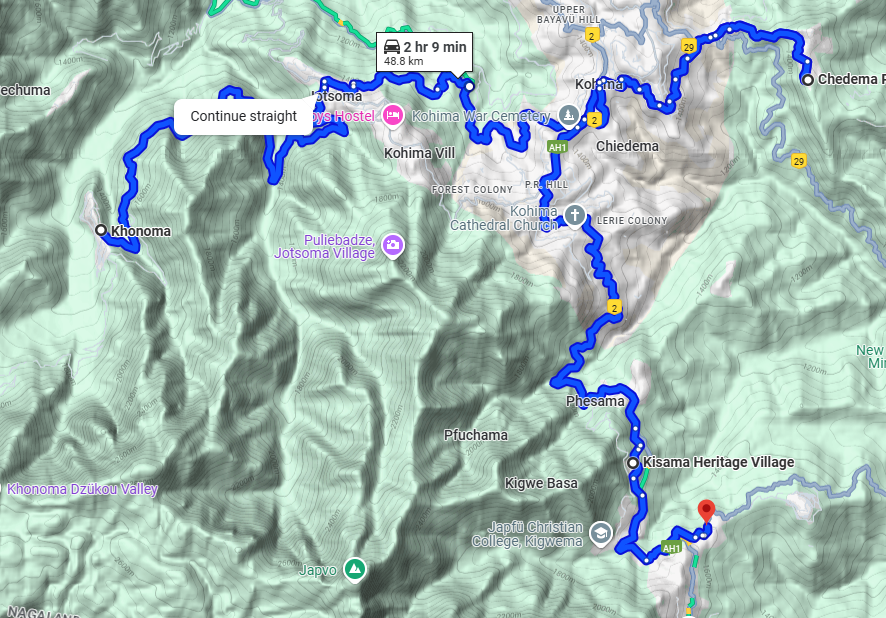
We'll venture out of town a little bit, first south to the Kisama Heritage Village, then west to Khonoma, then east to Chedema, then south again to Kigwema, at the end of the blue line.
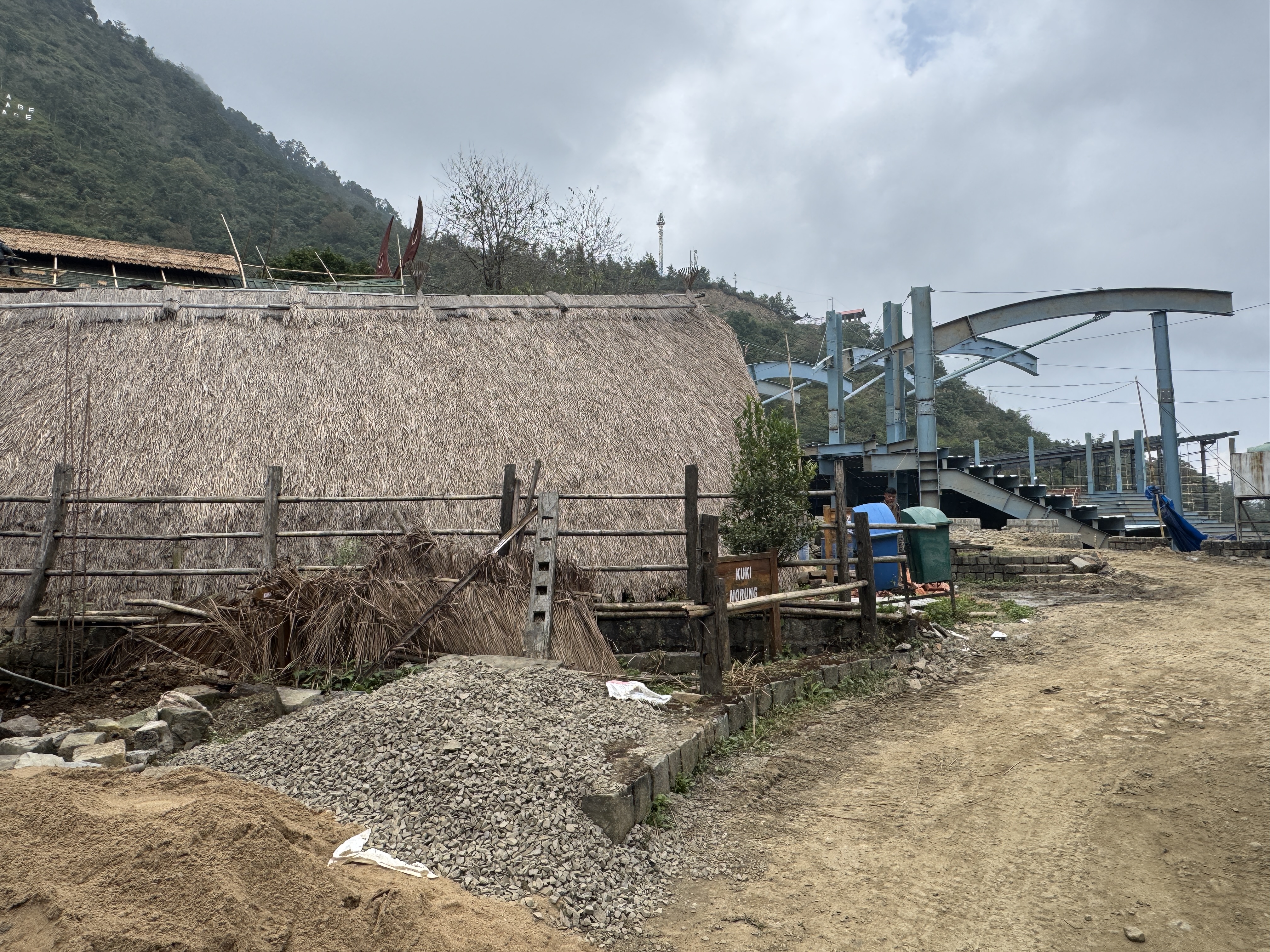
Kisama is not the name of a village; it's a cobbled-together name for an outdoor museum begun in 2003 to display the variety of traditional Naga houses. Great idea. In 2024 a fine amphitheater was being added. Rorschach test question of the day: was that a great idea?
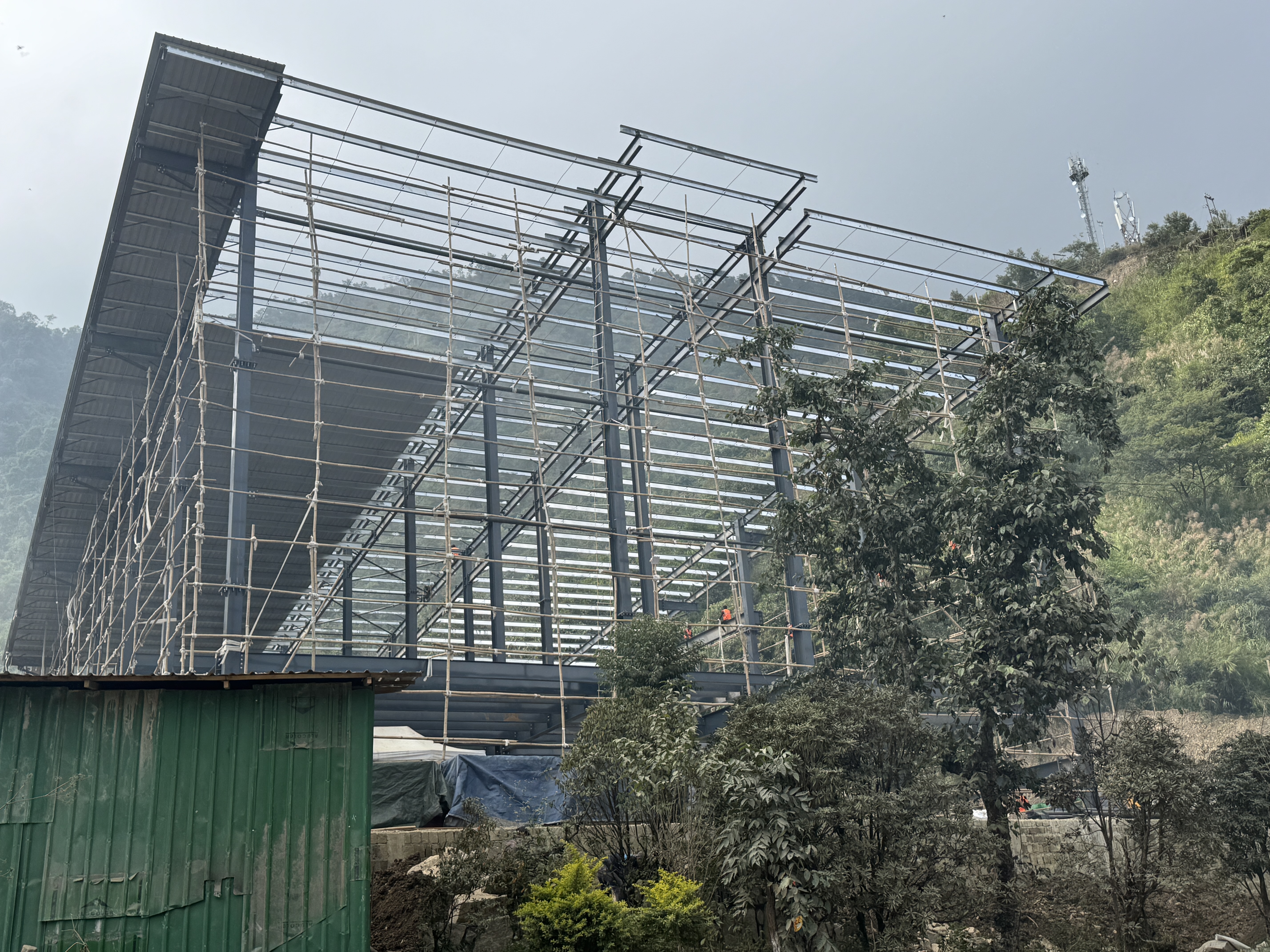
Three cheers for bamboo, which makes at least a temporary appearance.
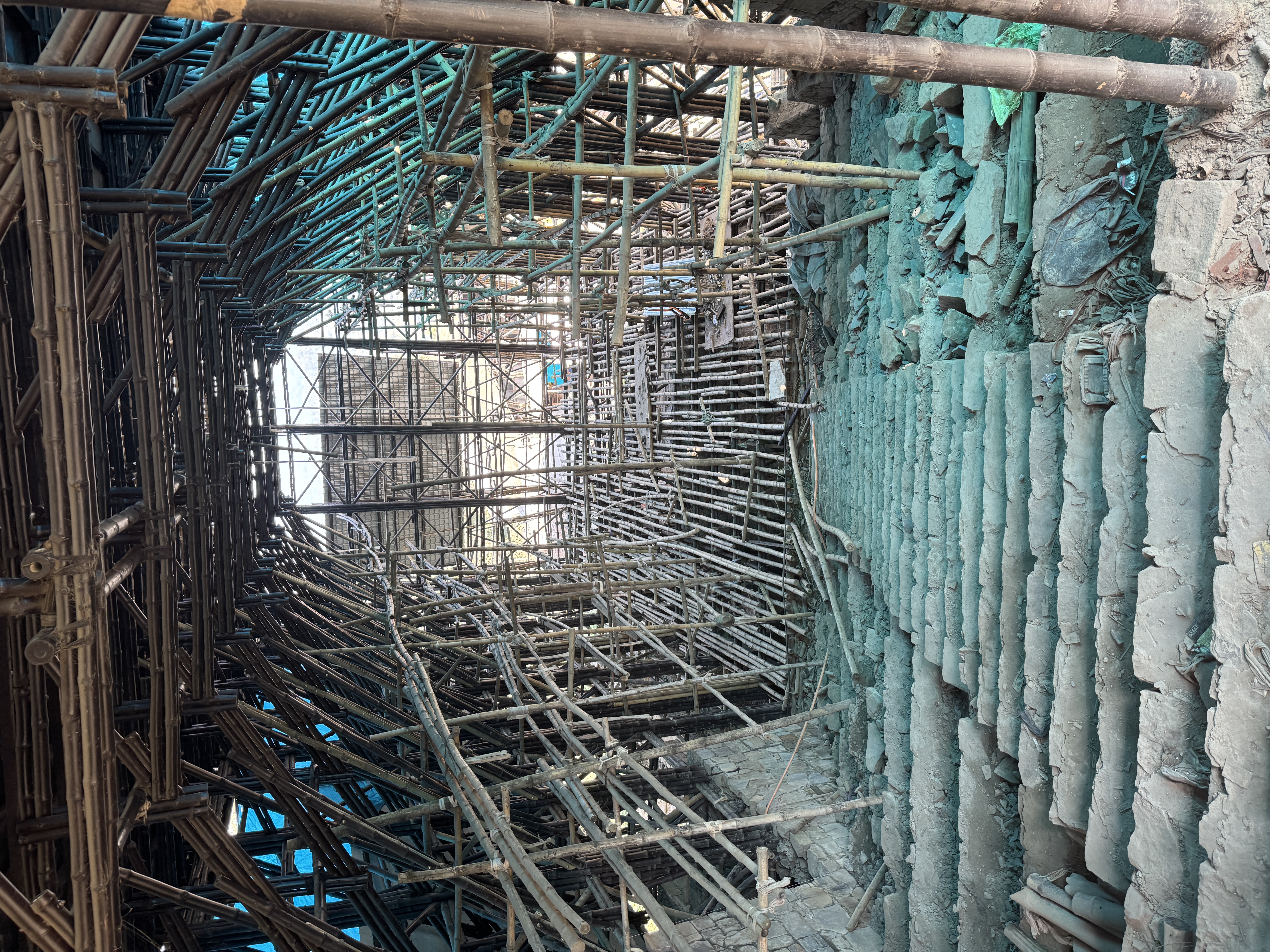
Brief detour: vanishingly few buildings are built of bamboo and other traditional materials in Nagaland today, but here's a spectacular exception. For a profile of its architect, see
https://www.thenestories.com/richard-belho-bridging-tradition-and-innovation-in-kohima/
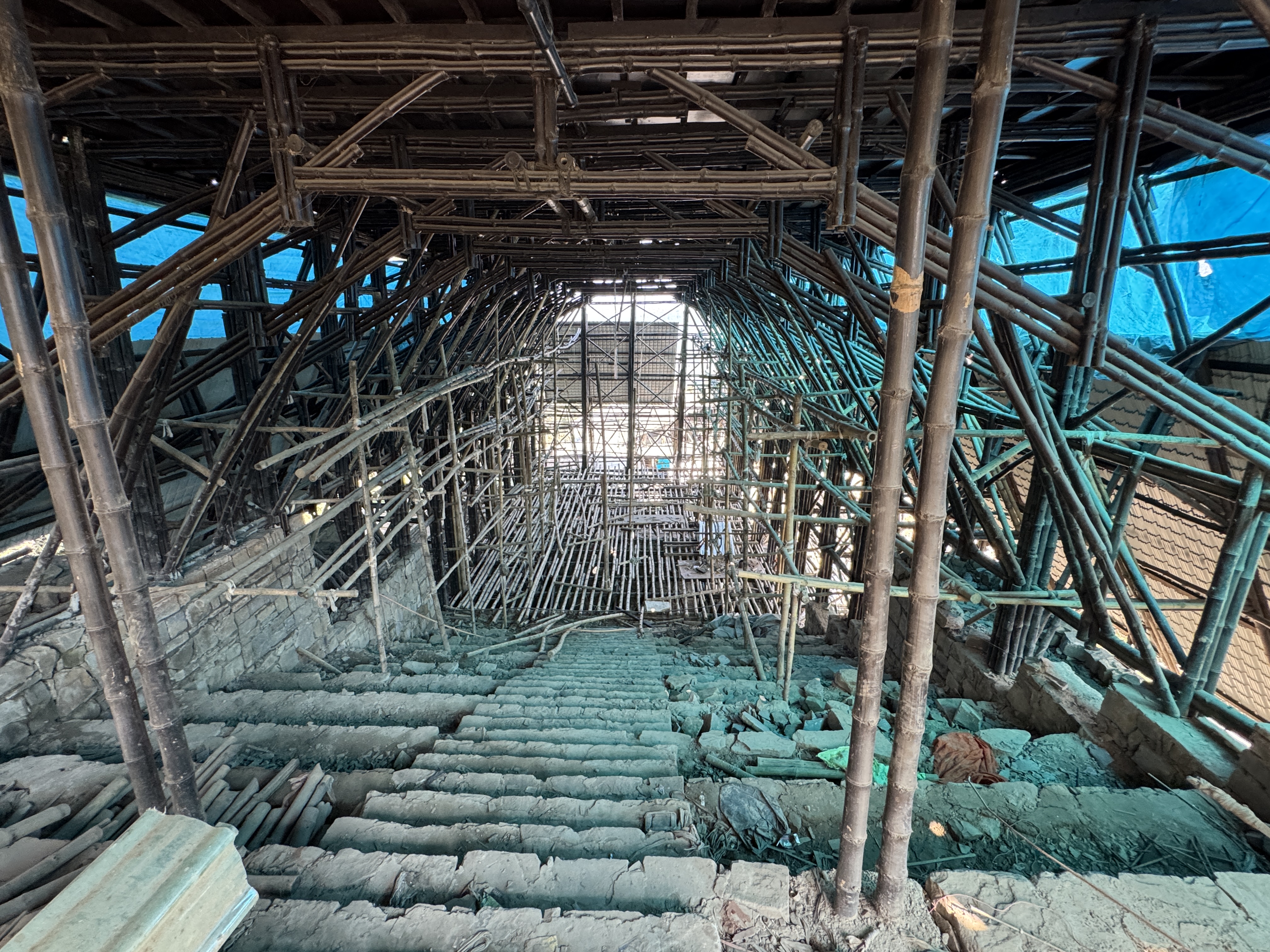
It's close to Kohima and on the road to Dimapur, and is apparently intended to be a shopping center.
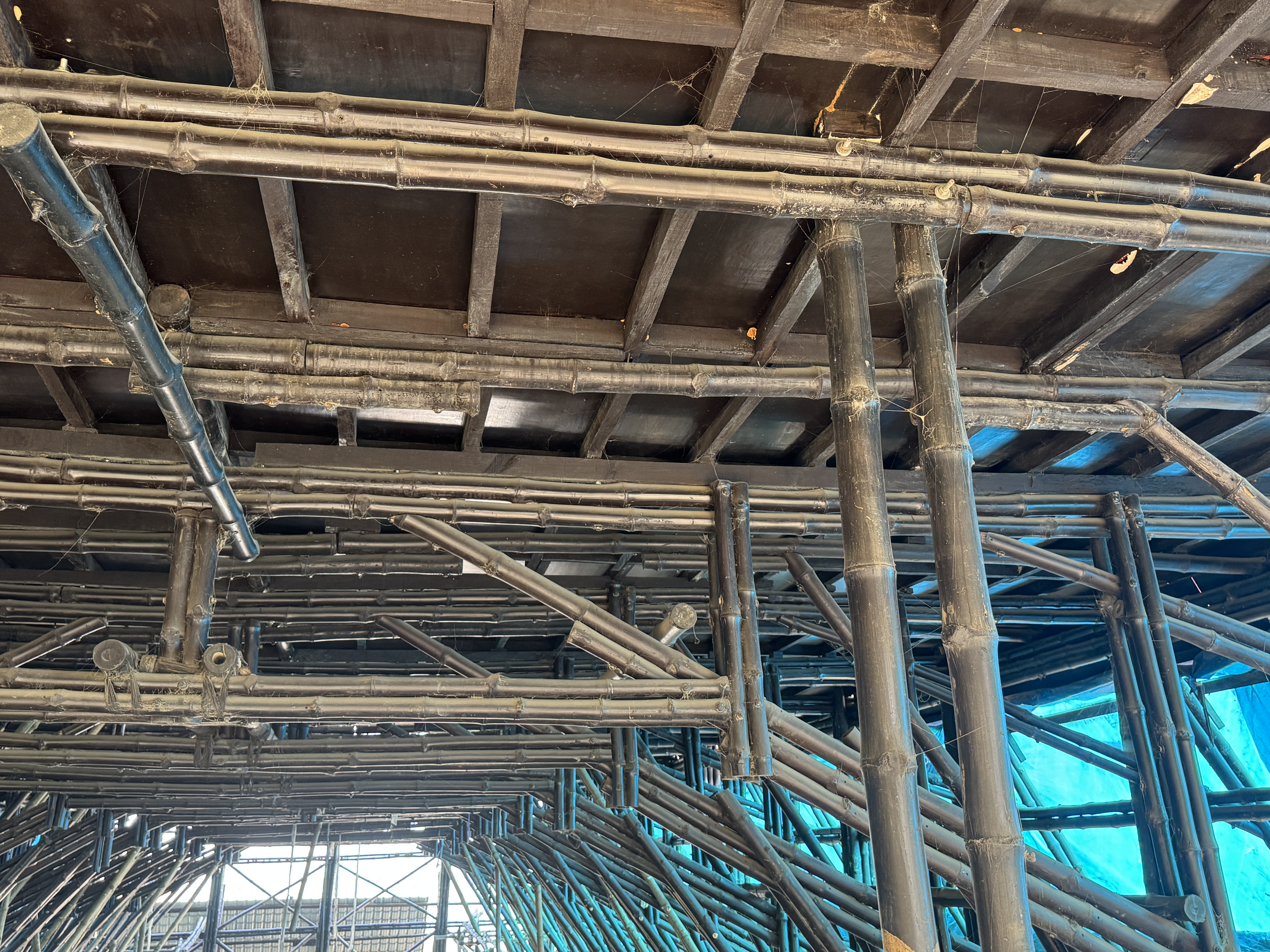
Sawn lumber isn't traditional, but let's give the guy a break.
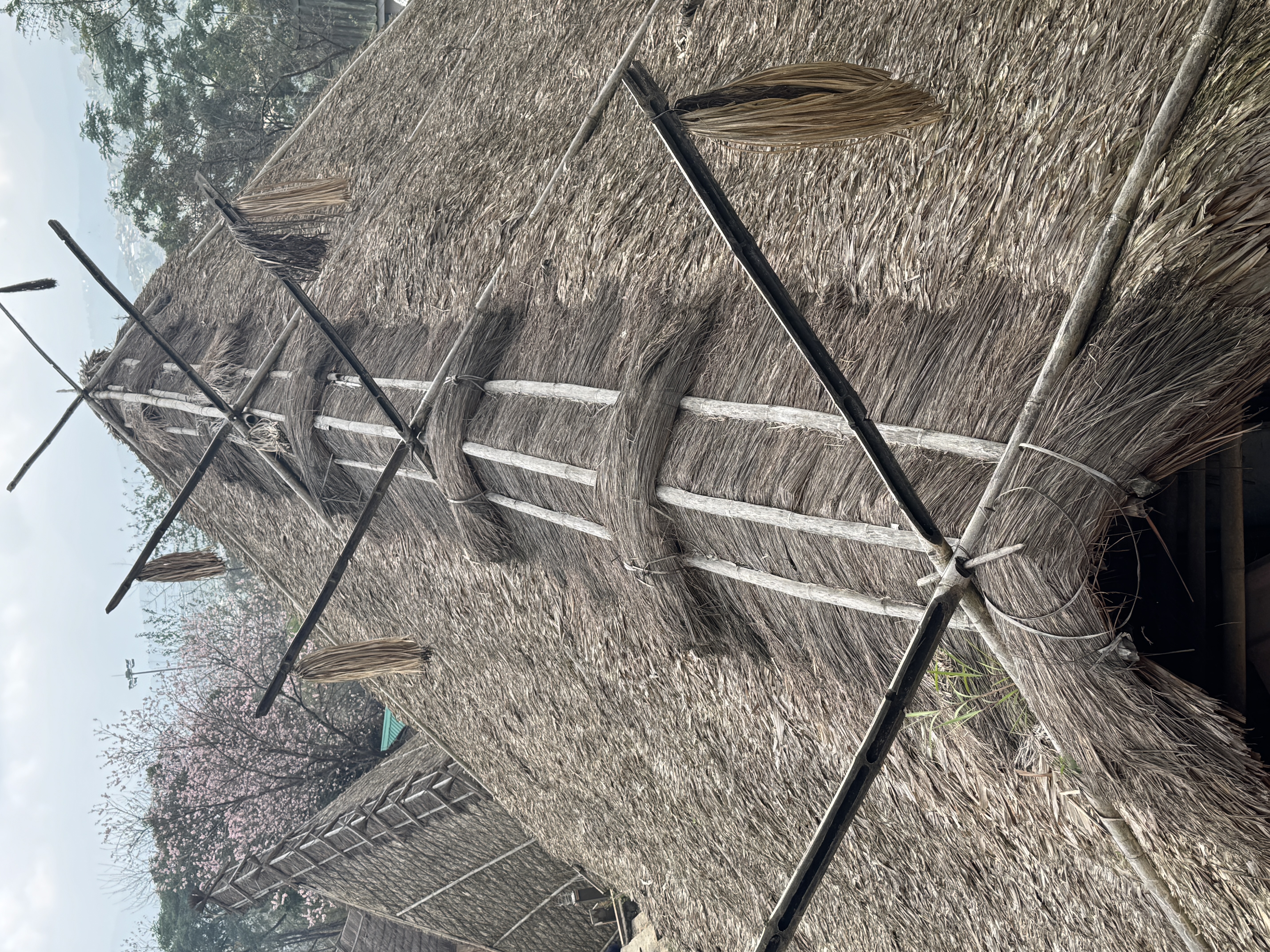
End detour. You won't find thatch in Kohima or anywhere nearby. Perhaps that's reason enough to visit Kisama.
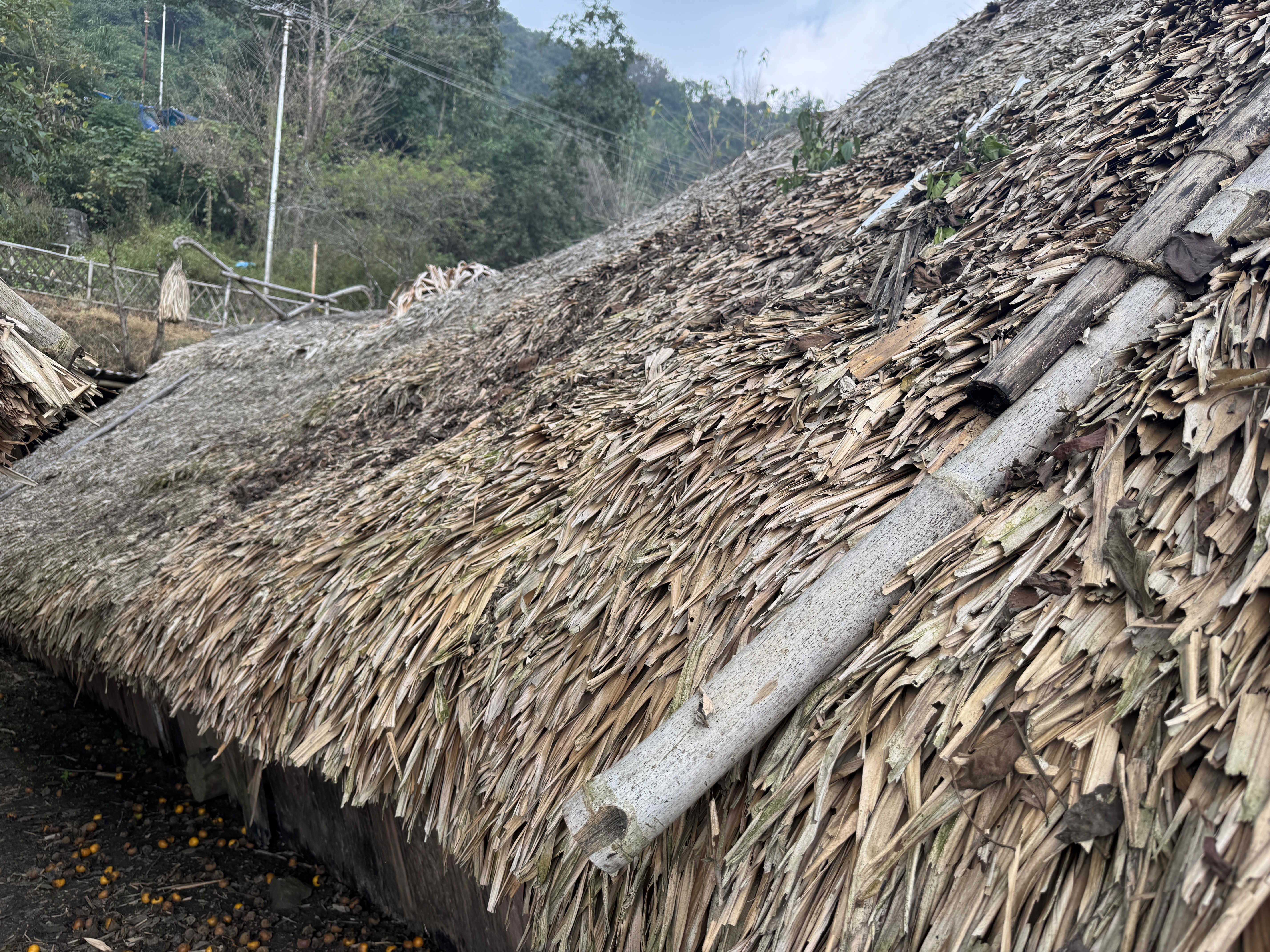
Thatching materials vary. Here's one.
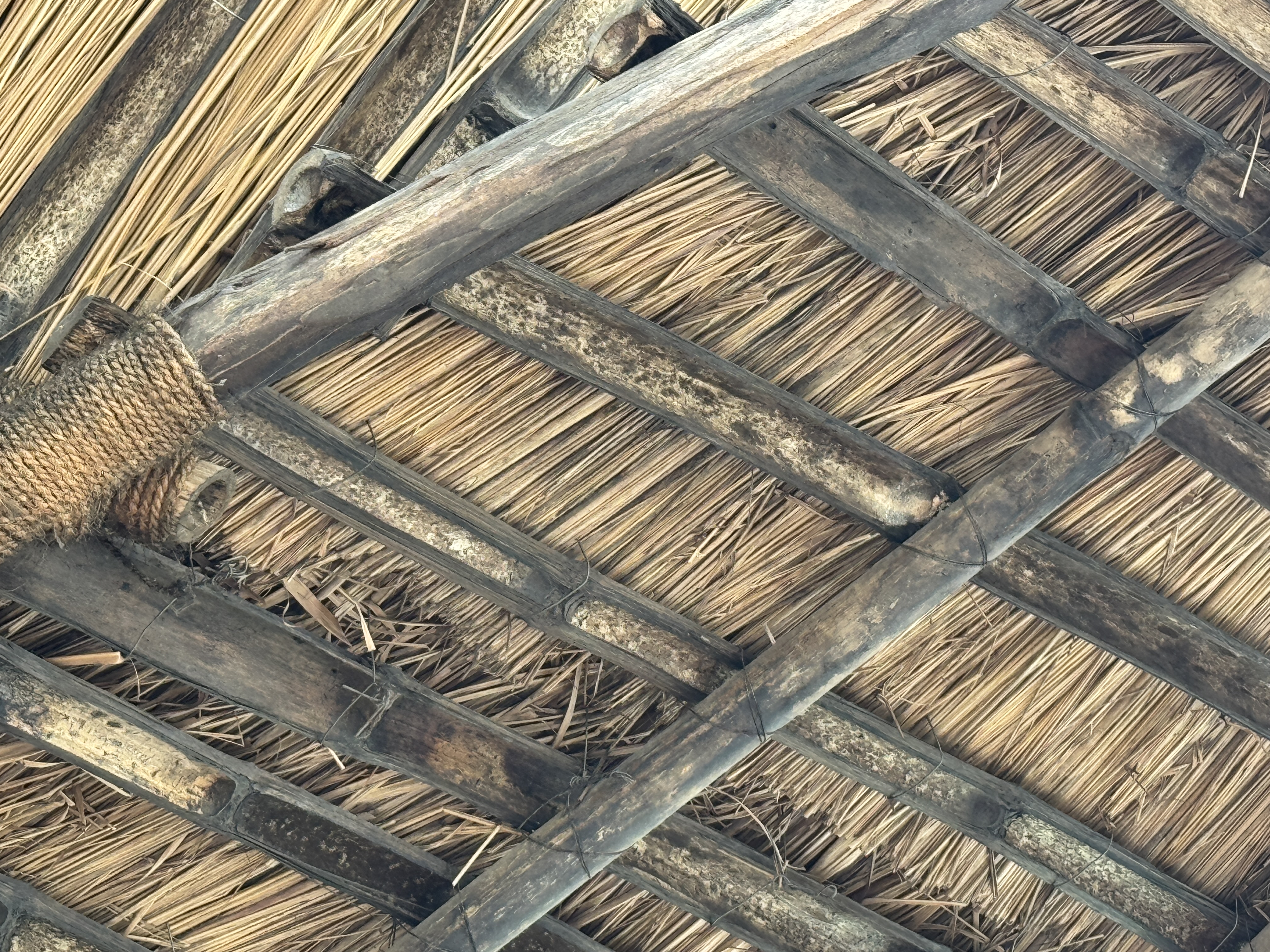
Here's another. Smoke out the vermin every few years and the thatch will last 20.
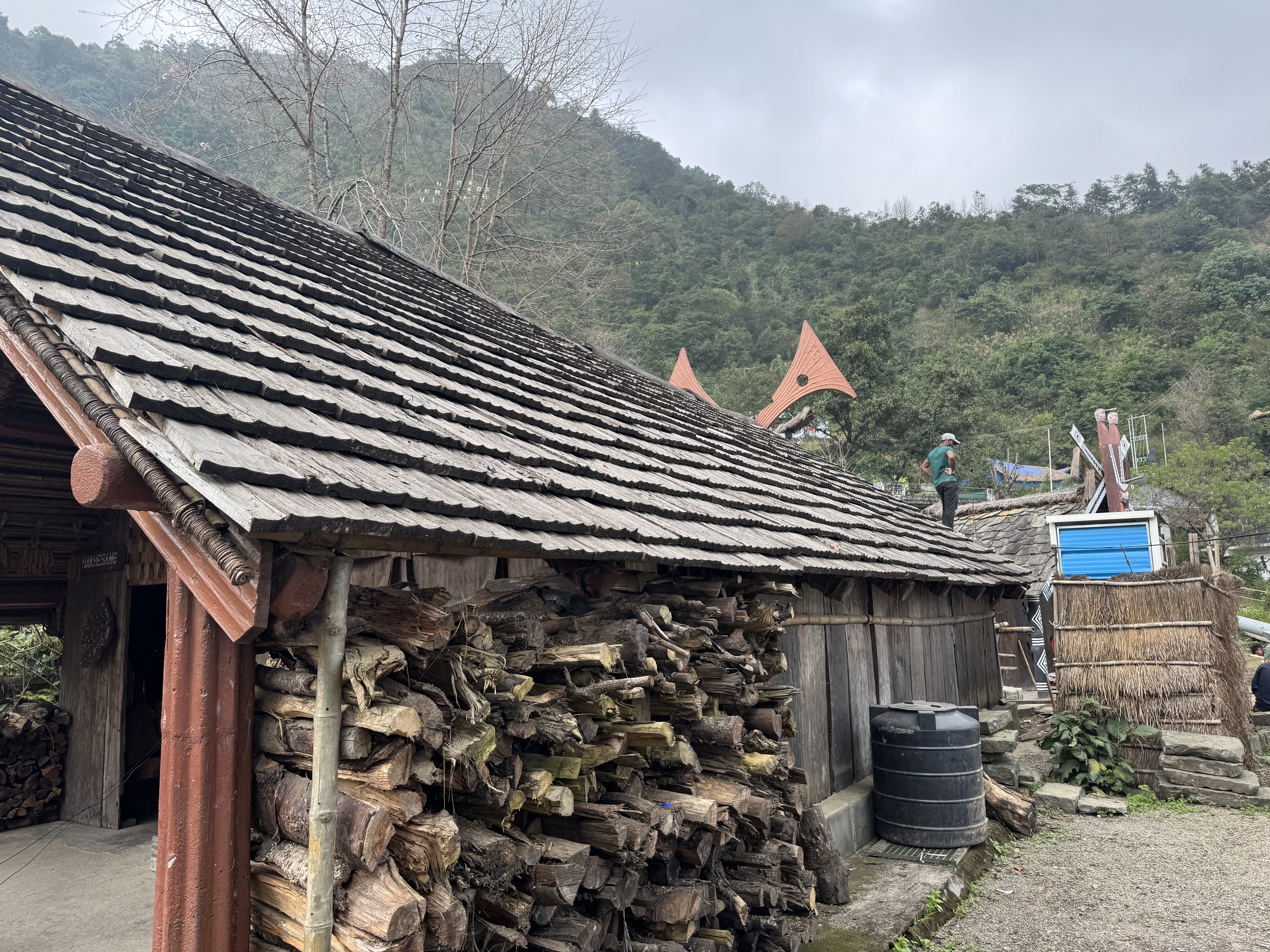
Naga houses displayed the status of their occupants, and among the Nagas wooden shakes were upper upper.
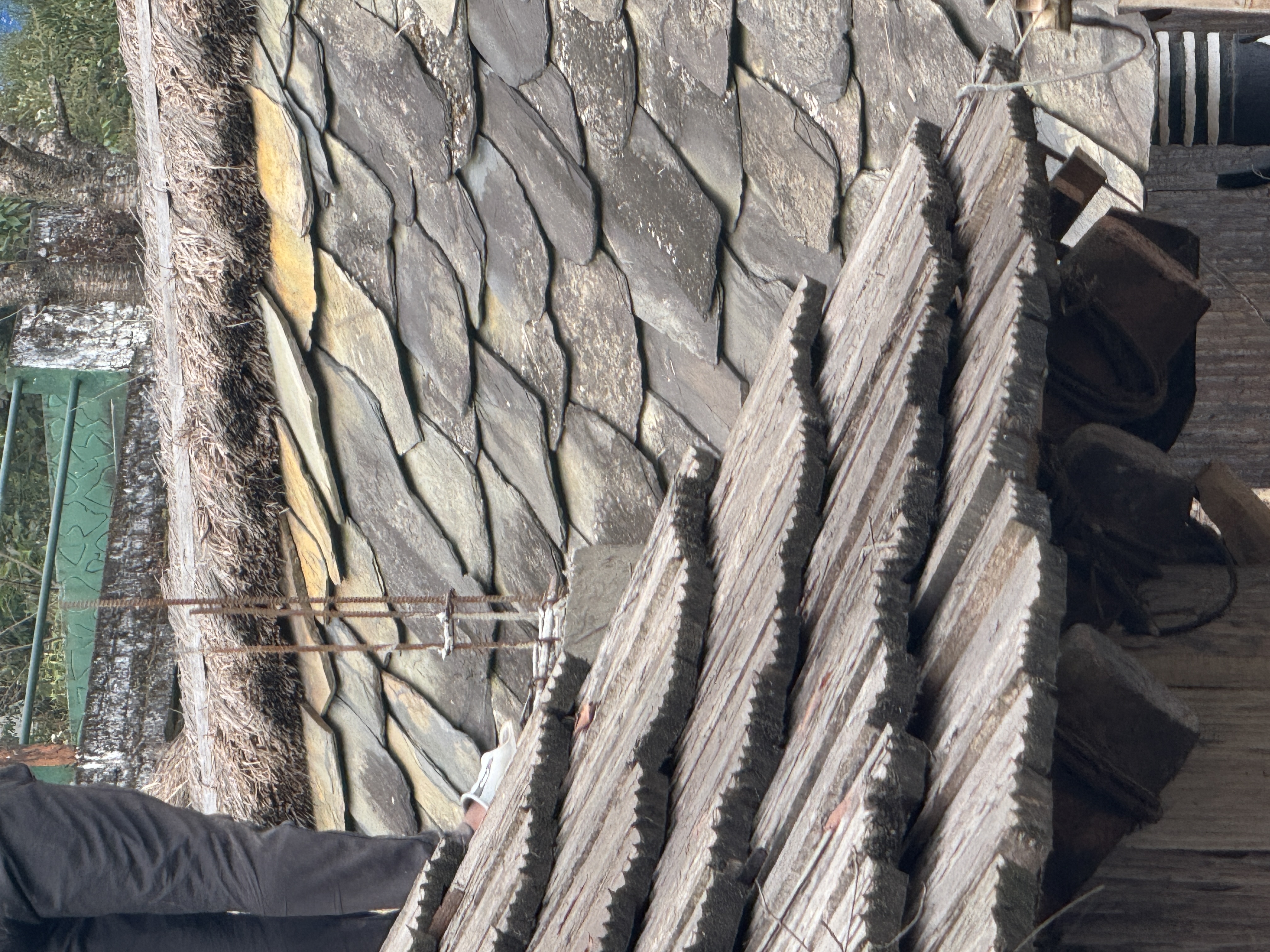
Here's a roof of slate.
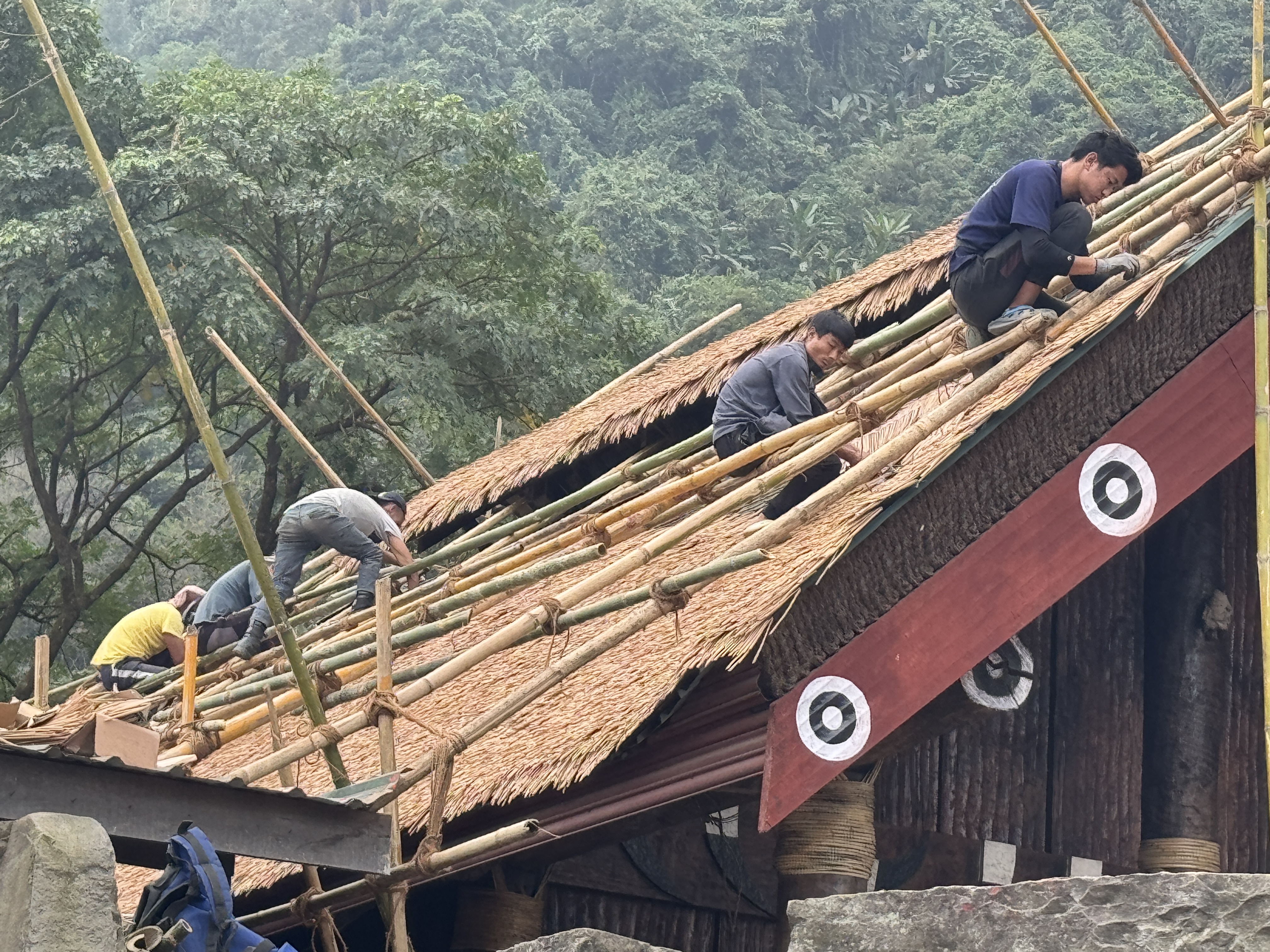
Here's a building under construction to illustrate the style of the Angamis. It's dismaying. Why?
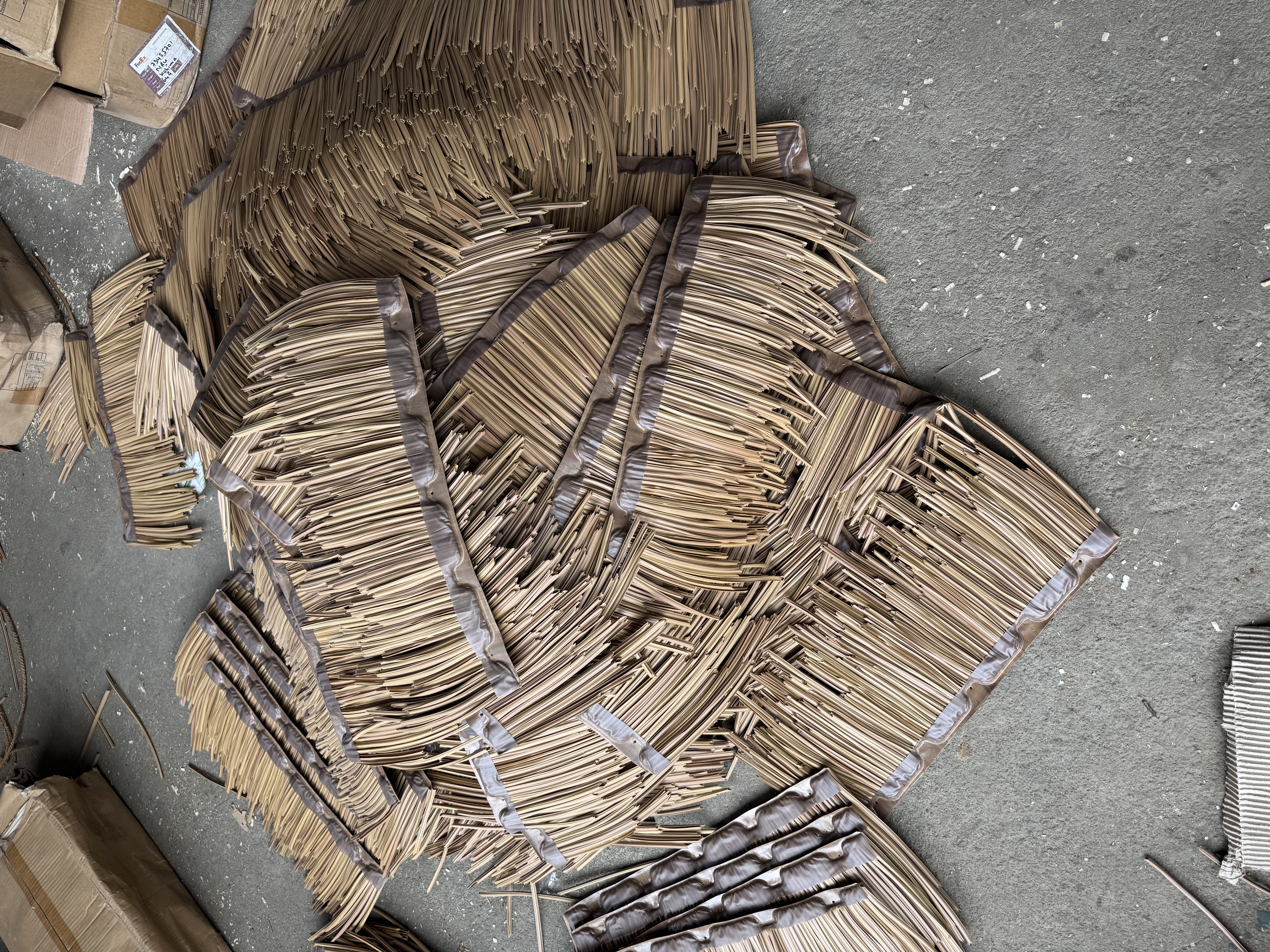
Here's why: the "thatch" is plastic, probably from China.
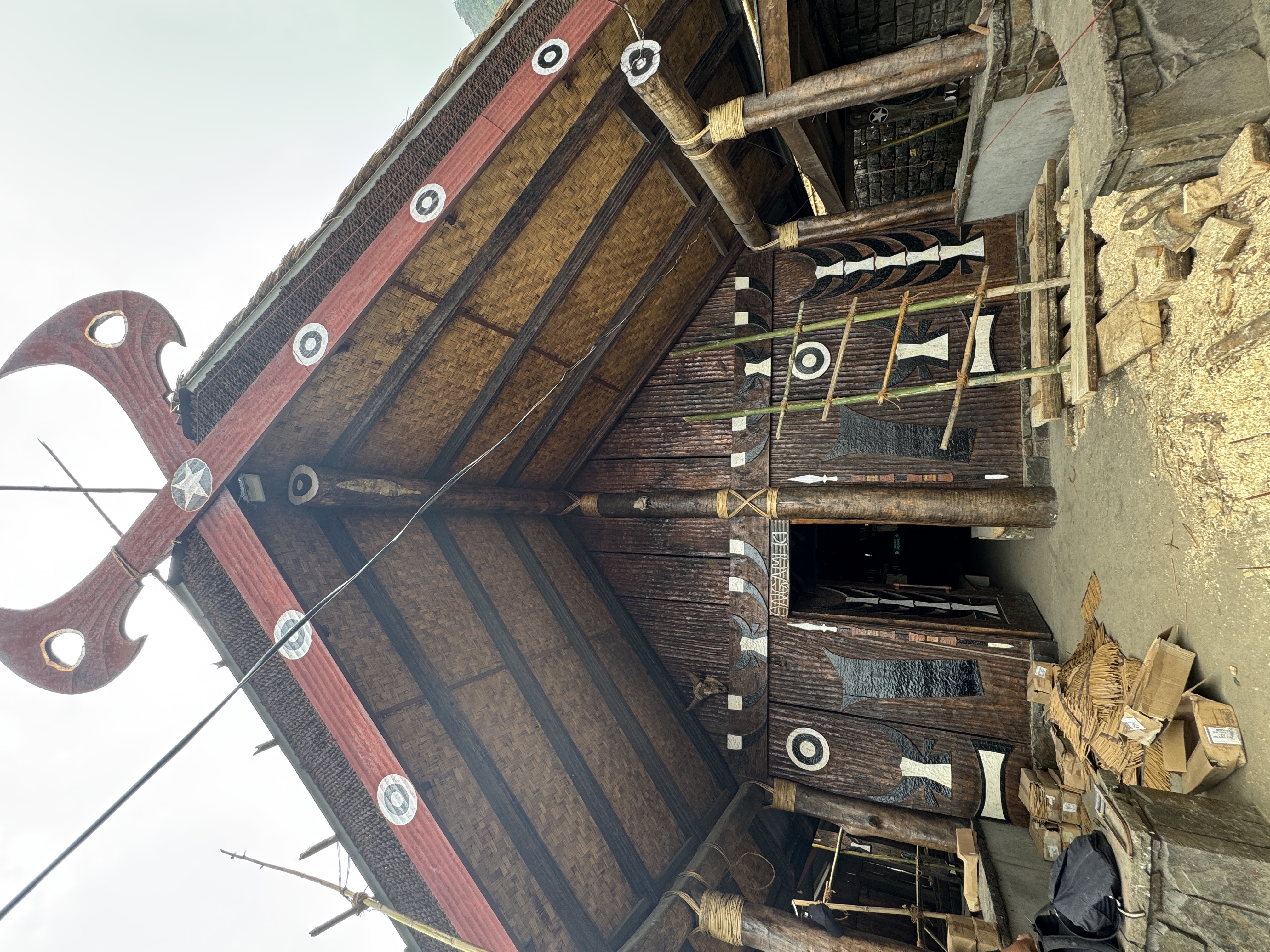
The building does have classic "house horns," another prestige marker.
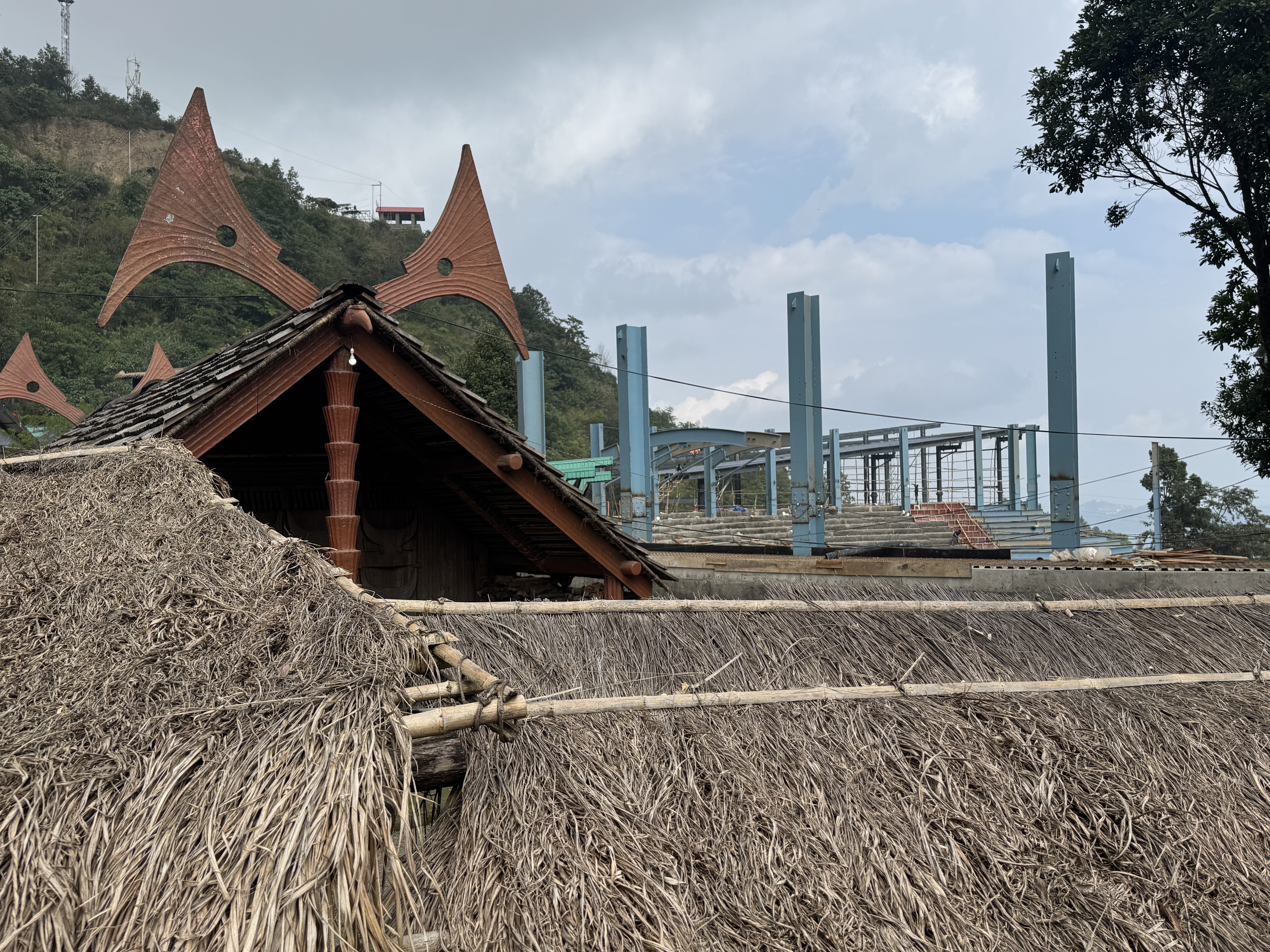
Juxtaposition of the day.
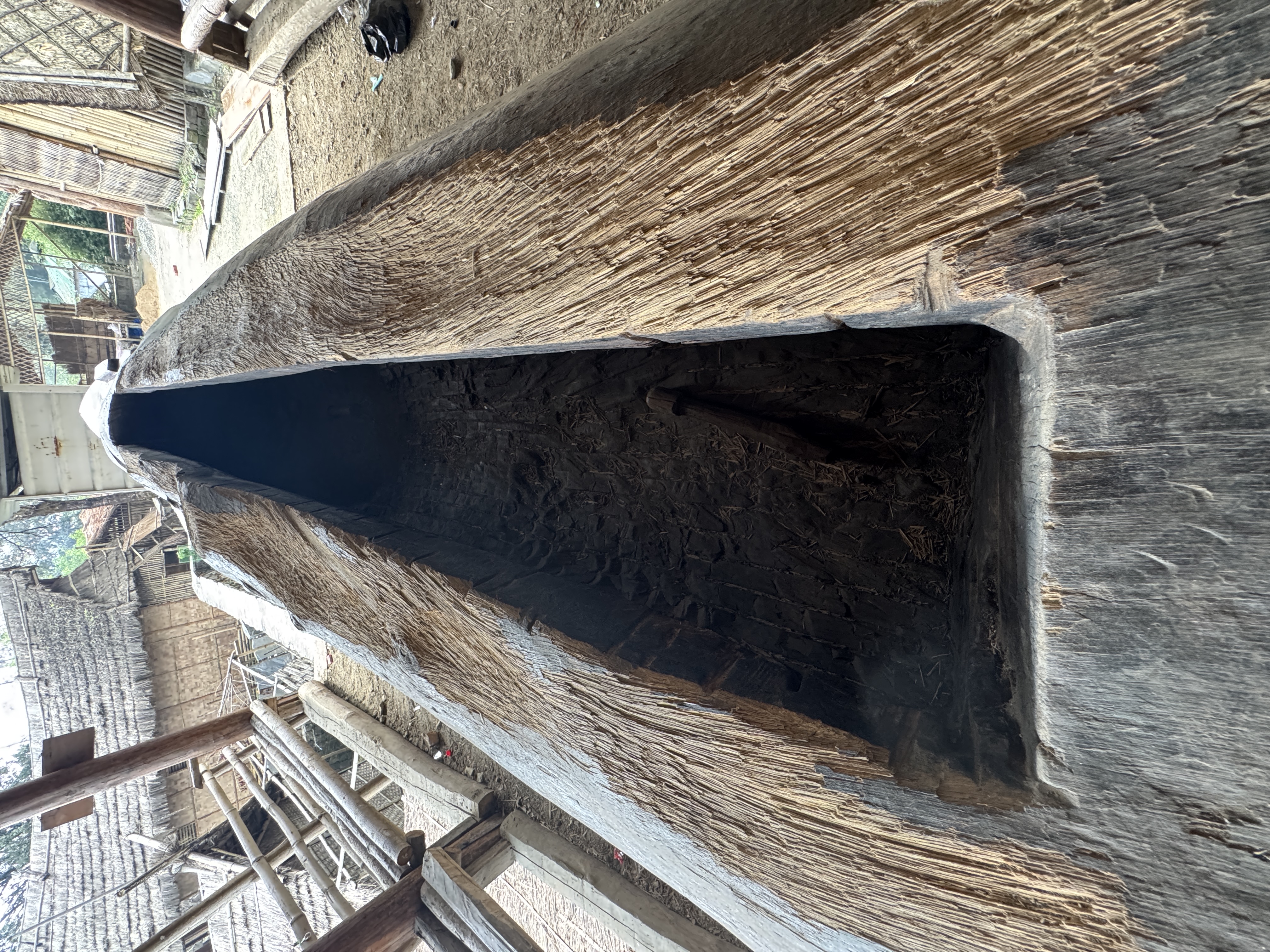
Any ideas? It looks like a dugout canoe destined to capsize.
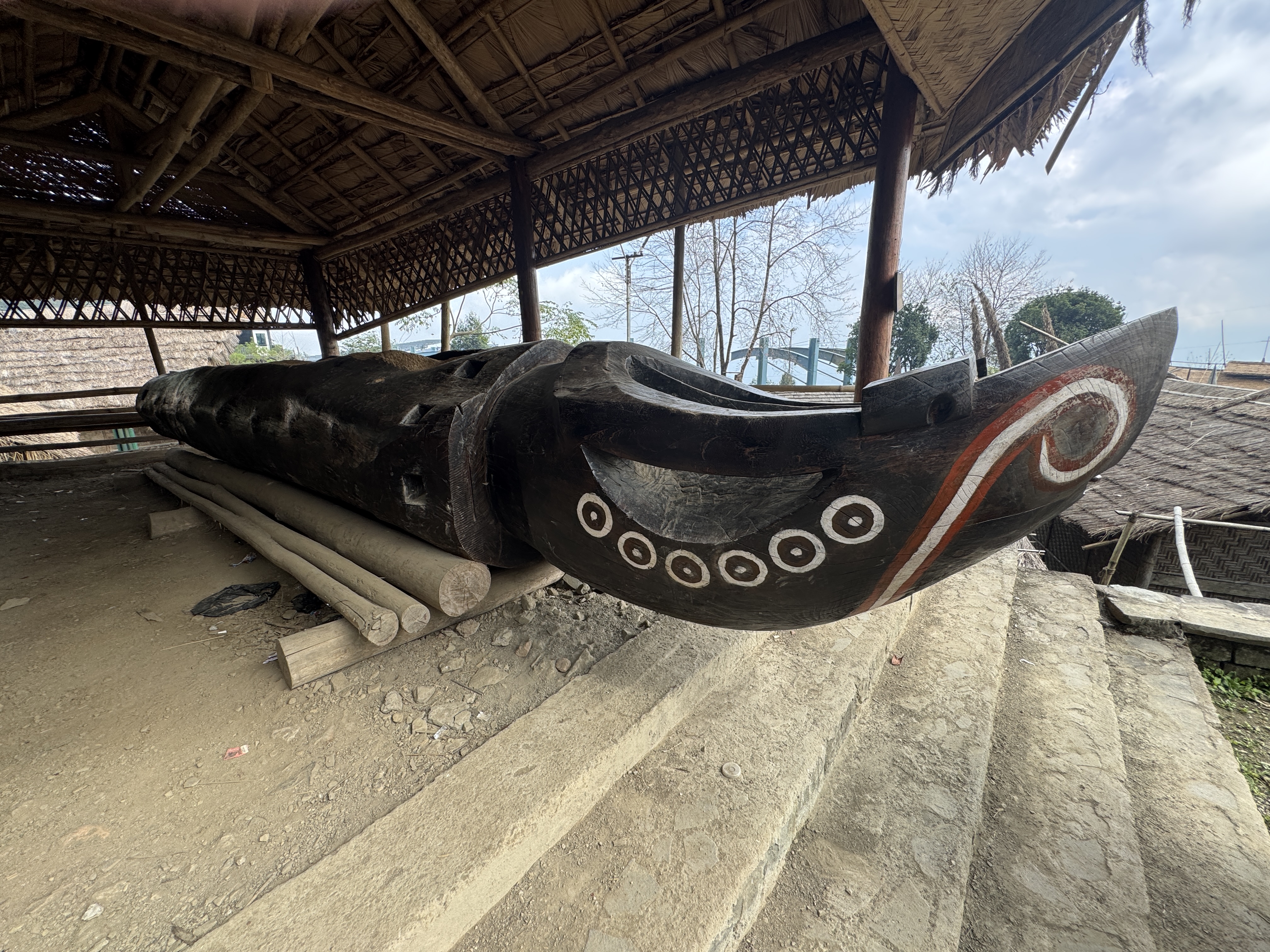
It's a drum, played by half a dozen men pounding heavy posts into the trench.
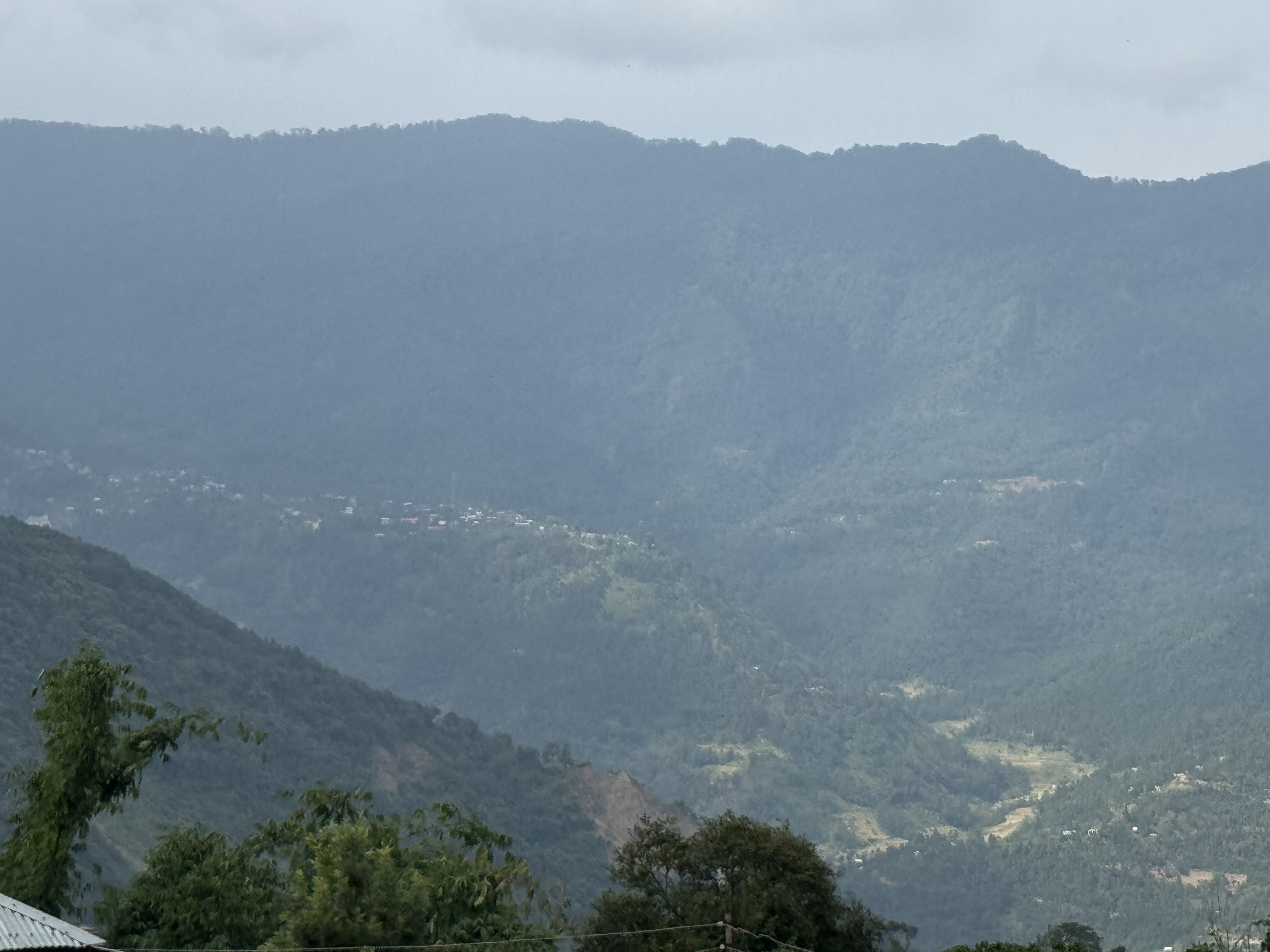
We'll head now to Khonoma, an Angami village about five miles southwest of Kohima and, among outsiders at least, the most famous Naga village. Like most if not all Angami settlements, it's on a hilltop for security and, for more security, was once fenced and gated. Getting the head of a woman or child was especially meritorious, because it showed that the hunter was clever enough to get close.
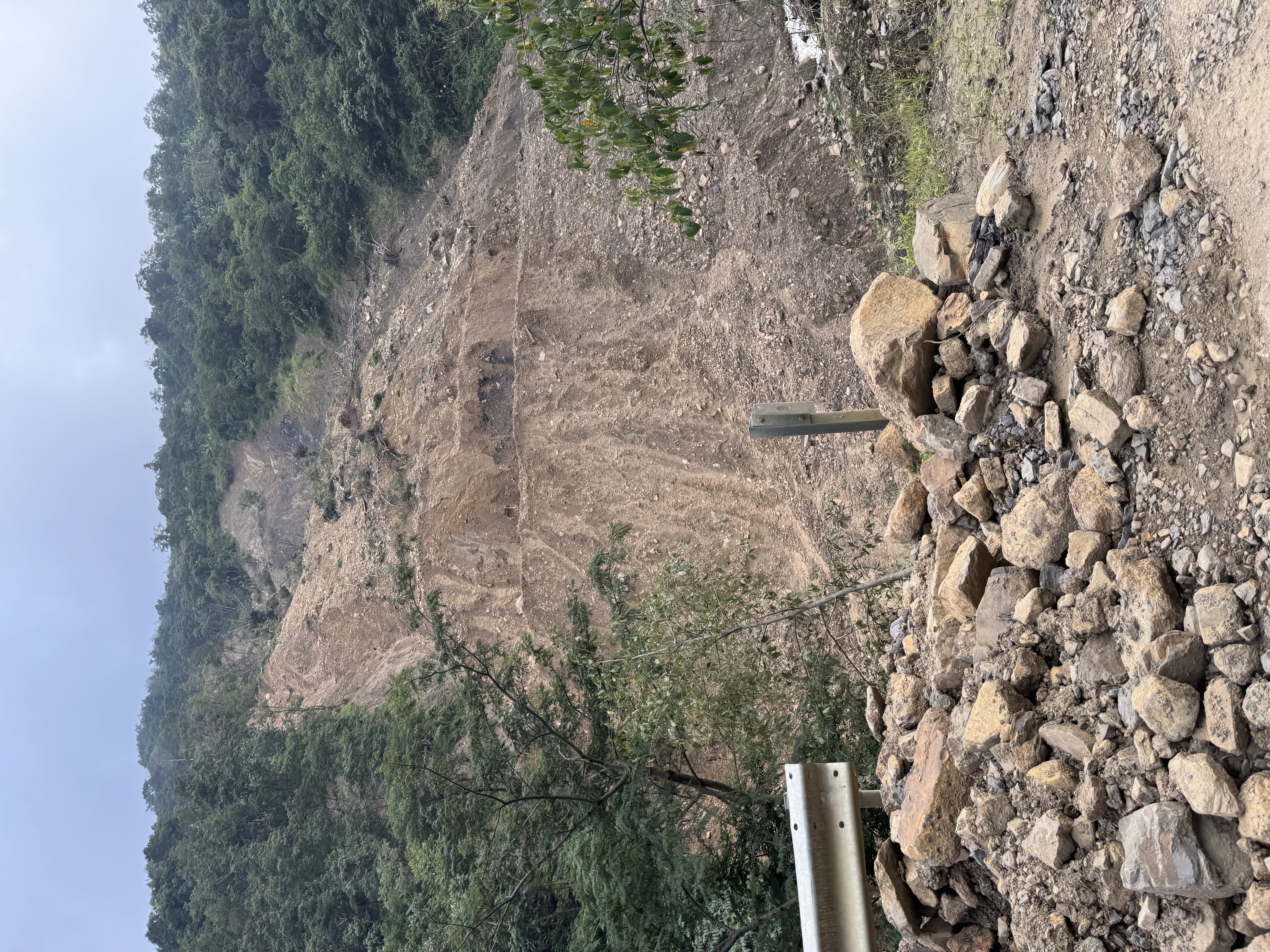
On the way: another damned landslide.
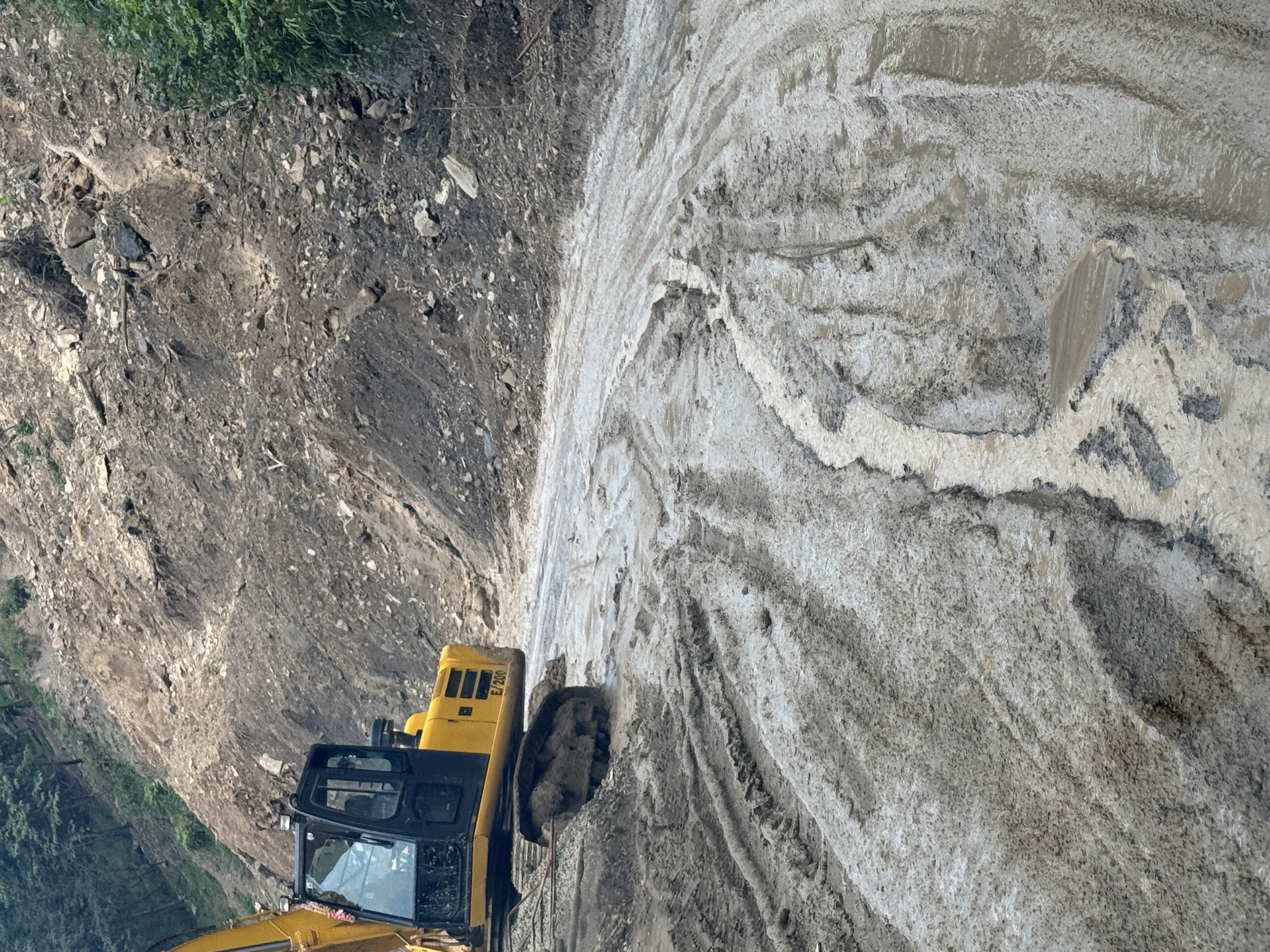
It was easy coming down, but we wondered if we'd make it back up. We did.
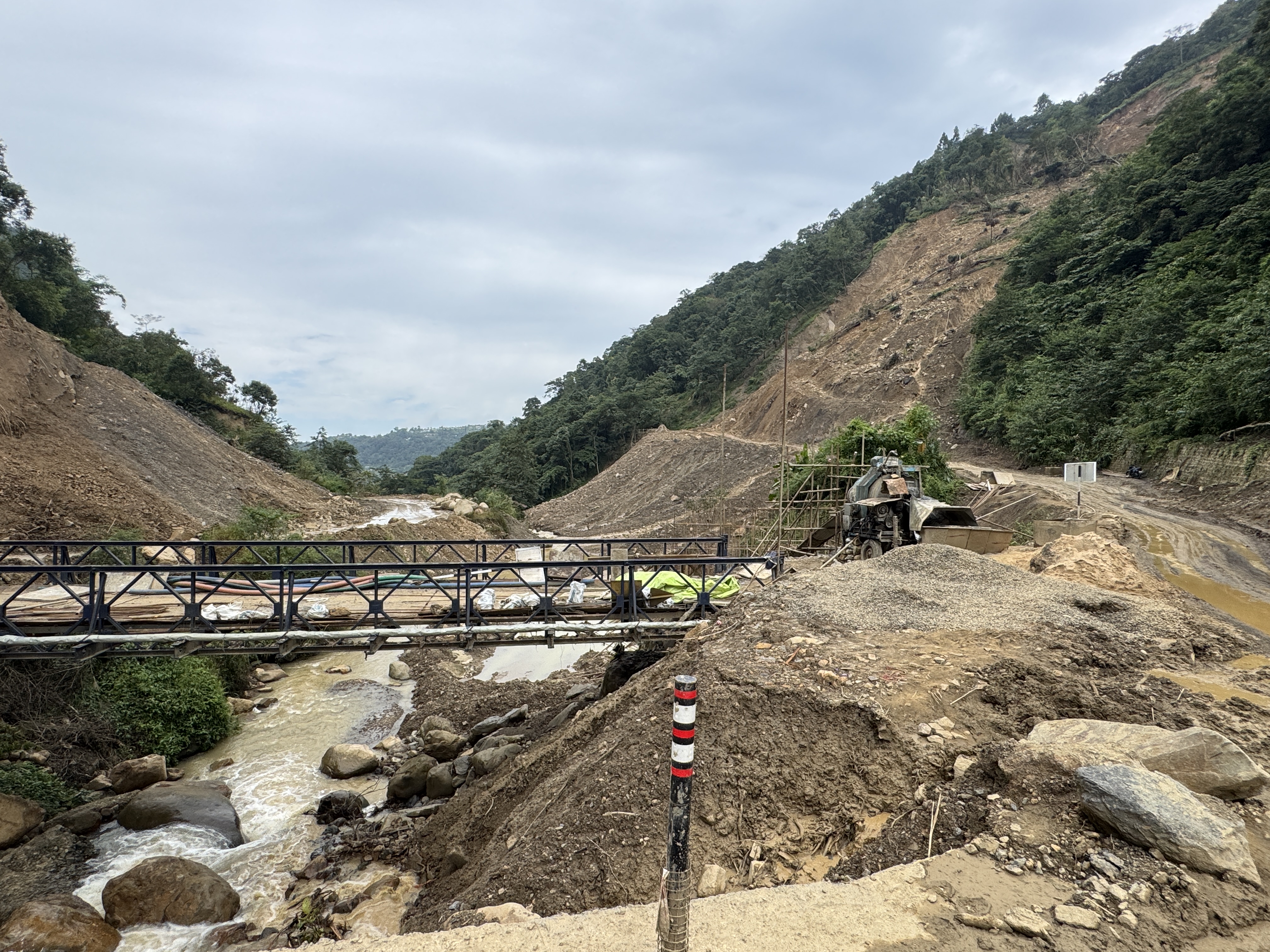
Here's the hairpin at the crossing.
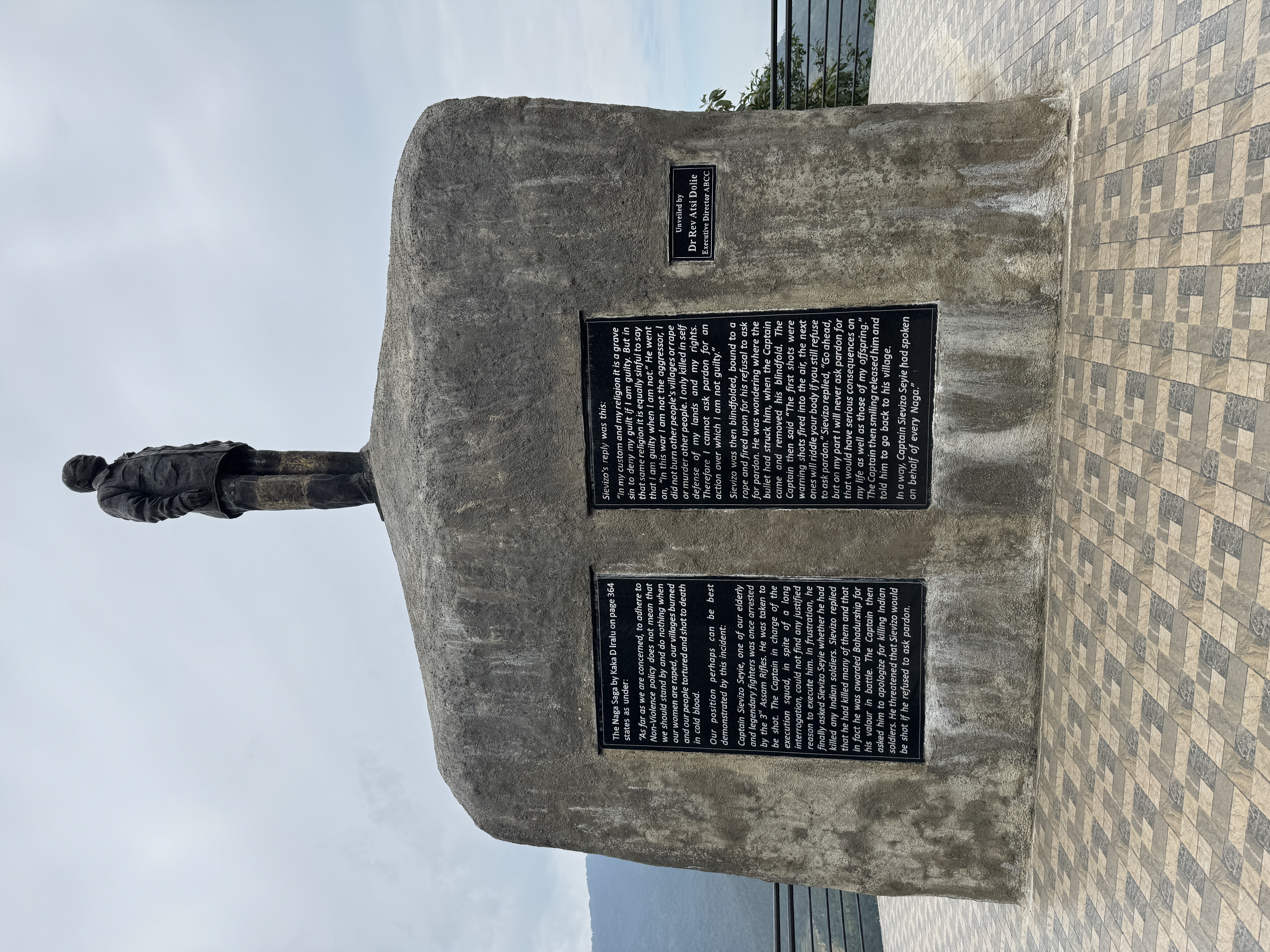
A monument along the road celebrates a man who, after the departure of the British, fought for a free Nagaland. Sir Robert Reid, who had governed Assam when it was part of Assam, was sympathetic. Recommending that the Naga Hills become a Crown Colony, he wrote that the Nagas "cannot be left to Indian political leaders with neither knowledge, interest nor feeling for these areas" ("A Note on the Future of the Hill Tribes of Assam and the Adjoining Hills in a Self-governing iIdia," in David R. Syiemlieh, ed., On the Edge of Empire: Four British Plans for North East India, 1941-1947, p. 66).
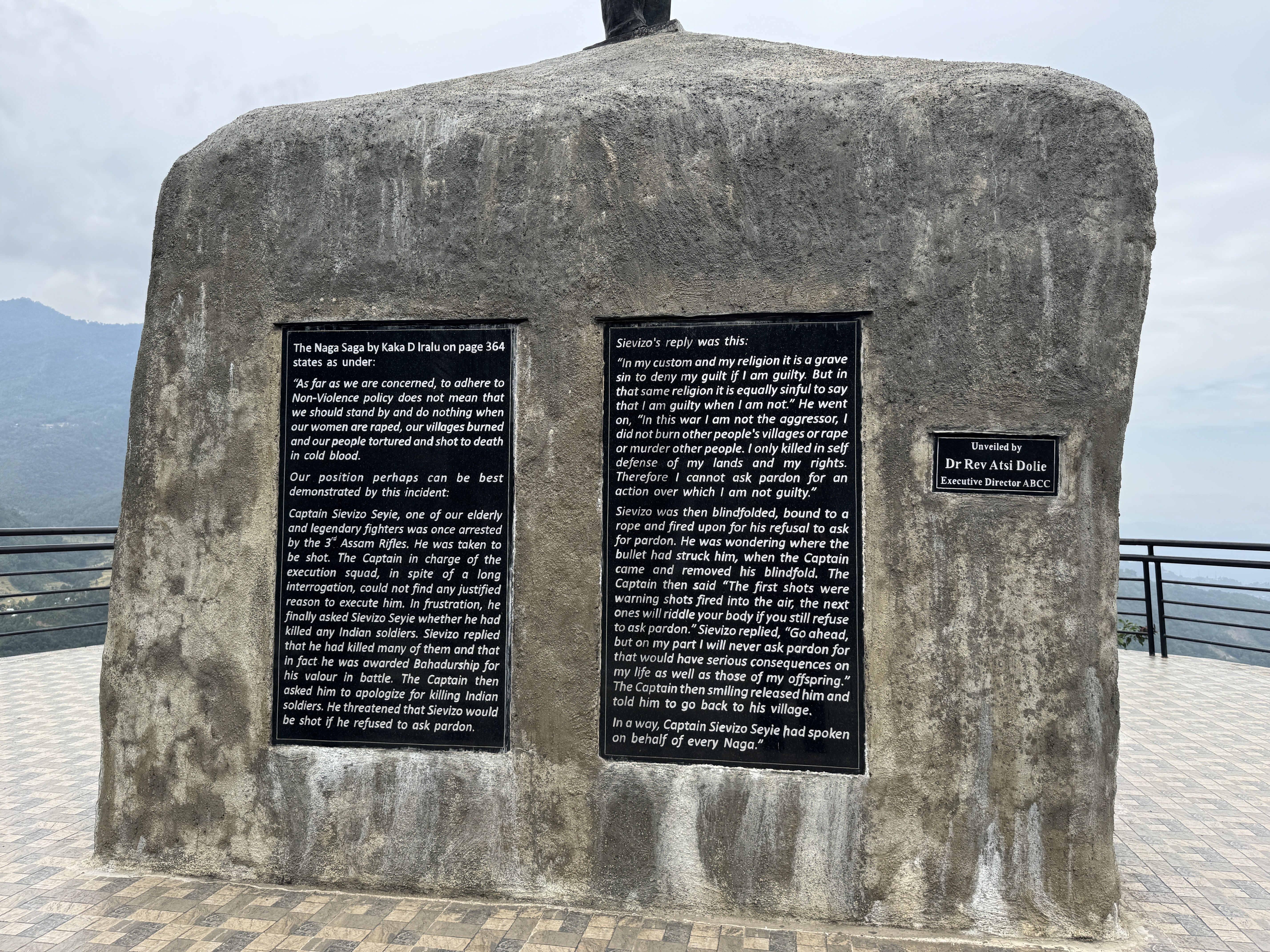
Hagiographical? Probably Kaka Iralu (1956-2020) was a prolific author whose work was mostly published in Kohima rather than in Europe or North America. As the initials on the monument hint, the unveiling was done by a pastor working with the Angami Baptist Church Council (ABCC).
You might think that Naga children would learn this story, but they don't, at least not in schools, where the curriculum is dictated by Delhi.
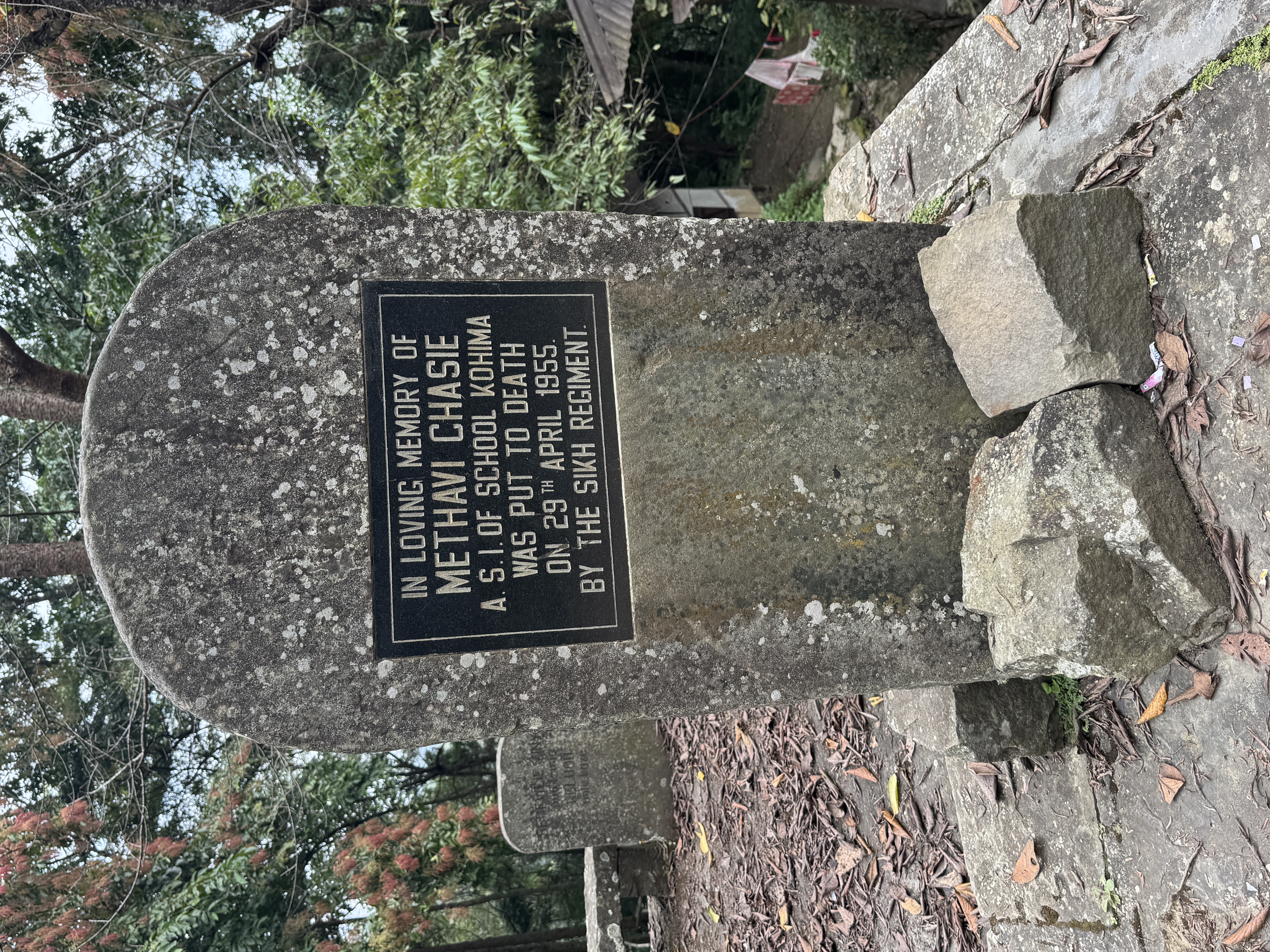
A reminder of the troubles. They peaked in 1956 but linger still.
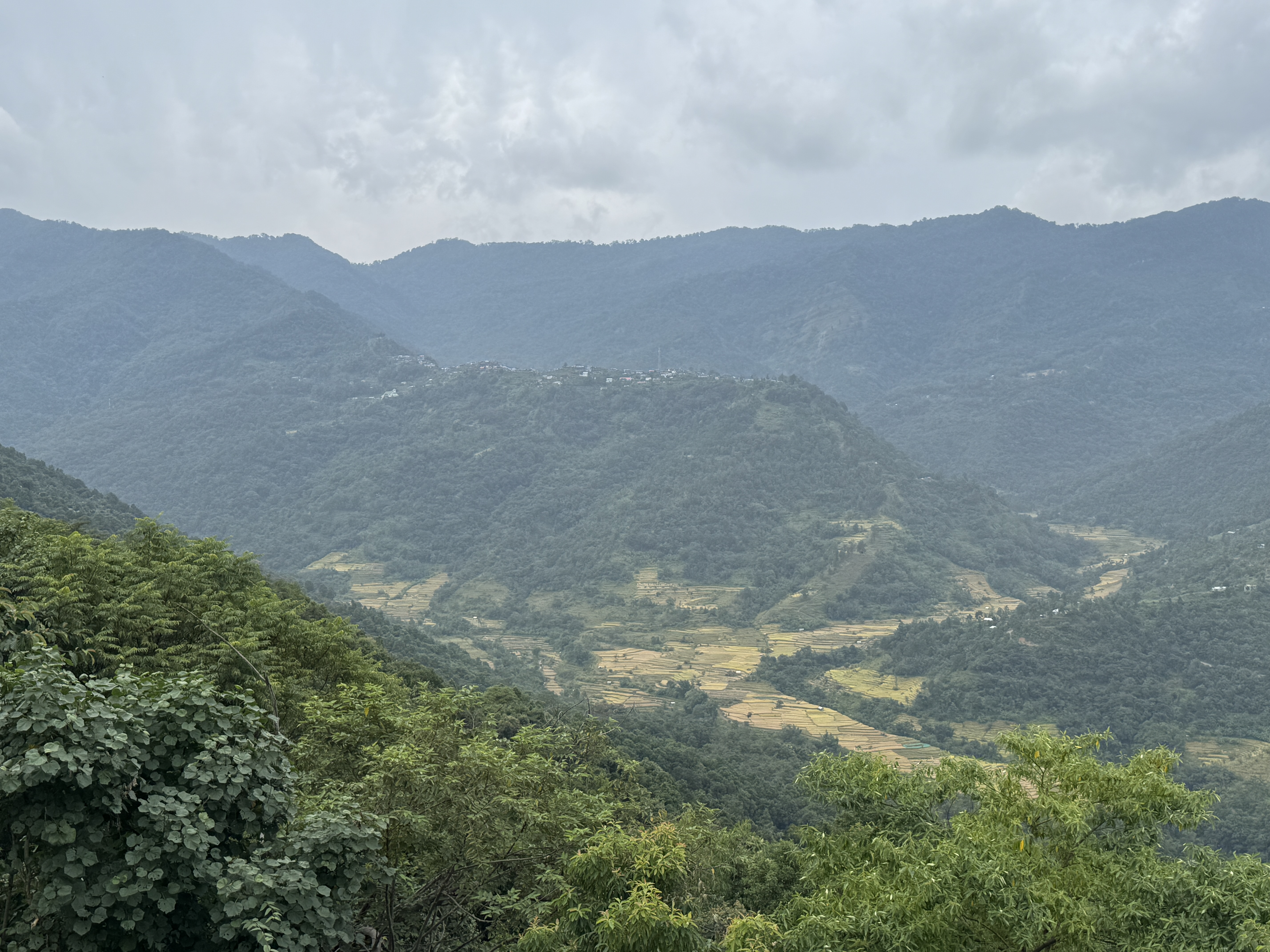
A bit closer. Khonoma is surrounded on three sides by its paddy fields. The Angamis were famous not only for their independent spirit but for their wet paddy. Nearly every other Naga tribe grew rice, if at all, by shifting cultivation, or jhum. The British understood that this was a stable method so long as population was stable, but they feared that rotational cycles would shorten as population grew. Instead, people have moved to town and jhuming has declined.
You'll notice a white building at the left edge of the village.
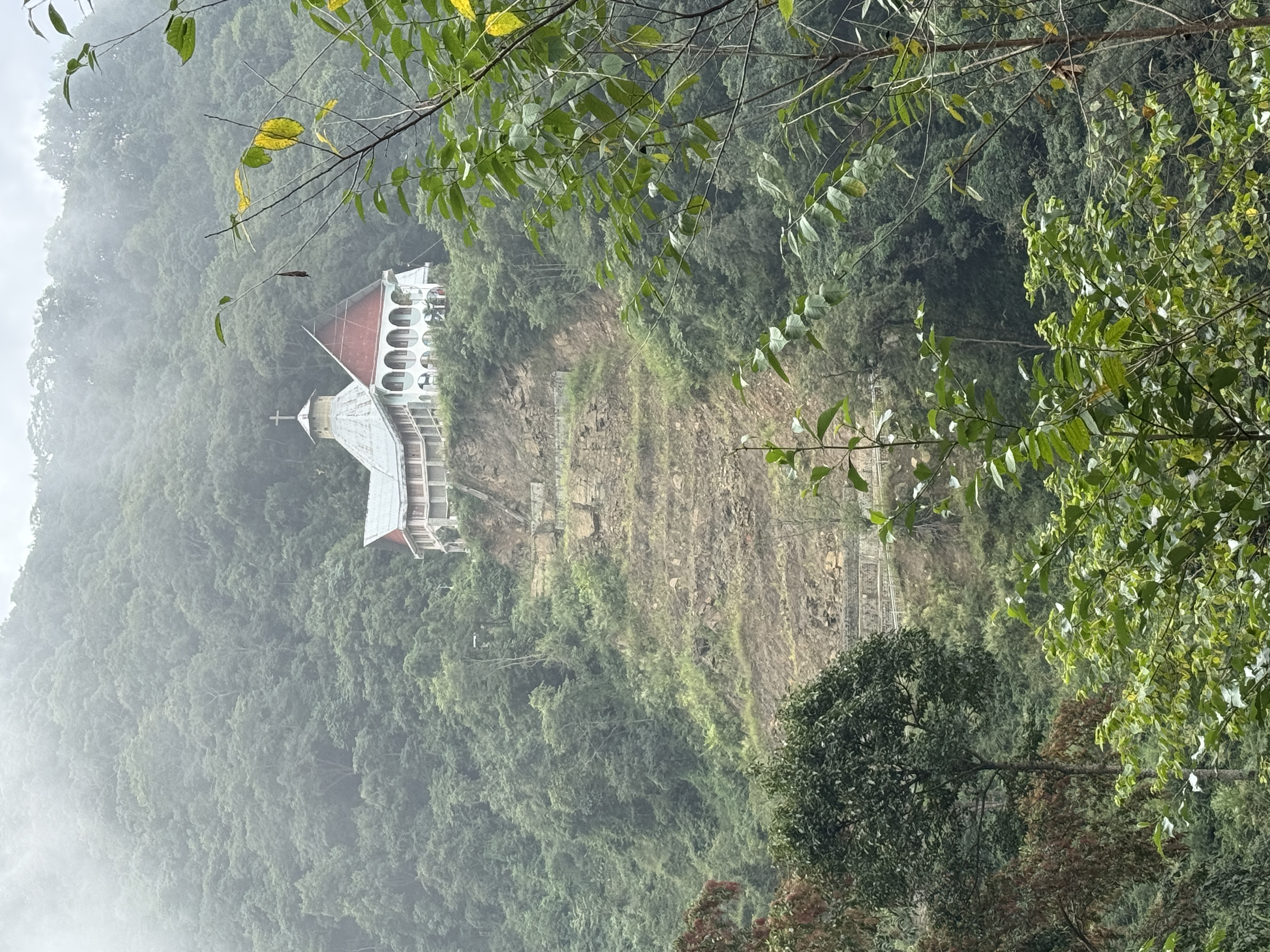
It's Saint John the Evangelist Church, a Catholic chuch precariously surviving at the top of a recent landslide.
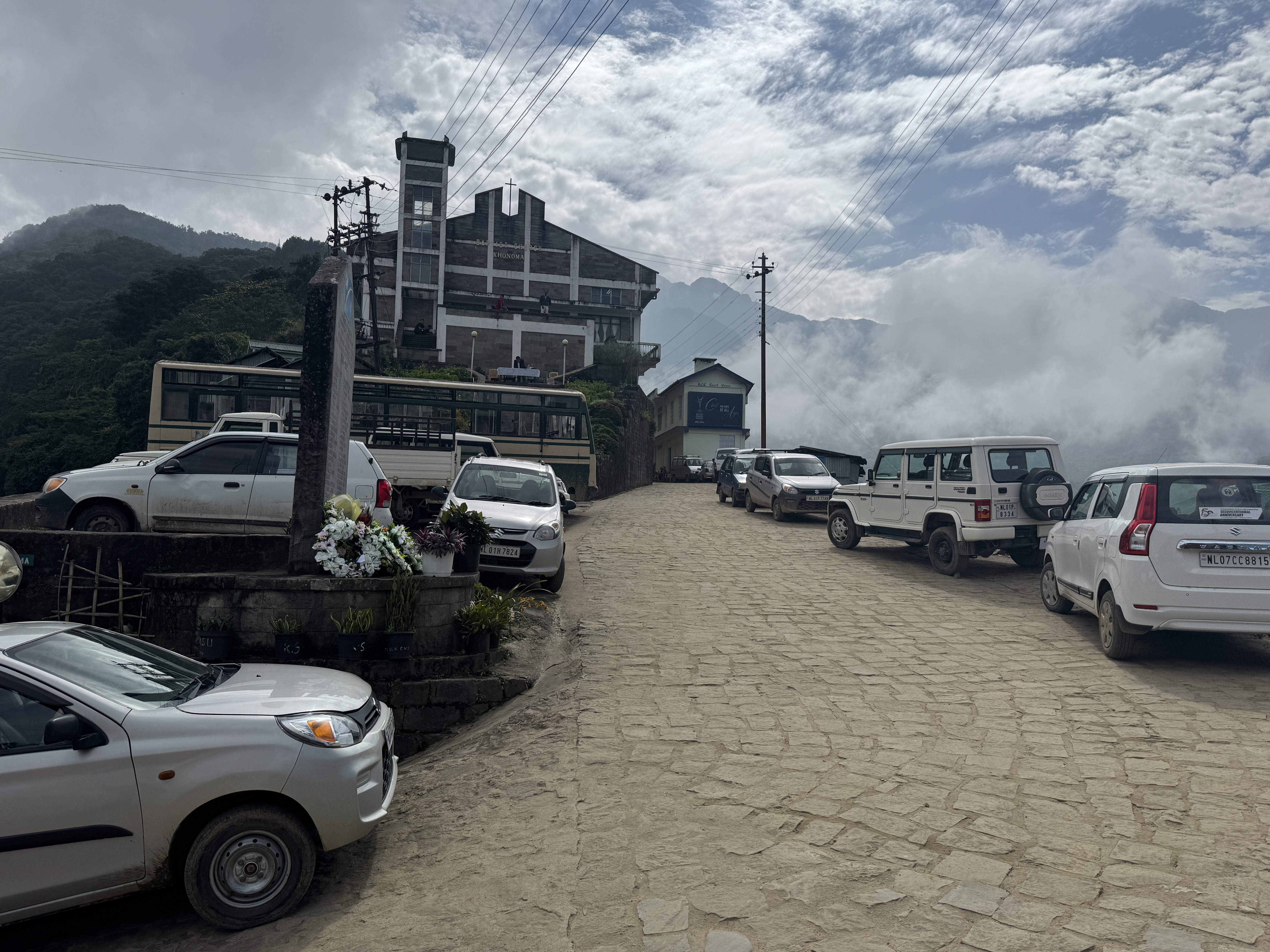
And here, on the summit of the ridge, there's a service this Sunday morning at the Baptist church. "You are not Christian? How can you not be Christian?" This from a medical doctor who explains that it was American missionaries who brought the gospel to the Nagas.
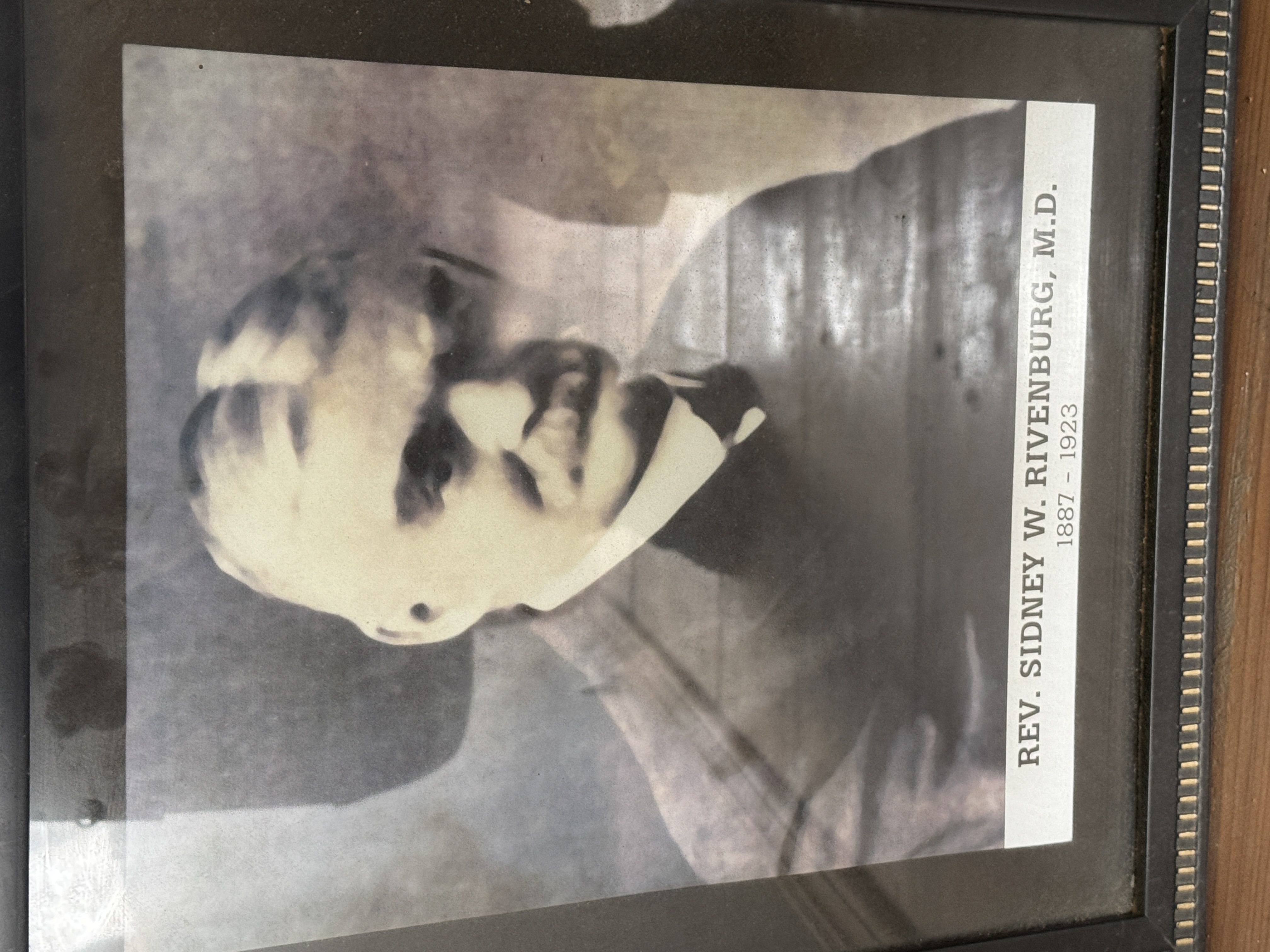
A second and final detour. Sidney Rivenburg arrived in 1885 with his wife Hattie and spent five years learning the Angami language but winning not a single convert. One reason is clear from his daughter Narola. Trying to produce an Angami version of the gospel according to Mark, she lamented of the Angamis: "nor do they have the equivalent for our word sin" (Narola Riverburg, ed., The Star of the Naga Hills: Letters from Rev. Sidney and Hattie Riverburg, 1941, p. 117).
The Rivenburgs went home, and Sidney got a medical degree. He returned to Kohima where Hattie wrote, the Nagas were "definitely more friendly... one reason is because Sidney is a full-fledged doctor" (The Star of the Naga Hills, 1941, p. 91). As such, he worked to vaccinate the Nagas against smallpox. He also met Sir Ronald Ross, who was working in Calcutta. As a result, Rivenburg worked to reduce pools and swamps near Angami villages to reduce mosquito populations and malaria. Still, conversions came slowly. In 1891, there had been 211 converts; a decade later, the number was 579. By the 1960s, Nagaland had 632 Baptist churches with a membership of 73,500. Other denominations arrived, too, Catholic first but in the years to come various revivalist alternatives.
The photo here is from a museum attached to Kohima's Baptist Mission. Church, formerly Kohima's American Baptist Mission Church. Rivenburg is still remembered, though he left in 1923 and died in 1936.
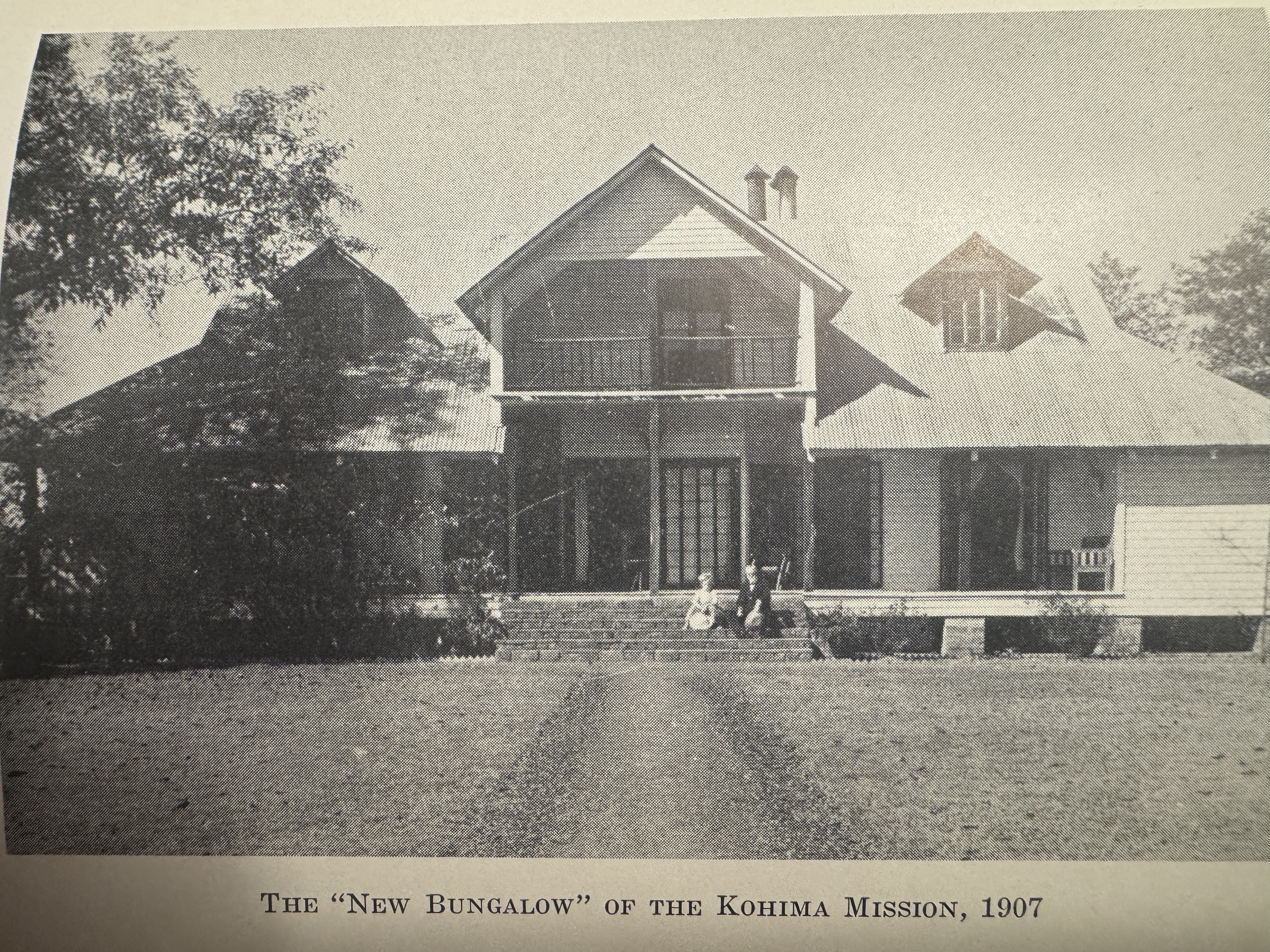
That might just be Pastor Rivenburg. (Narola Rivenburg, The Star of the Naga Hills: Letters from Rev. Sidney and Hattie Rivenburg, p. 104.)
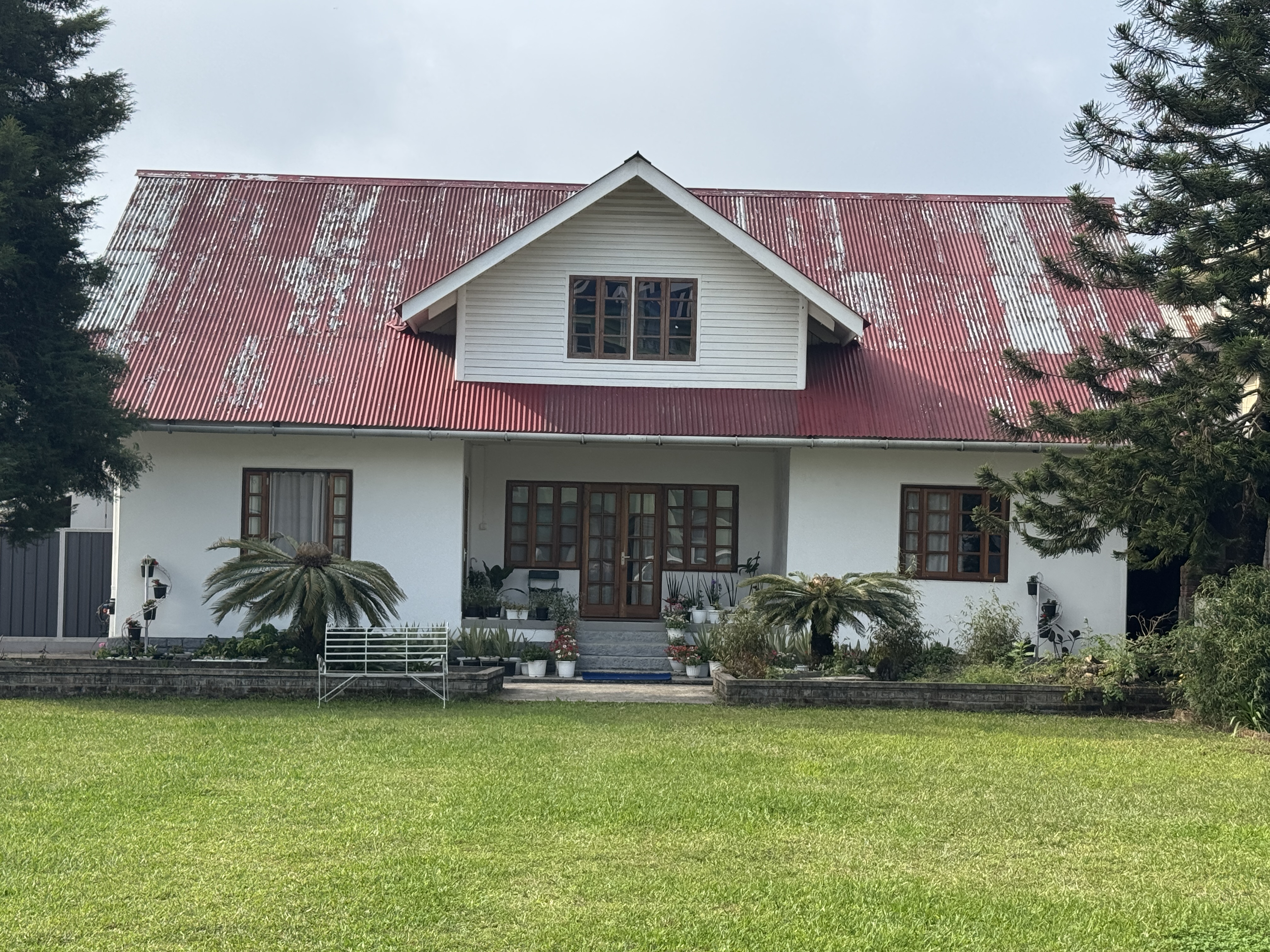
The same building survives, modified.
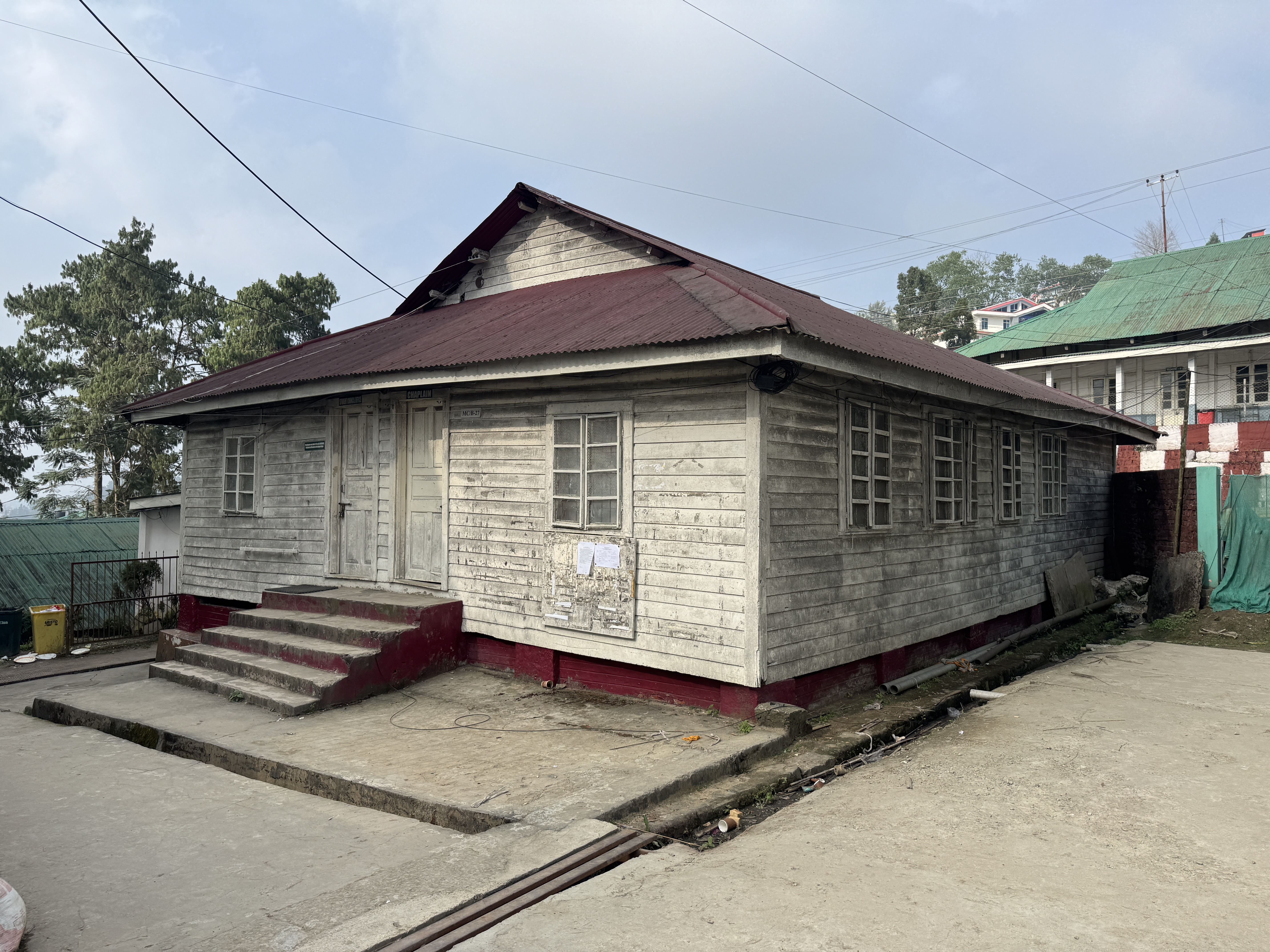
This may be only Kohima building that survived World War II intact.
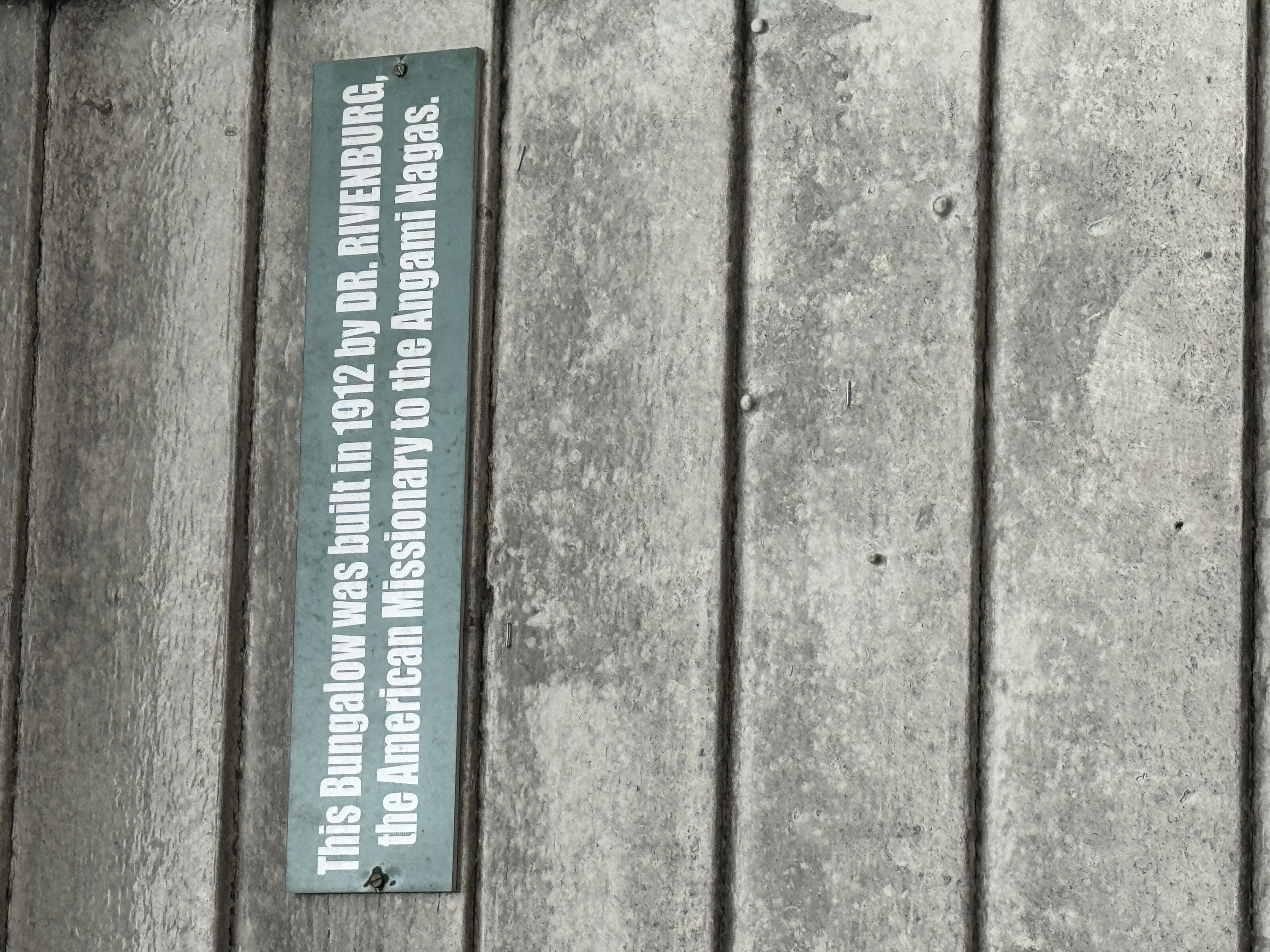
On the wall.
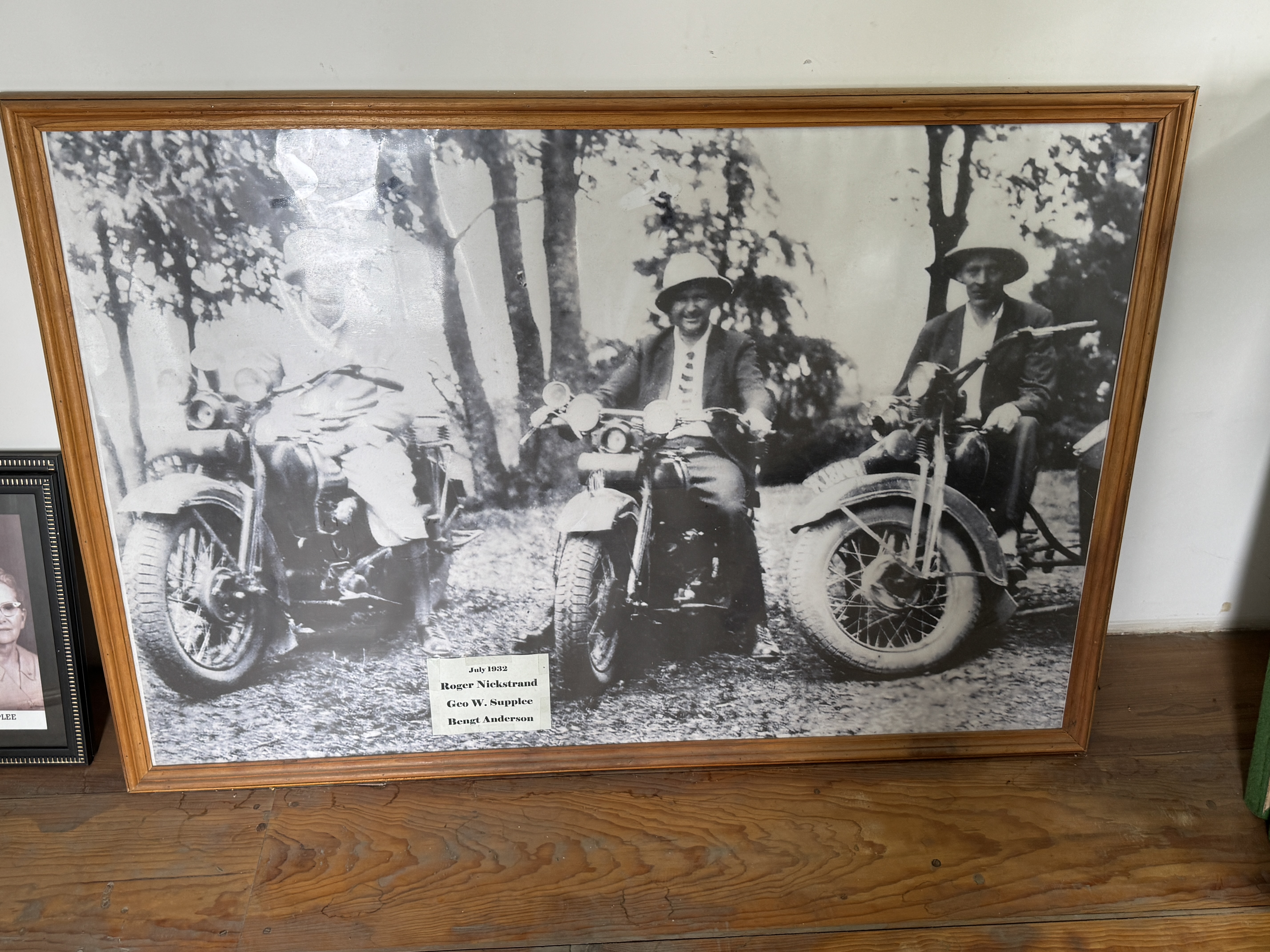
Missionaries used bikes to spread the Word in the 1930s. That's probably how they got to Khonoma.
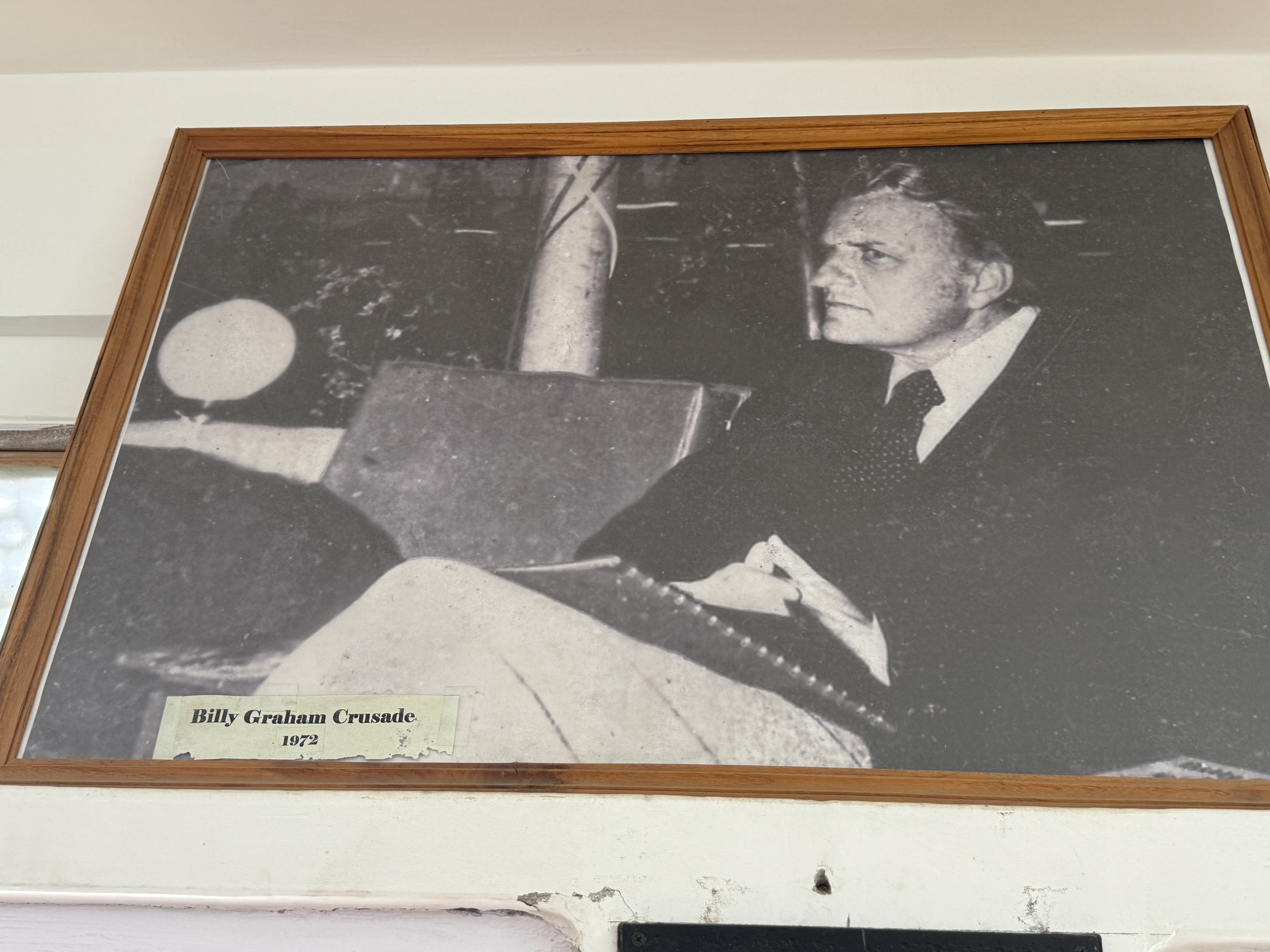
Billy Graham came by in 1972 and preached on the Kohima soccer field. There's video of the event on YouTube.
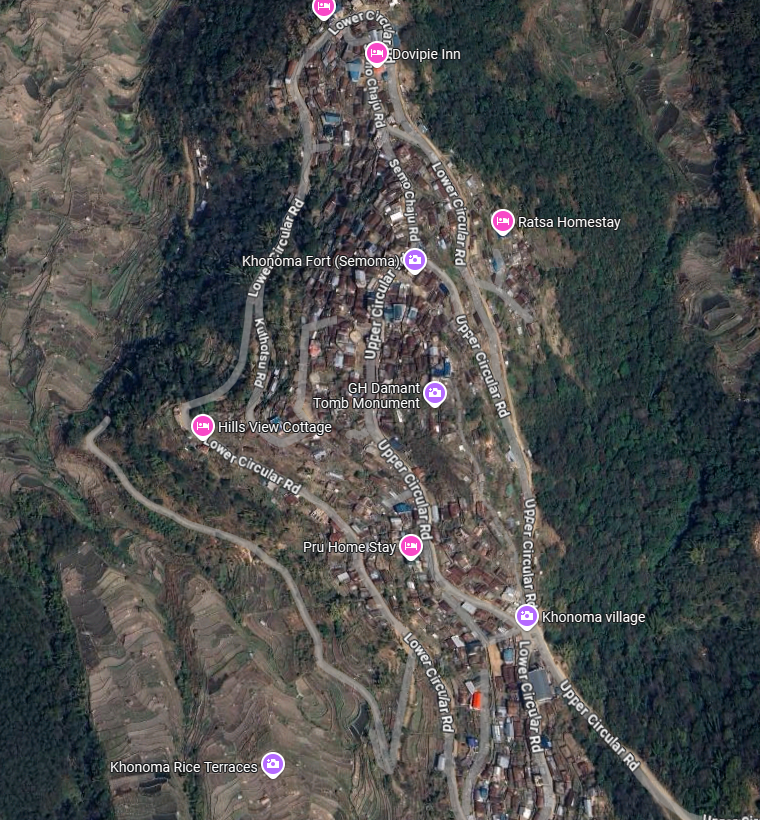
End detour. We're back to Khonoma. We were looking at the Baptist church from the spot labelled Khonoma village. The church is the dark-roofed building just below that spot.
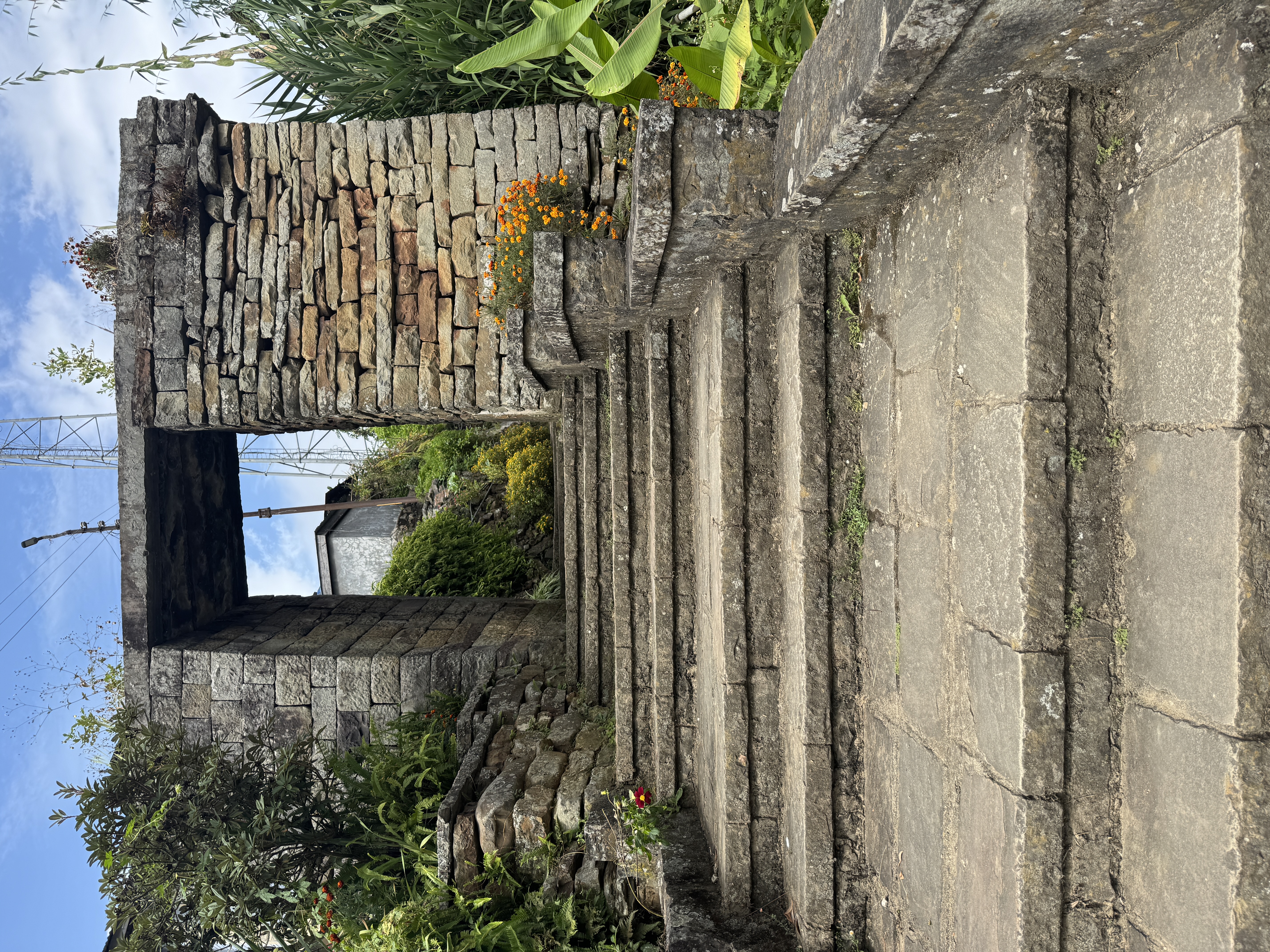
Here's a village gate, reconstructed a bit.
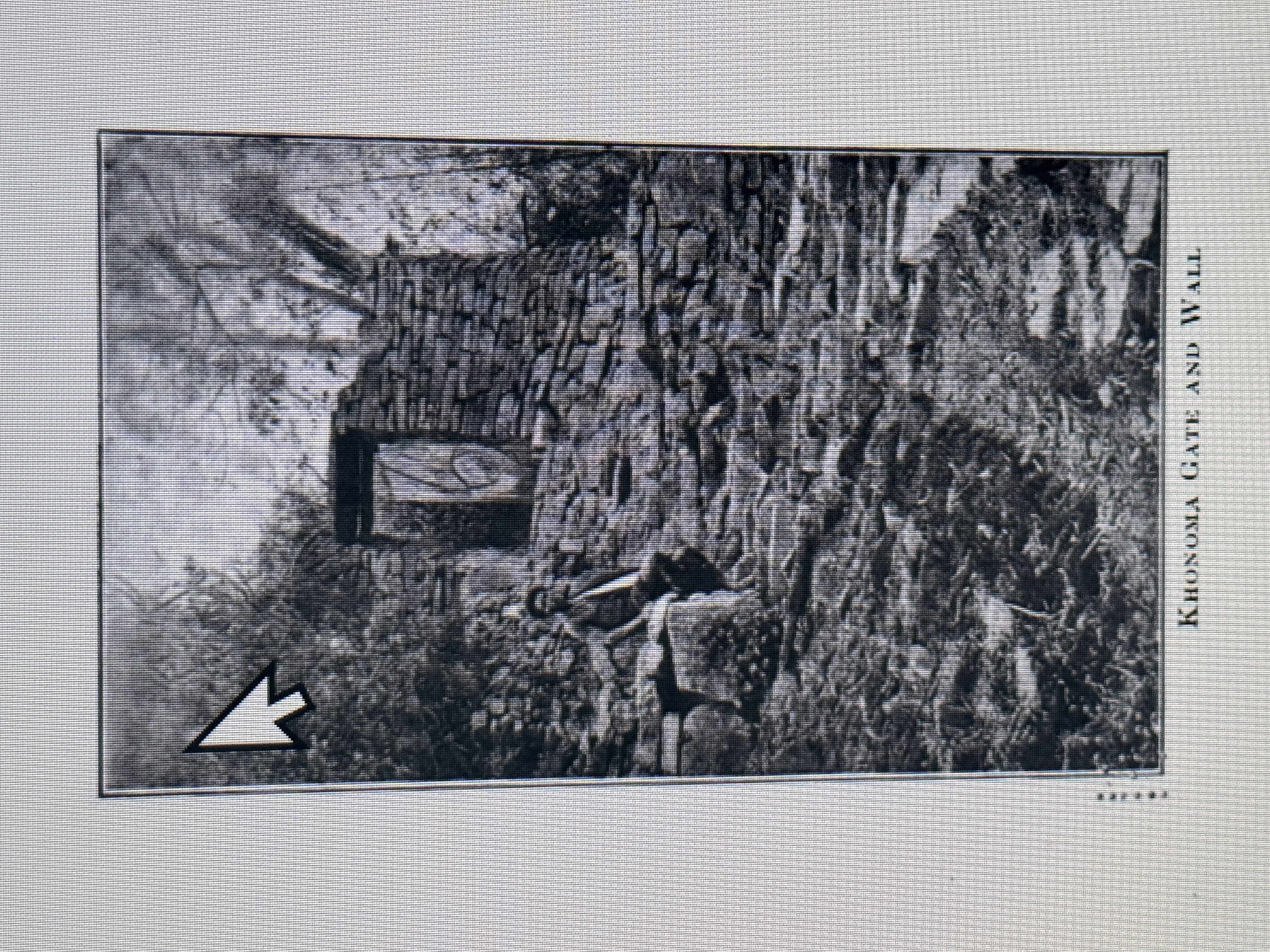
Here's the same gate sometime around 1920 (Hutton, The Angami Nagas, p. 155).
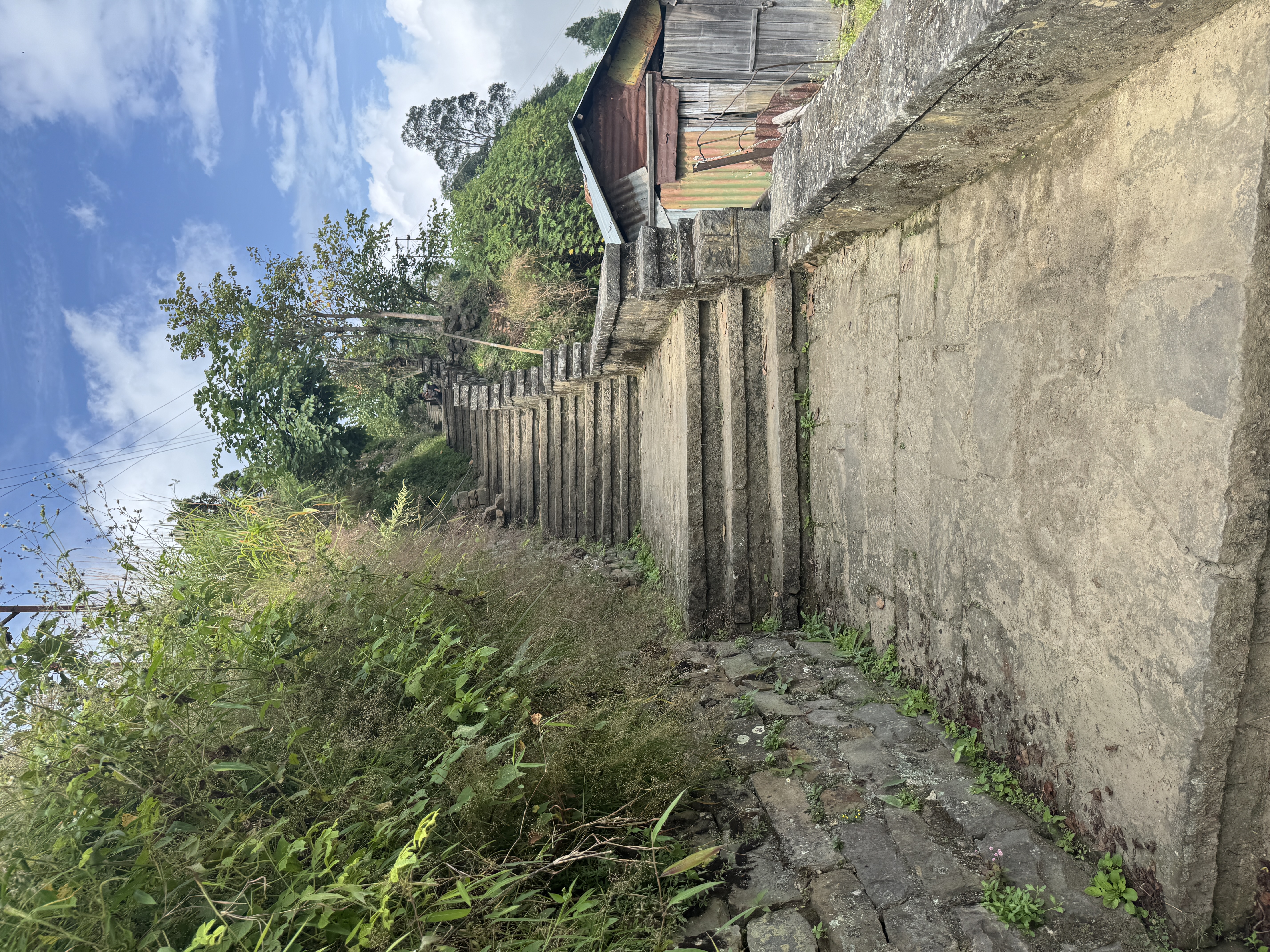
Puff, puff. You go ahead.
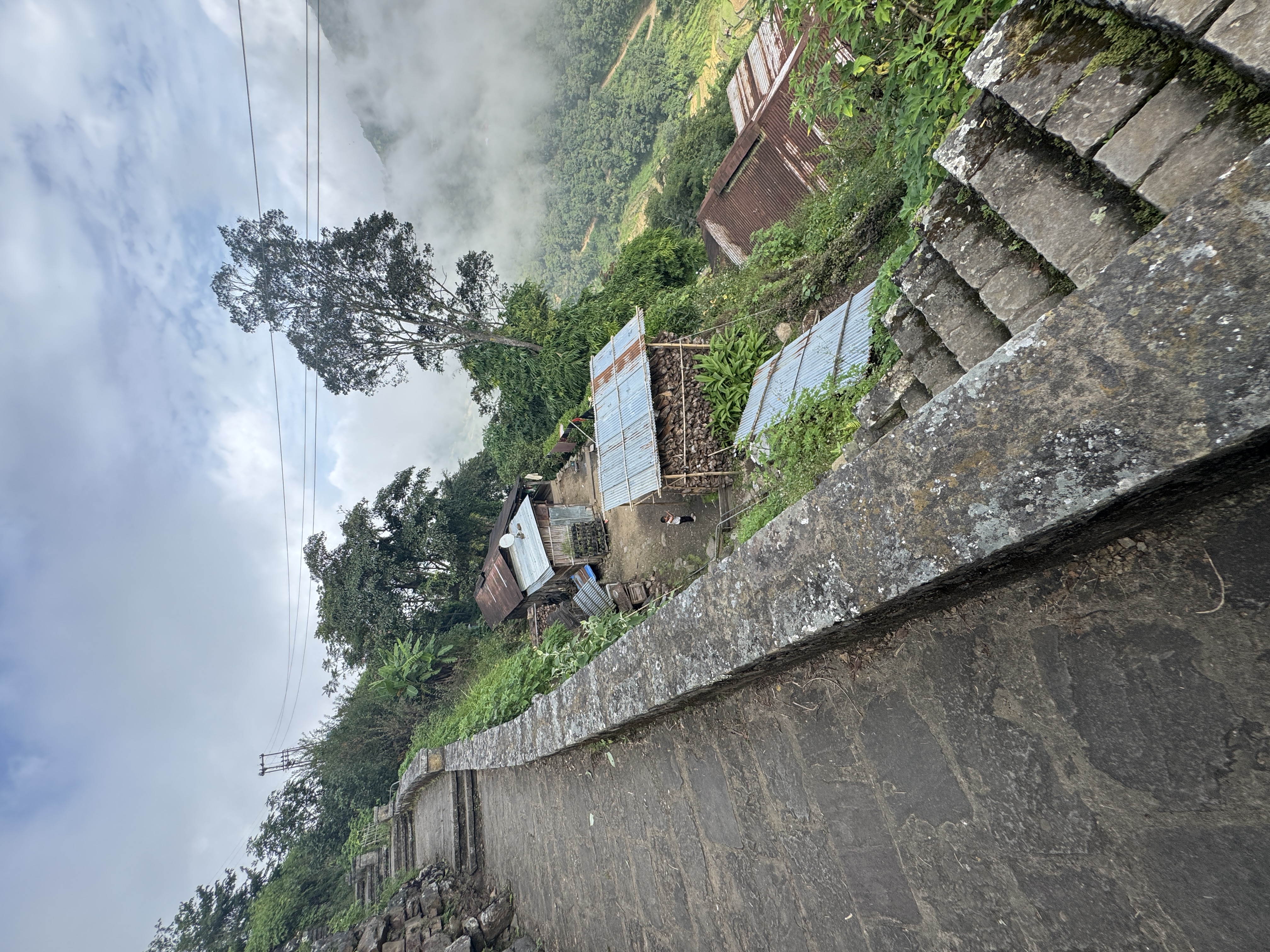
Visitors are accosted almost at once and told they must hire a guide. Give him credit: the guide I got was well-informed.
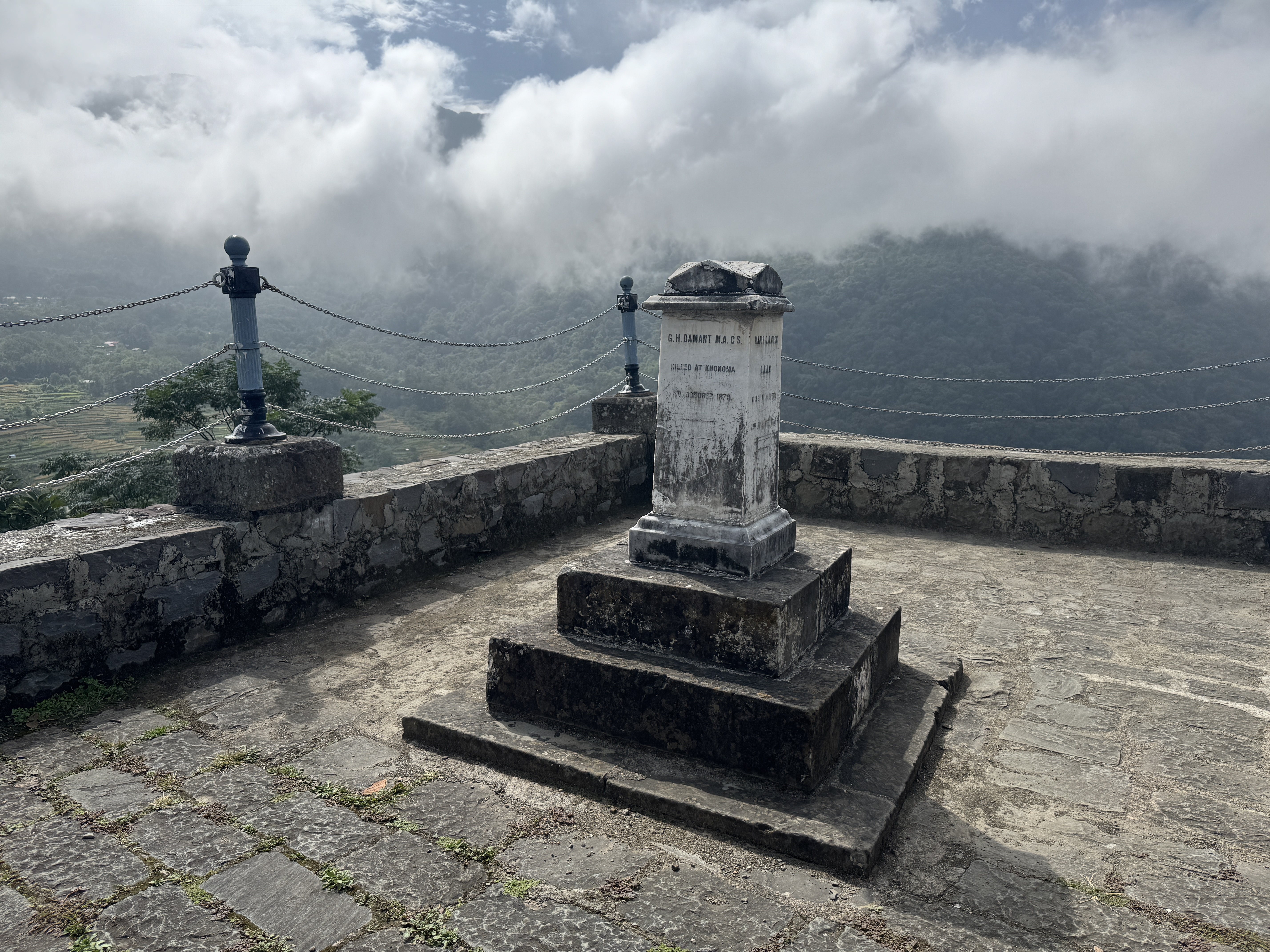
The signboard in the Heritage Hotel listed a Mr. G.H. Damant as "political officer, Naga Hills 1878-1879." Not a long stint! "It is said that an interpreter from Jotsoma warned him that the village was hostile, and on more than one occasion fell on his knees before him and begged him not to proceed. Mr. Damant declined to believe that there was any danger...he advanced... up the steep pathway leading to the village. The gate was closed, and as he stood before it he was shot dead... The Nagas then poured out of the village...and completely dispersed the troops, killing 35 and wounding 19... It was obviously time that the Nagas should be taught a lesson... " (Allen, Gazetteer of the Naga Hills, p. 22-23).
The monument itself is said to date from 1906-7 (http://www.kaiserscross.com/304501/544622.html).
In the spirit of teaching the Nagas a lesson, the British burned the village, but the villagers formed an alliance with some of the residents of Kohima, where the British station was soon besieged by 6,000 Naga warriors. A message was smugged out: "Surrounded by Nagas, cut off from water. Must be relieved at once...We are in extremity, come on sharp. Kohima not abandoned." The besieged British finally agreed to surrender in return for free passage out of the Hills. A British officer arriver with a military force before the surrender too place. He wrote: "This fatal arrangement would have been carried into effect within an hour or two, had not my letter arrived assuring them of help. What the result would have been no one who knows the Nagas can doubt; 545 headless and naked bodies would have been lying outside the blockade" (Sir James Johnstone, My Experiences in Manipur and the Naga Hills, p. 157).
The British proceeded to teach a lesson to the Nagas of Kohima. It was easy: just takes a match or two.
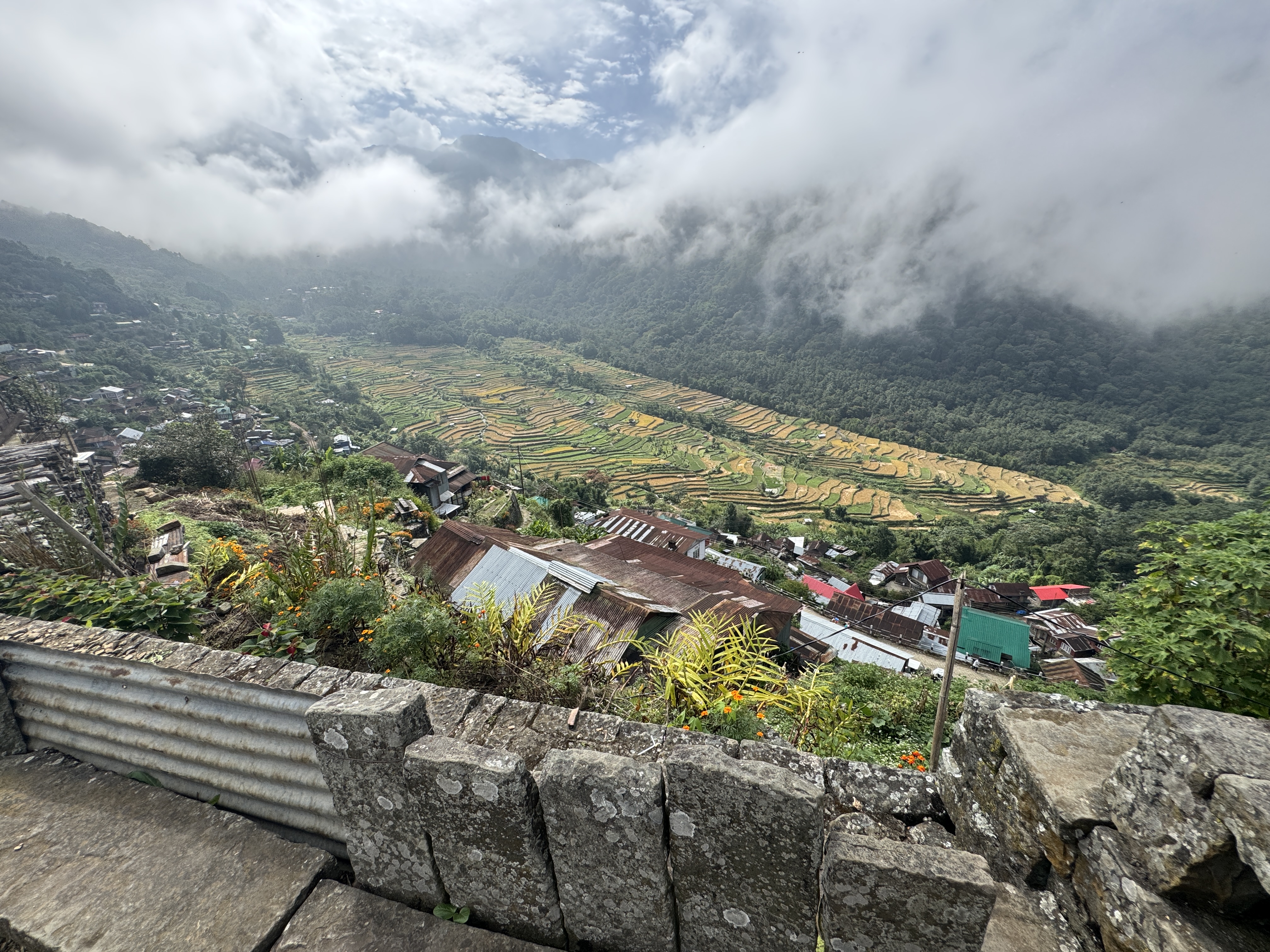
Khonoma's north-side paddy fields It looks timeless but isn't. The village and its paddy lands were abandoned after the troubles in 1879 and they were abandoned again during World War II. The paddy lands have never been completely restored, because the flat area beyond the paddy fields was, before the war, planted to paddy.
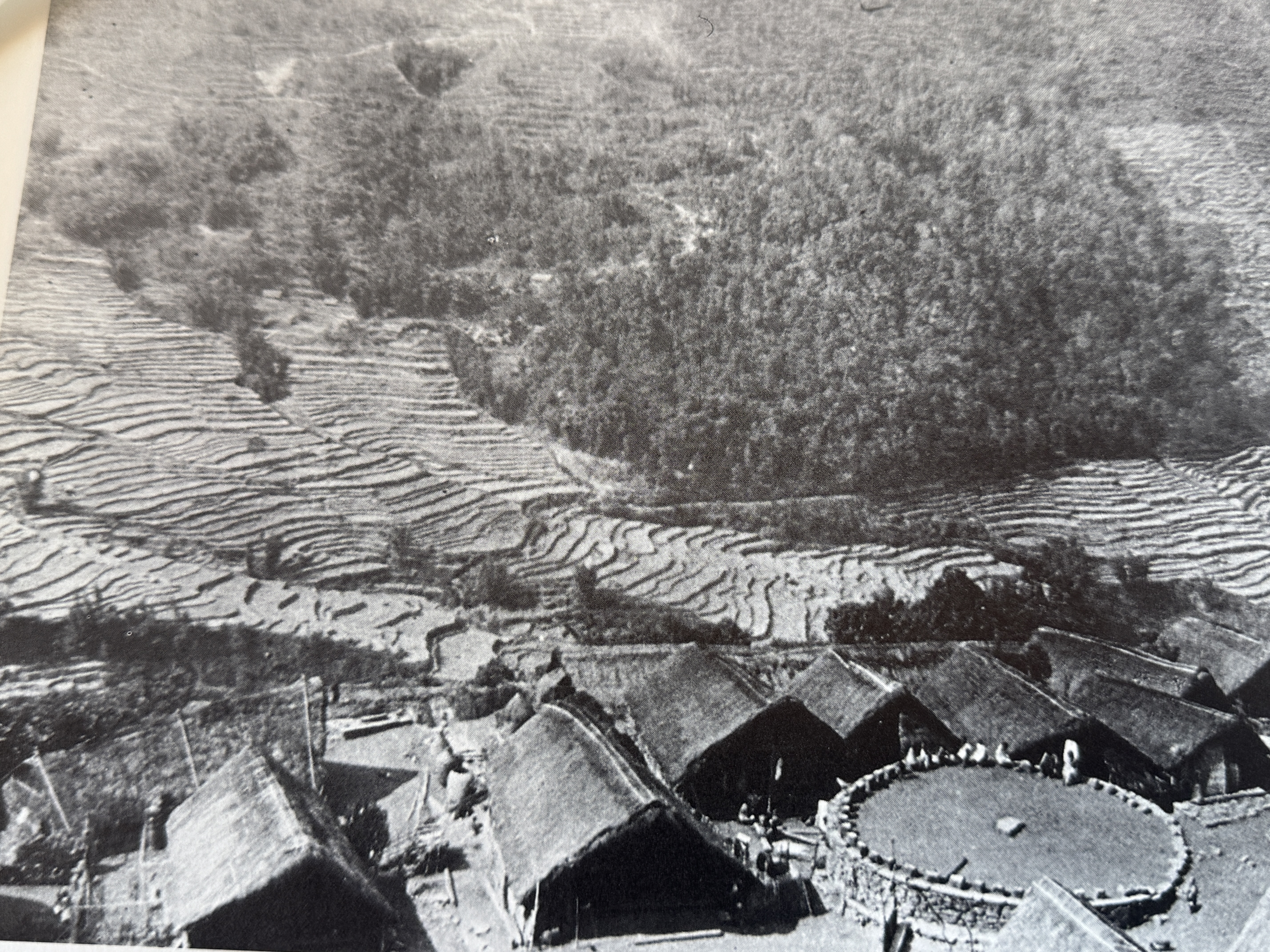
The village about 1920, with thatch-roofed houses. The circular platform is a meeting area and lookout point. (J.P. Mills, "The Assam-Burma Frontier," The Geographical Journal, 1926 p. 291.)
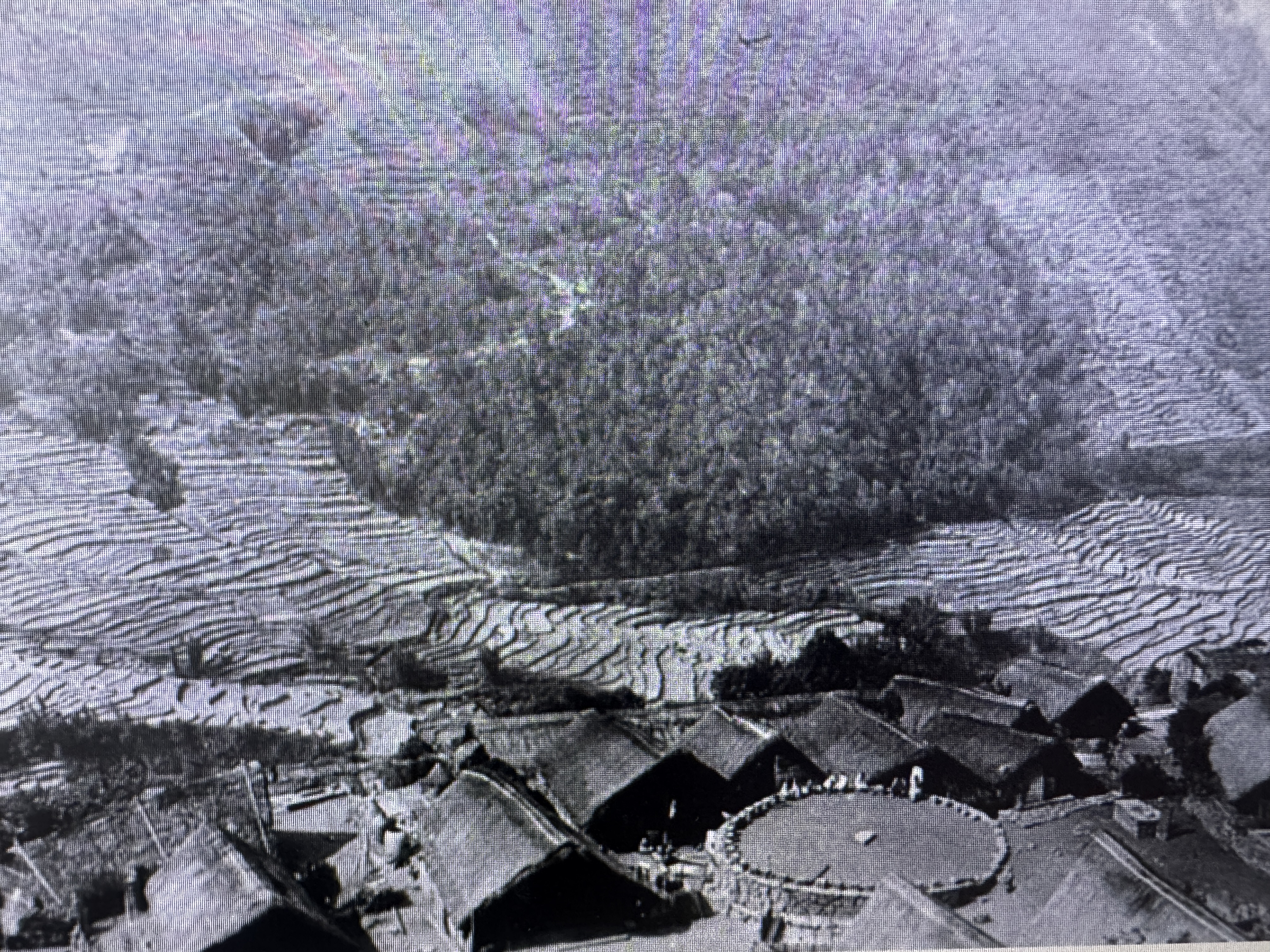
The same photo, cropped a bit differently (https://raiot.in/debates-divisions-and-deaths-within-the-naga-uprising-1944-1963/ ; this is the digital, illustrated version shown in Jelle J.P. Wouters, "Difficult Decolonization: Debates, Divisions, and Deaths Within the Naga Uprising, 1944-1963," Journal of North East India Studies, 2019.
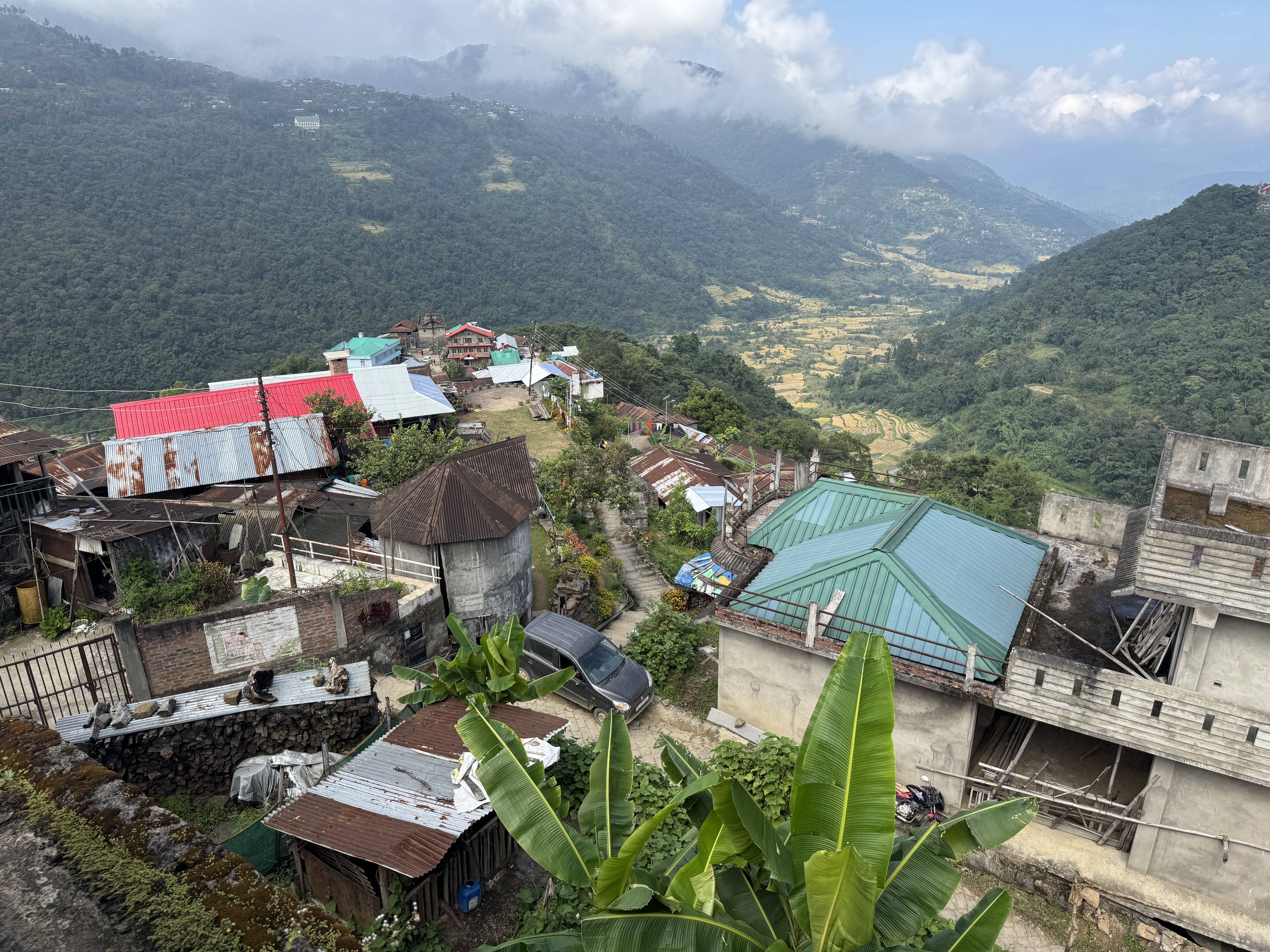
Want thatched roofs today? Or timber or slate? You're out of luck. The octagonal building to the left of the vehicle is a water tank, fed through a long pipeline by gravity.
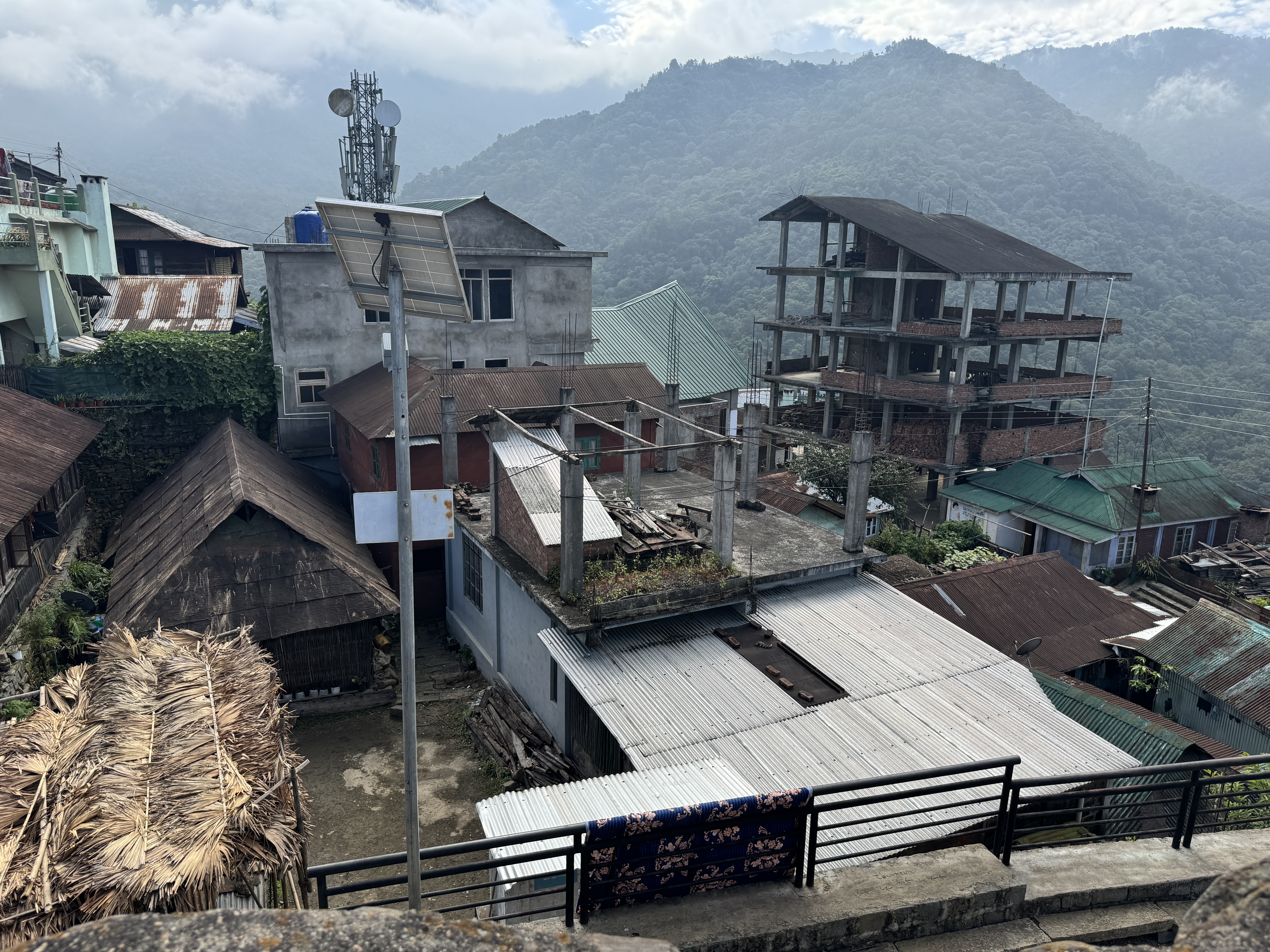
One landowner is doing everything in his power to destroy the village's traditional appearance.
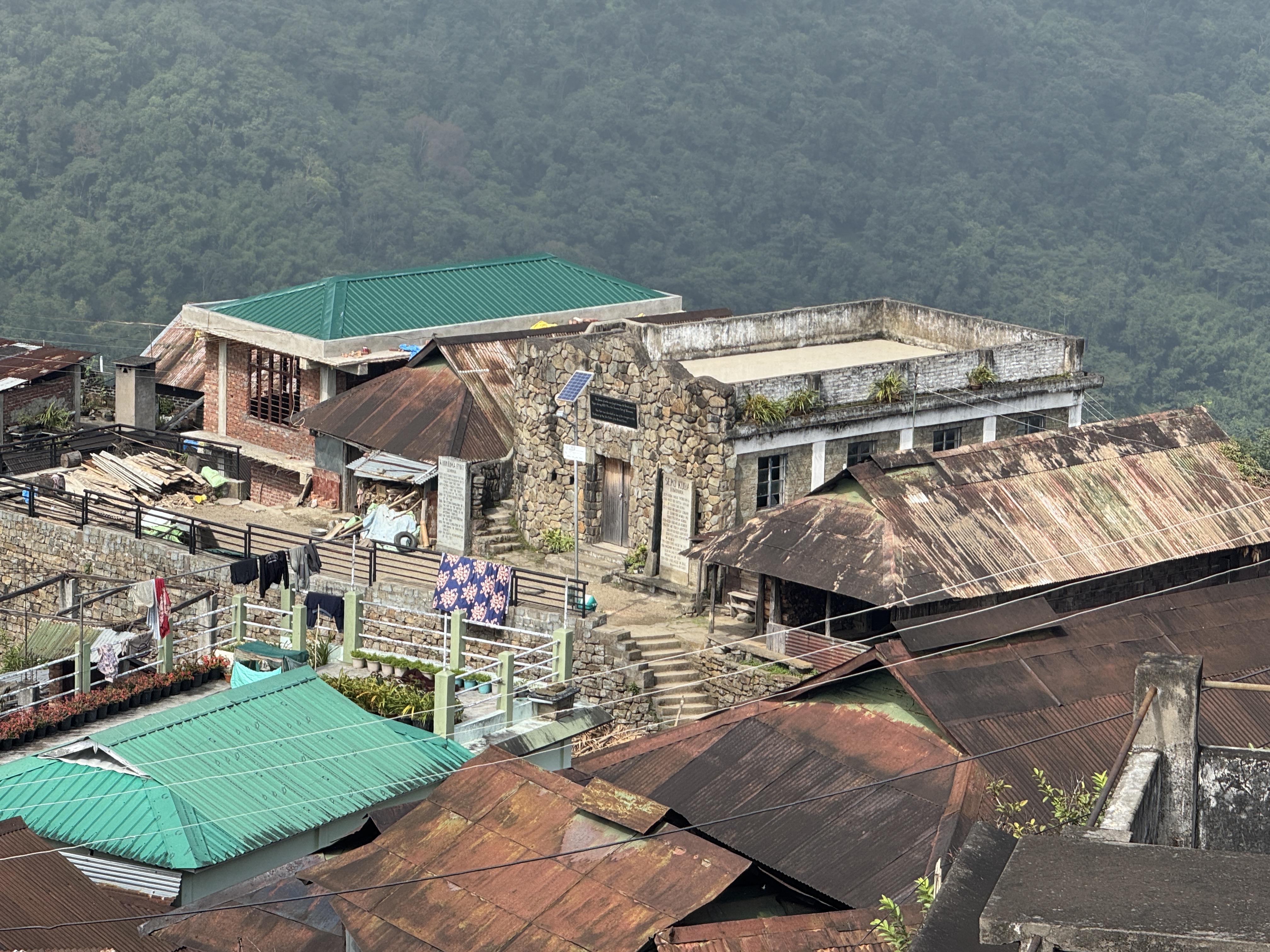
A few years ago, people say, the government provided green paint so the village could claim to be India's first green village. Hard to believe, but green paint is certainly washing off. The stone building is the village fort. Doesn't look very traditional.
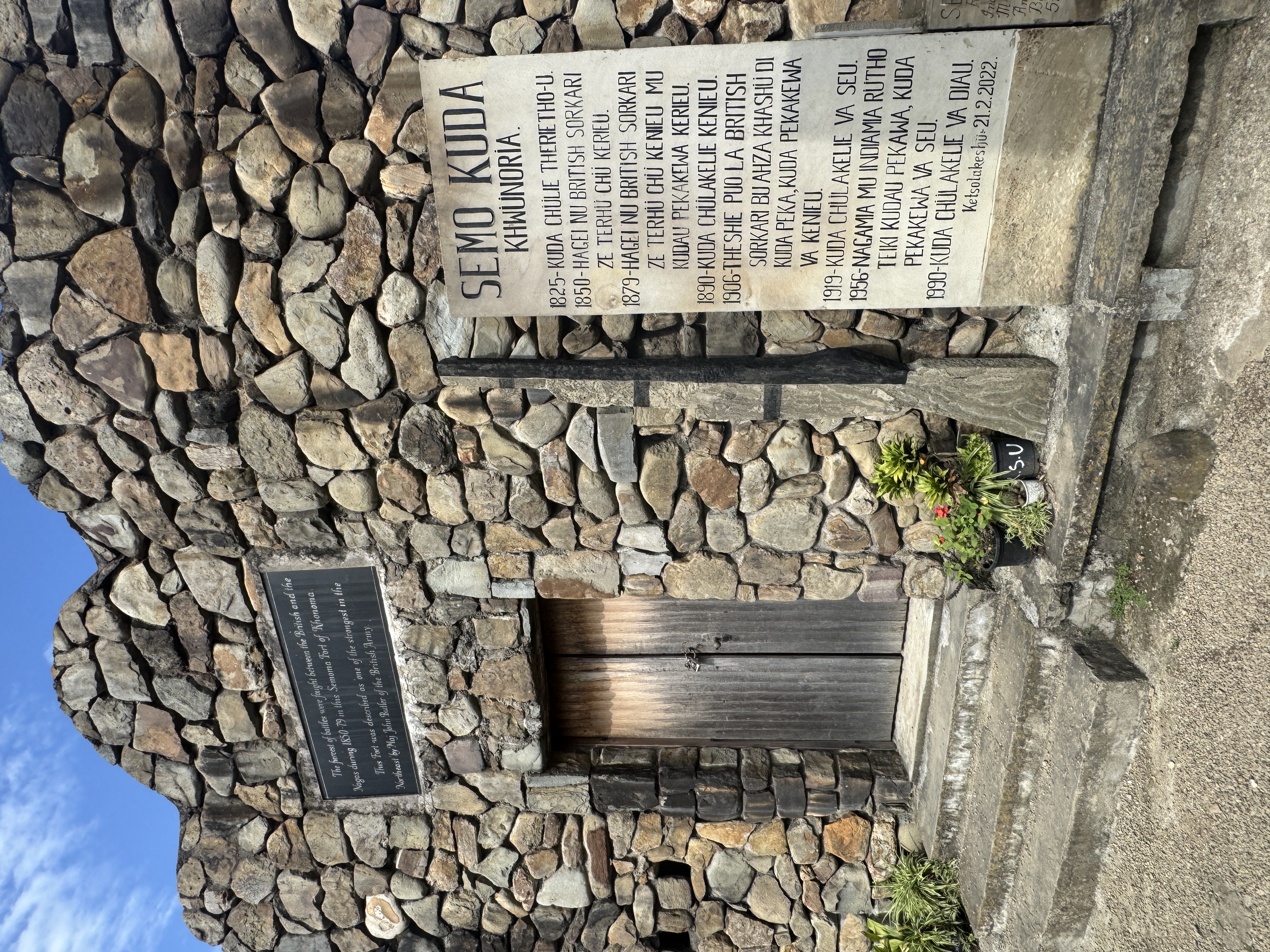
The sign says that the fort was built in 1825 and demolished by the British in 1879. It was rebuilt in 1890, demolished by the British again in 1906, rebuilt in 1919 and demolished a third time by the Indian Army in 1956, at the peak of the insurgency led by the Angamis. It stands today as rebuilt in 1990.
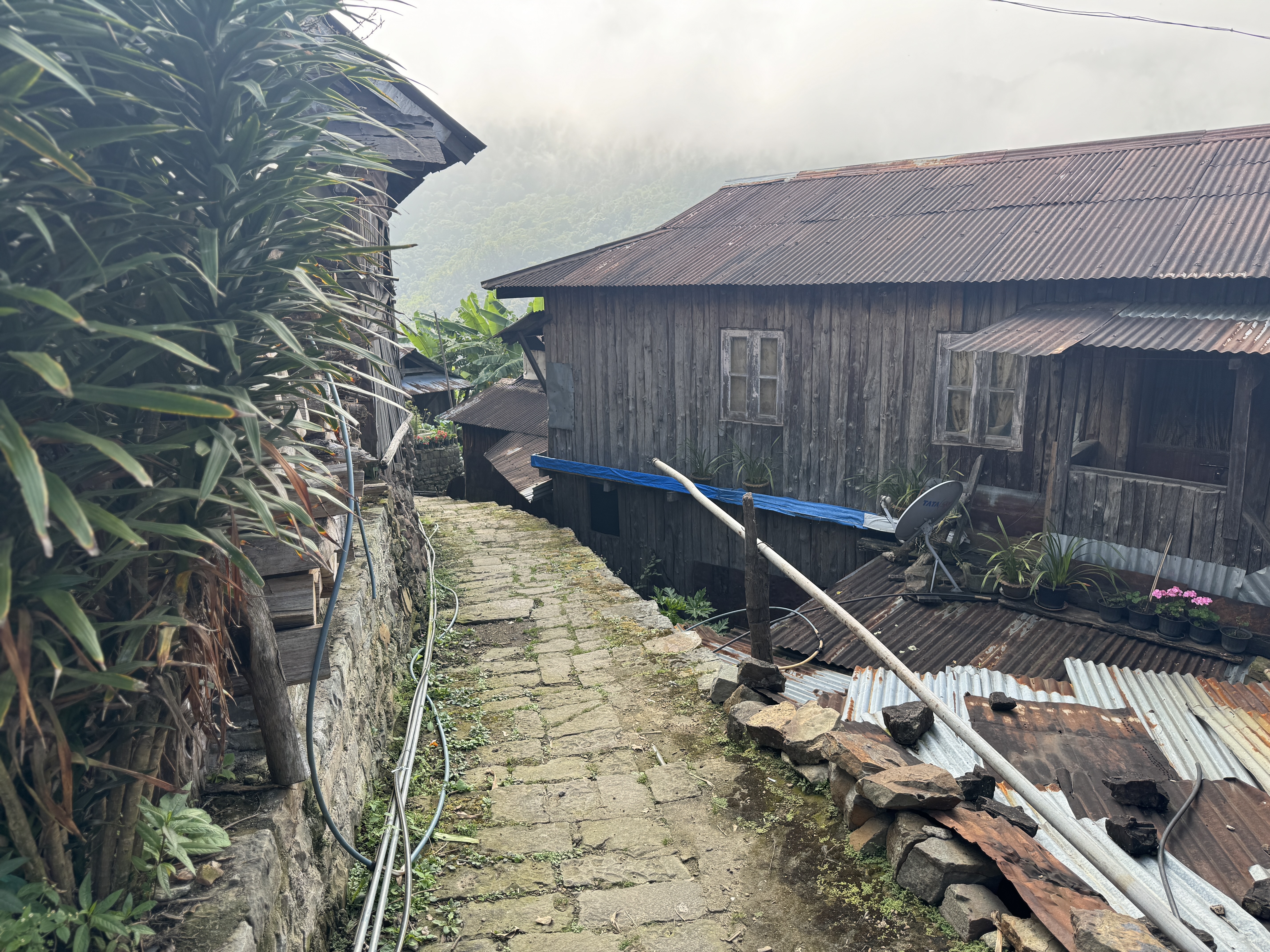
There are some surviving village lanes that have a rustic feel. Stone, seen in the path and the protection wall on the left, is traditional. Wood walls aren't; neither is the satellite dish.
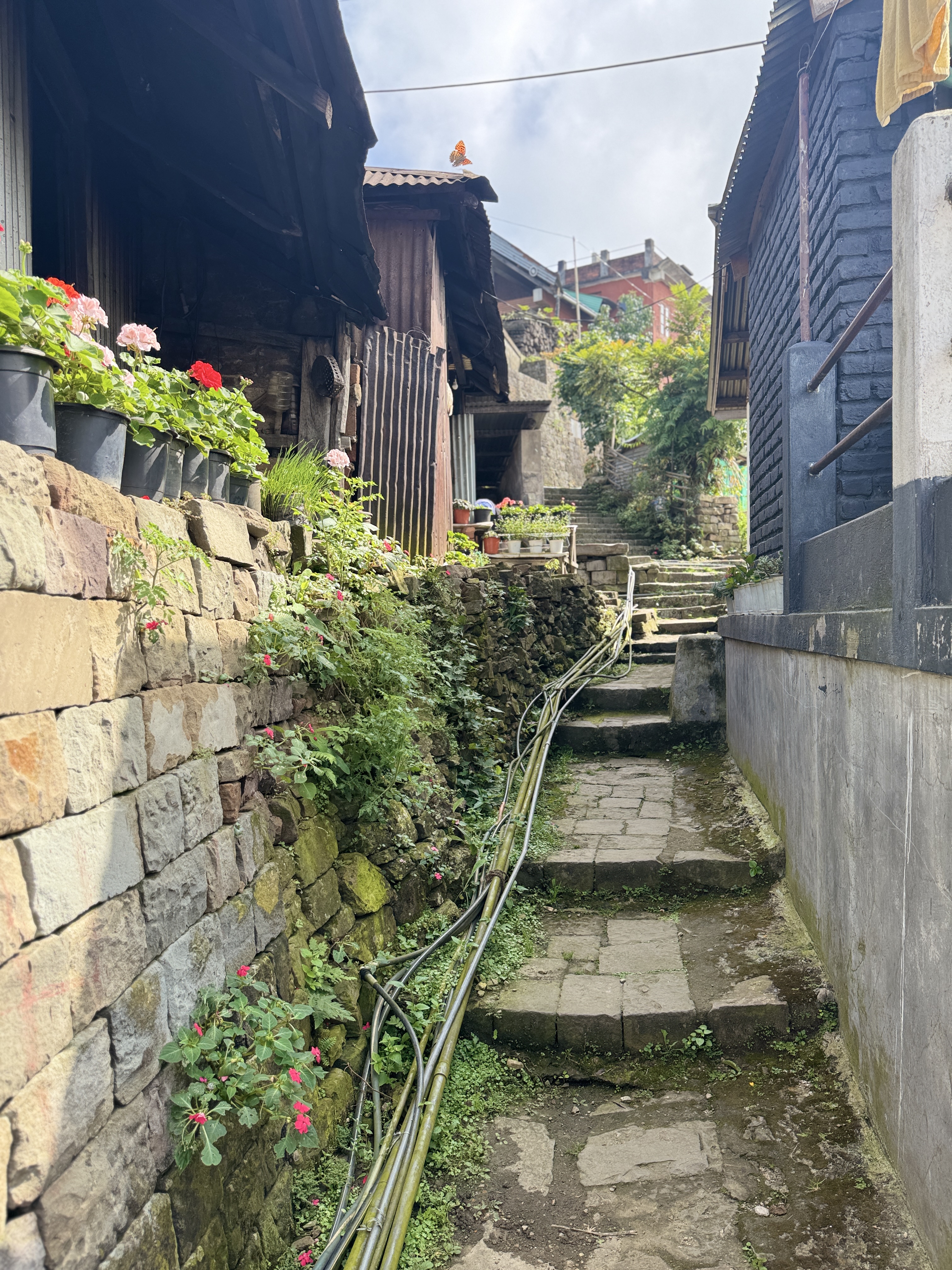
Many houses are empty, with their owners in Kohima or elsewhere and returning to Khonoma only on holidays. Still, somebody is taking care of ornamental plants.
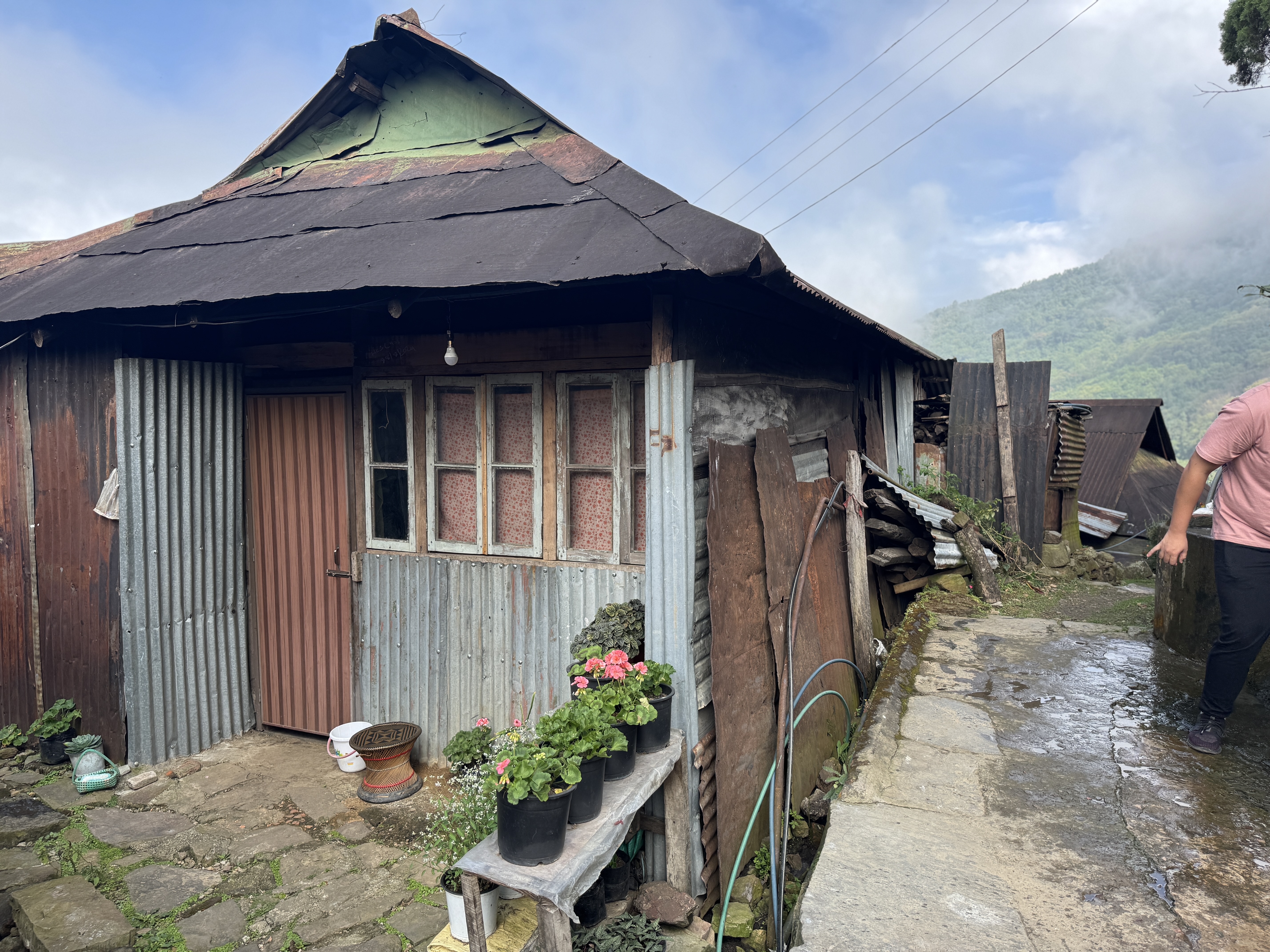
Metal, metal everywhere.
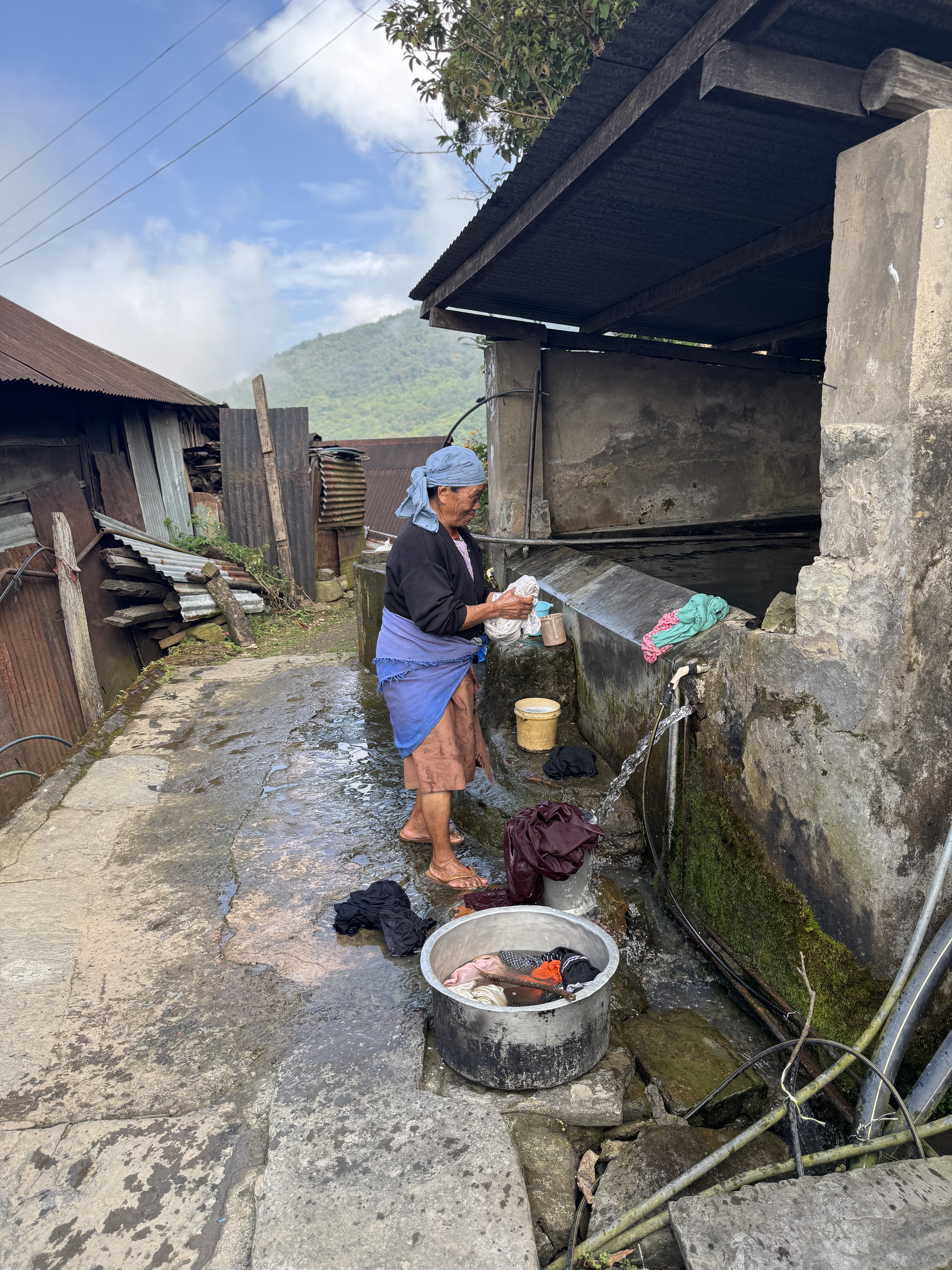
No washing machine, but piped water and aluminum pots.
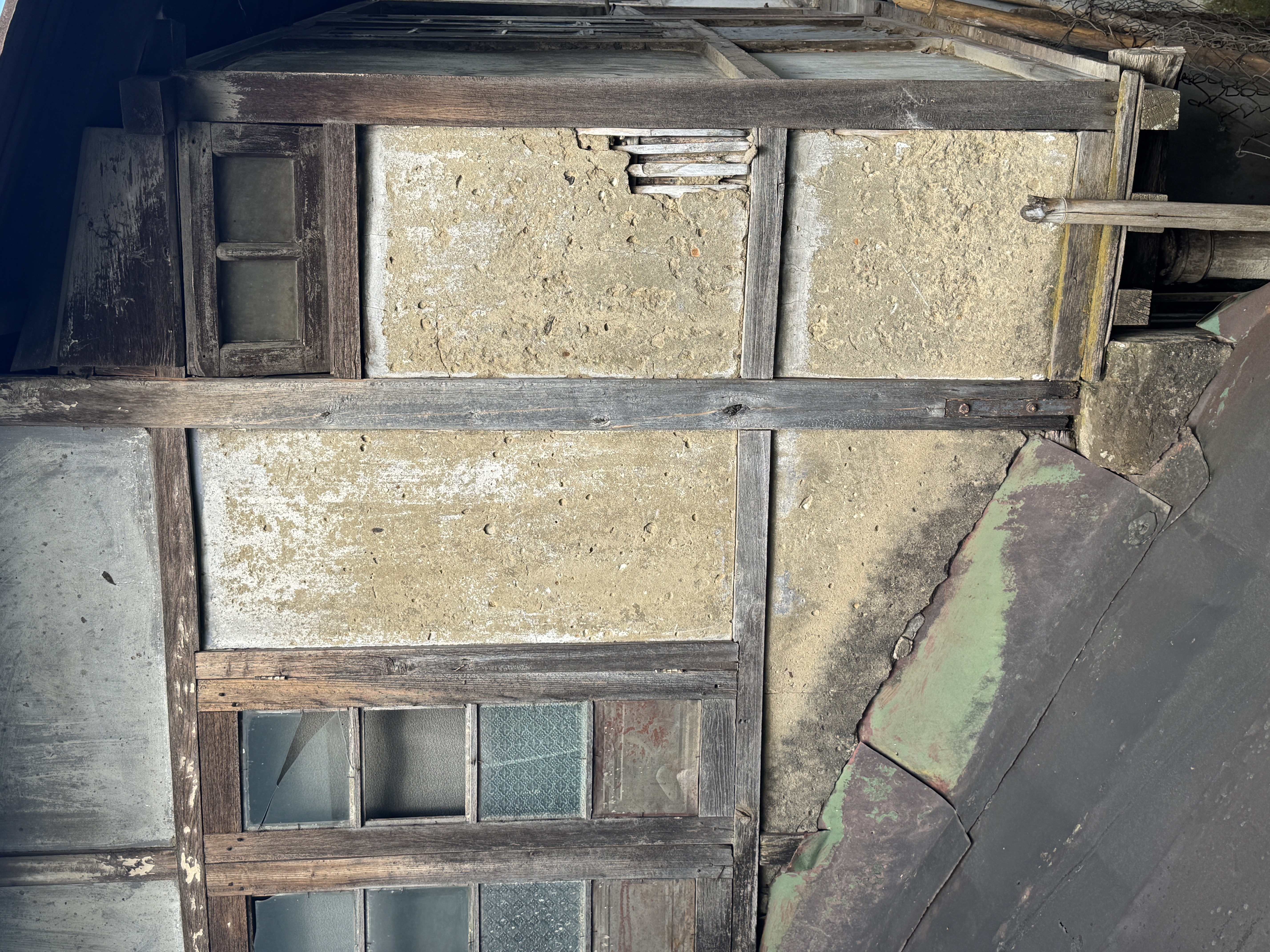
Here's an older building type, with walls made of clay pressed into bamboo slats.
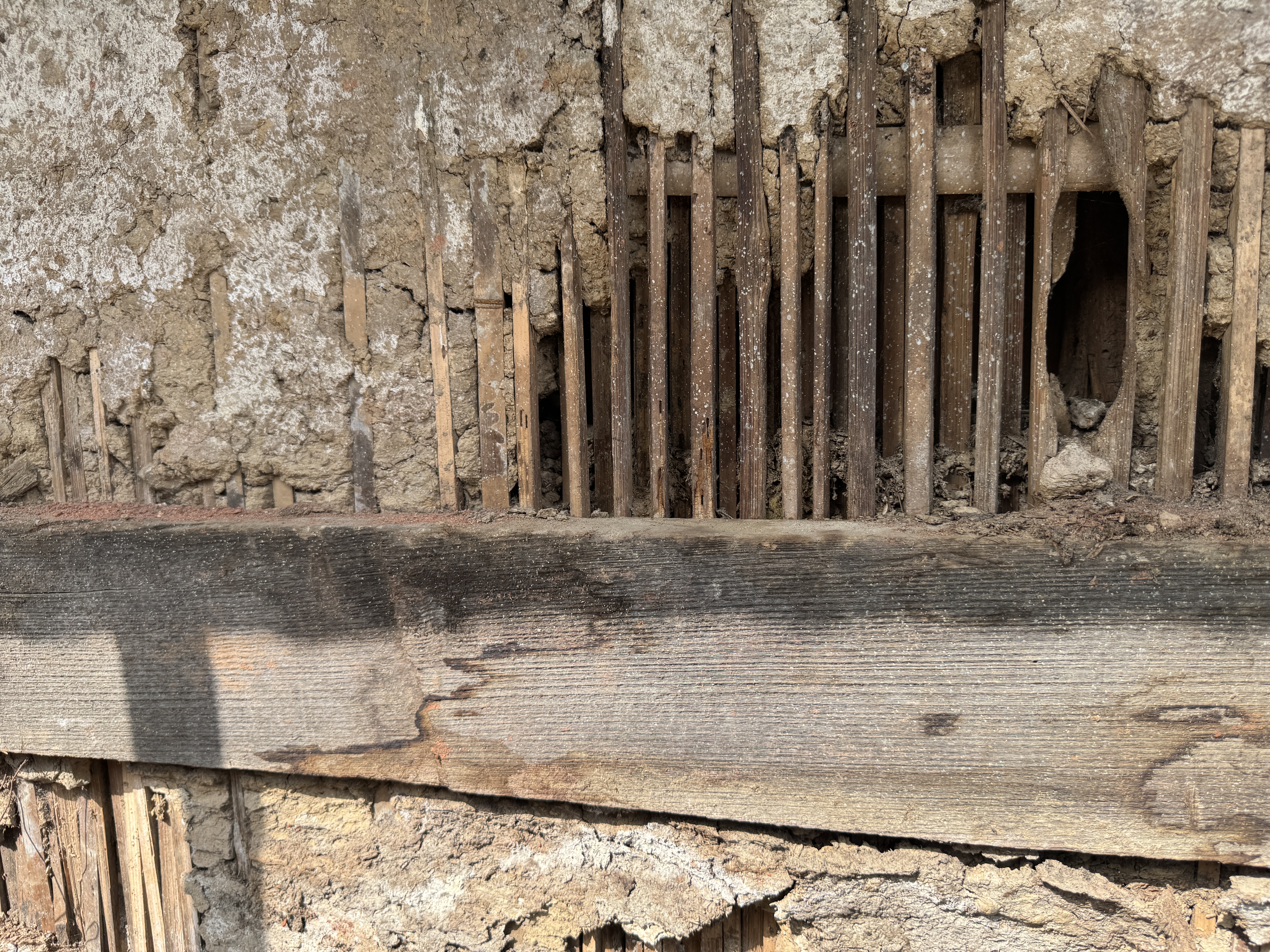
For a clearer view, here's another example, this one from a house in Kigwema. At one time this would have been a prestige wall, superior to the common alternative of bamboo matting.
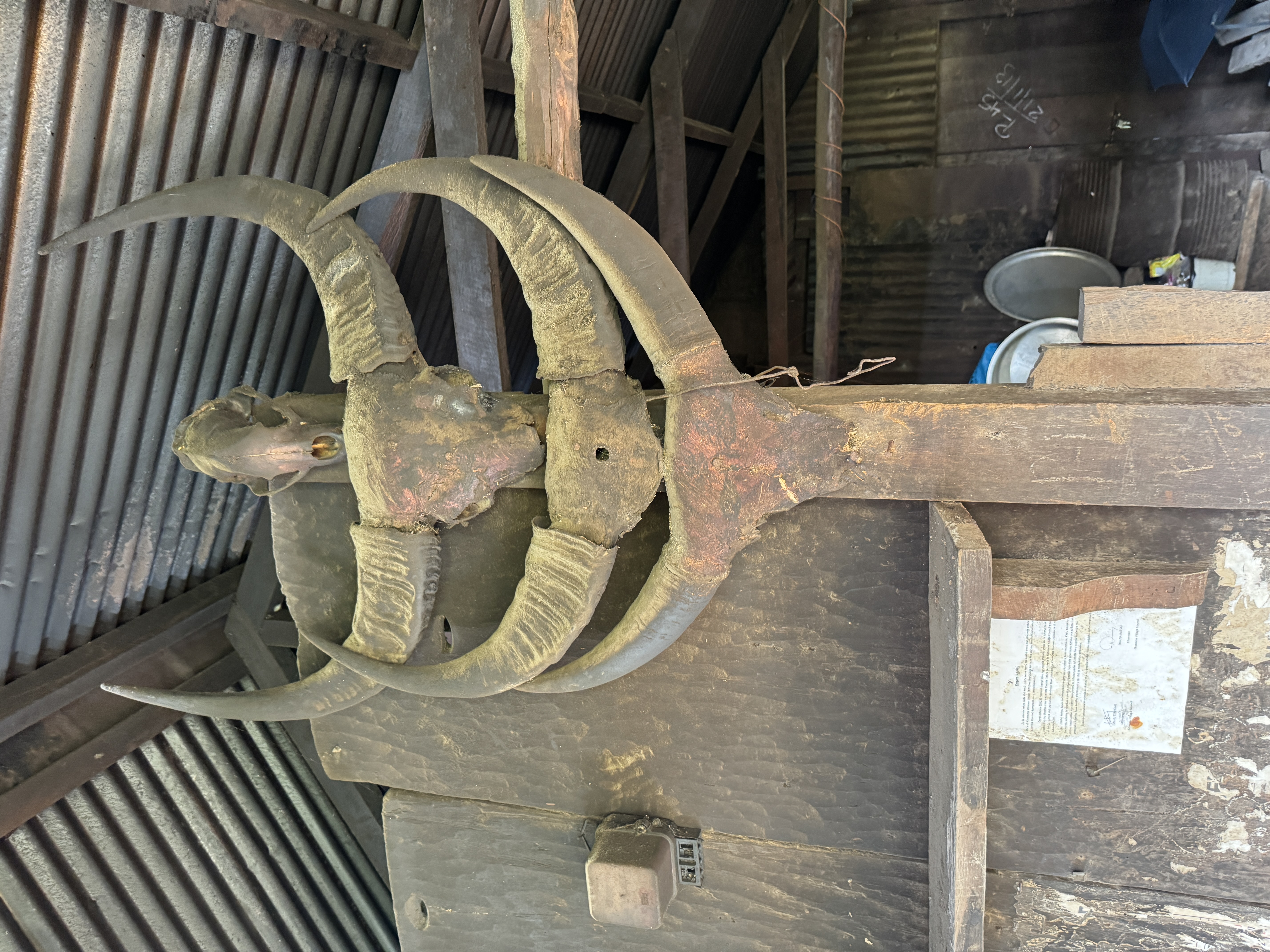
This roof here isn't traditional, but the mithun horns are: they're from a domesticated form of the gaur (Bos gaurus, domesticated as Bos frontalis). The animals were sacrificed for feasts sponsored by villagers seeking prestige. There are no human heads displayed here, but Mildred Archer, in the hills in 1947, saw housefronts displaying the "human heads taken by the owner on various raids" (William and Mildred Archer, India Served and Observed, p. 119).
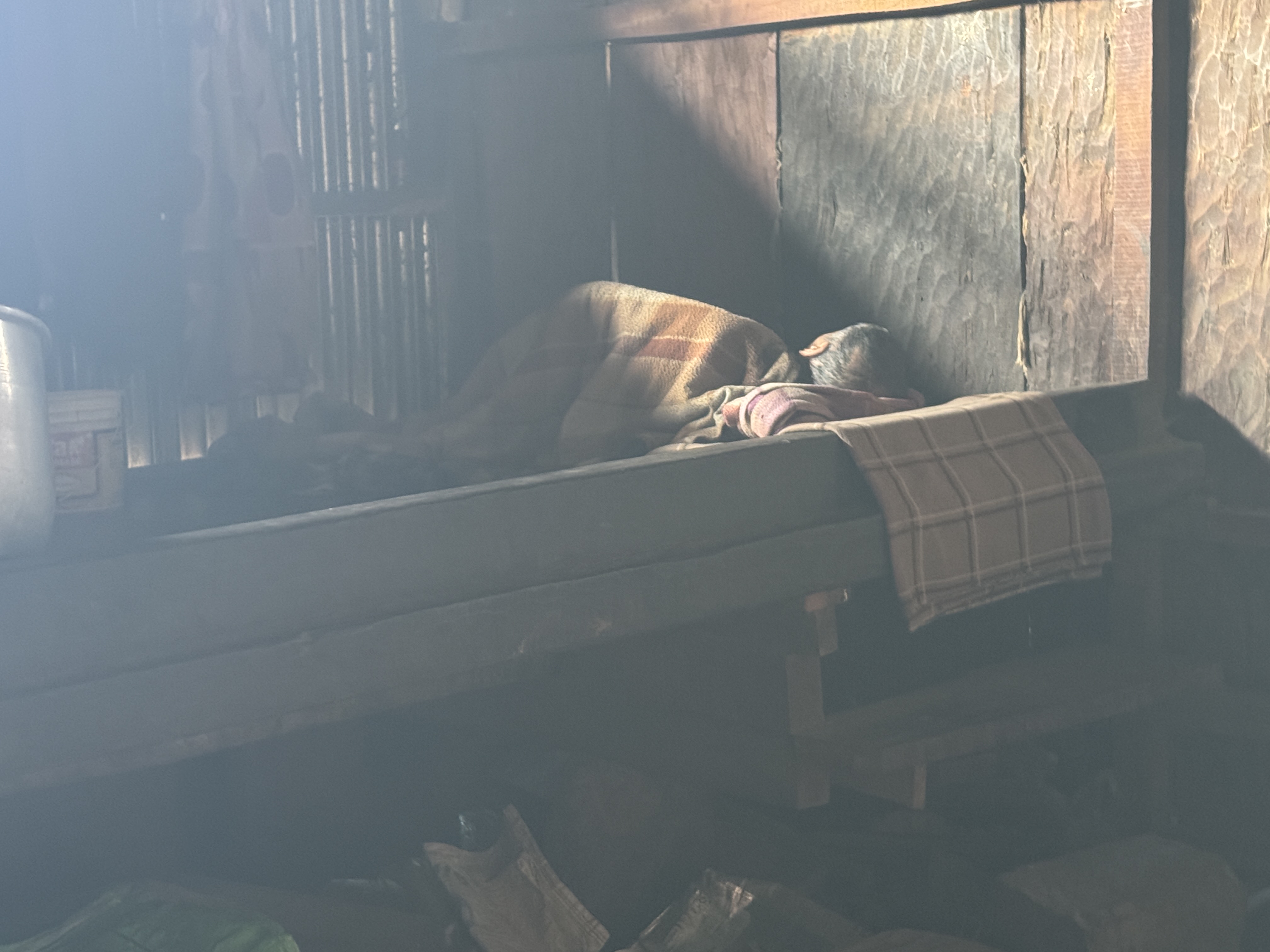
A boy asleep on one of the superduper king-size beds characteristic of Naga "bachelor dormitories" or morungs.
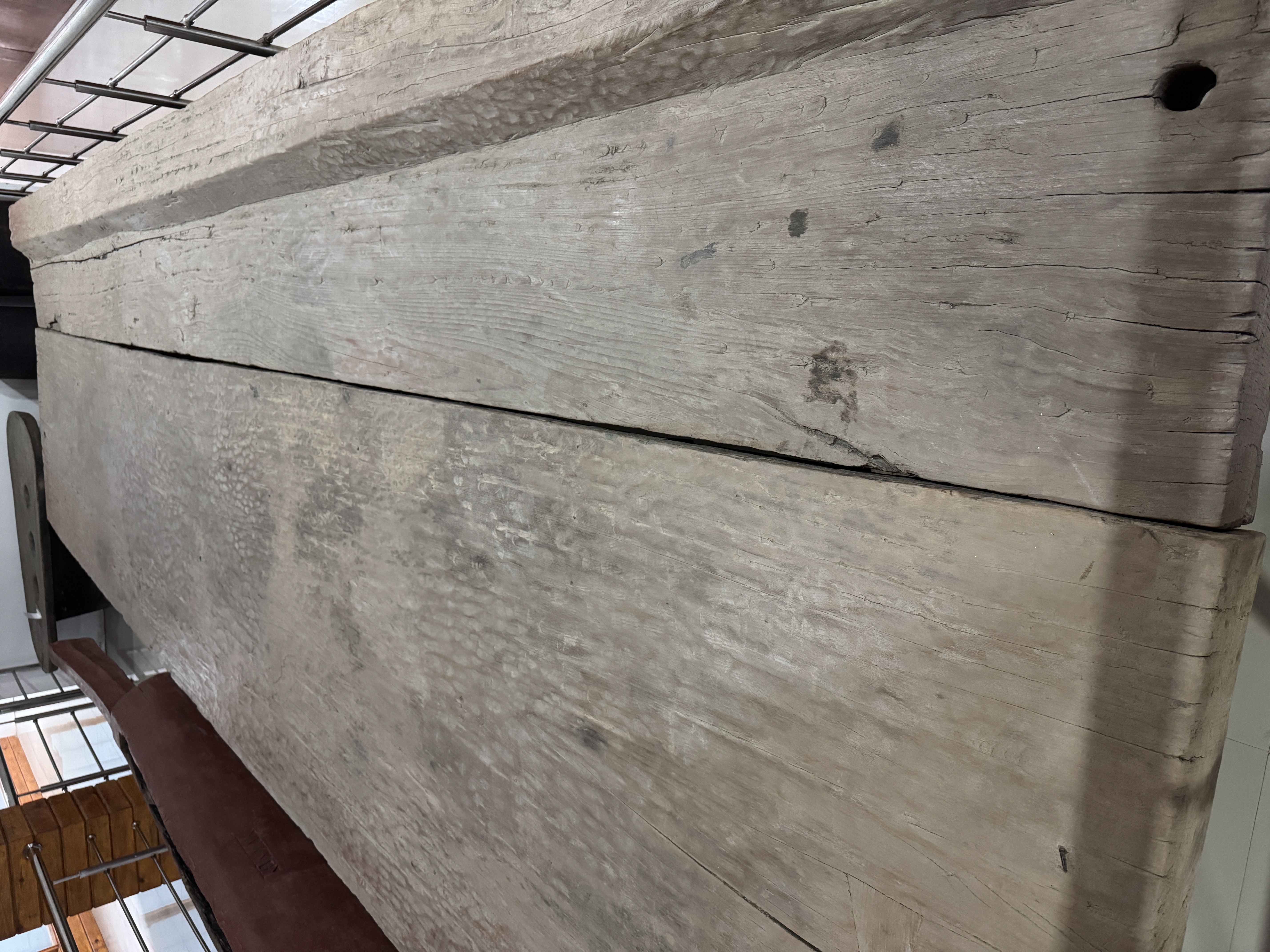
This one is easier to see because it's displayed at the Nagaland State Museum in Kohima. Room for a dozen young men.
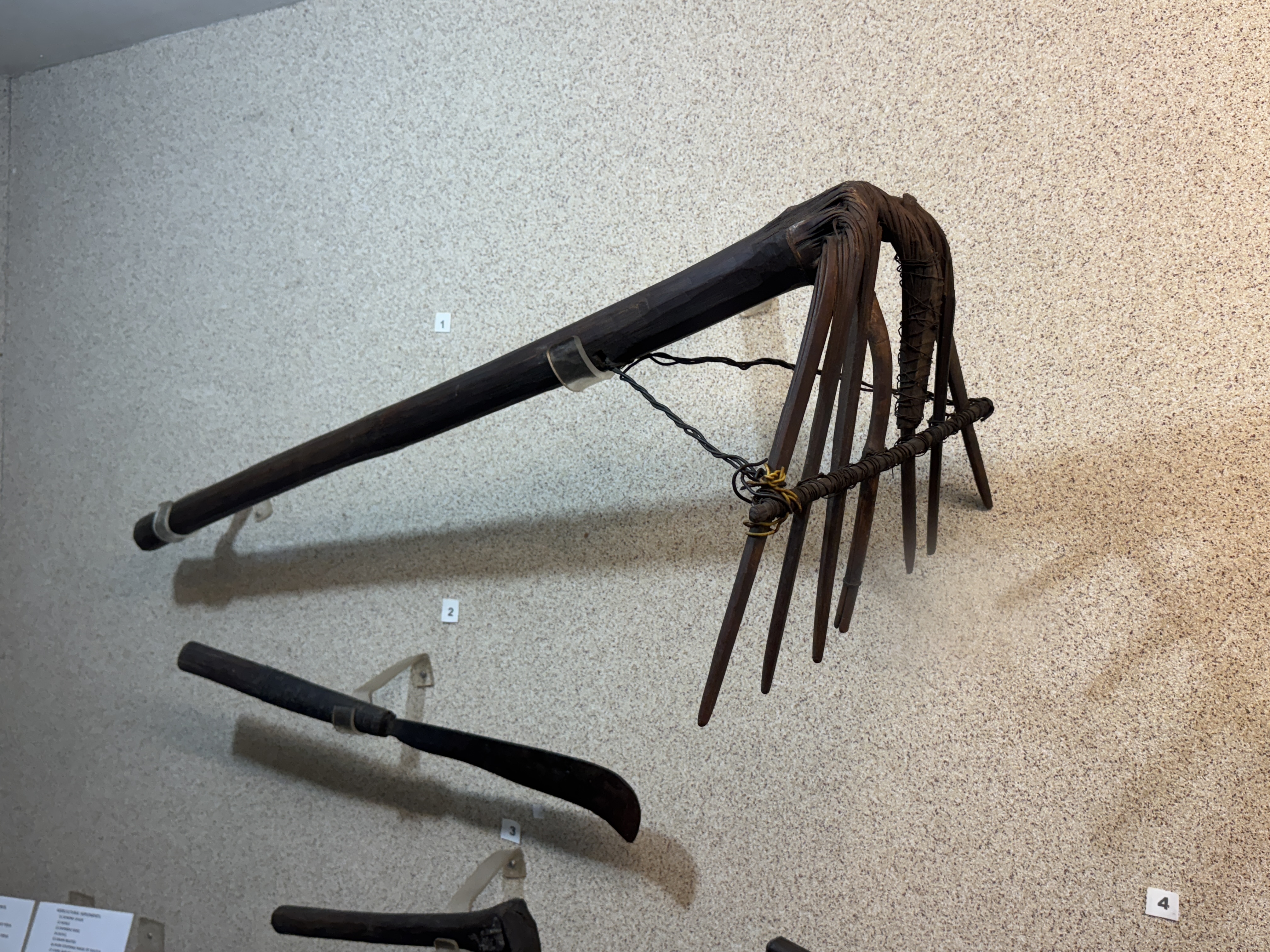
While we there, check this beautiful bamboo rake or "paro." These were traditionally bound with bamboo thongs.
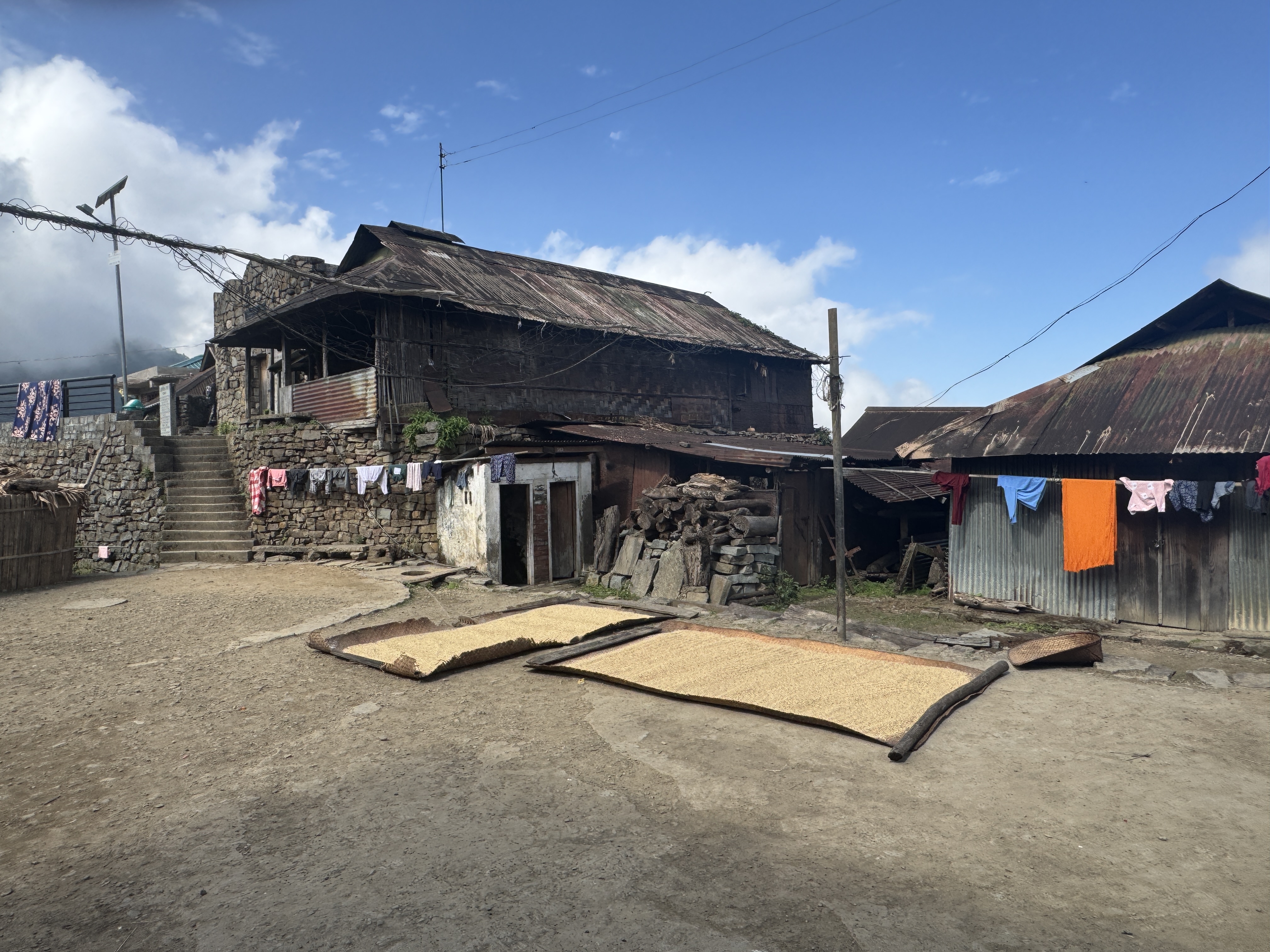
Surviving crafts in Khonoma? Here's one, paddy drying.
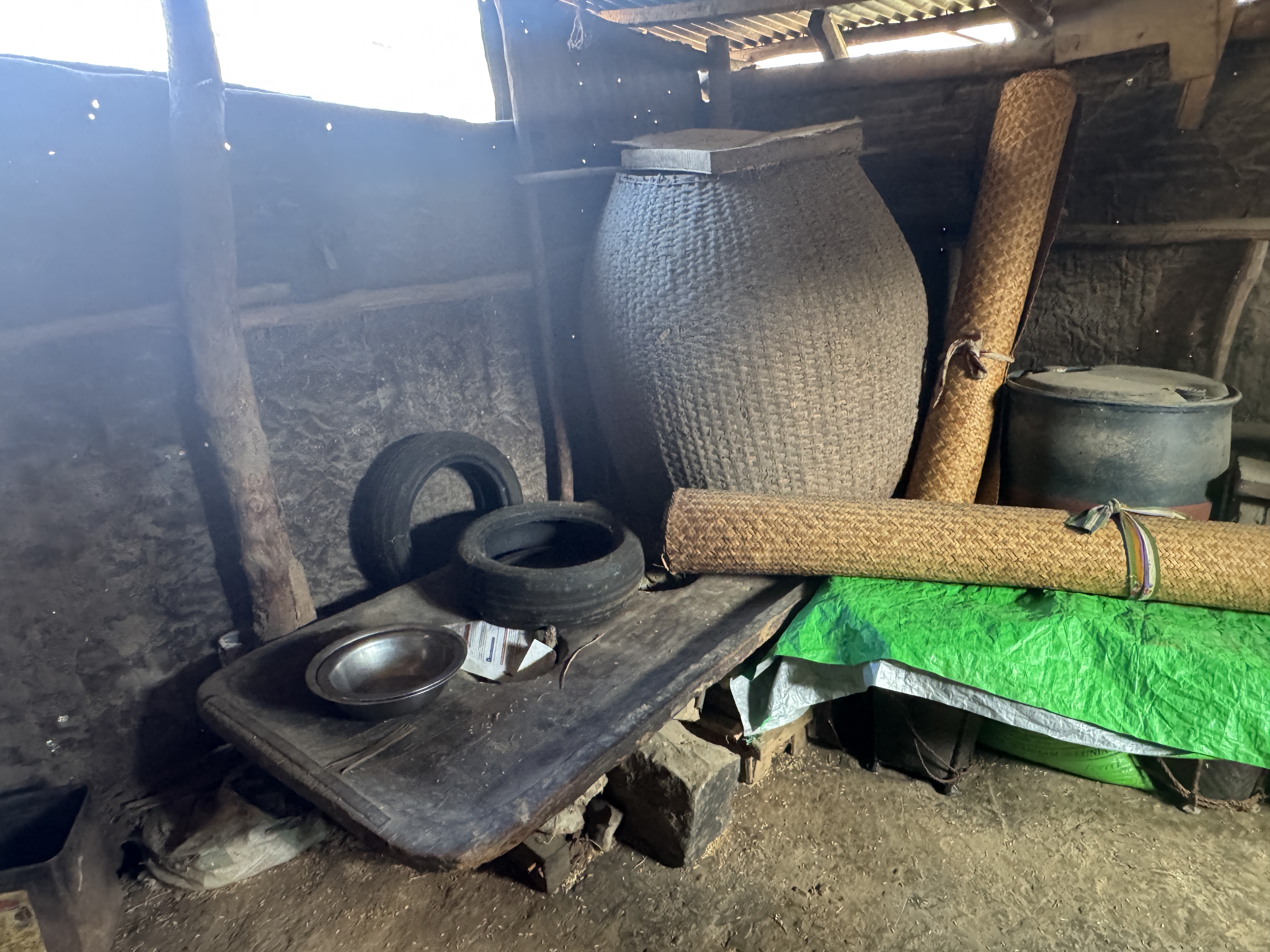
And here, perched on a bench used to pound the husks off paddy, is a wonderful basket to store the unhusked grain. This basket is close to houses, which may not be quite traditional: "...most of the tribes keep it in granaries outside the village, from fear of fire or rats. There is nothing, except his sense of honour and the severity of the punishment that would follow on detection, to prevent a man from helping himself to his neighbour's grain; and the existence of this custom is a striking testimony to the high standard of honesty observed in their relations with one another." (B.C. Allen, Assam District Gazetteers, vol. 9, Naga Hills and Manipur, p. 45). Or fear.
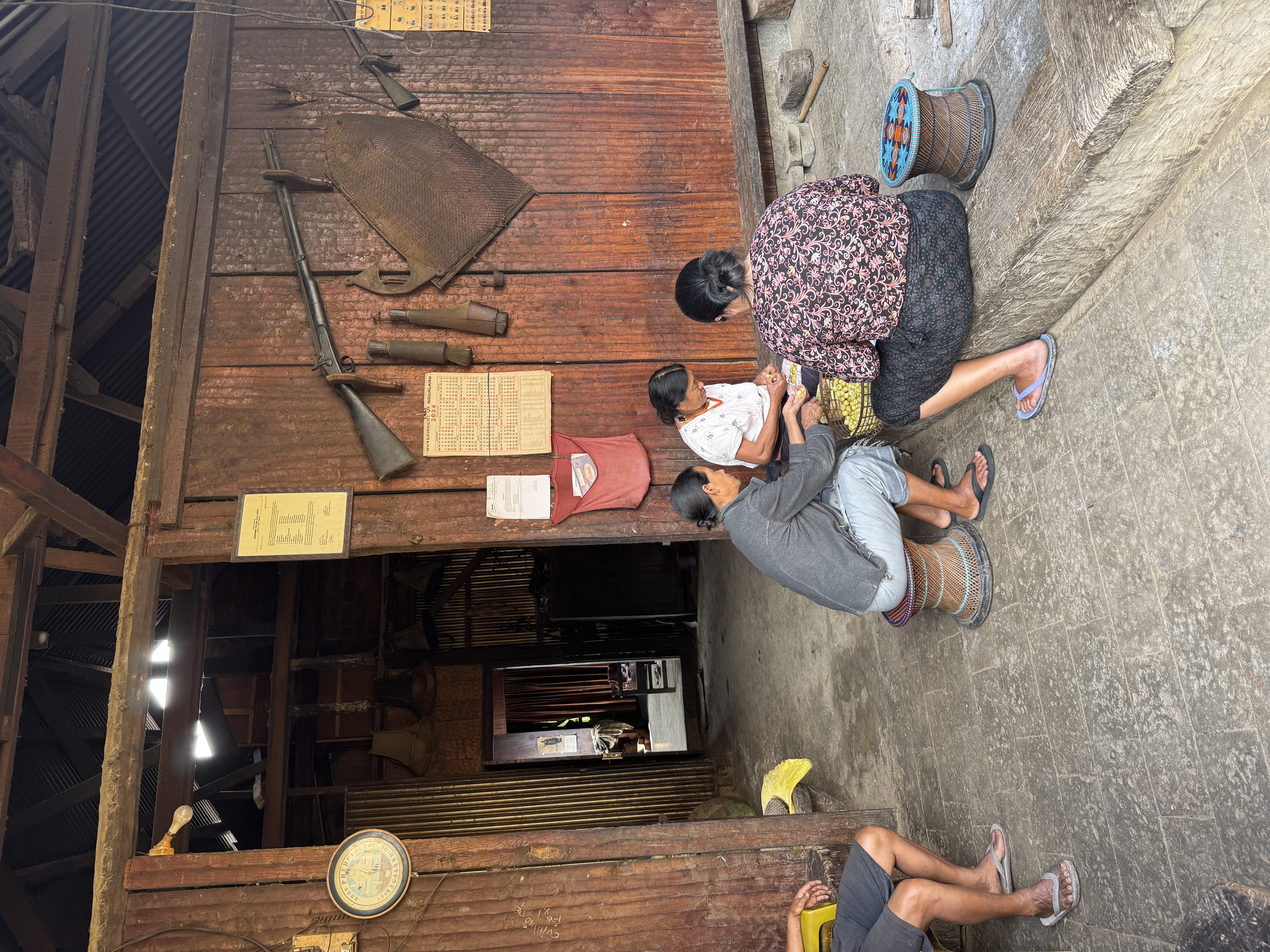
That might just be a Tower Musket on the wall. They were dispersed over the Hills after a rebellion in nearby Manipur in 1891. One consequence: "Game is nowadays hardly obtainable in the Angami country" (Hutton, The Angami Nagas, 1922, p. 84.). The shield on the wall is a lightweight ceremonial style of bamboo; for fighting, a heavier shield was used with a covering a rhino or elephant or buffalo hide. Like the stools?
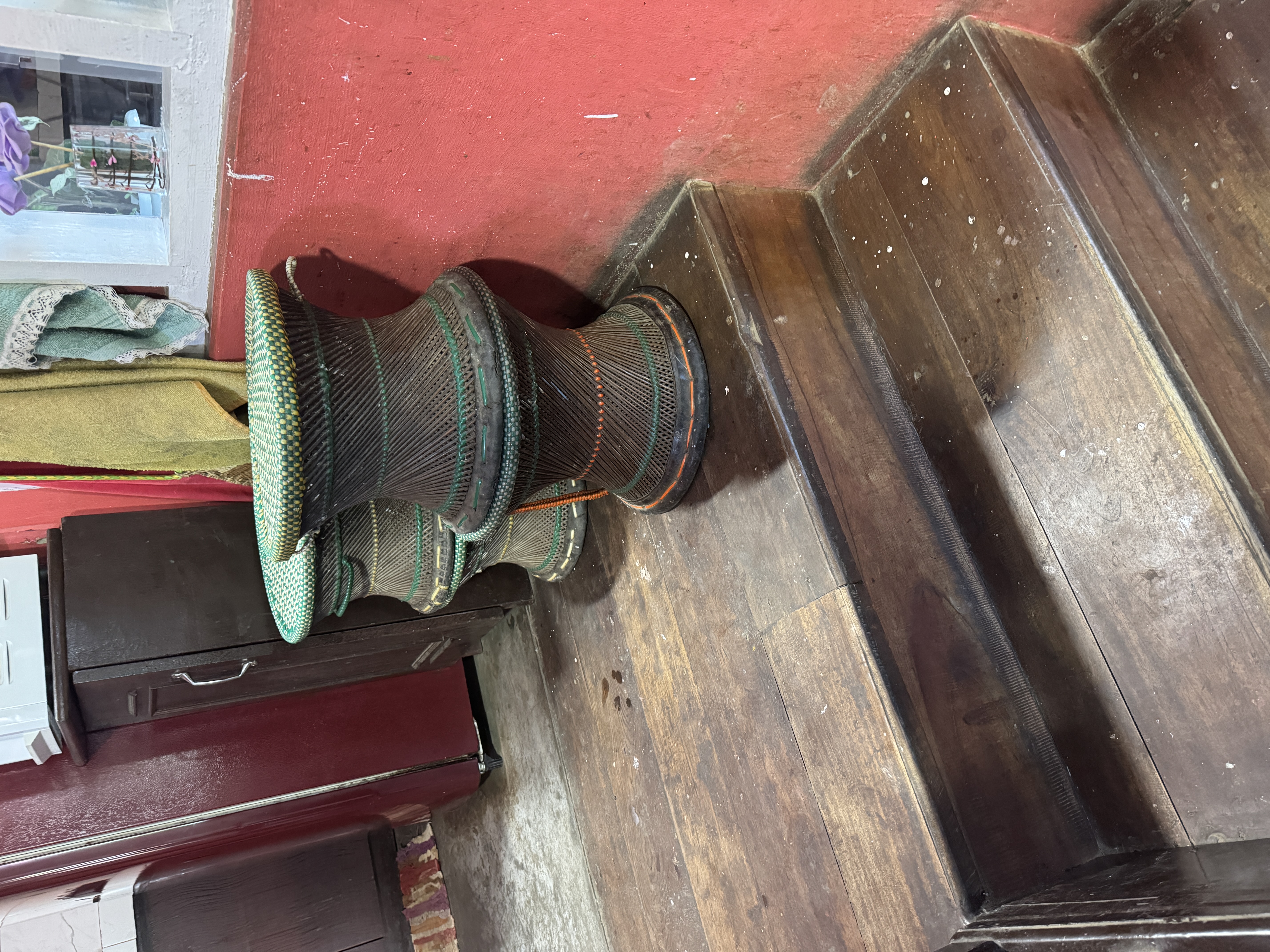
They're traditional; here a a few more from a house in Kohima.
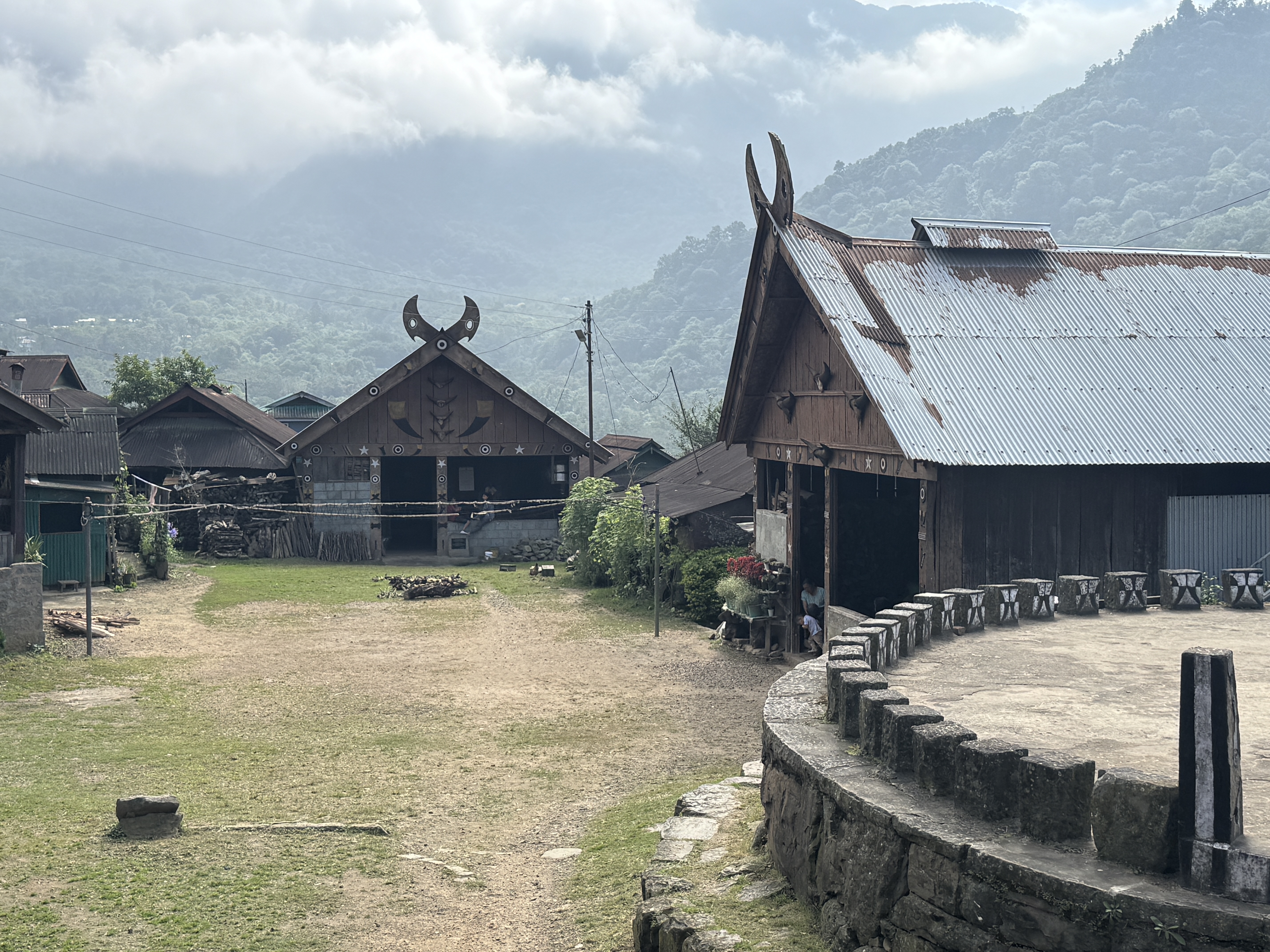
Khonoma hangs on to traditions at the same time as it abandons them. Here's a stone meeting place and two traditional meeting halls.
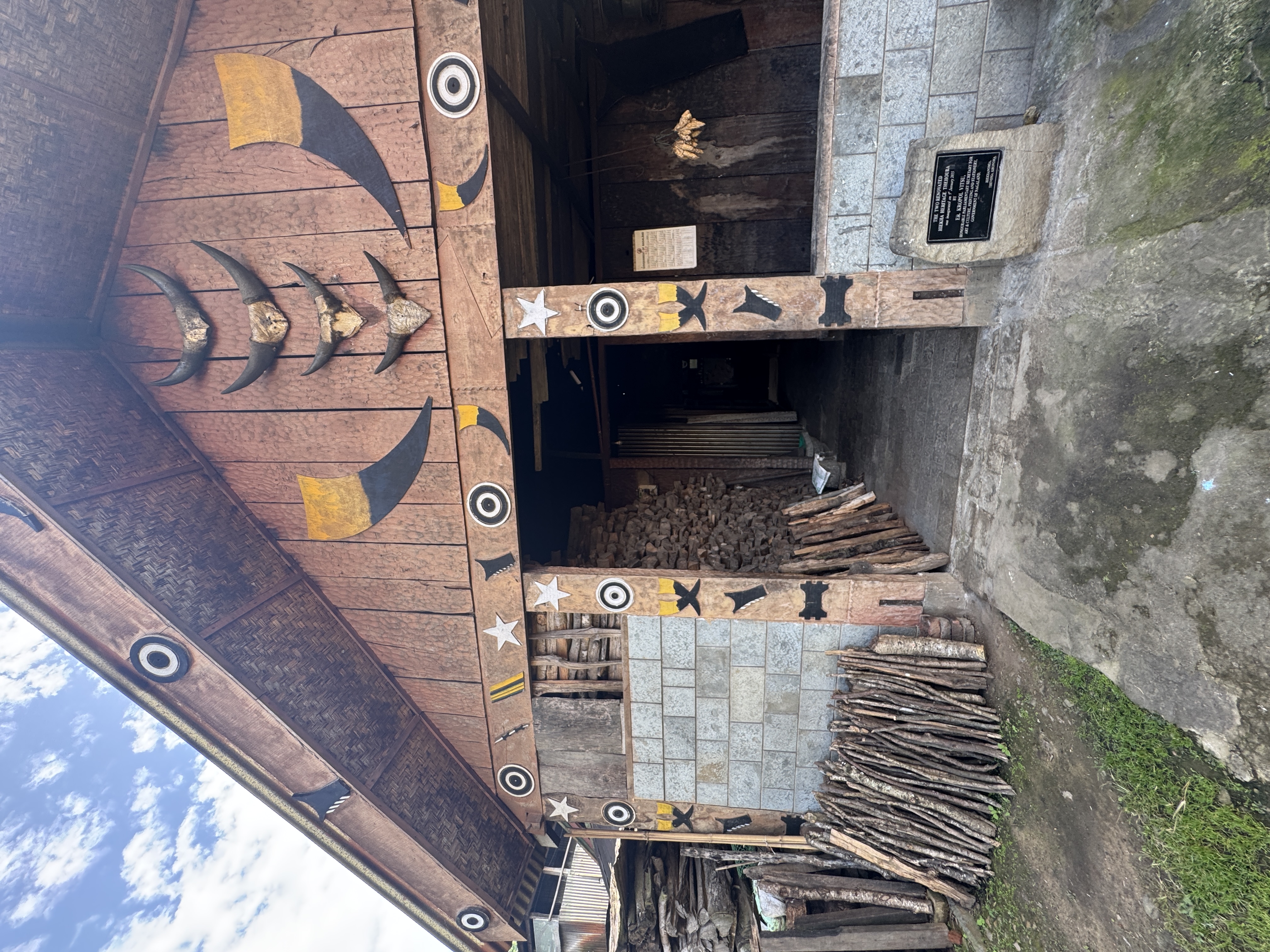
We can argue about its authenticity.
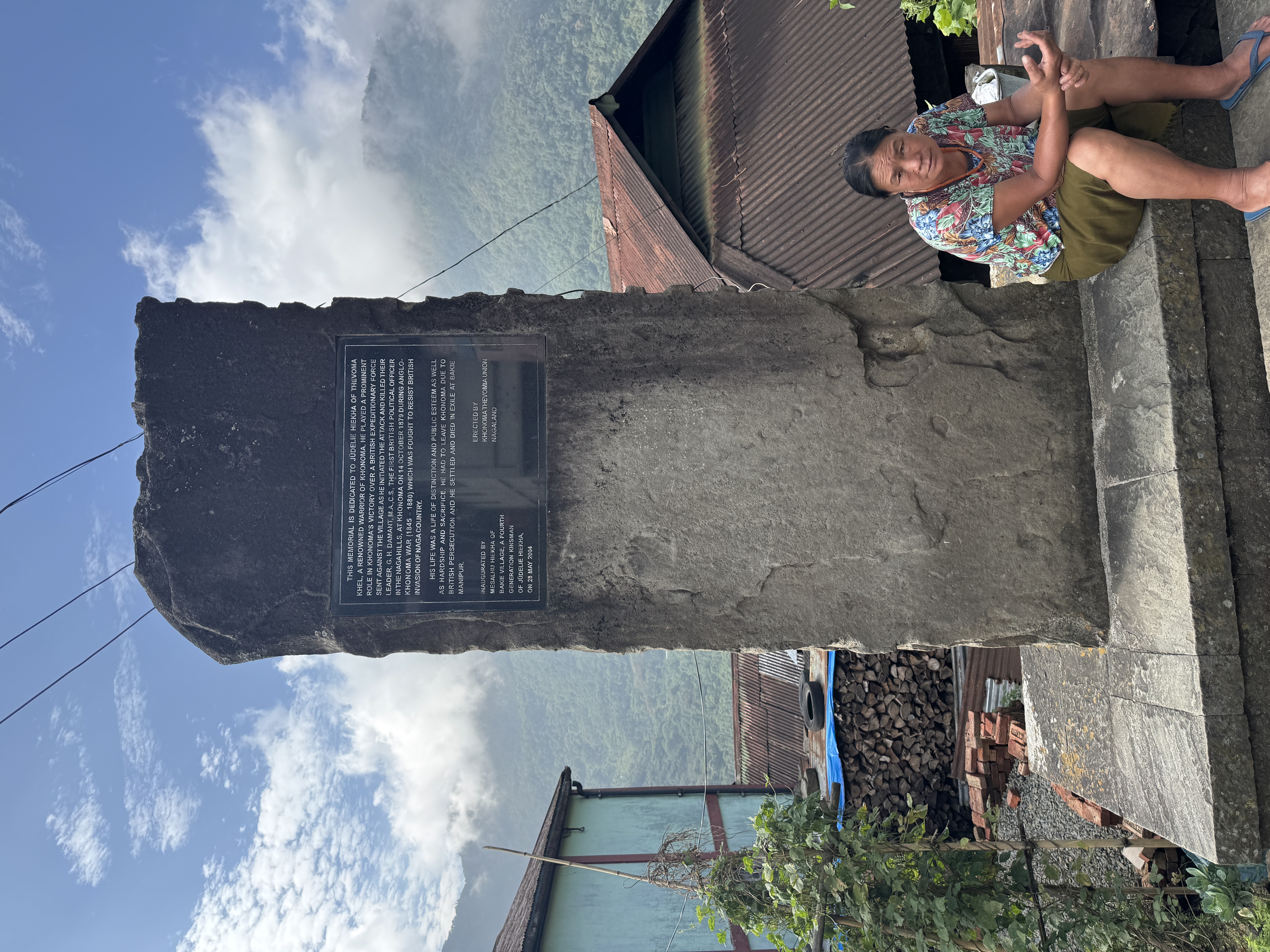
A monolith. Wonder what it says?
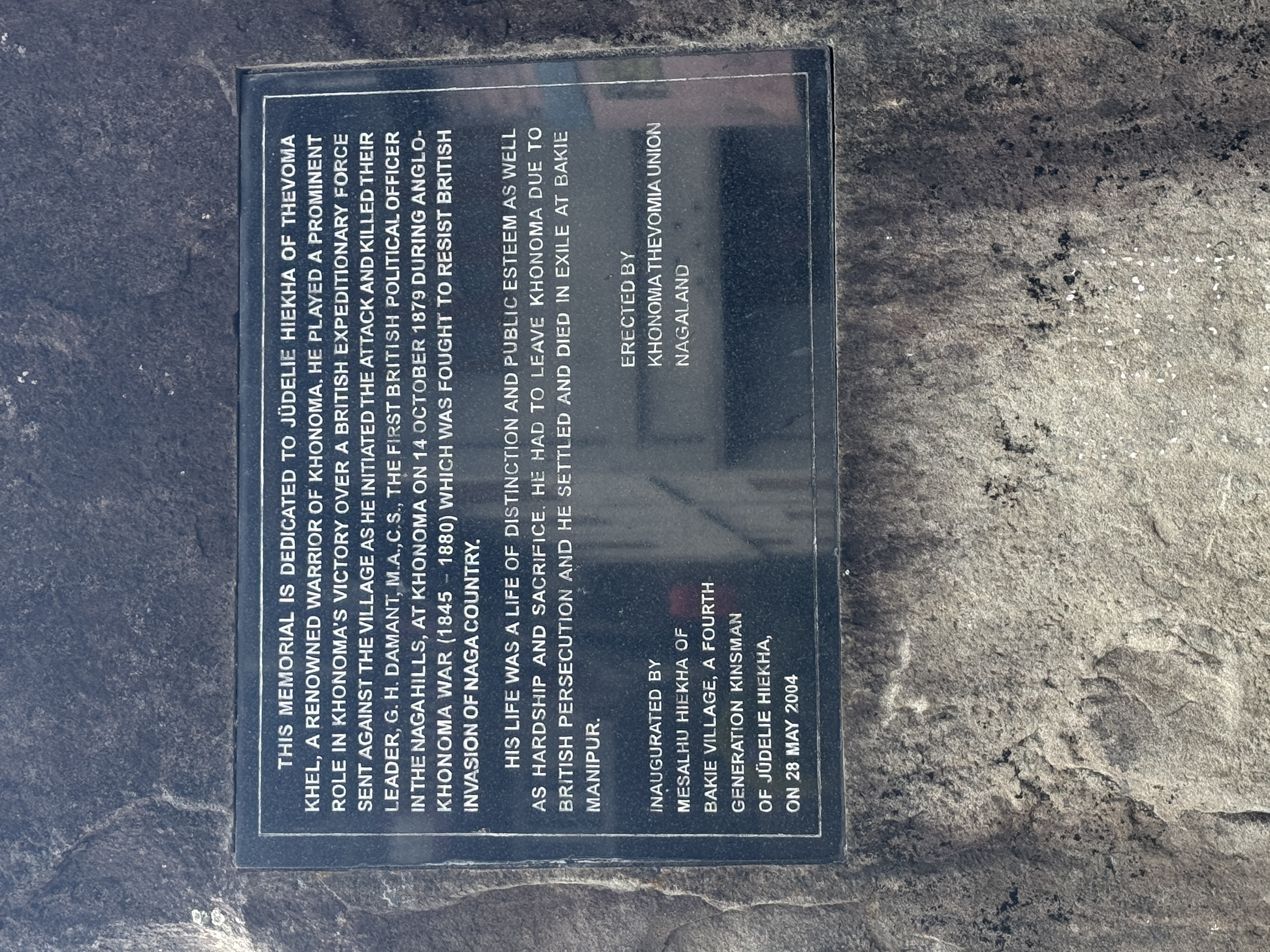
Here you go. The villagers never lost their spirit. Two of the most important leaders of the Naga independence movement, Zapu Phizo ("the Moses of his people") and T. Sakrie, were born in Khonoma. In 1955 they had a falling out and Sakrie, who believed in non-violent methods, was assassinated in Kohima the next year, 1956. India that same year declared Nagaland a "disturbed area," which put it under direct Army control. A few months slater, Phizo created the Federal Government of Nagaland, with a military wing, but also in 1956, fled. He landed in London, where he died more than 30 years later. He is buried, however, in Kohima, where his tombstone, at the end of a monumental staircase, reads "Father of the Nation."
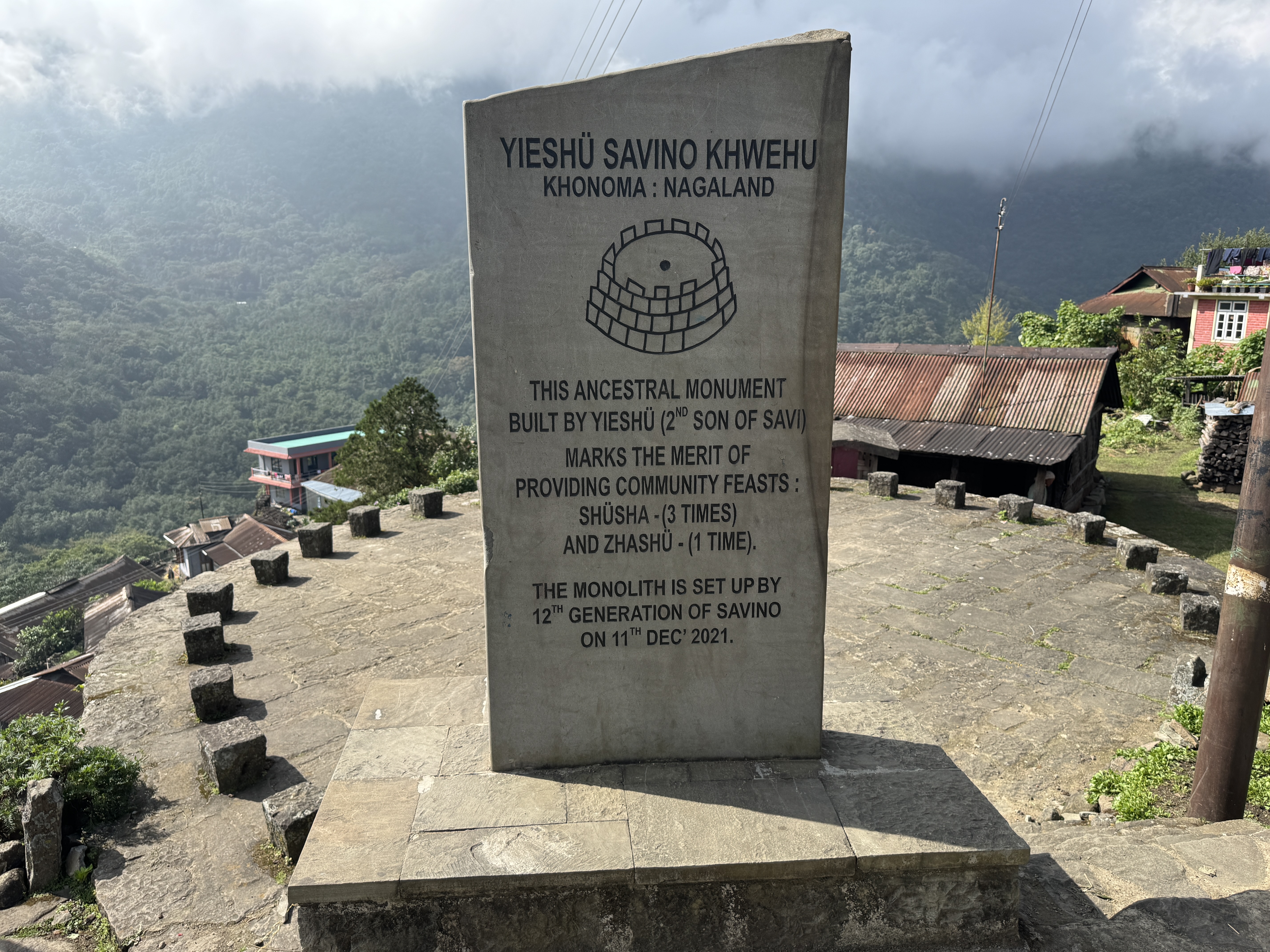
Here's a more peaceful monolith, speaking to continuing tradition.
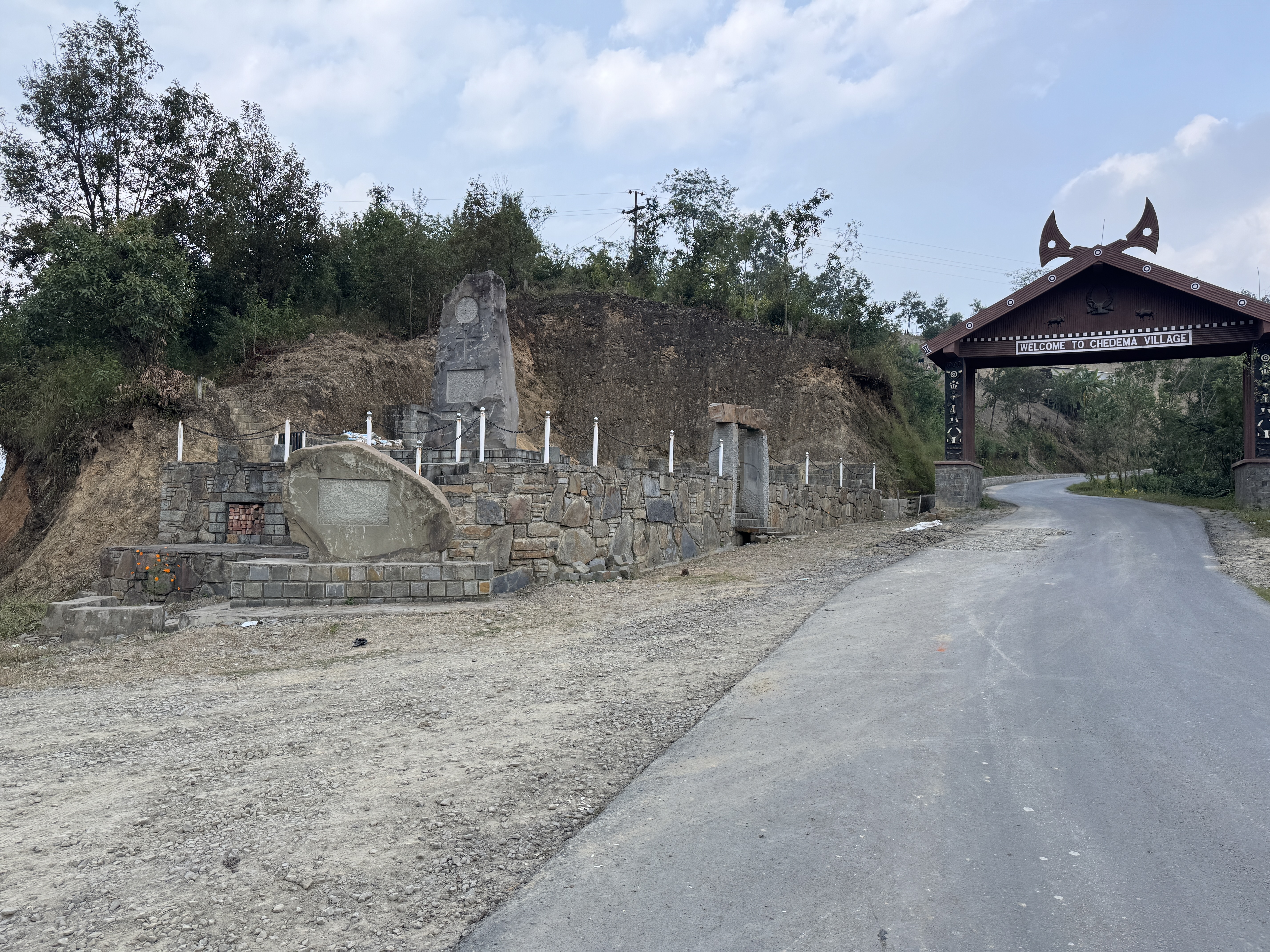
We're jumping over to Chedema, a village where somebody is seeking visitors. The monolith has yet to get its inset plaque.
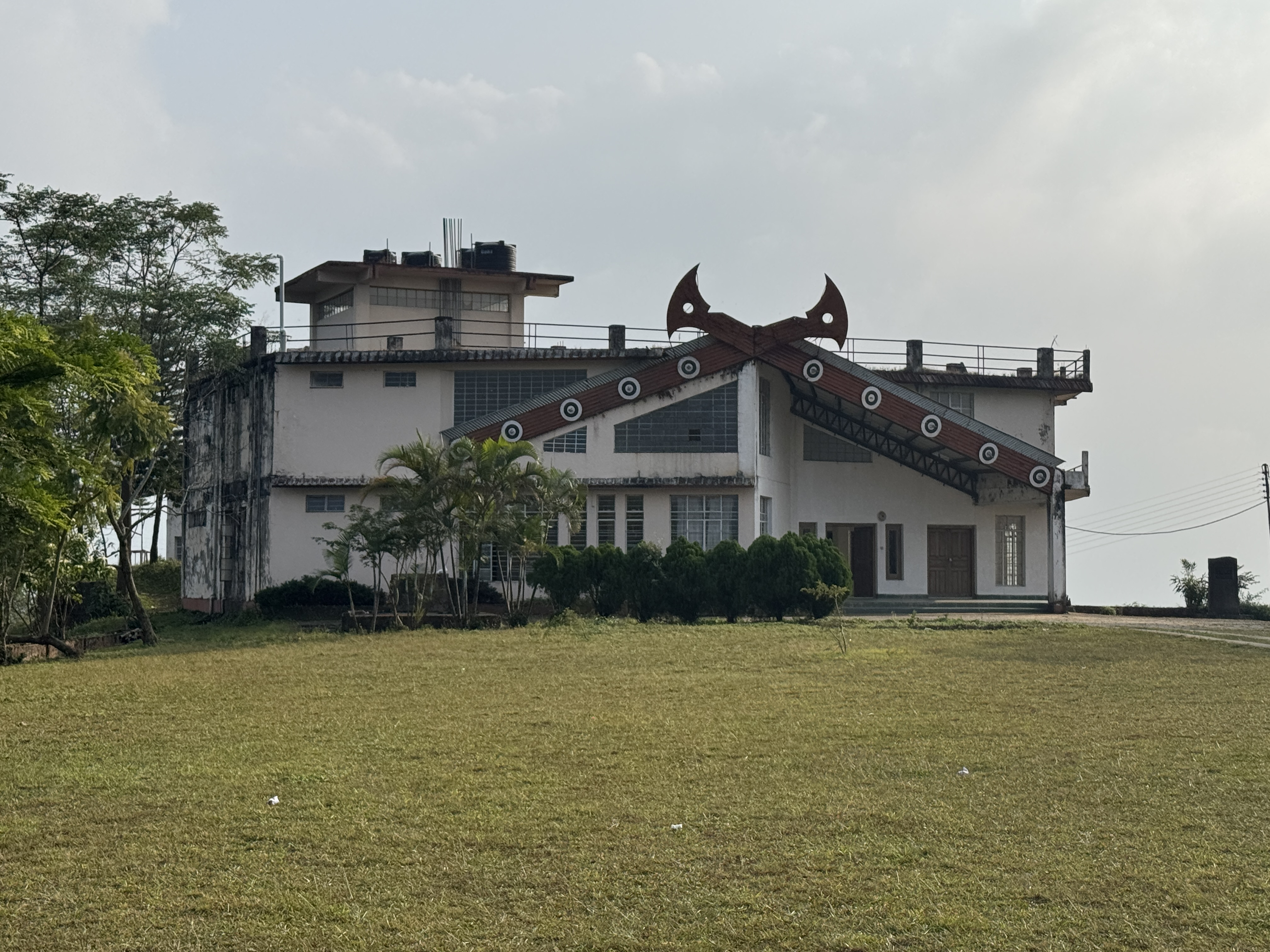
Here's the thing obviously intended to serve visitors. It's the Chedema Tourist Lodge. Rorschach Test No. 2: what do you think of the house horns?
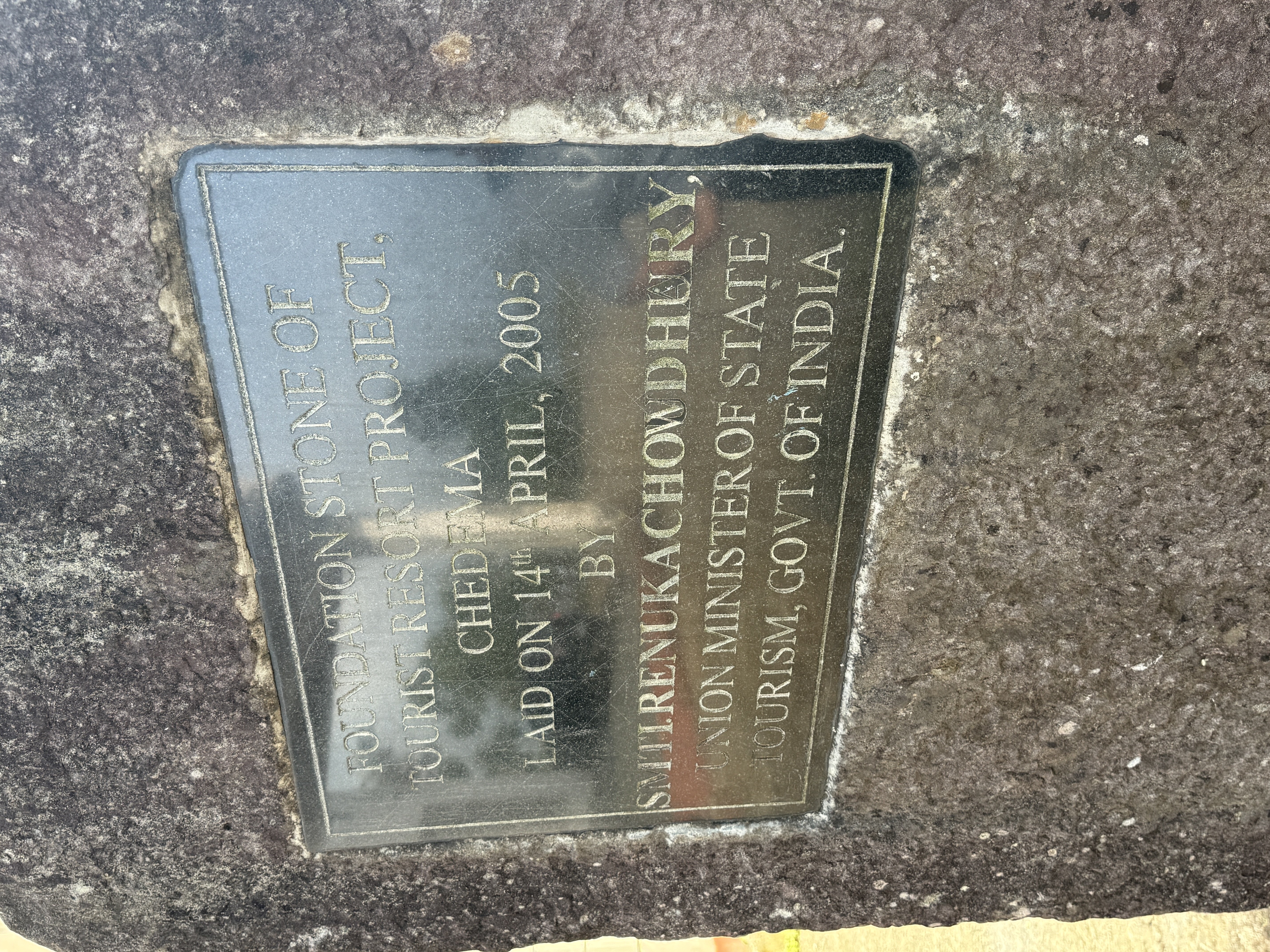
The building was too remote to attract many visitors, despite the fancy plaque.
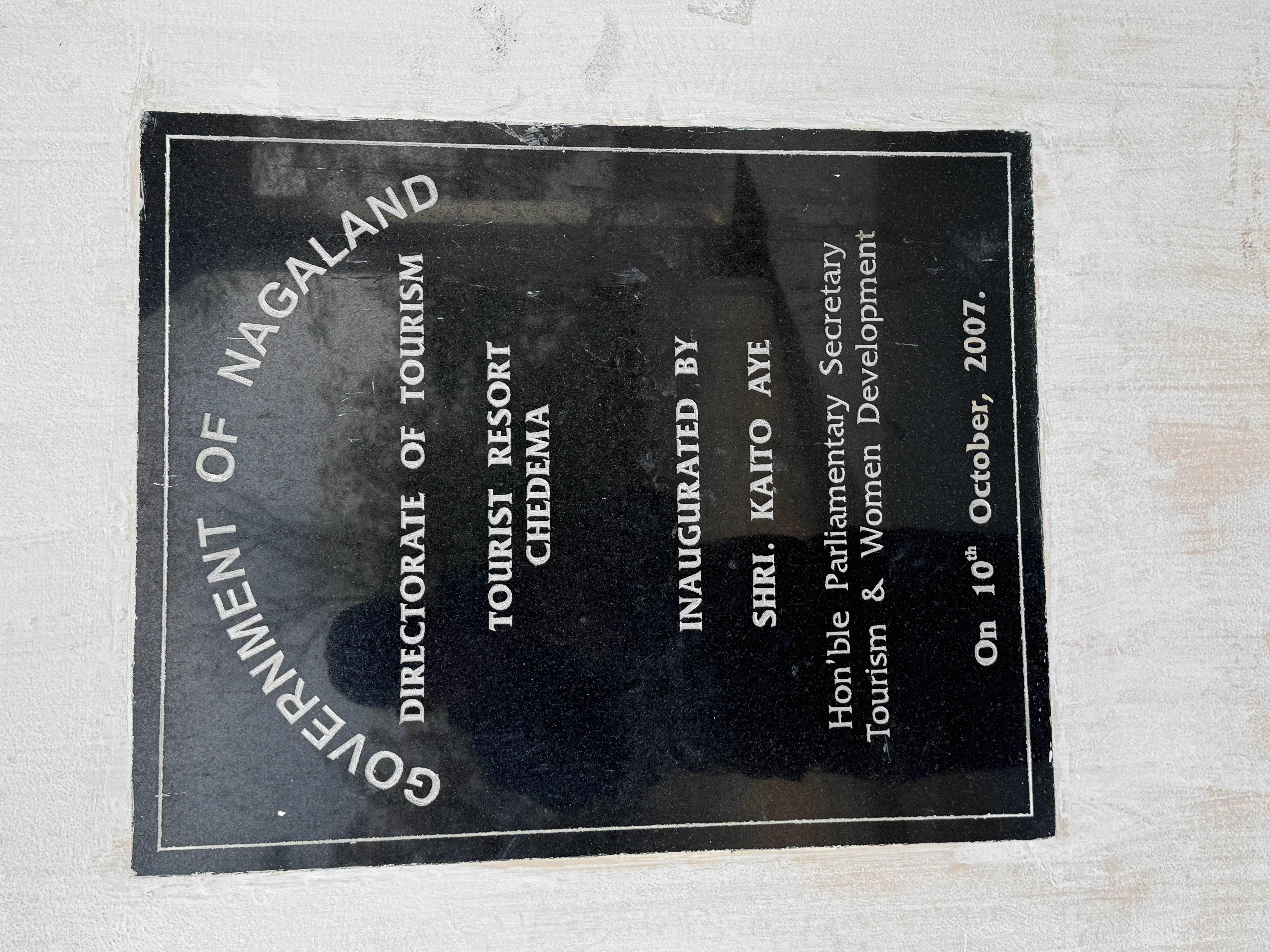
The Indian motto is "no plaque too many." Here's one for the opening, but in 2024 the resort had been closed for several years.
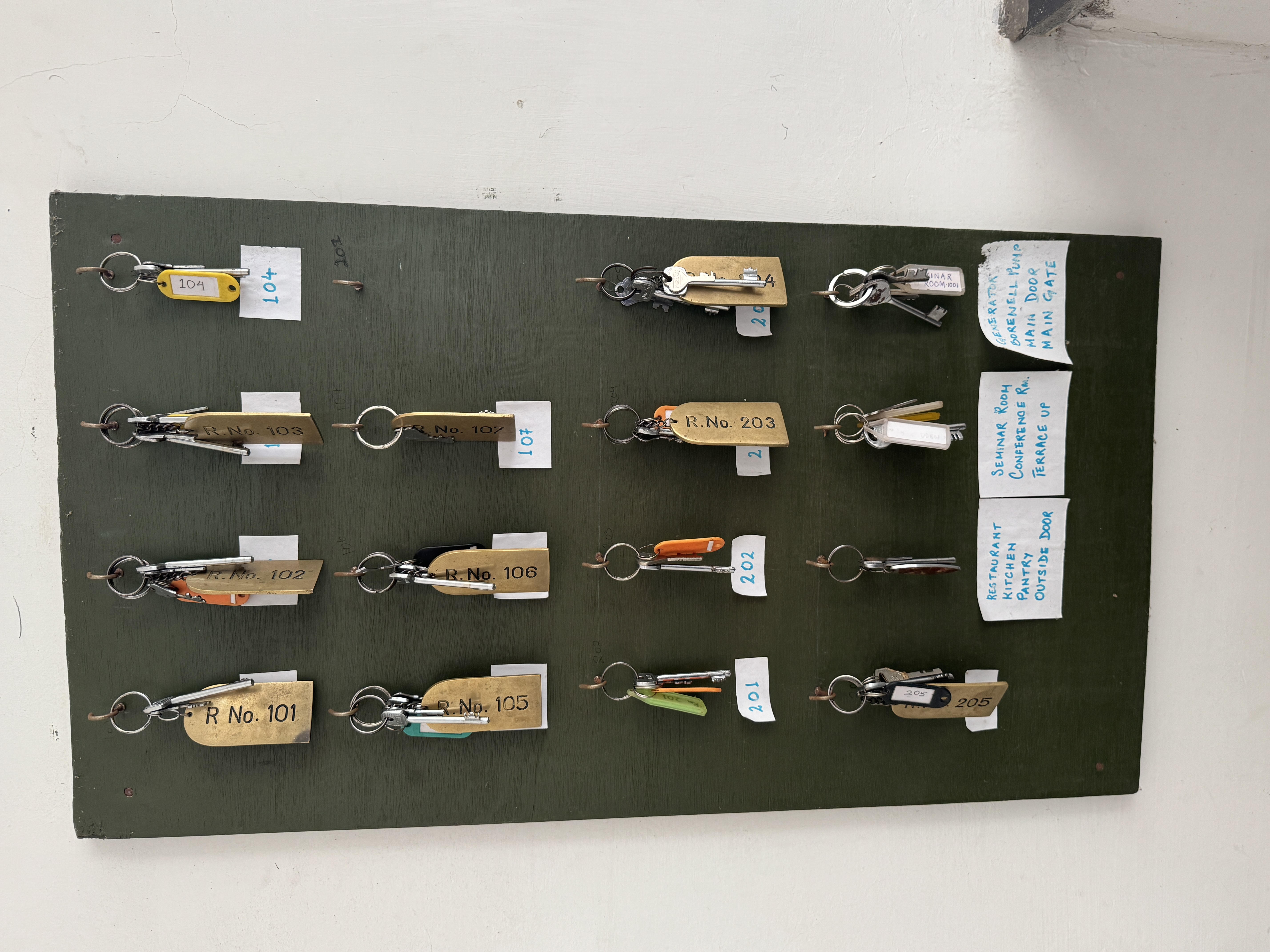
The place was deserted, but the door was open and all the keys were on their hooks. That's interesting, almost astonishing.
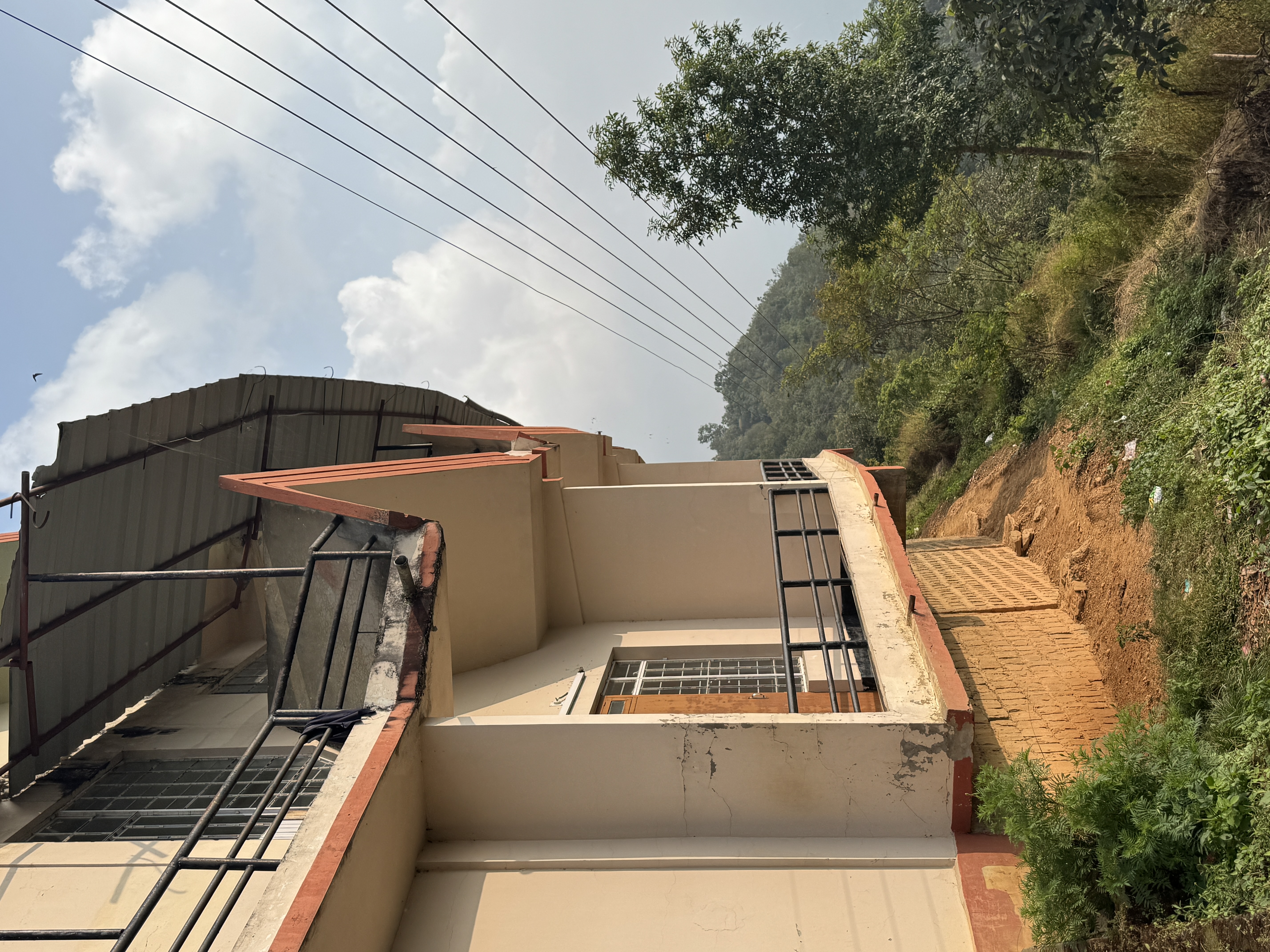
The lodge was built at the end of a ridge overlooking valleys to the east and west. There's a great view of Kohima, but on this day mist got in the way.
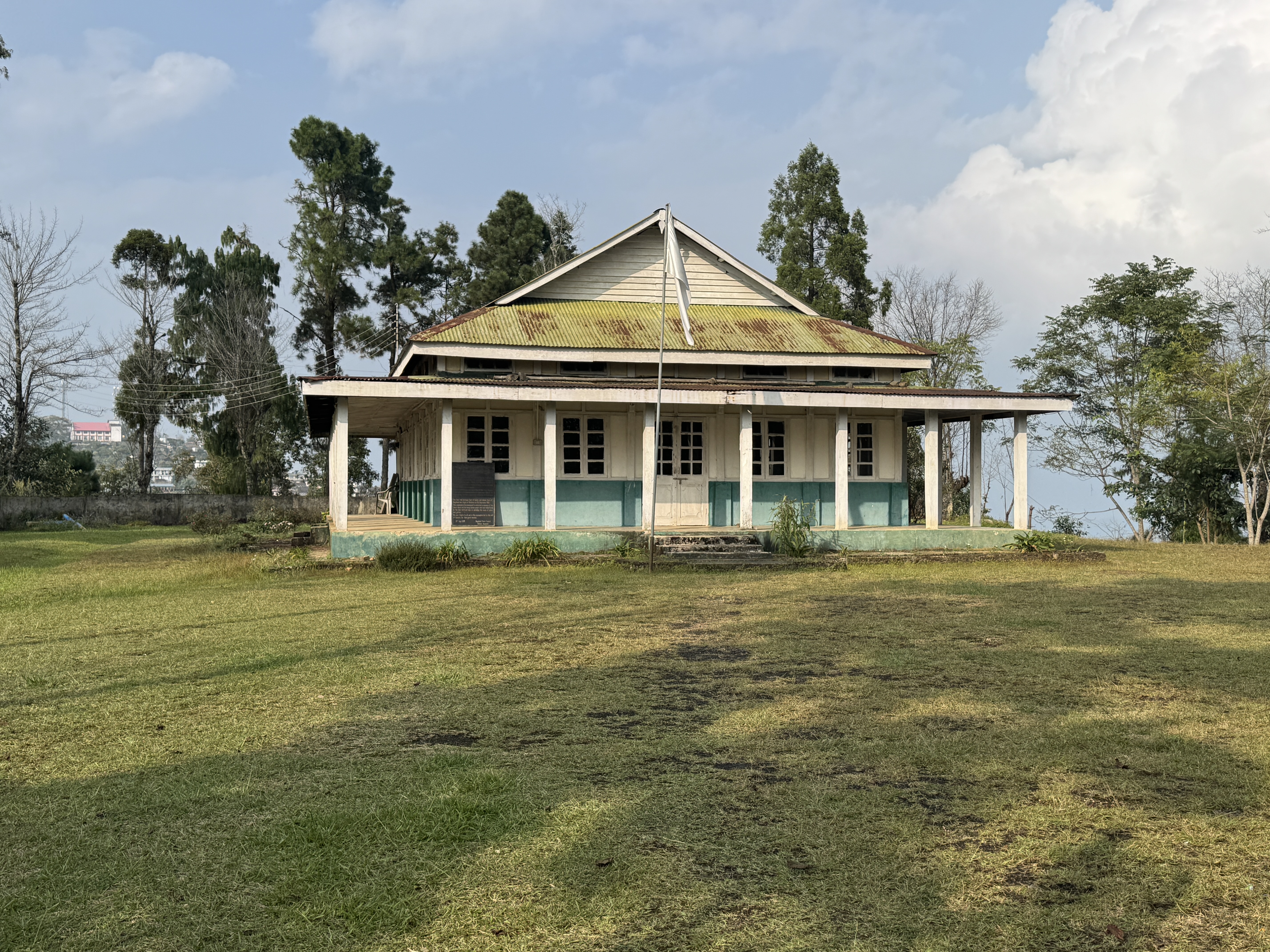
There is one little-visited but important thing to see nearby; it's the Chedema Peace Camp, where negotiations were conducted in 1964 between the government of India and insurgents.
Naga nationalism has been traced to World War I veterans returning from Europe, as well as to the establishment in 1918 of the Naga Club, mostly a group of educated Nagas working for the colonial government. In 1929 they officially asked the Simon Commission, which was considering reforms to the government of India, to let Nagaland stand "directly under British Government... We pray that the British Government will... leave us alone to determine ourselves as in ancient times" https://nagalandjournal.wordpress.com/2013/04/05/naga-hills-memorandum-to-simon-commission-1929/
The Commission did not address the issue, and the Nagas have not had better luck with the government of independent India. In 1947 Nehru met with a Naga delegation and "banged the table with his fist: 'India cannot be split into a hundred bits. If you fight, we shall resist.' The next day, two press communiques appeared. The first, on behalf of the Indian Government, said: 'we can give you complete autonomy but never complete independence. You can never hope to be independent'" (quoted in Jelle J.P. Wouters, "Difficult Decolonization: Debates, Divisions, and Deaths Within the Naga Uprising, 1944-1963," Journal of North east India Studies, 2019, p. 12).
In 1956, the last British officer in charge of the Nage Hills received a latter from a European tea-planter near the Naga Hills: Stephen Laing wrote that "the Indian Army is in full occupation of every section of the Naga Hills. 60% of the Ao villages have been burnt... 70% of the Sema villages have been burnt, and 30% of the Angami. The army uses incendiaries. Worse still: the Nagas are not allowed to rebuild them, so they are living in the jungles as best they can. Their crops are being deliberately destroyed and any Naga seen is apt to be shot on sight so that they cannot enter their fields anyway" (Jelle J.P. Wouters in "Difficult Decolonization: Debates, Divisions, and Deaths Within the Naga Uprising, 1944-1963," Journal of North East India Studies, 2019, p. 23).
The ceasefire signed here in 1964 failed. Ceasefires were renewed in 1975 and against in 1997, but in 2021, the army in the northern tip of Nagaland killed 14 miners, mistaking them for militants. The regional director for Human Rights Watch said that "So long as the Armed Forces Special Powers Act [enacted in 1958 to expand the powers granted by the Assam Disturbed Area Act of 1955] protects soldiers from accountability, such atrocities will continue." https://www.hrw.org/news/2021/12/08/india-army-kills-14-civilians-nagaland . Reuters in 2024 headlined: "India's Naga separatists threaten to resume violence after decades-long truce" https://www.reuters.com/world/india/indias-naga-separatists-threaten-resume-violence-after-decades-long-truce-2024-11-08/#:~:text=The%20Naga%20insurgency%2C%20India's%20oldest,since%20it%20began%20in%201947.
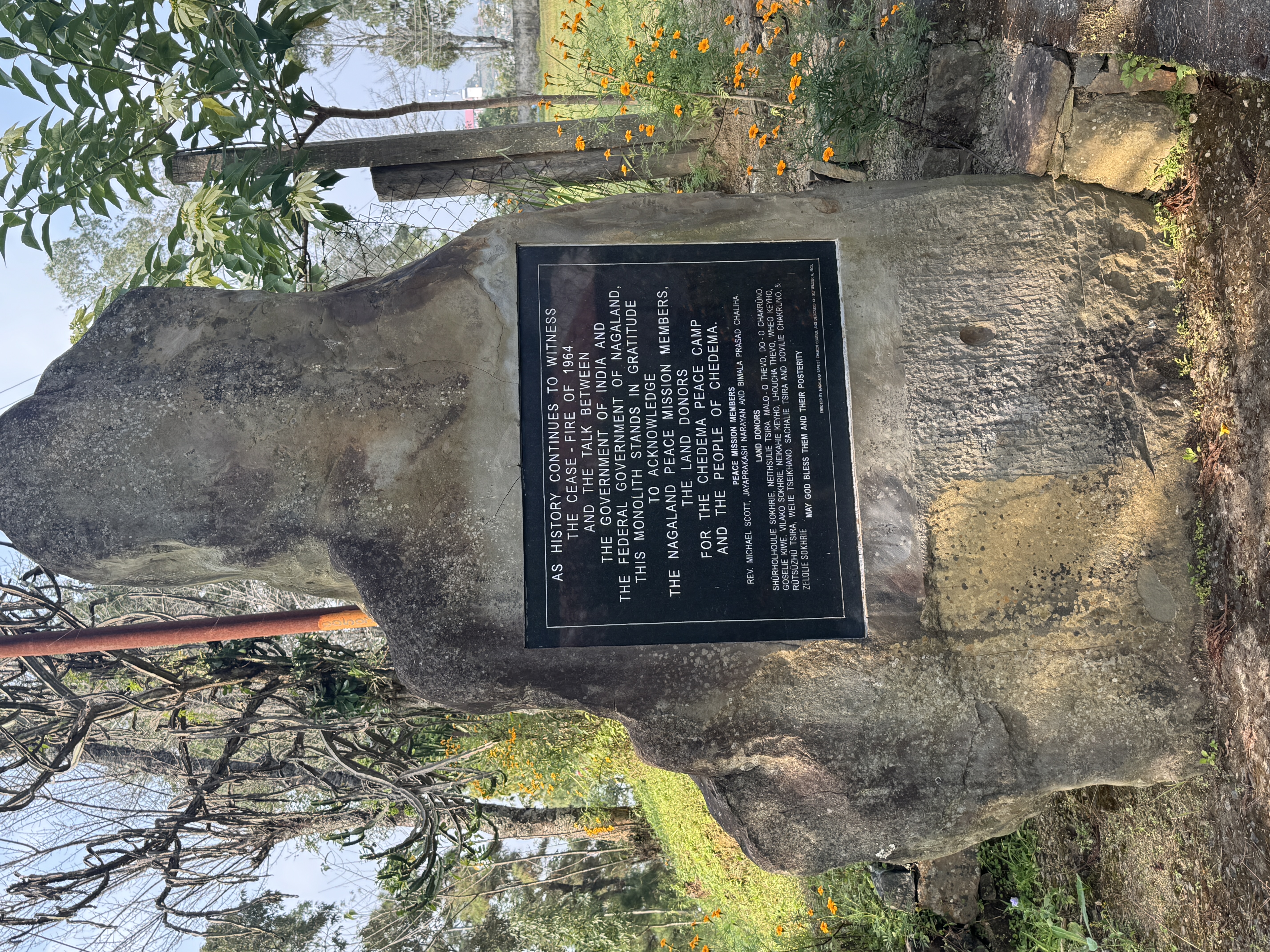
A monolith records the cease-fire of 1964.
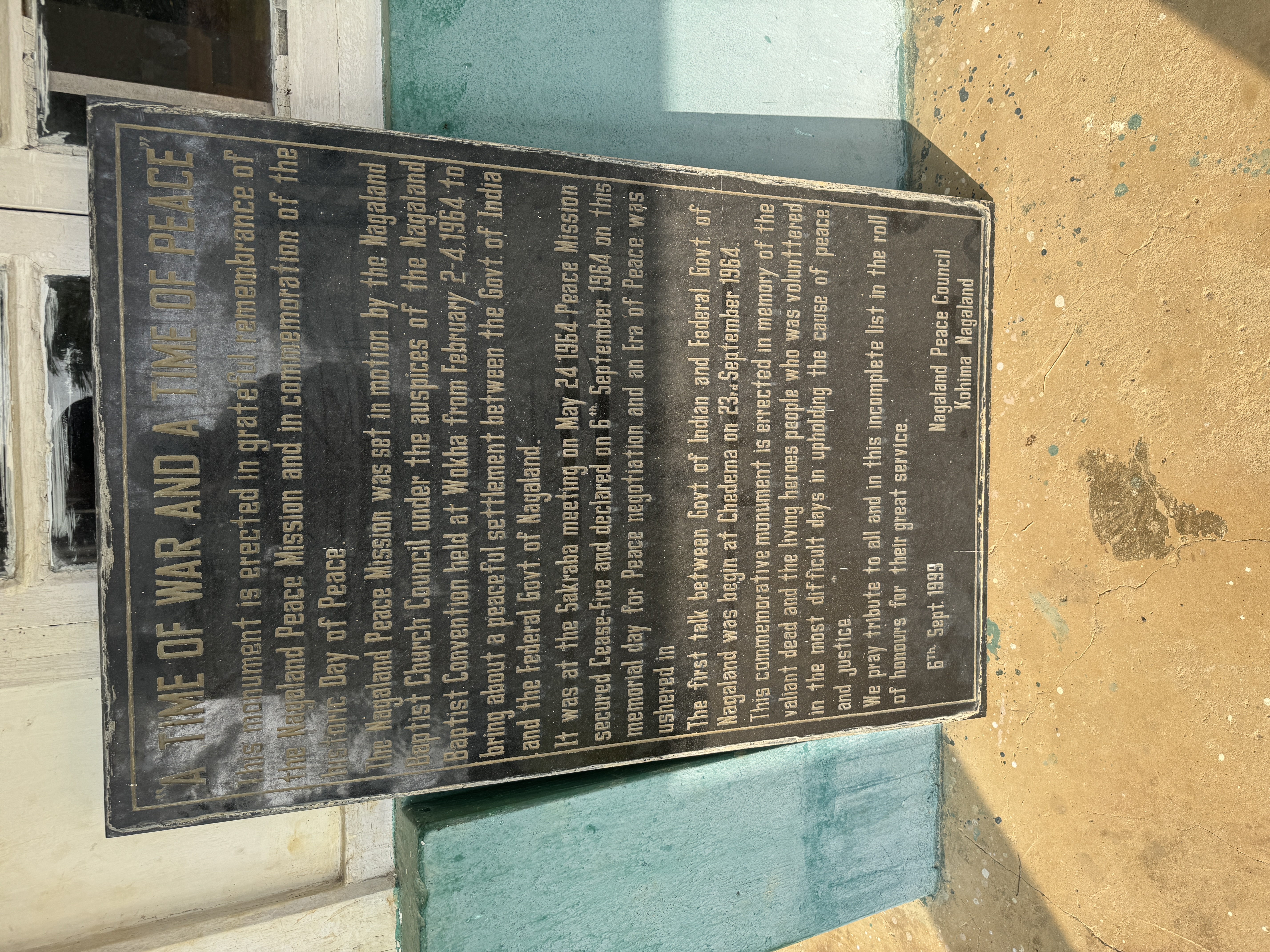
A later plaque leans against the building's wall and echoes Ecclesiastes.
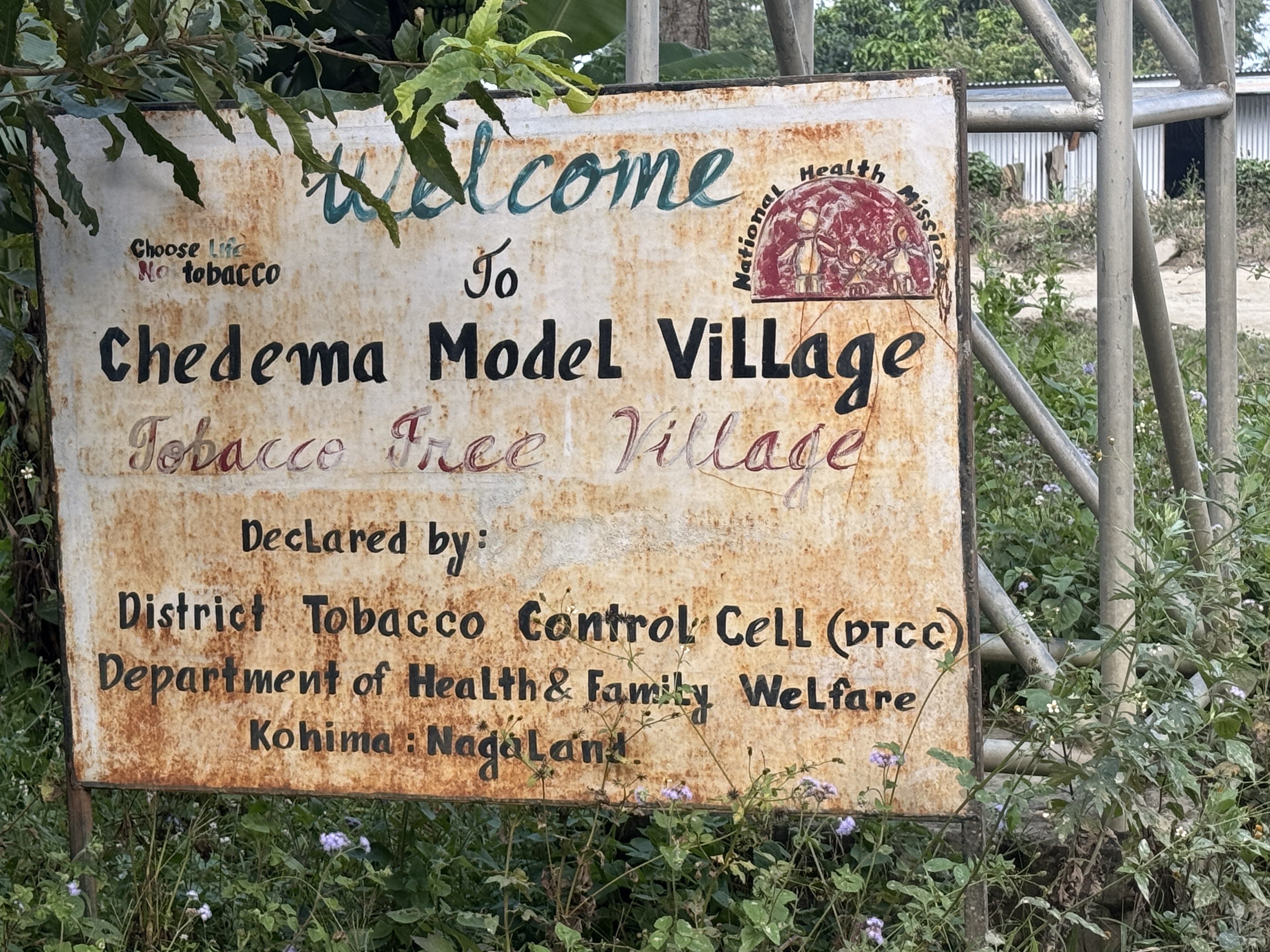
We've gone a mile to the northeast, where there's a "model village," the sort of thing popular in post-independence India, with its faith in central planning.
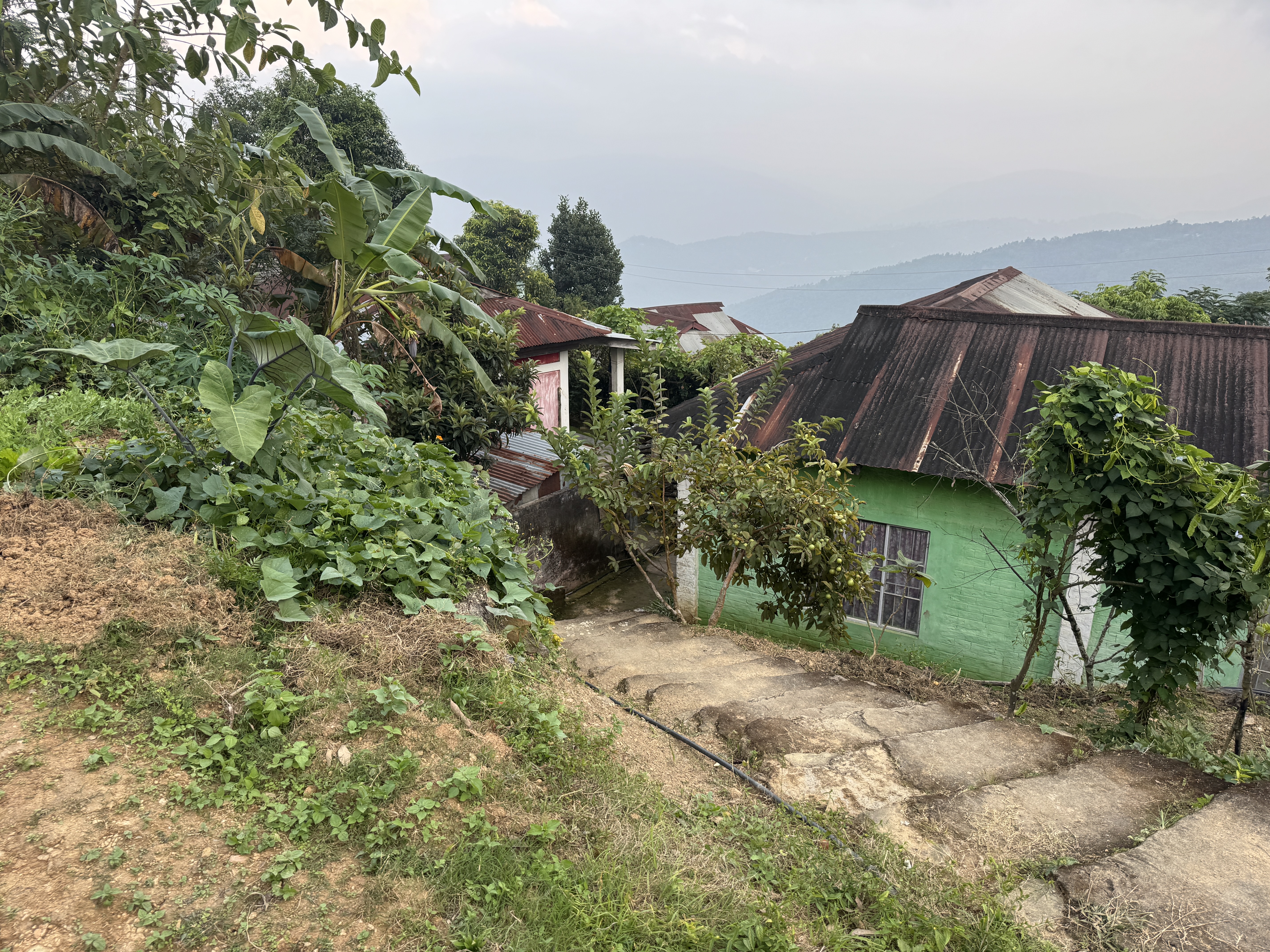
We can walk through it.
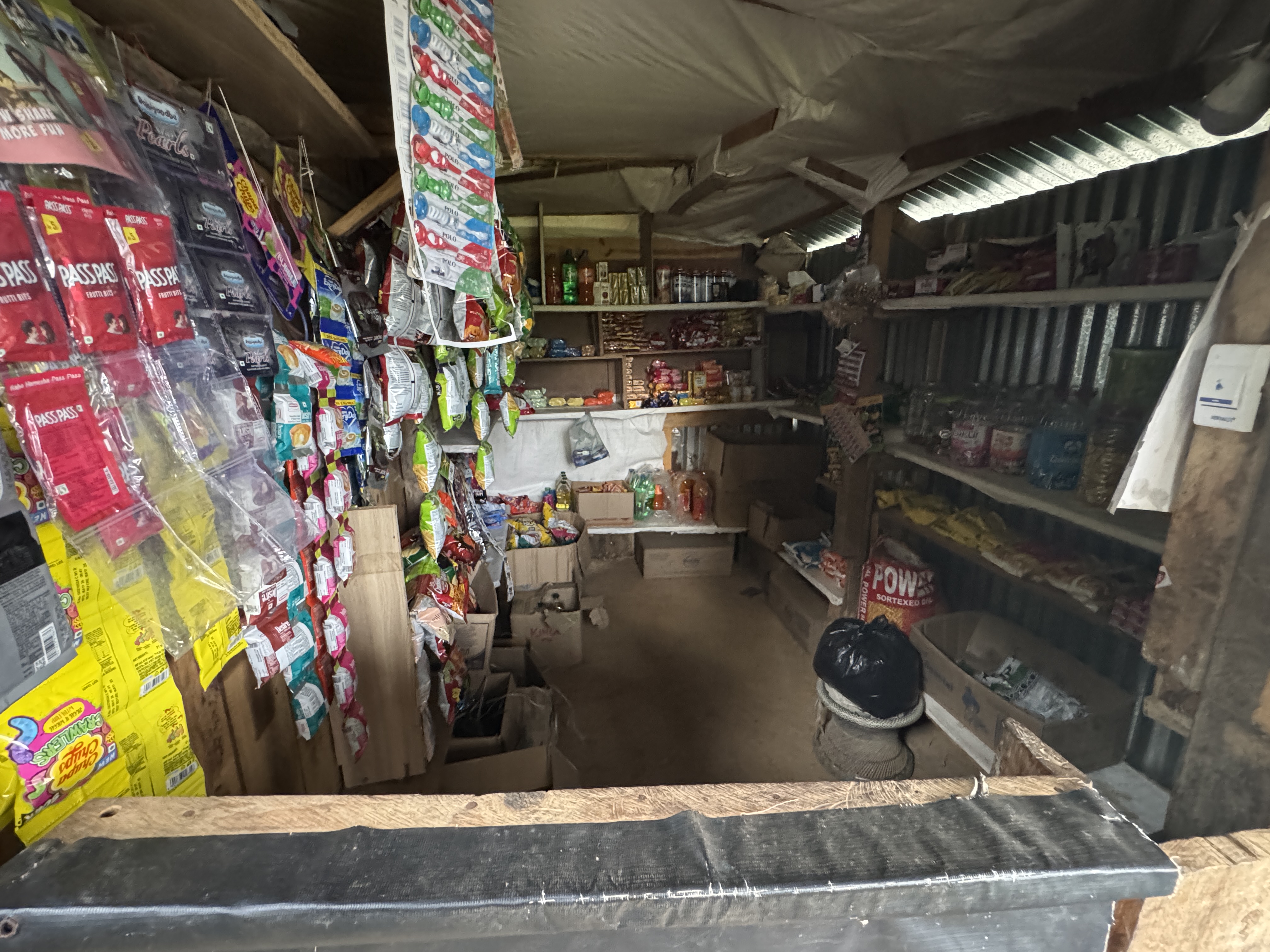
The village shop.
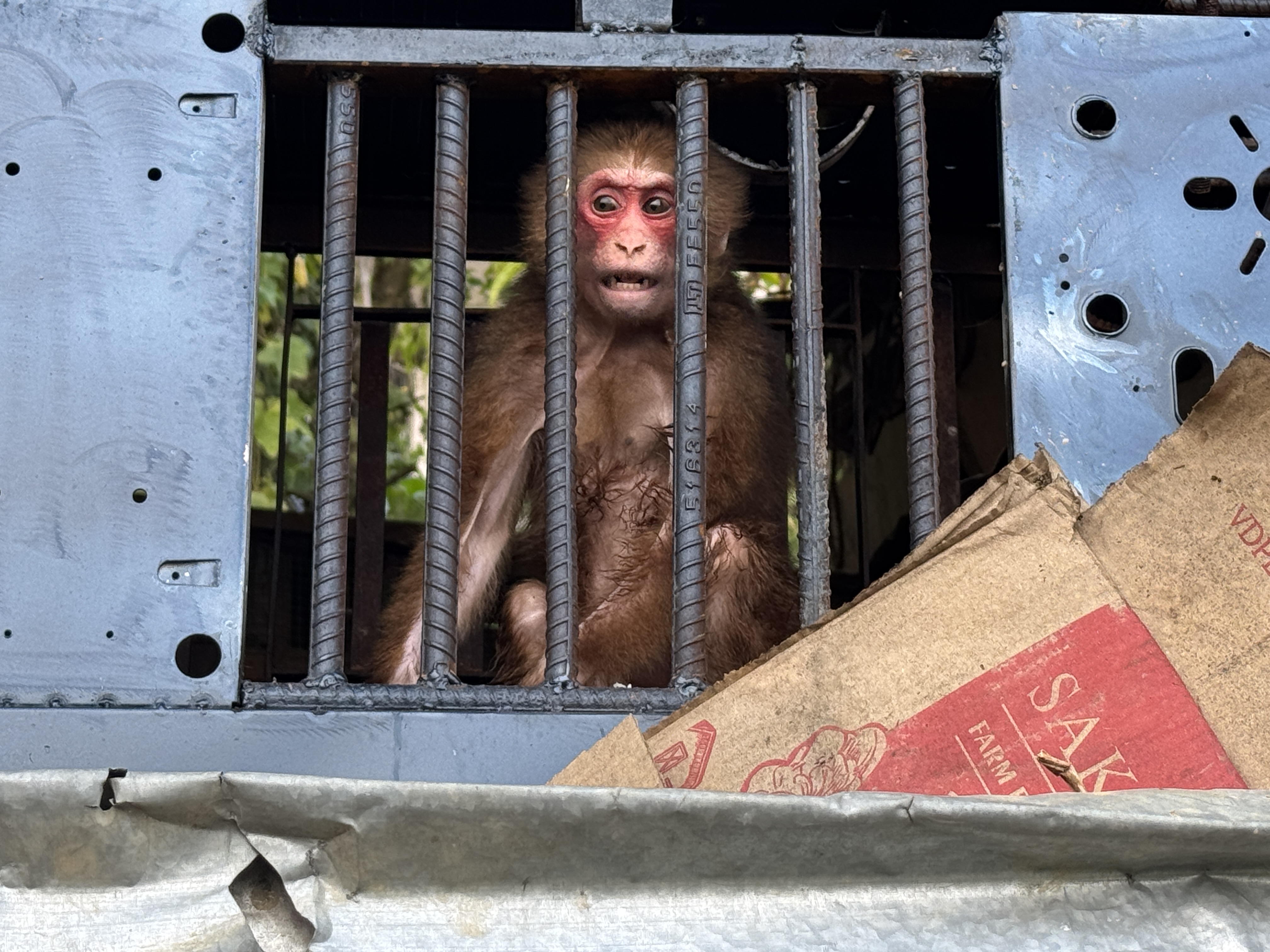
An angry and noisy guard-monkey lets the shopkeeper know if anyone comes by.
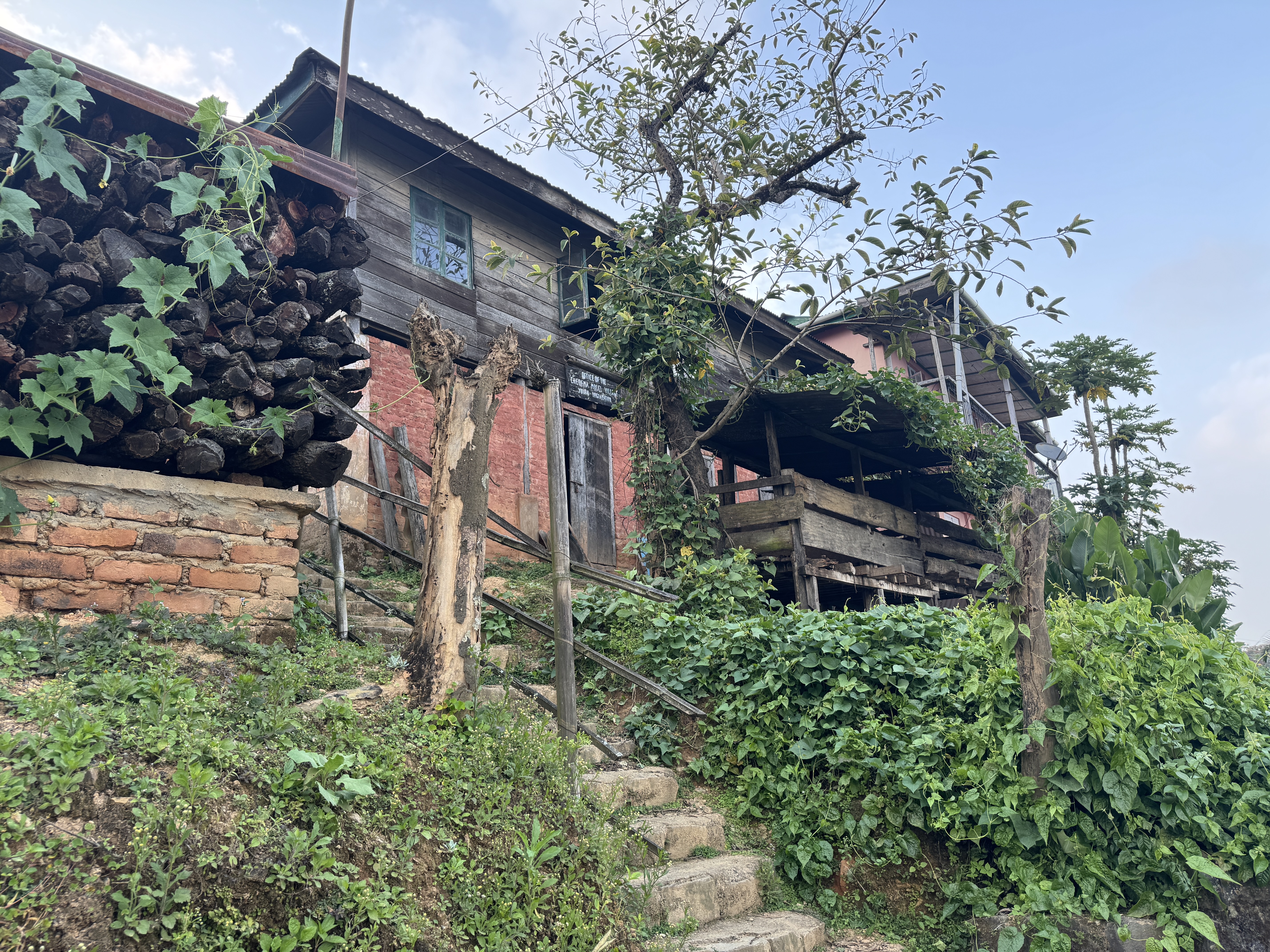
There are some substantial homes. The obvious question is how people here make a living.
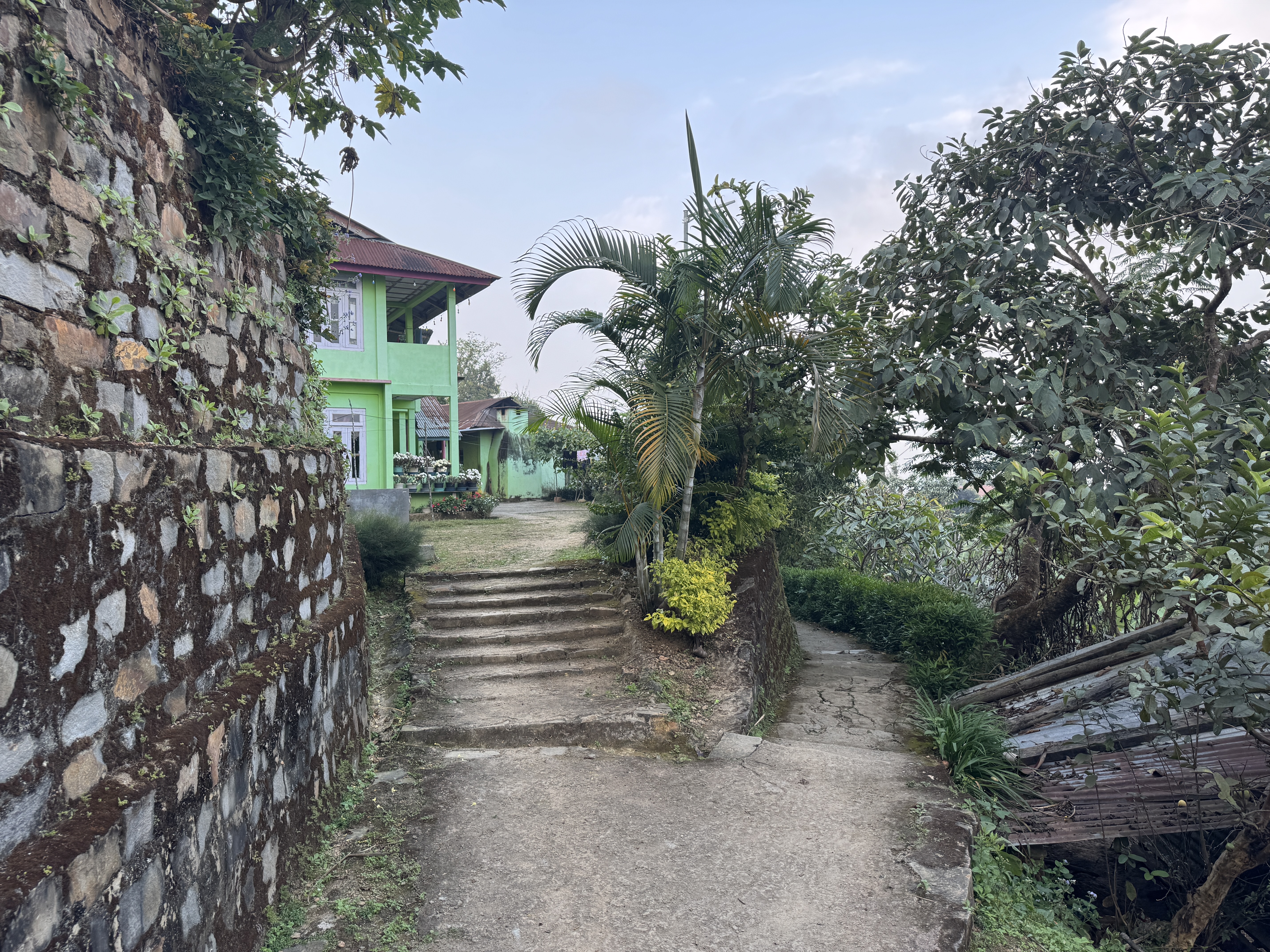
I'm guessing people have a family member sending money.
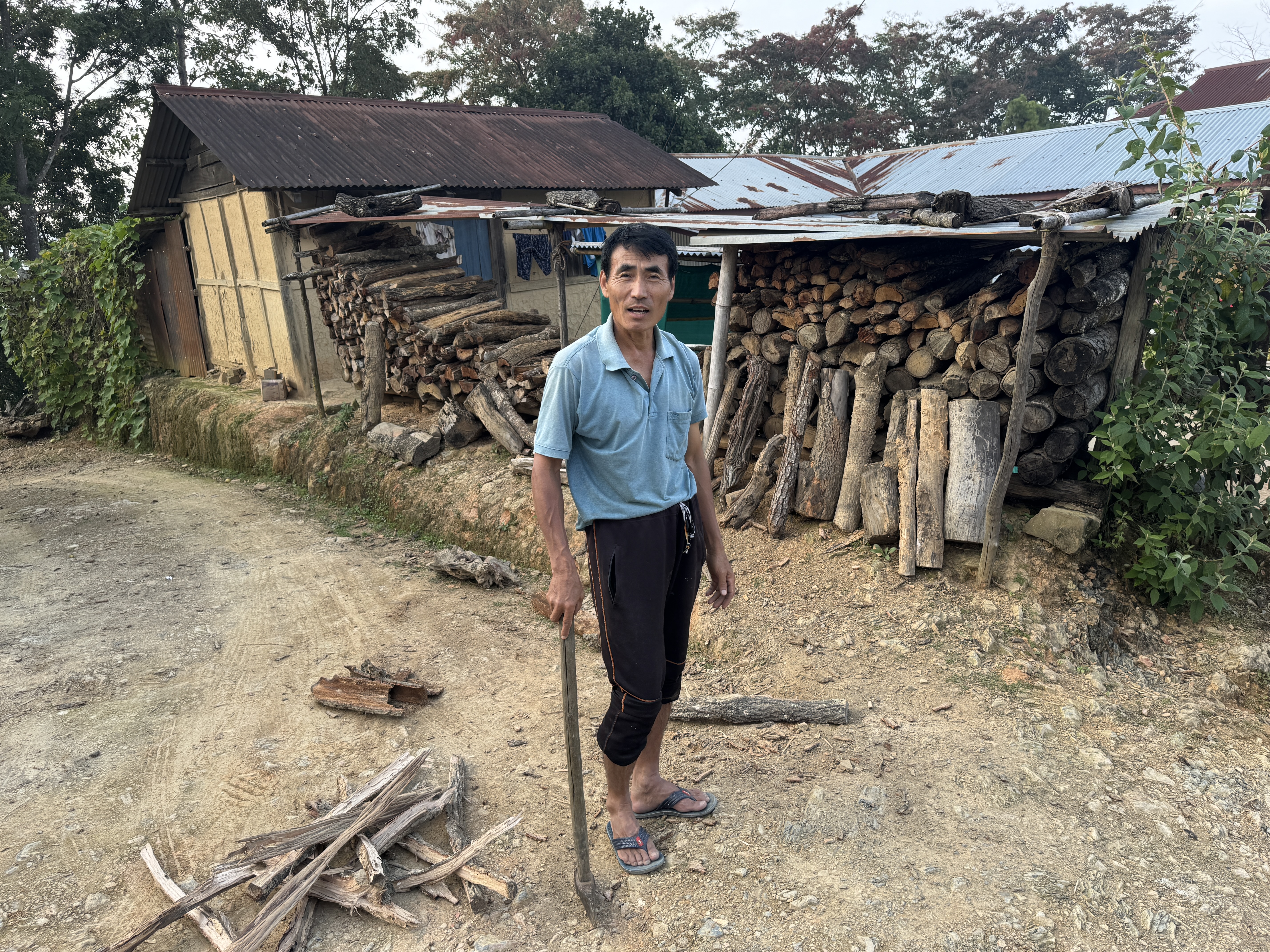
There's no nearby block of cultivated land, but there's a lot of non-paying work.
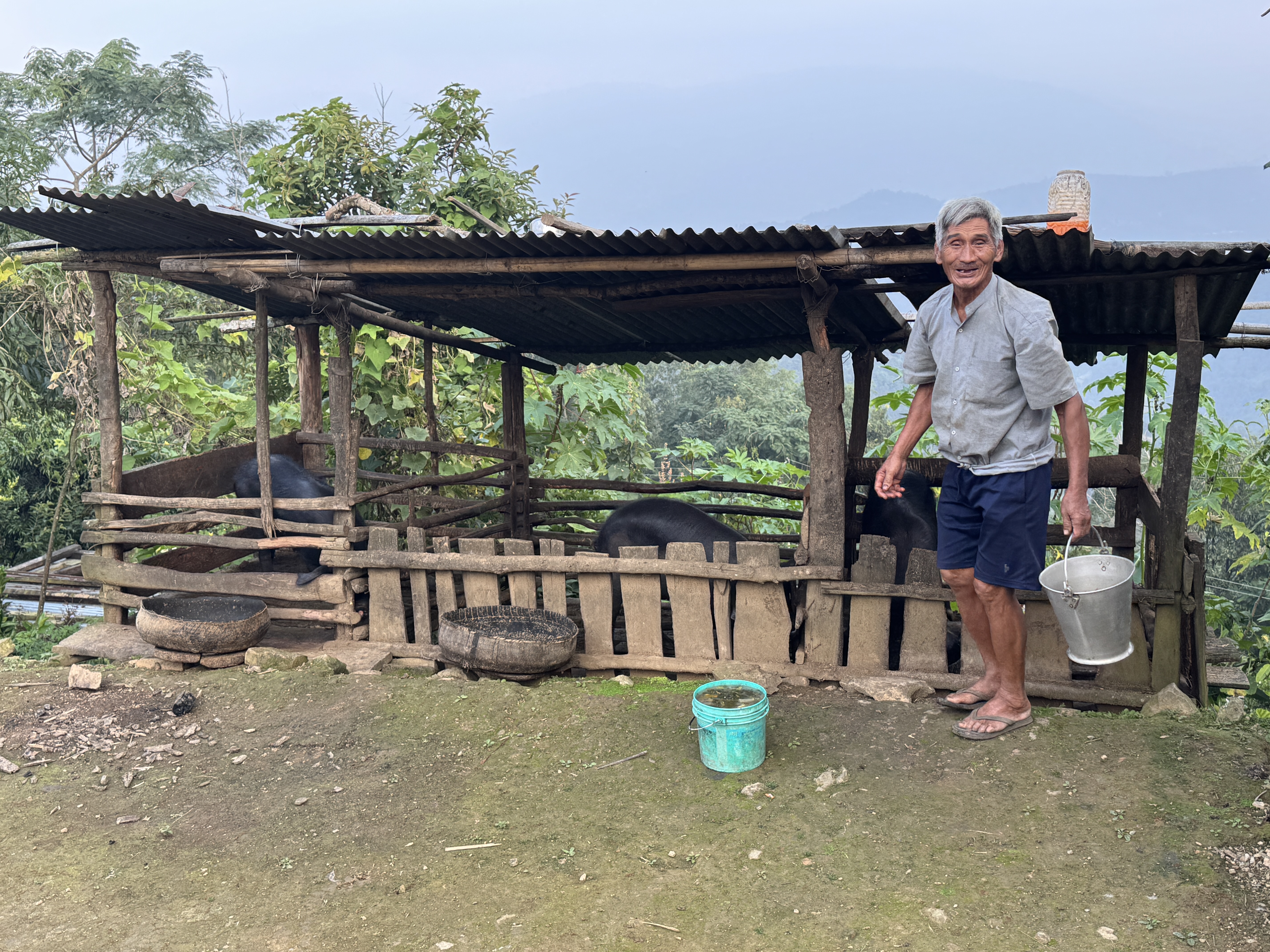
One man chops wood for the coming winter; another feeds his three pigs.
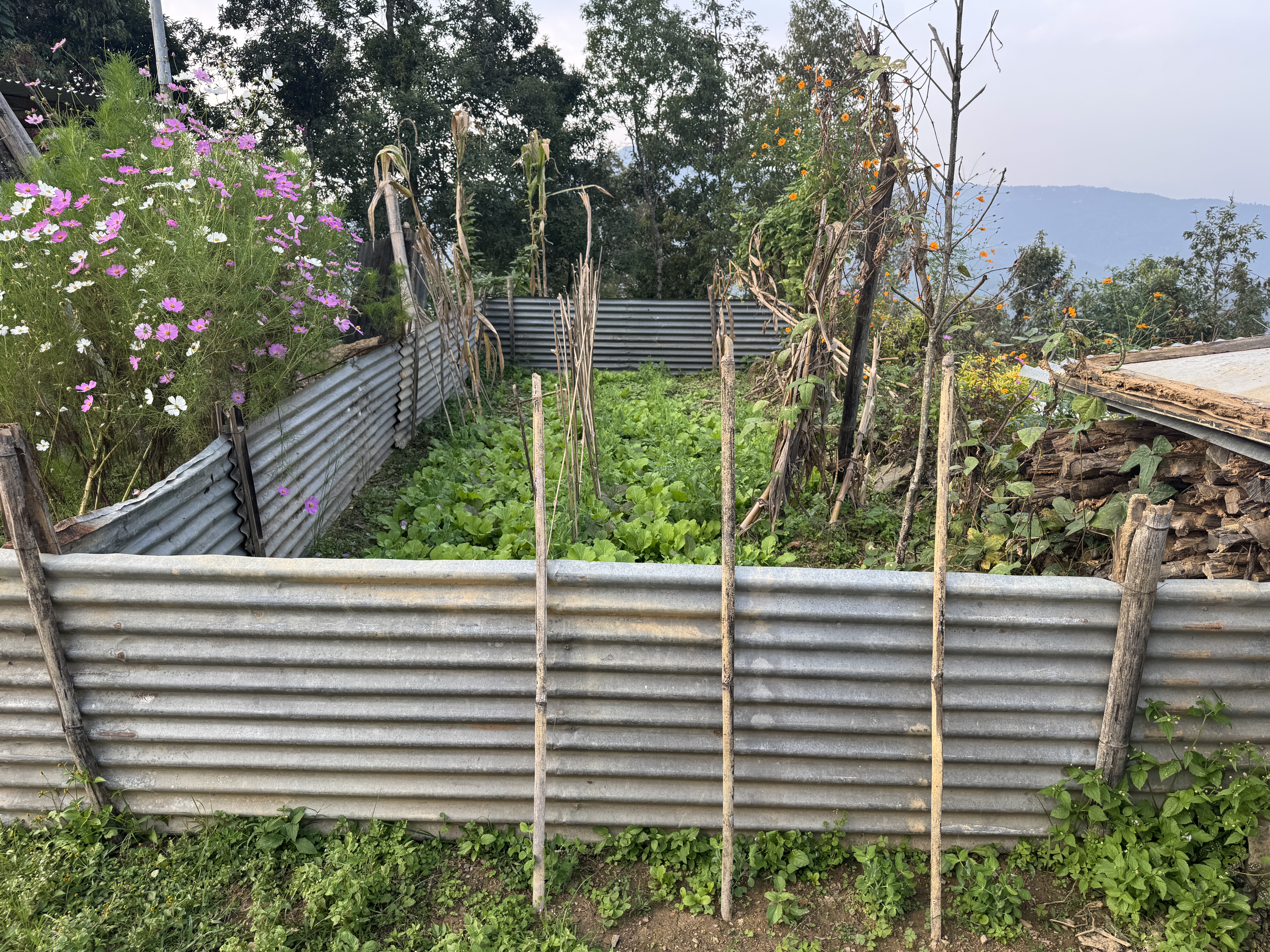
A woman has just picked some greens to put in the pot.
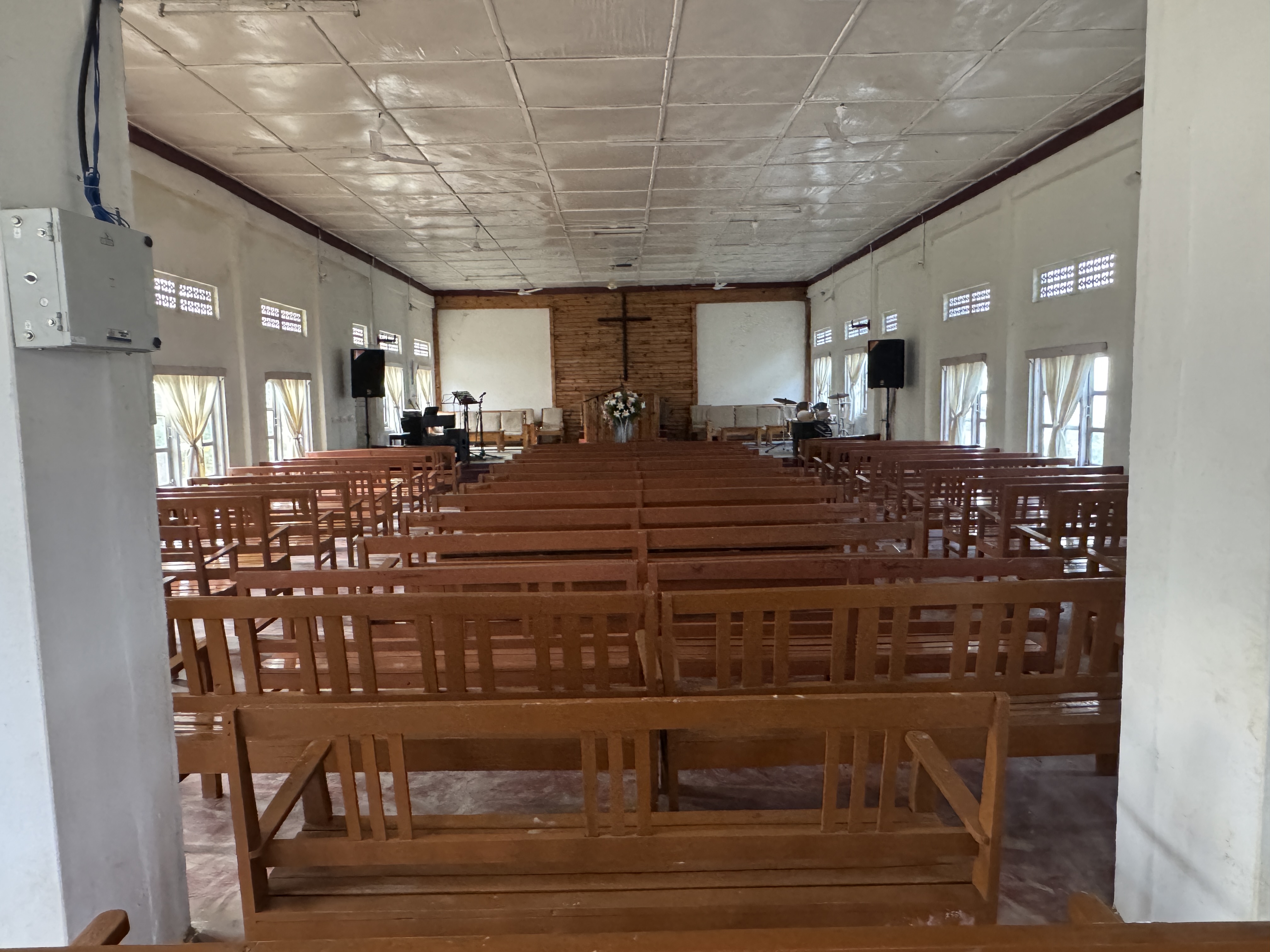
The village church.
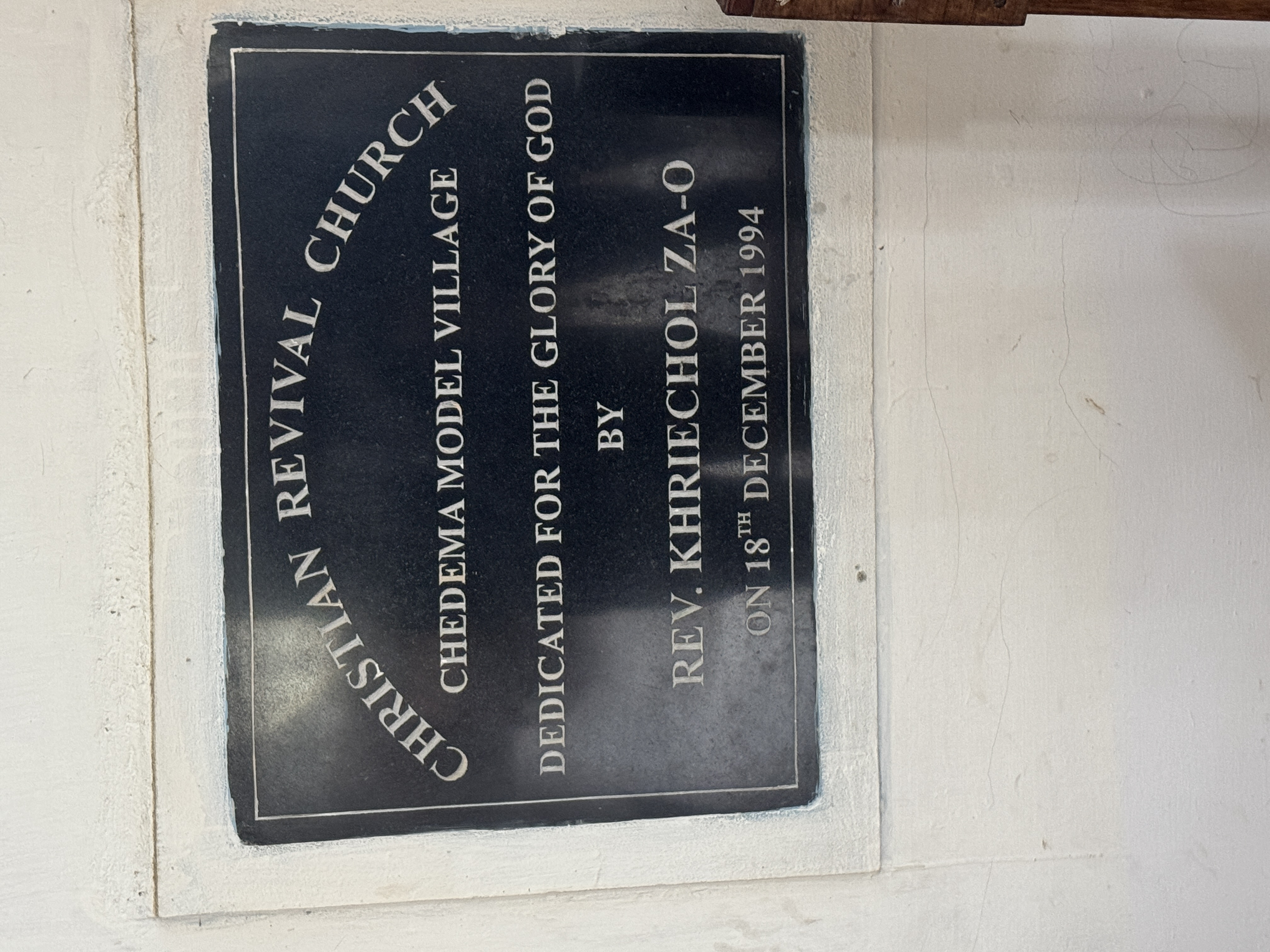
Not Baptist.
What would Rev. Riverburg think?
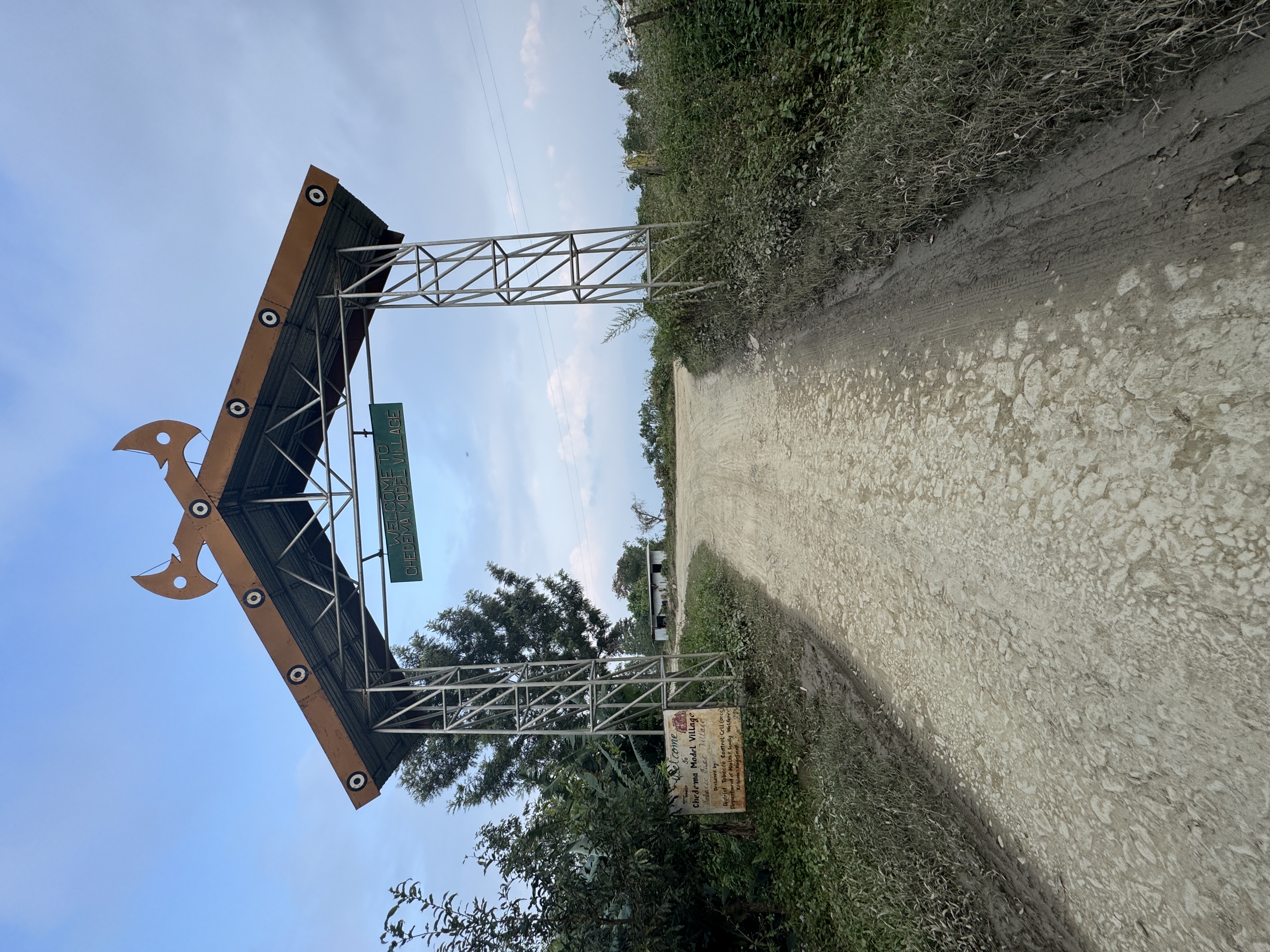
The only thing that look traditional is this entrance gate, all except for the barge boards and house horns.
Over to Kigwema and neighboring Jakhama.
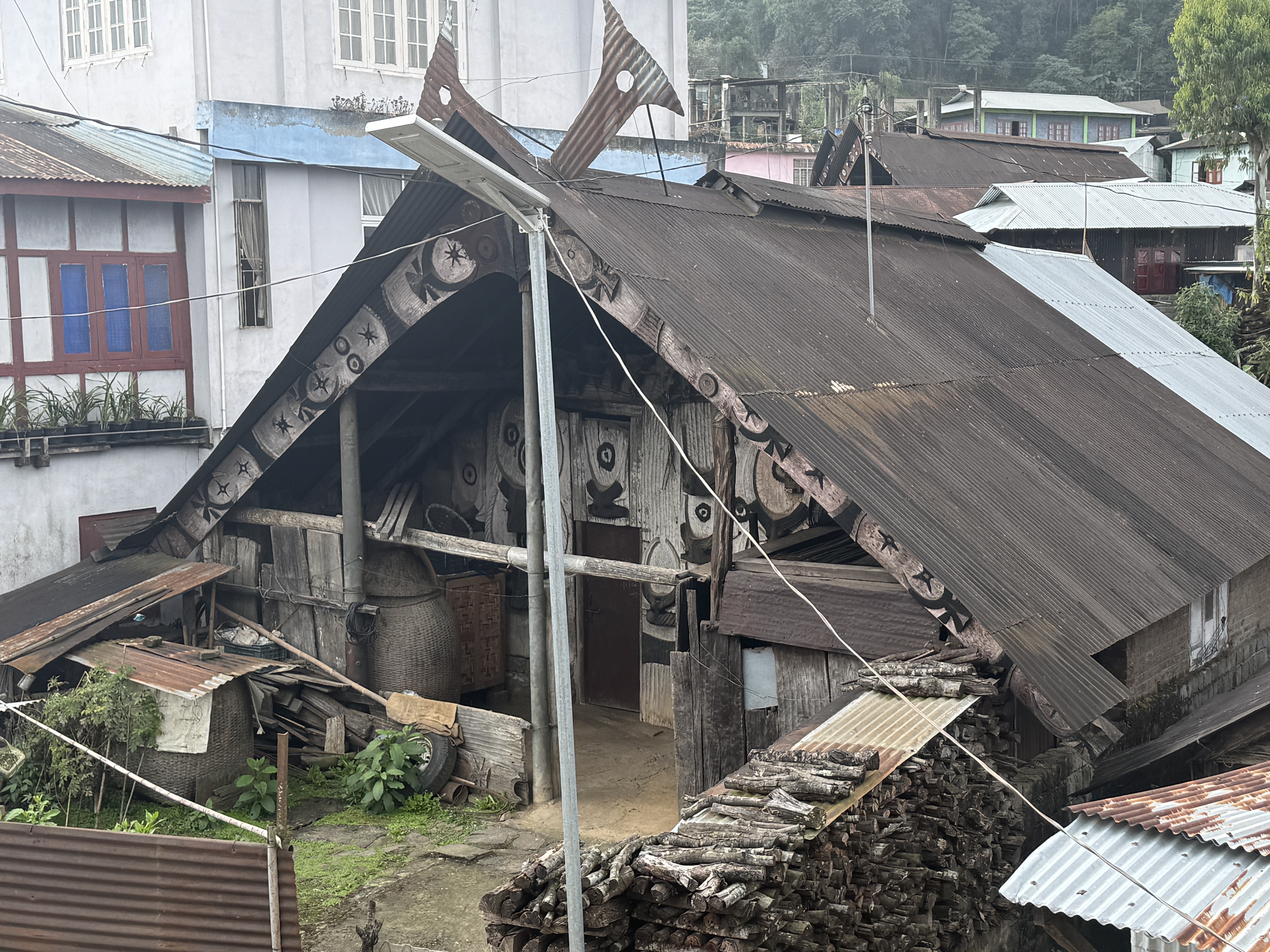
Here's a house built of modern materials yet fitted with house horns cut from sheetmetal.
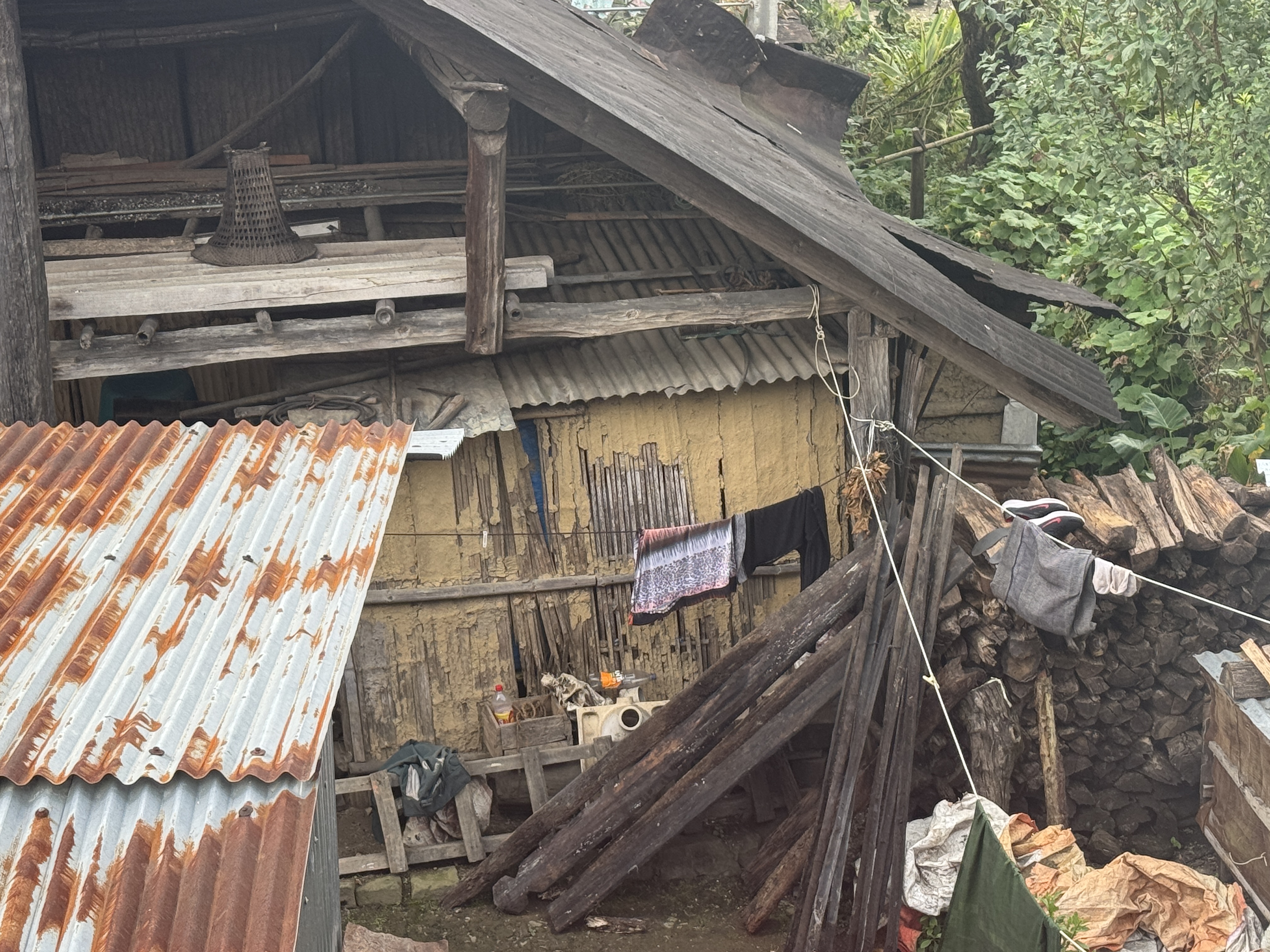
Another building with traditional walls of bamboo and mud.
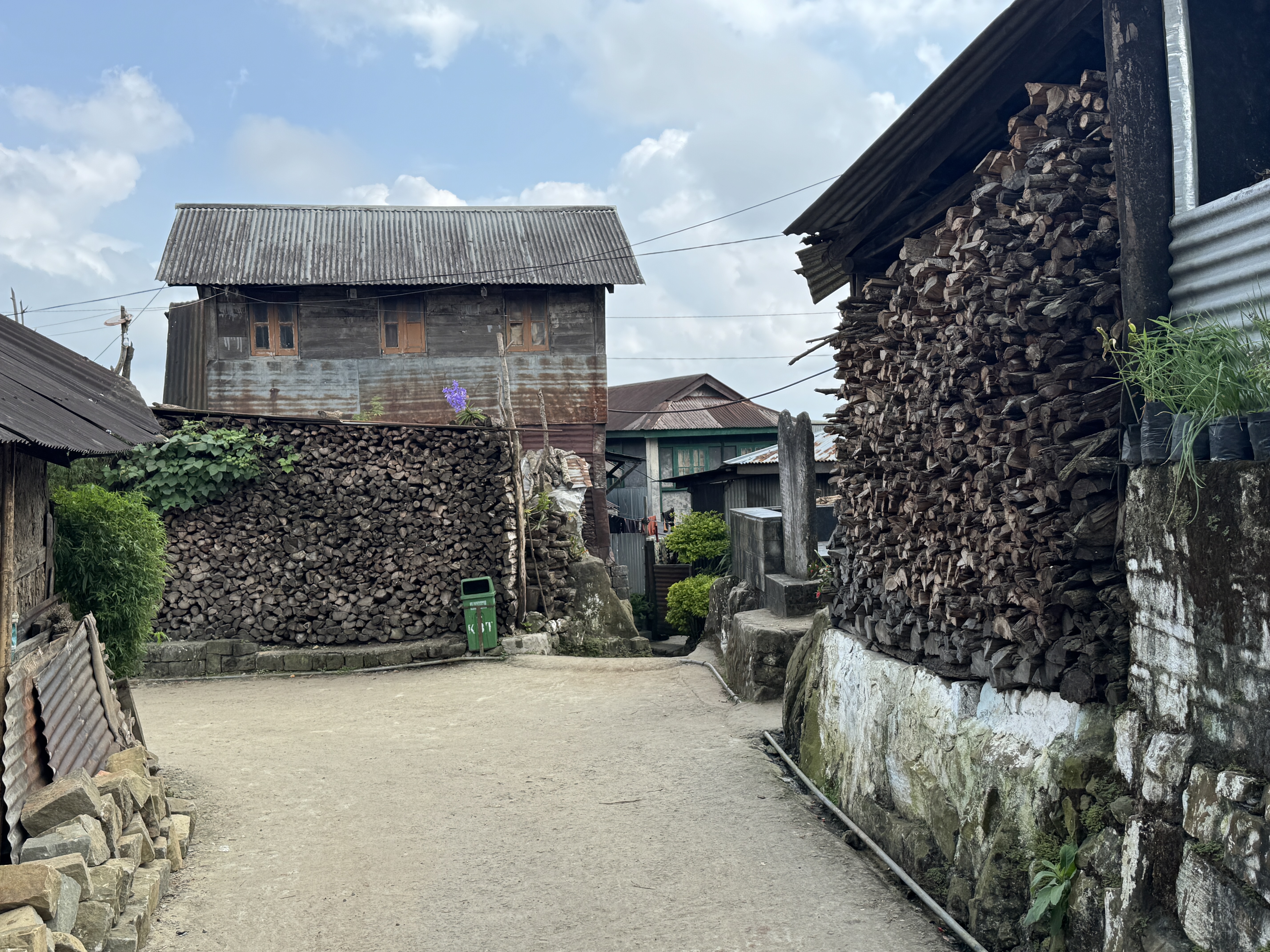
You may have noticed in earlier photos that many houses have stacks of firewood. Here it's carried to extraordinary lengths. Even more interesting is the extreme cleanliness of the village, which you might take for granted until you read what J.H. Hutton wrote a hundred years ago of Angami villages: "In wet weather the filth is indescribable... in dry weather the dust and dirt through which one walks are crawling with fleas. The only time when an Angami village is in anything approaching a sanitary condition is when it has just been burnt" (J.H. Hutton, The Angami Nagas, p. 50). Why the change? Good question. The missionaries? The war?
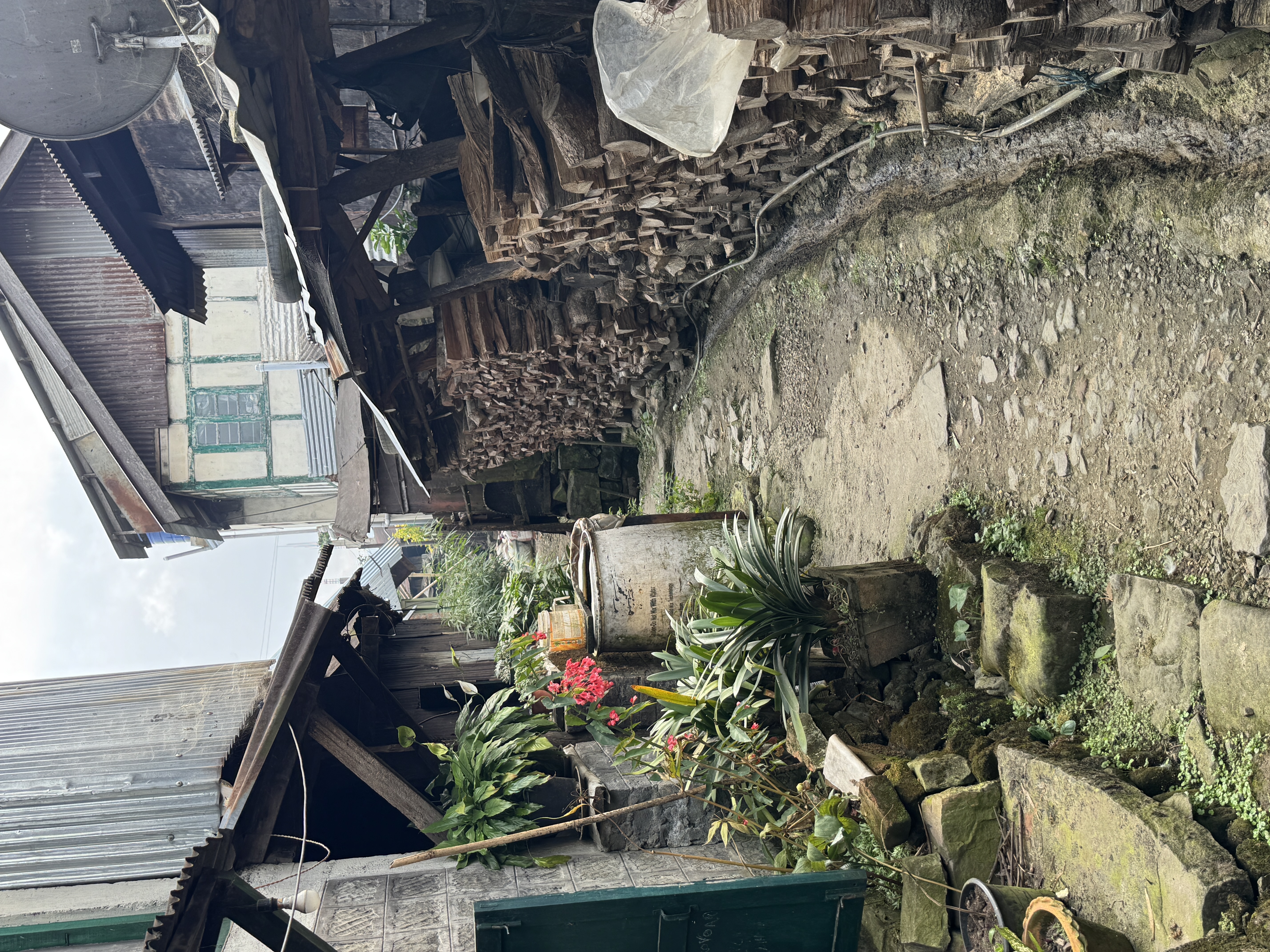
More firewood, but time for ornamental plants, too.
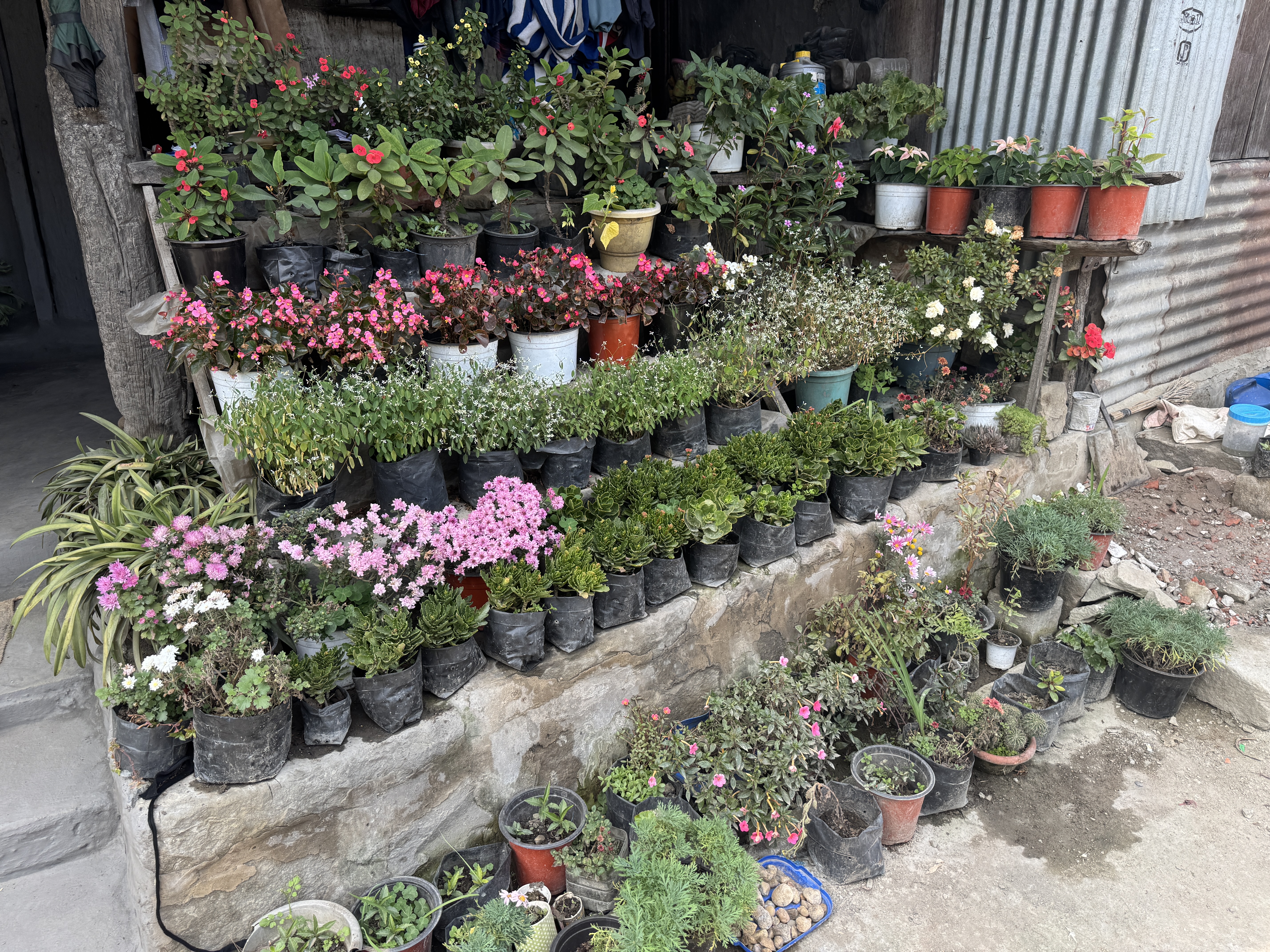
A commercial florist. Not what you'd expect? Me neither.
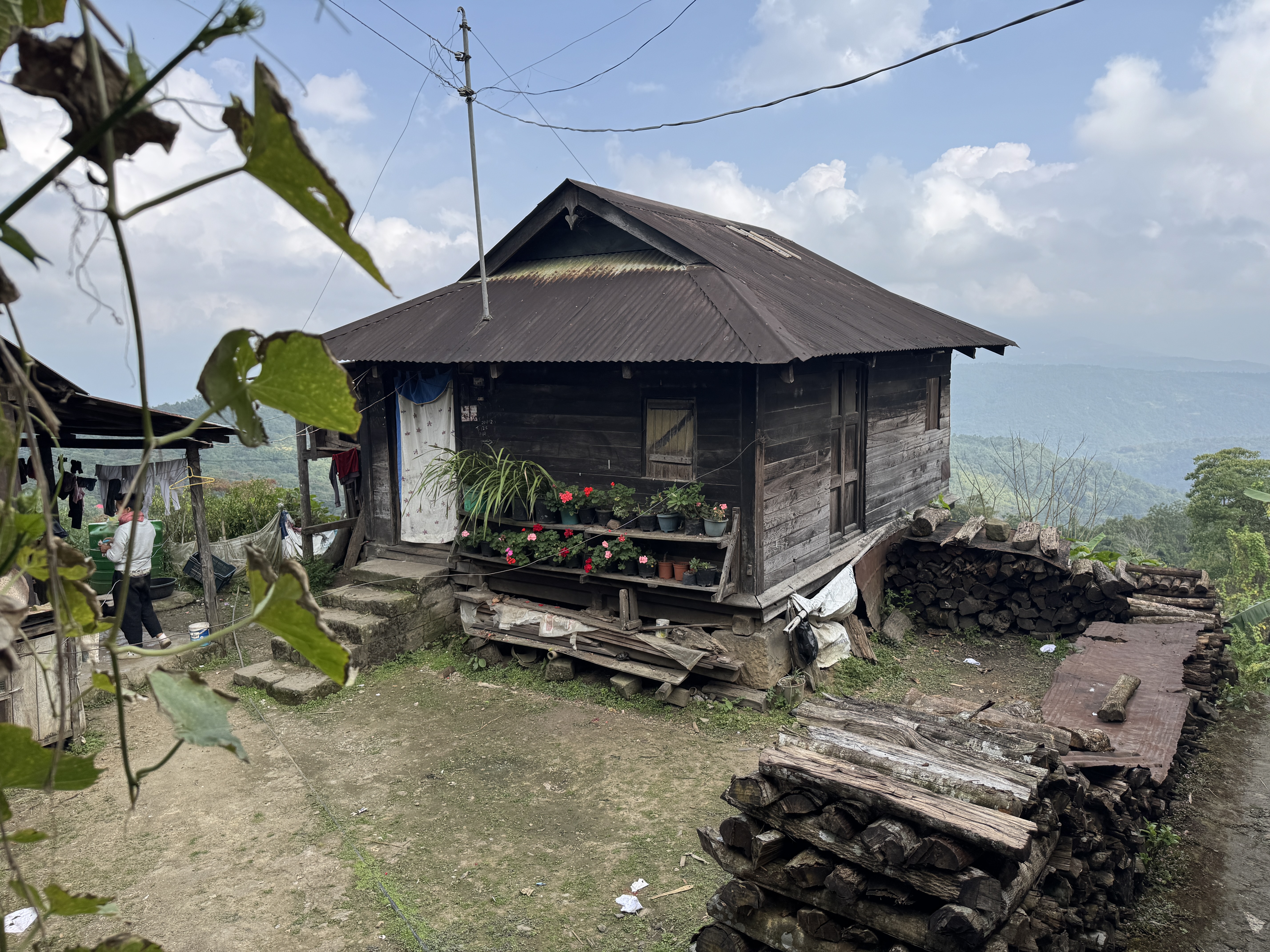
This house is at the edge of the ridgetop village. The Commonwealth War Cemetery is four miles to the north. The connection is this: we're looking at the house of General Sato, the commander of the Japanese forces in 1944. The horizontally mounted plank walls are very unusual, if not unique around here. No, it's not a museum. Somebody lives in it.
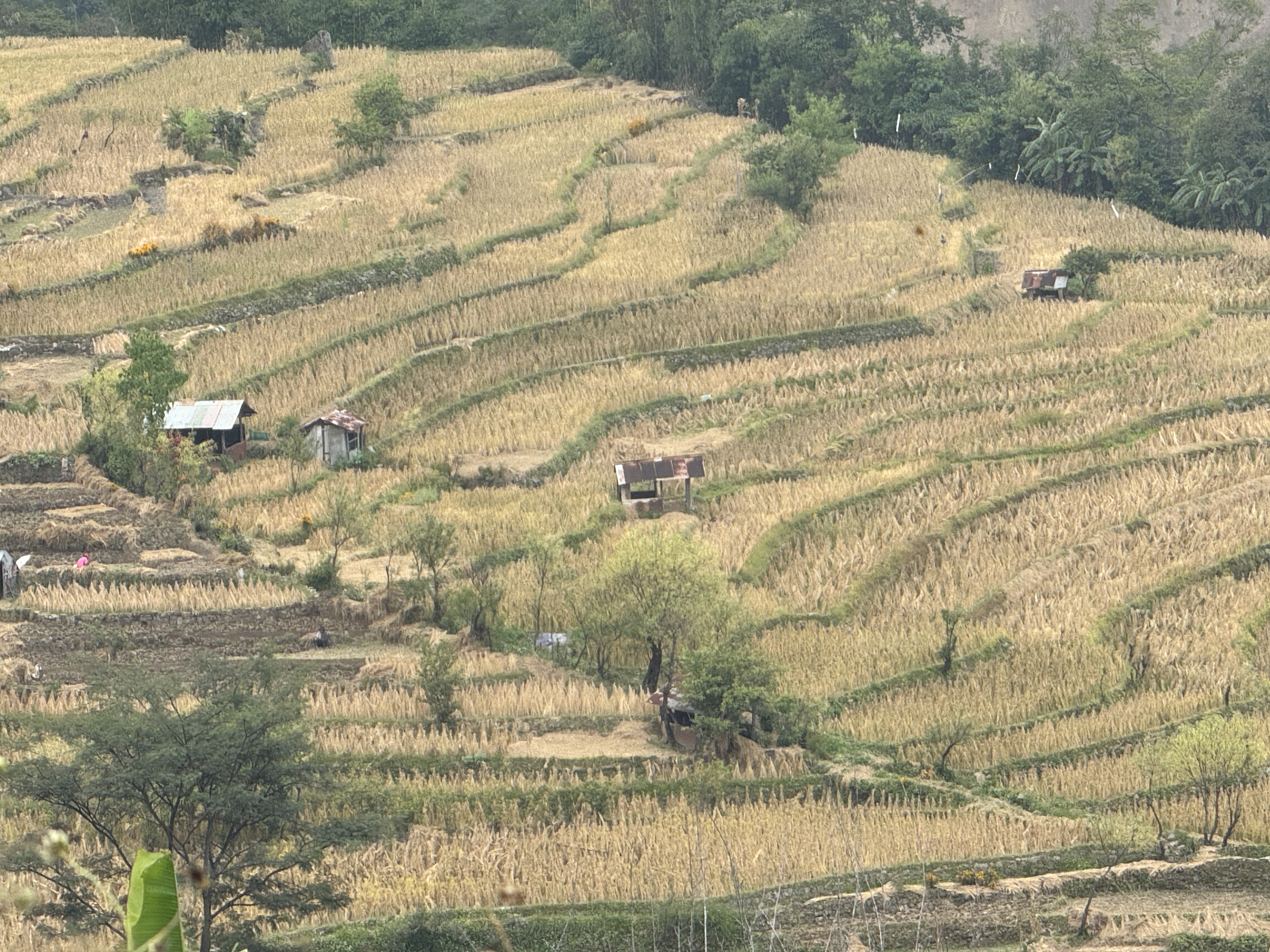
Kigwema's paddy lands.
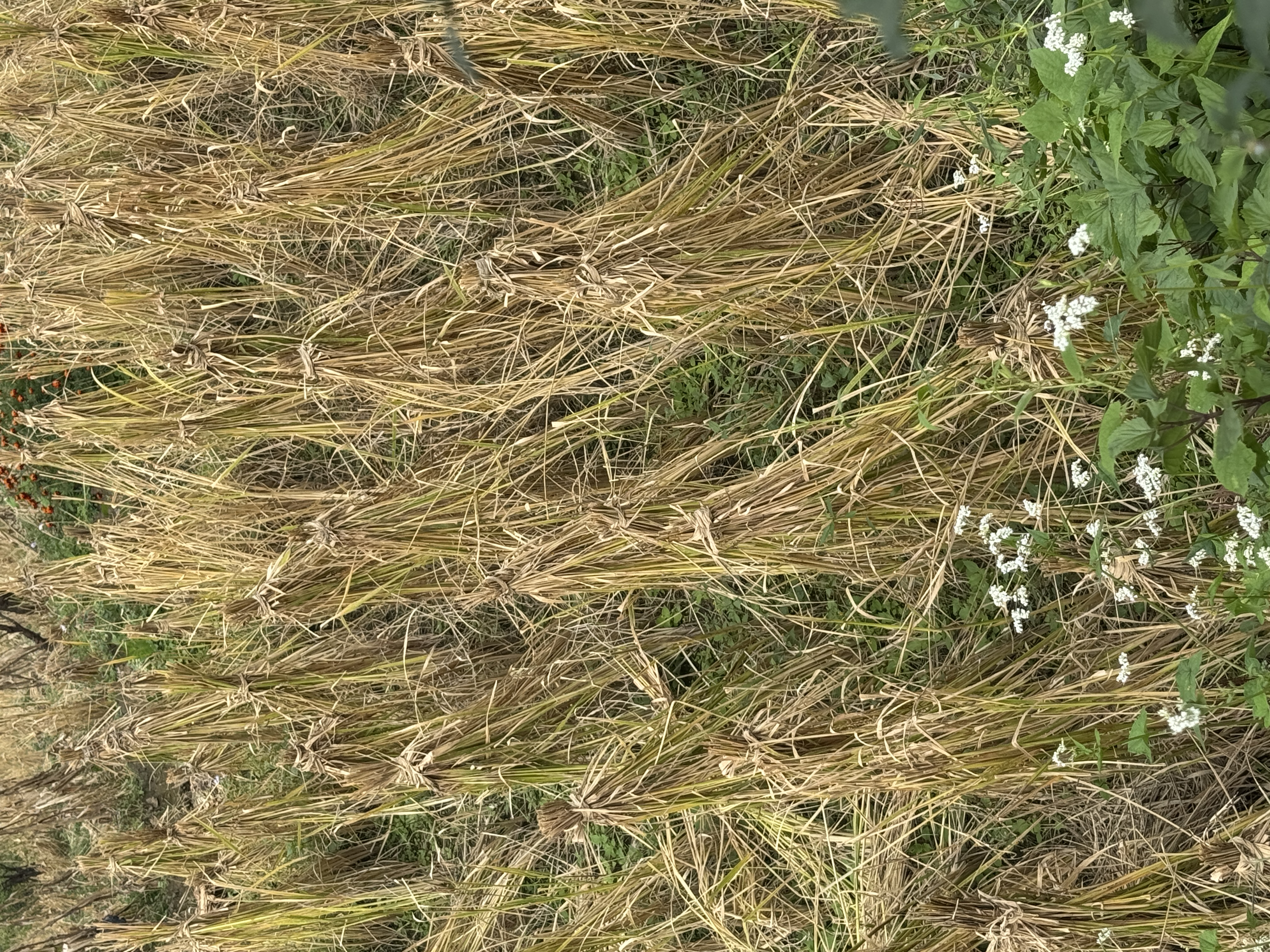
The crop is harvested manually but the straw is left standing, perhaps because there are few cows to feed. "It is genna [forbidden] to cut the straw before all the grain has been harvested" (Hutton The Angami Nagas, p. 76).
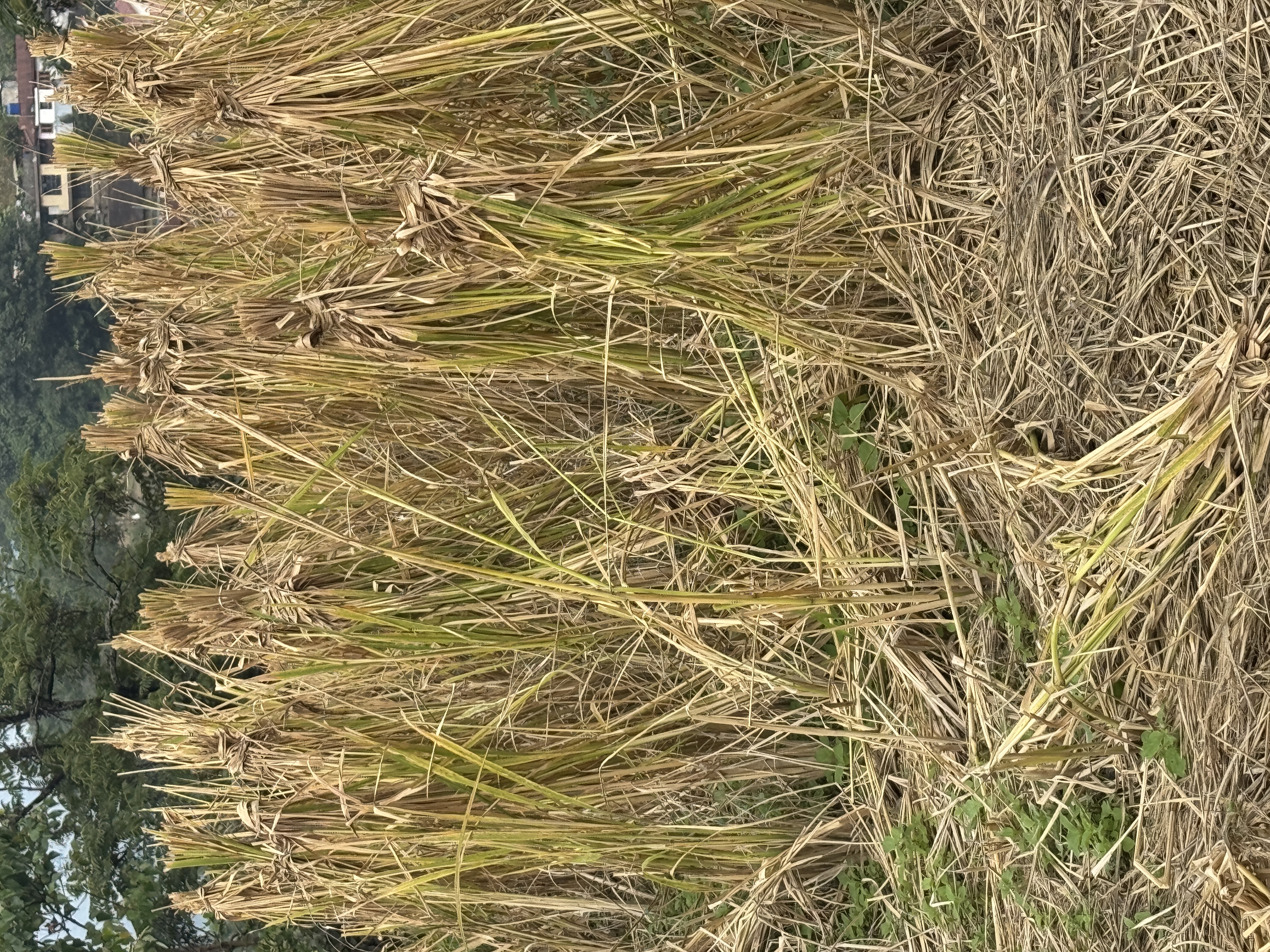
Is there anywhere else in India where rice is harvested this way?
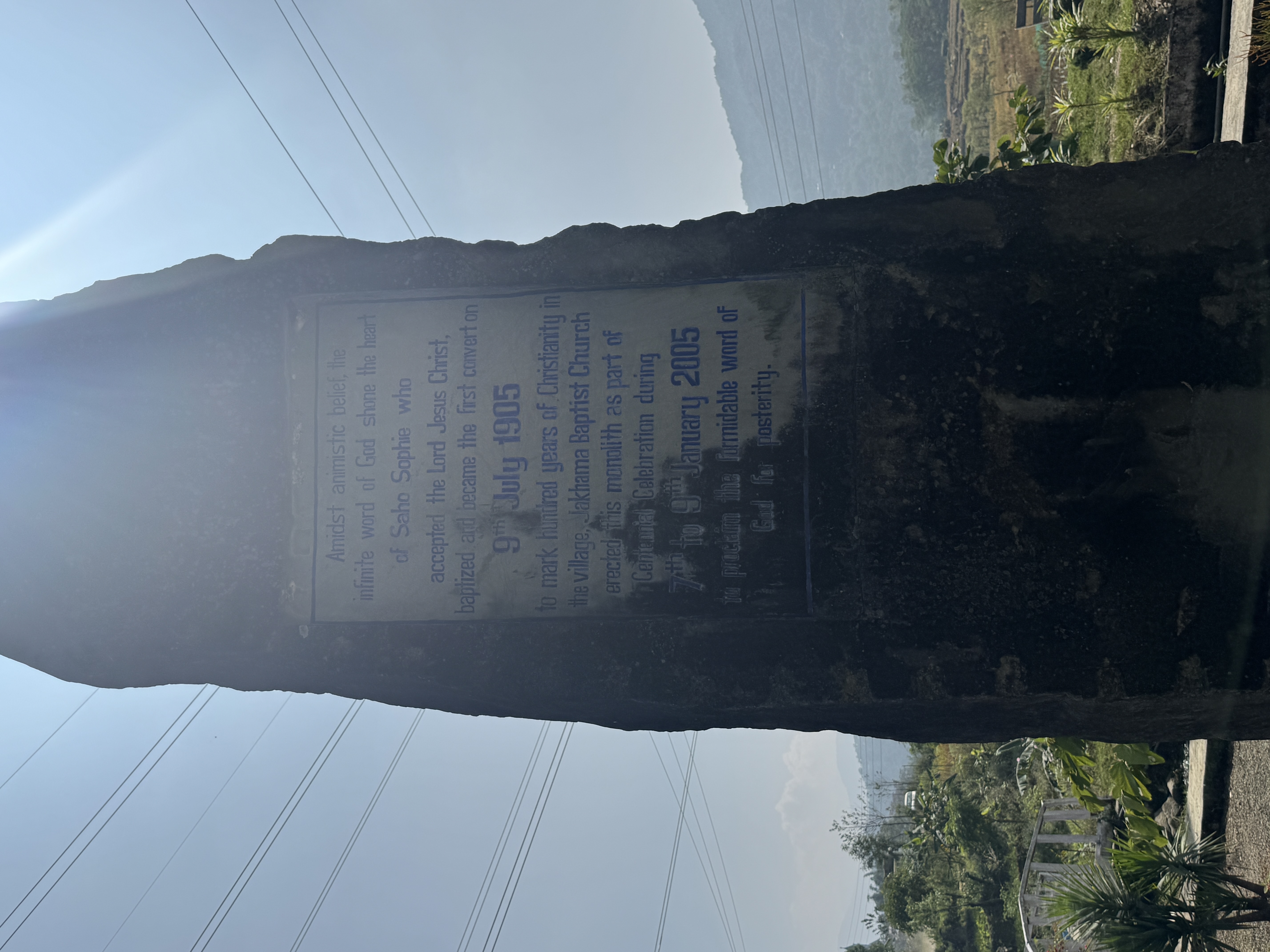
We've moved just a mile or two to Jakhama (or Zakhama), here with a monolith proclaiming the first local convert to Christianity.
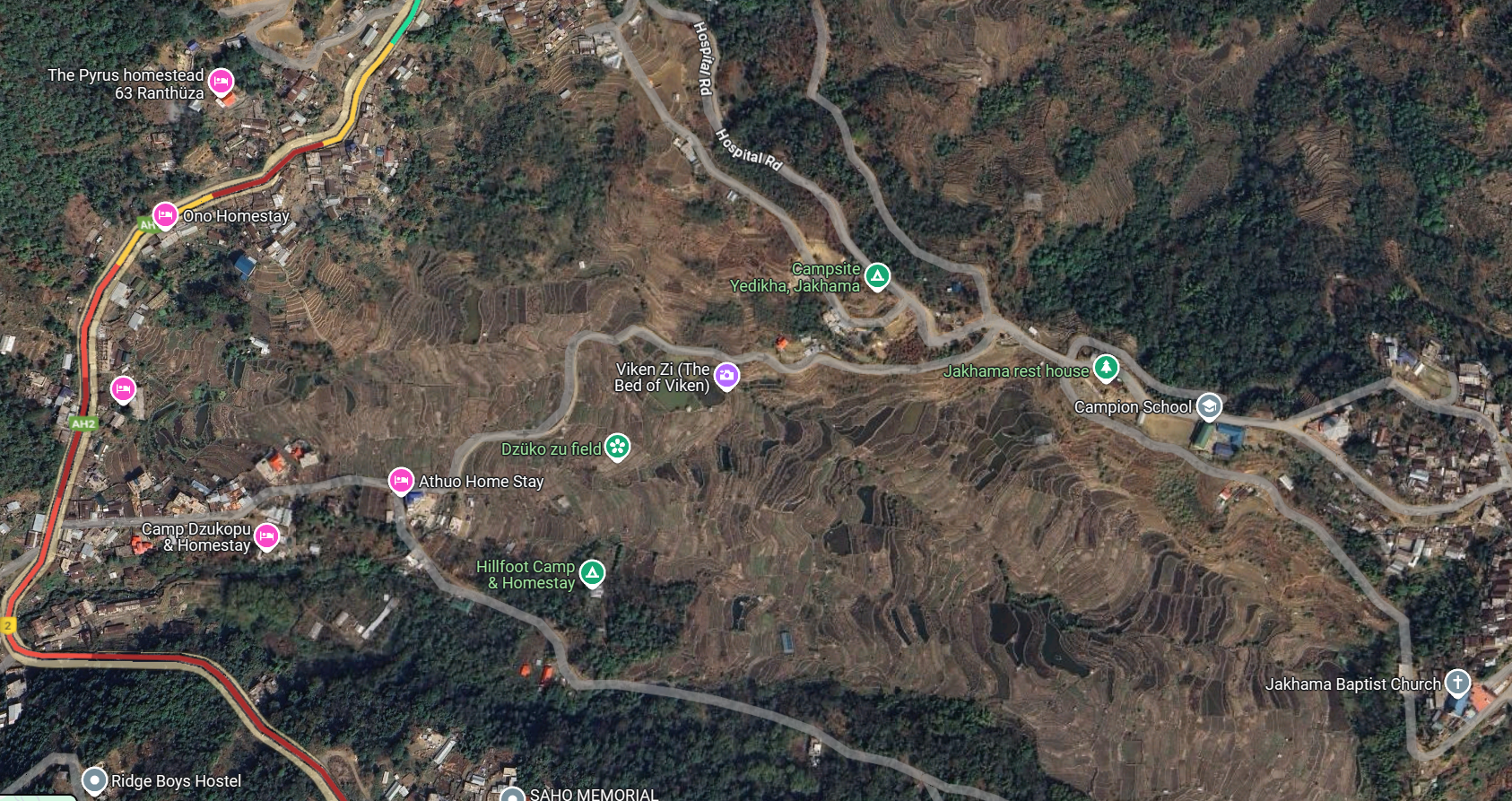
The monolith is close to the spot marked Viken Zi. At the lower right the Jakhama Baptist Church is marked.
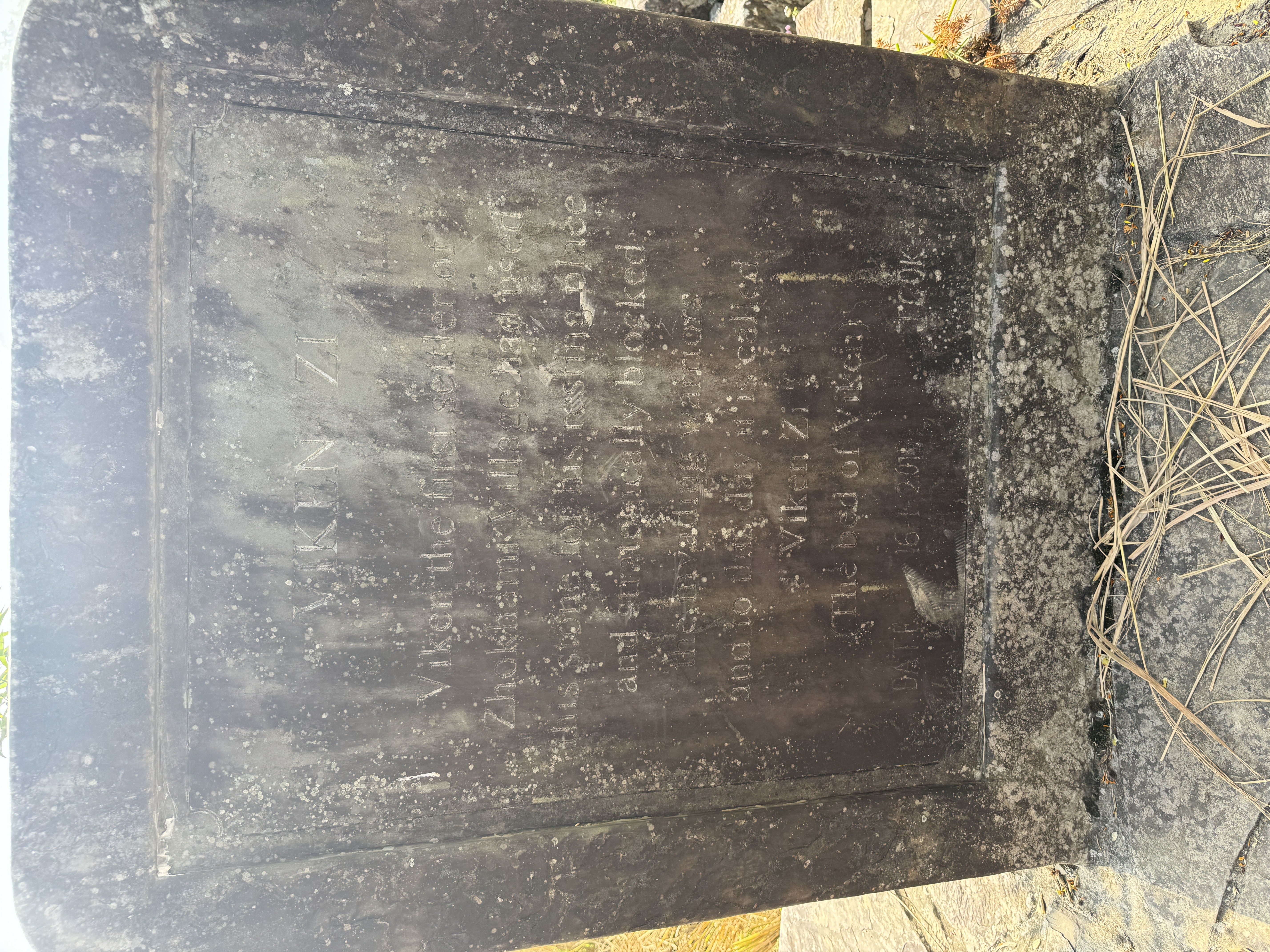
Here is the Viken Zi itself: "Viken the first settler of Zhokhami Village had used this stone for his resting place and strategically blocked the invading warriors and to this day it is called Viken Zi (The bed of Viken)."
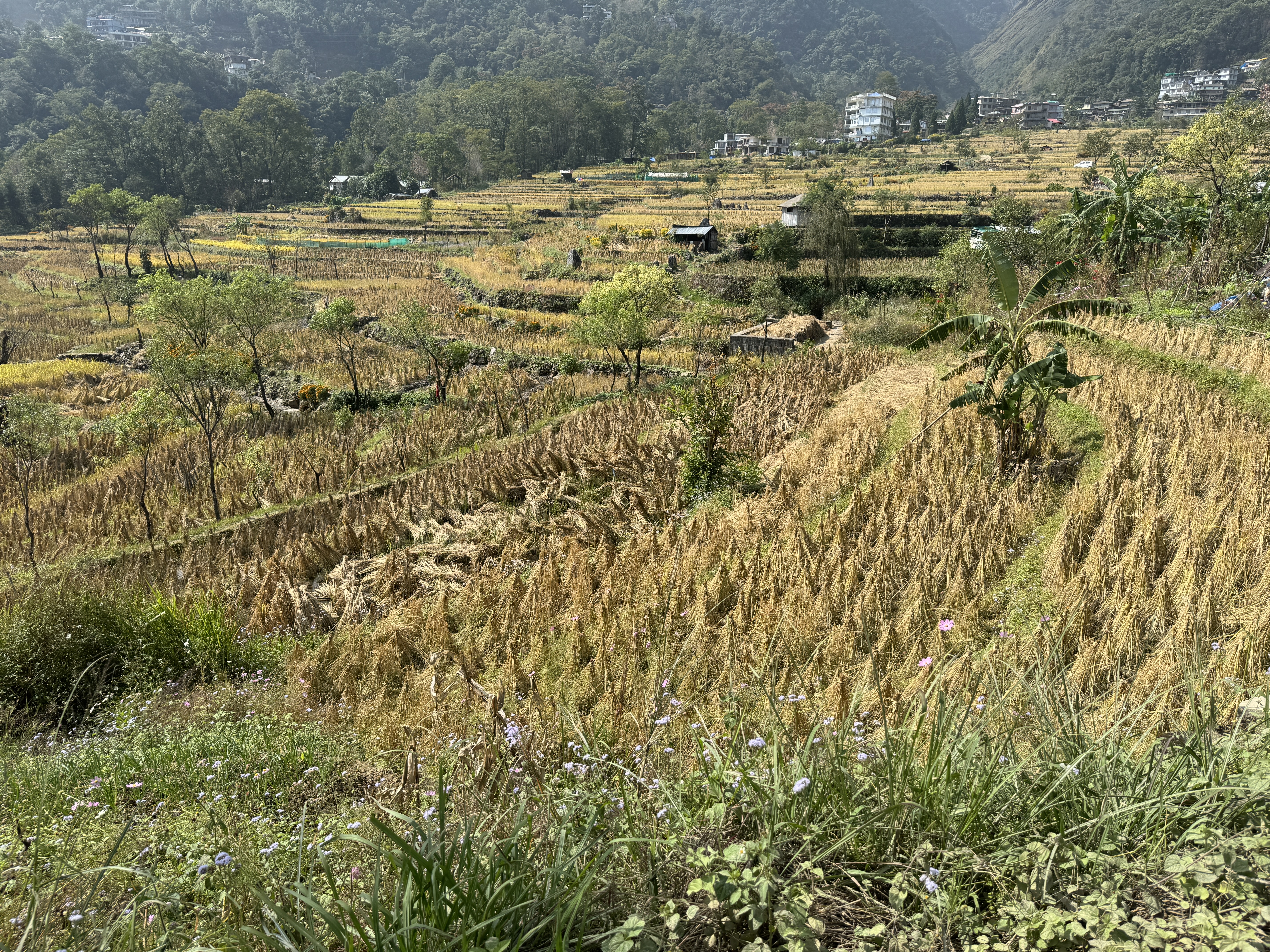
Local paddy, again harvested with the straw left standing.
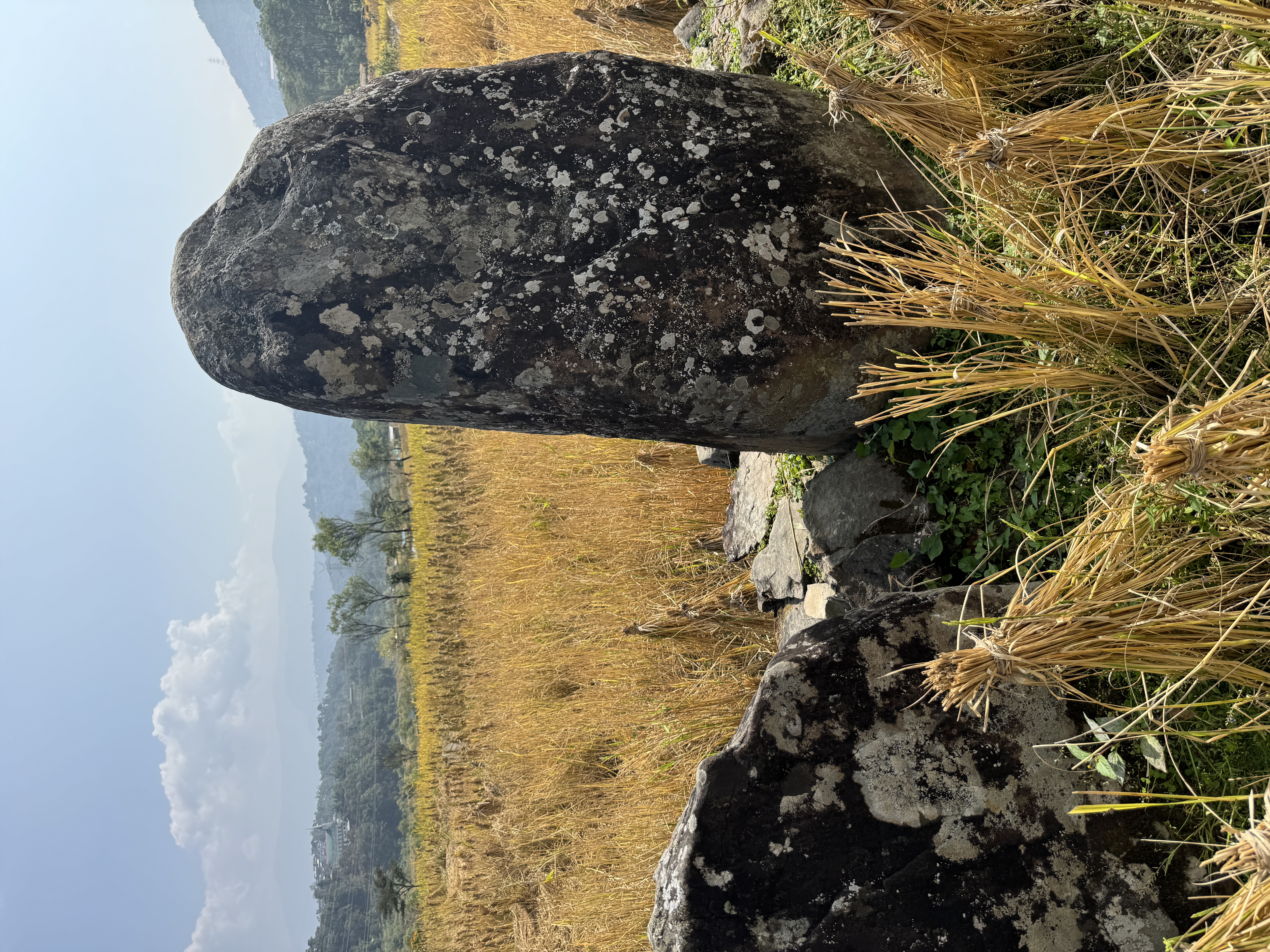
And in the sea of paddy, monoliths have been erected. "Dotted all over the village and its outskirts may also be seen numbers of monoliths, some of them of inconsiderable size, others occasionally so massive as to make the observer wonder at the labour which must have been necessary to haul the huge stones up to the village...These monoliths are erected to commemorate the personal "gennas" [ritual] performed by individuals at which they have feasted the village , and are set up either in front of the house of the giver of the feast or in some conspicuous place near one of the paths to the terraced fields" (J.H. Hutton, The Angami Nagas, p. 48). Elsewhere, Hutton wrote that the monoliths "must be regarded, therefore, as phallic symbols... though the difficulty presented by the material has prohibited the nature of the symbols from being shown by carving, with the result that the Angami himself has forgotten what the stones actually represent ("The Meaning and Method of the Erection of Monoliths by the Naga Tribes," in J. of the Royal Anthropological Institute, 1922, p. 242). The logic is this: the stones are placed to mark a successful harvest and, therefore, to celebrate fertility.
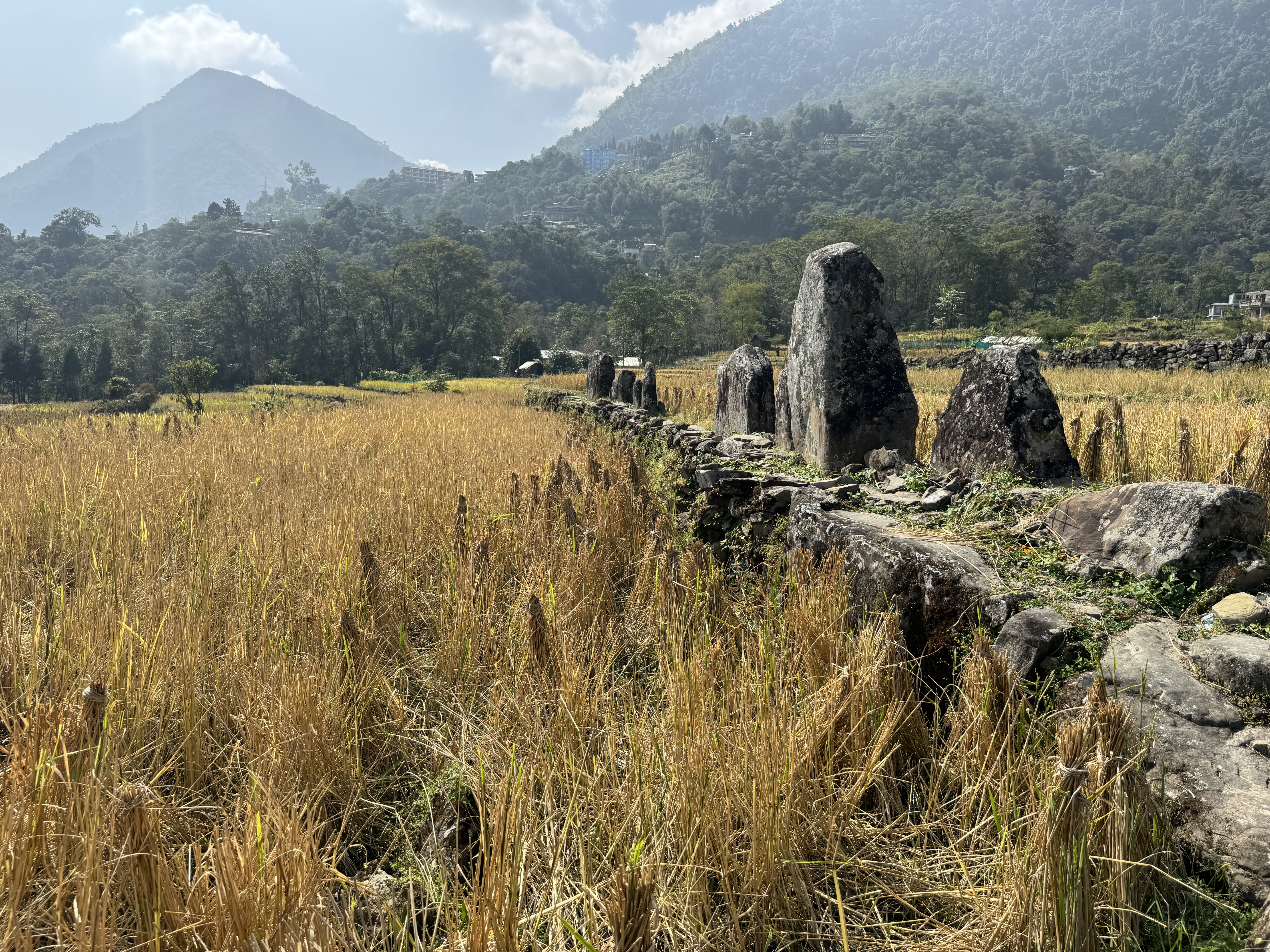
Monoliths galore. Henry Godwen-Austen wrote in the 1870s that the best monoliths he saw in the Naga Hills were around here: "they are set up by individuals during their life time to perpetuate their own memory and that of the feast given at the time; after a day or two of feasting the men assembled, all go in a body and drag in the stones, which are set up on the side of the principal road near the village or on a conspicuous knoll.... I have seen as many as twelve to fifteen in a row, but one to three is the most usual number" (Report on the Survey Operations in the Naga Hills and Munipur During the Field Season 1872-3, p. 86). But why in the middle of fields? Some people out here today say that the stones are simply boundary markers.
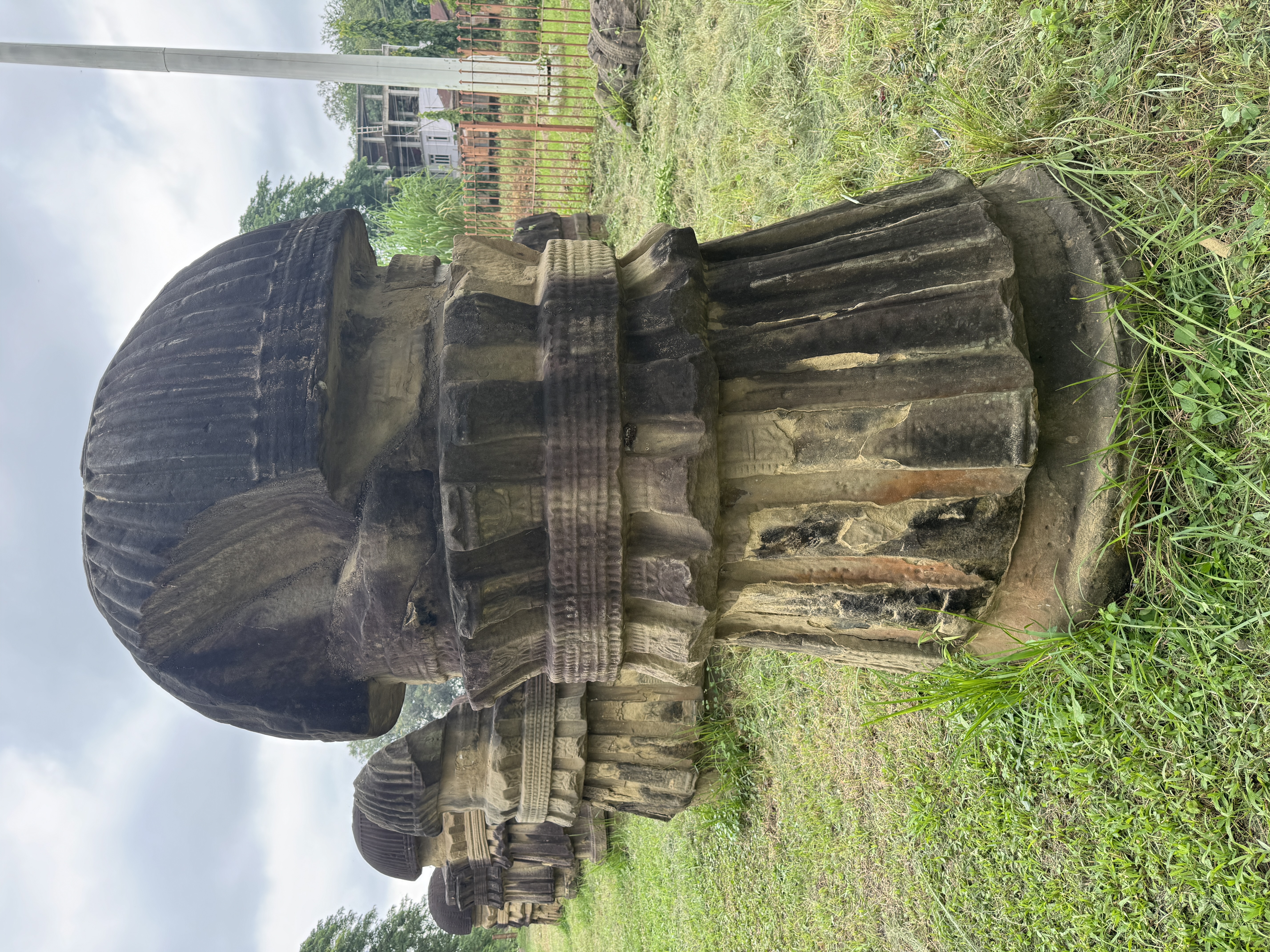
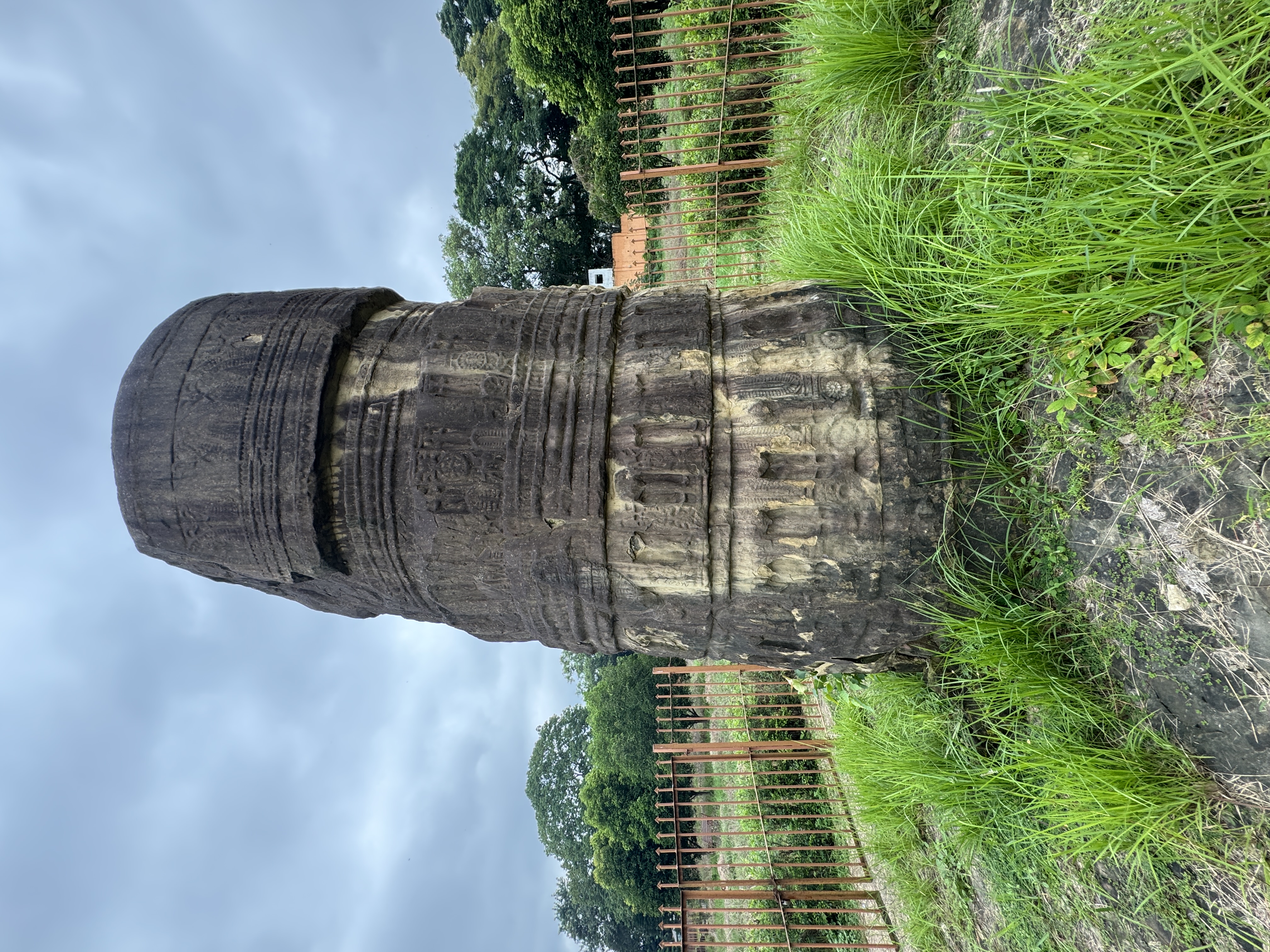
Speaking of Henry Godwin-Austen brings us back to Dimapur and the town's sole tourist attraction, the so-called Kachari ruins. (The name comes from the Kachari Dynasty, ruling here from the 10th to the 13th centuries.) Godwin-Austen came upon the stones in 1874. The countryside at that time, he wrote, was nearly uninhabited and of these stones "no native of the present place can tell one anything reliable" (Report on the Survey Operations in the Naga Hills and Manipur during the Field Season 1972-3, p. 86, quoted in Verrier Elwin, The Nagas in the Nineteenth Century, p. 530). Is there a linkage between these stones and the simpler ones in the Naga Hills? Hutton thought so. The only difference between these and the Naga monoliths was that these were "facilitated by the existence of skilled labour which a powerful prince in the piains could command" (J. H. Hutton, "The Meaning and Method of the Erection of Monoliths by the Naga Tribes," in J. of the Royal Anthropological Institute, 1922, p. 242).
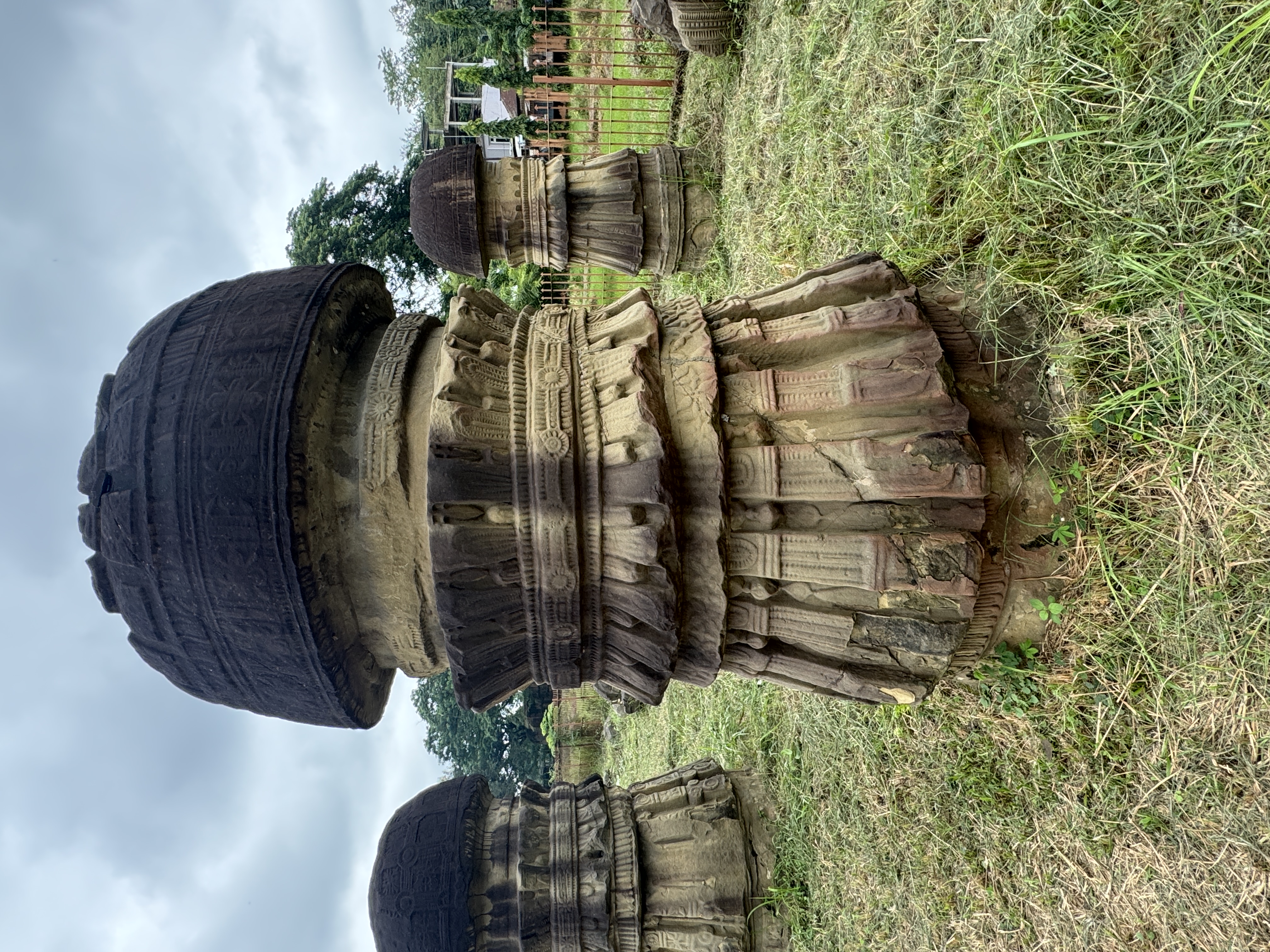
"No two are precisely alike in the minor ornamentation, but all are of one general form, large semi-circular tops with concentric foliated carving below on the shaft."
T
This is the tallest stone, but it's badly worn.
Another visitor wrote, "It is difficult to conjecture what they were brought here for, and how they were transported, as the nearest rocks from which they could have been cut, are at least ten miles away." The same visitor continued, referring to the city wall around these stones: "If the Assam-Bengal Railway passes near Dimapur as is, I believe, arranged, this interesting old city wall will probably be used as a quarry for railway purposes, and soon none of it will remain. Alas, for Vandalism!" (James Johnstone, My Experiences in Manipur and the Naga Hills, 1896, p. 9). The wall to which he refers is hard to find, if it exists.
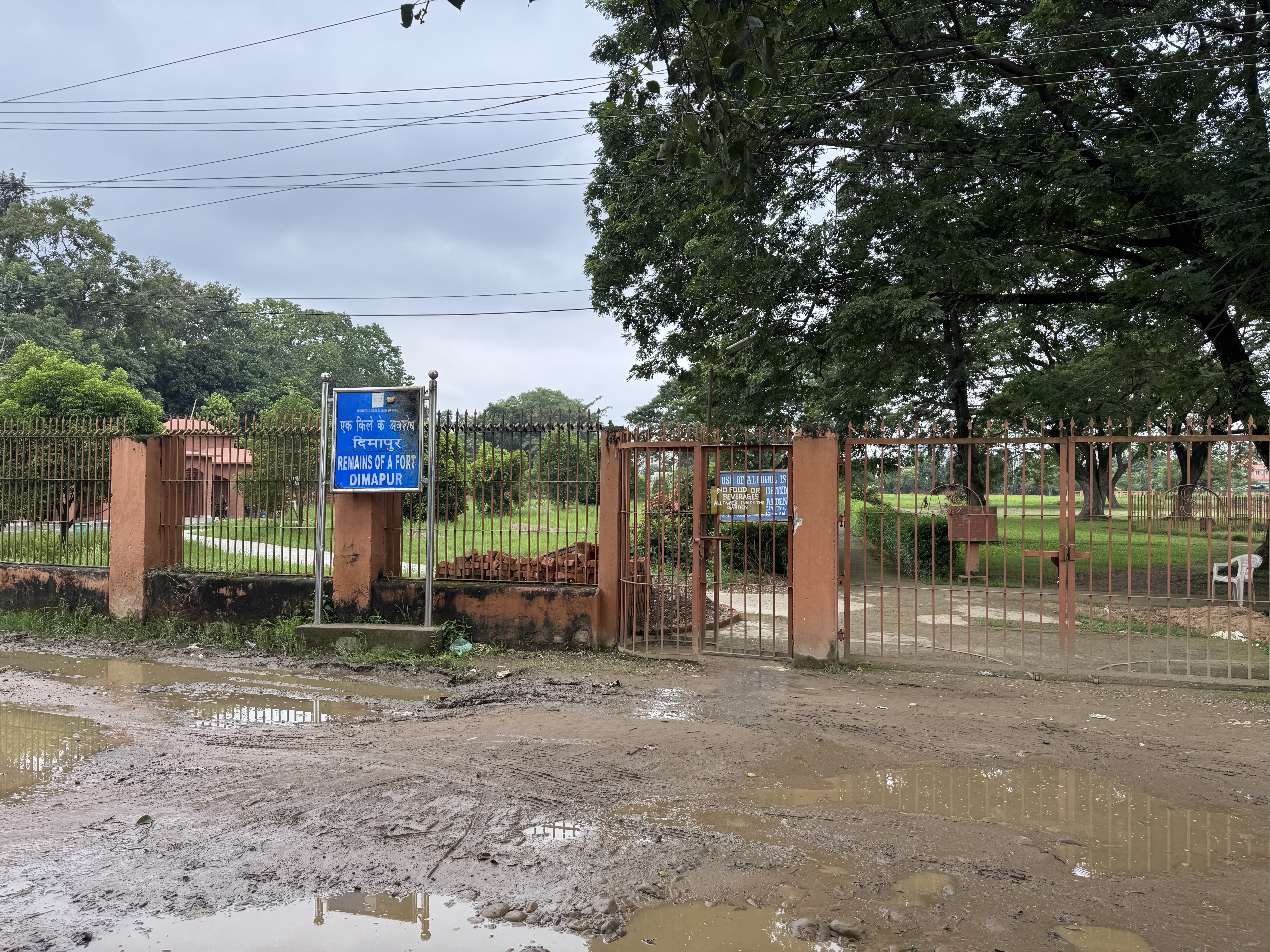
Today there's a fence.
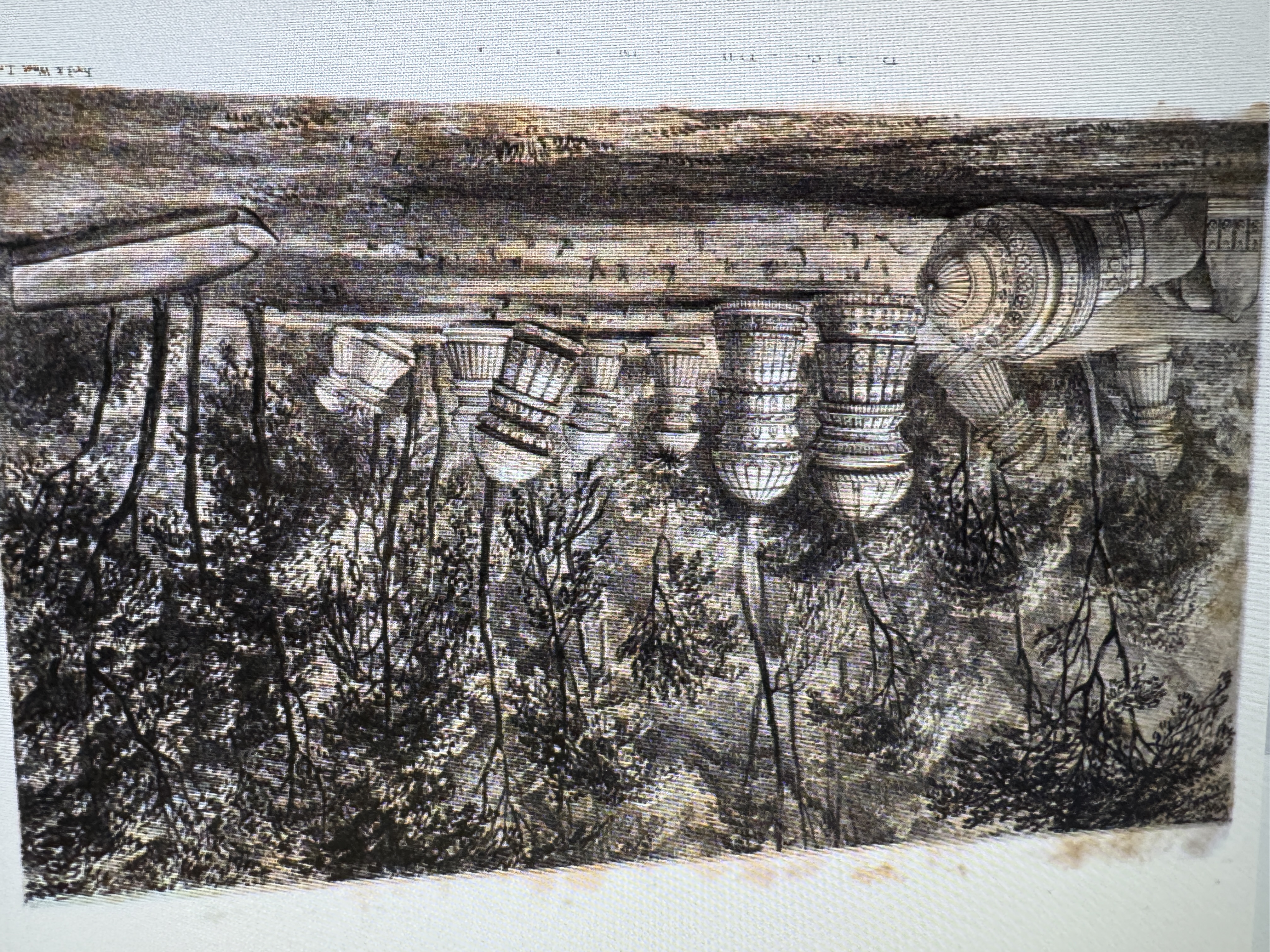
The stones appears as the exotic frontispiece from Major John Butler's, Travels and Adventures in the Province of Assam, 1855. (This was the senior Butler.)