Cauvery Temples 1. Ranganatha
<p><img src="https://wtbl.nyc3.cdn.digitaloceanspaces.com/b26f055c7f0c390d3021ae7c6d96da4c#orig=/sha256/fe7112580a36ac4a97de37d03f778eb7d3788c1da54ca21c53f6475ab64bf8ac"></p> <p>The Ranganathaswamy or Ranganatha Temple is India's largest. Built on Srirangam Island in the Cauvery River at Trichinopoly, it also boasts India's tallest gopuram. </p> <p>Let's stop sounding like a travel guide. The stone base is old, but the tower (made of bricks and mostly hollow, as in all gopurams) was completed only in 1987 with help from UNESCO. The design is formulaic, but perhaps no more so than the design of church steeples. A few bits of the formula: the doorway is twice as high as it is wide, the number of stories is odd, and the windows above the entrance are bordered by dvarapalas or guards. One more bit: each story or tier is lined with pavilions, and the number is them is the same on every story; only the pavilion size changes. </p> <p>For a photo of the gopuram in 1858, see this photograph from the British Library: <a href="https://www.bl.uk/onlinegallery/onlineex/apac/photocoll/t/largeimage57821.html">https://www.bl.uk/onlinegallery/onlineex/apac/photocoll/t/largeimage57821.html</a></p> <p><img src="https://wtbl.nyc3.cdn.digitaloceanspaces.com/88291ea1e586b2e70ba548e0cb0223c7#orig=/sha256/db9b619b7e49328cbb99c66b47f865d493553bc3a5f2c852d59160cda1878d69"></p> <p>The artist signed his work, although as artists go he had so little freedom that it might be better to call him a craftsman.</p> <p><img src="https://wtbl.nyc3.cdn.digitaloceanspaces.com/fc80297a4a4053db600a3a7244a06942#orig=/sha256/190eec936d44b78c95738c52fbd79abf9c62f5d750814742cbf7e379a9c775f6"></p> <p>It's hard to see the deities portrayed on the tower but easy to see the stone work of the gopuram base. It crams so many elements together that it might as well be the wall of a carpentry shop displaying all the shapes customers can buy.</p> <p><img src="https://wtbl.nyc3.cdn.digitaloceanspaces.com/0cd7e8ebd63755e6964b6c144d5358fb#orig=/sha256/51c70a5a8e83452b9f5df9216c4ce946c859abe389ff4efb812382623d4c655a"></p> <p>The gopuram’s setting or framing is a little rough.</p> <p><img src="https://wtbl.nyc3.cdn.digitaloceanspaces.com/21551d8779c355827553dd945c4ca0ce#orig=/sha256/e8c3ab9b0e0e169ce52a2556cd5f67c7f679e228f62291b78c20e65c16ffa86c"></p> <p>Nobody seems to object. Then again, how often do Americans notice, let alone object, to the commercial junk they see every day on the way to work? </p> <p><img src="https://wtbl.nyc3.cdn.digitaloceanspaces.com/721ce5e2b0146ad101f1f62315865650#orig=/sha256/0fd6db5e6f1d5fcccfa7112fc7d1b23c759c3c39167db23bed7b47fe28a572c5"></p> <p>The center of the passage leading through a gopuram has vestibules or recessed entrances to stairs leading up into the tower; often, as in this case, there are also tiny shrines. </p> <p>(For photos of some gopuram interiors and their stairways, see James C. Harle's <em>Temple Gateways in Southern India.</em>)</p> <p><img src="https://wtbl.nyc3.cdn.digitaloceanspaces.com/0985295fe6a75694506a7ec016aff1d3#orig=/sha256/69700f0f413c357932ccf753189086fb92229dc6ee48ea6eefc9d69fcf314a93"></p> <p>Here’s part of the south wall or <em>prakar</em>a of the fourth rectangle wrapping the central shrine, dedicated to Vishnu. (Ranganatha translates as Lord of the Place, referring to Vishnu.) You can perhaps see why the French and the British found the temple a ready-made fortress, but they also probably found it much less formidable than it is now, because Muslim invaders had repeatedly destroyed the temple long before the Europeans swept in. The British in any case moved out about 1800, and the temple was reconsecrated. </p> <p><img src="https://wtbl.nyc3.cdn.digitaloceanspaces.com/831a7b4f319c6d488967ae13280e7fbd#orig=/sha256/f2b37c03eb7ec8c3ad7b1144a0e3cb6cb1901d95c357750f82d112a1146e4ec2"></p> <p>A Krishna temple stands in the courtyard between the third and fourth walls. It’s just west of the main north-south axis and about 200 meters south of the temple’s main shrine.</p> <p><img src="https://wtbl.nyc3.cdn.digitaloceanspaces.com/0dadf509f3c2f6d9fe48f293ff5eb231#orig=/sha256/755b790c4a52800b7590168810488a76ca94dcb3c946f19945c0952294635e8c"></p> <p>The Krishna temple's shrine was locked on the day I came by, but, because it's subordinate to the central shrine to Vishnu, the temple priests have largely left it alone. Well, that was true until somebody looked at the <em>vimana</em> or tower and decided it needed paint. When I came by, a guide was showing two Swiss tourists around. I butted in nicely (I hope). I asked the guide if he thought the paint was an improvement. “No!” he shouted. I almost hugged him. </p> <p><img src="https://wtbl.nyc3.cdn.digitaloceanspaces.com/c7faacc61a85d0087016e854c3b2dcd3#orig=/sha256/65af3a1f1ff0ce1fbe7c938fe9c4c79cc487bc5d1aaf8d7987d65fc3e124a145"></p> <p>We can argue all day about whether paint improves stone. Anyway, here’s Krishna playing the flute, alias Venugopala. He evidently likes plus-sized women. Age of this temple? Somewhere between 1529 and 1726, when Srirangam came under the rule of the Madurai Nayaks, successors to the Vijayanagar kings, successors to the Chola.</p> <p><img src="https://wtbl.nyc3.cdn.digitaloceanspaces.com/a4cdedc6fd1dac4bc5d0cfee606c1606#orig=/sha256/9e3232c8791260e6803bc90067bb0defdda0793112b34e02f9a568affdb4bc74"></p> <p>Is it possible that she doesn’t notice his hand? Oh, I see, she’s just being coy.</p> <p><img src="https://wtbl.nyc3.cdn.digitaloceanspaces.com/1debf98e67a1c07992dfdbff45bcb694#orig=/sha256/5e1af7a6a0d49d9d67c50f1d1e6730e64b3b41762ad561ebf3769696c1d3db56"></p> <p>Judging from <em>her</em> hand, I’d say she’s encouraging him.</p> <p><img src="https://wtbl.nyc3.cdn.digitaloceanspaces.com/60d99d26d390bf3bdb0ee68f36de961c#orig=/sha256/09da3bec642c7807aff45558f84b781c2342cd91d8938edbb483aad1f97b960b"></p> <p>We’re up on a nearby roof; the main axis of the temple runs under the slightly higher roof just to our right, then through the gopuram and on to the low, gold-capped main shrine, which is (and has long been) open only to Hindus. The gilding goes back to 1251 and was placed in imitation of the gilding at Chidambaram. The gopuram on the right is the Vellai or Vellayi gopuram; it’s on the east side of the same wall whose south side we saw a while back, and it’s painted white (vellai in Tamil) in memory of a woman (named Vellayi) who is said to have sacrificed herself to save a temple treasure from Muslim attackers.</p> <p>James Fergusson, the pioneering British student of these places, wrote that the shrine "except that its dome is gilt has nothing to distinguish it from an ordinary village temple." Did Fergisson manage to peek inside? I'm betting not. If he had, he would have seen a golden image of Vishnu six meters long and reclining in comfort under the protective mantle of Shesha, the multi-headed serpent. (See Fergusson's <em>History of Indian and Eastern Architecture</em>, 1910 ed., p. 368.)</p> <p><img src="https://wtbl.nyc3.cdn.digitaloceanspaces.com/bc0d5be7118322ed88c965256b8370b1#orig=/sha256/0c8992f2bc2d596da05bb941af8516d45e69d7a66ca2340daed1f0cf70cc5972"></p> <p>A <em>dhvajastambha</em> or flagstaff sticks through a recently built roof over the main axis. On a scale of 1 to 10, the craftsmanship of the temple ranges from, well, 1 to 10.</p> <p><img src="https://wtbl.nyc3.cdn.digitaloceanspaces.com/443979cb34a78622b19c38554e0aaba9#orig=/sha256/236b3ded7df0554a23bf959981f743fd8ebe9d81e33c399e071cc51ce7b8fc51"></p> <p>Here’s that white gopuram. Wish I knew why this courtyard wasn’t paved. And why the palms had been decapitated.</p> <p><img src="https://wtbl.nyc3.cdn.digitaloceanspaces.com/4061c8c7f3885c2164ec529dff2aeaff#orig=/sha256/6b2014471fcdb1c0df3baa60f9d5c4f630c952fa82dbb26005628c0439b4231c"></p> <p>The same sandy courtyard is flanked by a “thousand-pillared” hall. Fergusson, who liked to count, came up with a total of 953. Nice elephant, though. Nicer than the temple’s live elephant, which deserves better than to be treated like a slave.</p> <p>A finely drawn plan and cross-section of this hall appears in the very scarce <em>India: Photographs and Drawings of Historical Buildings; 100 Plates Reproduced by W. Griggs from the Collection in the Late Office of Curator of Ancient Monuments in India,</em> London, 1896. Don't run out to get a copy unless your willing to spend something over $9,000. I got my copy through interlibrary loan.</p> <p><img src="https://wtbl.nyc3.cdn.digitaloceanspaces.com/2c863fb4c062e4acc1e7779793f31d74#orig=/sha256/aaae1c92fdbca3698c3d81bcefbff8fd558a2cad2433c980c39c590a75b6846b"></p> <p>The other side of the same courtyard has the smaller Seshagiri-Rao pillared hall. The monolithic pillars are typical of the Vijayanagara Empire, which dates them more or less to 1500. I can’t figure out why the figure is smiling, since he's under a horse rearing over a tiger. He must know something I don't. (You don't think it looks like a tiger? Check the fine drawing in Griggs, cited in the previous picture.)</p> <p> </p> <p><img src="https://wtbl.nyc3.cdn.digitaloceanspaces.com/ab9414fa50612a1a84465aabbef724f4#orig=/sha256/6ecd2729d3fbe7c3526a62d71cebe55b5aac00b7623d6f1a03462abeb5a61499"></p> <p>The walls-within-walls layout is especially frustrating if you have trouble walking barefoot. Anyway, that’s another subsidiary temple off to the right. On the left, the “tuning fork” is a <em>namam.</em> There are two forms of it, identifying two sects of Vishnu worshippers. This form identifies the Tengalai. The other sect, the Vadakalai, is represented by a U-shaped <em>namam </em>without the prong.</p> <p><img src="https://wtbl.nyc3.cdn.digitaloceanspaces.com/7b50b48bb9d853d27441a6b27f945435#orig=/sha256/278e512cbf9b9f6915b609529d7e1123c7ee13d16ac59a1ca3e2261bfc2f25b2"></p> <p>Another subsidiary temple, locked tight.</p> <p><img src="https://wtbl.nyc3.cdn.digitaloceanspaces.com/86aaa73d637480b155c21bdf035d1bd7#orig=/sha256/cbf7404cb8a4f6975a8e72bfa7a0e8ef6256694c4f3777d898957bc30bc85a72"></p> <p>And you think Americans are fearful.</p> <p>.<img src="https://wtbl.nyc3.cdn.digitaloceanspaces.com/36ddb772908806a95956759137ab8c27#orig=/sha256/e0e80d5b15bb6a7e31e4577fe5a7b4d05f427a6ba1832407ed79462724d28632"></p> <p>No matter, the exteriors of these temples offer more to see than the interiors, where the walls of the shrine (or sanctum or garbhagriya or "womb house") are typically blank. Too bad that the paint-brigade has been busy. Maybe a senior priest visited Disneyland.</p> <p><img src="https://wtbl.nyc3.cdn.digitaloceanspaces.com/6b0fbd37f692e35cee4207820a32cec7#orig=/sha256/c903d9c8f2ac7e51415046e977e753e30a57c4be927146697c08a0c3c72cac36"></p> <p>Ah, a mithuna, a reminder on the temple's wall of what Stella Kramrisch calls “reintegration.” So easy to forget, so hard to remember.</p> <p><img src="https://wtbl.nyc3.cdn.digitaloceanspaces.com/92595b6c4142b18a0b8c4dbdd29949be#orig=/sha256/6ab8b321b1d6bc1b41dbab4646558e07ca080dda5d17ba3410de44a5ad4533b1"></p> <p>Scout around, and you'll find places within the temple walls that are pretty crude.</p> <p><img src="https://wtbl.nyc3.cdn.digitaloceanspaces.com/c1aa2fac7124861796b76a3294b8dea3#orig=/sha256/89e91db132cdb8423ea0cb982441fe10c388060e0ee003f0d7a6216b6594ae59"></p> <p>Tour operators aren’t likely to ask if they can use this photo in their next brochure.</p> <p><img src="https://wtbl.nyc3.cdn.digitaloceanspaces.com/7eaad79fa1f9a07064717e87f74bc0d4#orig=/sha256/5698cf4af0a8bb501f18de5aa8c4c89204ba5d496012b70cc4d594b6133956e7"></p> <p>The best time to visit is early in the day. I mean early early: people are already beginning to drift in here at the north entrance.</p> <p><img src="https://wtbl.nyc3.cdn.digitaloceanspaces.com/81070fa8a7696b38f0bb1da861ee1237#orig=/sha256/ff80b991070b0beeaf72354a13b3911e8ecee21221f2fcba7d5f6f68c6547f15"></p> <p>Almost deserted.</p> <p><img src="https://wtbl.nyc3.cdn.digitaloceanspaces.com/cf65030acd115d3e4e0b9813bf9c85be#orig=/_sha256/9204f685c054390bce8b4db974a1be34a099ec90a695e21dc73d896eafe581ad"></p> <p>Even earlier, an elephant walks to the doorway of the central shrine. Nobody has to to tell you to keep your distance. You’re barefoot, after all. Come to think of it, though elephants walk almost silently, this one did have a necklace of bells. sounding gently musical. </p>
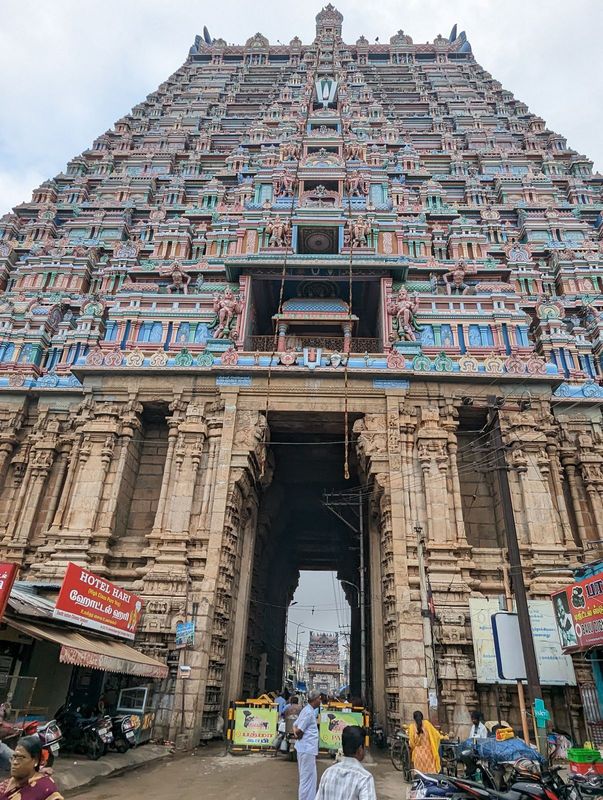
The Ranganathaswamy or Ranganatha Temple is India's largest. Built on Srirangam Island in the Cauvery River at Trichinopoly, it also boasts India's tallest gopuram.
Let's stop sounding like a travel guide. The stone base is old, but the tower (made of bricks and mostly hollow, as in all gopurams) was built with financial help from UNESCO and completed only in 1987, The design is formulaic, but perhaps no more so than the design of church steeples. A few bits of that formula: the doorway is twice as high as it is wide, the number of stories is odd, and the windows above the entrance are bordered by dvarapalas or guards. One more bit: each story or tier is lined with pavilions, and the number on them is the same on every story; only the pavilion size changes.
For a photo of the gopuram in 1858, see this photograph from the British Library: https://www.bl.uk/onlinegallery/onlineex/apac/photocoll/t/largeimage57821.html
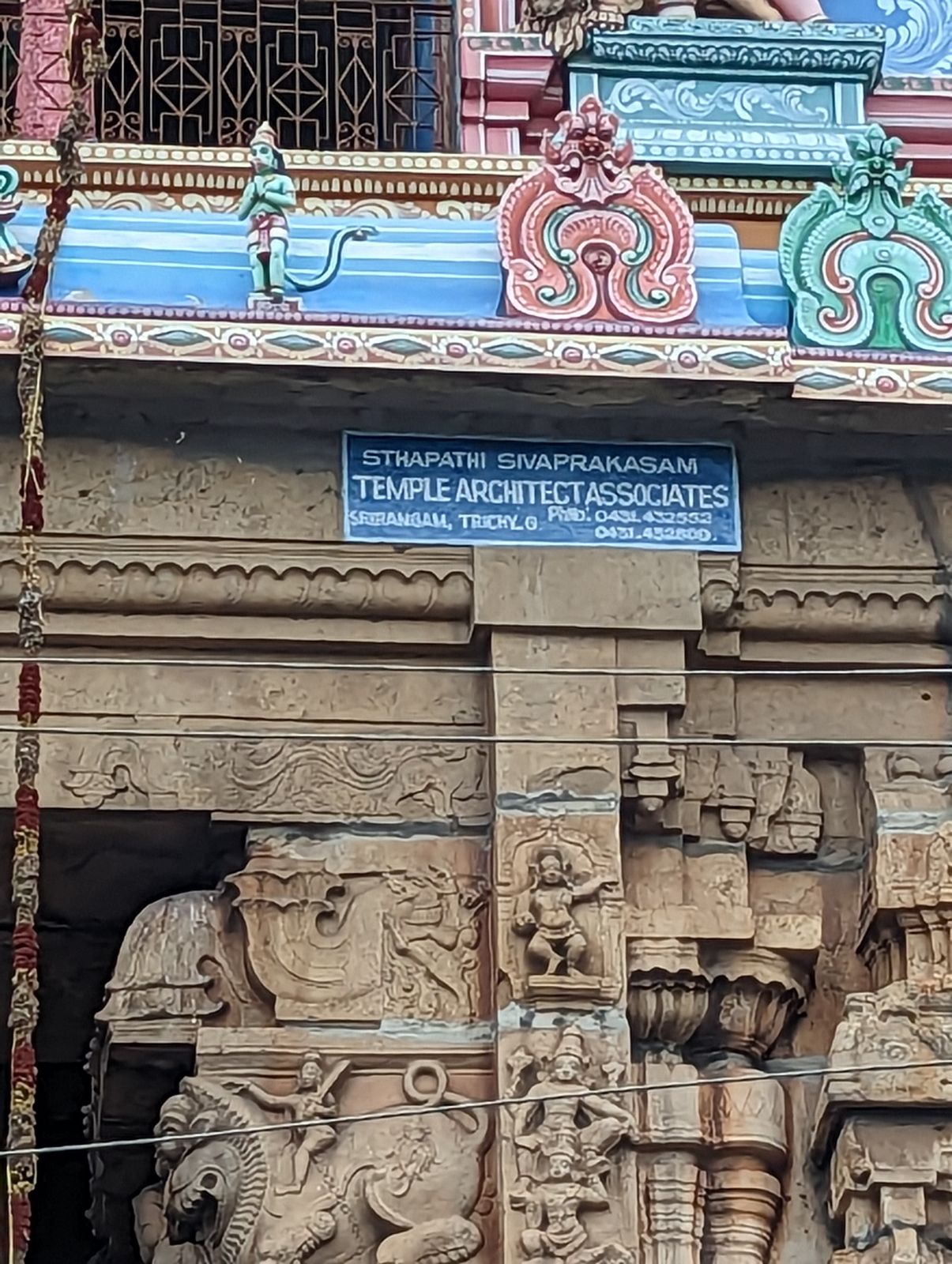
The artist signed his work, although as artists go he had so little freedom that it might be better to call him a craftsman.
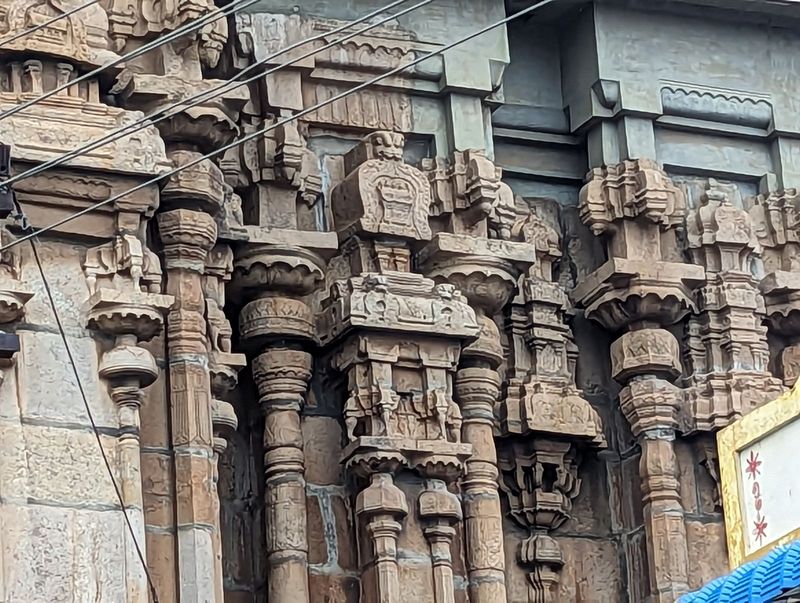
It's hard to see the deities portrayed on the tower but easy to see the stone work of the gopuram base. It crams so many elements together that it might as well be the wall of a carpentry shop displaying all the shapes customers can buy.
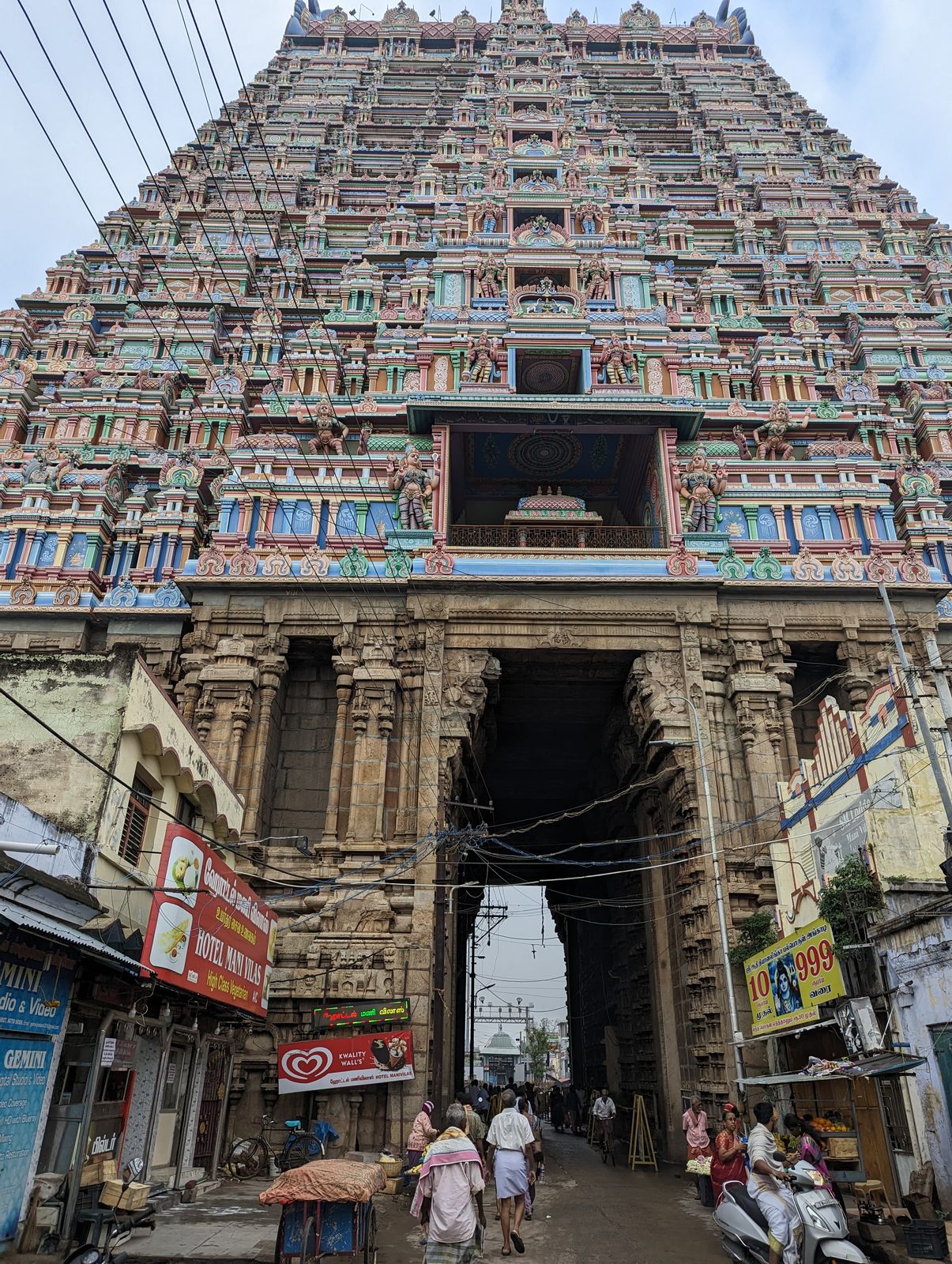
The gopuram's setting or framing is a little rough.
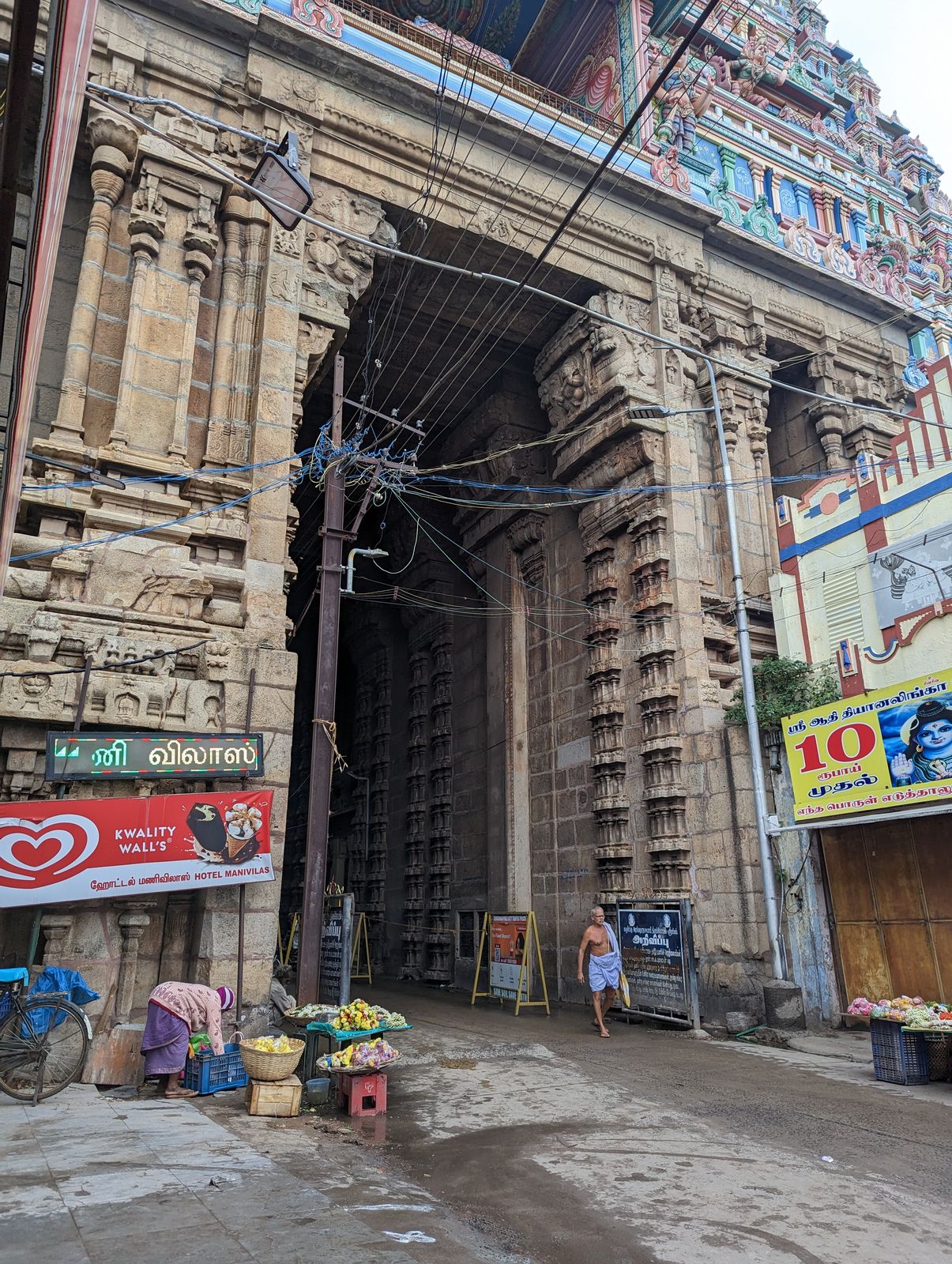
Nobody seems to object. Then again, how often do Americans object to the commercial junk they see every day?
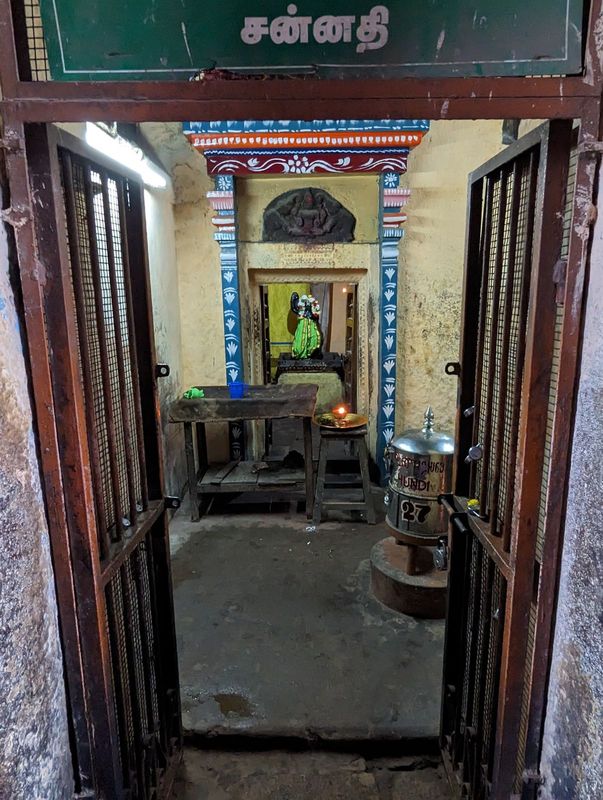
The center of the passage leading through a gopuram has vestibules or recessed entrances to stairs leading up into the tower; often, as in this case, there are also tiny shrines.
(For photos of some gopuram interiors and their stairways, see James C. Harle's Temple Gateways in Southern India.)
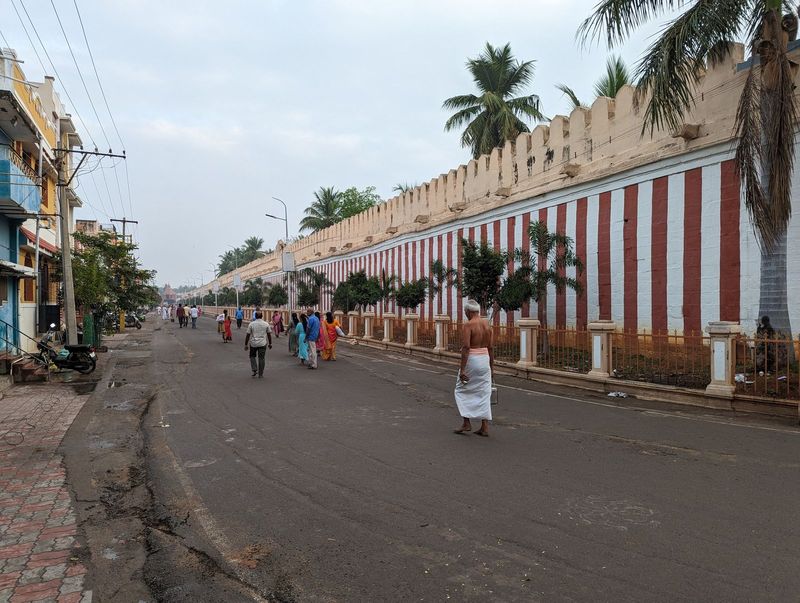
Here's part of the south wall or prakara of the fourth rectangle wrapping the central shrine, which is dedicated to Vishnu. (The temple's name, Ranganatha, translates as Lord of the Place, referring to Vishnu.) You can perhaps see why the French and the British found the temple a ready-made fortress, but they also probably found it much less formidable than it is now, because Muslim armies had repeatedly destroyed the temple long before the Europeans arrived. The British in any case moved out about 1800, and the temple was reconsecrated.
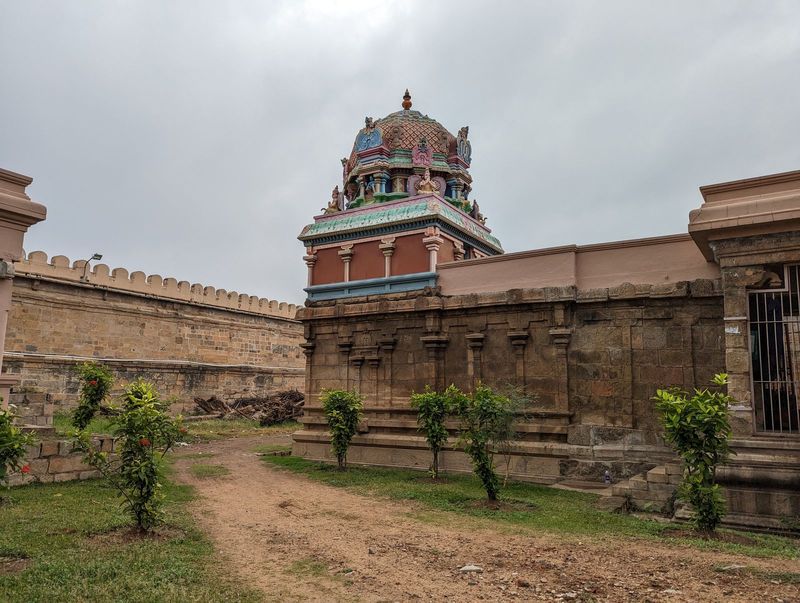
A Krishna temple stands in the courtyard between the third and fourth walls. It's just west of the main north-south axis and about 200 meters south of the temple's main shrine.
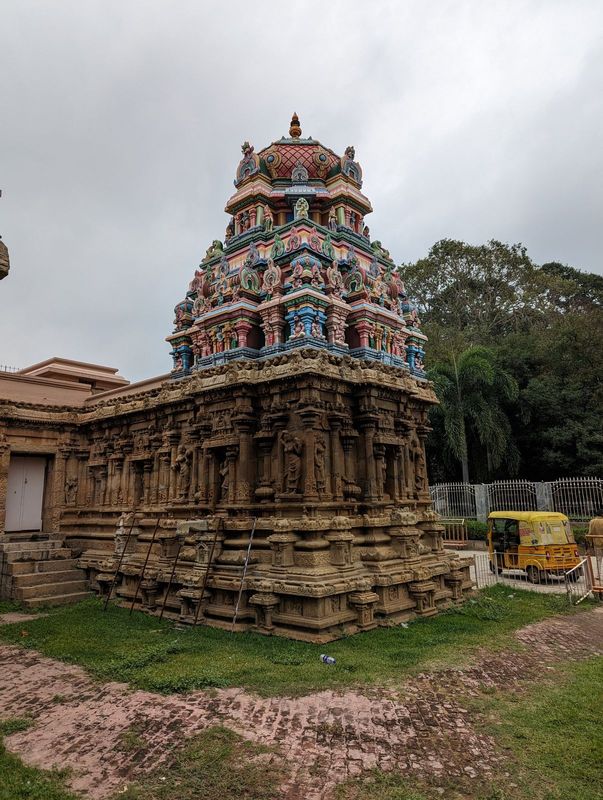
The Krishna temple's shrine was locked on the day I came by, but, because it's subordinate to the central shrine, the temple priests have largely left it alone. Well, that was true until somebody looked at the tower of the shrine and decided it needed paint. When I came by, a guide was showing two Swiss tourists around. I butted in nicely and asked the guide if he thought the paint was an improvement. "No!" he shouted. I almost hugged him.
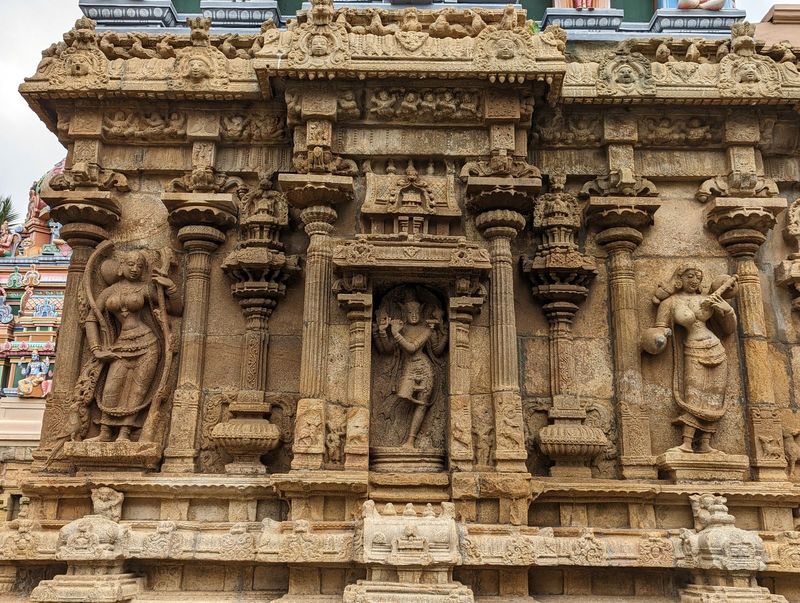
We can argue all day about whether paint improves stone. Anyway, here's Venugopala, which is to say Krishna playing his flute. He evidently likes plus-sized women. Age of this temple? Somewhere between 1529 and 1726, when Srirangam came under the rule of the Madurai Nayaks, successors to the Vijayanagar kings, successors to the Cholas who established the temple. There's a lot of dynastic history here, more than I want to deal with.
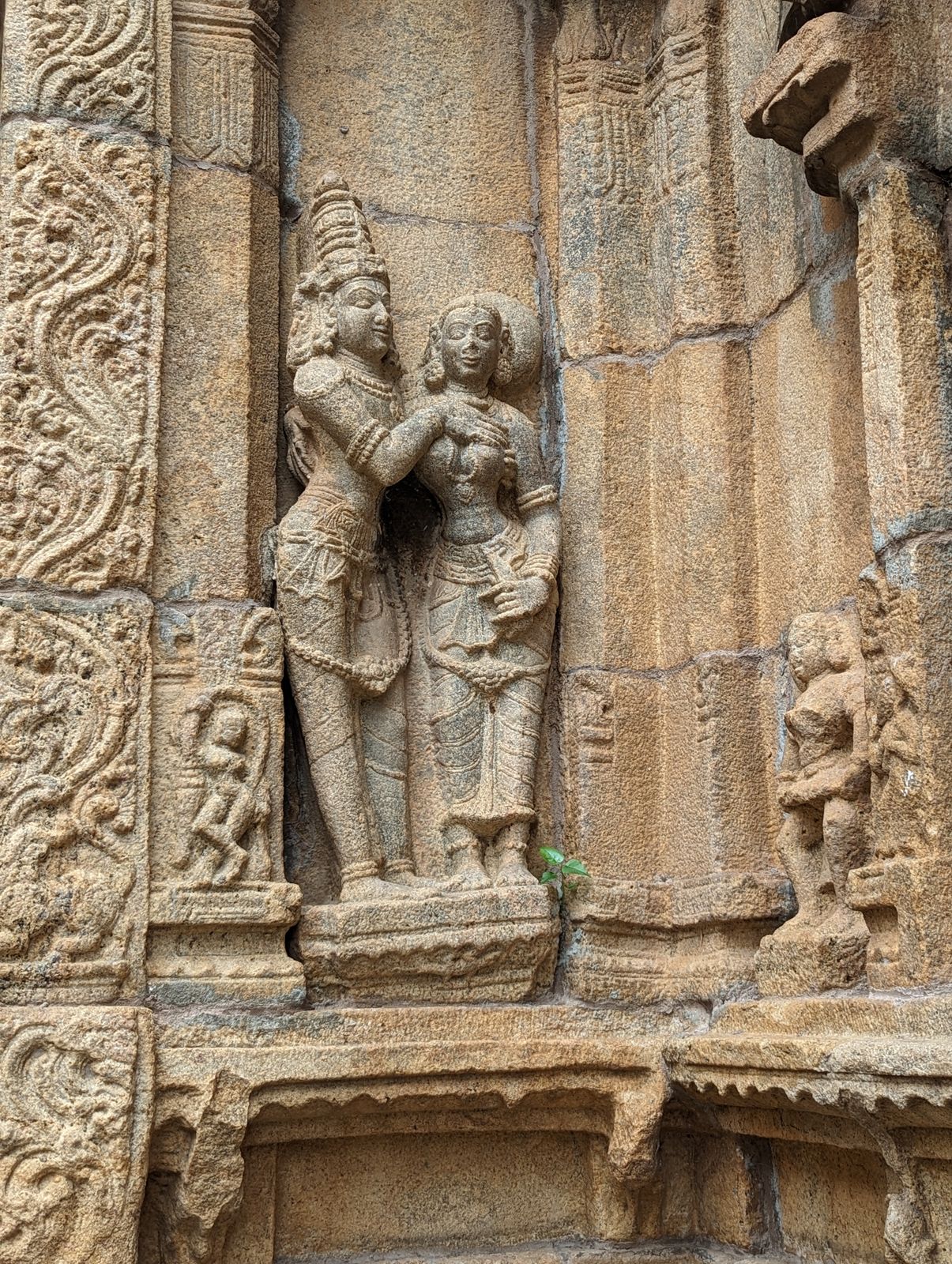
Is it possible that she doesn't notice his hand? Oh, I see, she's just being coy.
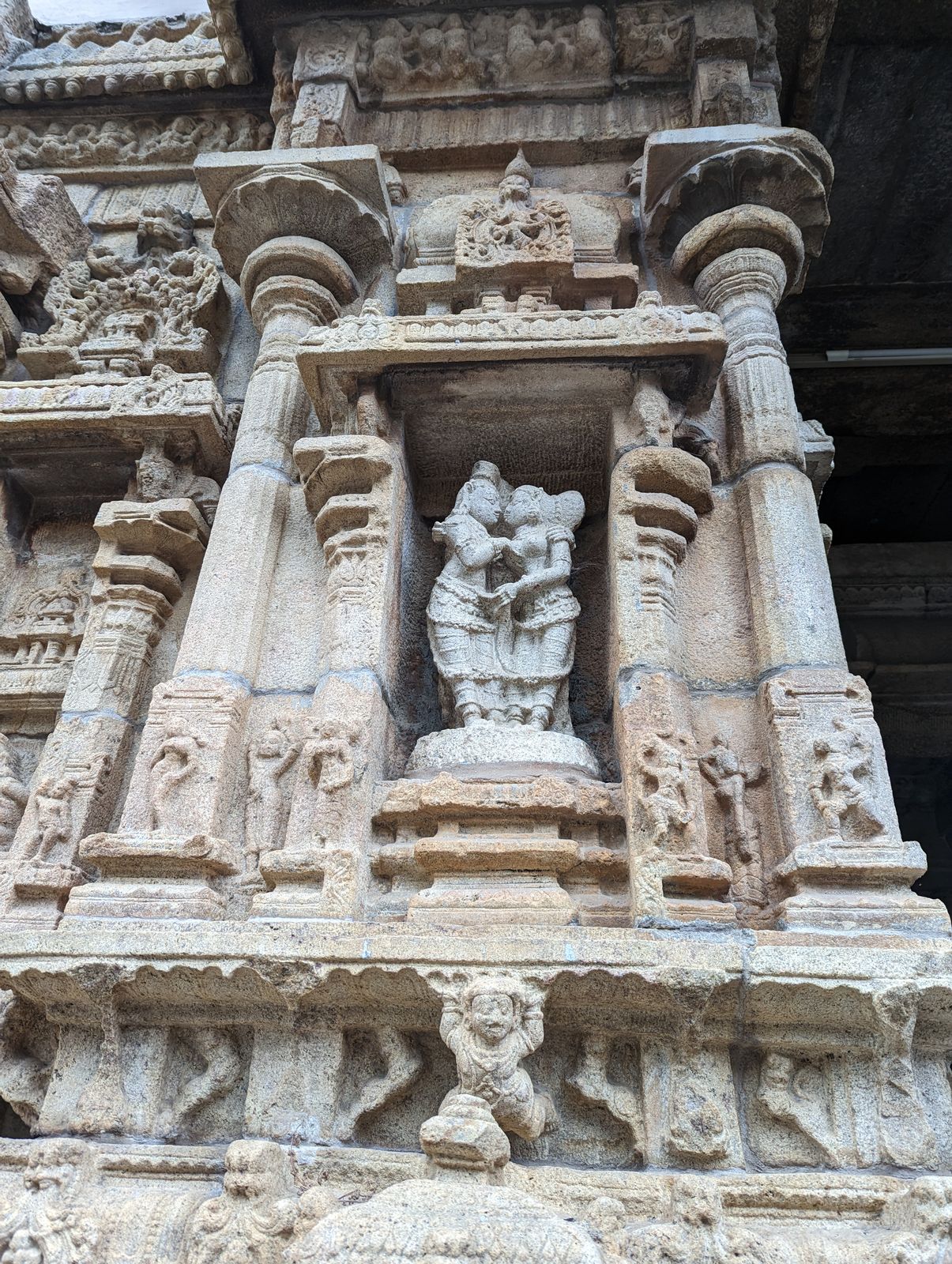
Judging from her hand, however, I'd say she's more than willing.
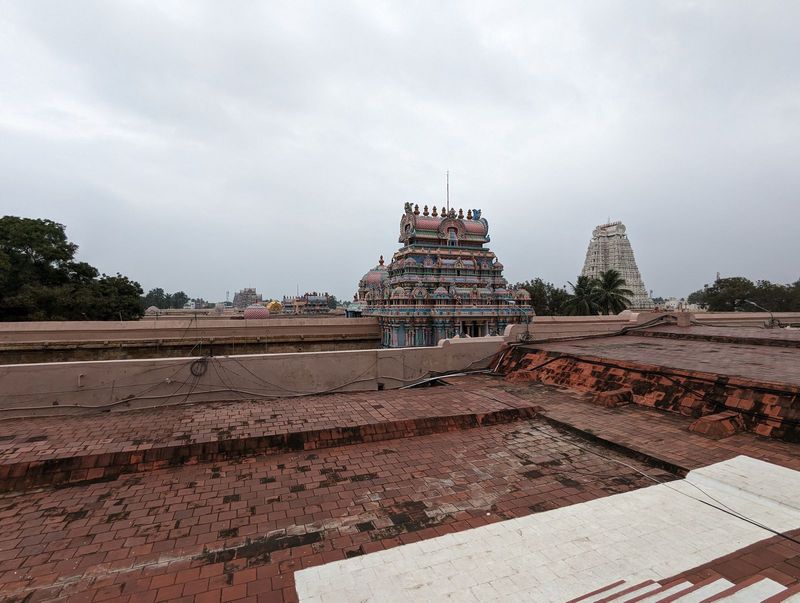
We're up on a nearby roof. The main axis of the temple runs under the slightly higher roof just to our right, then through the gopuram and on to the low, gold-capped main shrine, the vimana, which is (and has long been) open only to Hindus (not so long ago, only high-caste Hindus). The shrine was first gilt 1251 in imitation of the gilding at Chidambaram, shown in a later file. The gopuram on the right is the Vellai or Vellayi gopuram; it's on the east side of the same wall whose south side we saw a while back, and it's painted white (vellai in Tamil) in memory of a woman (named Vellayi) who is said to have sacrificed herself to save a temple treasure from Muslim attackers.
James Fergusson, the pioneering British student of these places, wrote that the shrine "except that its dome is gilt has nothing to distinguish it from an ordinary village temple." Did Fergusson manage to peek inside? I'm betting not. If he had, he would have seen a golden image of Vishnu six meters long and reclining in comfort under the protective mantle of Shesha, a multi-headed serpent. (See Fergusson's History of Indian and Eastern Architecture, 1910 ed., p. 368.)
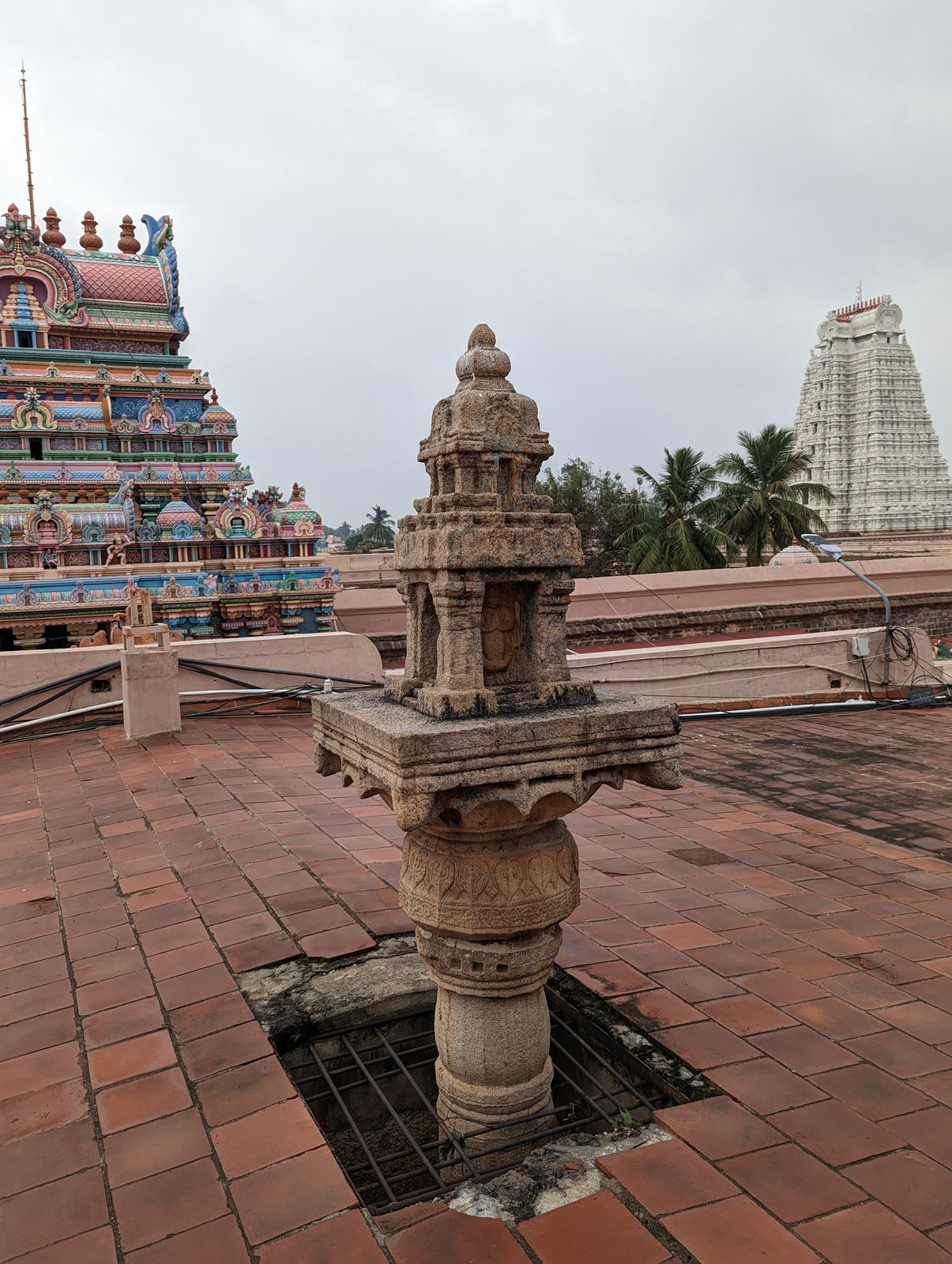
A dhvajastambha or flagstaff sticks through a recently built roof over the main axis. On a scale of 1 to 10, the craftsmanship of the temple ranges from, well, 1 to 10.
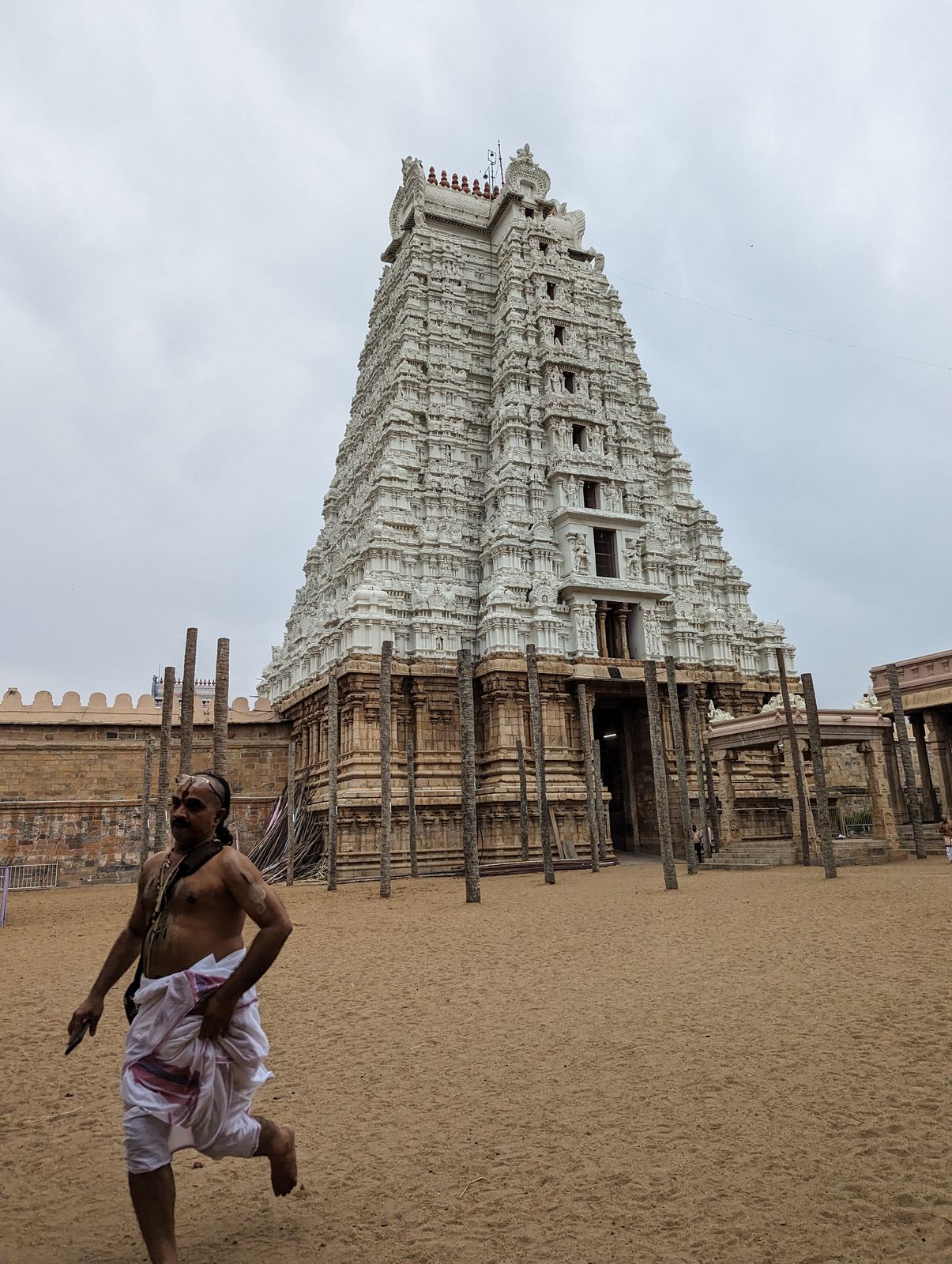
Here's that white gopuram. Wish I knew why this courtyard wasn't paved. And why the palms have been decapitated.
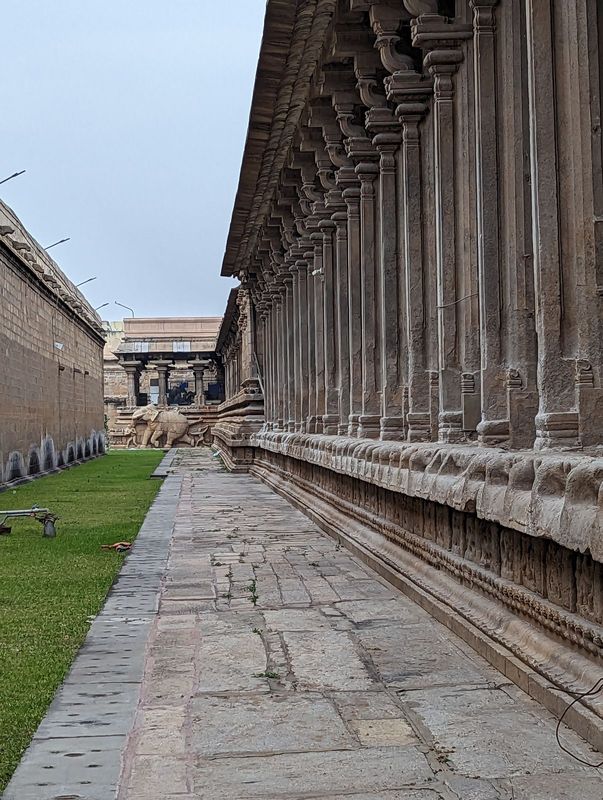
The same sandy courtyard is flanked by a "thousand-pillared" hall. Fergusson, who liked to count, came up with a total of 953. Nice elephant, though. Nicer than the temple's live elephant, which deserves better than to be treated like a slave.
A finely drawn plan and cross-section of this hall appears in the very scarce India: Photographs and Drawings of Historical Buildings; 100 Plates Reproduced by W. Griggs from the Collection in the Late Office of Curator of Ancient Monuments in India, London, 1896. Don't run out to get a copy unless you're willing to spend something over $9,000. I got my copy through interlibrary loan.
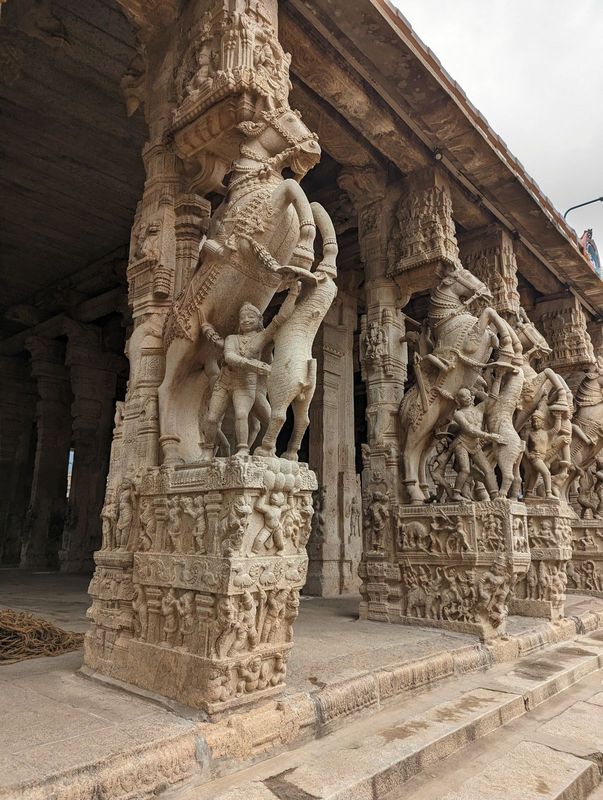
The other side of the same courtyard has the smaller Seshagiri-Rao pillared hall. The monolithic pillars are typical of the Vijayanagara Empire, which dates them more or less to 1500. I can't figure out why the figure is smiling, since he's under a horse rearing over a tiger. He must know something I don't. (You don't think it looks like a tiger? Check the fine drawing in Griggs, cited in the previous caption.)
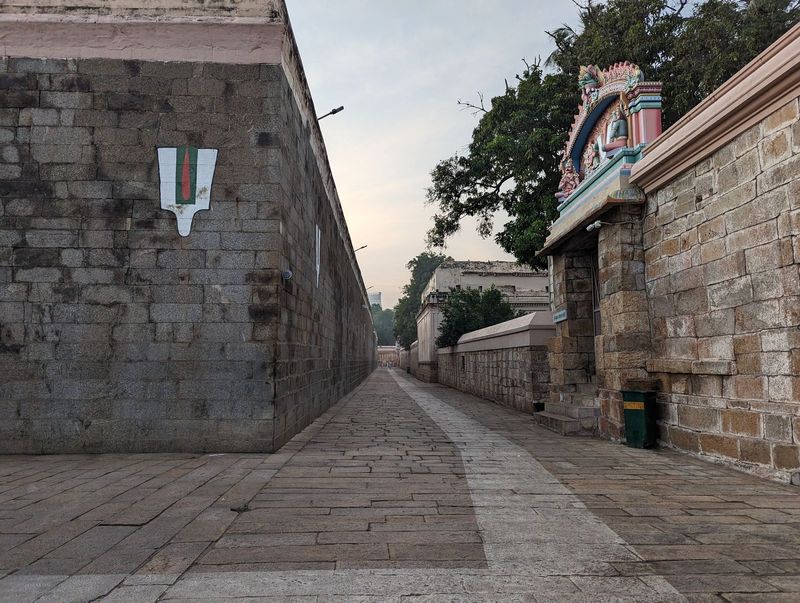
The walls-within-walls layout is especially frustrating if you have trouble walking barefoot. Anyway, that's another subsidiary temple off to the right. The "tuning fork" on the left is a namam. There are two forms of it, iand they identify two sects of Vishnu worshippers. This form identifies the Tengalai. The other sect, the Vadakalai, is represented by a U-shaped namam without the prong.
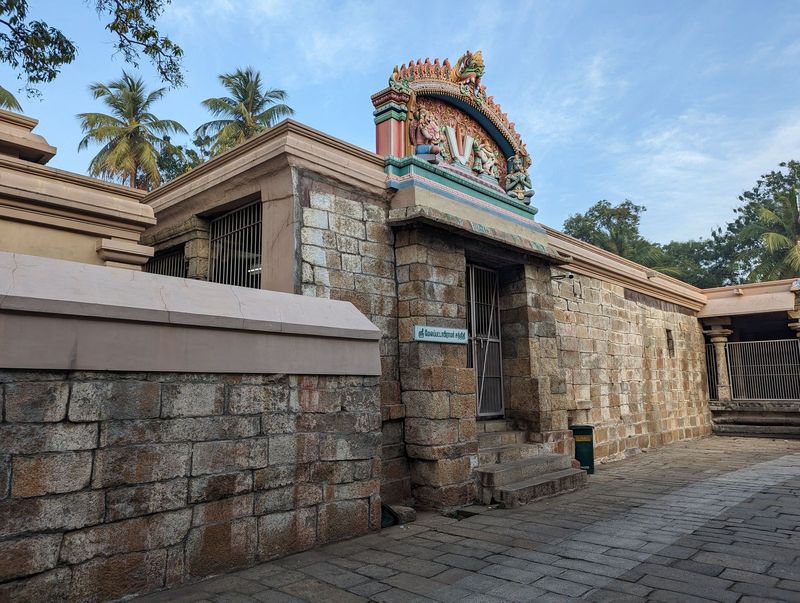
Another subsidiary temple, locked tight.
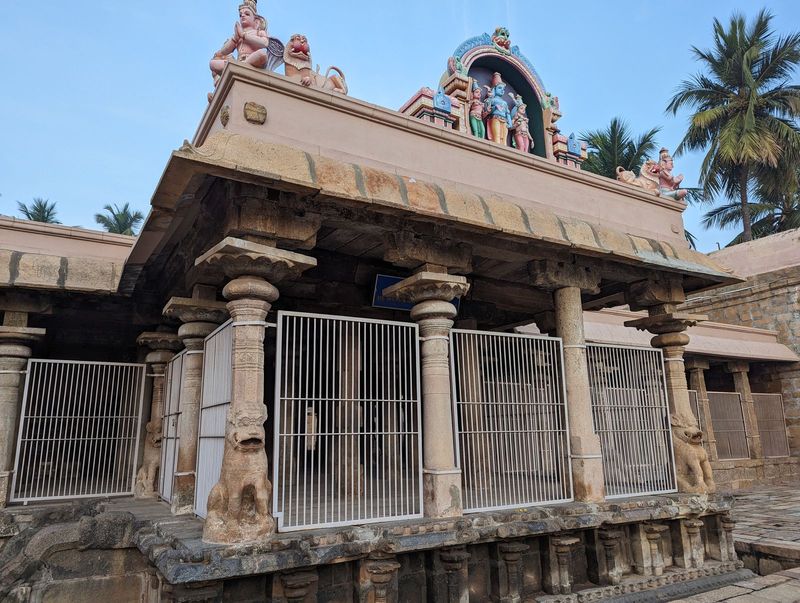
And you think Americans are fearful.
.
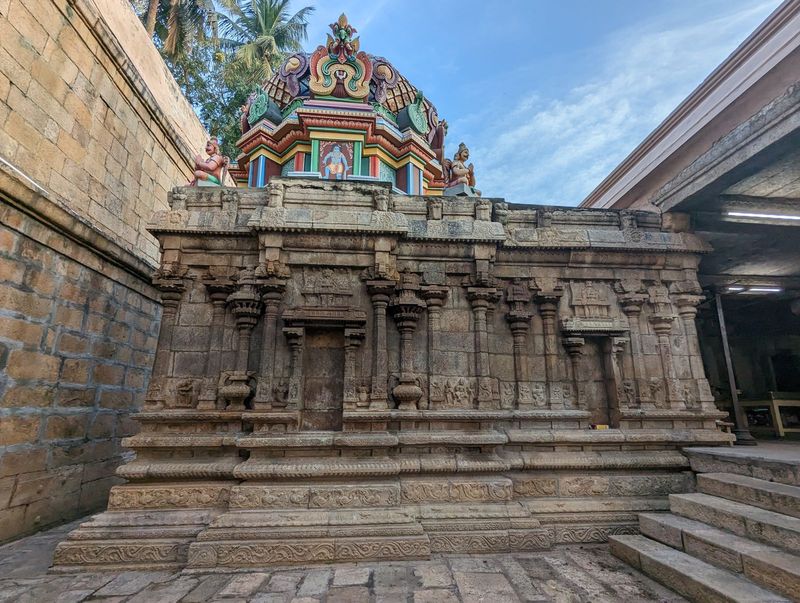
No matter, the exteriors of these temples offer more to see than the interiors, whose walls are typically blank. Too bad that the paint-brigade has been busy. Maybe a senior priest visited Disneyland.
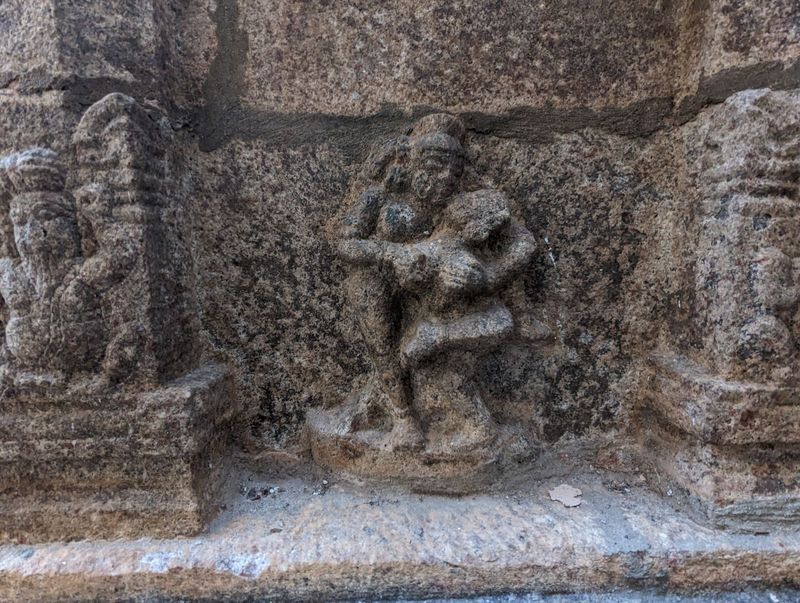
Ah, a mithuna, a reminder on the temple's wall of what Stella Kramrisch calls "reintegration." So easy to forget, so hard to remember.
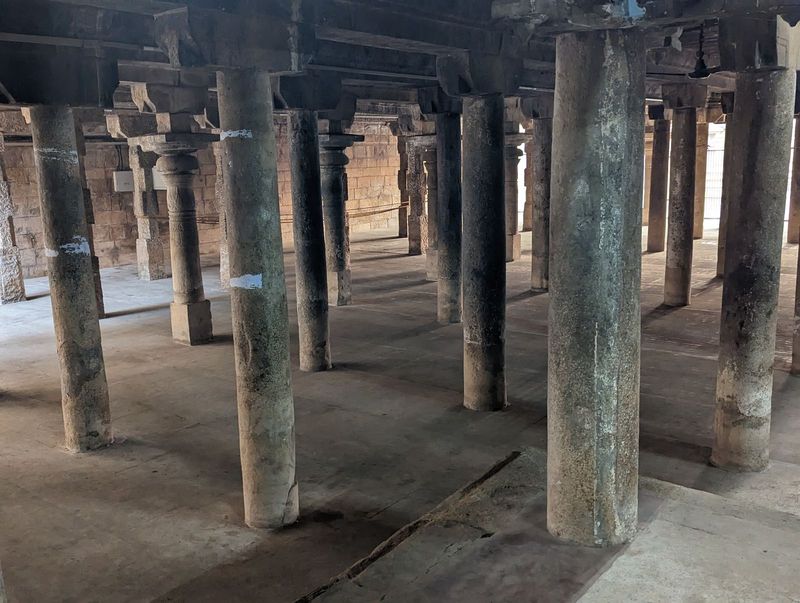
Scout around, and you'll find places within the temple walls that are pretty crude.
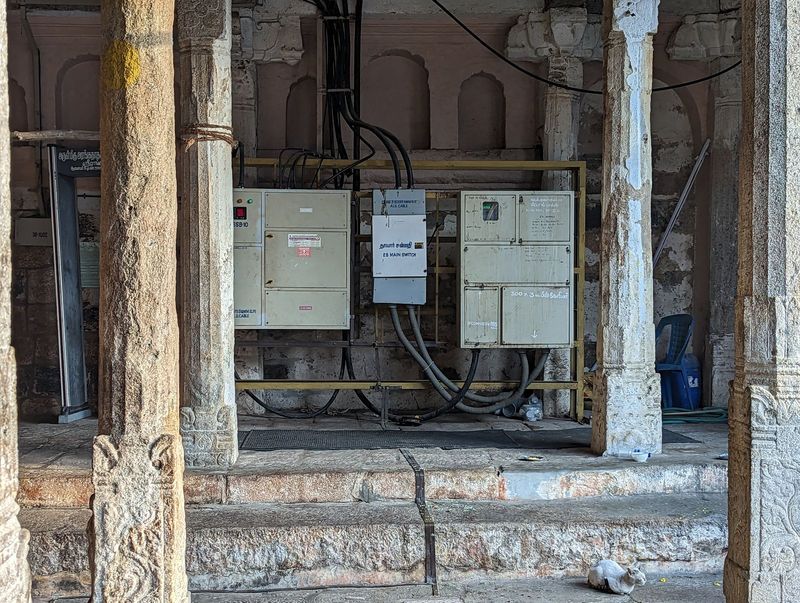
Tour operators aren't likely to ask if they can use this photo in their next brochure.
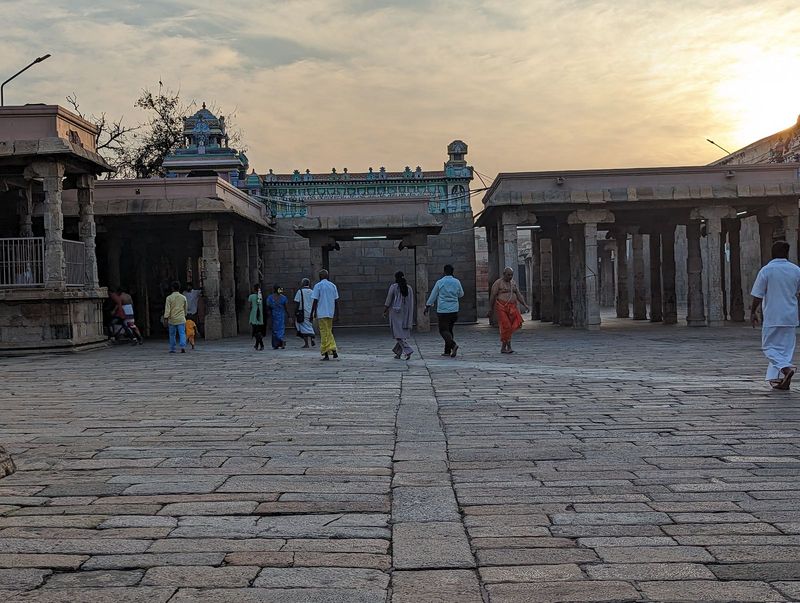
The best time to visit is early in the day. I mean early early: people are already beginning to drift in here at the north entrance.
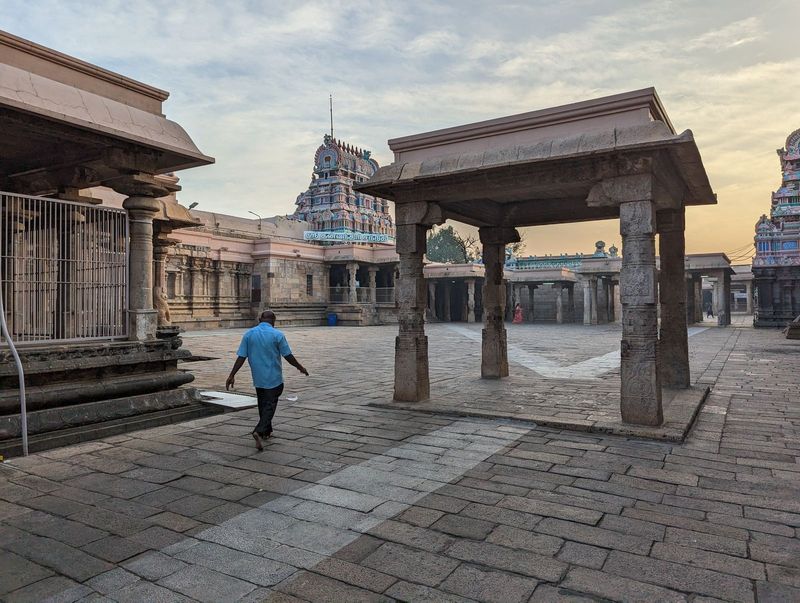
Almost deserted.
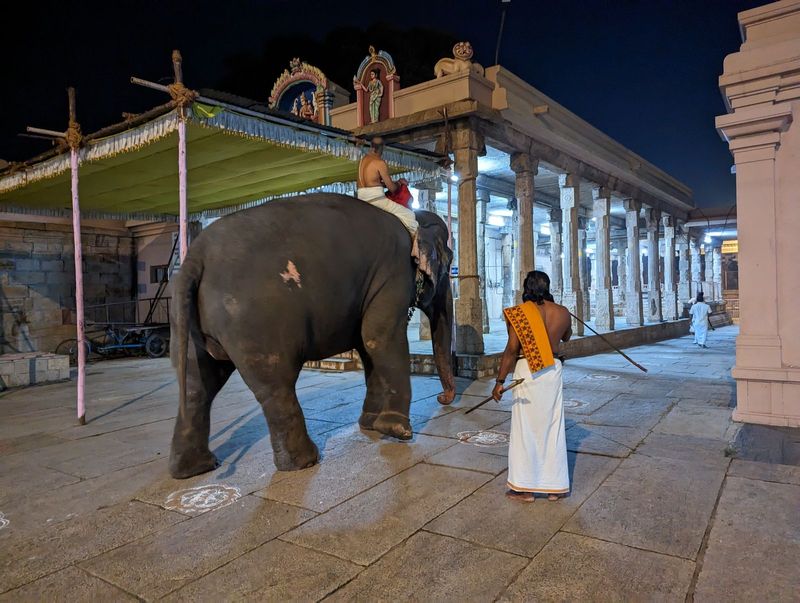
Even earlier, an elephant walks to the doorway of the central shrine, where he will briefly stand as part of Ranganatha's regalia. Nobody has to to tell you to keep your distance. You're barefoot, after all. Come to think of it, though elephants walk almost silently, this one did have a necklace of bells. sounding gently musical.