Cauvery Temples 3. Thanjuvur
<p><img src="https://wtbl.nyc3.cdn.digitaloceanspaces.com/21b41102cc727b455cd1dfb5a4dd1eff#orig=/sha256/21b41102cc727b455cd1dfb5a4dd1efff92d9e3b2cc6acf616efba7c23e51499"> </p> <p>How can we not look at this and think of the man-hours that went into it? Followed perhaps by the a little prayer of thanks for the industrial revolution. Here's another thought: how did the kings responsible for this wall cajole their workers? Whips are useful for a few troublemakers, but I'll bet the workers came to believe that they were doing something magnificent. For a good cause. A noble cause. Like soldiers. </p> <p> </p> <p> <img src="https://wtbl.nyc3.cdn.digitaloceanspaces.com/94fb8332448f4452eedebf58d09f4427#orig=/sha256/94fb8332448f4452eedebf58d09f4427e6a6f5d8b691b06b6bd7f47493c61f84"></p> <p>Welcome to the Big Temple. That's a rough translation of (the variously spelled) Brihadisvara Temple, "the temple of the giant lord." We can argue about whether the giant lord is Shiva or Rajaraja I, the king who ordered the temple's construction. My money says that the two are fused, an elision that magnifies the king and makes his wish your command.</p> <p><img src="https://wtbl.nyc3.cdn.digitaloceanspaces.com/b90e415886fa97ff871753dbbae71943#orig=/sha256/b90e415886fa97ff871753dbbae71943c8c468e88a8d5ba7d072b0c44313f04e"></p> <p>Here's the second gopuram. I can't get over the anachronistic lawn, near-positive proof that the Archaeological Survey of India is here. I am very appreciative of the Survey's work, but I doubt that Rajaraja I (r. 985-1014) ever saw a lawn. As for the gopuram, I see a Roman triumphal arch topped with a pointy hat. Of course this gopuram is much earlier than the gopurams of Ranganatha and Jambukeshwara.</p> <p> </p> <p> <img src="https://wtbl.nyc3.cdn.digitaloceanspaces.com/e93ab68c0d8b618b5de08c78db59538f#orig=/sha256/e93ab68c0d8b618b5de08c78db59538f1b115ac6fa414b2205432b08159c0d4e"></p> <p>The fanged <em>dvavapalas</em> are supposed to guard the temple, but they aren't very fierce, and they don't even make sure that people are wearing masks. They aren't!</p> <p> </p> <p><img src="https://wtbl.nyc3.cdn.digitaloceanspaces.com/46fb00c63e4b789a00139fa1ba4455b7#orig=/sha256/46fb00c63e4b789a00139fa1ba4455b7d3fd40d0130e5637bbbf3838c0c8d38d"> </p> <p>See why it's called the big temple? The <em>vimana</em> or tower is a bit over 200 feet high. </p> <p> <img src="https://wtbl.nyc3.cdn.digitaloceanspaces.com/b57d04f19acdb5e1c18d0ace8d7802cb#orig=/sha256/b57d04f19acdb5e1c18d0ace8d7802cb4e243aa4772f220e8bb7e5133569be40"> </p> <p>So we have the attached porch or pillared hall or <em>mandapa</em> and a second, unattached one housing Nandi, Shiva's mount. After visiting the temple sometime in the late 1830s or early 1840s, James Fergusson wrote that the "shrine of the Bull Nandi... is sufficiently important for its purpose, but not so much as to interfere with the effect of the great vimana, which stands near the inner end of the court.... The porch in front is kept low, and... the tower dominates over the gopurams and surrounding objects in a manner that imparts great dignity to the whole composition." That's high priase from Fergusson, who was a tough critic. (<em>History of Indian and Eastern Architecture</em>, 1910 ed., p. 363.) The bright sign is another matter. Good thing that Fergusson was dead before its installation. </p> <p> <img src="https://wtbl.nyc3.cdn.digitaloceanspaces.com/12fab503357dda5725c6c4c1a4bd6f32#orig=/sha256/12fab503357dda5725c6c4c1a4bd6f3285e1c39185af35e70756ff5ce2f232a7"></p> <p>Impressive? Most everybody says yes, but of course it was designed to be the temple of the king's god. We know this because its original name was Rajarajesvaram, the temple of the god of the king. The king presumably told his architect to do everything he could to impress people. P.S. You better not suggest that the king was the junior partner.</p> <p><img src="https://wtbl.nyc3.cdn.digitaloceanspaces.com/f37df7a9aa6998a4e23118b254af222d#orig=/sha256/f37df7a9aa6998a4e23118b254af222d4eda35756e4201c8d89acdf501661baf"></p> <p>If you're wondering where Rajaraja or his architect got the idea for the tower, come up almost to Chennai and see this 9th century Shore Temple, built by Narasimhavarman II of the Pallava Dynasty. He got <em>his</em> idea from wooden buildings built for Buddhists. They're all gone, but if you squint a bit, you can see a bit of resemblance between these towers and some Buddhist temples in Japan today.</p> <p><img src="https://wtbl.nyc3.cdn.digitaloceanspaces.com/c510ef1e3c838c8ec612b64248ee11cd#orig=/sha256/c510ef1e3c838c8ec612b64248ee11cd494348f15048edbac3ead8c65bc66777"></p> <p>So the pious line up.</p> <p><img src="https://wtbl.nyc3.cdn.digitaloceanspaces.com/158c11c3d98073d89a6dc00ace54a783#orig=/sha256/158c11c3d98073d89a6dc00ace54a78361cb694361dbe520def78b3dcab4106c"></p> <p>Inside (seen here from a side entry), they hope for a peek at a huge Shiva lingam and for the opportunity to make a donation. </p> <p><img src="https://wtbl.nyc3.cdn.digitaloceanspaces.com/15510826816ab85efd196374f470c7ed#orig=/sha256/15510826816ab85efd196374f470c7ed5fa222342306b655843f6f72973995f8"> </p> <p>Side view of the exit. The tower is of stone, unlike gopurams, which are brick atop a stone base. The tower is also hollow, with the lingam open to the sky. For a dramatic diagram, see Radha Champakalakshmi, <em>The Hindu Temple</em>, London, 2001, p. 16.)</p> <p> <img src="https://wtbl.nyc3.cdn.digitaloceanspaces.com/7253332fa5779cb625f1047aca5080ba#orig=/sha256/7253332fa5779cb625f1047aca5080ba5ec8e113cd430e5e4f2b0378ef9134fc"> </p> <p>There are a dozen square tiers under a conical cap. The regularity of the ornamention reminds me a supermarket display of soft drinks. That's not very polite, but the sculptors had zero freedom to express whatever devotion they felt for Shiva. How is that different from the supermarket display builder? If you think this is grossly disrespectful, see the quotations from the eminently respectable T.A. Gopinatha Rao in the file called Jambukeshwara. </p> <p> <img src="https://wtbl.nyc3.cdn.digitaloceanspaces.com/4c1b1f87824b99ecf358d317854e7e8e#orig=/sha256/4c1b1f87824b99ecf358d317854e7e8eec0d5d1141ae2439bff6ea5c72dae187"> </p> <p>Here's the Subrahmanya shrine, added about 600 years later. Goes to show that it's not just Christian churches whose style evolves glacially. (Even if you're not a fan of Le Corbusier, you have to admire his nerve in designing Notre-Dame du Haut at Ronchamp.)</p> <p> <img src="https://wtbl.nyc3.cdn.digitaloceanspaces.com/76beec23a7c50cfbbbd167c9d8e28154#orig=/sha256/76beec23a7c50cfbbbd167c9d8e281549e92eacbb939e04e82f677bcb8ff6f60"> </p> <p>Just because it's smaller, this temple is cosier, less intimidating. Well, excepting those dvarapalas or door guards.</p> <p> <img src="https://wtbl.nyc3.cdn.digitaloceanspaces.com/1ef33a9835e281adc46c65f087f1884b#orig=/sha256/1ef33a9835e281adc46c65f087f1884bda23a9b5eea2221f35dae3b7a509d7ad"> </p> <p>A priest cares for the image of Subrahmanya, a son of Shiva.</p> <p> <img src="https://wtbl.nyc3.cdn.digitaloceanspaces.com/d63c3ab91d14d3676d762dfa559d1800#orig=/sha256/d63c3ab91d14d3676d762dfa559d18000156f3c3e35ccc5072628f5680662183"> </p> <p>Seen from the right perspective, the two vimanas look equally high.</p> <p> <img src="https://wtbl.nyc3.cdn.digitaloceanspaces.com/a9512331a85f55610d1c83e390333ea9#orig=/sha256/a9512331a85f55610d1c83e390333ea90f249148147c1c9327a2186489802115"> </p> <p>I could be nice and call it this tower, which is part of the nearby palace of the kings of Tanjore, flattery.</p> <p> <img src="https://wtbl.nyc3.cdn.digitaloceanspaces.com/afb18c47cd2a37495f53b422177b3395#orig=/sha256/afb18c47cd2a37495f53b422177b339563031dd1304ea8839bbeb3b0bd5b7bdc"> </p> <p>Whaddya think? It's the palace's durbar or reception hall. The statue is of Raja Serfoji II, who ruled from 1797 to 1832 though his writ hardly extended beyond the palace. In exchange for ceding real control of the Tanjore State to the British, he got a pension to die for.</p> <p> <img src="https://wtbl.nyc3.cdn.digitaloceanspaces.com/5c3173ada2d10637d062551ac709c24a#orig=/sha256/5c3173ada2d10637d062551ac709c24afedf54992a4152e34de2fd6326221735"></p> <p>The palace library is famed for its collections if not its decor.</p> <p> </p> <p> <img src="https://wtbl.nyc3.cdn.digitaloceanspaces.com/95abe9d4107362856c9cf259e13949a7#orig=/sha256/95abe9d4107362856c9cf259e13949a717466fb2824446e7b04ee80dbf485472"></p> <p>Somewhere in the dynastic genes of the dynasties ruling here, there was an appreciation for beautiful things, such as this elegant bronze Shiva, one of many superb figures in the palace's demoralized and depressing museum. Better to put the stuff in the basement and let visitors explore with a flashlight.</p>
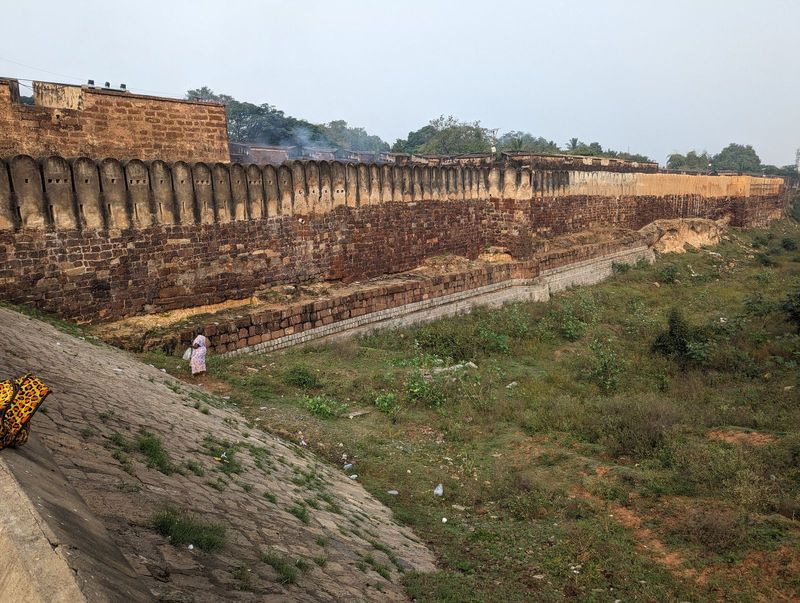
How can we not look at this and think of the man-hours that went into it? Followed perhaps by the a little prayer of thanks for the Industrial Revolution. Here's another thought: how did the kings responsible for this wall cajole their workers? Whips are useful for a few troublemakers, but I bet the workers came to believe that they were doing something magnificent. For a good cause. A noble cause. Like soldiers.
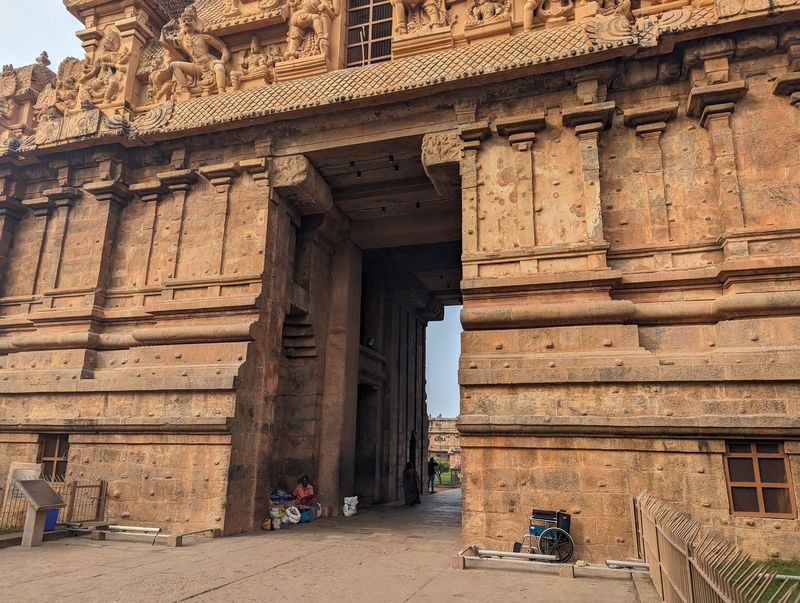
Welcome to the Big Temple. That's a rough translation of (the variously spelled) Brihadisvara Temple, "the temple of the giant lord." We can argue about whether the giant lord is Shiva or Rajaraja I, the Chola king who ordered the temple's construction. My money says that the two are fused, an elision that magnifies the king and makes his wish your command.
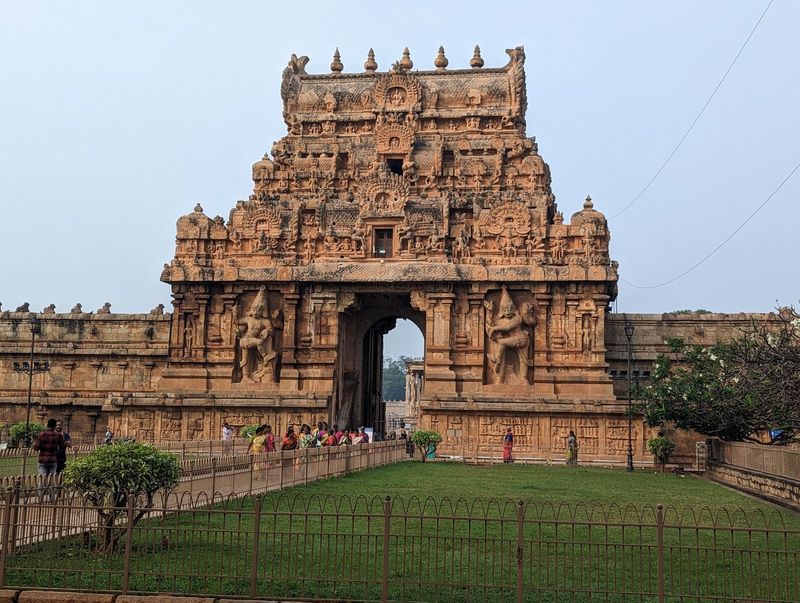
Here's the second gopuram. I can't get over the anachronistic lawn, proof that the Archaeological Survey of India is here. I am very appreciative of the Survey's work, but I doubt that Rajaraja I (r. 985-1014) ever saw a lawn. As for the gopuram, I see a Roman triumphal arch topped with a pointy hat. Of course this gopuram is much earlier than the taller gopurams of Ranganatha and Jambukeshwara.
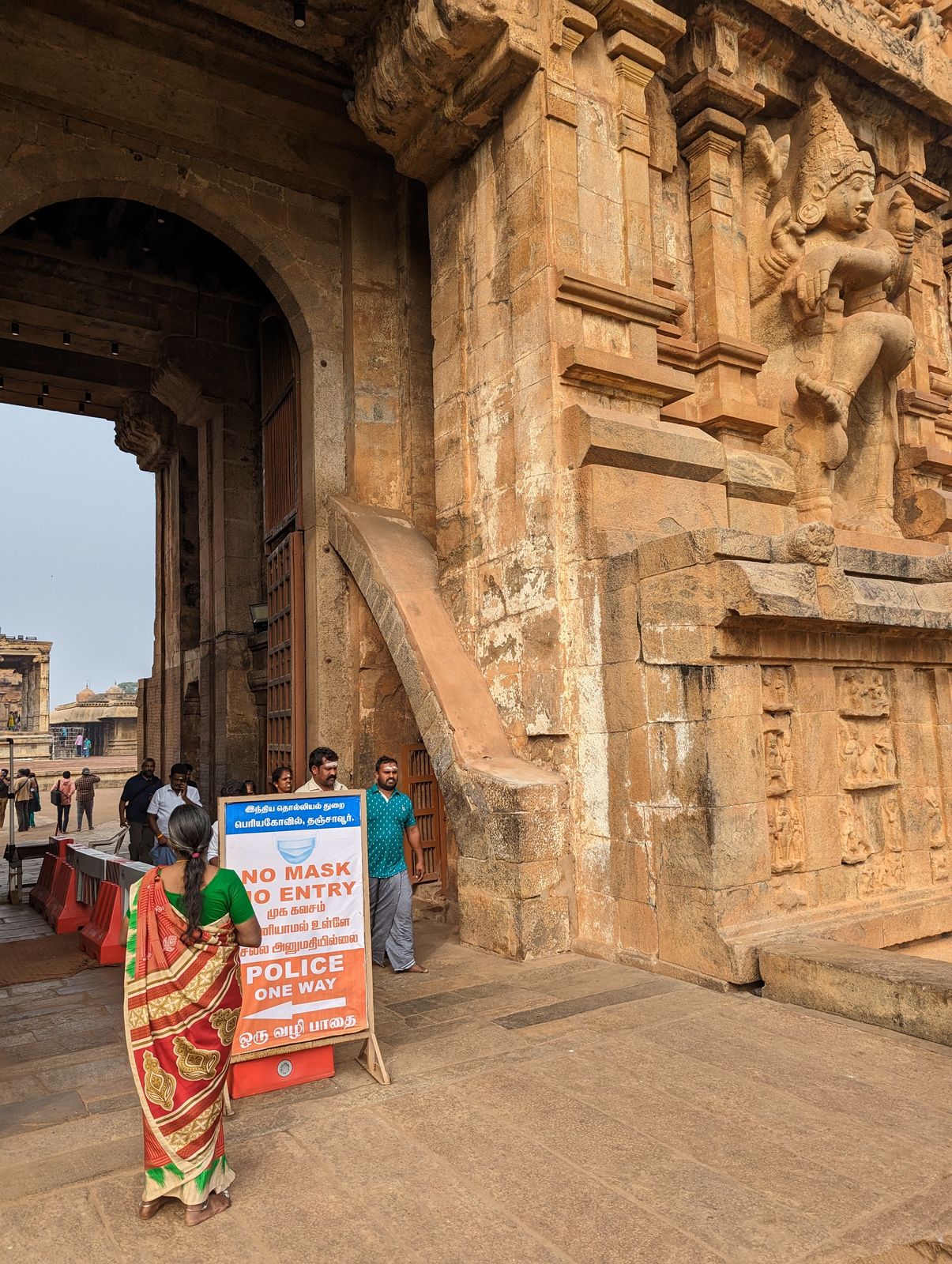
The fanged dvavapalas are supposed to guard the temple, but they don't even scare people into wearing the required masks.
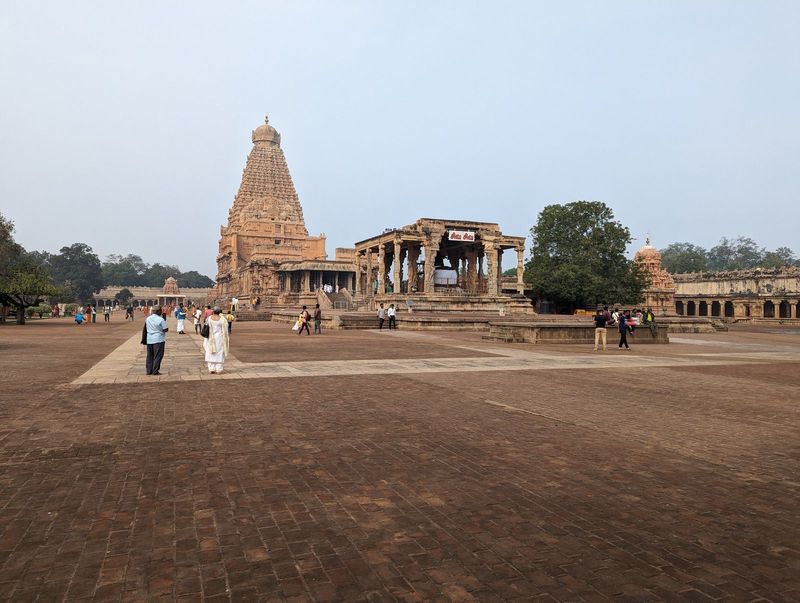
See why it's called the big temple? The vimana or tower with its base is a bit over 200 feet high.
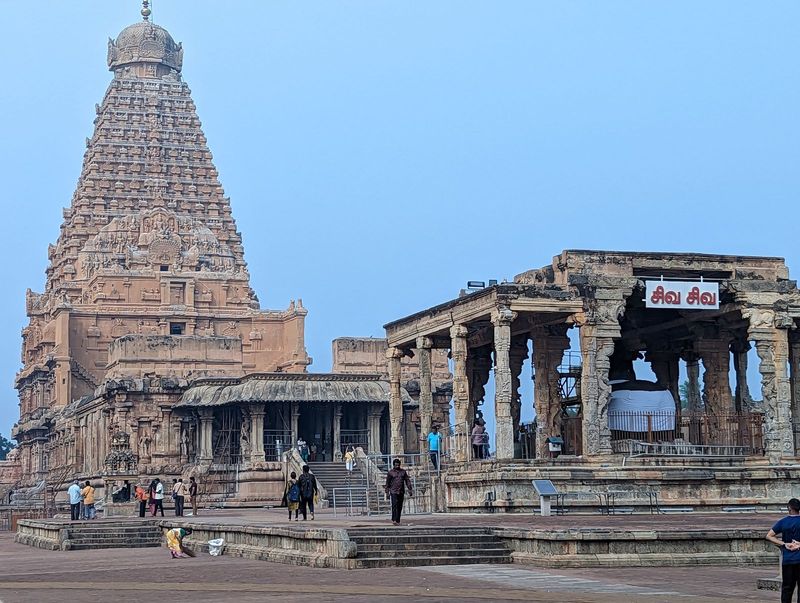
So we have the attached porch or pillared hall or mandapa and a second, unattached one housing Nandi, Shiva's mount. After visiting the temple sometime in the late 1830s or early 1840s, James Fergusson wrote that the "shrine of the Bull Nandi... is sufficiently important for its purpose, but not so much as to interfere with the effect of the great vimana, which stands near the inner end of the court.... The porch in front is kept low, and... the tower dominates over the gopurams and surrounding objects in a manner that imparts great dignity to the whole composition." That's high priase from Fergusson, who was a tough critic. (History of Indian and Eastern Architecture, 1910 ed., p. 363.) The bright sign is another matter. Good thing that Fergusson was dead before its installation.
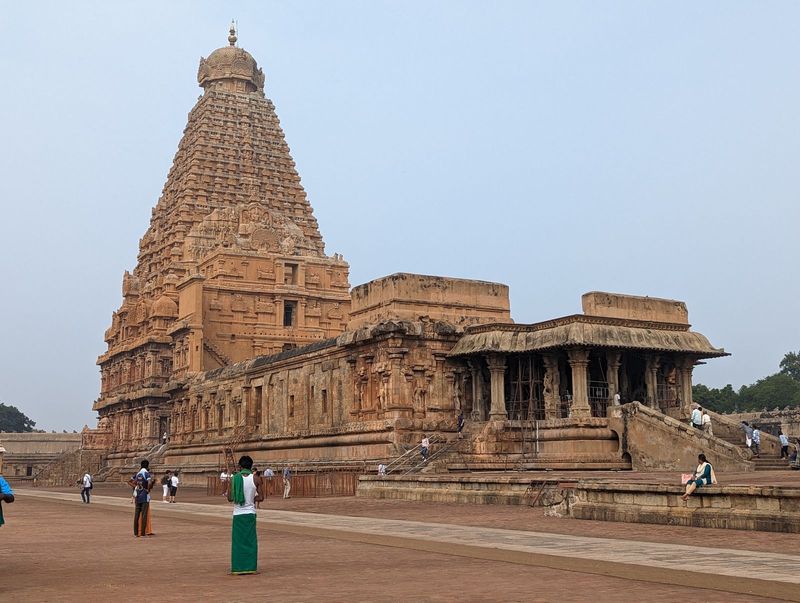
Impressive? Most everybody says yes, but of course it was designed to be impressive. We know this because its original name was Rajarajesvaram, the temple of the god of the king. The king presumably told his architect to do everything he could to make people feel tiny. P.S. You better not suggest that the king was the junior partner.
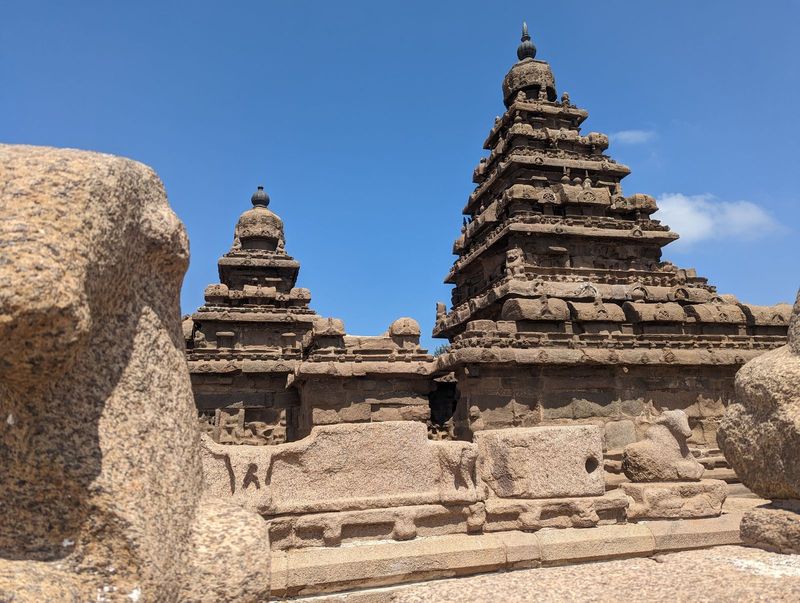
If you're wondering where Rajaraja or his architect got the idea for the tower, come up almost to Chennai and see this 9th century Shore Temple, built by Narasimhavarman II of the Pallava Dynasty. He got his idea from wooden buildings built for Buddhists. They're all gone, but if you squint a bit, you can see a bit of resemblance between these towers and some Buddhist temples in Japan today.
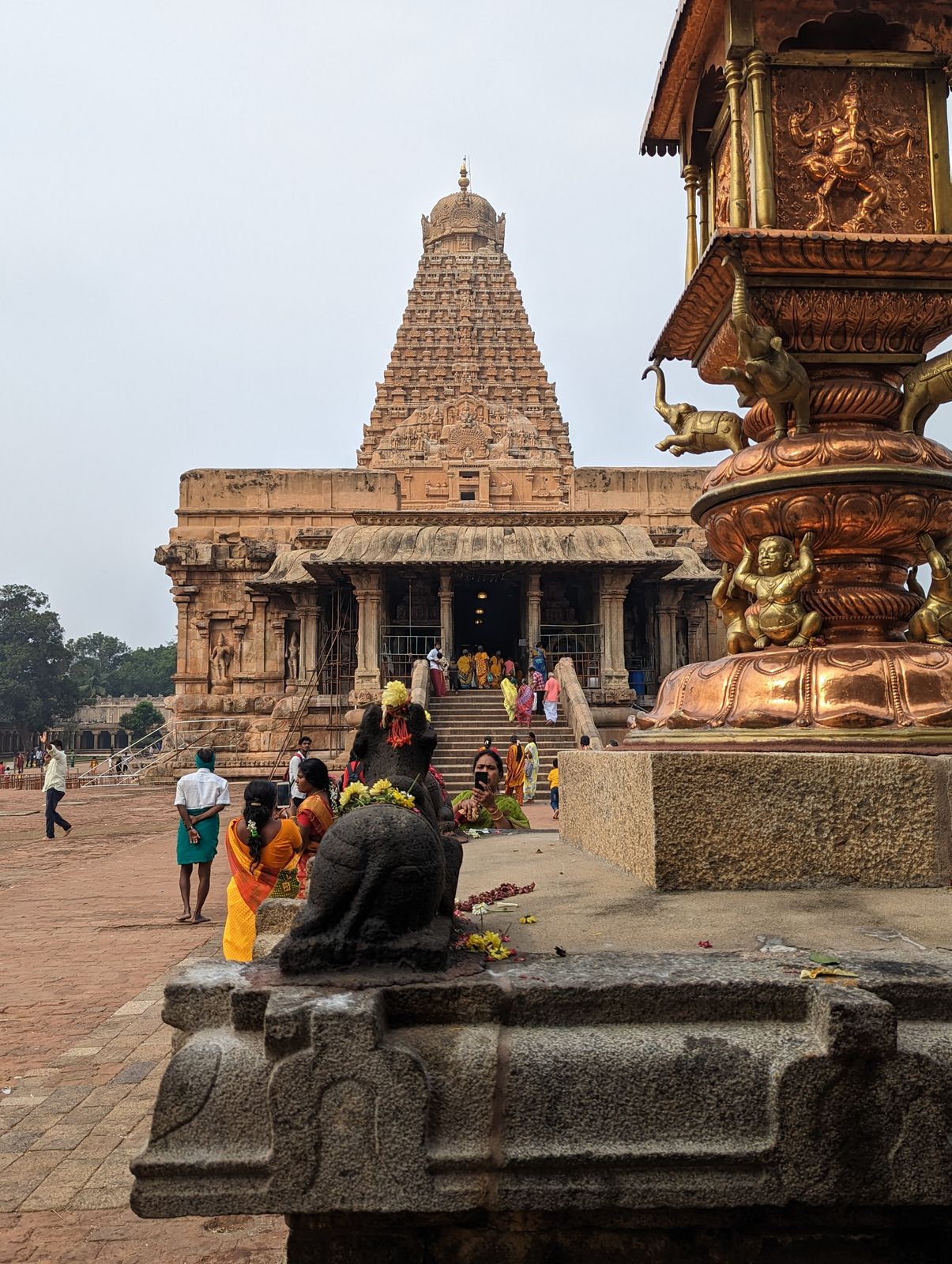
So the pious line up.
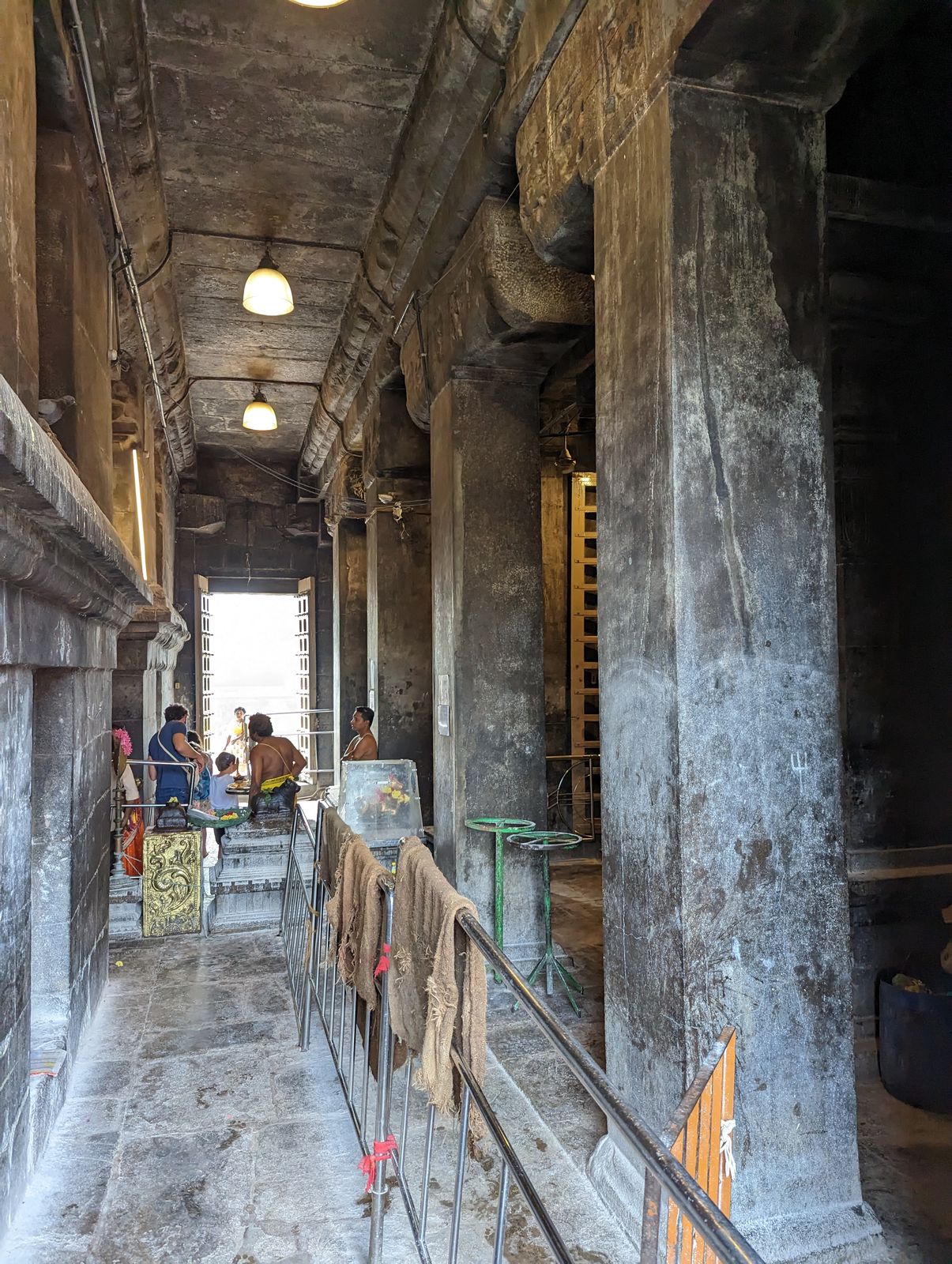
Inside (seen here from a side entry), they hope for a peek at a huge Shiva lingam and for the opportunity to make a donation.
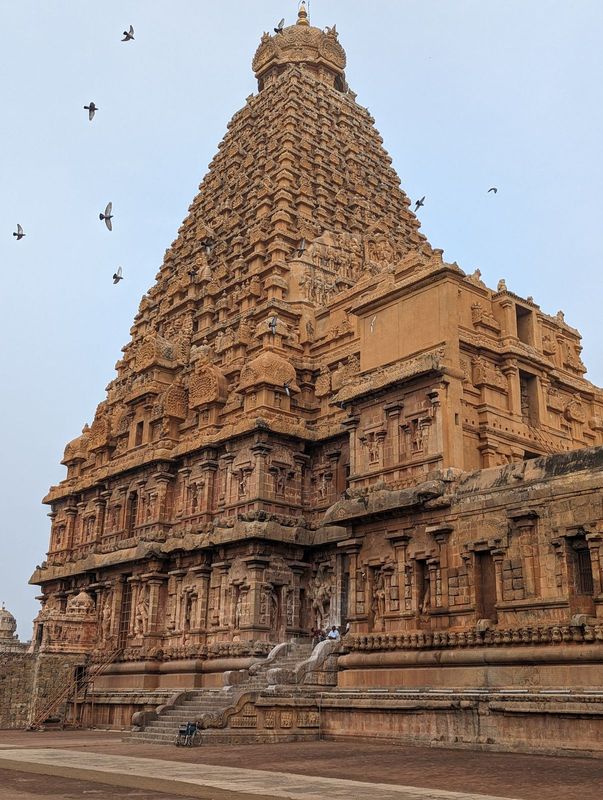
Side view of the exit. The base is double walled, with an ambulatory path between those walls. The tower is of stone, unlike gopurams, which are brick atop a stone base. The tower is also hollow, with the lingam open to the sky. For a dramatic diagram, see Radha Champakalakshmi, The Hindu Temple, London, 2001, p. 16.
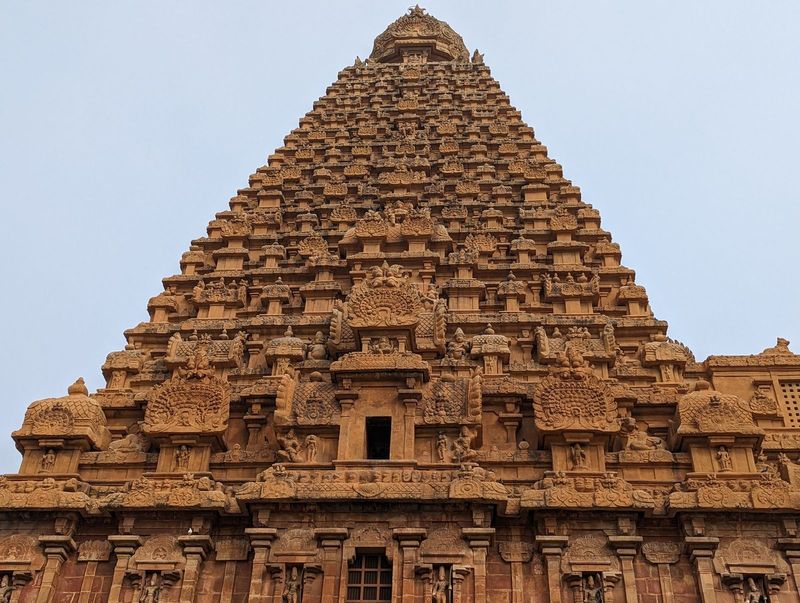
There are a dozen square tiers under a conical cap. The regularity of the ornamentation reminds me a supermarket display of soft drinks. That's not very polite, but the sculptors had zero freedom to express whatever devotion they felt for Shiva. How is that different from the supermarket display builder? If you think this is grossly disrespectful, see the quotations from the eminently respectable T.A. Gopinatha Rao in the file called Jambukeshwara.
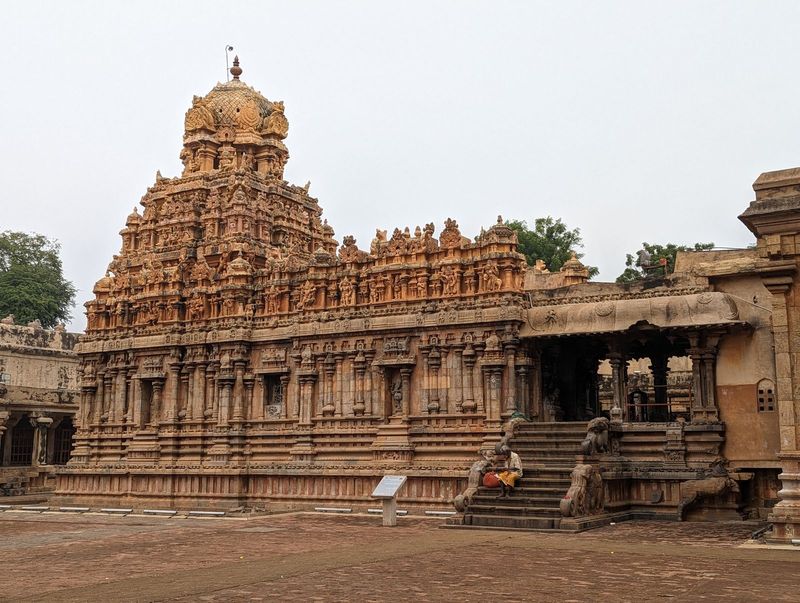
Here's the Subrahmanya shrine, added about 600 years later. Goes to show that it's not just Christian churches where style evolves glacially. (Even if you're not a fan of Le Corbusier, you have to admire his nerve in designing the church of Notre-Dame du Haut at Ronchamp.)
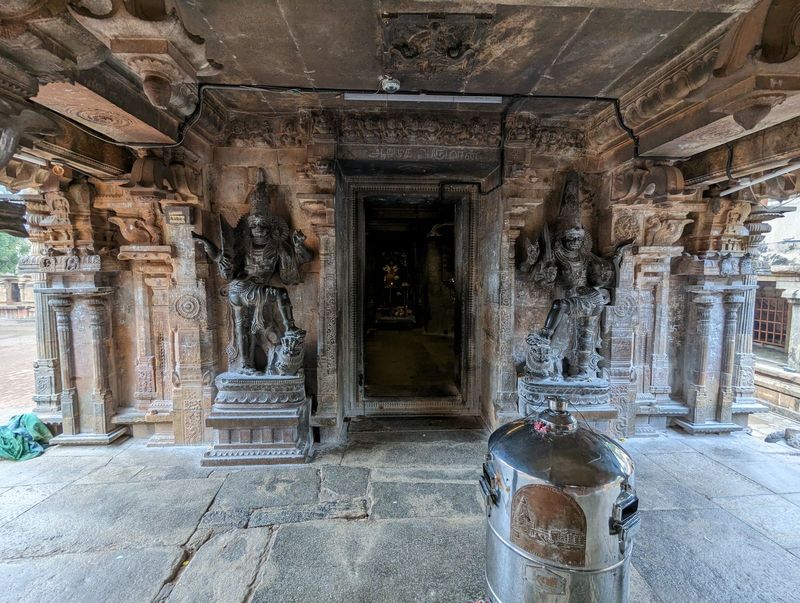
Just because it's smaller, this temple is cosier, less intimidating. Well, excepting those dvarapalas or door guards.
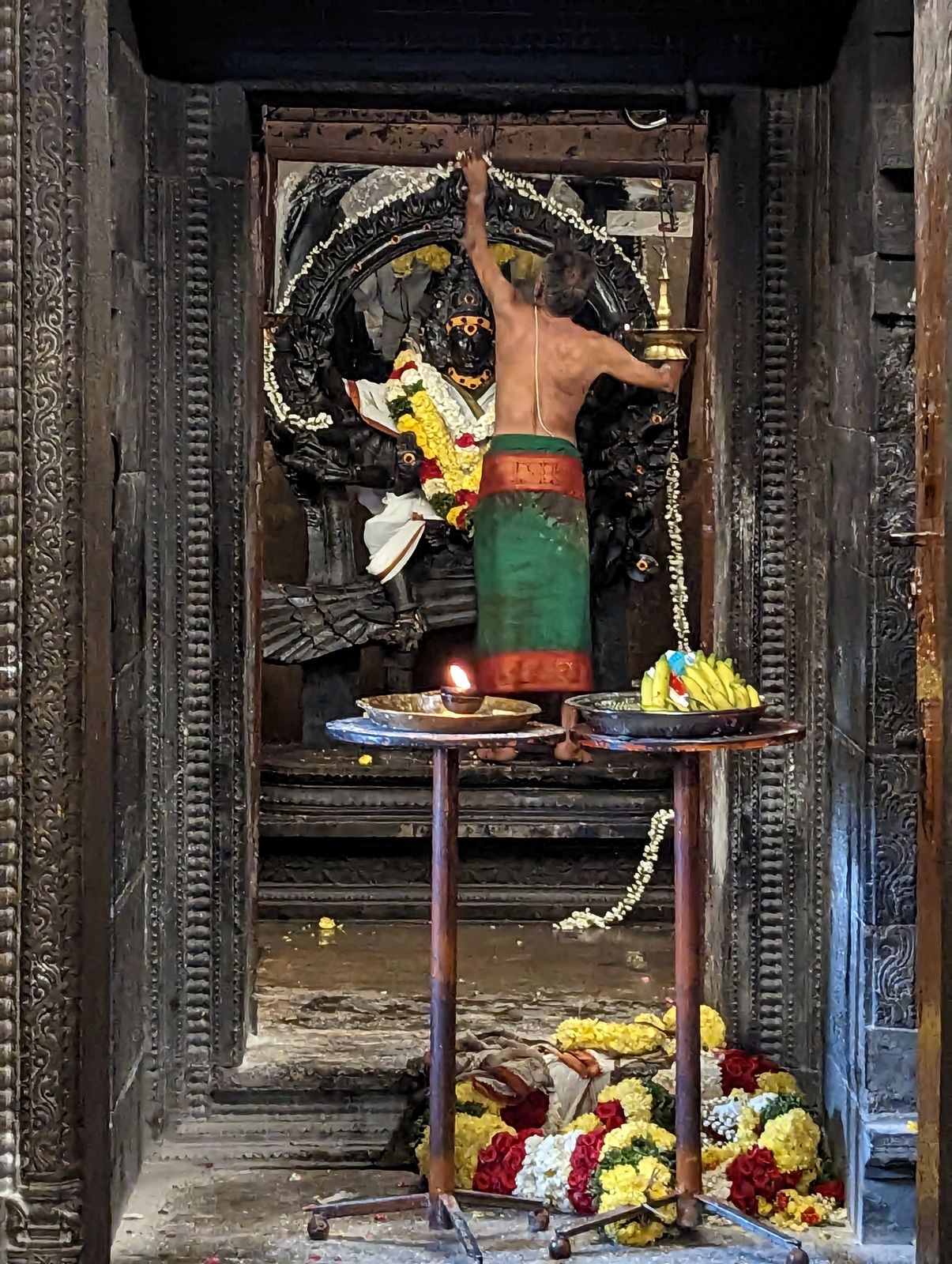
A priest cares for the image of Subrahmanya, a son of Shiva.
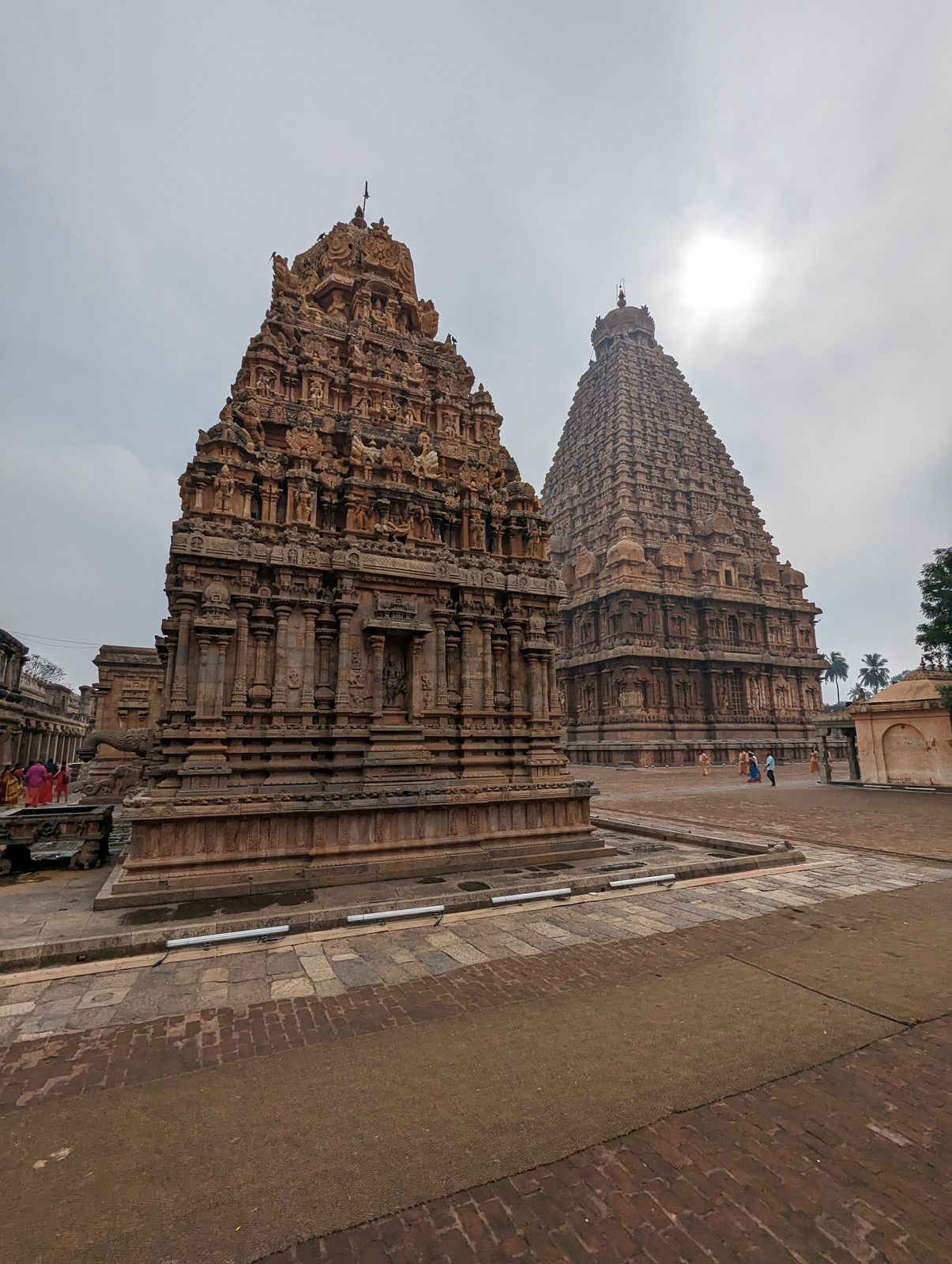
Seen from the right perspective, the two vimanas look equally high.
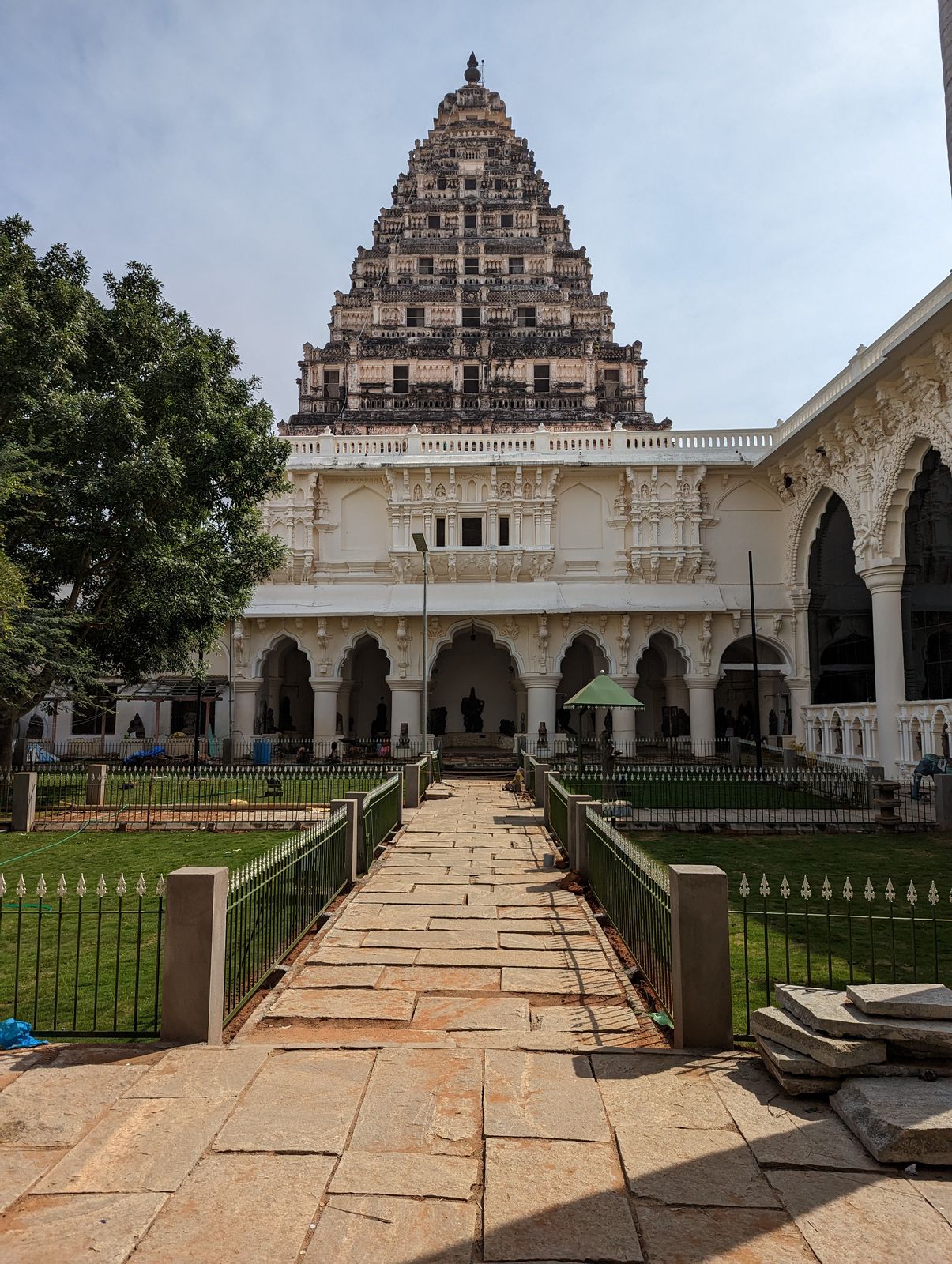
This imitative tower is part of the nearby palace of the kings of Tanjore, flattery.
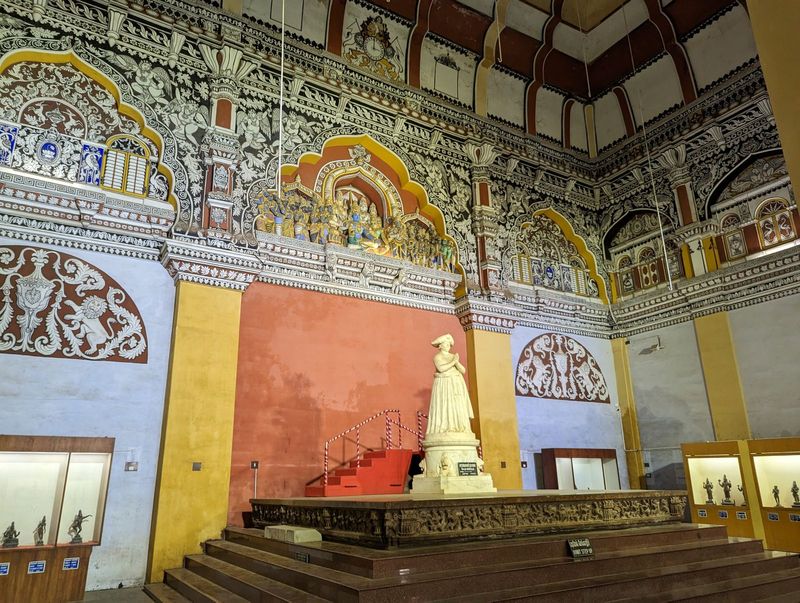
Whaddya think? It's the palace's durbar or reception hall. The statue is of Raja Serfoji II, who ruled from 1797 to 1832 though his writ hardly extended beyond the palace. In exchange for ceding real control of the Tanjore State to the British, he got a pension to die for.
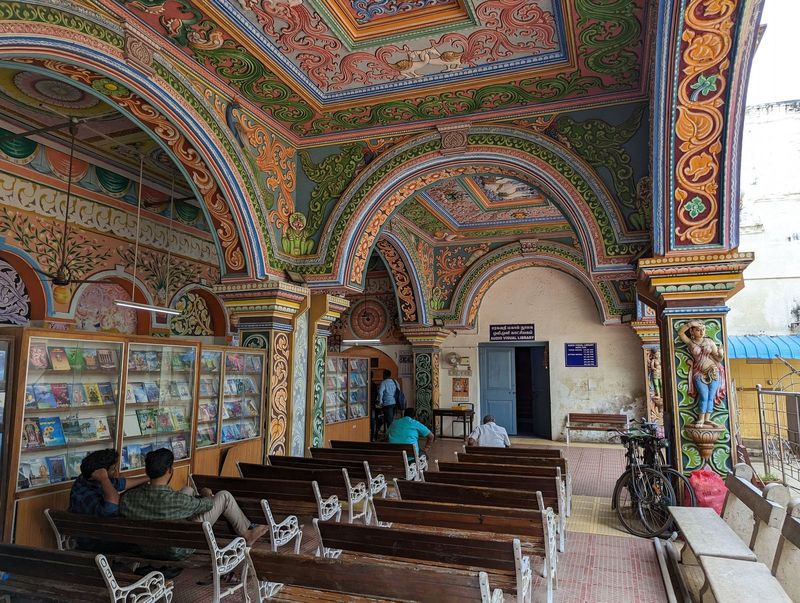
The palace library is famed for its collections if not its decor.
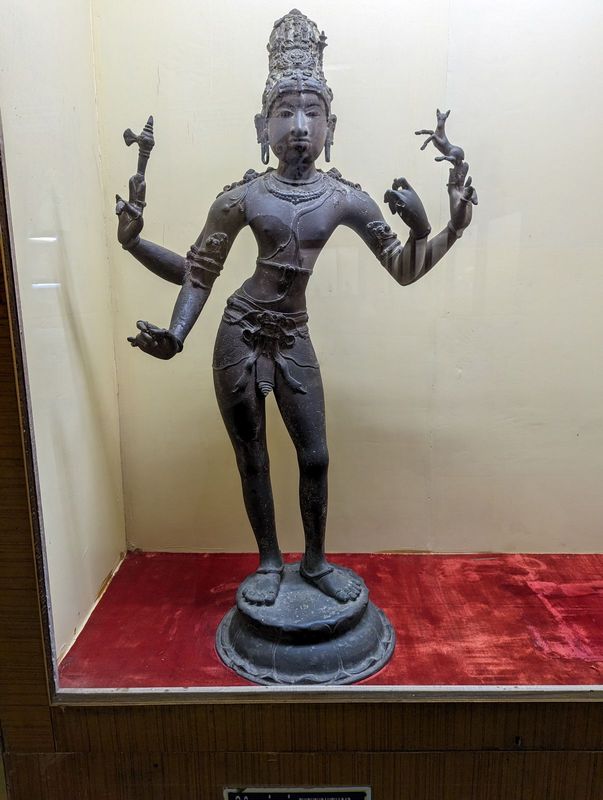
Somewhere in the dynastic genes of the dynasties ruling Tanjore, there was an appreciation for beautiful things like this elegant bronze Shiva, one of many superb figures in the palace's demoralized and depressing museum. Better to put the stuff in the basement and let visitors explore with a flashlight.