Cauvery Temples 4. Kumbakonam
<p><img src="https://wtbl.nyc3.cdn.digitaloceanspaces.com/d933302e62bc58094c927fec86443b1c#orig=/sha256/d933302e62bc58094c927fec86443b1cb896a17c2aa464d13b2ad750577ea88a"> </p> <p>Immaculate, even modern, except for the little Nandis up top. This is the Airavatesvara Temple at Darasuram, just outside Kunbakonam. It was built at the order of Rajaraja II, who ruled (r. 1150-1173) about a century after Rajaraja I, builder of the Brihadesvara or Big Temple at Tanjore. Yes, at the left edge you can see lawn, a tipoff that the Archaeological Survey of India is in charge. </p> <p> <img src="https://wtbl.nyc3.cdn.digitaloceanspaces.com/d83c428f49192772d07fbb191425afdb#orig=/sha256/d83c428f49192772d07fbb191425afdbe18fc32bf5c1ddd1b19a946c277e3c99"> </p> <p>The main entry is modest compared to that at Thanjuvur's Big Temple., but everything here, not just the entry, is on a reduced scale. The gopuram reminds me (I'm shameless) of a covered wagon mounted on family members. Note also that the temple is below the ground surface. Credit civil engineers who sometime in the last century failed to realize (or didn't care) that the temple would flood during the monsoon. The little sign on a pedestal is another reminder that we're at a World Heritage site and are not allowed to take pictures that don't include something new. (You're right. Things could be worse: consider the sign blocking the "Sleeping Buddha" at Polonnuwara--or, worse still, the tower at Pagan/Bagan.)</p> <p> <img src="https://wtbl.nyc3.cdn.digitaloceanspaces.com/58e307ade52195fbbc3a60681aba3d5d#orig=/sha256/58e307ade52195fbbc3a60681aba3d5dd47ec8fc5490a431166fdc26d7664281"> </p> <p>An eminent student writes that "the temple at Darasuram is the most evocative in Chola art..." (Calembus Sivaramamurti, in <em>5000 Years of the Art of India</em>, 1978, p. 251.) Elsewhere, he writes that Airavatesvara is so elaborately detailed that it is "a sculptor's dream re-lived in stone." (Sivaramamurti, <em>The Art of India</em>, pp. 256-7, quoted by S. R. Balasubrahmanyam in <em>Later Chola Temples: Kulottunga I to Rajendra III (A.D. 1070-1280), </em>1979, p. 233.)</p> <p> <img src="https://wtbl.nyc3.cdn.digitaloceanspaces.com/b8a6b444fa365113bc0f54aa007c97d3#orig=/sha256/b8a6b444fa365113bc0f54aa007c97d3f610255dc732bea41e8e9eed592e42ba"></p> <p>The temple is about to take flight, thanks to its horses and wheels. The idea of making a temple into a chariot was not new: it appears (appeared first?) 20 miles to the northeast at the small Melakkadambur temple built by Rajaraja II's predecessor. After its use here the idea was magnified a century later at the huge sun temple at Konark, on the coast some 800 miles to the north. The connection is that the builder of Konark, Narasimha, was a descendant of Kulottunga, the builder of Melakkadambur. (A few photos of Melakkadambur, including its wheels, are at the tail end of the file on Gangaikondacholapuram. There's a file on Konark, too.)</p> <p><img src="https://wtbl.nyc3.cdn.digitaloceanspaces.com/01e86c65e086153e5f2b5a20c93a6b2f#orig=/sha256/01e86c65e086153e5f2b5a20c93a6b2f0f0a4e4ba7fa1da35848d01457b5969c"> </p> <p>Nearby those wheels there's a confusing image. Notice that the left breast is male, the right one female. Some authors call this Ardhanari, a bi-sexual blend of Shiva and Parvati. On the other hand, the female half holds a skull cup, which is part of the evidence that leads another scholar (Ramachandran Nagaswamy) to call this an image of Tantri Mahamaya. The Archaeological Survey of India opted for vagueness and calls this a "unique syncretisation of divinities..." (Sirkali Ramaswamy or just plain S. R. Subrahmanyam wonders if this image was part of a Sakti cult. (S.R. Subrahmanyam, <em>Later Chola Temples</em>, 1979, pp. 232-4.) </p> <p> <img src="https://wtbl.nyc3.cdn.digitaloceanspaces.com/35e592f9cb0af3de30e4bd6b9bdcd021#orig=/sha256/35e592f9cb0af3de30e4bd6b9bdcd02177fe0932d88b5d7a058068007022516f"> I</p> <p>Pathway through the temple toward the sanctum, the <em>garbhagriy</em>a or literally the womb chamber.</p> <p> <img src="https://wtbl.nyc3.cdn.digitaloceanspaces.com/21555c4a11a460fcfdd6a4c0e929543e#orig=/sha256/21555c4a11a460fcfdd6a4c0e929543eb69c83a6a1d55d0a7003d87f2cfecc6e"> </p> <p>The lingam.</p> <p> <img src="https://wtbl.nyc3.cdn.digitaloceanspaces.com/ba9f7321938beb59e67e535d67cd6706#orig=/sha256/ba9f7321938beb59e67e535d67cd670666bfc8a8c684a7d57023fbe9ee04d95a"> </p> <p>The temple once held a statue of Rajaraja II, but it's been moved to the Thanjuvur Art Gallery. Pity. Don't suppose there's a campaign to repatriate it.</p> <p><img src="https://wtbl.nyc3.cdn.digitaloceanspaces.com/94540f2f57840b308b353325b025c0ac#orig=/sha256/94540f2f57840b308b353325b025c0acbc4c1fad0e7880d2b20cd8c6c2325f27"> </p> <p>We've moved to an older temple in the center of Kumbakonam. <em>The Encyclopedia of Indian Temple Architecture</em> calls this "perhaps the most celebrated" early Chola building (vol. 1, part 1, p. 159.) It's the Nagesvaran Temple, with a core built during the reign of Aditya I (870-907), the second Chola king. The gopuram is centuries later.</p> <p> </p> <p> <img src="https://wtbl.nyc3.cdn.digitaloceanspaces.com/85aeb4cacabf9e7937447239d24c780a#orig=/sha256/85aeb4cacabf9e7937447239d24c780afd01f373e226dc32615a8f392605dffc"> </p> <p>You're not impressed by the inside? Cool your jets.</p> <p> <img src="https://wtbl.nyc3.cdn.digitaloceanspaces.com/a4cbb00eb604b586d7c7a28fc1de62bf#orig=/sha256/a4cbb00eb604b586d7c7a28fc1de62bf41cb84cf48b5ea9d9eba454de1c187e4"> </p> <p>No better? Take it easy.</p> <p> <img src="https://wtbl.nyc3.cdn.digitaloceanspaces.com/8fbebd67d25ee72b93d815cc5dbb7216#orig=/sha256/8fbebd67d25ee72b93d815cc5dbb721697fb03fbf1fdebb3afc43901264c8b70"> '</p> <p>We're entering the mandapas or porches leading to the shrine.</p> <p> <img src="https://wtbl.nyc3.cdn.digitaloceanspaces.com/d27f29f7c649da84c0d635727f2884c1#orig=/sha256/d27f29f7c649da84c0d635727f2884c1f997cbac55f3a762c81f9703c8f2f8dd"> </p> <p> I may as well tell you that I'm heading to something on the outside wall of the shrine.</p> <p> <img src="https://wtbl.nyc3.cdn.digitaloceanspaces.com/fb59643a720772f0d6e57fba25135387#orig=/sha256/fb59643a720772f0d6e57fba2513538770446dae6f52c2662efe00bcc420e25e"></p> <p>Forget the colorful cap, which is a later "improvement." Ditto the concrete excrescence.</p> <p>What we're here for is the older, unpainted surface, "done with a finesse which few temples in Colanadu equal." (<em>Encyclopedia of Indian Temple Architecture</em>, 1983, vol. 1, part 1, p.161) The two men are variously described as "exquisite apsaras" or princesses. </p> <p><img src="https://wtbl.nyc3.cdn.digitaloceanspaces.com/c385fb6600155fb1e691207a4f69b38b#orig=/sha256/c385fb6600155fb1e691207a4f69b38b7fde0ae3166f3b435e66163e7fcda44e"> </p> <p>Here's the stand-out: an image of Brahma.</p> <p> <img src="https://wtbl.nyc3.cdn.digitaloceanspaces.com/56e11311452ac8d7aaa095675562ce44#orig=/sha256/56e11311452ac8d7aaa095675562ce44ef0e916bbae78b60c4d55b319cd801c3"> </p> <p>Closer. The <em>Encyclopedia of Indian Temple Architecture </em>says that these figures have a "vitality and intensity unknown in other Cola examples." (1983, vol. 1, part 1, p.161.) </p> <p> <img src="https://wtbl.nyc3.cdn.digitaloceanspaces.com/83b23e563ec867b17d278df23b6248d9#orig=/sha256/83b23e563ec867b17d278df23b6248d9a384faeab0213286aeb91331a105d8c2"> </p> <p> You buy that? I do--and more. Sorry, but I can't tell you what he's saying. It's personal. </p> <p><img src="https://wtbl.nyc3.cdn.digitaloceanspaces.com/70611500759da2772a3de218e9c46869#orig=/sha256/70611500759da2772a3de218e9c46869a326581585295f05915a2318f6cf6866"></p> <p>We've moved on to a side entrance (no gopuram here, or at least none left) of the Adi Kumbeswararar Temple.</p> <p> <img src="https://wtbl.nyc3.cdn.digitaloceanspaces.com/1776f8fda4496f59ca903d6b6ba38726#orig=/sha256/1776f8fda4496f59ca903d6b6ba3872615becfd31723d0af58160de0abf730a2"> </p> <p>Gotta love these billboards.</p> <p> <img src="https://wtbl.nyc3.cdn.digitaloceanspaces.com/66bb4344fdf5d756e8d3fb2c184c4f67#orig=/sha256/66bb4344fdf5d756e8d3fb2c184c4f67765a58e02fac2ca89f5f0a2bf6296d0f"></p> <p>Popular place, with shrines to both Shiva as Adi Kumbeswarar and Parvati as Mangalambai Amman.</p> <p><img src="https://wtbl.nyc3.cdn.digitaloceanspaces.com/7c910f8d06be5773967d5f7d6db42d67#orig=/sha256/7c910f8d06be5773967d5f7d6db42d674b81a825df807f657da10d740d078d63"> </p> <p>Parts of the temple, like the pillars, are from the 1600s and later.</p> <p> <img src="https://wtbl.nyc3.cdn.digitaloceanspaces.com/5e75837ebd556879783293a39c8f488d#orig=/sha256/5e75837ebd556879783293a39c8f488d70ffba26f7d1d8e9ceb576c3caed40d1"></p> <p>This pillared hall had no wall until somebody in charge decided that walls should be added, with barred windows.</p> <p><img src="https://wtbl.nyc3.cdn.digitaloceanspaces.com/02f1afb258679ab1c0f4d5f10f5ad5d1#orig=/sha256/02f1afb258679ab1c0f4d5f10f5ad5d1dd8aaa3c8e2e61fee1e8cca92917610c"> </p> <p>We're drifing around the shrine.</p> <p> <img src="https://wtbl.nyc3.cdn.digitaloceanspaces.com/b7de5d38dbf491fca28161bb368d74ef#orig=/sha256/b7de5d38dbf491fca28161bb368d74ef11f0ea2036299b754dd065f89aac2978"></p> <p>Here's the one to Parvati.</p> <p><img src="https://wtbl.nyc3.cdn.digitaloceanspaces.com/f7a1b6e37480995bceeb3027624f74a7#orig=/sha256/f7a1b6e37480995bceeb3027624f74a7f7e310b744abc6178086a085c5969c9c"> </p> <p>Outside the Adi Kumbeshwarar shrine, a man chants from the <em>Tevaram, </em>sacred poem from the 7th and 8th centuries. Too bad you can't hear him. </p> <p> <img src="https://wtbl.nyc3.cdn.digitaloceanspaces.com/797598ca8a4c6827a7157b5ba0519acc#orig=/sha256/797598ca8a4c6827a7157b5ba0519accb3babfd7584b6321a3083a05d003e1de"></p> <p>Gotta feel sorry for this elephant, even if he does support a family or two.</p> <p> <img src="https://wtbl.nyc3.cdn.digitaloceanspaces.com/9d7a8baafaf9932908dc5a6a92af1ac6#orig=/sha256/9d7a8baafaf9932908dc5a6a92af1ac64ff03e4626546117d82c379370ba68eb"></p> <p>I was trying to get to the Arulmigu Sri Oppiliappan Temple but got lost. Still, when I found this street I knew I had to be near an important temple. (As the realtor says, "location, location, location.") Unfortunately for me, it wasn't the temple I wanted, it was the Arulmigu Naganathaswamy Temple. Wanna peak?</p> <p><img src="https://wtbl.nyc3.cdn.digitaloceanspaces.com/d1a6c17c90368bf8e9aa49869f705446#orig=/sha256/d1a6c17c90368bf8e9aa49869f7054462eaa83d00a810b5da3b87e3cdd9db613"> </p> <p>Be careful what you wish for. Here are some Disneyesque side shrines; the main temple is under the gopuram.</p> <p> <img src="https://wtbl.nyc3.cdn.digitaloceanspaces.com/df71bf14da6cee305a2fd44be0c23387#orig=/sha256/df71bf14da6cee305a2fd44be0c23387a98baba2d5a00c00265ab7e96fc18aa0"> </p> <p>Paint makes everything better.</p> <p> <img src="https://wtbl.nyc3.cdn.digitaloceanspaces.com/b13b2987656091462b517007f75de7dc#orig=/sha256/b13b2987656091462b517007f75de7dcc03599543483005155252a3f9e67a8c9"> </p> <p>I hear Nandi asking if somebody will please remove those cold, cold LEDs.</p> <p> <img src="https://wtbl.nyc3.cdn.digitaloceanspaces.com/56e4bc38e6a336c321c71505ab9c3735#orig=/sha256/56e4bc38e6a336c321c71505ab9c3735a31da1efb10b2bd0c1d97bb5e2b543ec"> </p> <p>I'll wait out here, next to the airport-style qeueing. Obviously, it was a quiet day.</p> <p> <img src="https://wtbl.nyc3.cdn.digitaloceanspaces.com/cc318a57af7c7204725fceea4b296282#orig=/sha256/cc318a57af7c7204725fceea4b2962829fdb83da66d63f90b49f57930150afdf"> </p> <p>Wonder what a peak day would be.</p> <p> <img src="https://wtbl.nyc3.cdn.digitaloceanspaces.com/9bea3f2aad1bc1f12e9b2d16d70ddb26#orig=/sha256/9bea3f2aad1bc1f12e9b2d16d70ddb260aa21dd84fbd0790c819f9a1b1f6d63b"></p> <p>I was trying to get out of the parking lot, but I wound up turning off the engine while waiting at least five minutes for somebody to unpick the gridlock. </p> <p> <img src="https://wtbl.nyc3.cdn.digitaloceanspaces.com/95cf56d984080578e9fd2e159ecc6e78#orig=/sha256/95cf56d984080578e9fd2e159ecc6e78577049bbd7517e71cd84478562bbbdd6"></p> <p>People are still entering. No point in warning them.</p>
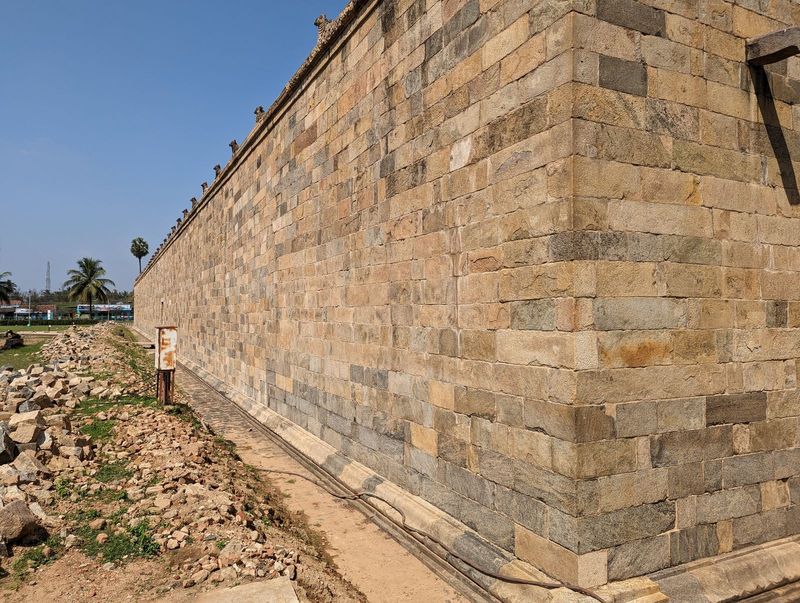
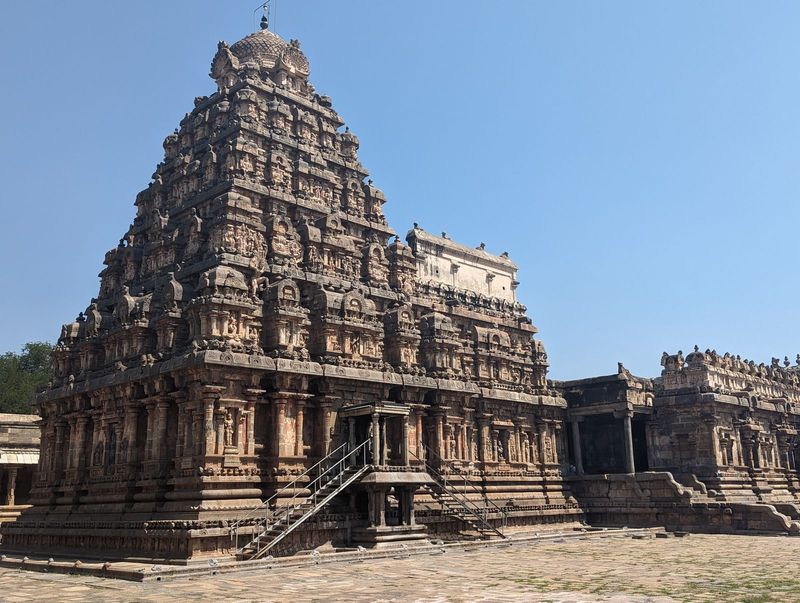
An Immaculate wall, even modern if you overlook the little Nandis up top. This is the Airavatesvara Temple at Darasuram, just outside Kunbakonam. It was built at the order of Rajaraja II (r. 1150-1173) about a century after Rajaraja I built the Big Temple Tanjore. Yes, at the left edge you can see lawn, a tipoff that the Archaeological Survey of India is in charge.
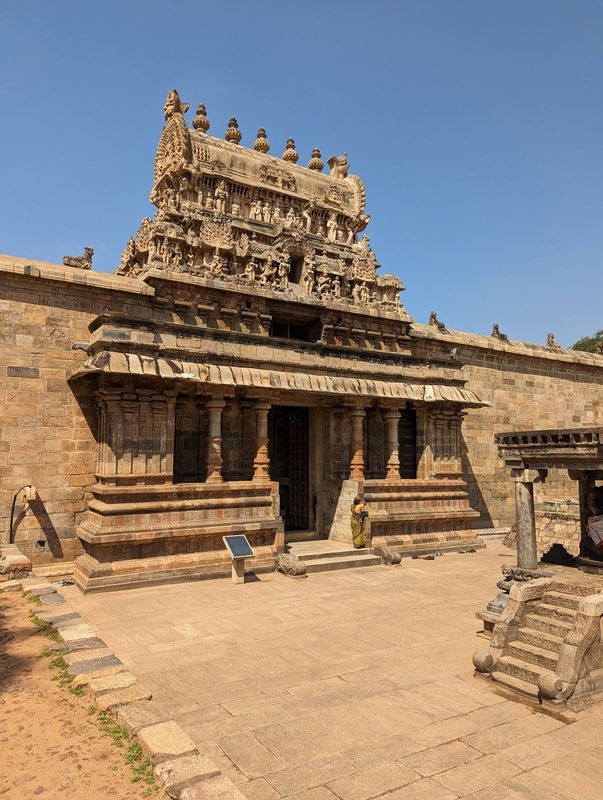
The main entry is modest compared to that at Thanjuvur's Big Temple., but everything here, not just the entry, is on a reduced scale. The gopuram reminds me (I'm shameless) of a covered wagon carried by family members acting like pall bearers. Note also that the temple is below the ground surface. Credit civil engineers who sometime in the last century failed to realize (or didn't care) that the temple would flood during the monsoon. The little sign on a pedestal is another reminder that we're at a World Heritage site and are not allowed to take pictures that don't include something new. (You're right. Things could be worse: consider the huge sign blocking the "Sleeping Buddha" at Polonnuwara--or, worse still, the tower at Pagan/Bagan.)
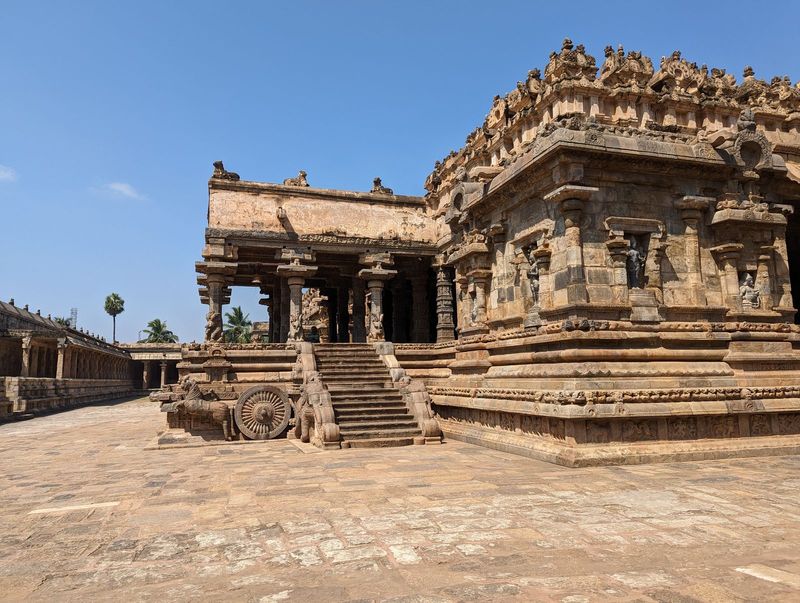
An eminent student writes that "the temple at Darasuram is the most evocative in Chola art..." (Calembus Sivaramamurti, in 5000 Years of the Art of India, 1978, p. 251.) Elsewhere, he writes that Airavatesvara is so elaborately detailed that it is "a sculptor's dream re-lived in stone." (Sivaramamurti, The Art of India, pp. 256-7, quoted by S. R. Balasubrahmanyam in Later Chola Temples: Kulottunga I to Rajendra III (A.D. 1070-1280), 1979, p. 233.)
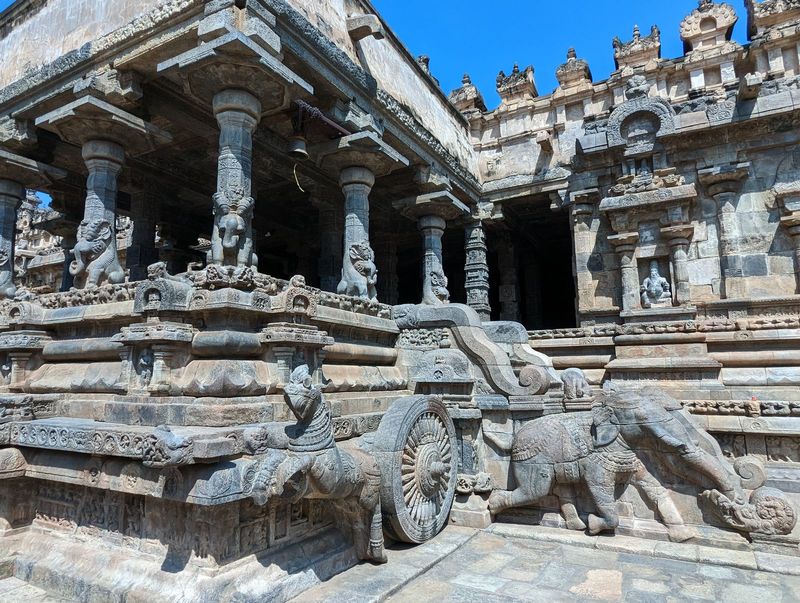
The temple is about to take flight, thanks to its horses and wheels. The idea of making a temple into a chariot was not new: it appears (appeared first?) 20 miles to the northeast at the small Melakkadambur temple built by Rajaraja II's predecessor. After its use here, the idea was magnified a century later at the huge sun temple at Konark, on the coast some 800 miles to the north. The connection is that the builder of Konark, Narasimha, was a descendant of Kulottunga I, the builder of Melakkadambur. (A few photos of Melakkadambur, including its wheels, are at the tail end of the Gangaikondacholapuram Temple. There's a file on Konark, too.)
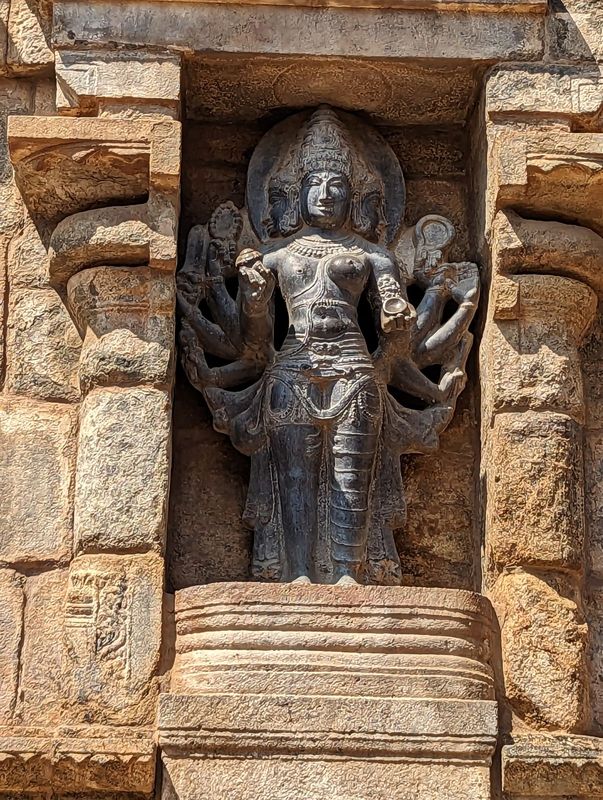
Near those wheels there's this confusing image. Notice that the left breast is male, the right one female. Some authors call this Ardhanari, a bi-sexual blend of Shiva and Parvati. The female half holds a skull cup, however, which is part of the reason for another scholar (Ramachandran Nagaswamy) calling this an image of Tantri Mahamaya. Opting for vagueness, the Archaeological Survey of India has called this a "unique syncretisation of divinities..." (Sirkali Ramaswamy or just plain S. R. Subrahmanyam wonders if this image was part of a Sakti cult. (S.R. Subrahmanyam, Later Chola Temples, 1979, pp. 232-4.)
I
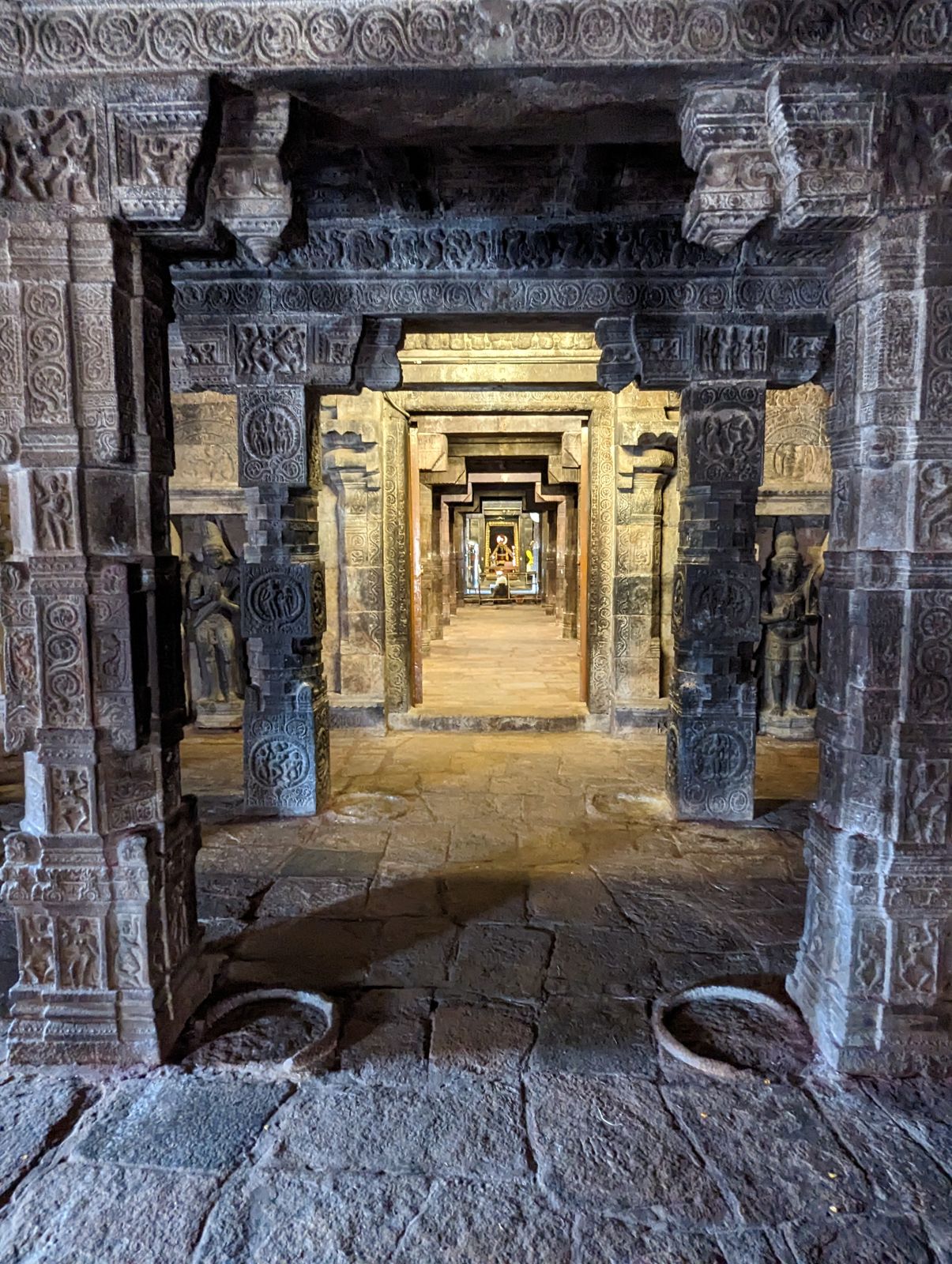
Pathway through the temple toward the sanctum, the garbhagriya, literally the womb chamber.
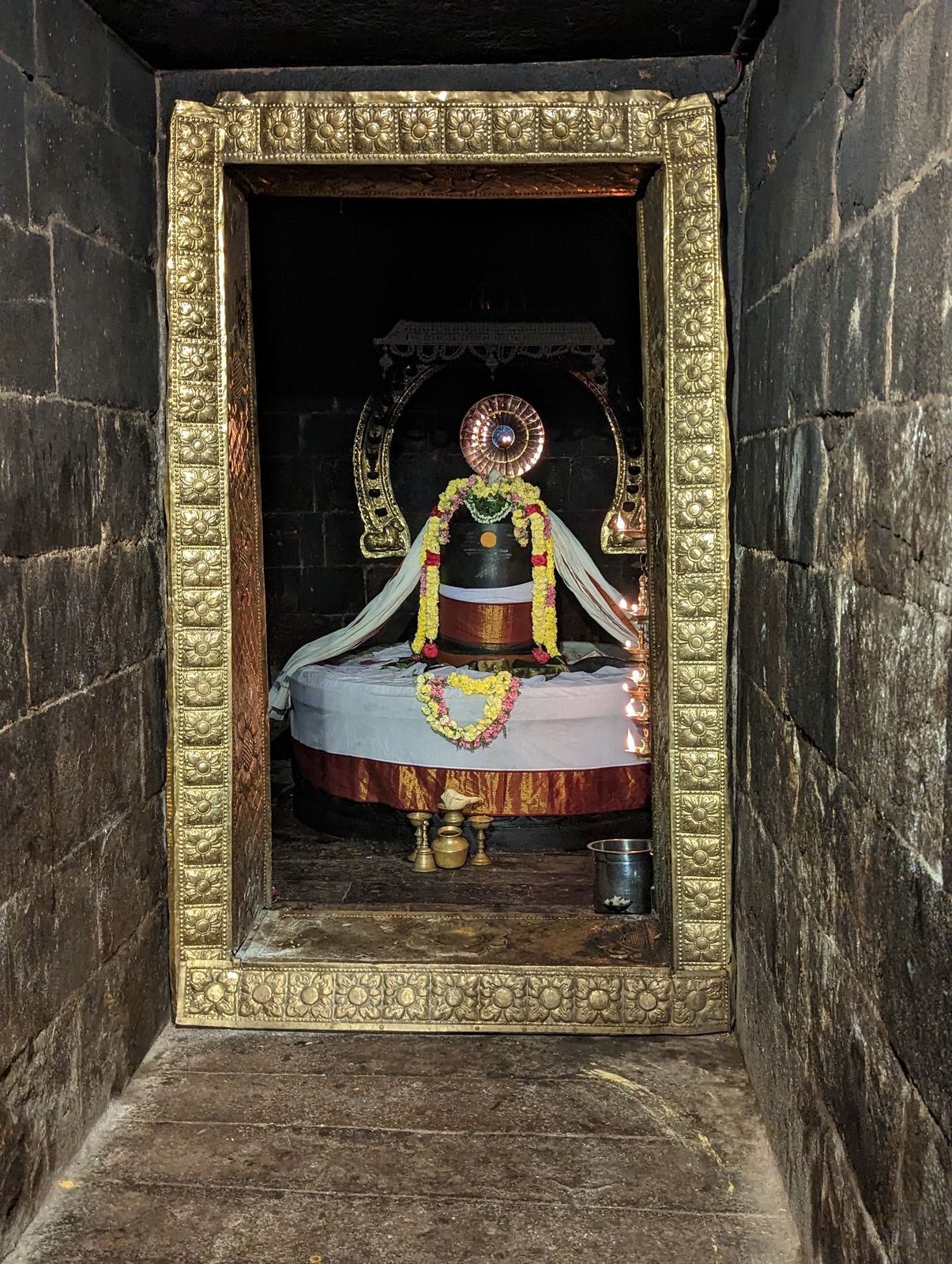
The lingam.
The temple once held a statue of Rajaraja II, but it's been moved to the Thanjuvur Art Gallery. Pity. Don't suppose there's a campaign to repatriate it.
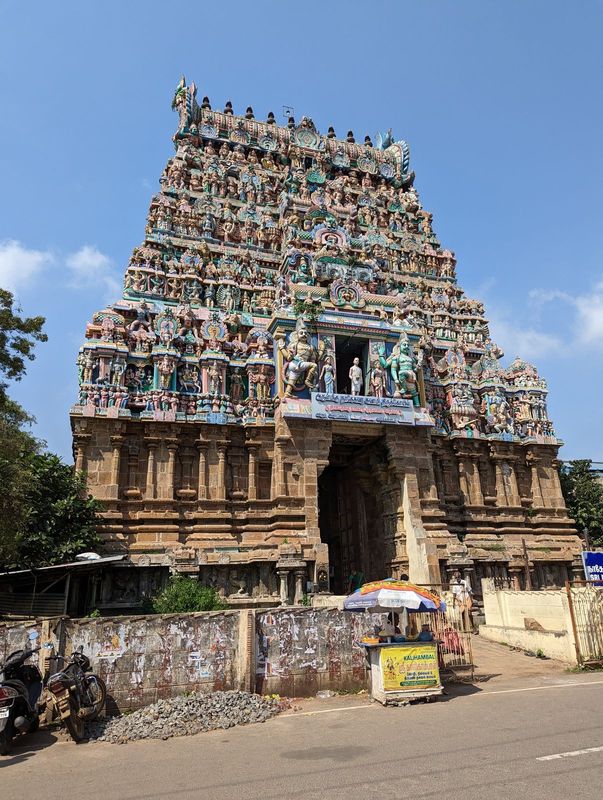
We've moved to an older temple in the center of Kumbakonam. The Encyclopedia of Indian Temple Architecture calls this "perhaps the most celebrated" early Chola building (vol. 1, part 1, p. 159). It's the Nagesvaran Temple, with a core built during the reign of Aditya I (870-907), the second Chola king. The gopuram is centuries later.
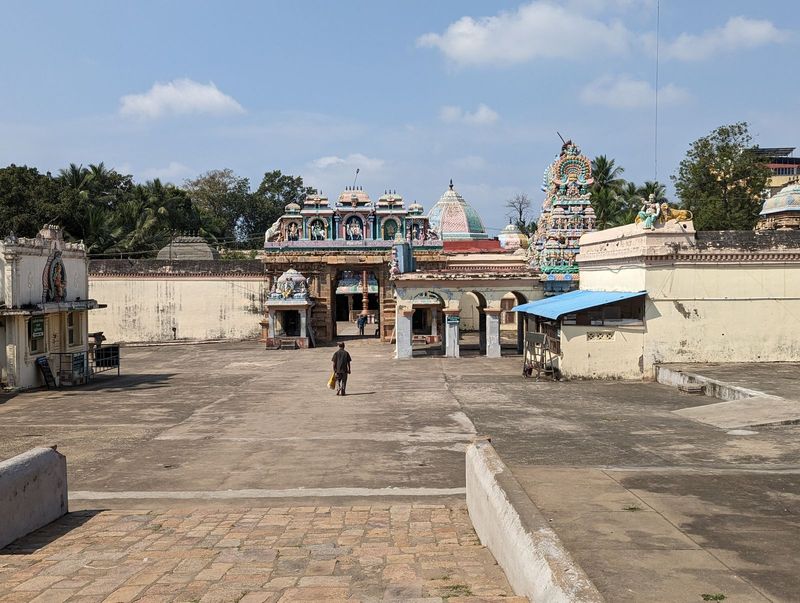
You're not impressed by the inside? Cool your jets.
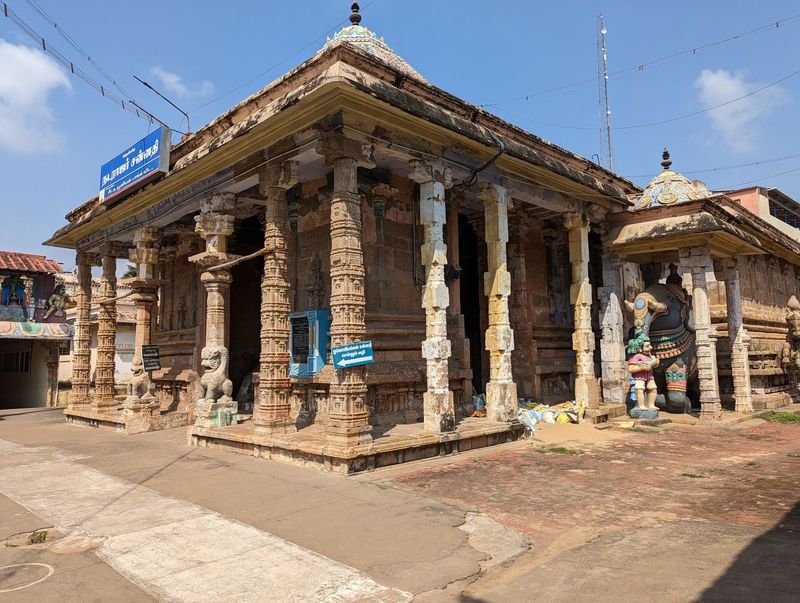
No better? Take it easy.
'
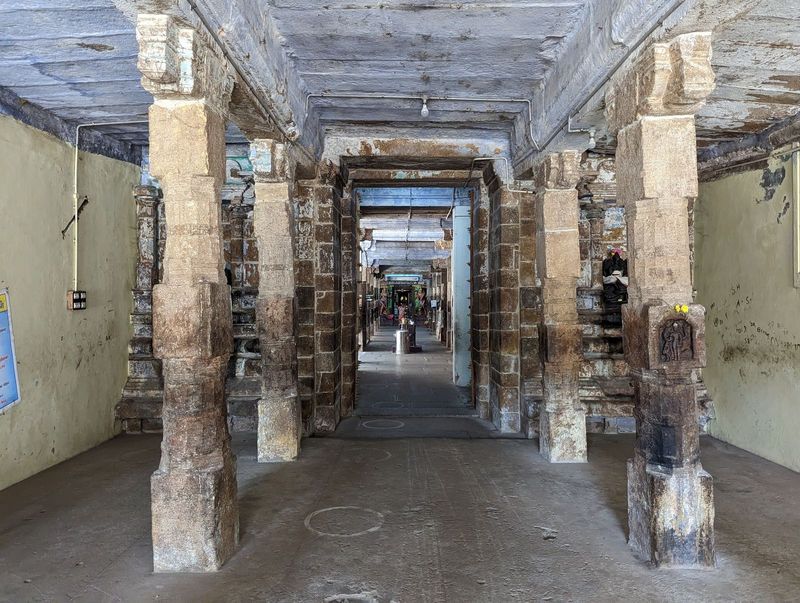
We're entering the mandapas or porches leading to the shrine.
I may as well tell you that I'm heading to the outside wall.
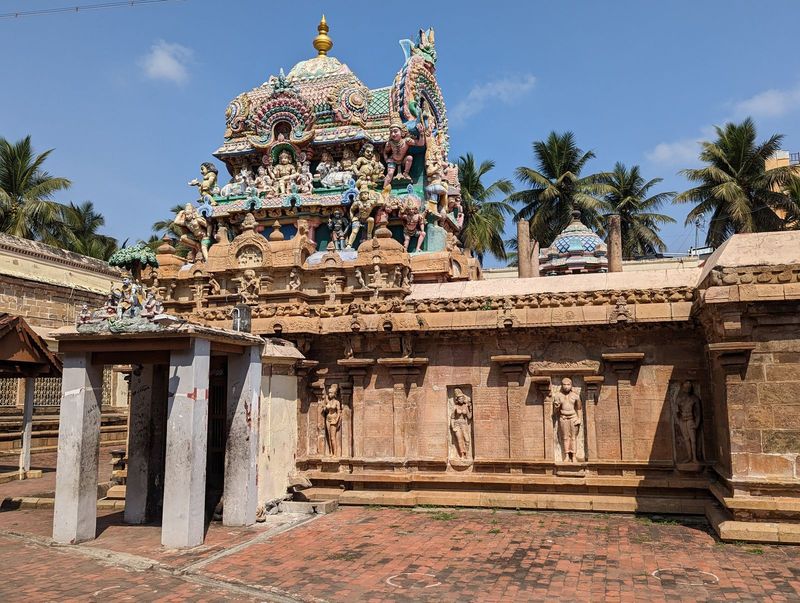
The late S.R. Balasubrahmanyam, a leading authority, writes, "This is one of the finest of the early Chola temples. Its original structure and the exquisite sculptures on it were really things of beauty radiating joy and aesthetic elevation. It is a pity that this gem of art is marred by bizarre colour-coating indulged in by modern renovators ignorant of the value of true art." (S.R. Balasubrahmanyam, Early Chola Art, Part 1, 1966, p. 136.) An English author is almost equally angry: this shrine "cleaned and relieved of its disfiguring stucco on the tower, would be one of the finest things in India." (Douglas Barrett, Early Cola Architecture and Sculpture, 1974, p. 68.)
And they didn't even get to enjoy the concrete addition!
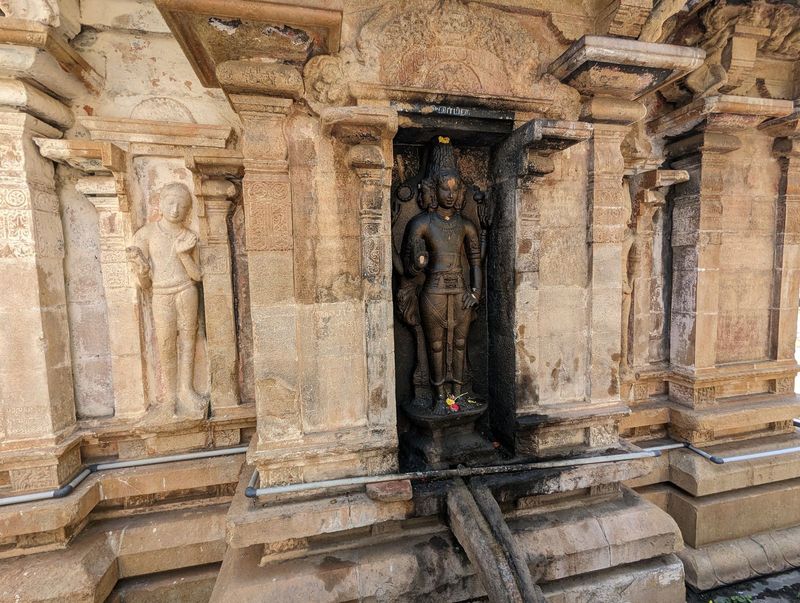
Here's the stand-out: an image of Brahma on the north side of the vimana.
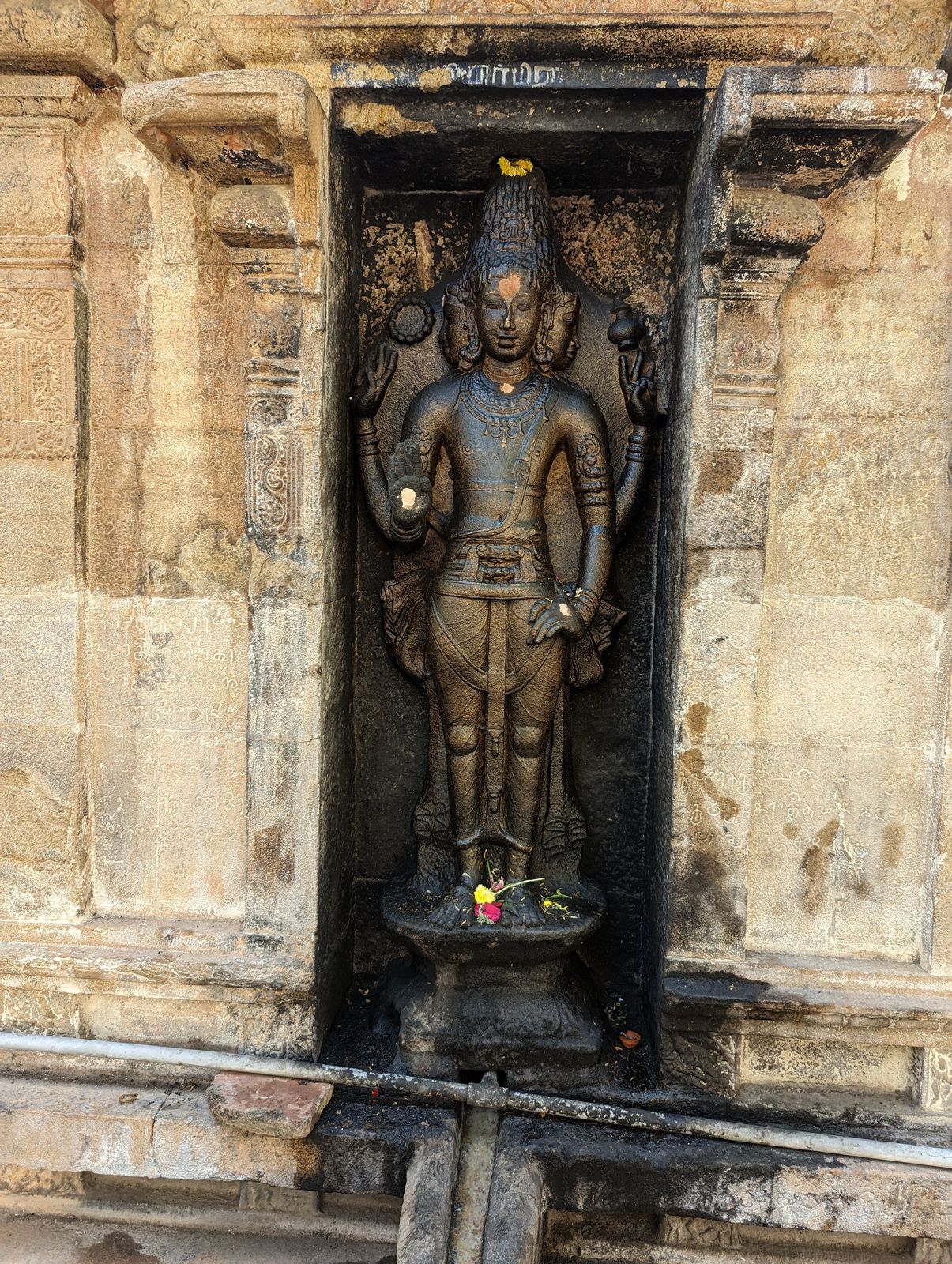
Closer. The Encyclopedia of Indian Temple Architecture says that these figures have a "vitality and intensity unknown in other Cola examples" (1983, vol. 1, part 1, p.161).
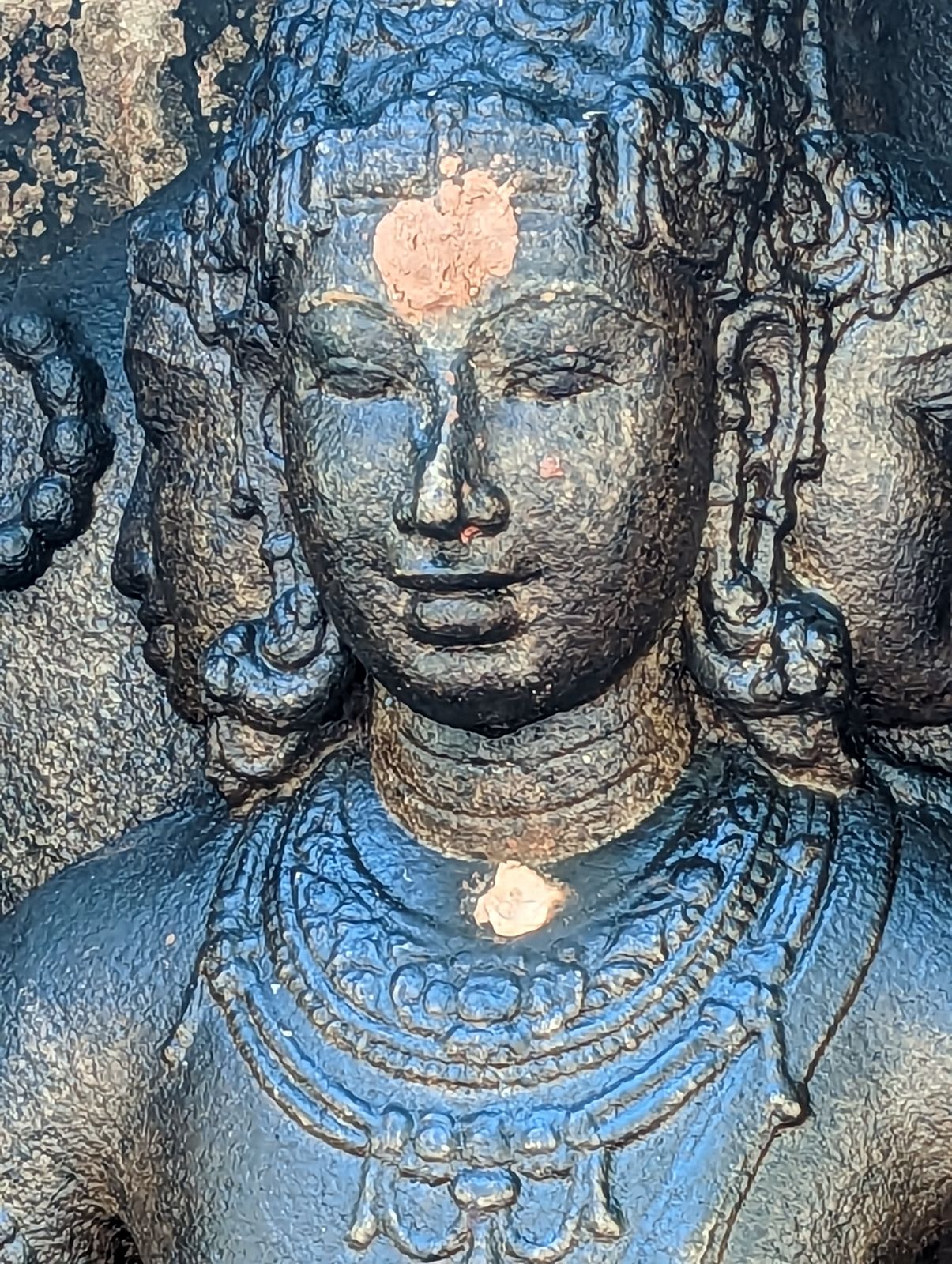
You buy that? I do--and more. Sorry, but I can't tell you what he's saying. It's personal.
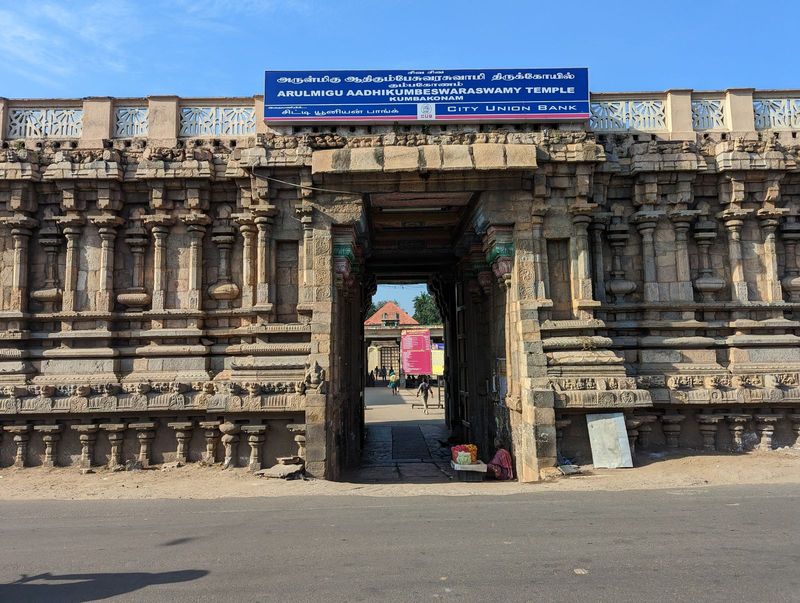
We've moved on to a side entrance (no gopuram here, or at least none left) of the Adi Kumbeswararar Temple.
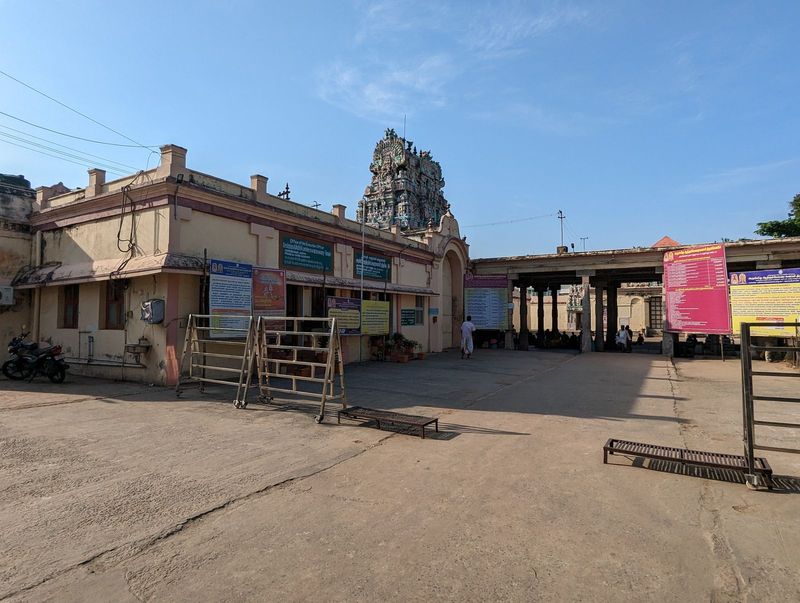
Gotta love these billboards.
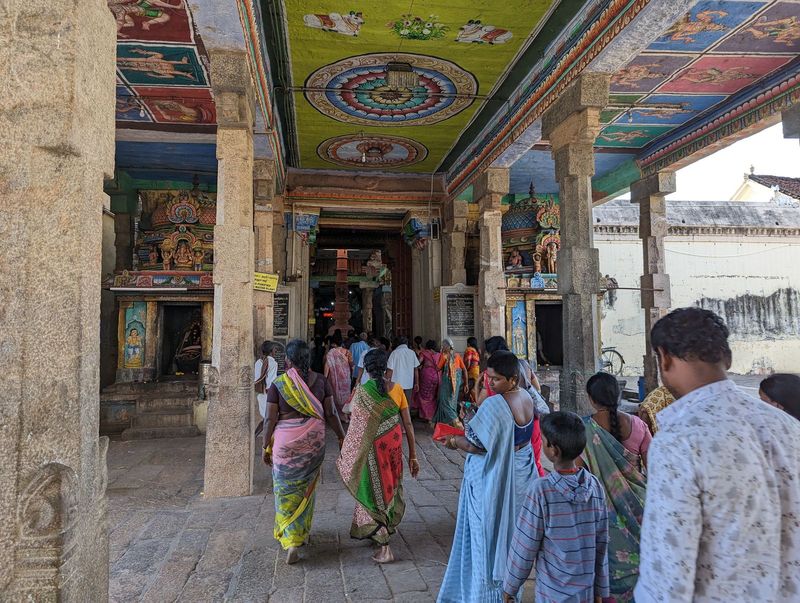
Popular place, with shrines to both Shiva as Adi Kumbeswarar and Parvati as Mangalambai Amman.
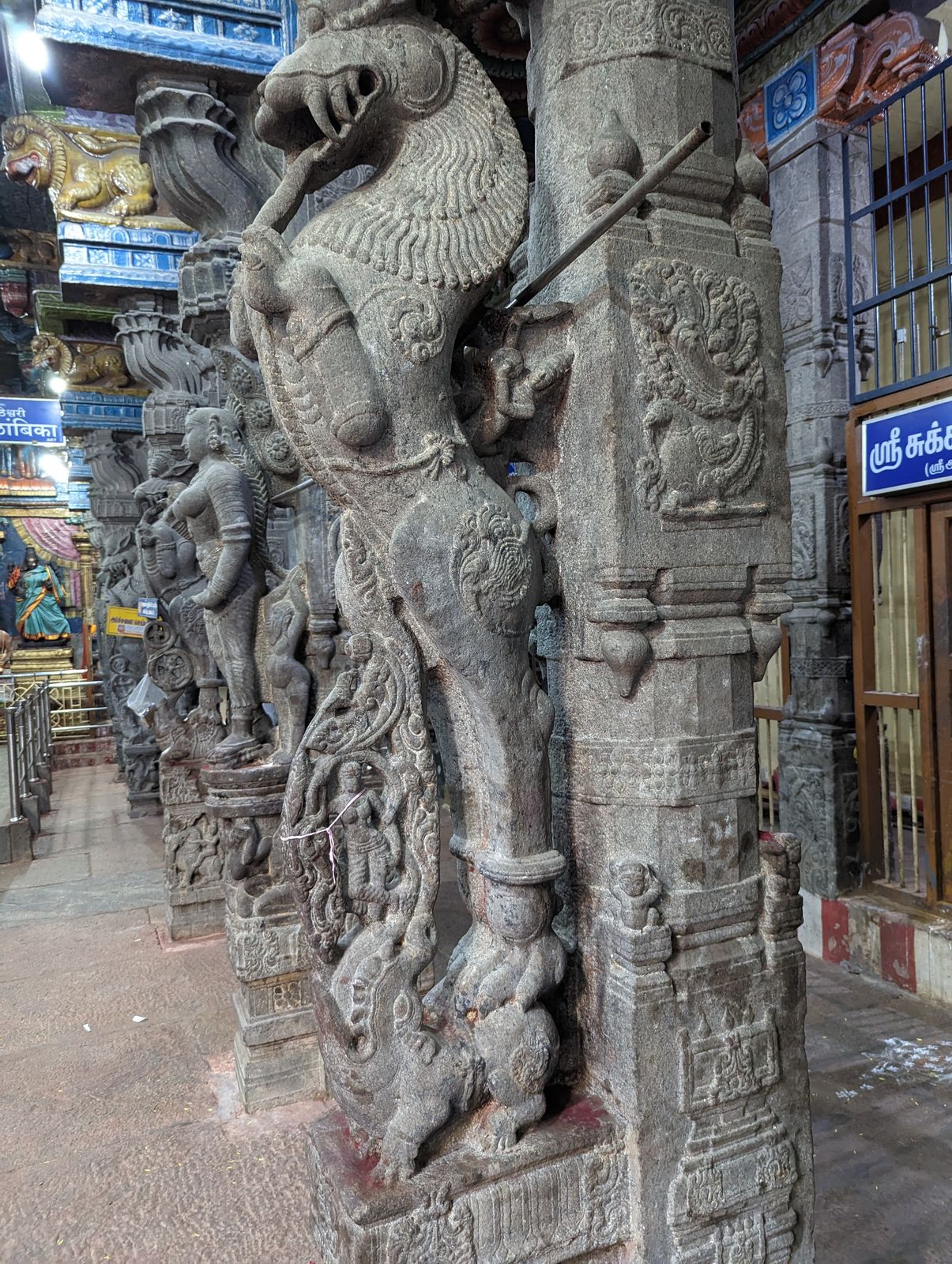
Parts of the temple, like these pillars, are from the 1600s and later.
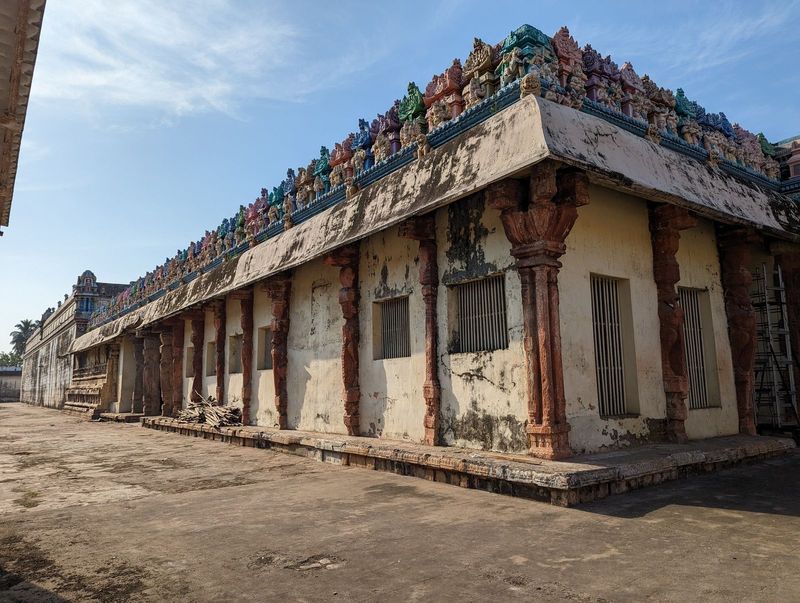
This pillared hall had no wall until somebody in charge decided that walls should be added, with barred windows. A trifle grim, no?
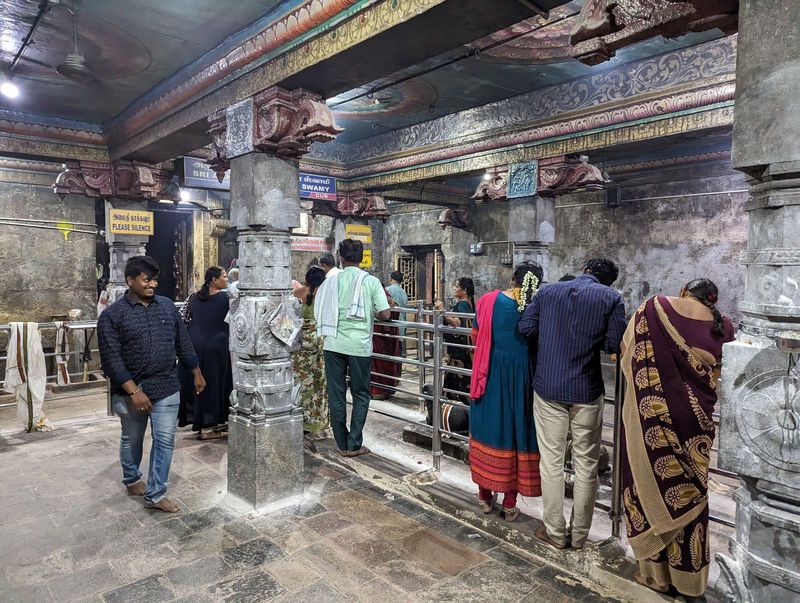
We're drifing around inside.
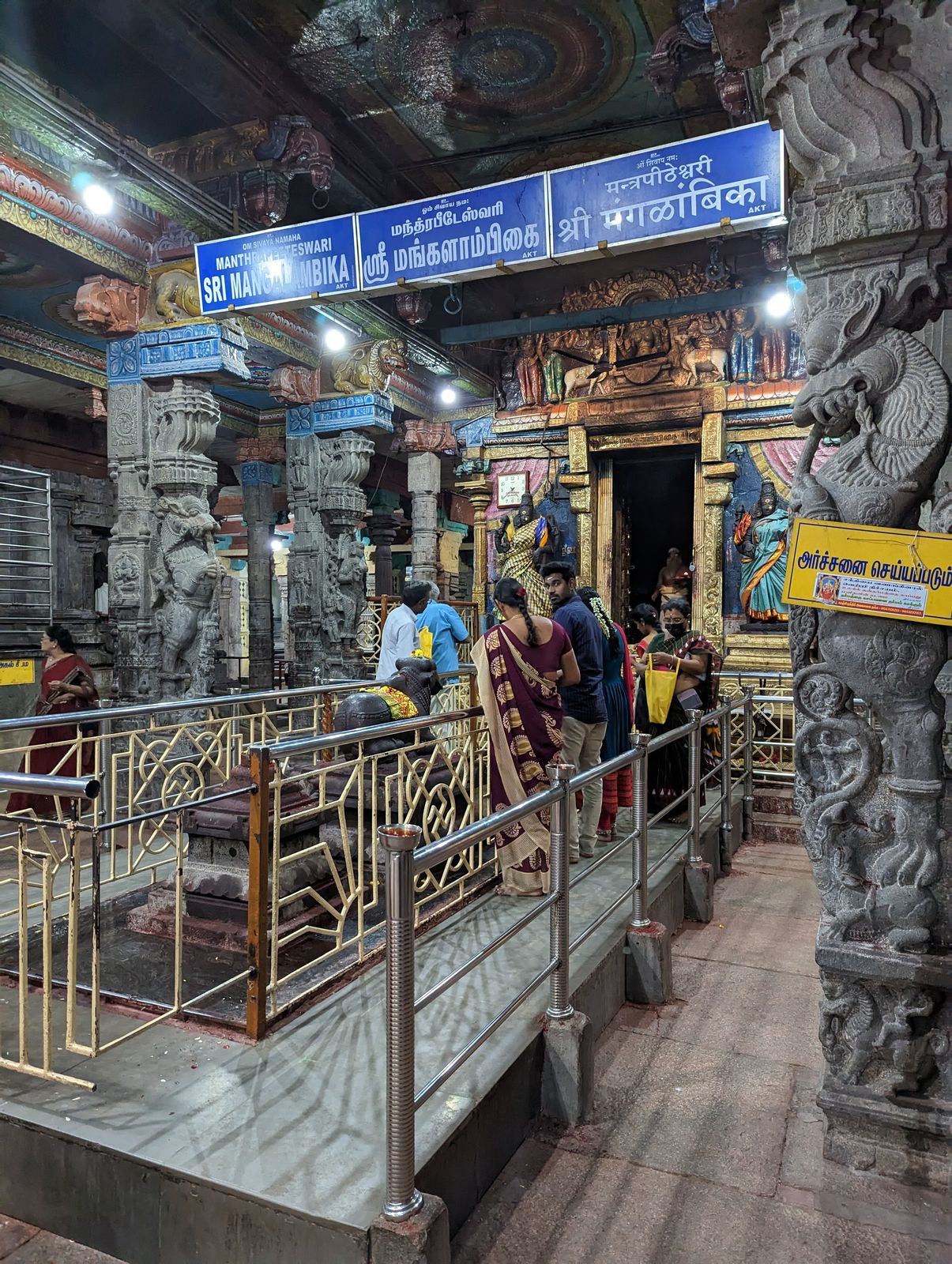
Everybody is happy wth the stainless steel, the bright lights, the signs.
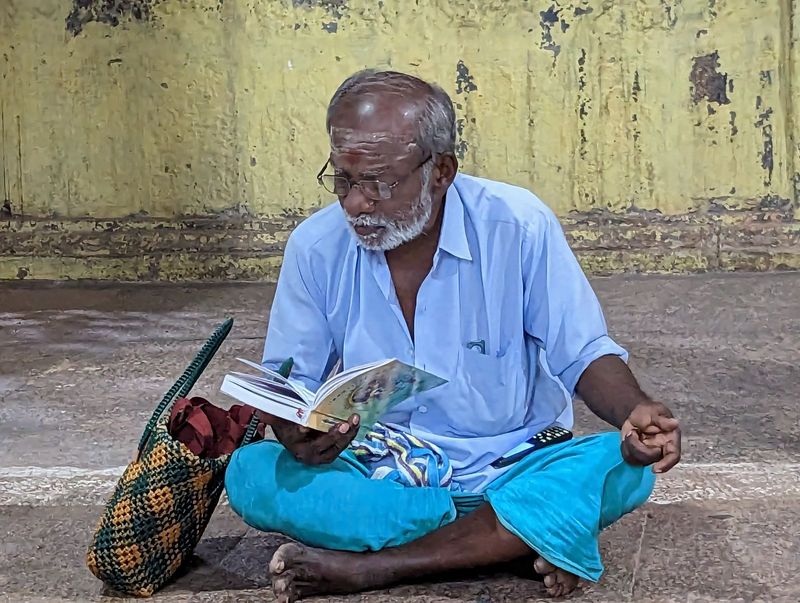
Some relief: just outside the Shiva as Adi Kumbeshwarar shrine, a man chants from the Tevaram, sacred poem from the 7th and 8th centuries. Too bad you can't hear him. Very peaceful. Resonant in this space. Nobody paid him any attention.
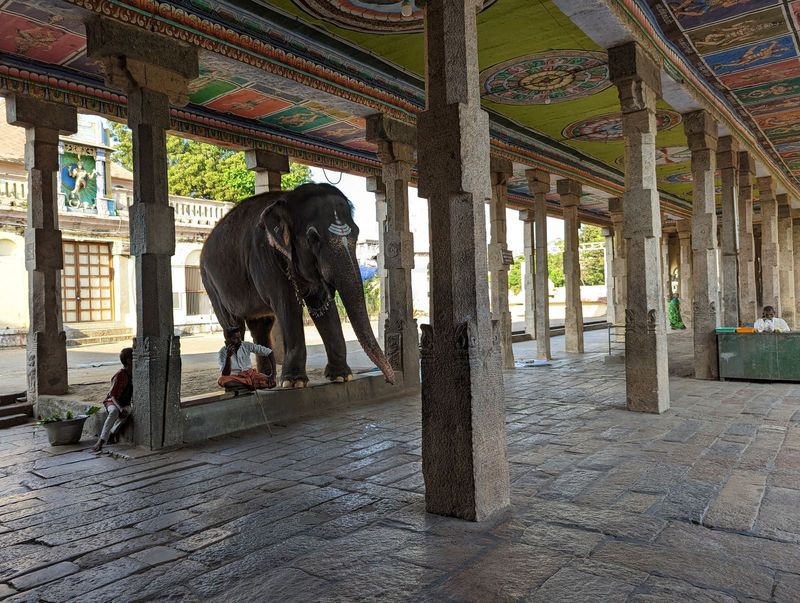
Gotta feel sorry for this elephant, even if he does support a family or two. He was shifting his weight back and forth like a convict pacing.
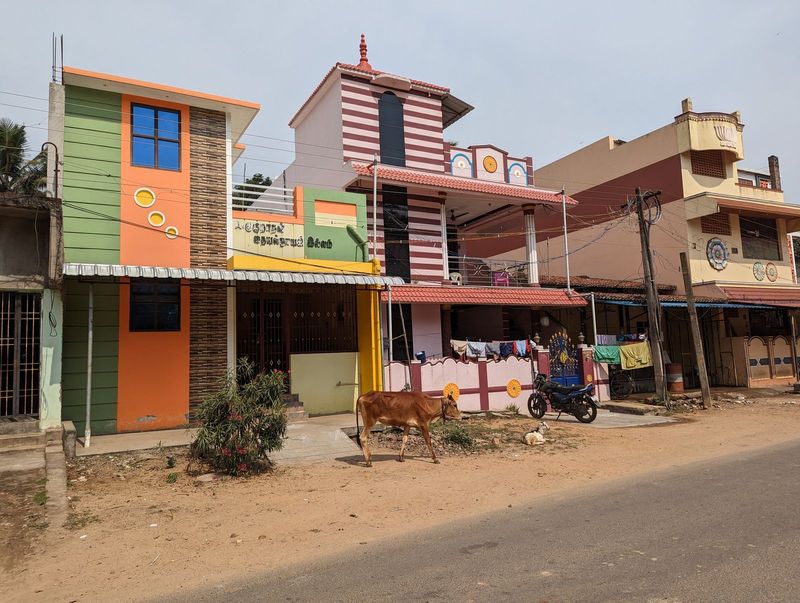
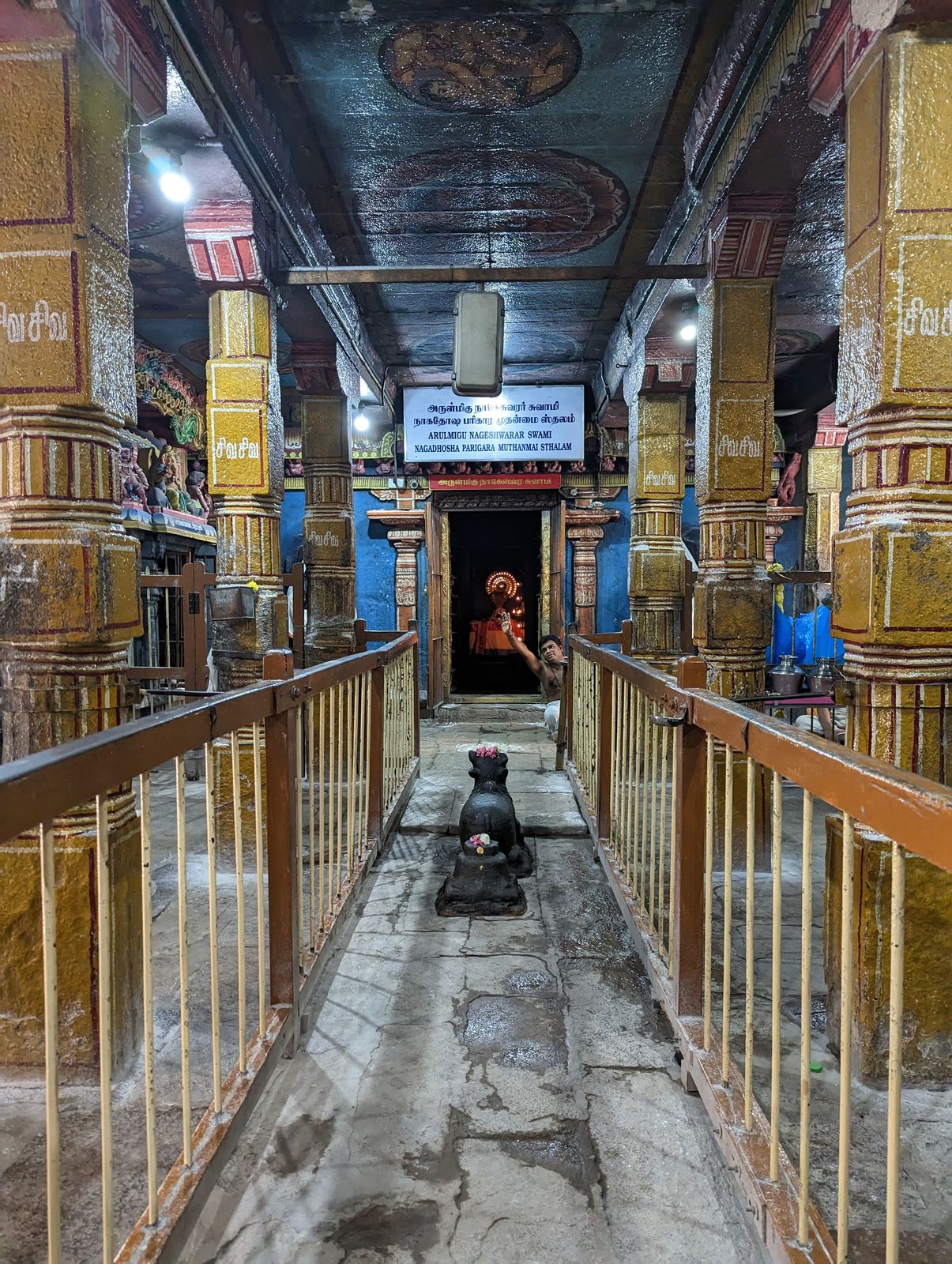
I was trying to get to the Arulmigu Sri Oppiliappan Temple, but I got lost. Still, when I found this street I knew I had to be near an important temple. (As the realtor says, "location, location, location.") Unfortunately for me, it wasn't the temple I wanted, it was the Arulmigu Naganathaswamy Temple. Wanna peak?
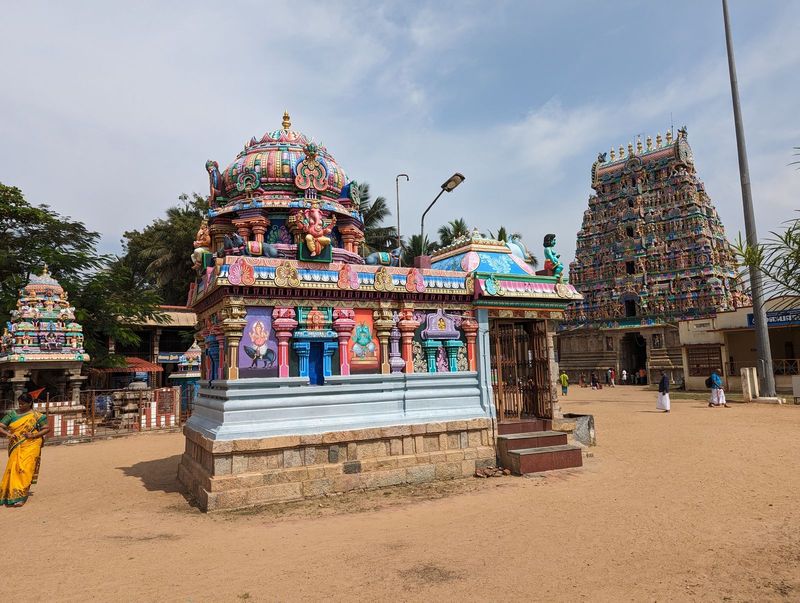
Be careful what you wish for. Here are some Disneyesque side shrines; the main temple is under the gopuram.
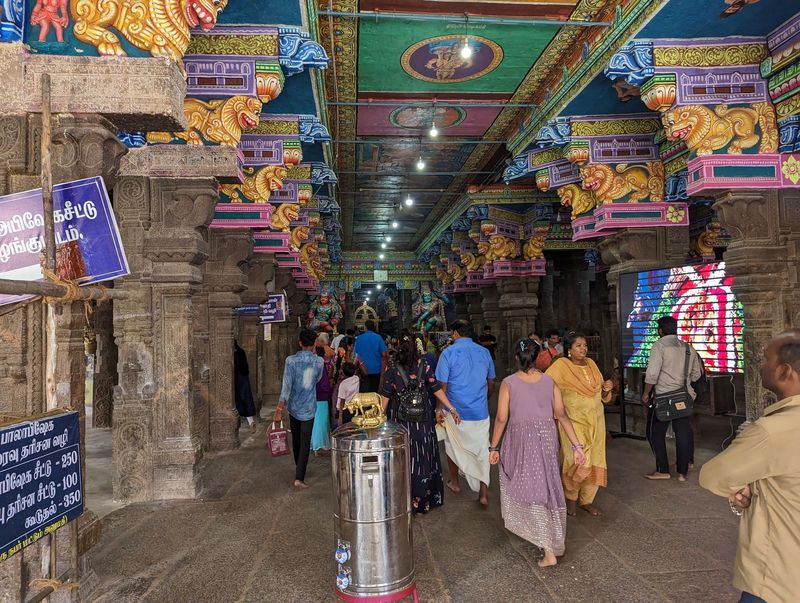
Paint makes everything better.
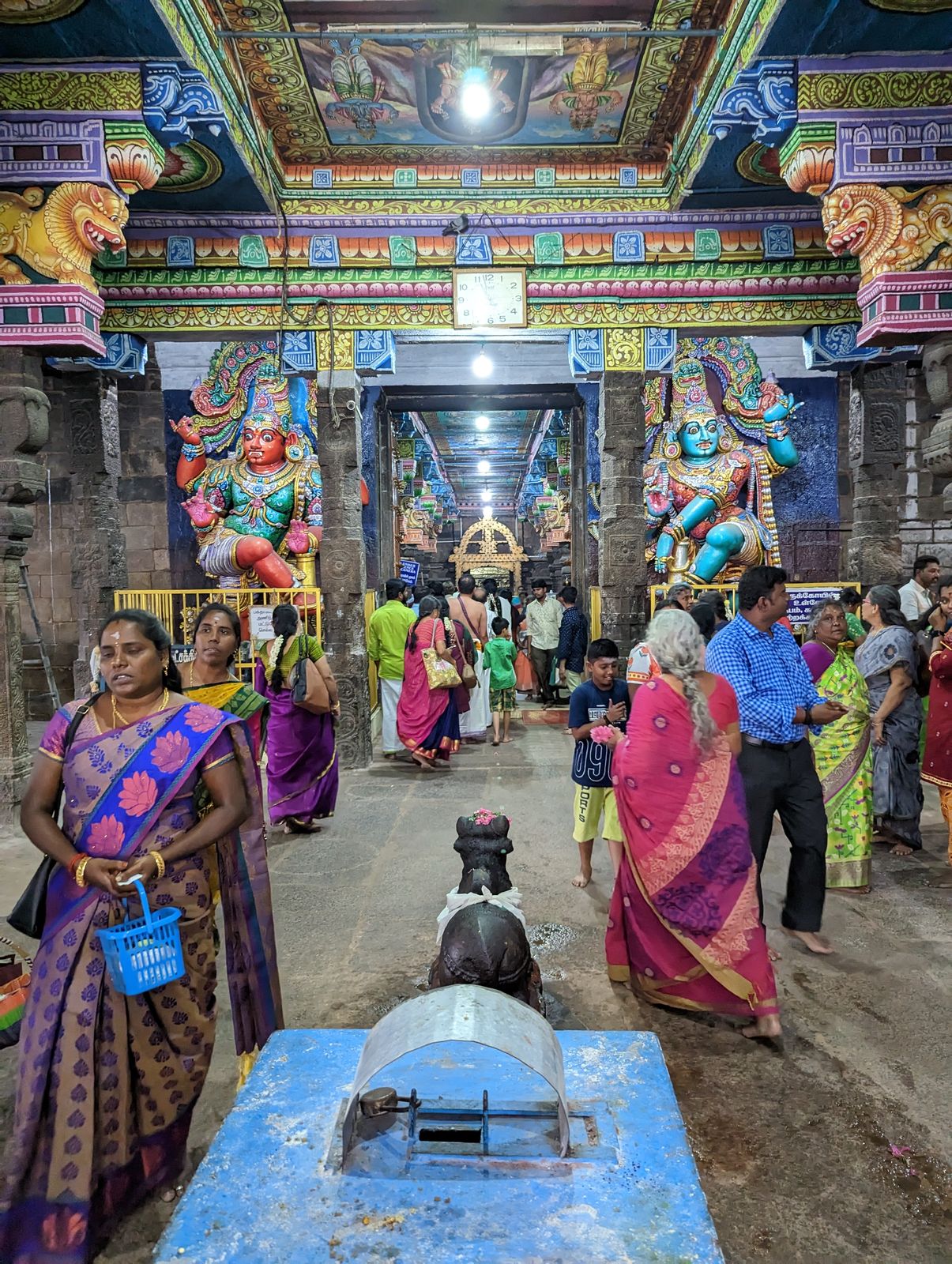
I hear Nandi asking somebody to please remove those cold, cold LEDs.
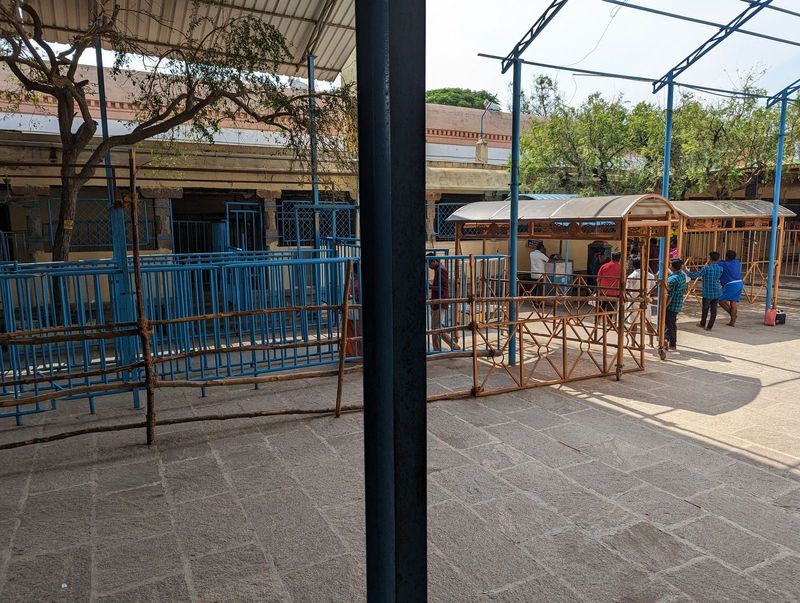
I'll wait out here, next to the airport-style qeueing. Obviously, it's a quiet day.
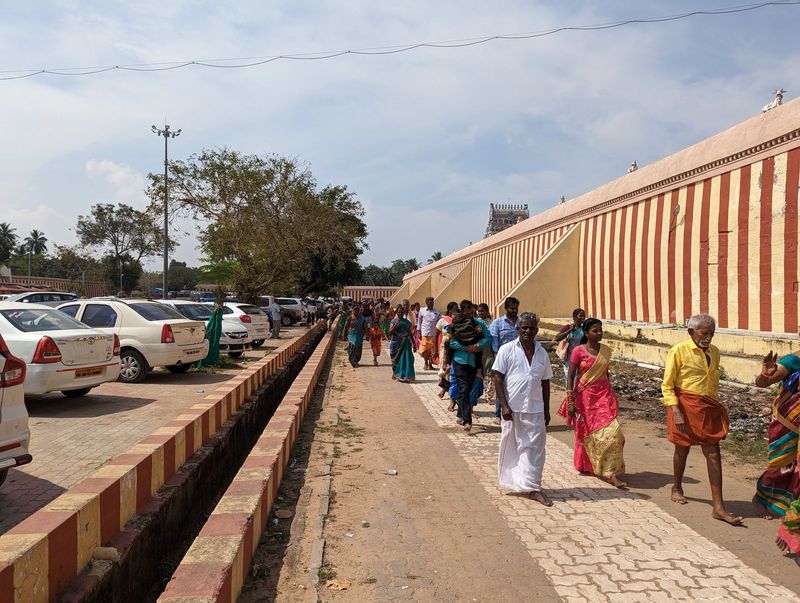
Wonder what a peak day would be.
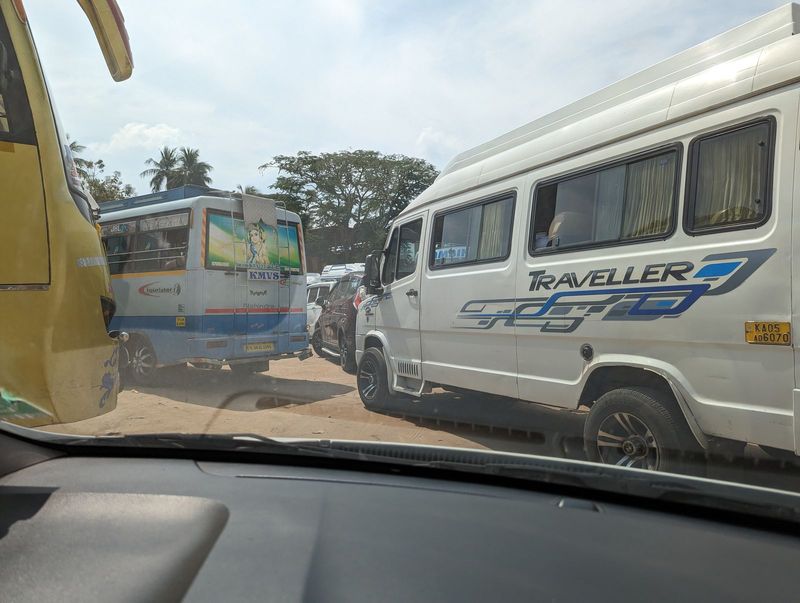
I was trying to get out of the parking lot, but I wound up turning off the engine and waiting at least five minutes for somebody to unpick the gridlock.
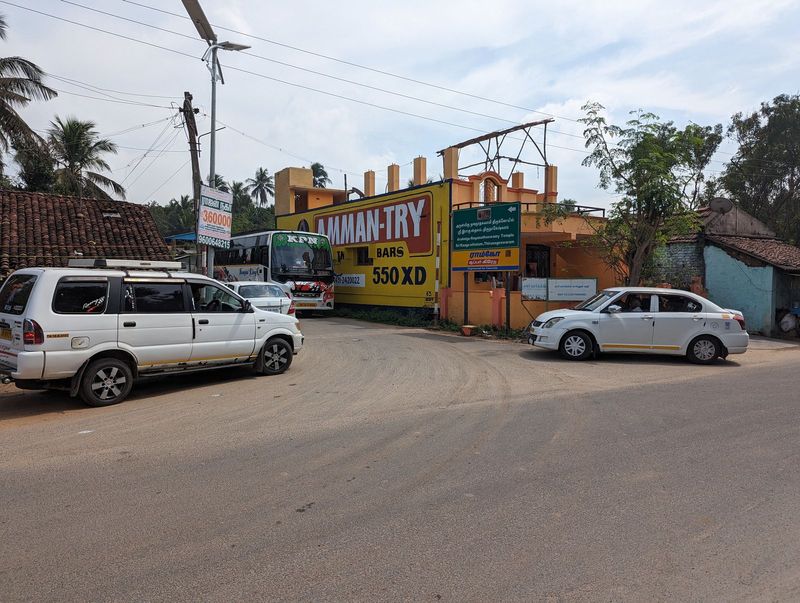
People were still entering. No point in warning them.