Cauvery Temples 5. Gangaikondacholapuram
<p><img src="https://wtbl.nyc3.cdn.digitaloceanspaces.com/40f9ca11caa34641f907476d617ab71b#orig=/sha256/40f9ca11caa34641f907476d617ab71b554cc9e2039161dd365462f273c78703"></p> <p>We're between Kumbakonam and Chidambaram and stopped at the parking lot in front of the jawbreaking Gangaikondacholapuram Temple. Built by Rajendra, son of Rajaraja, it's smaller than daddy's temple at Tanjore but is pristinely cared for by the Archaeological Survey of India. Witness the lawn, an ASI footprint. Everything is shipshape today, but return to the 1930s. Here's Percy Brown describing the place he saw then: "...this fine structure now stands in solitary state, except for the mud huts of a village straggling around it... Nature with artistic hand has endeavoured to veil its abraded surfaces... so that it appears as a lovely grey-green pile lumbering amidst the tangled verdure of a wide neglected garden. Built by a king for the purpose of his own religious ceremonial it has now become the occasional resort of the local idlers, and even its existence is known only to a view. ... (Brown, <em>History of Indian Architecture</em>, 1940, vol. 1, p. 86). The unflattering comparison that comes to mind is Angkor, where the strangling figs have not been stripped away from the ruins, which are all the more atmospheric for it.</p> <p> </p> <p> <img src="https://wtbl.nyc3.cdn.digitaloceanspaces.com/31bc967c5aad21795ebef6cdca8f542a#orig=/sha256/31bc967c5aad21795ebef6cdca8f542af5fbd84524cedc8d98b1b15809b522e4"></p> <p>We're looking at the vestiges of a gopuram. When was it last used as a quarry? Not so long ago, judging from this record of a visit to the site in the 1870s. The visitor was Col. Brydges Robinson Branfill, deputy-superintendent of the Trigonometrical Survey of India in charge of the Madras Party. "Roughly speaking, it is a facsimile of the great Tanjore Temple, possibly its prototype, or perhaps more probably a copy; but never having been "restored," as the Tanjore example has, and being built throughout in a very hard kind of stone, it retains much of its pristine appearance and purity of design, which has been lost there." Branfill continued in language surprising for a military officer: "the chief ornament of the pyramidal portion of the tower is the square and oblong cells of "Rath" (=car) or "Gopuram" (=spire-roofed) pattern, with their elaborate fan-shaped windows, like spread peacocks' tails." Odd attention to esthetic detail for a senior military officer, no? Turning to this gopuram, he writes of "the court-yard of the temple ... with a fine gopuram or entrance tower built entirely of stone (fast falling down)." (<em>Journal of the Asiatic Society of Bengal</em>, vol. 49, 1880, pp. 1-4). </p> <p> <img src="https://wtbl.nyc3.cdn.digitaloceanspaces.com/cbd1d158f98ffc6543db3edc0a986fb1#orig=/sha256/cbd1d158f98ffc6543db3edc0a986fb1c9a70d226396193e10551b67d2fd39ad"></p> <p>The temple base or upapatha comprises a stack of traditional elements, each layer names. The bottom layer is the <em>upana</em>, for example, and the semicircle projecting from a vertical diameter is the <em>cumud</em>. The pioneering modern study of this grammar is the <em>Essay on the Architecture of the Hindus (</em>London, 1834, reprinted Delhi 2021) written in his spare time by a judge in Bangalore who hunted up old, mostly fragmentary treatises on the subject and tried to make sense of them. Born in Tranjore, he was Ram Raz (1790-1830).</p> <p>For a sample of the ties that bound temple architects, consider this sentence Raz quotes from Manasara, his principal source. Writing about <em>upapitha</em>s, or pedestals, Manasara instructs the builder to "let the height of the <em>upapitha </em>be divided into thirty equal parts, give three to the <em>upana</em>, a half to the<em> campa</em>, three to the <em>mahambuja</em>, a half to the campa, two to the<em> candhara</em>... " etc. Raz writes that "Manasara, our principal guide, expresses himself in so obscure a manner, that I must acknowledge my inability to understand him thoroughly." (Raz, p. 27.)</p> <p> <img src="https://wtbl.nyc3.cdn.digitaloceanspaces.com/12e9104f0a17261c51f67c0288910676#orig=/sha256/12e9104f0a17261c51f67c0288910676b79b6f376362d7e5f2ec5bdd9e84ffc4">F</p> <p>For all that attention to detail, the huge anteroom or <em>mahamandapam </em>presents a wall to the world.</p> <p> <img src="https://wtbl.nyc3.cdn.digitaloceanspaces.com/820c8bd4c3009e0267899c065efc50c1#orig=/sha256/820c8bd4c3009e0267899c065efc50c14f96504b05c745bbc30024867b069fe1"></p> <p>No intimidation here, only a friendly Nandi. Original? Almost certainly not. The temple has a much larger and less friendly version just behind this fellow, who sits up on the level of the anteroom.</p> <p> <img src="https://wtbl.nyc3.cdn.digitaloceanspaces.com/6be2187924e7e97afdc2a84d69a8e70e#orig=/sha256/6be2187924e7e97afdc2a84d69a8e70e93f6df787a13027f780814202b79dc07"> </p> <p>The interior of the antetoom is monotonous. </p> <p> <img src="https://wtbl.nyc3.cdn.digitaloceanspaces.com/7982d700b57e073bfe26b253e725d178#orig=/sha256/7982d700b57e073bfe26b253e725d17872f95d628fa950acbf77b0ef91355a04"> </p> <p>Except for entrance sculptures like this dvarapalaka.</p> <p> <img src="https://wtbl.nyc3.cdn.digitaloceanspaces.com/f7a39c642548d3bc13190923e30a96bc#orig=/sha256/f7a39c642548d3bc13190923e30a96bc1d02c4da2e6ddbfaf298e7f72c6e5edd"> </p> <p>This Saravati, the goddess of wisdom.</p> <p> <img src="https://wtbl.nyc3.cdn.digitaloceanspaces.com/78a149455a4a256cf4a3ec121b27e08f#orig=/sha256/78a149455a4a256cf4a3ec121b27e08fa7c6c0551a6c11cdcc01db7ee7390505"></p> <p>Kankalamurti, "the one with the skeleton," is a fearsome form of Shiva, shown with a spine draped over his shoulders. Why is he here? Perhaps as a reminder of Rajendra's power.</p> <p> <img src="https://wtbl.nyc3.cdn.digitaloceanspaces.com/62957dd4cbbc4edcb2734b32629fbc45#orig=/sha256/62957dd4cbbc4edcb2734b32629fbc45a8cfdc0bf09ab3c75cbf8763c9ff2e51"> </p> <p>Stairs lead down from both sides of the shrine, which is to the left.</p> <p> <img src="https://wtbl.nyc3.cdn.digitaloceanspaces.com/bc125f560c384c3057b66359eddc0808#orig=/sha256/bc125f560c384c3057b66359eddc0808e3d621c6e62fd897ec99bda62dc3bb57"> </p> <p>Smaller than the temple at Tanjore, Gangaikondacholapuram is more elaborately detailed.</p> <p> <img src="https://wtbl.nyc3.cdn.digitaloceanspaces.com/33c794ec94116869e64a0de3c8b0491a#orig=/sha256/33c794ec94116869e64a0de3c8b0491aa580900690092d6b2c0aaa6b1fc60d8c"></p> <p>The kids aren't the least bit alarmed by the dvarapala.</p> <p> <img src="https://wtbl.nyc3.cdn.digitaloceanspaces.com/030f360beb982480f5178ecac842279f#orig=/sha256/030f360beb982480f5178ecac842279f73856355ff93e713fe64482442f1d708"> </p> <p>They were having fun running along the temple base, much to the annoyance of a maintenance crew.</p> <p> <img src="https://wtbl.nyc3.cdn.digitaloceanspaces.com/0c968d44f509d496c1f8826391ef7a8a#orig=/sha256/0c968d44f509d496c1f8826391ef7a8a15c42ba0c7a1641dbf13c2070095efab"> </p> <p>The vimana from behind.</p> <p> <img src="https://wtbl.nyc3.cdn.digitaloceanspaces.com/19839131201571b091a849ad6d1076b8#orig=/sha256/19839131201571b091a849ad6d1076b8ffa82533189905769a5b953de38aecbe"> </p> <p>A subsidiary temple to the north.</p> <p> <img src="https://wtbl.nyc3.cdn.digitaloceanspaces.com/726ba58d3930ade9f68b4a6a8d68eda9#orig=/sha256/726ba58d3930ade9f68b4a6a8d68eda9330e3c5aac87c8d53fe6f047b8d2d958"> </p> <p>We shift now to a small but innovative temple. It's the Amritaghateswara temple at Melakadambur. It was built by Kulottunga I (r. 1070-1122), whose capital was at Gangaikondacholapuram, five miles to the southwest, close enough perhaps to justify royal attention.</p> <p> <img src="https://wtbl.nyc3.cdn.digitaloceanspaces.com/aef5c94b264734fa3908529546b2b988#orig=/sha256/aef5c94b264734fa3908529546b2b9888b18a6a5cdc45a439b0bffe8805e1891"></p> <p>Entrance.</p> <p> </p> <p> <img src="https://wtbl.nyc3.cdn.digitaloceanspaces.com/6cd7f072aa16ee59df4608cb1193a9d6#orig=/sha256/6cd7f072aa16ee59df4608cb1193a9d6c988c1527a82fc5f63bb4985afa8981b"> </p> <p>Anteroom, with clothes-line.</p> <p> <img src="https://wtbl.nyc3.cdn.digitaloceanspaces.com/1389d6a0d82e0f8a0c907efdd03af07c#orig=/sha256/1389d6a0d82e0f8a0c907efdd03af07c954c672dd629214932355774a763522e"> </p> <p>One of many details on the anteroom columns.</p> <p> <img src="https://wtbl.nyc3.cdn.digitaloceanspaces.com/7eb72472989baf7c3580626160854df5#orig=/sha256/7eb72472989baf7c3580626160854df573fd7db14f132ad73b88a71f887d9104"> </p> <p>Nandi dressed to kill.</p> <p> <img src="https://wtbl.nyc3.cdn.digitaloceanspaces.com/128917ae10dfccca7fe7e28ae49311de#orig=/sha256/128917ae10dfccca7fe7e28ae49311de3f92deb448aaa1e267834432f08d60e5"> </p> <p>But here's what we came to see: the exterior of the shrine.</p> <p> <img src="https://wtbl.nyc3.cdn.digitaloceanspaces.com/48ac4dd23539e33f2d521244514f7dcf#orig=/sha256/48ac4dd23539e33f2d521244514f7dcfcbb18411e0c3619a2aaa63d3cac77b68"></p> <p>The intimidating name Amritaghateswara comprises three Sanskrit words (amrita=immortality, ghat=step, and eswarar=lord) with the meaning of the lord who leads to immortality. Why do we see wheels attached here? It's a motif picked up later at the Airavatesvarar Temple at Darasuram and amplified still later at the mighty Sun temple at Konark. Call it wild speculation, but I imagine the temple flying off into the heavens or perhaps landing here after the journey. </p> <p><img src="https://wtbl.nyc3.cdn.digitaloceanspaces.com/39d06abd17efc3b56c5240eb310822e0#orig=/sha256/39d06abd17efc3b56c5240eb310822e0b76827d84e4a78eb8598946ea05b9b1e"></p> <p>Here it is with its attached porch or anteroom.</p> <p><img src="https://wtbl.nyc3.cdn.digitaloceanspaces.com/9872716a931cfae688e7d4d774b2d37e#orig=/sha256/9872716a931cfae688e7d4d774b2d37e2f438f15be672510c0916ee99b4376bf"> </p> <p>Busy, busy. At the center, Manasa, the ancient and originally tribal snake goddess. </p> <p> <img src="https://wtbl.nyc3.cdn.digitaloceanspaces.com/7b5b97dfb4dc4727e1f03259d0fa2090#orig=/sha256/7b5b97dfb4dc4727e1f03259d0fa20907d65c2244c8ec2365239940d2af619cd"> </p> <p>Who?</p> <p> <img src="https://wtbl.nyc3.cdn.digitaloceanspaces.com/7ff2ff753ed76aec48eea6fa4fa4d1fe#orig=/sha256/7ff2ff753ed76aec48eea6fa4fa4d1fe7f5c14193b6d705b2e5064e2fdcbdb95"></p> <p>Could this be a portrait of the king who commissioned the temple?</p>
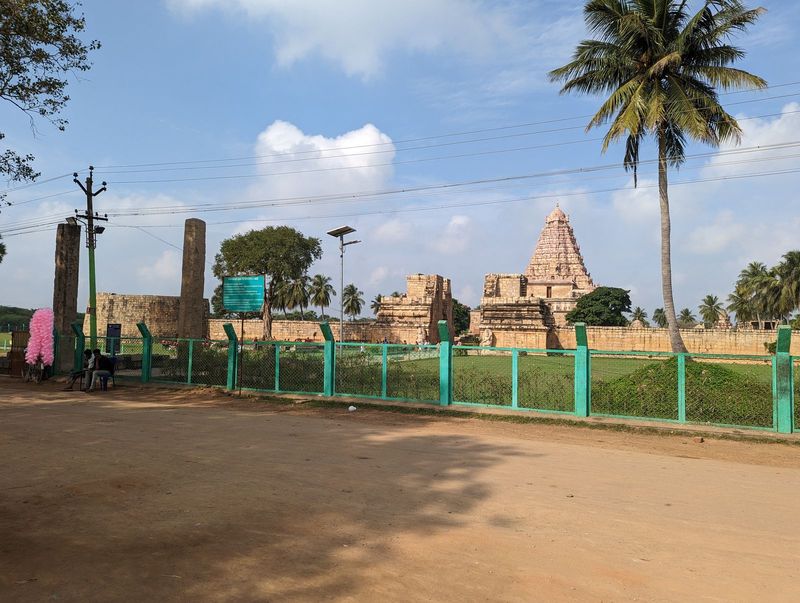
We're between Kumbakonam and Chidambaram and at the parking lot in front of the jawbreaking Gangaikondacholapuram Temple. Built by Rajendra, son of Rajaraja, it's smaller than daddy's temple at Tanjore but is pristinely cared for by the Archaeological Survey of India. Witness the lawn, the ASI fingerprint. Everything is shipshape today, but return to the 1930s. Here's Percy Brown describing the place he saw then: "...this fine structure now stands in solitary state, except for the mud huts of a village straggling around it... Nature with artistic hand has endeavoured to veil its abraded surfaces... so that it appears as a lovely grey-green pile lumbering amidst the tangled verdure of a wide neglected garden. Built by a king for the purpose of his own religious ceremonial it has now become the occasional resort of the local idlers, and even its existence is known only to a view. ... (Brown, Indian Architecture, 1940, vol. 1, p. 86). The unflattering comparison that comes to mind is Angkor, where the strangling figs have not been stripped away from the ruins, which are all the more atmospheric for it.
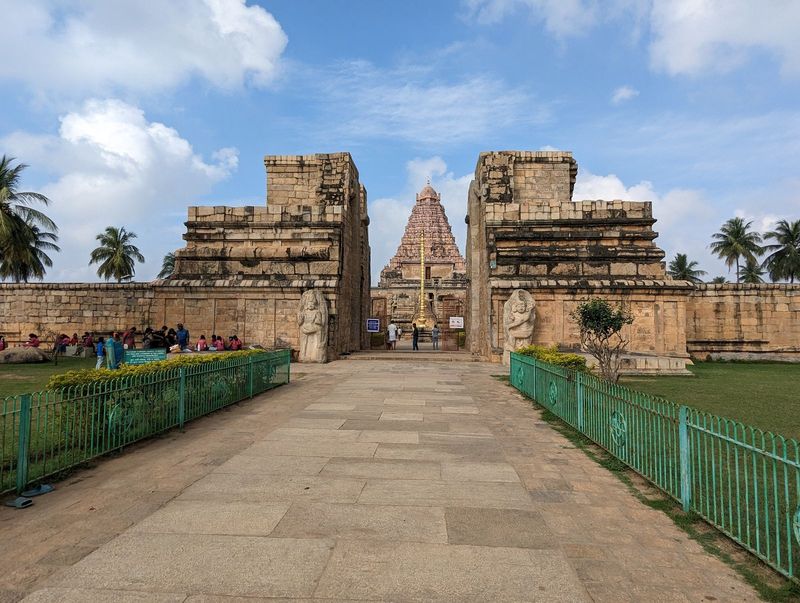
We're looking at the vestiges of a gopuram. When was it last used as a quarry? Not so long ago, judging from this record of a visit to the site in the 1870s. The visitor was Col. Brydges Robinson Branfill, deputy-superintendent of the Trigonometrical Survey of India in charge of the Madras Party. "Roughly speaking, it is a facsimile of the great Tanjore Temple, possibly its prototype, or perhaps more probably a copy; but never having been "restored," as the Tanjore example has, and being built throughout in a very hard kind of stone, it retains much of its pristine appearance and purity of design, which has been lost there." Branfill continued in language surprising for a military officer: "the chief ornament of the pyramidal portion of the tower is the square and oblong cells of "Rath" (=car) or "Gopuram" (=spire-roofed) pattern, with their elaborate fan-shaped windows, like spread peacocks' tails." Odd attention to esthetic detail for a senior military officer, no? Turning to this gopuram, he writes of "the court-yard of the temple ... with a fine gopuram or entrance tower built entirely of stone (fast falling down)." (Journal of the Asiatic Society of Bengal, vol. 49, 1880, pp. 1-4).
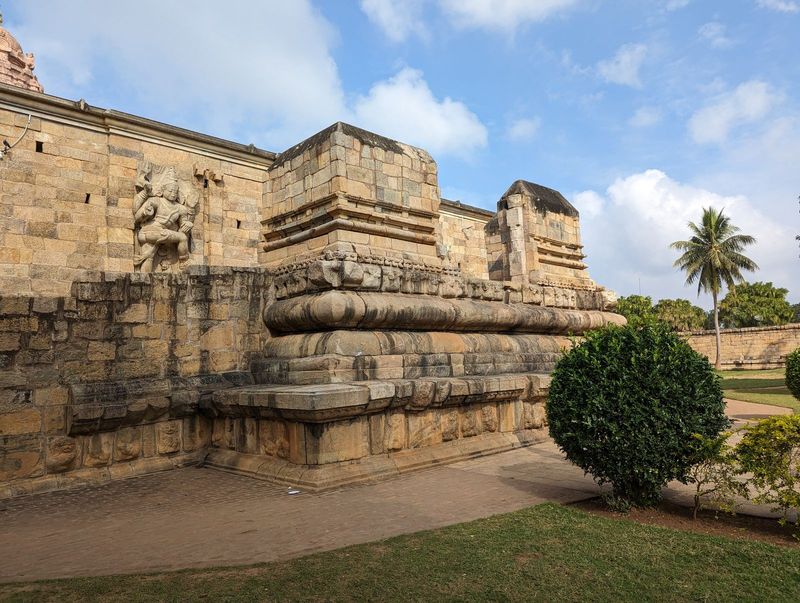
The temple base or upapatha comprises a stack of traditional elements, each layer with a name. The bottom layer is the upana, for example, and the semicircle projecting from a vertical diameter is a cumud. The pioneering modern study of this grammar is the Essay on the Architecture of the Hindus (London, 1834, reprinted Delhi 2021) written in his spare time by a judge in Bangalore who hunted up old, mostly fragmentary treatises on the subject and tried to make sense of them. Born in Tranjore, he was Ram Raz (1790-1830).
For a sample of the ties that bind temple architects, consider this sentence Raz quotes from Manasara, his principal source. Writing about upapithas, or pedestals, Manasara instructs the builder to "let the height of the upapitha be divided into thirty equal parts, give three to the upana, a half to the campa, three to the mahambuja, a half to the campa, two to the candhara... " etc. Raz writes that "Manasara, our principal guide, expresses himself in so obscure a manner, that I must acknowledge my inability to understand him thoroughly." (Raz, p. 27.)
F
For all that attention to detail, the huge anteroom or mahamandapam presents a wall to the world.
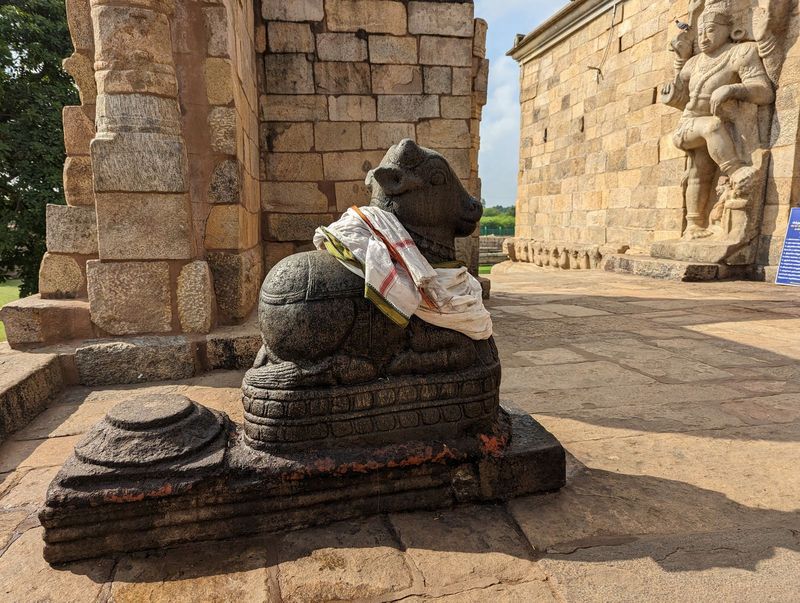
No intimidation here, only a friendly Nandi. Original? Almost certainly not. The temple has a much larger and less friendly version just behind this fellow, who sits up on the level of the anteroom.
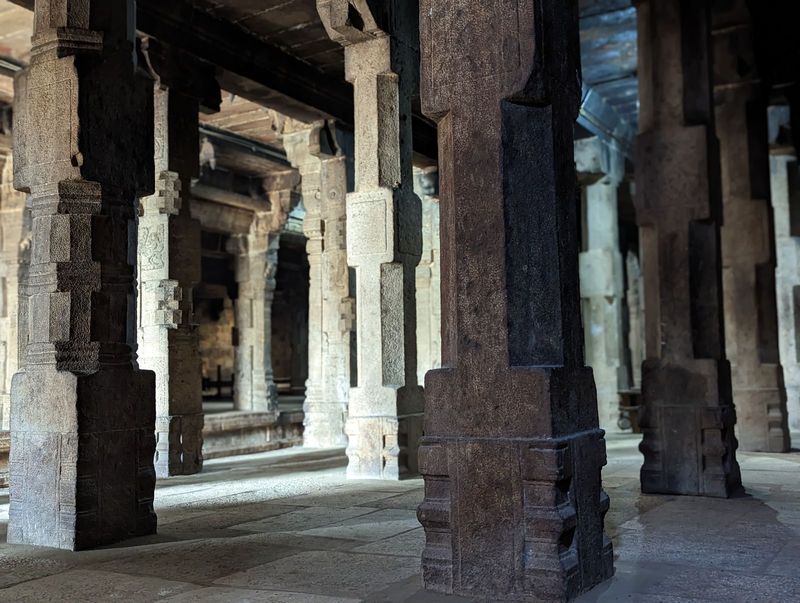
The interior of the antetoom is monotonous.
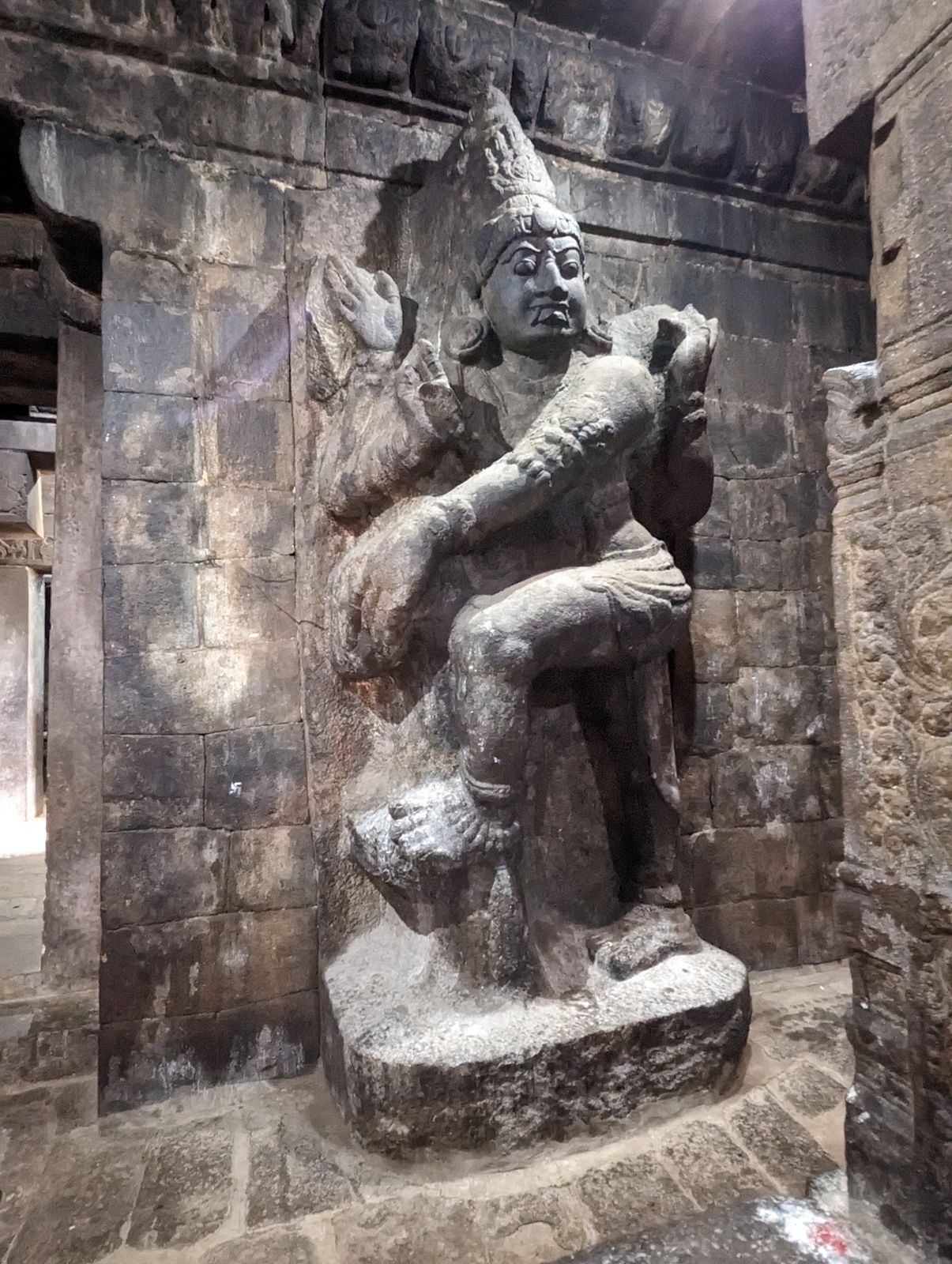
Except for entrance sculptures like this dvarapala.
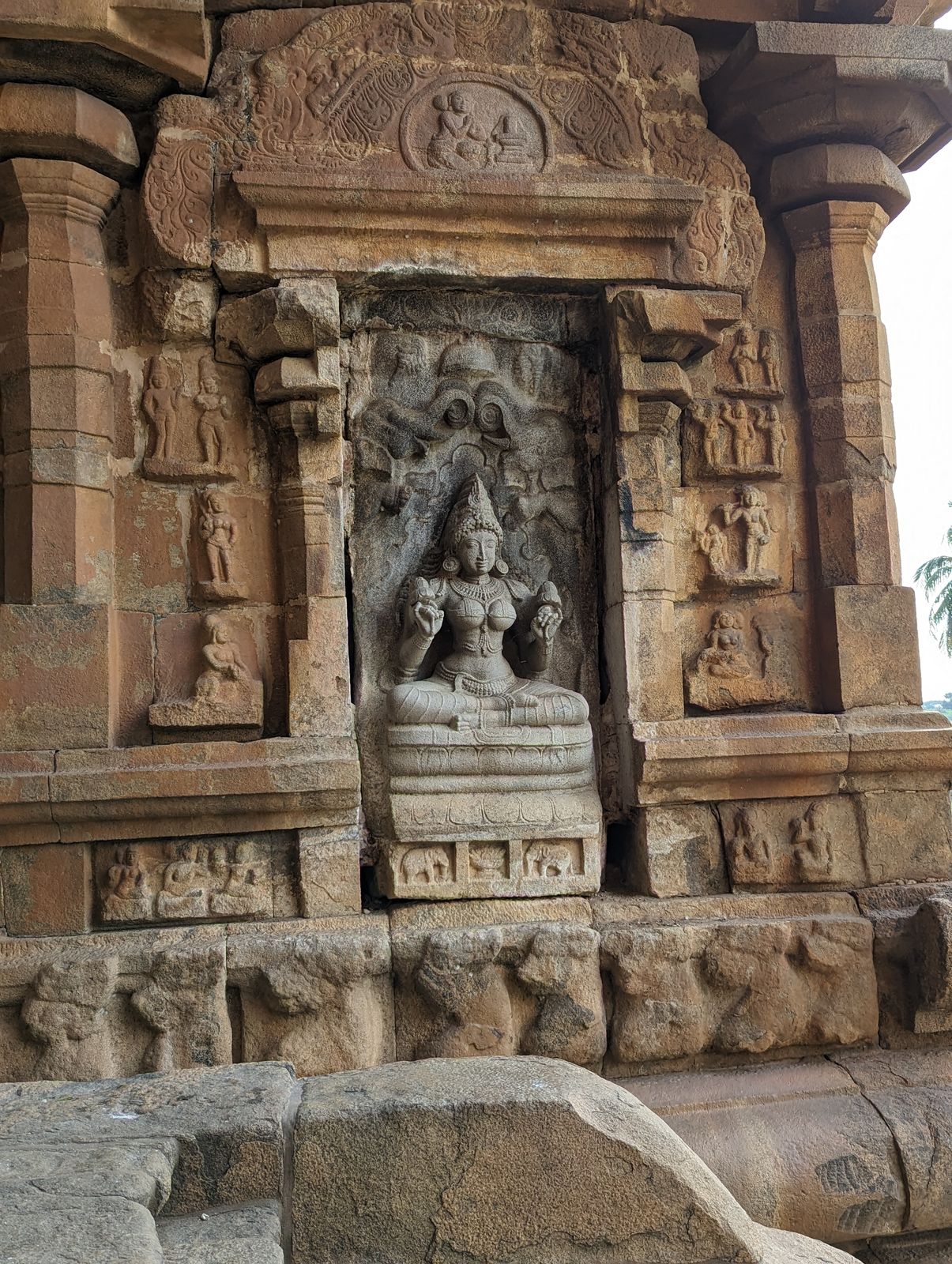
Also, this Saravati, the goddess of wisdom.
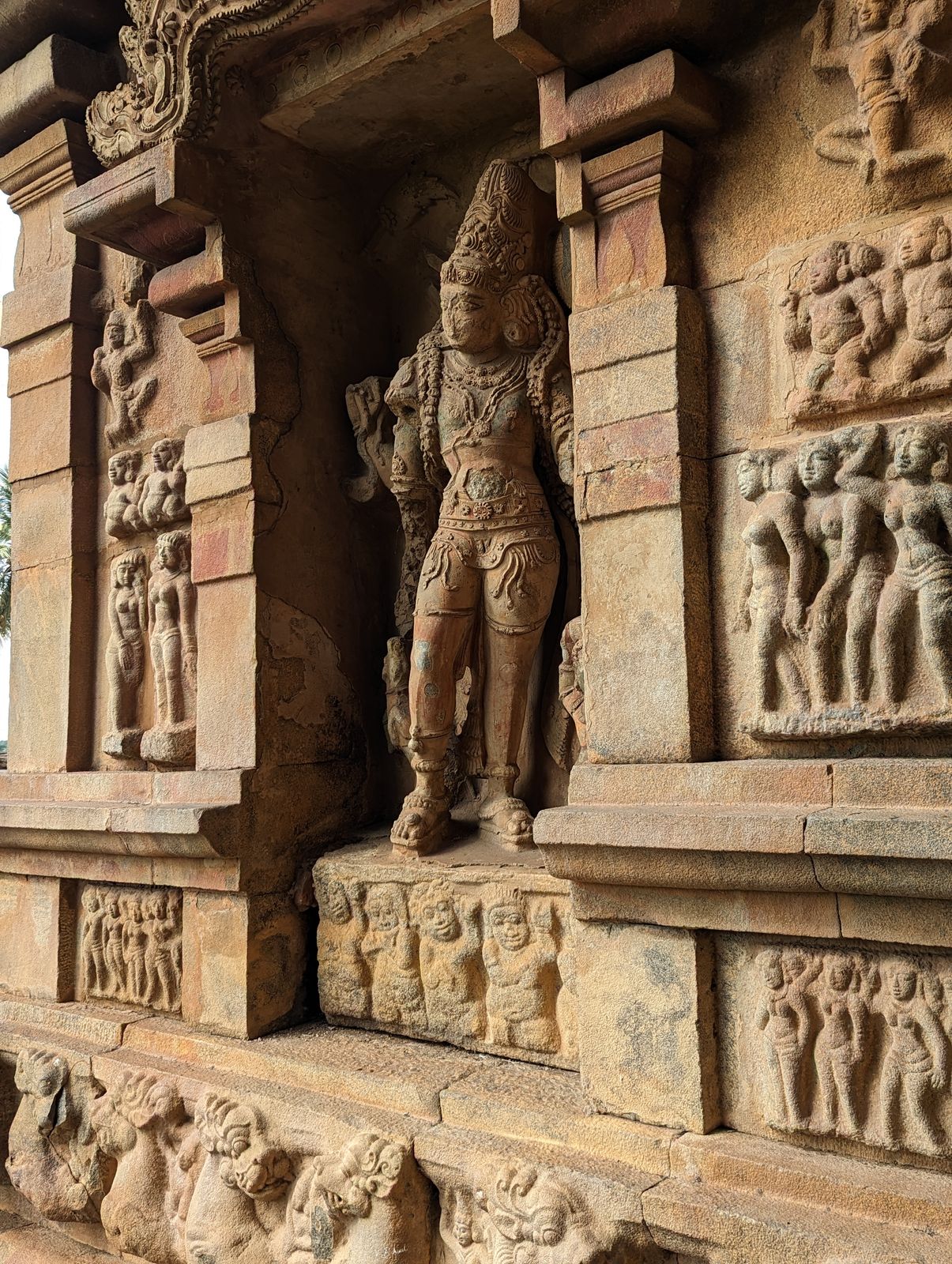
And this Kankalamurti, "the one with the skeleton." This is a fearsome form of Shiva, shown with the vertebrae of a spine draped over his shoulders. Why is he here? Perhaps as a reminder of Rajendra's power, but I'm just guessing.
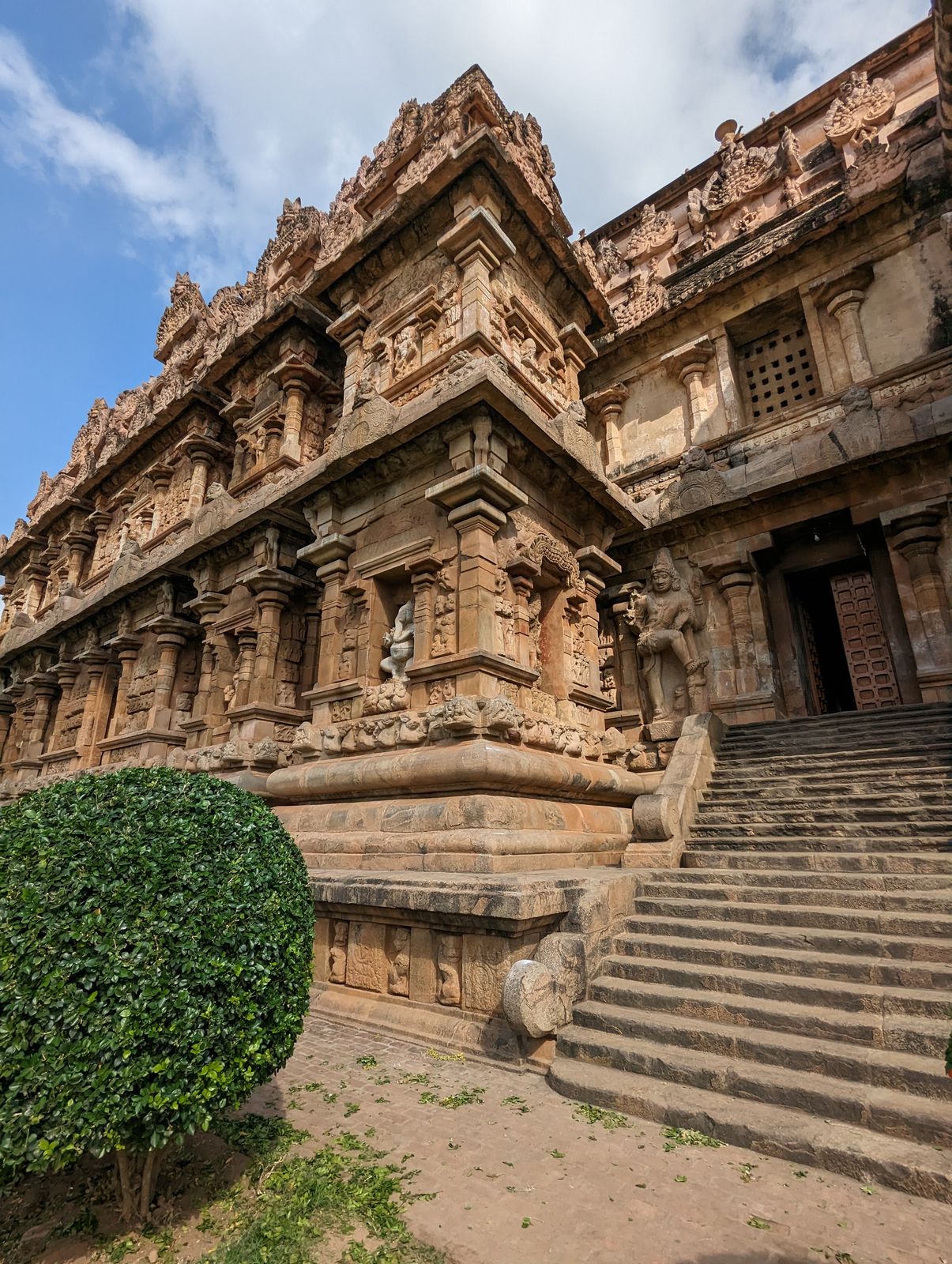
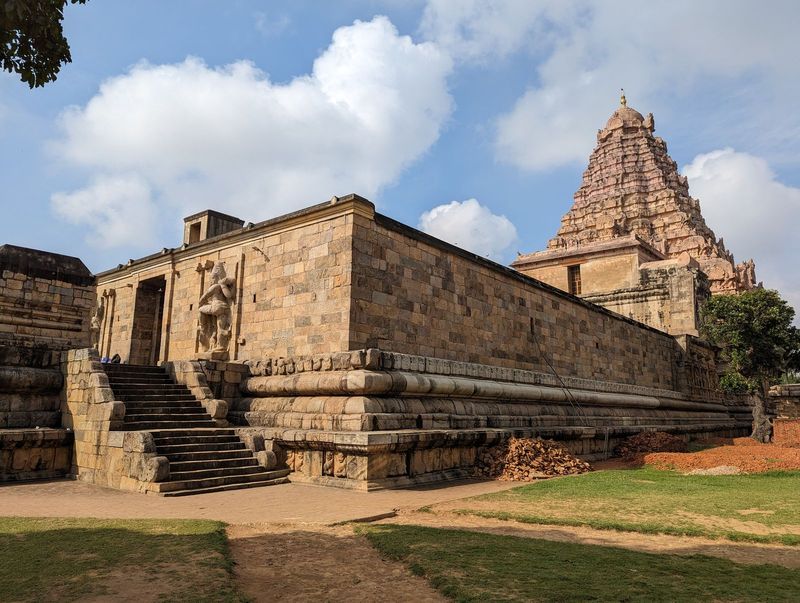
Stairs lead down from both sides of the shrine, which is to the left.
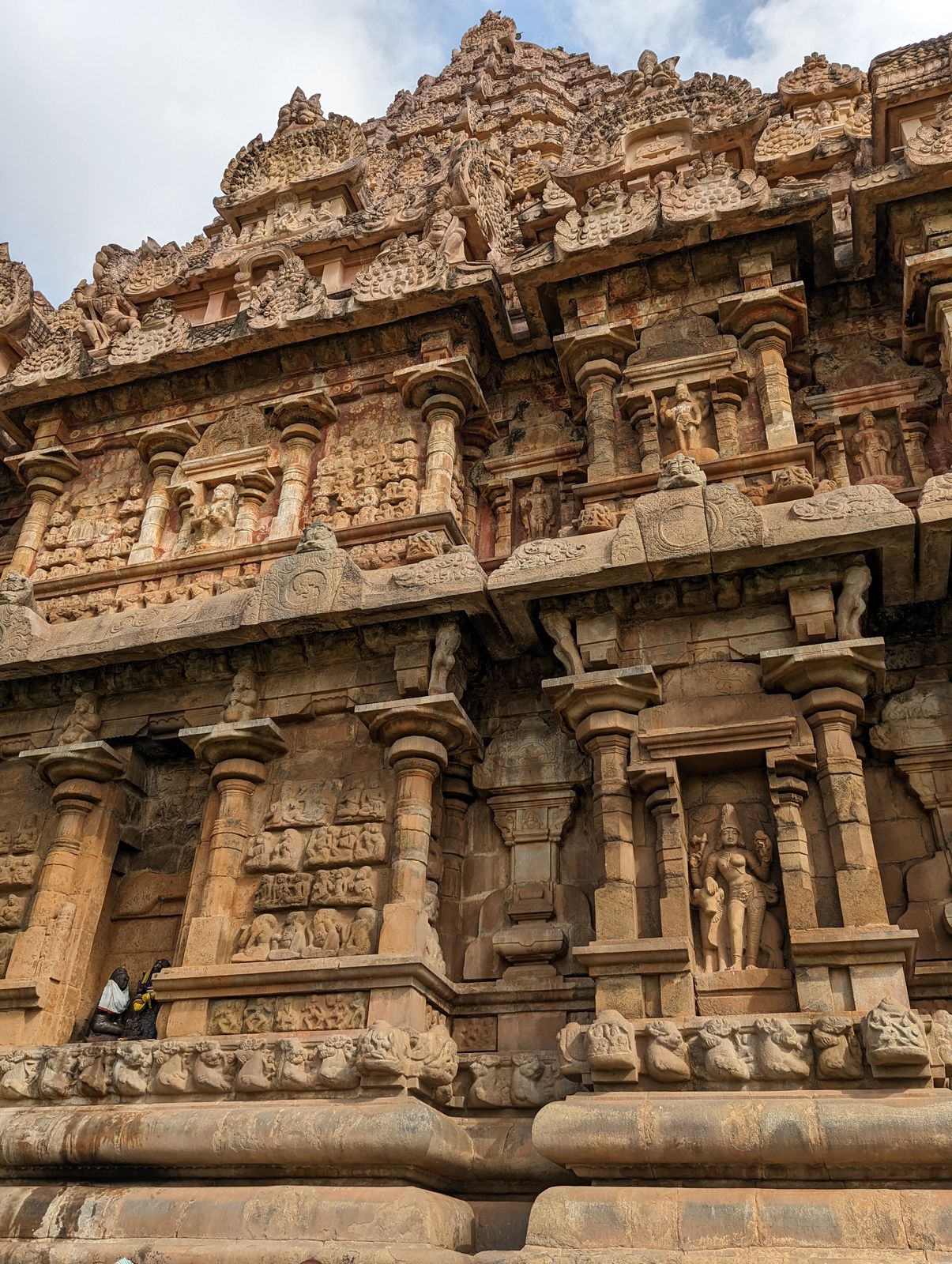
Smaller than the one at Tanjore, the vimana at Gangaikondacholapuram is more elaborately detailed.
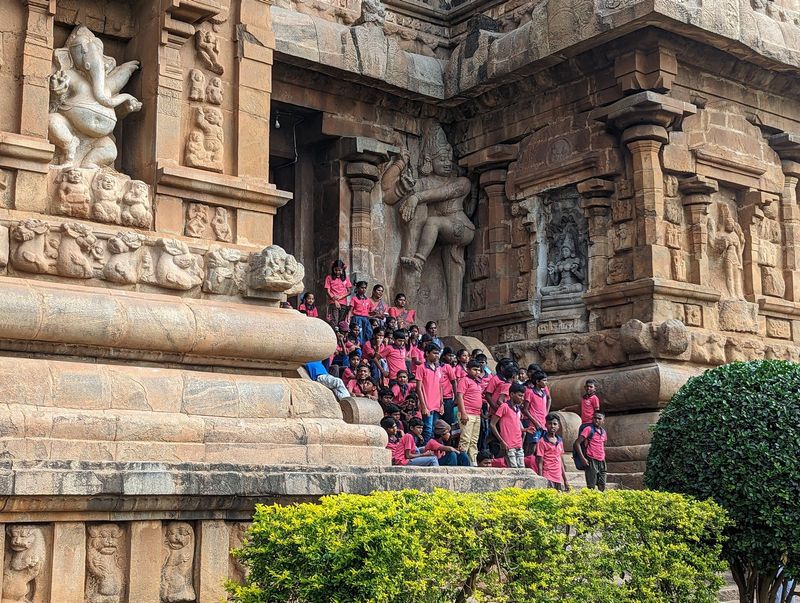
The kids aren't the least bit alarmed by the dvarapala.
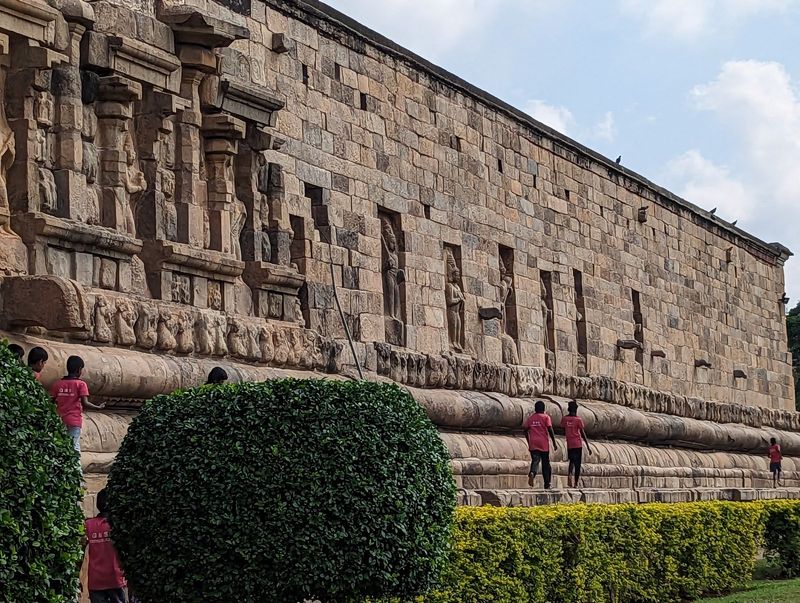
They were having fun running along the temple base, much to the annoyance of a maintenance crew.
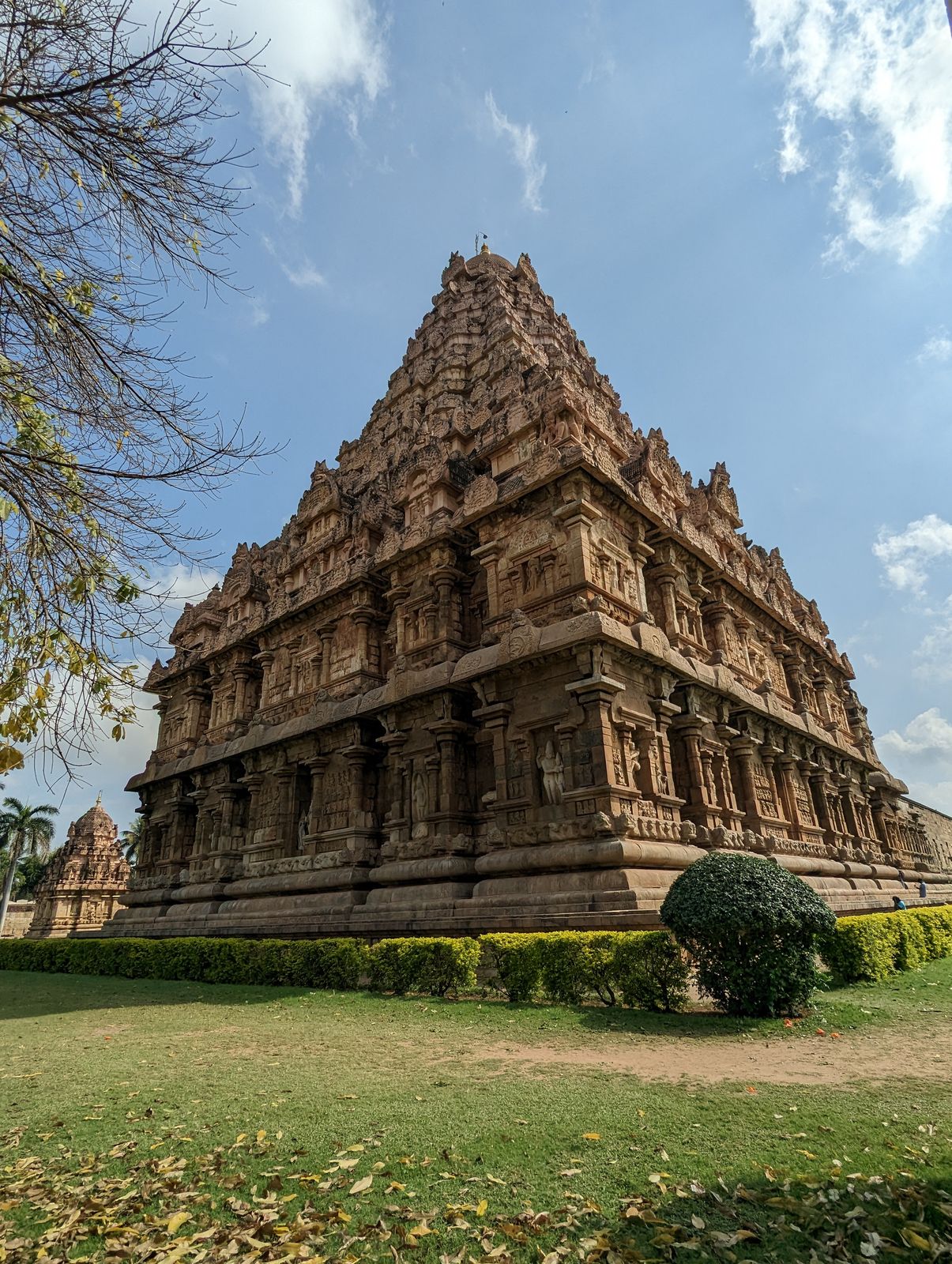
The vimana from behind. Others have noted the slightly concave profile, unlike the Big Temple at Tanjore. Why concave? No idea.
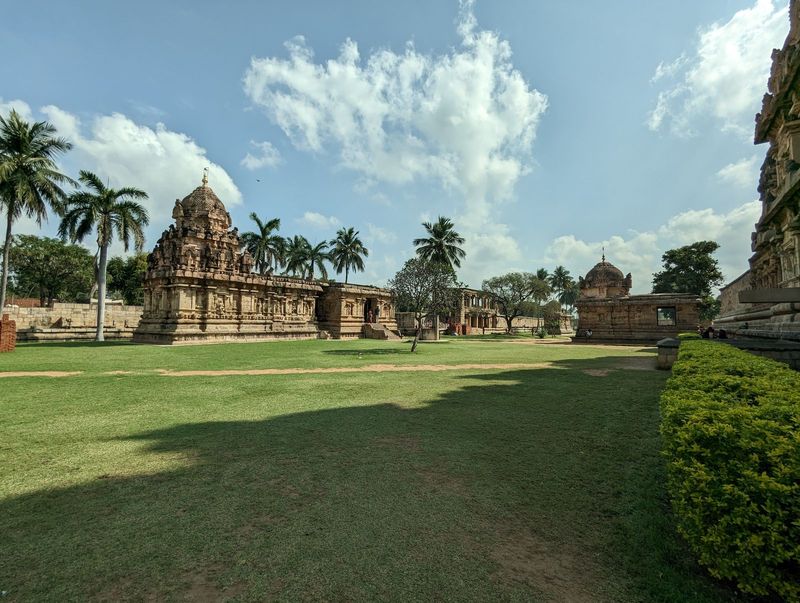
A subsidiary temple to the north.
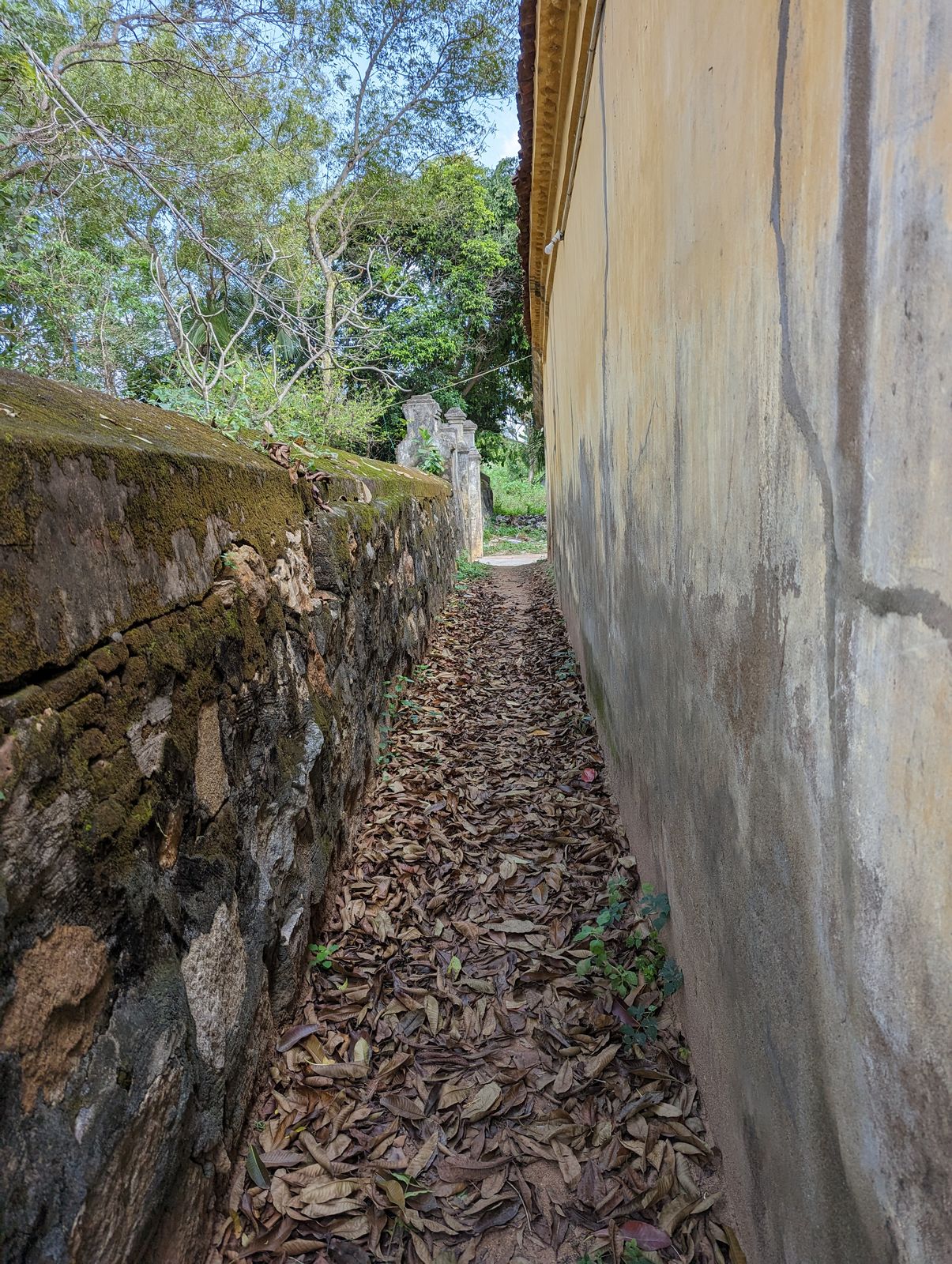
We shift now to a small but innovative temple. It's the Amritaghateswara temple at Melakadambur and was built by Kulottunga I (r. 1070-1122), whose capital was at Gangaikondacholapuram, five miles to the southwest, close enough perhaps to justify royal attention.
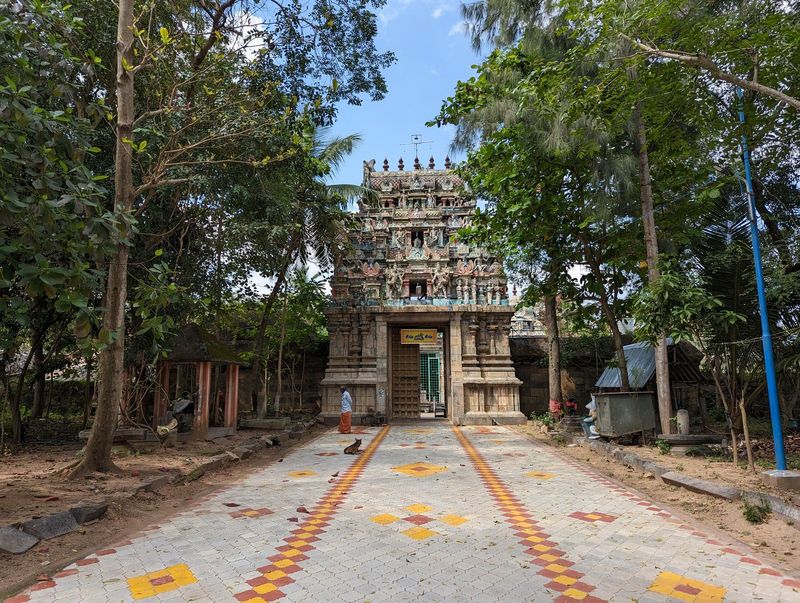
Entrance.
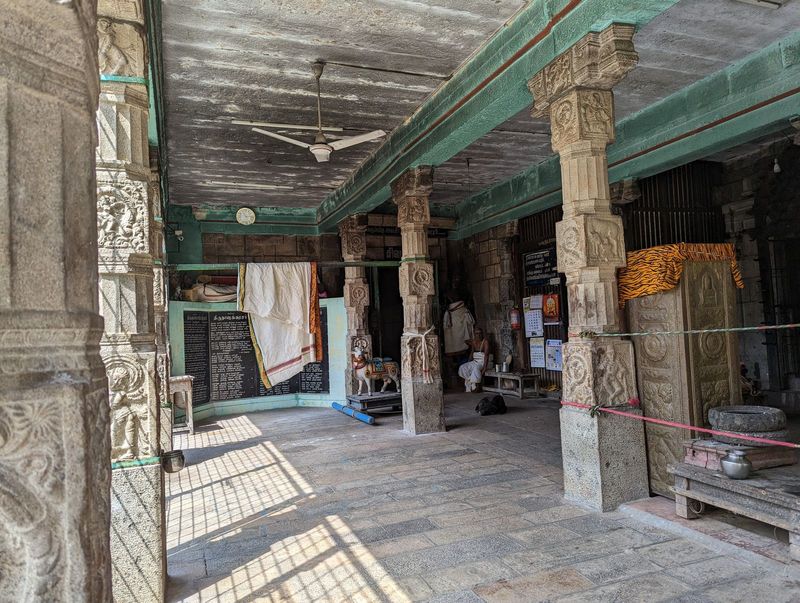
Anteroom, with clothes-line.
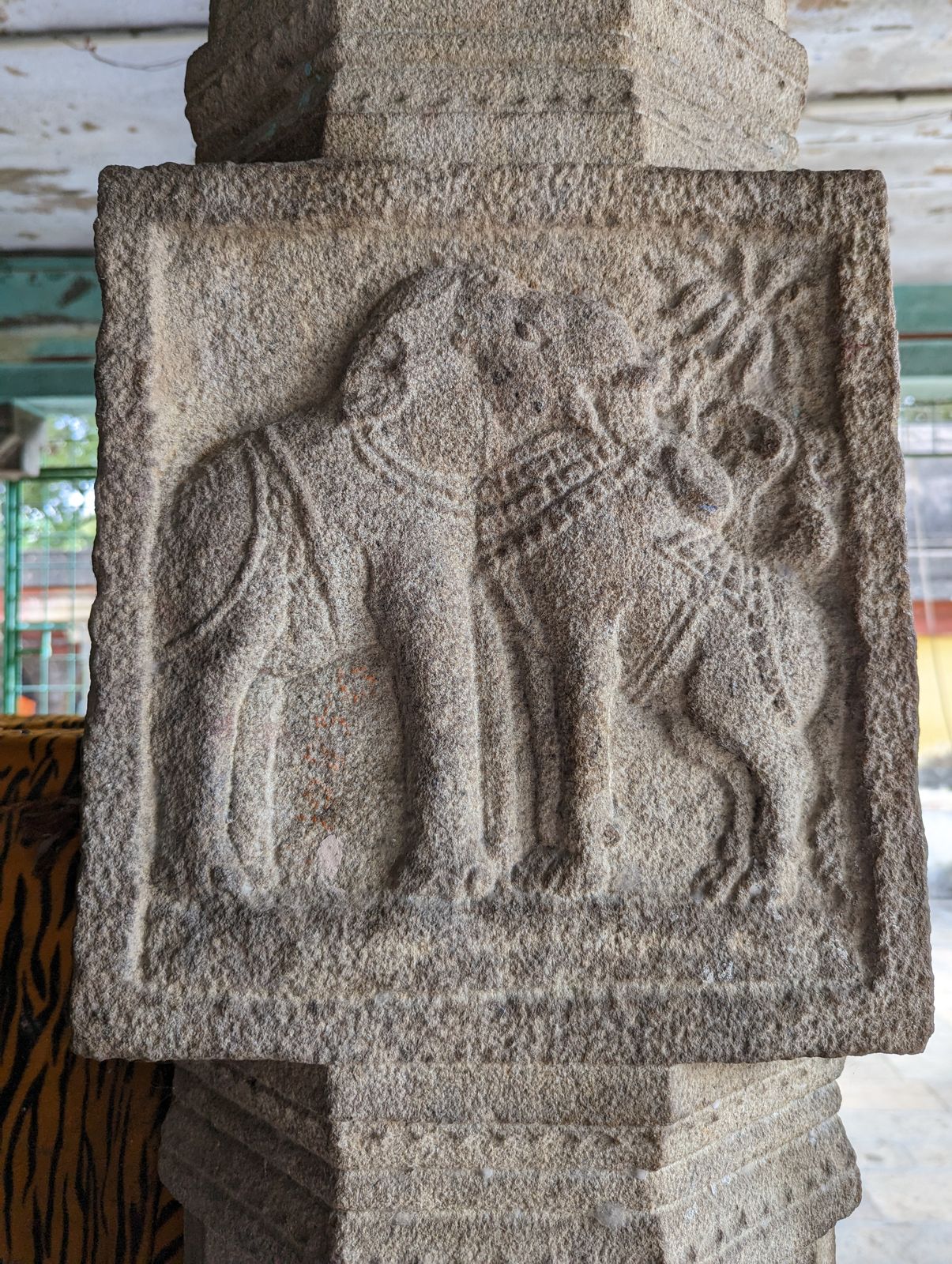
One of many details on the anteroom columns.
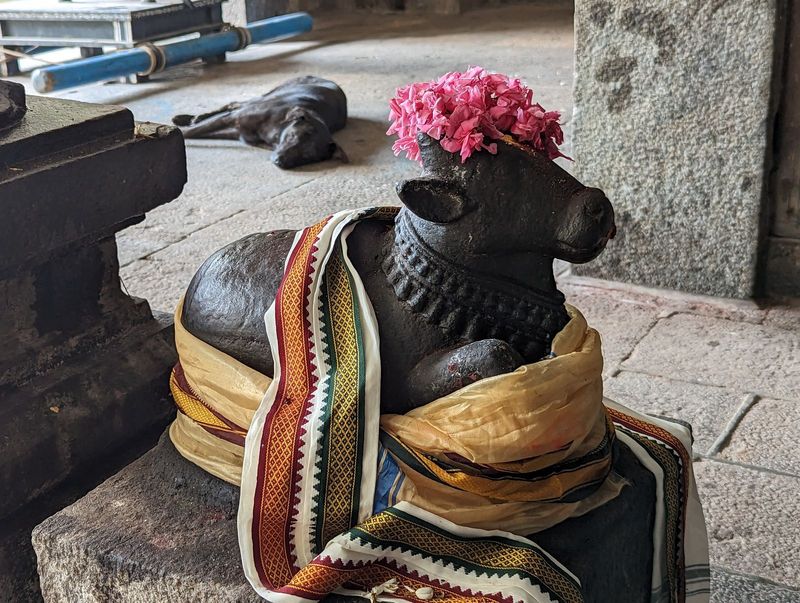
Nandi dressed to kill.
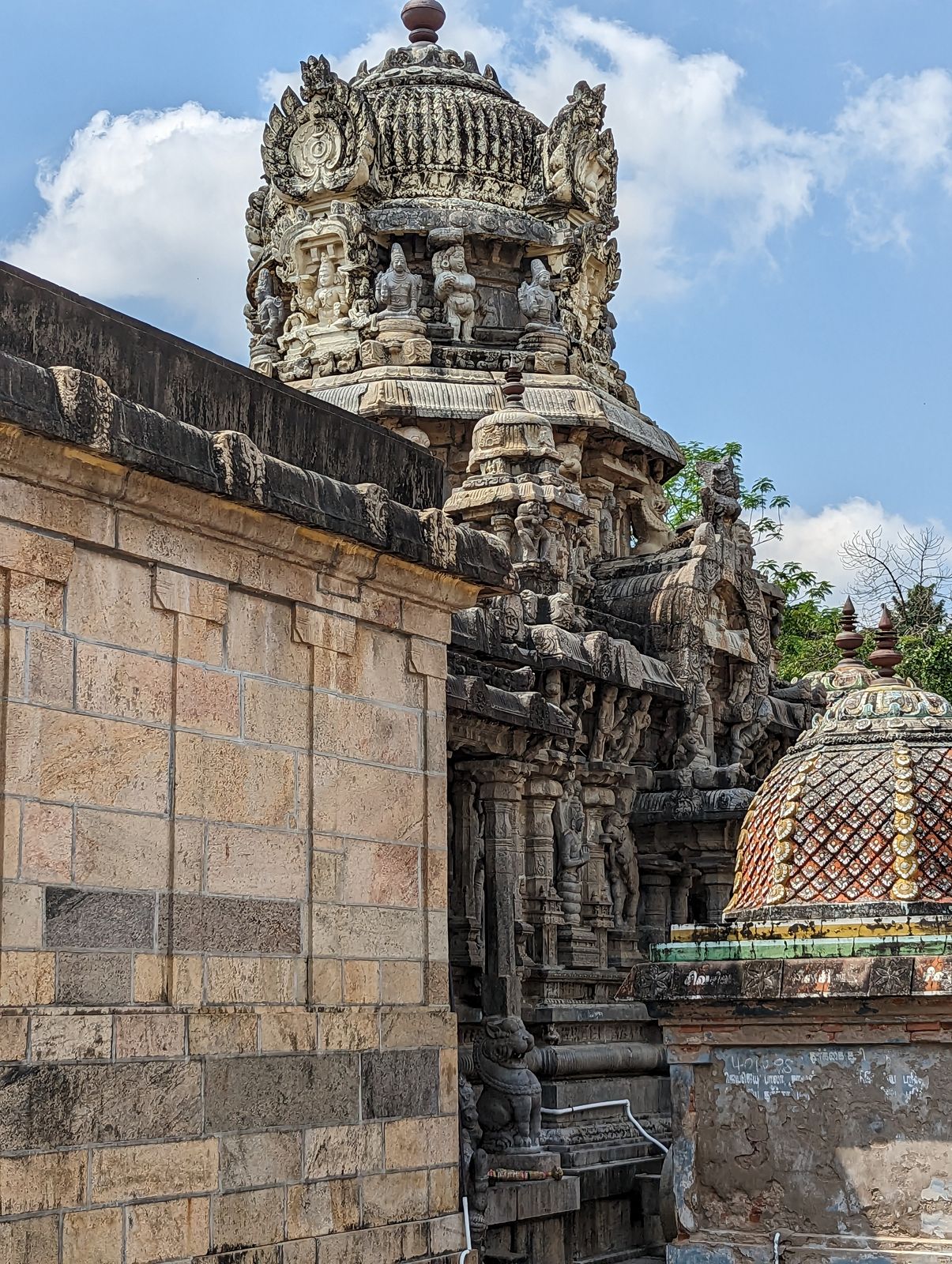
But here's what we came to see: the exterior of the shrine.
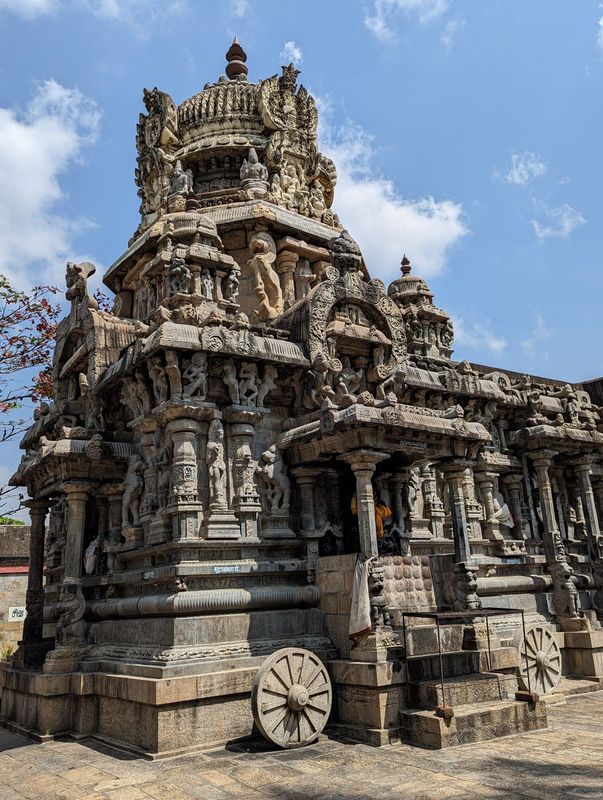
The intimidating name Amritaghateswara comprises three Sanskrit words (amrita=immortality, ghat=step, and eswarar=lord) with the meaning of the lord who leads to immortality. Why do we see wheels attached here? It's a motif picked up later at the Airavatesvarar Temple at Darasuram and amplified still later at the mighty Sun temple at Konark. Call it wild speculation, but I imagine the temple flying off into the heavens or perhaps landing here after the journey.
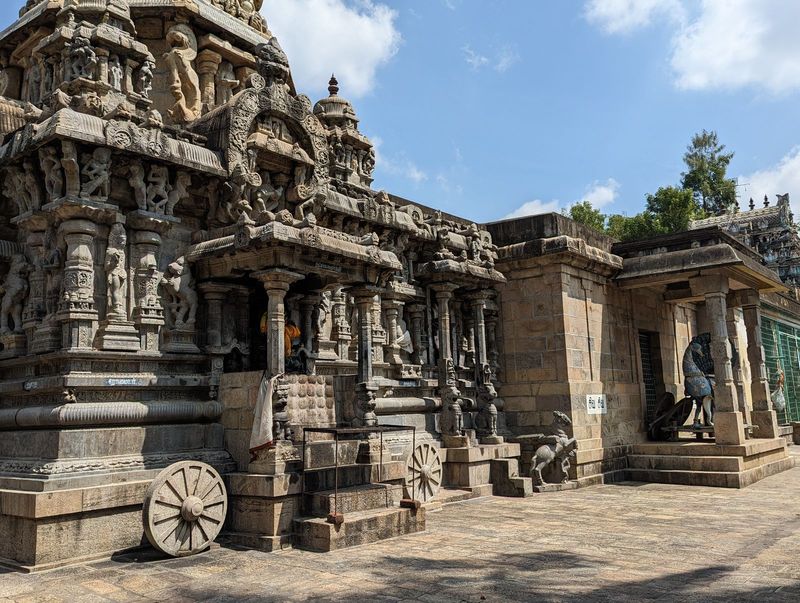
Here it is with its attached porch or anteroom.
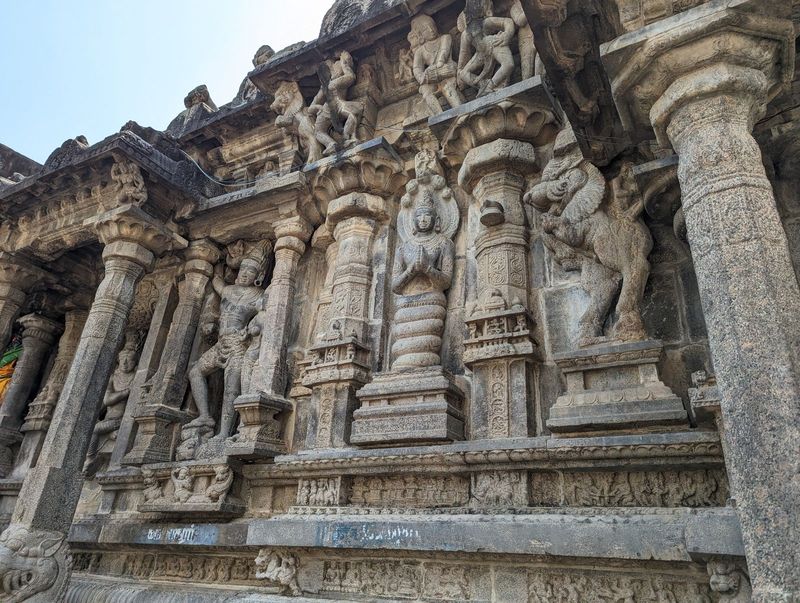
Busy, busy. At the center, Manasa, the ancient and originally tribal snake goddess. On the left, conceivably Siva as Kalasamharamurti, stepping on a seriously crushed Kala or Yama, the god of death.
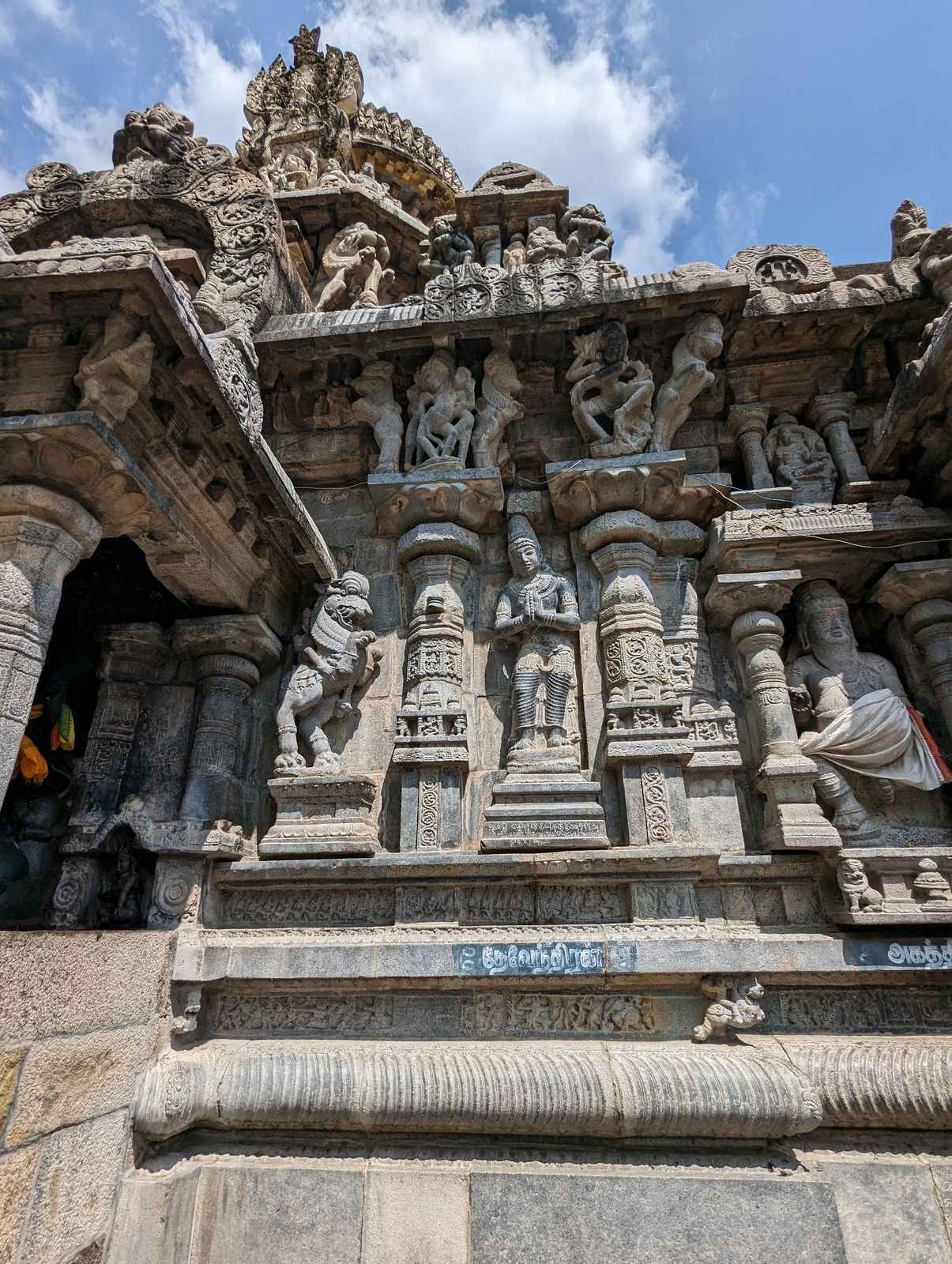
More gods to identify.
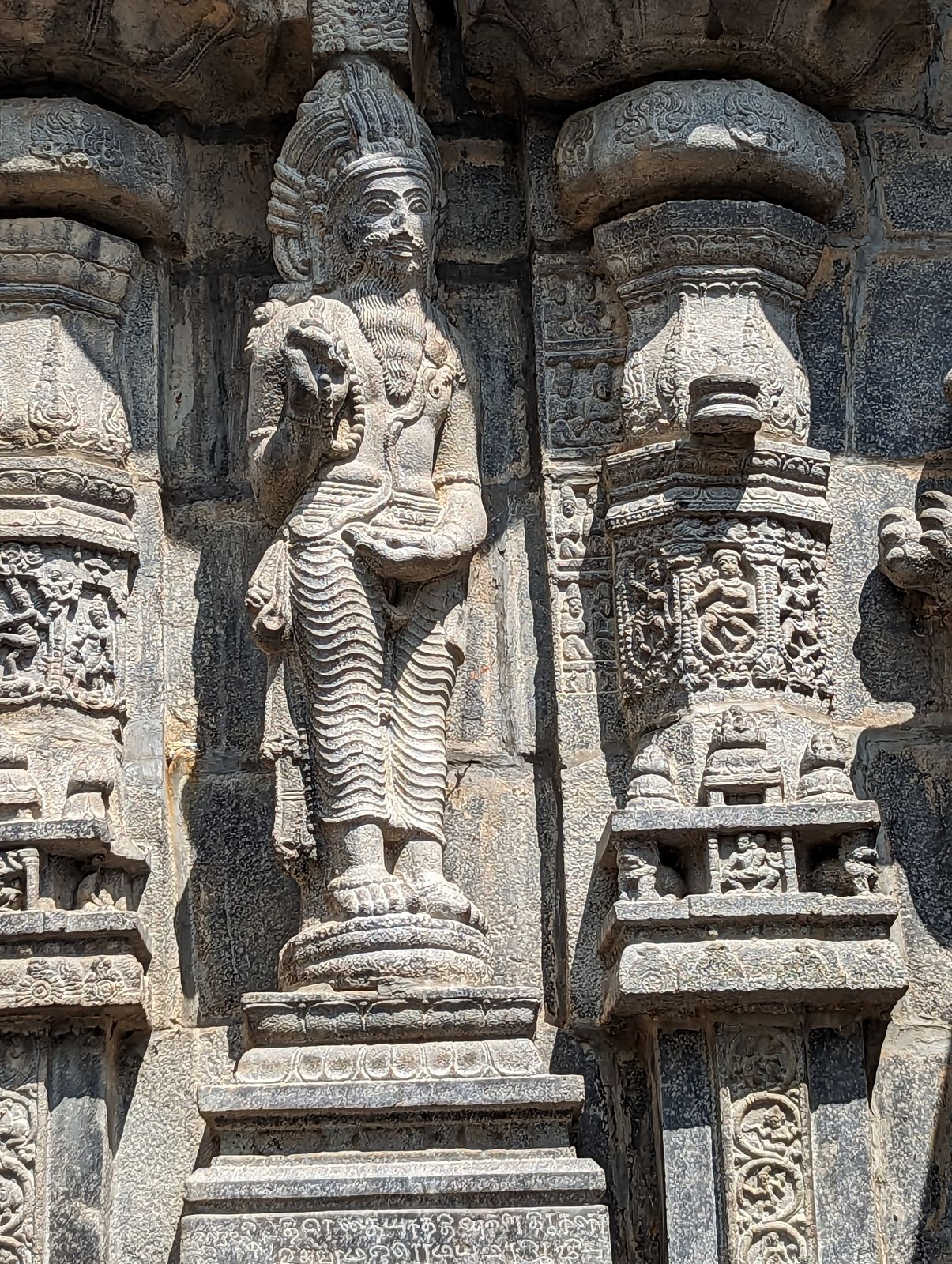
Could this be a portrait of Kulottunga I, the king who commissioned the temple?