Mumbai 8, 2019
Got a day to run around Fort and Colaba? Been there before but don't mind a second check?
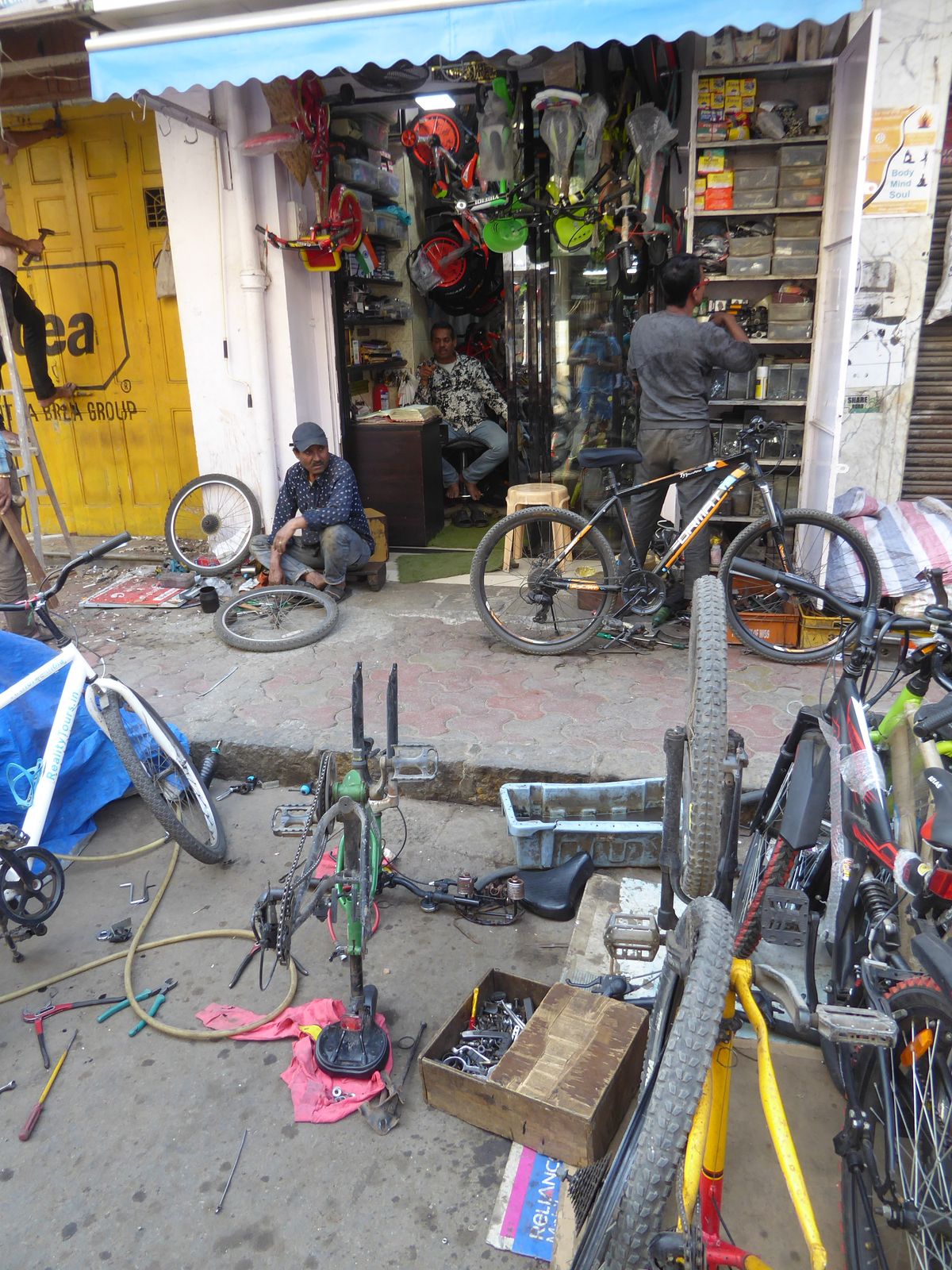
How about doing it on a bicycle? You only live once, right? The bike's in good shape.
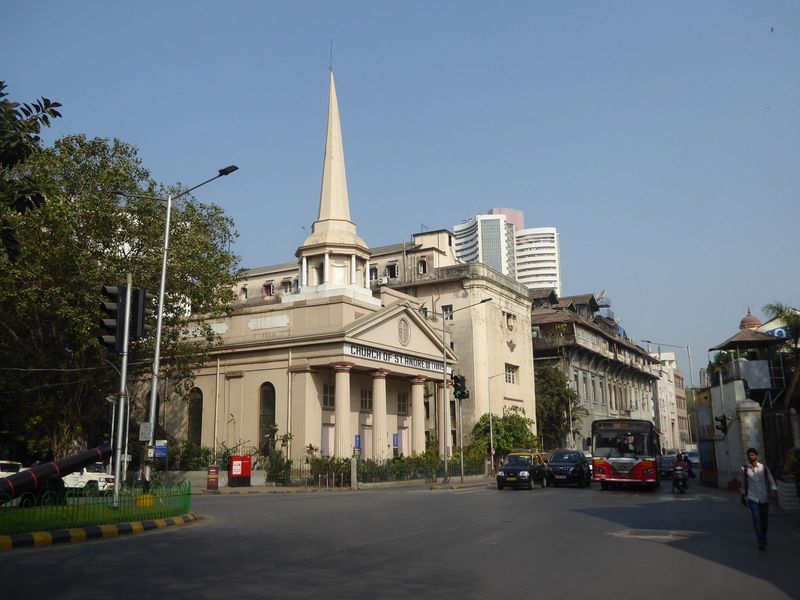
We're heading north from the Wellington Fountain and along Shahid Bhagat Singh Road. It's easier for foreigners to call it by the old name, Colaba Causeway. (Few men can be known so widely in India and so little in the West as Bhagat Singh, a martyr for Indian independence. His Wikipedia entry has over 130 footnotes! Not a bad indicator, really.) The ground here looks ordinary, but it's artificial, created after the Colaba Causeway was completed in 1838 to link the then-island of Colaba (behind the camera) with the rest of the city, farther north.
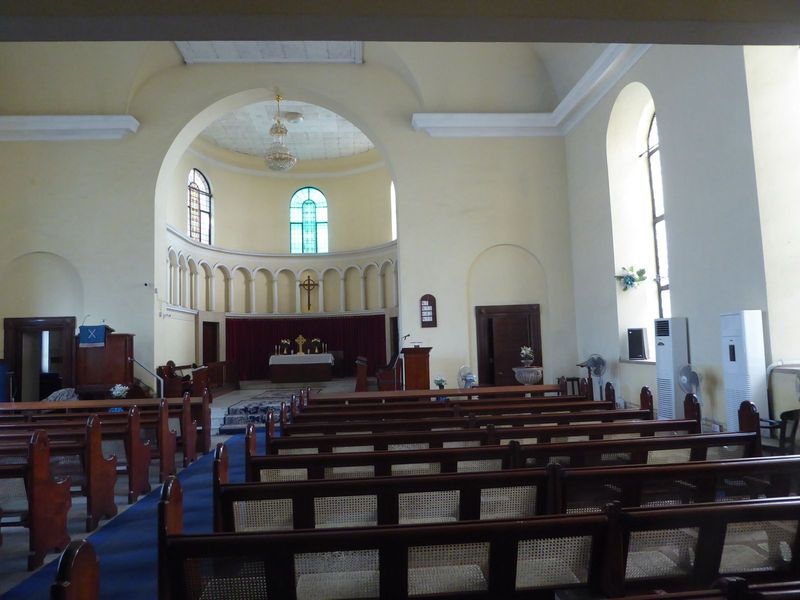
St. Andrew's is losing its congregation as this part of town becomes less residential. Too bad, because the church now has spiffy air-conditioning.
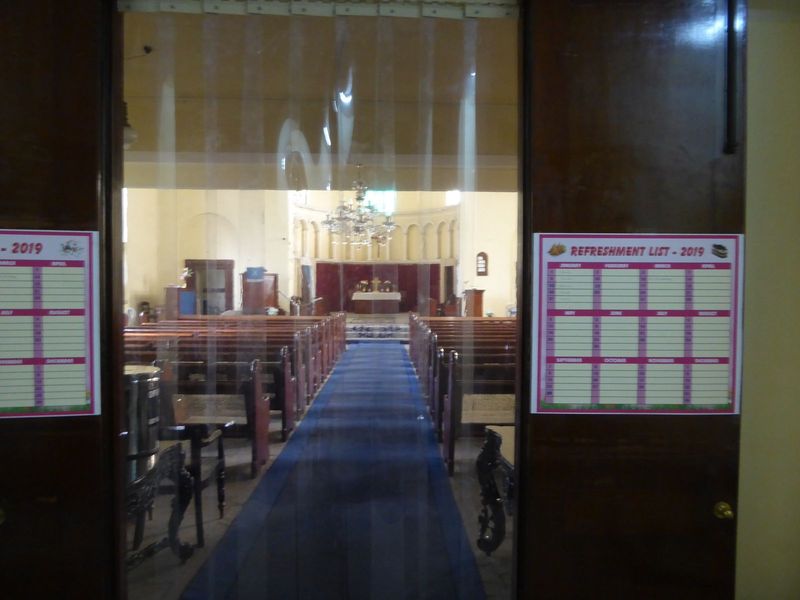
In the old days, there was an ice plant next door, and fans kept the congregation shivering. Noise from streetcars (the tracks are gone now) was so great that the doors here had to be closed during services. Now we've graduated to plastic to trap the cool air.
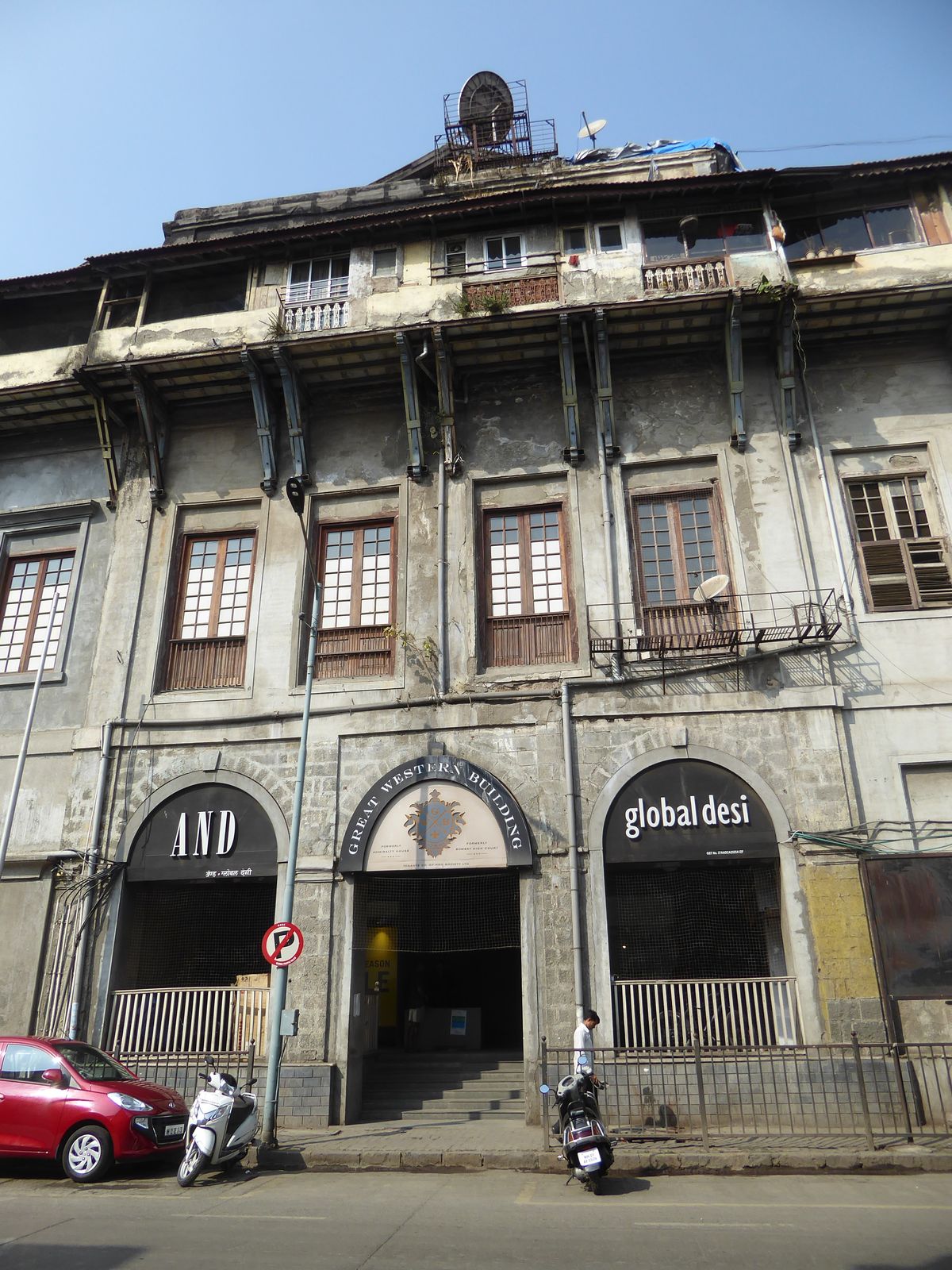
Next door, the Great Western Building is offices. It used to be the Great Western Hotel. B Earlier still, before 1883, it was a courthouse. Go back to the 1770s, and it was Admiralty House, residence of the commander of Britain's Indian Fleet.
Old photos show a porch with suitably impressive columns, but it and they disappeared with street widening. Wonder how sturdy those brackets are; the iron balconies below have fallen apart.
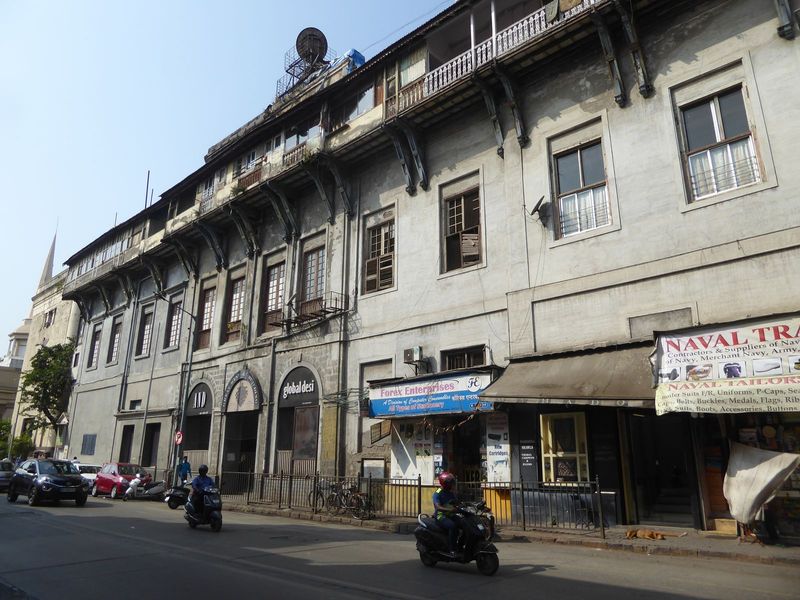
On the site of the building now wedged between the Great Western Building and St. Andrew's, there once was a domed ice house.
T
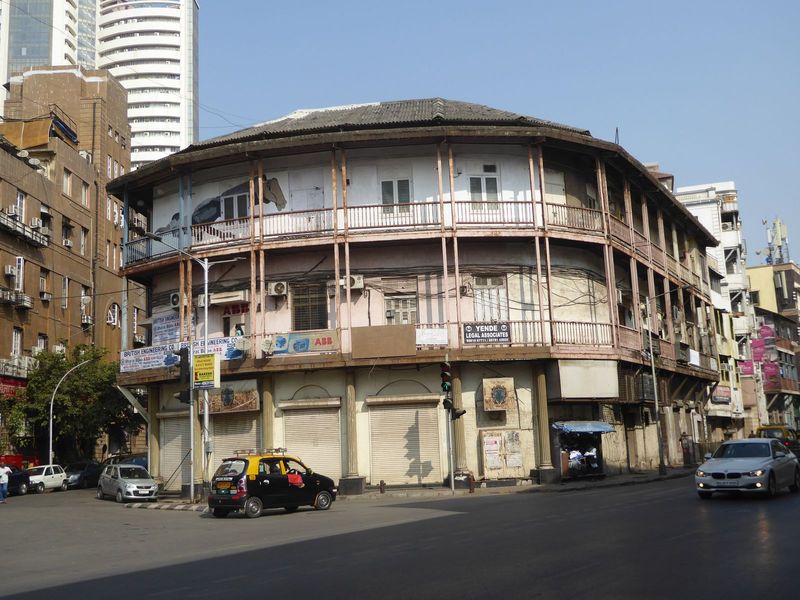
We're still working our way north, though we're about to leave Bhagat Singh Road and head up the narrower one on the left, which is Mumbai Samachar Marg—or Bombay News Street. The name comes from a newspaper published nearby since 1822, but the road until much more recently was called Apollo Street—which has nothing to do with the Greek god and comes instead from the European corruption of a local word for a kind of "fish."
The unnamed building here suggests the value of porches in the days before air-conditioning.
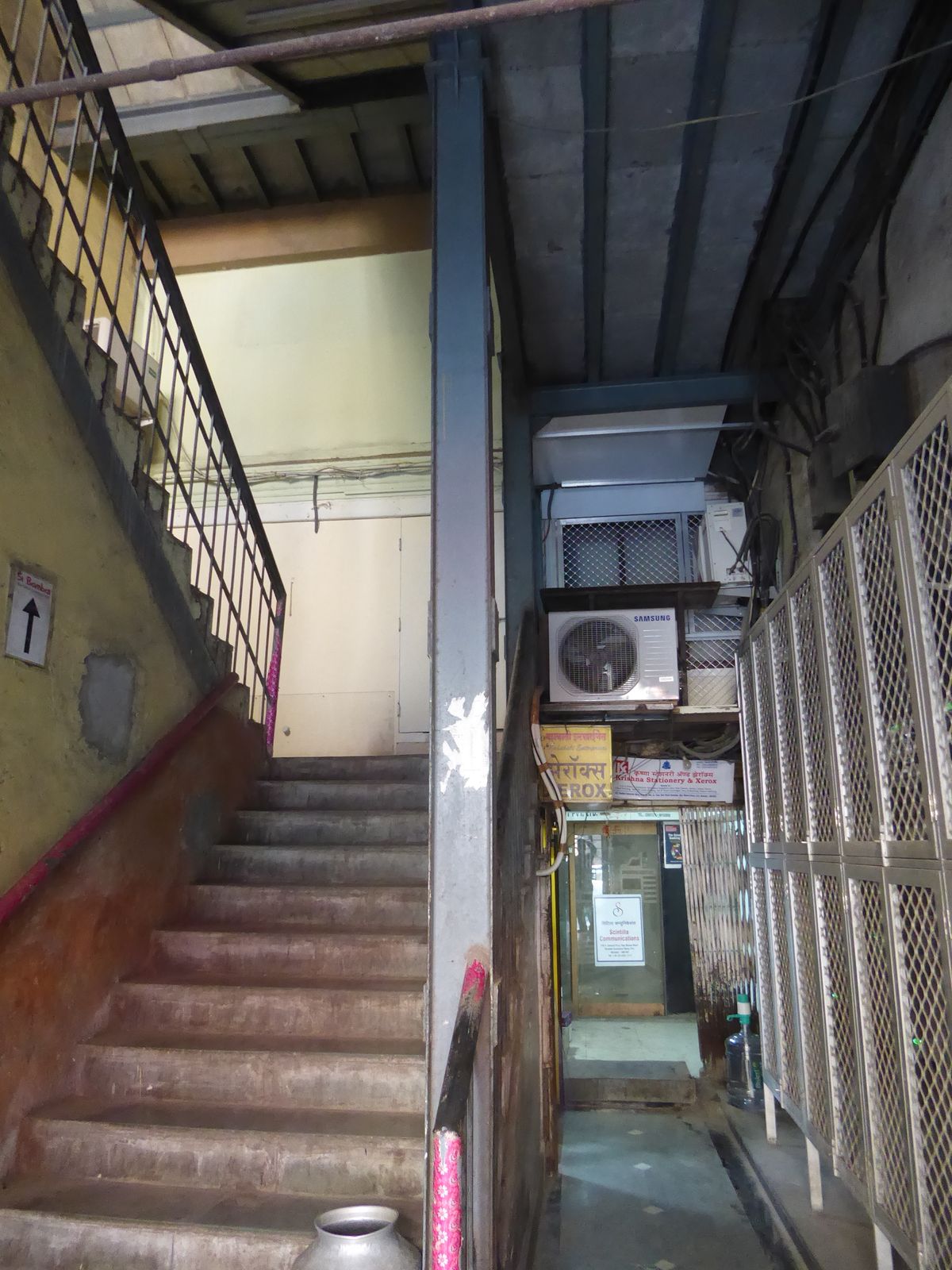
Let's see: the lawyer's office has to be around here somewhere.
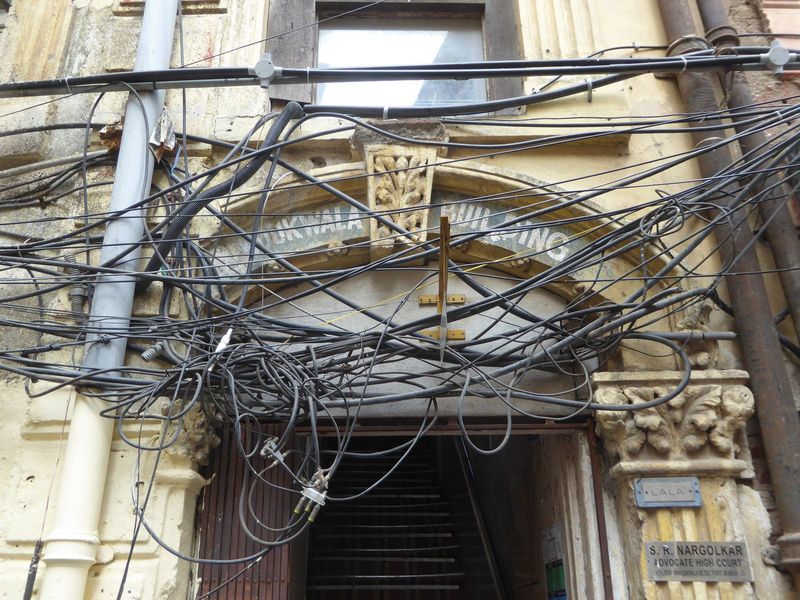
And you thought the tangle of wires behind your desktop was bad. Imagine a walking tour conducted here for an international meeting of fire marshals.
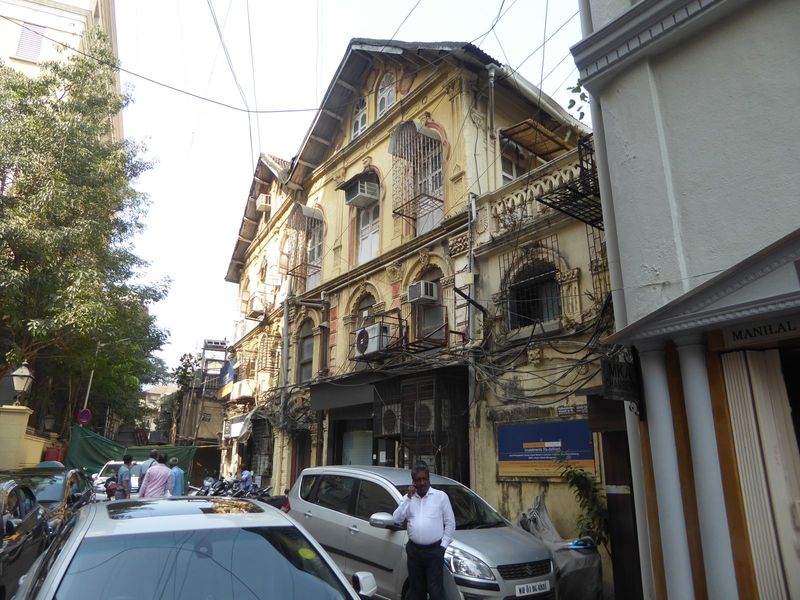
Here's the same building, which is classified as a heritage structure. Bad enough for bicycles; how cars get in and out is a mystery.
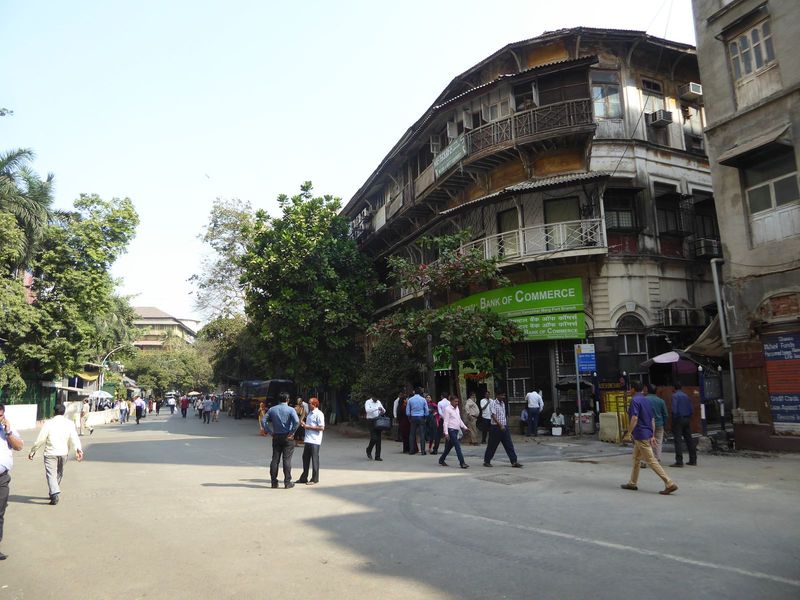
Can you believe it? A pedestrian zone. The sound level just went down 30 decibels.
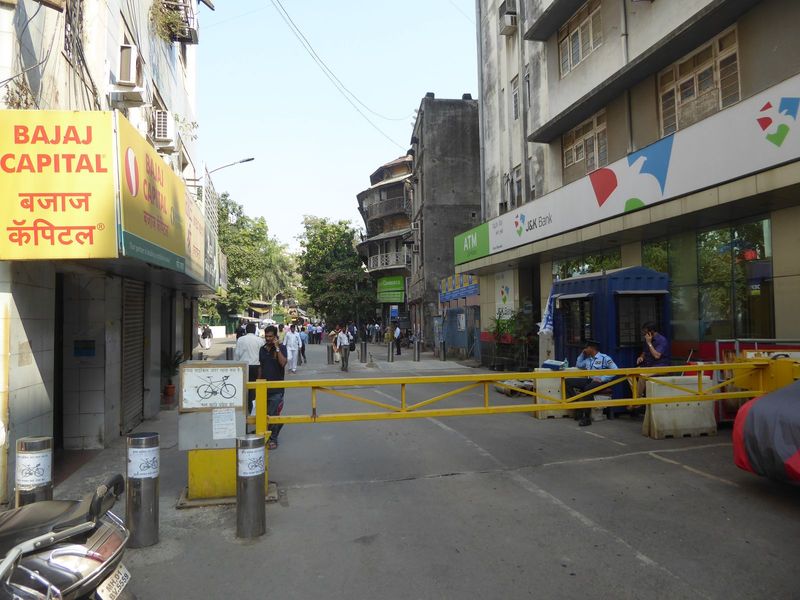
You don't get such quiet without discipline.
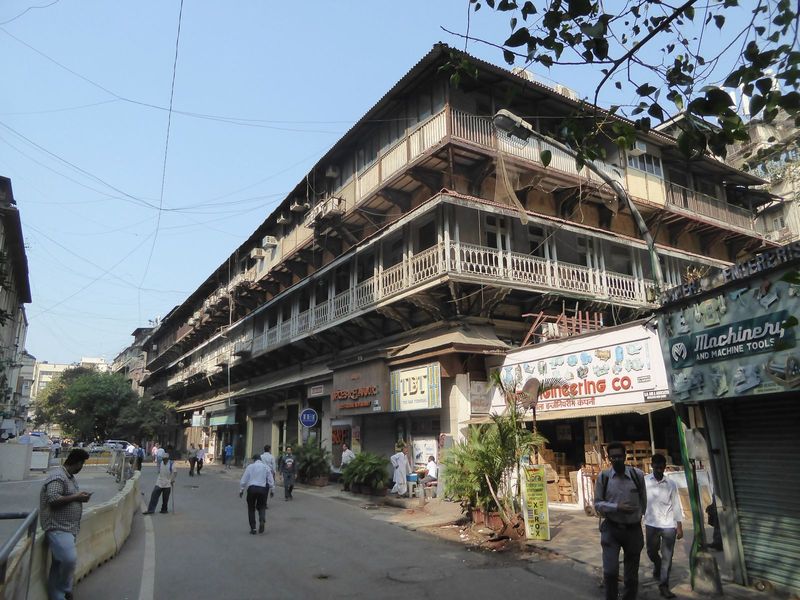
Was it the result of environmentalists pushing for a livable city?
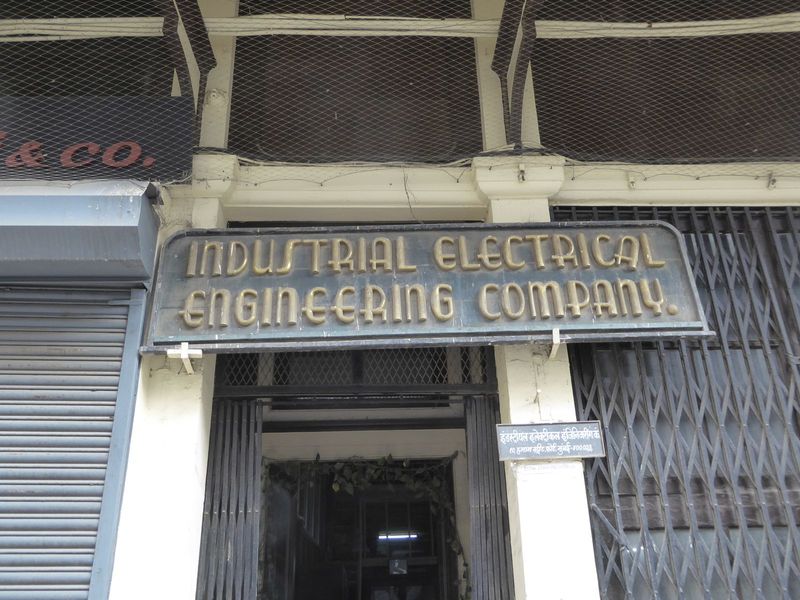
This sign (on the large building in the previous picture) is probably about as old as the company itself, established in 1921. The company's website (yes, it has one) states that "ethical business polices [sic] coupled with professional approach, has helped us in meeting the precise needs of our esteemed customers in the most efficient manner." The formalities of Victorian English have survived in India better than in Britain.
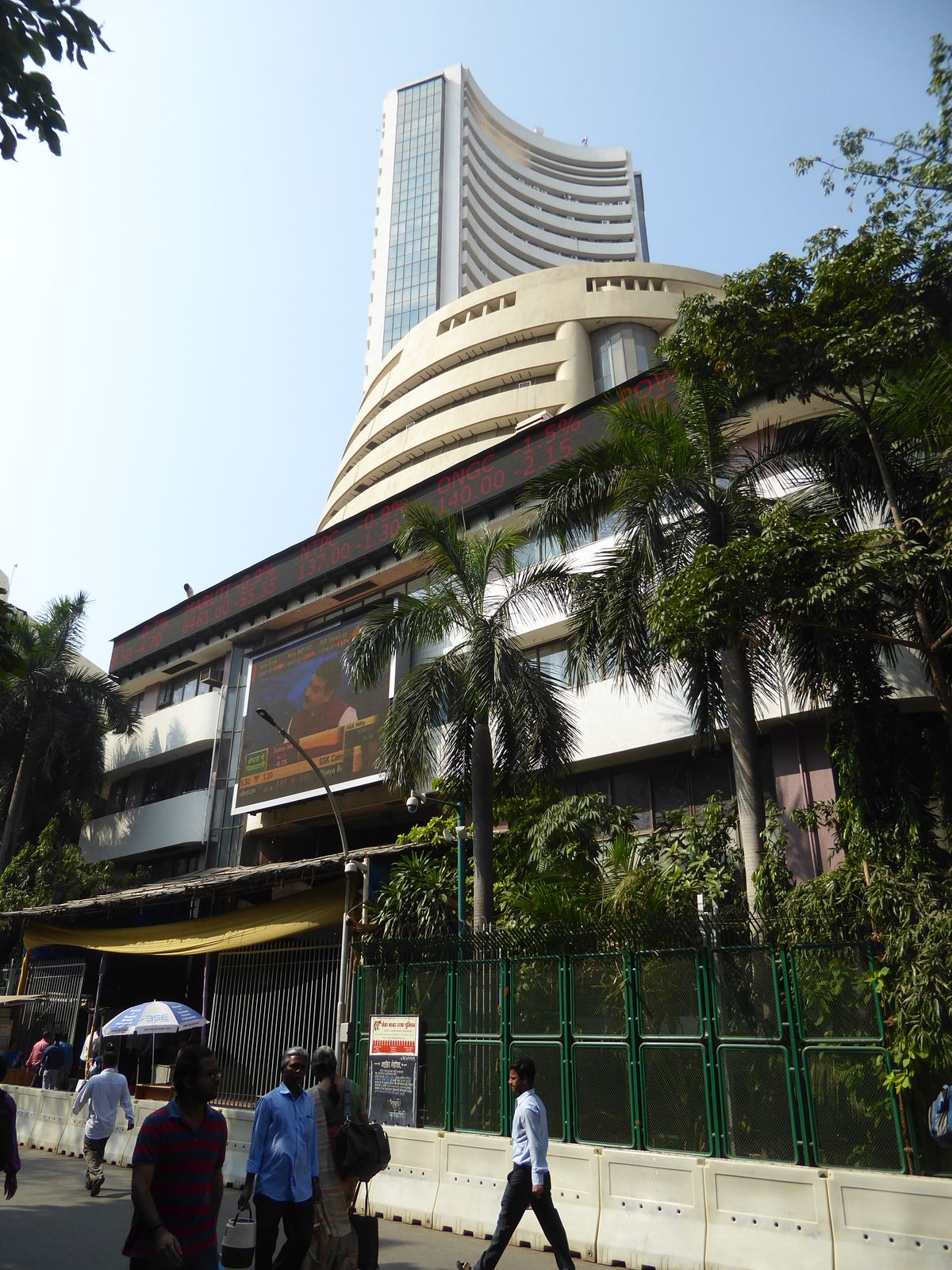
But no: forget environmentalists. The tower is the Bombay Stock Exchange, which was bombed in 1993. That's why we have the traffic-exclusion zone as well as these Jersey Barriers.
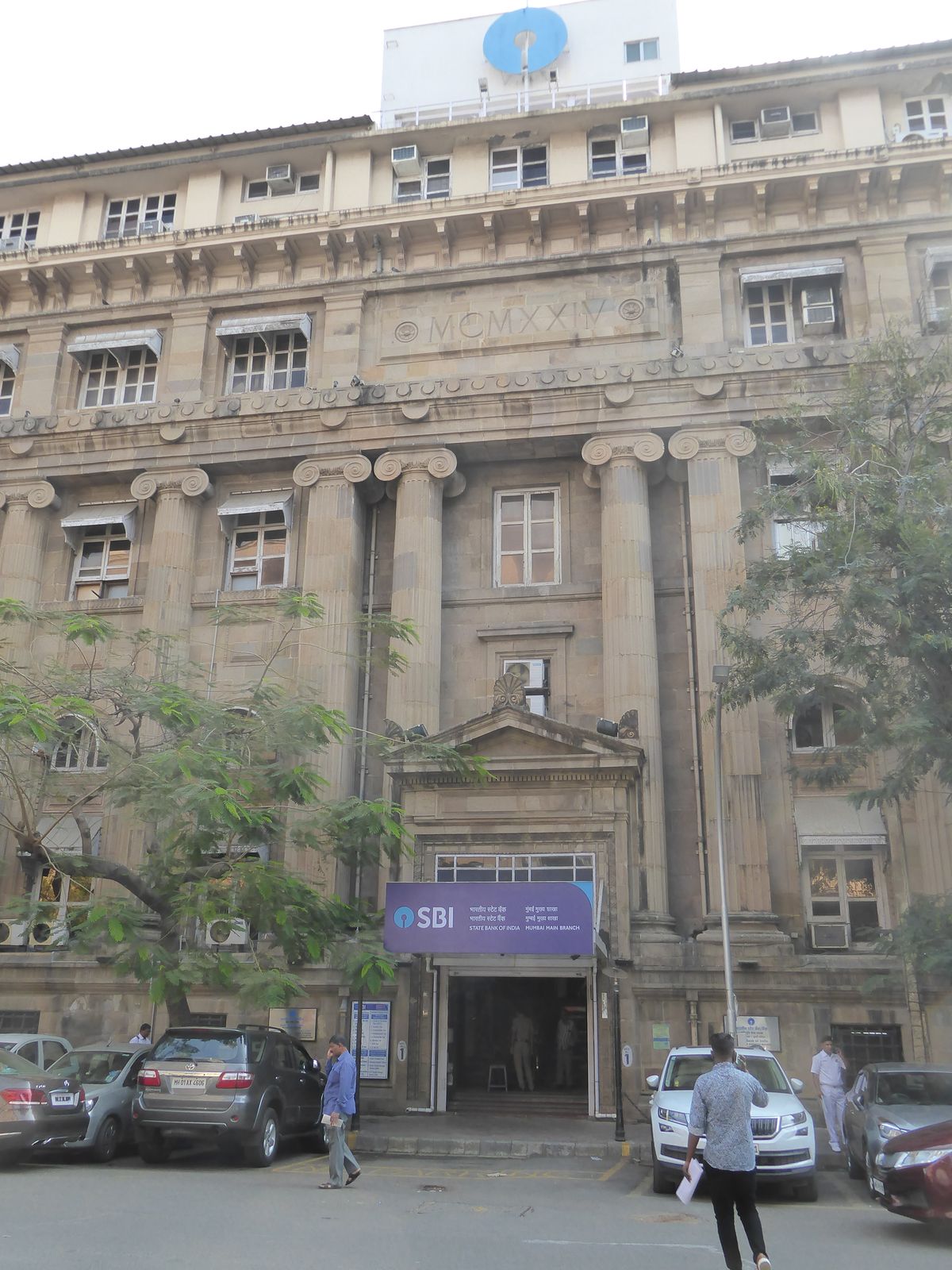
Welcome to the main Mumbai branch of the State Bank of India, until 1955 the Imperial Bank of India. That bank opened here in 1924 and had been formed a few years earlier with the fusion of banks in Bengal, Bombay, and Madras.
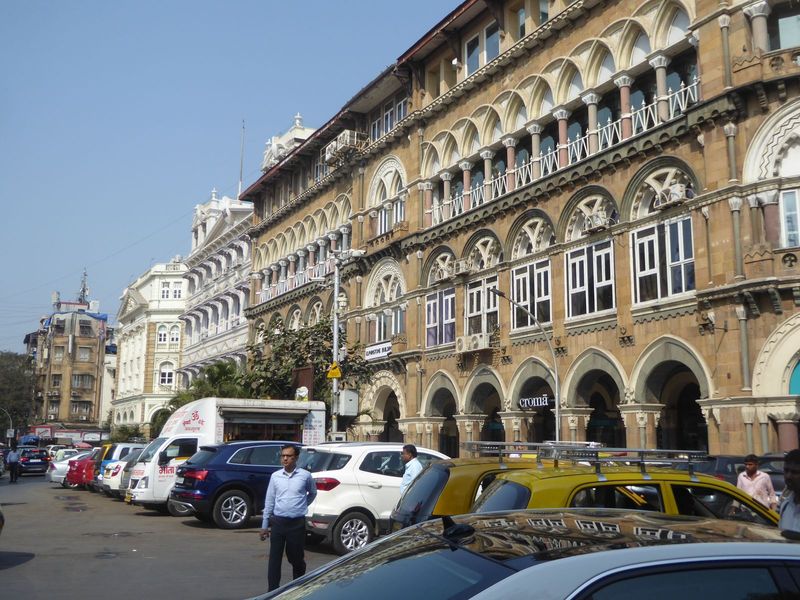
We've pushed on north to Veer Nariman Road, formerly Churchgate Street. (I know, these changes are infinitely tiresome, especially because the old names don't go away. Anyway, Veer Nariman was involved in the Freedom Movement and for a short while in the 1930s was Bombay's mayor. The name Churchgate is very literal, because the old Bombay fort, which enclosed this area, had a gate along this road, and it was near... well, you can figure it out.)
That's the Elphinstone Building on the right, followed by the Brady House and then the HSBC Building (with the pediment).
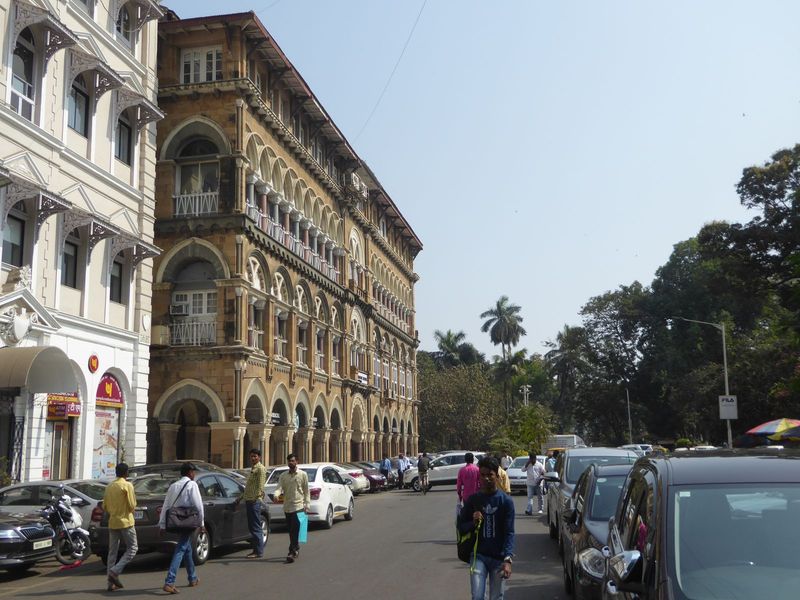
The view the other way terminates at the green space of Elphinstone Circle, now Horniman Circle.
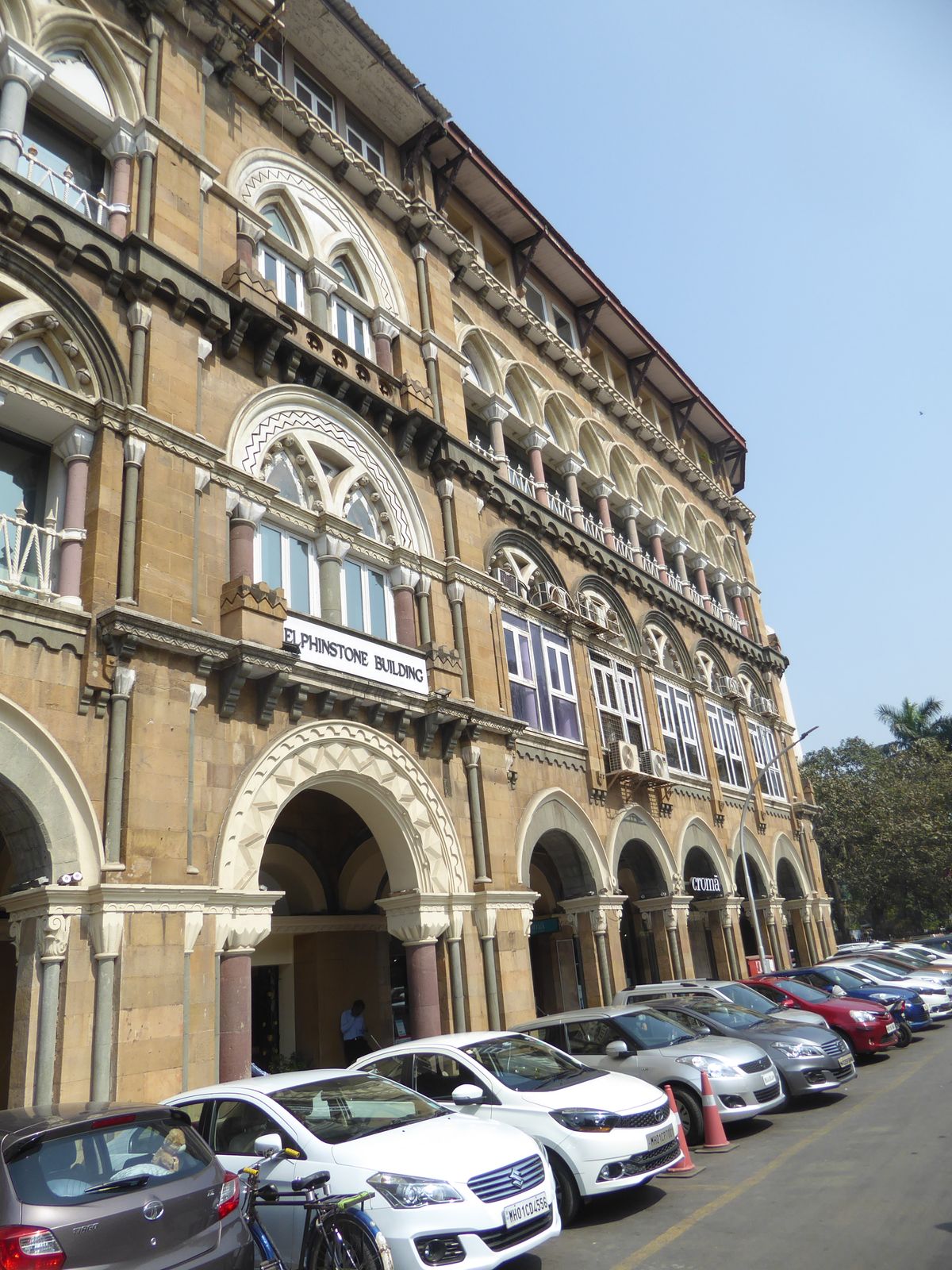
The Elphinstone Building is largely occupied by Tata enterprises.
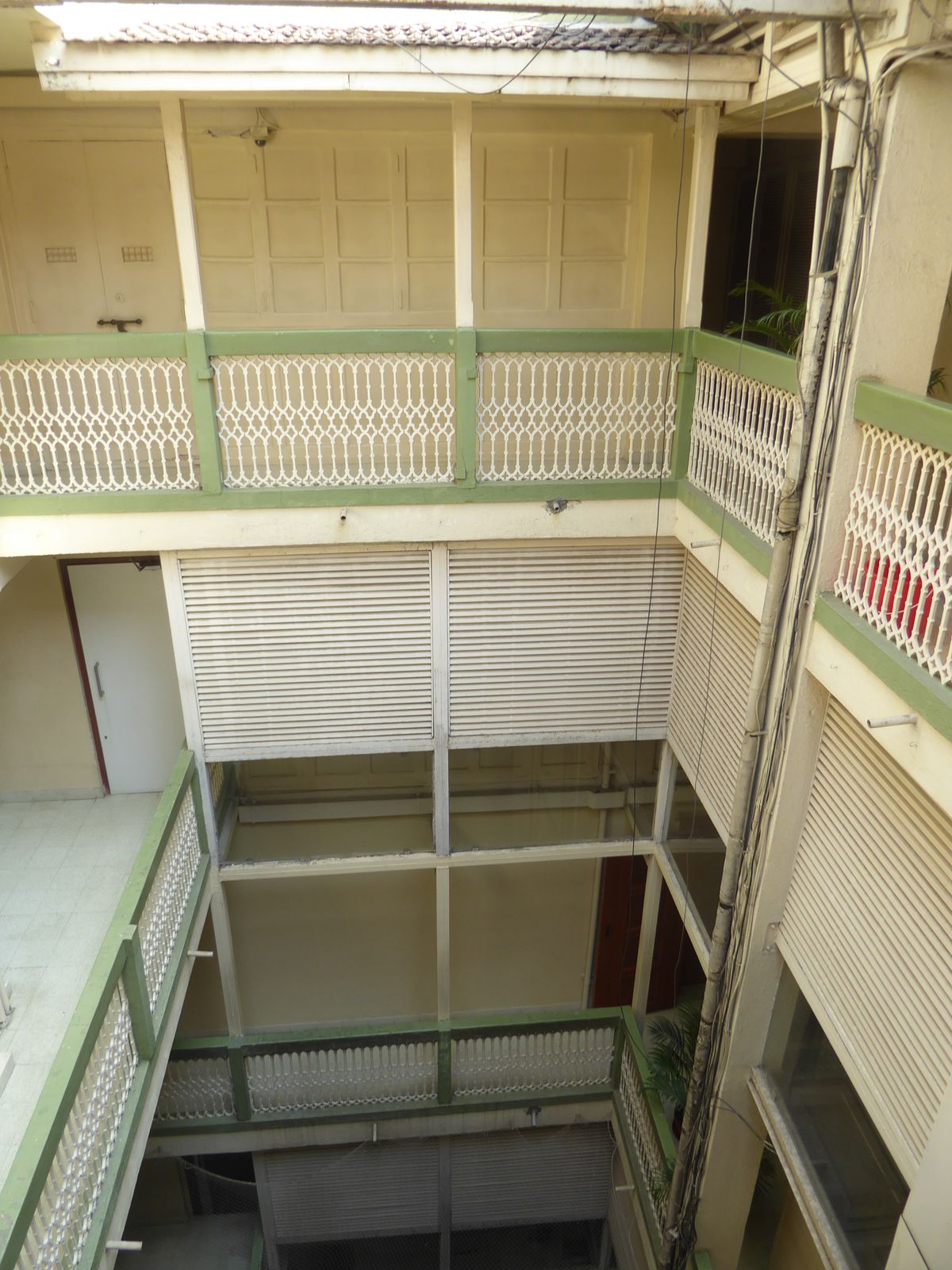
An interior airshaft doesn't bother with the Italian mood.
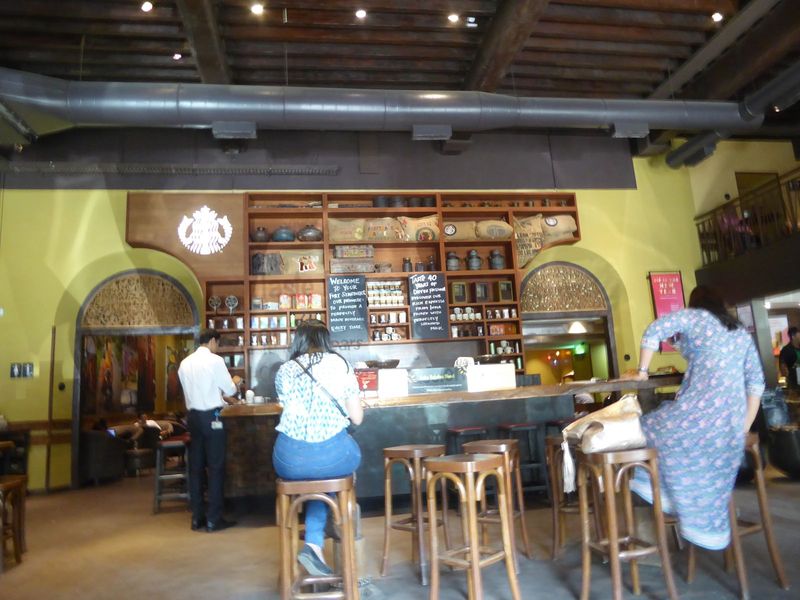
Tata is also the local partner for Starbucks in India, which partly explains why the ground floor has a large Starbucks store—India's first.
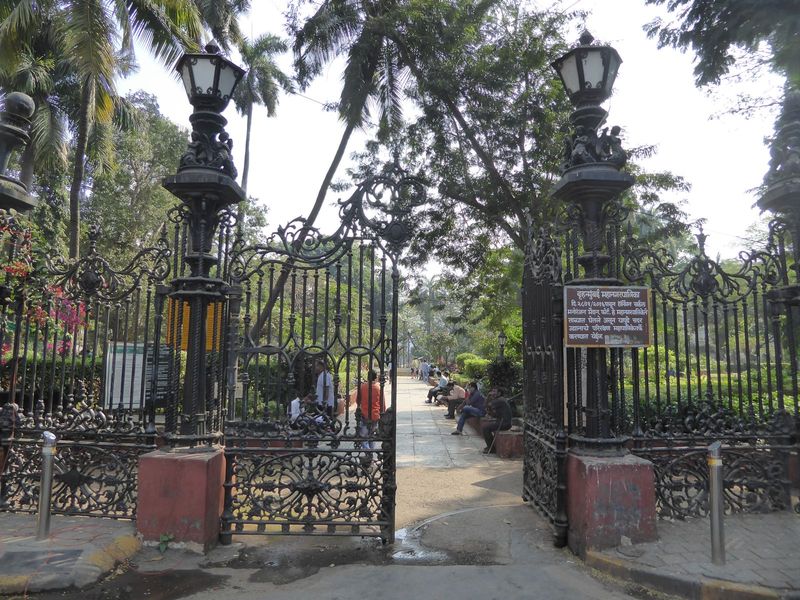
Horniman himself was English, but he was also the editor of a newspaper that dared to publish news that the government of India tried to suppress. Hence a post-independence place name that's European. It replaces the earlier name, Elphinstone Circle, which is confusing all by itself because there were two Elphinstones who served as governors of Bombay. The circle and the building are named for John, nephew of the more eminent Mountstuart,
The park, created in 1869 in the aftermath of the fort's clearance, is in very good shape, thanks to a neighborhood renovation done largely with foreign donations in the last decade or two.
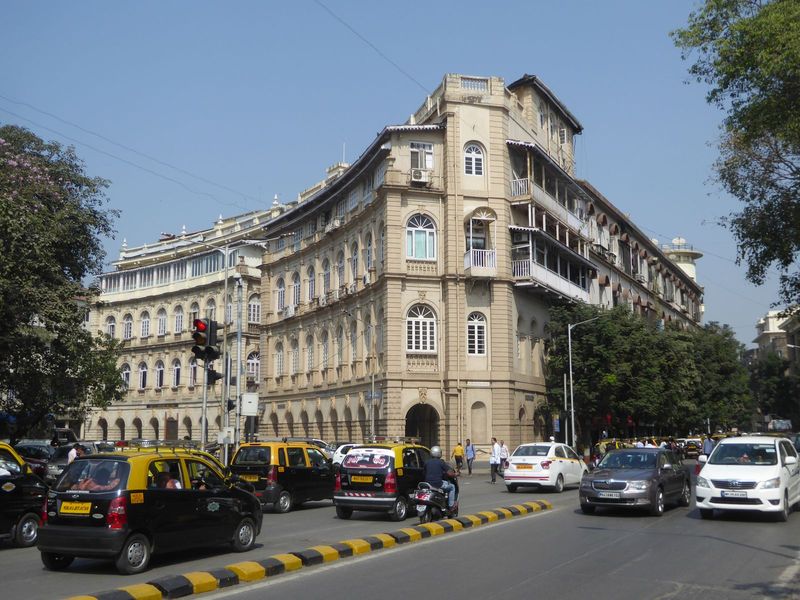
The circle is also wrapped by a set of four roughly identical office buildings developed as a group, again to create a proper Victorian business center on the site of the former fort.
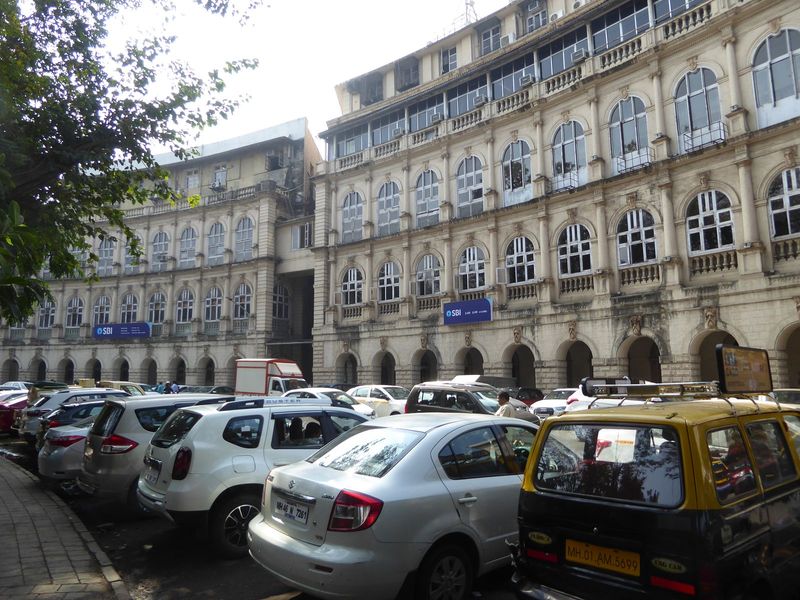
The most visable modification over the years has been glassing in the loggias. Thank or blame air conditioning.
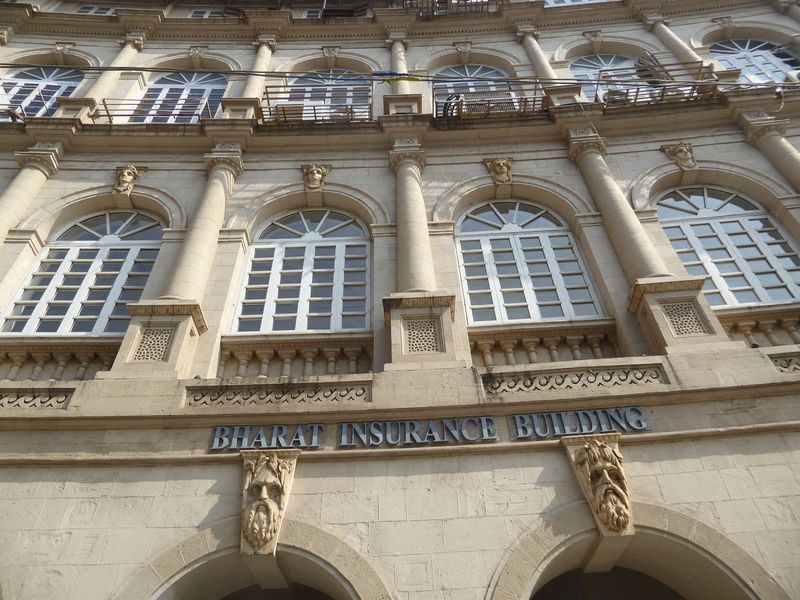
Office rents have gone up a lot since the buildings were cleaned up. The keystone heads seen unimpressed.
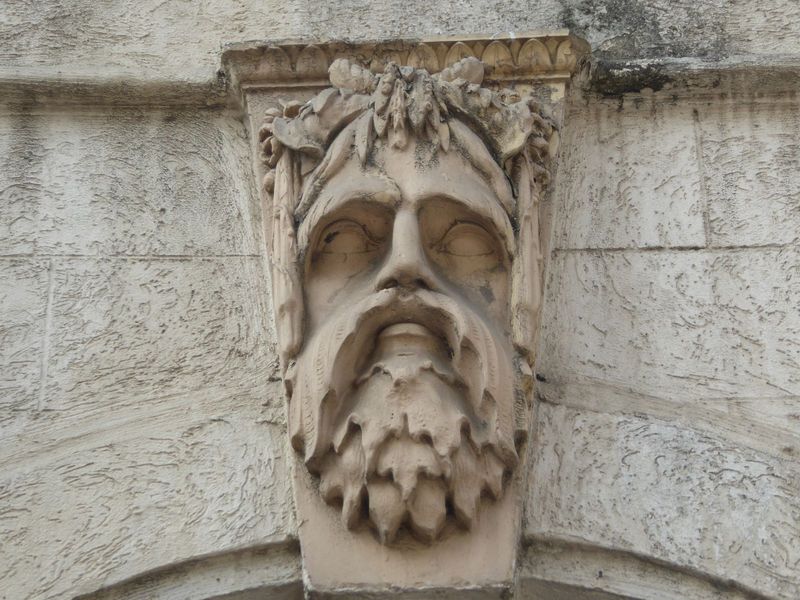
Neptune?
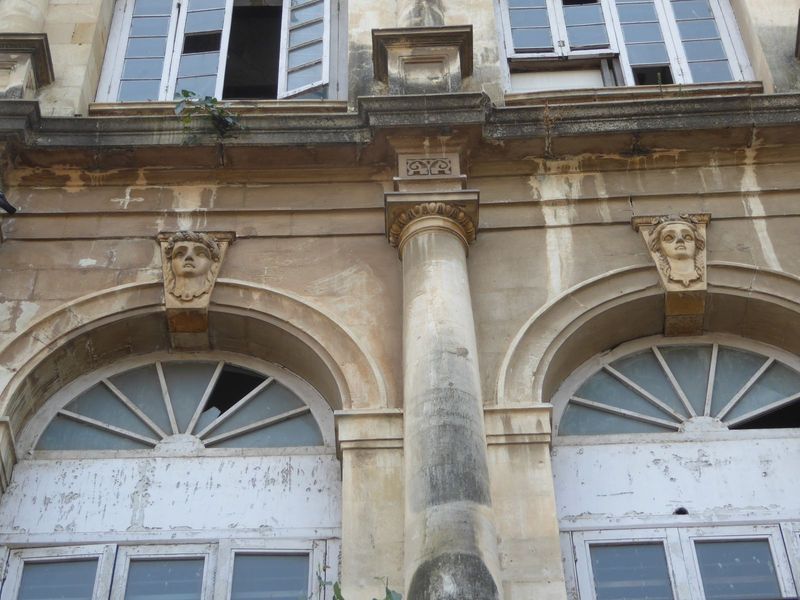
The poor girls desperately want to go home.
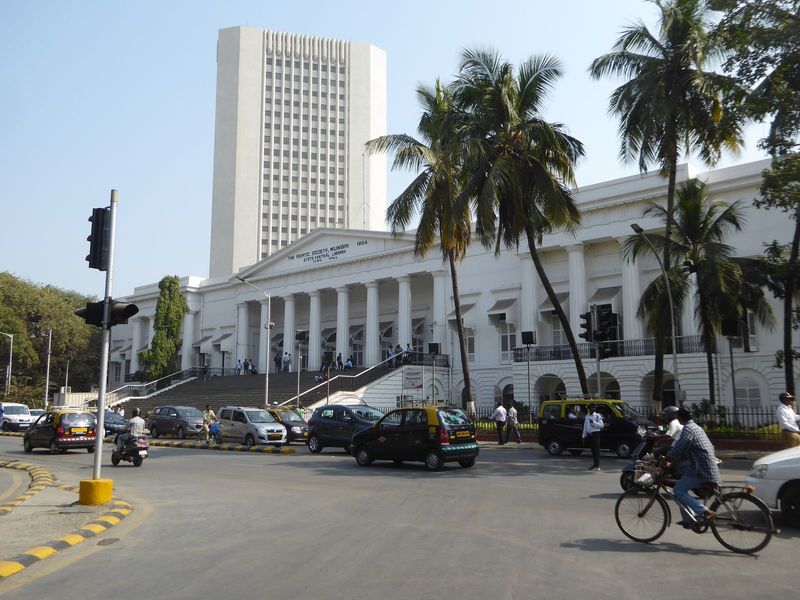
At the east end of the park there's the old town hall, backed up by the highrise Reserve Bank of India.
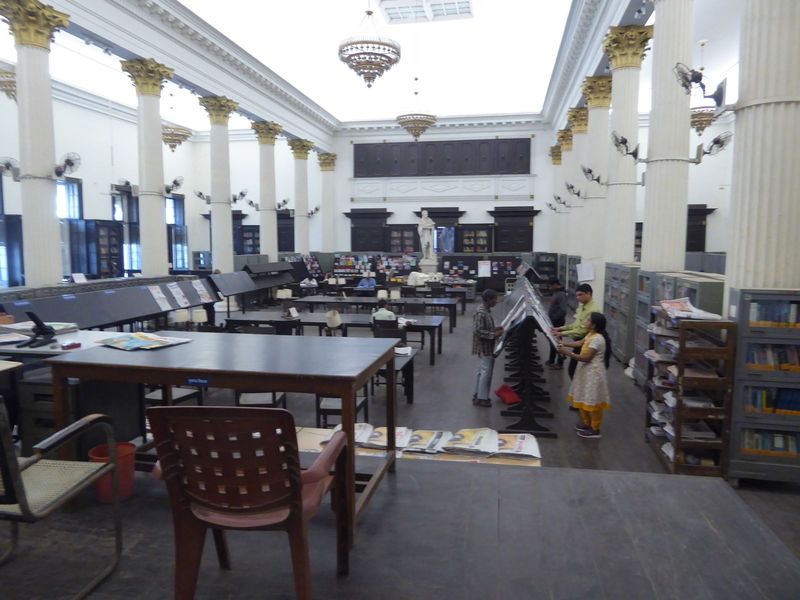
The town hall's interior is a library.
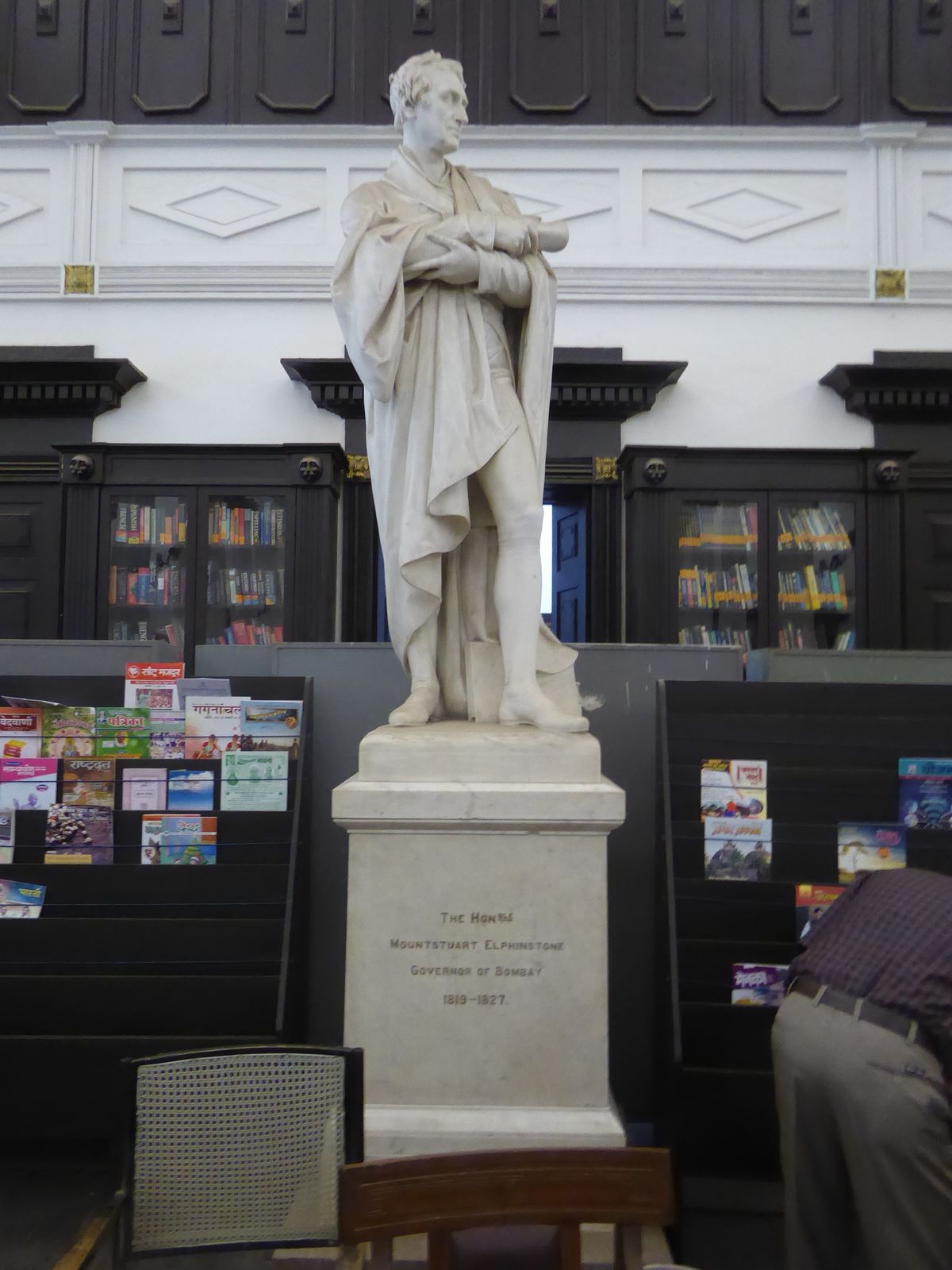
And now, heeeeere's Mountstuart! The papers in his hand hint at his scholarly nature. Did anyone else ever turn down (once, let alone twice) an invitation to be governor-general of India so that he could get on with writing a history of India? Elphinstone did, and the book was published in 1841.
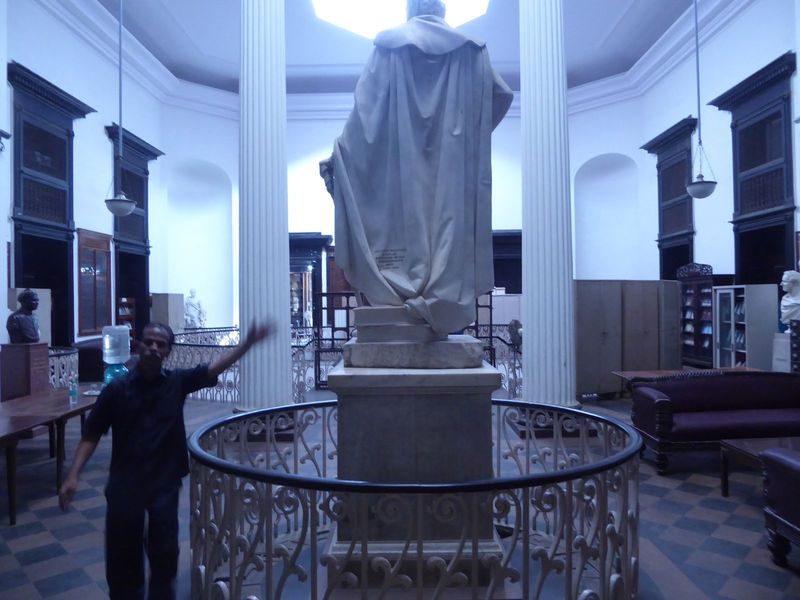
We'd like a snap of John Malcolm, another governor, but we're chased away.
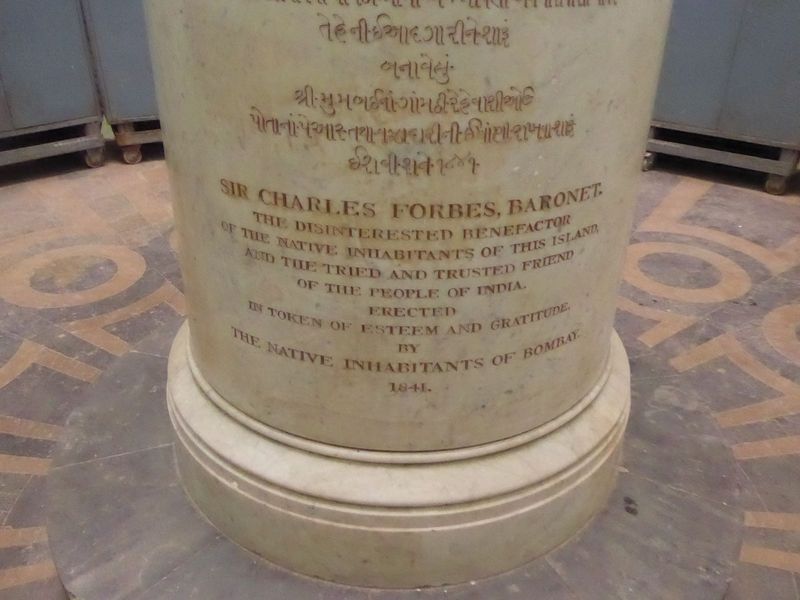
Nowadays it's hard to read encomiums of this sort without an upwelling of debunking skepticism.
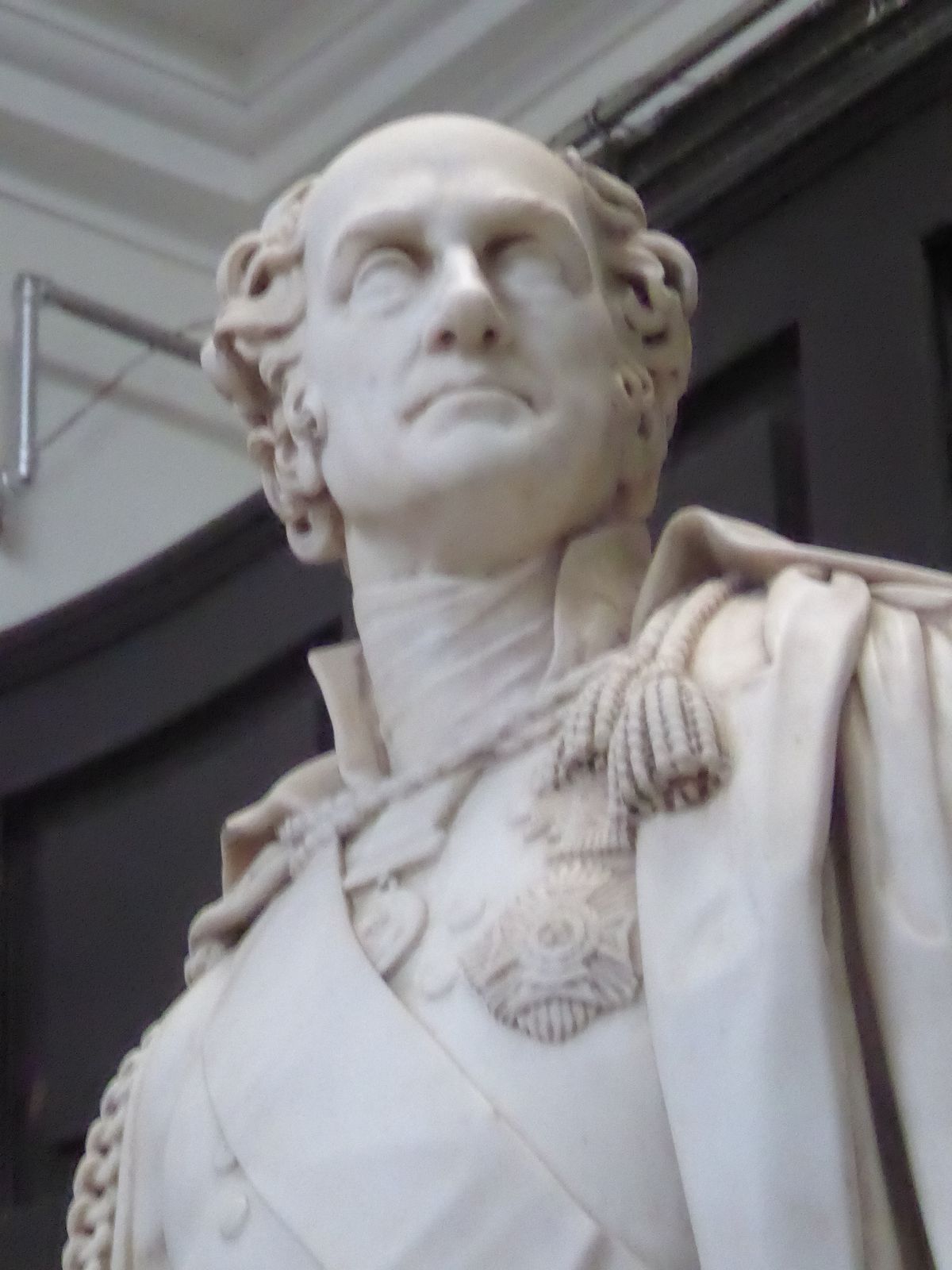
Here he is, Charles Forbes (1773-1849), a businessman turned parliamentarian turned philanthropist. His fortune was based on the family firm of Forbes and Company, Bombay, begun by his uncle and carried on by the nephew with interests expanding from trading to shipbuilding and banking. Forbes returned home in 1811 after 25 years in India but retained his managerial position in the firm, while also serving as a very Tory member of parliament. He made himself unpopular there with comments such as: "The more I see of my own countrymen, the more I like the natives of India." (See the lengthy article about him in historyofparliamentonline.org)
Among his philanthropies were donations to help Bombay improve its water supply and build this town hall. As for whether Forbes should be regarded as a bounder or a benefactor, consider this: he translated the gospels into Hindi but opposed missionary activity. ("He left the Hindoos to do with them what they pleased".)
The statue is by the eminent Francis Chantrey. See also James Grant's obscure Portraits of Public Characters, vol. 2, 1841.
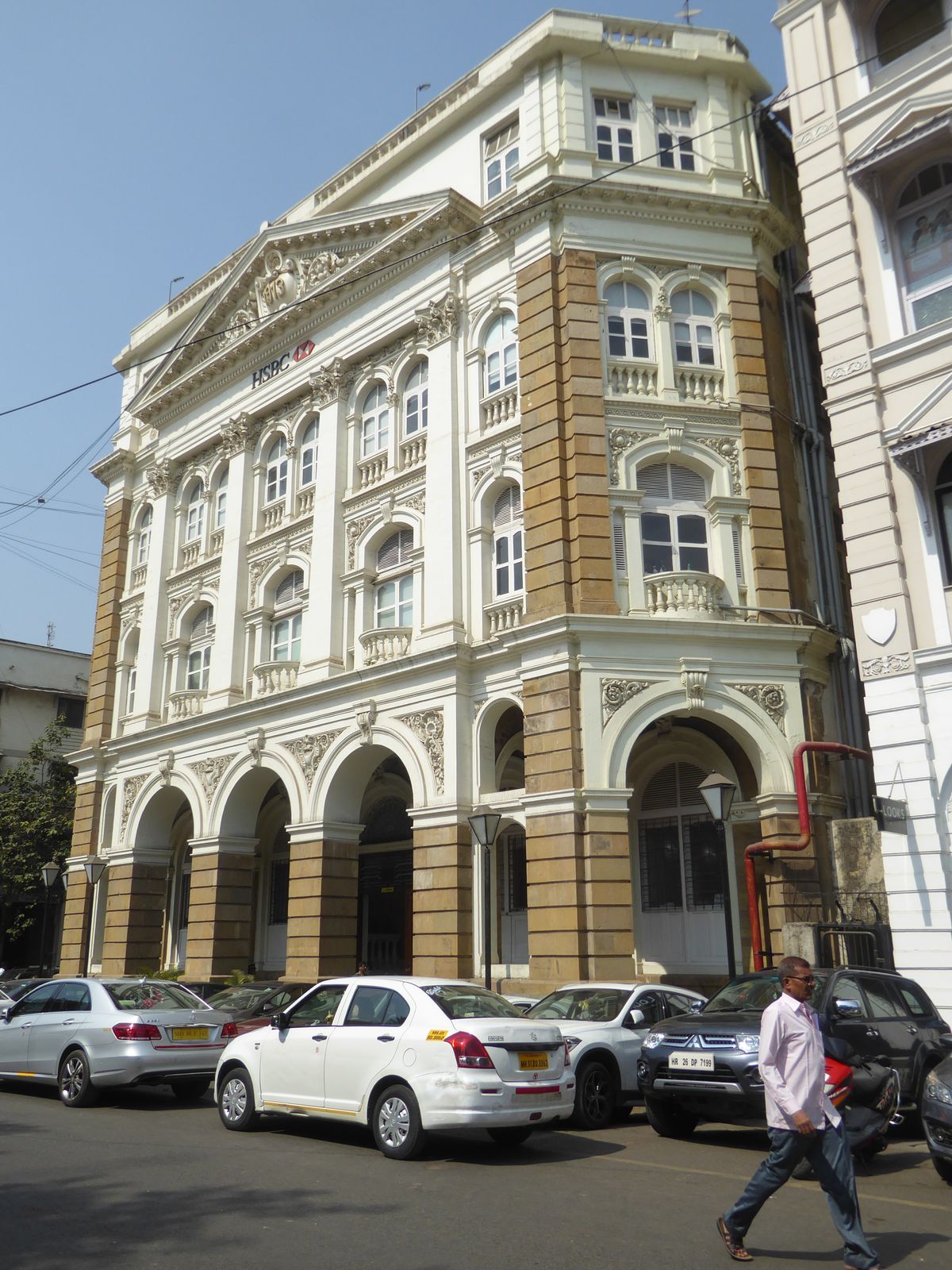
We've returned to HSBC, housed in a building formerly occupied by the British Bank of the Middle East. That bank had begun as the British-owned Imperial Bank of Persia, established in 1889 by Julius De Reuter. In 1952 the bank abandoned Iran and renamed itself the British Bank of the Middle East. Surely this building antedates that event, but references seem to trace it back no further. No matter: in 1959 it disappeared into HSBC's maw. Besides, we're here for what's on the other side of Veer Nariman.
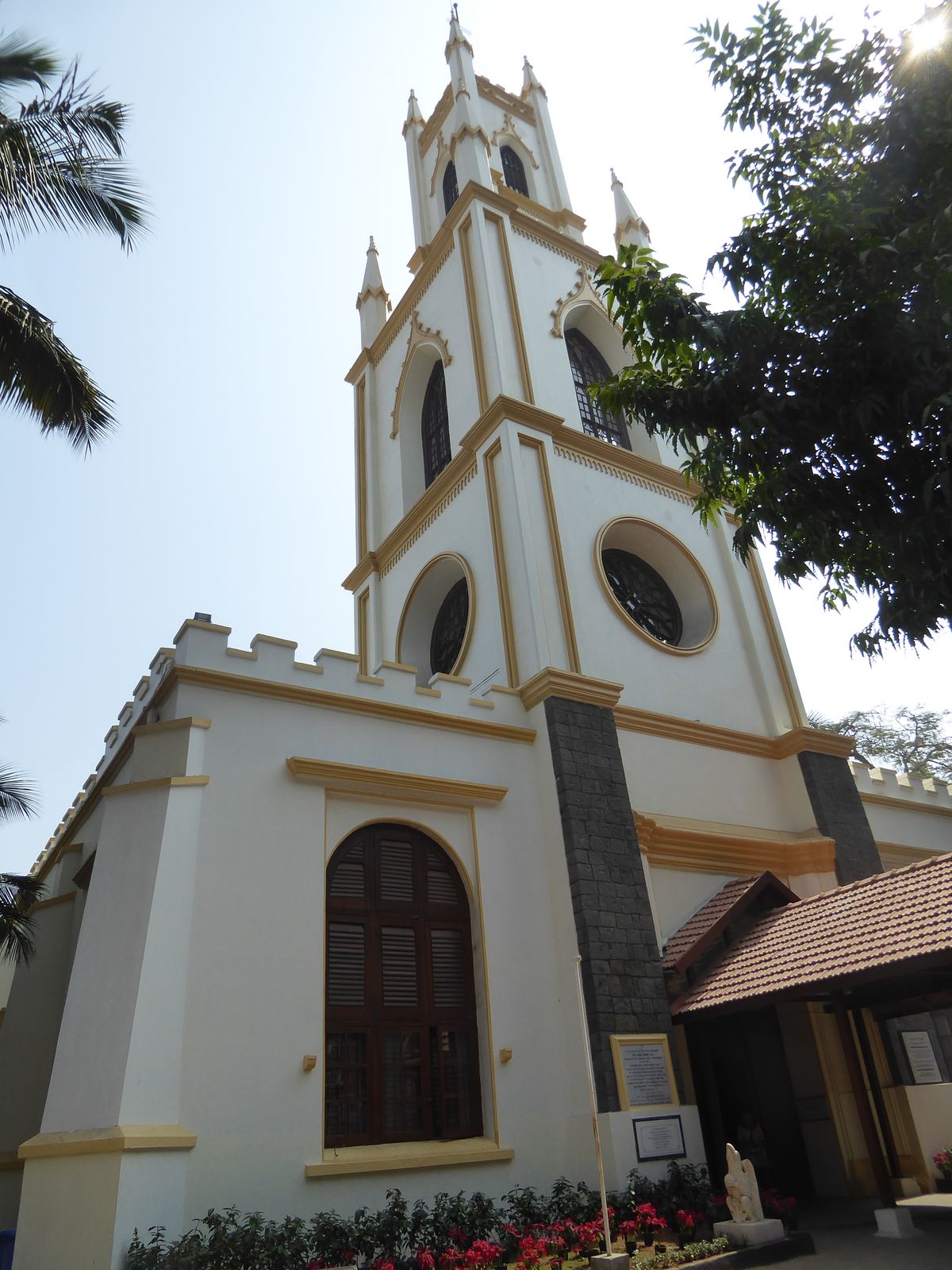
Yes, it's the St. Thomas church, from which the name Churchgate arose.
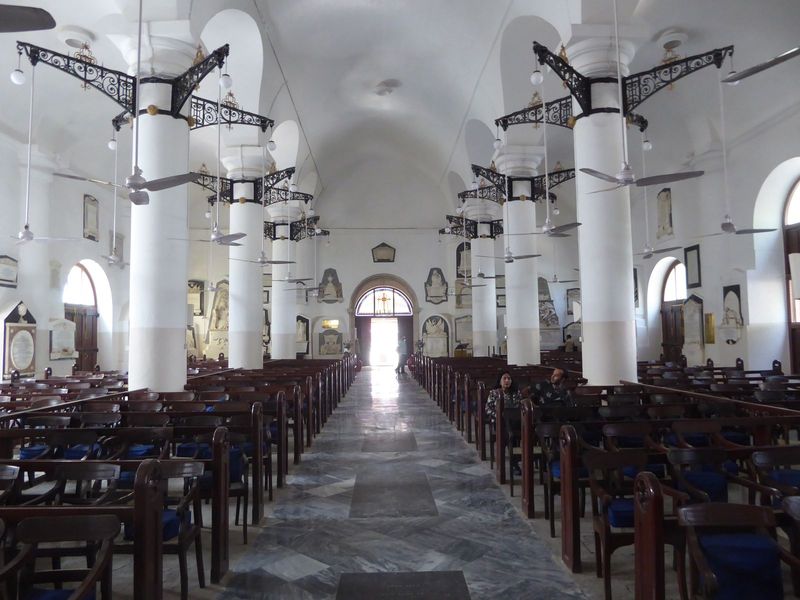
It's venerable enough--consecrated in 1718 and reconsecrated as a cathedral in 1837, after which the tower was added.
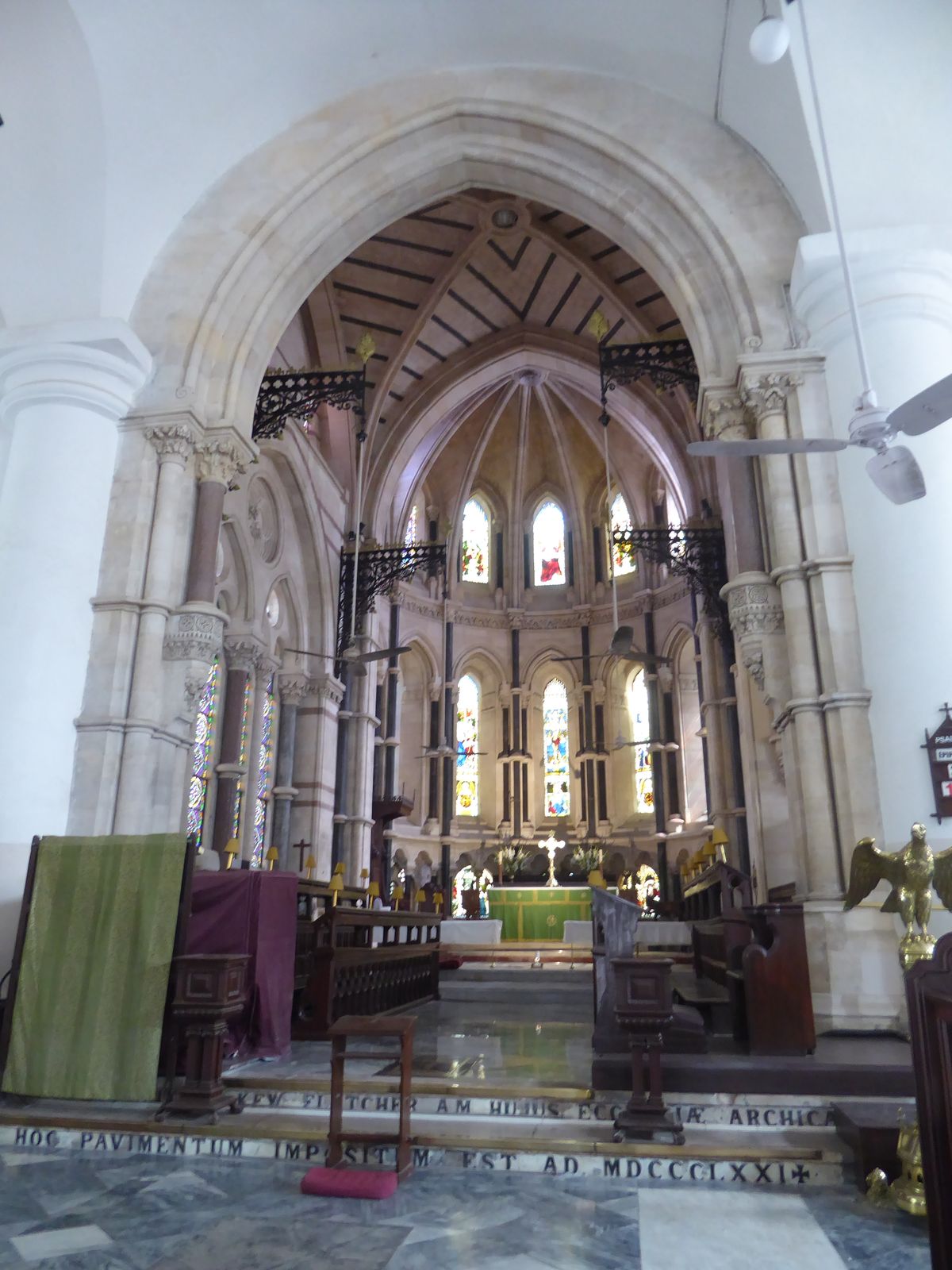
The comparatively opulent chancel is also later, from about 1865.
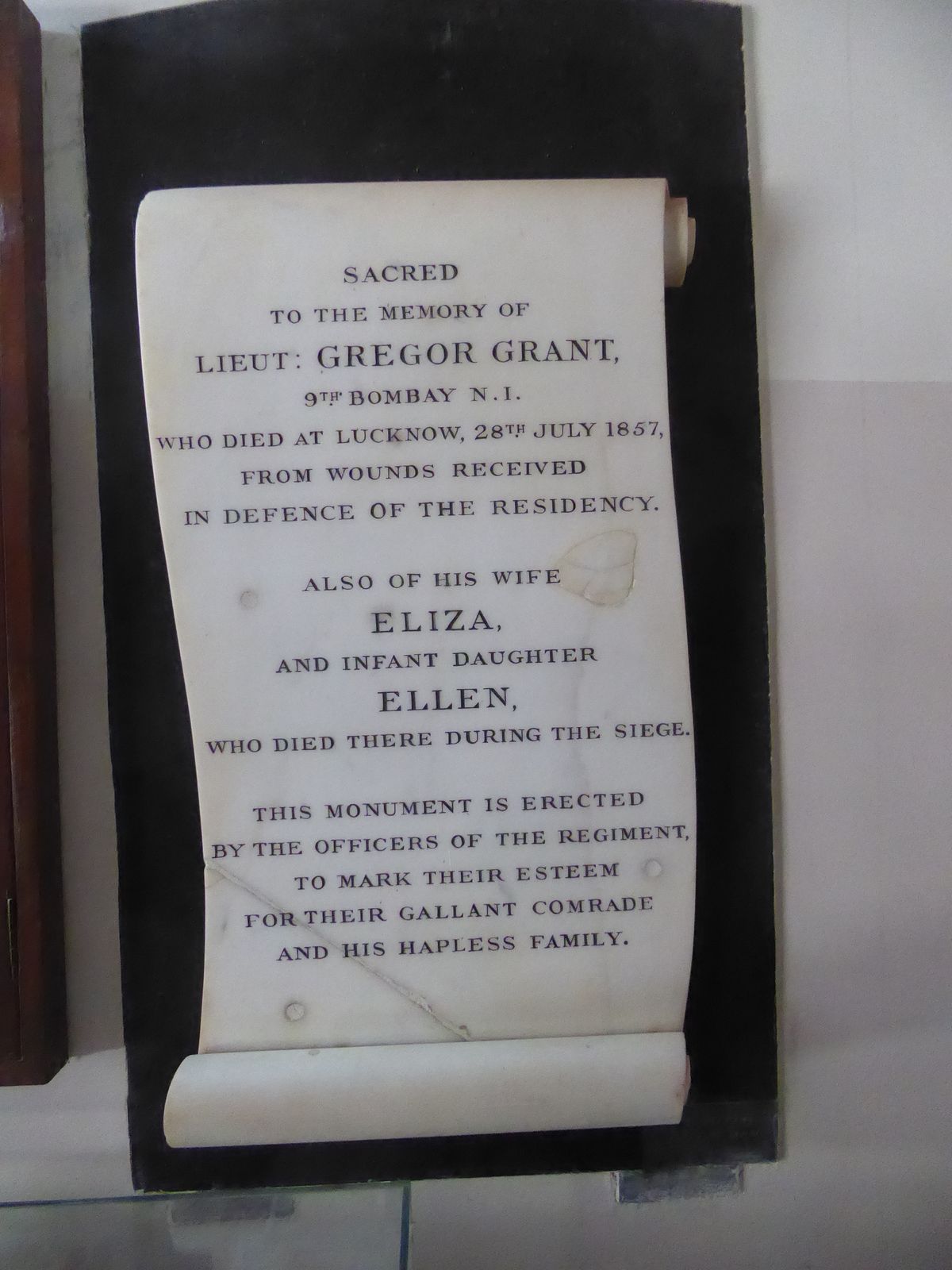
The most evocative part of the church (as is almost always true across the colonial world) are its wall-mounted memorials.
What was an officer from the Bombay infantry doing in Lucknow with his family? His timing was awful.
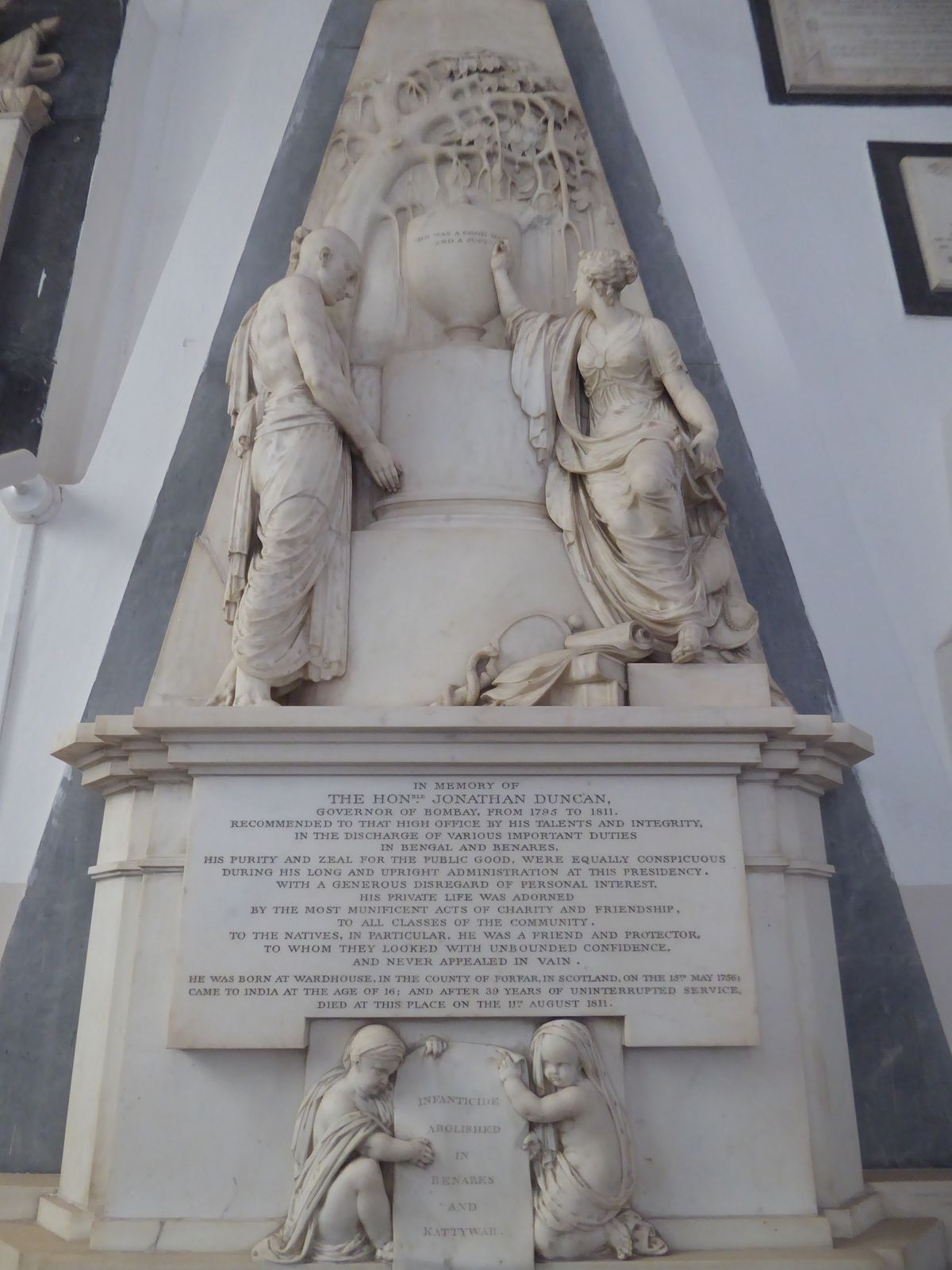
The stone at the bottom cuts through the verbiage.
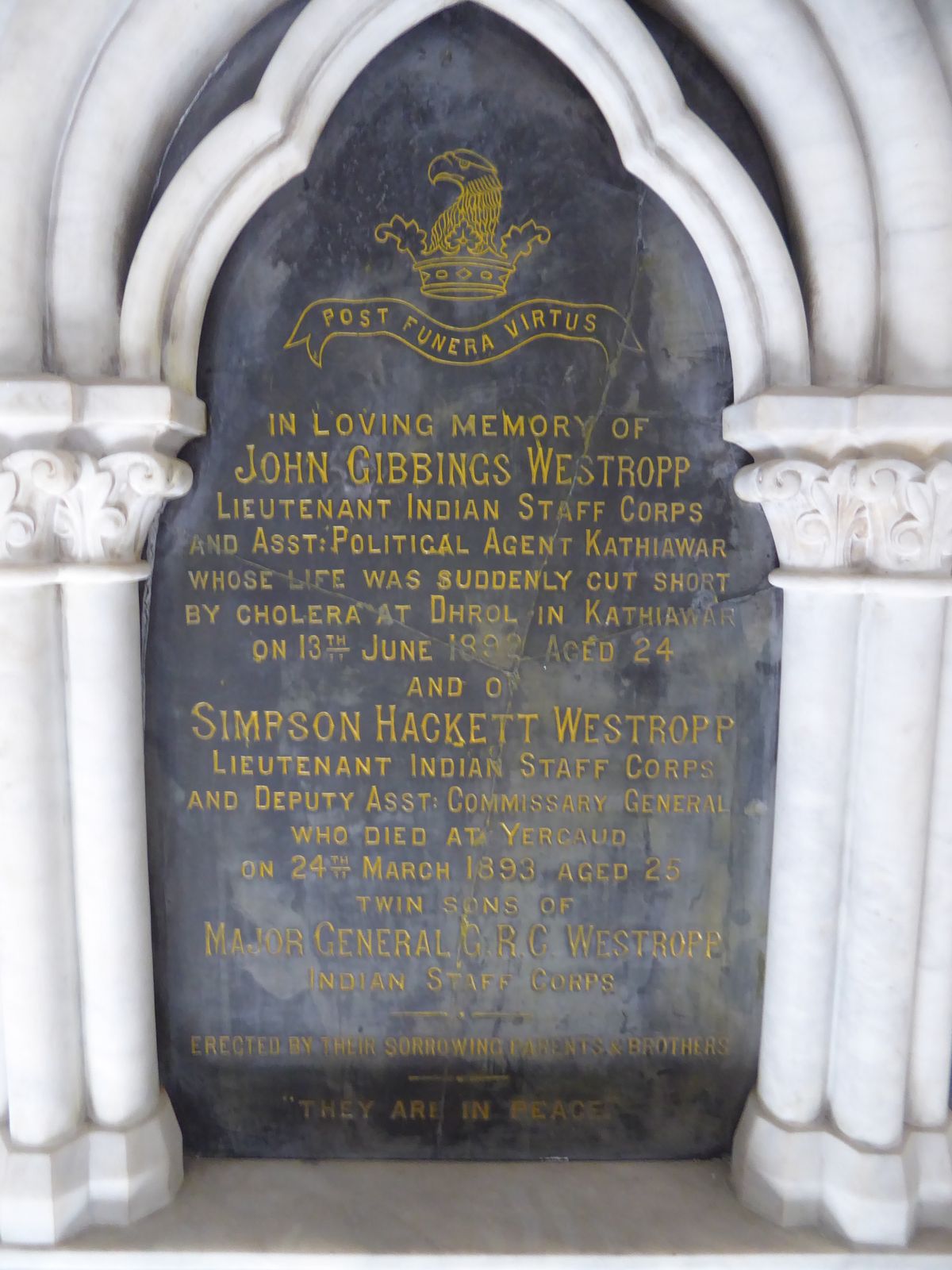
The guy with the scythe was never far away in the lowland tropics.
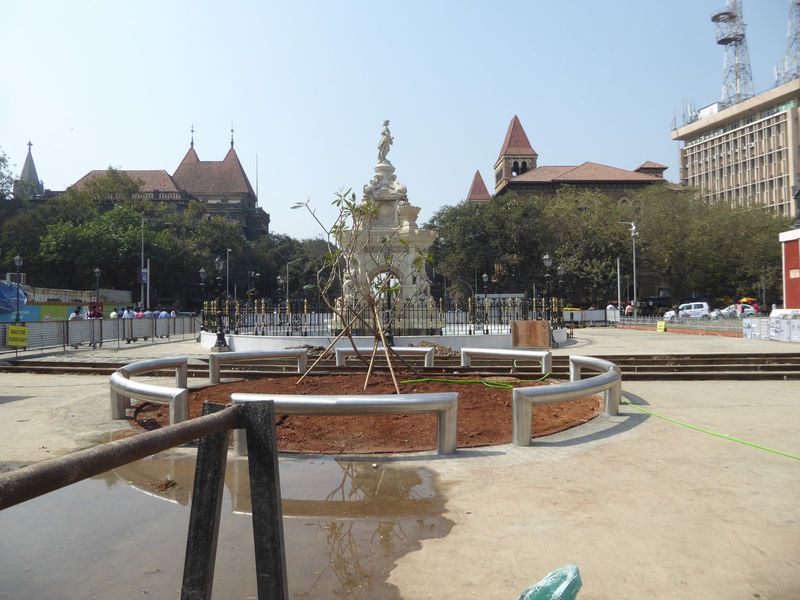
We've come west one block to the Flora Fountain of 1864. It sits on the site of Bombay Fort's Church Gate, demolished in 1860. The location is now the intersection of Veer Nariman and Mahatma Gandhi Road, formerly Esplanade Road. The Mumbai Metro is building a line underground here, which explains why the neighborhood is a construction zone.
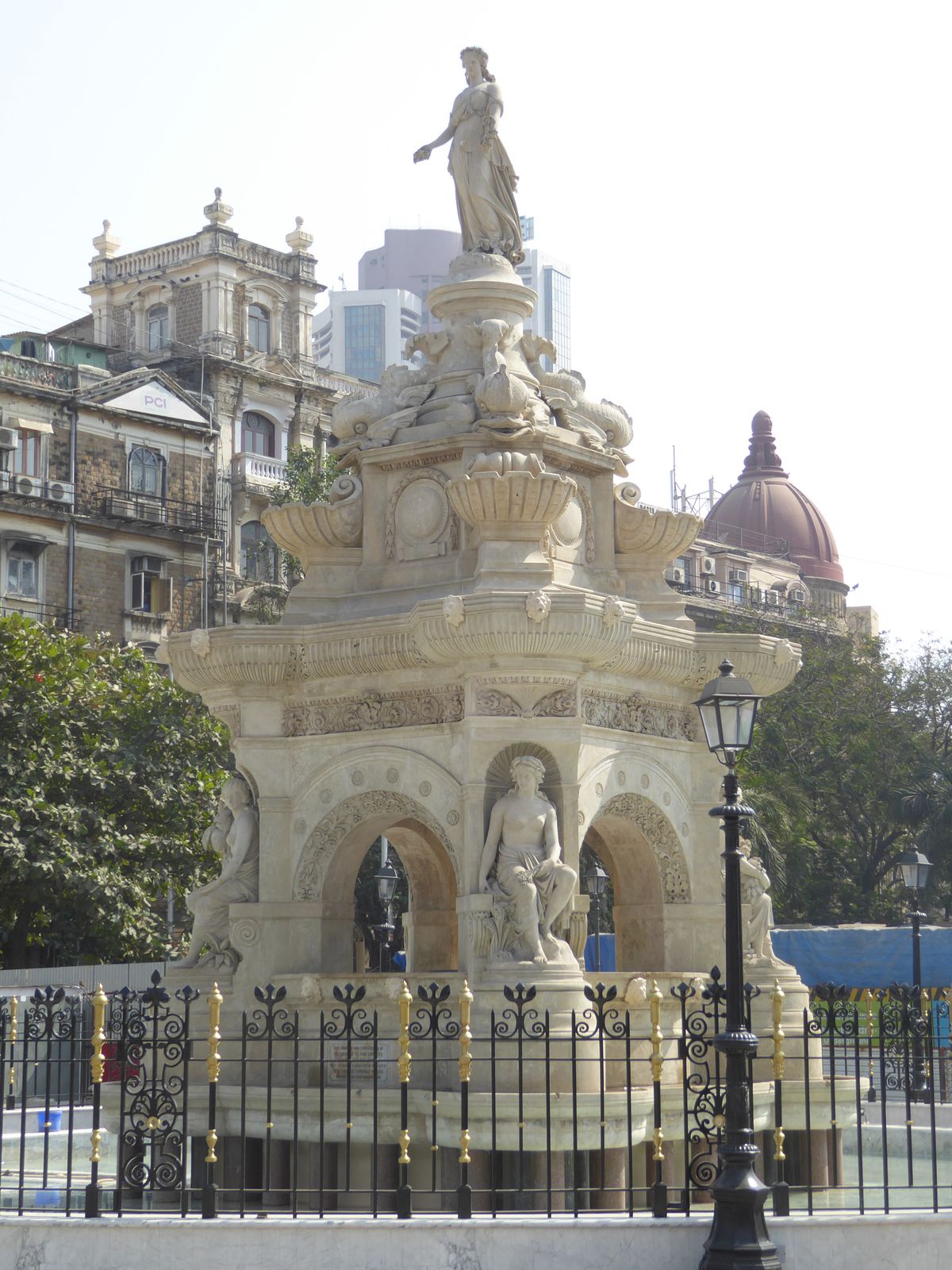
Freshly restored in 2019, the limestone is bright once again. Flora, the goddess of plenty is up top; at the lowest level, four women represent India's agricultural wealth. The monument was the work of the 33-year-old Richard Norman Shaw, whose New Scotland Yard buildings (now the Norman Shaw Buildings) were more than 20 years in the future.
Will running water return?
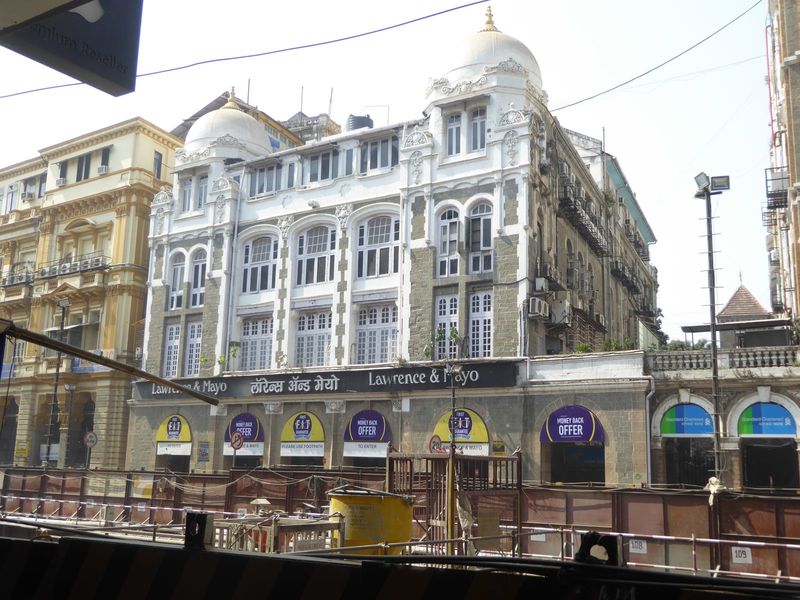
We're trying to cross the street, but Metro construction doesn't make it easy, and we're forced to detour north along D.N. Road. Not too much romance in initials, but they're more convenient that Dadabhai Naoroji, formerly Hornby Road. Naoroji was the remarkable (unique?) combination of a founder of the Indian National Congress and member of the British House of Commons. Hornby was Bombay's governor for the death-defying span of 1771 to 1784. Lawrence & Mayo, established as opticians in Calcutta in 1877, have had this Bombay shop since 1901. It's in the Macmillan Building, named for the British publisher hiding upstairs.
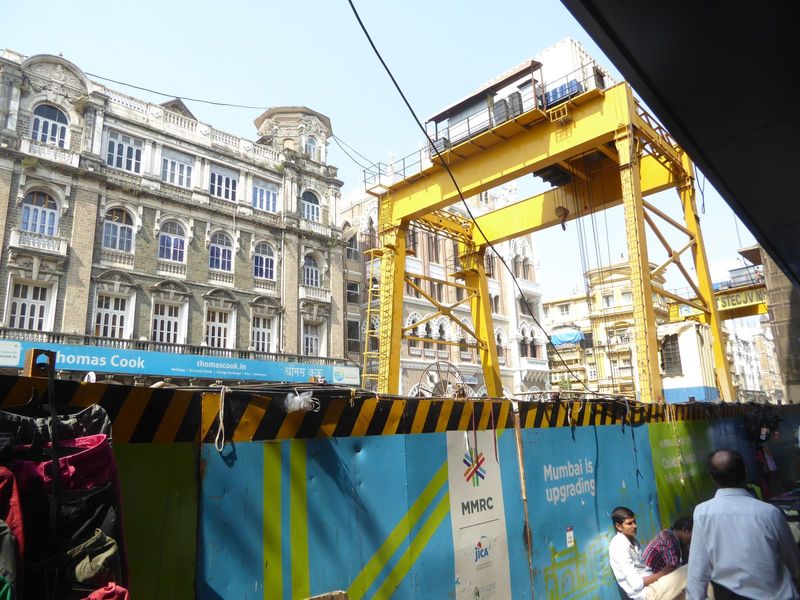
Getting around is a little tricky.
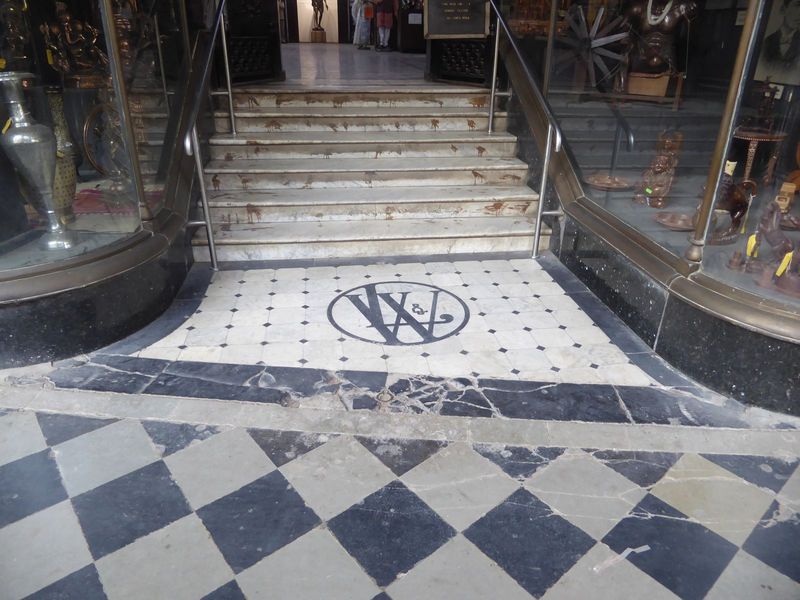
We made it across and are standing at the entrance to the former Whiteaway and Laidlaw, one of the two major department-store chains of British India. The store here opened in 1895, a dozen years or so after the company opened its first store, which was in Calcutta. The company seems to have stayed in business until 1962.
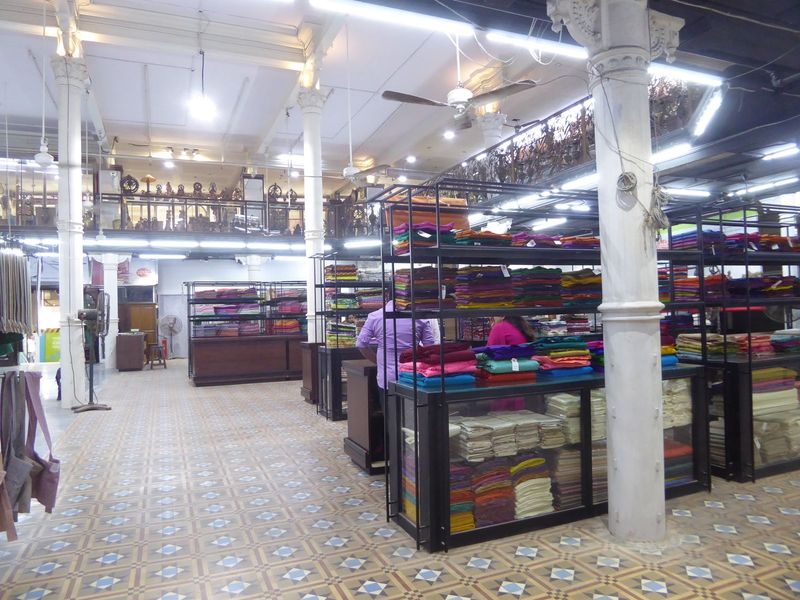
There's still a store here. It's the lightly stocked Khadi Bhandar, selling traditional products.
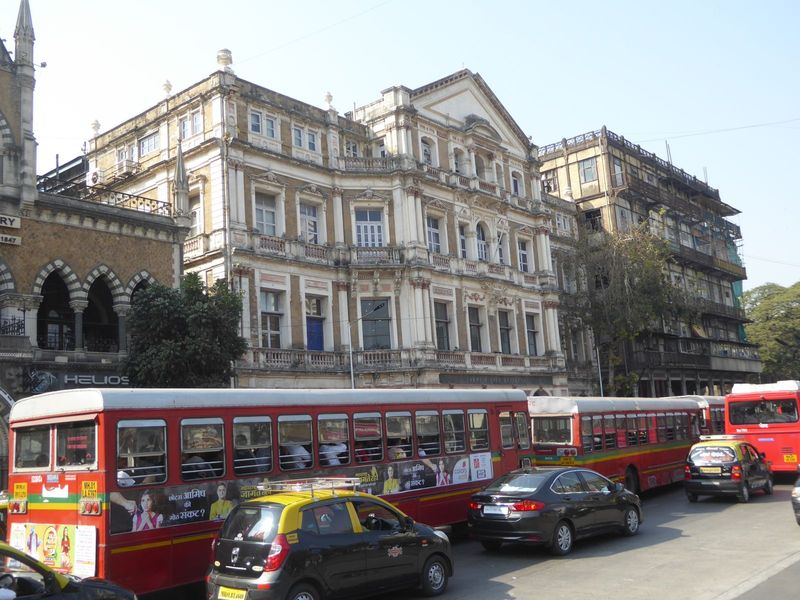
We're a kilometer south but still on M.G. Road. (Indians will be shocked to learn that foreigners rarely know who those initials stand for.) The cluster of three buildings, from left to right, are the Sassoon Library, the Army & Navy Building, and Esplanade Mansion, formerly Watson's Esplanade Hotel.
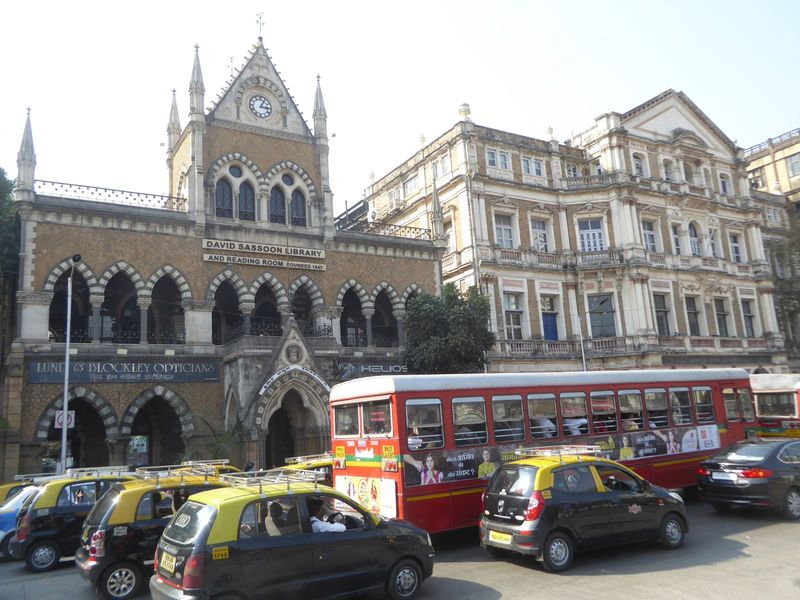
The library opened in 1870 as a Mechanic's Institute and was Bombay's first library open to the public by subscription. (About 2,500 members now pay an annual membership fee of about $50.) The name soon changed to honor the primary donor, an Iraqi Jew whose family's name is scattered not only around Bombay and Pune but much farther afield—in Shanghai, for example. Are the desks actually occupied by readers? Absolutely; it's a popular place but one that actively prohibits cameras.
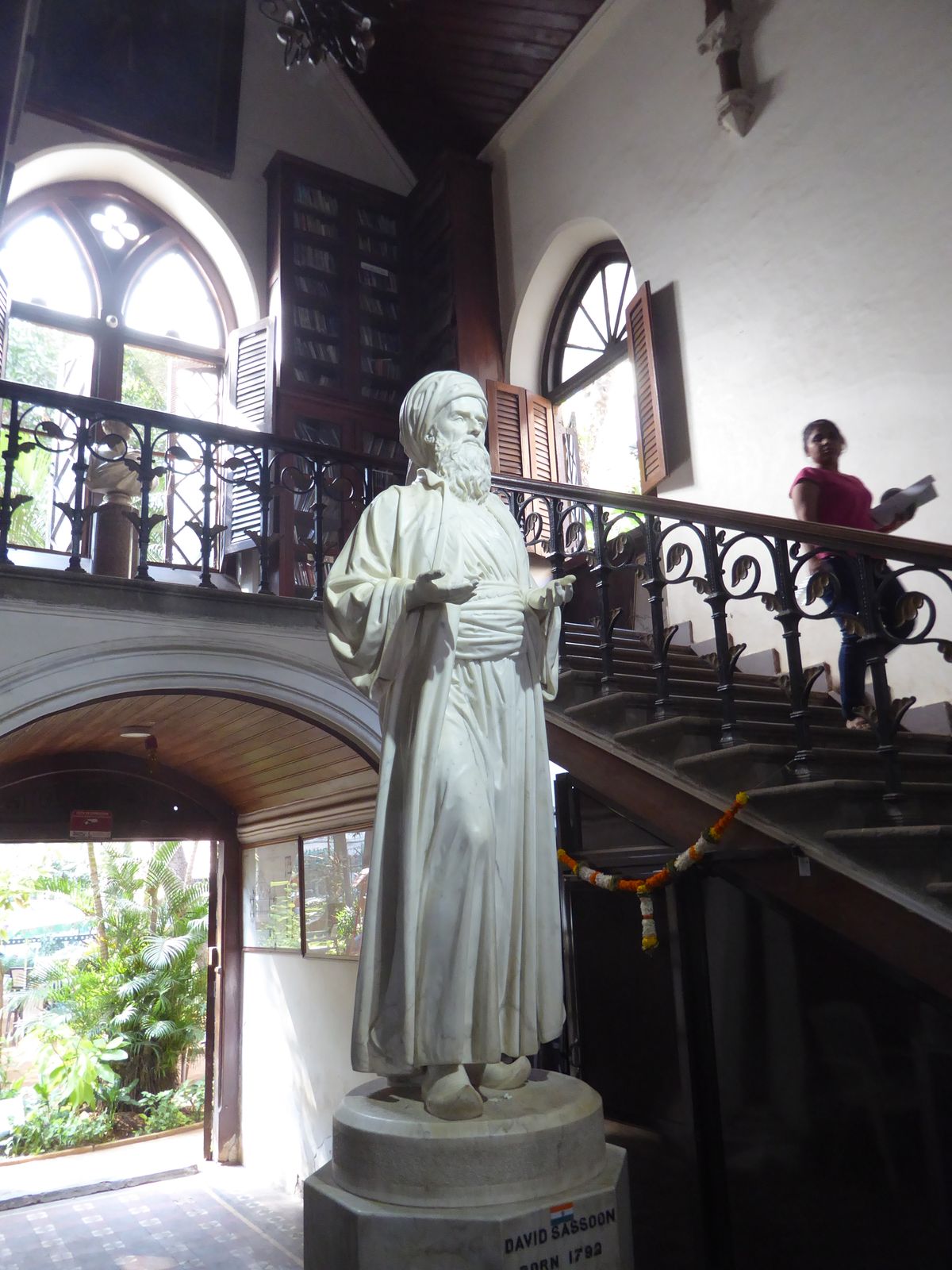
Sassoon himself (1792-1864) appears in a statue executed by Thomas Woolner, who also did the statued of Raffles in Singapore and Captain Cook in Sydney. Woolner was apparently a friend of Bombay's most famous governor, Bartle Frere, who commissioned the work.
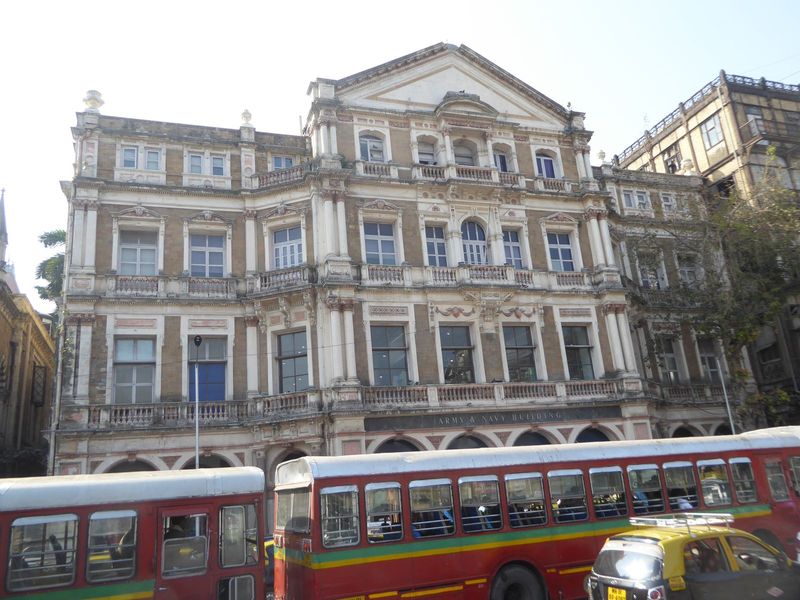
The Army and Navy Store is no longer a store.
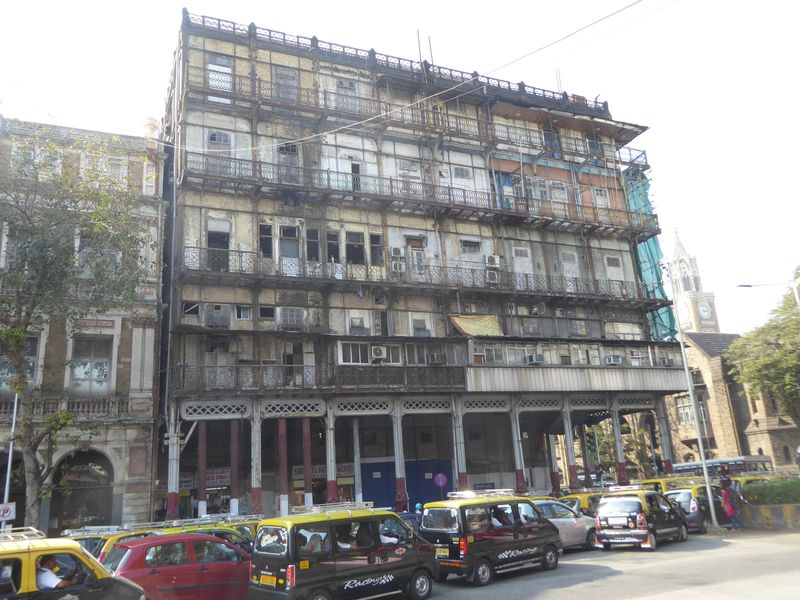
Nor is Watson's Esplanade Hotel a hotel. (That tower on the right? Wait a moment.) This was Bombay's best hotel from the 1860s until the construction of the Taj Mahal about 1900.
A prefabricated building sent from England, Watson's was designed by Rowland Mason Ordish, who worked on the Crystal Palace and later engineered the great shed at St. Pancras and the dome of the Royal Albert Hall. In case you think he messed up here, old photographs show a mansard roof and intact balconies, with doors offering ventilation for hotel residents.
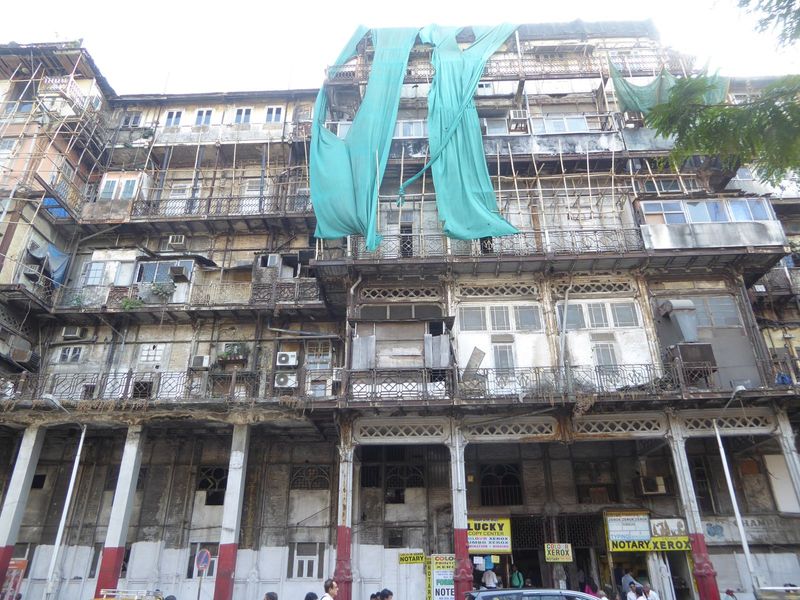
The hotel closed in 1960 and eventually was divided among 15 co-owners and about two hundred tenants, some residential but many others lawyers who rented quarters here because the location was conveniently close to the high court.
The bamboo scaffolding is a desperate attempt to keep the balconies from collapsing. An order from the Mumbai housing authority to evict residents in 2009 was apparently in vain. Sometimes lawyers are handy.
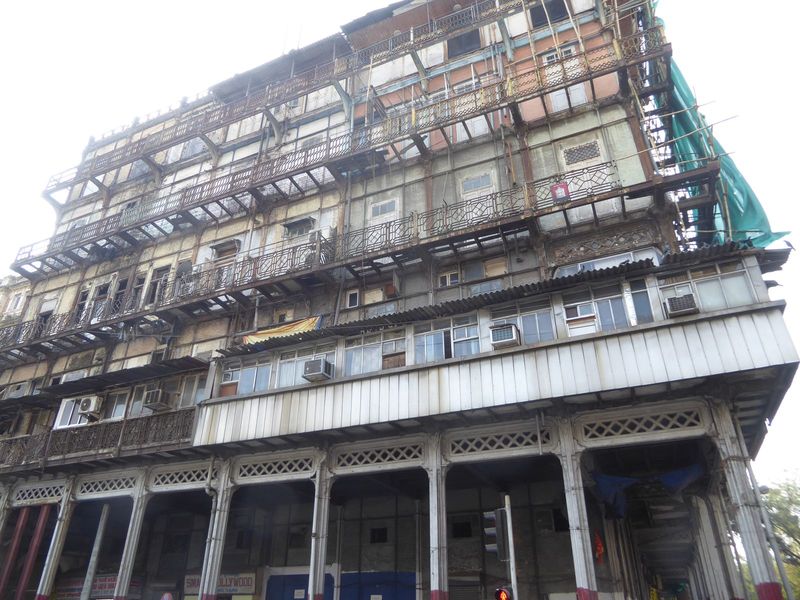
The building is now called Esplanade Mansion, an especially toney name for a building whose balconies have fallen off at least twice, once in 2005 and again in 2018. Only one fatality, however, and only one crushed taxi.
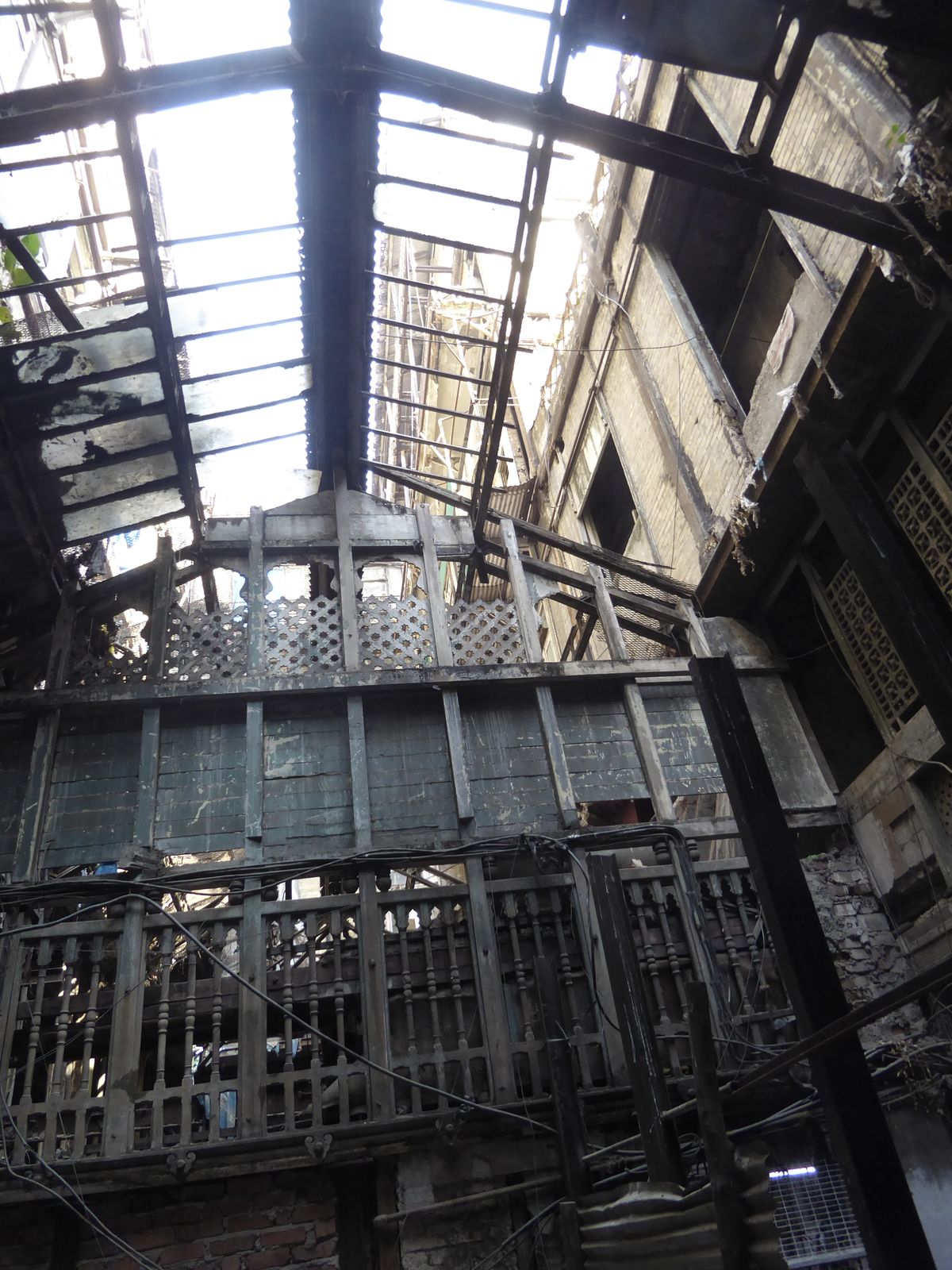
This is either the hotel ballroom or the hotel's once-famous atrium.
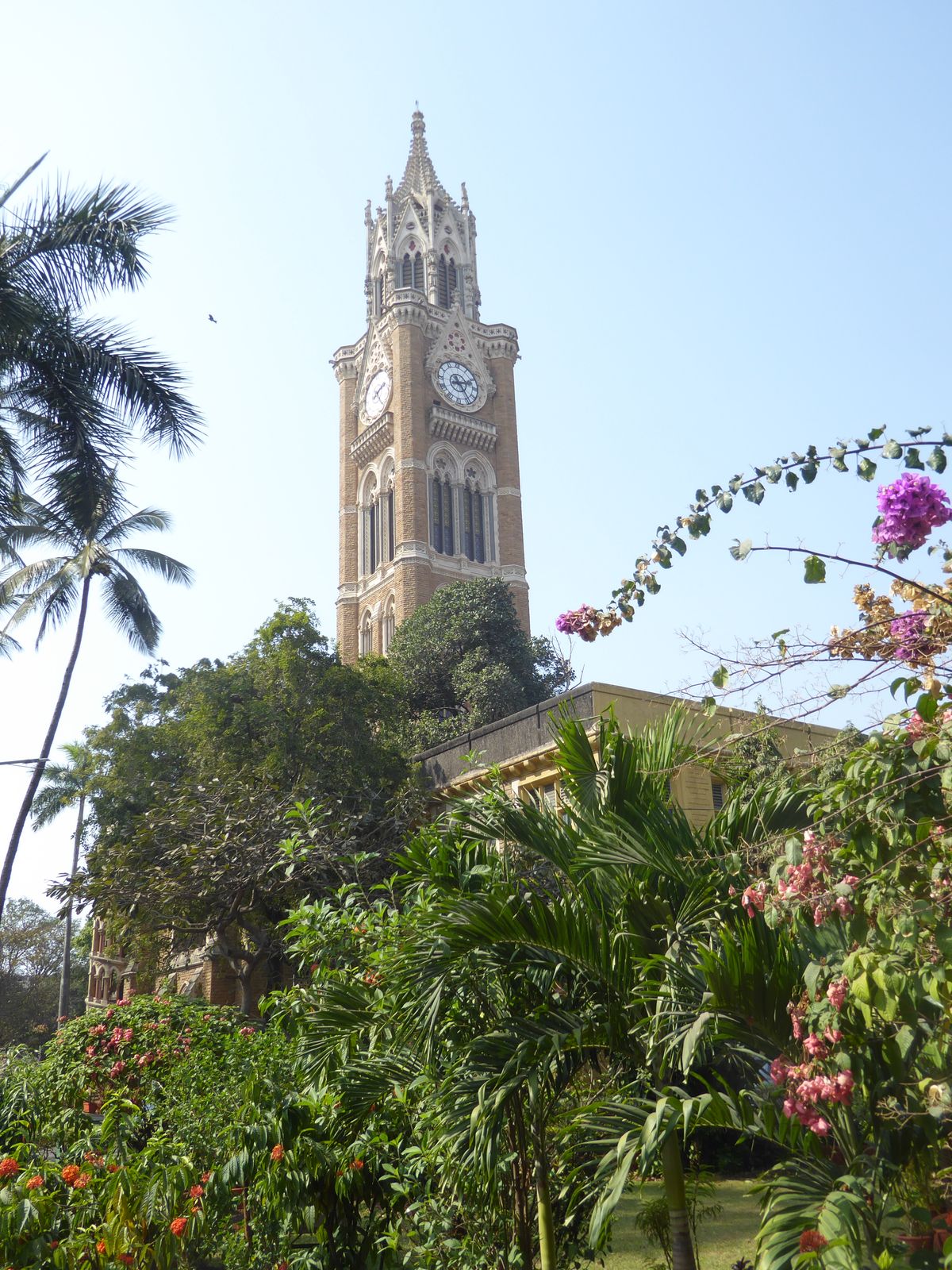
That tower you saw a minute ago belongs to the library of Bombay University.
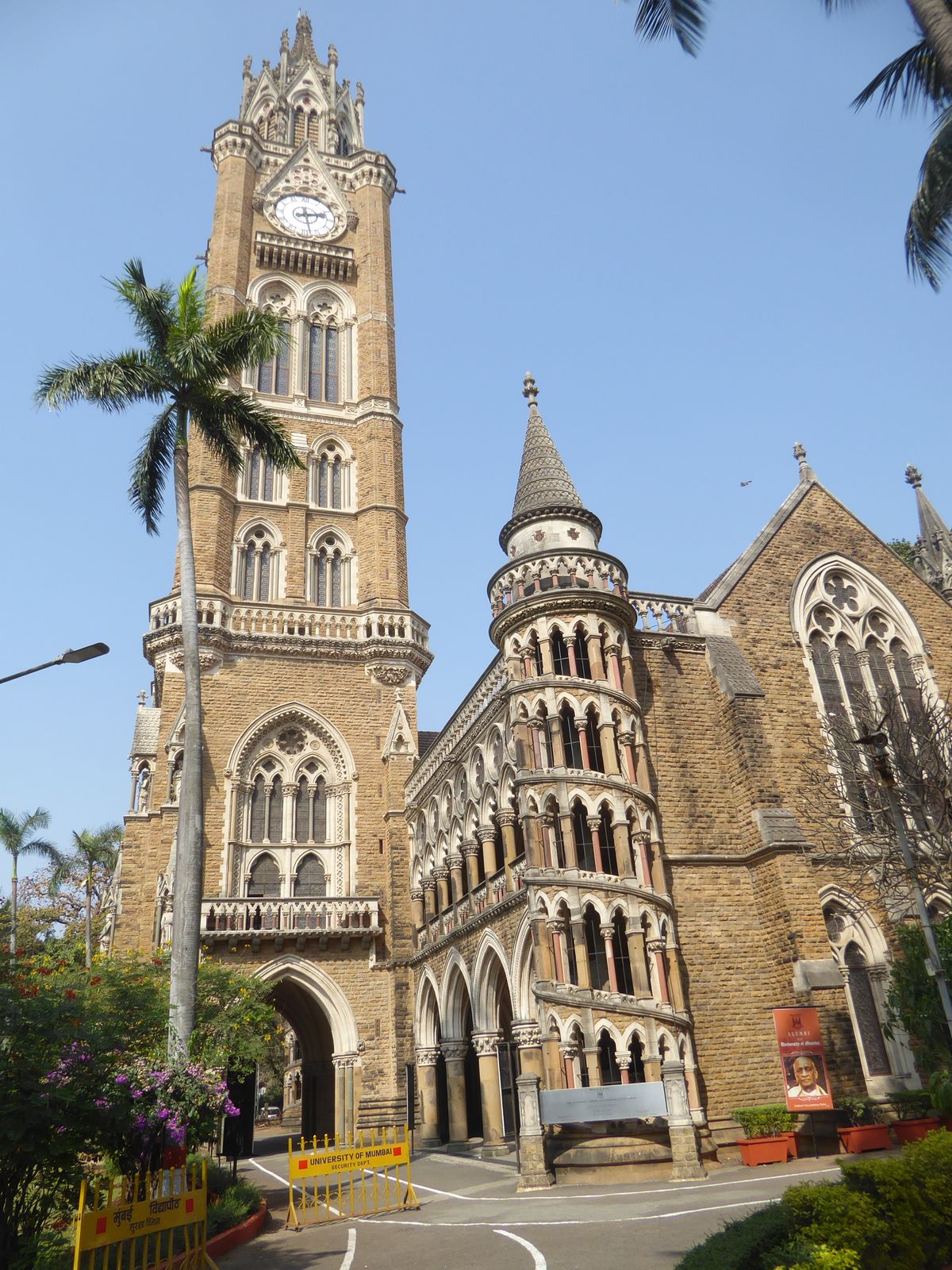
The architect was no less than George Gilbert Scott, working with funds provided in the 1870s by the founder of the Bombay Stock Exchange on the condition that the tower be named for his blind mother, Rajabai. And so it was and is known by that name, though the carillon's repertoire is badly depleted. The library reading room has no a/c but is attractive; the book stack behind it is in sadder shape.
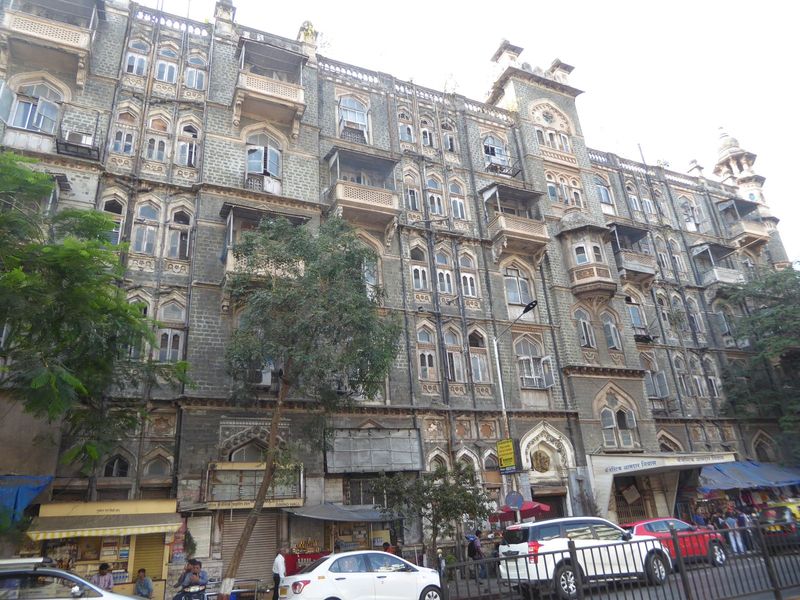
Want to get a room at the Majestic Hotel? It opened in 1909 and Murray's handbook for 1924 is reassuring: "the best are the Taj Mahal and the Majestic." By 1959, the Taj stood by itself, and the Majestic was in third spot. And how fares it now?
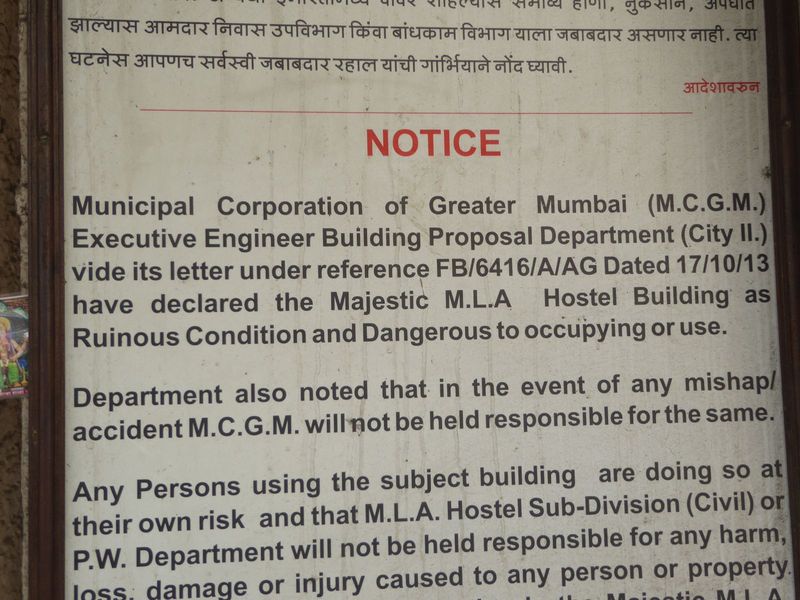
For some years it served as a hostel for members of the Maharashtra Legislative Assembly, but it's condemned. Are there squatters? Good question. Maybe just the ghosts of the original owners, who were Italians that had previously run hotels in Lucknow and Mussoorie.
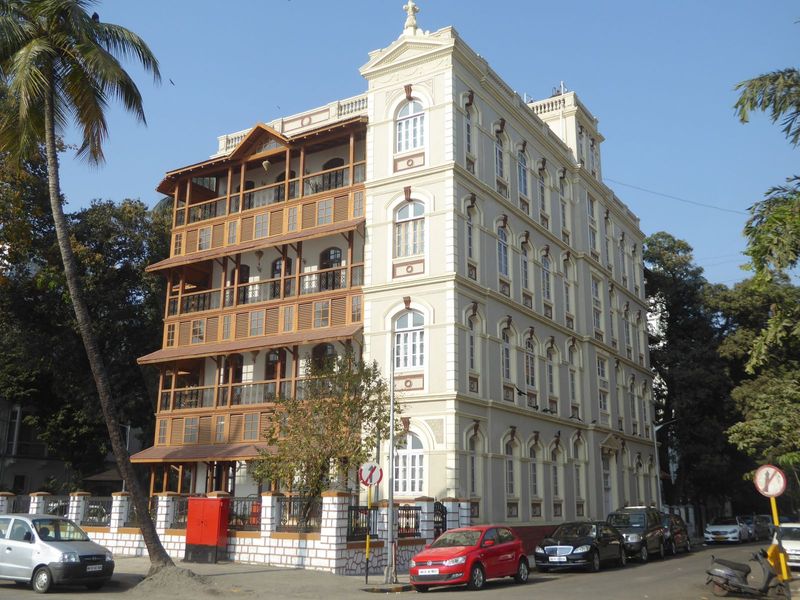
On the other hand: here, at the corner of Henry Road and P.J. Ramchandani Marg (the former Strand Road) and supremely lucky to face the Arabian Sea, is Curzon House, built in 1906 but fresh from facelift. No longer Prosser's Boarding House, as it was in 1947, and no longer Scholar's School, as it was in 1960, it is now primo office space. Want to rent 4,200 square feet of office space? Get ready to shell out about $17,000 a month. But think: you're only a three-minute walk along the water's edge to the Taj Mahal and it's around-the-corner Starbucks.
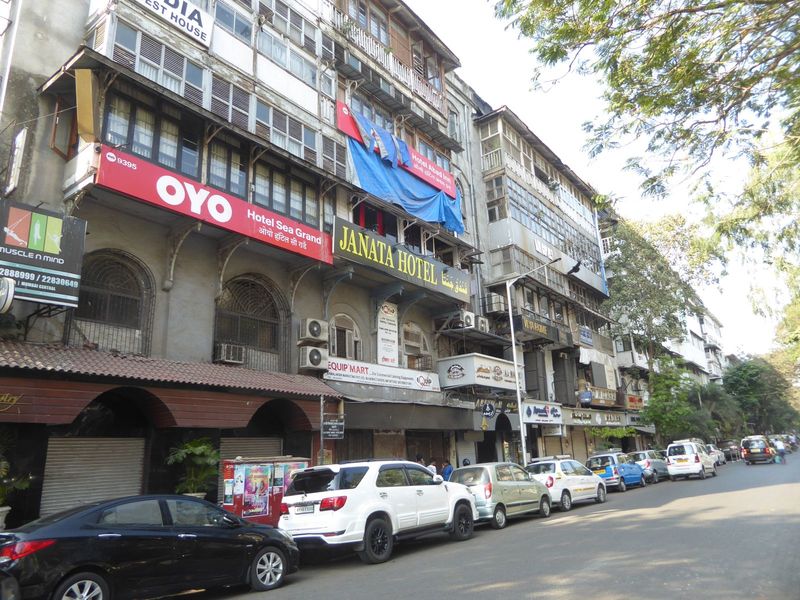
We're pushing south though Colaba. It must be very early in the morning, because the street almost looks peaceful.
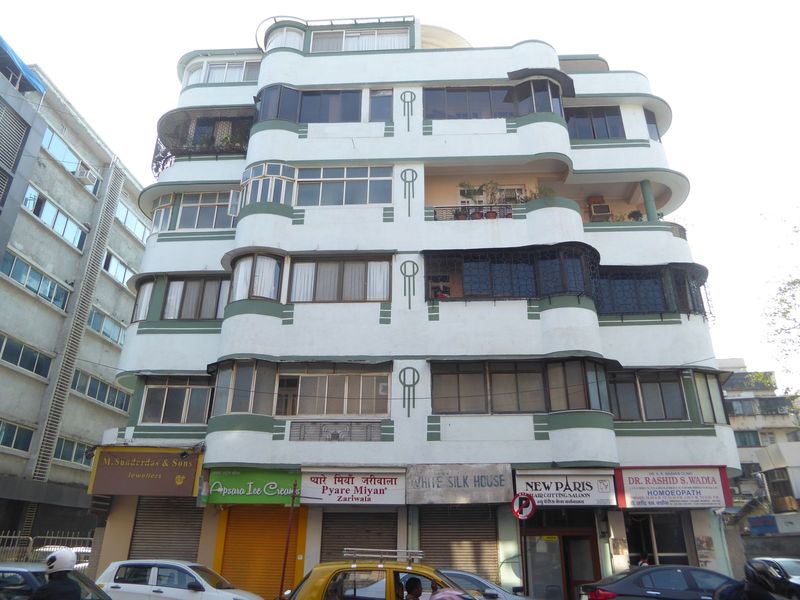
The main road is the same Bhaghat Singh Road where we started, and though nobody would confuse the streetscape here with London, there are Art Deco buildings here that would not be out of keeping there. This one is Girdhar Nivas. Freshly painted, the building has apartments you can rent for $1,400 dollars a month. That gets you 1,200 square feet. And don't forget a substantial deposit—about eight month's rent.
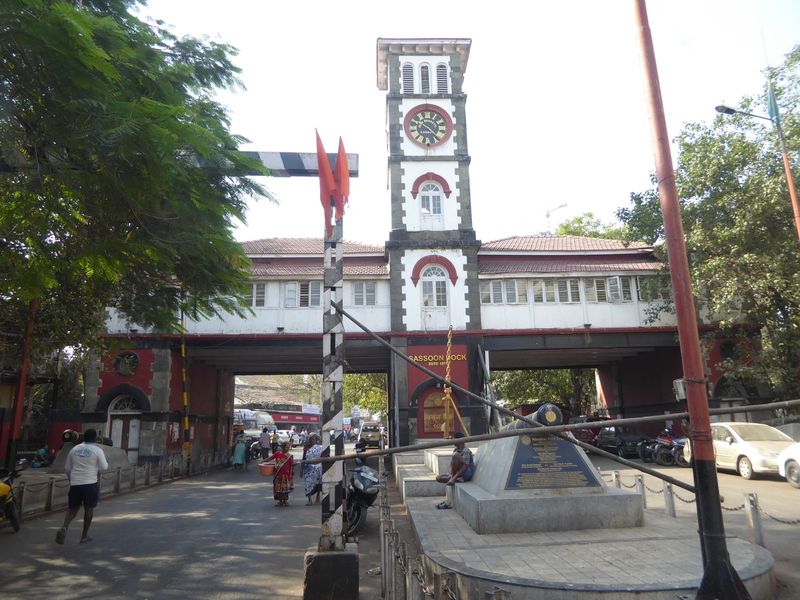
Remember the Sassoon Library? Son Albert developed the Sassoon Docks on the east side of Colaba. That was 1875, and these were Bombay's first; four years later, the government bought the docks and went on to build others.
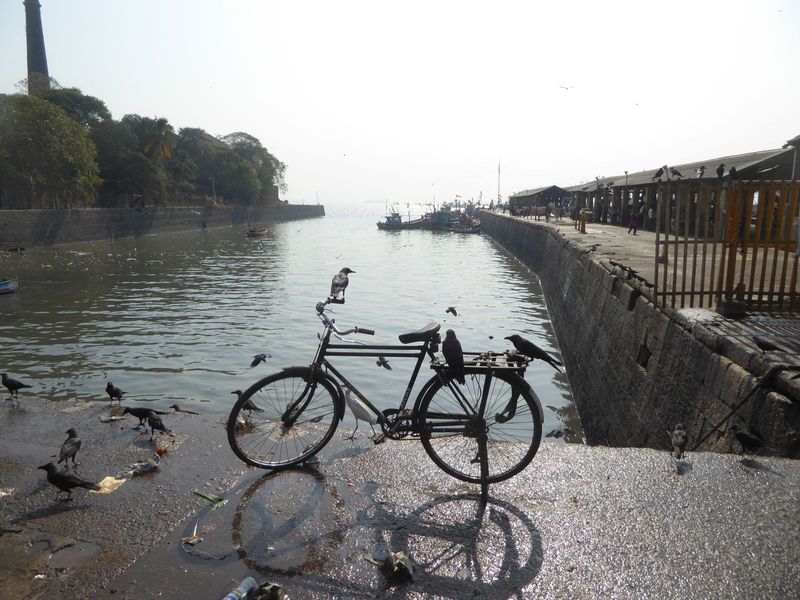
The place is a very busy fish market, though we're at a quiet corner with crows for company.
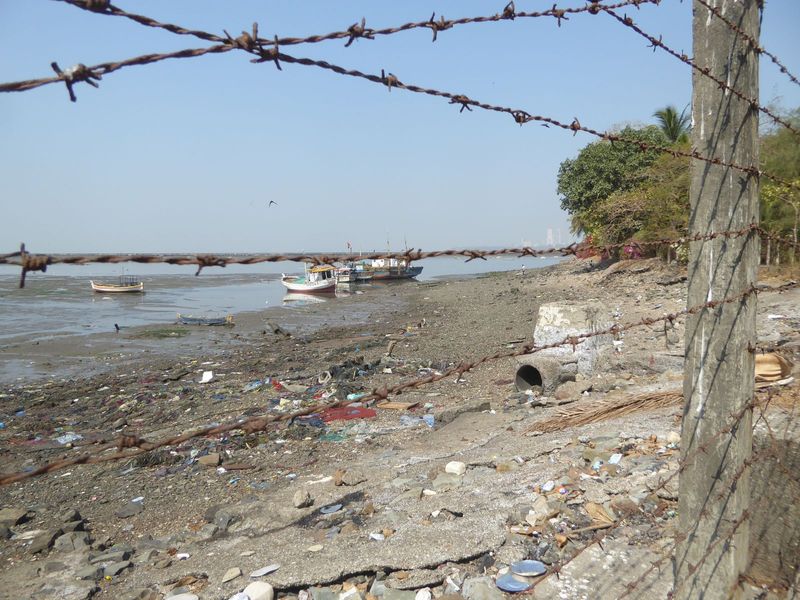
The west side of the peninsula varies from high-end to low-end to still vacant.
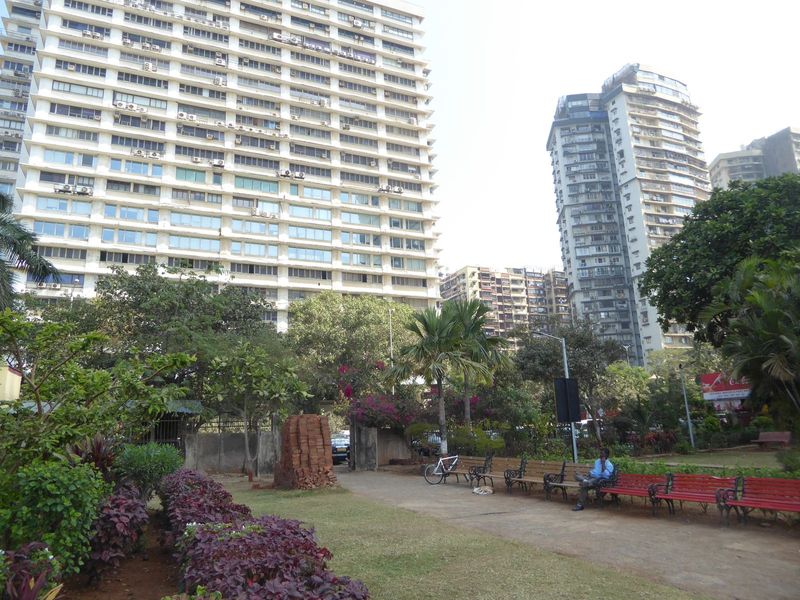
Here's the high end, one of the Maker Towers, where a two-bedroom apartment will cost you over USD 1 million. The neighborhood is Cuffe Parade, named for T.W. Cuffe of the Bombay City Improvement Trust, which reclaimed much of the western shore of Colaba.
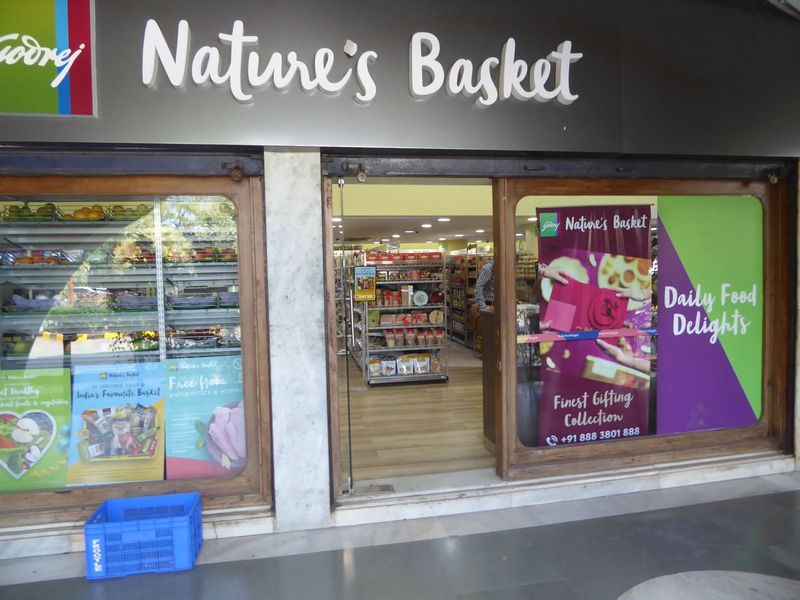
Residents who can buy apartments here sustain shops like this, owned by Godrej, a Bombay-based family conglomerate. You won't be surprised if I say that the 37 stores in the chain are managed by a woman whose previous job was CEO of Tata Starbucks.
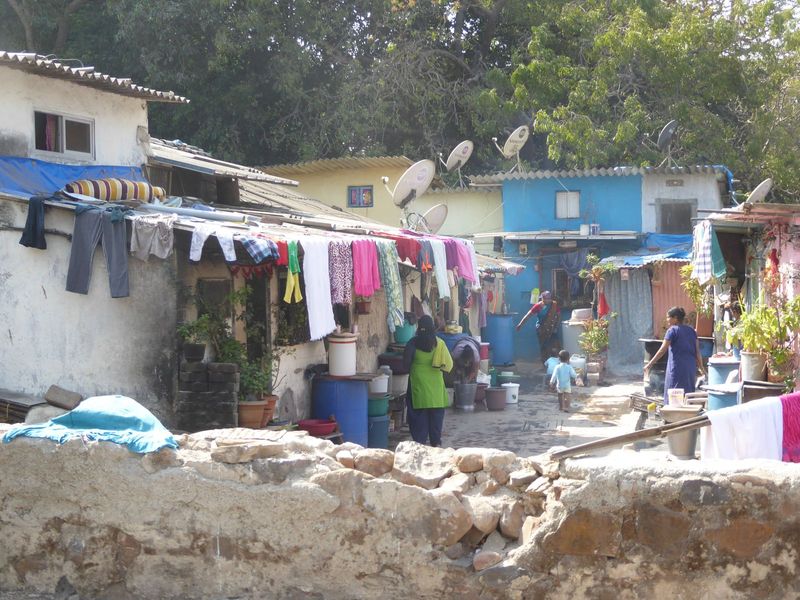
And then there's the low end, with several slums inhabited by people who serve the people at the high end.
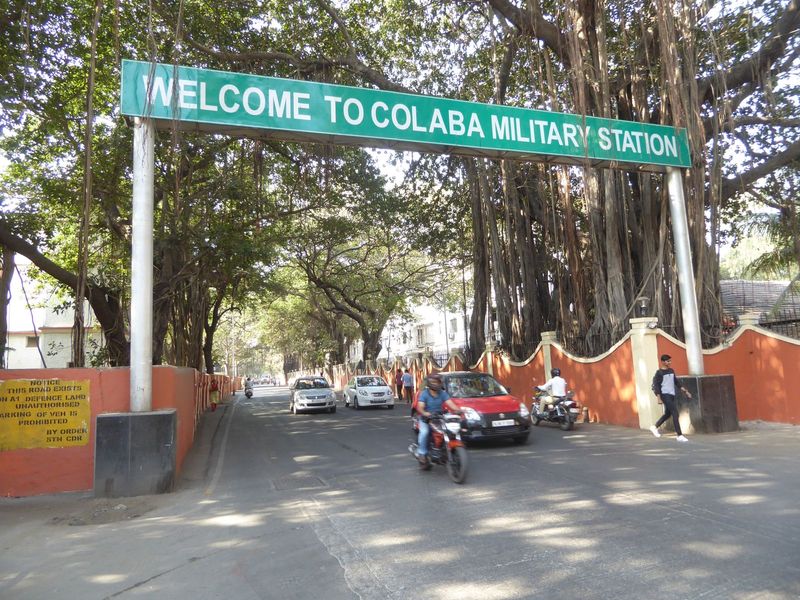
The southern tip of the peninsula is mostly walled off for the use of the Indian navy.
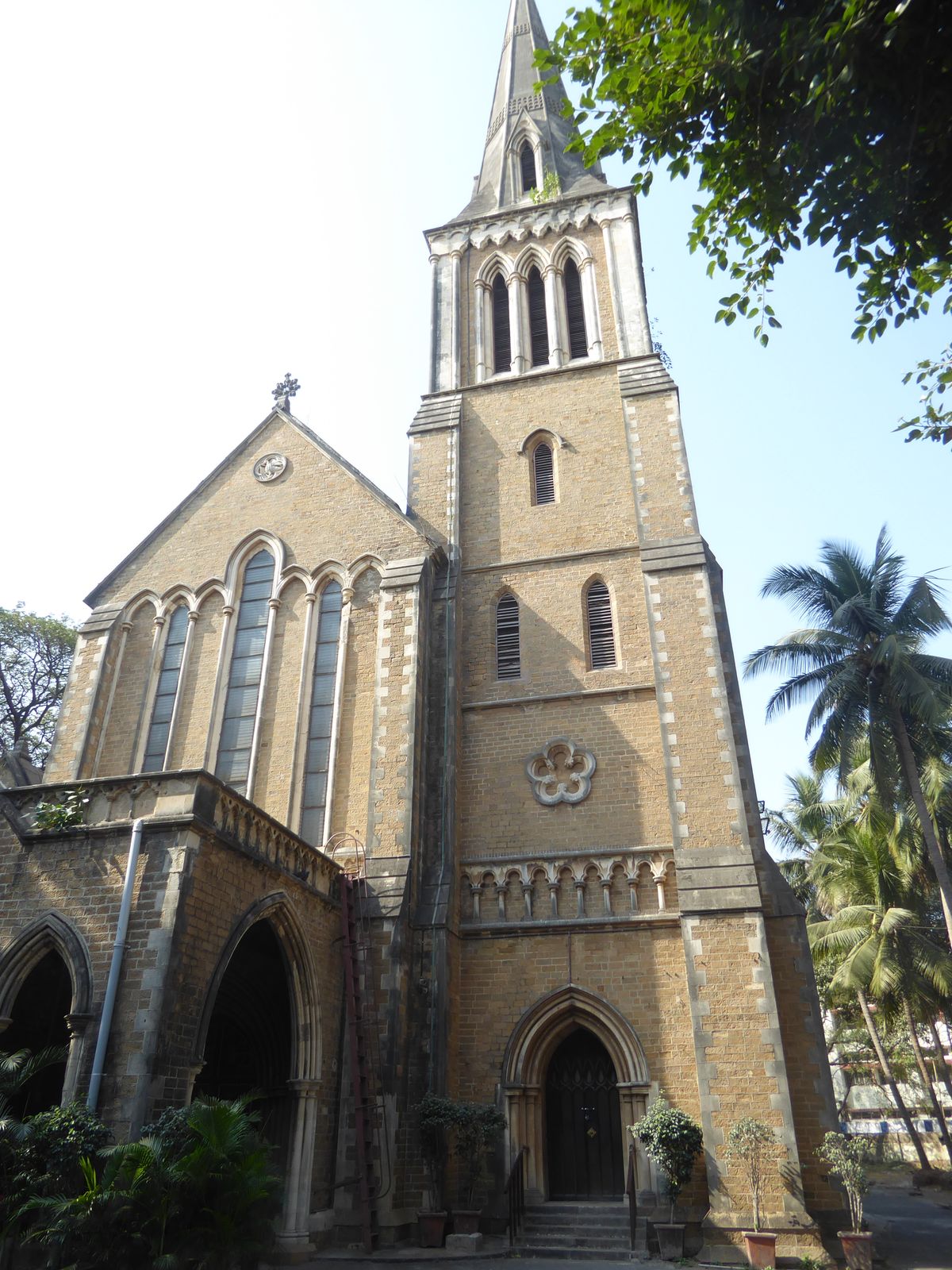
This is just about the only building that's accessible here. It's the famous Afghan Church—properly, the church of St. John the Evangelist—consecrated in 1858 in memory of the soldiers lost you know where.
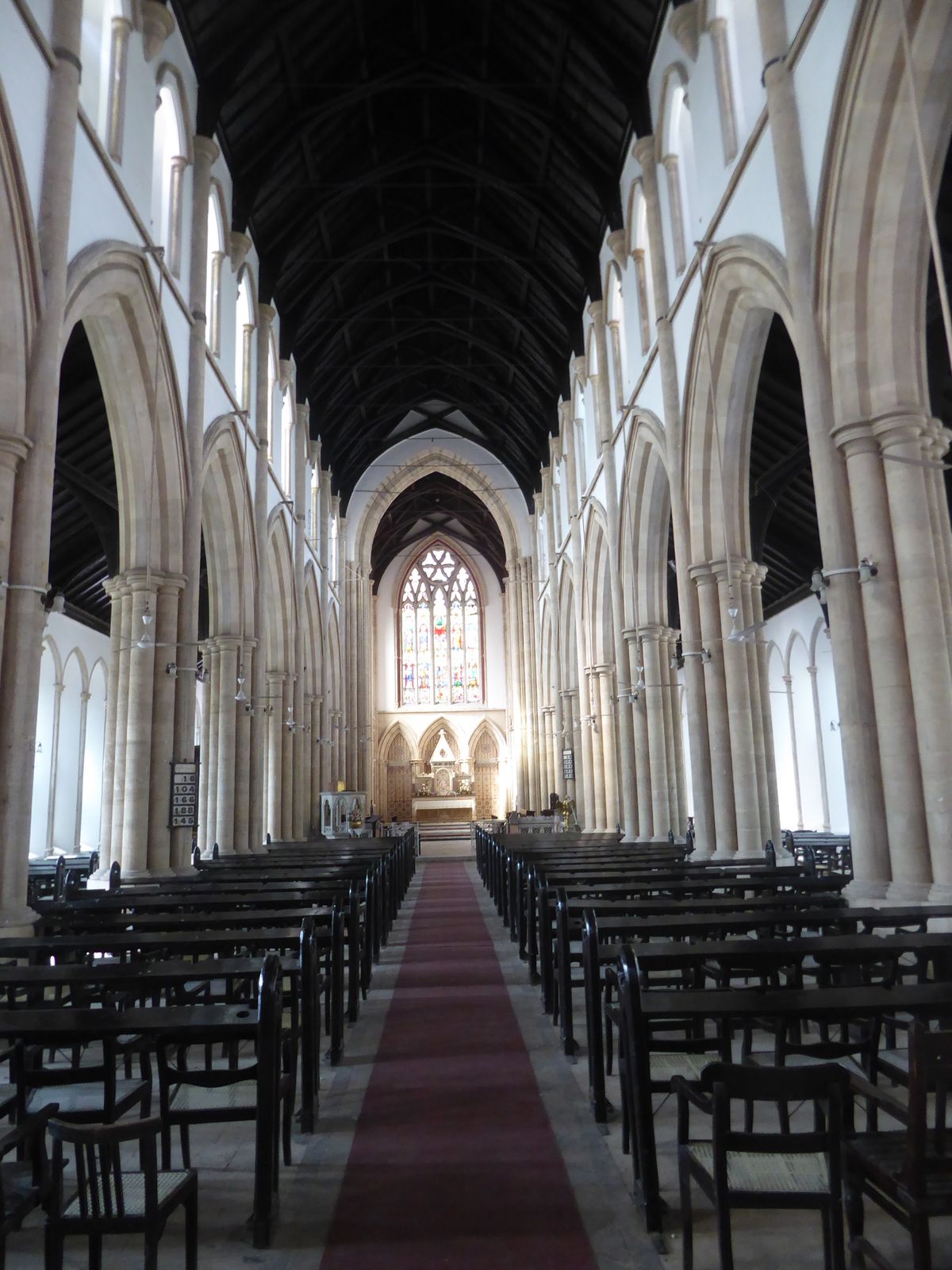
Talk about ghosts.
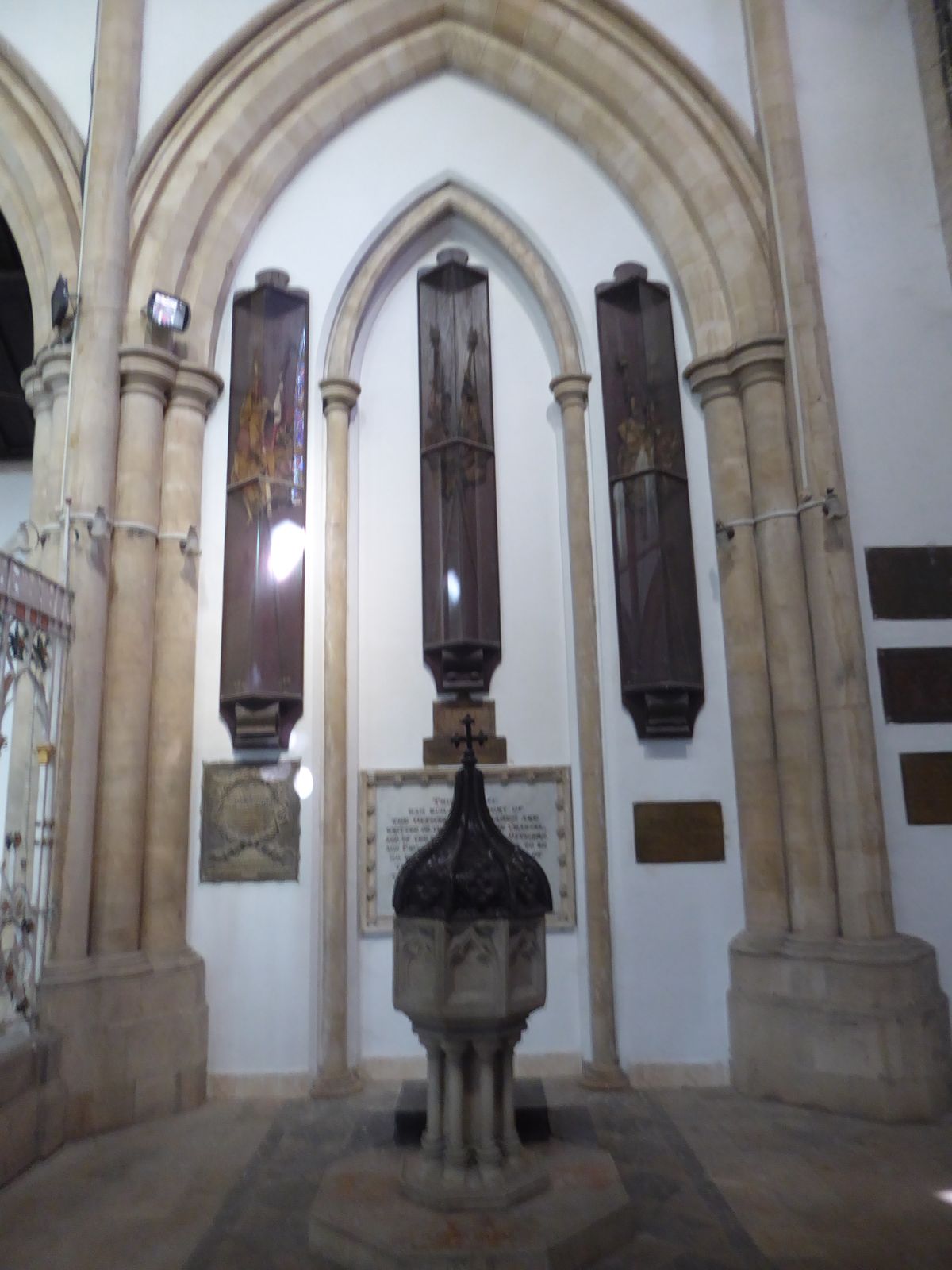
Regimental colors are preserved, though hard to see.
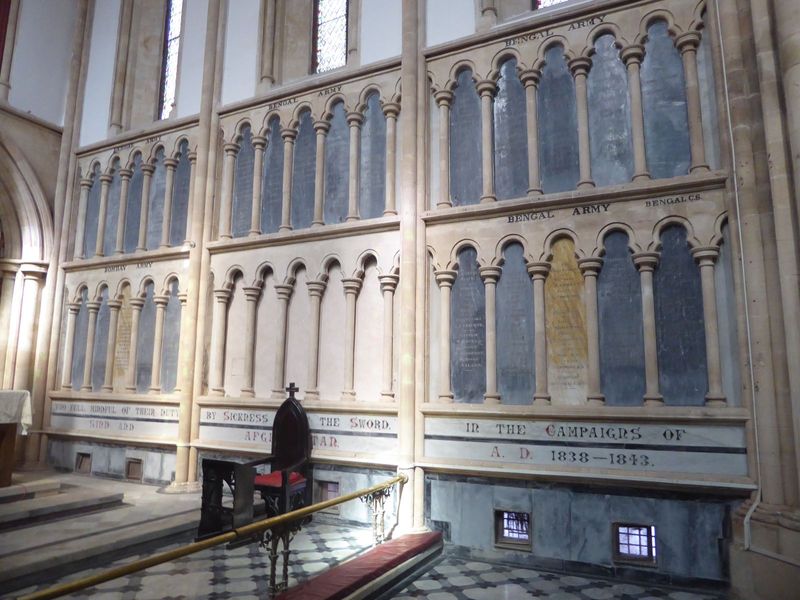
By sickness and by sword.
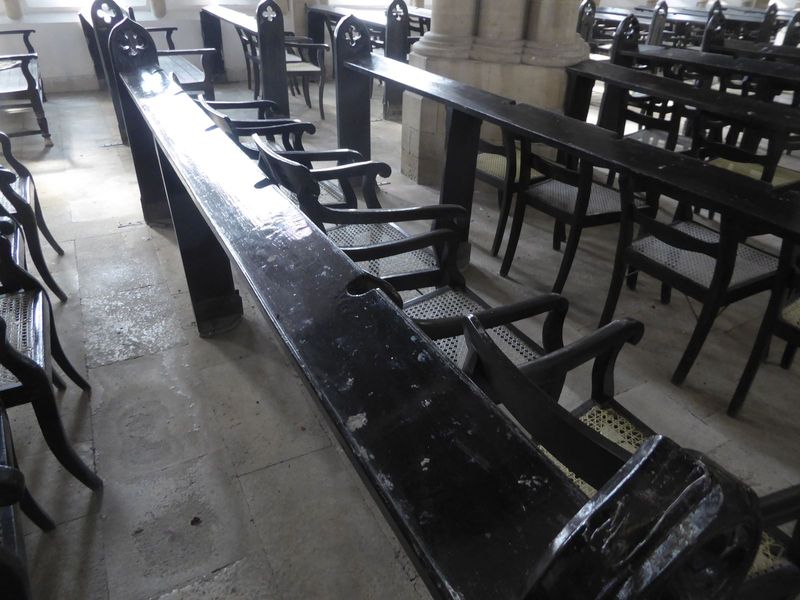
Notches cut out to hold rifles at the ready.
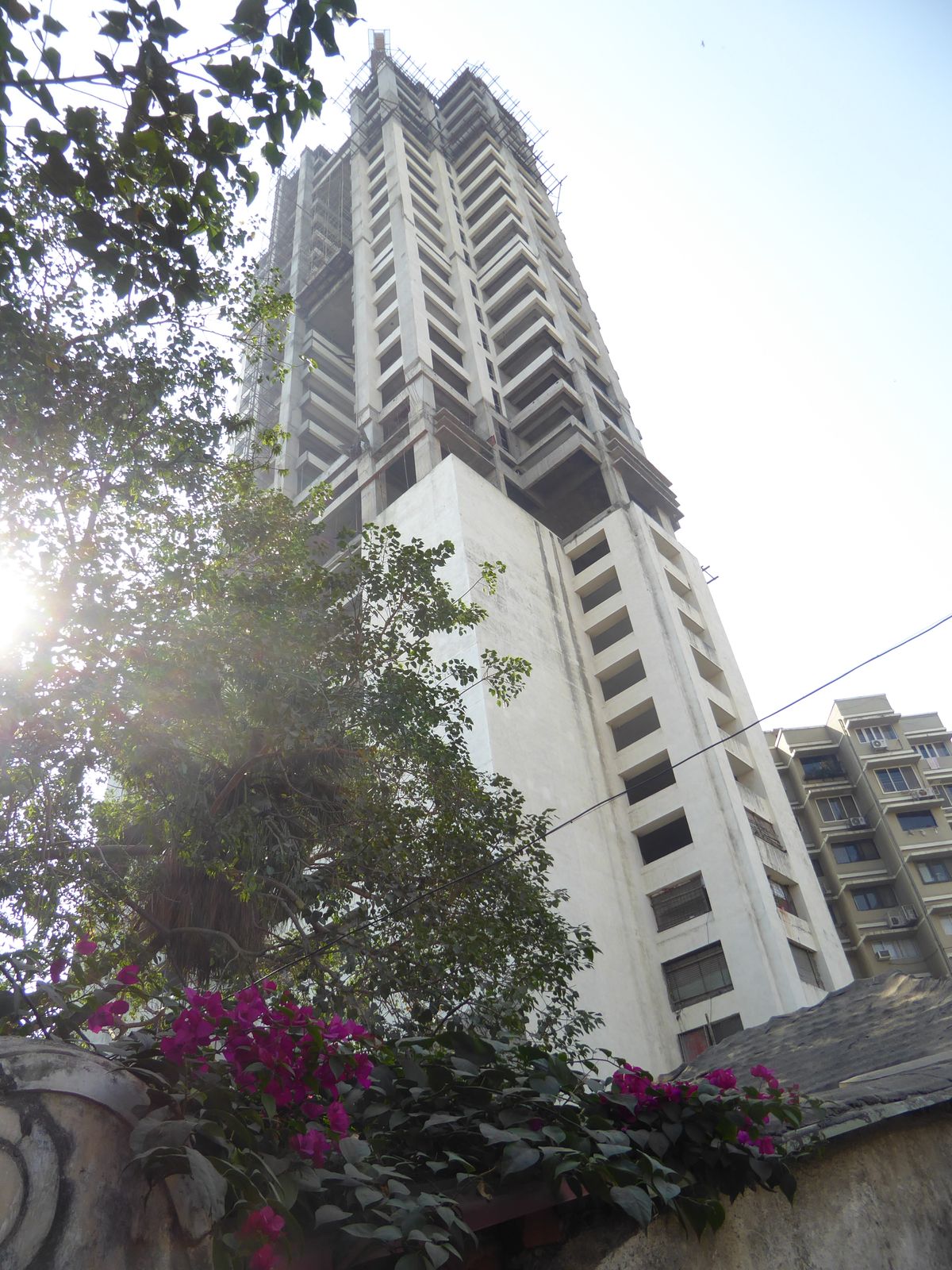
All very nice, but Mumbai doesn't have a lot of time for elegies. It's too busy making way for people who want to join the party.