Yucatan 1: Merida and Uxmal
A window opened late in March, 2024. I'd have eight days to meet the ruins of the Maya. I had never been to their part of the world, I don't speak Spanish, I was alone, and I am allergic to guides. Call it perfect.
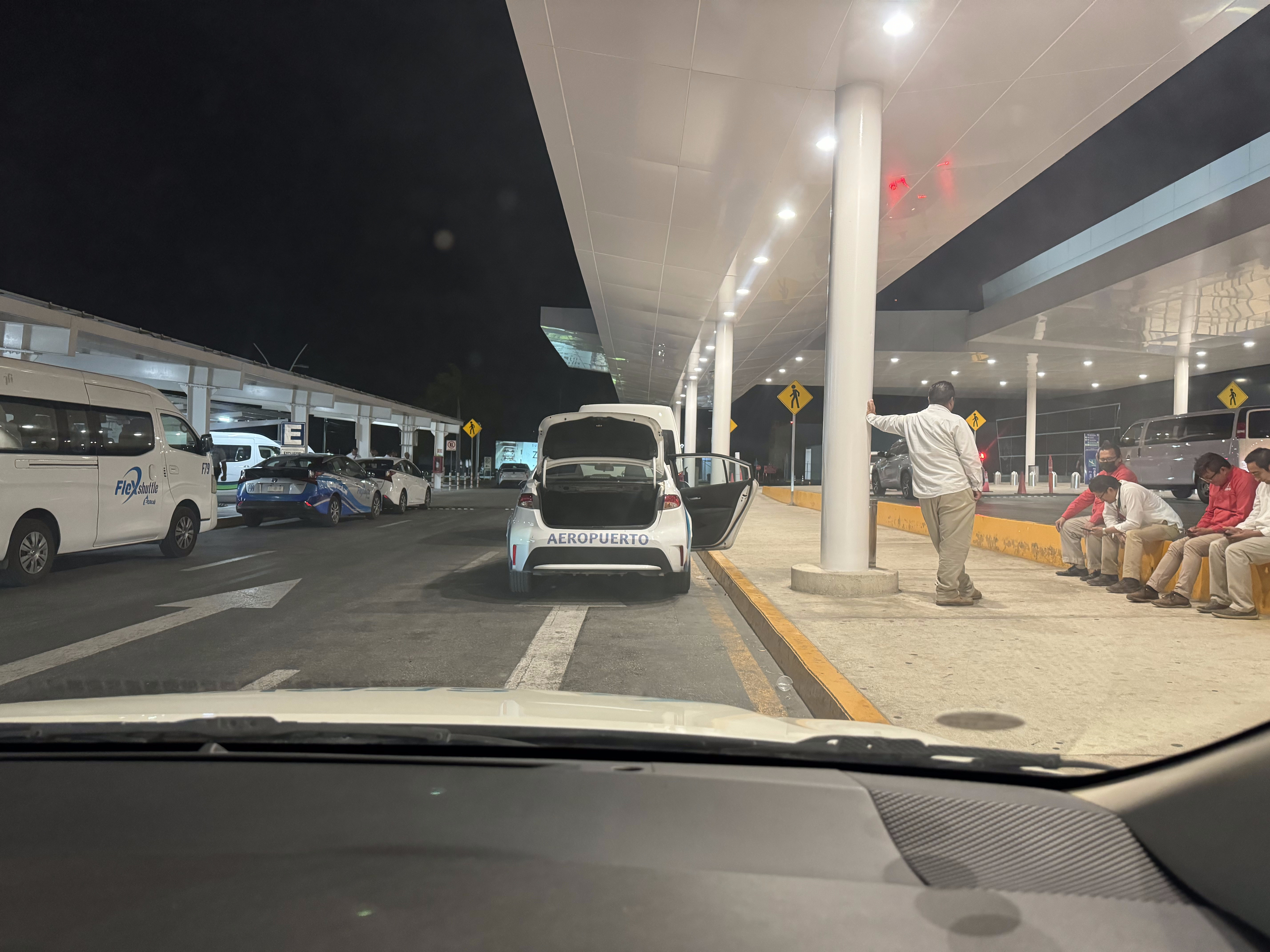
Cancun's airport sees 34 million passengers annually, which is just about the same as DFW or Denver or O'Hare or LAX. I'd call that a bad sign. So I flew to Merida, whose modern and clean airport handles about 4 million passengers annually. AA's flight from Miami arrives shortly after noon, but I was on the Dallas flight, which lands about eight hours later. United's flight from Houston had landed a bit earlier, and that does it for Merida's international arrivals, except for a Delta codeshare operated by Aeromexico from Atlanta.
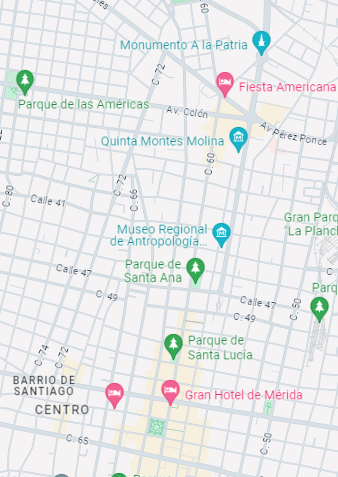
With almost a million people, Merida is the biggest city on the Yucatan Peninsula. Unless you want to stay on the periphery--and of course you don't--you have two choices. One is a bunch of old hotels, including the externally elegant but no longer grand Gran Hotel (shown on the map) or a cluster of hotels a mile and a bit to the north, near the Fiesta Americana (also shown on the map), where you can choose between Hyatt, Hilton, Marriott, and Holiday Inn, provided you can tell them apart. Thank God for hotel flags. Notice the major road running south from that cluster?
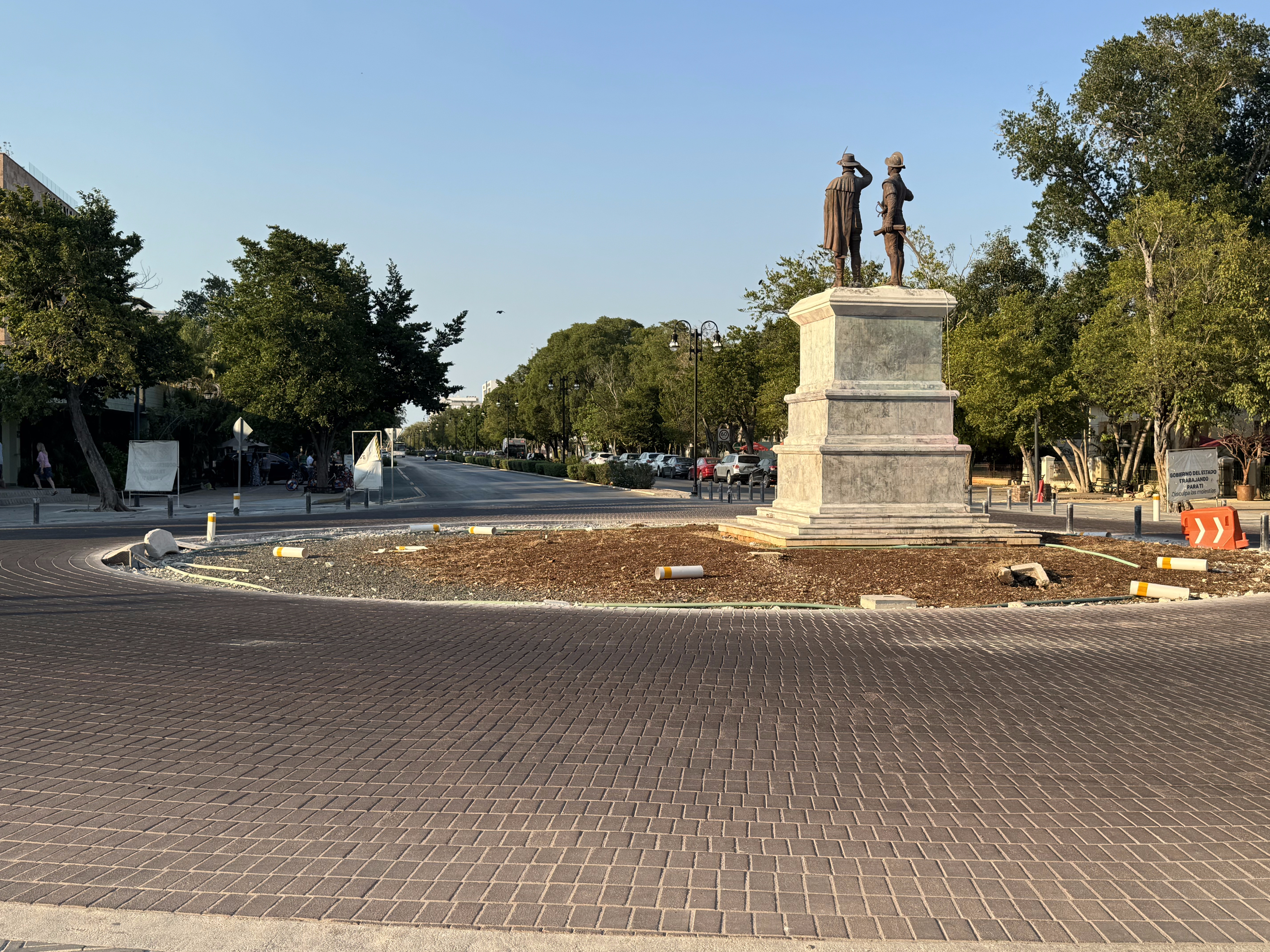
This is its southern terminus. It's the Paseo Montejo, opened in 1904 as Merida's very own Champs Elys es.
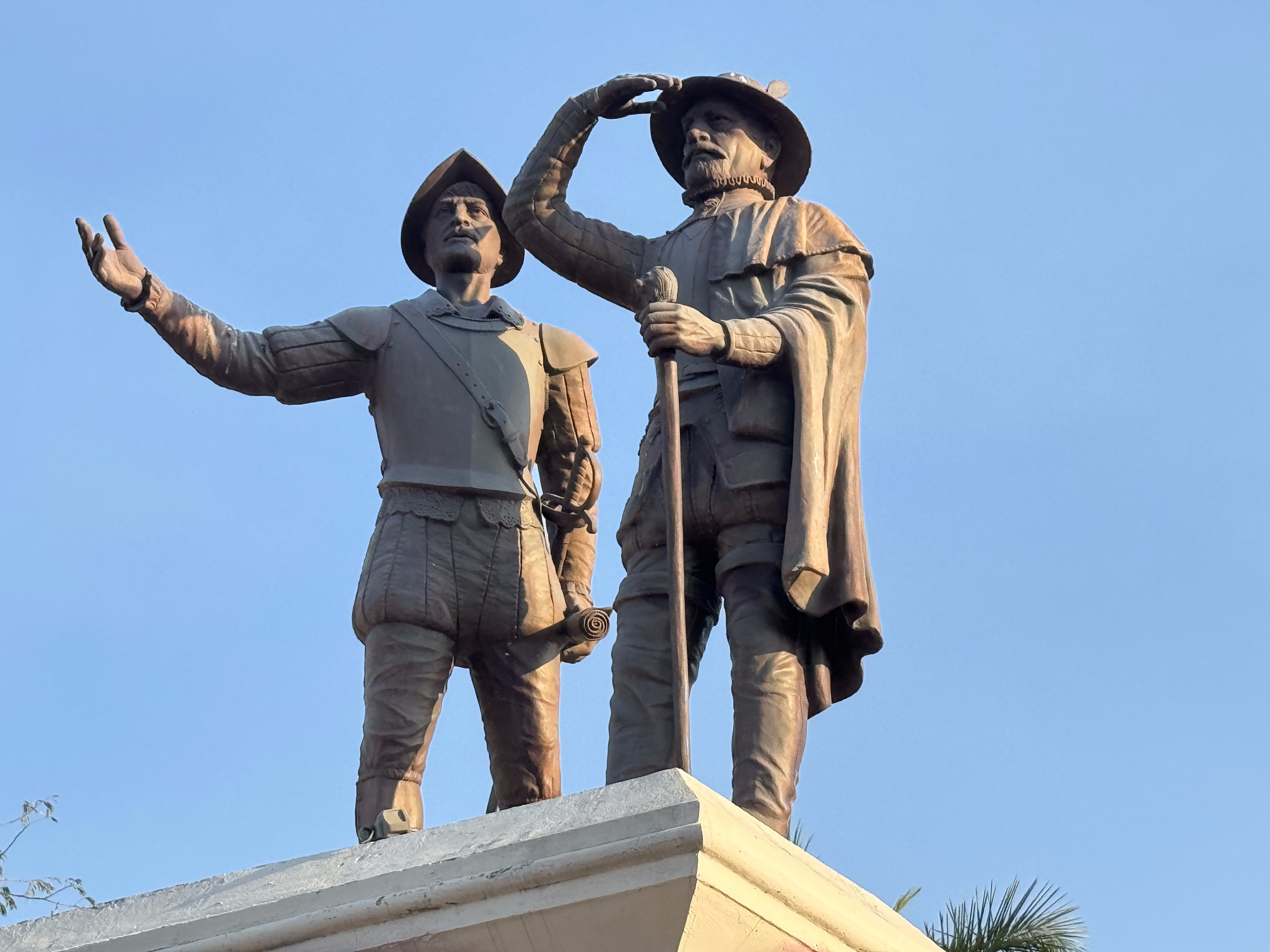
The paseo is named for the city's founders, Francisco de Montejo (1479-1553) and his son, also Francisco. We'll see their house in a couple of minutes. It's an eye-opener.
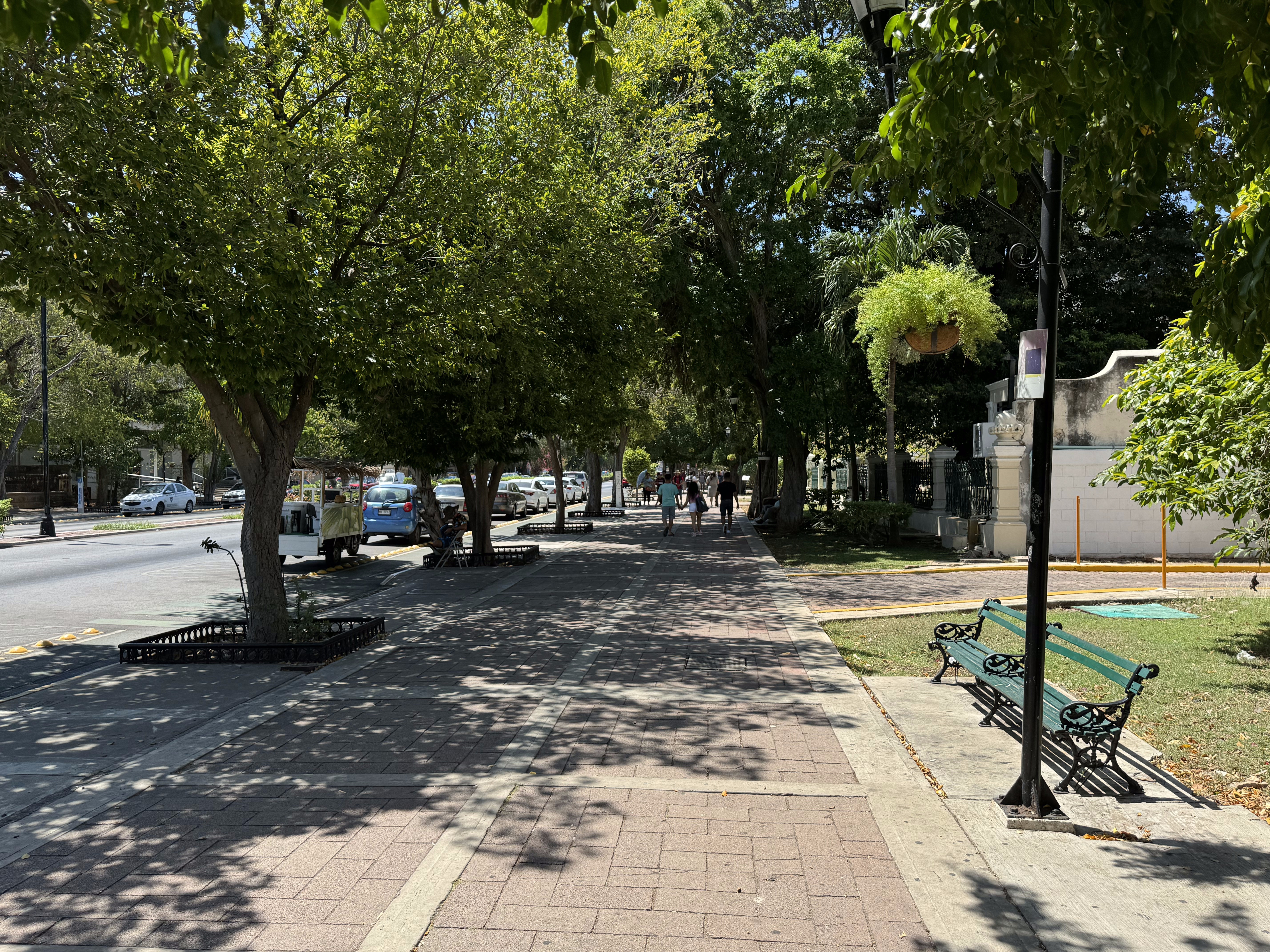
The paseo is pleasanter in the evening than in the heat of the day. (The daily maximum varies from 85 in January to 97 in May.) Sweltering aside, you have to admit that the street is more attractive than the most attractive street in most American cities.
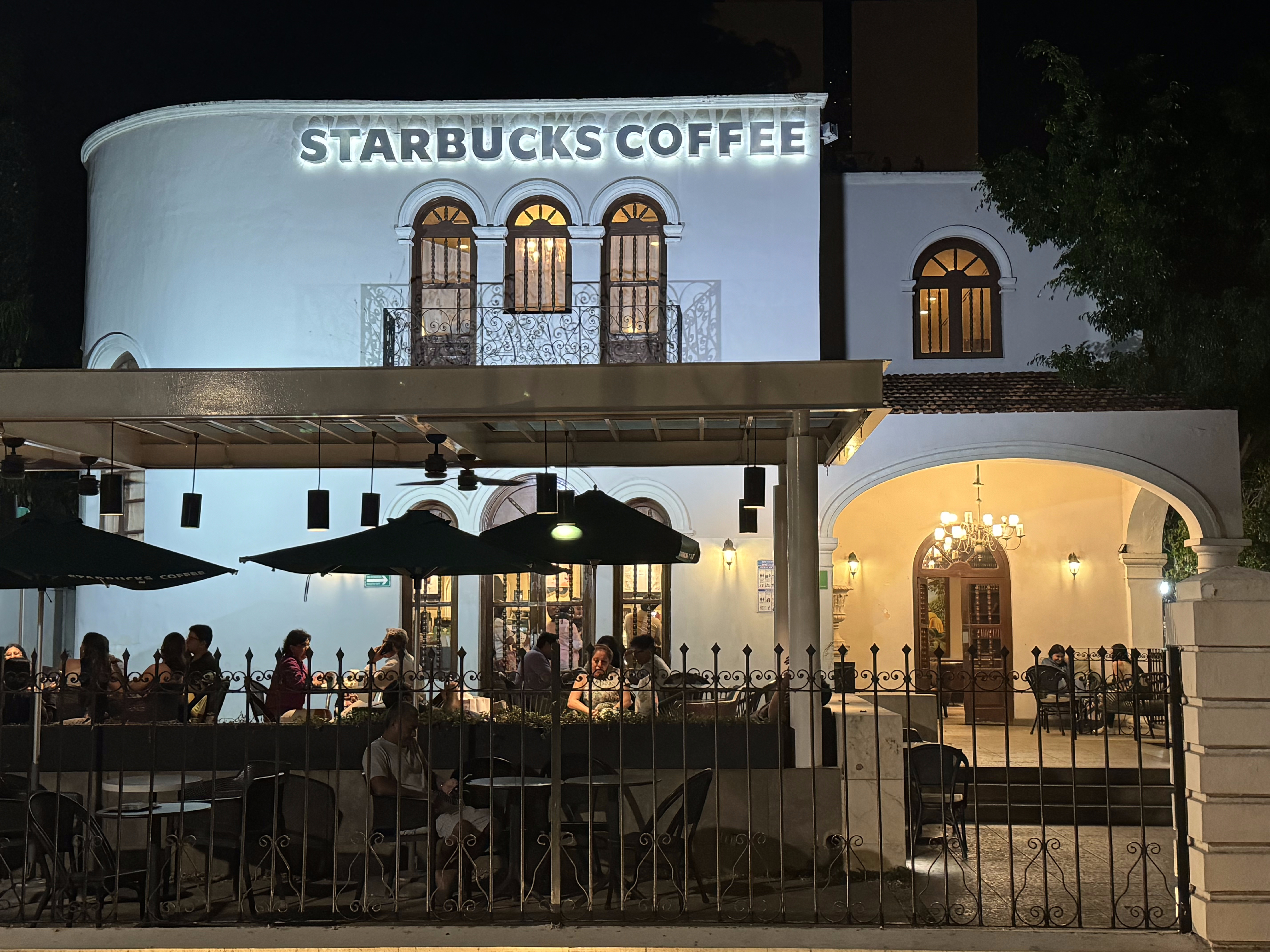
Along the same street, here's a Starbucks in an old mansion.. How many U.S. stores can match it?
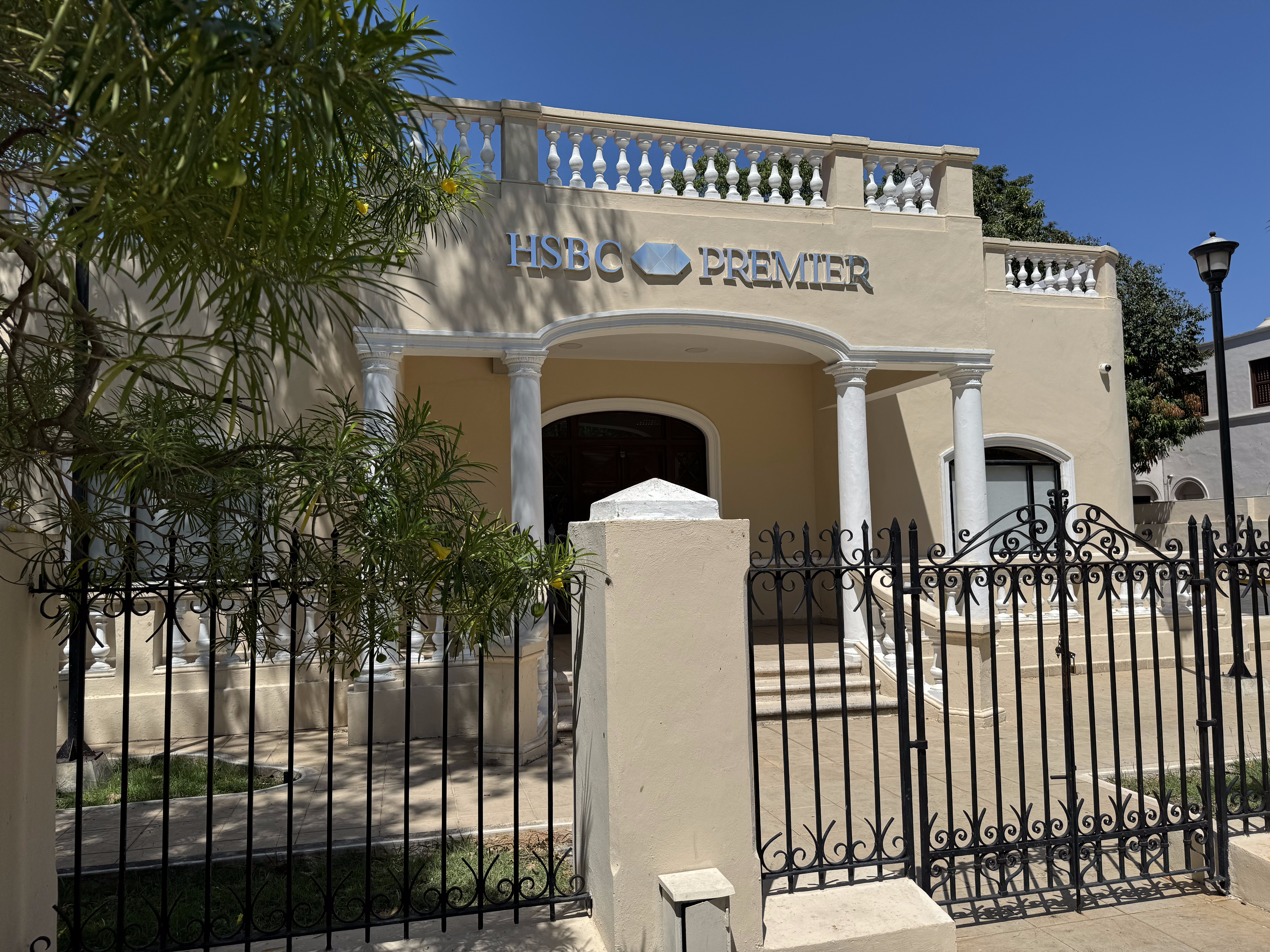
Do you use a private bank? No? Really? You should. They're much better.
But what are rich folks doing in Merida? I could have answered that question in 1900, when the Yucatan Peninsula was world central for plantations devoted to the agave cactus. It yields a fiber known as henequen or sisal. That second name comes from the coastal village of Sisal, 30 miles northwest from Merida. In the 1880s, as the industry grew, a new port was developed at a site 25 miles farther east and 10 miles closer to Merida. Not wanting to strain their imaginations, the founders of the new port named it Progreso. It's now a town of 50,000, despite the collapse of the sisal industry. (It's hard to compete with plastic.) But still: why the big bucks now? One answer at least is tourists, including cruise ships at Progreso. Tourists may not dominate the economy the way sisal did, but they bleed at least a bit of green. Witness Hyatt, Hilton, Marriott, and Holiday Inn. European chains, too.
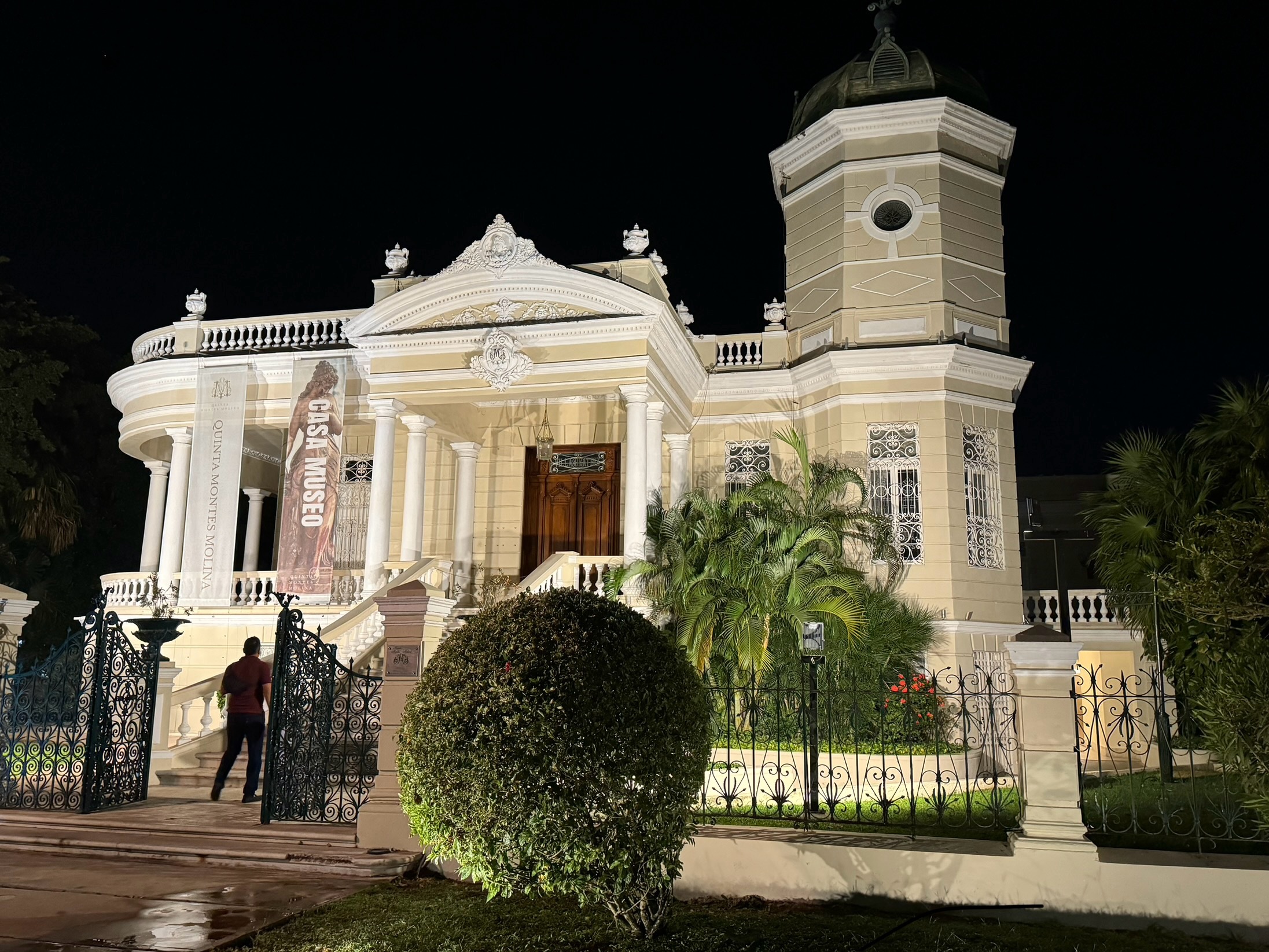
Close to Starbucks and still on the paseo, here's the Quinta Montes Molina. Calling this place a quinta, or country house, is like calling a Newport mansion a cottage, but I'm not complaining. You can wander around a house little changed from when the Montes Molina family lived here. Where did their money come from? As a young man, Avelino Montes Linaje was smart enough to marry Maria Molina Figueroa, daughter of a henequenero, or agave plantation owner. Think we should come back in the morning so we can go inside?
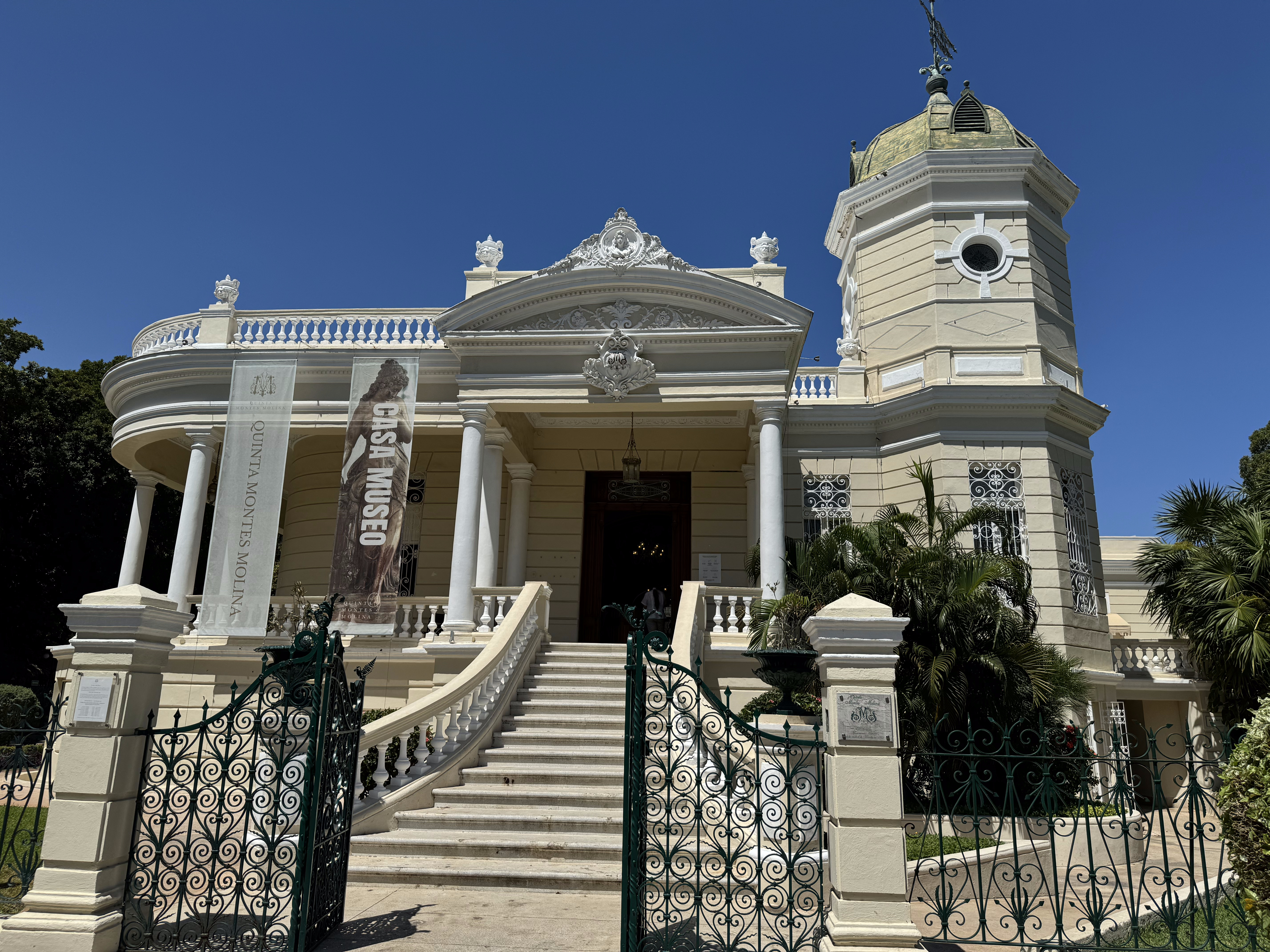
Of course. The house was built in 1906 by a Cuban named Don Aurelio Portuondo y Barcelo. By 1915, Don Aurelio had had his fill of Mexican politics. He moved back to Cuba and sold the house to Don Avelino, who lived here until he died in 1956. His daughter Josefine lived in the house and maintained it almost unchanged until her own death, after which the building in 1982 was designated a historical monument.
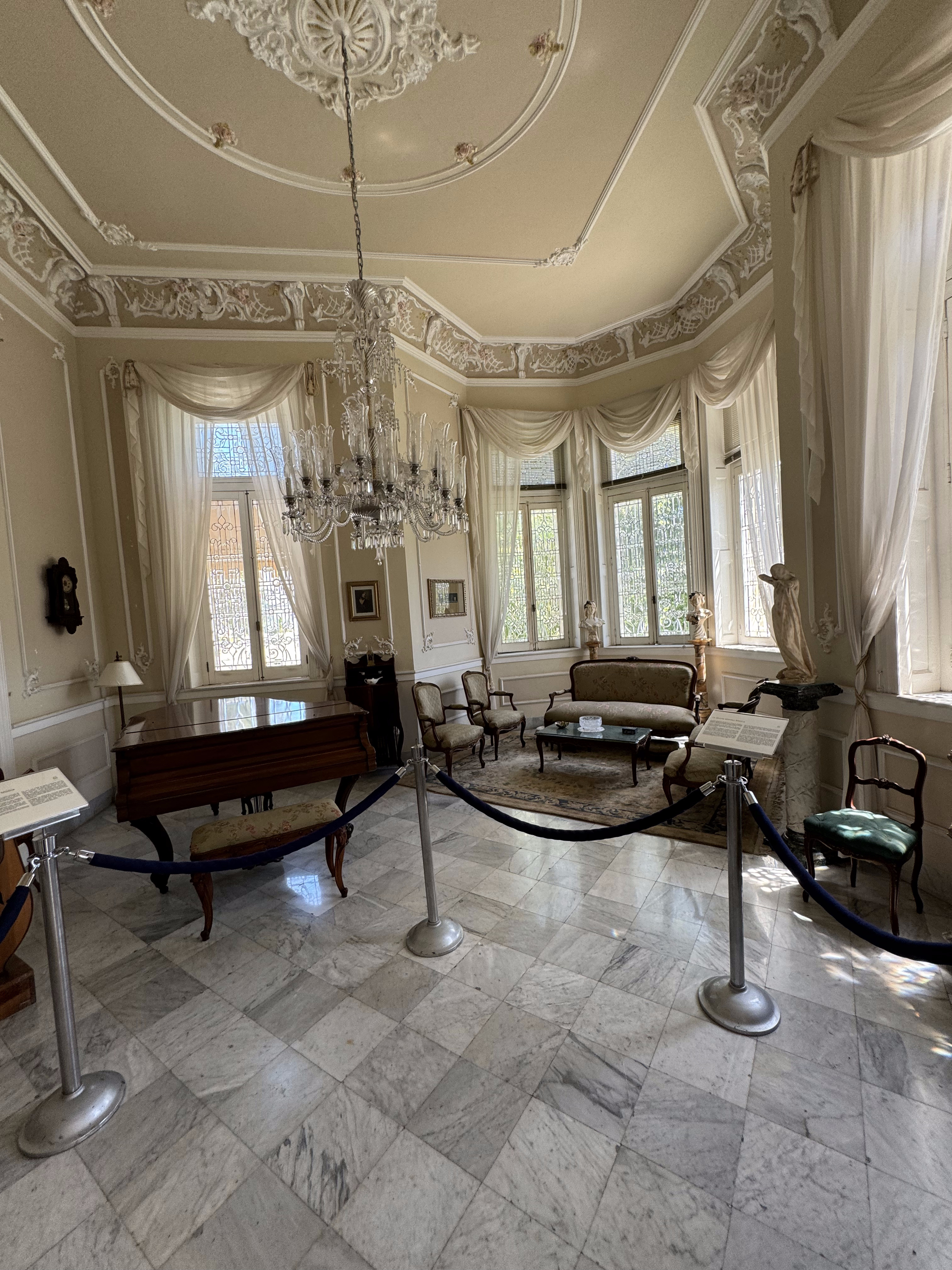
The tile floor probably doesn't help the acoustics of the music room, but carpets have trouble in the wet season. Local hotels pretty much don't have them. Many also manage without drapes.
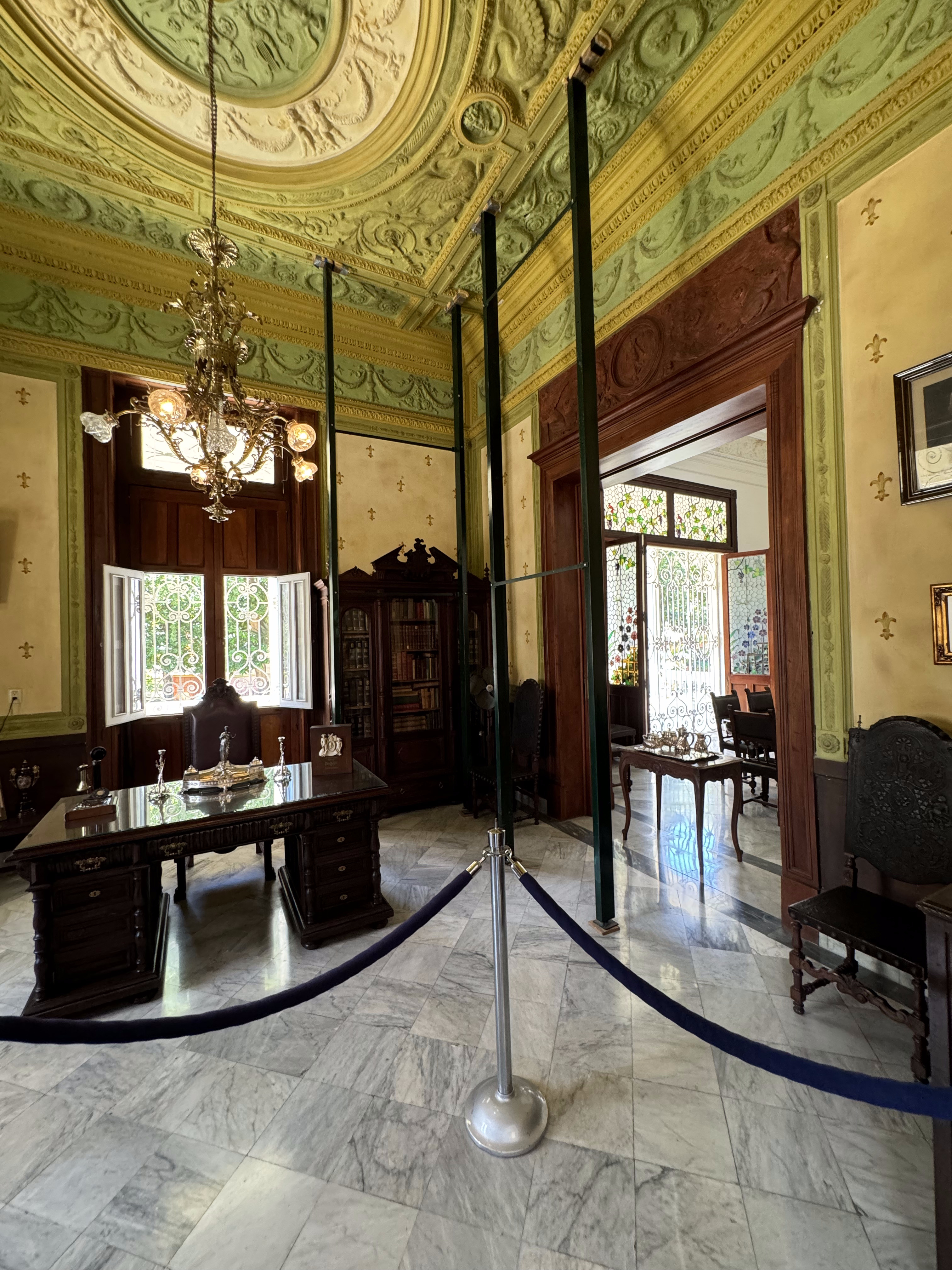
Witness the plaster ceiling of this room, temporarily propped up. At least one other room's ceiling, softened by humidity, collapsed years ago and was replaced with a flat ceiling.
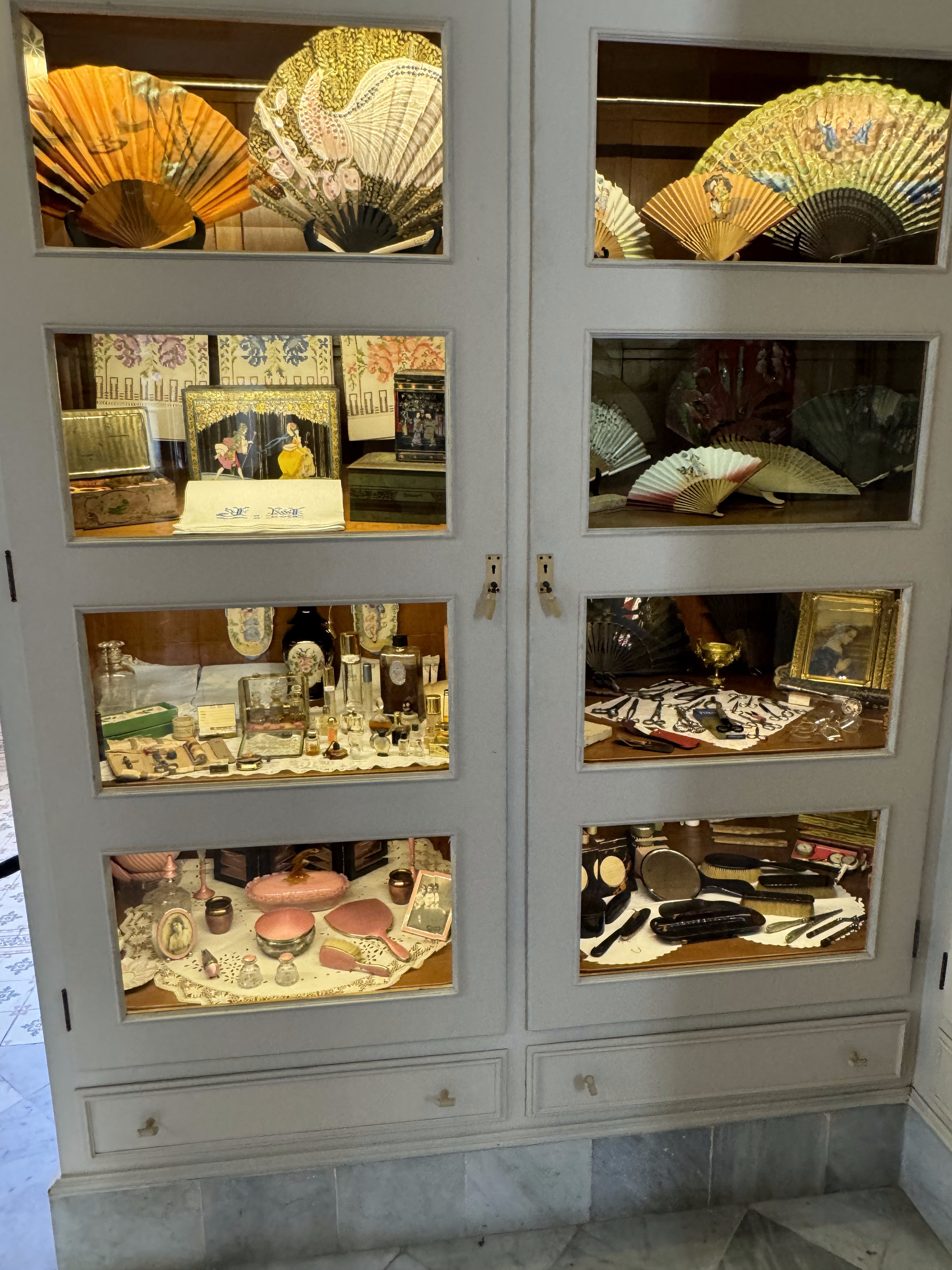
A built-in cupboard for the lady of the house.
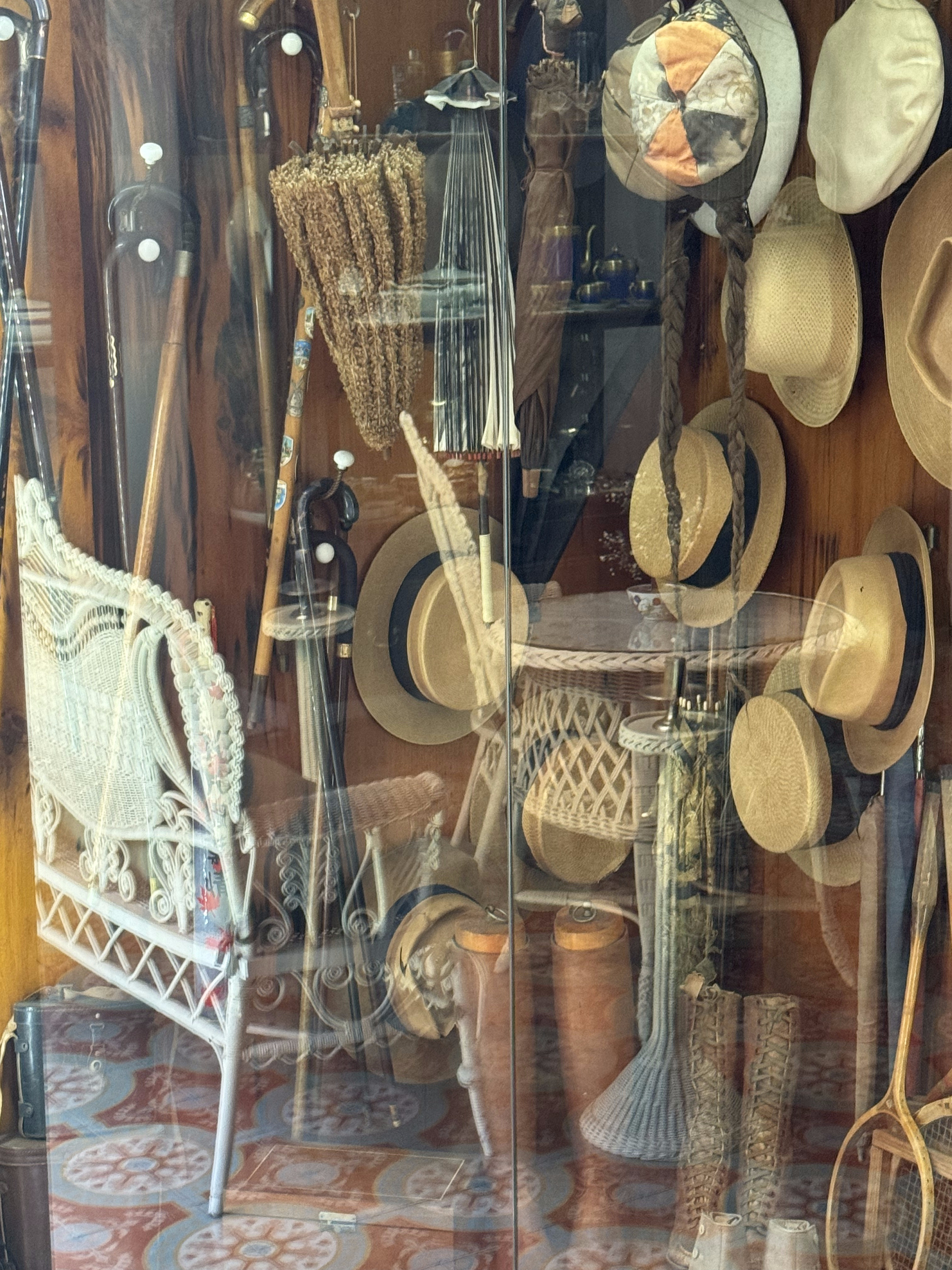
And one for sen r.
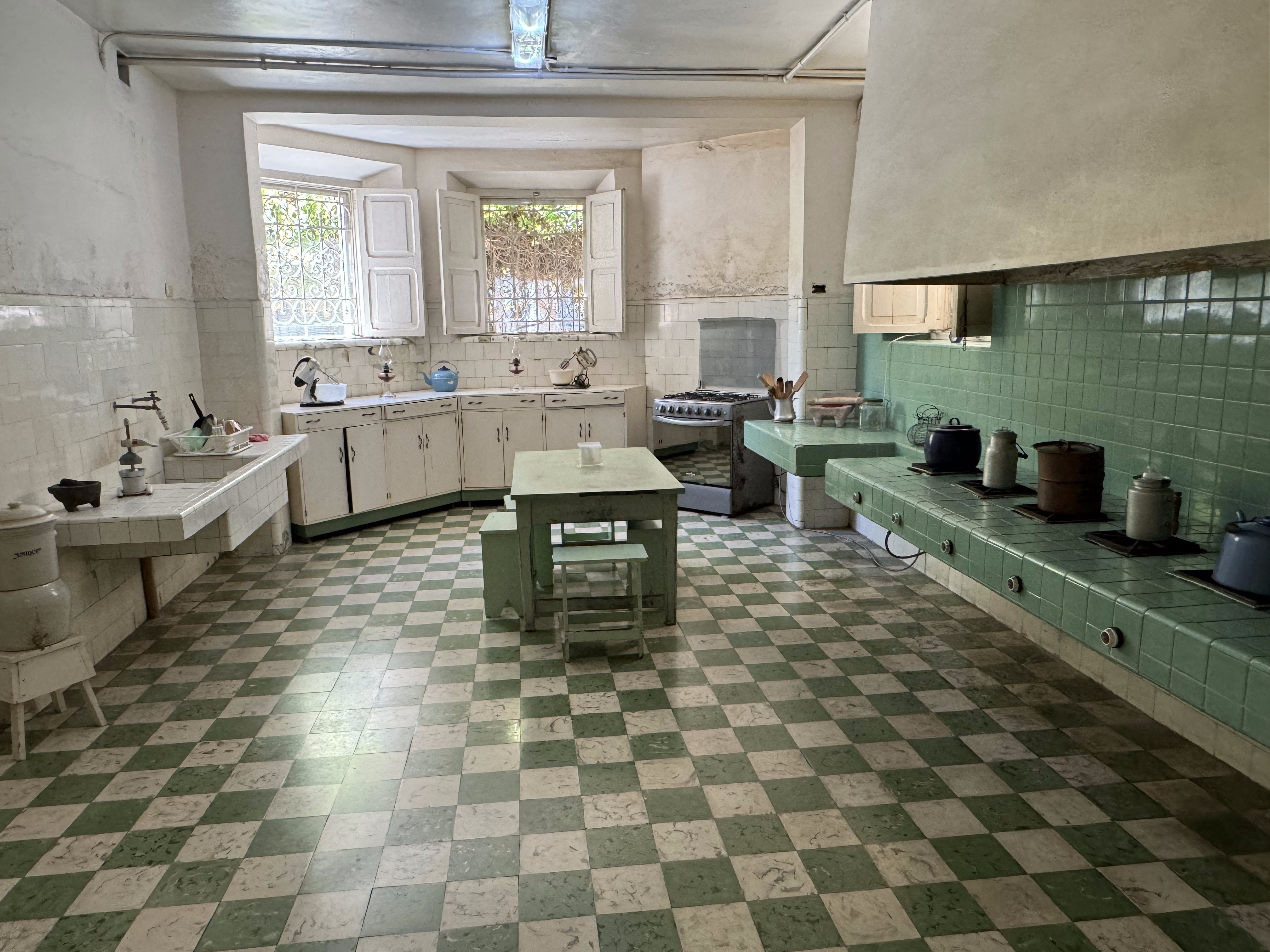
The basement was for servants. Here's the kitchen, now with two generations of stoves.
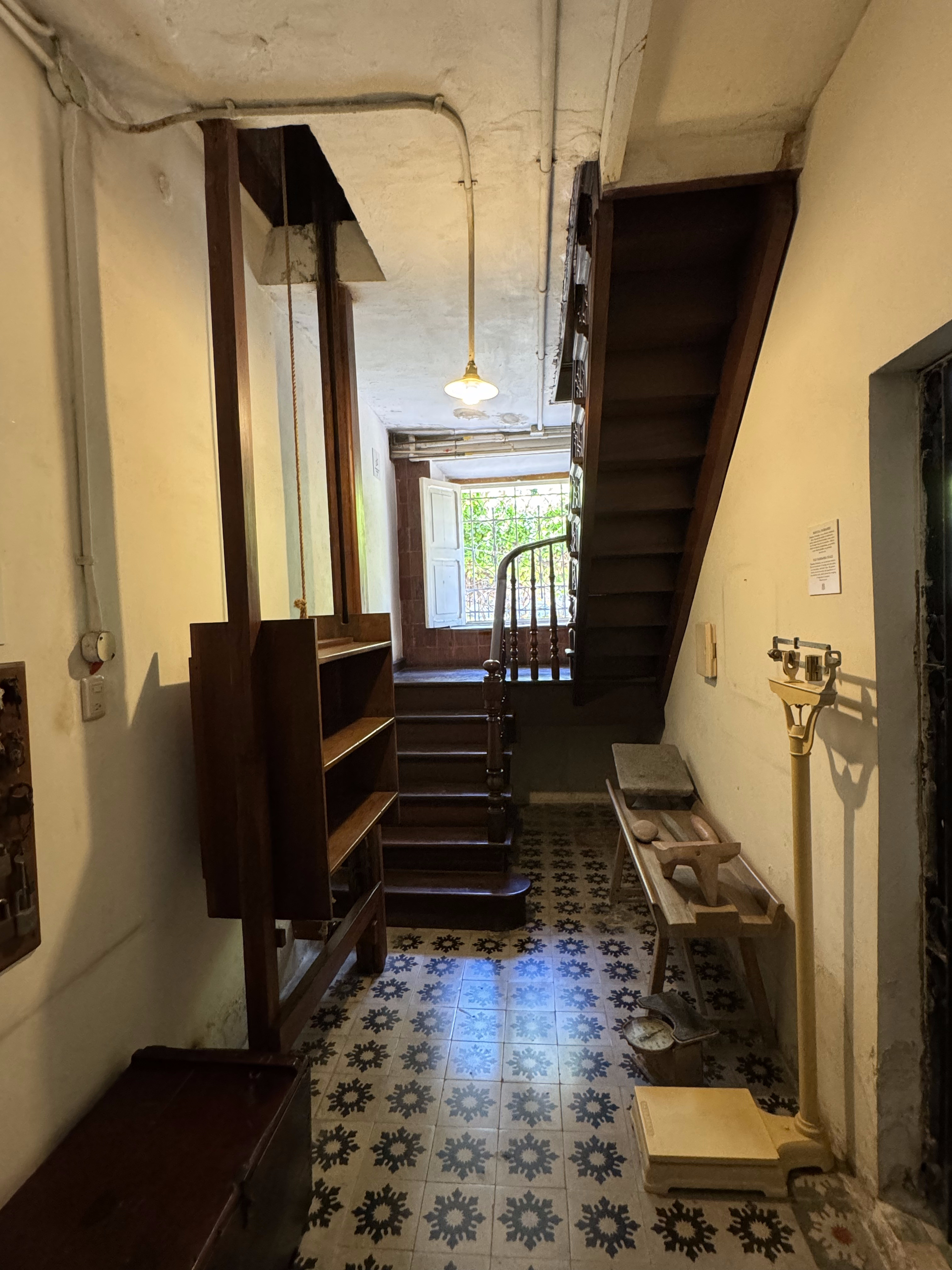
How about that dumb waiter?
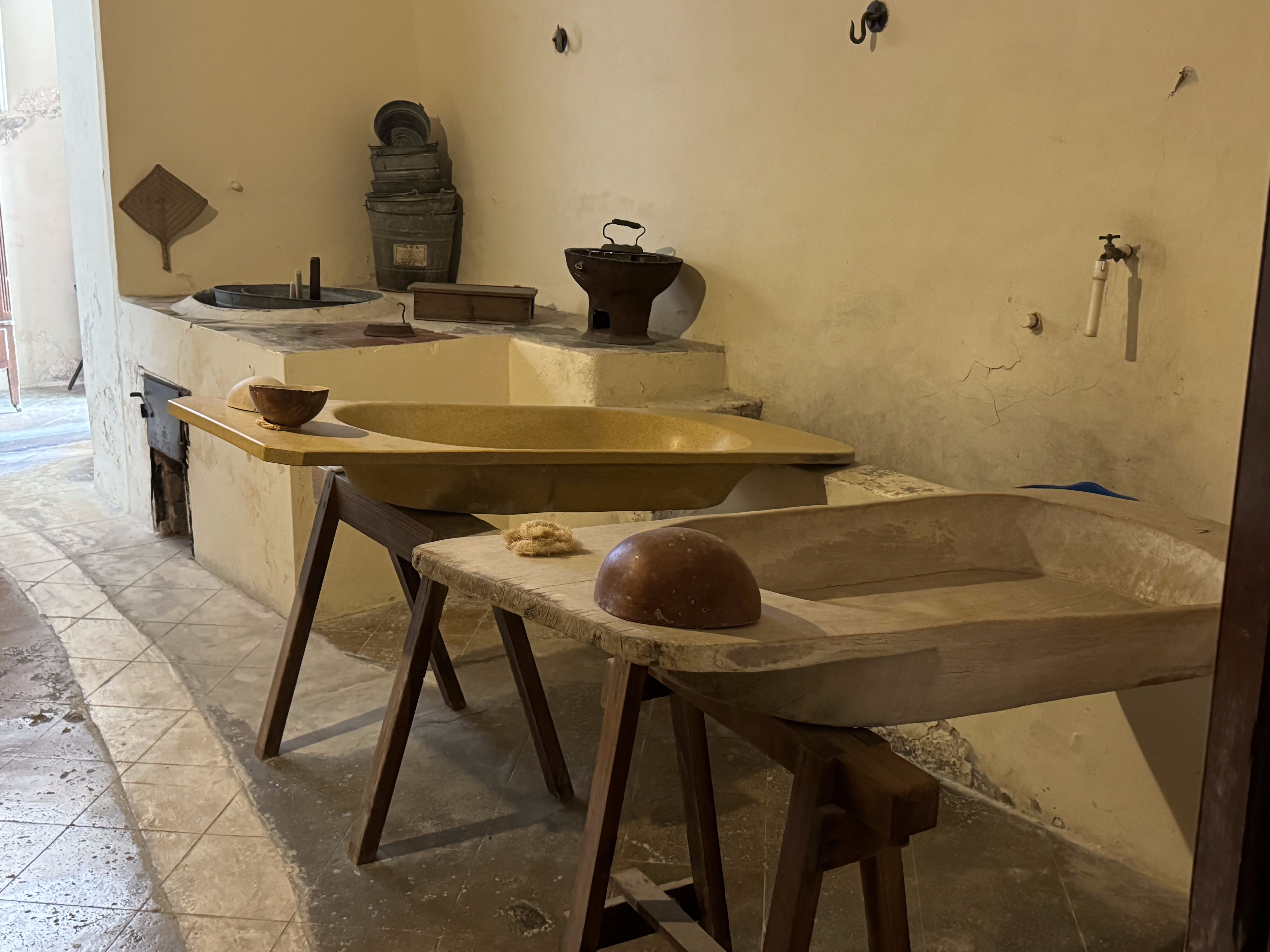
The laundry room, pre-Maytag.
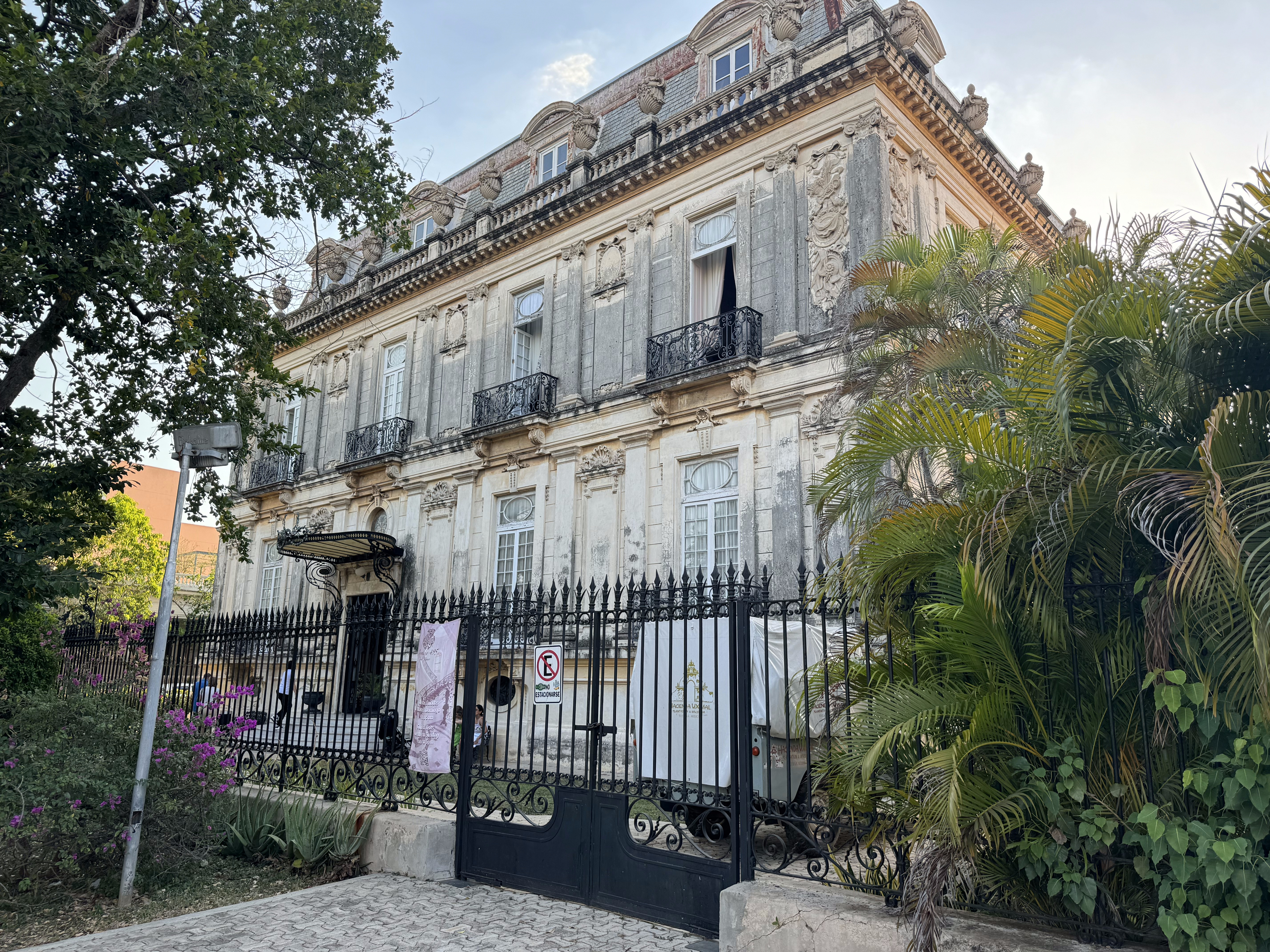
Here's another house on the paseo. It's one of a pair completed in 1911 for the C mara brothers, descendants of Juan de la C mara, who had arrived with Francisco Montejo, the elder. (Remember the statue of father and son?) The architect was Gustave Umgdenstock, a Frenchman, and much of the material came from Europe.
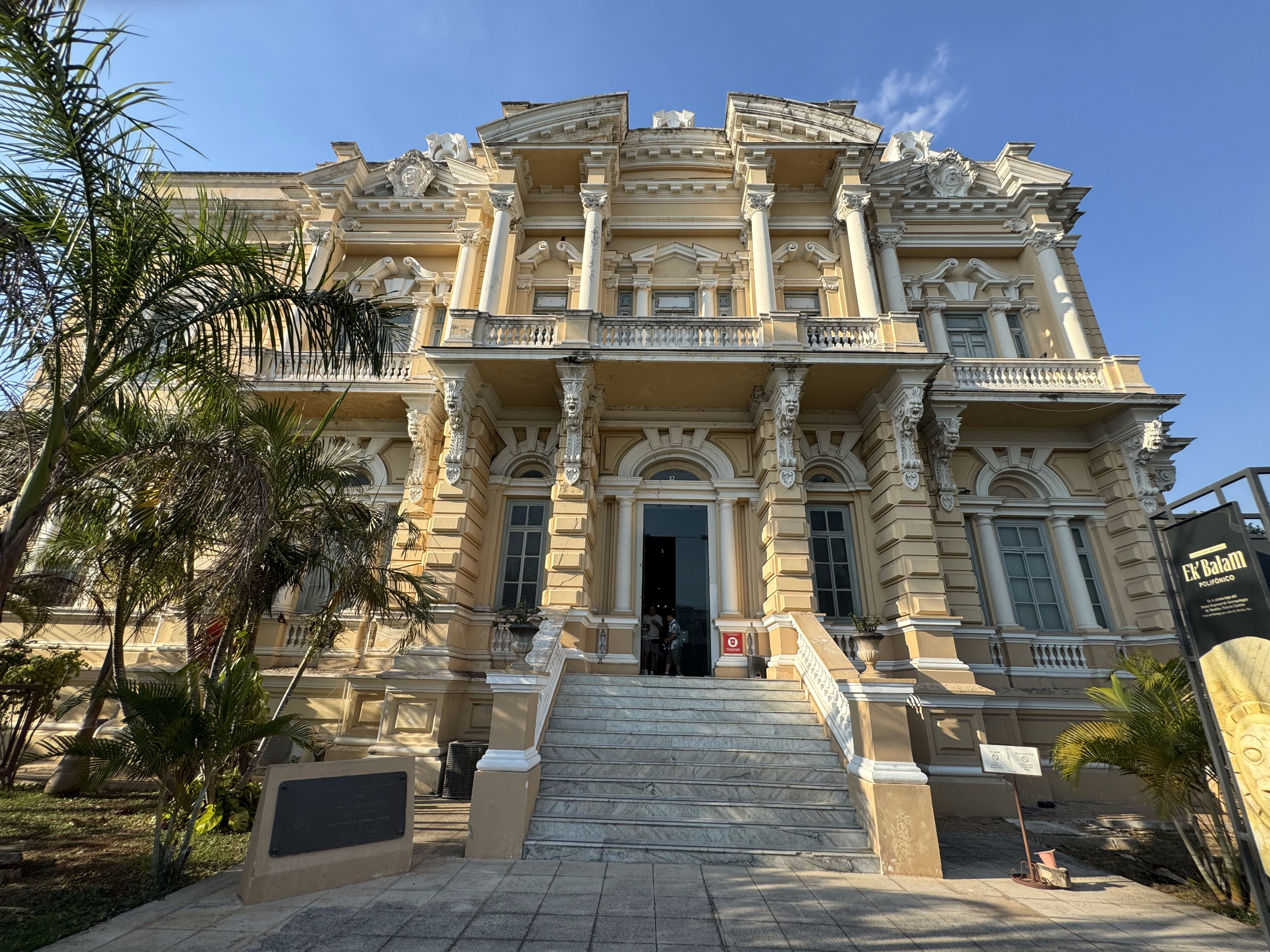
Here's a "cottage" by the Italian architect Enrico Deserti. Since 1966, it's been the Museo Regional de Antropologia, but it was originally the home of Francisco Cant n Rosado. Years earlier, in 1867, he had made the mistake of supporting Maximilian against Juarez and had had to retreat to Cuba. He eventually returned and became the governor of Yucatan. That was in 1898. He retired in 1902 and enjoyed retirement here. He died in 1917.
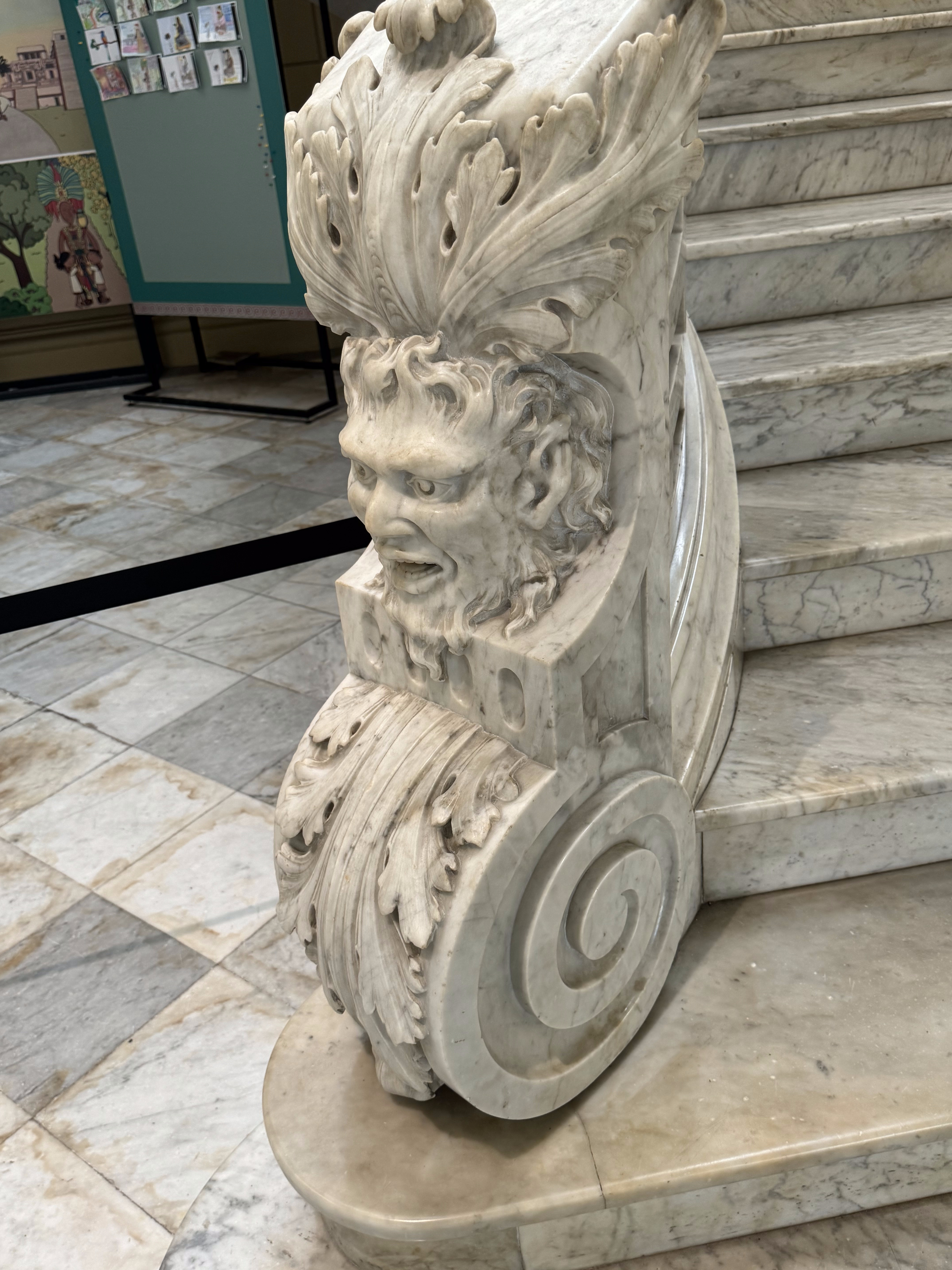
A bit of the home's presumably Italian marble. I bet this newel post terrified little kids.
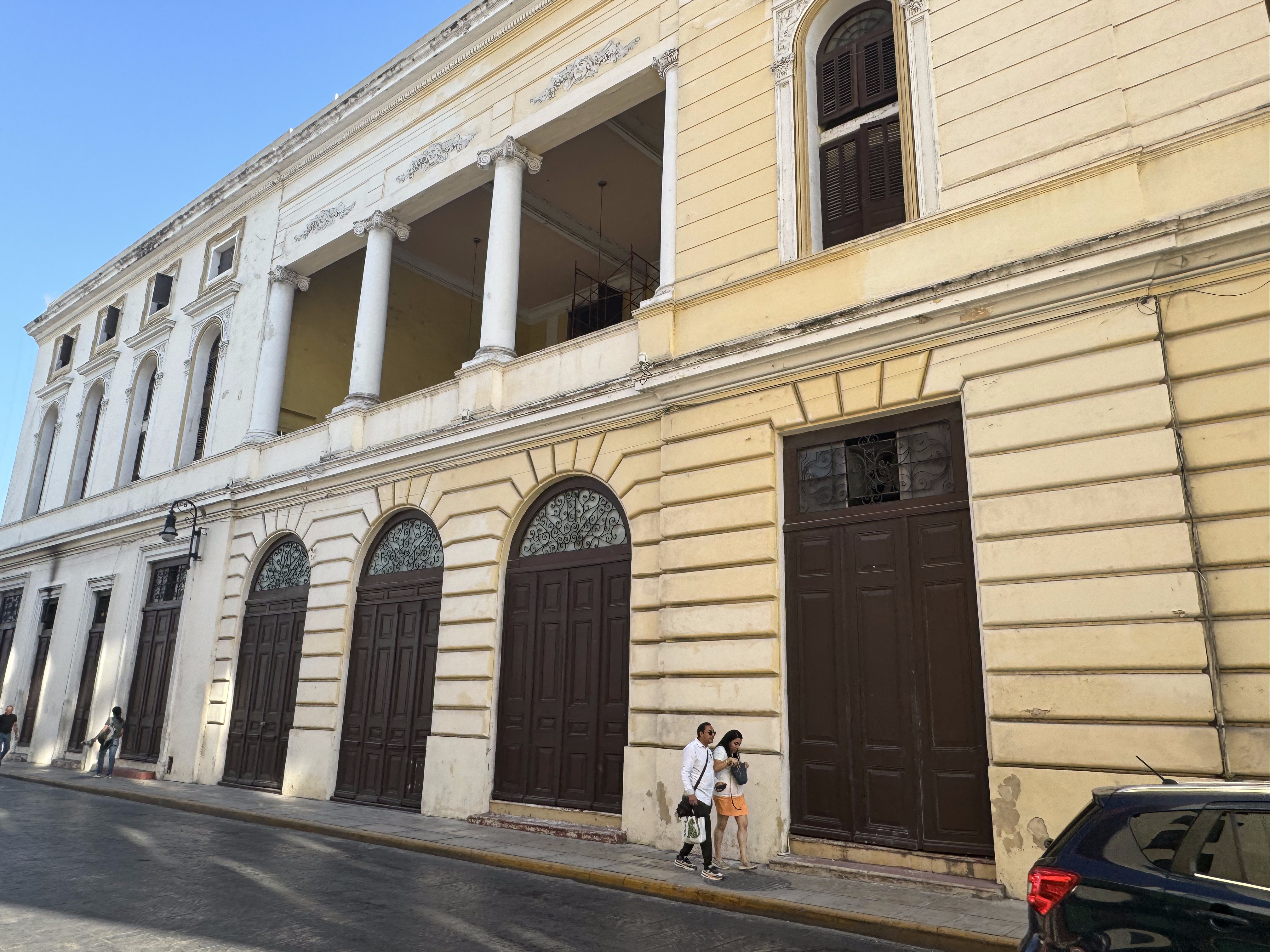
Merida's elite needed a theater. Here it is, the Teatro Jos Pe n Contreras, opened in 1908 and named for a Merida-born physician and playwright who had died the previous year. Amazing, the bounty of the agave.
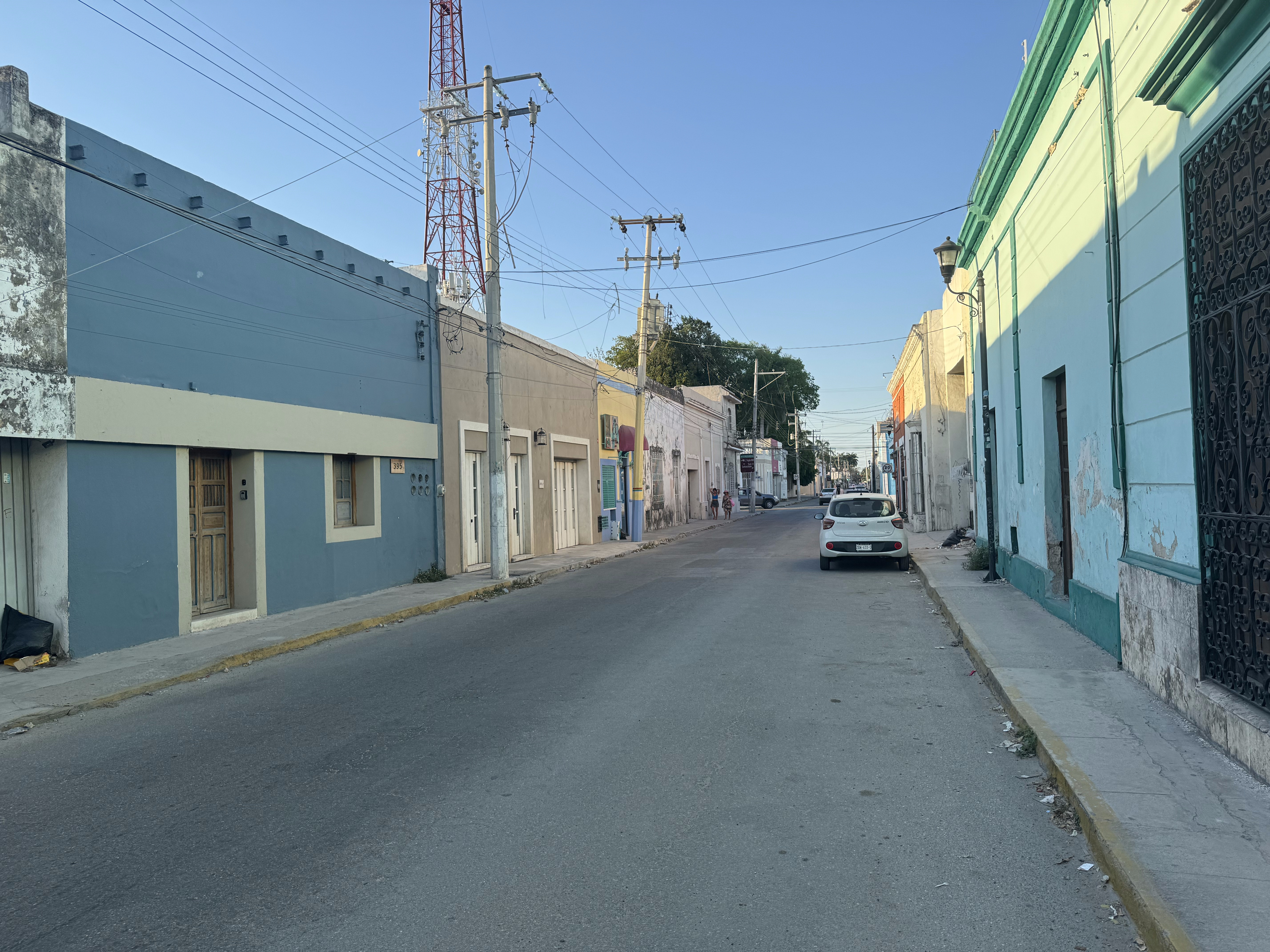
Continue south beyond the end of the Paseo Montejo and you're in the colonial town. Forget European boulevards, but an old Terry's Guide to Mexico says, "To reflect the sun, protect the eyes and induce coolness and cleanliness the city houses are (by law) kalsomined twice a year with light brown, blue, pink, and green tints." (Calsimine, variously spelled, is a lime-based paint.) Terry adds that "the city houses are entered through massive swinging twin doors large enough to admit the passage of a carriage or an auto." (6th ed., 1944., p. 599.)
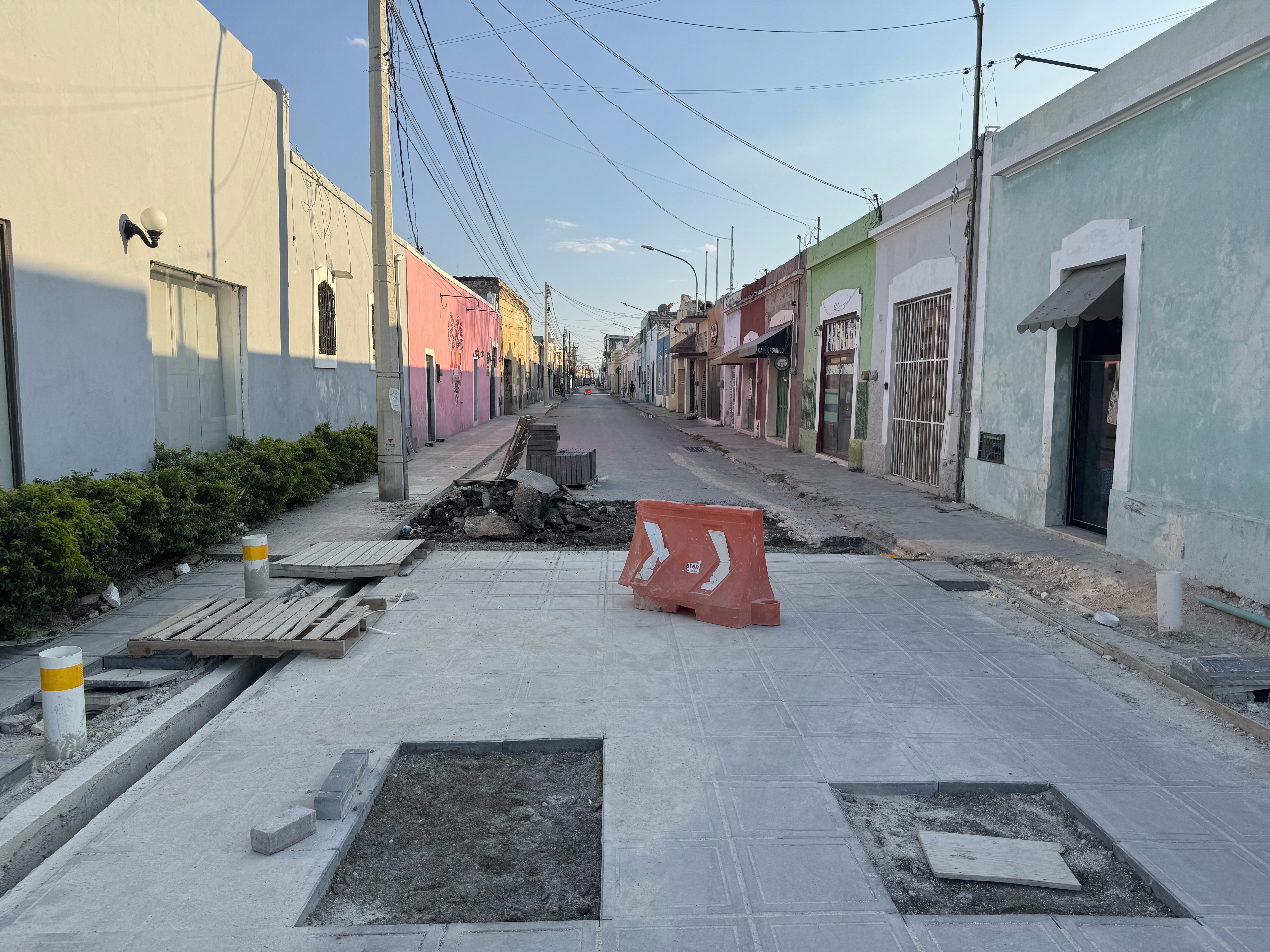
In 2024 there was a lot of money going into upgrades.
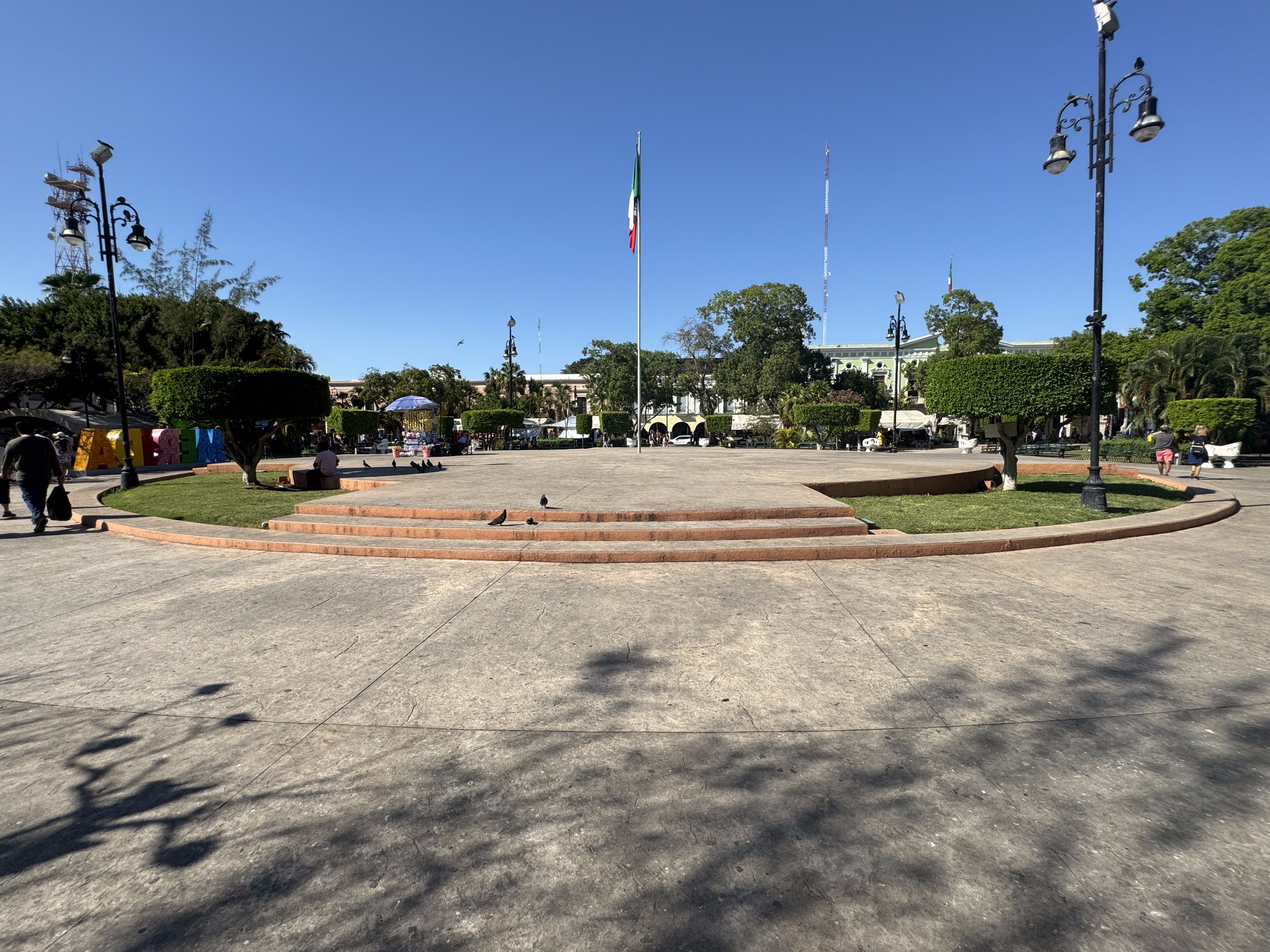
Oddly, the bandstand that had once stood at the center of the city's central plaza was gone, leaving a void.
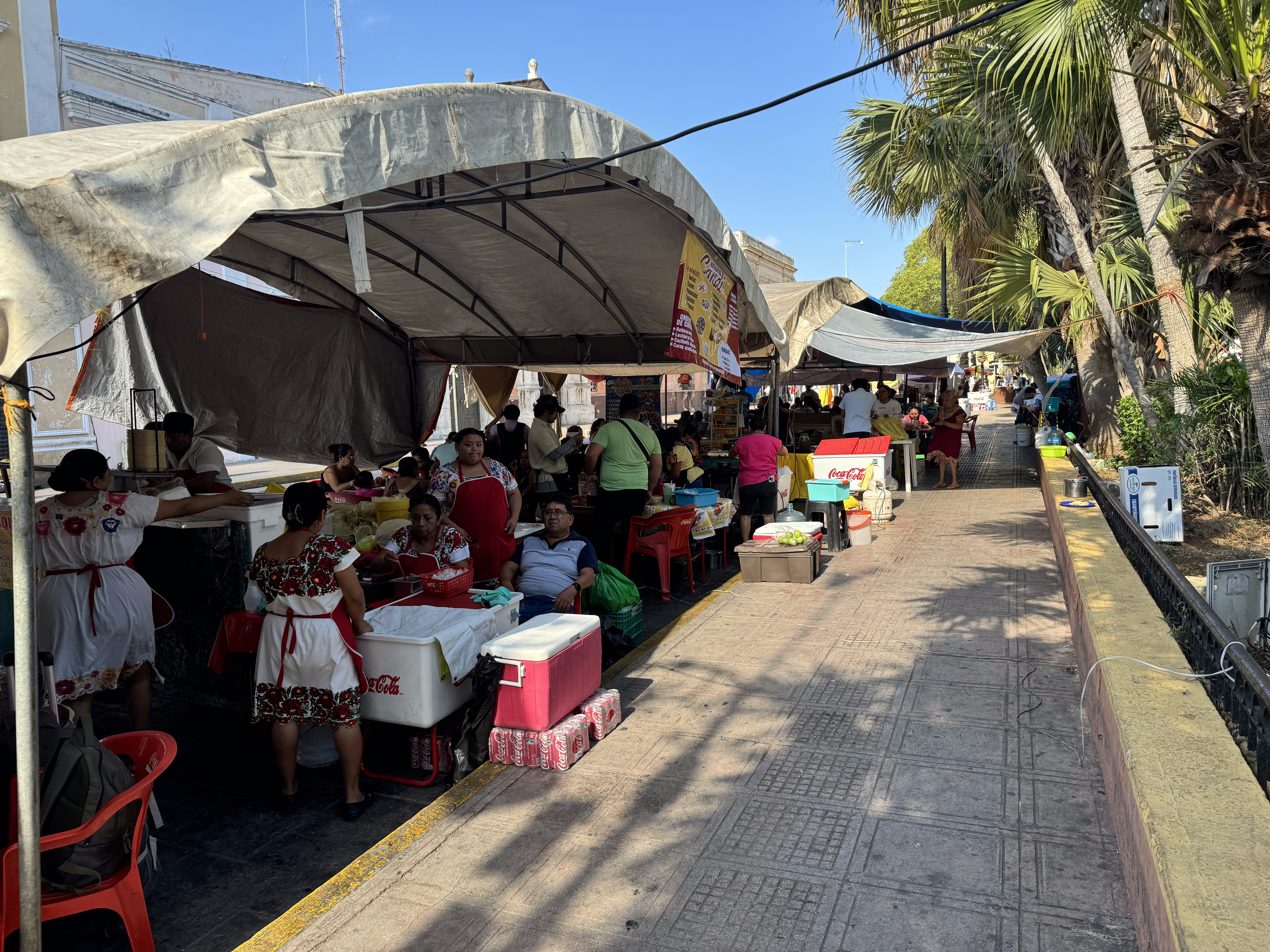
The periphery of the square was another story, at least on this Easter Sunday.
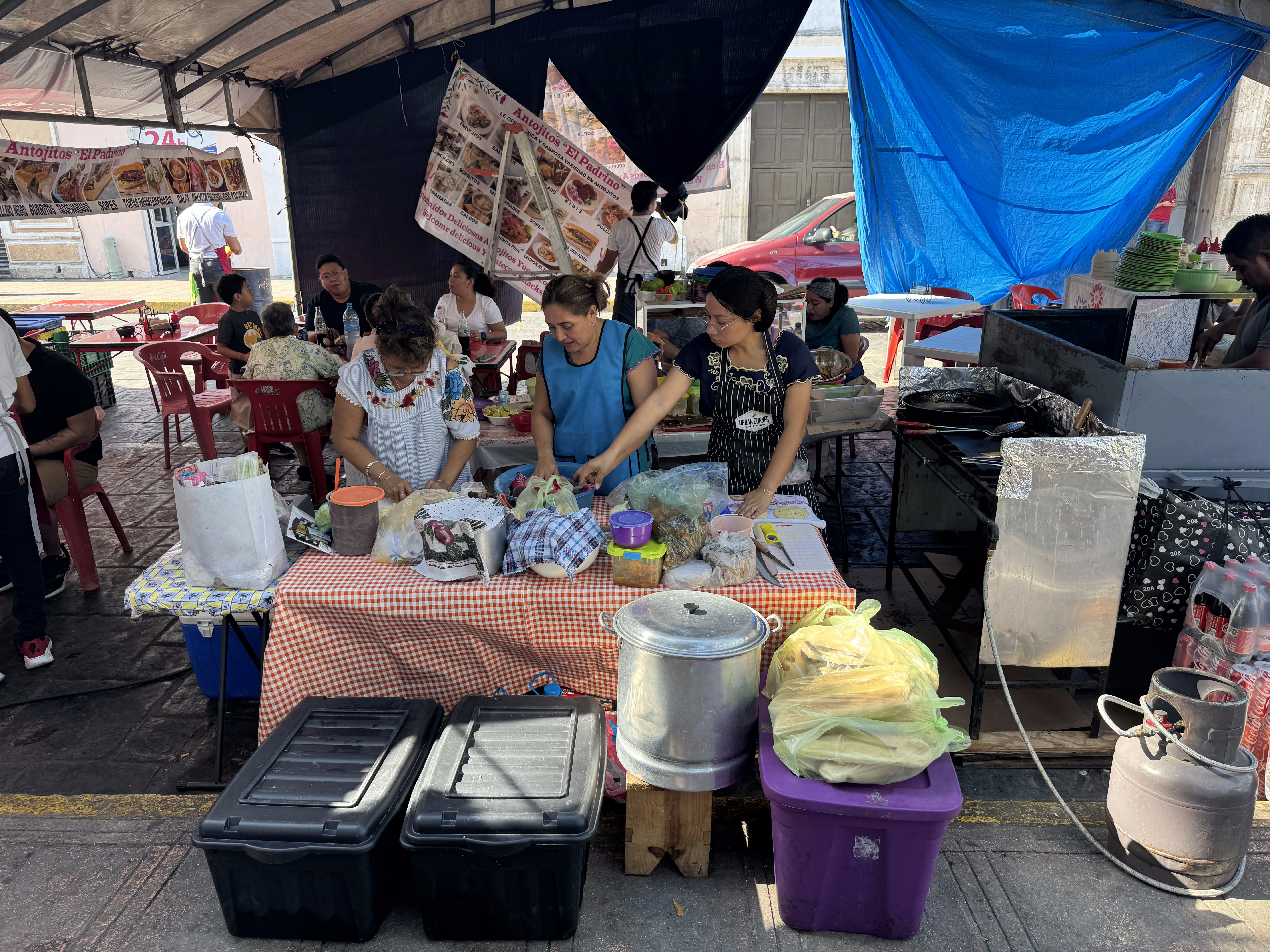
Busy, busy.
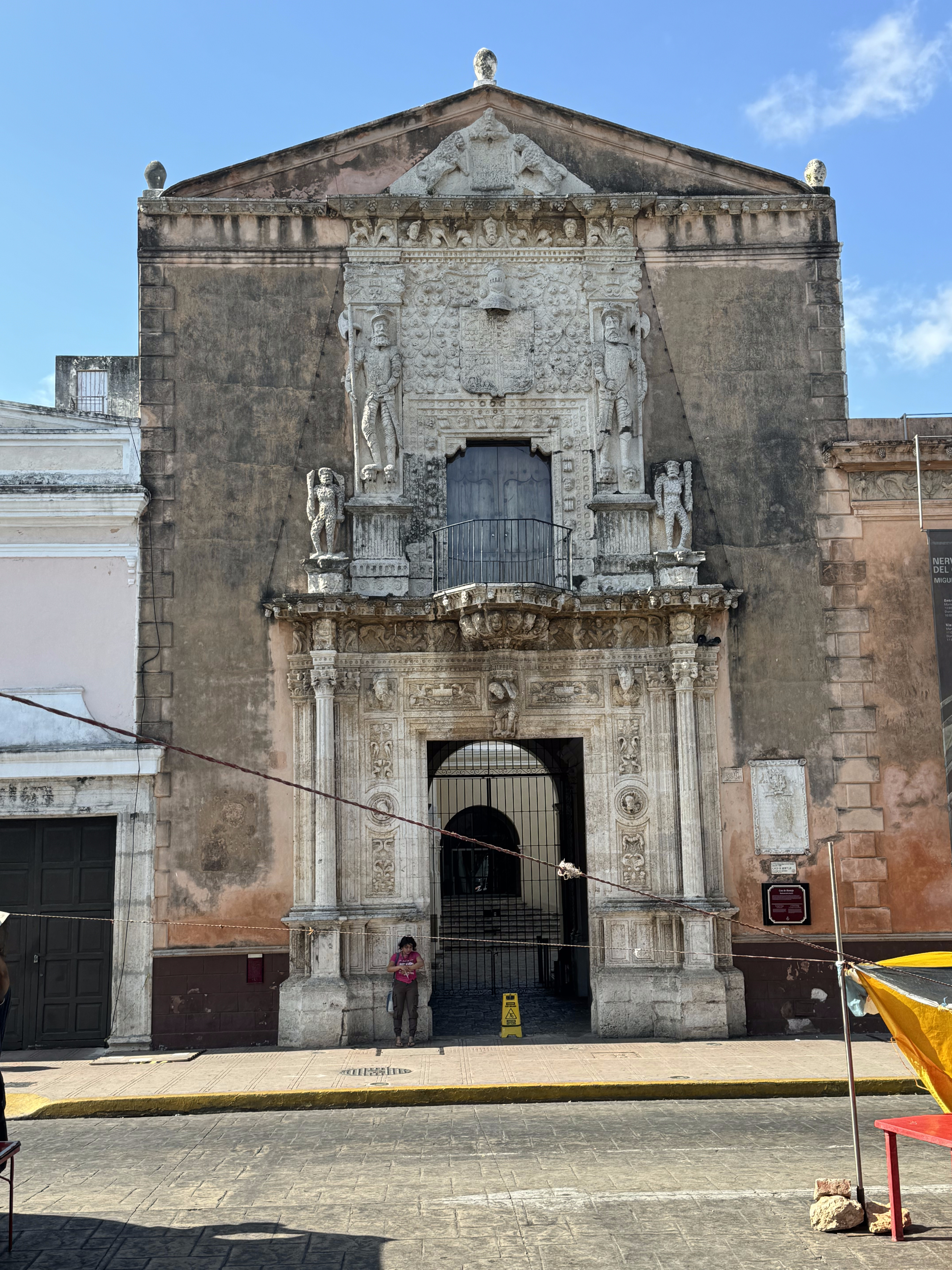
Remember the Montejo's, father and son? Here, across the street from the women cooking up a storm, is the entrance to the Montejo house, built by the son in 1549.
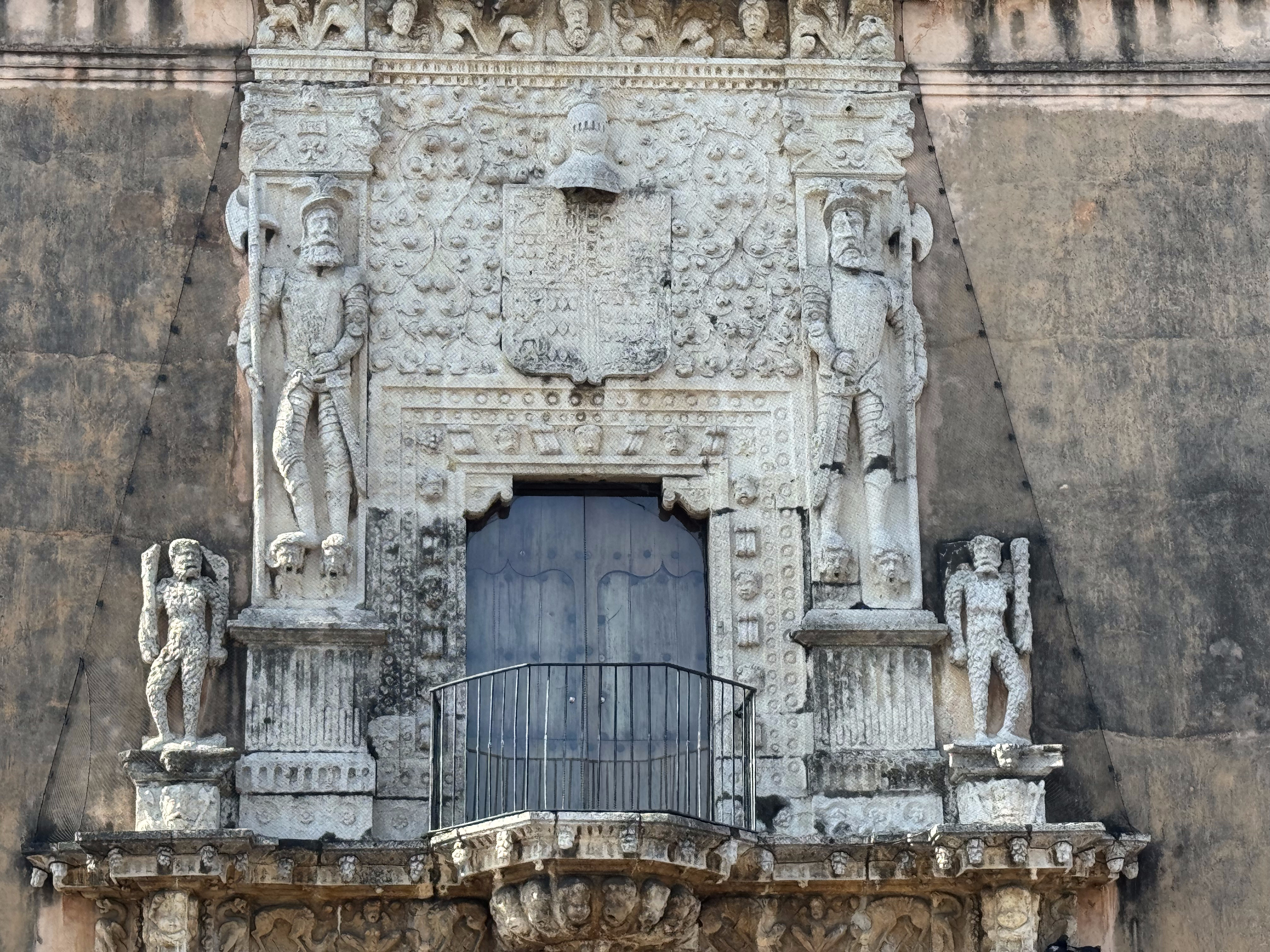
The Montejo's were proud about crushing--sorry, I meant pacifying--the indigenous population. Notice the feet of the Spanish soldiers.
;
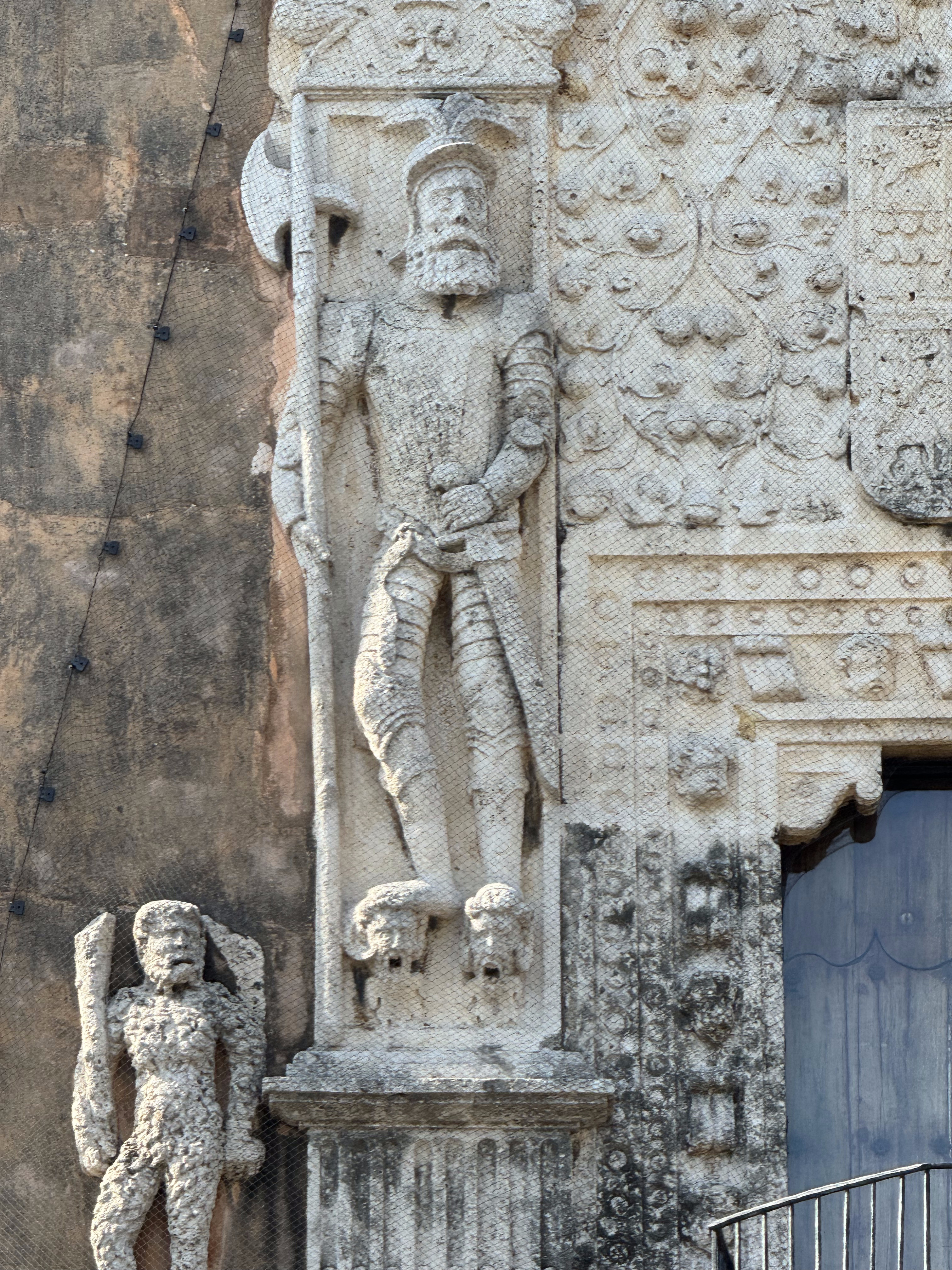
I like the little Hercules, club in hand.
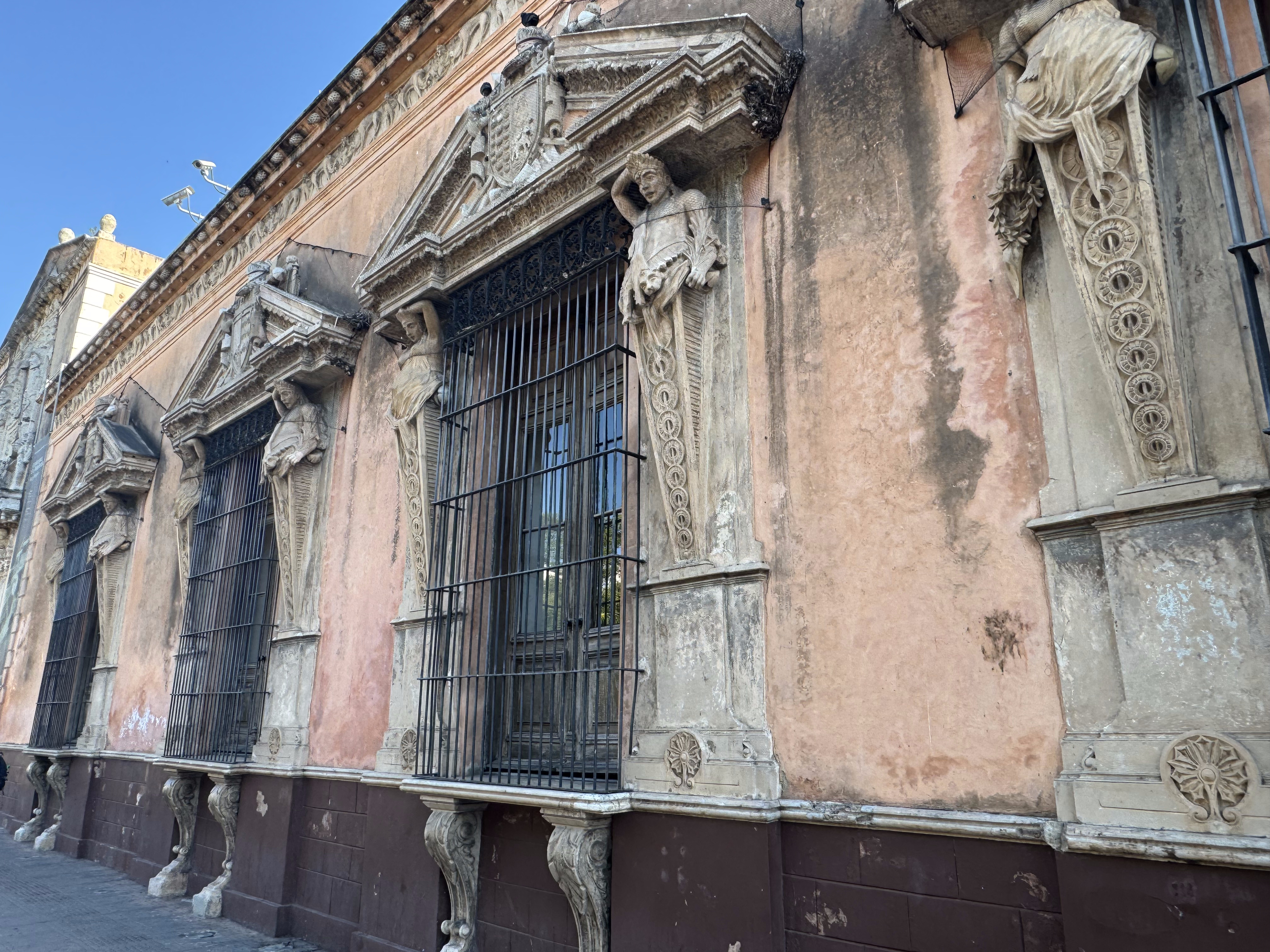
And how 'bout these caryatids? They were added in the 19th century and suggest that racial attitudes hadn't changed in three centuries.
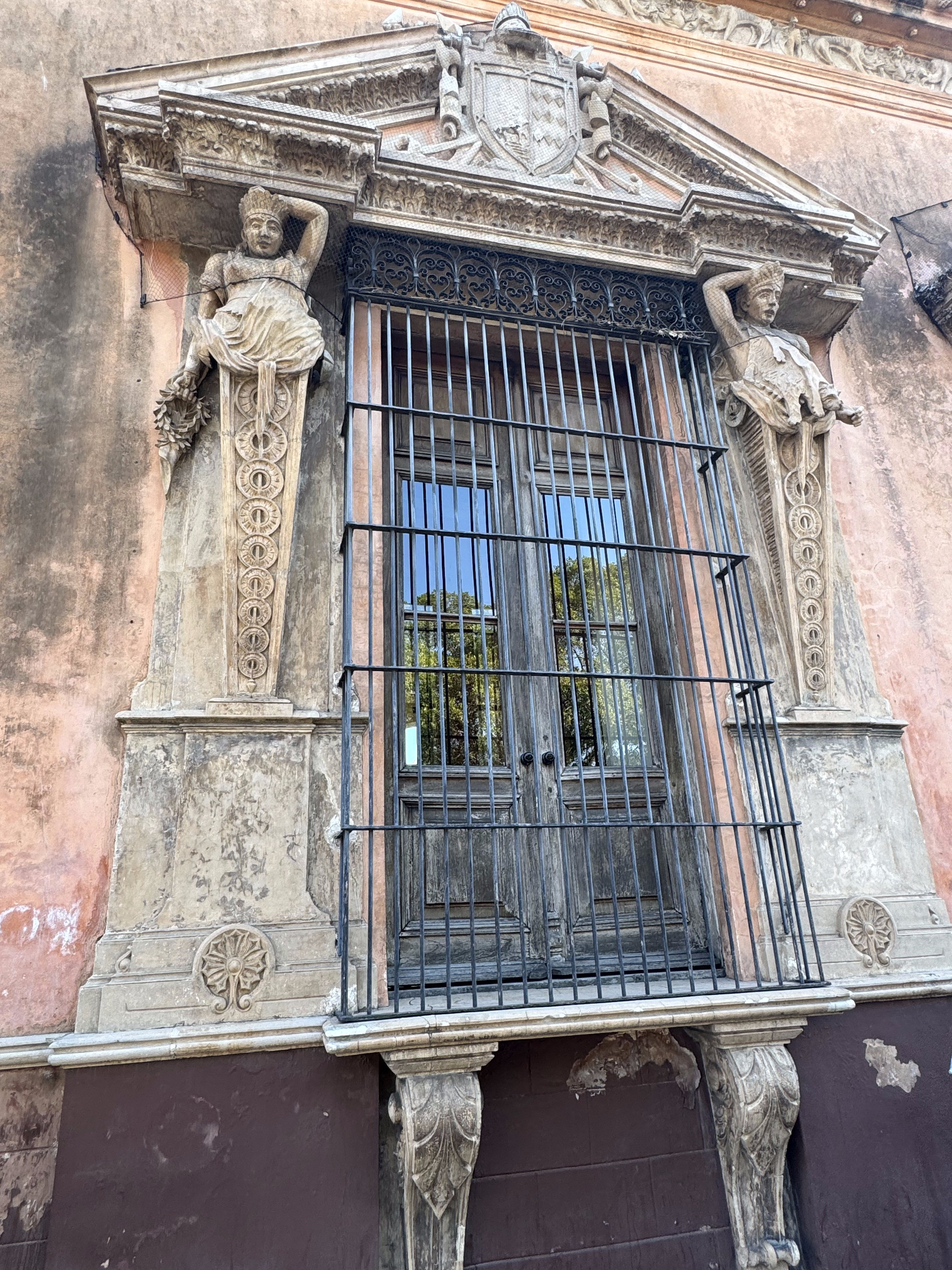
The irony would be complete if the sculptors had been Maya, but the figures are actually of artificial stone cast in a local factory. Come to think of it, the factory workers probably were Indians. More than half the population of the Yucatan Peninsula is still indigenous, and nearly half speak a Mayan language.
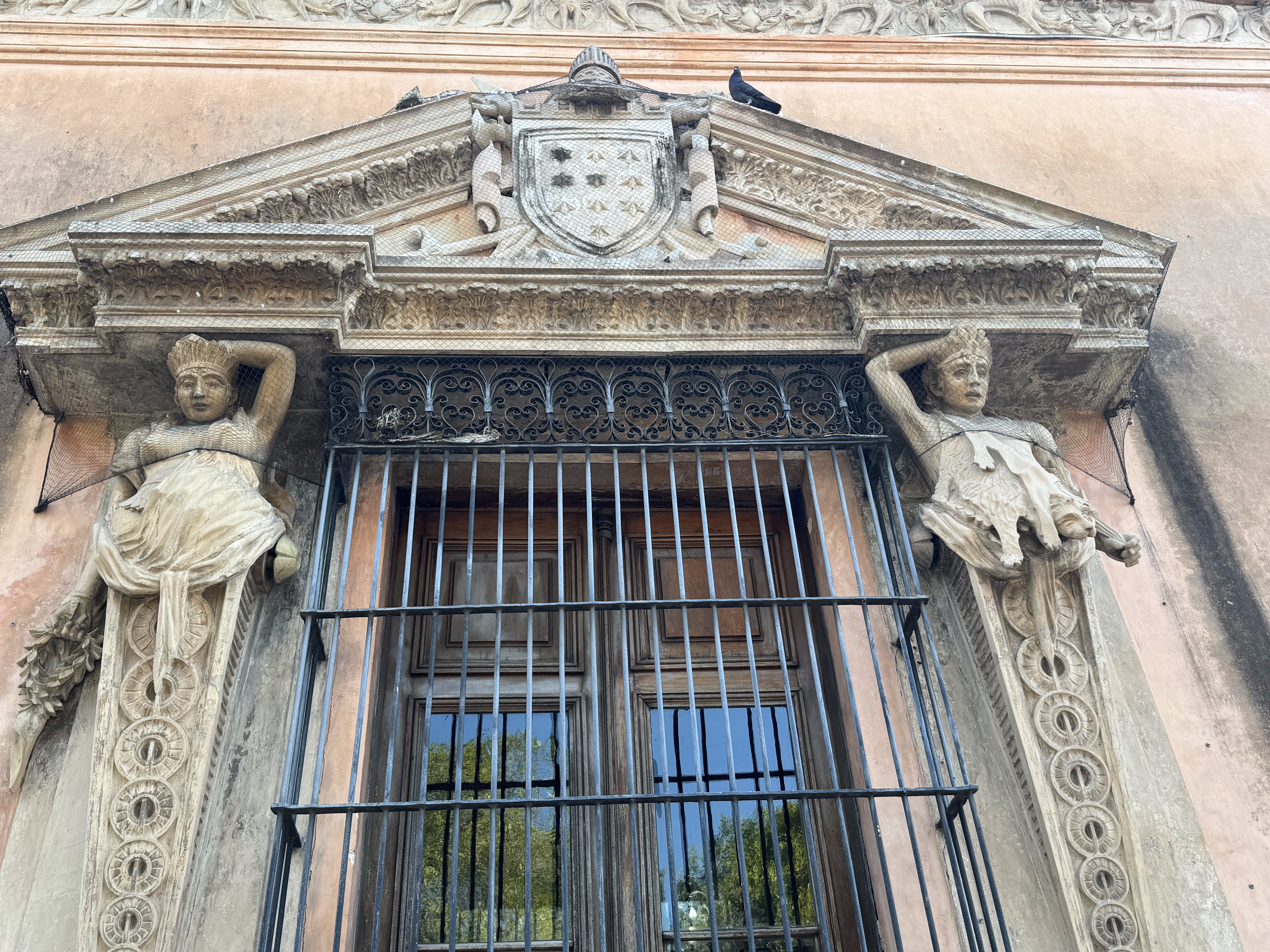
The house in the 1840s had become the property of Don Sim n Pe n, a henequenero who figures prominently in 19th century writing about Maya ruins. That's because Don Sim n owned a hacienda that included the famous ruins of Uxmal, and he offered hospitality to many visitors. If you're shocked by his caryatids, you may be pleased to learn that Don Sim n was arrested in 1869. Supporters of Juarez packed him off to Veracruz, where he soon died.
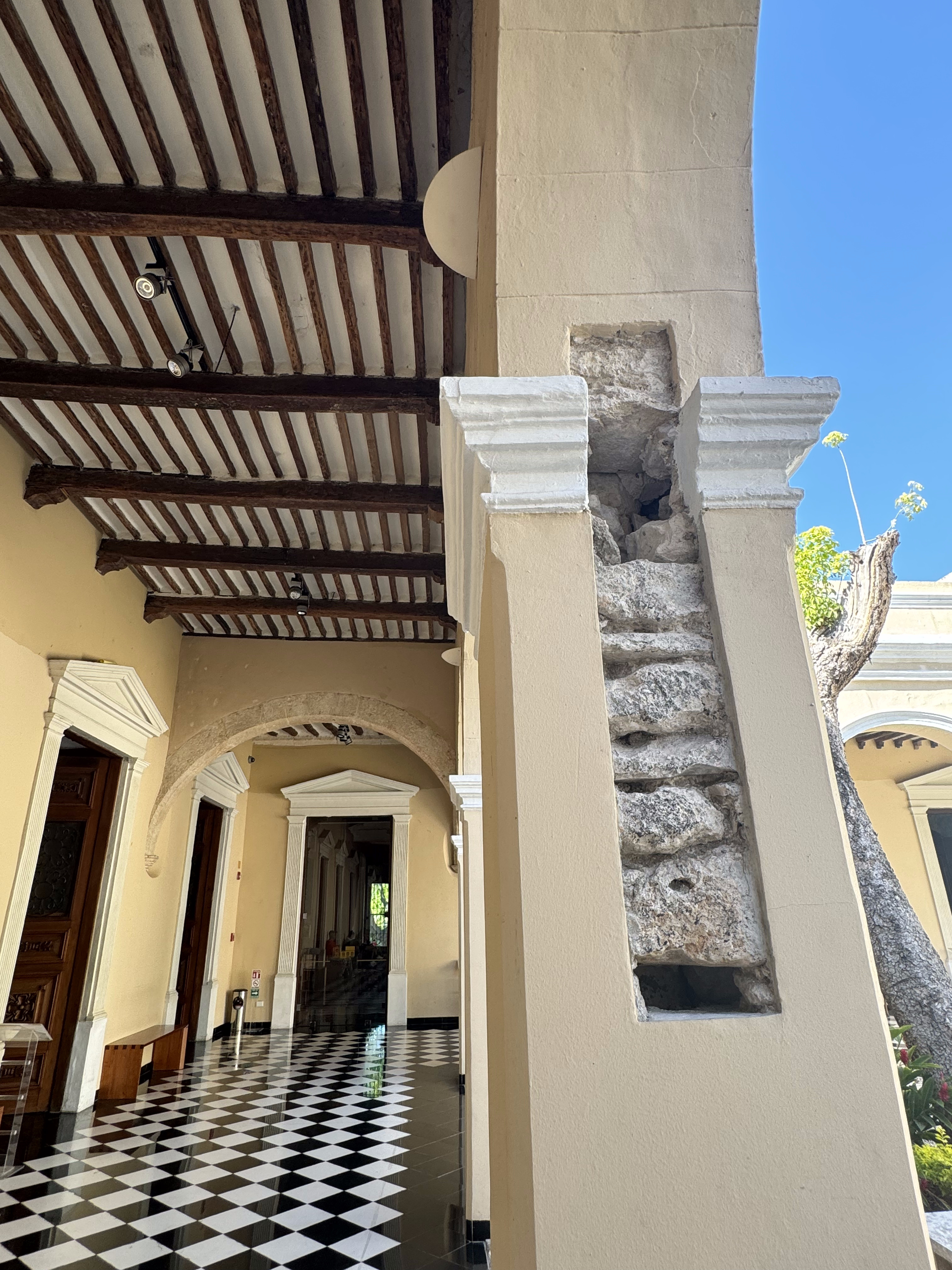
The interior is now a museum and a model of calm.
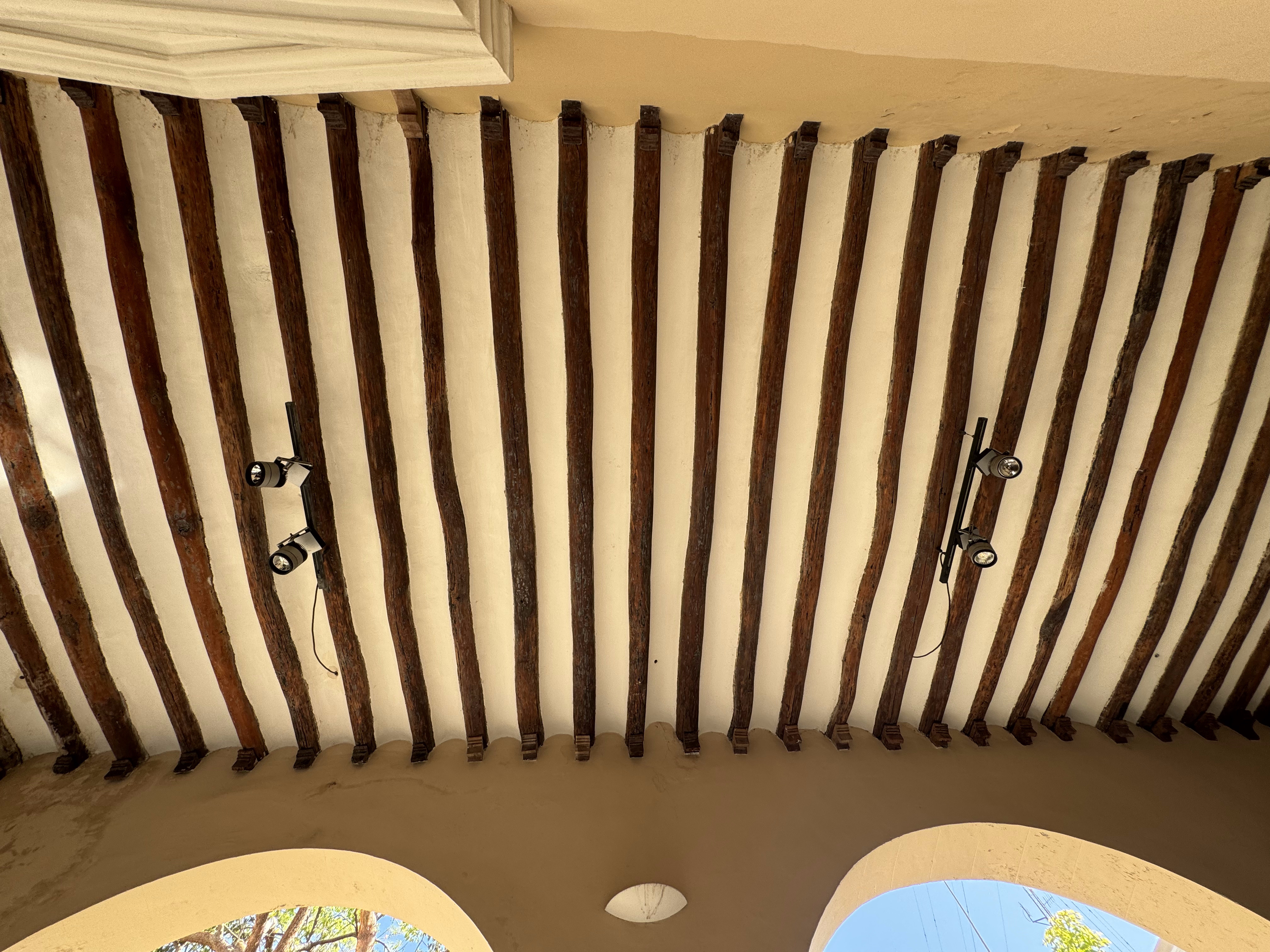
Wish I could find a bit of ceiling without those lights. No luck.
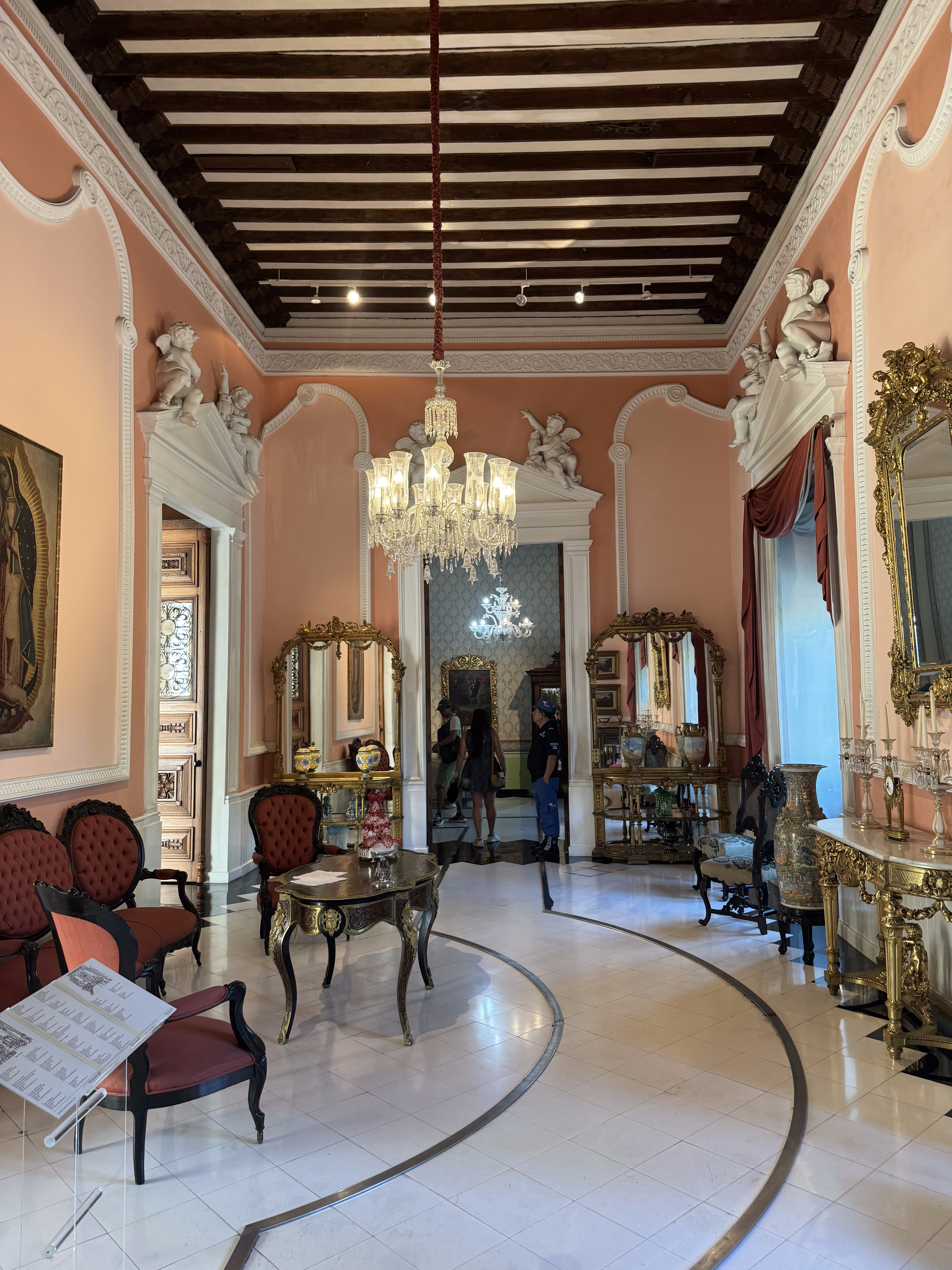
Think the furniture was imported?
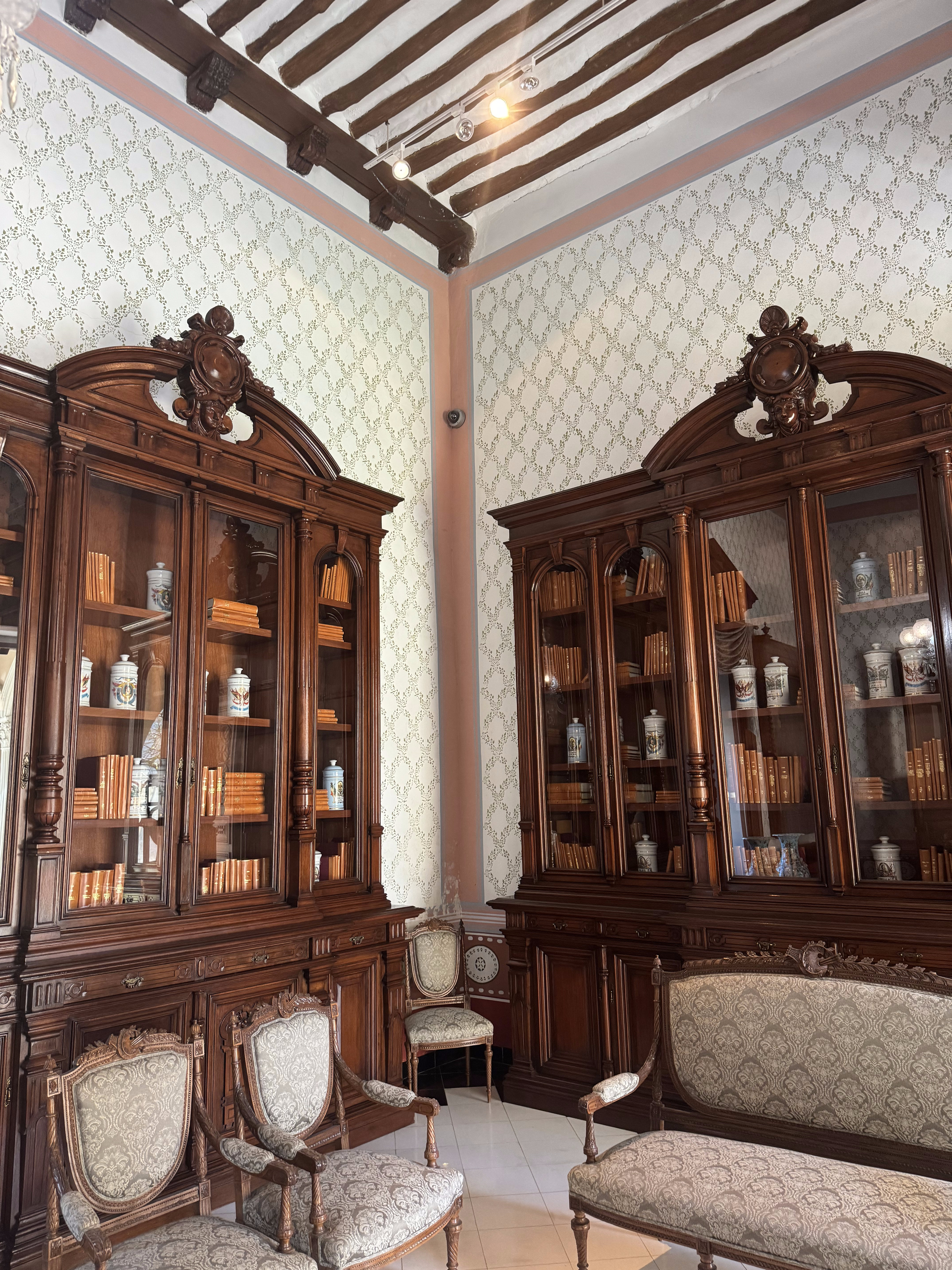
I'm betting it was. Don Sim n spoke excellent English. French, too, I assume.
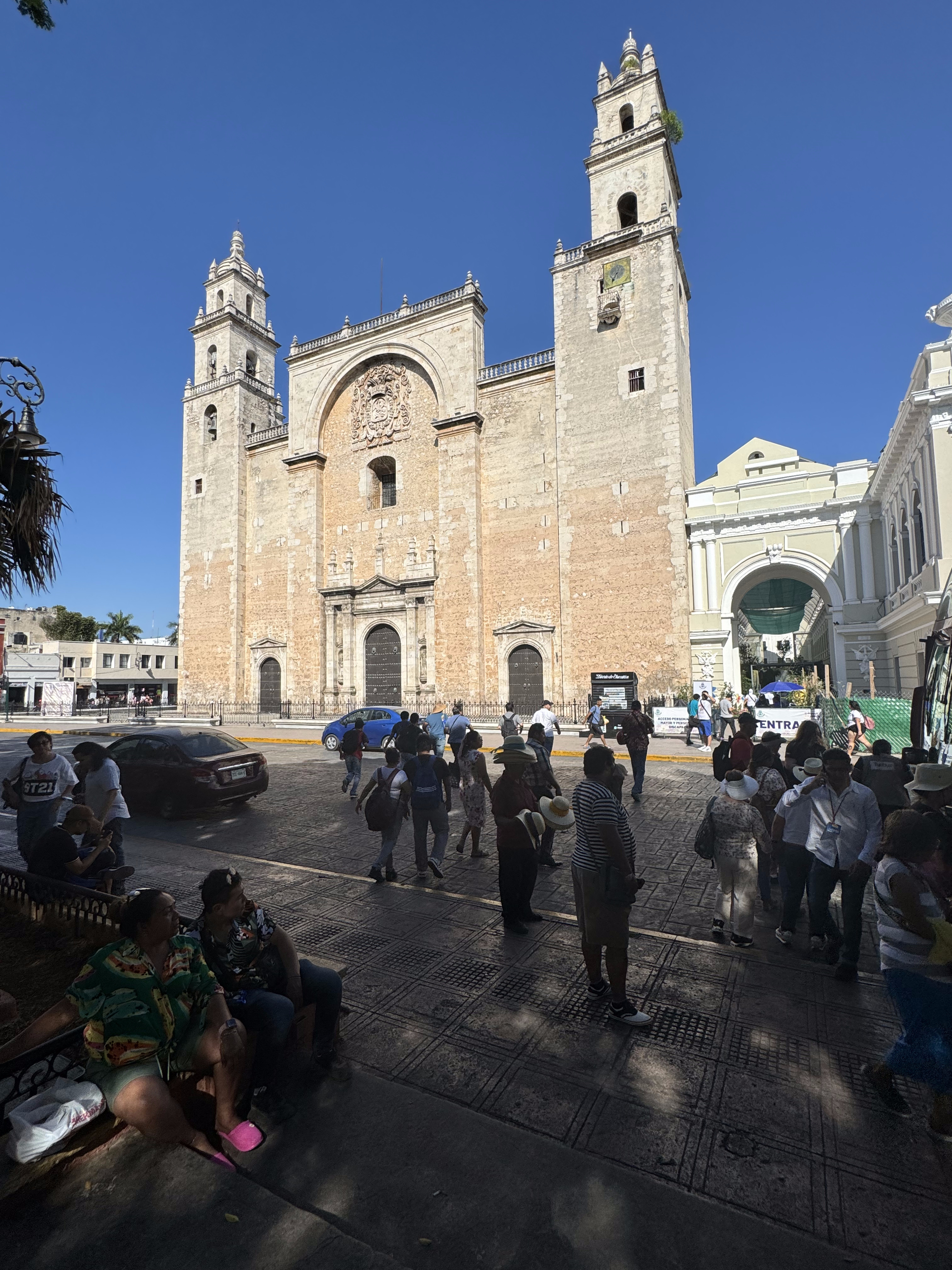
Kitty-corner to the Montejo House, here's the Cathedral of San Ildefonso, opened in 1598 and reputedly the first cathedral built on the American mainland.
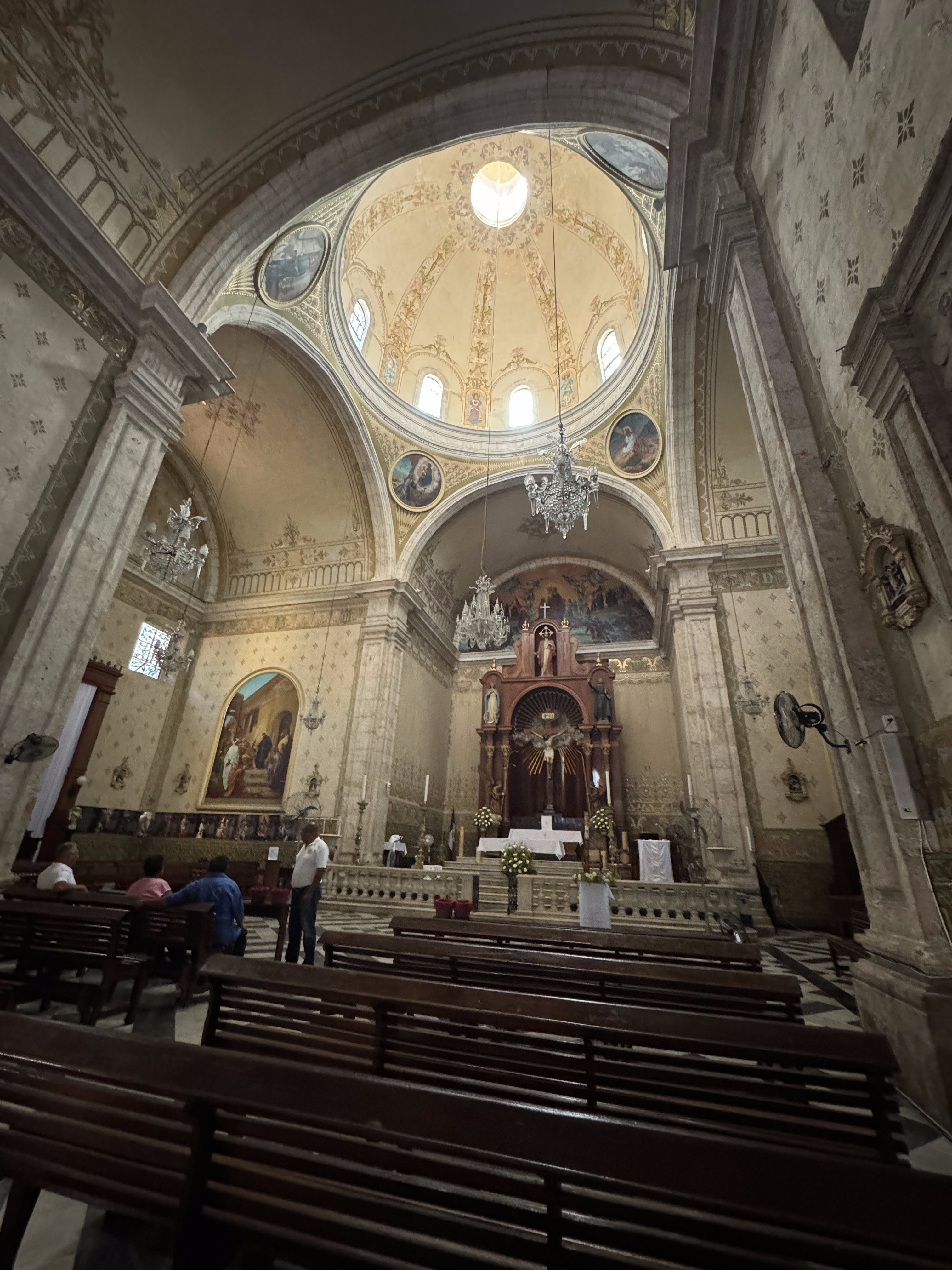
The interior. Don't yawn.
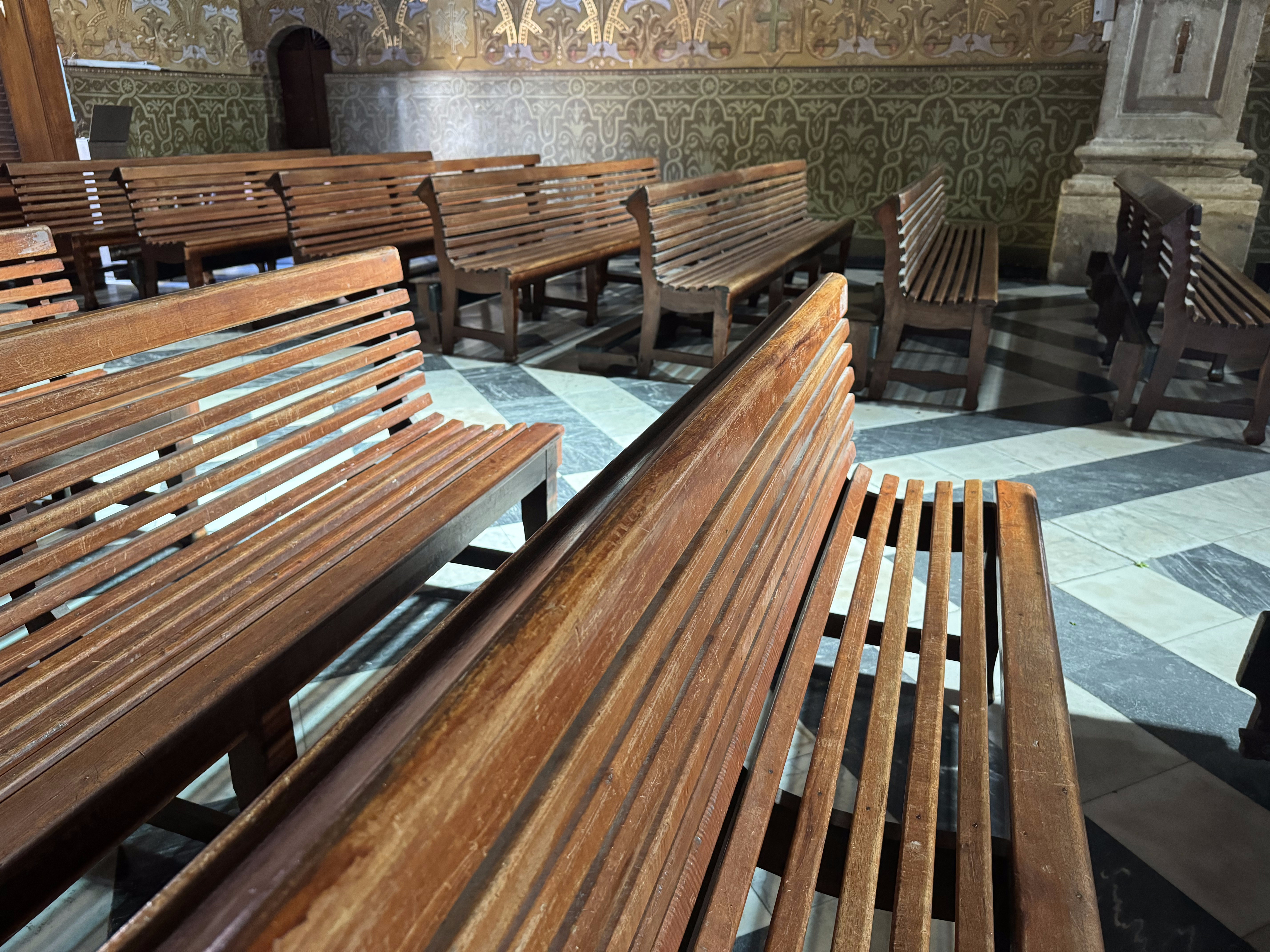
The slatted pews are brilliant. I'm not being sarcastic. Maybe you have to be sweating in the heat to appreciate them.
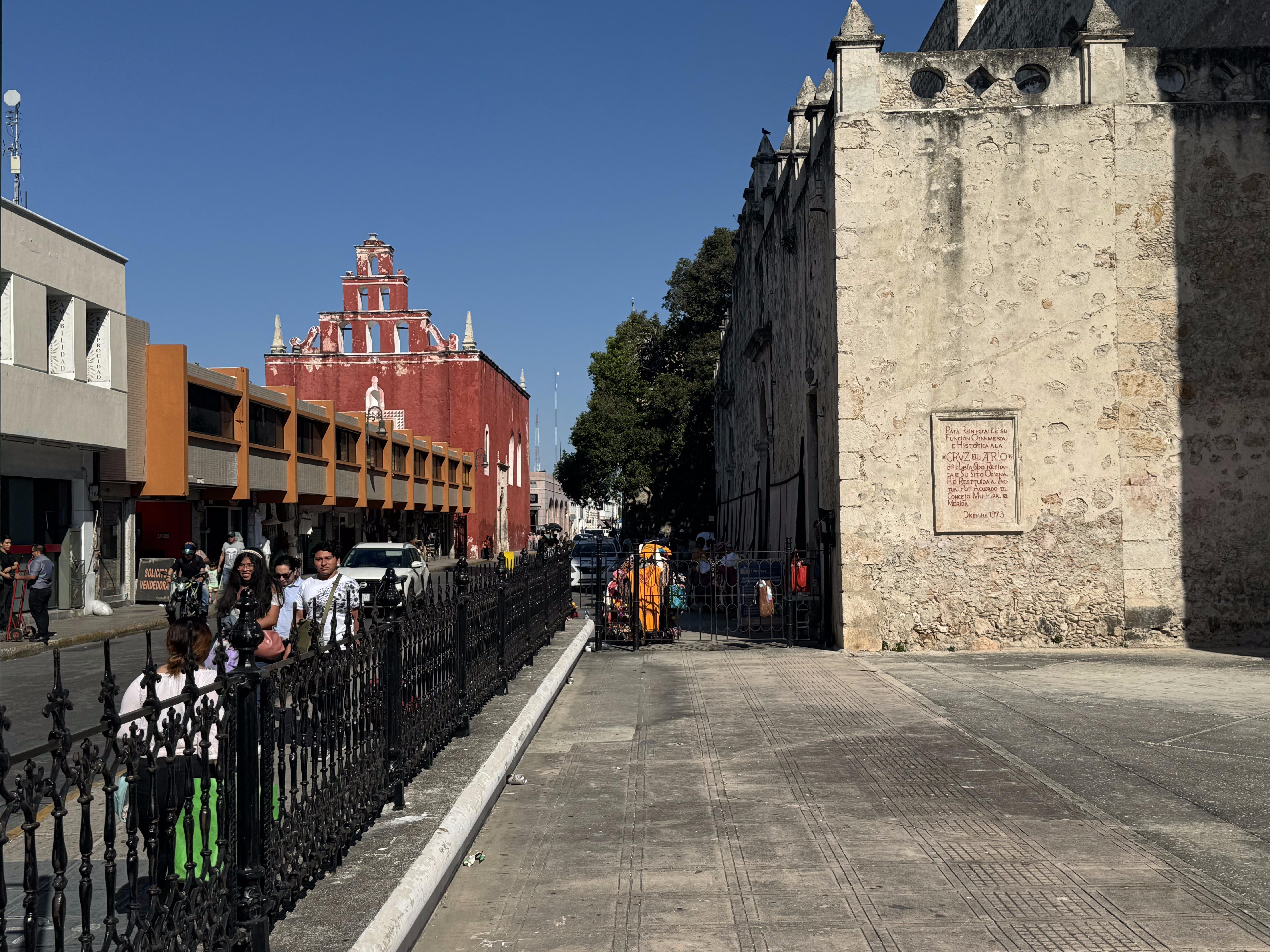
More interesting (well, I thought so) is this earlier church.
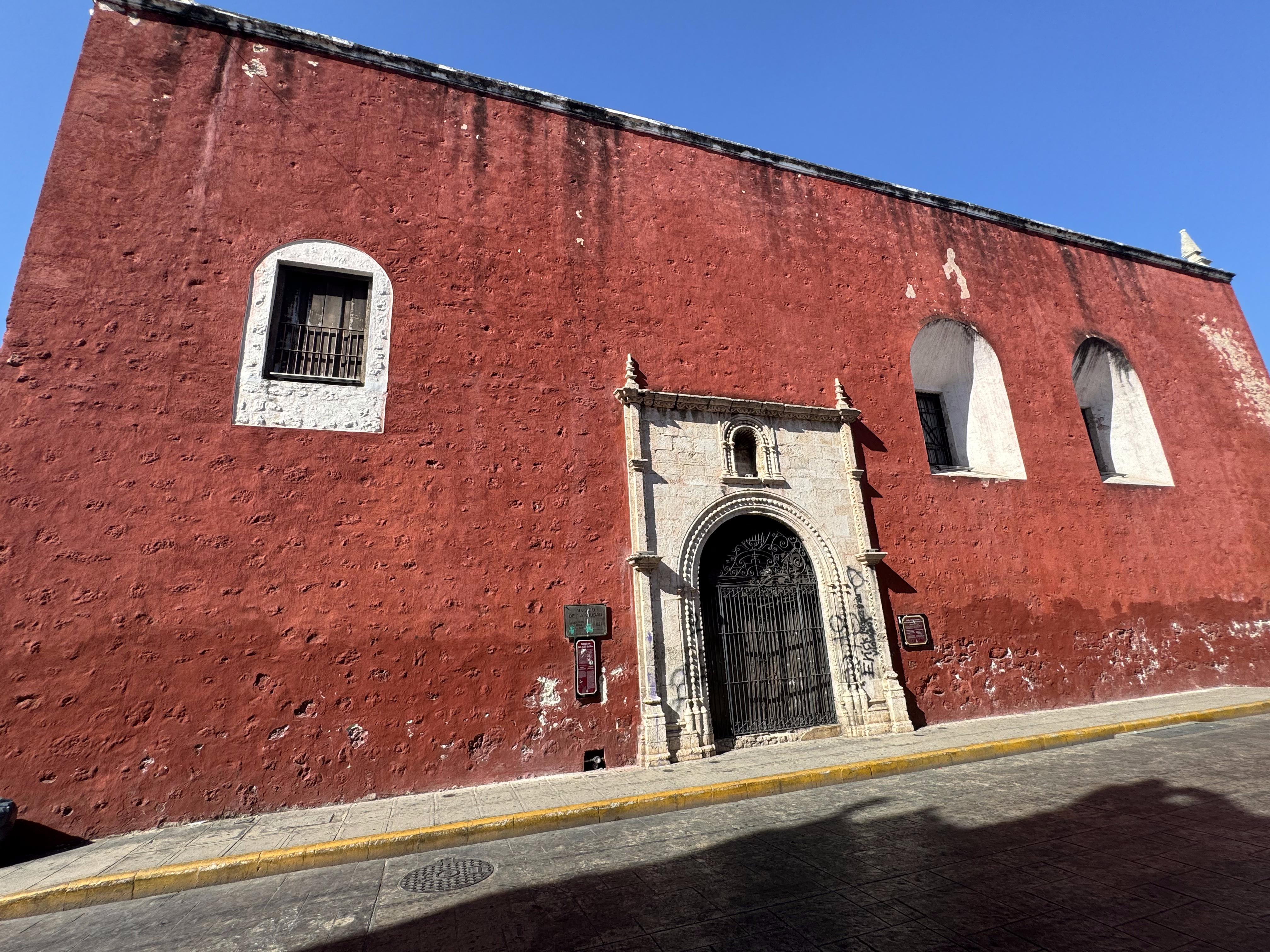
Despite the warm color, the building is a three-eyed monster with the mouth of a 1958 Edsel. It's also a 16th century Big Box. That's why it could be the Chapel of Our Lady of the Rosary from 1579 to 1625, then the Hospital of San Juan de Dios until 1832, and then the Merida General Hospital. Thirty years later, it became a Catholic school. In 1925 it became an archaeological museum, and in 1941 it became the state institute of ethnography and history. From 1987 to 2007 it was the city musum. Today, having found its true vocation, it's a warehouse for the national institute for archaeology and history (INAH). Door's locked. Too bad.
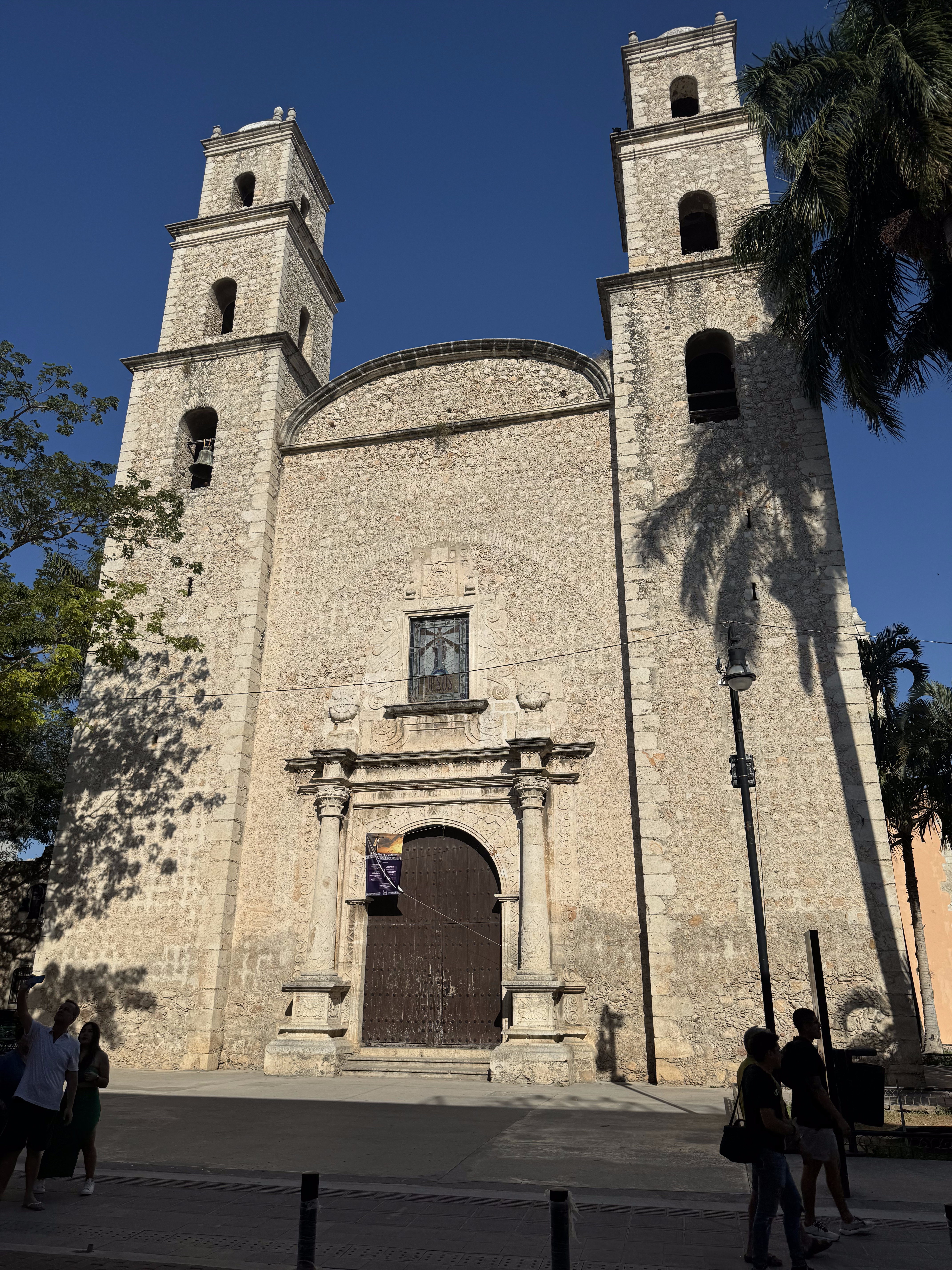
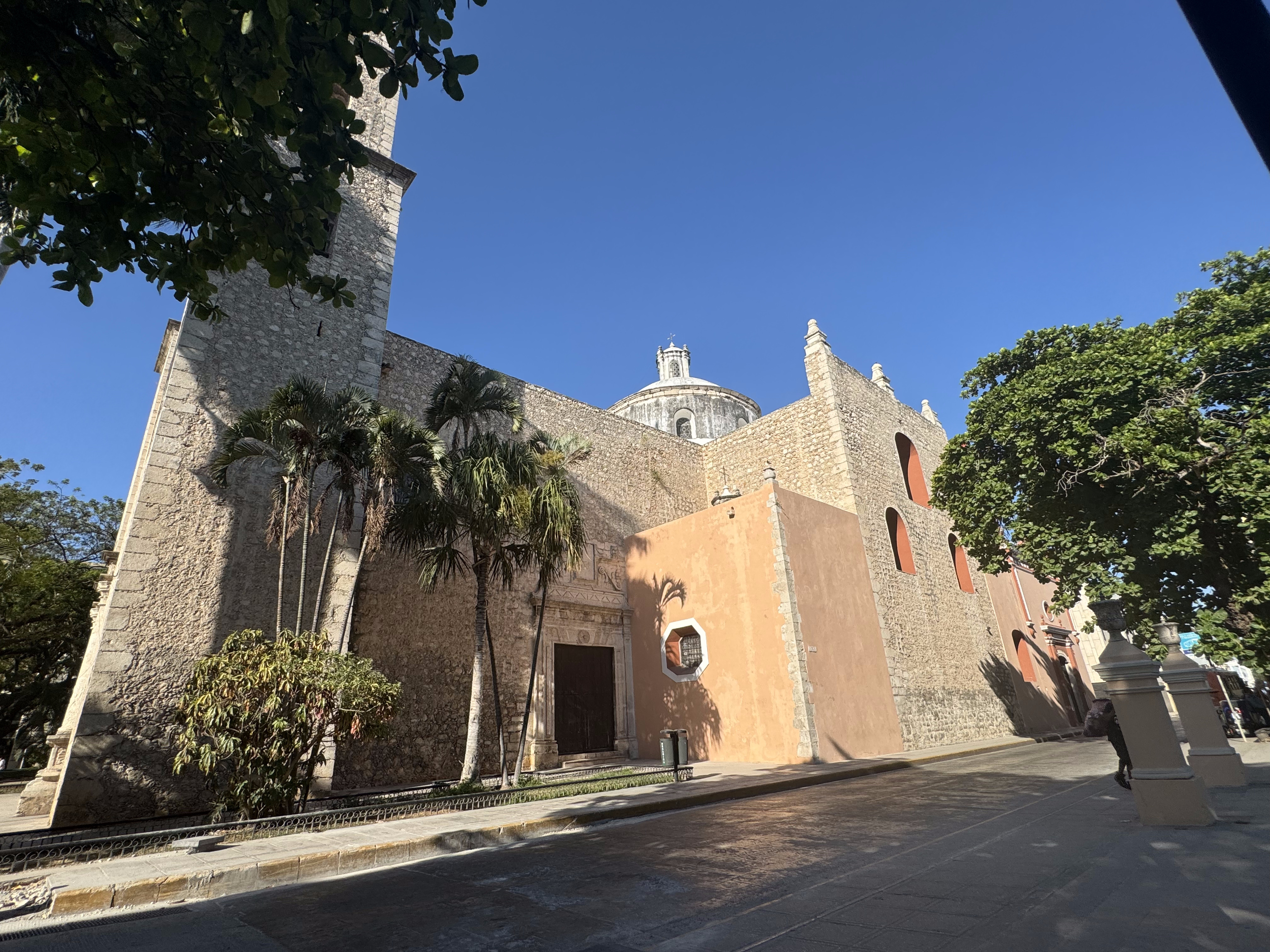
One more: it's the Church of Jesus, built by the Jesuits in 1618. It's also called the Church of the Third Order, because when the Jesuits were expelled from Spain's domains in 1767 this church was taken over by Franciscans of the Third Order--so-called because it's a lay order supplementing the friars and nuns of the first two.
I'm trying your patience, but look at this door.
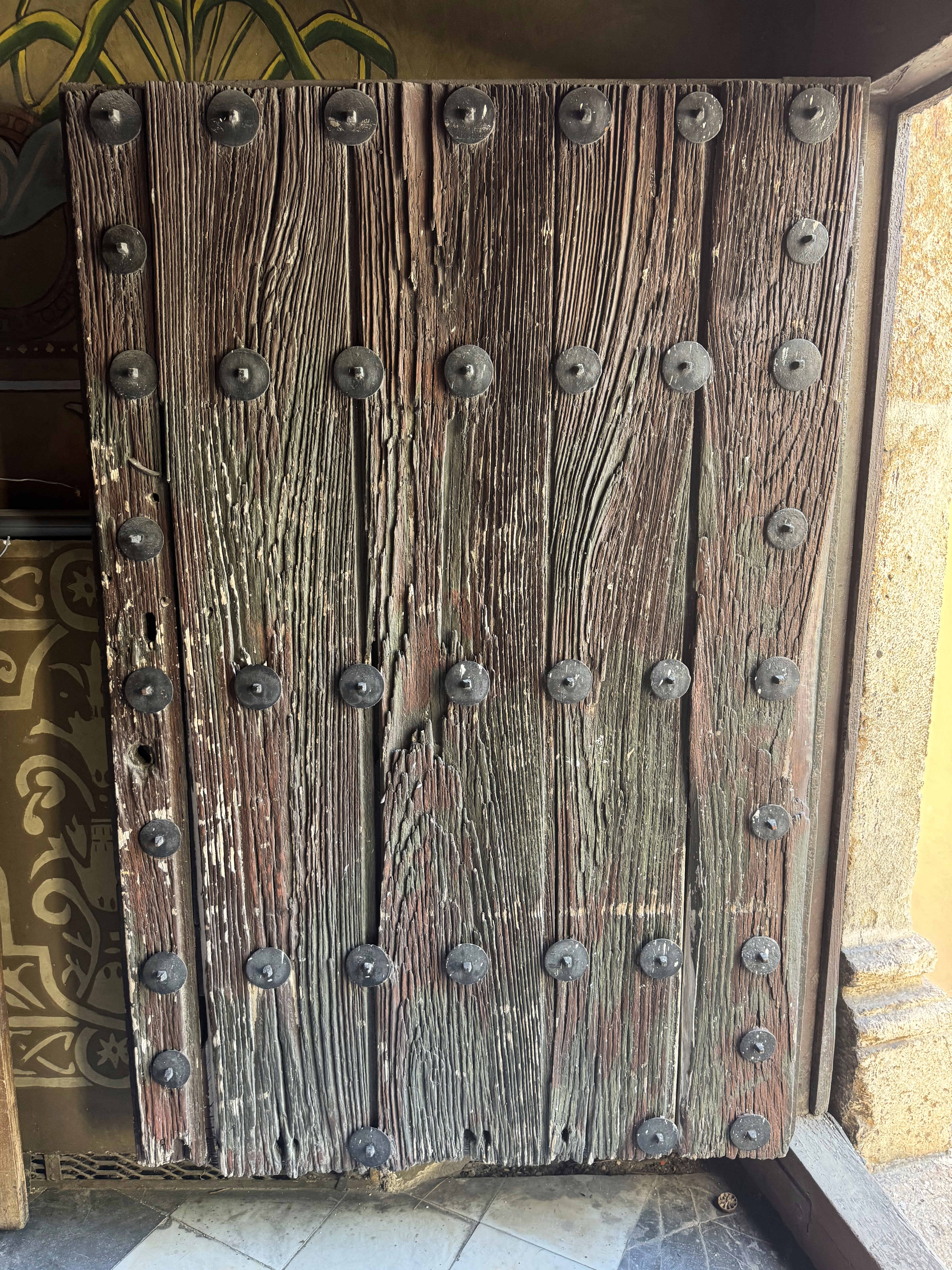
Tell me it's not the most beautiful thing so far.
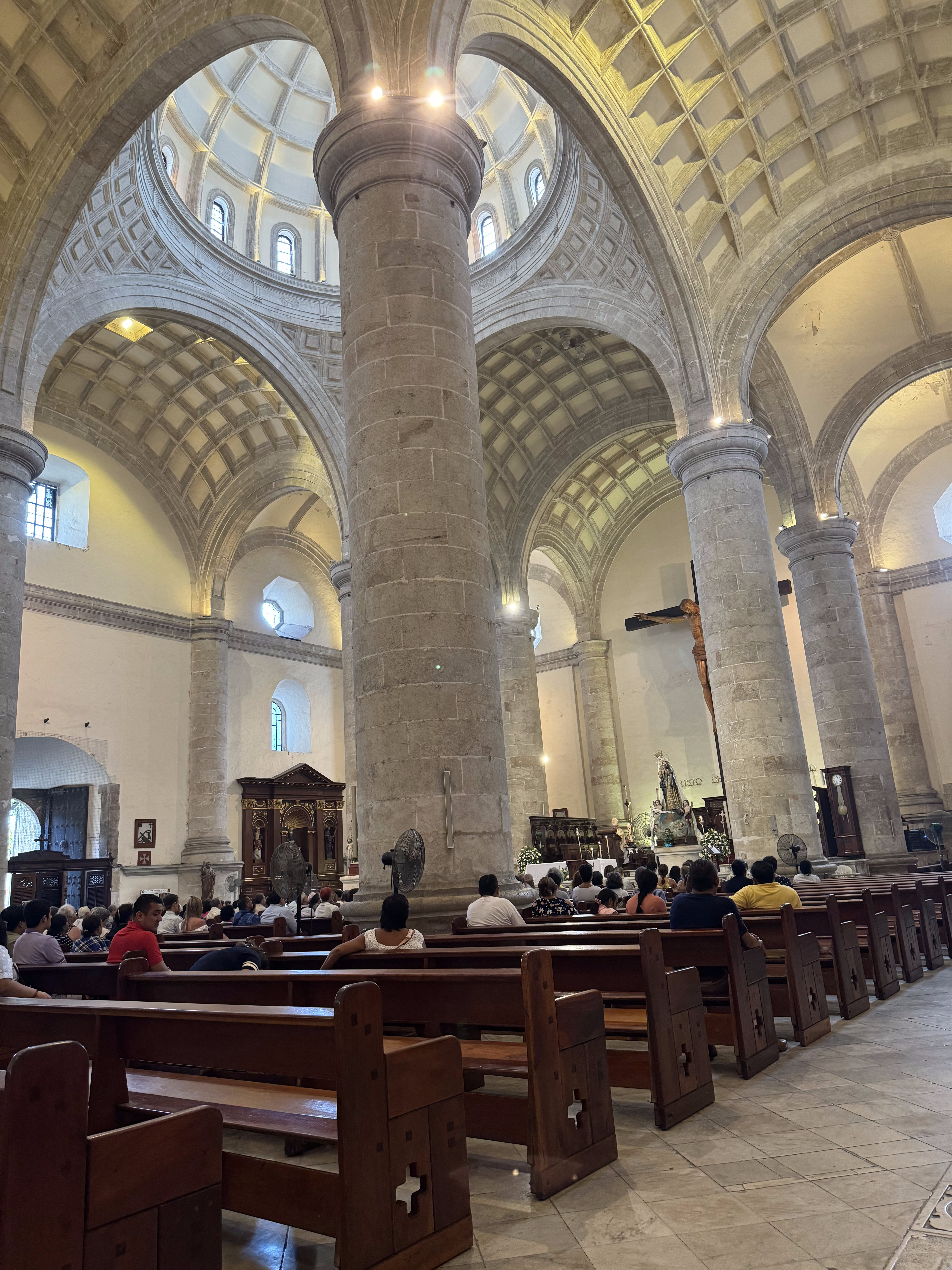
The net vaulting is a bit hallucinogenic.
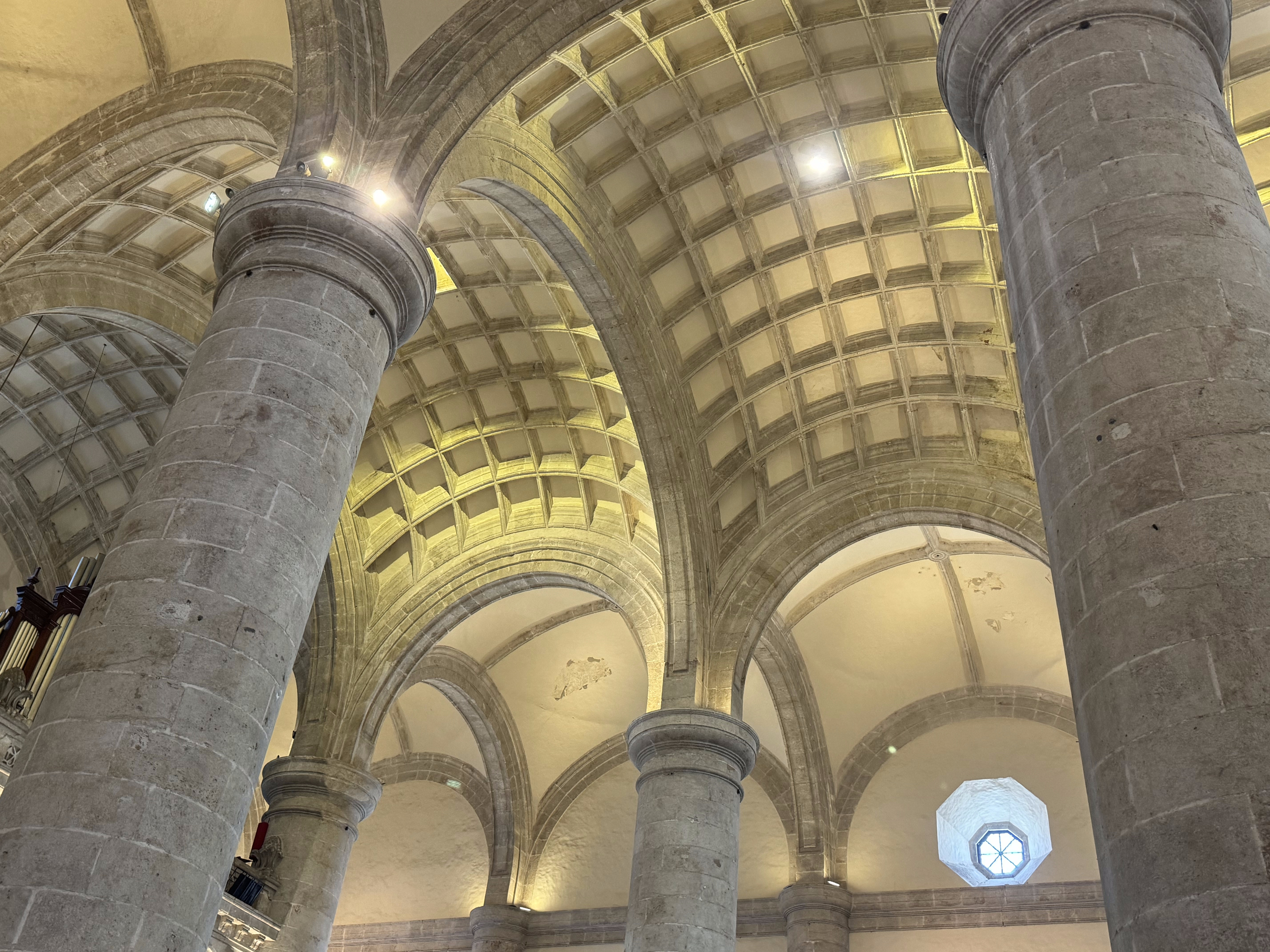
Wish I knew if it was original or a later addition.
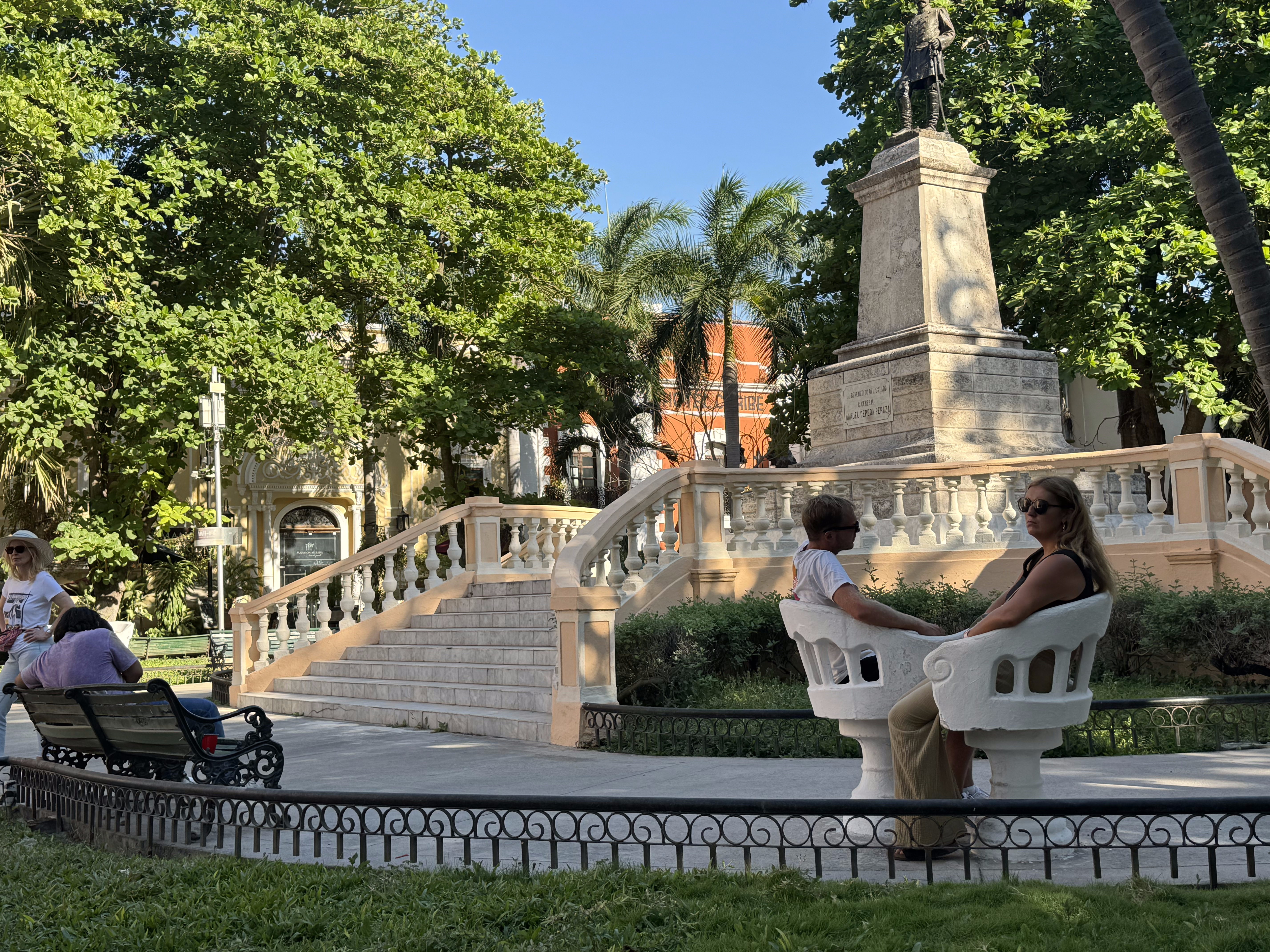
Just outside the church is one of the city's old squares, in this case the Plaza de Hidalgo. The bronze is of General Manuel Cepeda Peraza, a governor of Yucatan who died of tuberculosis in 1869. He was 41. Think people know? Think they care? Monuments aren't what they used to be. Ditto our respect for great men. Why, look how disrespectful this photo is, inadvertently decapitating the general.
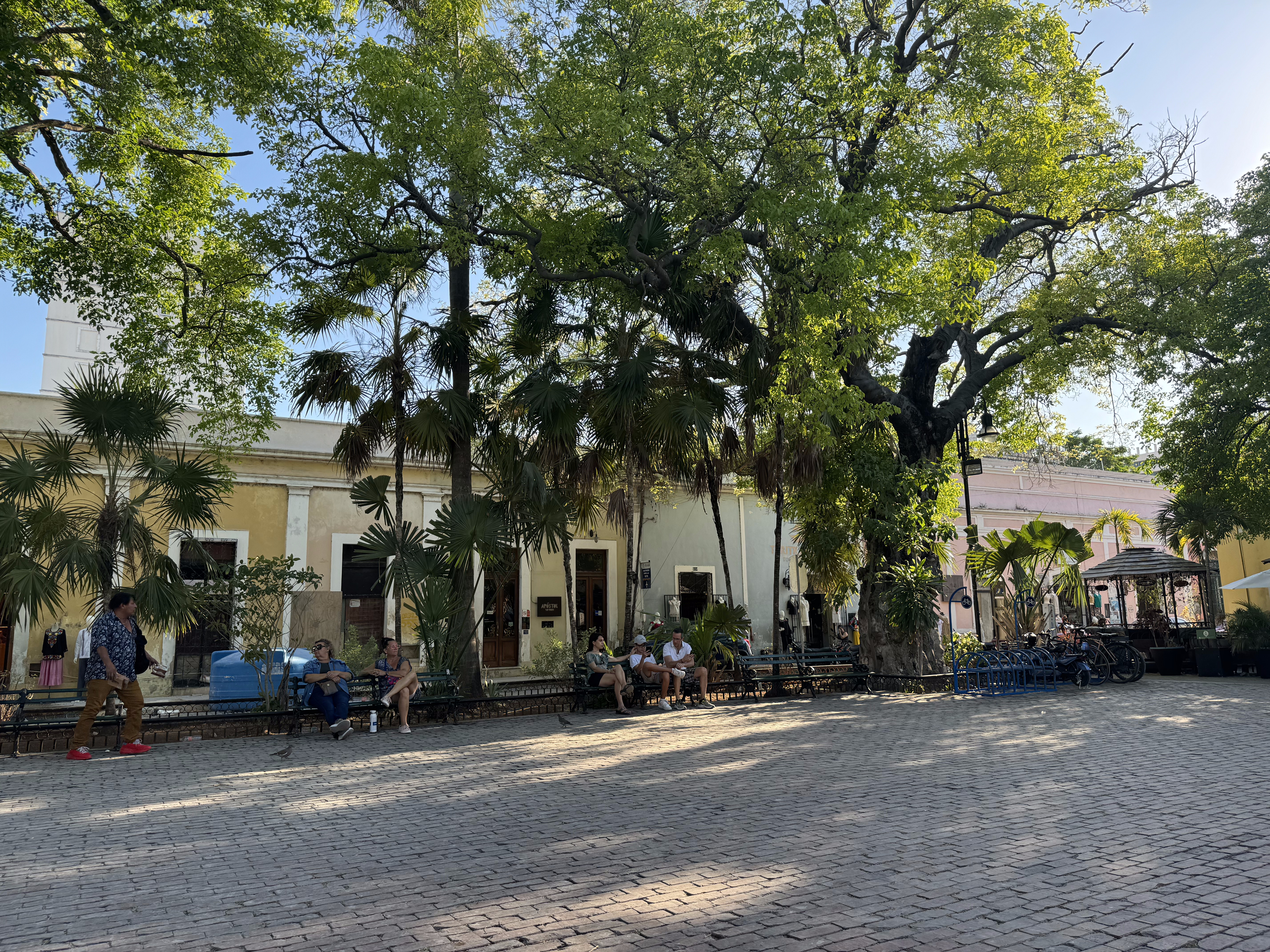
Here's another, the Parque de Santa Lucia.
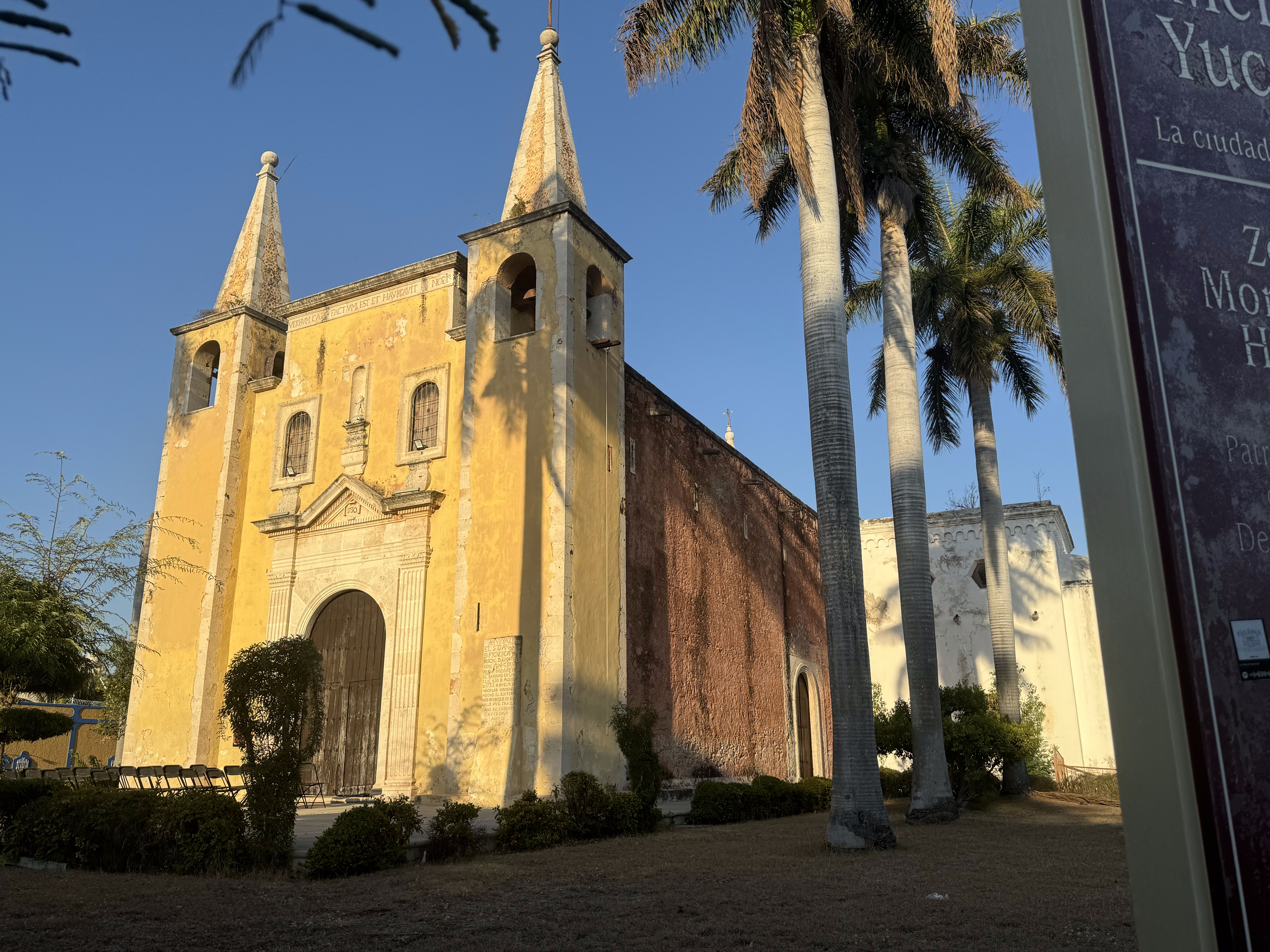
This is the Church of Santa Ana, but I don't want any more churches. Move on.
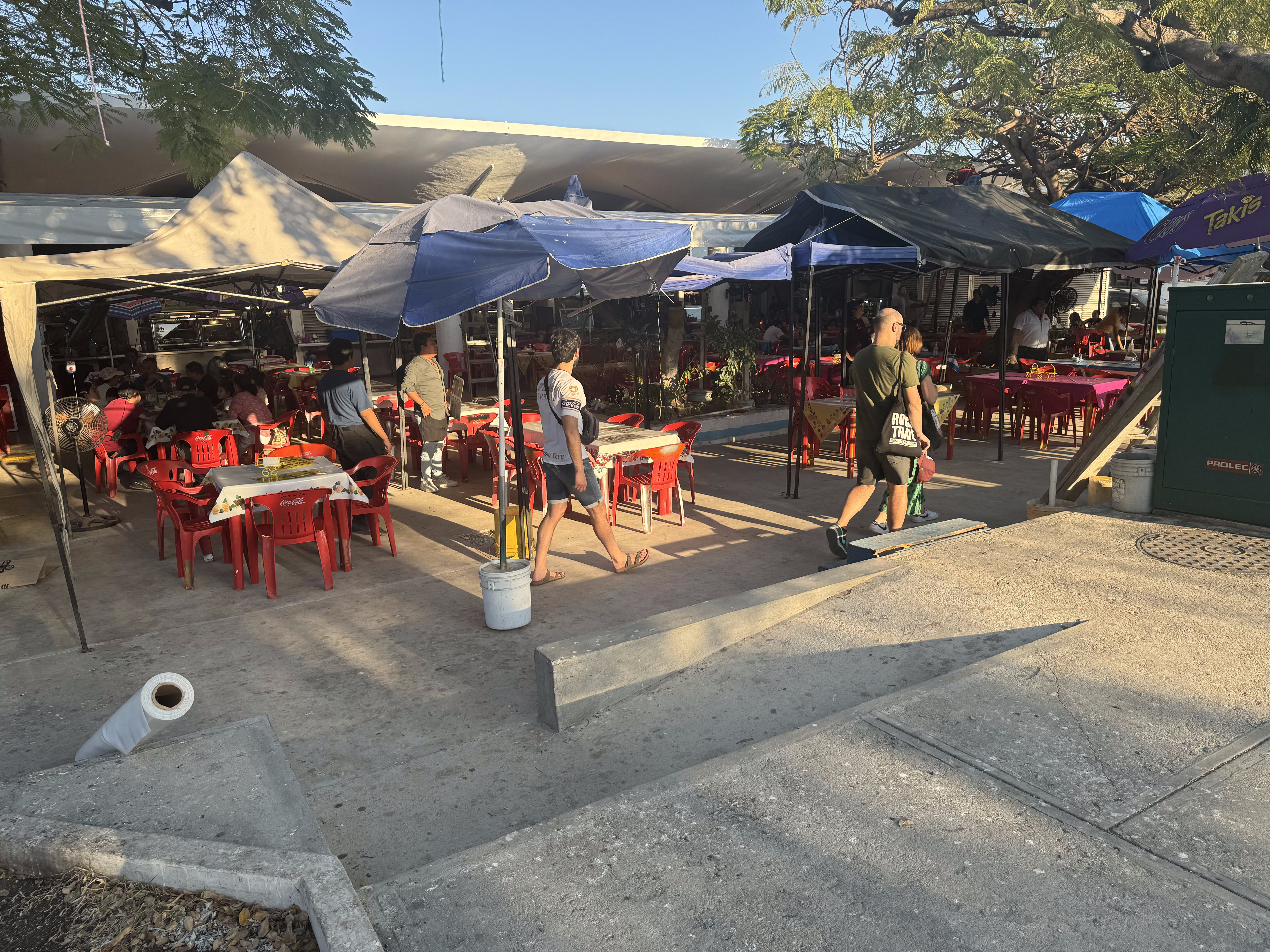
I put it here because next to the adjoining park is a collection of affordable restaurants.
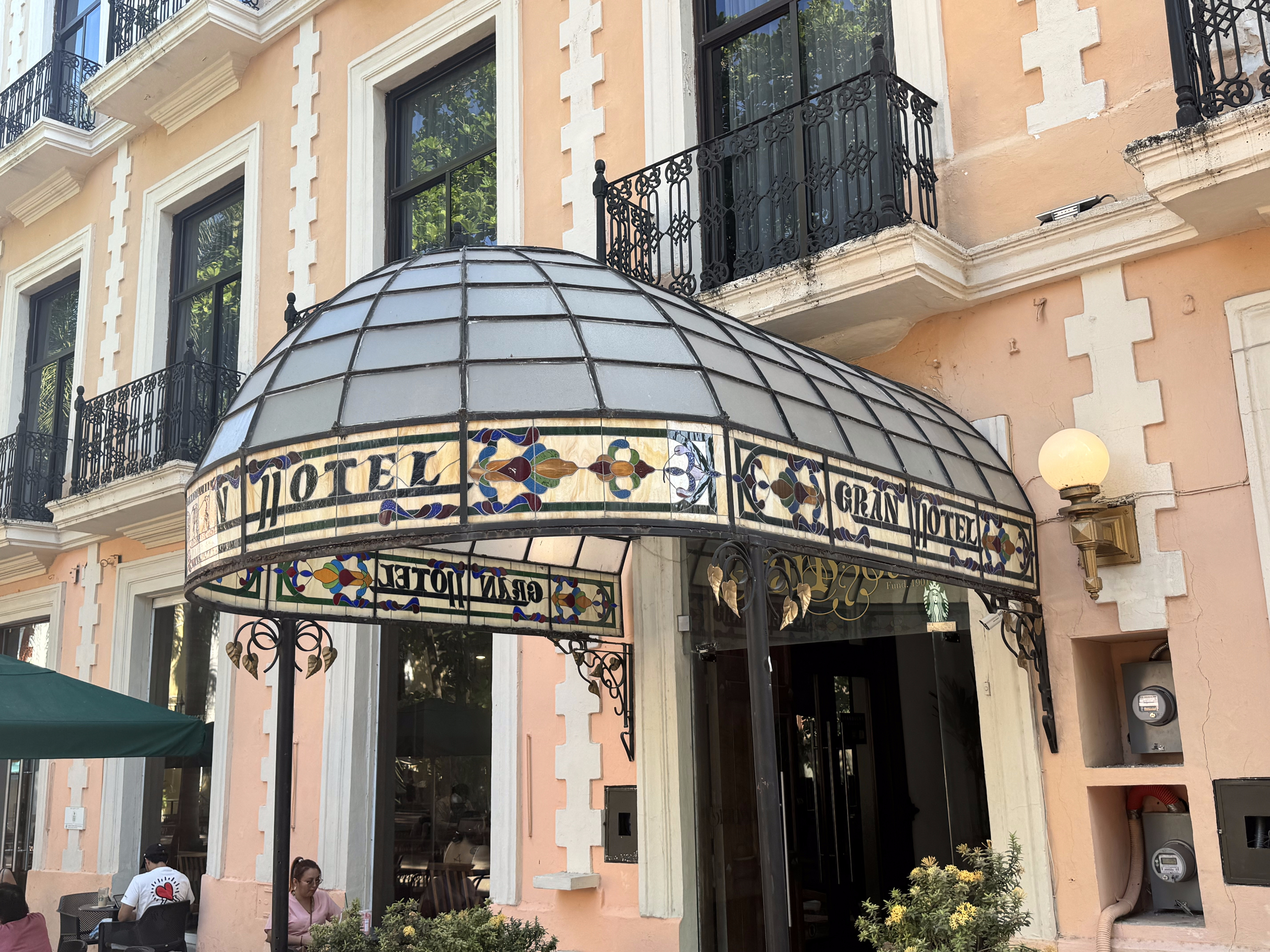
Speaking of tourist requirements, here's the Gran Hotel, which opened in 1901. It was the only hotel listed in the 1909 edition of Terry's Guide to Mexico, which reported room rates beginning at $1.50 per night. It was dropped by the time of the 1944 edition, but it's survived and has a great location if you don't need parking. Cheap, too, which is odd, because look who's moved in there on the left. If you can't make it out, it's Starbucks. Location, location, location, and yes, there was a line.
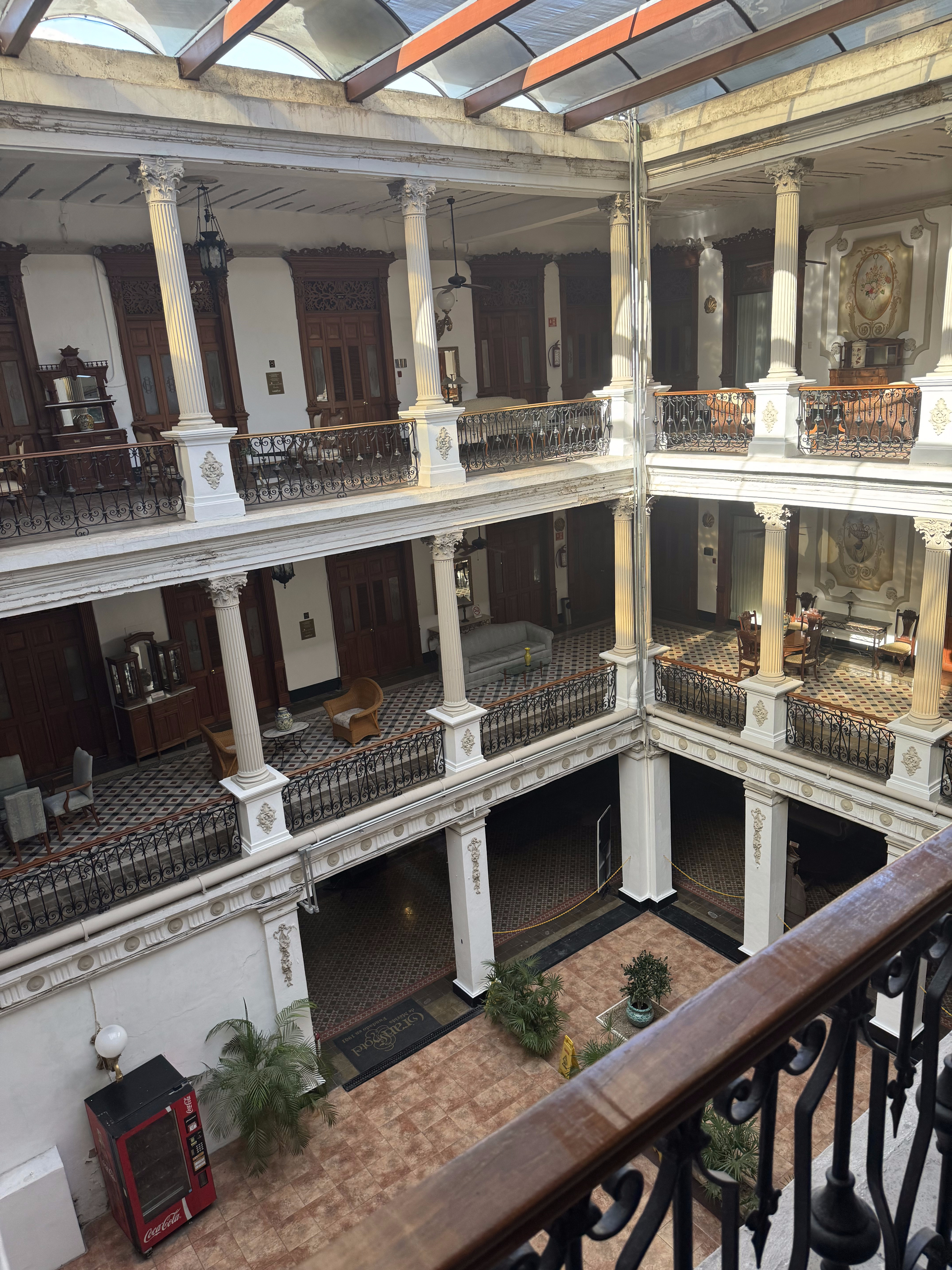
Here's why I said that the hotel is still elegant.
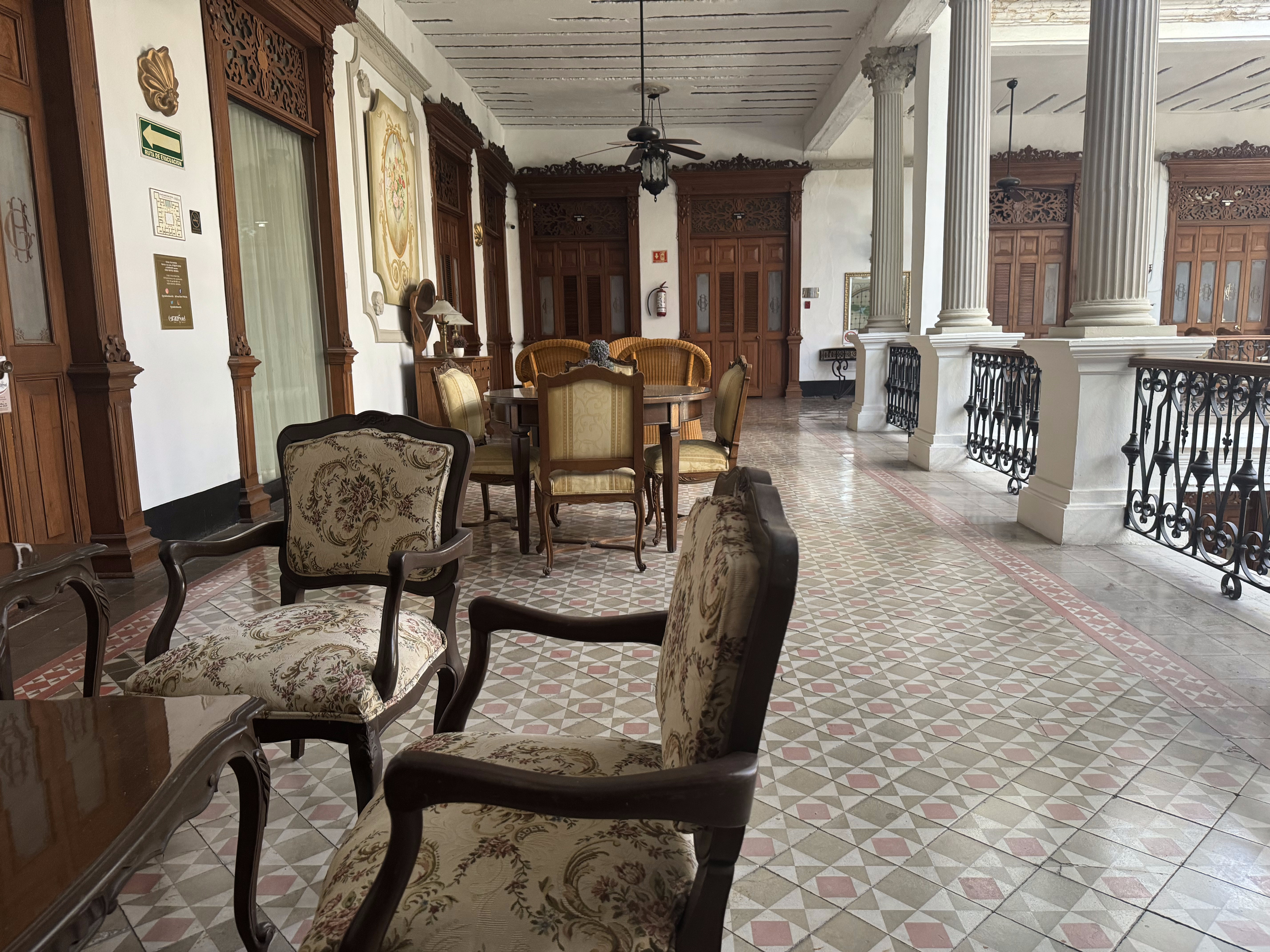
A closer look.
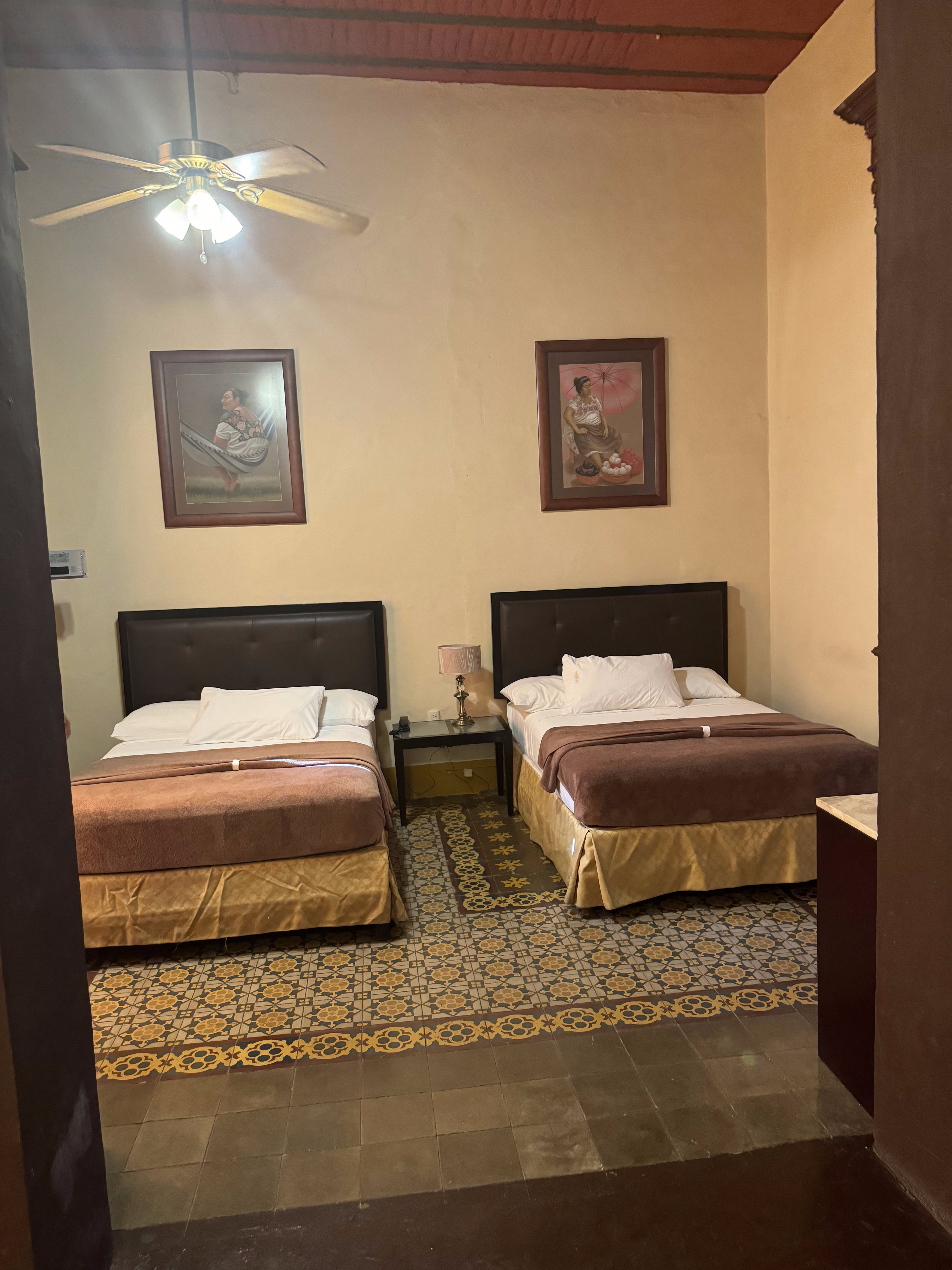
And here's why I said it's not so grand. (Yes, the room had a split-unit A/C.)
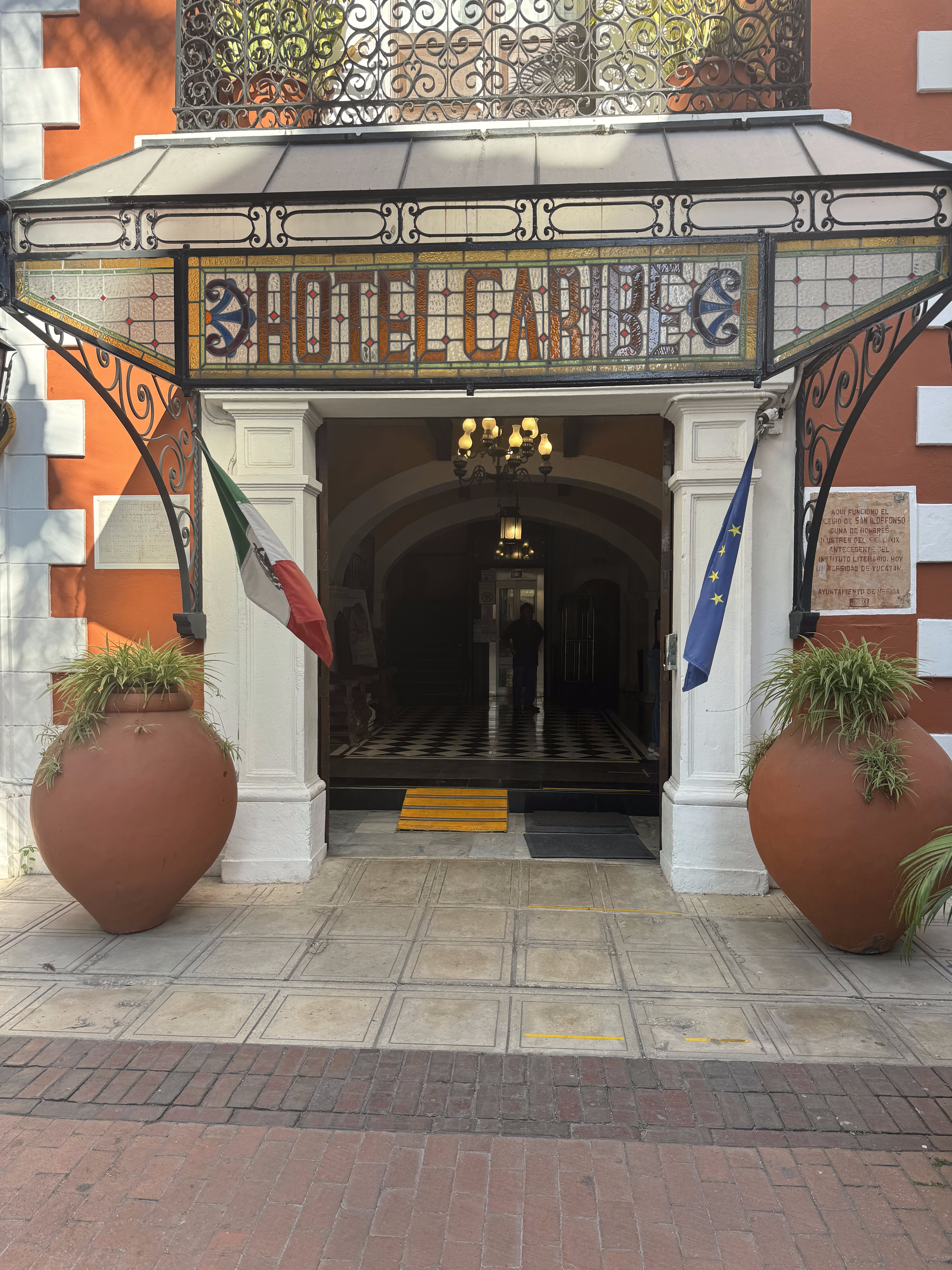
Here's another option.
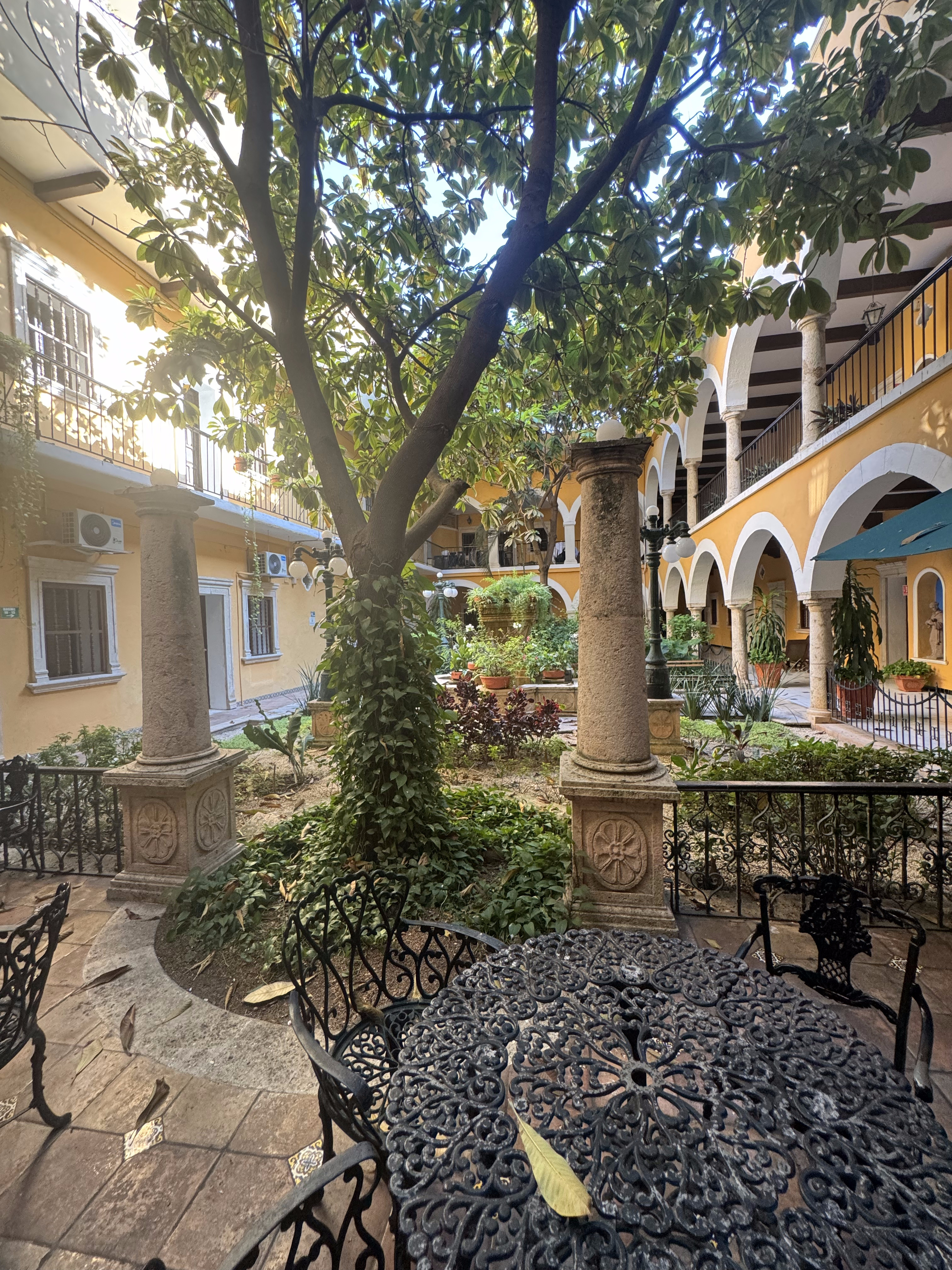
Check the courtyard.
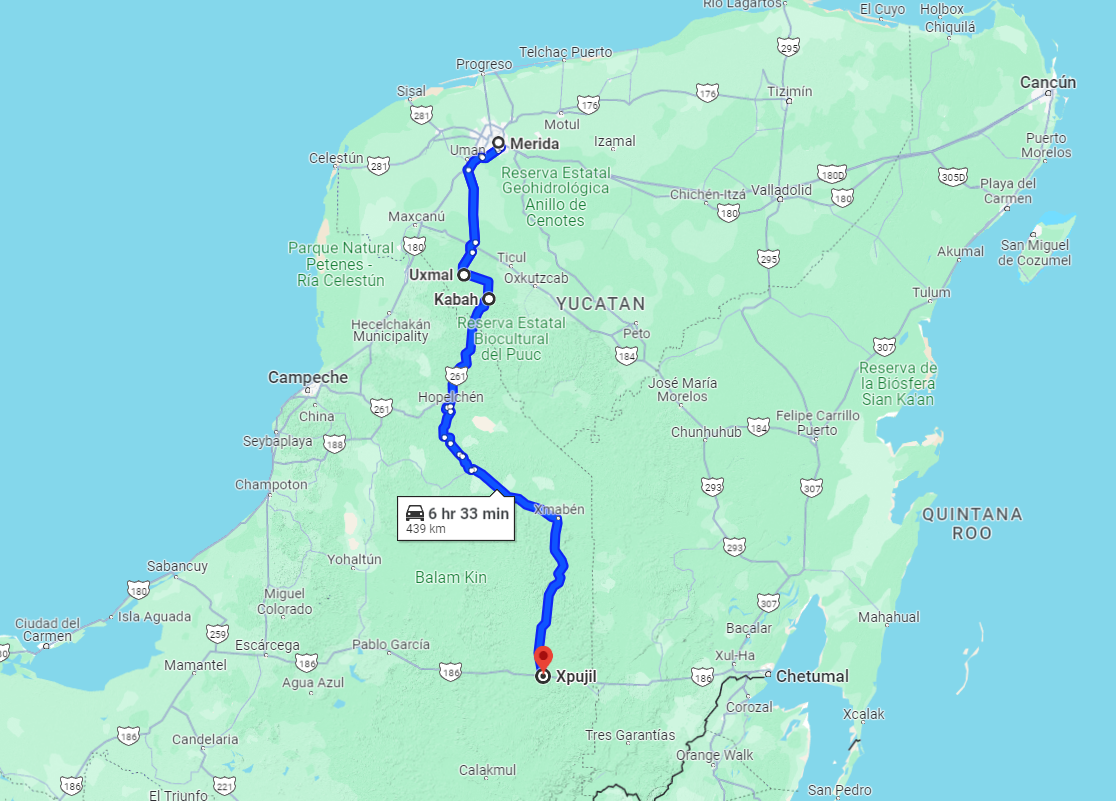
I had flown in Friday night, and I rented a car Sunday afternoon. Early Monday I left for Xpuhil, pronounced Shpu-heel. The goal was some quiet Maya ruins. To put it another way, I had wanted for some years to see something--anything--built by the pre-Conquest Maya, but I excluded Chichen Itza, which has four million visitors annually. Also the other biggies: Uxmal, Palenque, Yaxchilan, Tikal, and Copan. That's the list given by the late Michael Coe as "must-see" sites. "No one who has failed to see all of these can really be said to know the Maya area." (The Maya, 10th ed., 2022, co-authored with Stephen Houston, p. 298.) Well, OK, but you remember what Greta Garbo said.
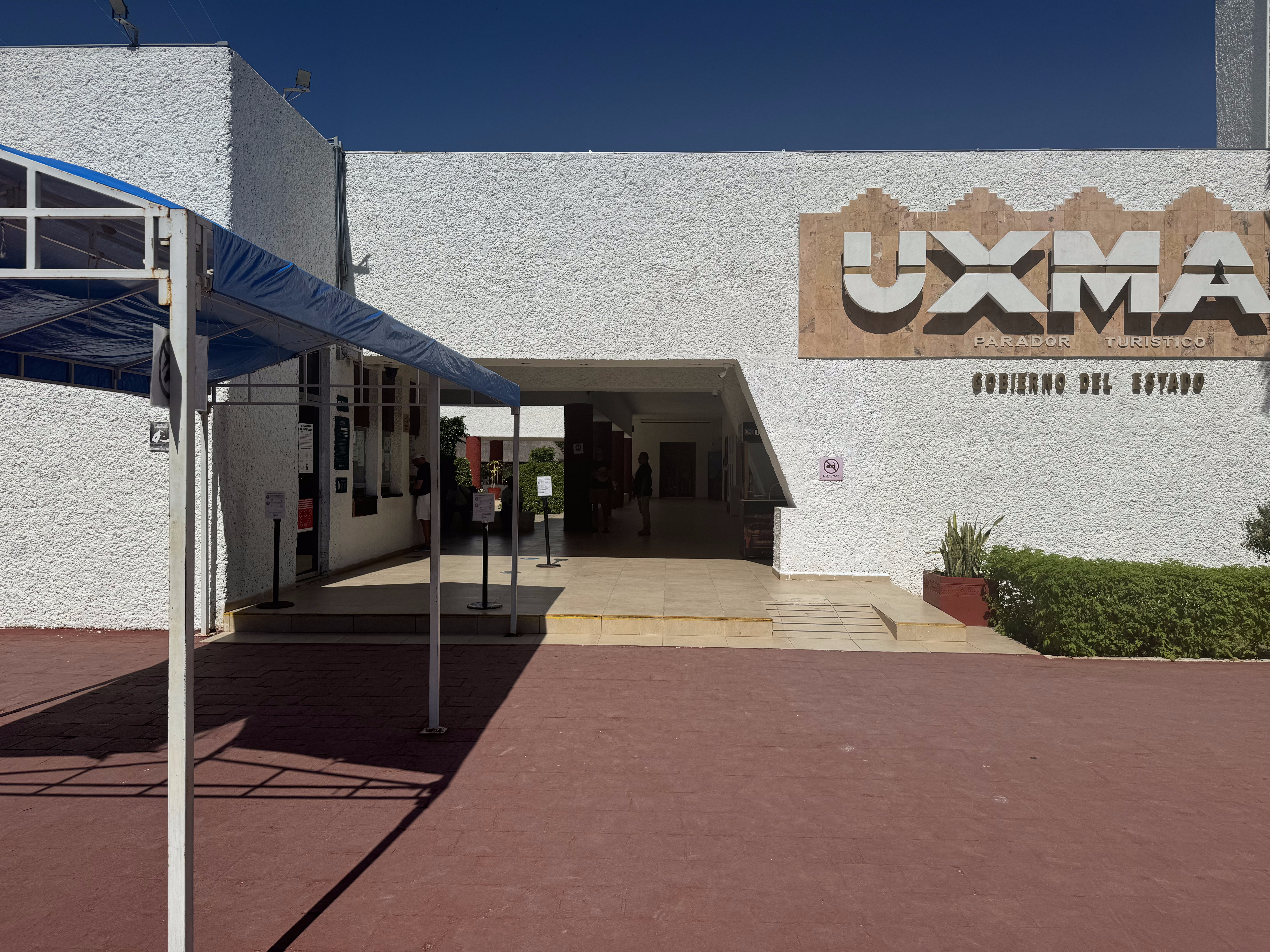
Allergic as I am to crowds, Uxmal is on the way to Xpuhil, and though time was short, short, short, it seemed stupid to just drive by. I wasn't coming back this way.
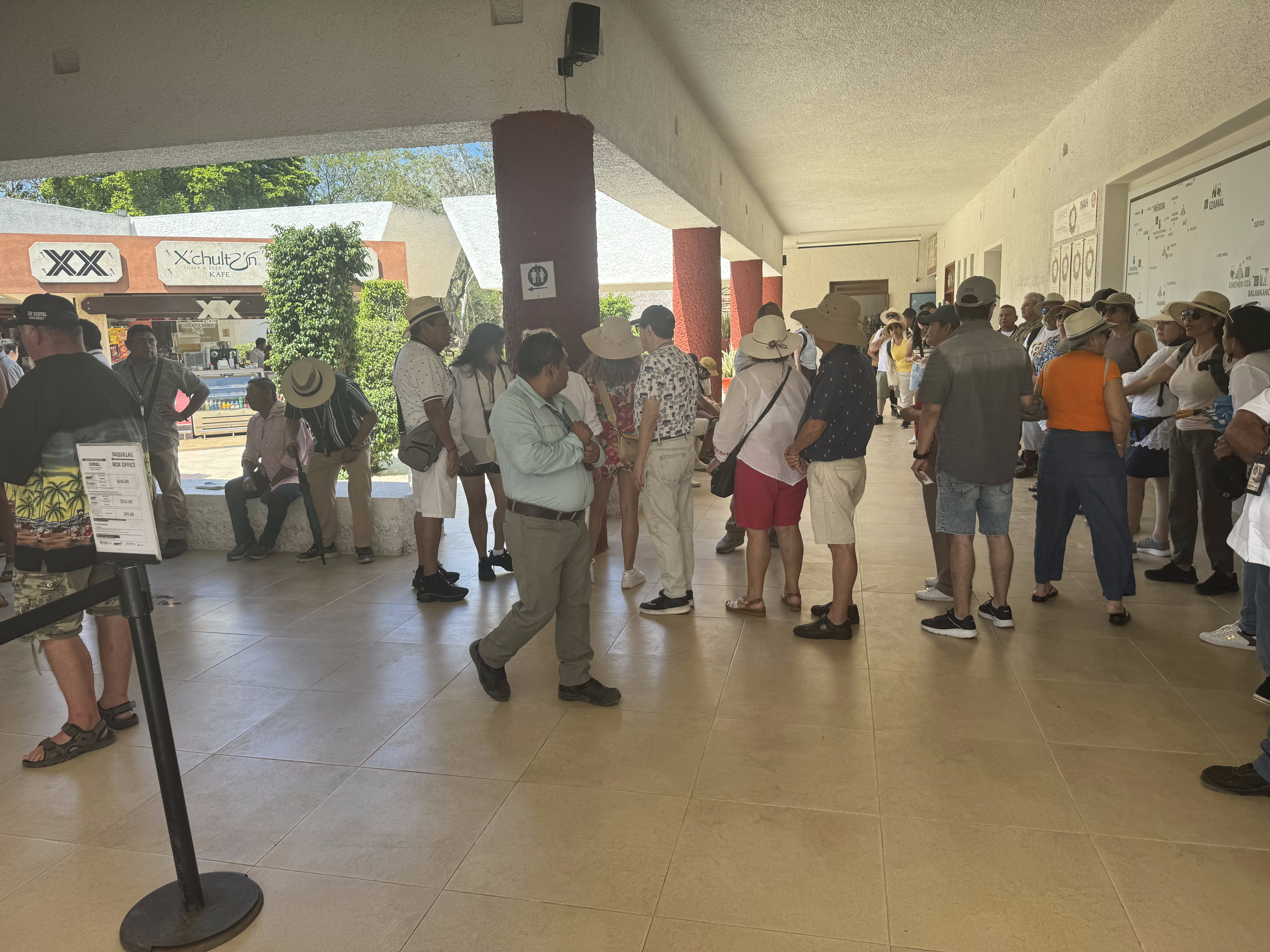
Oh, Lord! Sure, we can blame Boeing, but it's not as though Mexico said "no thanks."
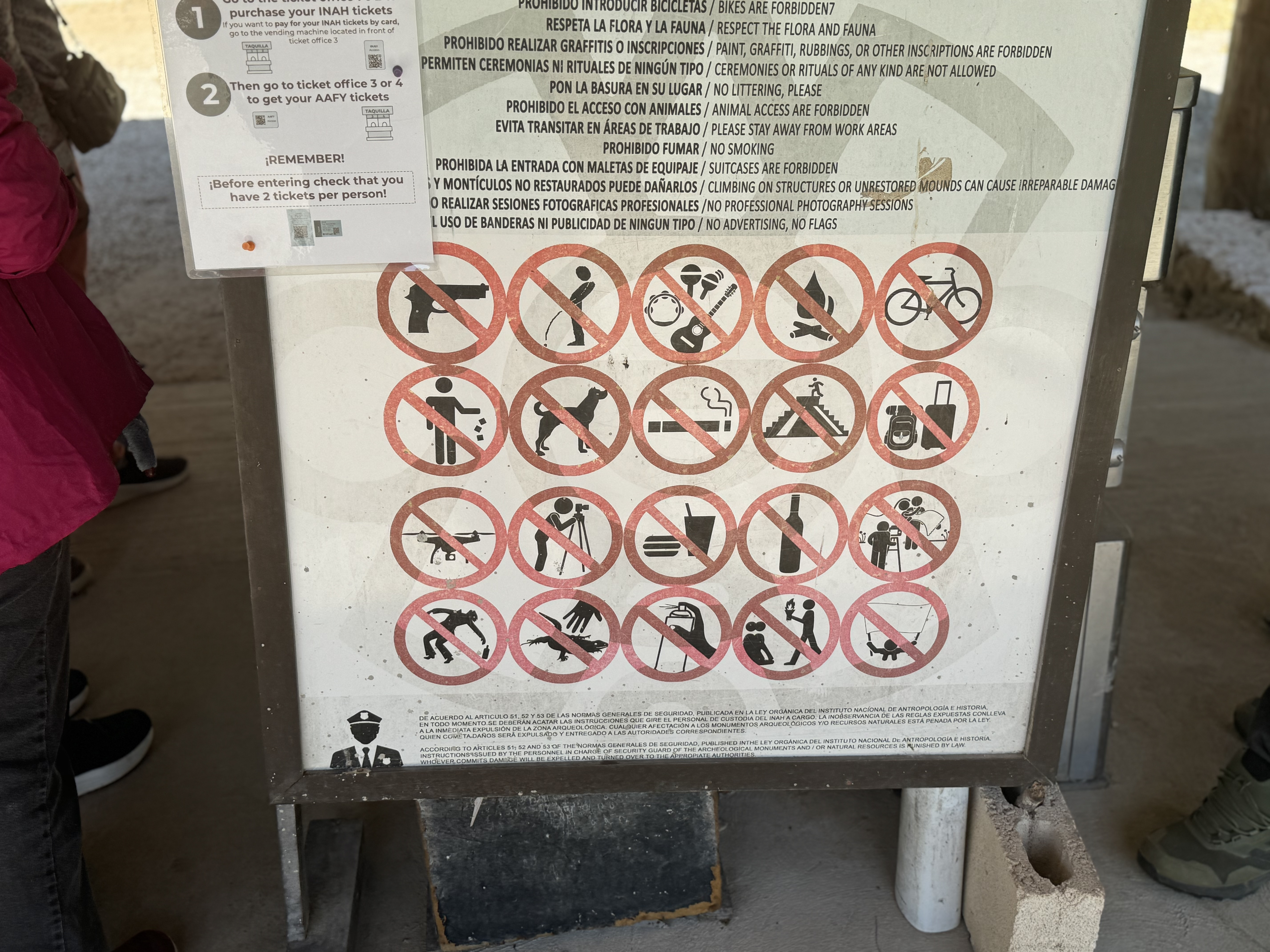
It might be easier if we were told what we can do.
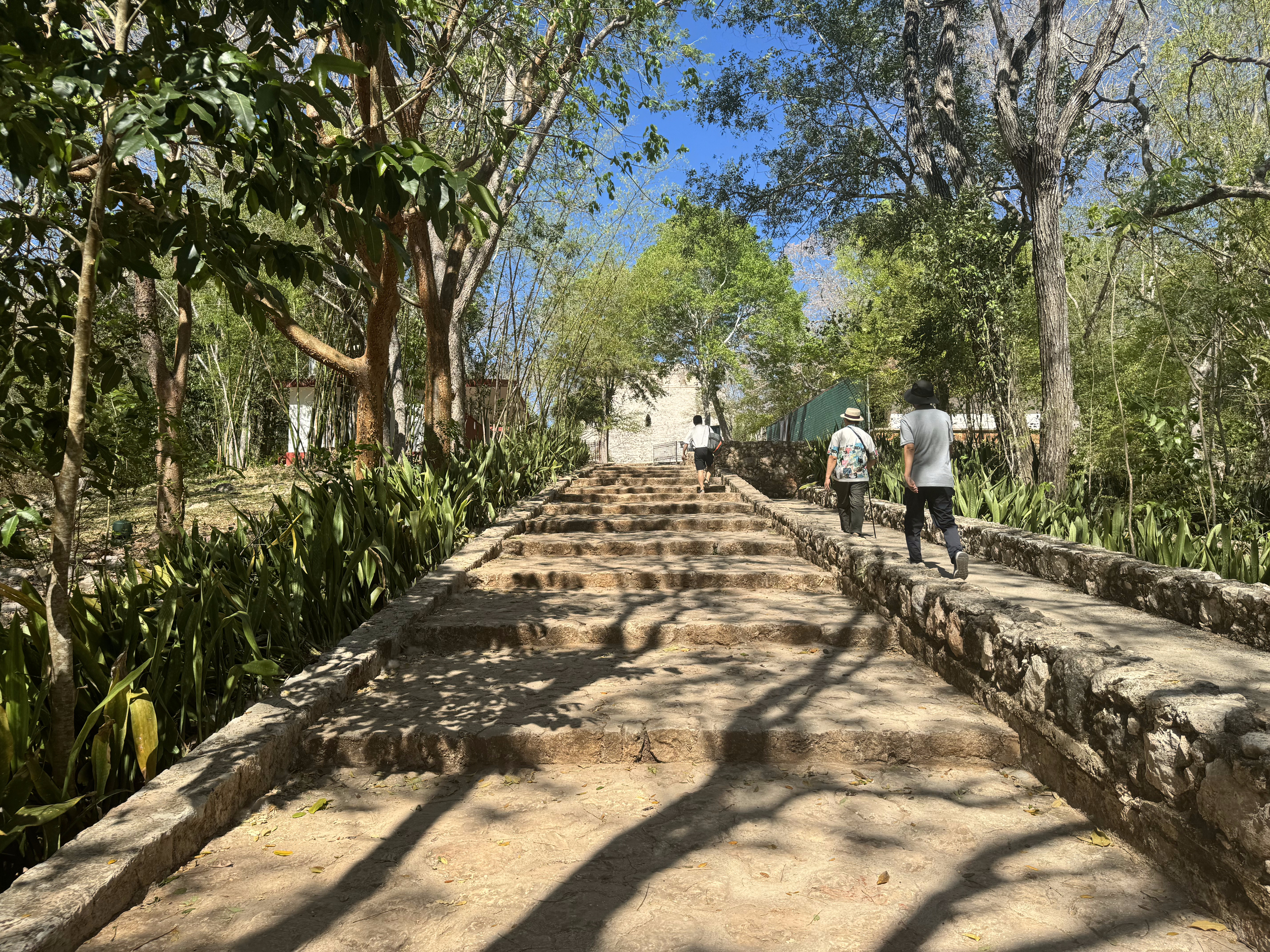
What's that up ahead? You can't tell, but it's hot, which made the hill downright inhospitable.
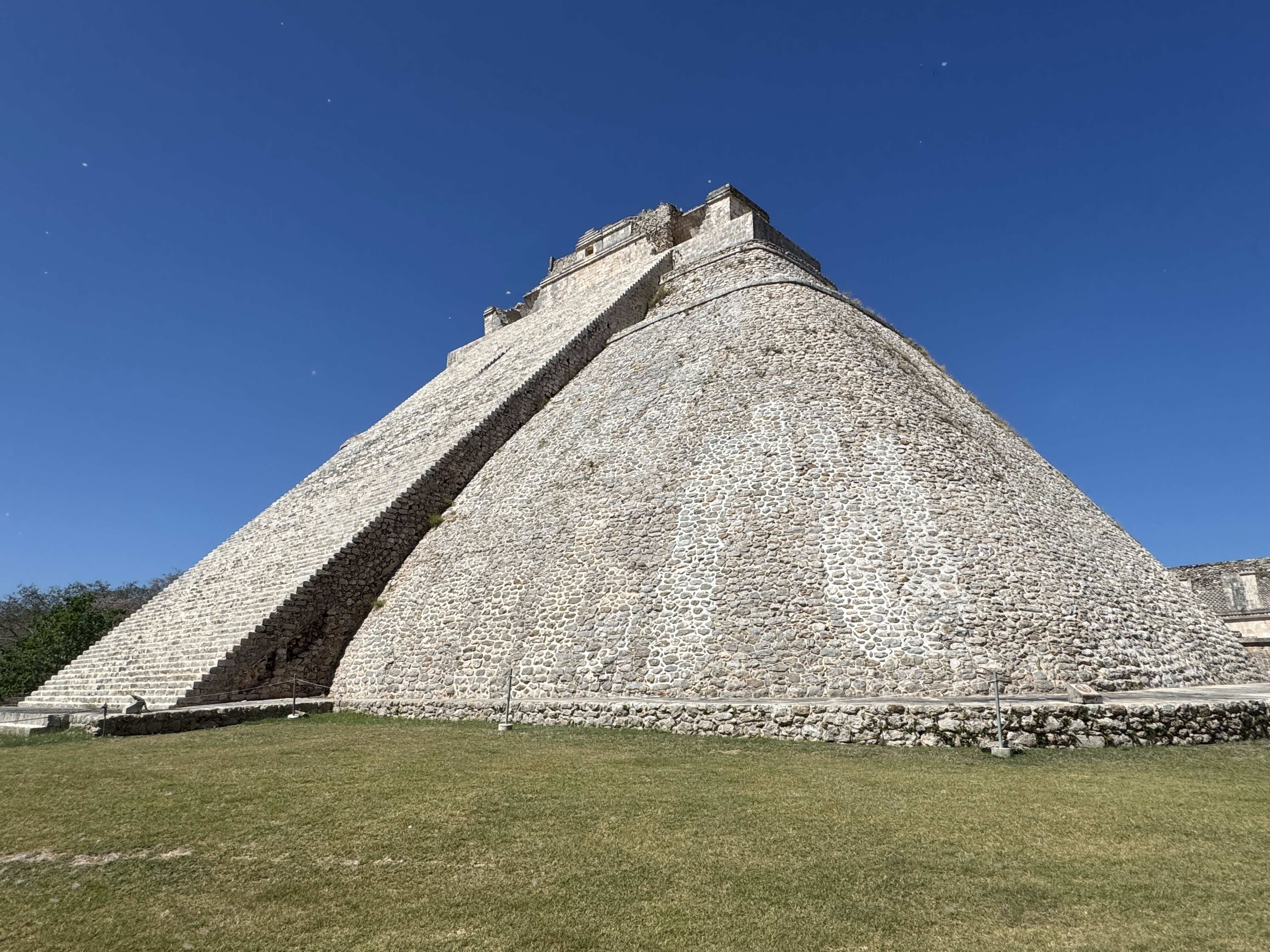
The thing up ahead proved to be the Pyramid of the Magician, or the House of the Dwarf, or El Adivino. All these names are post-Conquest inventions. They're silly but useful, because calling this pyramid "Structure 1" would get very confusing after a half-dozen sites, each with its own Structure 1.
The important question is, how do you react to this thing? Are you wow'ed? Bored? Reminded of Las Vegas?
There's a fourth possibility, which is to be studiously neutral. That's what I was. In retrospect, however, I lean skeptical, chiefly because I know now that the temple up top (you can't see it up close, because climbing is prohibited) was rebuilt in the 1920s., The stairs were rebuilt by the 1940s, and the skin of the pyramid was replaced with newly cut stones in the 1970s. So what are we looking at? The late Mayanist Ian Graham warned of the "disneyfication of archaeological sites in Yucatan." (See his memoir, The Road to Ruins, p. 417.)
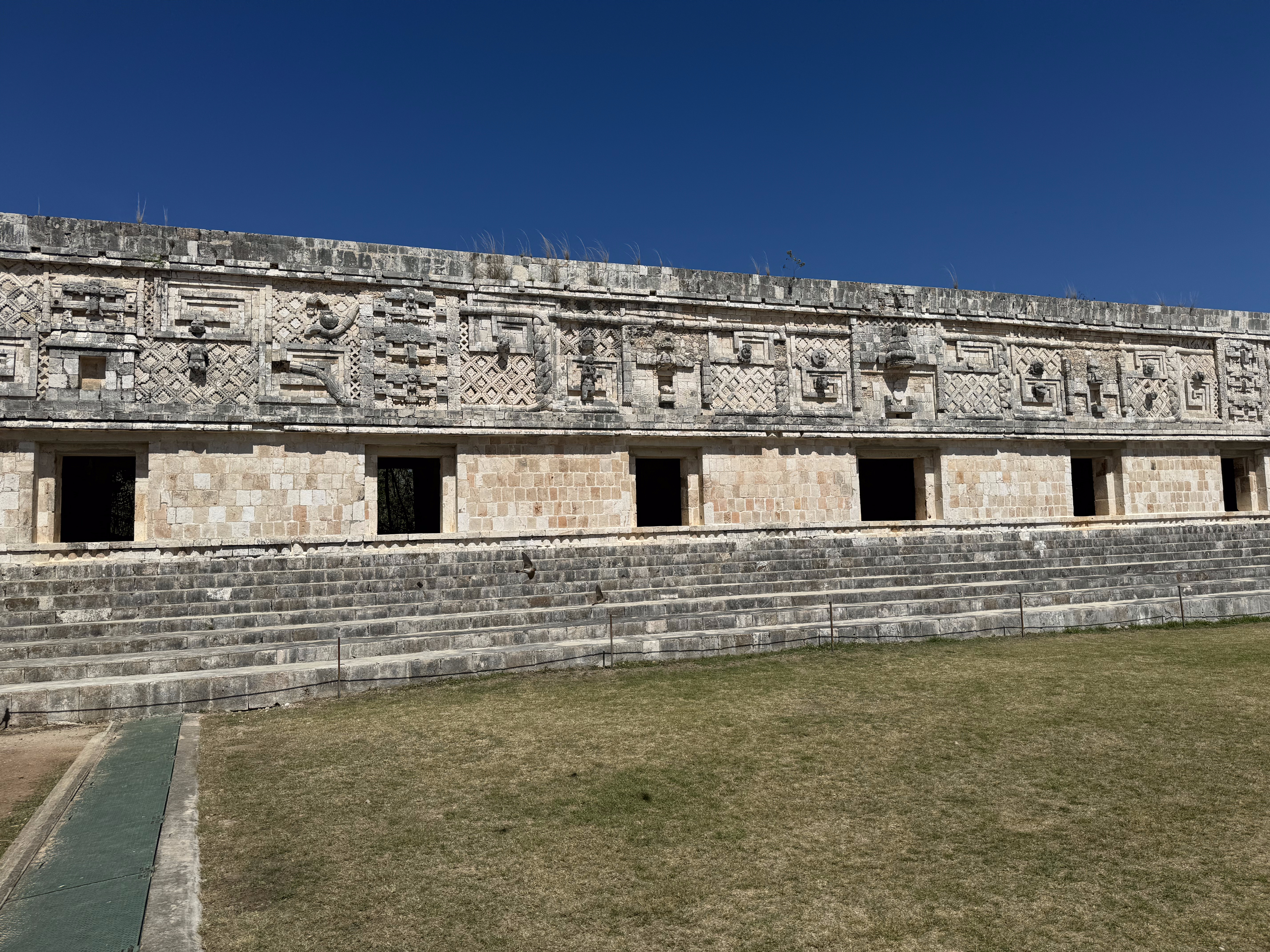
Let me quickly show you four other things I saw. Next to the pyramid is the so-called Nunnery, a name prompted by its resemblance to a cells of a Spanish nunnery. The Nunnery has four buildings arranged in a quadrangle. Here's most of the building on the north side.
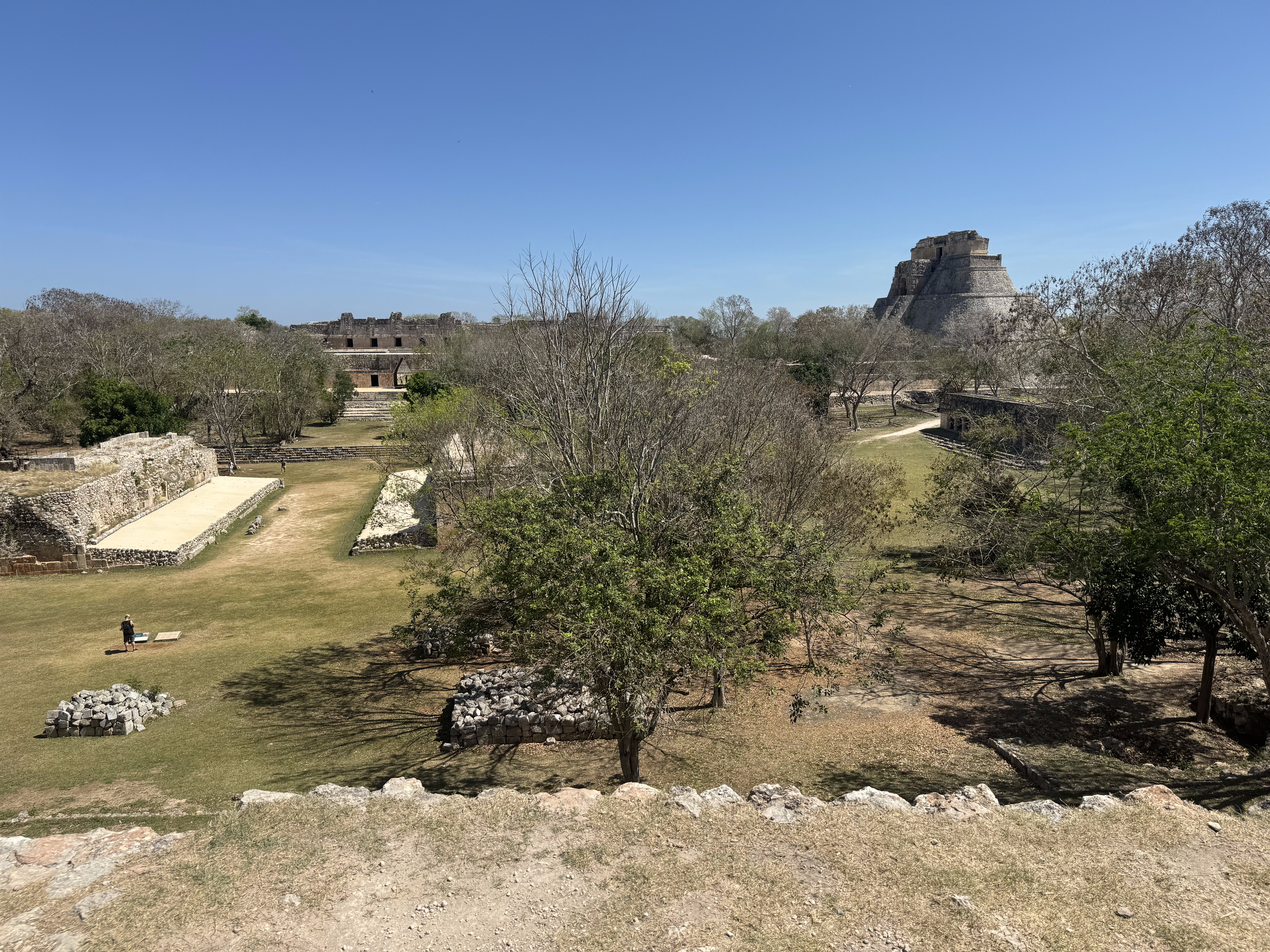
There in the distance is the same pyramid and, to its left, the nunnery. You can see both the west and, behind it, the east building of the quadrangle. The low building beneath the pyramid does not appear on early maps of the site and has been entirely rebuilt in recent years from a mound of stones. And the whitish platforms at the center-left?
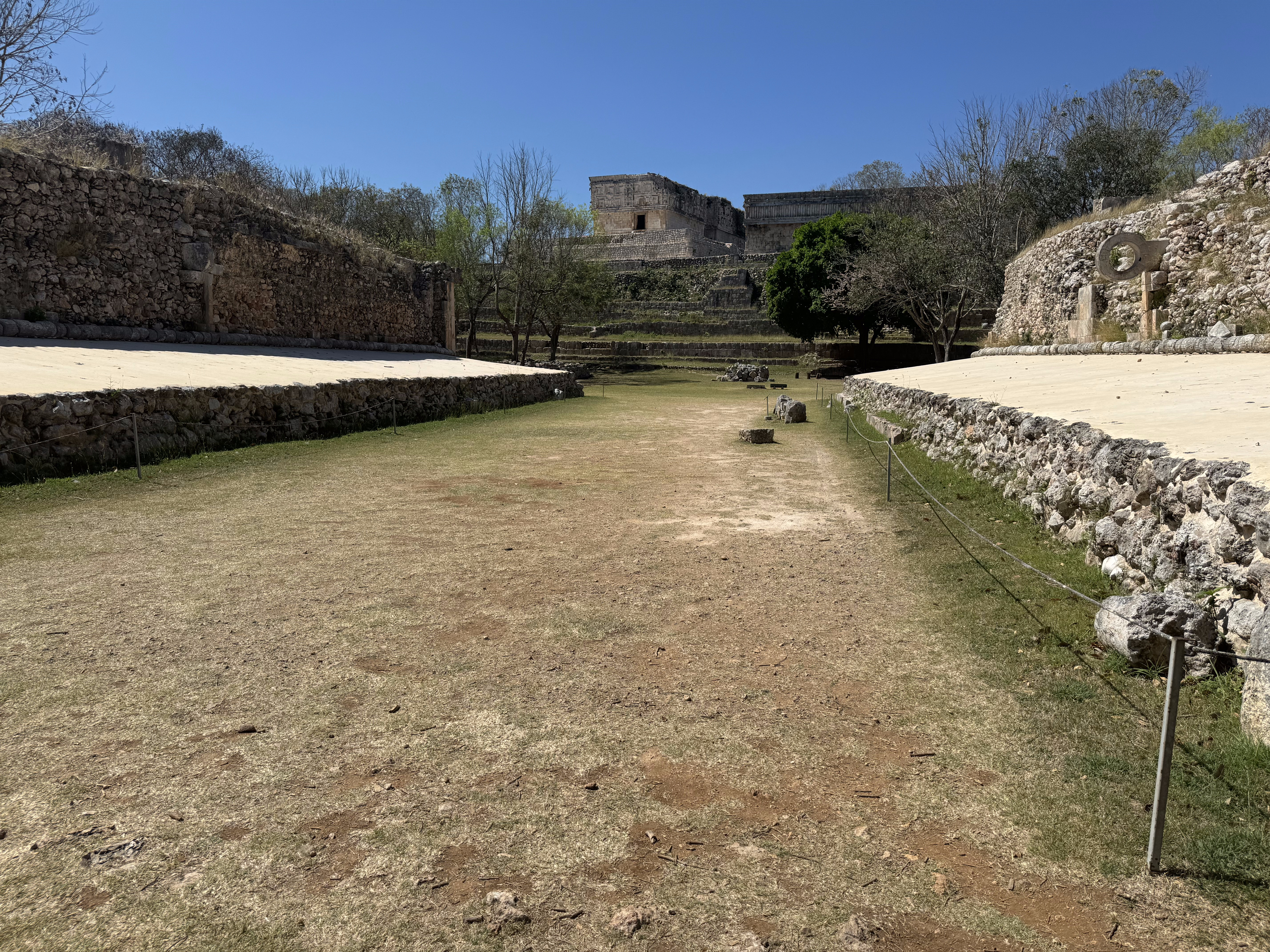
It's a rebuilt ball court. See that doughnut stuck on the wall to the right?
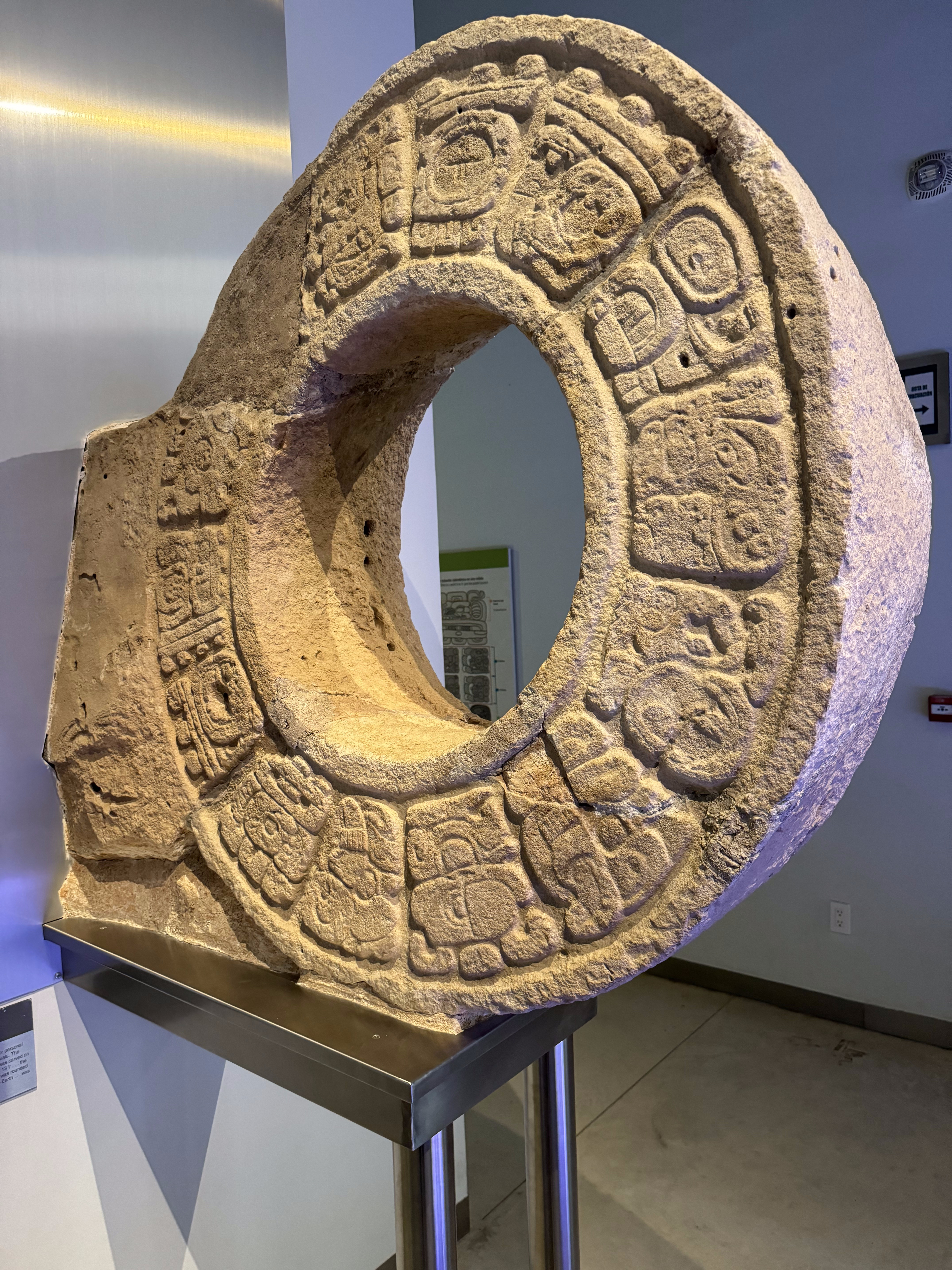
It's a replica of one that looked like this. (This one was displayed at the Mayan World Museum of Merida.) Now you're going to ask why a ball court (and the equivalent of a basketball hoop) should be located in the center of a city. The answer is that the "ball court was a central place in most Maya cities and represented the threshold between this world and the underworld." (Robert J. Sharer with Loa P. Traxler, The Ancient Maya, 2006, p. 730.)
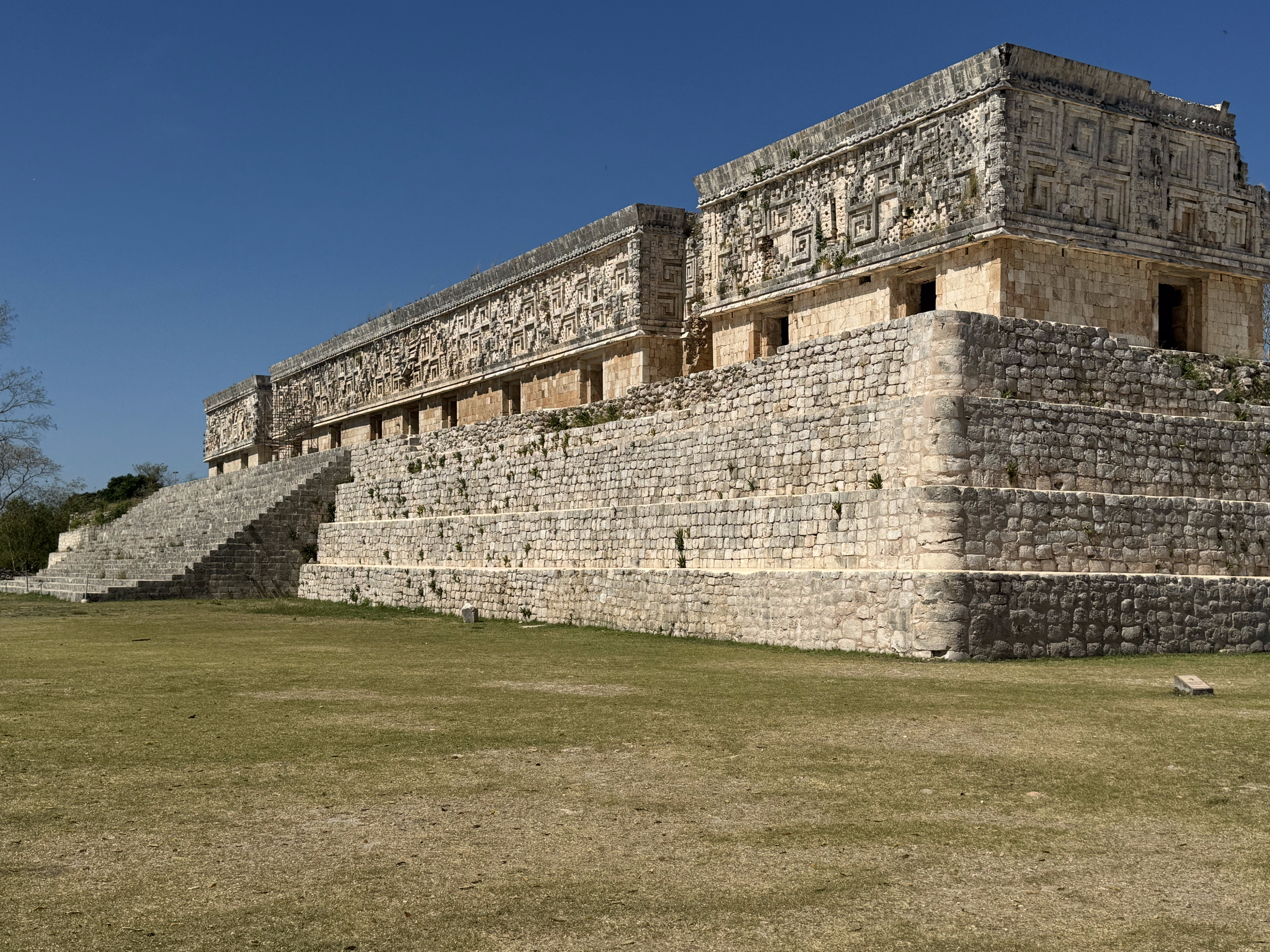
I was standing about here when I took the photo with the pyramid in the distance. Now I've turned to face this, the Governor's House, a name that is actually plausible. Sylvanus Morley (1883-1948), a leading Mayanist of his time, wrote that this building "is, in my opinion, the most magnificent, the most spectacular single building ever erected in the Americas in pre-Columbian times" (The Ancient Maya, 1st edition, 1946, p. 330-1).
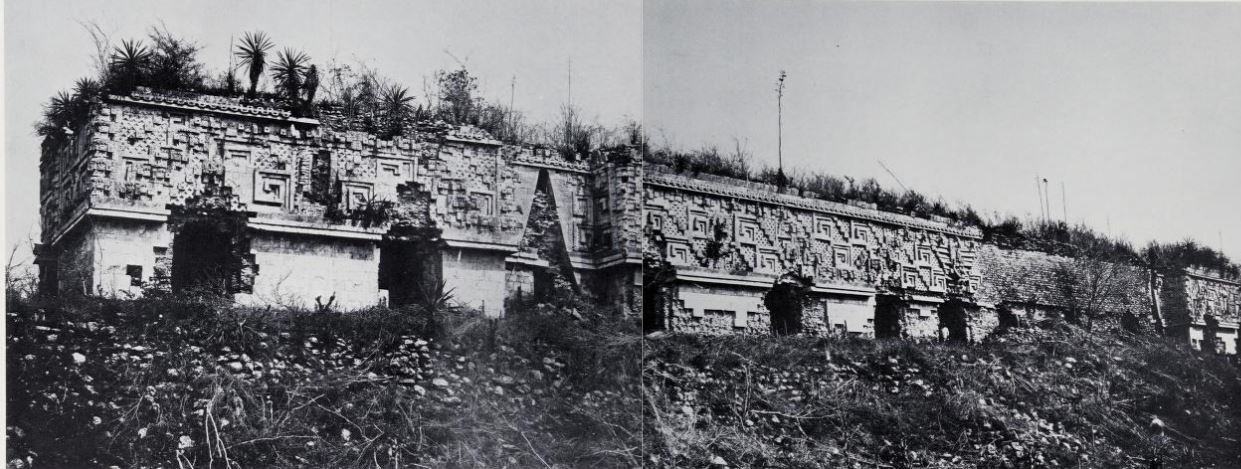
I don't disagree with that assessment, but visitors imagine that they're looking at a building over a thousand years old. They are in a way, and they aren't, in a way. Here's the building as it appeared in 1860. (Keith F. Davis, D sir Charnay, Expeditionary Photographer, 1981, pp. 64-5.)
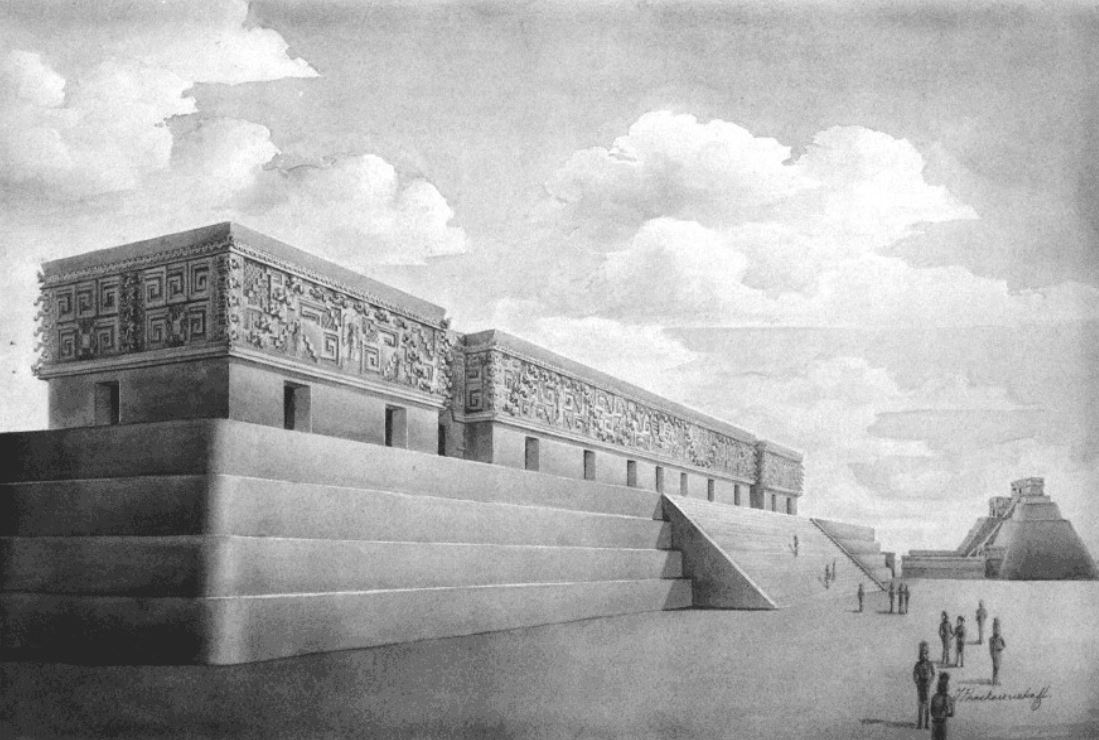
Here's the building that archaeologists set out to restore. Is it an improvement over the building photographed in 1860? (The drawing is by Tatania Proskouriakoff and appears in her An Album of Maya Architecture (1946, 1963 ed. p. 77).
For the gory details of the building's renewal, see the appendix to Jeff Karl Kowalski, The House of the Governor, 1987.
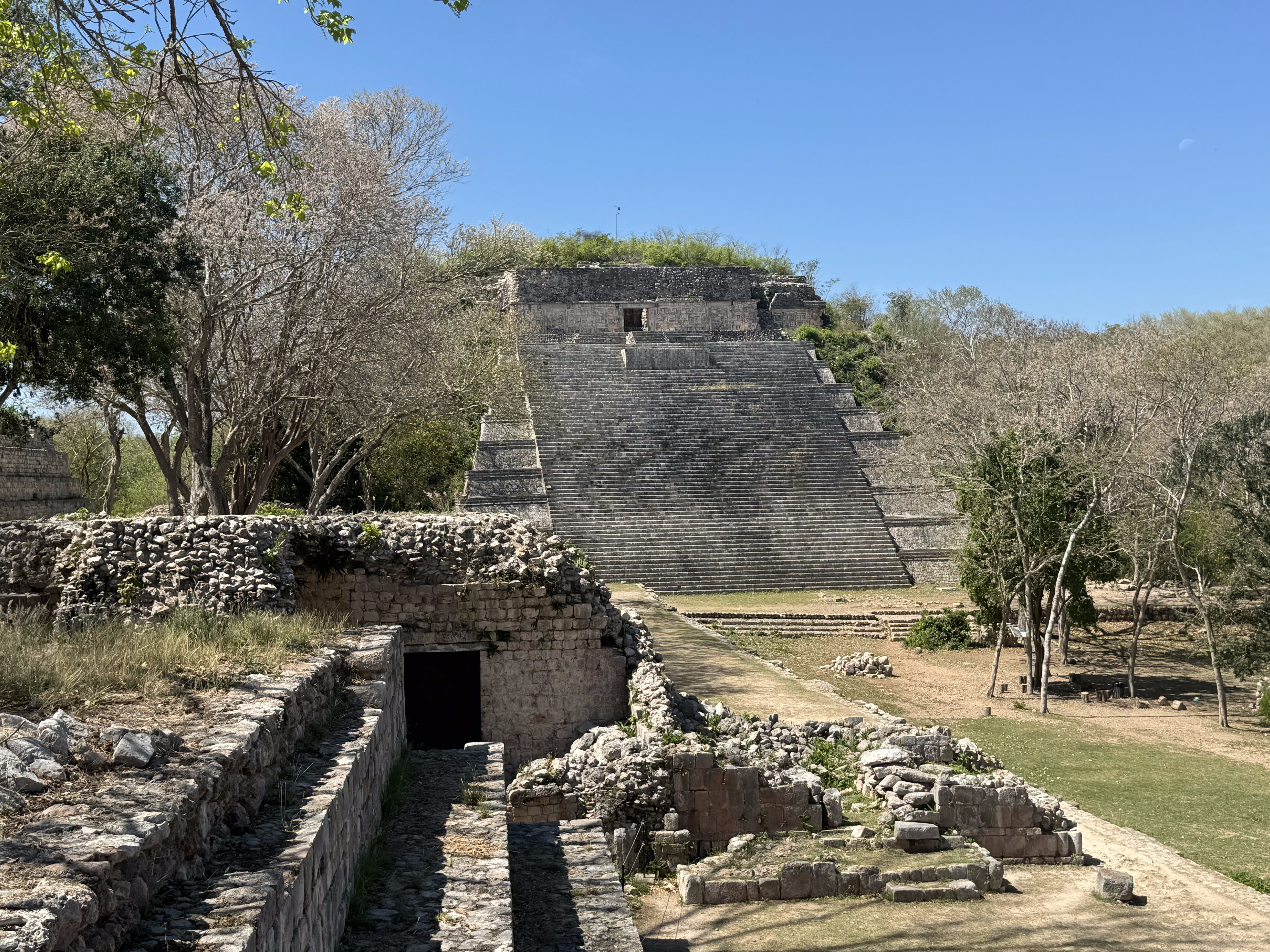
And here, the last thing I saw, is the so-called Great Pyramid. Great in the sense of big, not in the sense of beautiful. John L. Stephens and Frederick Catherwood, who worked here about 1840 and who made a close and pioneering study of Uxmal, make no mention of this pyramid. Why? Probably because they didn't see it. "It is almost completely covered by rubble, and only preliminary excavations have been made so far." That's Alberto Ruz, writing in the 1960s. See his Uxmal, the official guide published by the National Institute of Anthropology and History (4th ed., 1967, p. 38).
The stairway, in other words, is a 20th century creation. It was built under the direction of another prominent archaeologist, C sar S enz (1916-1998). It's a good thing I didn't know this when I came by: I would have asked for my money back. Instead, panting and sweating, I heard a couple chatting perhaps 15 feet away. I couldn't make out the language, but being occasionally garrulous, I asked, "Is that German I hear?" The woman smiled and said, "No, we're Dutch." I know that the Dutch don't appreciate this mistake, so I grovelled. She was easily appeased Then she said, "Isn't it lovely?" If I had known then what I know now, I'd have said, "No, it's a fake." Instead, I said, "Impressive, yes, lovely, no. Lovely implies love."
She conceded immediately and even said, "Yes, of course, this was a place of slavery." Oh, good. It's time for priests ripping beating hearts from bodies rolled down bloody steps. The Spanish told us about this, and some of them learned about it the hard way. But scholars can be such killjoys. Yes, they say, human sacrifices happened, but not nearly as often as the conquistadors said. (See David Carrasco's "The Exaggerations of Human Sacrifice," included in his edition of the The History of the Conquest of New Spain by Bernal D az del Castillo (2008).
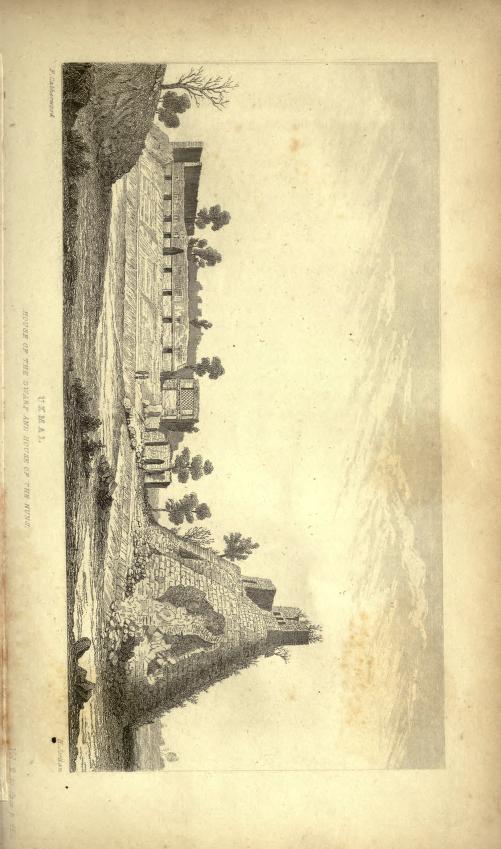
We see what we want to see. What we are told to see. What we expect to see. In short, we see with our ears. Consider Frederick Catherwood's drawing of the Nunnery and the Pyramid of the Magician. Catherwood was meticulous, drawing with the aid of a camera lucida. I do wonder, however, about the lack of vegetation. Stephens wrote that the forest had recently been cleared, not to help people appreciate the ruins but to grow corn. Apparently, Catherwood ignored the corn. Those things simply weren't of interest. (The drawing appears in Stephens' Incidents of Travel in Central America, Chiapas, and Yucatan (New York, 1841, facing p. 420) where it is identifed as "the House of the the Dwarf." It also appears in Catherwood's own Views of Ancient Monuments in Central America, Chiapas and Yucatan, New York, 1844.)
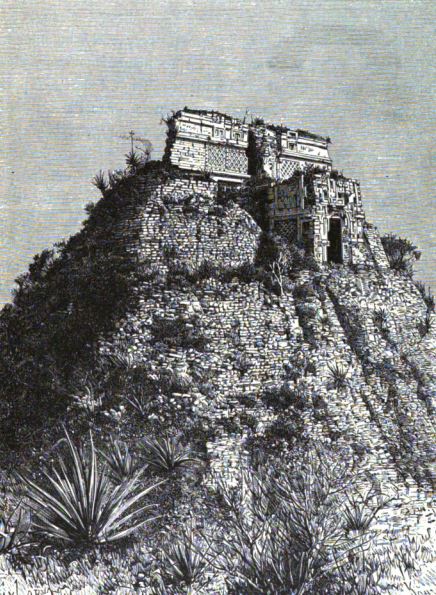
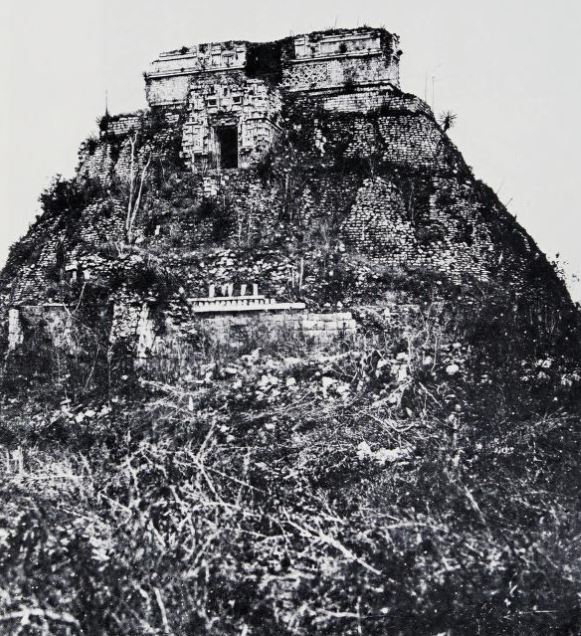
Fifty years later, D sir Charnay published this engraving (on the left) of a photograph of the same pyramid. Unless you look closely, it seems to show a steep but natural hill. (The Ancient Cities of the New World, 1887, p. 403.)
The image on the right is Charnay's actual photograph, which suggests that the engraver took some liberties. (Keith F. Davis, D sir Charnay: Expeditionary Photographer, 1981, p. 58).
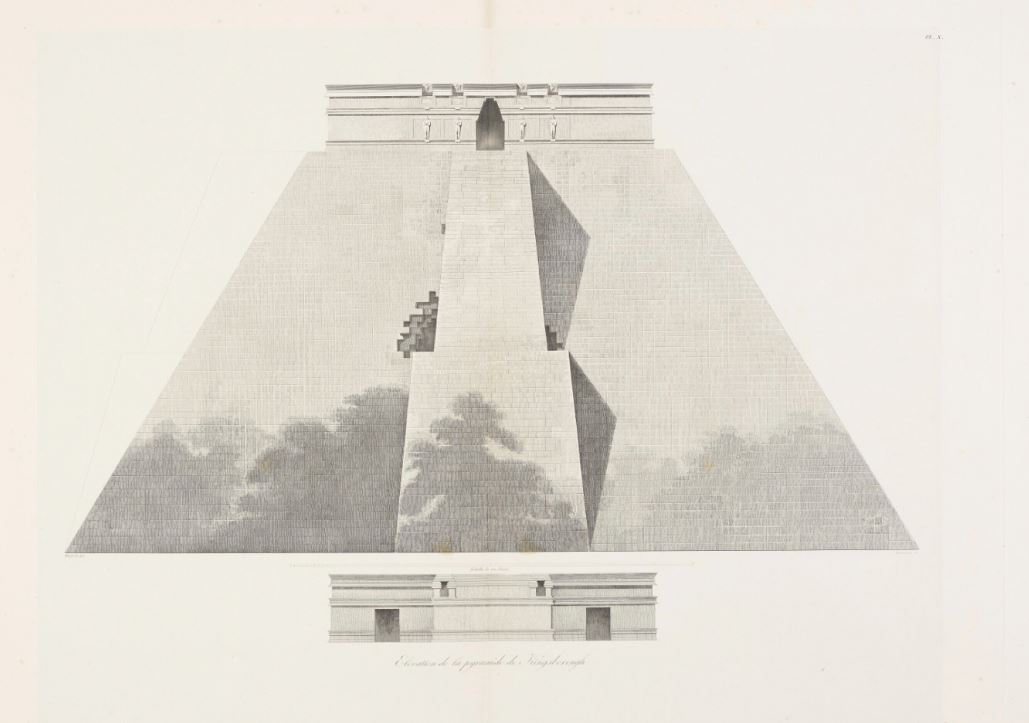
And here is the same pyramid as drawn by Jean Fr d rick Maximilien Waldeck. It was published in 1838, before either of the other two, and appears in Waldeck's Voyage Pittoresque et Arch ologique dans la Province d'Yucatan.
Why is it so different from the others? The answer is that Waldeck was funded by an Englishman so keen on proving that the Maya were descended from the Lost Tribes of Israel that he bankrupted himself and died in debtor's prison. Eager to please his benefactor, Waldeck made the pyramid look obligingly Egyptian. He even named it the Pyramid of Kingsborough. (That would be for Edward King, Viscount Kingsborough, 1795-1837.) As if to bookend the Lost Tribes theory, D sir Charnay believed that the ruins were built by people from the Far East. He wrote that the "architecture is so like the Japanese as to seem identical" (The Ancient Cities of the New World, 1887, p. xxviii).
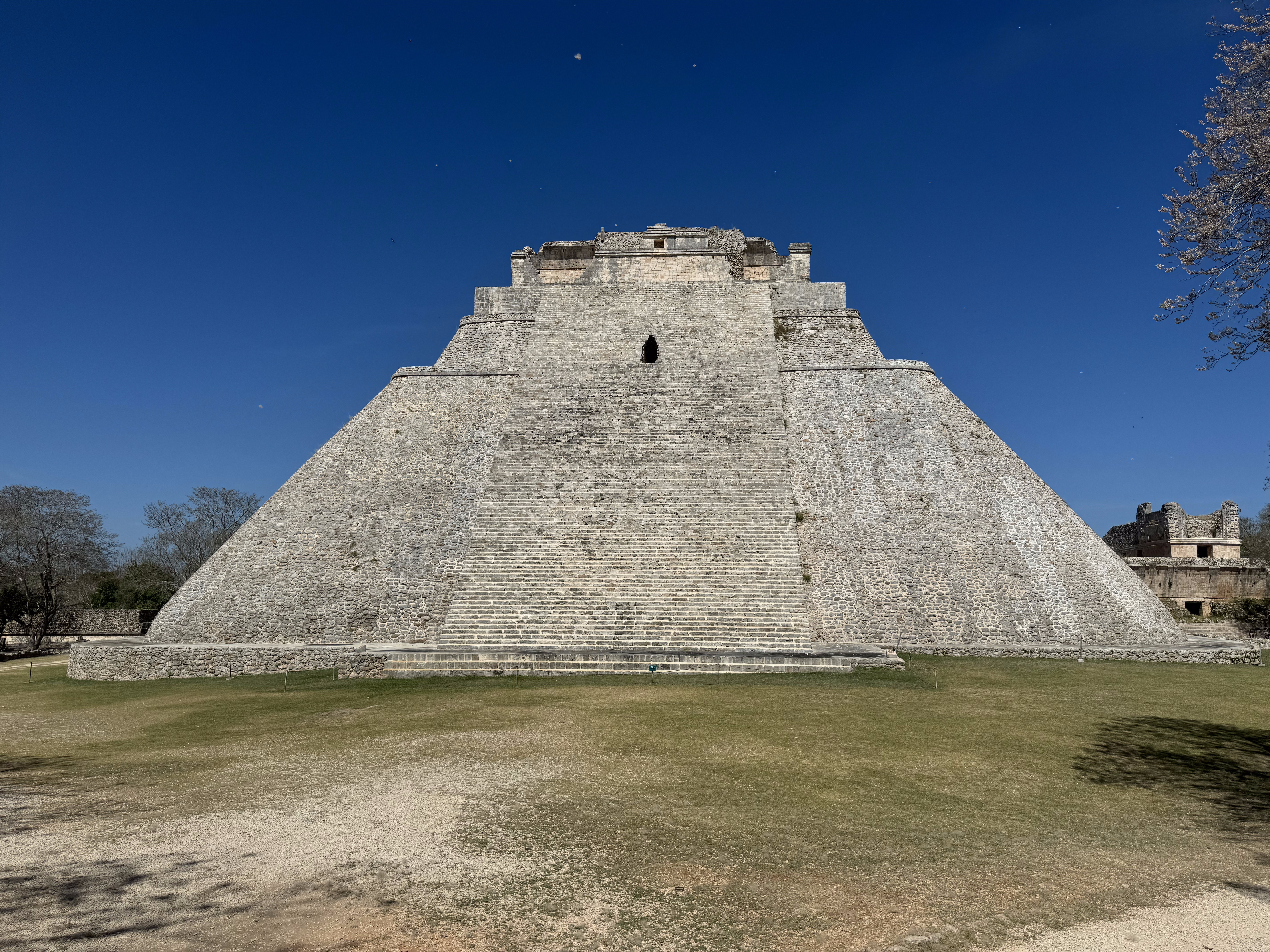
The funny thing is that the pyramid today looks more like Waldeck's drawing than either Catherwood's or Charnay's.
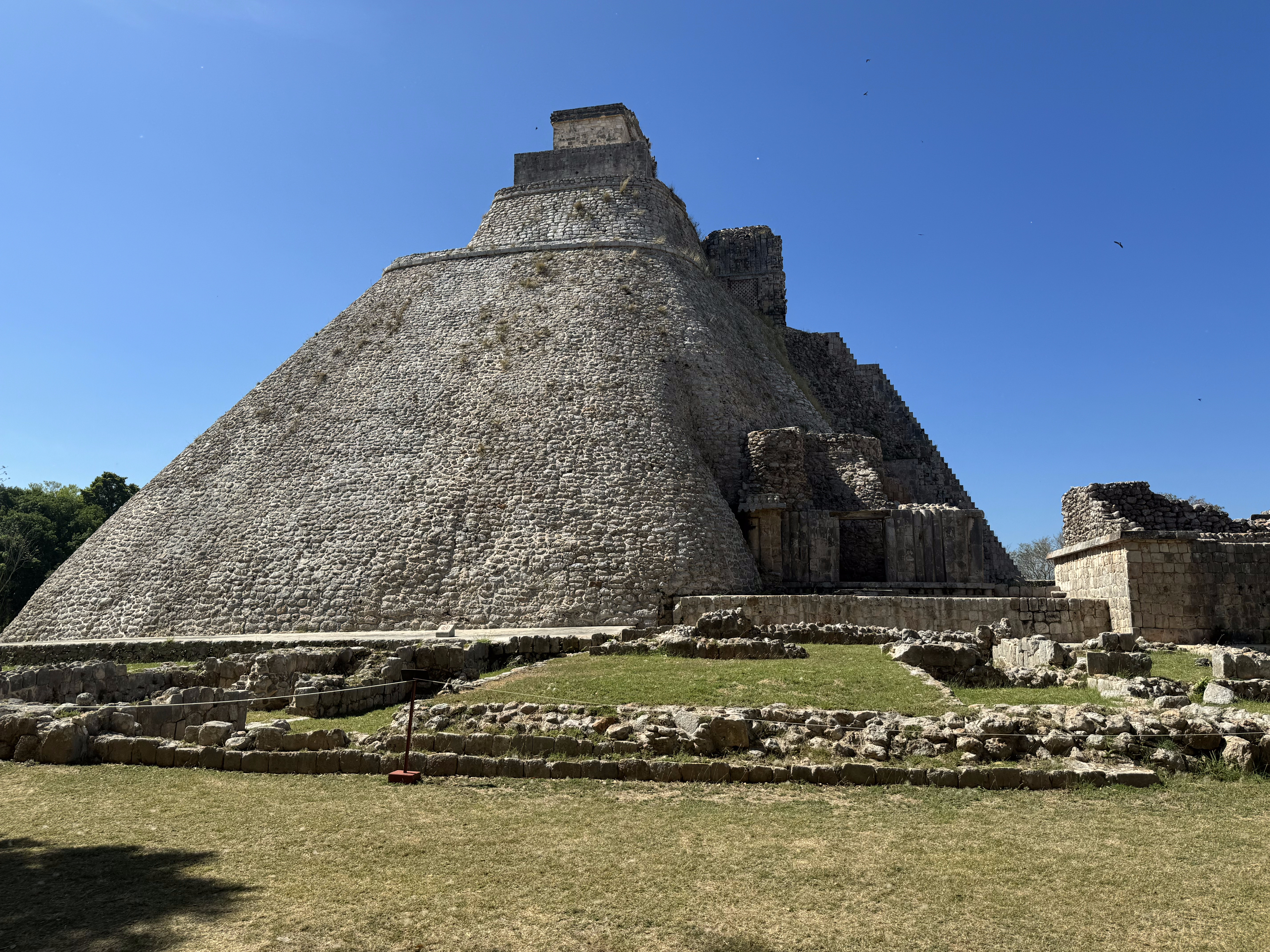
There's one temple at the top and another at the base. That's because the pyramid was built in stages. Archaeologists don't know much about those stages because the recladding done in the 1970s was done in a hurry to make the pyramid pretty for a visit by Queen Elizabeth. No time for archaeologists to probe inside. There was a precedent for this. In her The Pursuit of Ruins (2016), Christina Bueno tells the story of how the Pyramid of the Sun at Teotihuac n was imaginatively rebuilt about 1910 as part of a project to strengthen Mexican pride and impress foreigners. For a photo of the pyramid as it was about 1960, see the official guide to Uxmal published by the National Institute of Anthropology and History (Alberto Ruz, Uxmal, 4th ed., 1967, pp. 9 and 12).
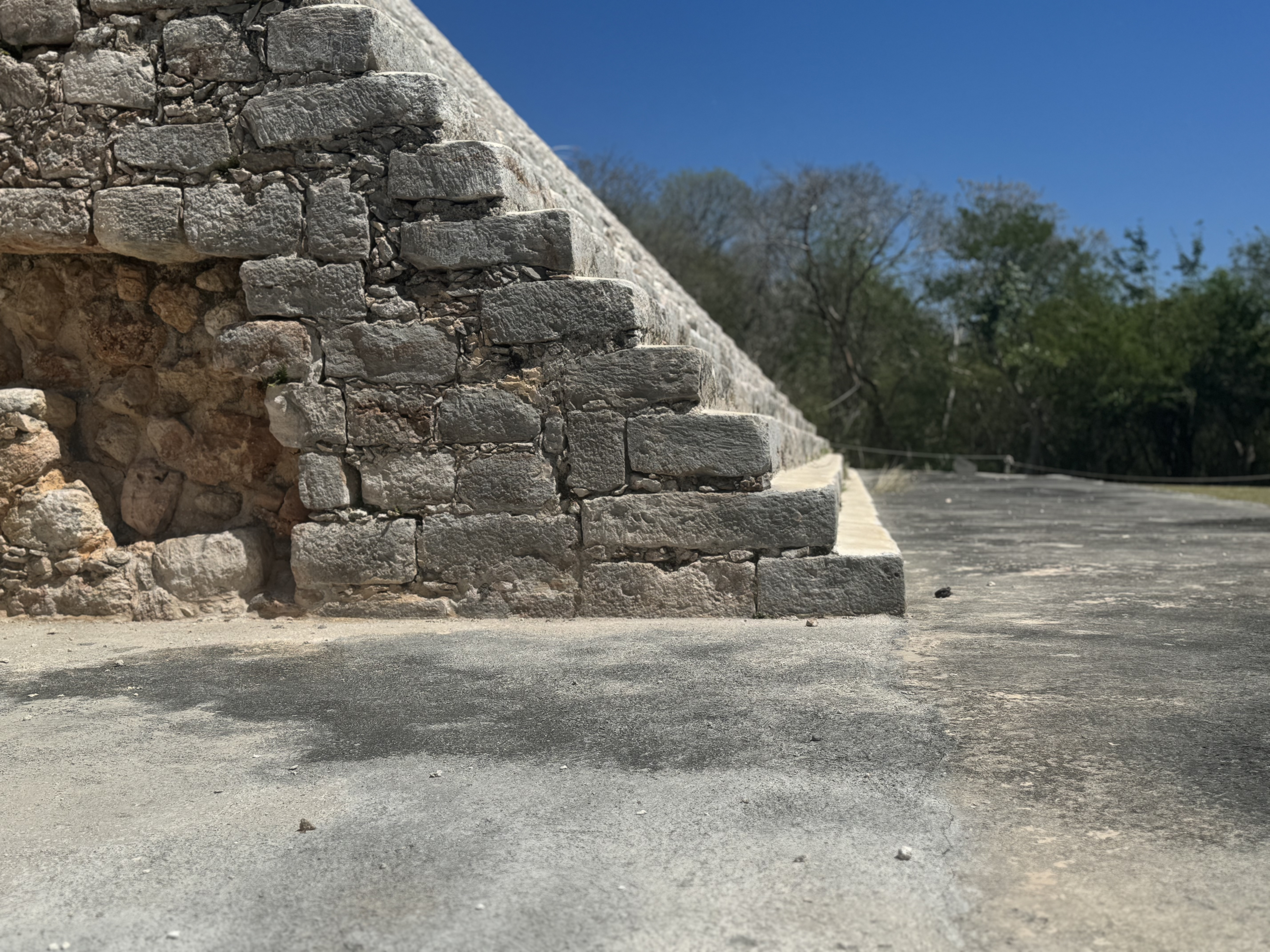
You can see a bit of the material that Stephens and Catherwood and Charnay saw. It's a bit of a shock to realize that these structures were built of stone-faced rubble and were not solid masses of finished blocks.
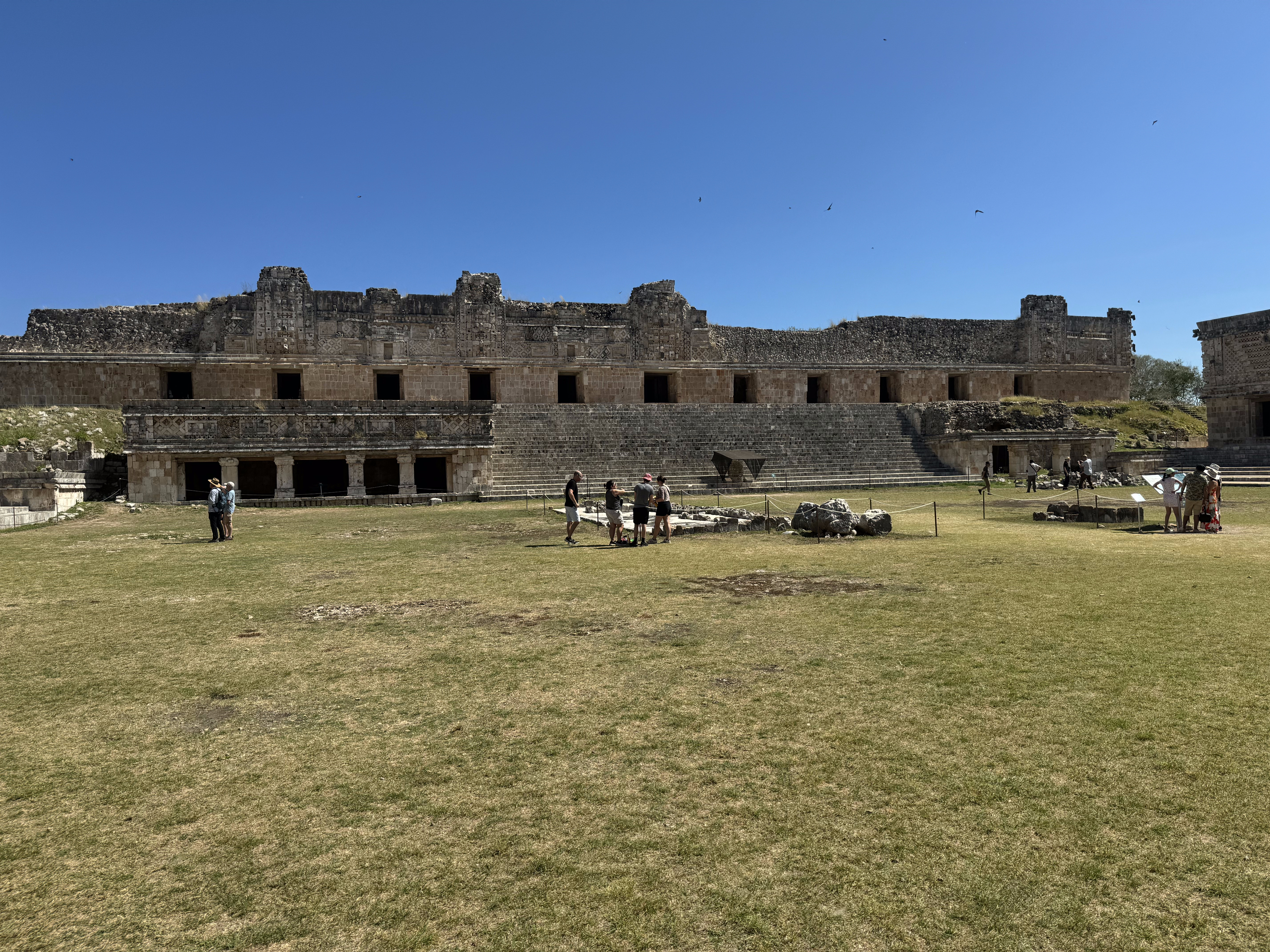
We're back in the Nunnery Quadrangle. I was long gone by nightfall and so I missed the Son et Lumi re or Luz y Sonido show. Break my heart. It was installed in 1975, but archaeologists weren't invited to take a look at the trenches dug for the wiring. Did I mention "disneyfication"?
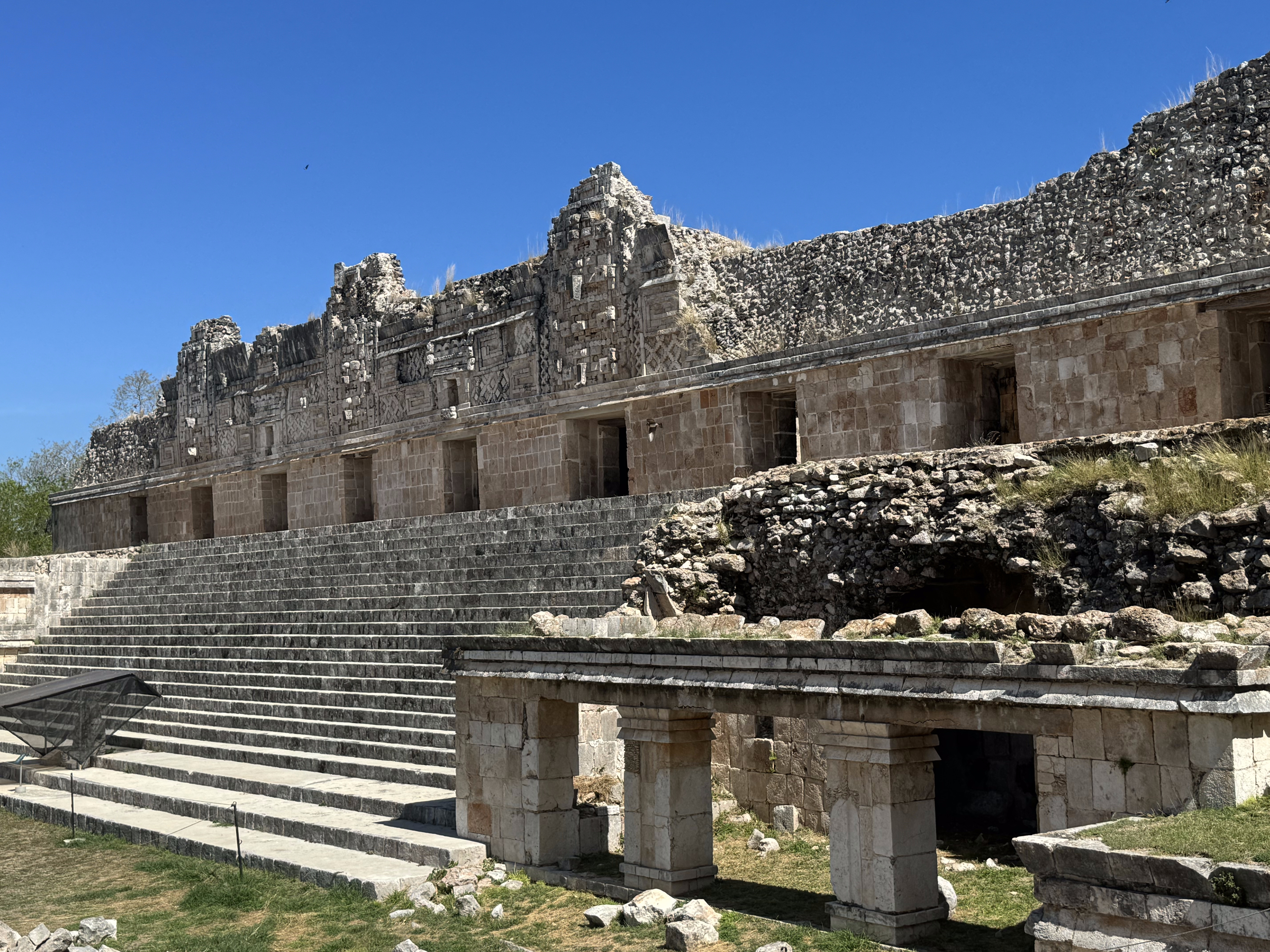
So what should we think about the East Building, or about Uxmal in general? For starters, we can go back to Stephens and Catherwood, who at least saw something real and studied it seriously. Catherwood writes, "They impressed my mind at the first glance with the same feelings of wonder and admiration, with which I first caught site of the ruins of Thebes" (Views of Ancient Monuments in Central America, Chiapas, and Yucatan, 1844, p. 8). And here's Stephens: "The place of which I am now speaking was beyond all doubt once a large, populous, and highly civilized city, and the reader can nowhere find one word of it on any page of history. Who built it... what led to its abandonment and destruction, no man can tell" (Incidents of Travel in Central America, 1841, p. 412).
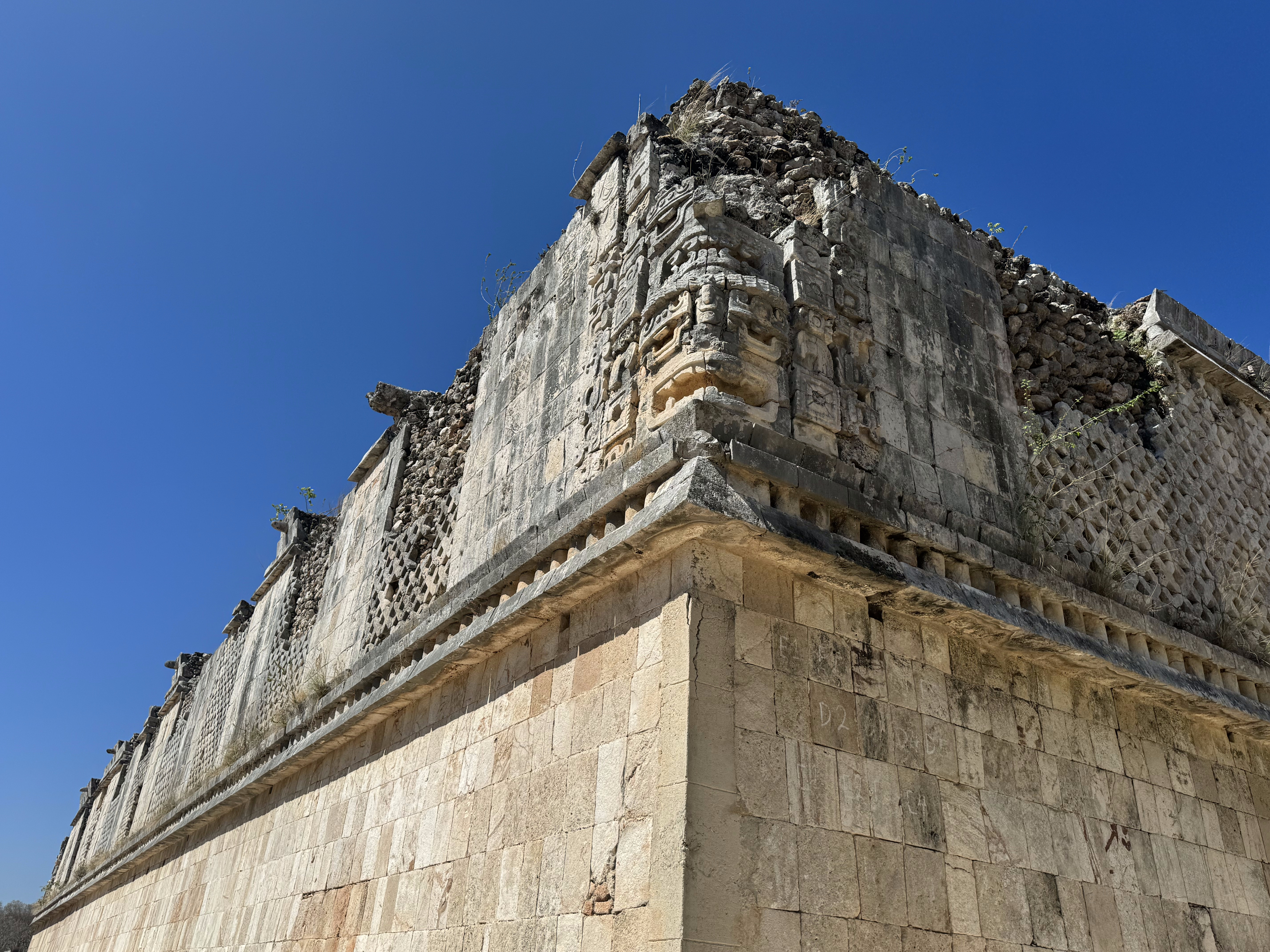
Stephens observed that the decoration of these buildings was a mosaic made of blocks, not thumbnail-sized bits. What the mosaics meant, however, remained a mystery: "Probably all the ornaments have a symbolic meaning... hidden from us... but which... if ever revealed... would show that the history of the world yet remains to be written " (p. 435).
Today we at least know the name of one king who ruled here: Lord Chac (that's a convenient shorthand for Chan Chak K'ak'nal Ajaw). He ruled about 900. And how do we know? The short answer is that we know because it's written on a cylindrical stone (the "Uxmal Altar") found near the House of the Governor. (See Jeff Karl Kowalski, "The Historical Interpretation of the Inscriptions of Uxmal," published online at mesoweb.org/pari/publications/RTO6/Uxmal.pdf For an overview of other inscriptions at Uxmal, see the Corpus of Maya Hieroglyphic Inscriptions, online at peabody.harvard.edu/uxmal)
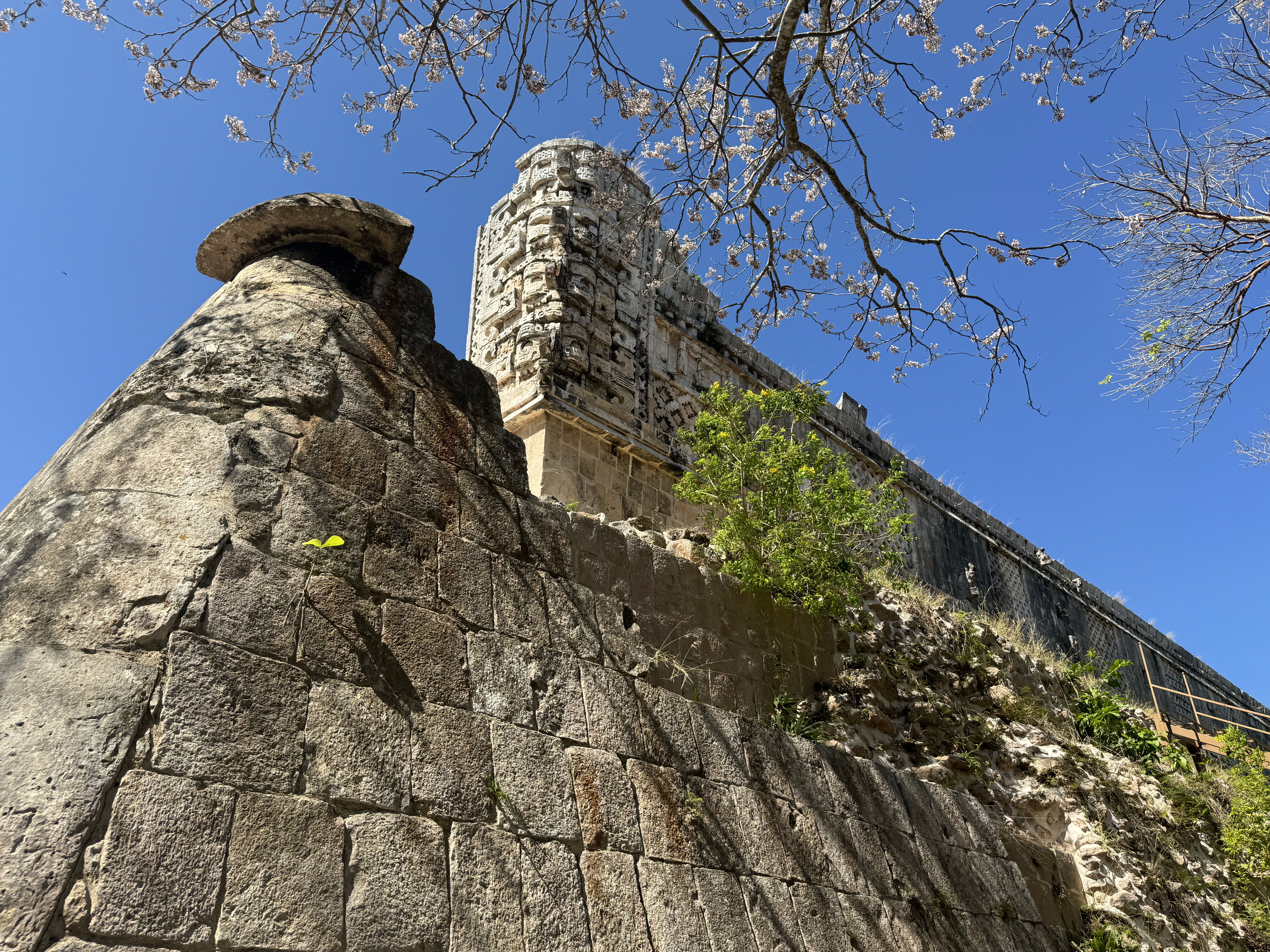
Second takeaway: Stephens had no truck with the idea that foreigners created this place. He writes, "I repeat my opinion that we are not warranted in going back to any ancient nations of the Old World for the builders of these cities; that they are not the work of people who have passed away and whose history is lost, but that there are strong reasons to believe them the creations of the same races who inhabited the country at the time of the Spanish conquest" (p. 455).
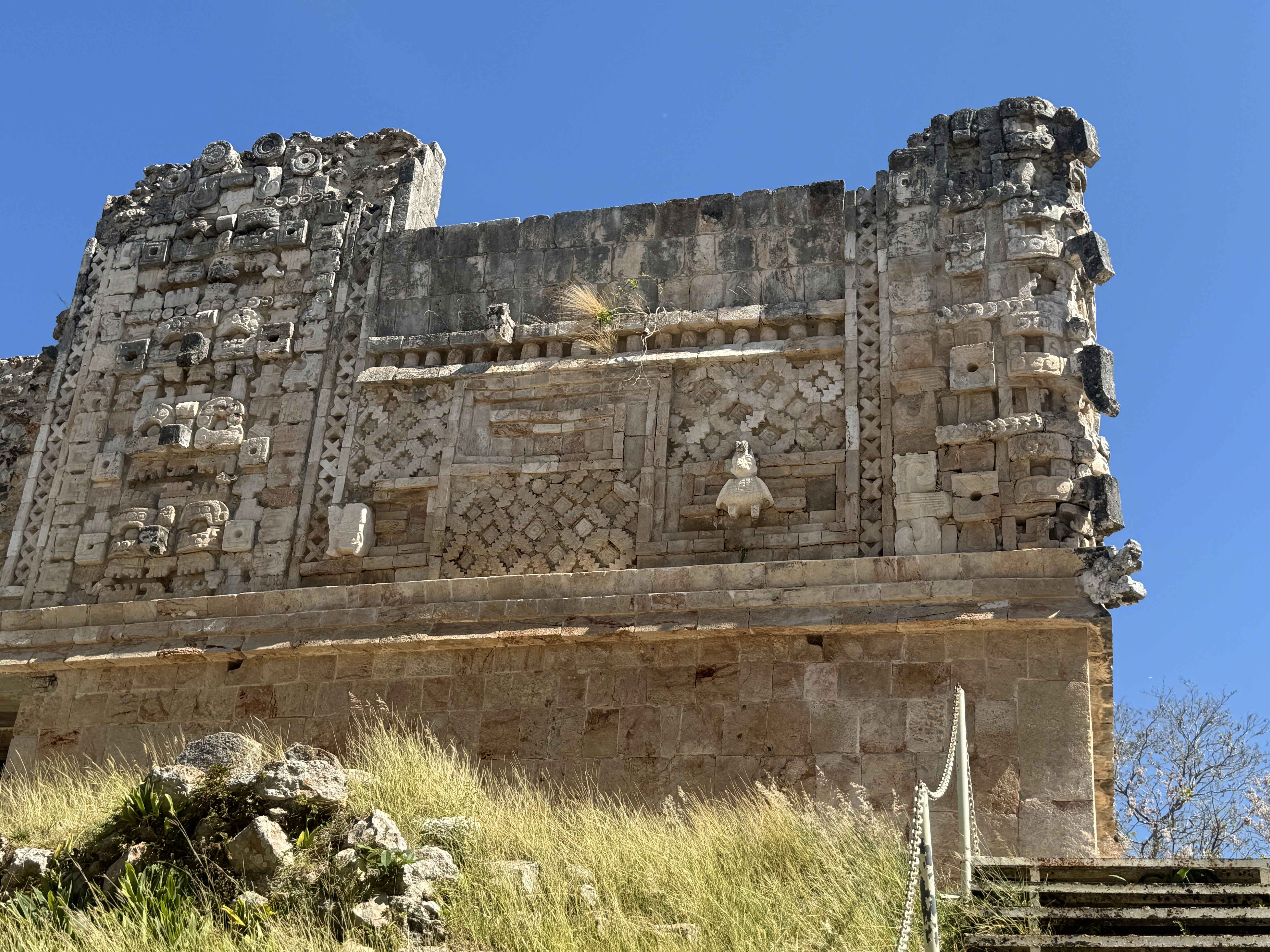
Third takeaway: since Stephens couldn't answer the "who, when, why" of these ruins, he focused on the "what." Alas, this can become compulsive. He reported, for example, that the buildings of the nunnery measured 95 paces on a side. That's OK, but then he tells us that there are 2,000 linear feet of sculpture at the nunnery, if you include all four sides of each of the four buildings. Is this important?
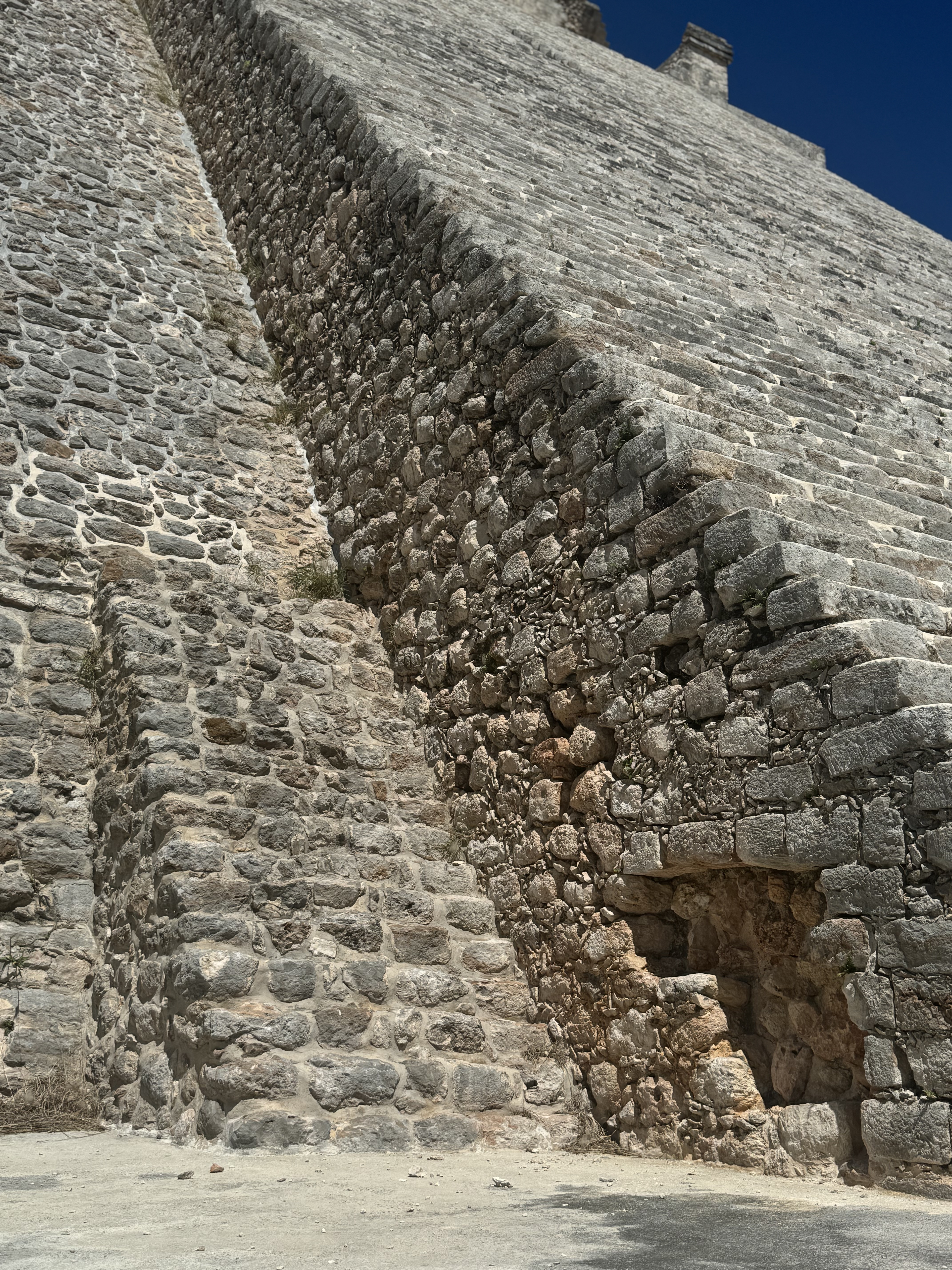
Climbing to the top of the pyramid was trickier in his day than it would be in ours, if we were allowed to do it, but Stephens managed it and counted 101 steps. He wrote that eight or nine blocks were missing at the top and that twenty blocks at the bottom were covered with rubbish. He adds that the temple at the top is 68 feet long. What good do such numbers do for anyone other than guides and the authors of guidebooks, who want to seem well-informed and who think that we'll be impressed by numbers.
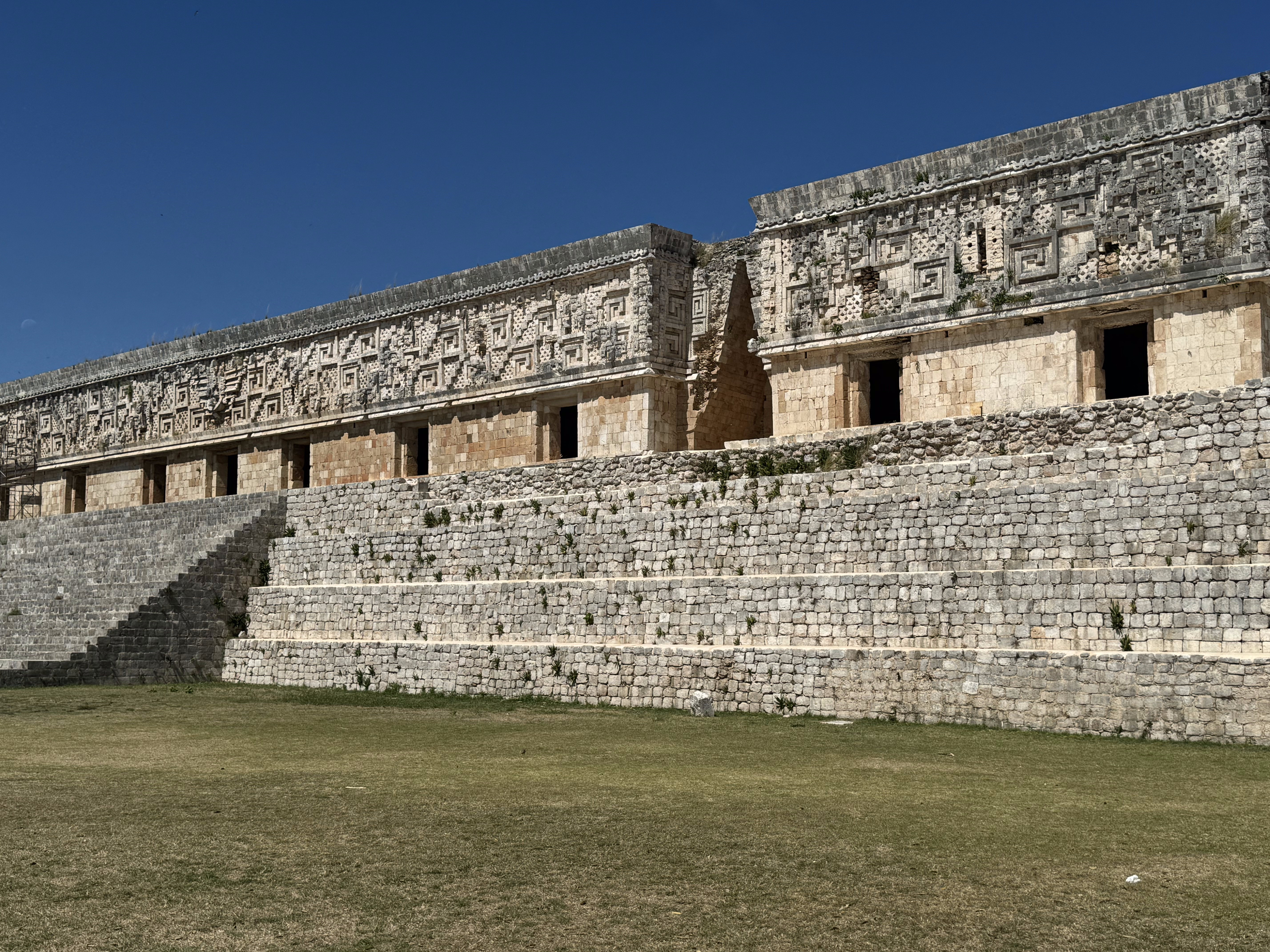
For all his brilliance as a draftsman, Catherwood writes that the Palace of the Governor is 320 feet long, 40 feet deep, and 26 feet high, with 11 doorways on this side and one at each end. Sylvanus Morley a century later went Catherwood one better and reported that "the elaborate and rich mosaics decorating its four facades are composed of some twenty thousand specially cut and fitted stone elements." Well, that's very nice, but a real expert would tell us the exact number! Remember Lord Kelvin saying that knowledge rests on numbers. Of course Kelvin also said that it was a crime to let the Niagara River pour over the falls when the water could be diverted into a hydroelectric power station.