Yucatan 2: From Kabah to Calakmul
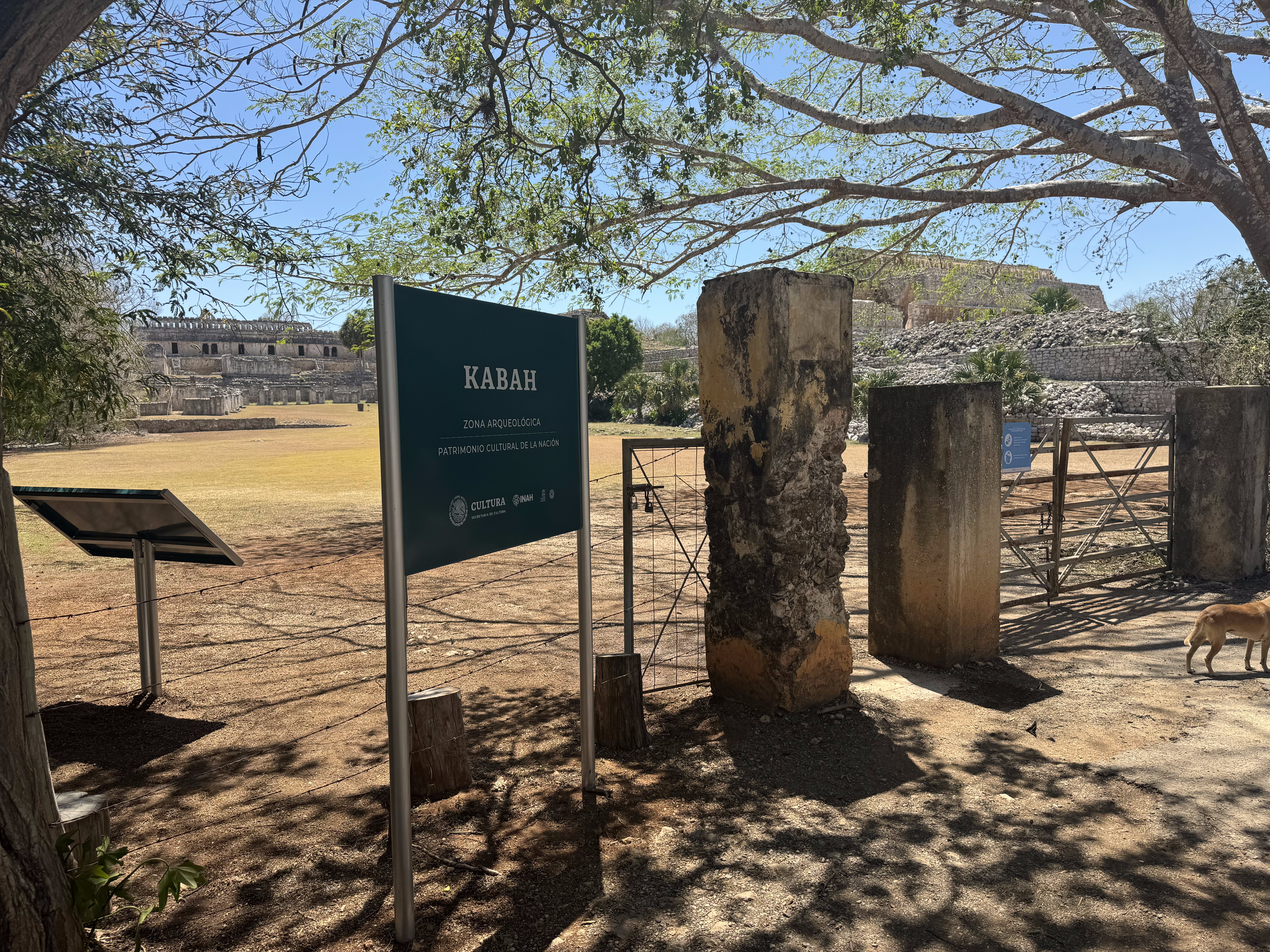
We've jumped a dozen miles from Uxmal to the much quieter ruins at Kabah, connected to Uxmal not only by a modern road but by a straight processional path built over a thousand years ago and so brightly white that in modern Yucatec it is called a sakbe or "white road."
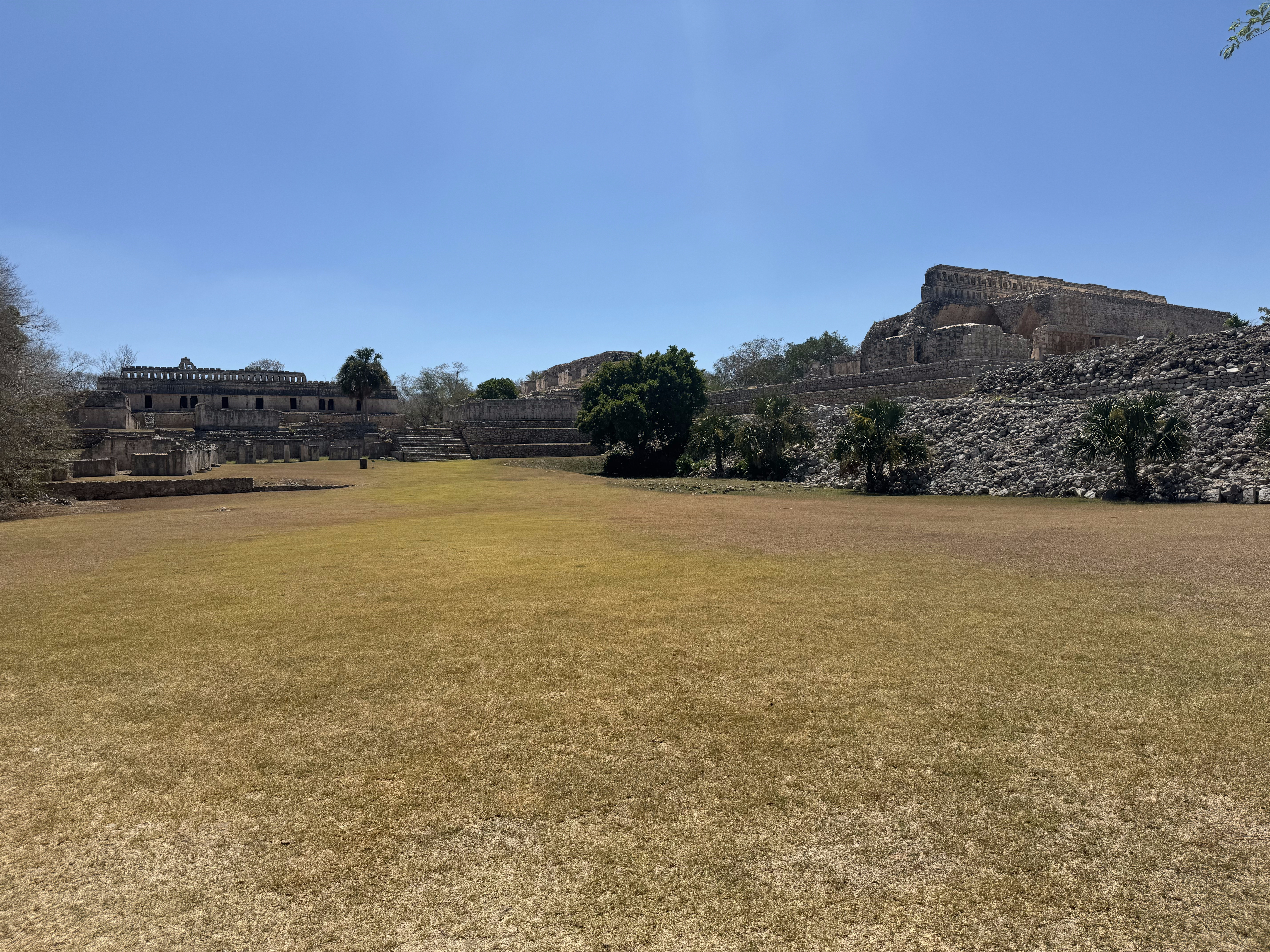
Kabah's central courtyard is framed by a palace complex on the left and, on the right, by the Palace of the Masks, also known awkwardly in English as the Kodz Poop. (The obscure translation is "rolled mat," but at least the other name is decorously pronounced "codes pope"). When Stephens and Catherwood saw Kabah in the 1840s, the courtyard had been cleared to create a corn field. Shocking? Ha! At Palenque a local government officer had offered to sell Stephens the hacienda whose boundaries embraced the ruins. He said that the ruins added no value to the property and that, if Stephens bought the hacienda, he was welcome to pack the ruins up and take them to the United States. Stephens says that the deal fell through because a condition of ownership was that the owner had to have or get a local wife. It was another 50 years before Mexico in 1897 passed a Law on Archaeological Monuments that made Mexican archaeological sites the property of the nation.
I should explain that Stephens had briefly been a New York attorney. In his 20s he left for Egypt and the Holy Land, then went home to write a book called Incidents of Travel in Egypt, Arabia Petra, and the Holy Land. Plonking title, but Stephens collected $15,000 in royalties, equivalent today to over half a million. He followed this up with another successful Incidents of Travel..., this time about Greece and Turkey and Russia and Poland. Goodbye to the law office. Stephens now met Catherwood, who had travelled widely himself. Prompted perhaps by Waldeck's illustrations, the two men decided to explore Yucatan. They began with Copan, in Guatemala, and ended, after other stops including Palenque, with Uxmal. Catherwood promptly got malaria. (The Uxmal hacienda was so notorious on this score that many visitors made day trips from Merida, rather than spend the night at Uxmal.) Stephens took him back to the United States, where Catherwood recovered. Stephens himself got malaria in Panama in 1852 but made it back home only to die from a malarial recurrence later that year. Catherwood had meanwhile gone to California for the Gold Rush. He died two years after Stephens. Malaria? Nope: a shipwreck in the Atlantic.
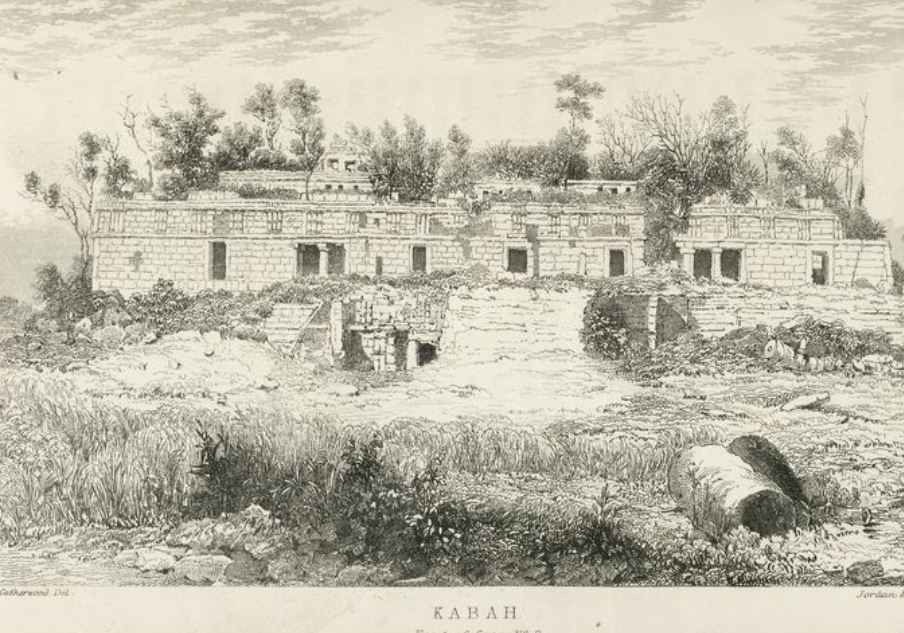
The palace, as drawn by Catherwood. He writes, "Perhaps they have been known to the Indians from time immemorial; but, as we were informed by the Padre of the village of Nohcacab, until the opening of the road to Bolonchen [20 miles to the south], they were utterly unknown to the white inhabitants, This road passed through the ancient city [as the highway still does in 2024], and revealed the great buildings, overgrown and, in some cases, towering above the tops of the trees. The discovery, however, created not the slightest sensation; the intelligence of it had never reached the capital; and though, ever since its occurrence, the great edifices were visible to all who passed along the road, not a white man in the village had ever turned aside to look at them, except the Padre referred to" (Views of the Ancient Monuments in Central America, Chiapas and Yucatan, 1844, pp. 9-10).
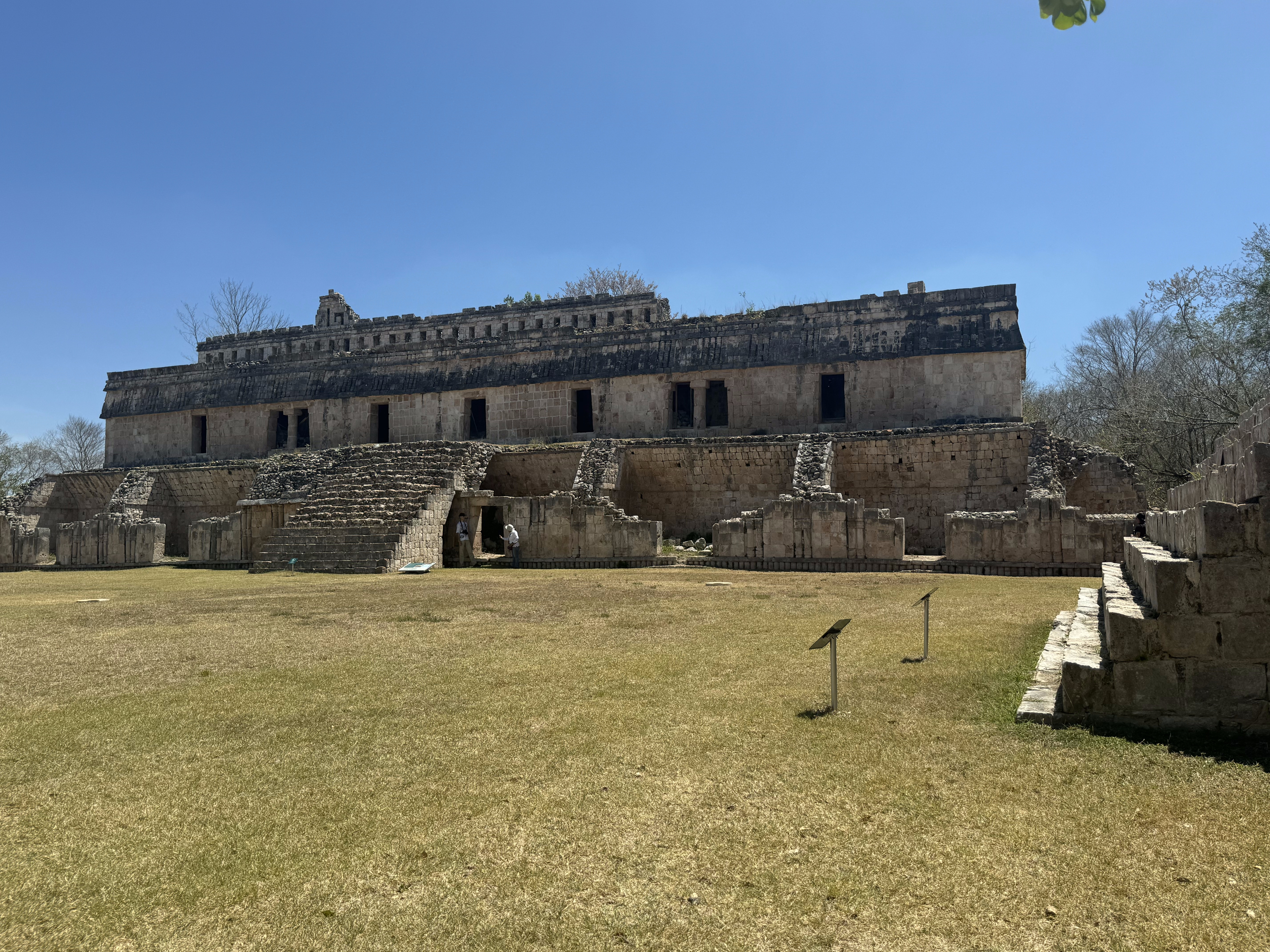
The palace looks sterile compared to Catherwood's drawing. I recall a quartet of young people. I overheard one ask the others if they should go look at something. I don't know what the something was, but a young woman replied, "I want to find shade." Perhaps you had to be there to appreciate the humor.
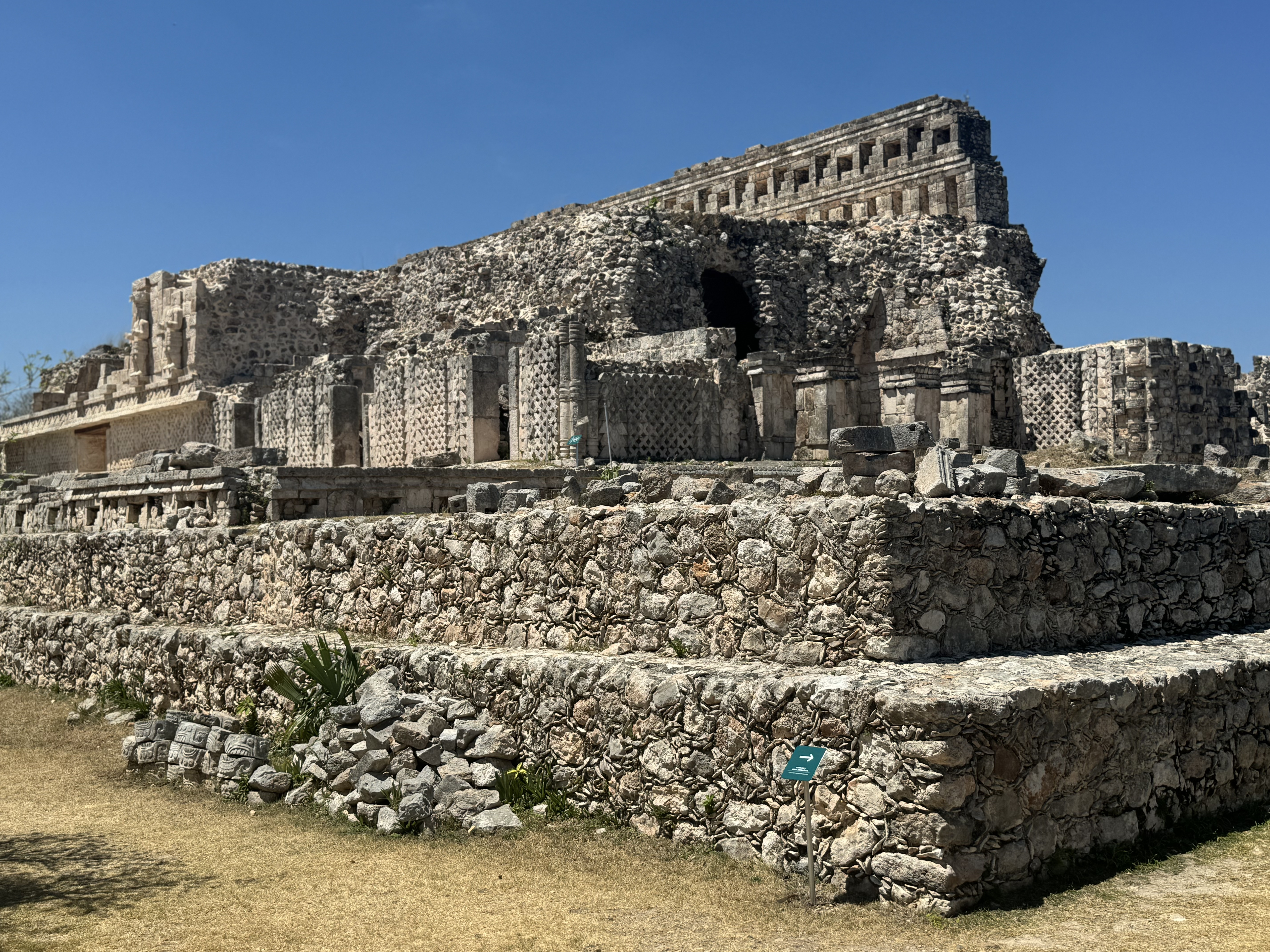
The Kotz Poop. Maybe we should stick with Palace of the Masks.
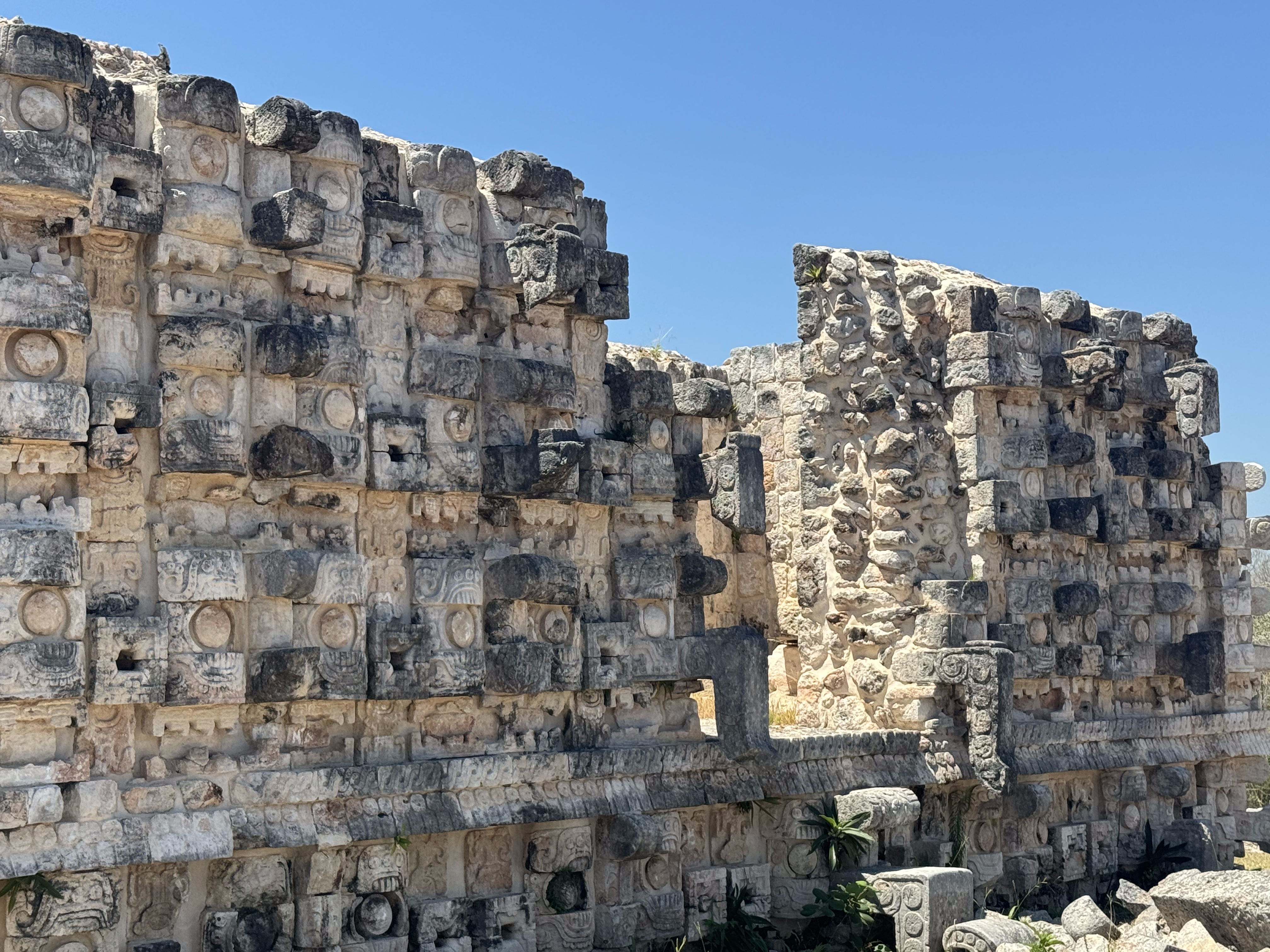
Coe writes (The Maya, 10th edition with Stephen Houston, p. 226) of "a symphony of step-and-fret, lattice work, and Flower Mountain mask motifs."
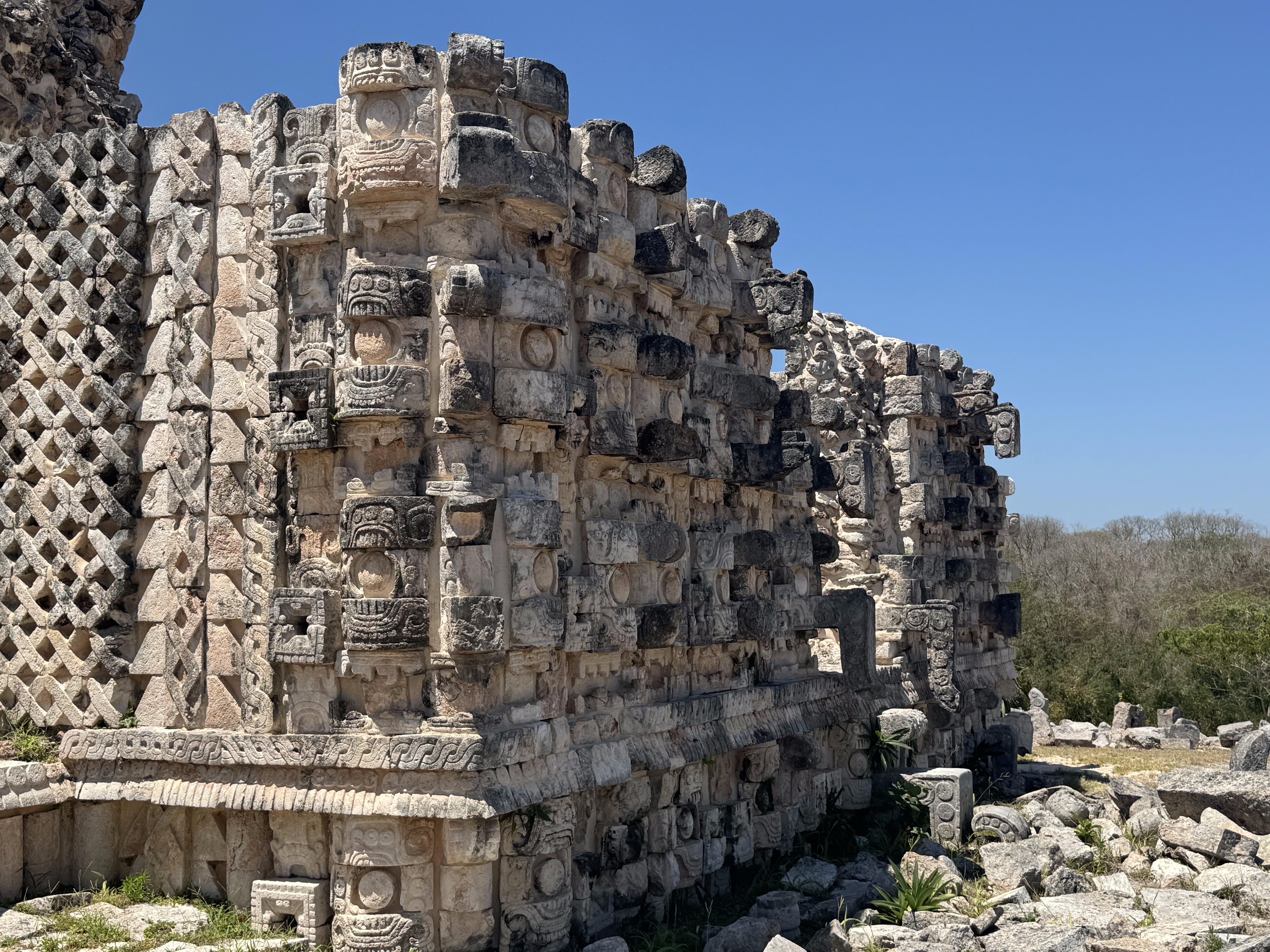
What's a Flower Mountain? Focus on the top of the corner and you'll make out a brow, two eyes and a nose with cheeks, and a mouth with teeth. Coe writes, "Long thought to be faces of the Maya Rain God Chakh, they are actually, for the most part, iconographic mountains" (p. 226). Coe is relying on Karl A. Taube, who writes that the local ruins "frequently portray stacked zoomorphic heads at the corners.... Rather than portraying rain gods or mythic birds the ... facades are depictions of Flower Mountain...." Want a bit more explanation? Taube to the rescue: "There has been a tendency to focus on darker aspects of Classic Maya religion, such as bloody offerings... [but] there was also a strong orientation towards a solar celestial paradise, a shining place of flowers and beauty.....Flower Mountain was both the home of gods and honored ancestors, and the means of supernatural ascent into the heavens" ("Flower Mountain: Concepts of Life, Beauty, and Paradise among the Classic Maya," in RES: Anthropology and Aesthetics, Spring 2004, pp. 69-98).
Reluctantly, I add one more line from Taube: "Rather than being enjoyed by all deceased, this realm was probably limited to special individuals." Well, wouldn't you know it?
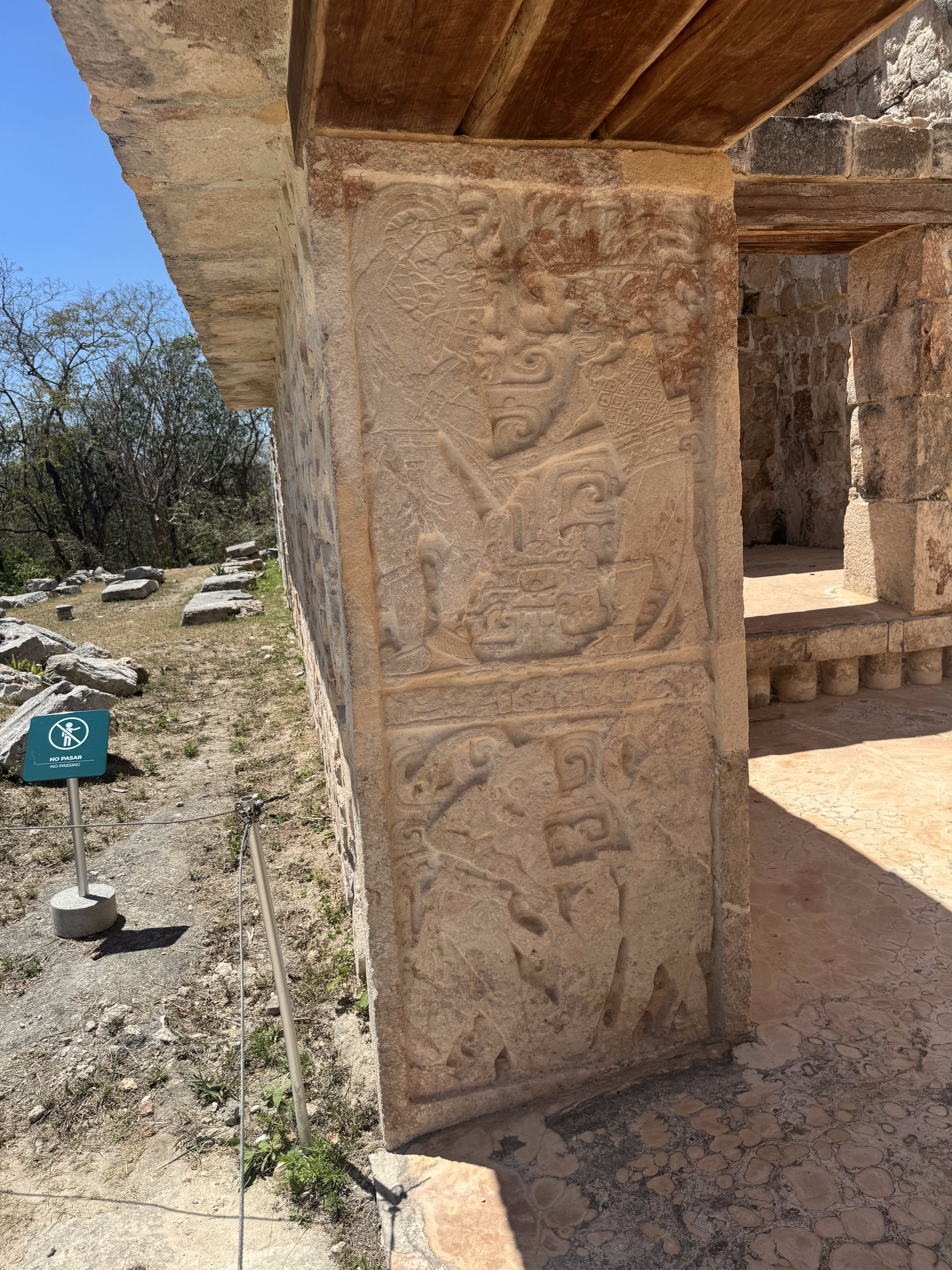
On a door jamb of the palace, warriors take captives.
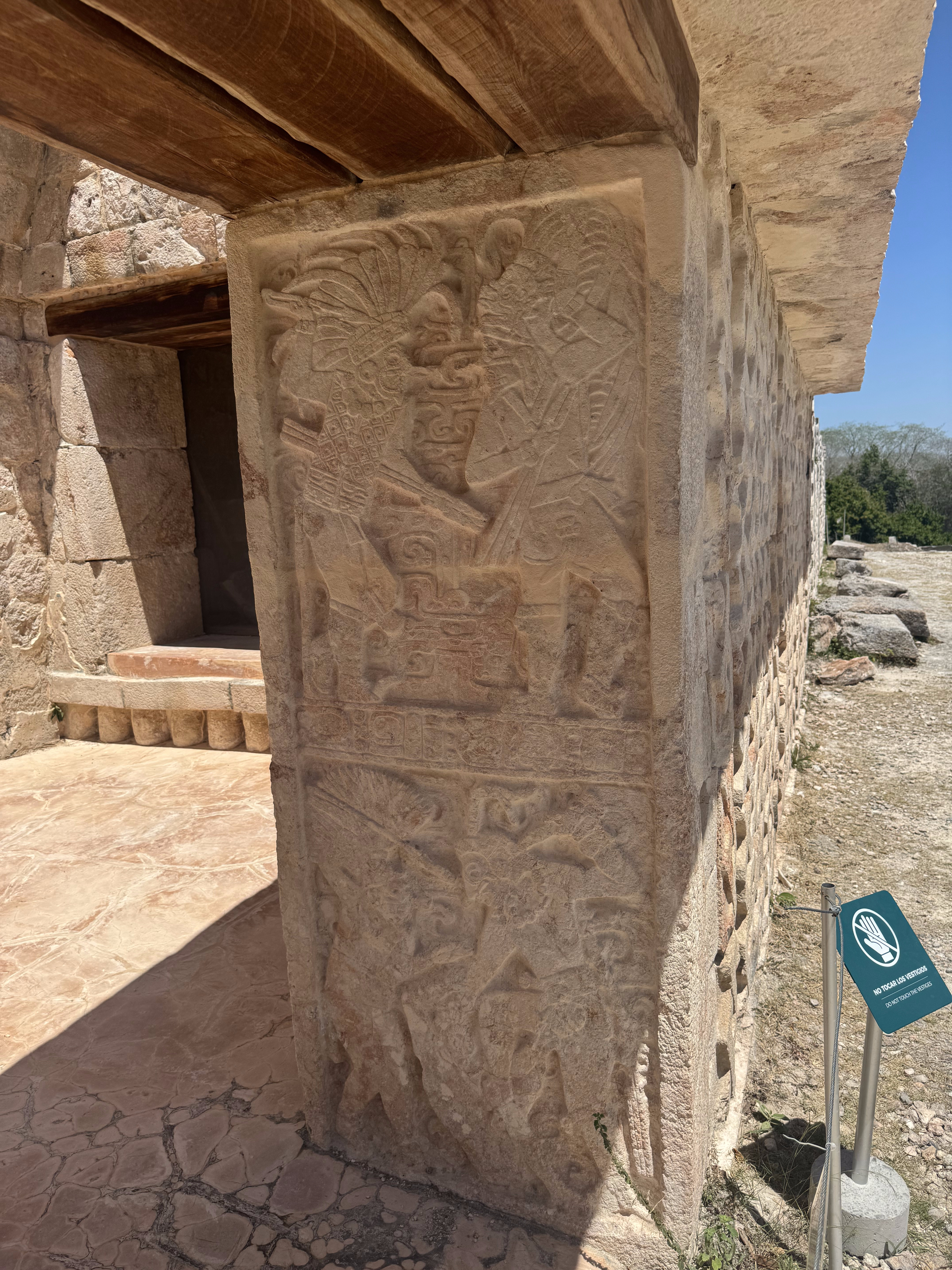
No Flower Mountain for the losers.
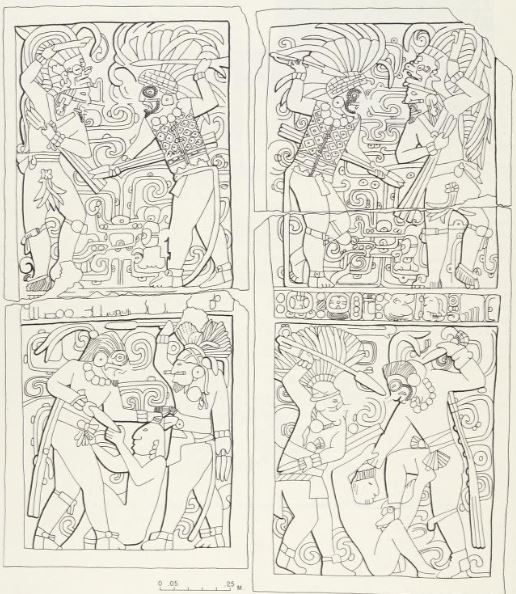
Here is a clarifying drawing by Laura Wiggins Putnam and published in H.E.D. Pollock, The Puuc: Architectural Survey of the Hill Country of Yucatan and Northern Campeche, Mexico, 1980, p. 196.
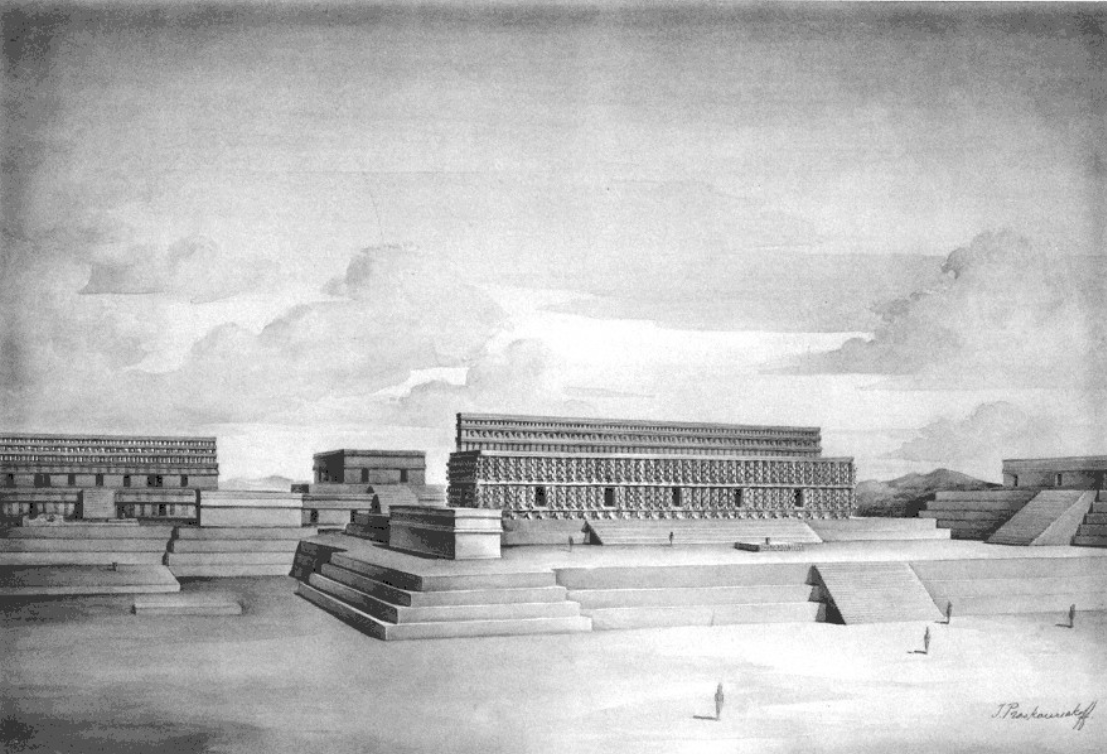
And here's a reconstruction of the Palace of the Masks by Tatiana Proskouriakoff. It's from her extraordinary Album of Maya Architecture (1946). Proskouriakoff was that rare creature, an archaeologist who dares to criticize the buildings she studies. Here is the text she wrote to accompany this drawing:
"The tendency to rely for effect on surface decoration culminated finally in an indiscriminate piling-up of ornament and the elimination of all plain surfaces.... In view of the tremendous amount of skilled labor involved in carving so many individual pieces of stone, the artistic effect achieved is disappointing, and one regrets that the originality of the designer was no equal to the craftsmanship of the artisan.... Perhaps the builders themselves were discouraged by the results of their efforts by the time the mask facade was completed, and terminated the extravagance by substituting a simple roof comb for the intended second story" (1963 ed., p. 67).
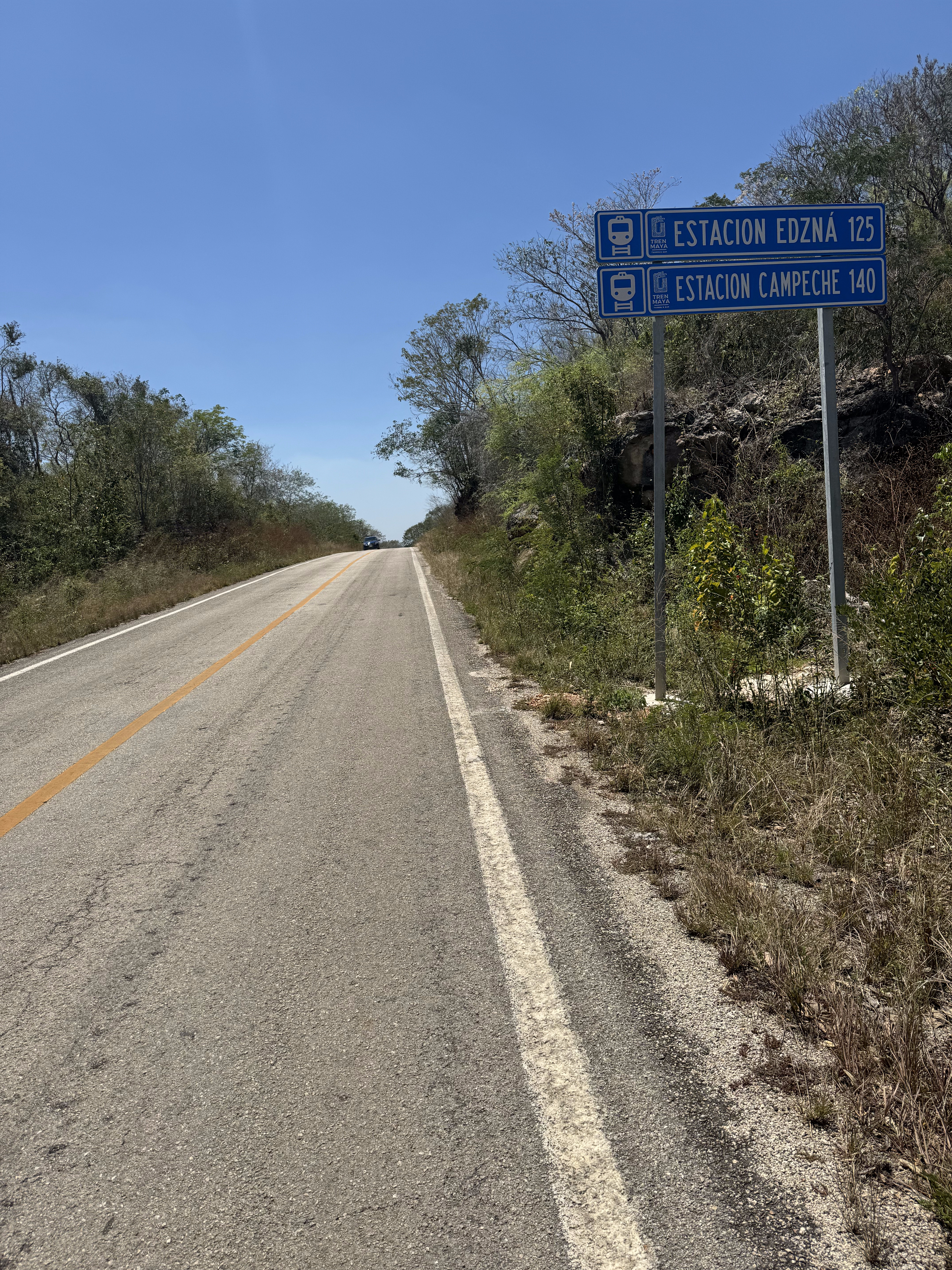
Sorry, gotta run. Xpujil is still 150 miles or four hours down the road, and that's according to Miss Google. The road looks good but has wicked and unsigned potholes big enough to turn on your windshield wipers. I felt sorry for the rental car, but I shouldn't complain. An old Terry's Guide to Mexico warns "of a semi-wild country of forest and plain. The region is infested with ticks, and the traveller is cautioned to be on his guard against these little demons" (1909 ed., p. 580).
The road sign refers to the Maya Train or Tren Maya.
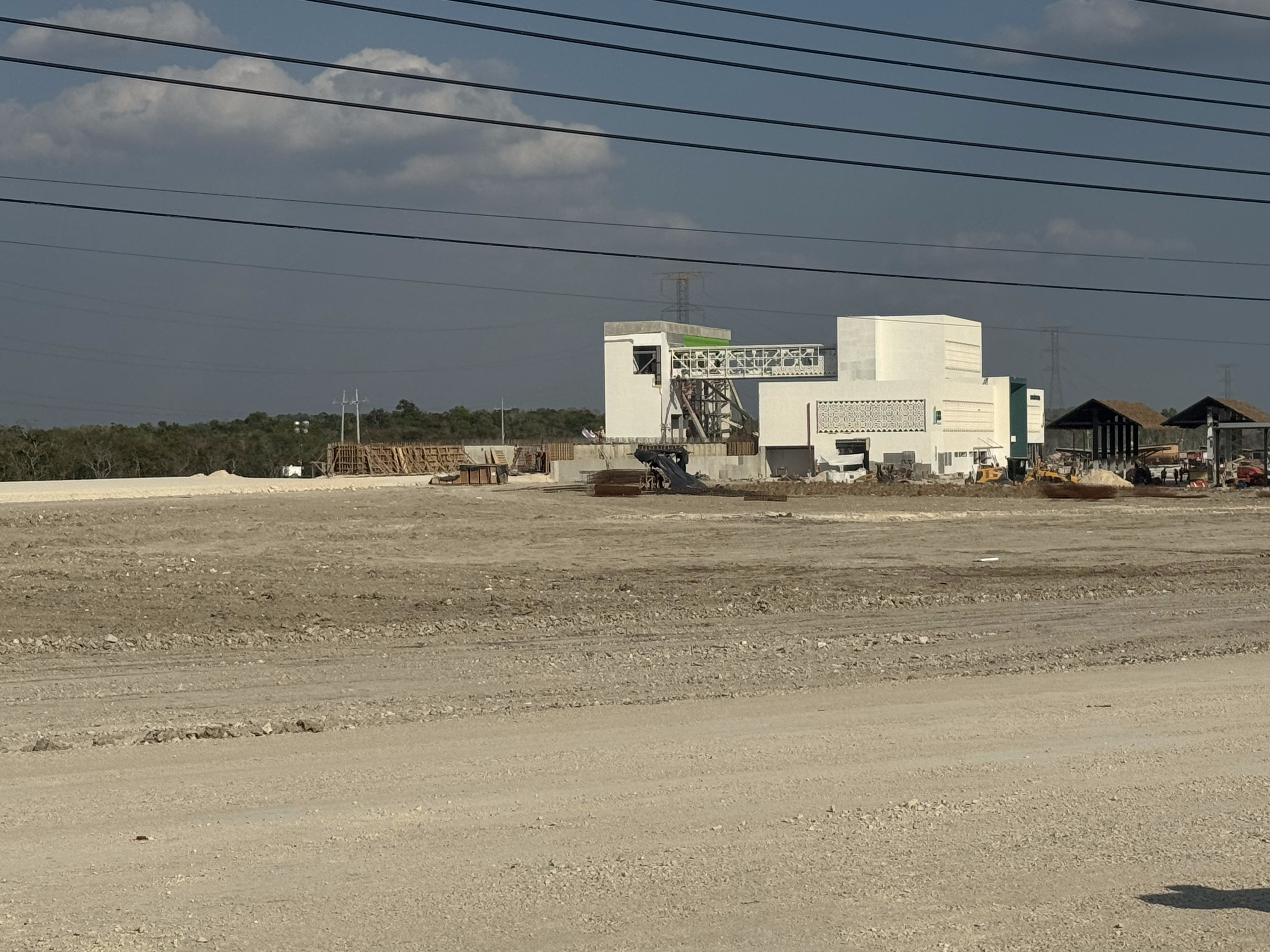
Yes, indeed. Here's the Xpujil Station, seen on the fly in April, 2024. A northern route from Cancun to Palenque was already open, but I had hoped that the southern half would never get built.
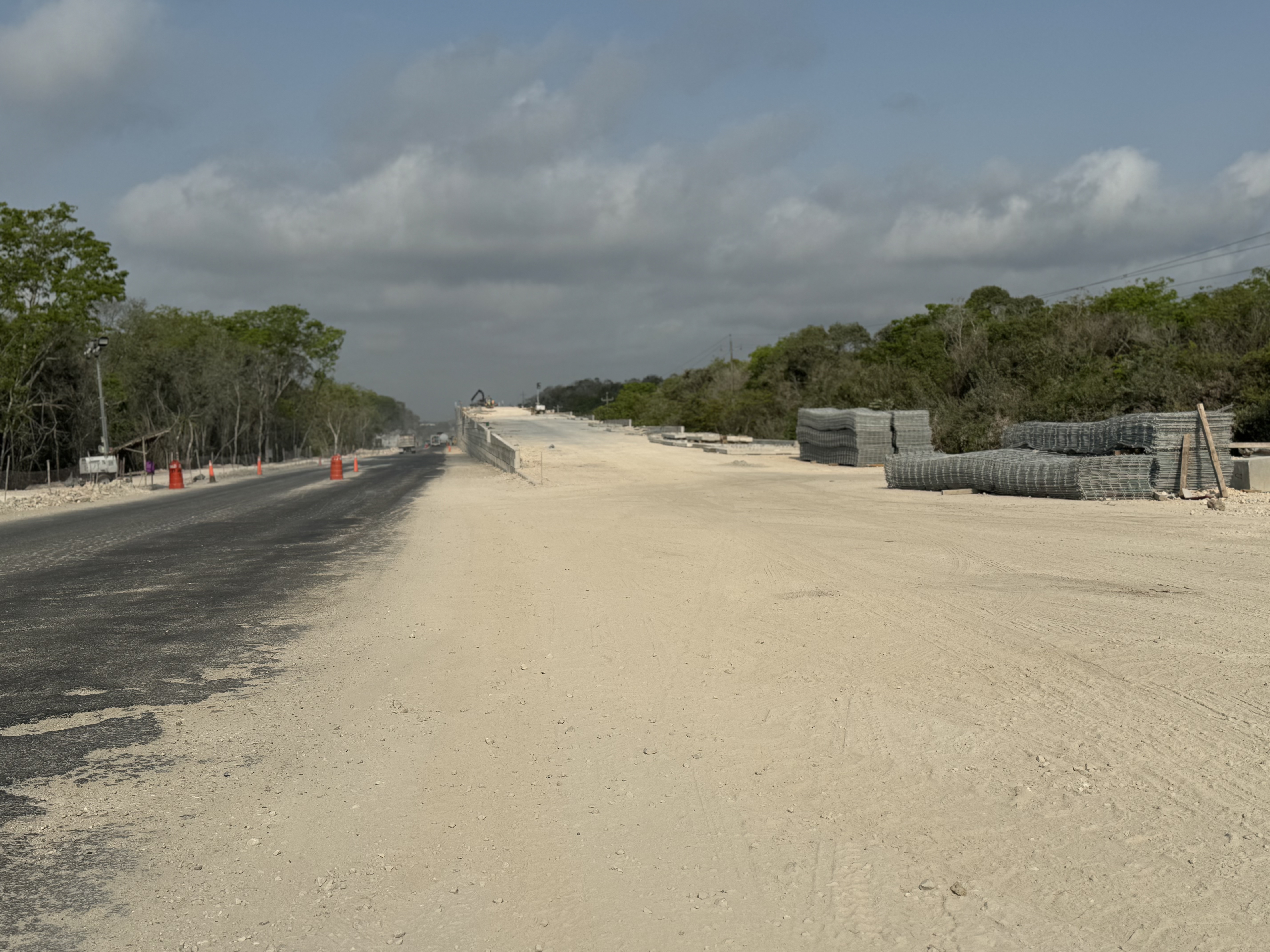
Fat chance. The rail line here largely parallels the Transpeninsular Highway (Route 186, running west from Chetumal). The highway was unpaved as late as 1968, but here an overpass will carry the now-paved road over the track.
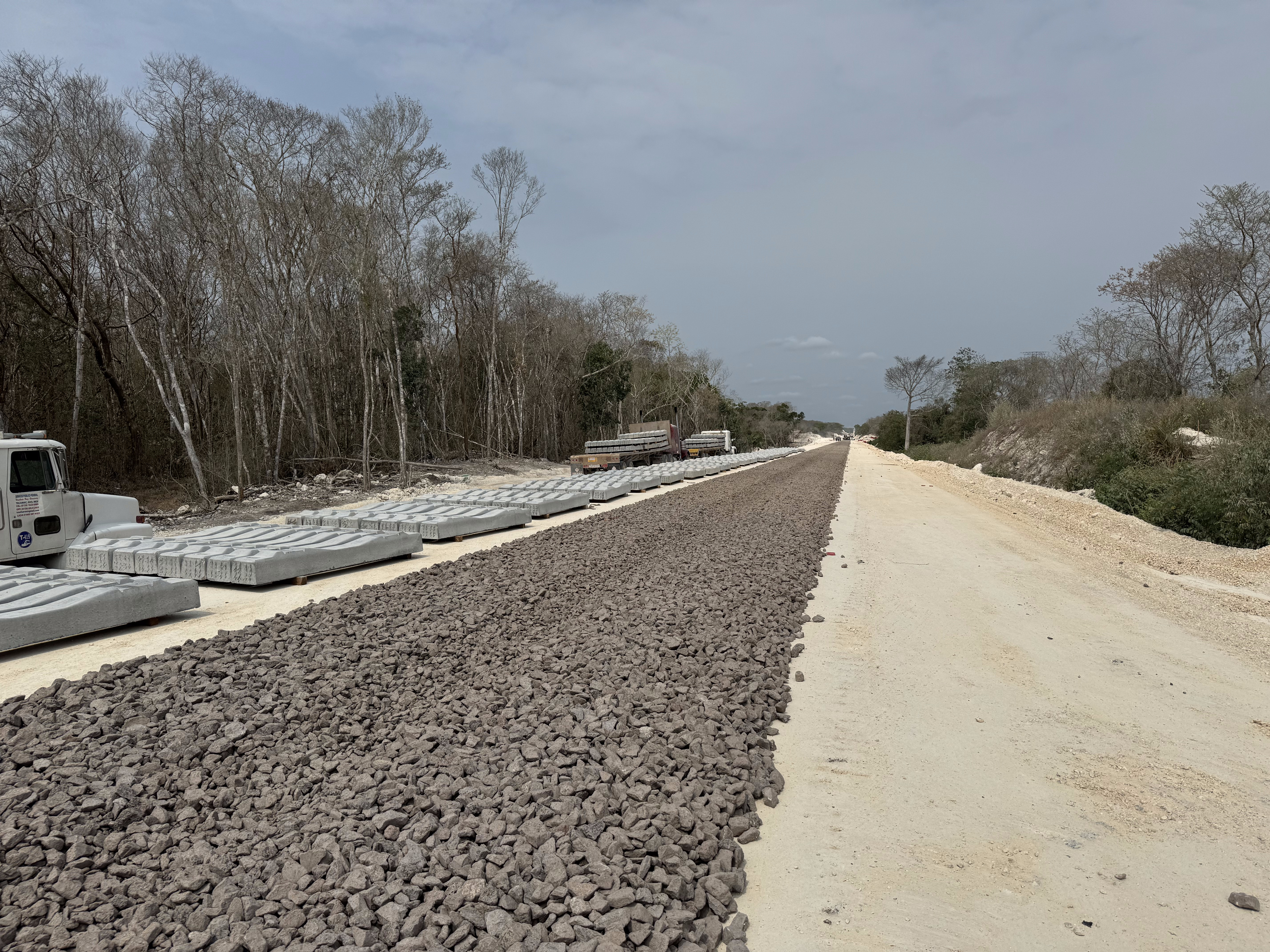
High-speed trains like straight lines.
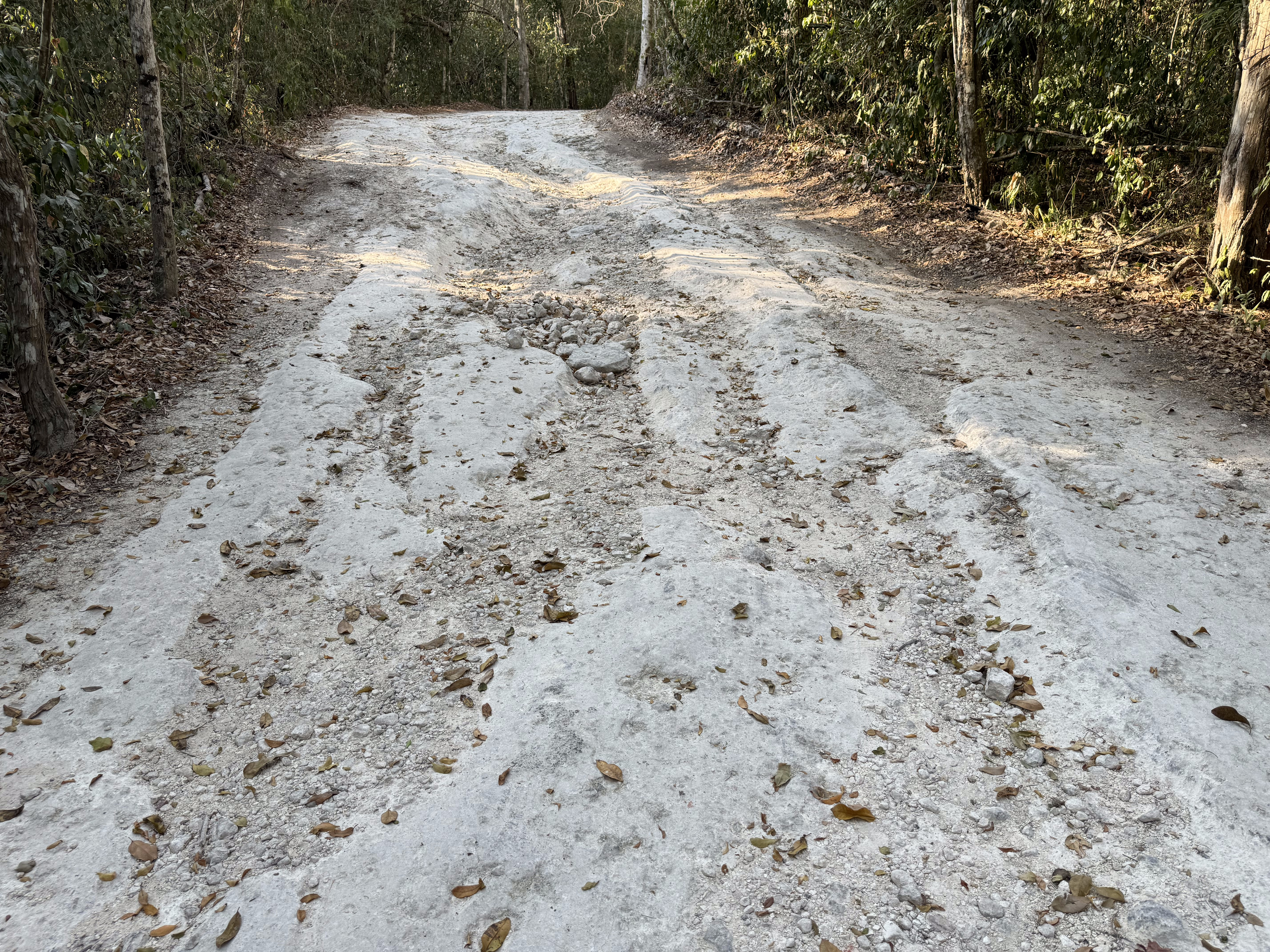
Living up to my assertion that we see what we expect to see, I drove through Xpuhil half a dozen times. saw nothing, and took no pictures. The next day, however,I did drive 10 miles southwest to the ruins of Hormiguero ("Anthill"). The last few miles were like this. The country is deserted but listen to Jack D. Eaton, an archaeologist workng in the 1960s. He writes that "the ancient buildings described in this report were only a few of the seemingly numberless stone houses noted scattered across the central southern part of the Yucatan peninsula. The houses are everywhere found associated with evidence of a specialized form of intensive agriculture which employed the use of hillside soil traps, forming terraces, as well as other linear walled structure, apparently designed to modify land use and improve irrigation.... The small buildings... comprise the farmsteads of a region wide farming community that flourished during the Maya Late Classic period."
Eaton adds that "the evidence here supports the view that the skills employed to build the great centers were drawn from the surrounding countryside.... and that the farmsteads, and the associated intensive agriculural production, were abandoned at about the same time that monumental building activity ceased...." (Jack D. Eaton, "Ancient Agricultural Farmsteads in the Rio Bec Region of Yucatan," 1975, pp. 66-69, online at https://digitalassets.lib.berkeley.edu/anthpubs/ucb/proof/pdfs/arf027-007.pdf )
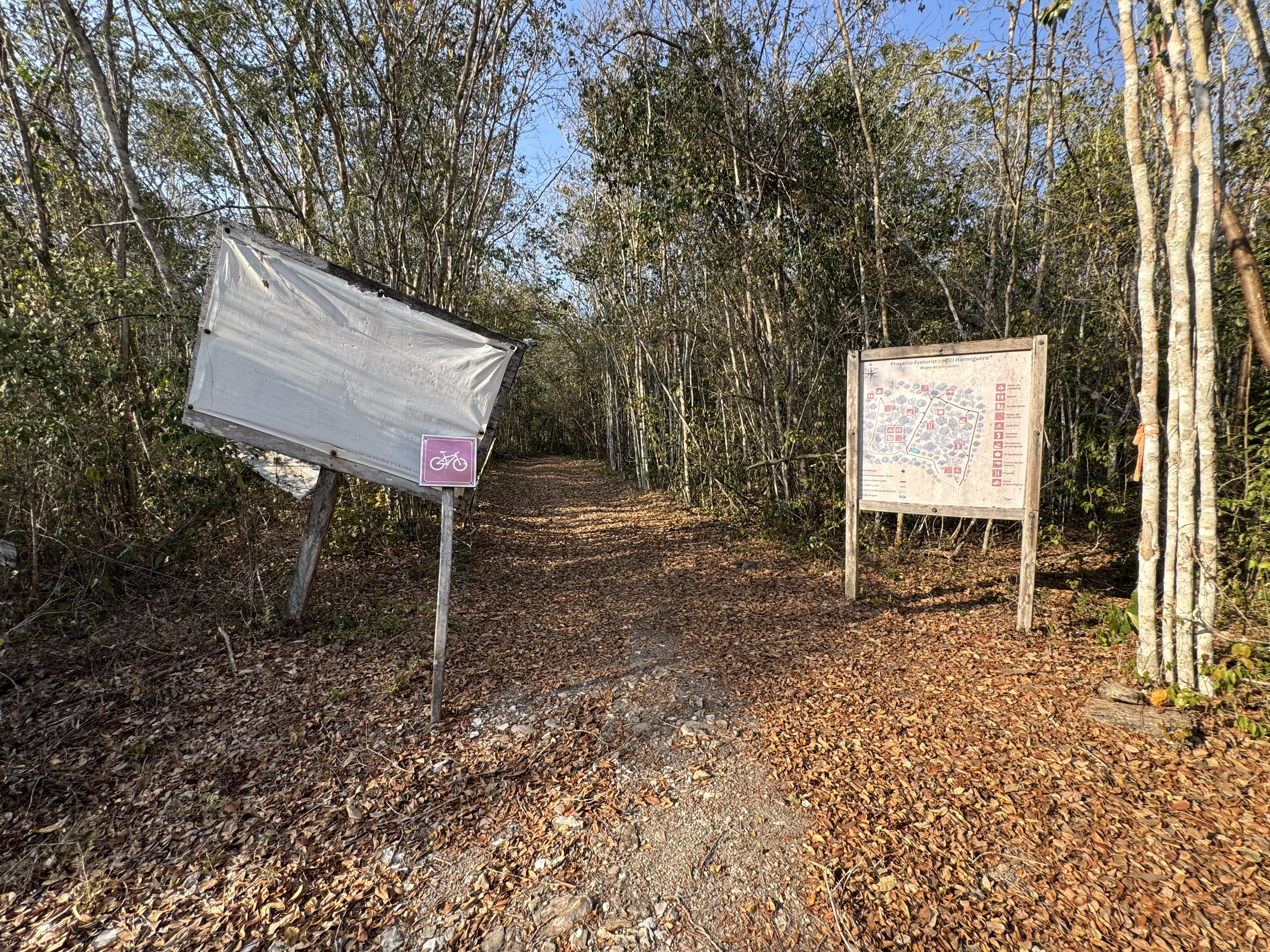
I didn't see anybody on or off a bicycle. Ticks? Your guess is as good as mine. Maybe better.
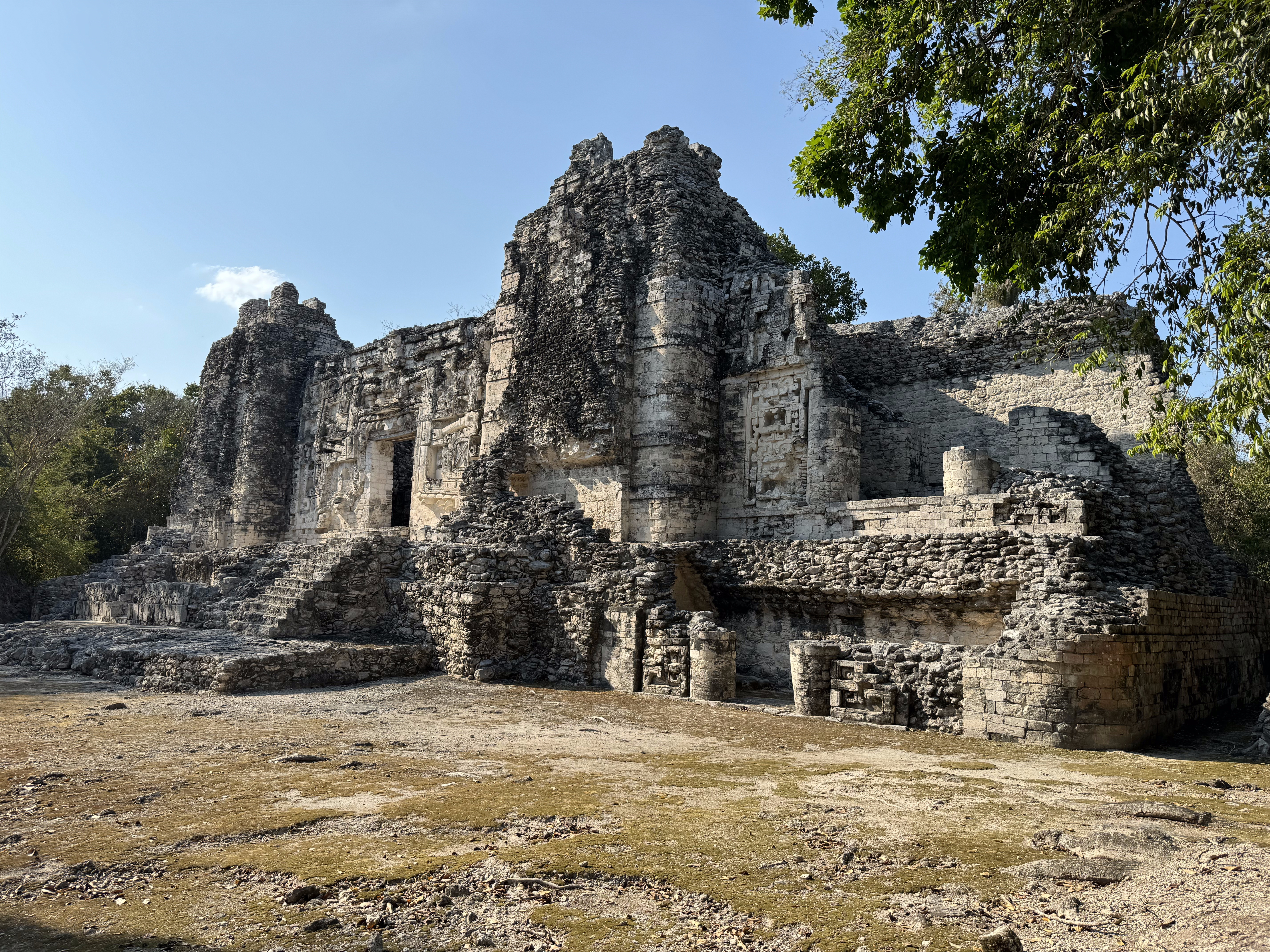
Then boom! Hormiguero was unknown to the outside world until Karl Ruppert and John Denison "discovered" it in 1933 on an expedition sponsored by the Carnegie Institution. How did they find it? Not by wandering around with a machete. Before they got started, they hired a chiclero (a hunter of the sapodilla trees that yield the gum once used in chewing gum) to spend four months asking other chicleros for information about ruins they knew of. Tatiana Proskouriakoff points out the irony: "Oddly enough, it is to the gum-chewing habit of our sedentary city-dwellers that we owe what little knowledge we have of the mysteries hidden in this deserted land." (Archaeological Reconnaisance in Campeche, Quintana Roo, and Peten, Carnegie Institution Publication 543, 1943, p. 1; Proskouriakoff, An Album of Maya Architecture, 1963 ed., p. 51.)
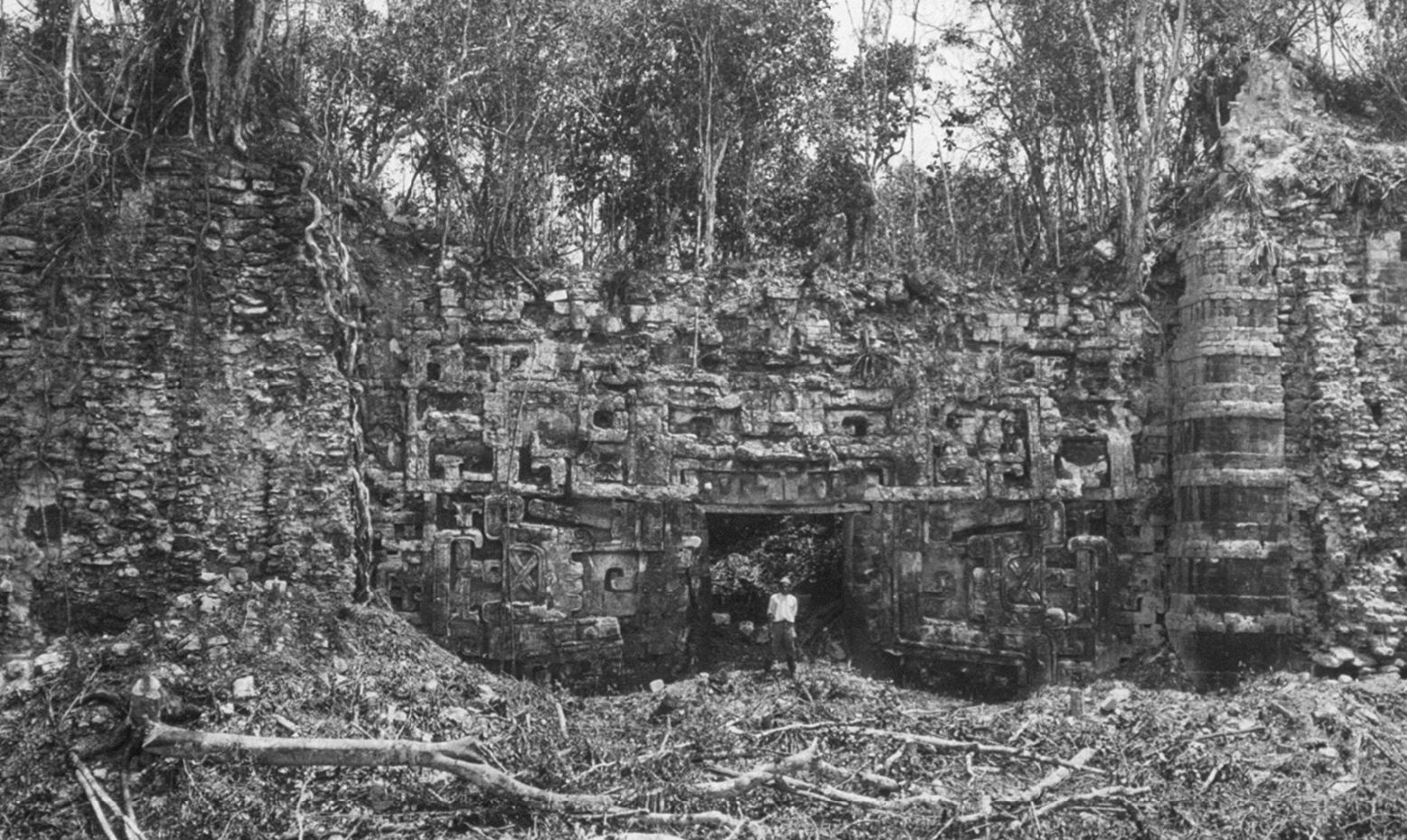
Here's a photo taken during that pioneering expedition of 1933. Ruppert and Denison: "it is possible that under the debris at the base of the stairway some of the steps may be in good condition" (p. 38). And so it proved to be.
The Carnegie Institution worked on Maya ruins from 1902 until 1958. Its archive was transferred to Harvard's Peabody Museum, which subsequently put the archive online at https://www.artstor.org/collection/carnegie-institution-washington-photographs-mayan-excavations/
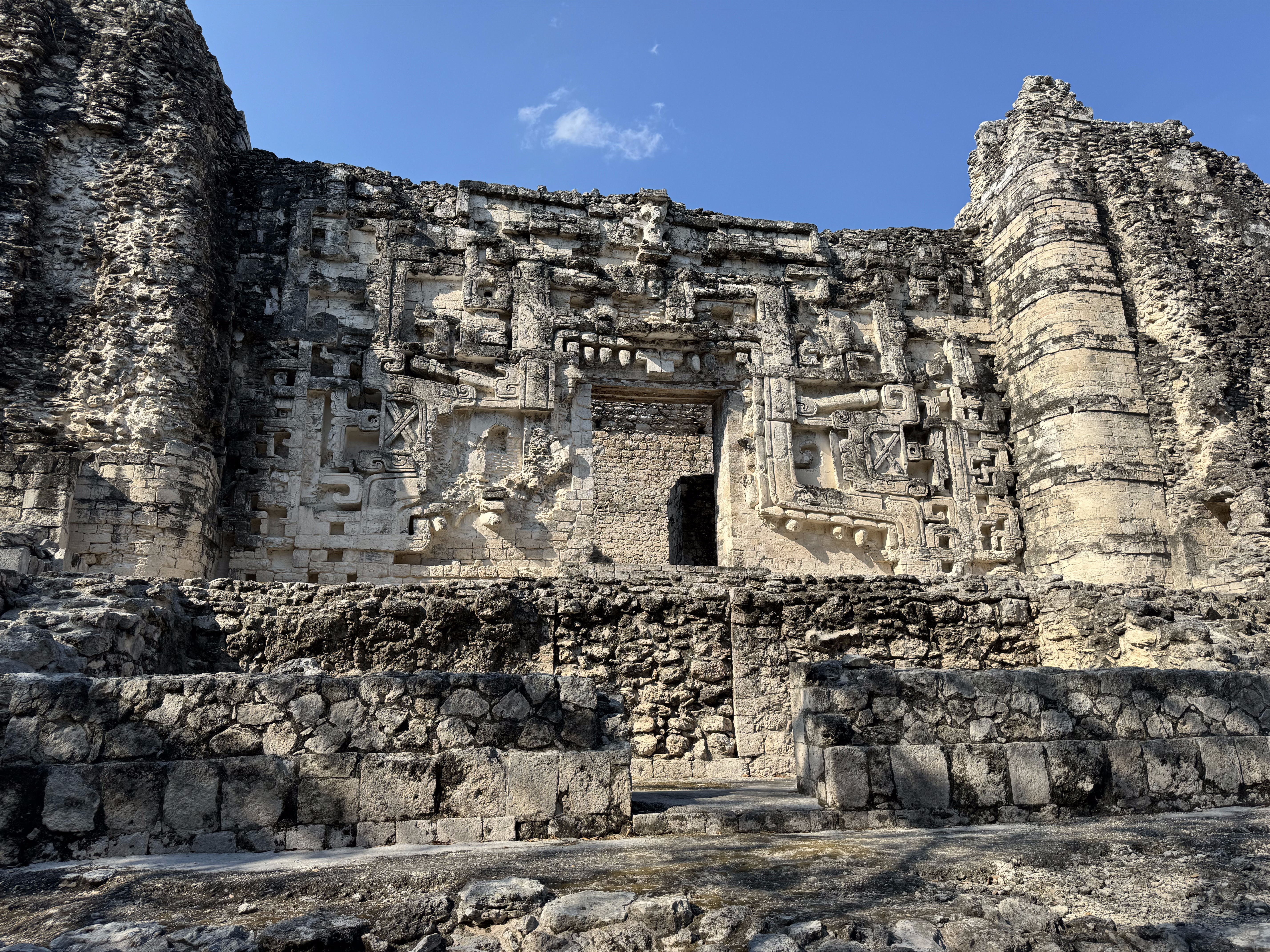
See the mouth, with teeth? See eyes? Ruppert and Denison: "The motif of the face decoration above the doorway is a mask with the teeth projecting down over the lintel, and to either side is an elaborate serpent face in profile" (p. 37). The report reads like a pathologist's. A less clinical visitor, the late Paul Gendrop, writes: "Upon gazing at these gigantic menacing jaws we can recall one of the invocations of Itzamna as Hapayc n, 'the serpent that imbibes or swallows" Gendrop considered the figure to be a personified version of a sacred mountain where a cave entrance led to a world of supernatural beings and ancestors who could bring "benefits from the beyond...." (Gendrop, Rio Bec, Chenes, & Puuc Styles in Maya Architecture, 1998, pp. 72 and 89, online at https://mayaruins.com/hormiguero.html )
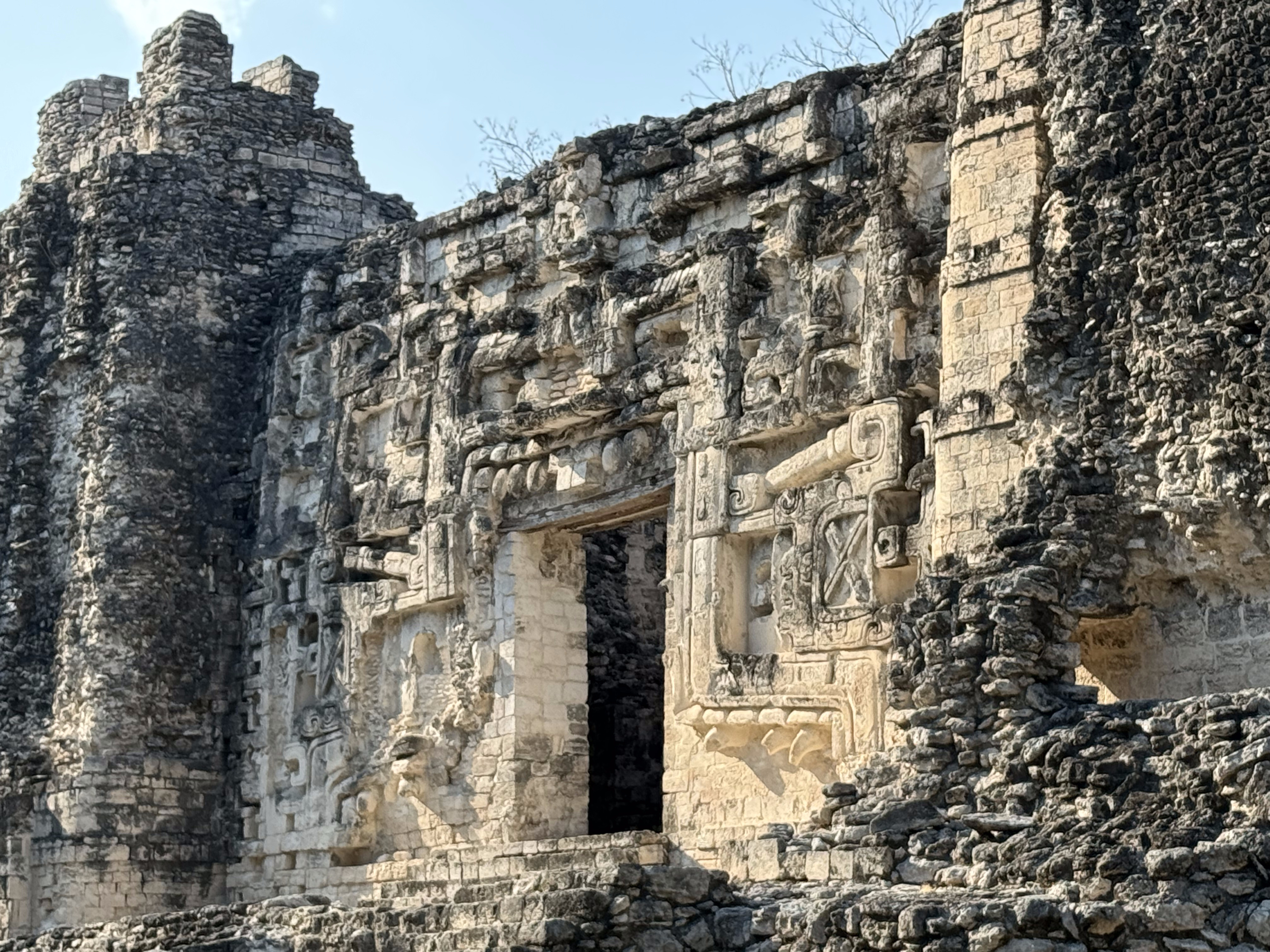
Gendrop: "And if, to our Western eyes, this recalls some Dantean vision of hell, it must have been for the Mayas of the time a poetic and stimulating sign of life and hope" (Gendrop, p. 72).
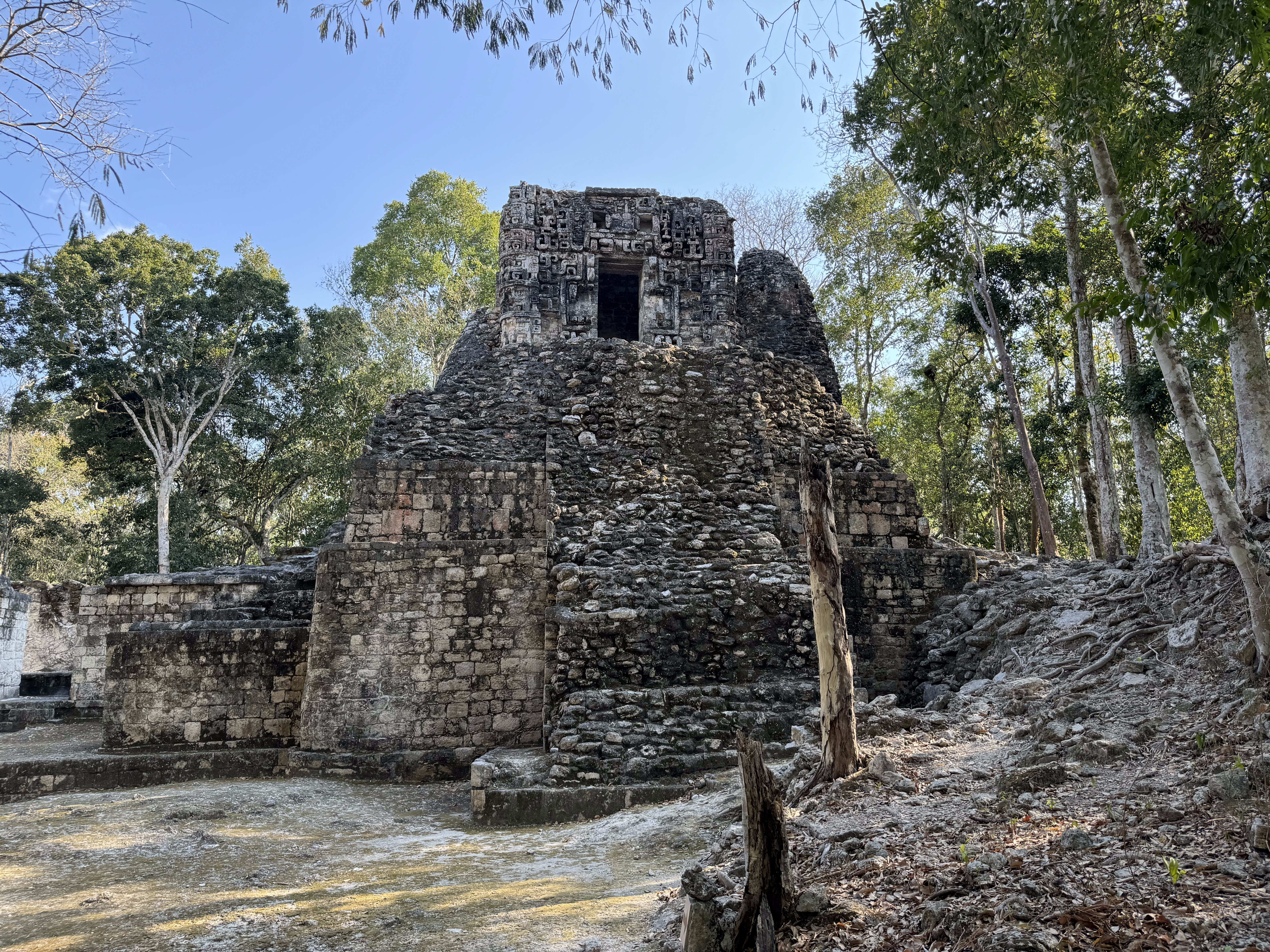
There's at least one other large structure at Hormiguero. See what's up top?
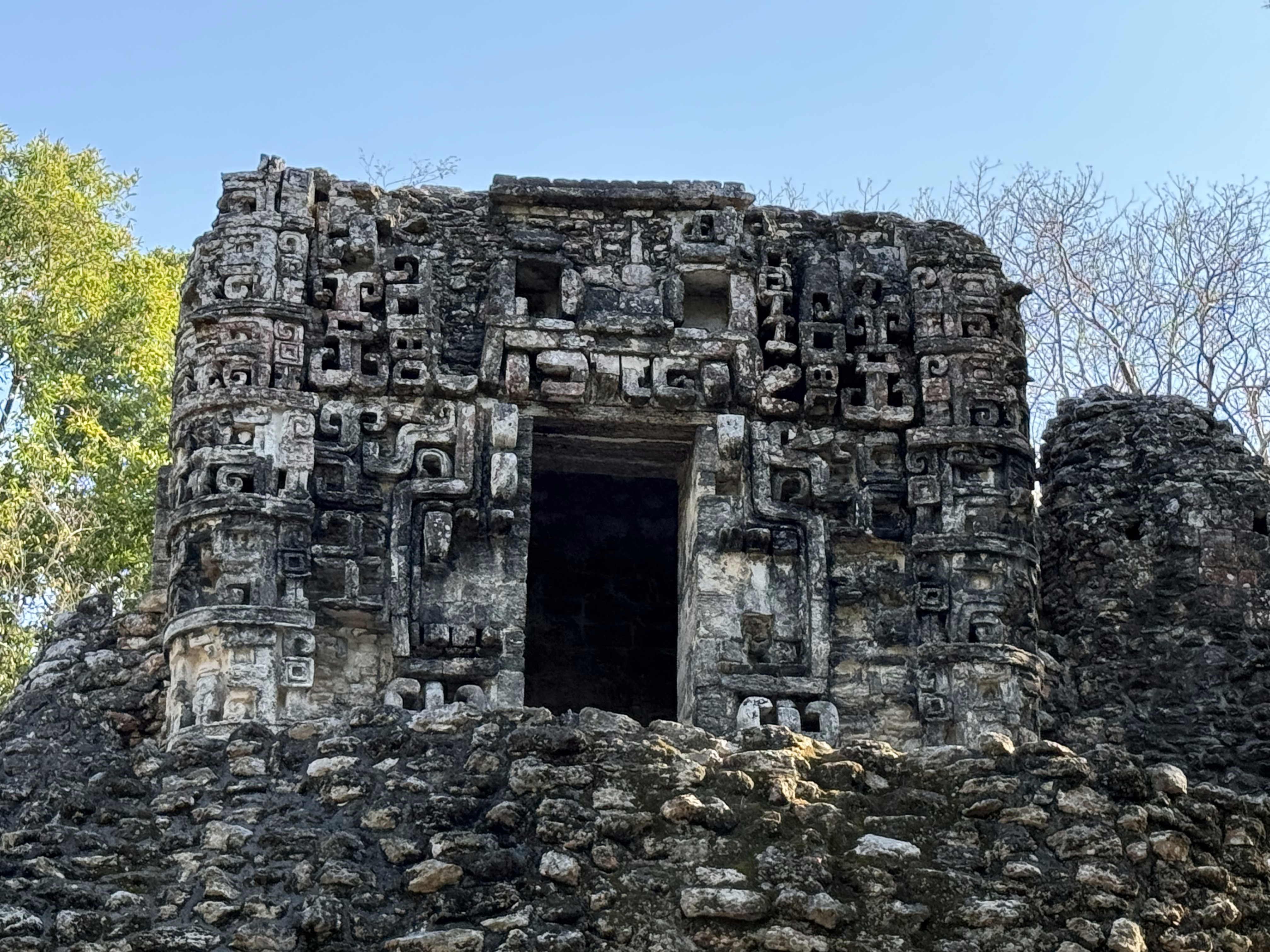
Ol' Toothy. There was nobody here except me and a large Mexican family. They were spread out a bit, and I asked a young woman what she thought about this facade. She replied, "We call it the Earth Monster." I said that when I looked at it I thought that I was seeing what Donald Trump wanted to be, a creature captivating us, holding our attention, allowing us to focus on nothing else. She laughed and replied, "Very true."
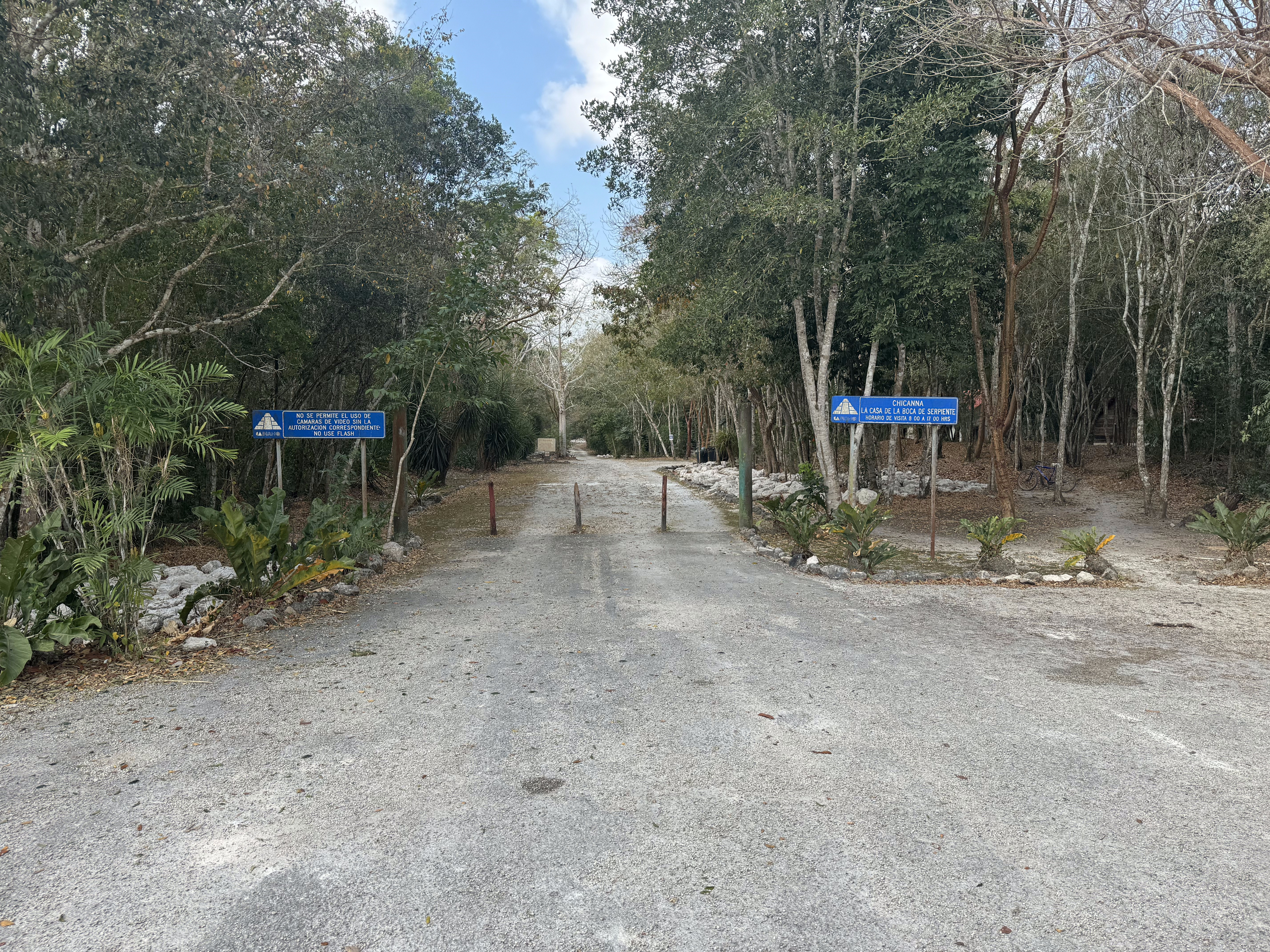
Jack Eaton, whom I quoted a moment ago, in 1966 discovered a site he named Chicanna about seven miles north of Hormiguero. (I can put discovered in quotation marks if you insist.) Chicanna means Serpent-Mouth House. Guess why.
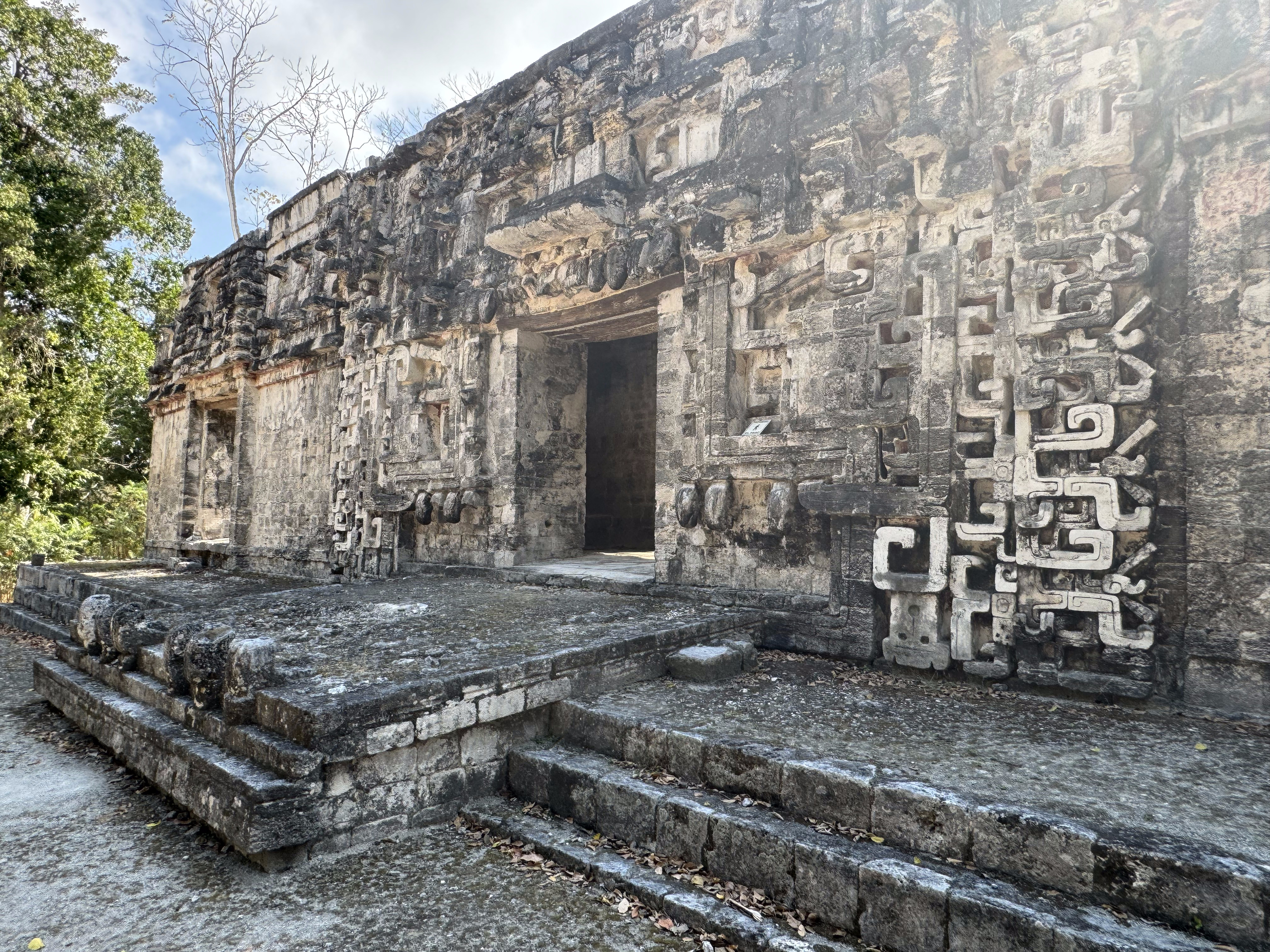
Oh, for a better photographer. This is Chicanna's Structure 2, with teeth above the door and lower teeth at the edge of the porch. The temple was originally painted red, a fact revealed at the far right. The color survived because it was covered by plaster that fell off in 1986.
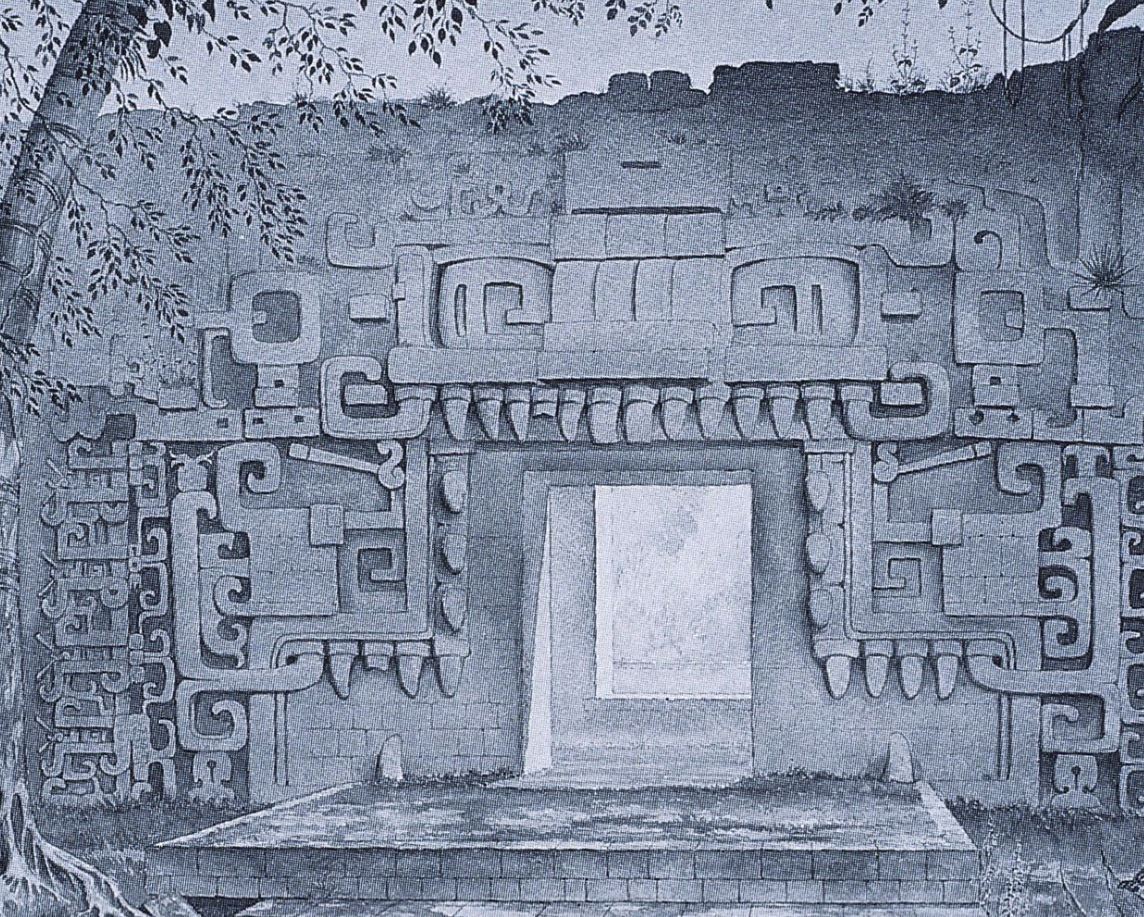
A drawing helps. The teeth of the jaw are missing for some reason. (The drawing, uncredited, is online at JSTOR under Artstor Chicanna.)
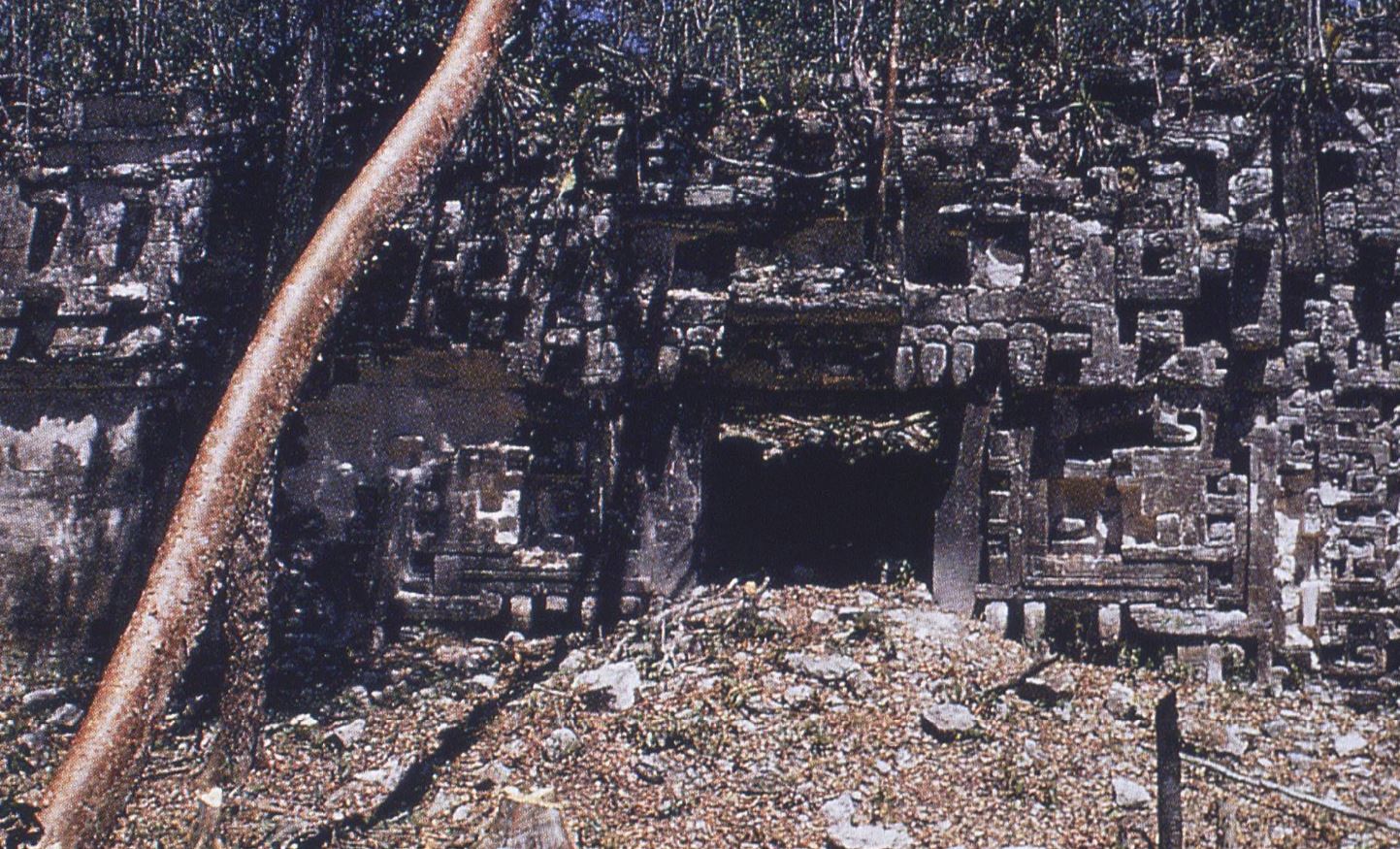
Here's the ruin as it appeared when found. The late but stalwart photographer Joyce Kelly wrote that, if she had discovered this place, "I would have fainted." (See her The Complete Visitor's Guide to Mesoamerican Ruins, 1982, p. 333. This uncredited image is also online at JSTOR under Artstor Chicanna.)
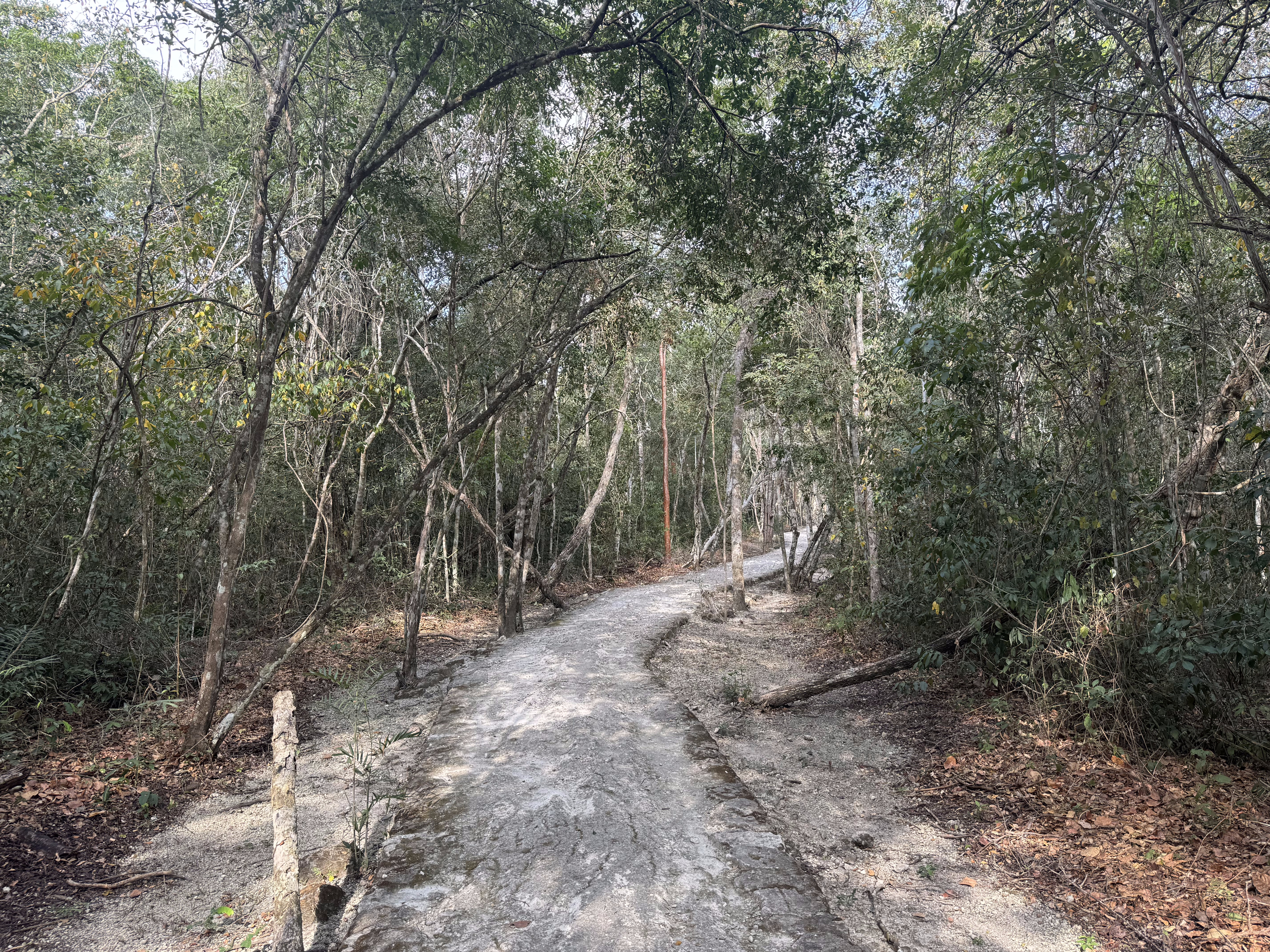
Seven years later, in 1970, Eaton was cutting his way through the forest. We can just take the path.
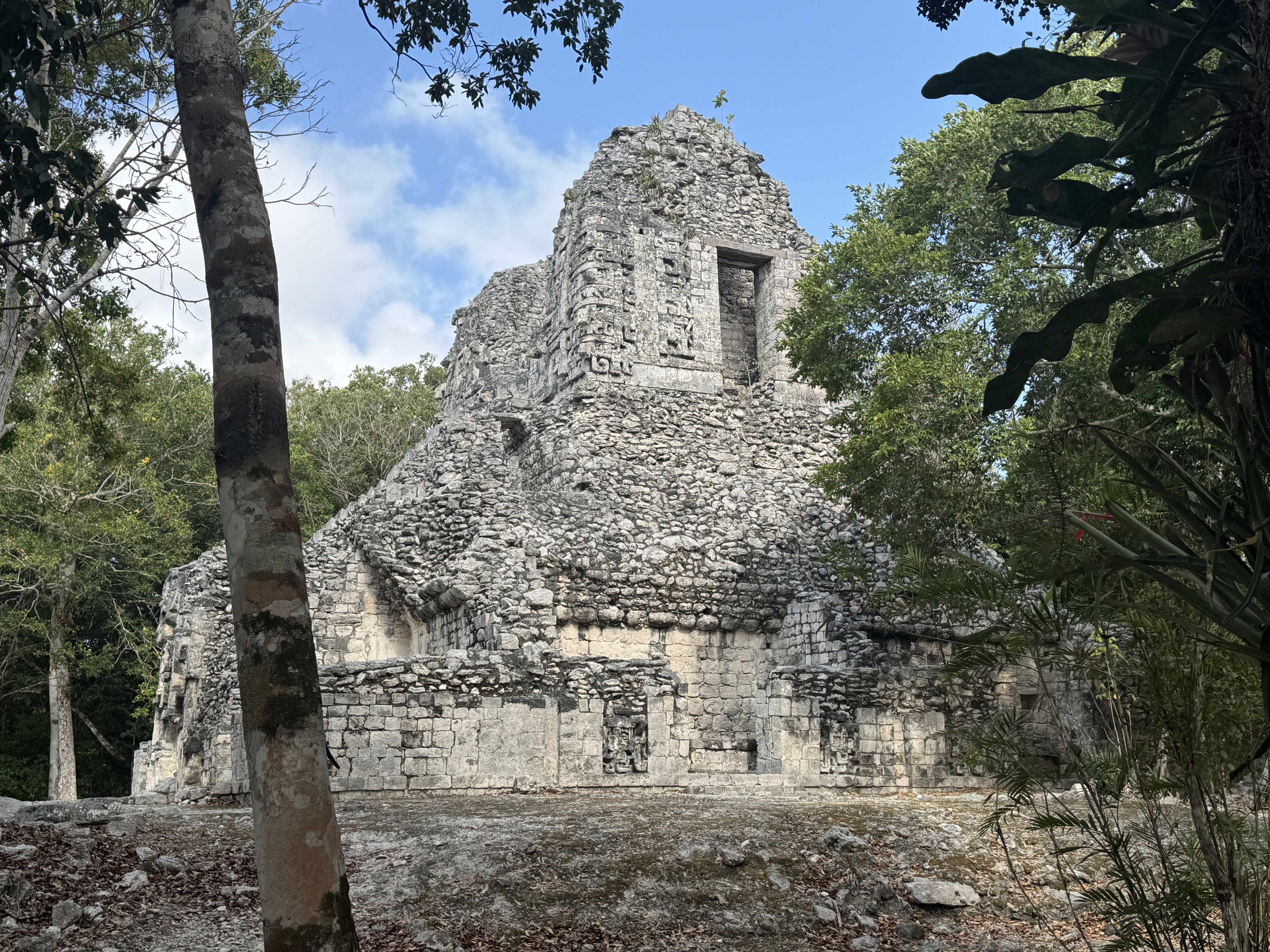
He found this, now with impeccable logic called Structure 20.
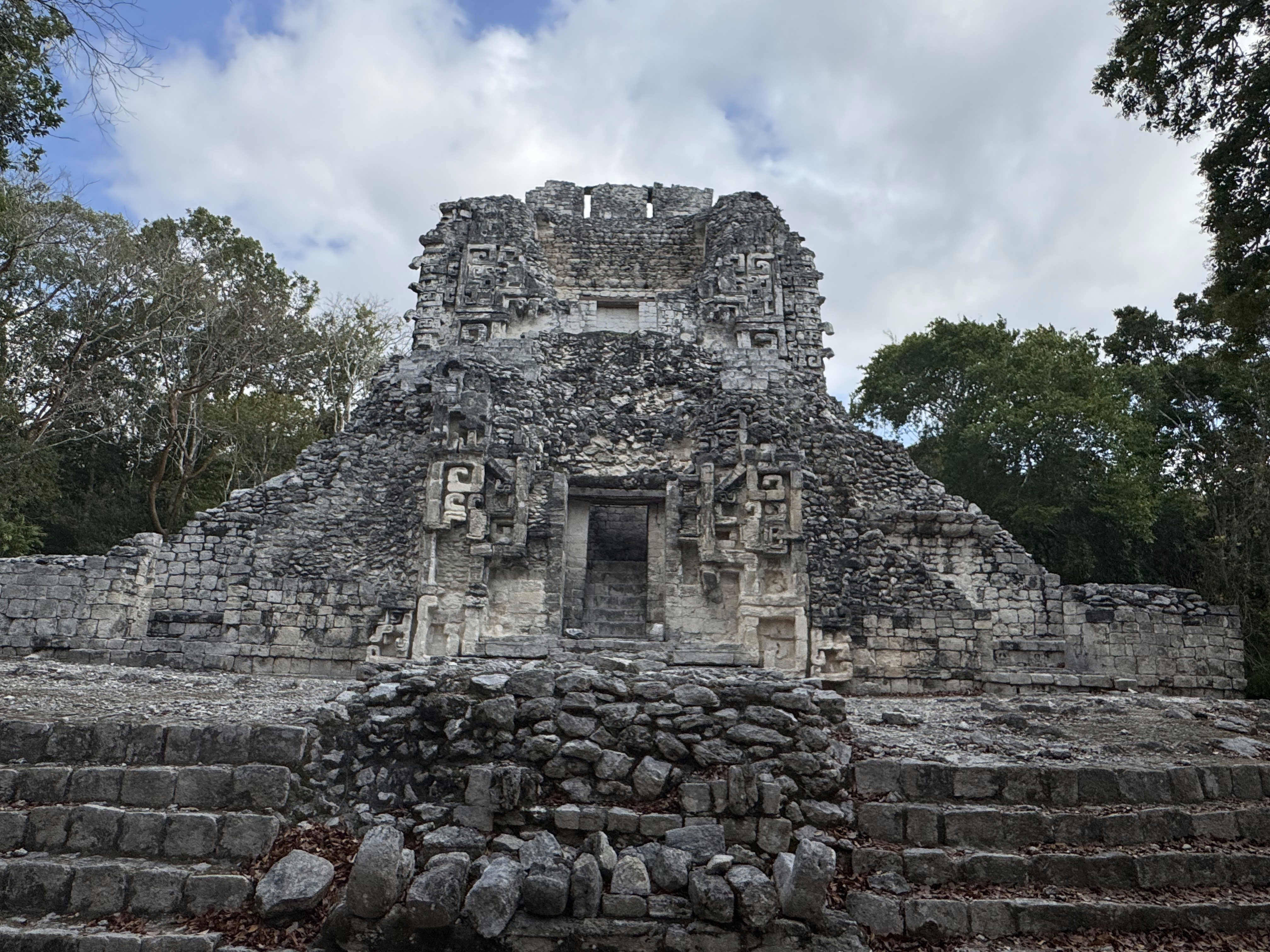
See the snaggle teeth in the foreground? We can skirt them and go up the steps to see the towers.
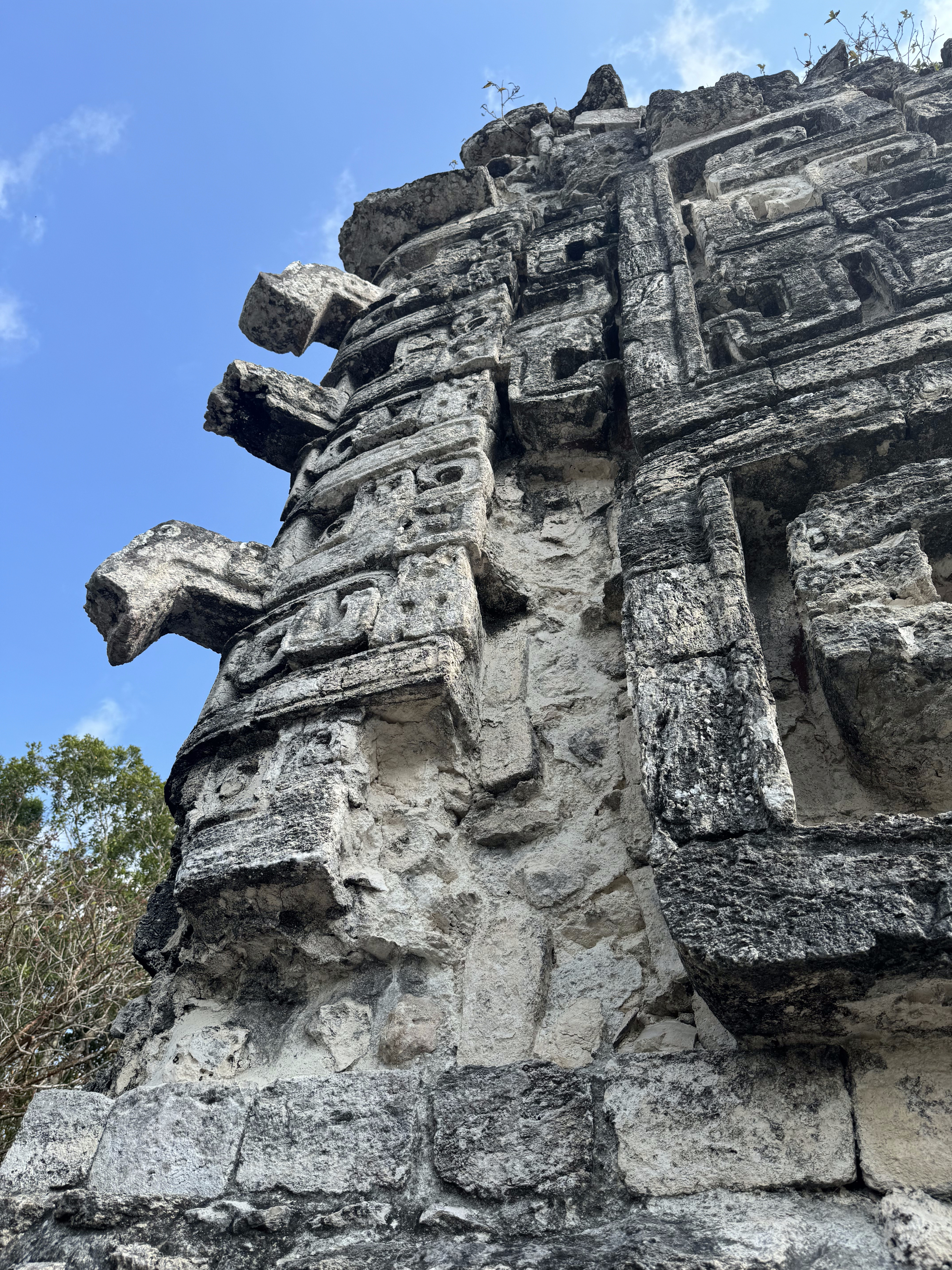
Flower Mountain masks.
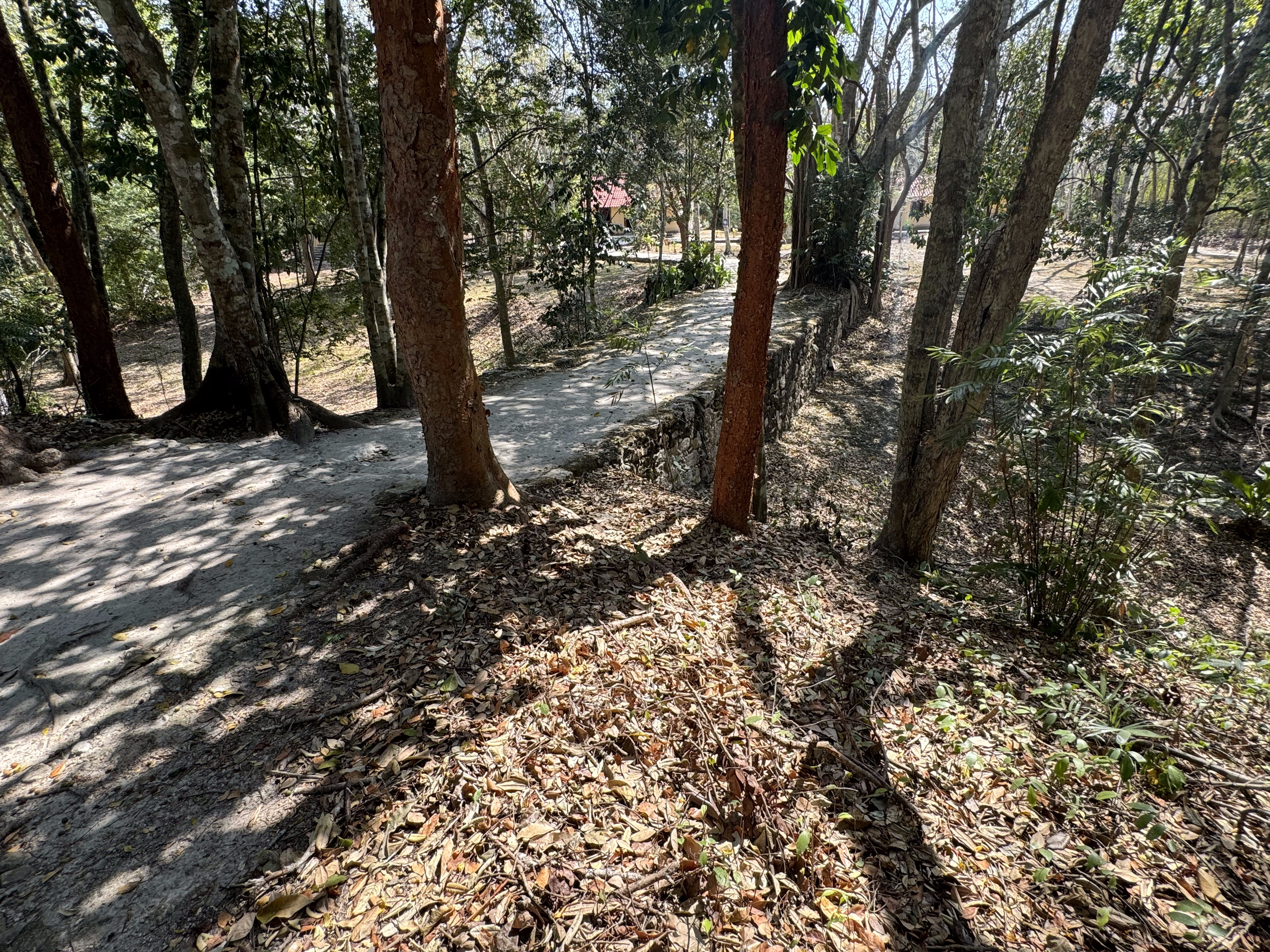
There's more at Chicanna, but here's a path leading to Becan, "discovered" in 1934 by the same Karl Ruppert and John Denison who found Hormiguero. You'd think that if they found this place they would also have found Chicanna, which is only a mile and a half away, but Chicanna remained hidden for another 30 years.
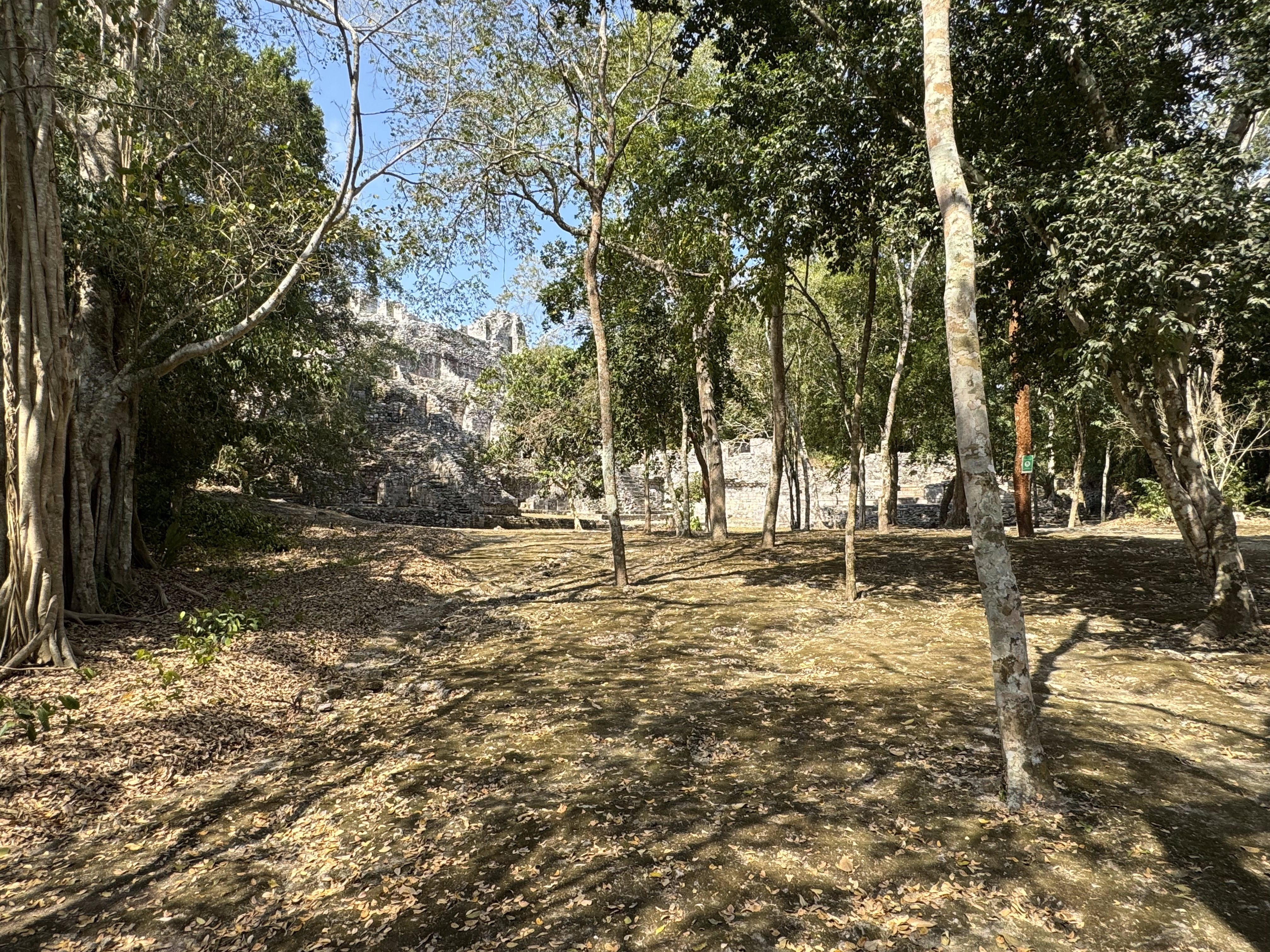
Something looms.
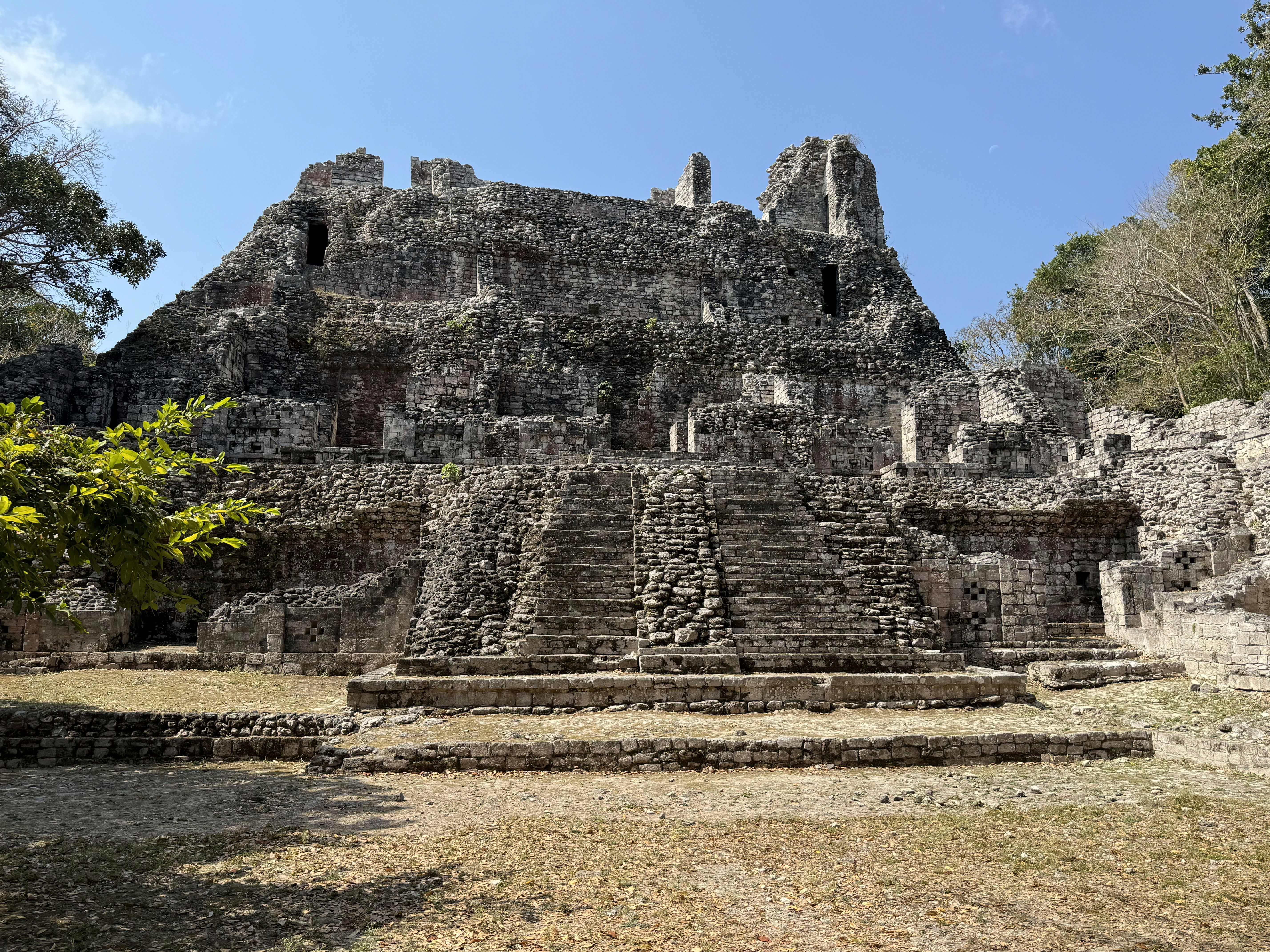
It's Structure 4, "consolidated" in 1969-71 by E. Wyllys Andrews IV, director of a project funded by the National Geographic Society and Tulane's Middle American Research Institute.
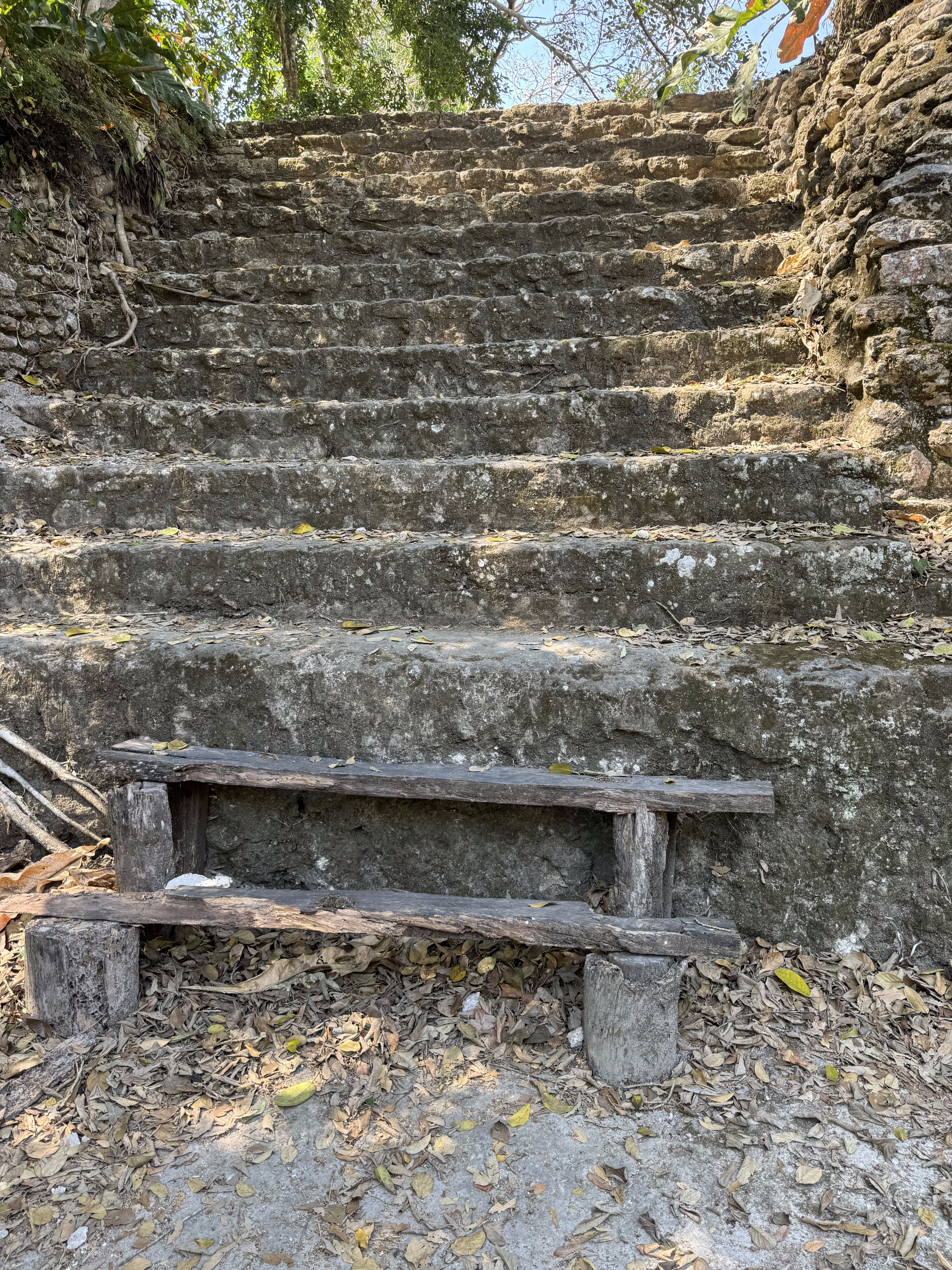
Thank you.
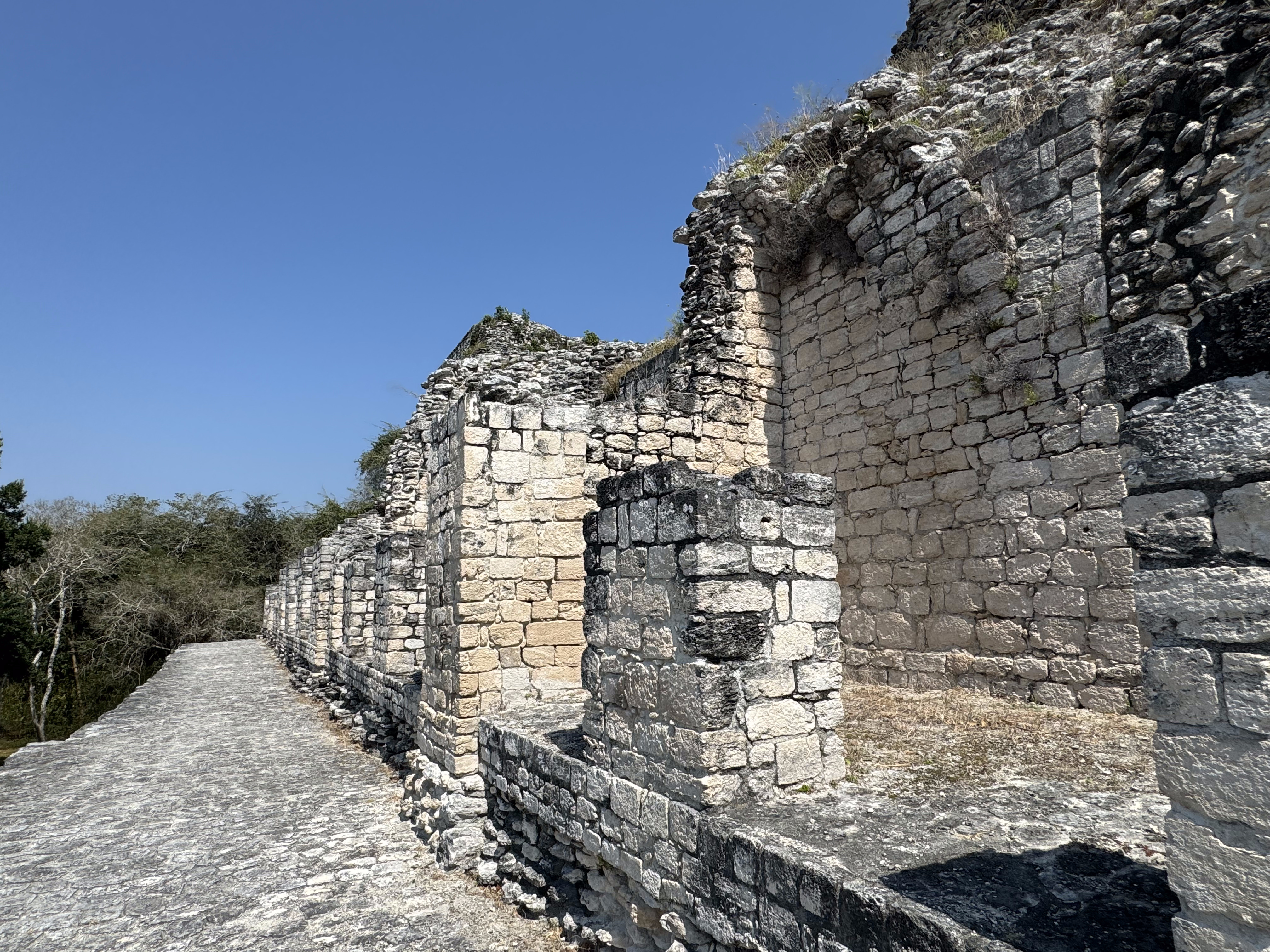
Unlike Uxmal, you can climb to your heart's content. How much is original? How much has been put back in place ("consolidated") or entirely replaced? Hard to tell.
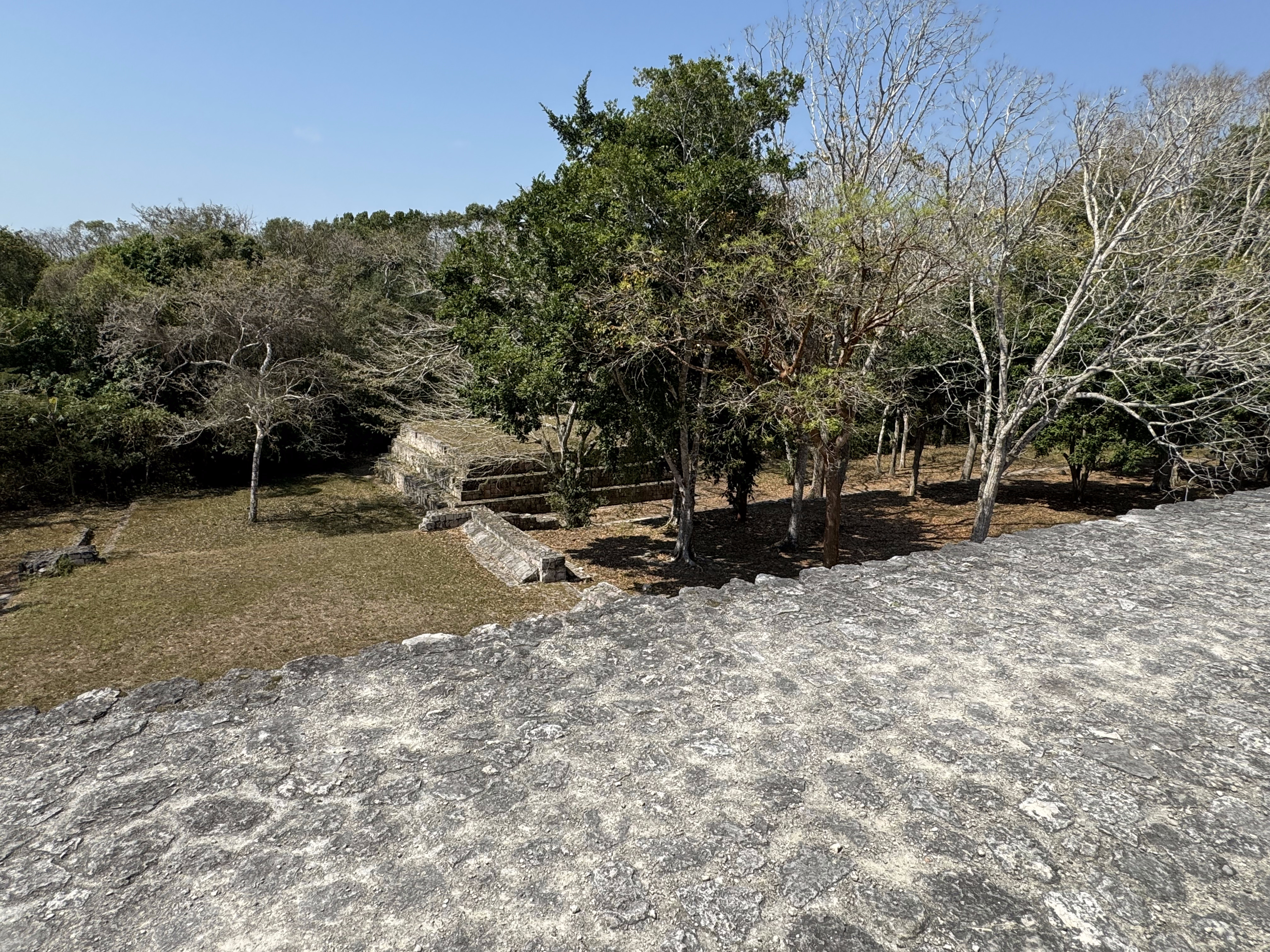
Forest at bay.
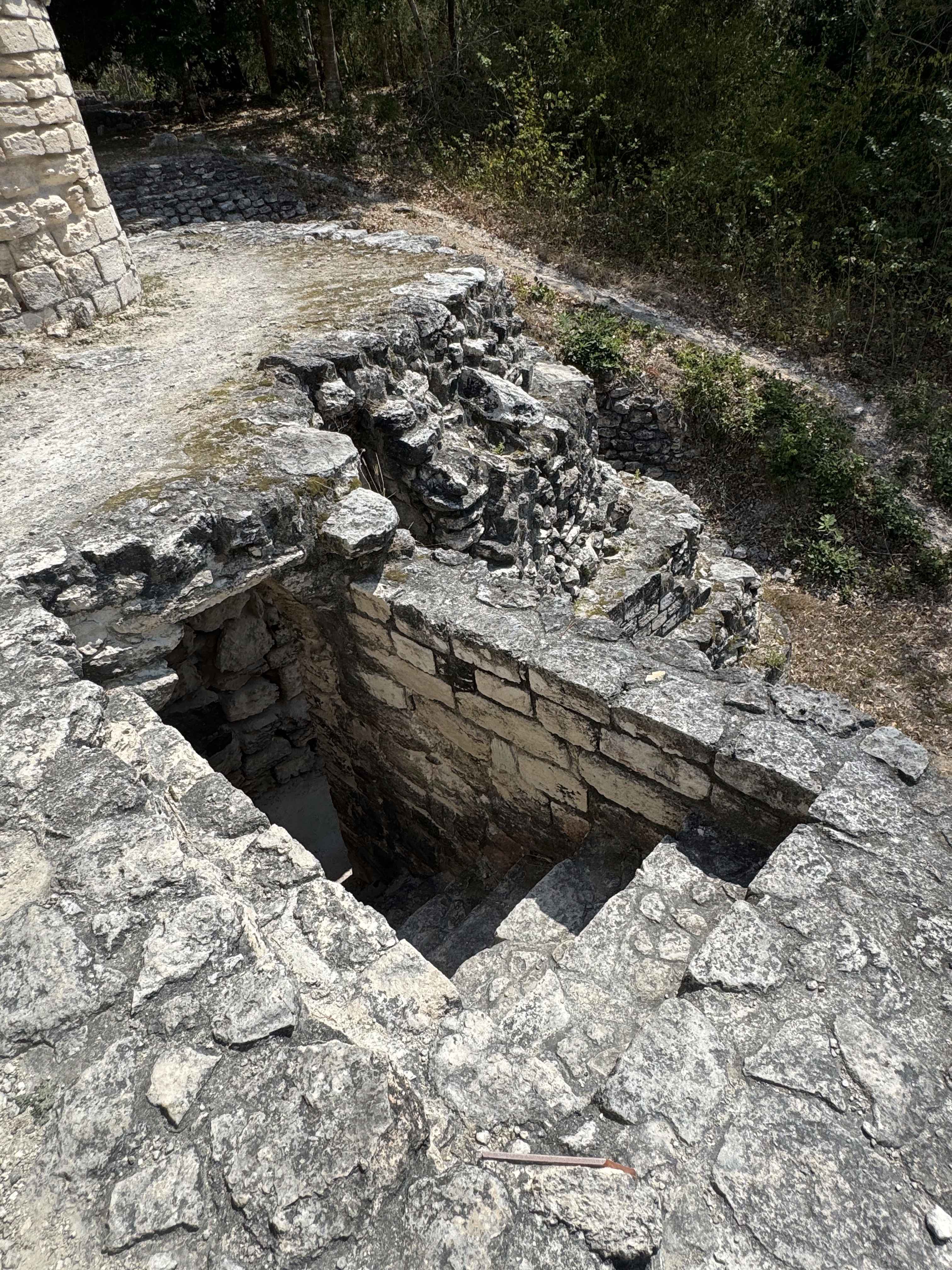
If this was the U.S., these stairs would be waiting for a lawsuit.
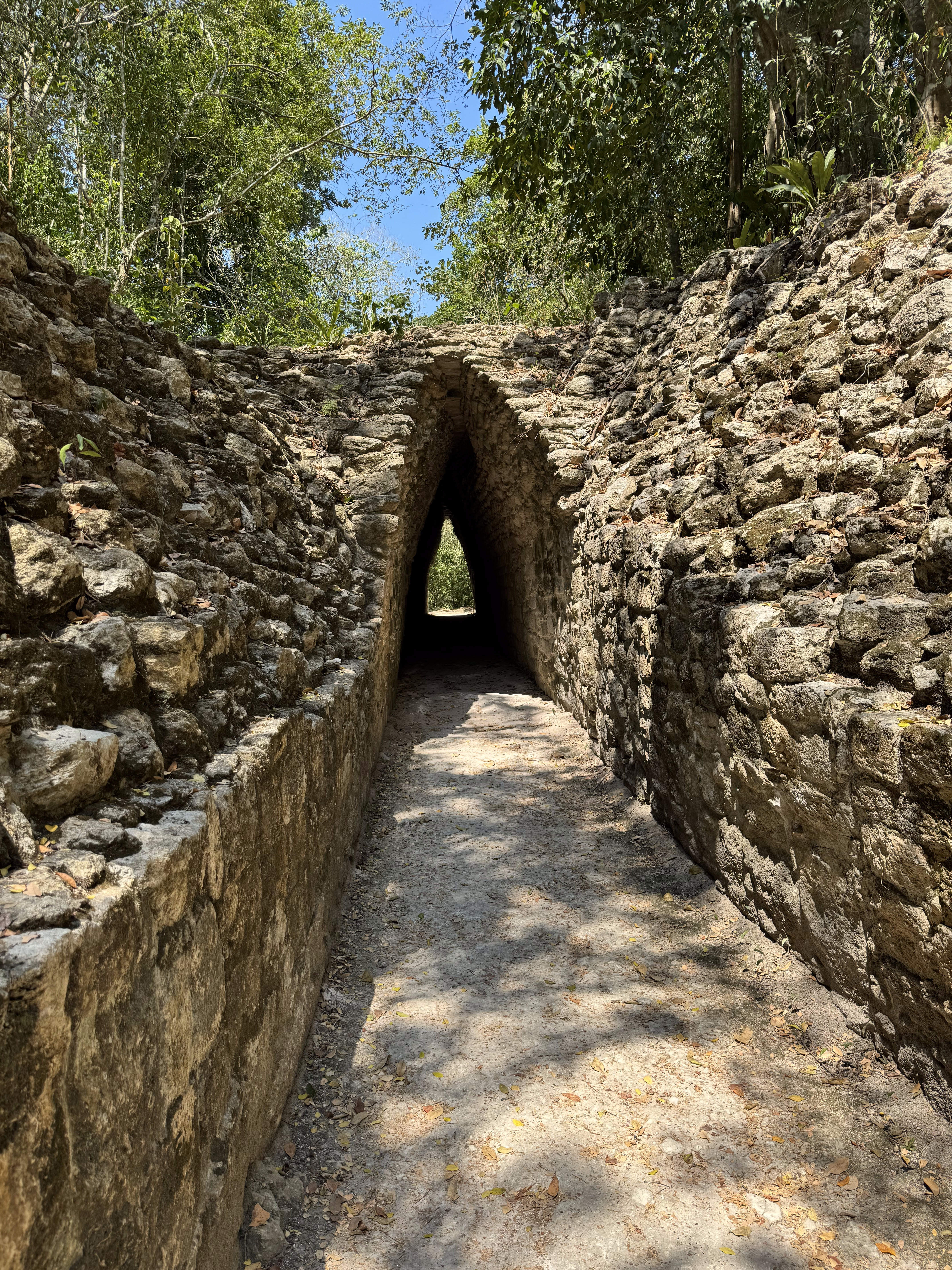
A Maya arch on the path toward Structures 9 and 10.
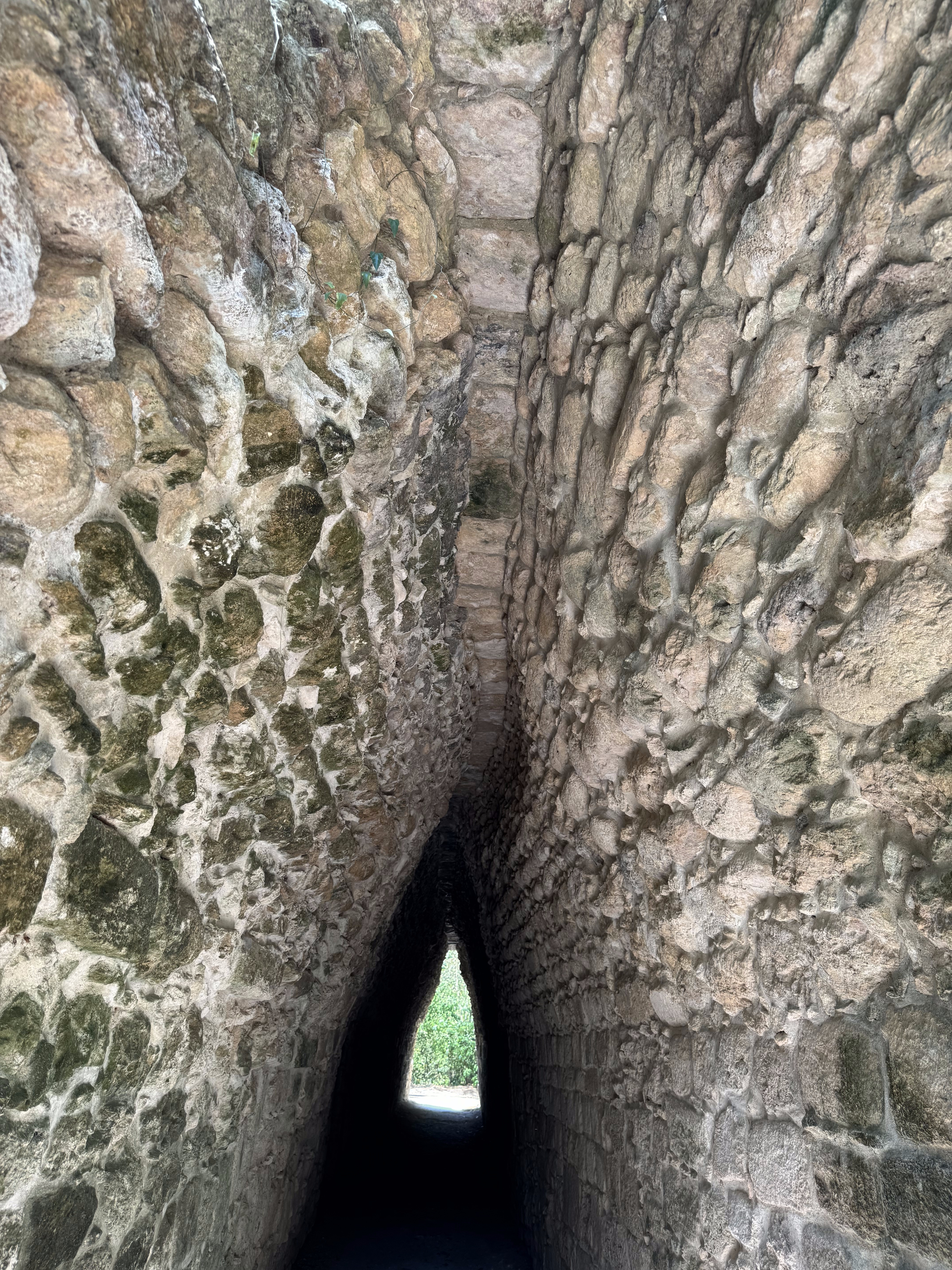
View from inside. Is it old? New? Hard to tell.
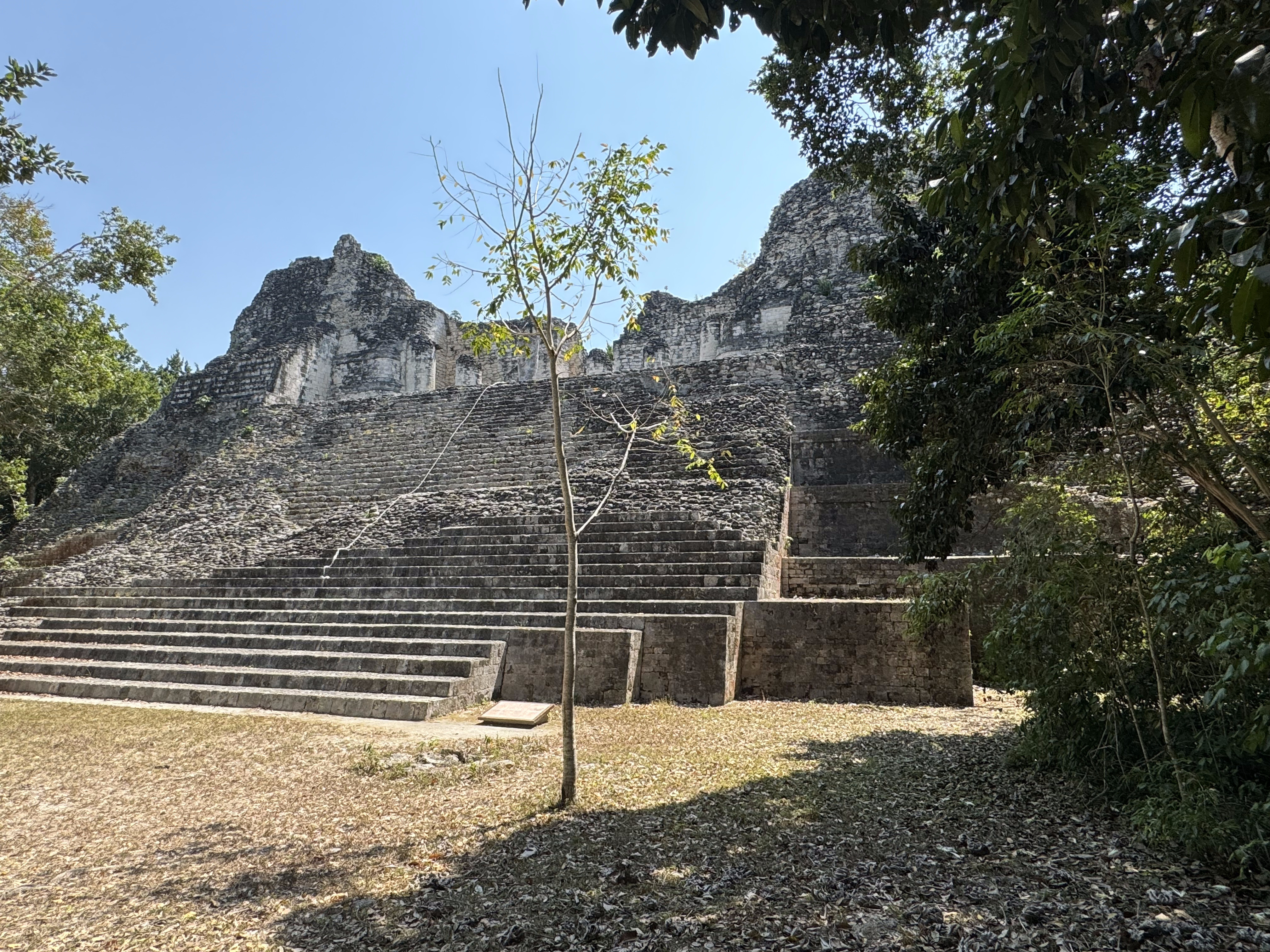
Structure 8, at one side of the Central Plaza.
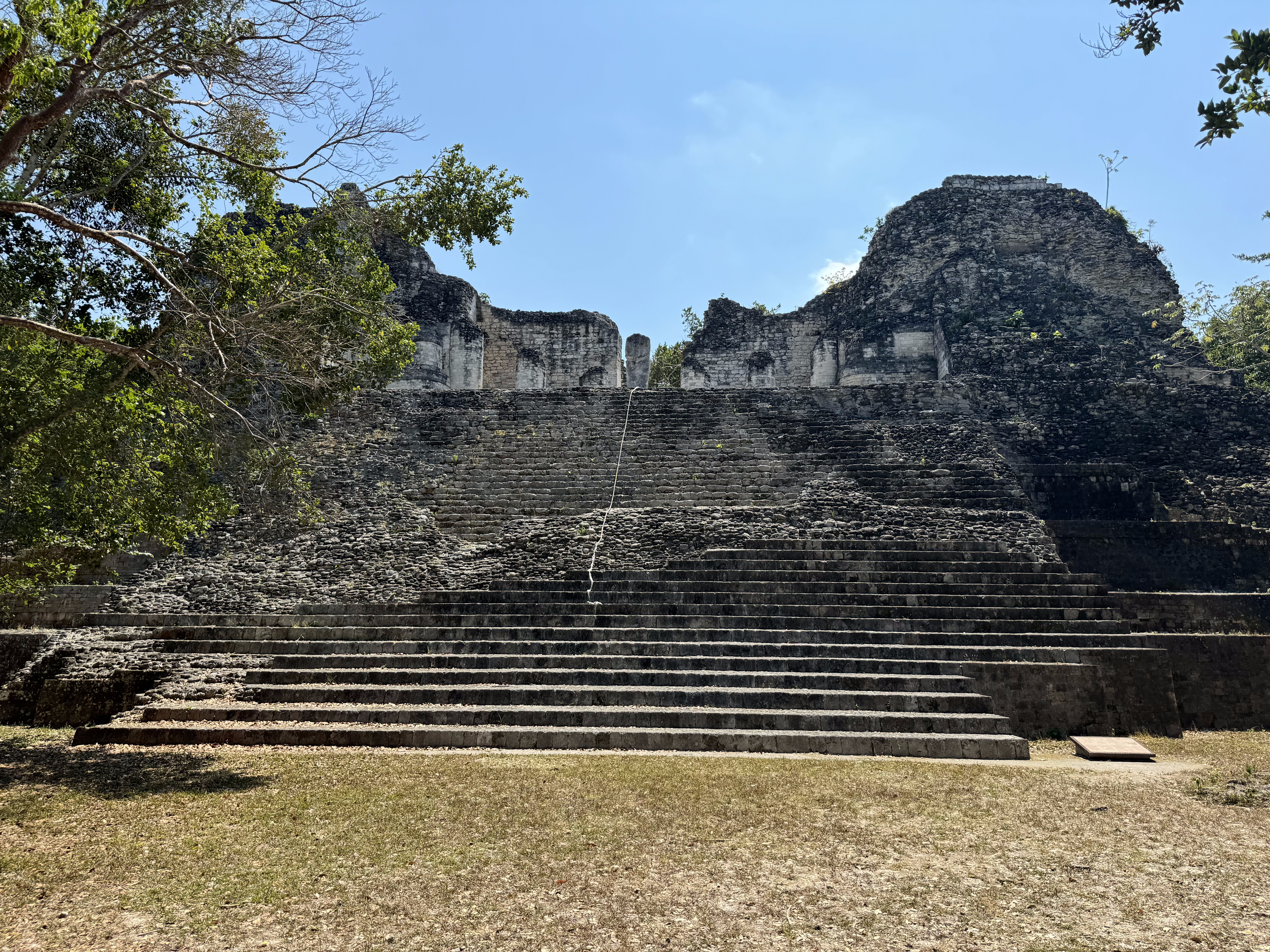
You should run up there and check the steles. I'll wait down here.
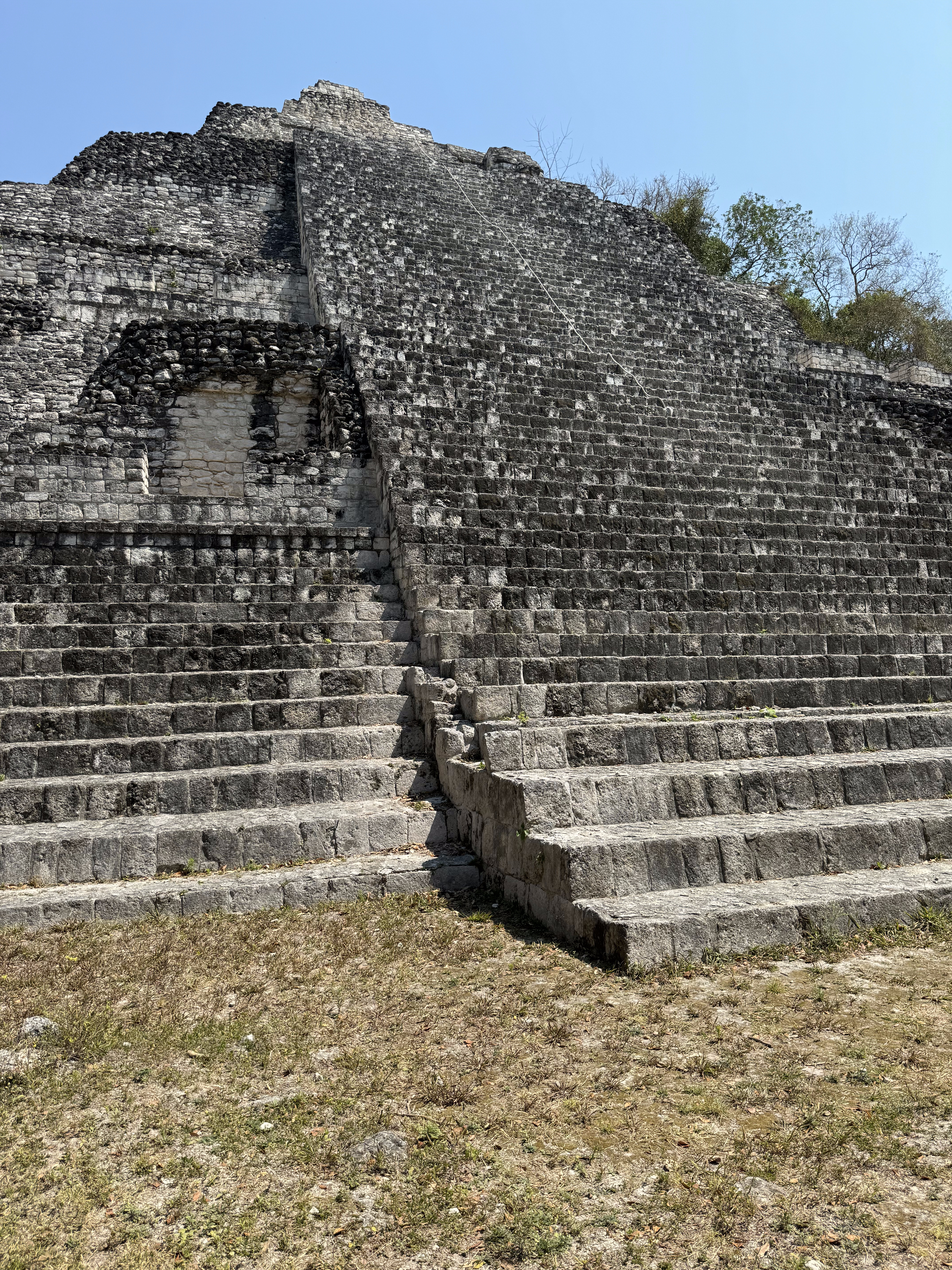
Structure 9 is Becan's highest pyramid, but before you run up let me say that the steps were in ruins when Ruppert and Denison saw them in 1933. Thank the boys from Tulane for restoring them. Don't believe me? Here's the scoop straight from Tulane: "Structure IX, by a considerable margin the highest structure at Becan, fronts about half of the long north side of the central plaza. Little remains in view except the impressive mound, so the view of the structure shown on the bird's eye drawing of the site is conjectural in its details and intended as noncommittal regarding influence from Tikal, Teotihuacan, or elsewhere. Ruppert reported this pyramid as rising 32 m above the plaza, with a ruined stairway on the plaza side and a probably structure at the top, of which no walls were visible." (David F. Potter, Maya Architecture of the Central Yucatan Peninsula, Mexico, Middle American Research Institute Publication 44, Tulane University, 1977, p. 10.)
While you climb, I'll sing for you. I've already chosen the song. It's Jackie Wilson's "(Your Love Keeps Lifting Me) Higher and Higher." After all, the song is about the same age as the steps.
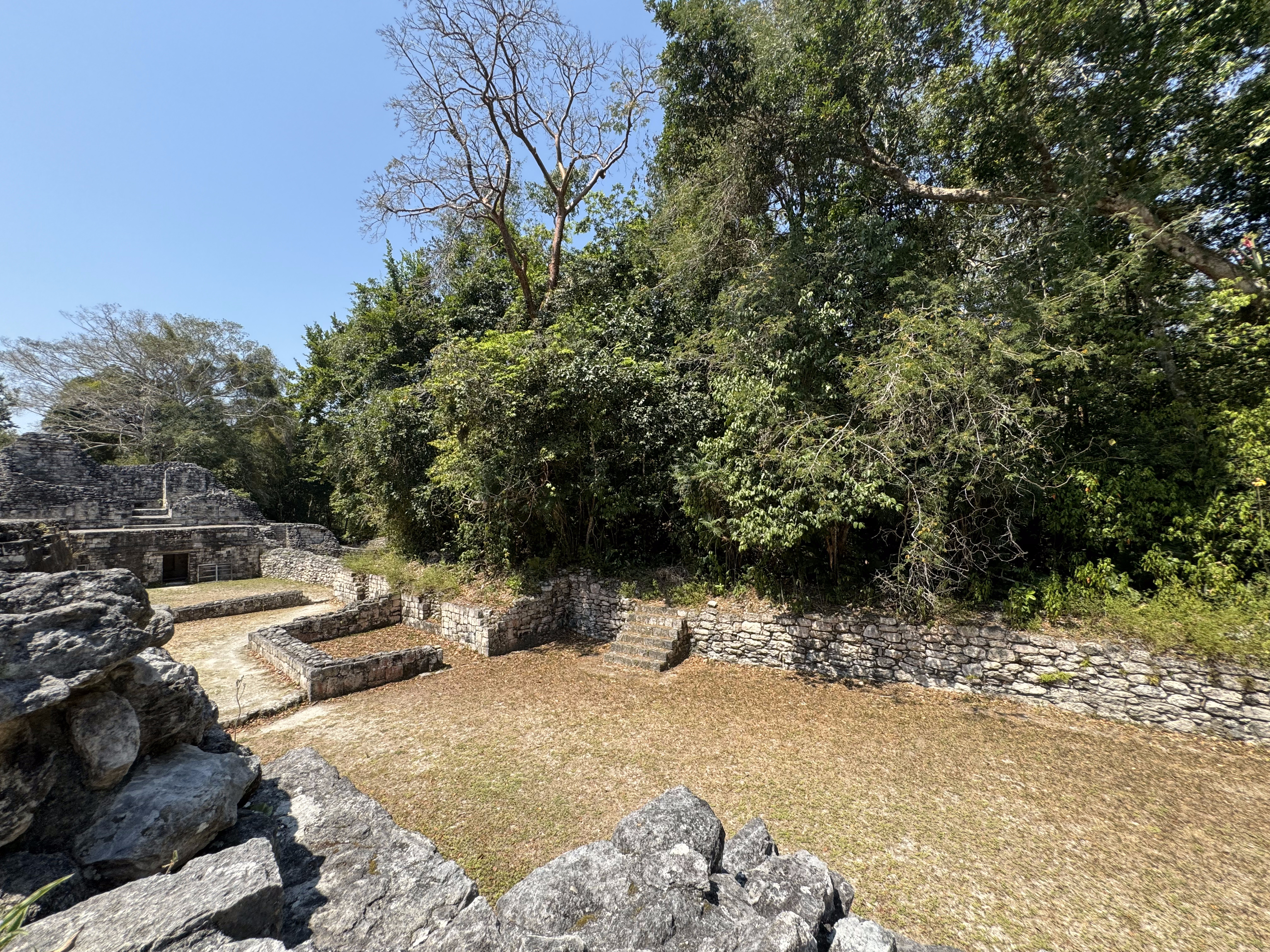
No crowds at all. Nobody in this courtyard behind Structure 10. I'm just not sure if the ghosts are a thousand years old or 50.
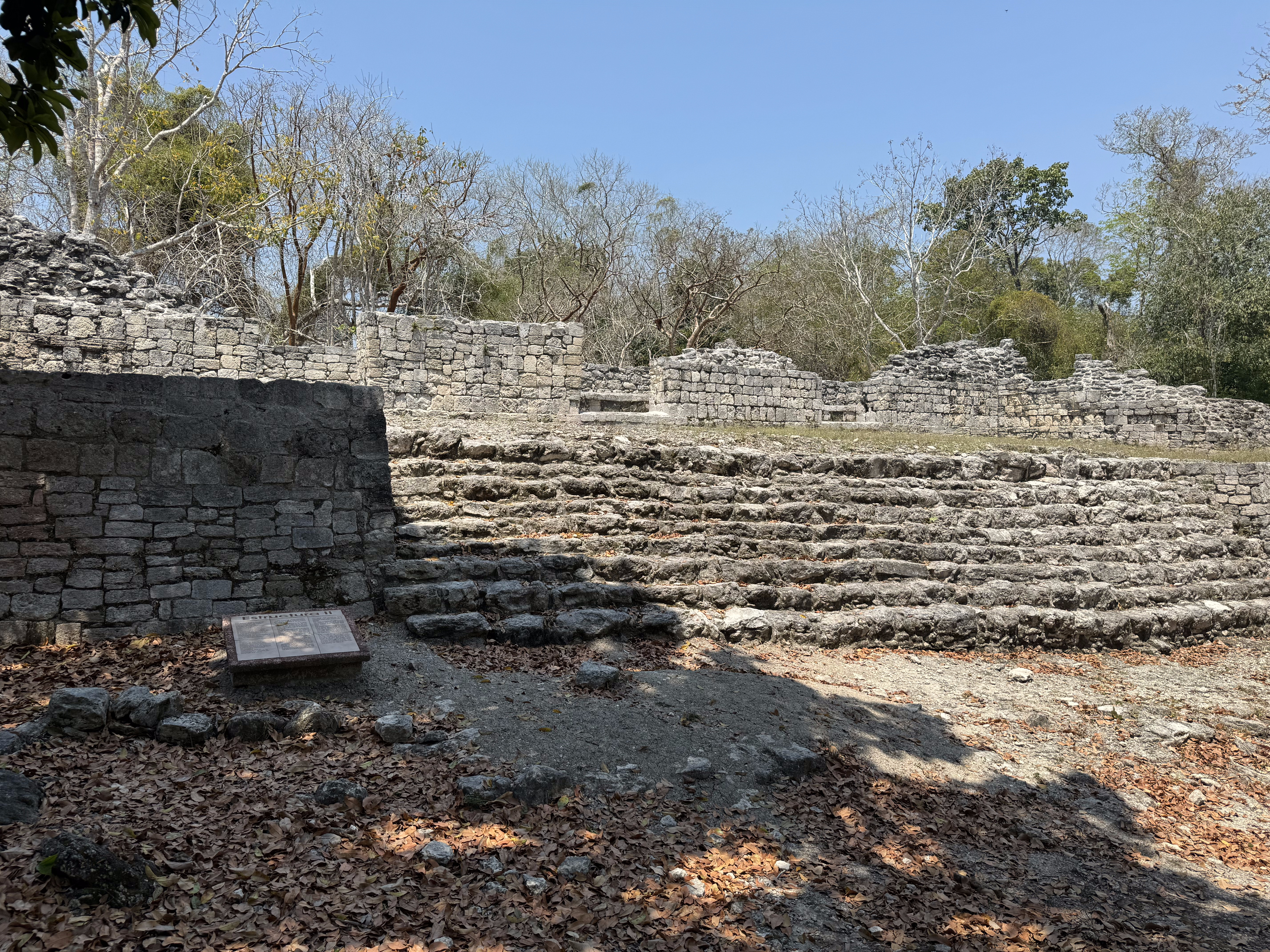
We've jumped four miles to the east to the Xpuhil ruins. You're not impressed, I know, but this is just the foundation of a house. Why is it here?
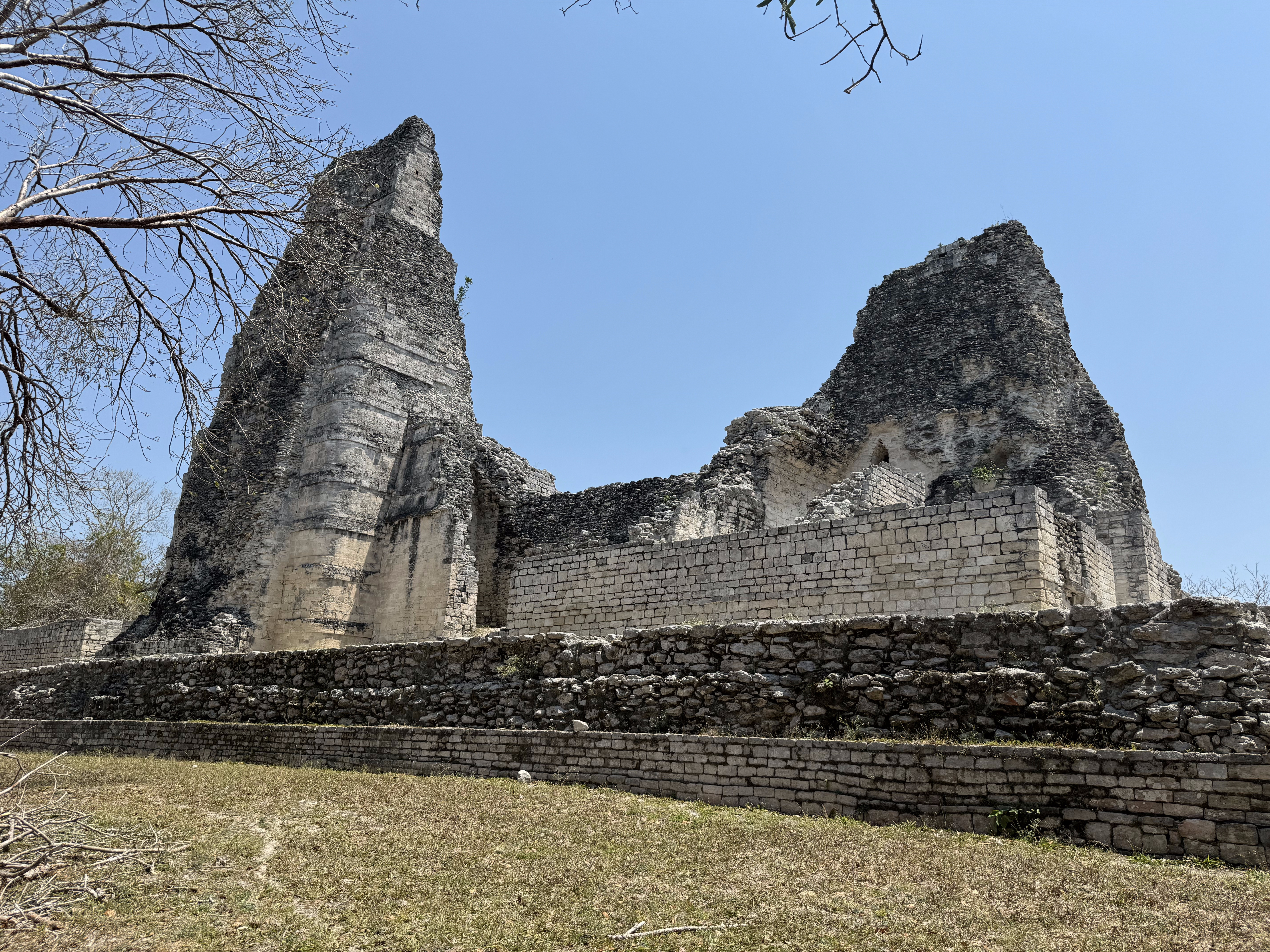
It's here to be close to this Building of the Three Towers (the third tower is hidin). The house we just saw was for someone who was, as we say, entitled.
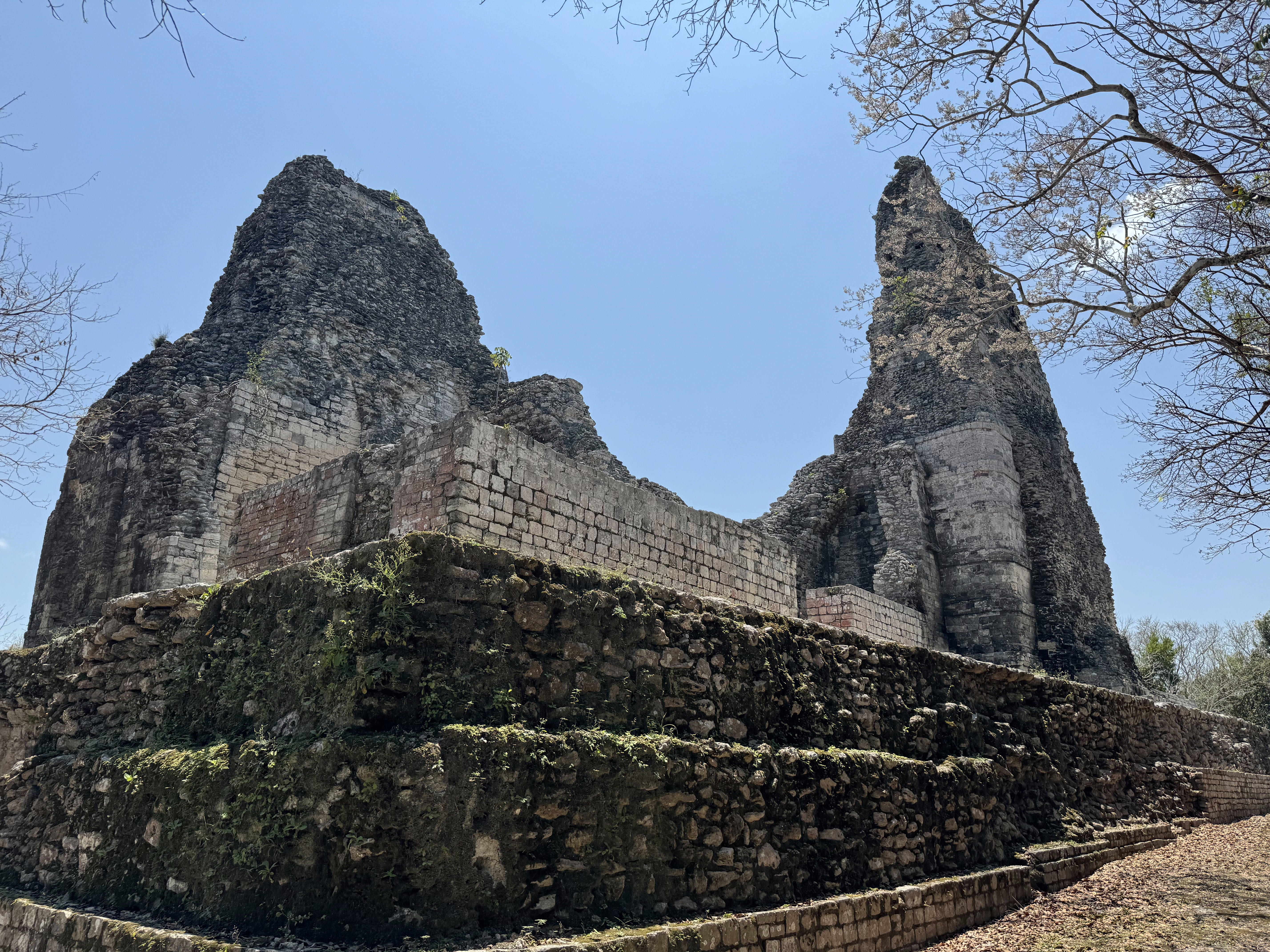
I wish Ruppert and Denison had written something about how they felt when they found this place.
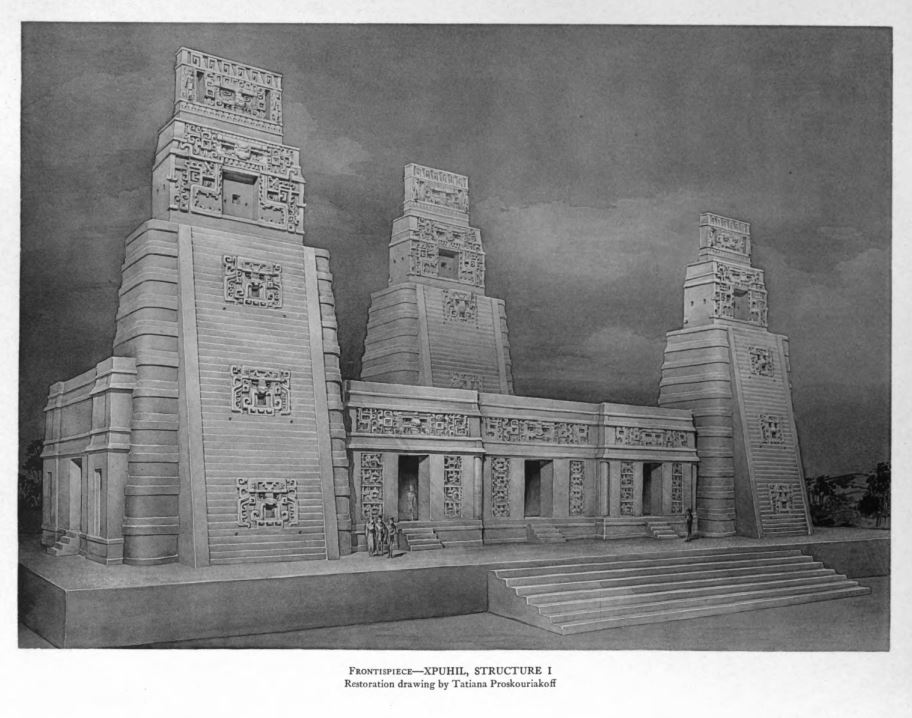
Their report includes this drawing by Tatania Proskouriakoff. It appears as well in Proskouriakoff's An Album of Maya Architecture (1946, 1963 ed. p. 53). The tower steps were always too steep to climb, so the temples up top were non-functional. They were for show, like the fins on American cars in the '50s.
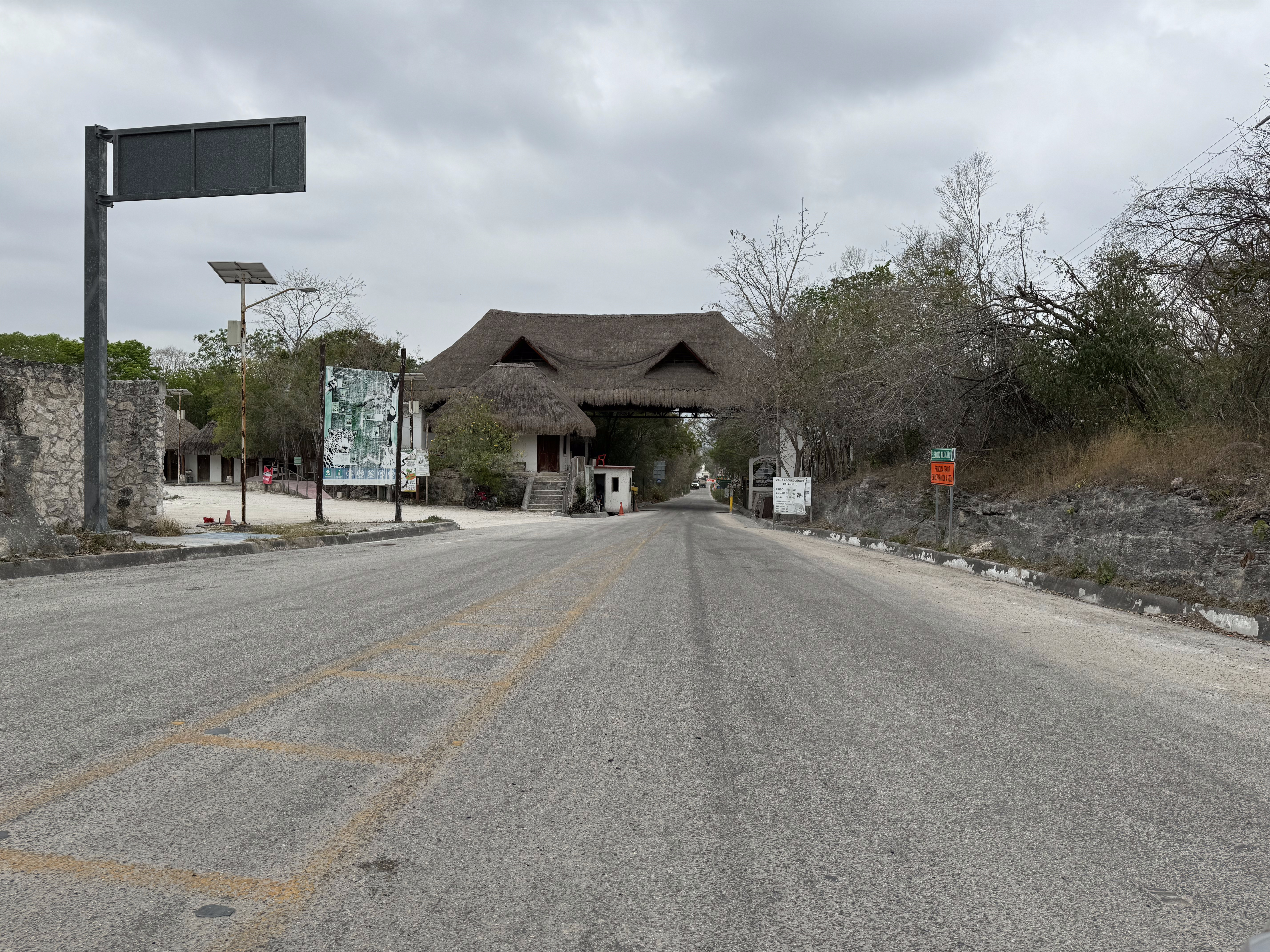
So much for Homiguero, Chicanna, Becan, and Xpujil. It's time for remote Calakmul, famous both for being discovered recently and for being the biggest of all Maya cities. We're at the start of the 30-mile drive south from Highway 186 to the ruins. The entrance station (and ticket office) is a bad sign for anyone hoping that these ruins, only found in the 1930s, might be deserted.
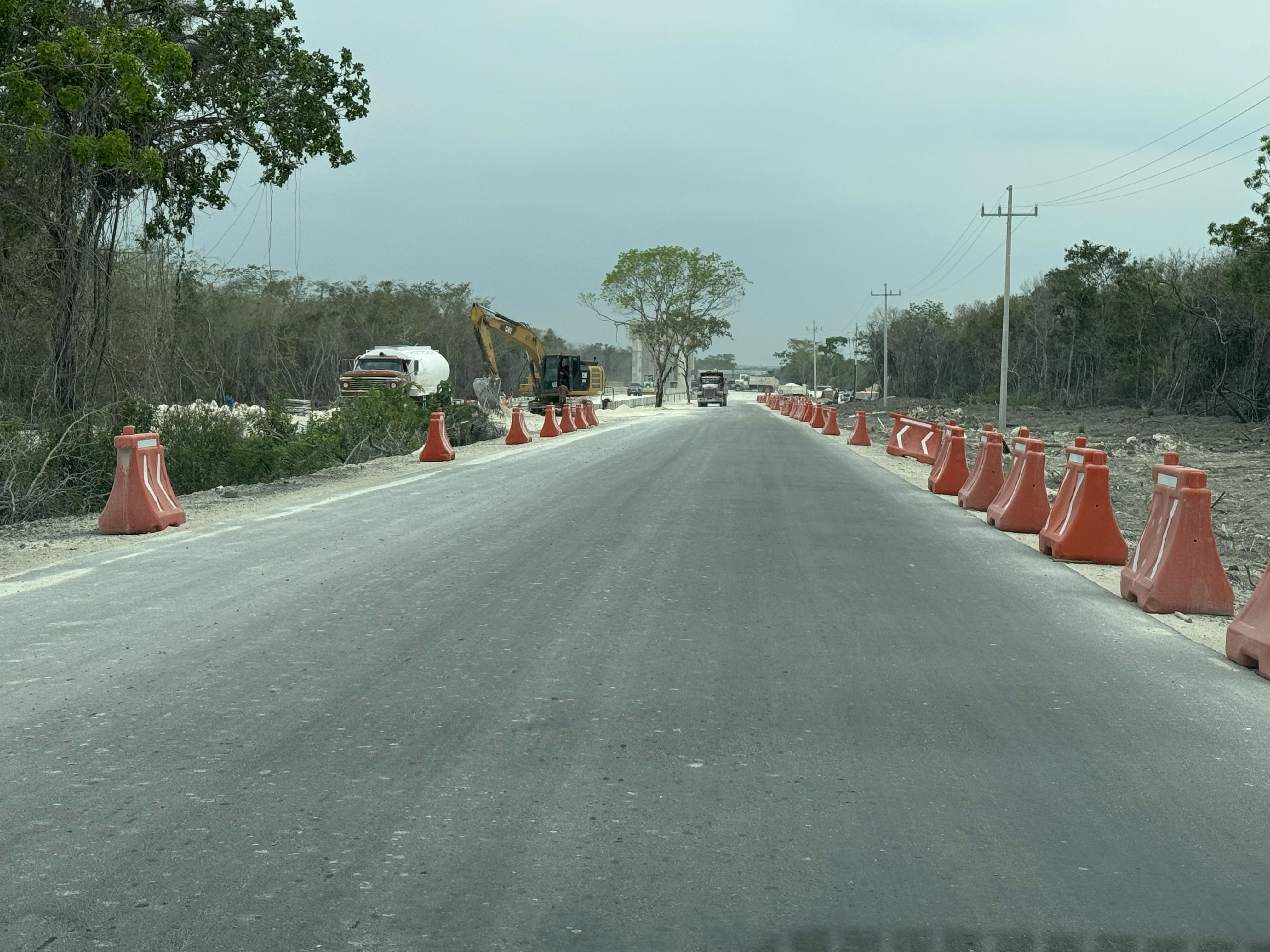
There's a new road under construction.
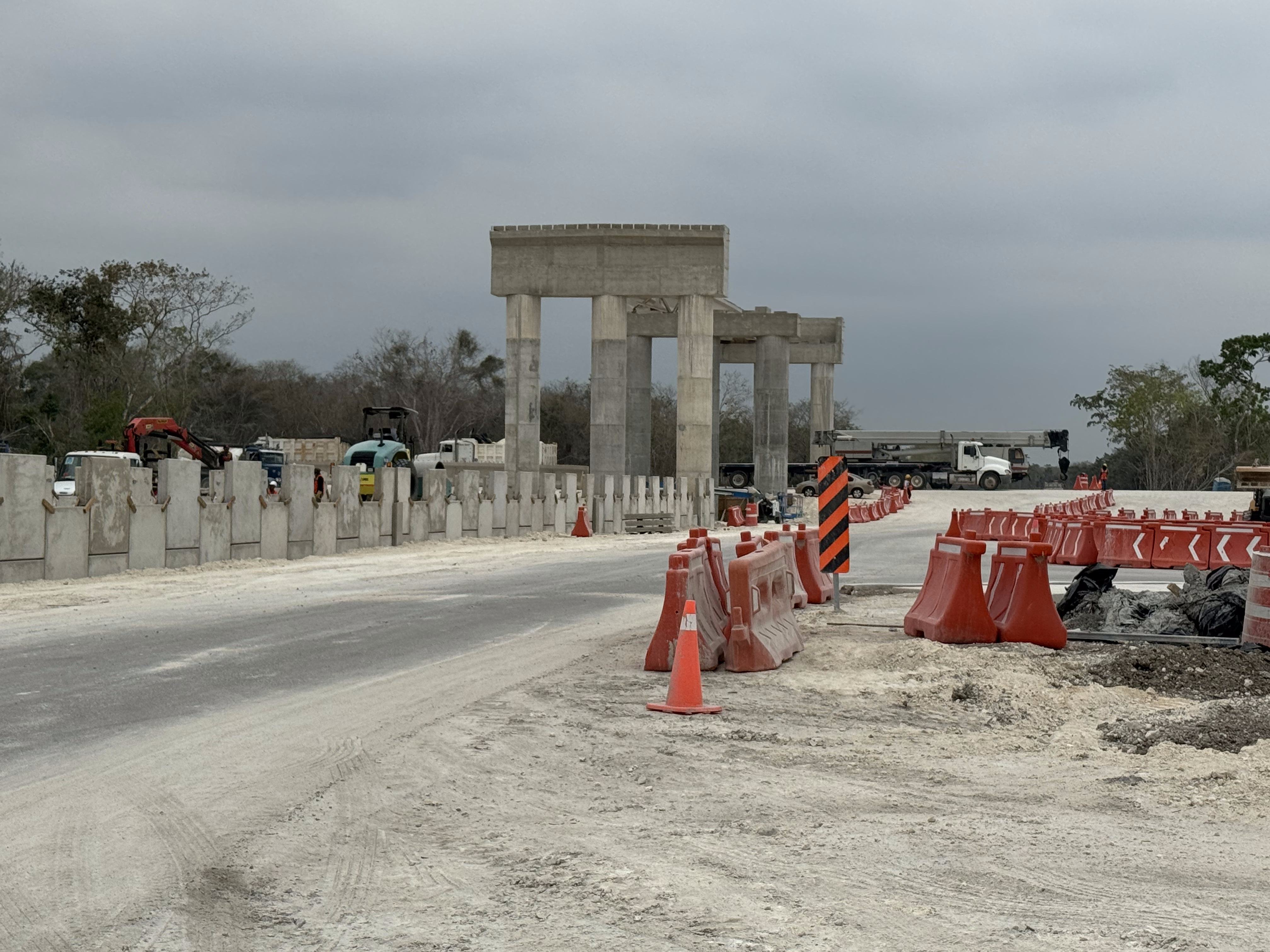
The road will use this overpass to clear the train line, which crosses where that truck is.
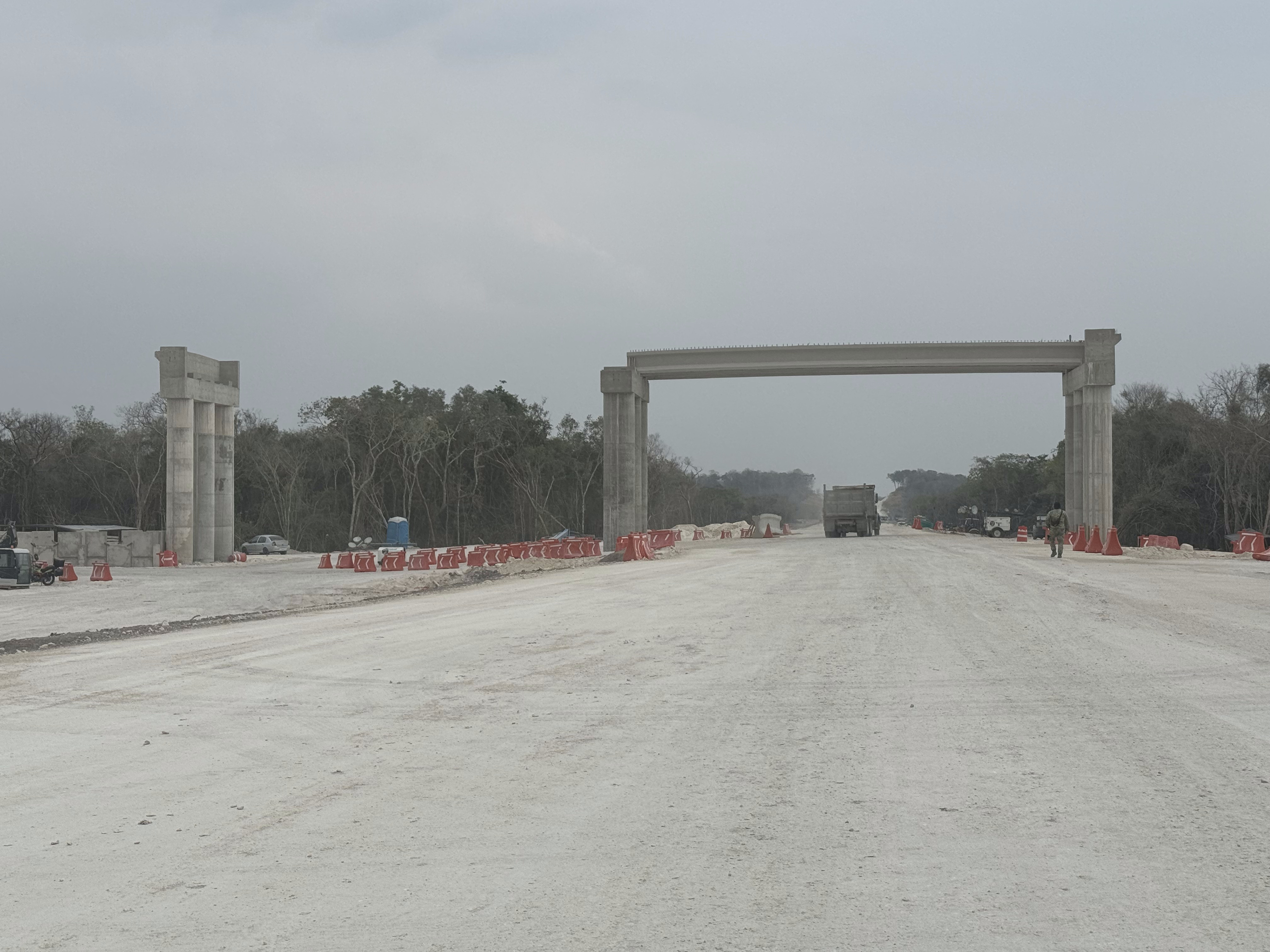
The train is a big, big deal.
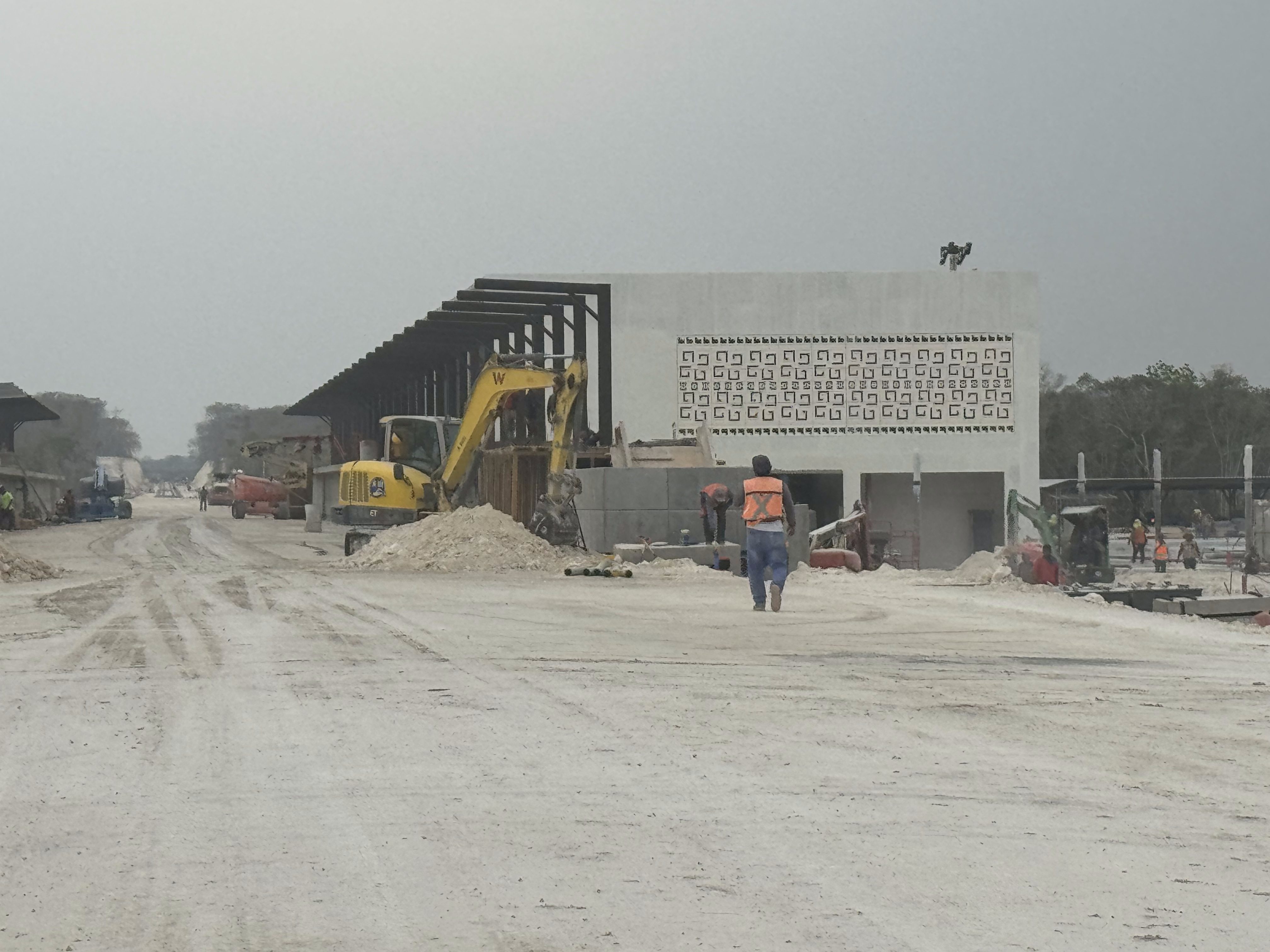
And here's the station.
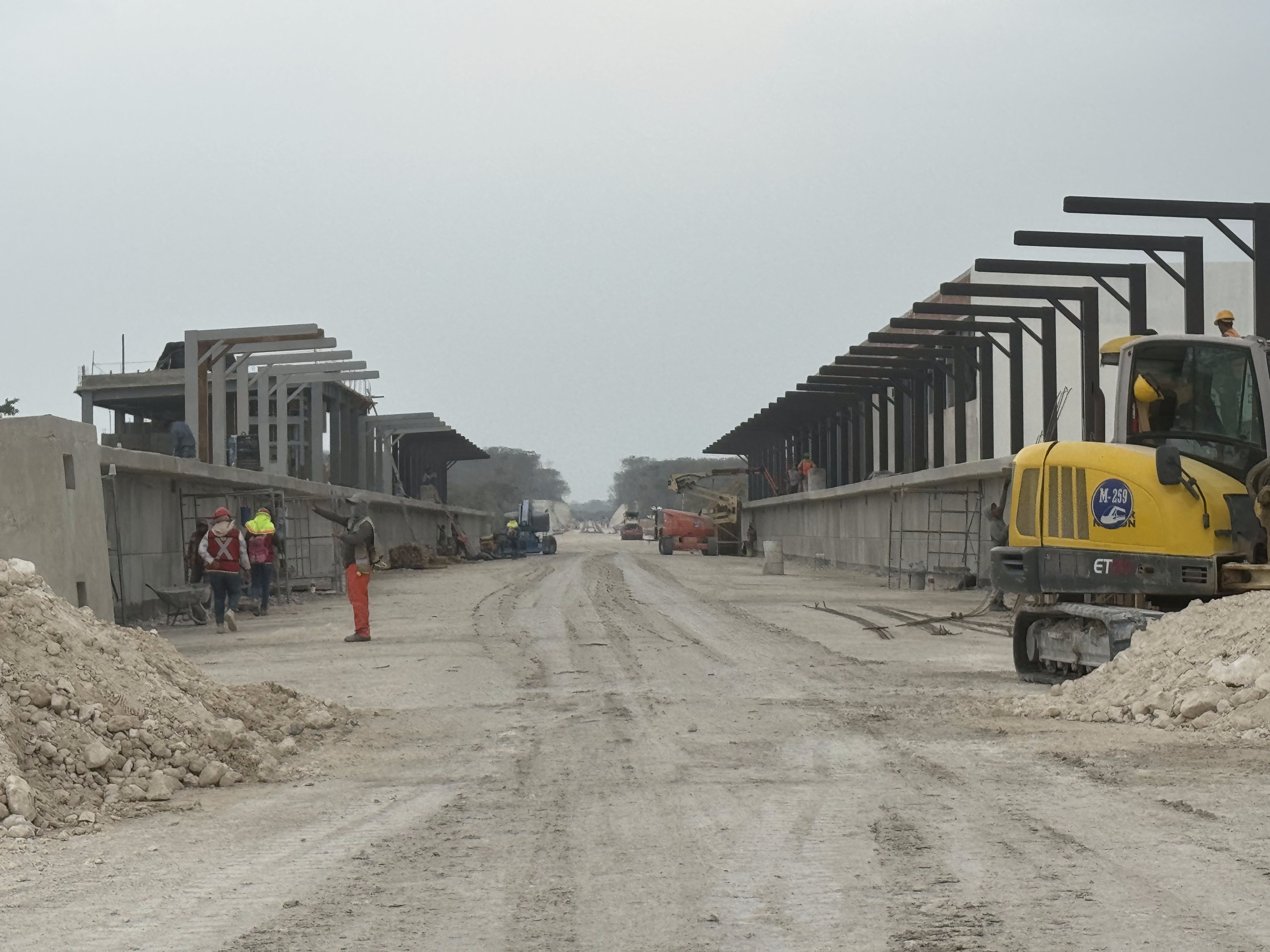
Don't sigh! It's not polite. Besides, sighing proves that you're an elitist.
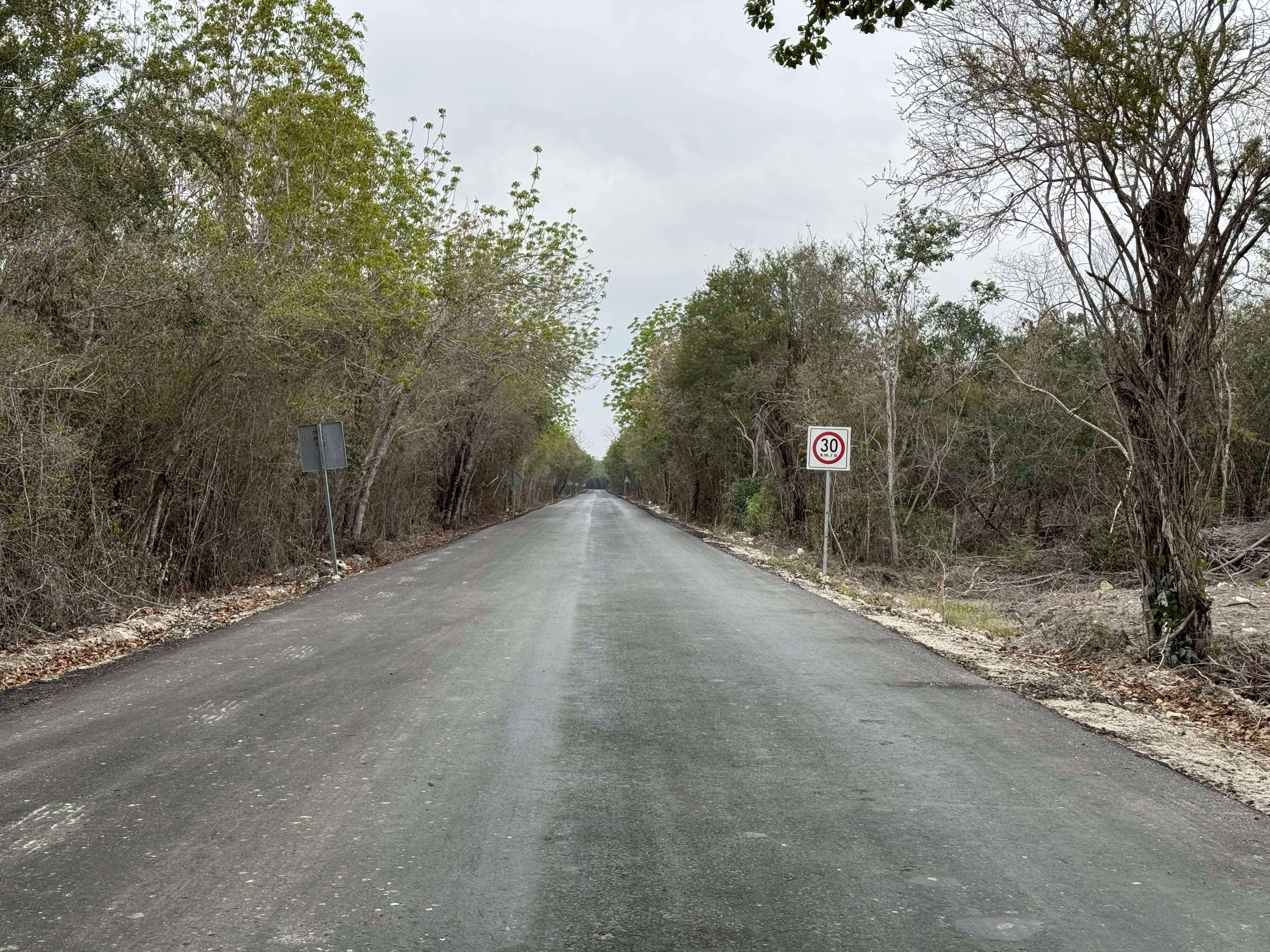
There's a hotel under construction up ahead, but I couldn't take a picture: Guards were watching, and the Maya Train is locally unpopular. The government doesn't want people making trouble with publicity. Can I prove that the train is unpopular? No, but I saw people shrug as if to say, "You can't stop the government." I also heard people say that the train would be bad for wildlife. I didn't hear anyone lamenting the crowds that would come. Maybe I should have looked harder.
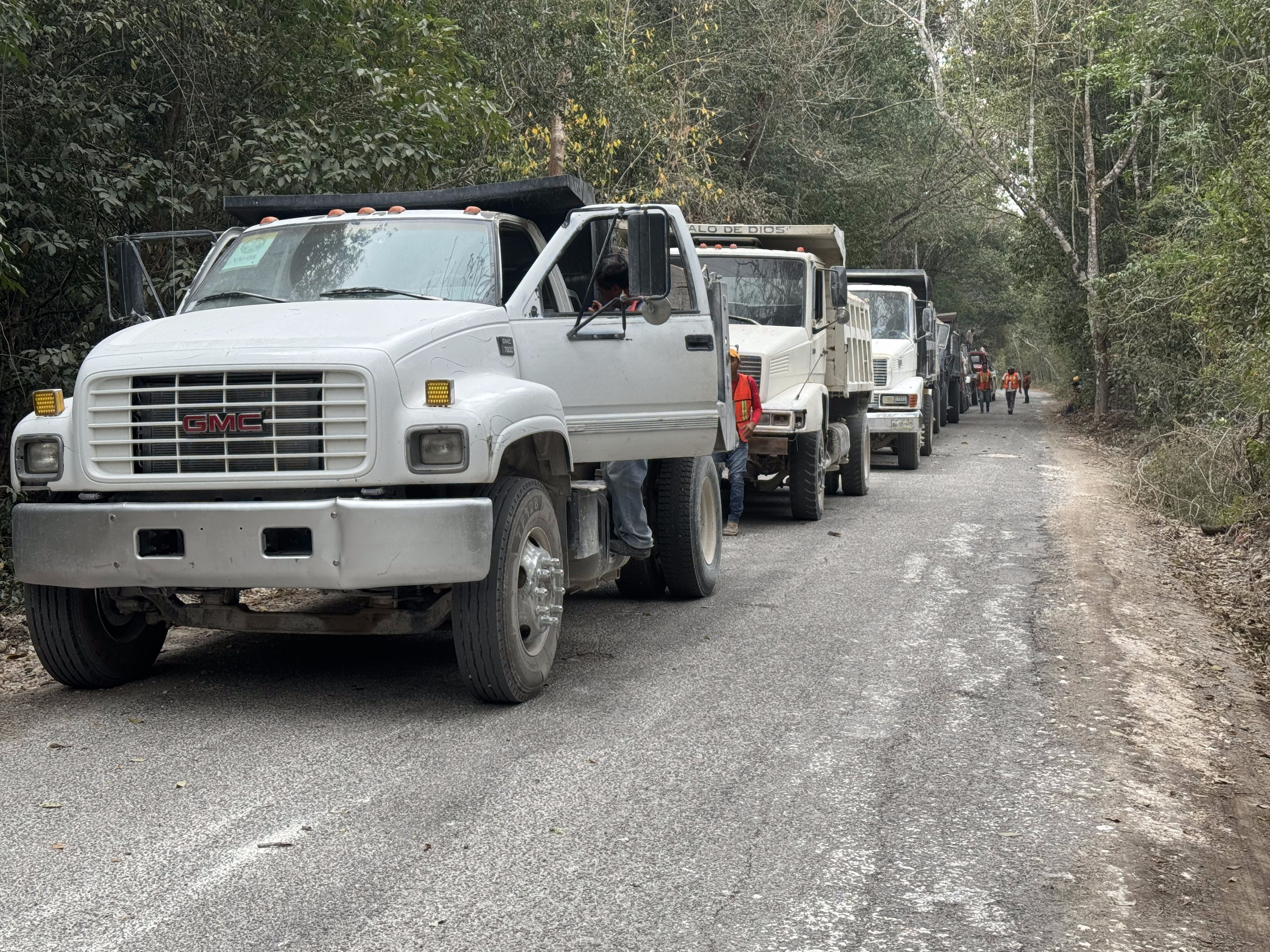
Mind-blowing?
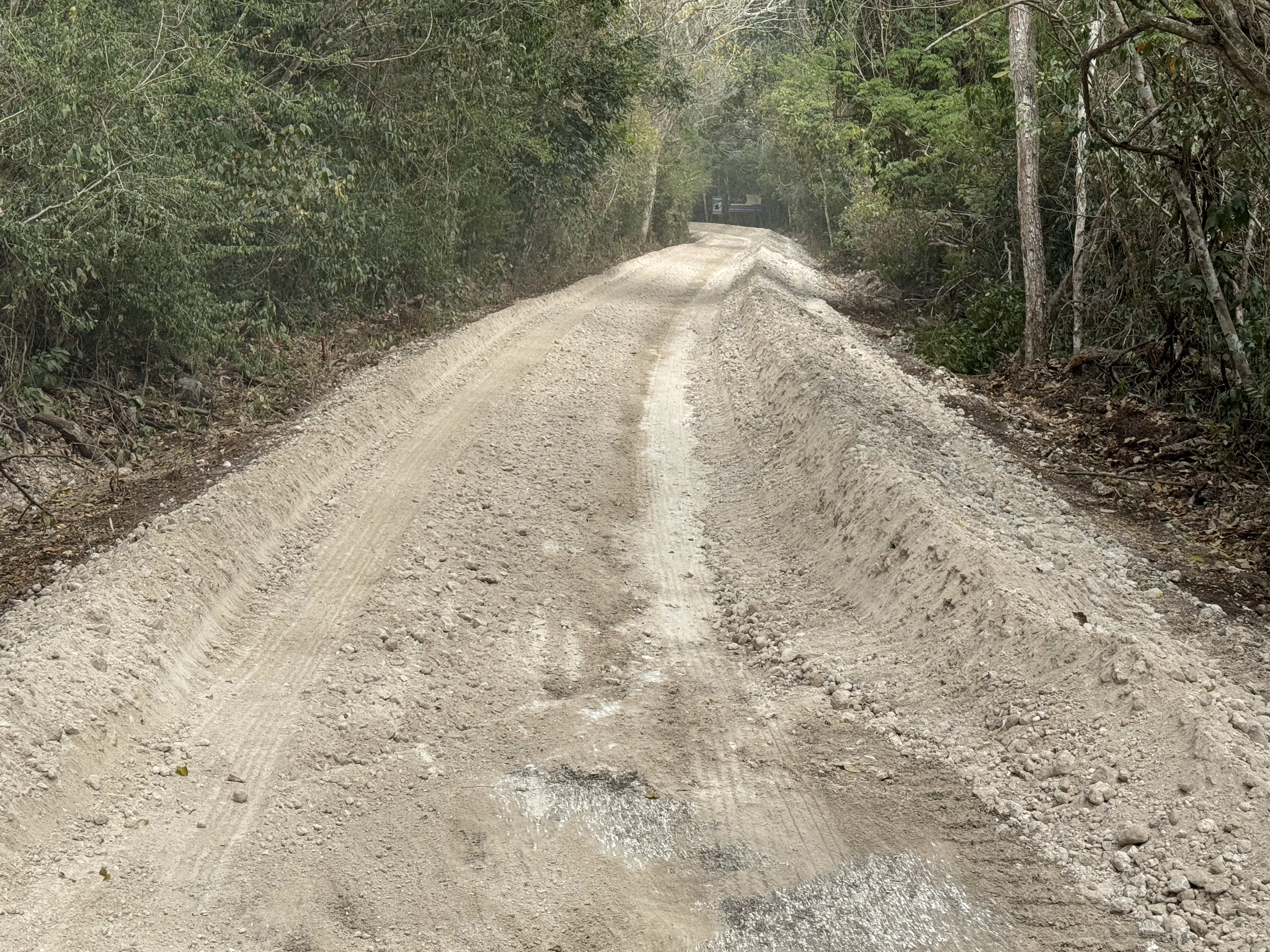
Parts of the road were like this.
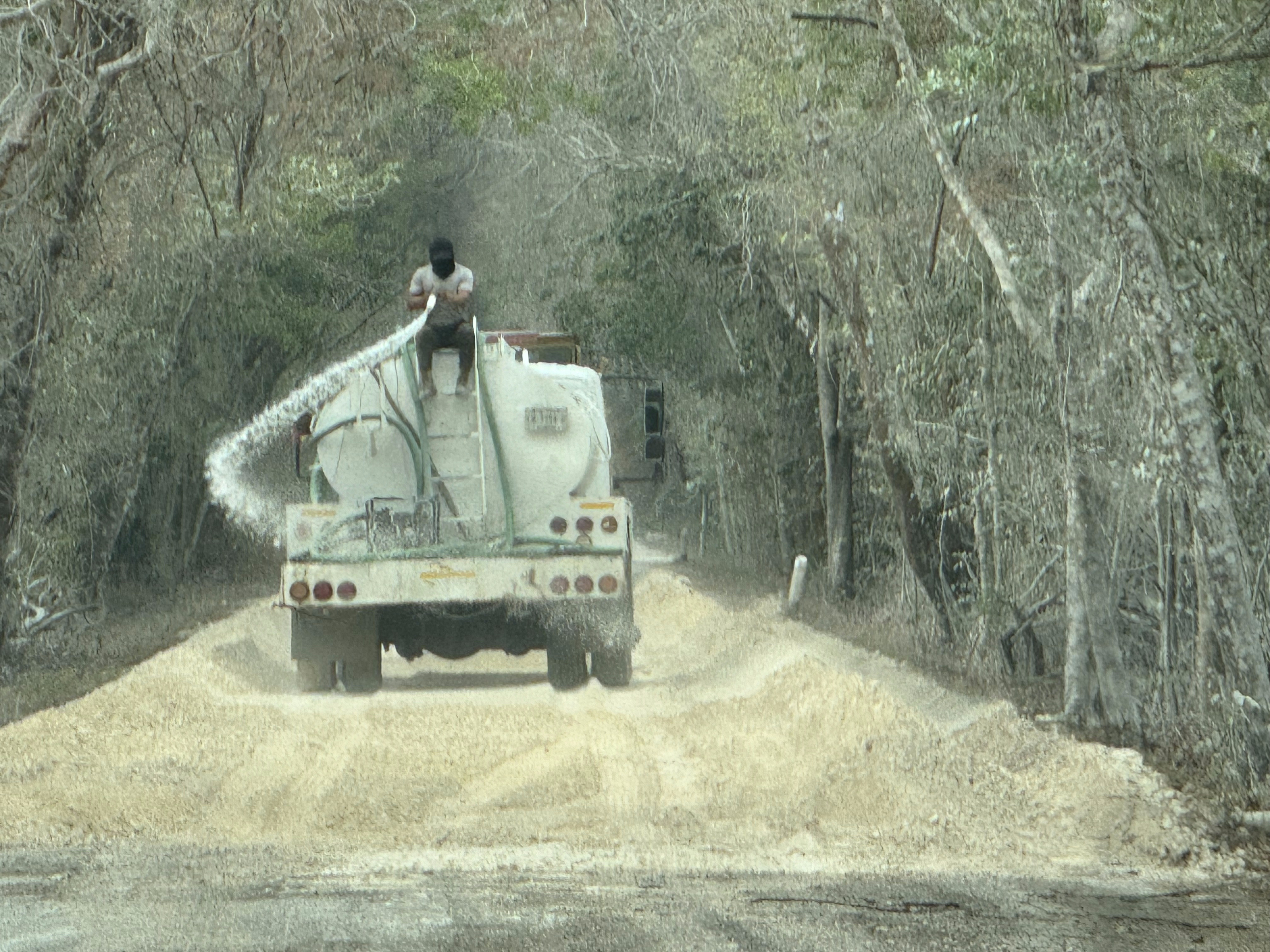
Parts were wet.
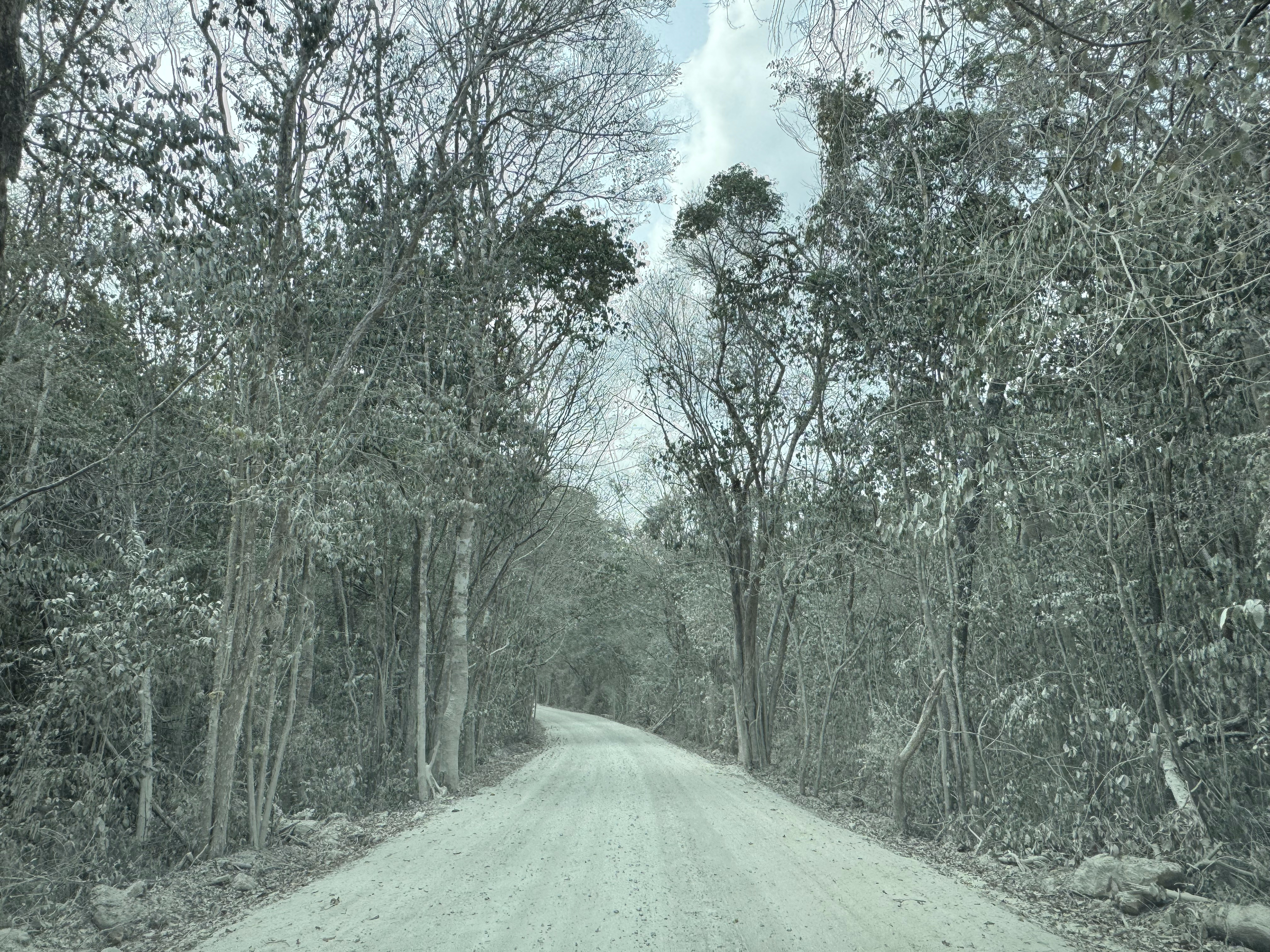
Parts were so dusty that the forest seemed covered with snow.
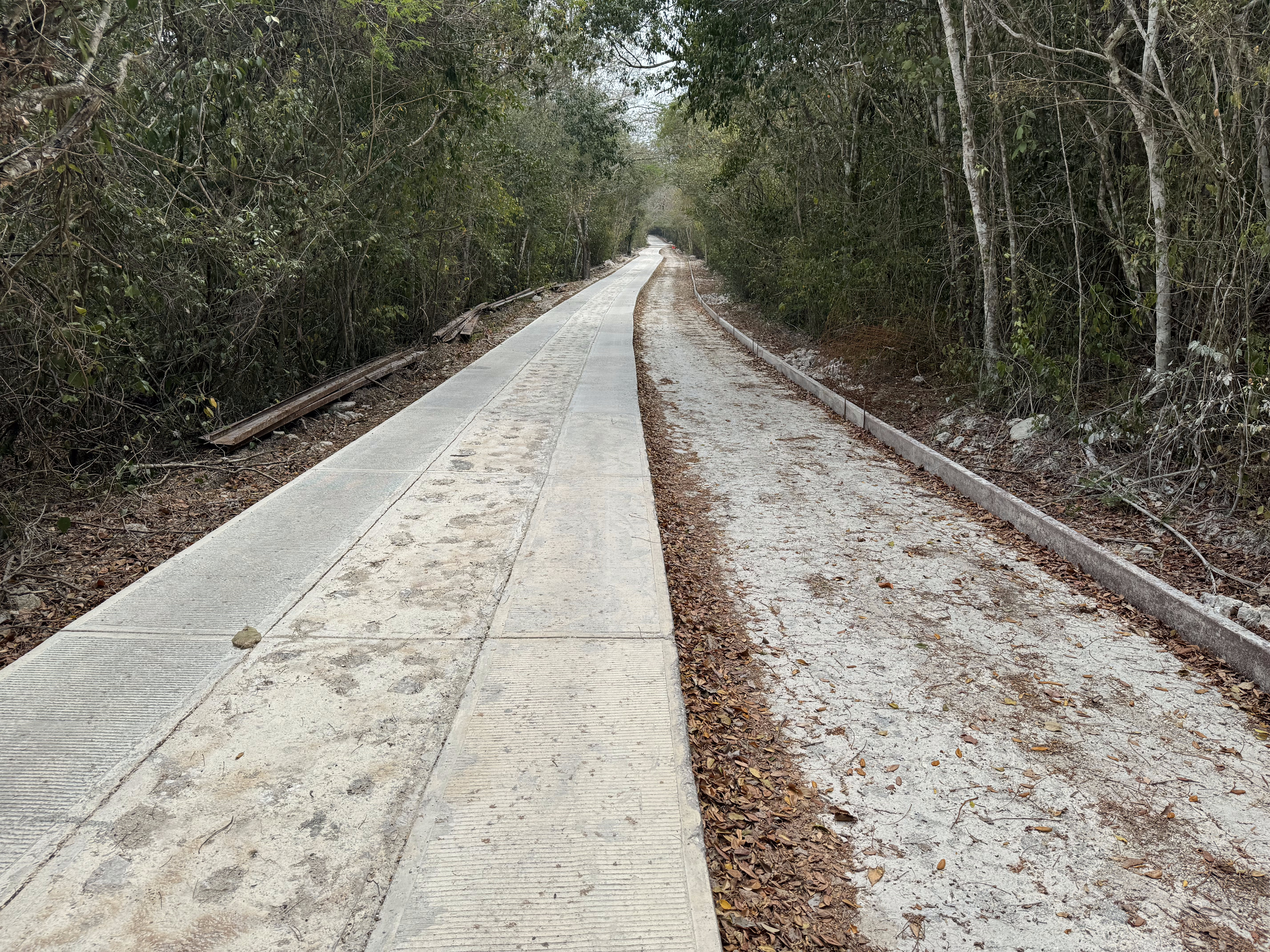
Traffic was sometimes forced onto a single paved lane bordered by an 8-inch drop. I prayed that I wouldn't meet somebody coming the other way. I didn't.
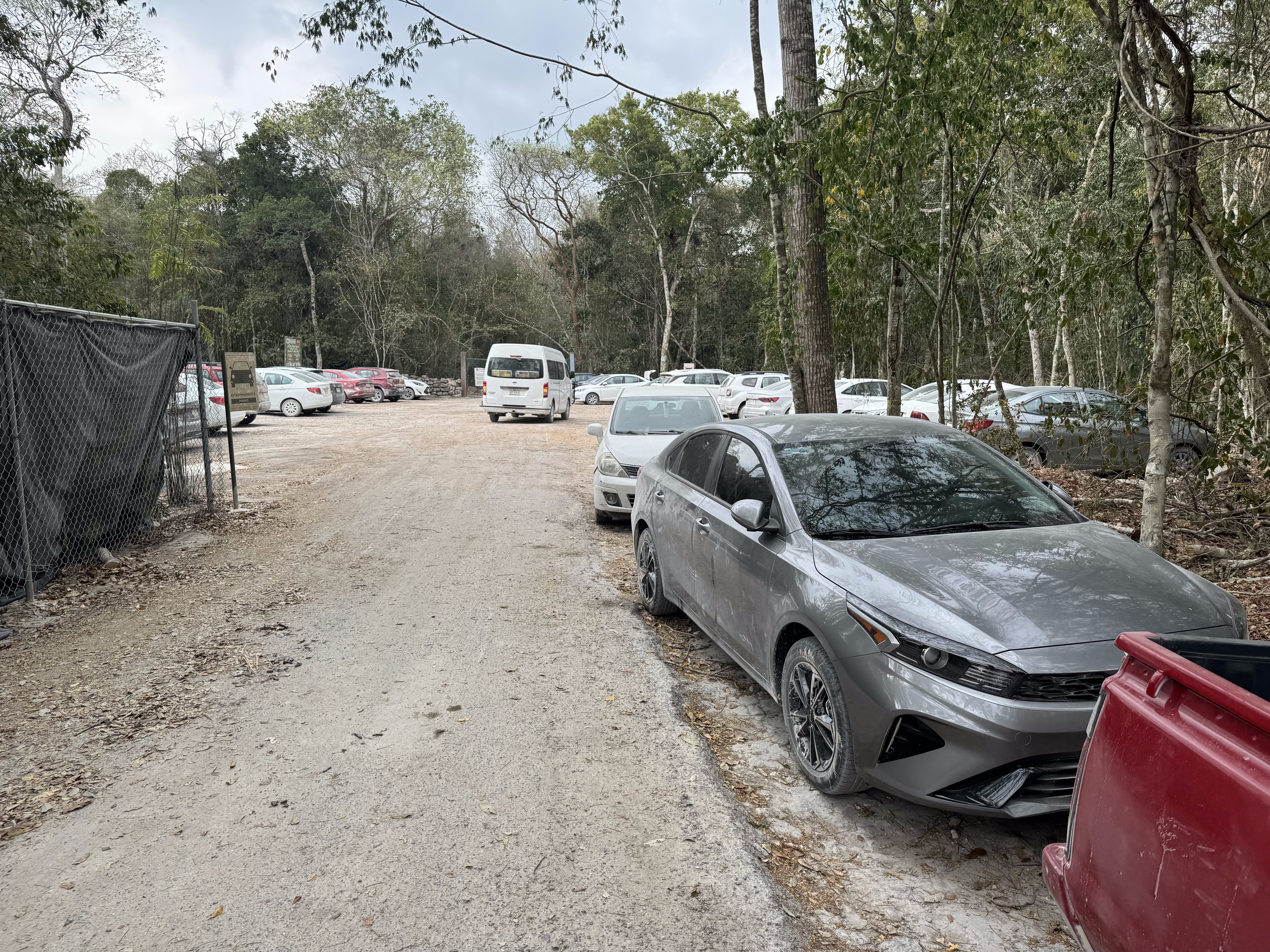
Which is surprising, because there were lots of cars at the end of the line. The explanation is that the site closed at 1 pm, so traffic was one-way in the morning and the other way after noon.
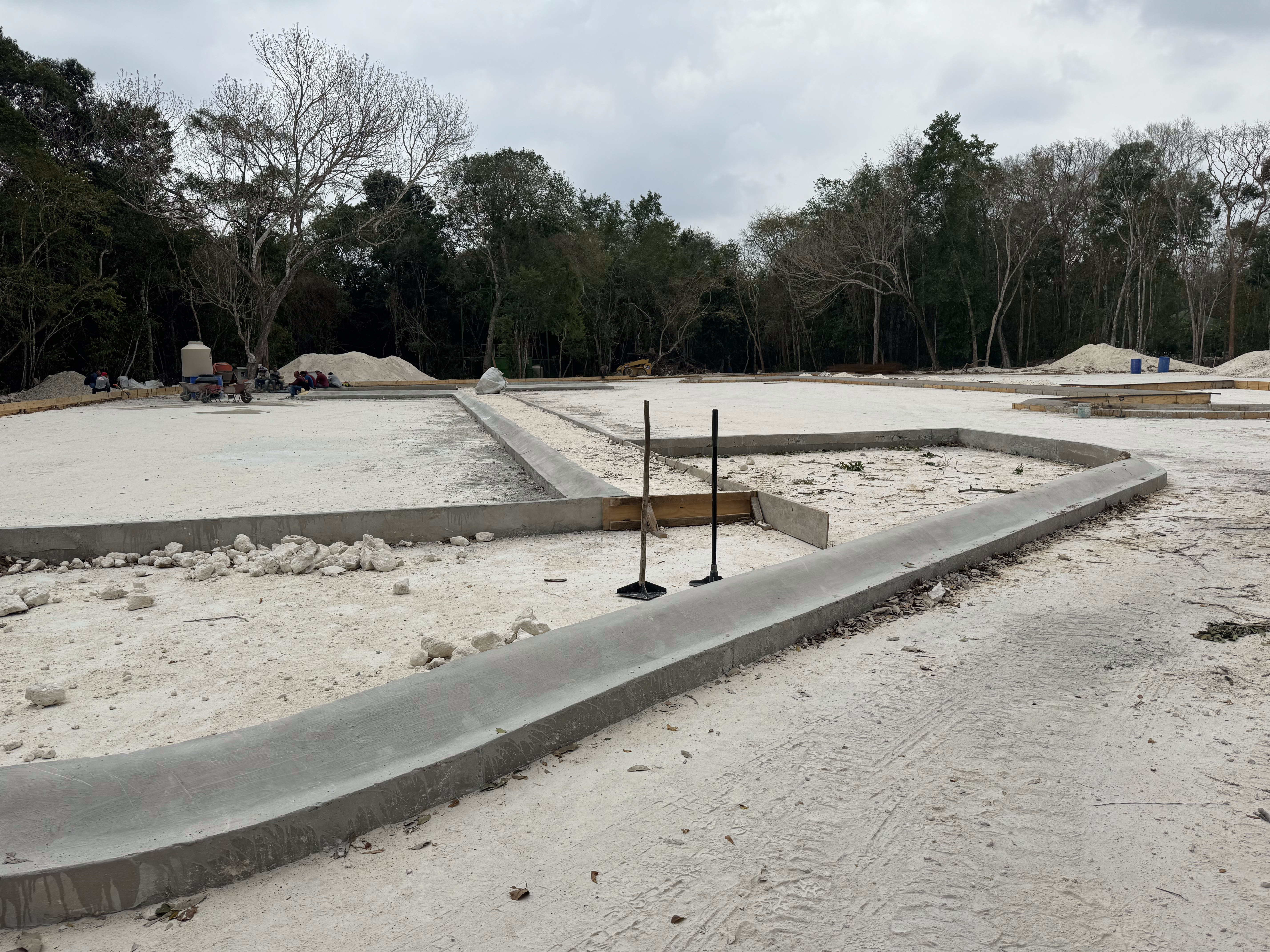
A fine new parking lot takes shape.
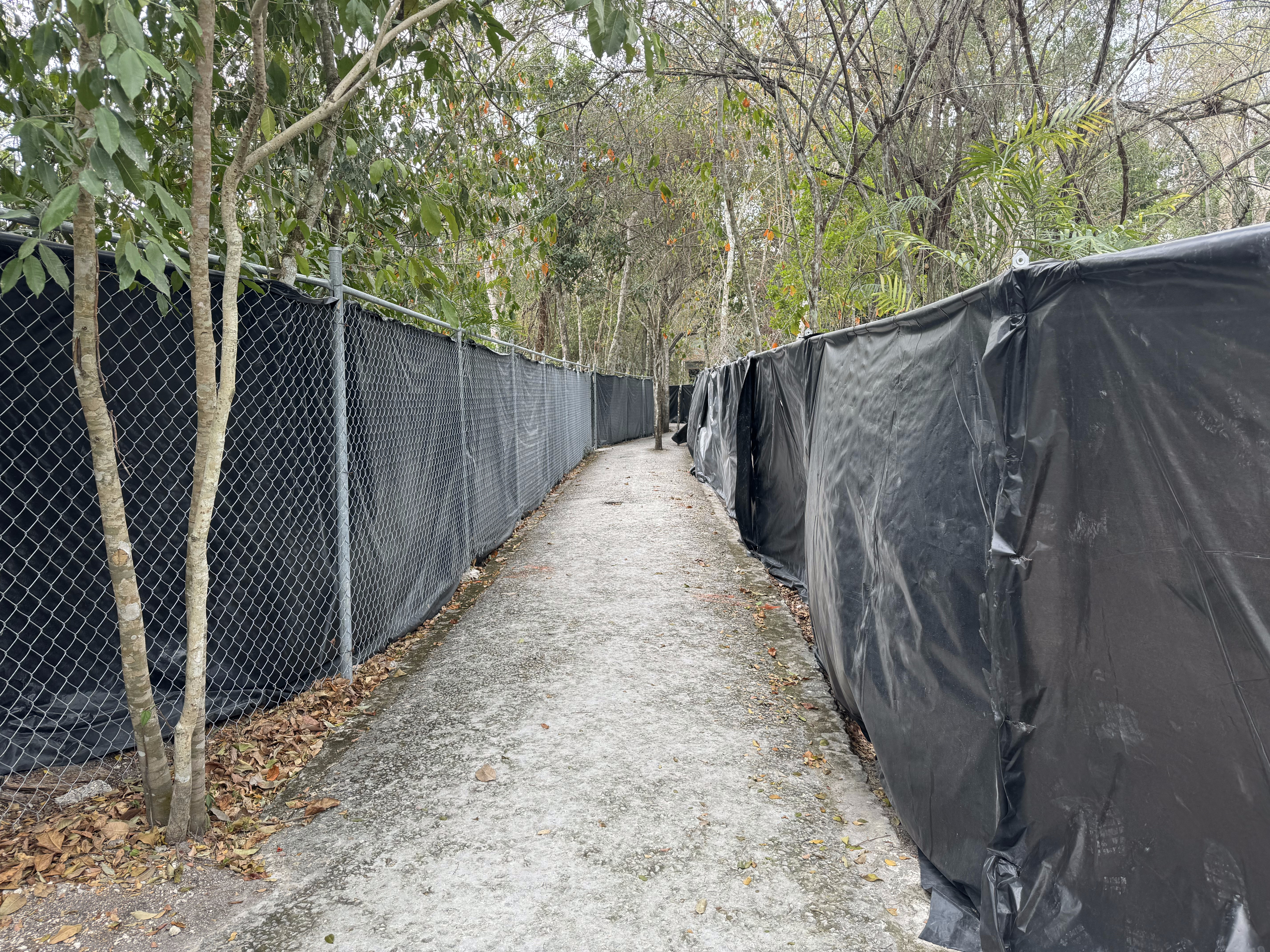
A new visitor center is coming.
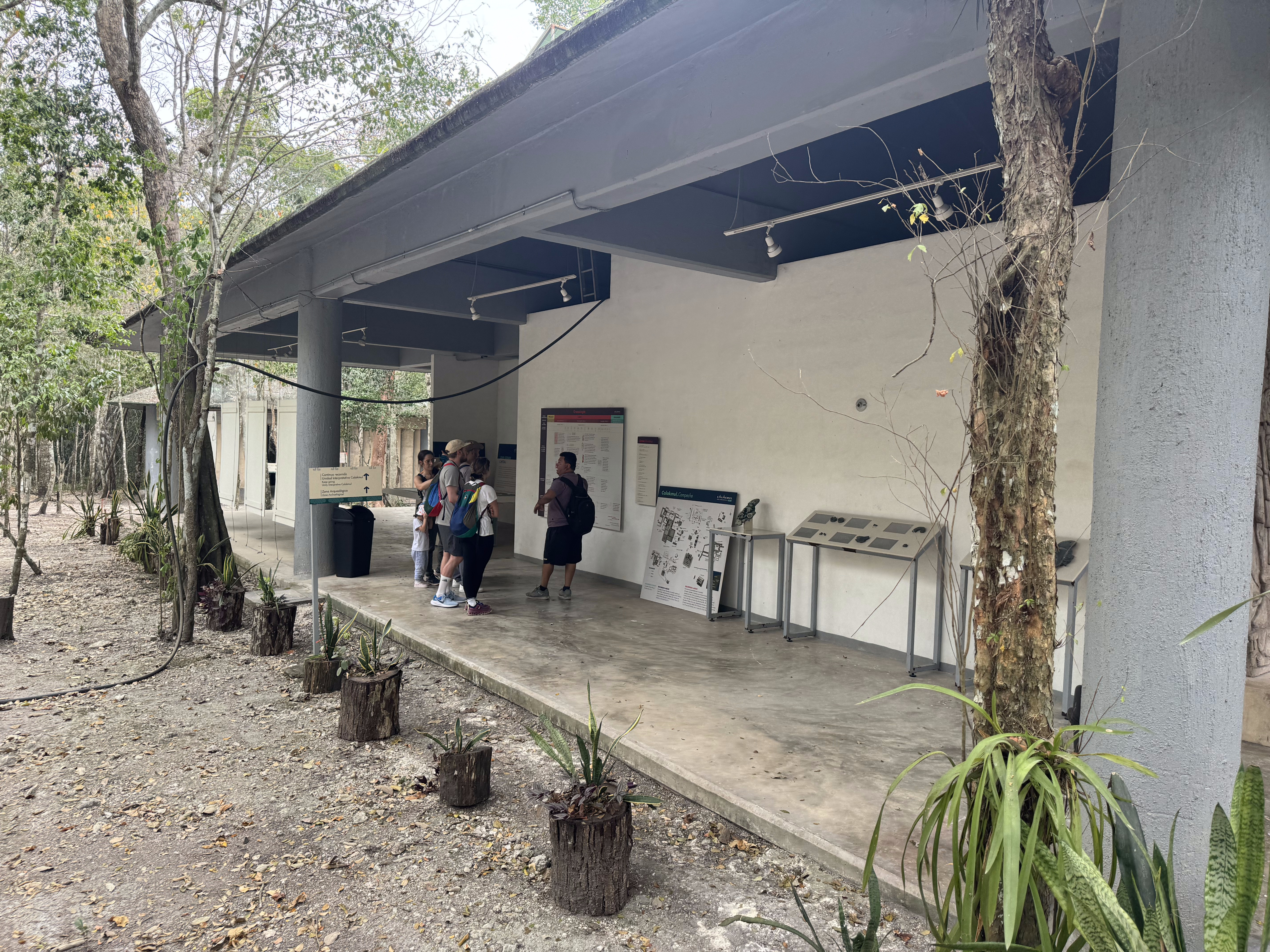
Is it just me, or are these potted plants a joke?
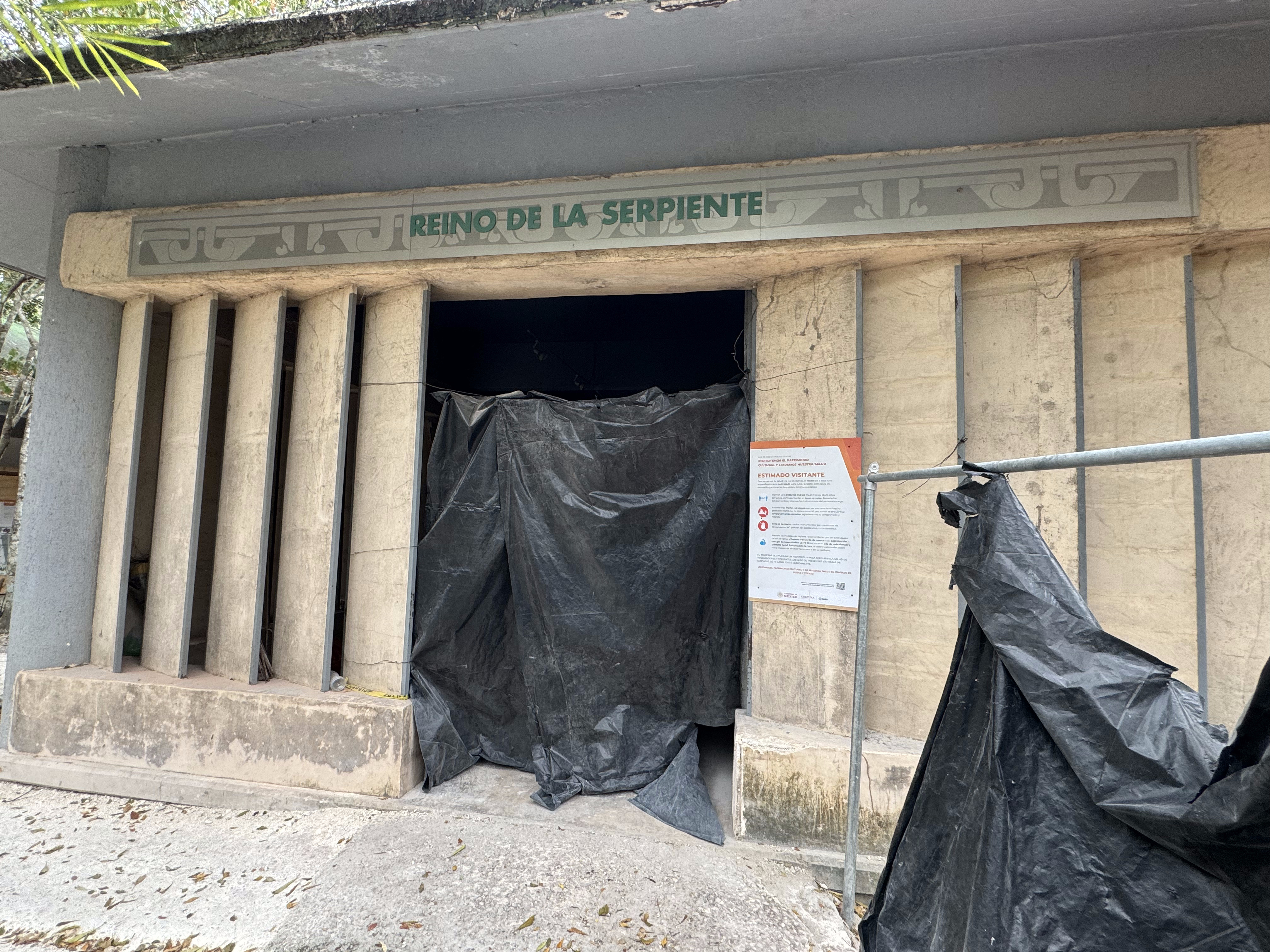
Have to wait for the museum. The name above the doorway comes from the name of Calakmul's kings, k'uhul kaanal ajaw, Divine Lords of the Snake. Hence, Kingdom of the Serpent. The name Calakmul, by the way, was coined in 1931 and means "two adjacent pyramids." We'll get to them.
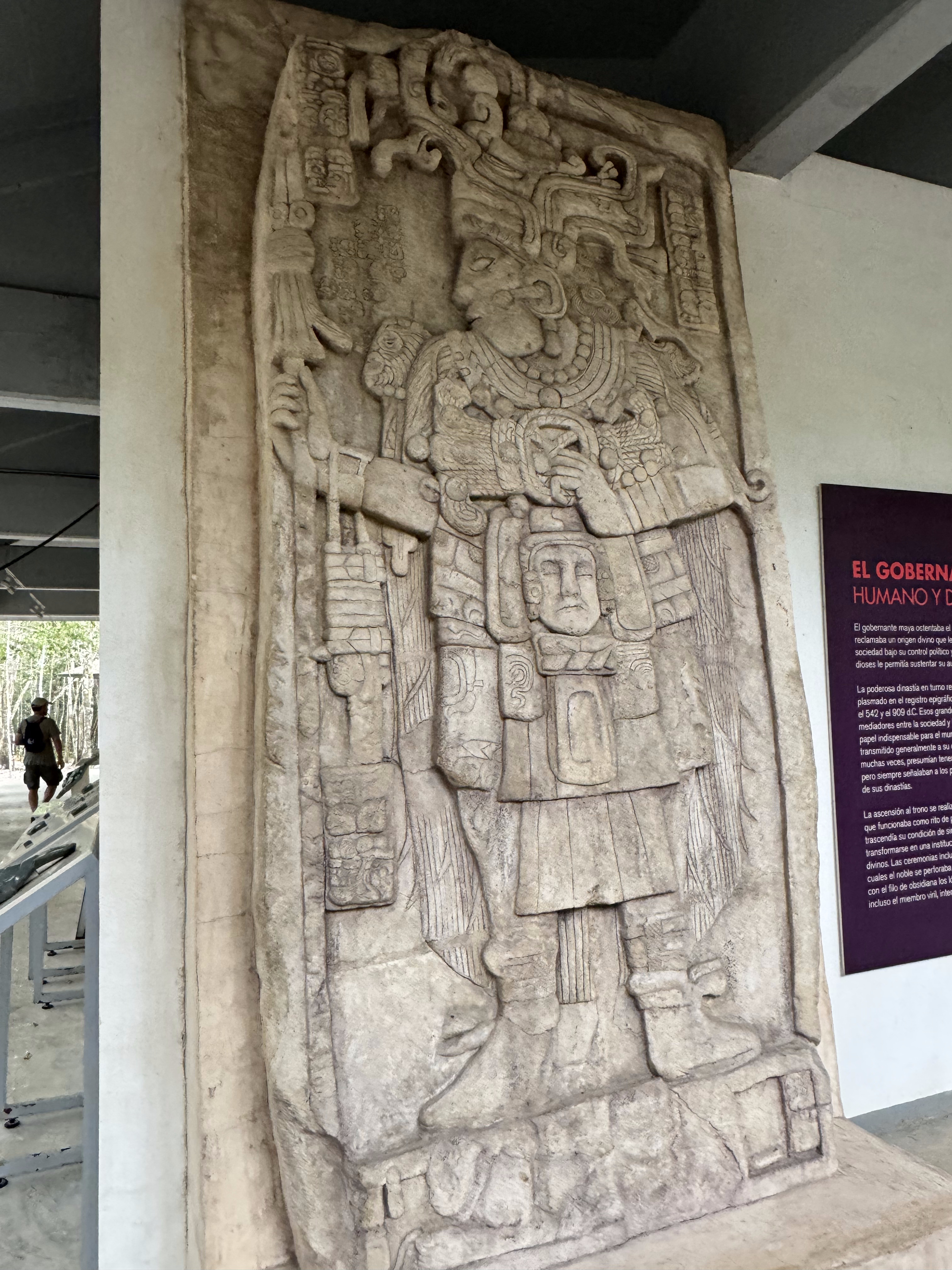
One stele was prominently displayed. The first archaeologist to work here wrote that he found a hundred steles on the site. Made of soft limestone, most were ruined by erosion, but this one was in good shape because it had been buried face-down. The subject is Yuknoom Took' K'awiil, the king in power from 702 until 736. Calakmul was already in decline, having lost a crucial battle fought against Tikal in 695, but the king is still posed, as I assume he wished to be, holding one victim's head and standing on a living captive.
Question: is the stele original or a replica? I'm betting replica, unless the real one has been transferred here from the National Museum of Anthropology in Mexico City.
That first archaeologist was Sylvanus Morley, the chief archaeologist of the Carnegie Institution in Washington. He had been alerted to ruins here by a botanist, Cyrus Longworth Lundell (1907-1993) who had been looking for commercial stands of sapodilla trees. It's a variation of the Ruppert and Denison story at Hormiguero. (Chicle gum production, by the way, is about as dead as sisal production; manufacturers of chewing gum today mostly use synthetic gums.)
I don't know how Lundell got around, but Morley wrote about the extreme difficulty of mounting an expedition here in 1932. He writes that part of the journey from Campeche was by "a five-ton truck over chicle trails that are utterly impassable for motor transport during the rainy season, and not much better during the dry season." He says that the truck took 20 hours to go 70 miles and reached its destination "after a nerve-racking, muscle-beating journey." Was it worth the trouble? Morley leaves no doubt that it was: "Calakmul may fairly be said to have surpassed every other city of the Maya civilisation now known." (See Morley's "The Calakmul Expedition," The Scientific Monthly, September, 1933, pp. 193-206.)
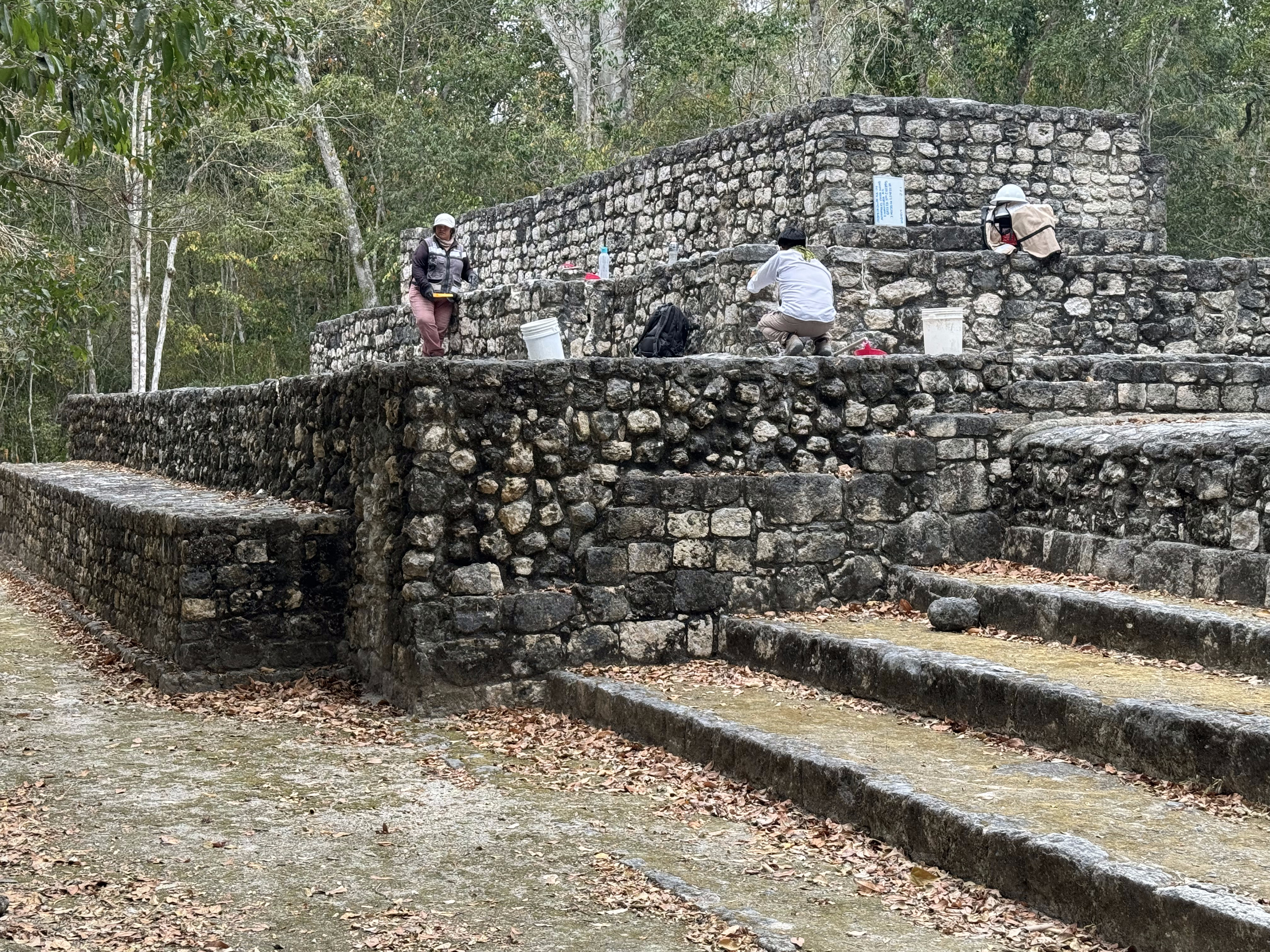
The path branches. I went the wrong way and wound up not at the big stuff but at this, the Chik Naab Acropolis.
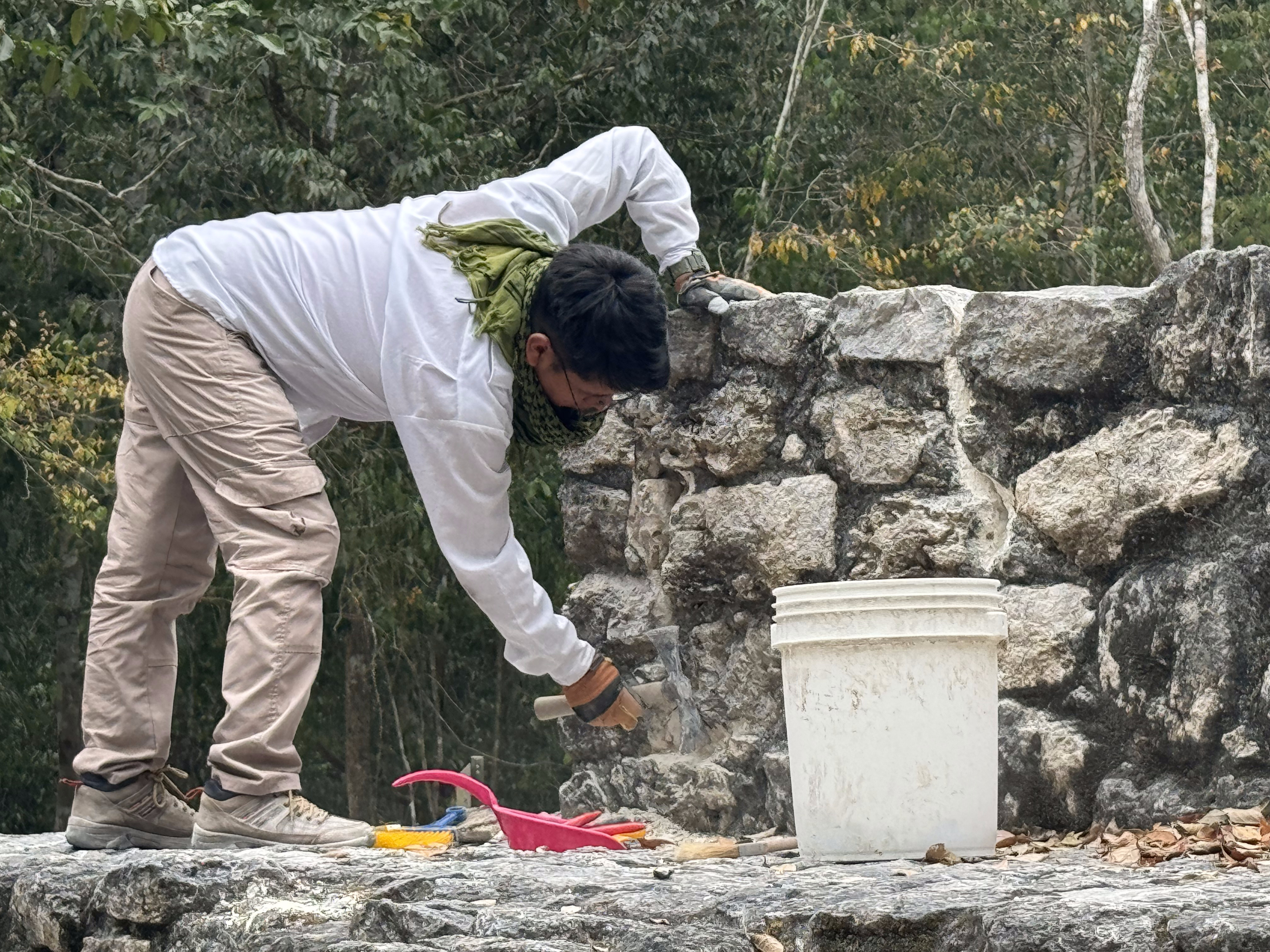
Apparently it's against the rules to take pictures of workers re-mortaring the stones, perhaps because nothing is supposed to spoil the image of Mexico's ruins being good as new.
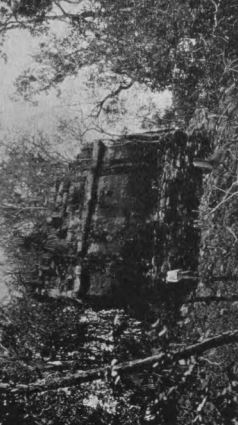
Of course there is an argument in favor of restoration, because otherwise you can only see a ruin poking from under a pile of rubble. Here's one of the few images I've found of Calakmul as it was in the 1930s. (Karl Ruppert and John Denison, Archaeological Reconnaisance in Campeche, Quintana Roo, and Peten, Carnegie Institution Publication 543, 1943; Plate 1.)
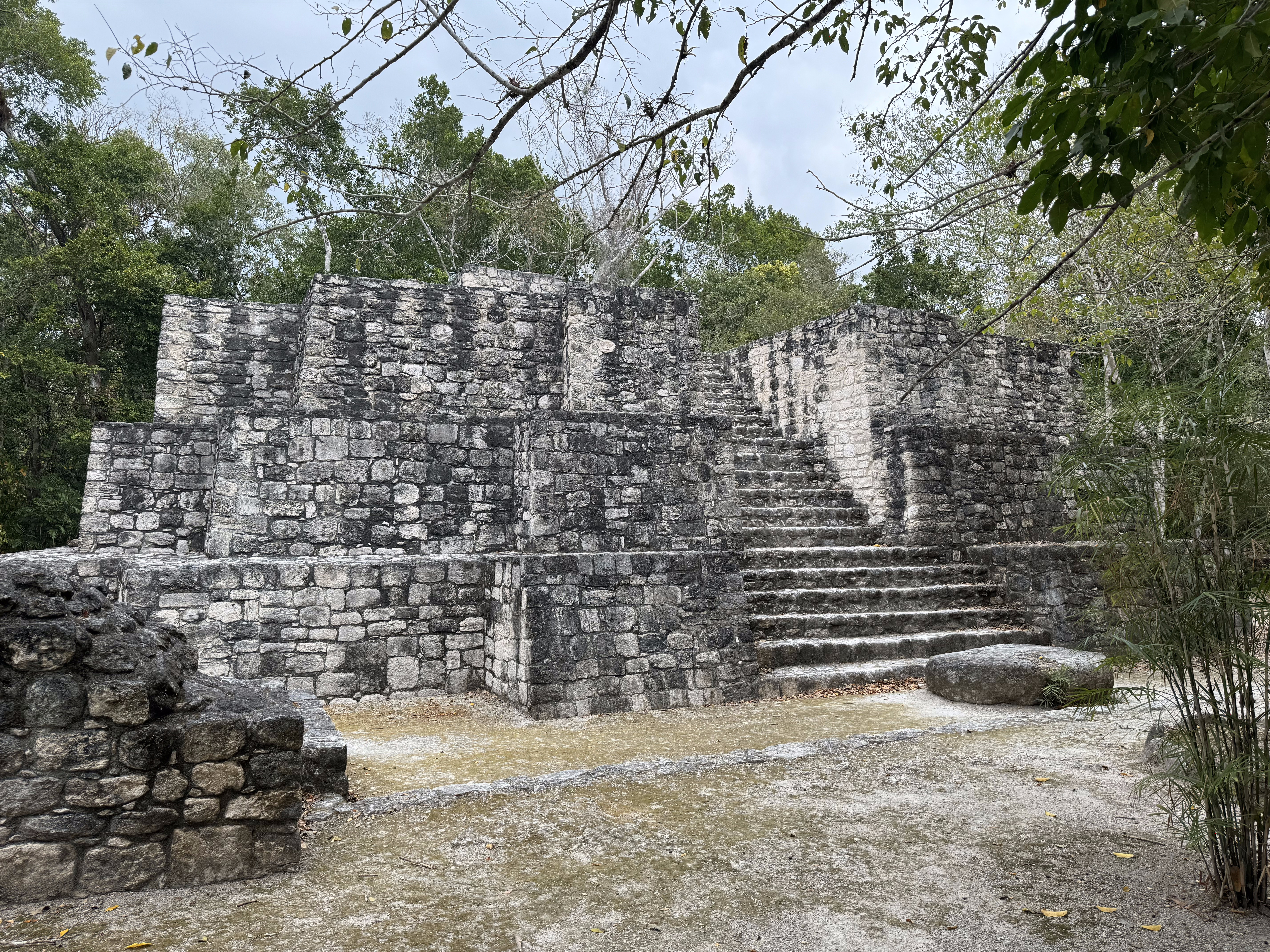
But there is something special at the Chik Naab acropolis. You just can't see it.
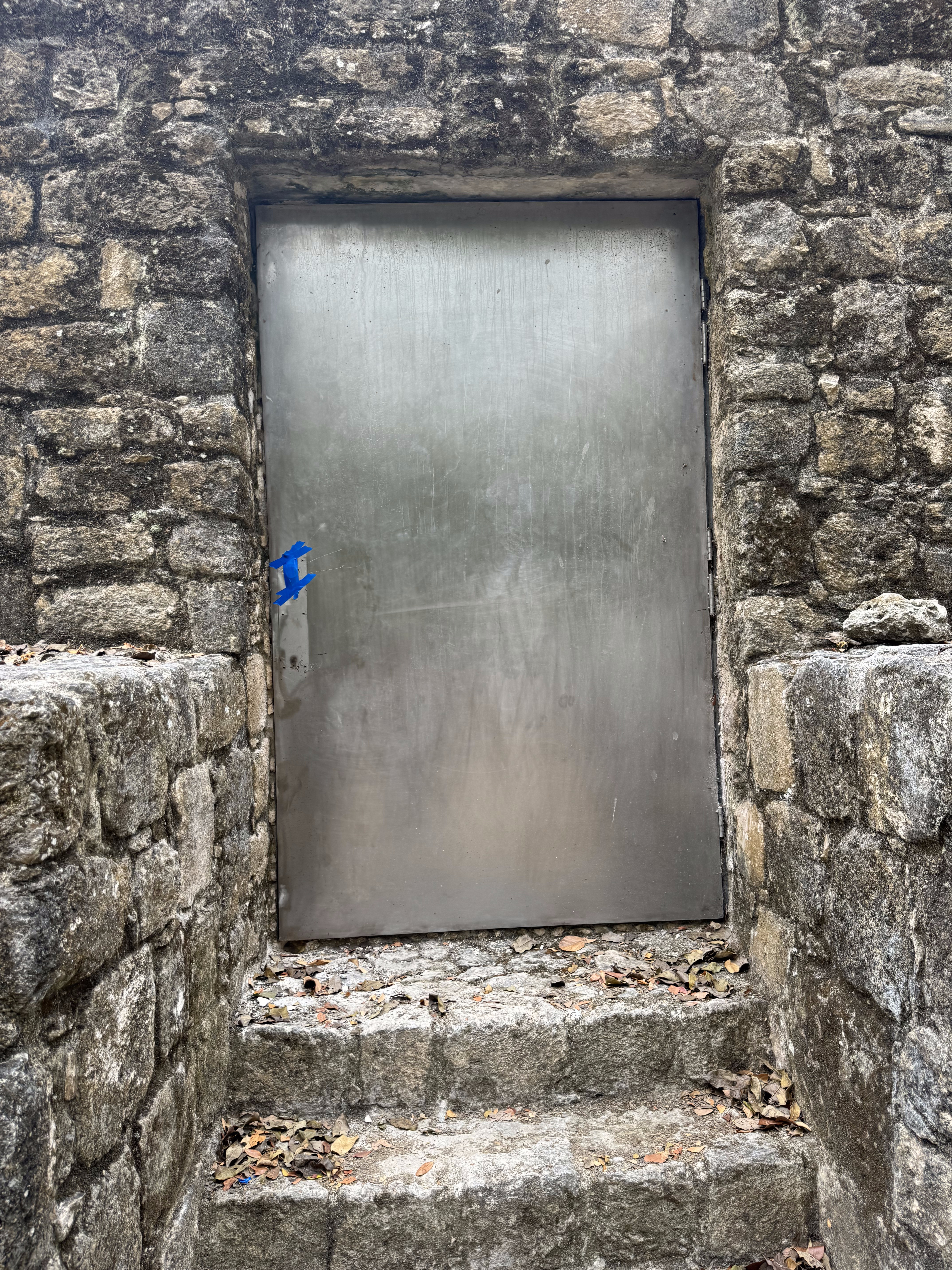
It's behind this door.
Calakmul was added to UNESCO's World Heritage List in 2002, and three years later a painted mural was found by archaeologists digging into this building. Ram n Carrasco Vargas, the archaeologist in charge of the Calukmul Archaeological Project at that time, writes that the mural offers "insights into quotidian activities... [with] men, women, and a child engaged in a range of different activities... A number show people preparing and dispensing foodstuffs together with others who consume them. Other characters are engaged in transportation: bearers are weighed down with large pots or rope-tied bundles, each carried with a tumpline over the forehead ... another figure is accompanied by a scarlet macaw perched on a pole stand" ("Daily Life of the Ancient Maya Recorded on Murals at Calakmul, Mexico," Proceedings of the National Academy of Sciences, 2009, pp. 19245-19249.)
You can see the mural at latinamericanstudies.org/calakmul-2.htm . For a technical discussion of the murals, see Ram n Carrasco Vargas and Maria Cordeiro Baqueiro, "The Murals of Chiik Nahb Structure Sub 1-4, Calakmul, Mexico," in Maya Archaeology 2, 2012, pp. 8-59. (ISBN 978-0-9821333-8-5)
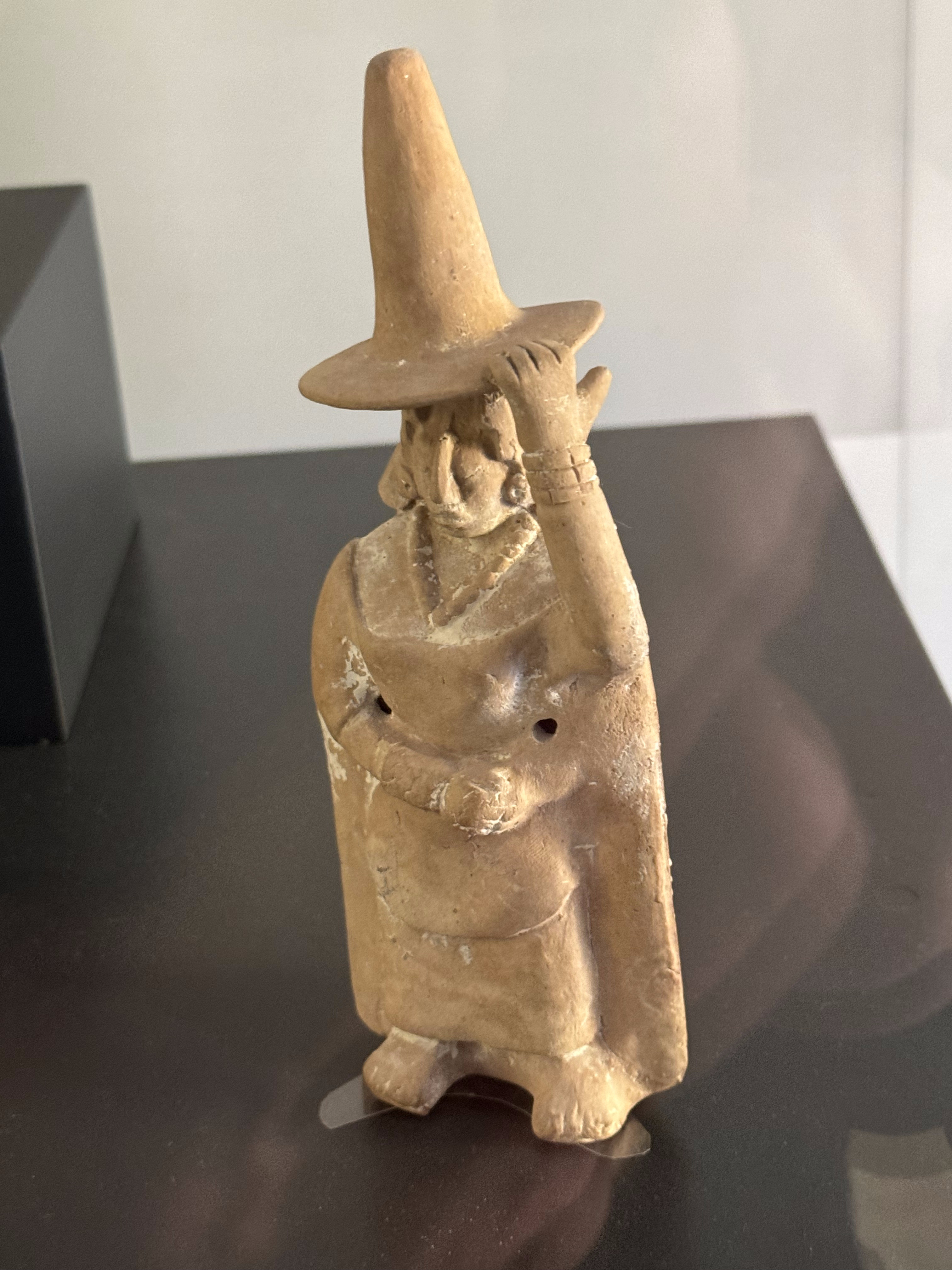
The closest I ever got to daily life at Calakmul was with items on display in the archaeological museum at Campeche's Fort San Miguel. Is the hat droll or functional? I'm betting it is functional, if the object is to keep your skull cool. It's also droll.
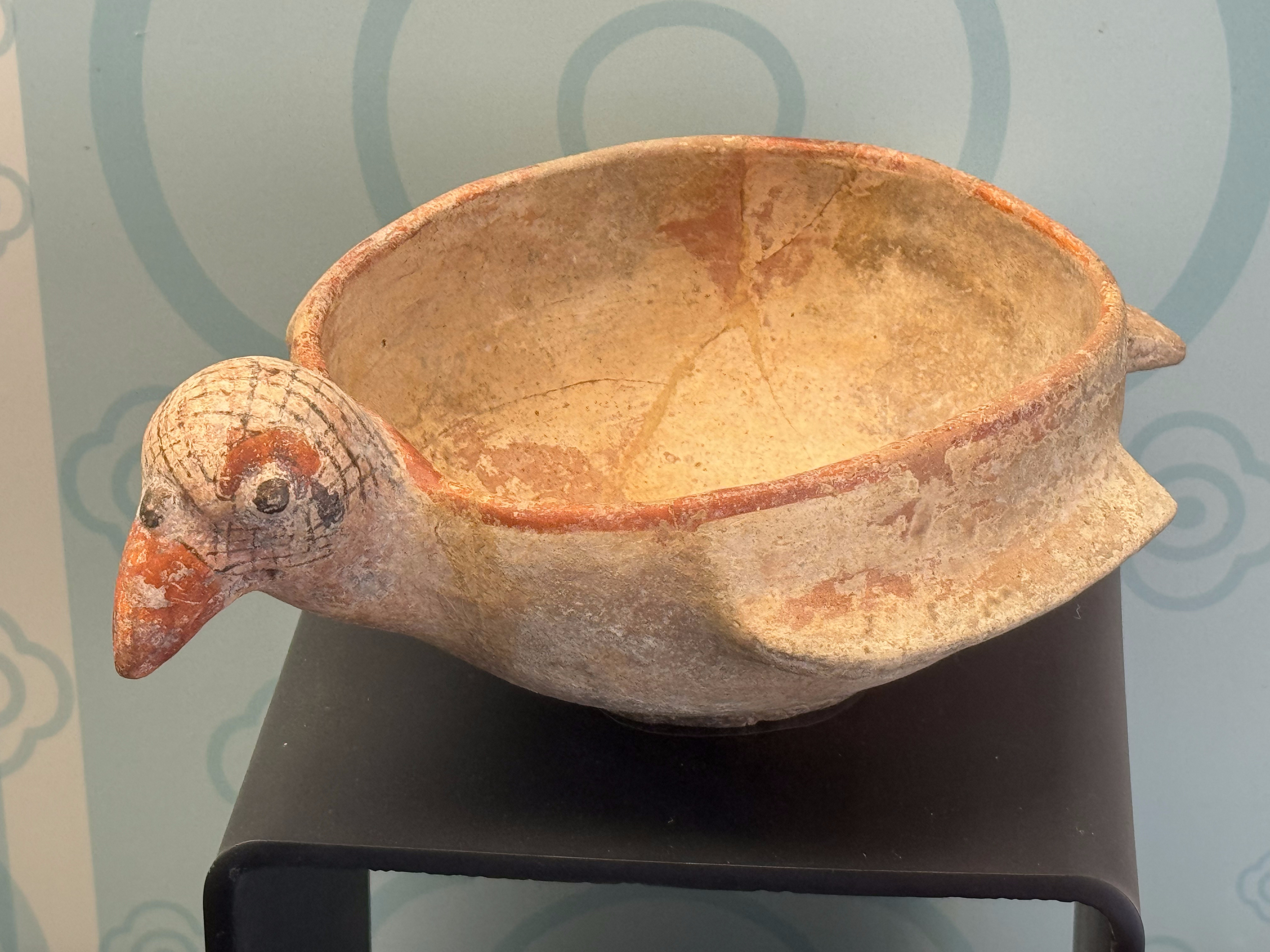
My favorite object is this welcome alternative to mighty men.
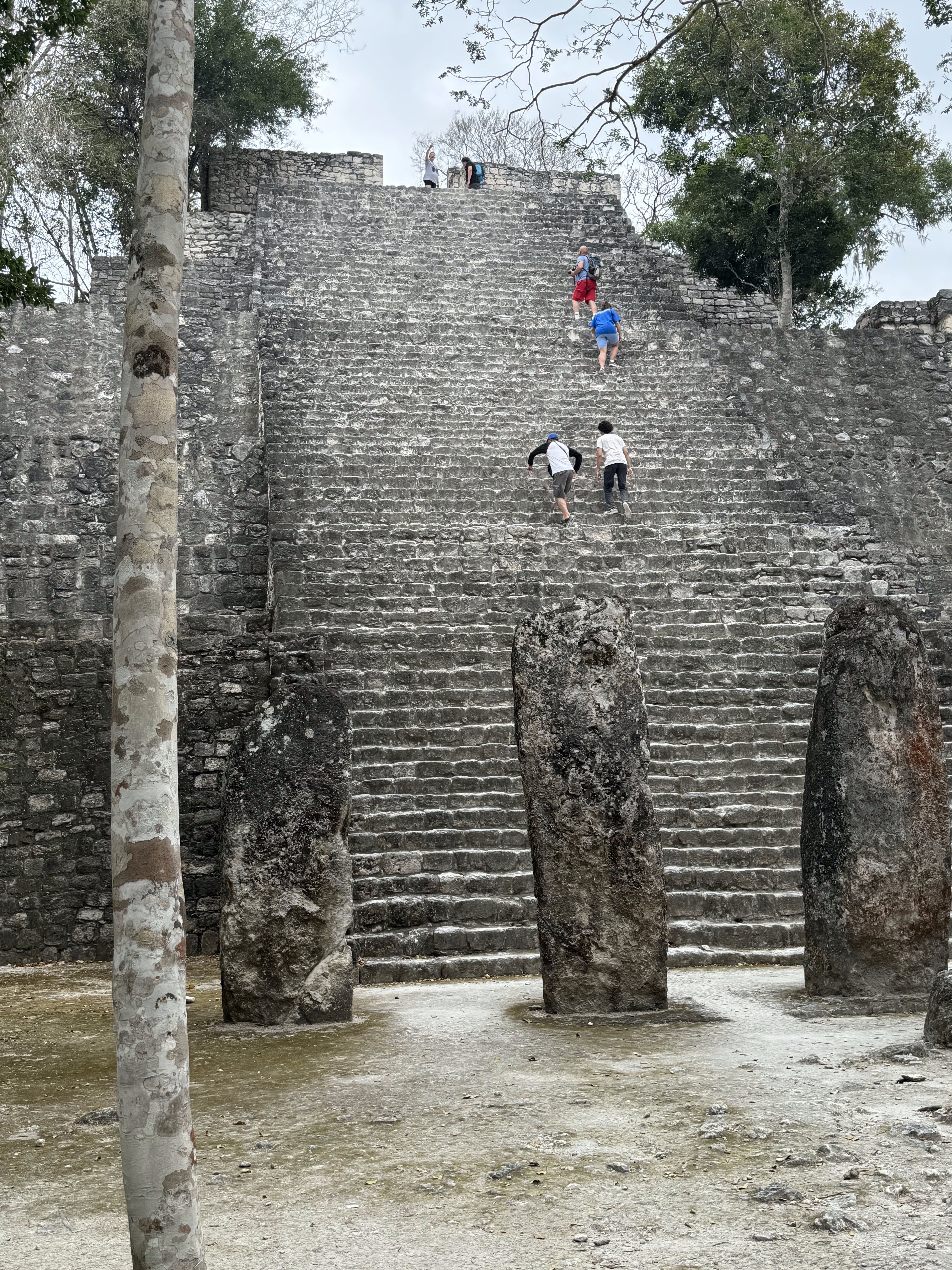
Isn't that what it takes to build something like this, Structure 7, at the north end of the central plaza? And no, the two pyramids implied by the name Calakmul refer to two other pyramids, not this one.
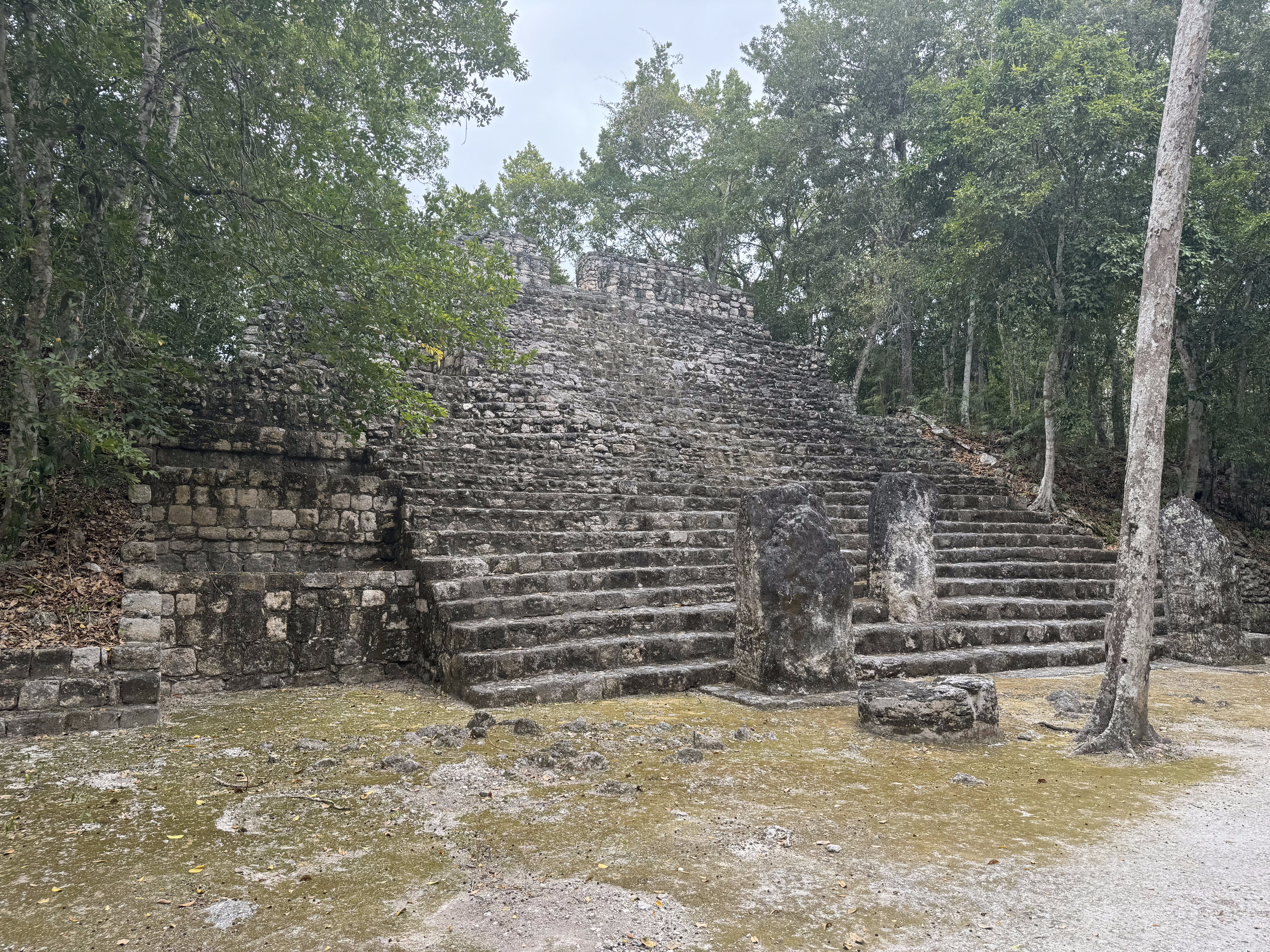
Not this one, either. It's Stucture 4, on the east side of the plaza. Carrasco writes that "plazas were viewed as the Primordial Sea, and large platforms as Mountains of Creation." I wish I knew what Tatiana Proskouriakoff thought about such structures. The most humane explanation I can think of is that hundreds or thousands of people willingly contributed their labor to building a work inspiring to all. I suppose that's possible. Back in the early 1960s I enjoyed marching in a battalion parade complete with brass band. Hard to believe.
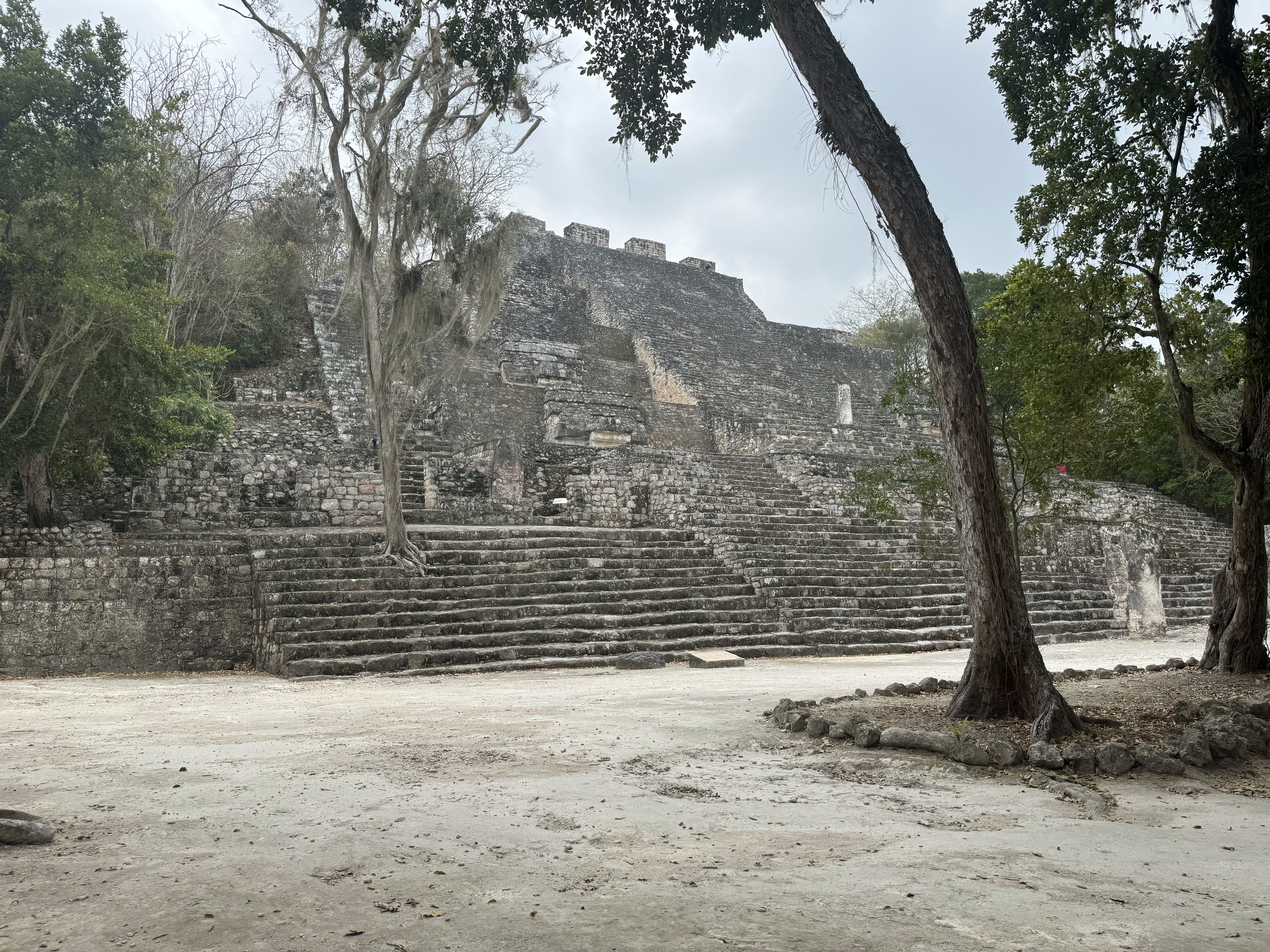
Now here's one of the "two pyramids" Lundell found. It's Structure 2. Sterile name, but the thing itself does suggest the "overwhelming power of this city-state" That power peaked under the 40-year reign of Yuknoom the Great, which began in 636 and which brought Calakmul to "the closest the Maya got to an empire." (Coe, The Maya, 10th ed., p. 225; Coe and Barry Brukoff, Royal Cities of the Ancient Maya, 2012, p. 44.)
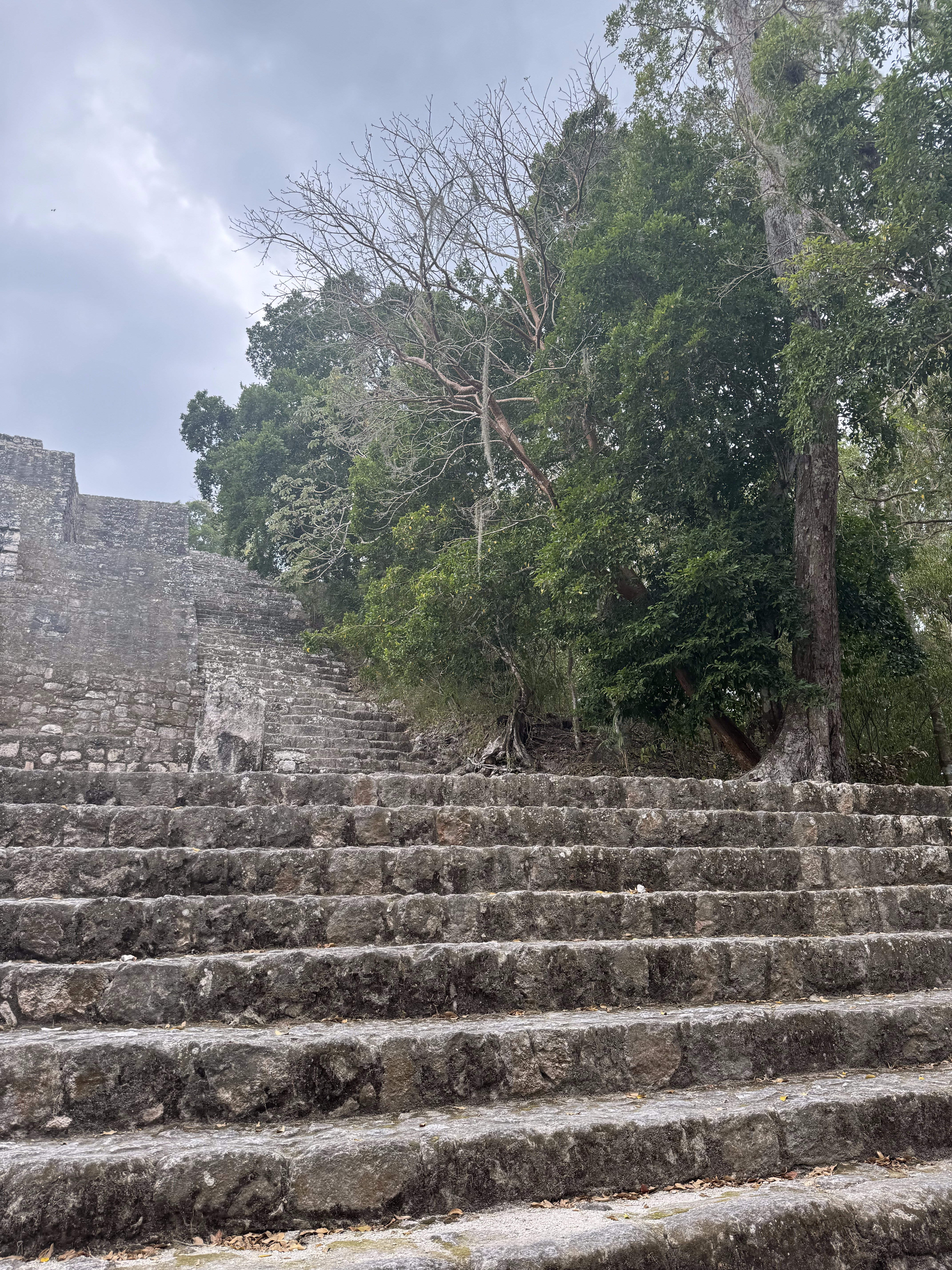
The forest has been cleared on only one side.
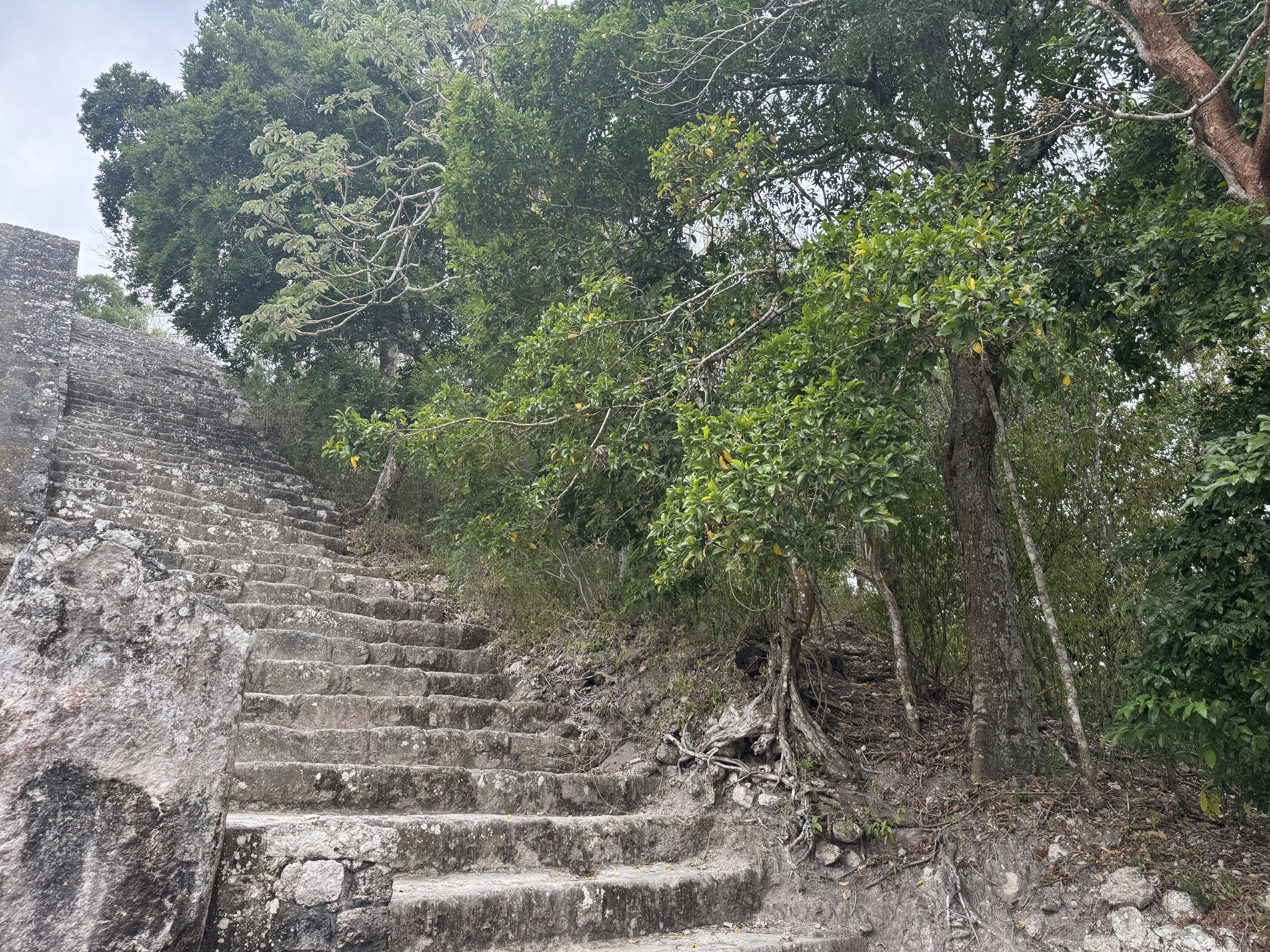
You can see it waiting to return.
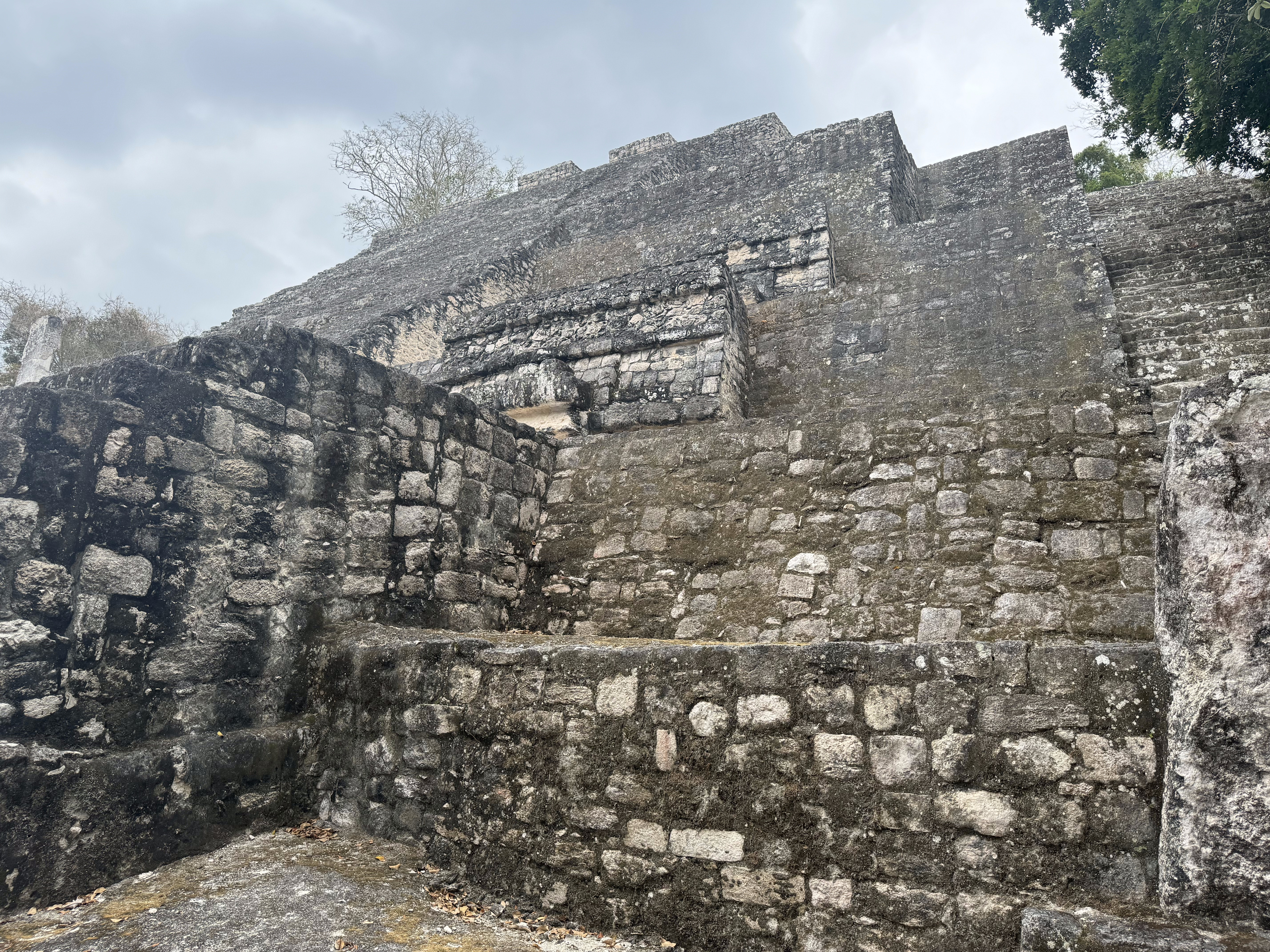
See any doors? There are some, because the pyramid was built in stages and swallowed up earlier buildings.
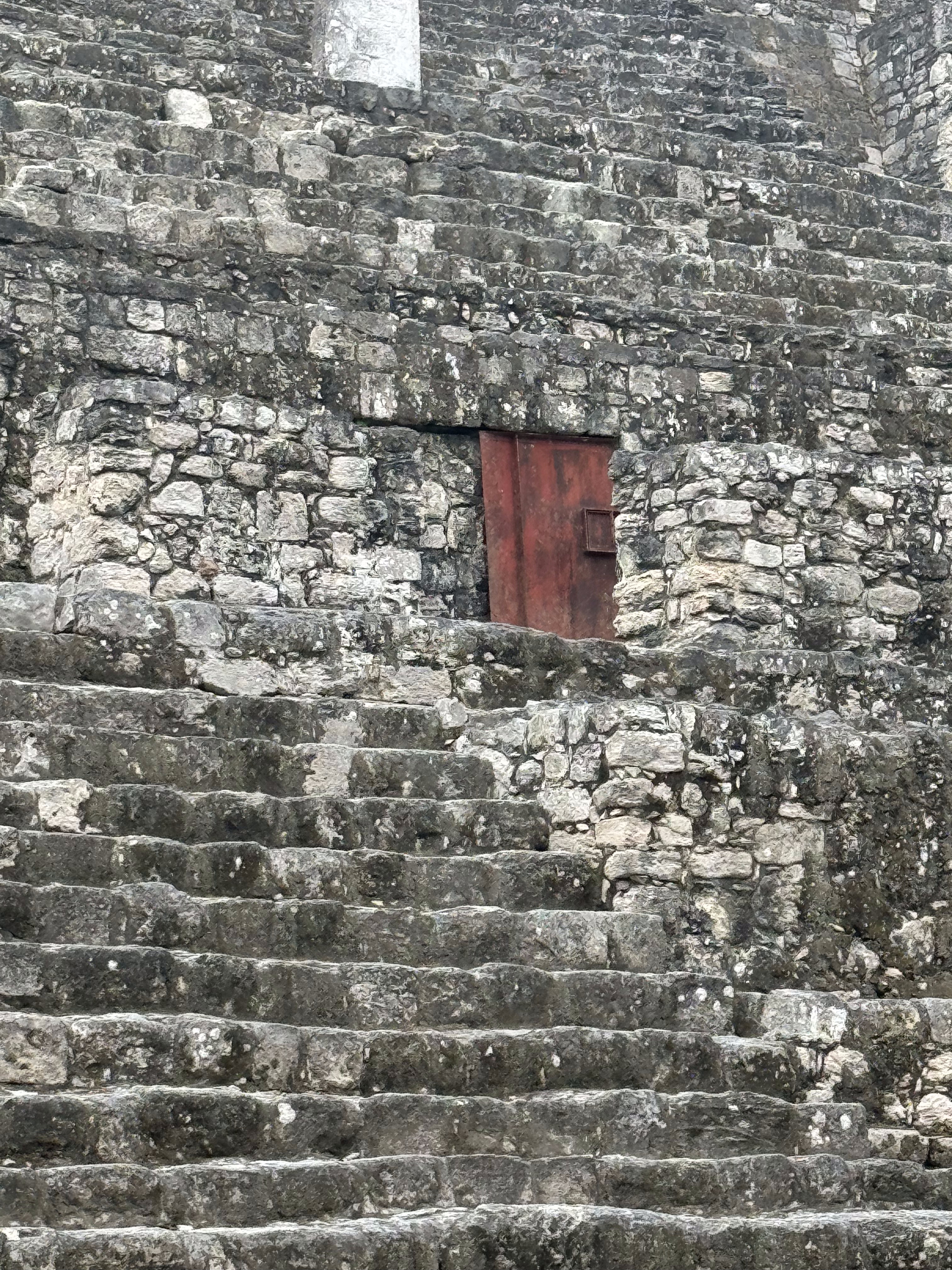
I'm not sure where this door leads, but the mountain includes the remains of a king buried along with two sacrificial victims, a young woman and an adolescent boy. He was Yuknoom Yich'aak K'ahk (r. 649-697). His name translates as Fiery Claw or Jaguar Paw Smoke. Despite the scary name, he was the king who led the disastrous campaign against Tikal in 695.
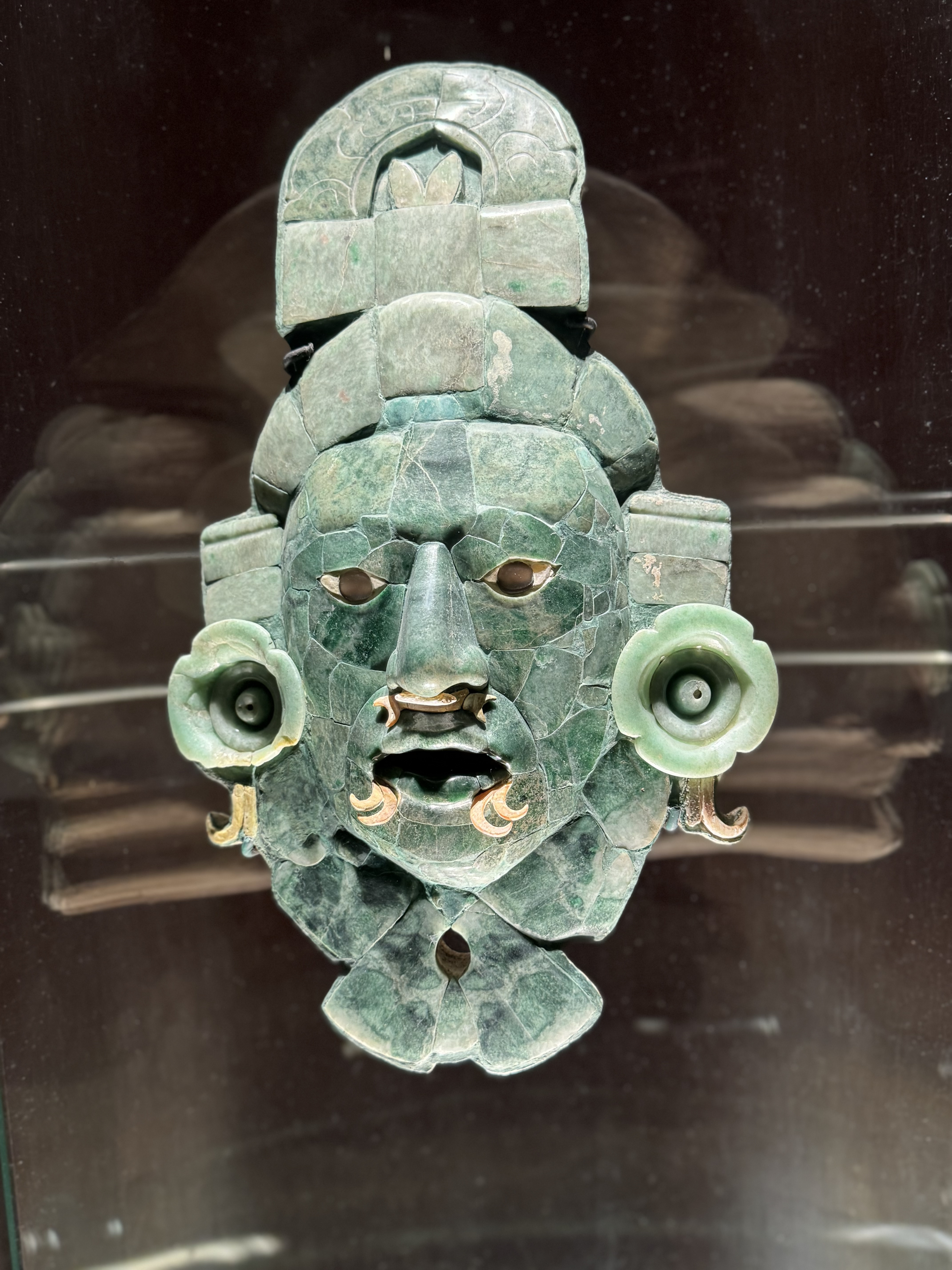
Defeat did not interfere with his getting a grand tomb discovered inside the pyramid in 1984. Next to his skeleton, archaeologists found this jade mask, now displayed in the Museum of Mayan Architecture in Campeche. Knock on a door to borrow a cup of sugar. If this guy answers, apologize and run. (There are two museums with Maya artifacts in the cty of Campeche. The one with this mask is built into a bastion on the water side of the wall around the chis gity's colonial core.)
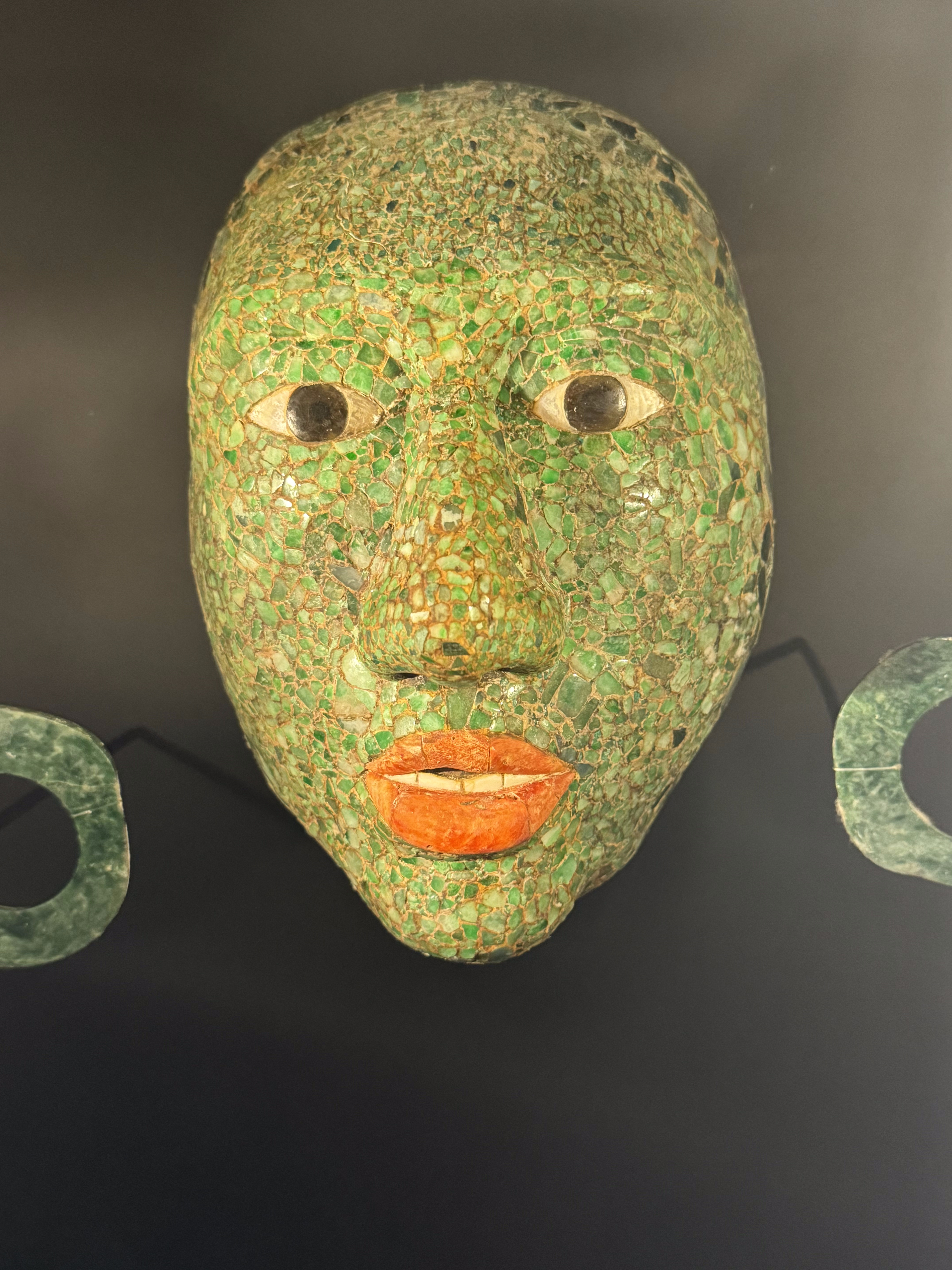
Another mask is now in Campeche's other archaeological museum, which is built in the former Fort San Miguel, a couple of miles to the west.
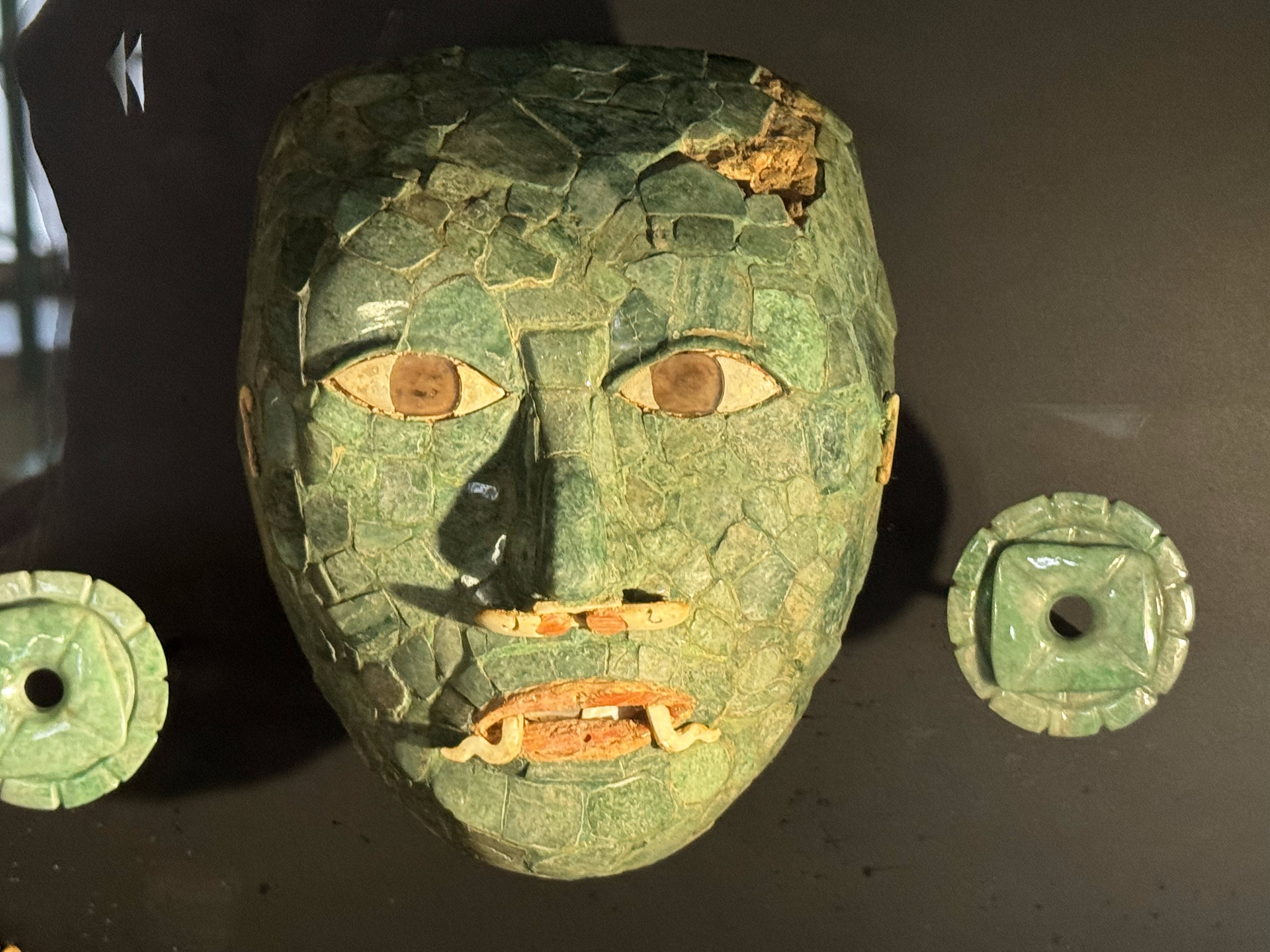
A third. "We don't have any sugar, but would you like to come in?"
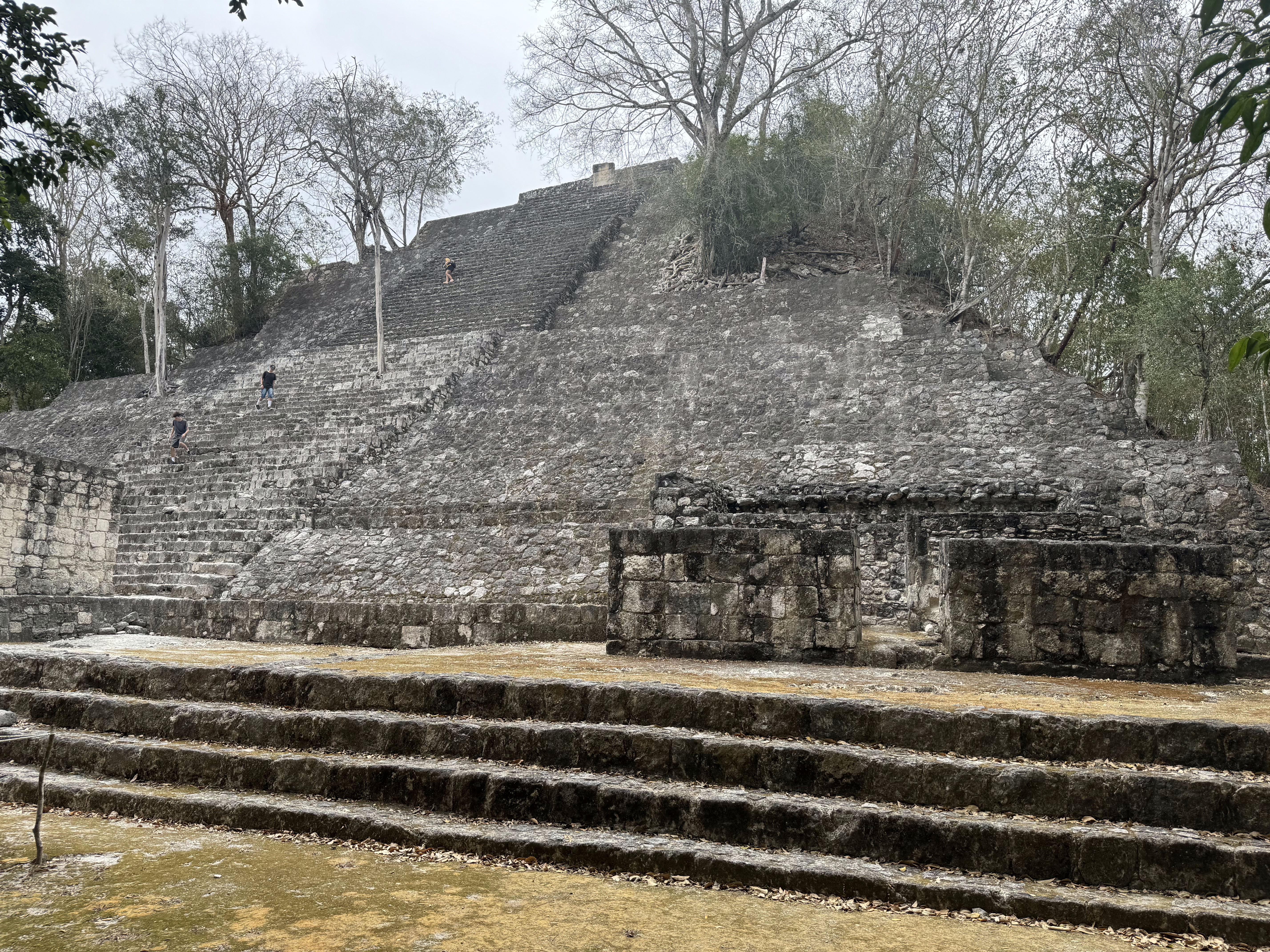
And here's the other pyramid, Structure 1. Coe and Brukoff remind us that the people who built it lived in "extremely dispersed... small compounds of two or three thatched houses with whitewashed walls of wattle and daub on low platforms....." (Michael Coe and Stephen Houston, Royal Cities of the Ancient Maya, p. 46).
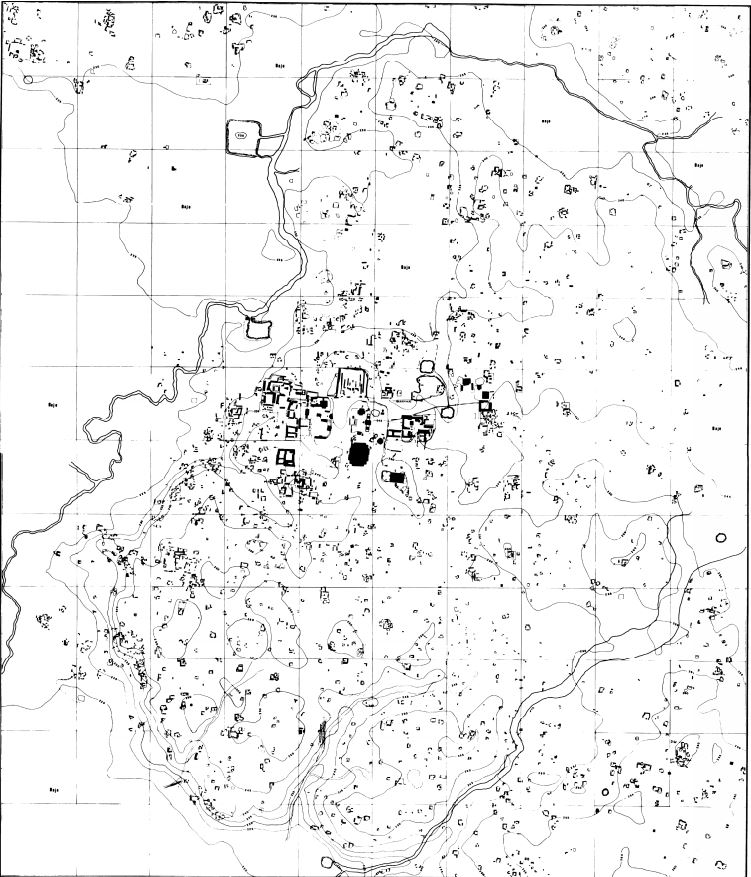
This map of part of Calakmul's domain suggests the dispersal of a population of at least 50,000 people. Maybe twice that many. The black rectangle is Structure 2. (https://www.jstor.org/stable/community.13908653 The map comes from the Calakmul Archaeological Project, William J. Folan, Director, and it also appears in Robert J. Sharer with Loa P. Traxler, The Ancient Maya, 6th edition, 2006, Figure 7.32.)
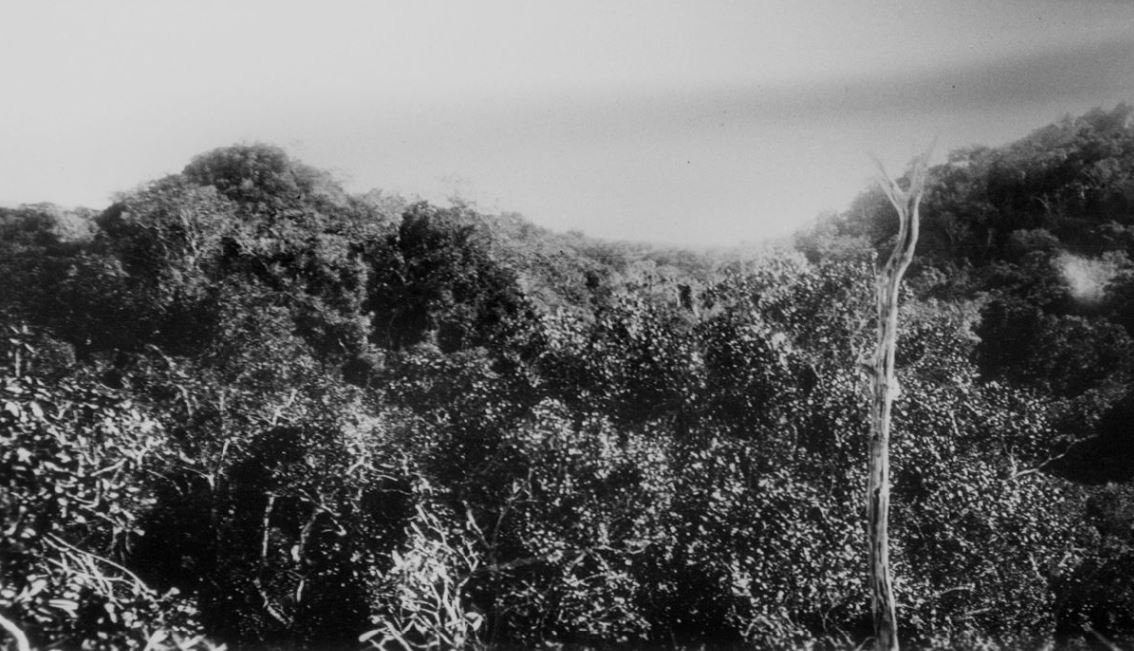
Here's a remarkable photograph of the "two pyramids" that gave Calakmul its name. The photographer is unidentified but presumably was either Lundell, the botanist, or someone a year or so later on the Morley team. In any case, it's part of the Carnegie Institution collection and is online as https://www.jstor.org/stable/community.11840379