2 Upolu
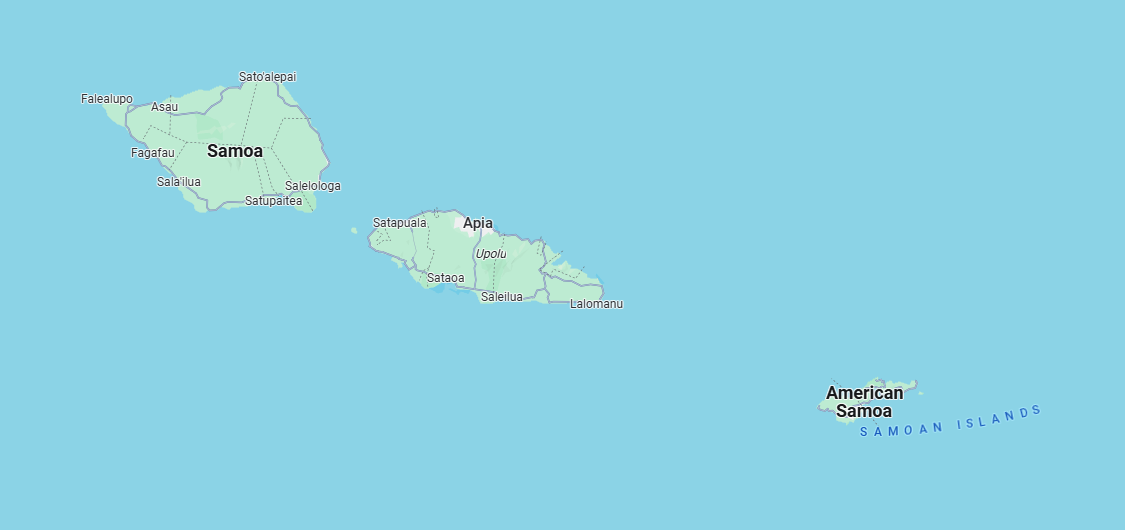
Here we are, a bit over halfway between Hawaii and New Zealand. There are no flights from the mainland United States, and there's only one flight weekly from Hawaii. Flight time: 5:40 in a 737. New Zealand is closer, with flights taking 3:55 in an Airbus 321. They're not only shorter, they're more frequent, operating daily.
The two big islands belong to the nation called Samoa (until 1997, it was called Western Samoa to distinguish it from American Samoa). The island on the right is correctly labeled as Upolu, but the island on the left is incorrectly labelled. It should read Savai'i. Meanwhile, the words American Samoa bury the island of Tutuila, which is indeed the main island of this American territory. Why the words Samoan Islands are placed next to it, rather than more centrally, is a mystery.
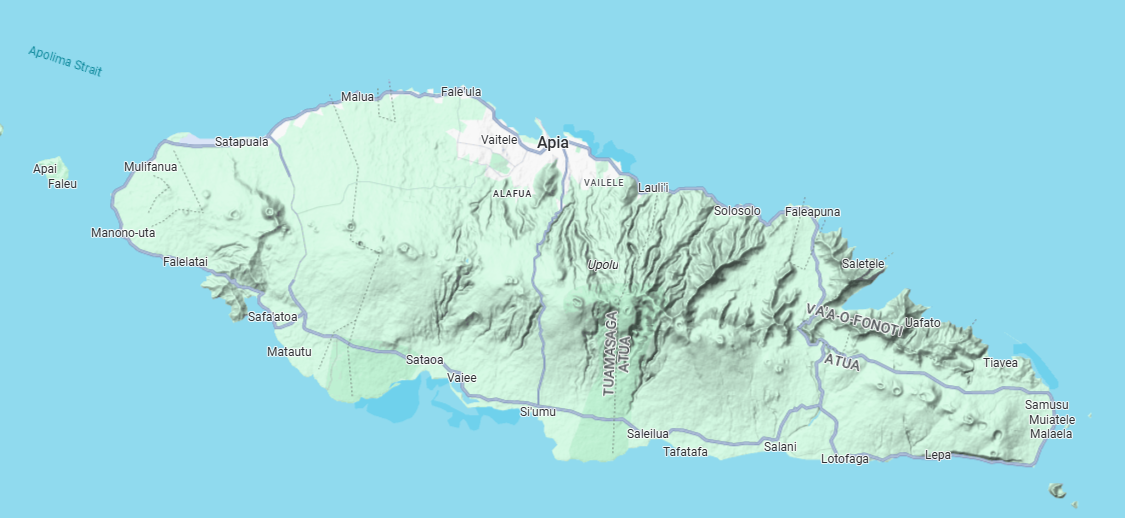
Upolu, with about 150,000 people, is the most populous island in the entire group, but it's only about 44 miles end to end, which helps explain why there are no gas stations east of Apia, the capital, and damned few west of it.
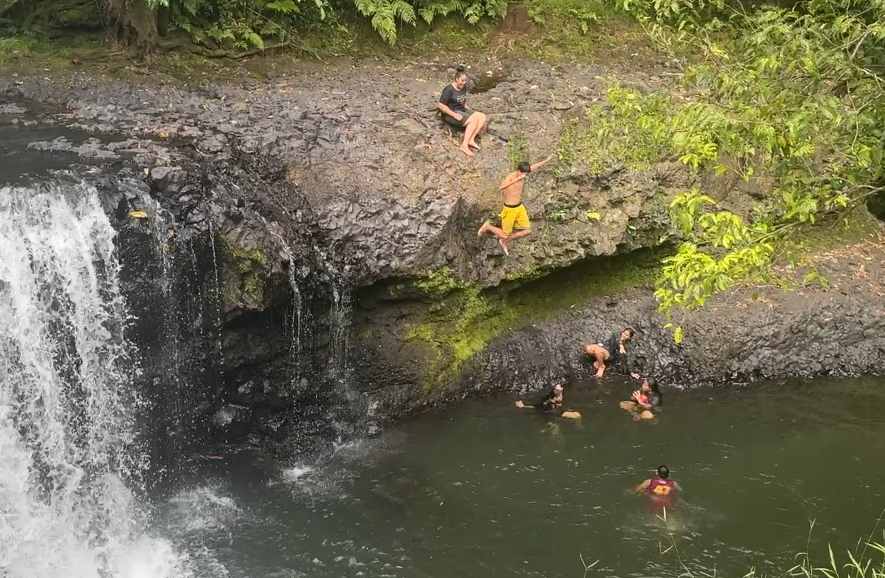
We could come for fun. The boy in yellow had been hesitating, so the girl in black pushed him. (It's Togitogiga Falls, about midway along the south coast.)
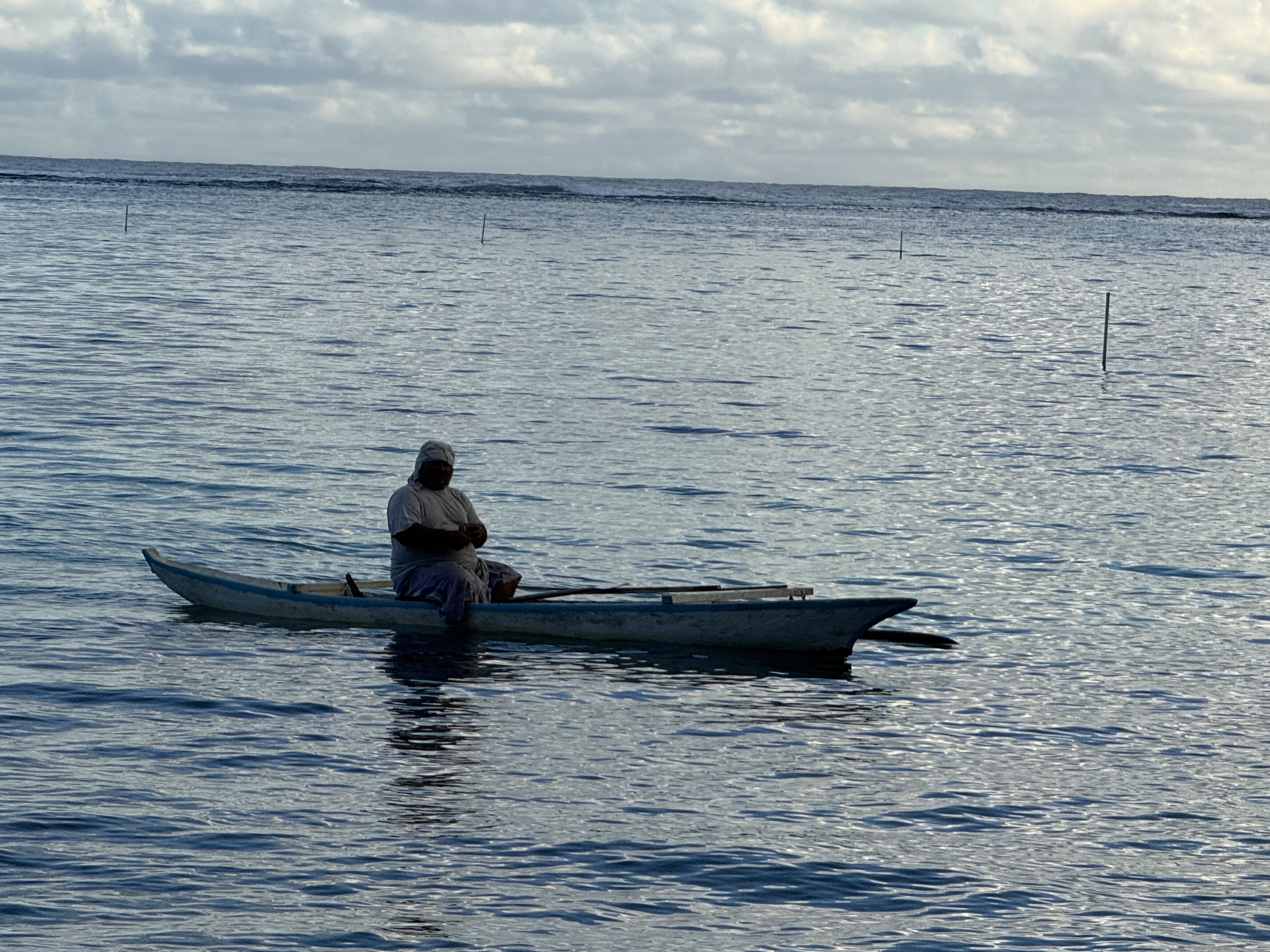
Or we could come for peace and quiet near Lafaga Bay. Note the calm waters, for which that subdued coral reef can take credit. Note also the outrigger canoe. Think the boat is a dugout? I do.
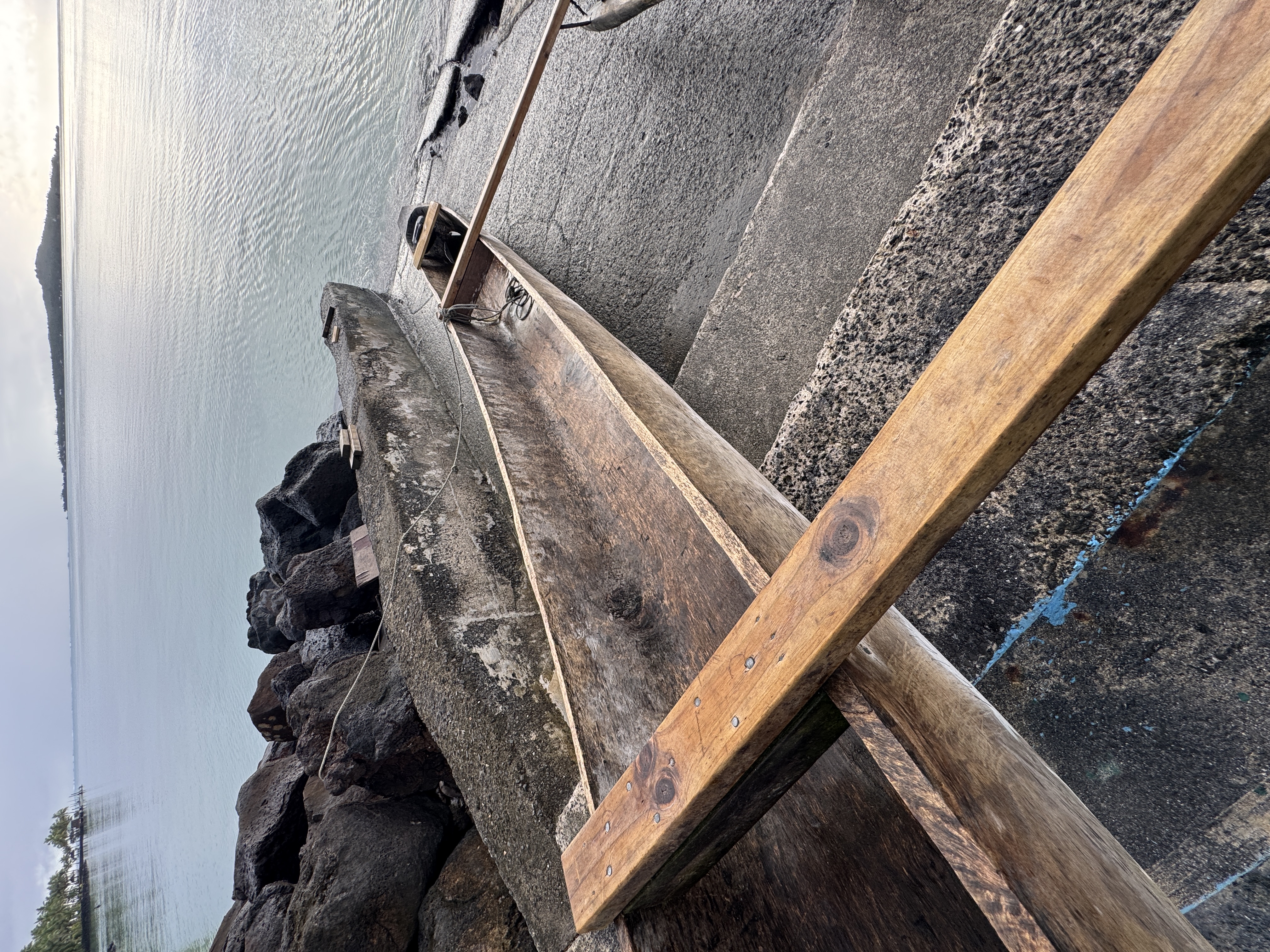
Like this one.
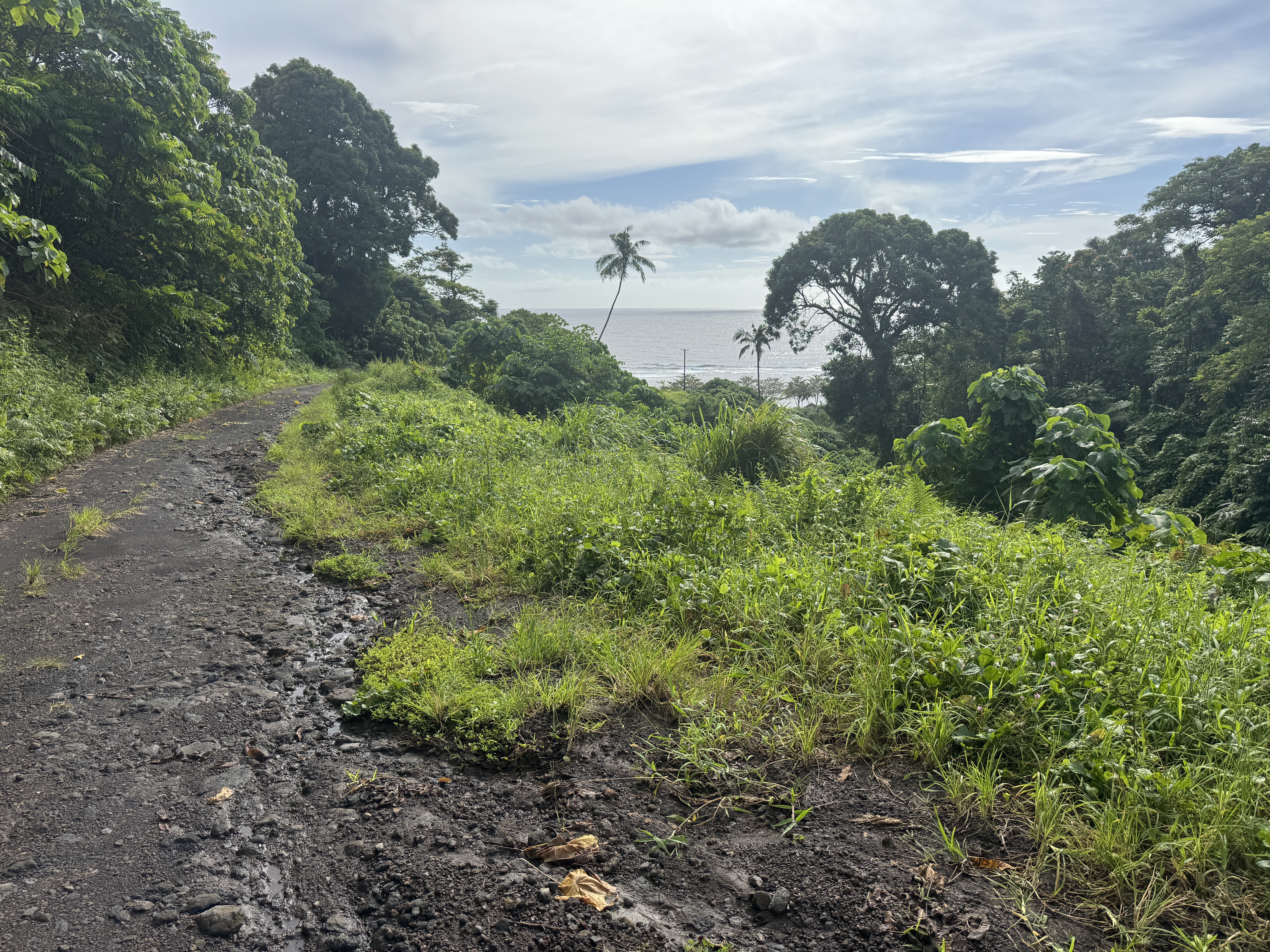
Or we could go exploring and walk down this deserted road to Tiavea Beach.
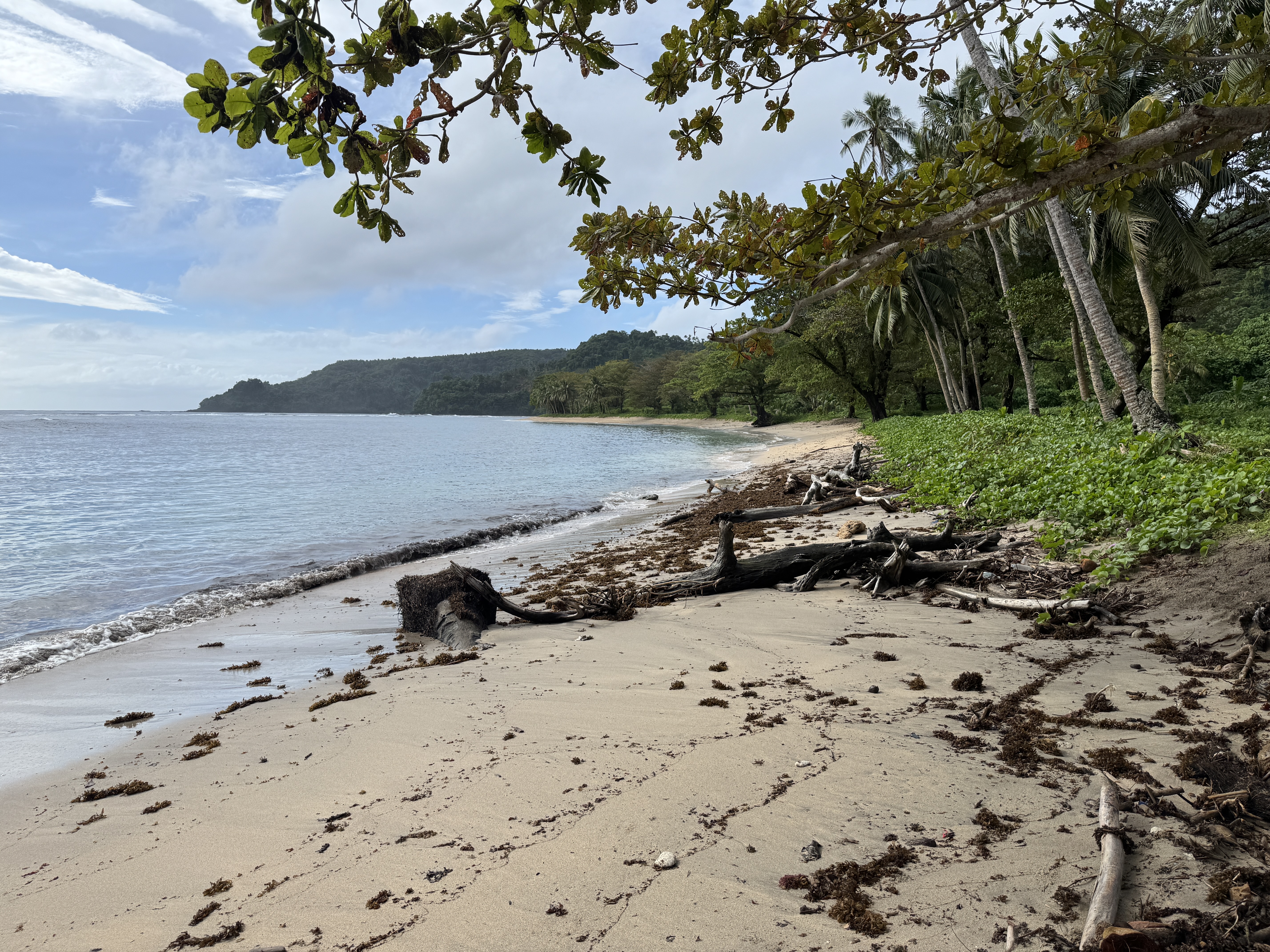
Bring your lunch. Water, too. Writing of the period before World War I, a leading German businessman in Samoa wrote: "We almost always travelled on foot, which I always preferred above all else.... only in quite impassible areas, such as from Tiavea to Fagaloa... were motorboats used." (James N. Bade, Karl Hanssen's Memoirs, 2016, p. 97.)
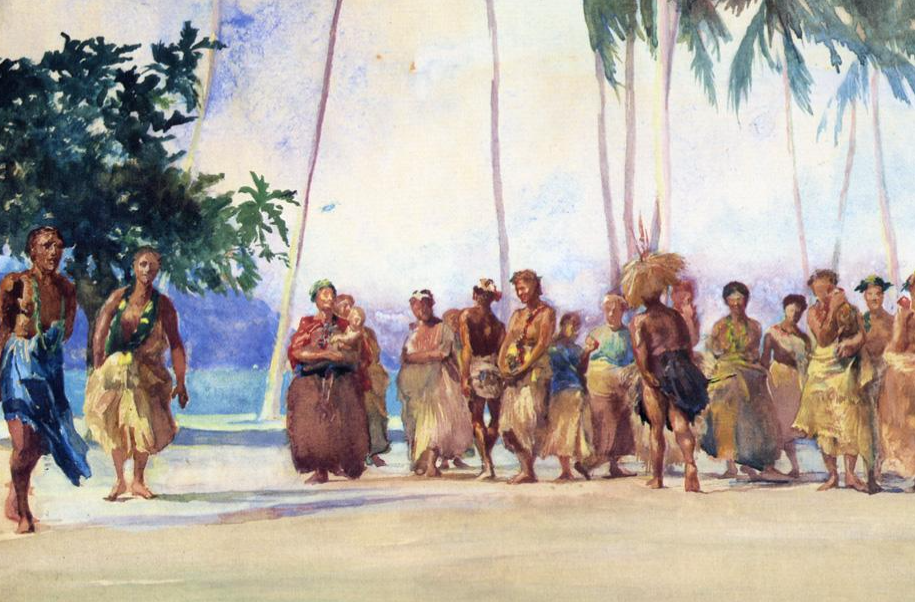
Henry Adams and John La Farge spent a few months in Samoa in 1890. They loved the place, and La Farge painted up a storm. Here, at the same Fagaloa mentioned in the previous picture, villagers welcome Adams and La Farge, who had just arrived by canoe. Yes, outrigger.
(Elizabeth Hodermarsky, John La Farge's Second Paradise: Voyages in the South Seas, 1890-92. p. 66)
Here, again by La Farge, is a view of the taupo, or official virgin of Fagaloa. She's shown with her chaperone and, yes, another outrigger canoe.
(Hodermarsky, p. 112.)
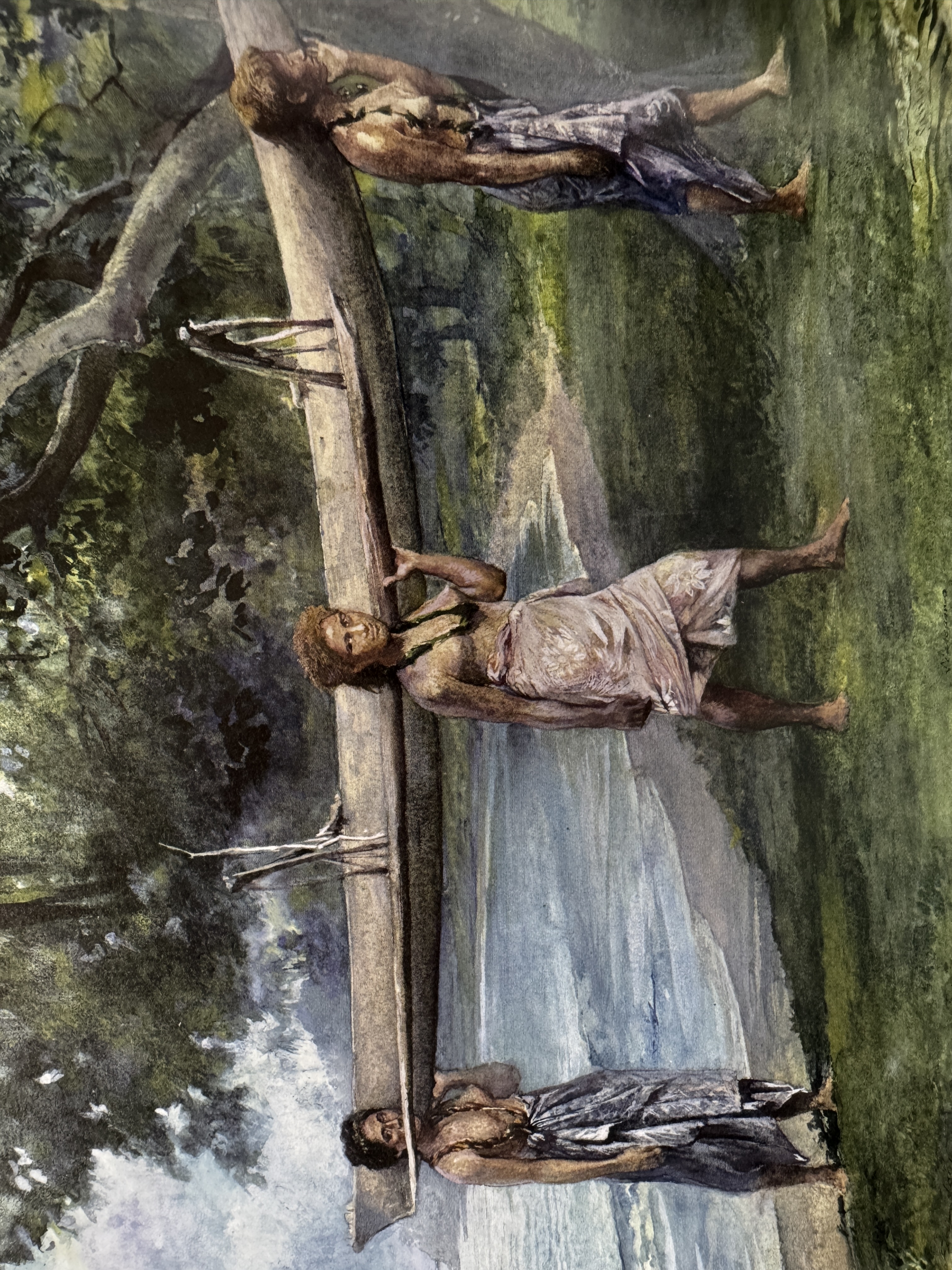
Samoan women are ridiculously strong. It can be embarrassing, as when a woman at a hotel insisted on carrying my luggage upstairs. It was only a carry-on, which made it worse.
(Hodermarsky, p. 20.)
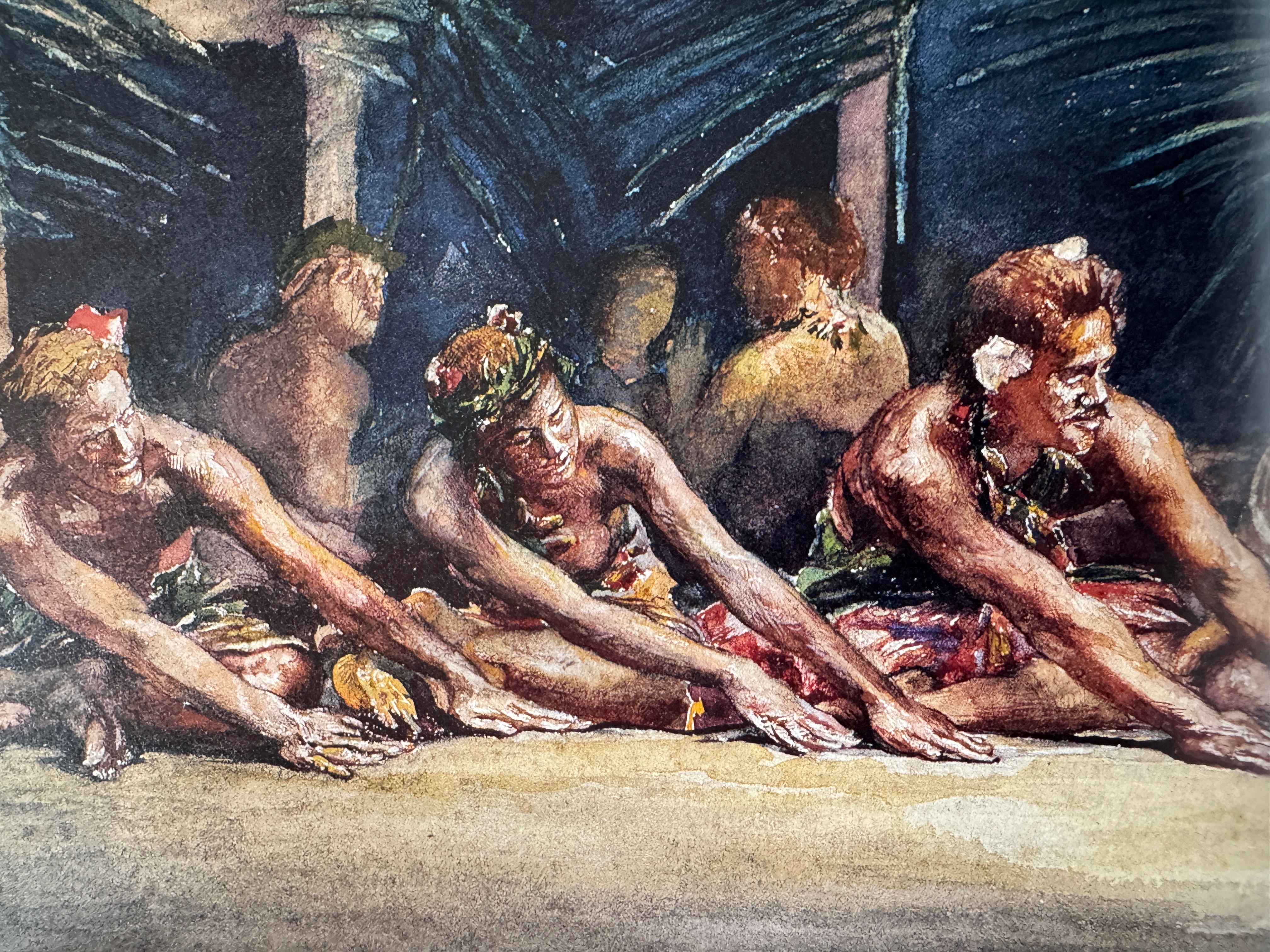
Both Adams and La Farge were infatuated by Samoan dancing. Adams described it as "all absolutely Greek in modelling and action, with such freedom of muscle and motion as the Greeks themselves hardly knew." (The Letters of Henry Adams, vol. 3, p. 291, 1982.)
La Farge wrote: "...of what use is it to say that it was beautiful, and extraordinary, and that no motion of a western dancer but would seem stiff beside such an ownership of the body." (John La Farge, An American Artist in the South Seas, 1987, original ed. 1914, p. 85.)
(Hodermarsky, p. 88.)
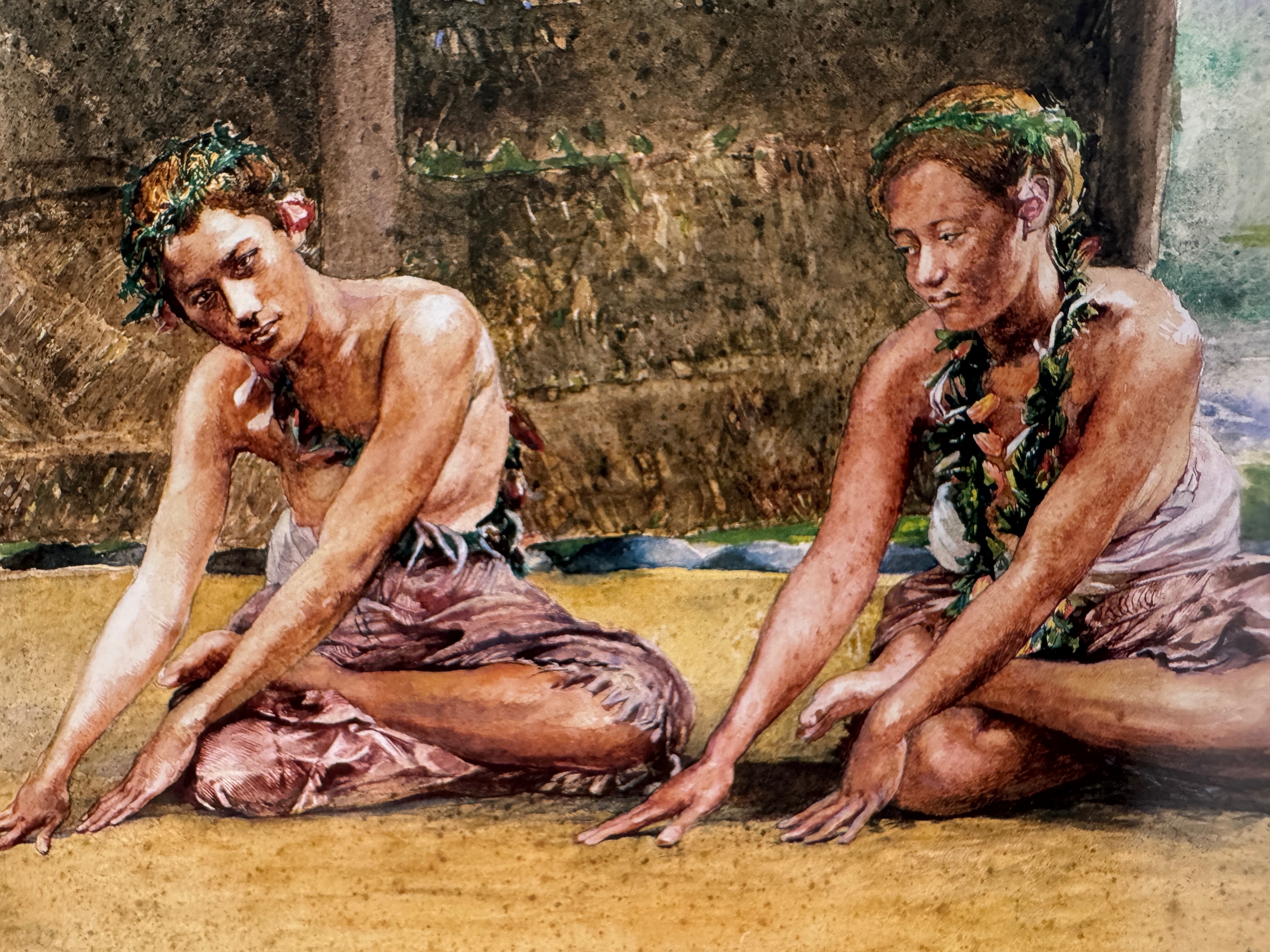
Watching with La Farge, Adams wrote: "The sensation of seeing extremely fine women, with superb forms, perfectly unconscious of undress, and yet evidently aware of their beauty and dignity, is worth a week's seasickness to experience. La Farge was knocked out by it.... I imagine he never approached such an artistic sensation before. For my own part, I gasped with the effect of color, form, and motion, and leave description to the fellow that thinks he can do it. To me the effect was that of a dozen Rembrandts intensified into the most glowing beauty of life and motion."" (Adams, p. 301.)
Elsewhere, Adams writes: "the whole scene and association gave so much freshness to our fancy that no future experience, short of being eaten, will ever make us feel so new again. La Farge's spectacles quivered with emotion... To me, the dominant idea was that the girls... had actually come out of the sea." (Adams, p. 291)
More: "I have no thought of trying to instruct the world any more, but want only to become Polynesian, and forget today what happened yesterday... You can imagine me living in a model archaic world such as I studied in books, and lectured about as Professor, where everything is thousands of years old, yet to me new... (Adams, p. 323)
(Hodermarsky, p. 81.)
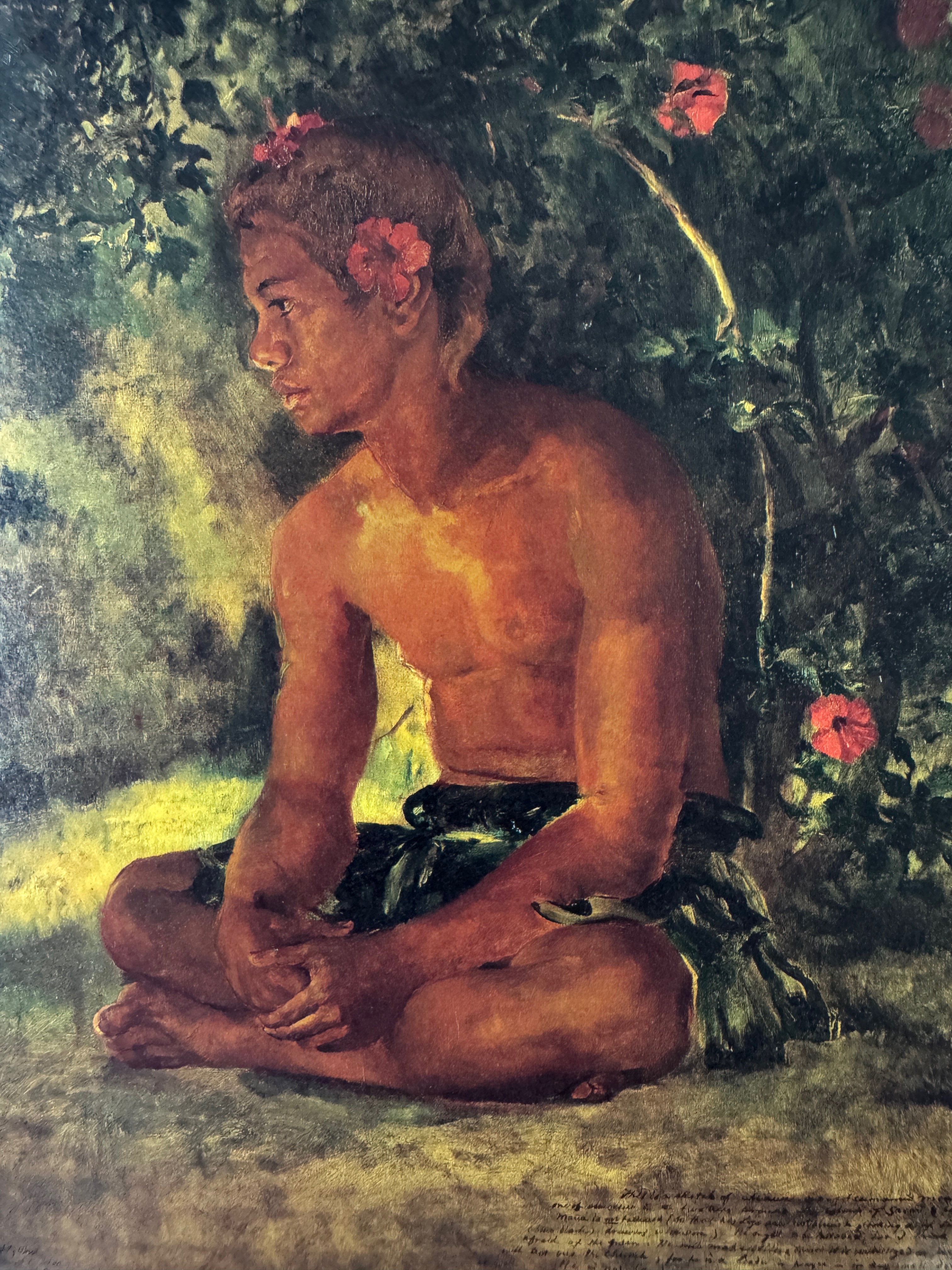
Adams and La Farge stayed as guests of a village chief who supplied them not only with a canoe but with men to row it. Here's one of them. Adams wrote: "I felt as though I had got back to Homer's time, and were cruising about the Aegean with Ajax" (p. 342).
Again: "They work little, and show their superiority over our idiotic cant about work, by proving how much happier an idle community can be, than any community of laborers ever was... I am inclined to profanity when I think that religion, political economy and civilization so-called, will certainly work their atrocities here within another generation..." (p. 302).
La Farge agrees: "...there will soon come a day when even for those who care, it will be no more; when nowhere on earth or at sea will there be any living proof that Greek art is not all the invention of the poet... (p. 93).
(Hodermarsky, p. 133.)
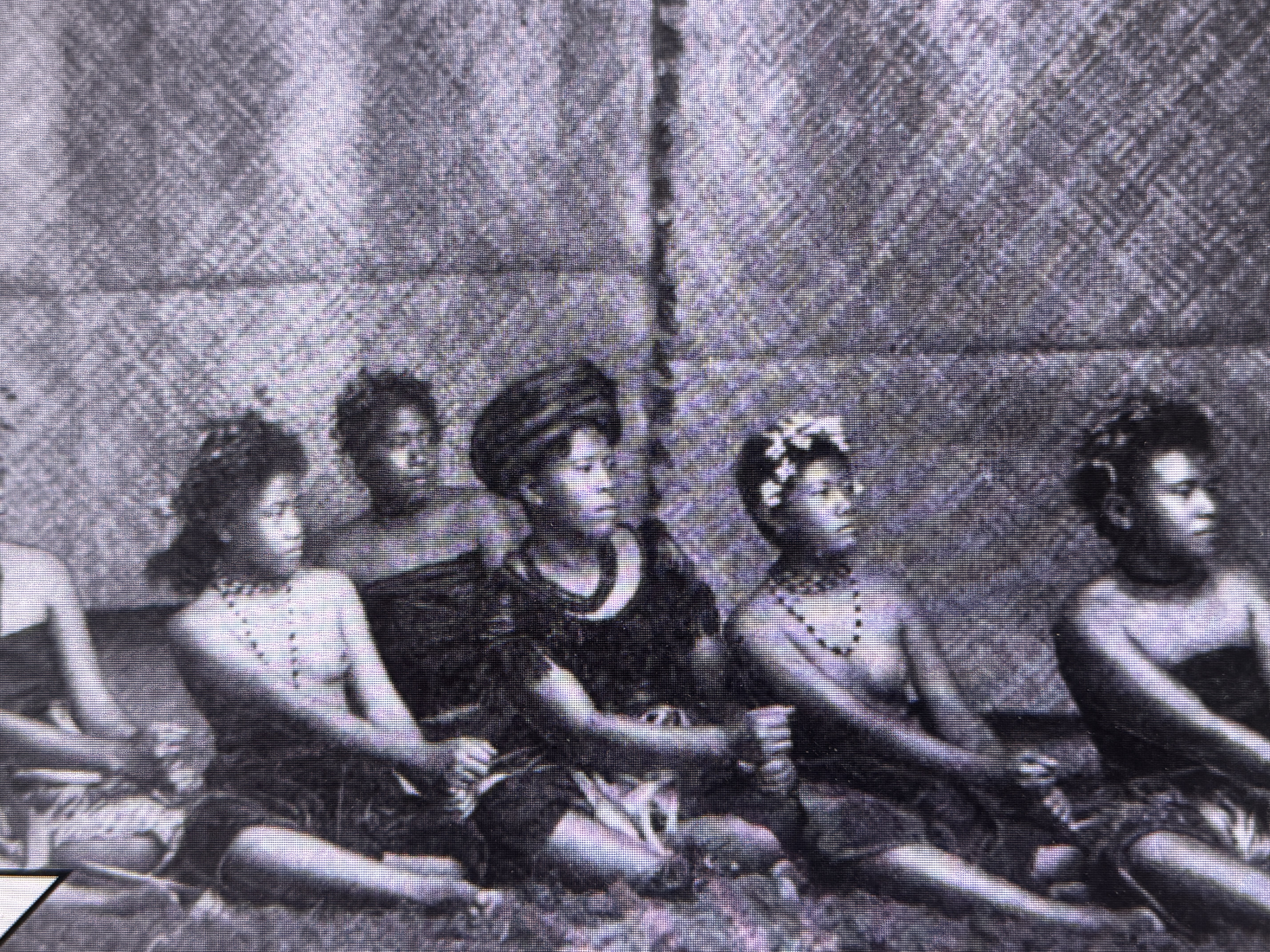
A photo if you don't trust paintings.
(F. Reinecke, Samoa, 1902, p. 173.)
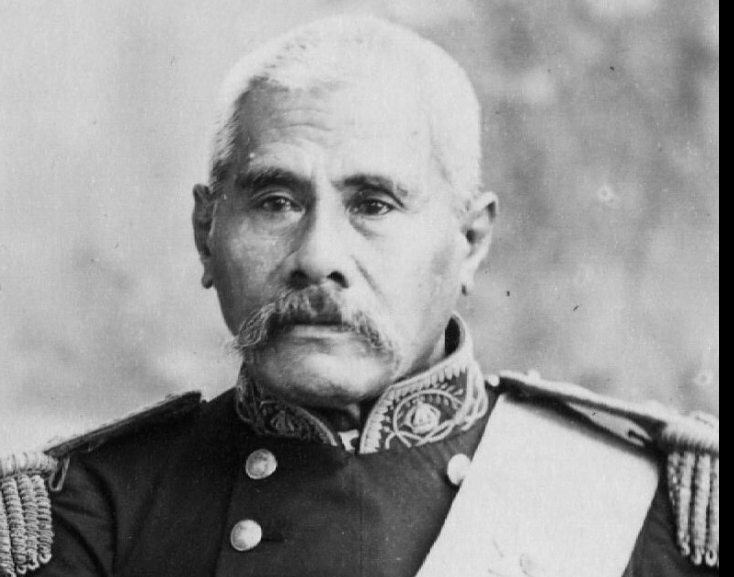
Adams wrote that the manners of Samoa's village chiefs were "astonishingly fine, and their rhetoric, either in conversation or oratory, makes me ashamed of my own race" (Adams, p. 324).
Here's a very senior chief, Malietoa Laupepa (1841-98). Adams wrote that he "talked slowly, with a little effort, but with a dignity and seriousenss that quite overawed me... As rhetoricians and men of manners, the great Samoan chiefs, and, for that matter, the little ones too, make me feel as though I were the son of a camel driver degraded to the position of stable-boy in Spokane West Centre. Aristocracy can go no further, and any ordinary aristocracy is vulgar by the side of the Samoan" (p. 292-3).
Other visitors have agreed. In 1940 the British governor of Fiji, who was also high commissioner of the British Western Pacific Territories, visited Samoa. In his diary, he wrote that the formal behavior of the Samoan chiefs bears "the same sort of relation to the punctilio and etiquette of the Spanish court of the eighteenth century, which were not exactly rudimentary, as a post-graduate course at university bears to a kindergarten" (Harry Luke, From a South Seas Diary, 1938-1942, 1945, p. 164).

Referring to another eminent chief, Mataafa, La Farge writes: "My companion [Henry Adams], difficult to please, says, "La Farge, at last we have met a gentleman." 137
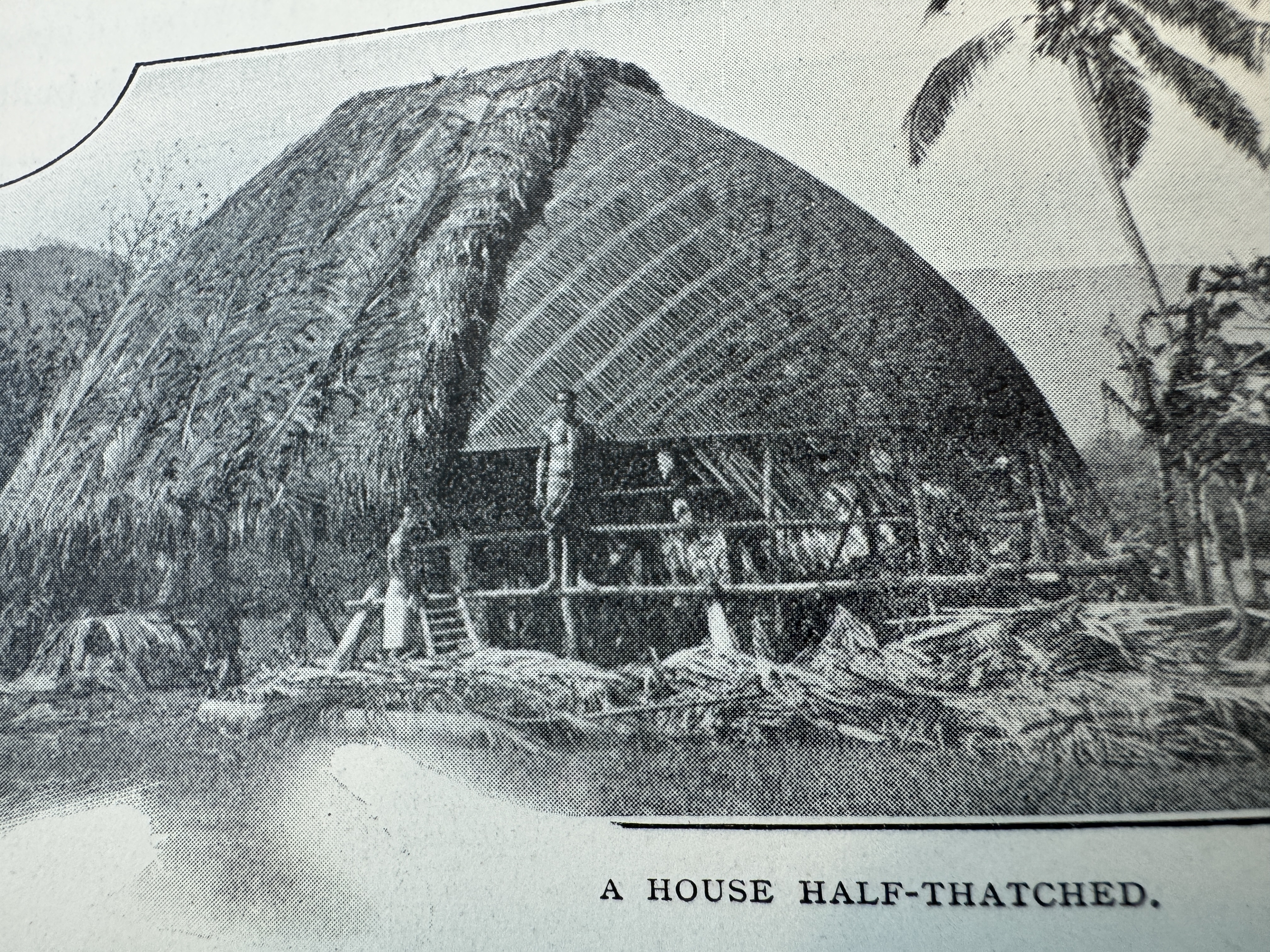
Adams stayed in a house like this. He described it: "The cabin was charming when one looked about it. Nearly circular, with a diameter of some forty feet, its thatched roof, beautifully built up, came within about five feet of the ground, ending there on posts, and leaving the whole house open to the air. Within, mats covered a floor of white corals, smooth and almost soft like coarse sand. Fire was made in the middle of the hut" (Adams, p. 289).
La Farge wrote "It is set upon a foundation of stones, and its flooring is of fine pebbles. It is made of a series of high posts... connected at the top by a series of double beams, which receive great rafters running from every set of posts to the peaked centre. At the centre they are supported by two more great pillars... Walls there are none in the true Samoan house" (La Farge, p. 104).
George Turner, an early missionary, described the house-building industry: "you may find one among every 300 men who is a master carpenter. Whenever this person goes to work, he has in his train some ten or twelve who follow him, some as journeymen, who expect payment from him, and others as apprentices, who are principally anxious to learn the trade.... If a person wishes a house built, he goes with a fine mat, worth in cash value 20s. or 30s. He tells the carpenter what he wants, and presents him with the mat as a pledge that he shall be well paid for his work.... Nothing is stipulated as to the cost; that is left entirely to the honor of the employing part.... It is a lasting disgrace to any one to have it said that he paid his carpenter shabbily.... It is a standing custom, that after the sides and one end of the house are finished, the principal part of the payment be made; and it is at this time that a carpenter, if he is dissatisfied, will get up and walk off.... No one will take up the work which another party has thrown down." George Turner, Nineteen Years in Polynesia, 1861, pp. 261-3). For construction details, see Te Rangi Hiroa (P.H. Buck), Samoan Material Culture, 1930.
This drawing comes from Samoa'uma (1902, p. 172), by Llewella Churcuhill. Her husband William was the American consul in Samoa in the late 1890s.
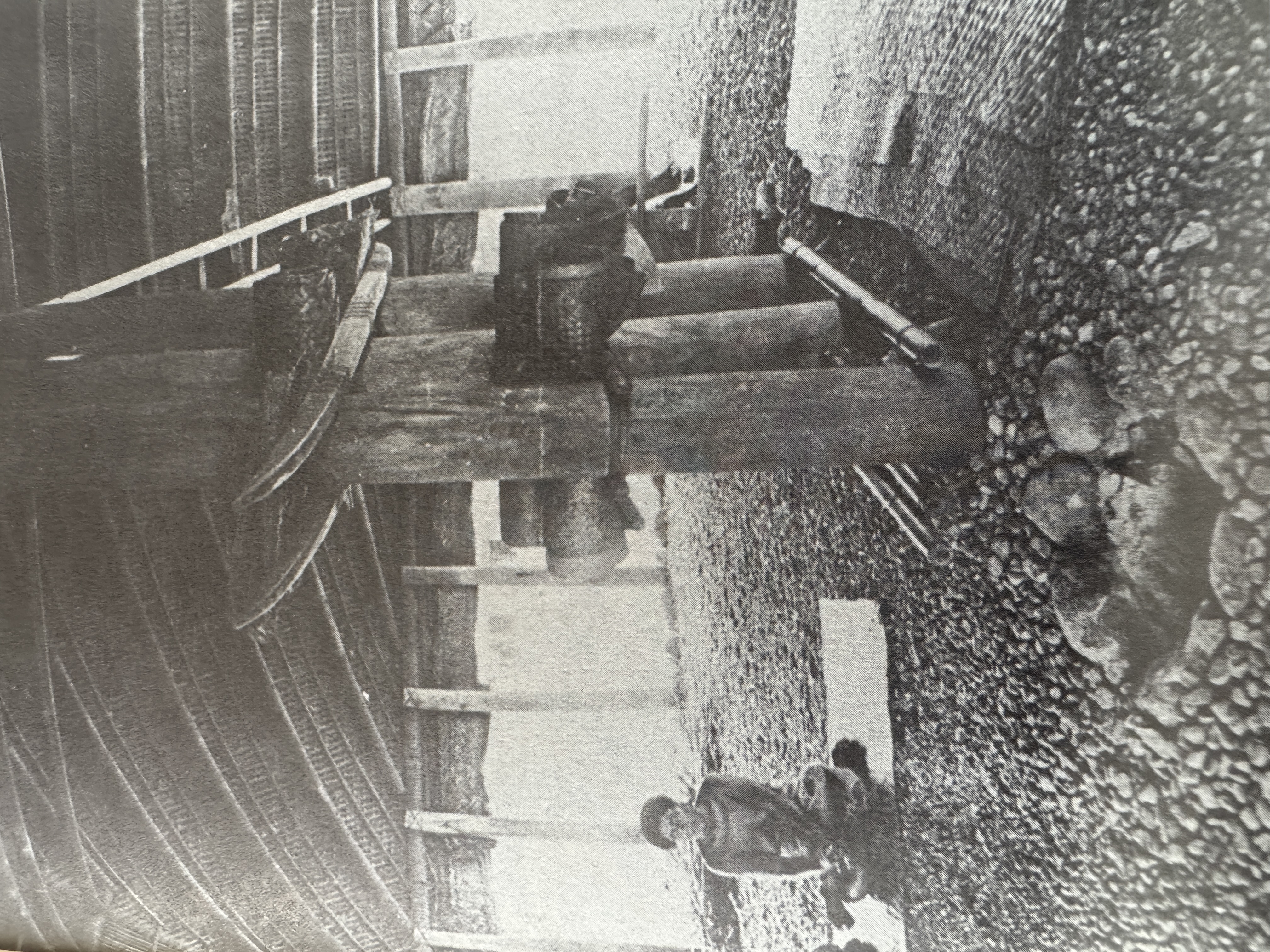
Henry Adams took this photograph and wrote that it was "either the house we live in or that of Mataafa next to us" (Adams, p. 317).
Perhaps the first American to describe these houses was Charles Wilkes, commander of the United States Exploring Expedition of 1838-42. He writes: "One cannot but view these natives not only as industrious, but as possessing great skill and ingenuity." Wilkes also wrote that "a native is in a comfortable condition when he has a good house; a well-made visiting canoe; a near, handy, large, and well-formed woman for a wife; a taro-patch wth a good fence; coconut and bread-fruit trees, with a reasonable number of pigs." (Charles Wilkes, Narrative of the United States' Exploring Expedition, condensed and abridged, 1845, p. 113 and p. 92).
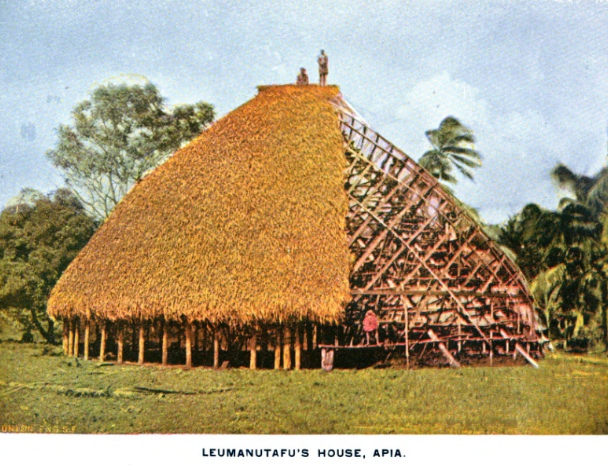
Another house under construction. It comes from a 50-page booklet written by the then-editor of California's Overland Monthly. (Charles S. Greene, Talofa, Samoa, 1896, p. 38).

The original photograph, by Thomas Andrew (1855-1939), a pioneer photographer in Samoa.
https://collections.tepapa.govt.nz/object/1414707?page=1&rtp=1&ros=6&asr=1&assoc=all&mb=c
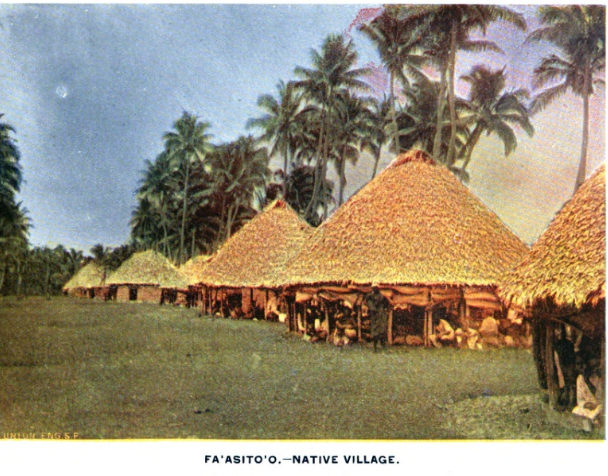
As late as 1982, John Dyson could describe the Samoan village as "a crowded campground in the Garden of Eden" and the Samoan house as "like living in a bandstand." (The South Seas Dream, 1982, p. 141).
(Greene, p. 27.)
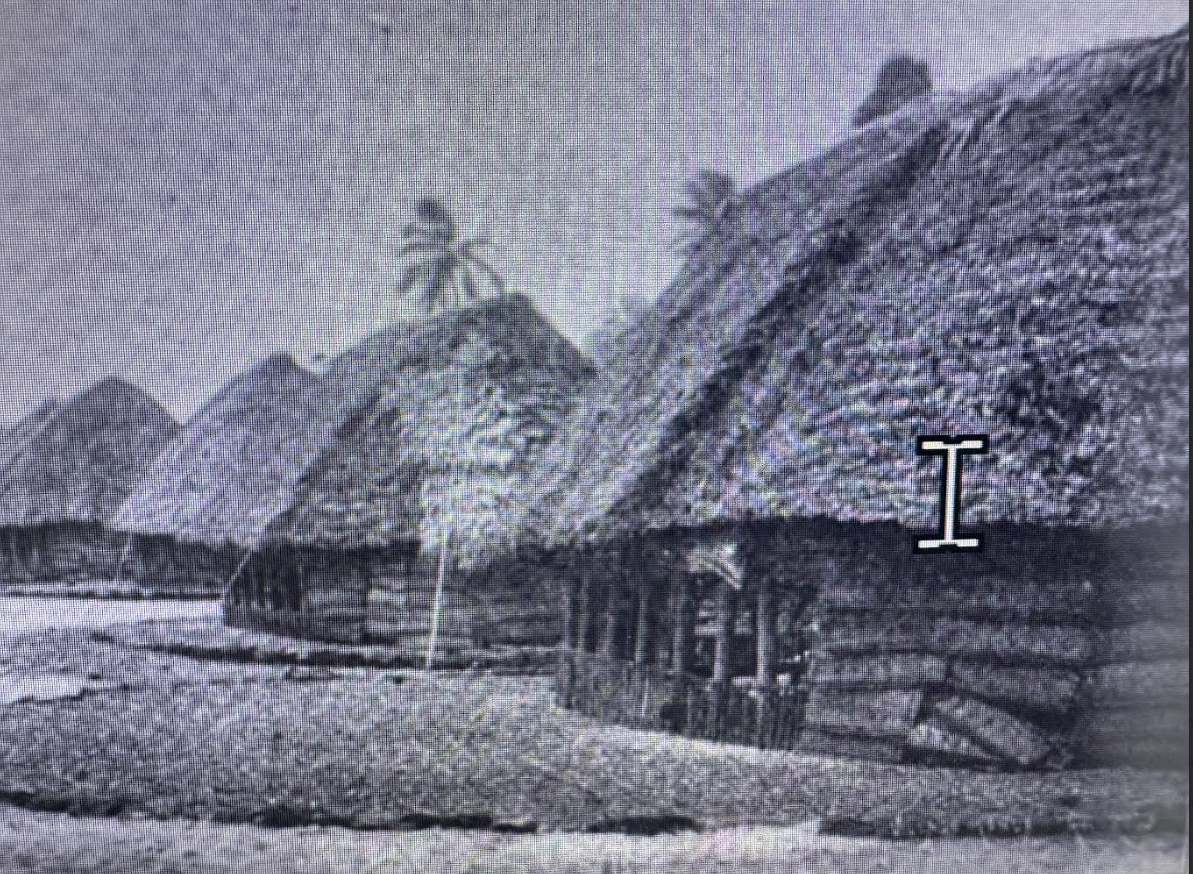
This photograph shows the maps that, like Venetian blinds, could be unrolled in the event of storms. (Edward Reeves, Brown Men and Woman, 1898, p. 157).
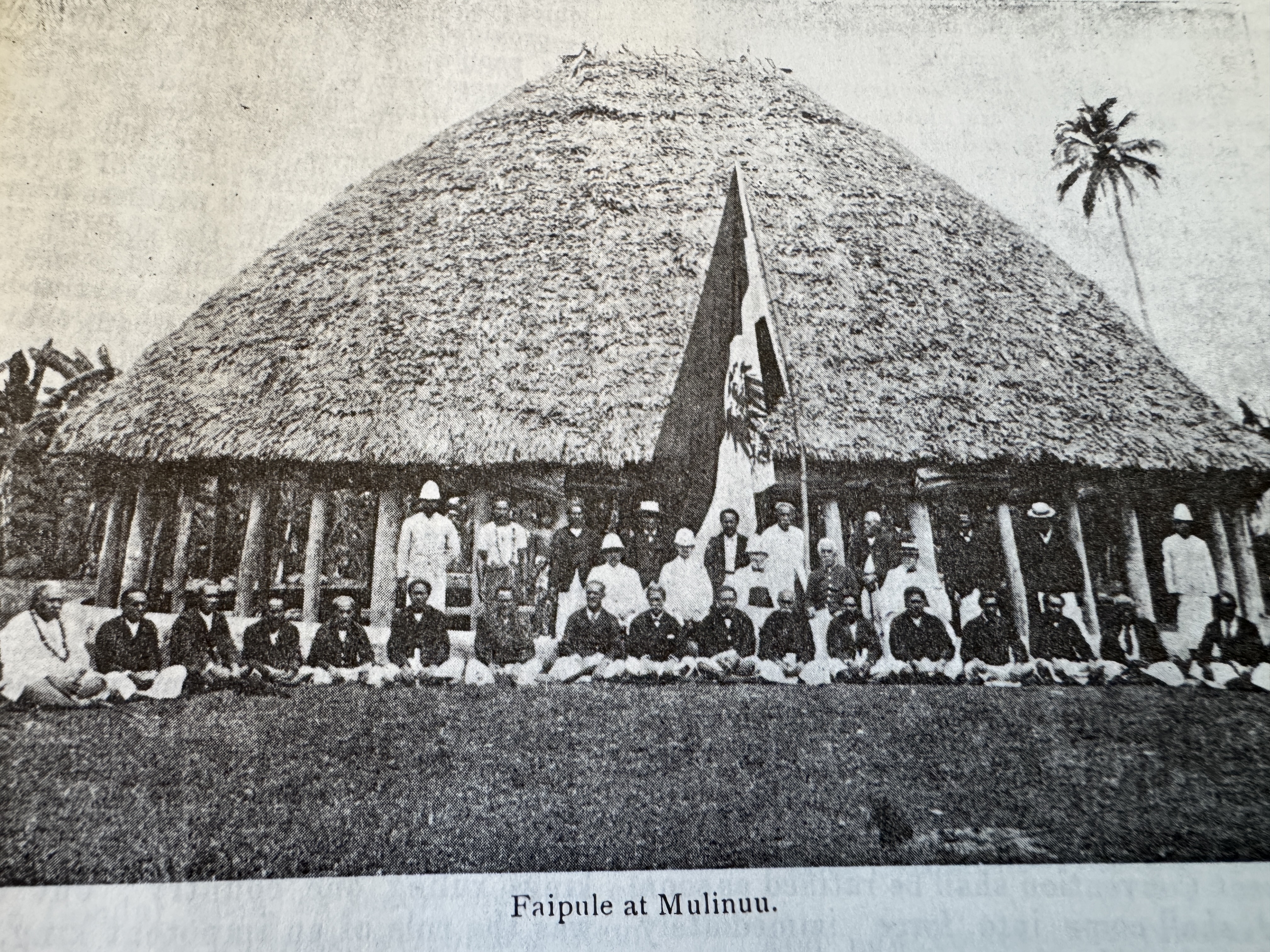
The structures could be very large, in this case (judging from the German colonial flag) serving as a meeting hall for village chiefs sometime between 1900 and 1914.
(The Cyclopedia of Samoa, Tonga, Tahiti, and the Cook Islands, 1907, p. 21.)
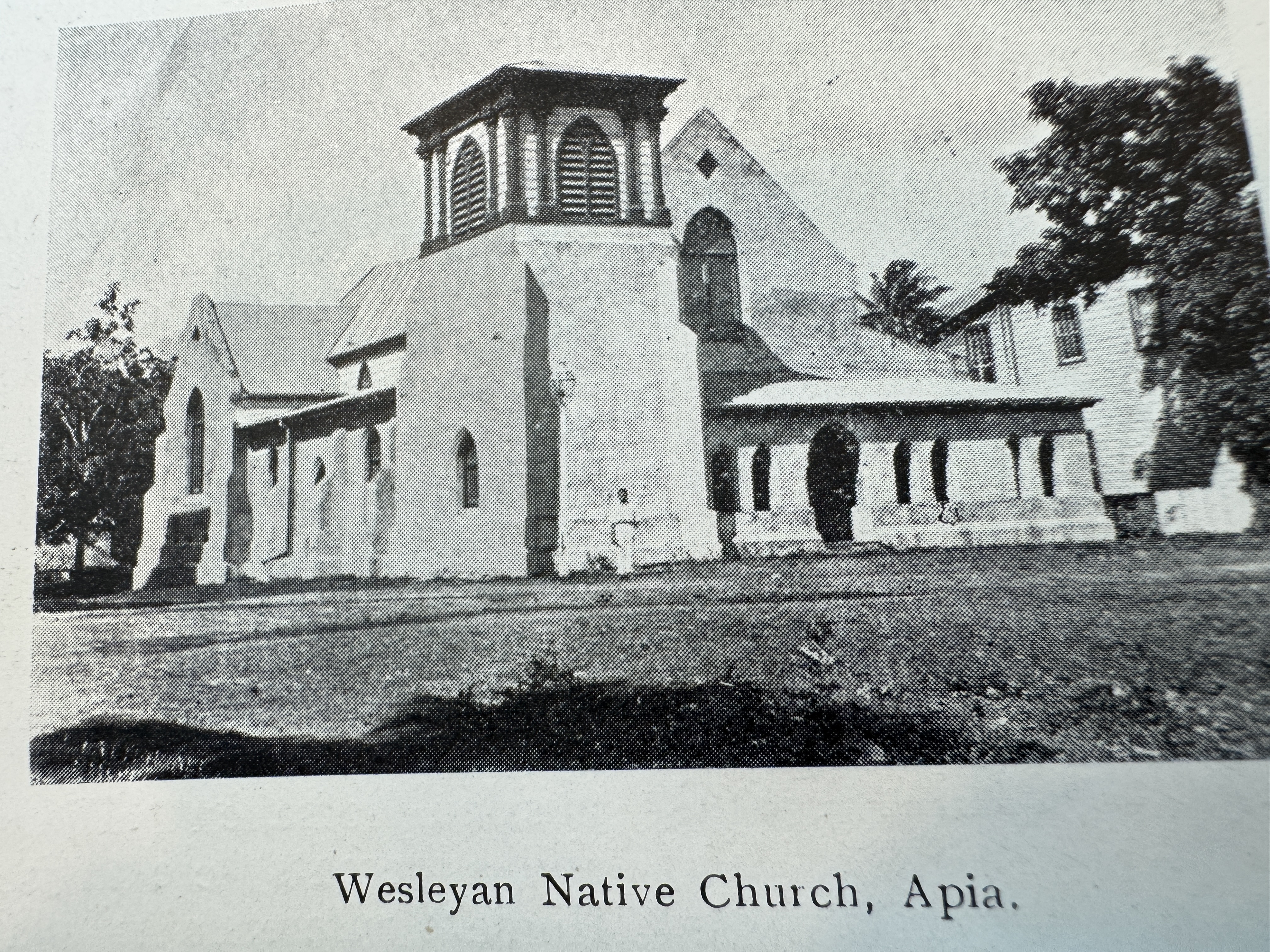
Who brought the first houses with walls and doors and windows to Samoa? Answer: missionaries, who first arrived in 1830. Charles Wilkes, commander of the U.S. Exploring Expedition, wrote that "all the missionary's houses have plastered walls and board floors... sawn by foreign carpenters" (Wilkes, p. 113). Call it the beginning of a tide that has now wiped the islands almost entirely clean of thatched houses.
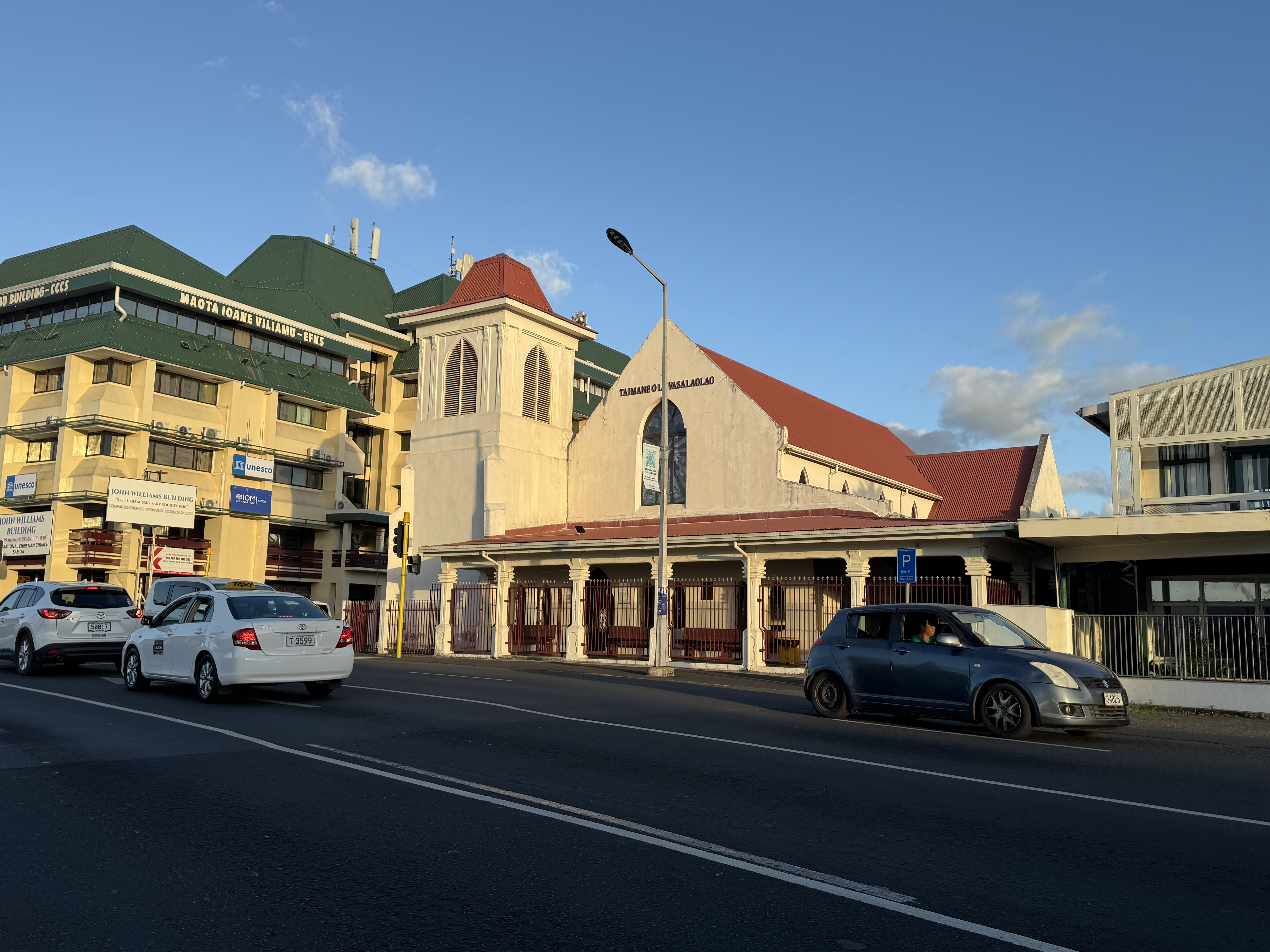
Here's the same church. It's on Beach Road in Apia and was built by the London Missionary Society, which arrived in Samoa (on nearby Savai'i) in 1830 and establshed the CCCS, or Congregational Christian Church of Samoa. See the building on the left?
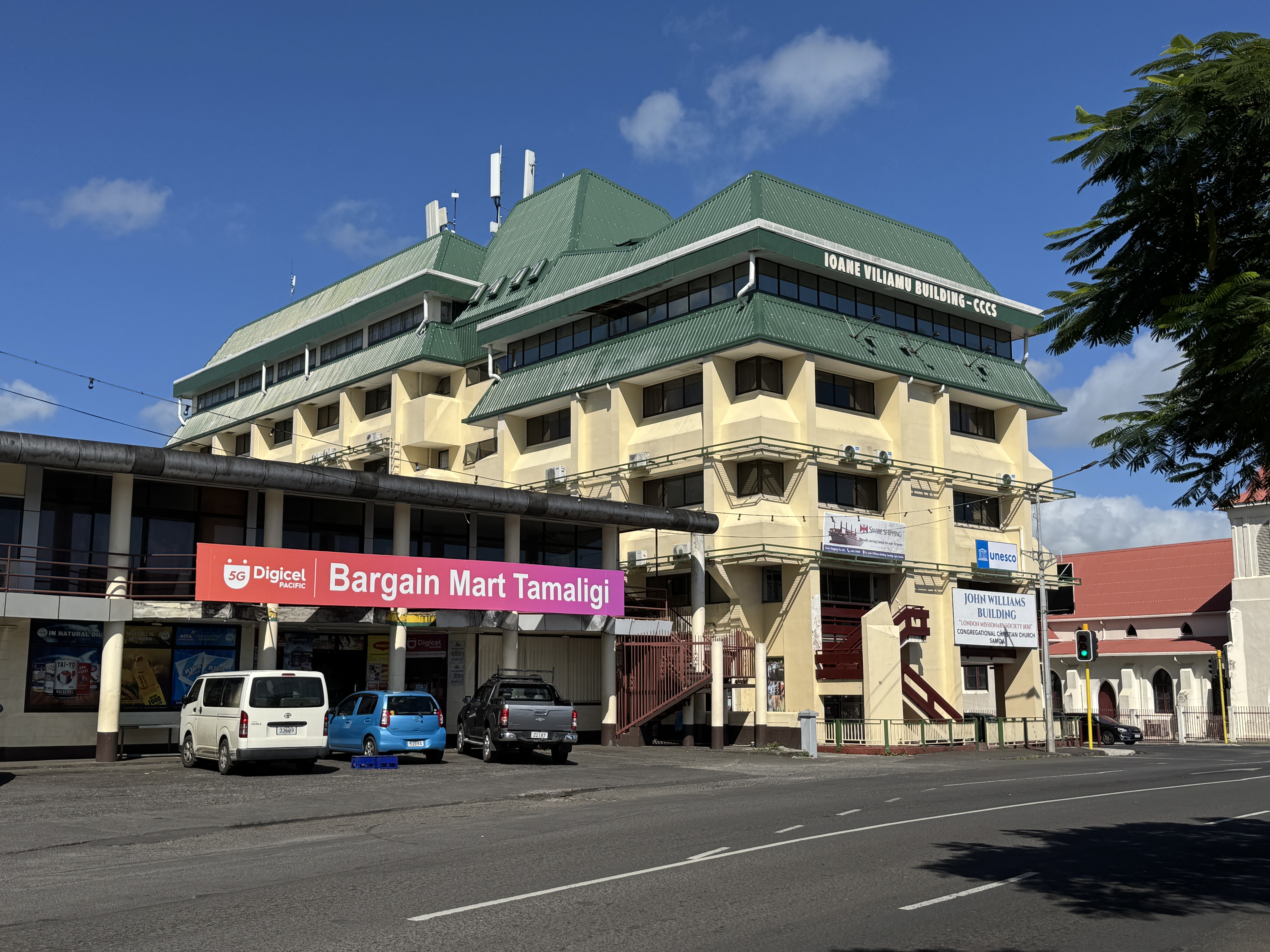
The pioneer missionary was John Williams, for whom the headquarters of the church is named.
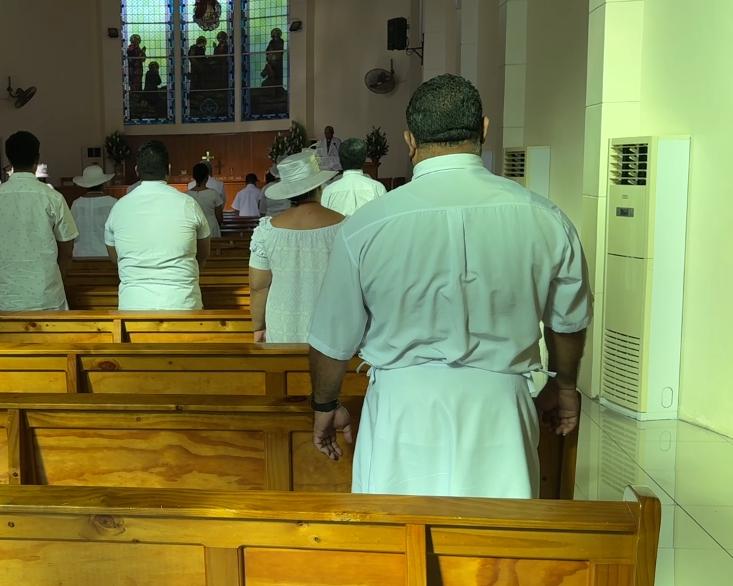
But don't imagine that it's all business. If there's any doubt, you should hear the congregation sing.
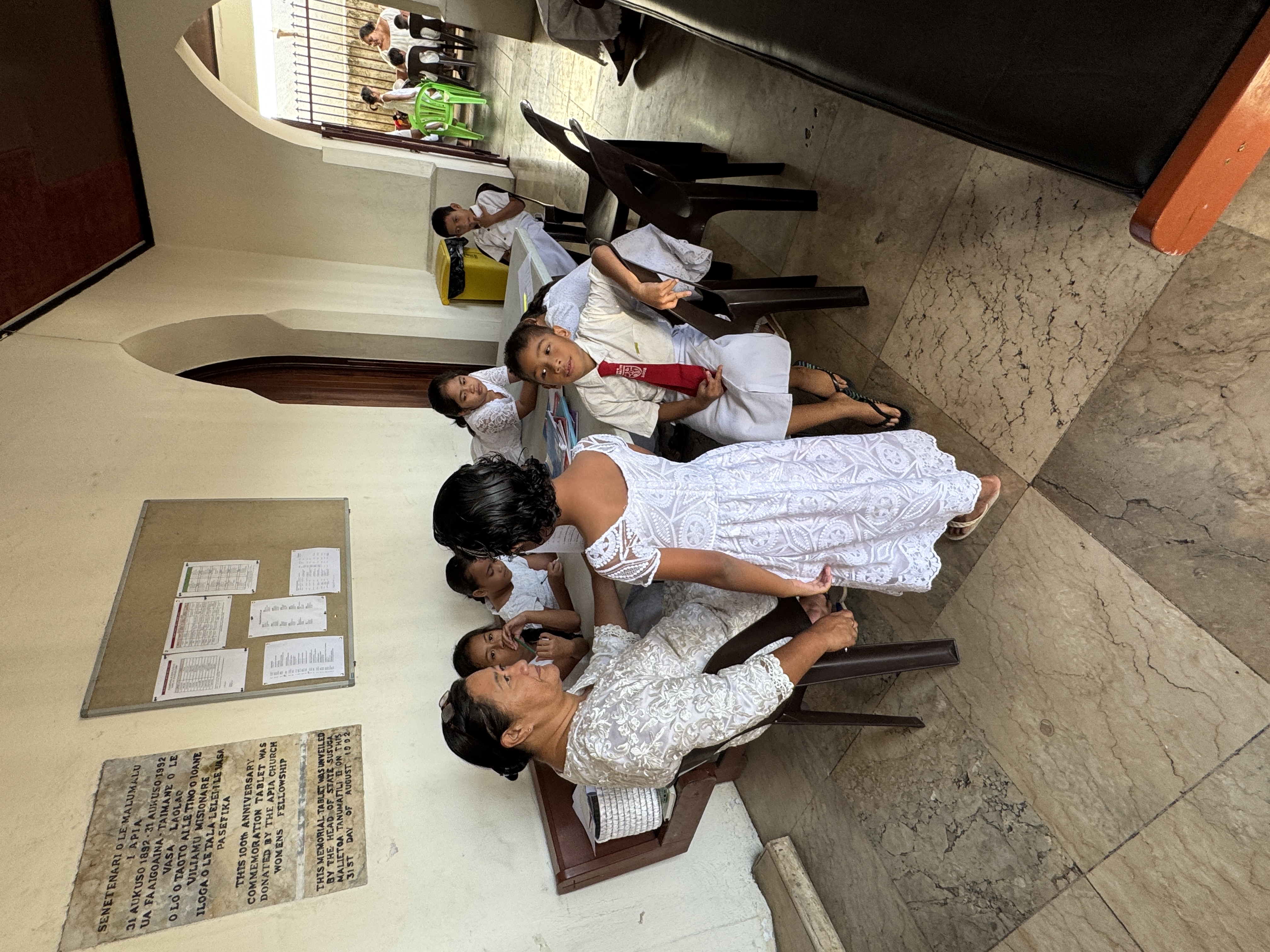
Or teach the young on Sunday.
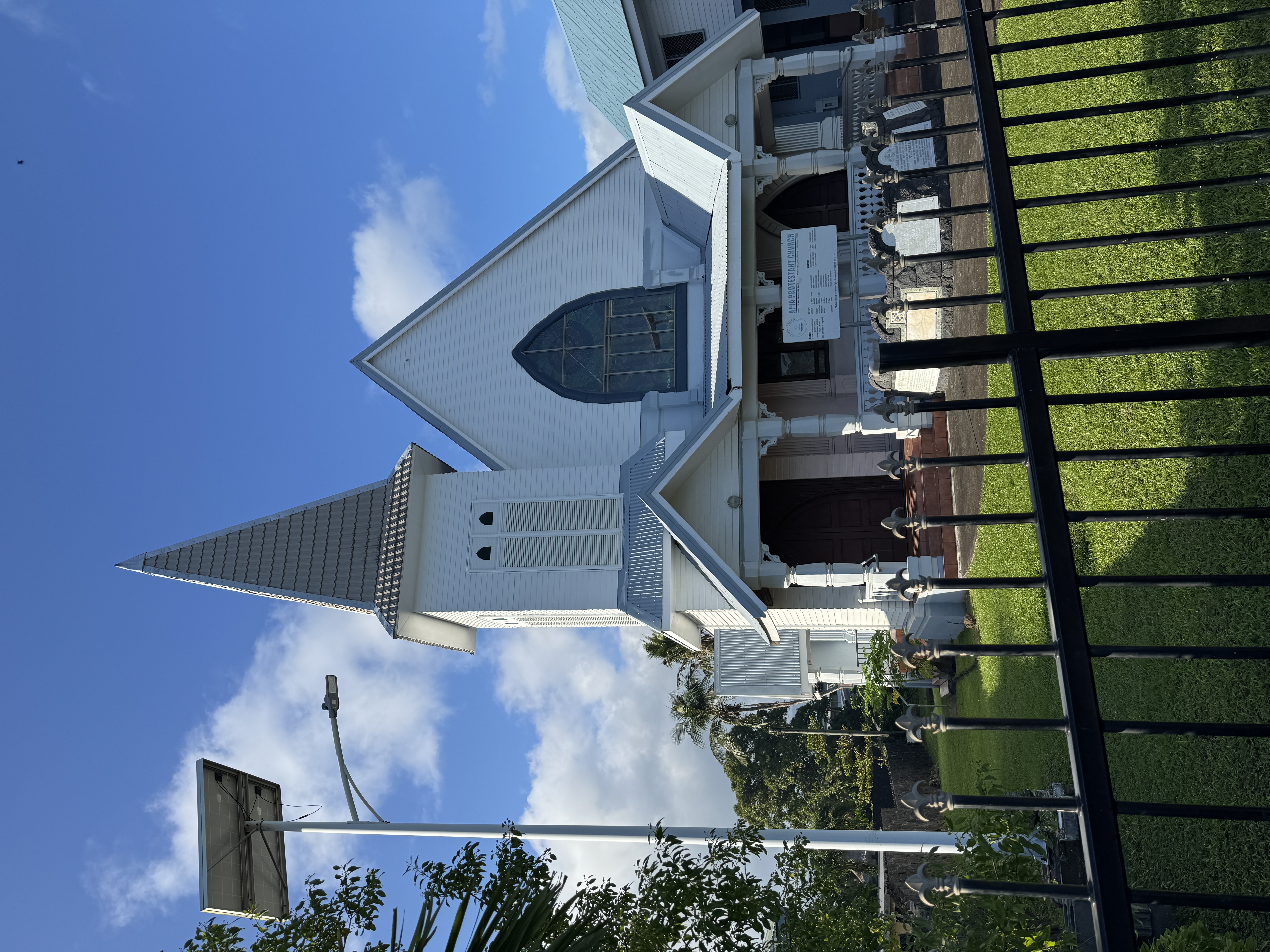
In 1895, the LMS opened this English-medium church a couple of blocks away. Hymns aren't sung as whole-heartedly here, but that's what you'd expect, I think. See the white stones?
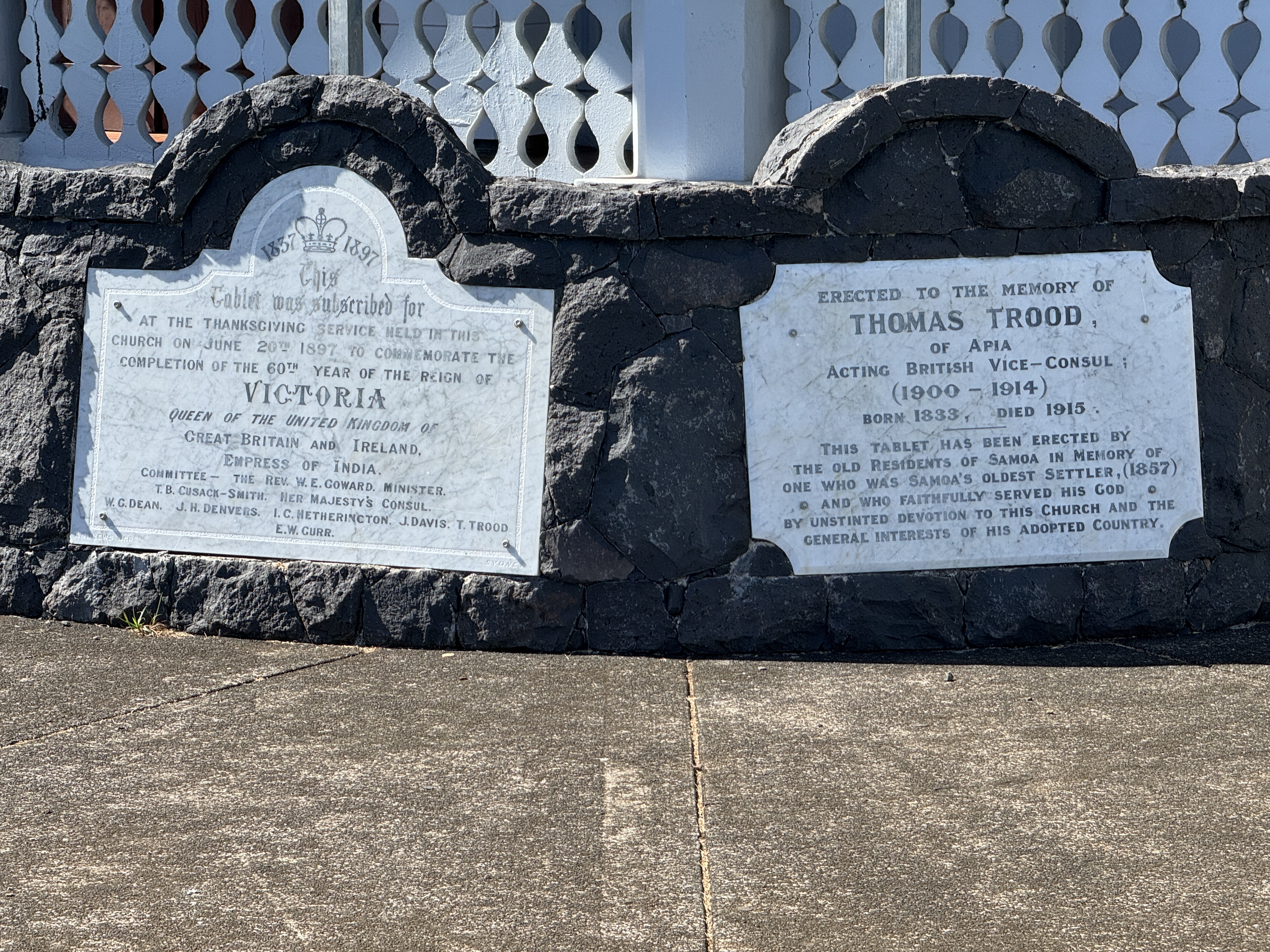
Here's a couple of them.
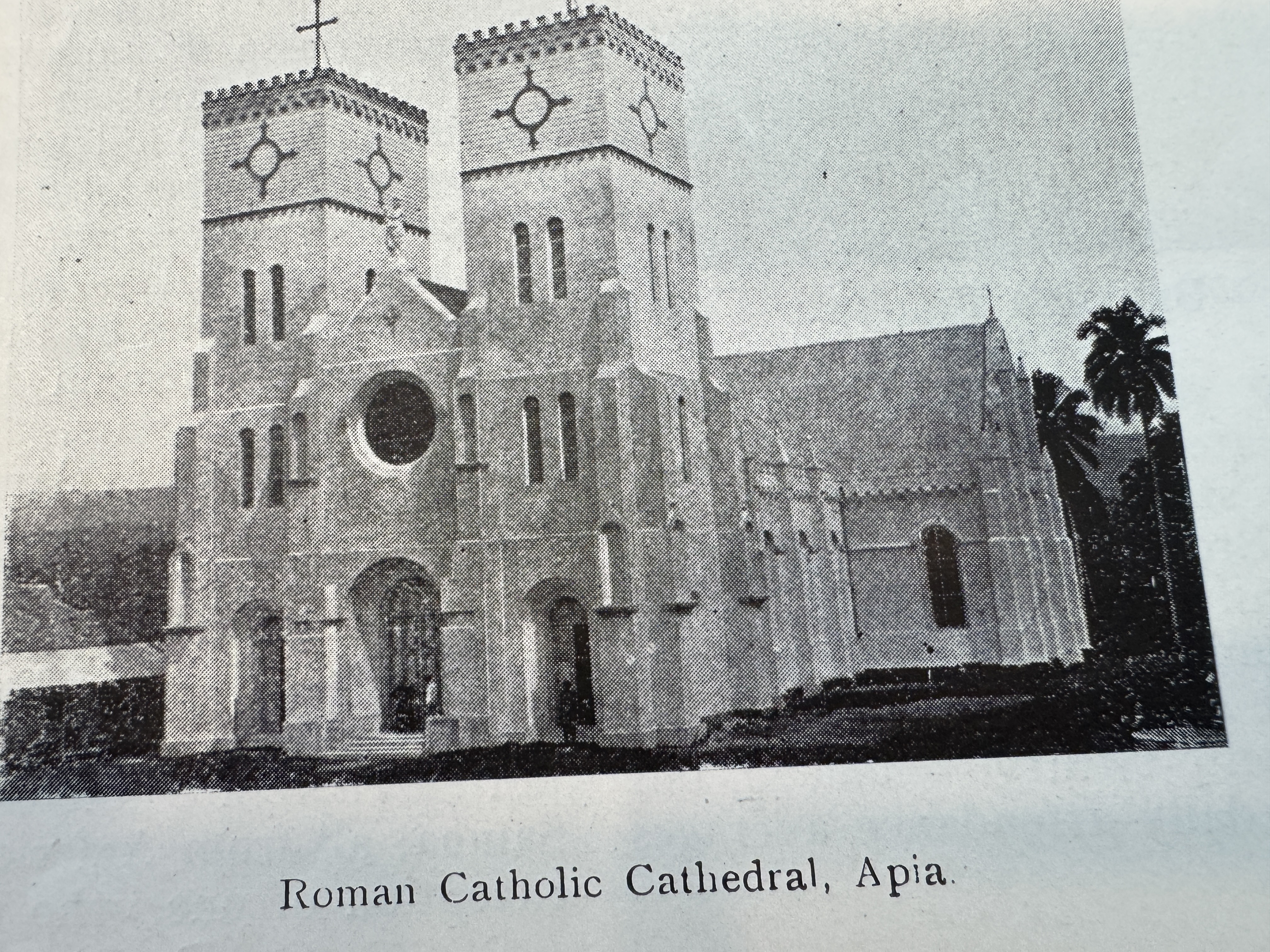
In 1845, a Catholic teaching order, the Marists, arrived from France. Catholicism still lags behind the CCCS. (Eighteen percent of Samoans are Catholic, but 27 percent belong to the CCCS). Still, Samoa's grandest churches are Catholic.
(Cyclopedia, p. 75.)
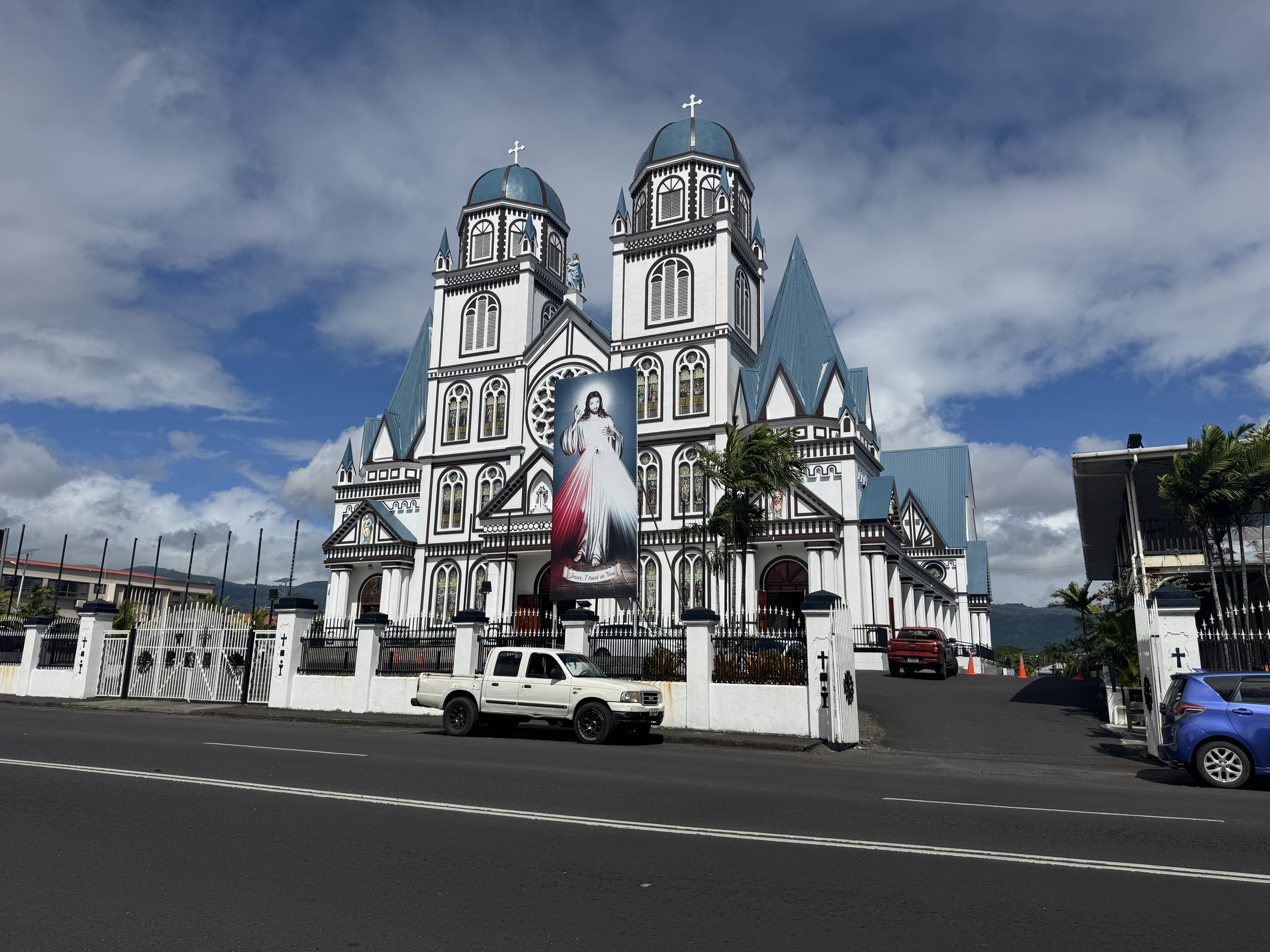
Here, on the site of the previous picture, is the replacement cathedral, opened in 2014.
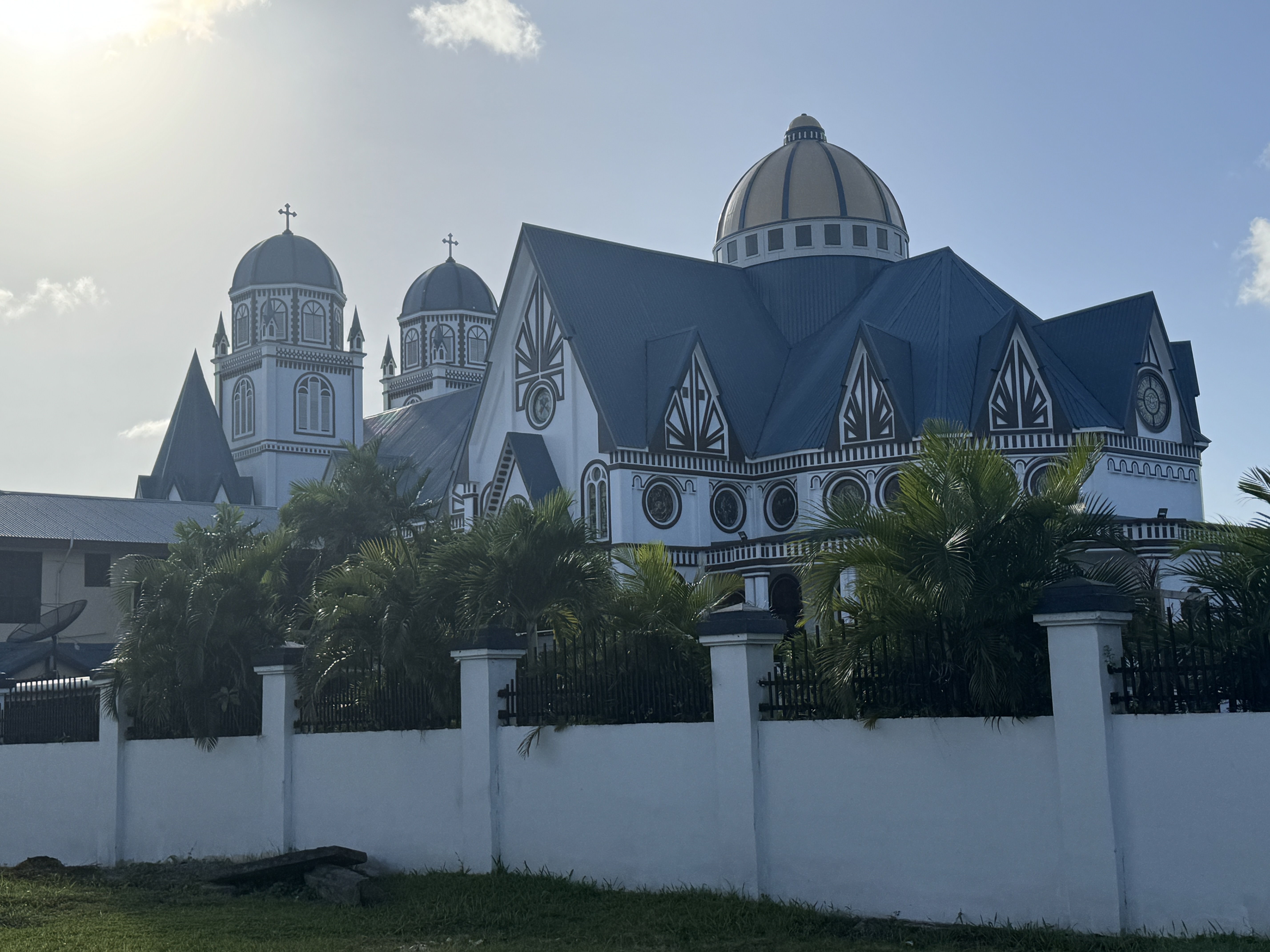
From another angle.
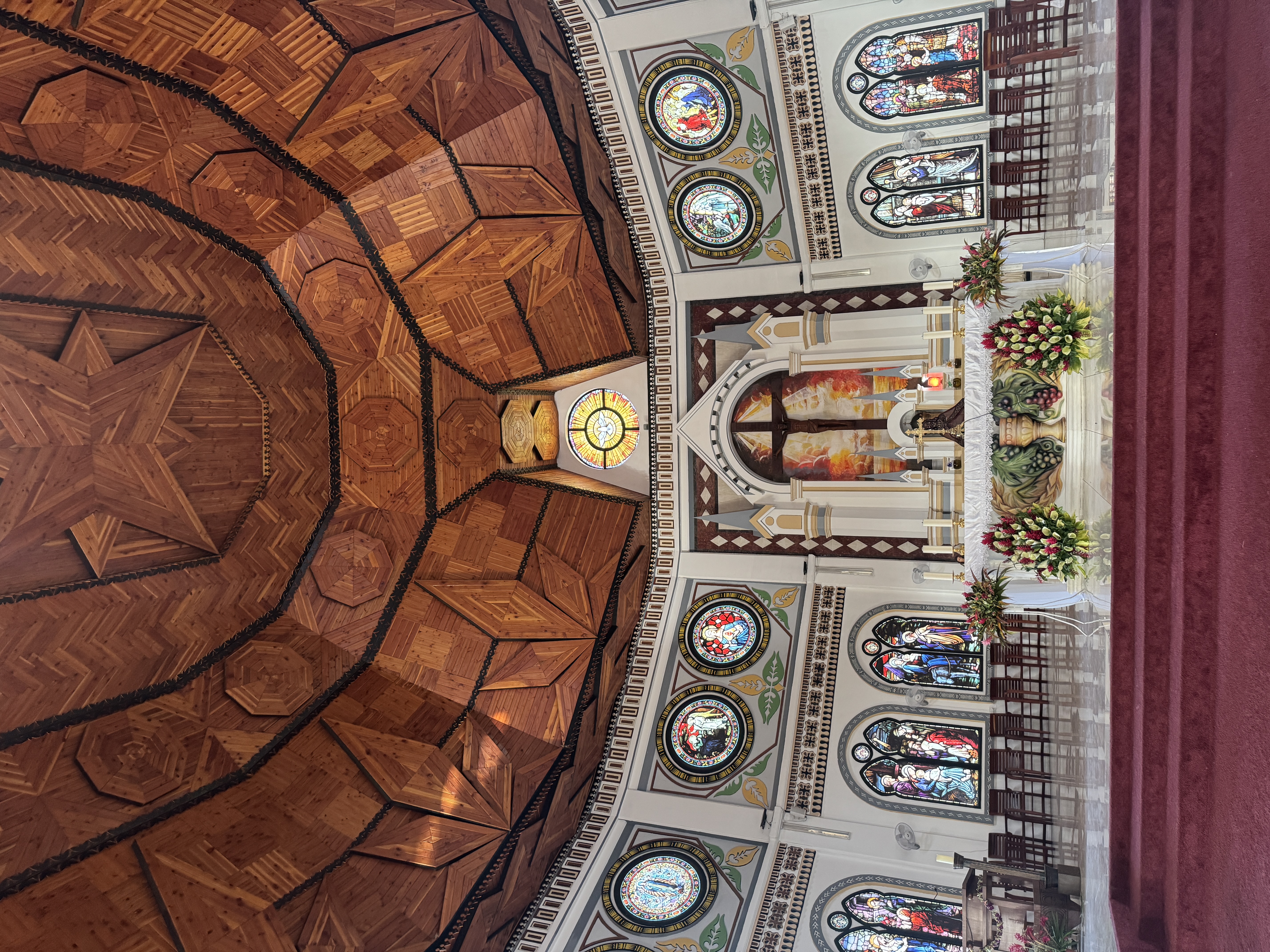
Interior.
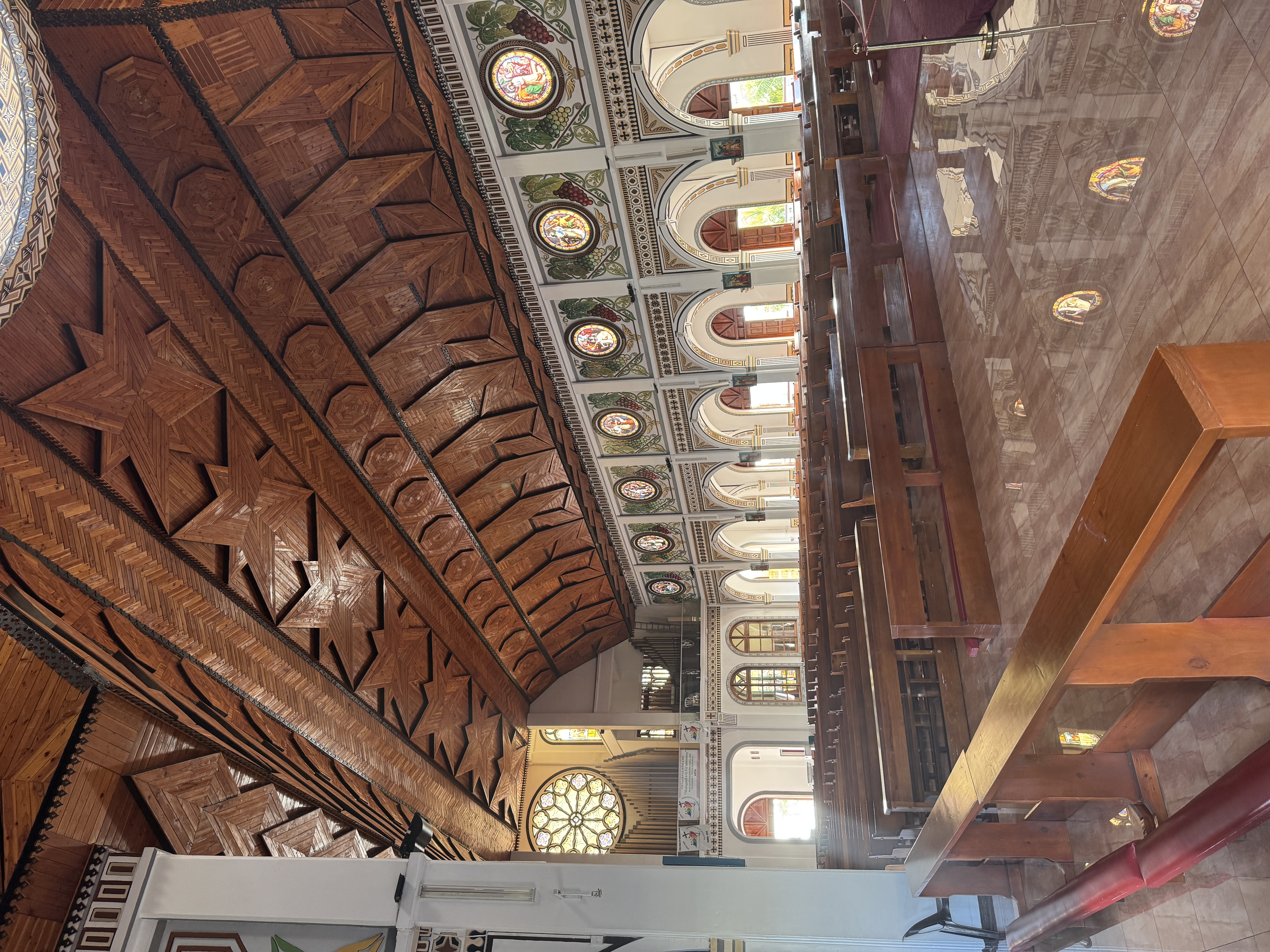
Maybe the ceiling proves that traditional woodworking skills survive.
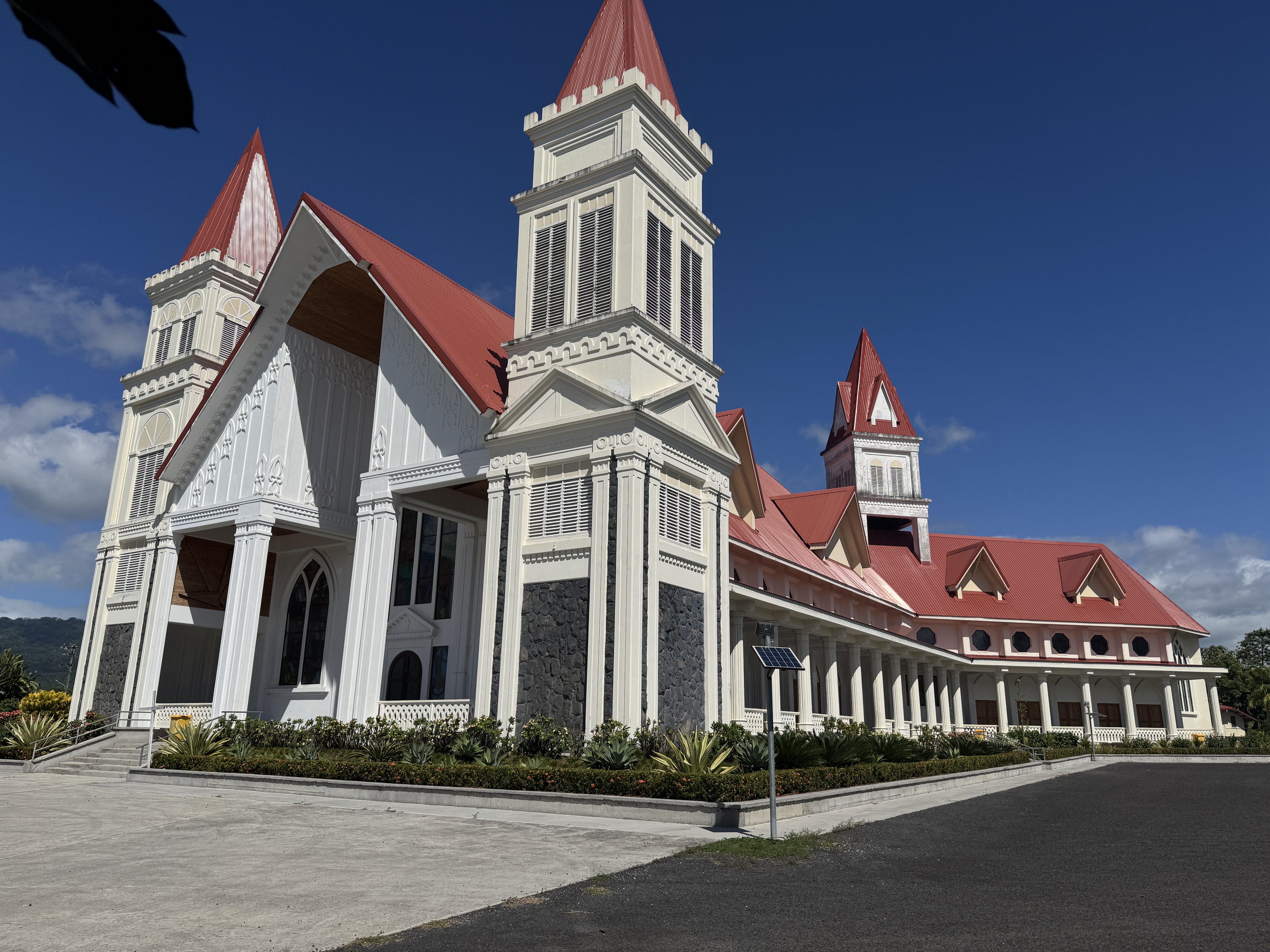
Here's another Catholic church, St. Theresa, also opened in 2014 and replacing an earlier church. It's only a mile and a half from the cathedral.
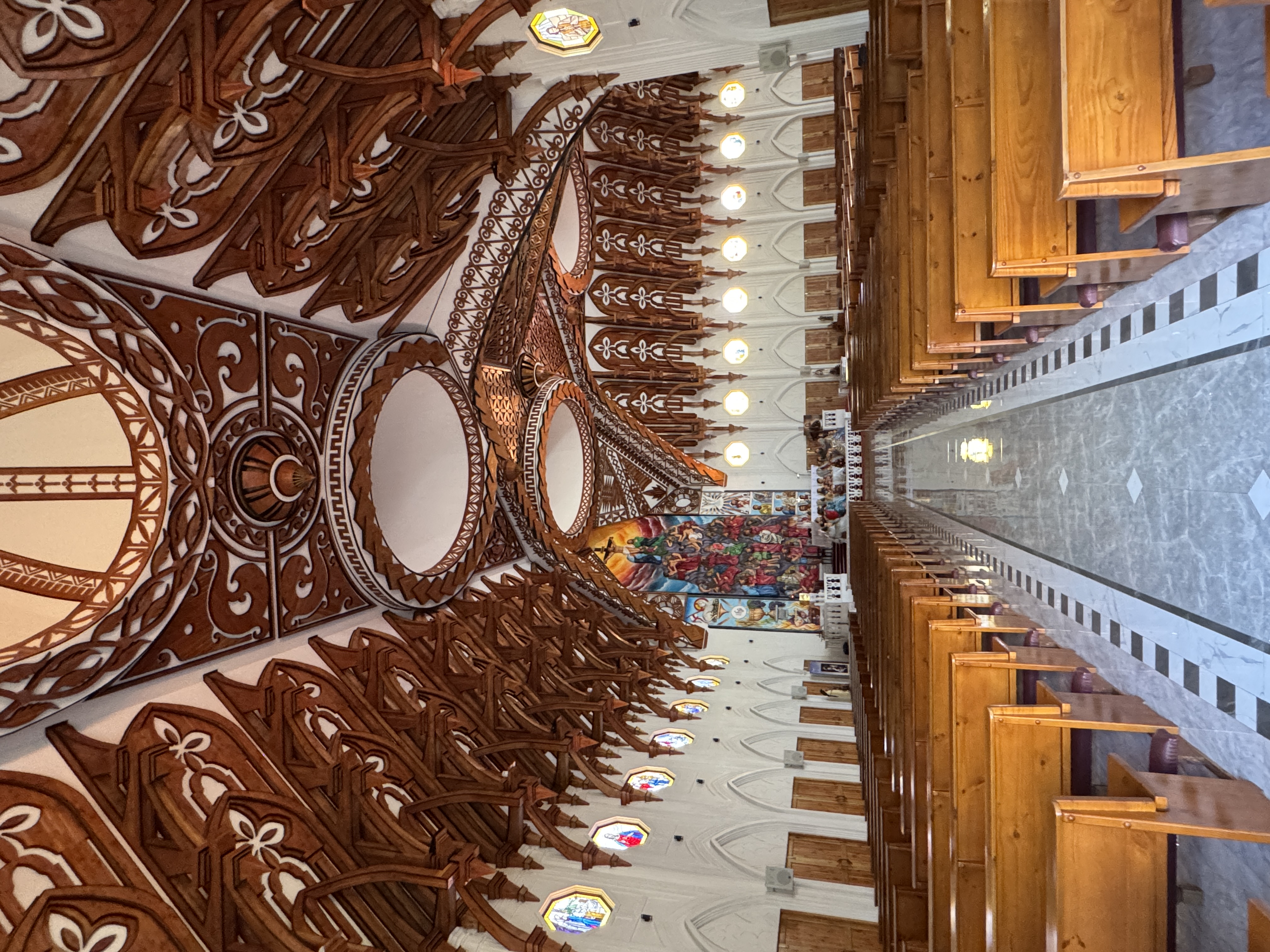
The nave.
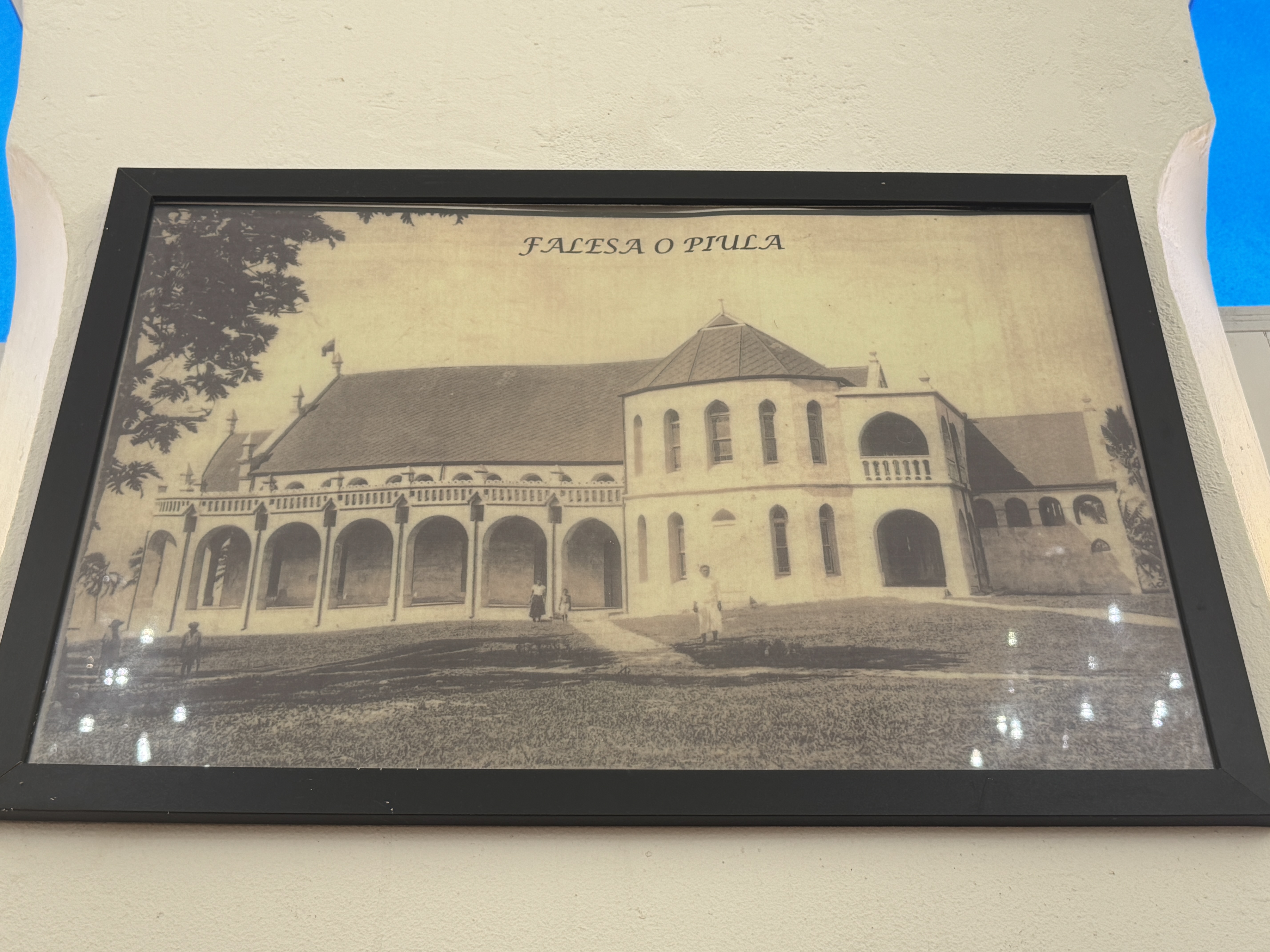
Here, a dozen miles east of Apia, is the Beulah Church, or Falesa o Piula, a Methodist church. There are an estimated 300 churches in Samoa. That's one for every 500 people.
(From a photo displayed on an inside wall in the church.)
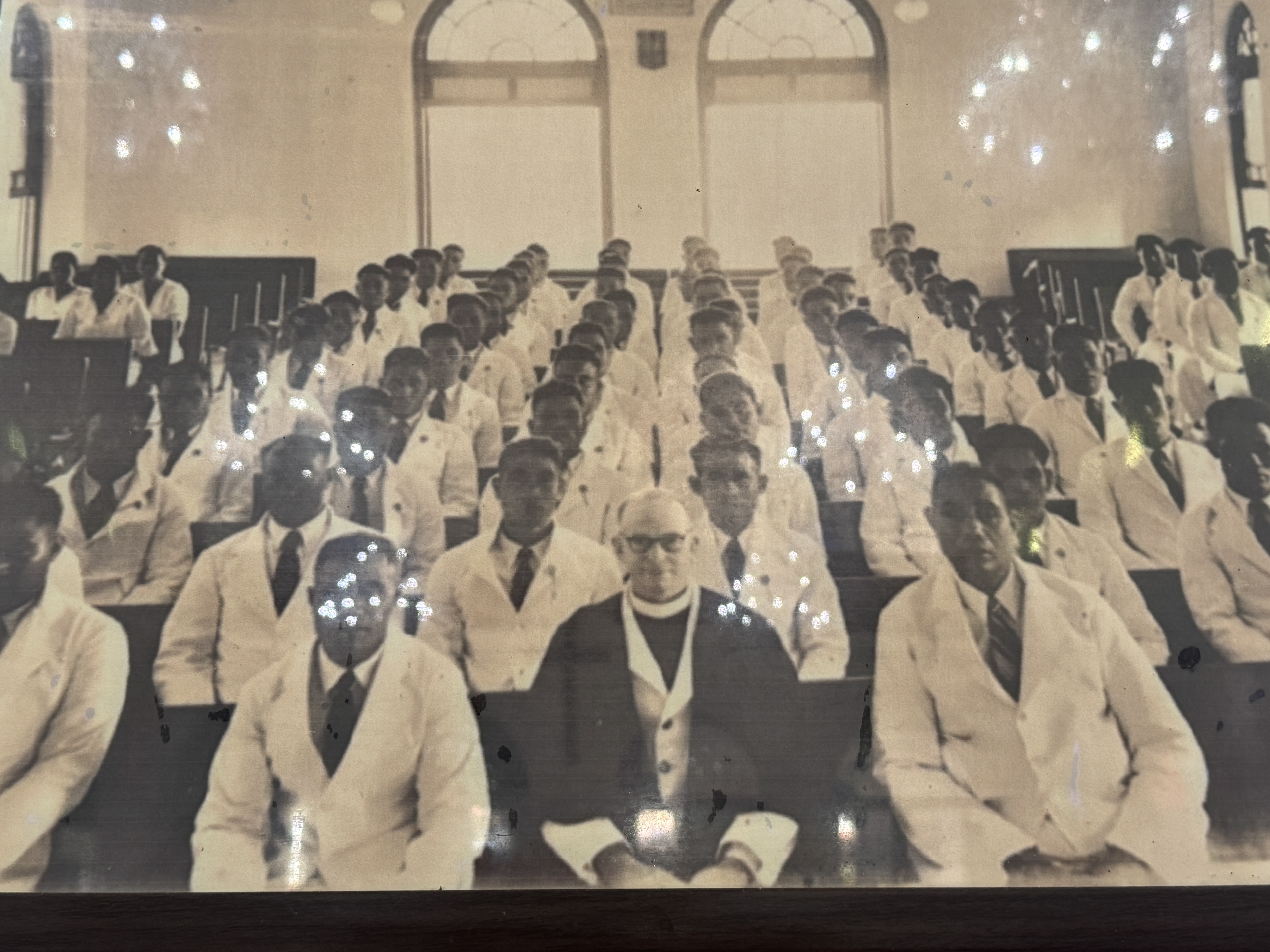
Parishioners still attend every Sunday dressed in white. The minister is Ernest George Neil (1872-1957), an Australian who lived in Samoa from 1902 to 1919.
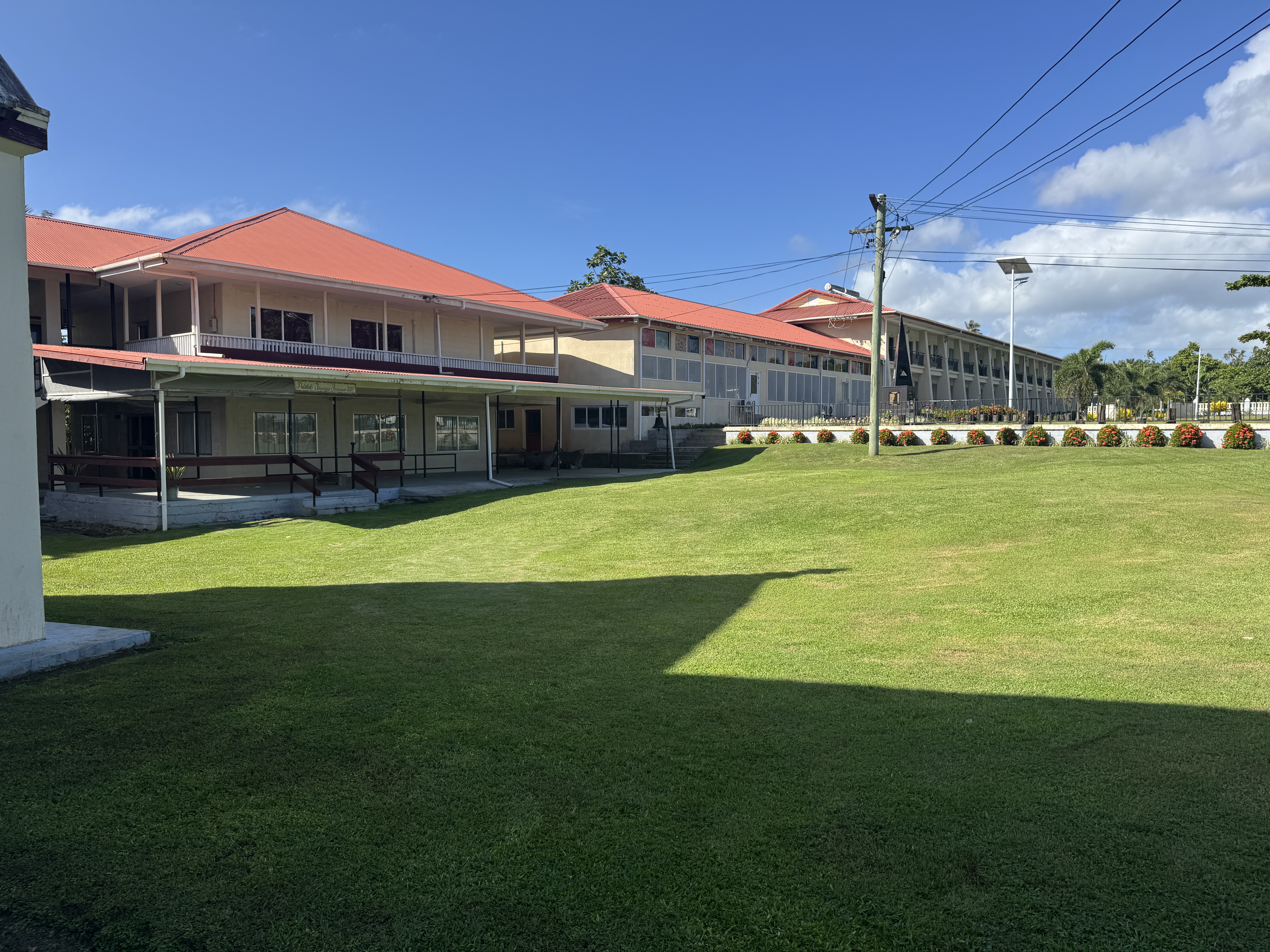
He's described as a "master builder of Pacific Missions." Here's the Piula Theological College, which adjoins the church.
https://asiapacific.anu.edu.au/pambu/catalogue/index.php/samoan-journal
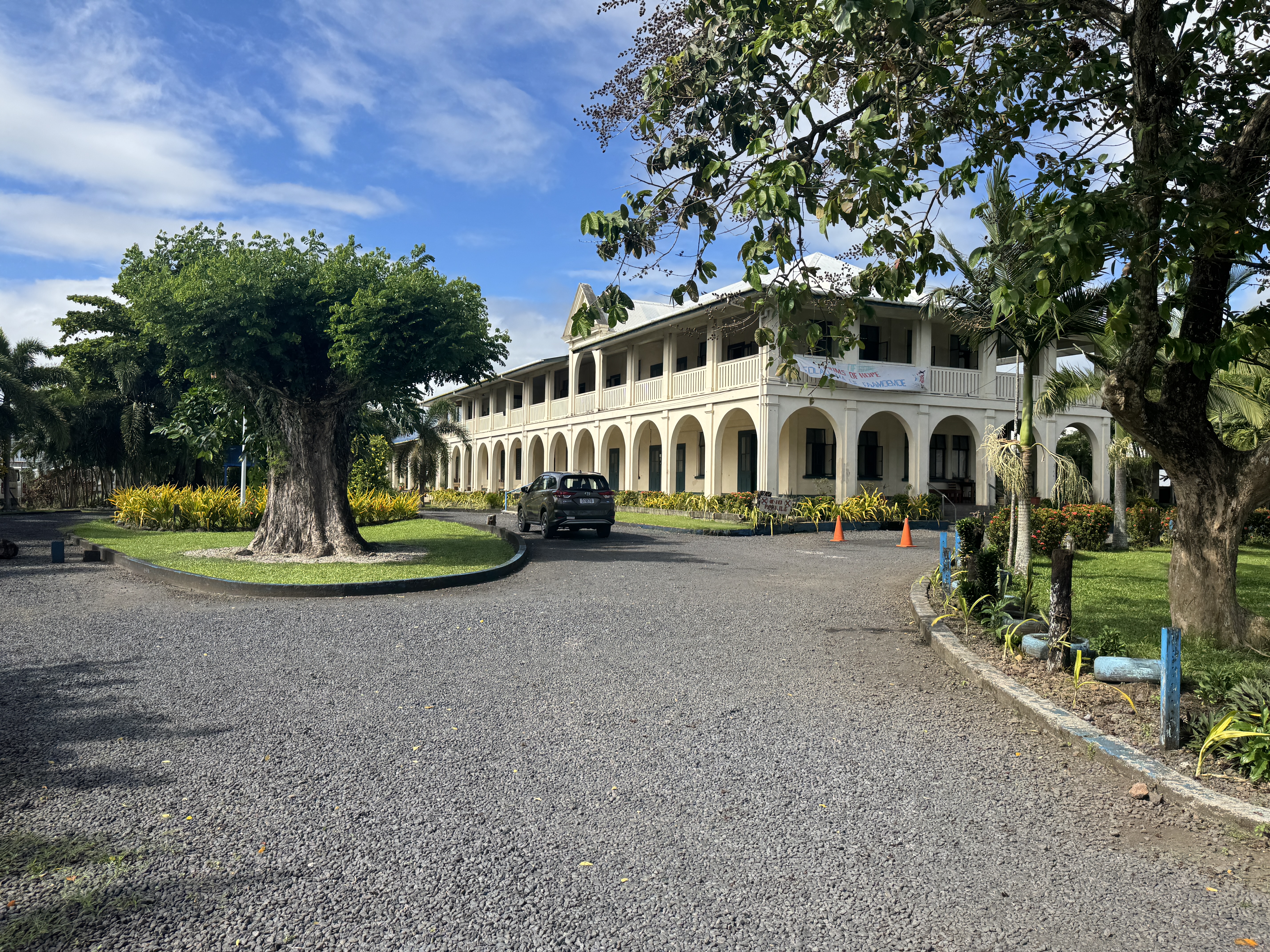
It's not the only religious school in Samoa. Here's St. Mary's School in Apia, built by the Marists.
https://asiapacific.anu.edu.au/pambu/catalogue/index.php/samoan-journal
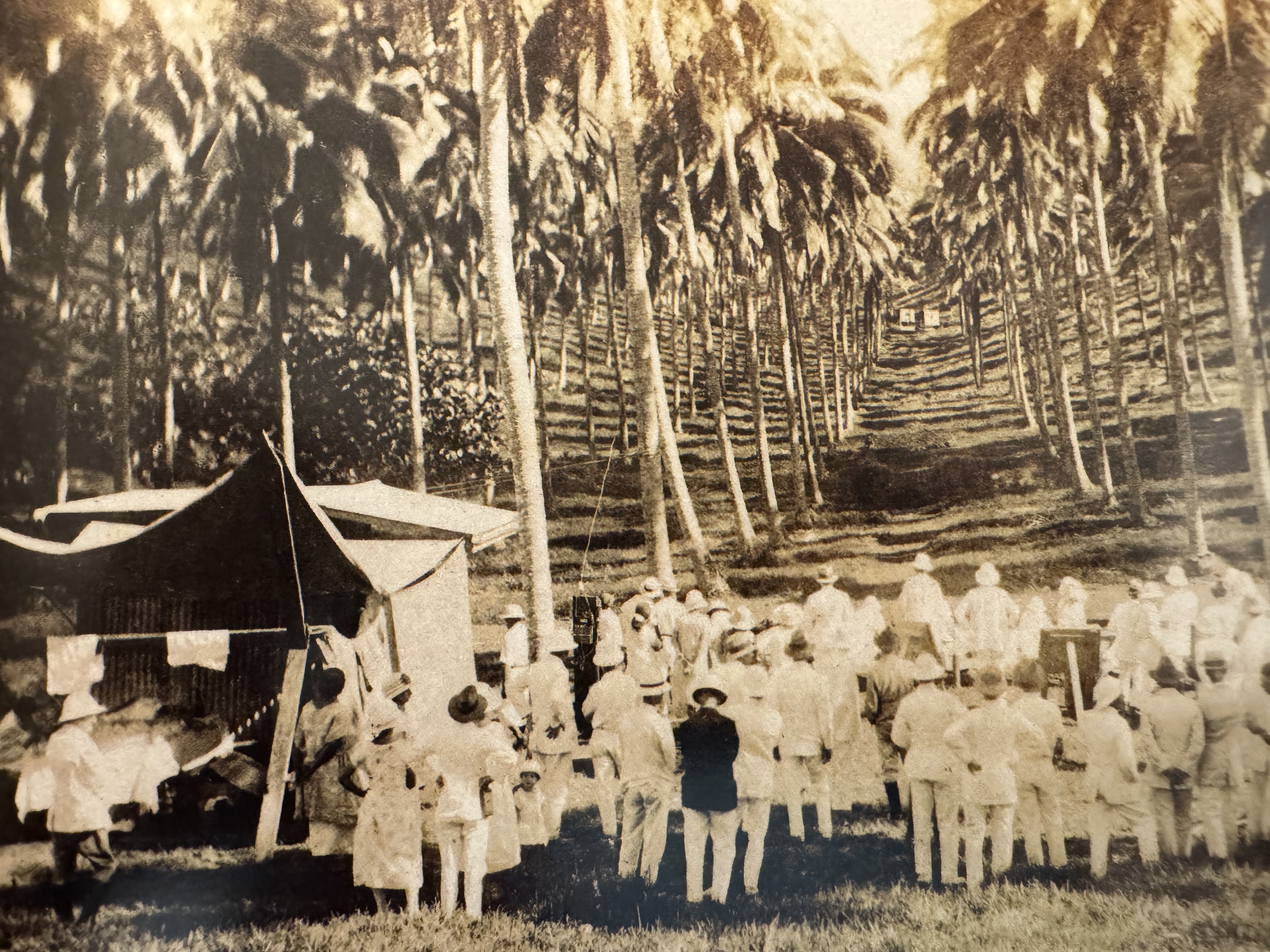
Twenty years after the arrival of the missionaries, German businessmen arrived in search of coconuts, source of the copra (dried coconut meat or flesh) from which coconut oil could be extracted. The pioneer and biggest produer was the company called J.C. Godeffroy and Son. It arrived in Samoa in 1855 and established its first plantation at Vailele, near what today is the Royal Samoan Country Club. Trees were planted on a 40-foot spacing. The trees that produced the most nuts were selected as seed trees for the next generation.
(Tony Brunt, To Walk Under Palm Trees, 2017, p. 117)
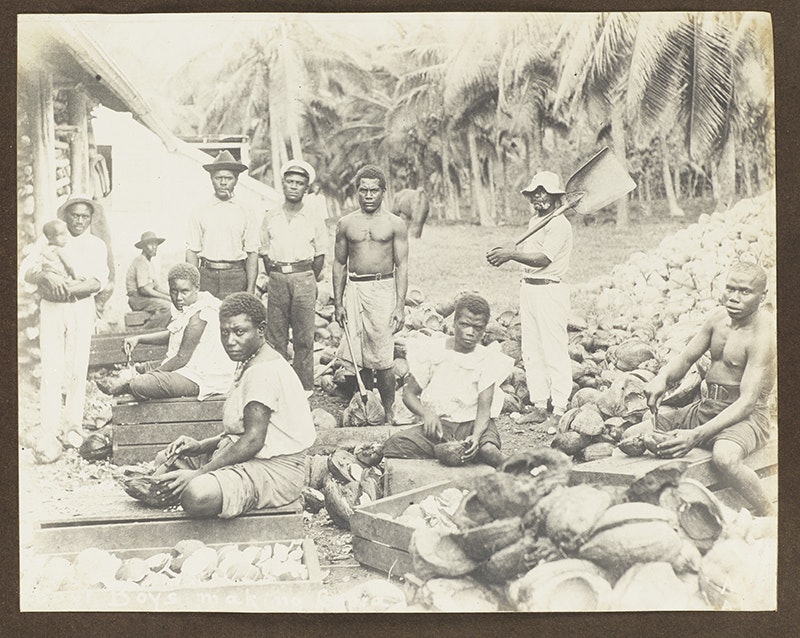
Samoans themselves weren't interested in plantation work, so Melanesians were imported and, later, Chinese.
https://www.tepapa.govt.nz/german-pacific-relations-the-precolonial-period
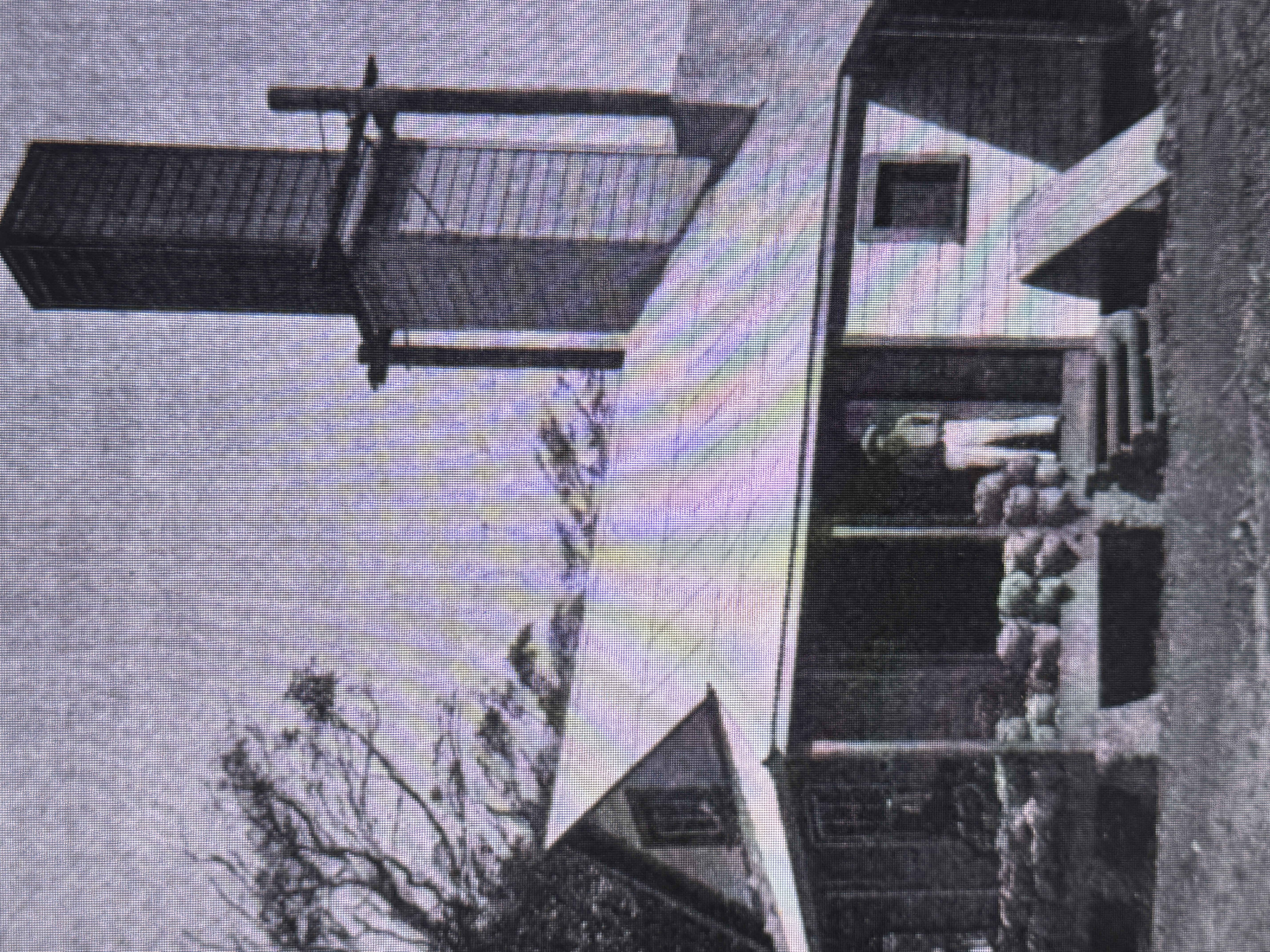
Coconut meat was oven dried to make copra for export.
(Franz Reinecke, Samoa, 1902, p. 207. In German.)
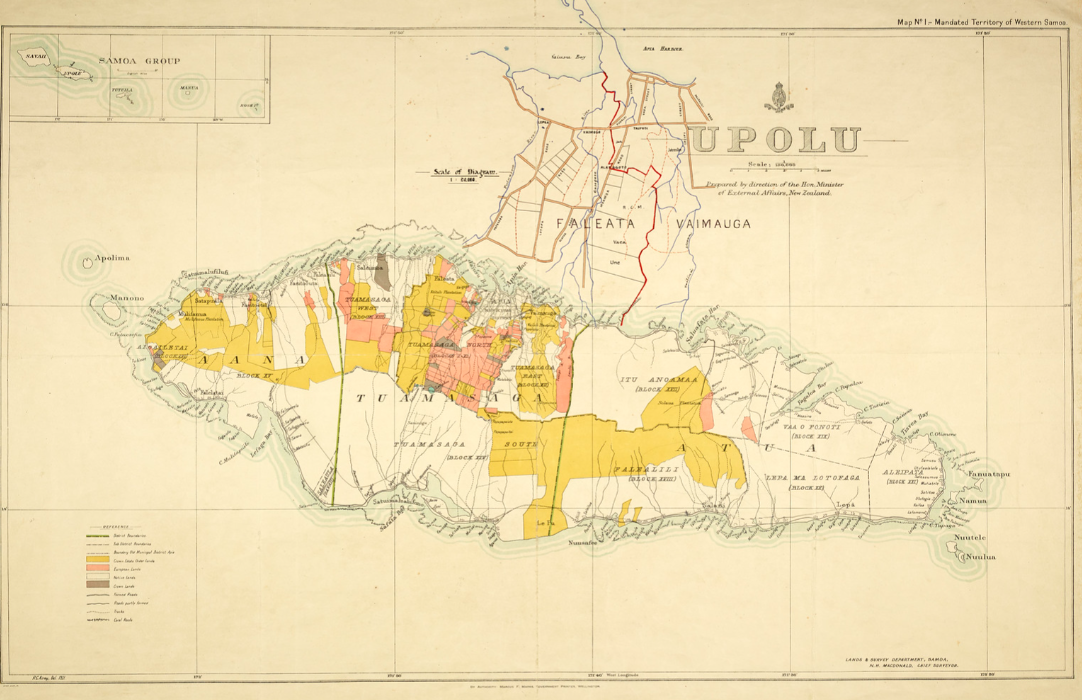
The business was profitable, but Godeffroy's European investments forced it into bankruptcy In 1878. The business was reorganized as the Deutsche Handels-und Plantagen Gesellschaft, of DHPG. Trading guns for land, Godeffroy and the DHPG acquired 75,000 acres, show in yellow here. (C.G.R. McKay, Samoana, 1968, p. 17)
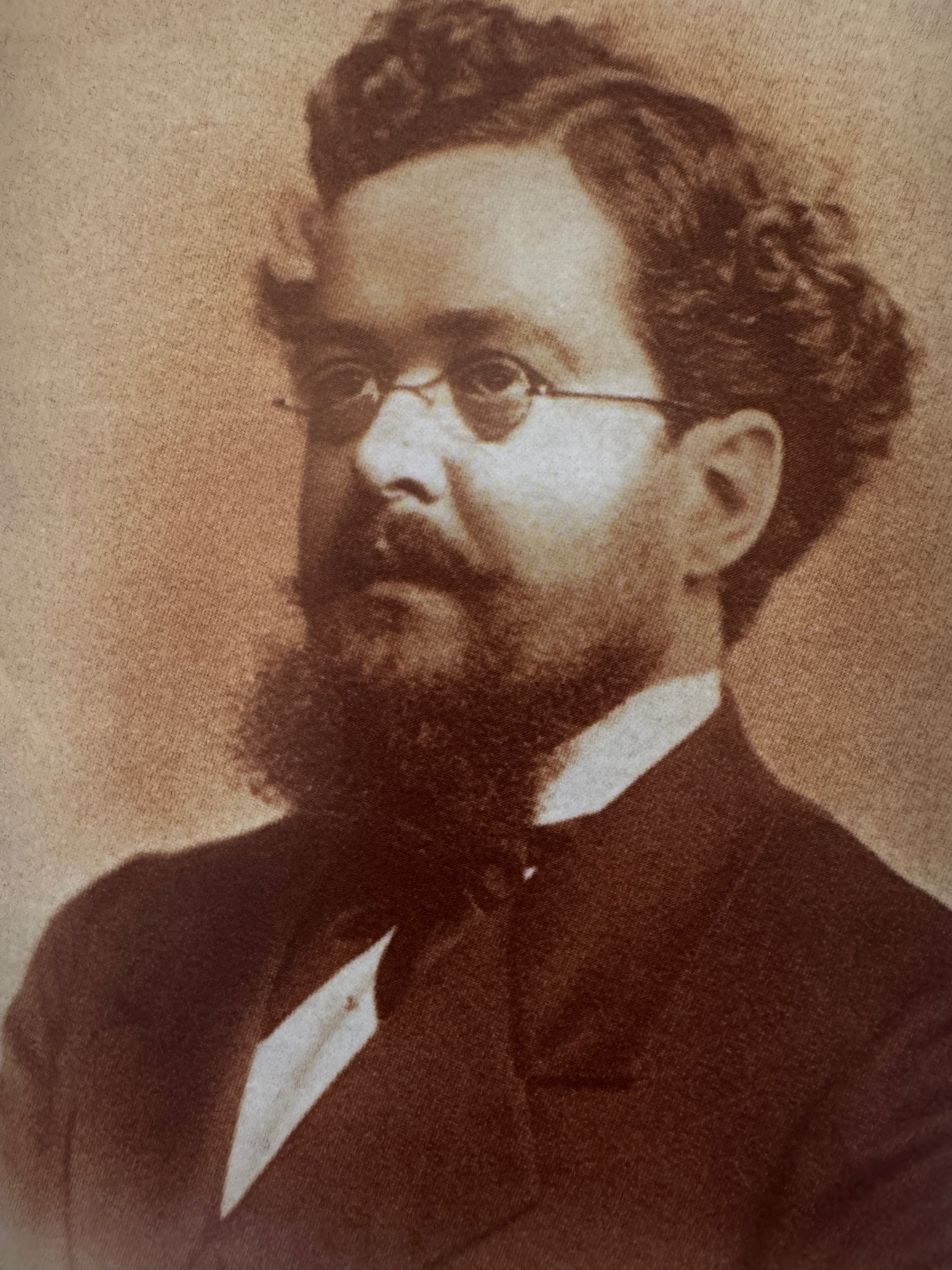
Theodor Weber was Godeffroy's man on the ground in the early years. Tony Brunt writes: "By the time he died on a trip back to Hamburg in 1889 at the young age of 44 the DH & PG owned massive swathes of Samoa--as much as a quarter of Upolu--much of it on the mountainous central spine which the company hoped to subdivide for settlers."
(Brunt, 114)
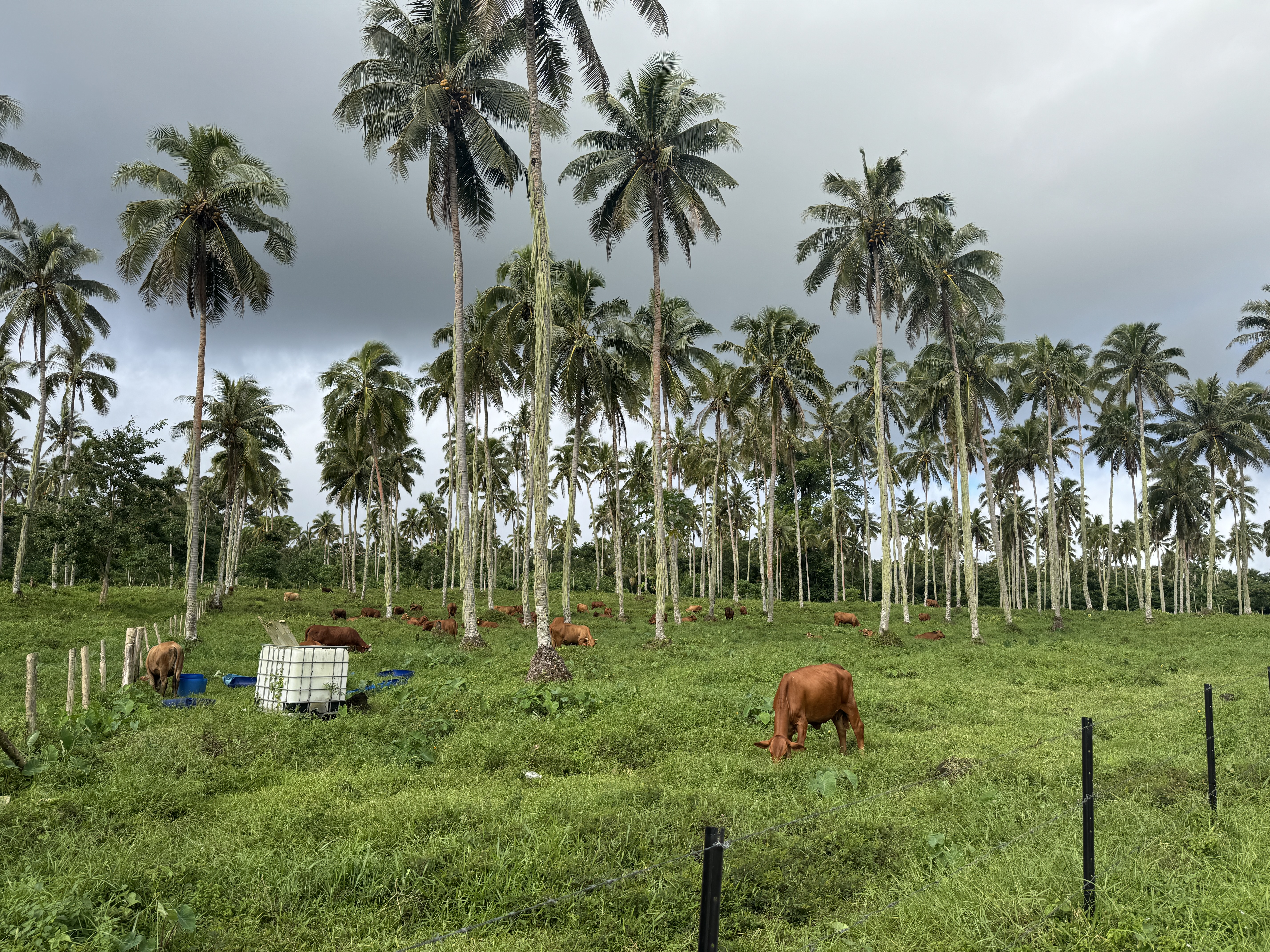
If you seek Weber's monument, look around.
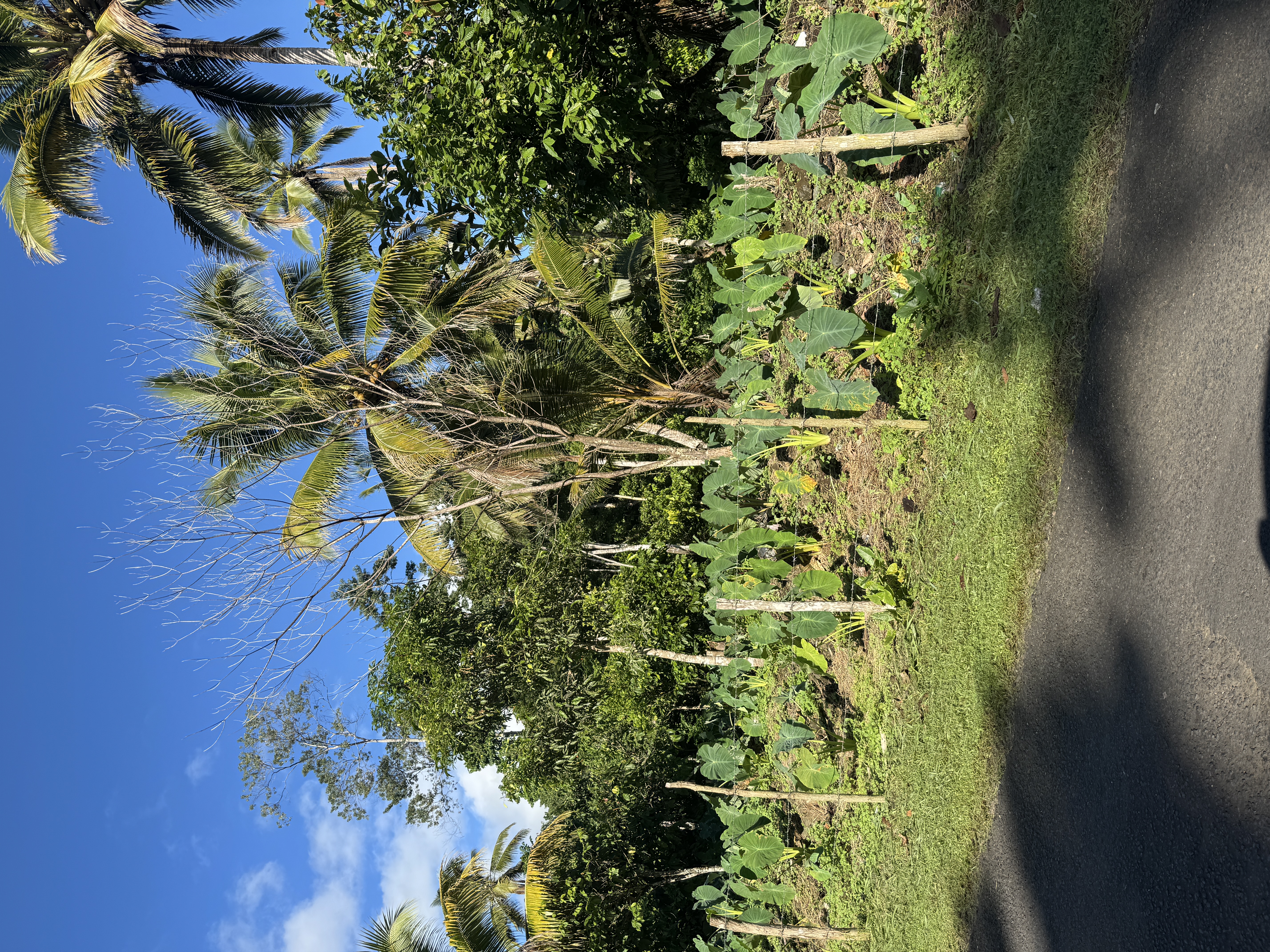
Interplanted with taro.
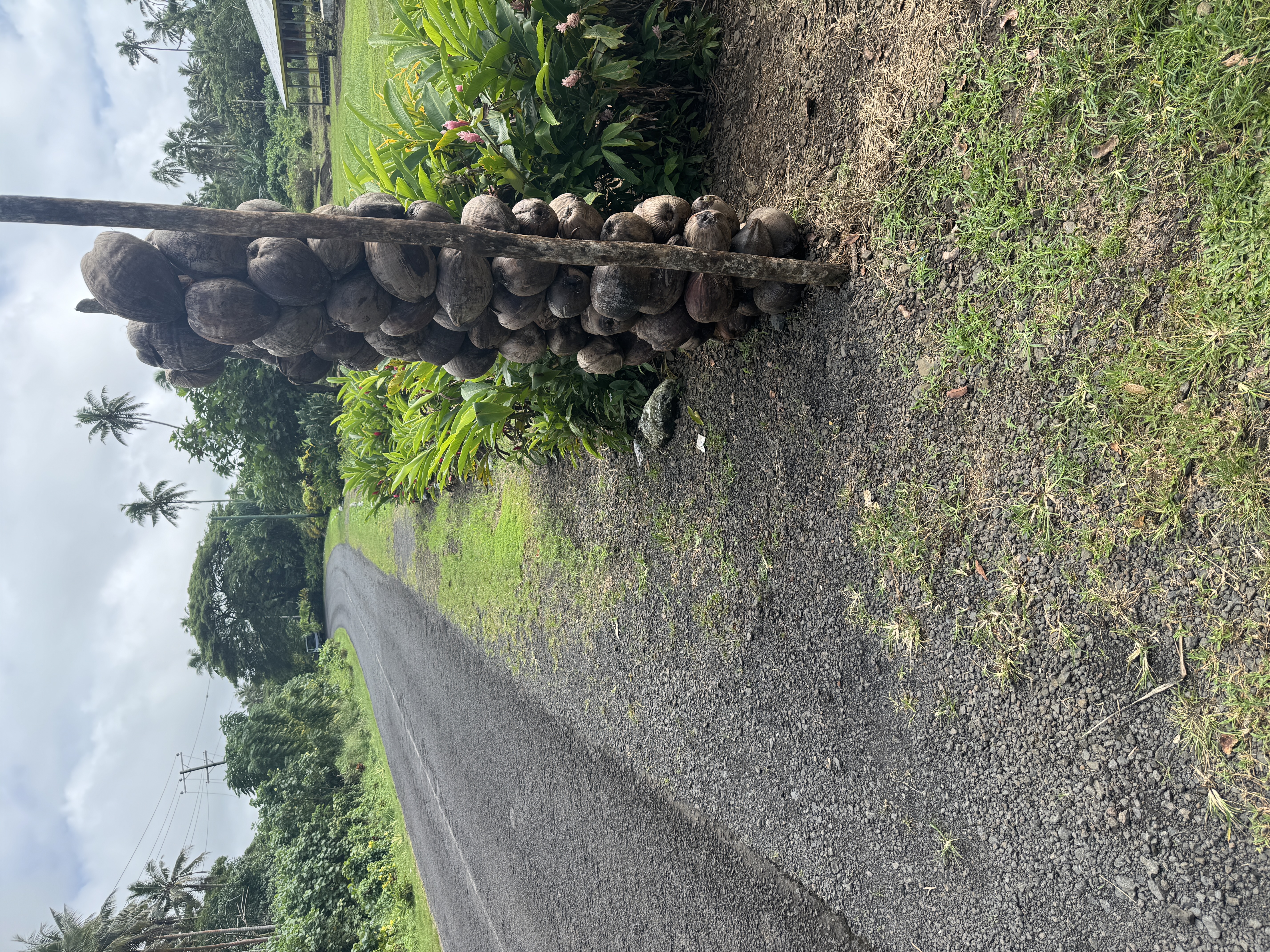
True, Weber can't take credit for every coconut. Here they are tied around posts to keep them off the ground so they don't sprout.
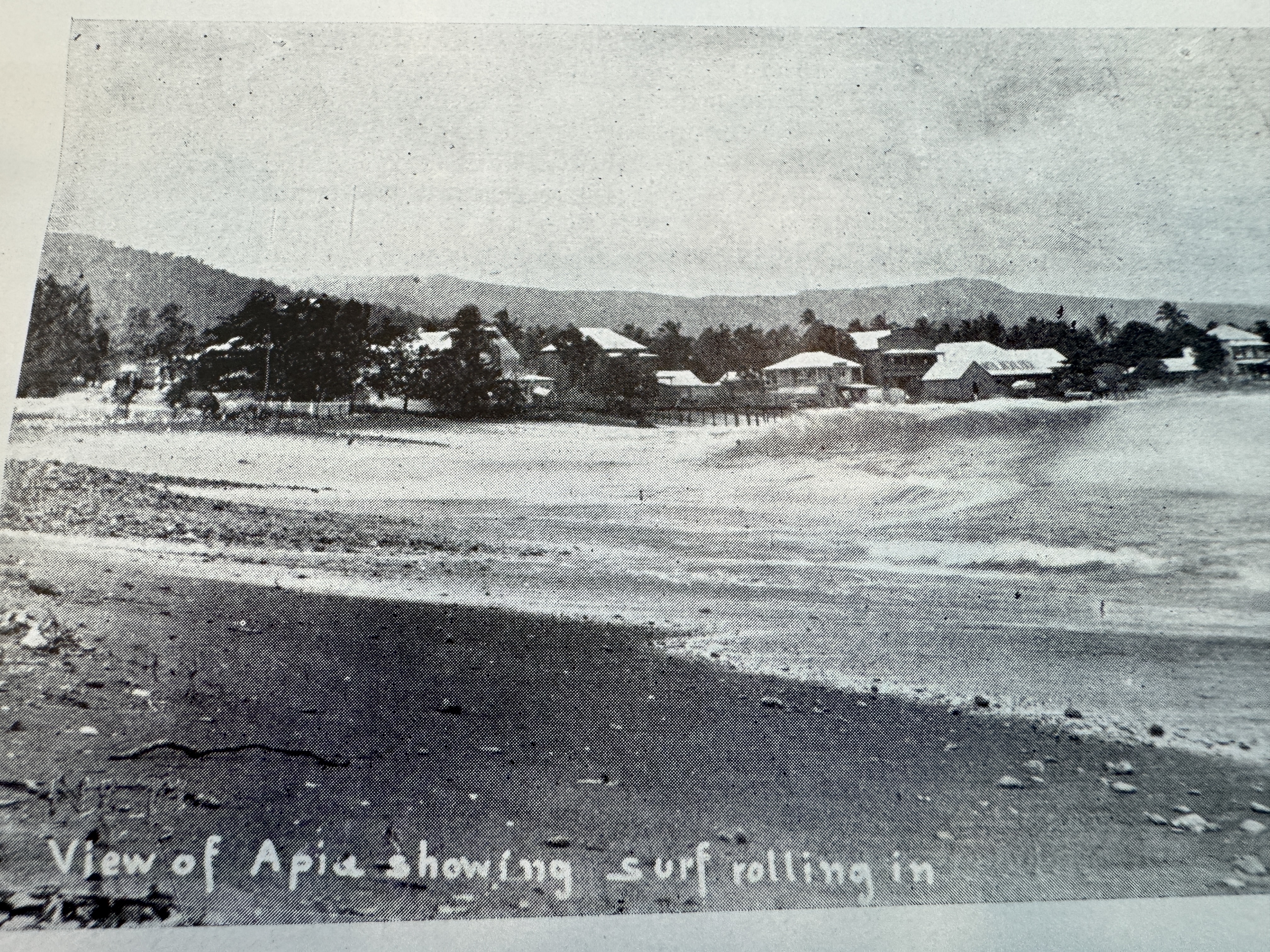
A town was needed. There's no good harbor on Upolu, so Apia Bay had to suffice. John La Farge in 1890 wrote: "It is an orderly little place strung along what might be called a street or two, the main one of which is on the beach, and goes by that name. There are stores, a few hotels and drinking places, warehouses and residences of the consuls... (La Farge, 97).
(Consuls? At the time of La Farge's visit, Samoa was in political flux. Several nations maintained consuls to represent their interests, but there was no clear authority until 1900, when Germany agreed to divide Samoa with the United States. Germany got the islands with agricultural potential; the United States got the island with by far the best harbor. Britain contented itself with other islands, including Fiji and Tonga.)
(Cyclopedia, p. 1.)
A view from 1905, which makes the town look very tidy.
https://natlib.govt.nz/records/22803818?search%5Bpath%5D=items&search%5Btext%5D=apia
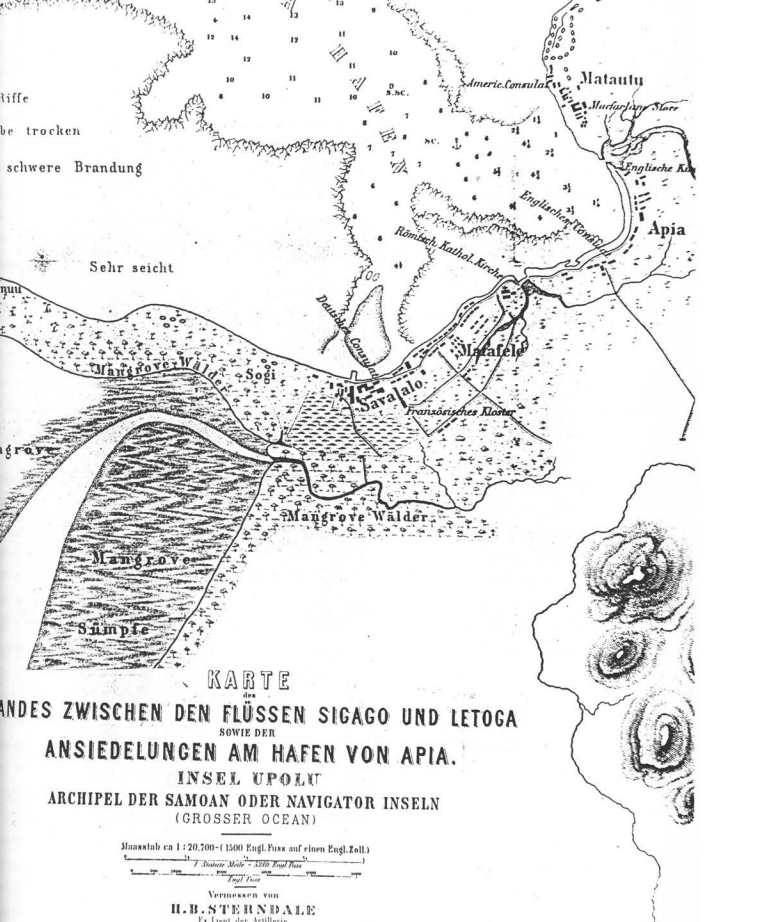
An undated map, presumably from about 1900, showing the town as little more than a string of buildings along the beach. William Churchward, Britain's consul in the 1880s, wrote that "very few native houses are to be seen from the sea; apparently they have all been thrust back by Europeans, who have wheedled the entire frontage out of the Samoans by means more or less fair." (Churchward, My Consulate in Samoa, 1887, p. 23.)
(Gary Pringle, Heritage Assessment Apia, Western Samoa, M.S (Architecture, University of Sydney, 1989. p. 24.)
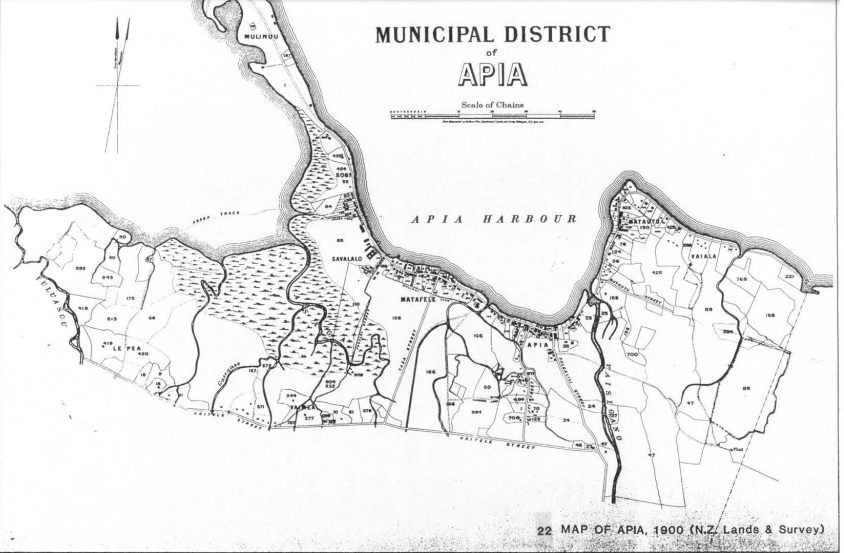
Another map of the time, easier to read.
(Pringle, p. 41.)
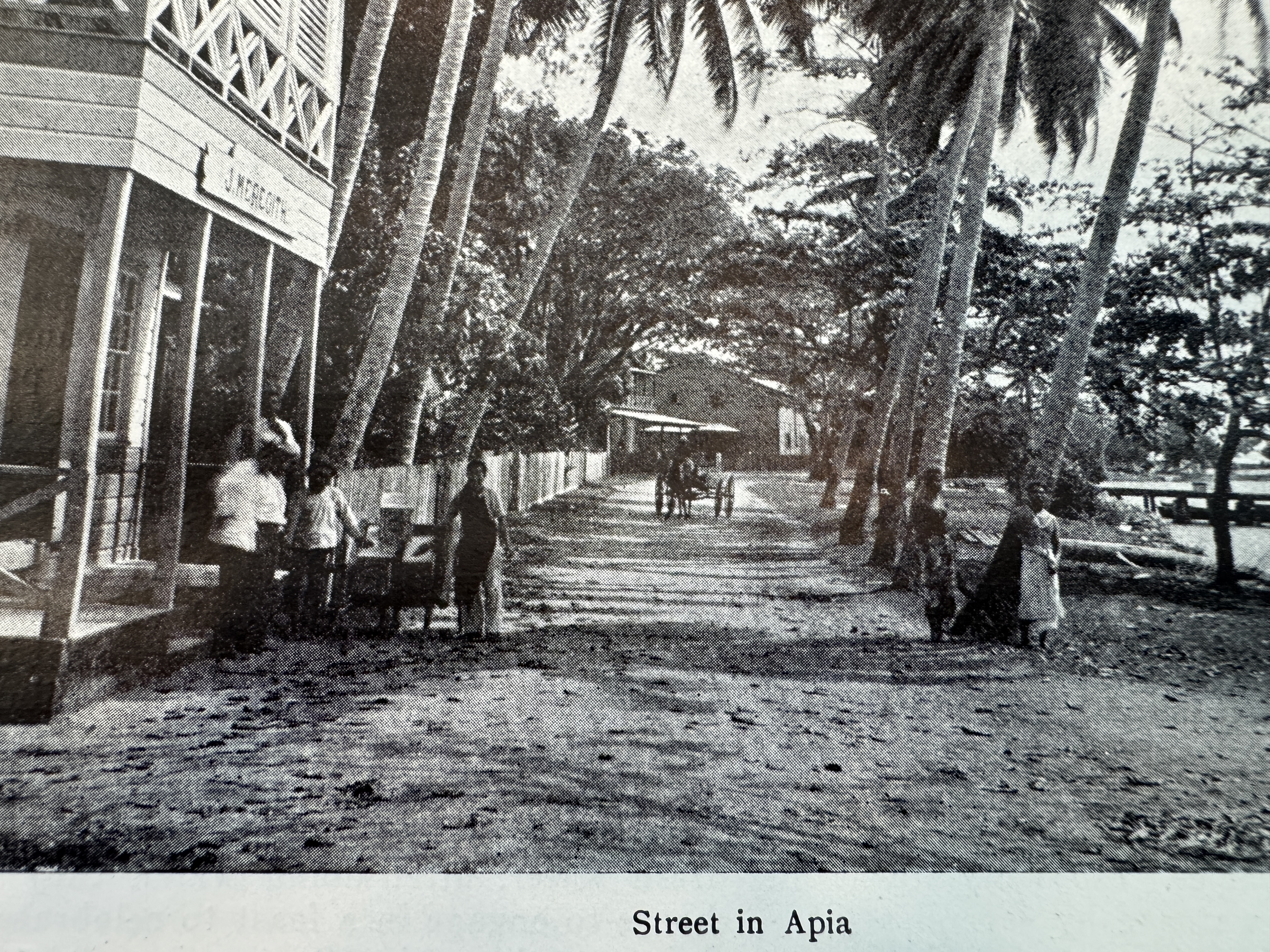
The Apia waterfront in about 1900.
(Cyclopedia, p. 31.)
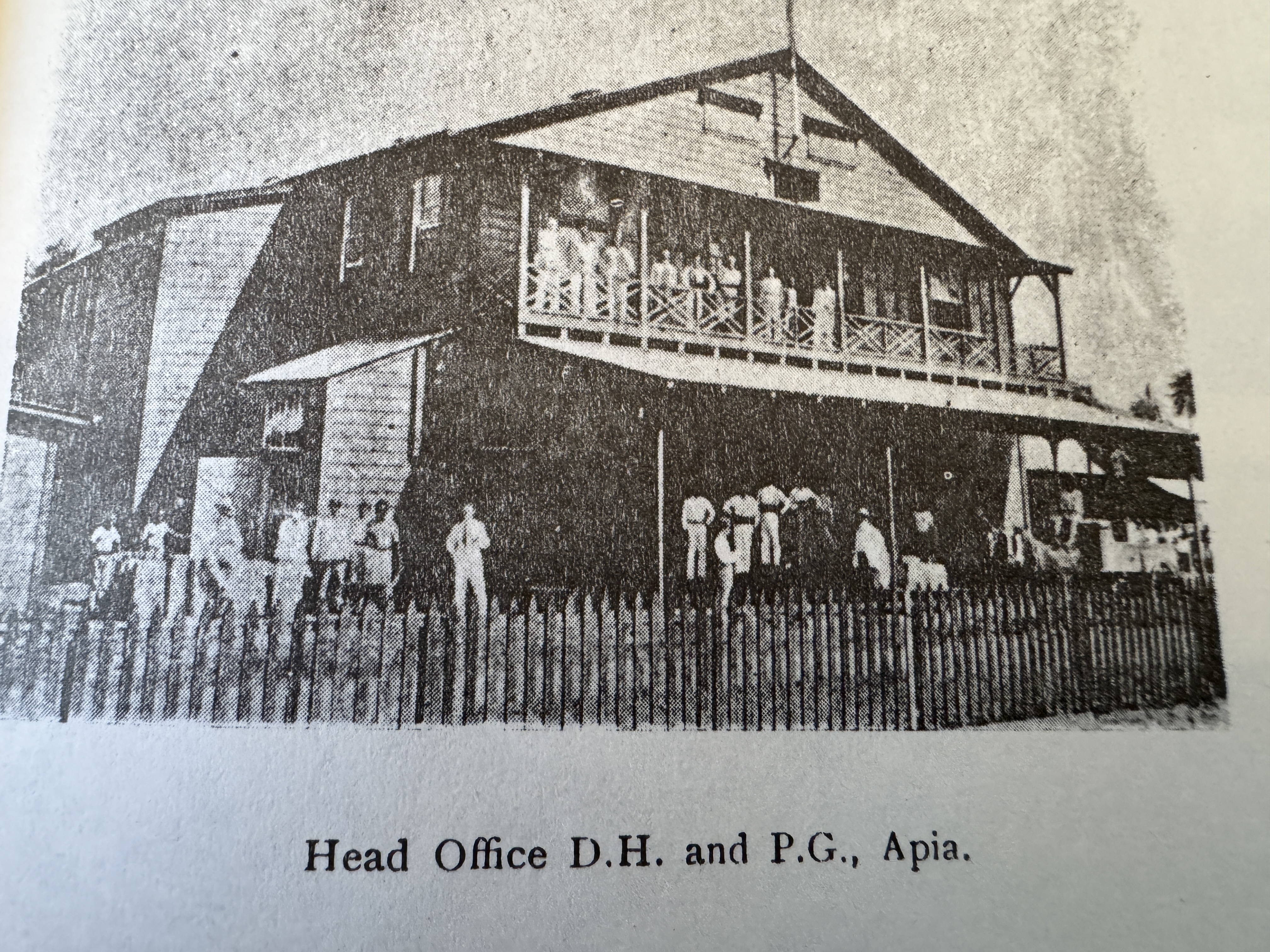
The early headquarters of Godeffroy and its successor, the DHPG.
A British diplomat in Apia on business in 1879 wrote: "Most of the houses are grog shops, and there are plenty of loafing half-castes and natives hanging about them, and drunken rows of a night are by no means uncommon. There are, however, a few good houses. At the one end of the town is the establishment of Godeffroy, the Hamburg merchants, a large substantial wooden building. The Manager, Mr. Weber, is also German Consul and is inclined to be most friendly, assisting me in any way he can. And at the other end of the town is a somewhat similar establishment of Ruge and Heddeman, also Hamburg merchants. There two firms do the greater part of the business of the place, and there are always several German vessels in the harbour..." (Alfred P. Maudslay, Life in the Pacific Fifty Years Ago, 1930, p. 195).
(Cyclopedia, p. 31.)
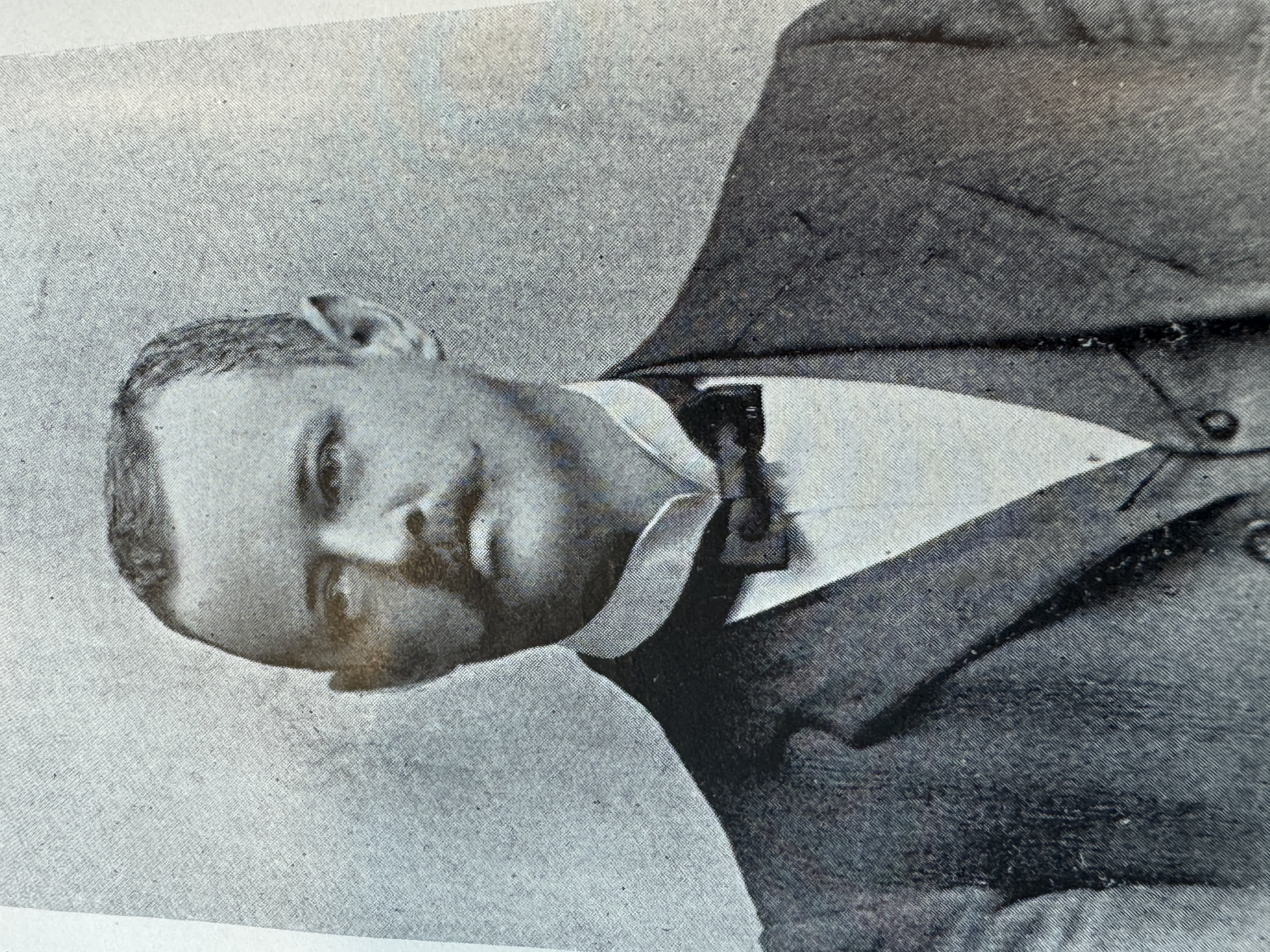
Karl Hanssen became manager of the DHPG in 1906 and stayed to the bitter end when in 1914, all DHPG properties were taken over by New Zealand.
(Cyclopedia, p. 84.)
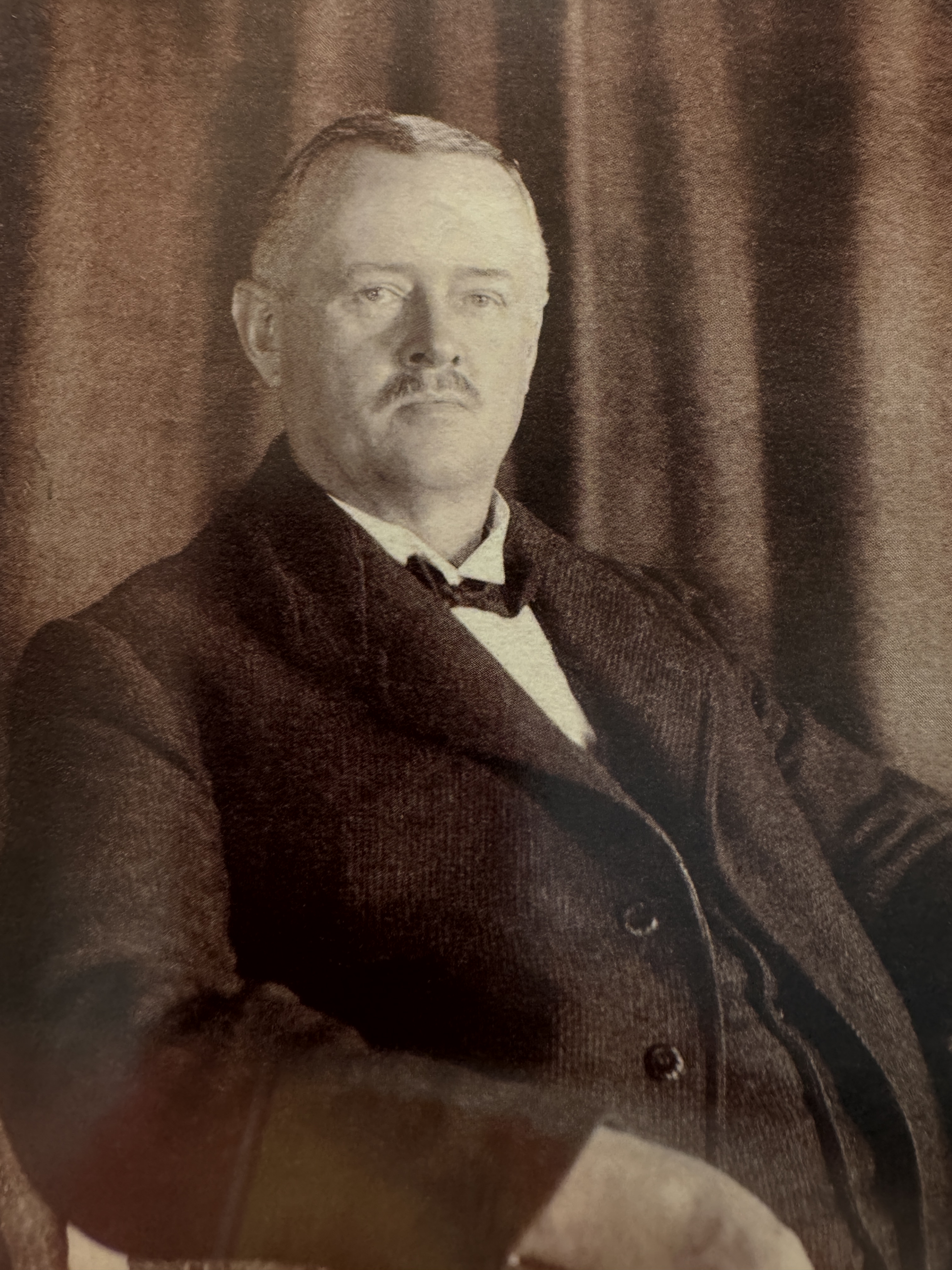
A later picture of Hanssen.
(Brunt,, p. 109)
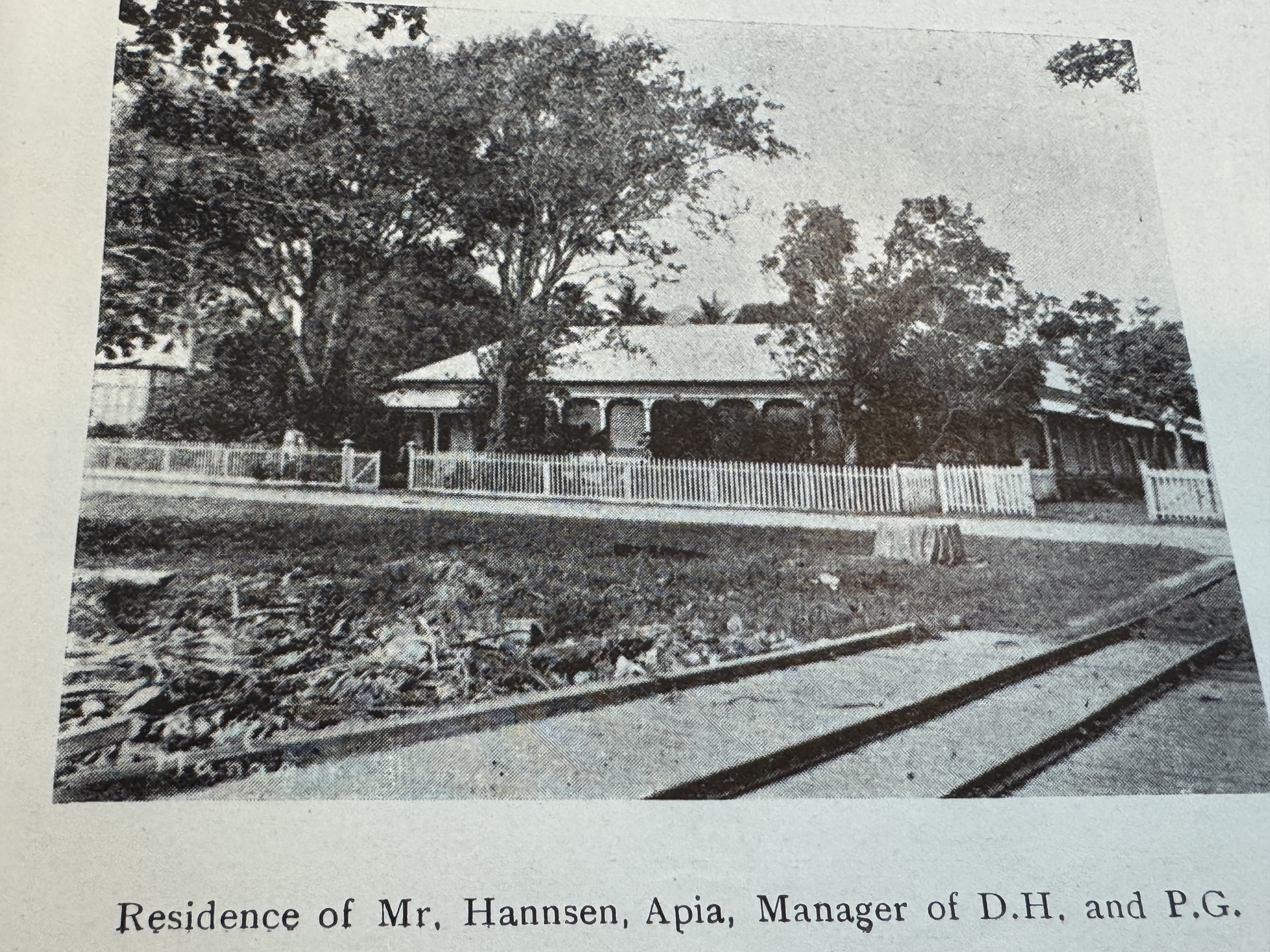
Not too bad, eh? There are no railroads on the island today, but in Hanssen's time short lines supported the copra producers. (Hanssen's name is mispelled here.)
(Brunt, p. 79.)
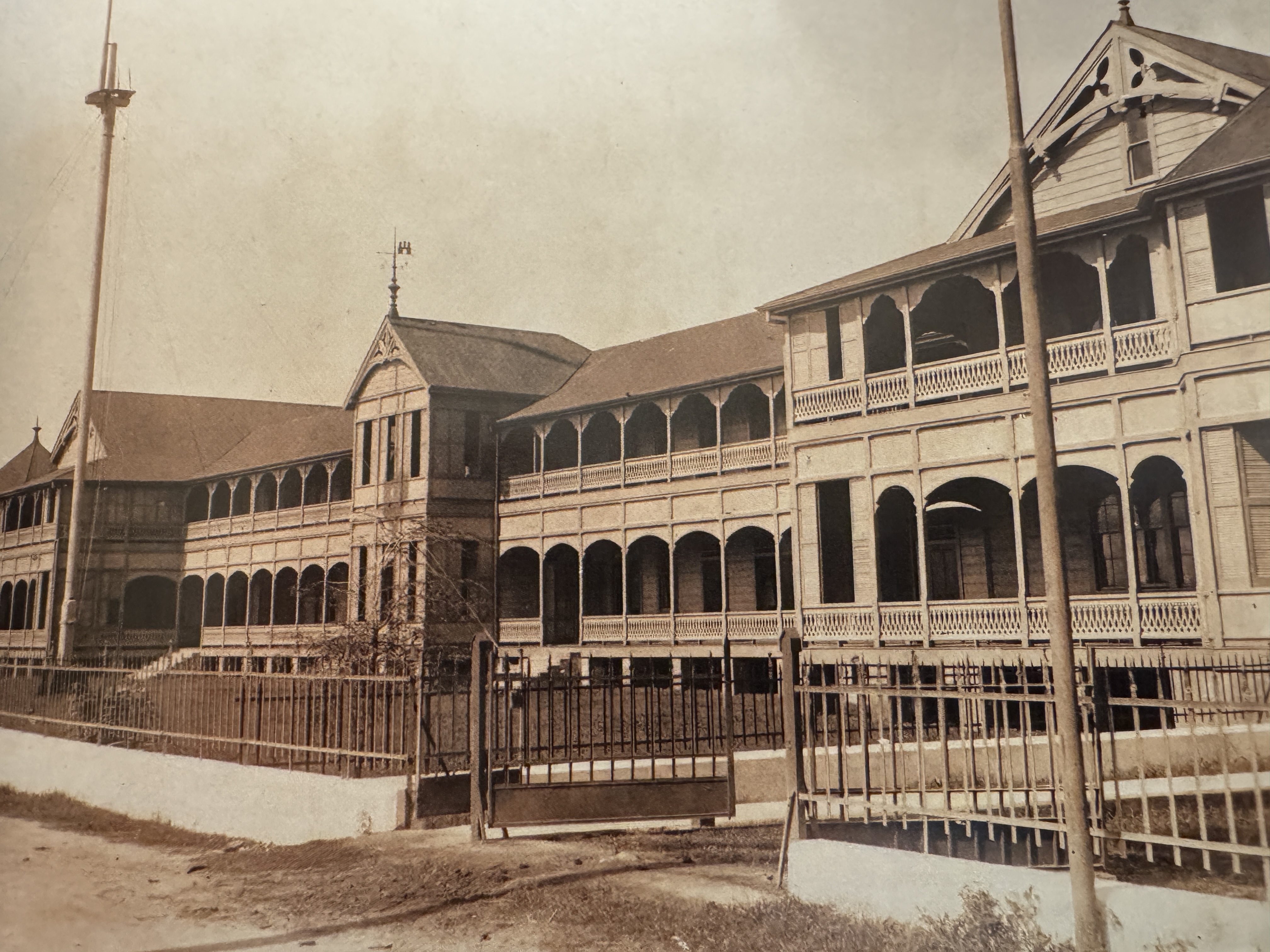
This pretty magnificent building was opened in 1912 for the unmarried employees of the DHPG. They enjoyed it for all of two years.
(Brunt, p. 81.)
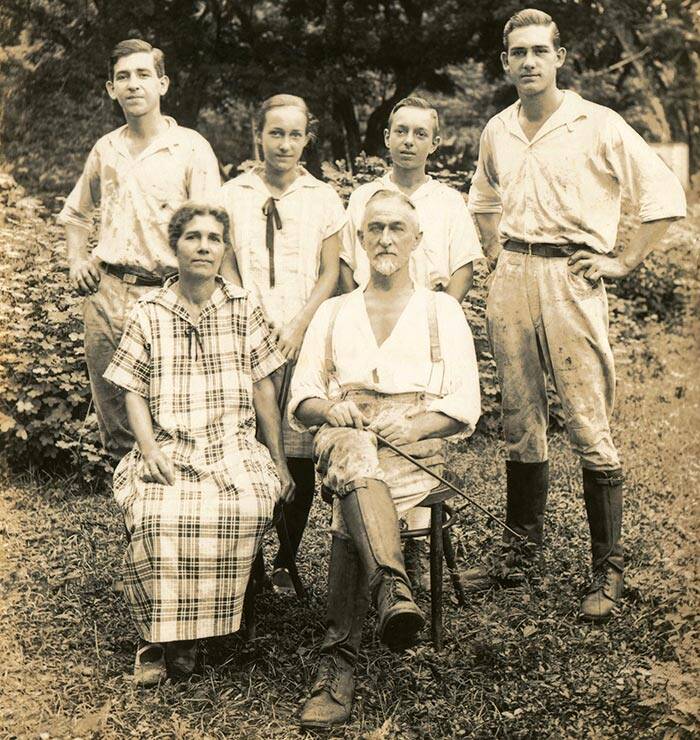
The building's architect, who had been trained as an engineer, was Fritz St nzner (1873-1948), here with his family. Like many other Germans, he was deported in 1915, He returned to Samoa in the 1920s but again returned to Germany in poor health and died there in 1948.
https://www.aucklandmuseum.com/discover/stories/blog/2014/the-stunzner-family-of-samoa
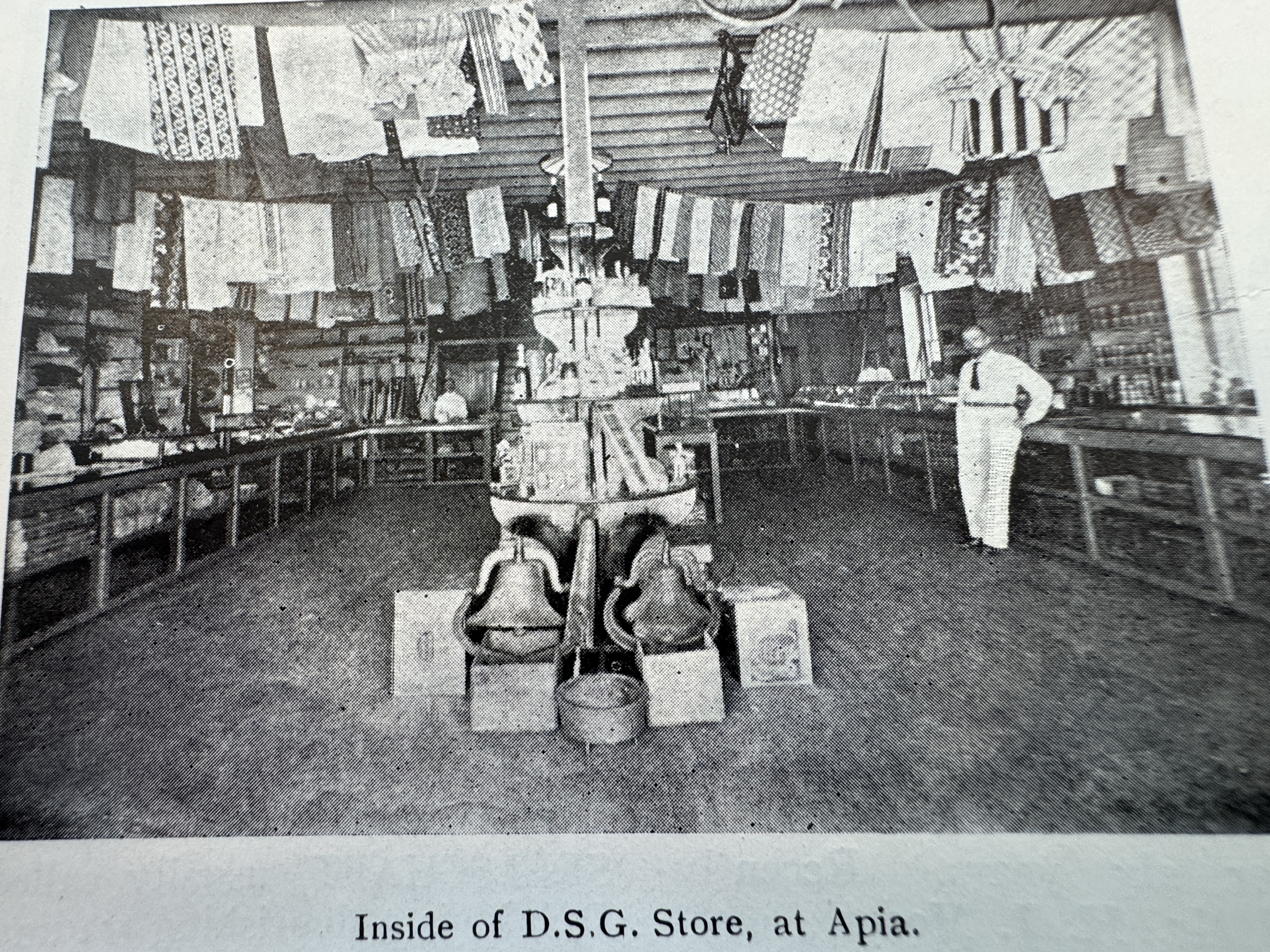
The Deutsche-Samoa Gesellschaft was a competitor of the DHPG.
(Cyclopedia, p. 90.)
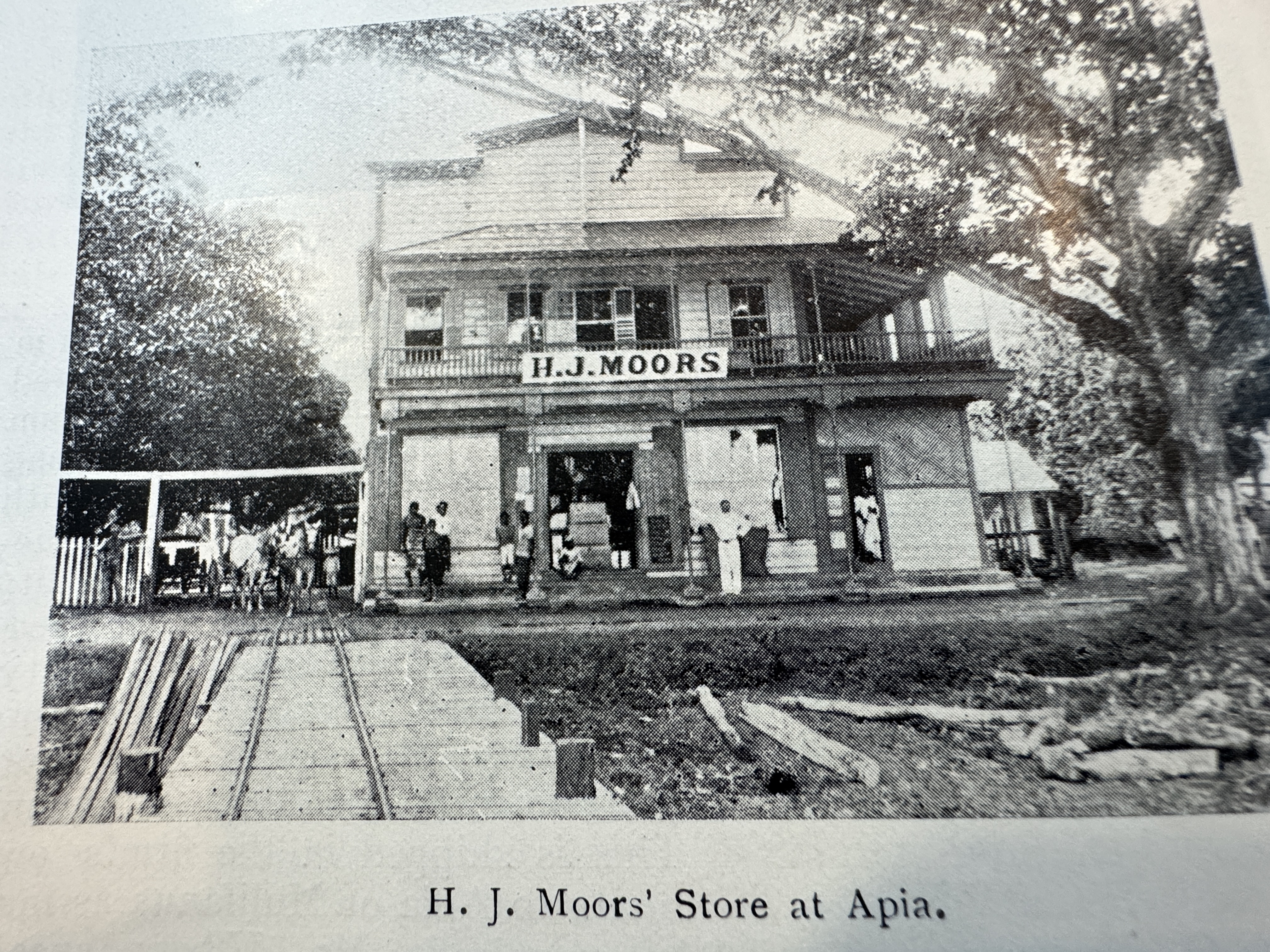
So was Harry Jay Moors (1854-1926).
(Cyclopedia, p. 88)
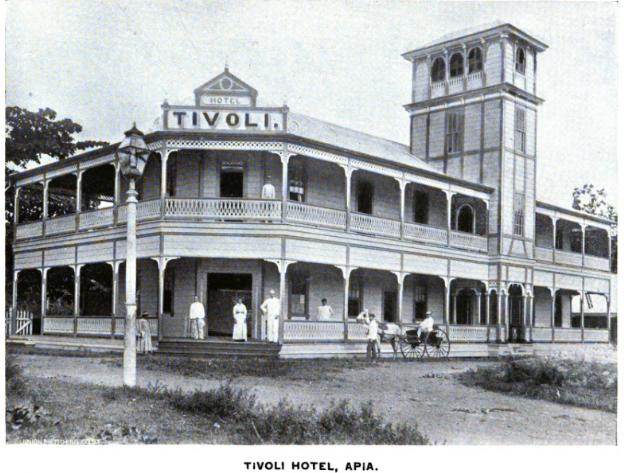
The Tivoli Hotel opened in 1892. Perhaps the tower was built to keep an eye out for ships. Could it have held a water tank?
(Greene, p. 45.)
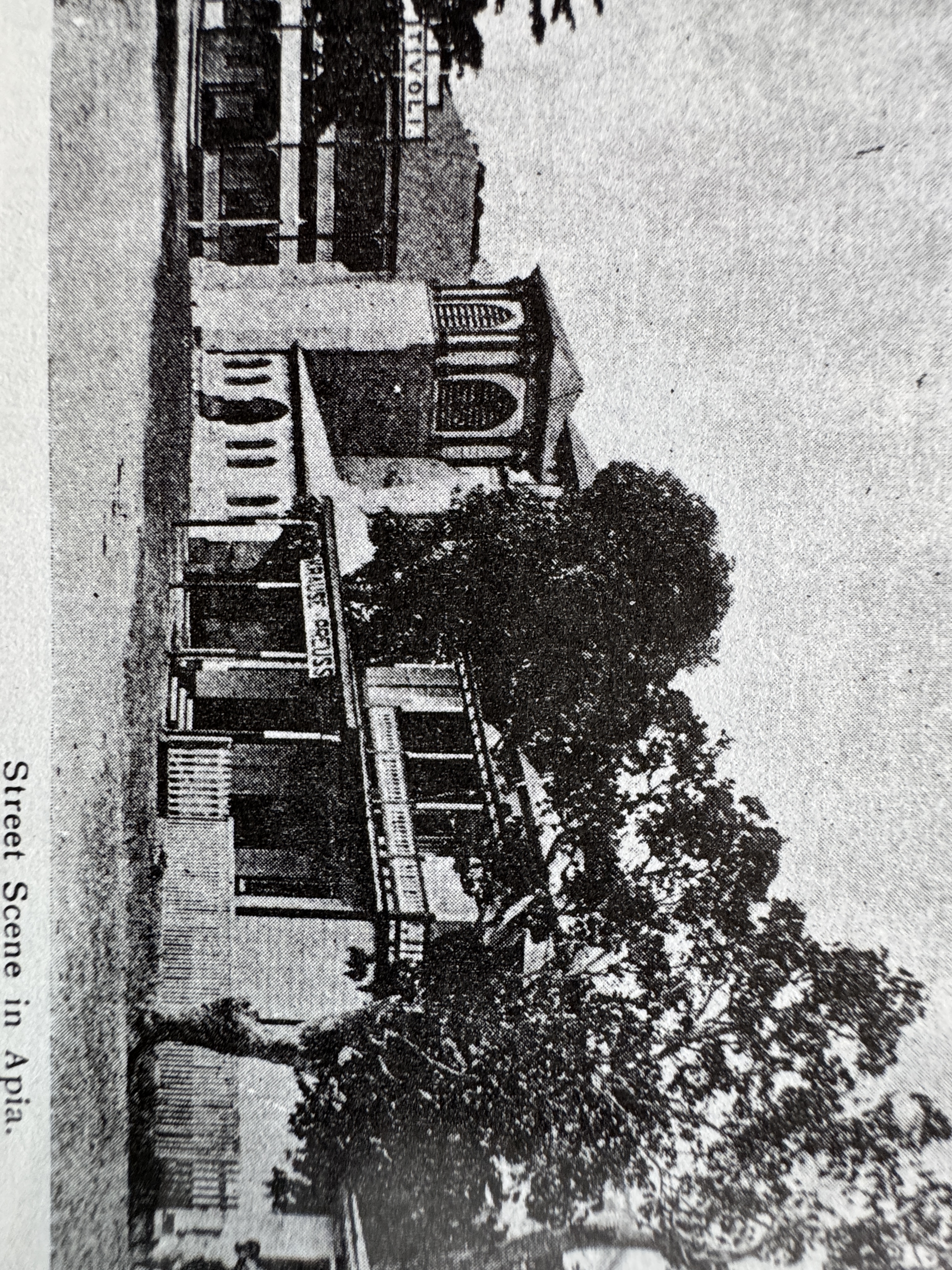
The hotel stood on the site now occupied by the John Williams Building.
(Cyclopedia, p. 51.)
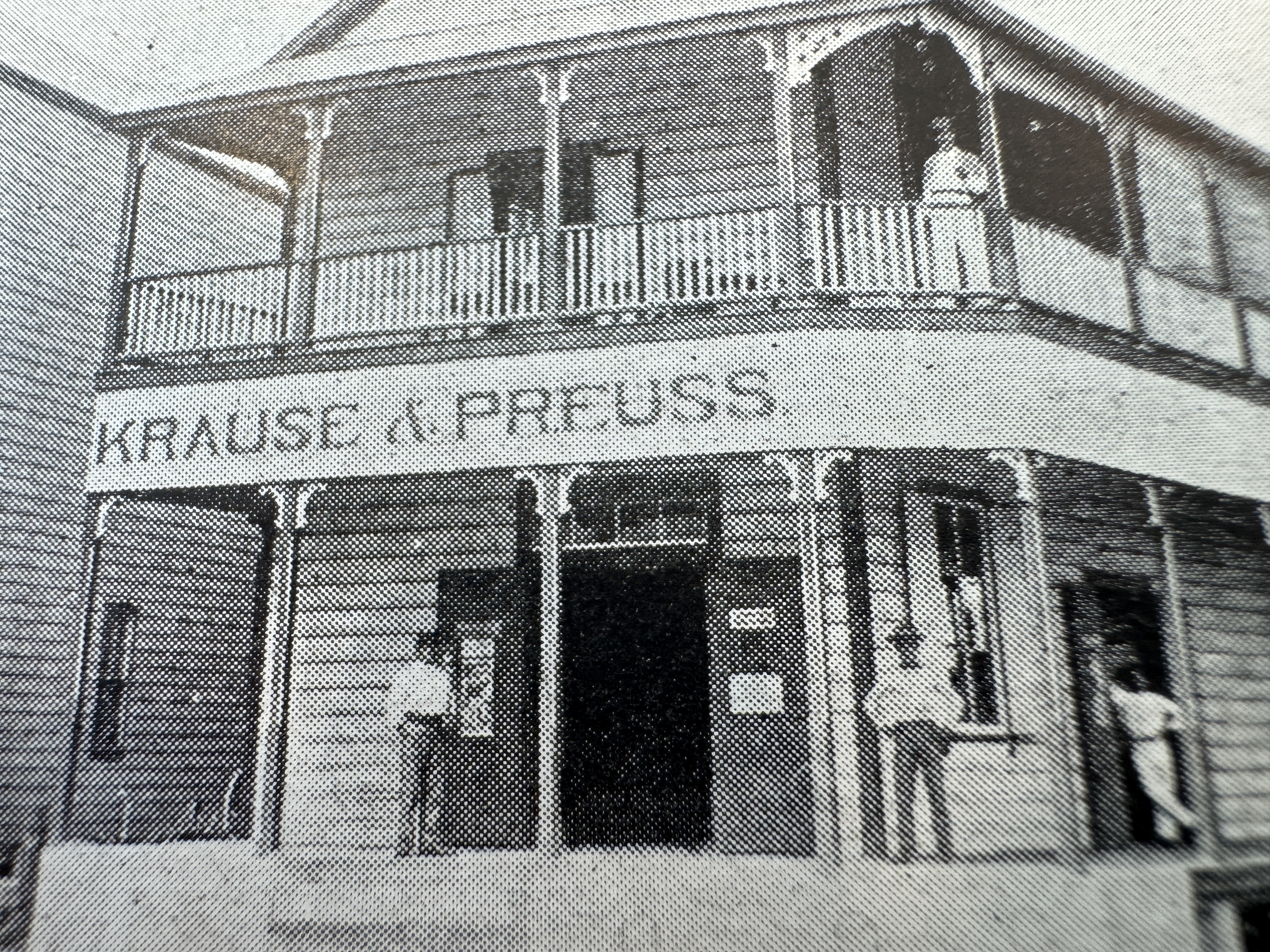
On the other side of the church, as can be seen in the previous picture, was this business, which exported cacao, a secondary plantation crop.
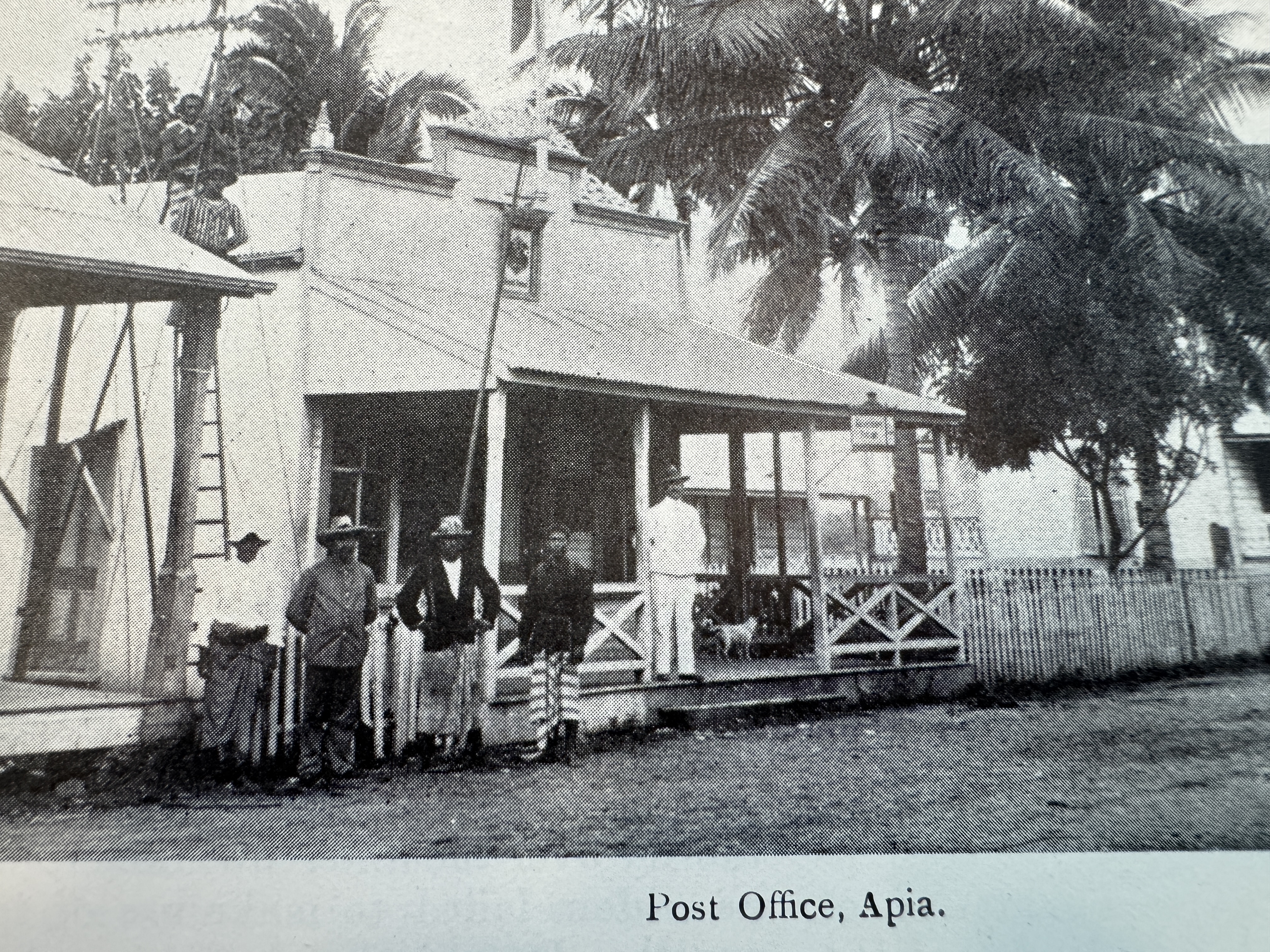
Yes, there was a post office.
(Cyclopedia, p. 43.)
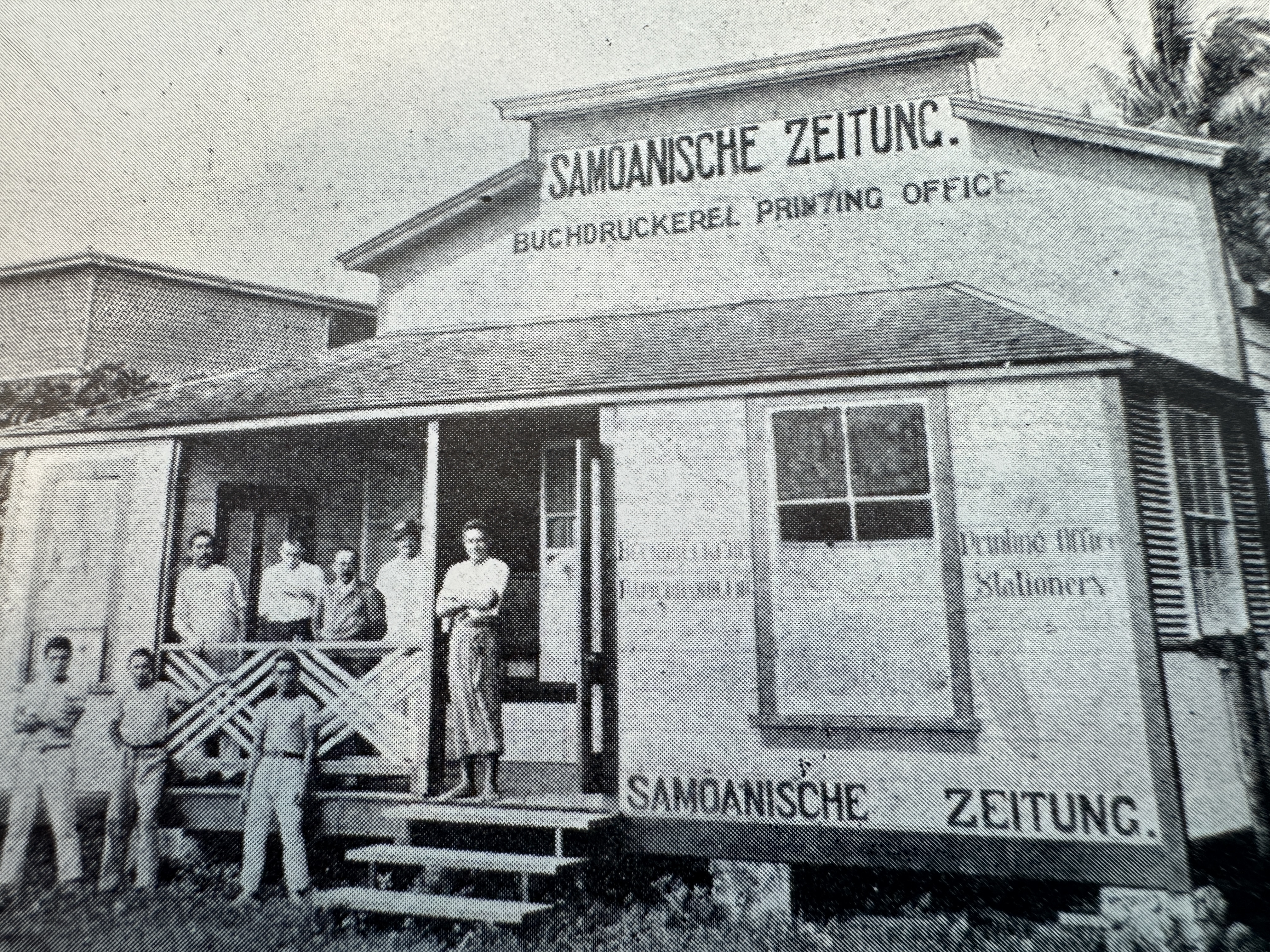
And a newspaper.
(Cyclopedia, p. 67.)
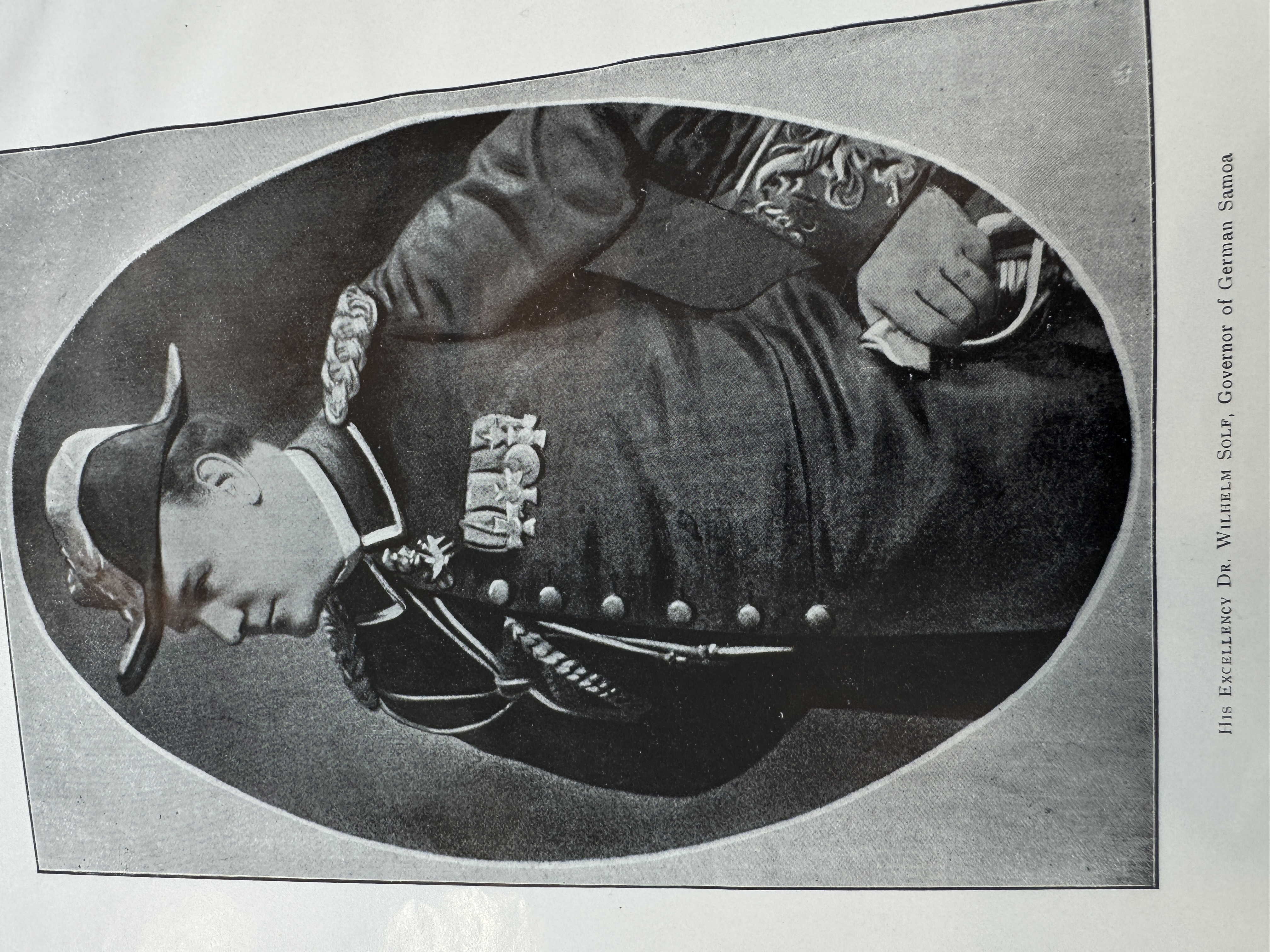
Finally, in 1900, Germany formally incorporated Samoa into its empire. The first governor Dr. Wilhelm Solf, declared that "German rule has now and for ever been established in Samoa." I bet he knew Shelley's "Ozymandias" but never imagined that the German empire would come crashing down so fast. He left Samoa in 1911 and was promoted to a position in Berlin, which probably didn't seem like much of a promotion, at least not for long (McKay, p. 18.)
(Cyclopedia, p. 58.)
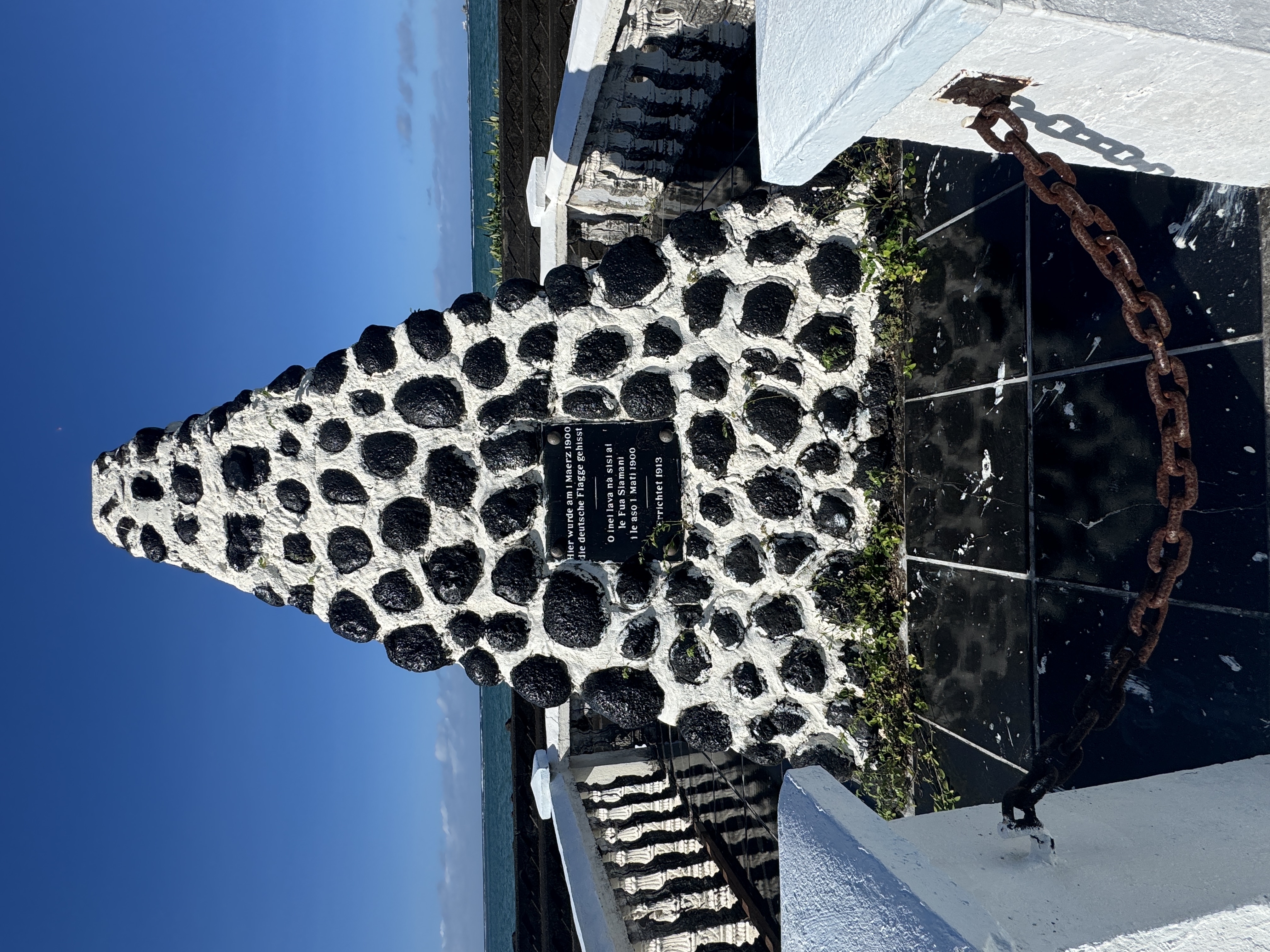
"Here, on 1 March 1900, the German flag was raised. Erected 1913." Good timing.
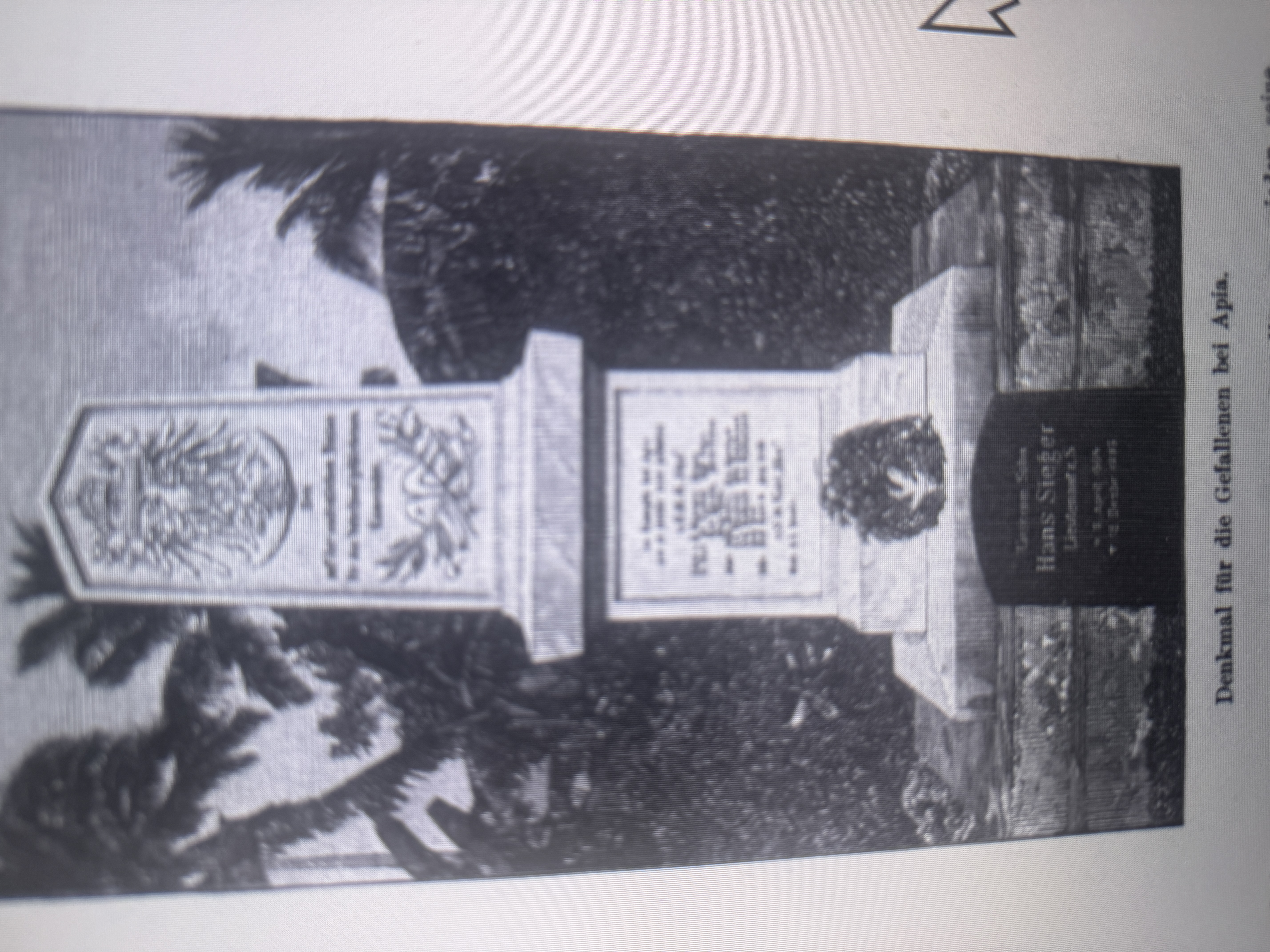
An earlier German monument marked the loss, on March 16, 1889, of several naval vessels unwisely anchored in Apia Bay when a storm hit.
(Reinecke, p. 58.)
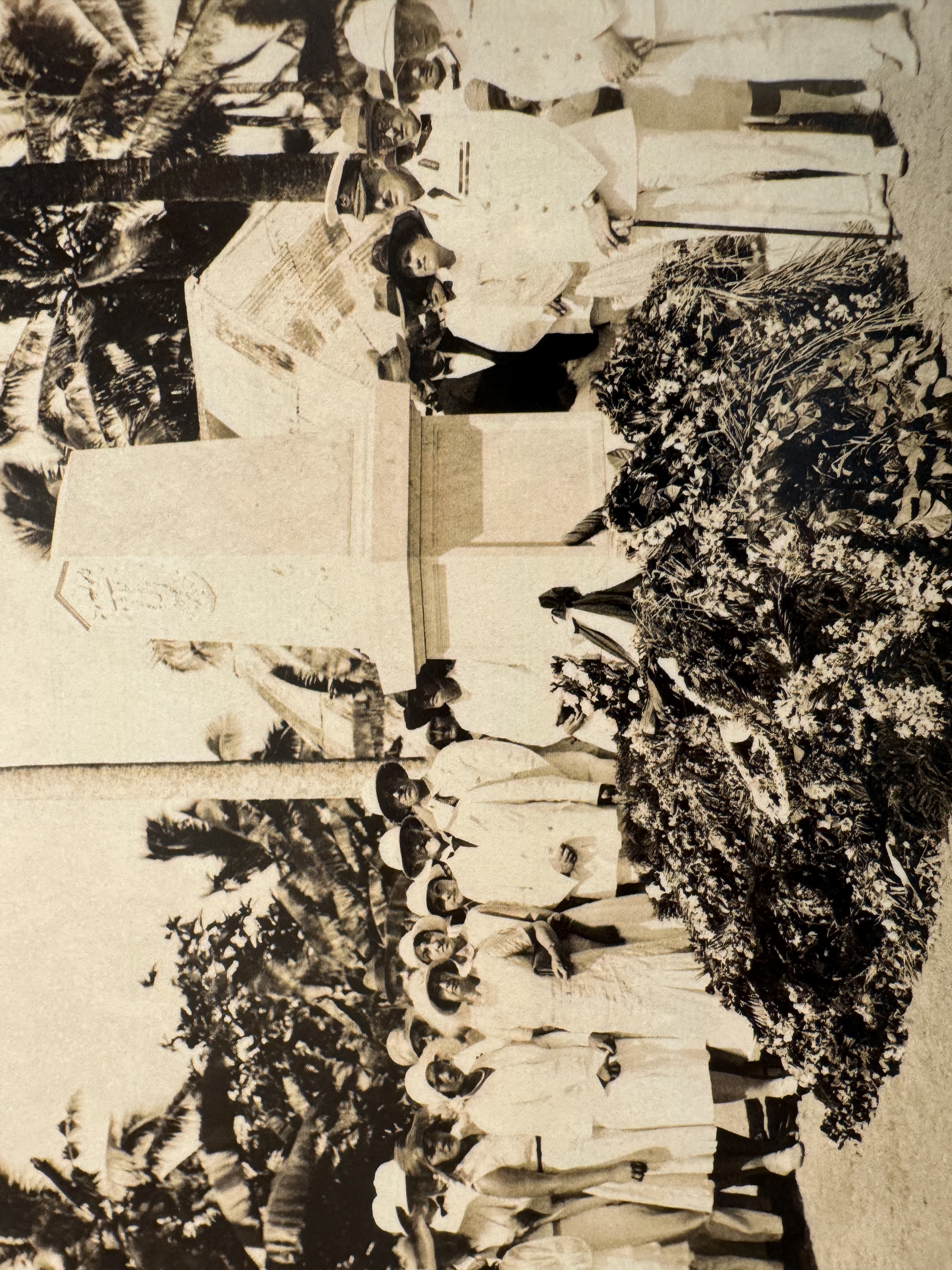
A commemoration was held at the site in 1932. The man in the foreground is New Zealand's Administrator of Western Samoa at that time, Brigidier Herbert Hart.
(Brunt, p. 15.)
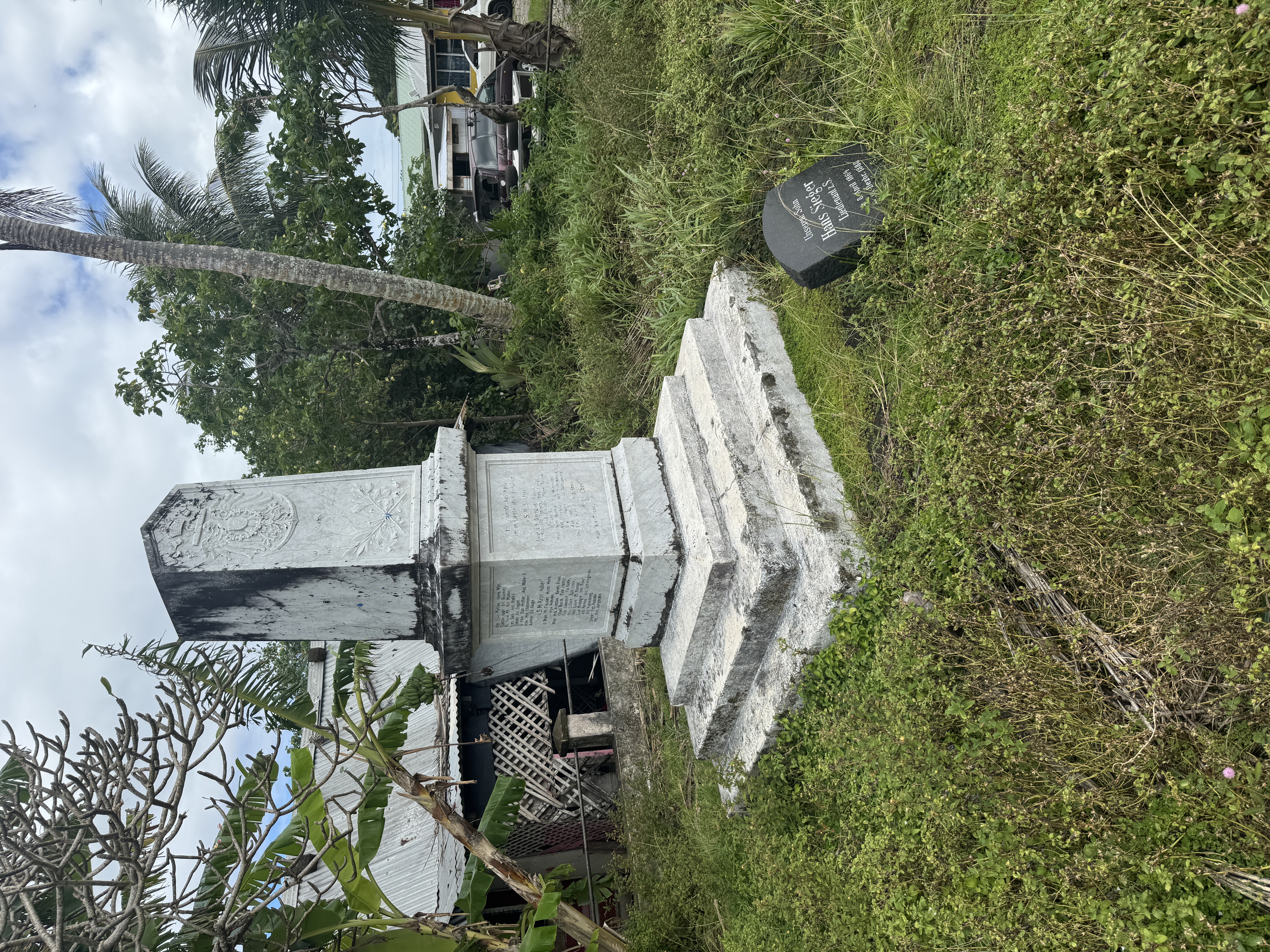
The monument as of 2025.
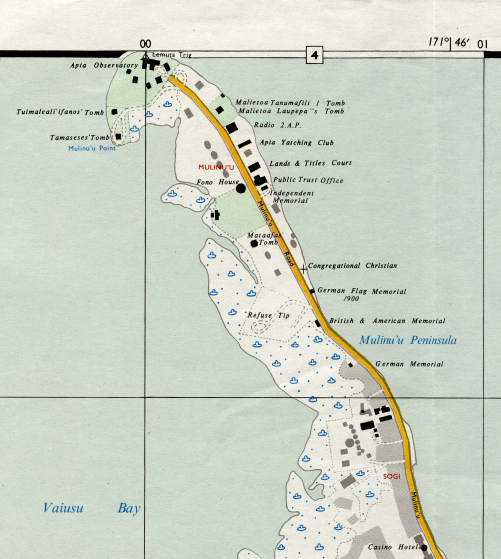
Both monuments are on the Mulinu'u Peninsula, shown here in a 1969 map published by the Department of Lands and Survey, Apia.
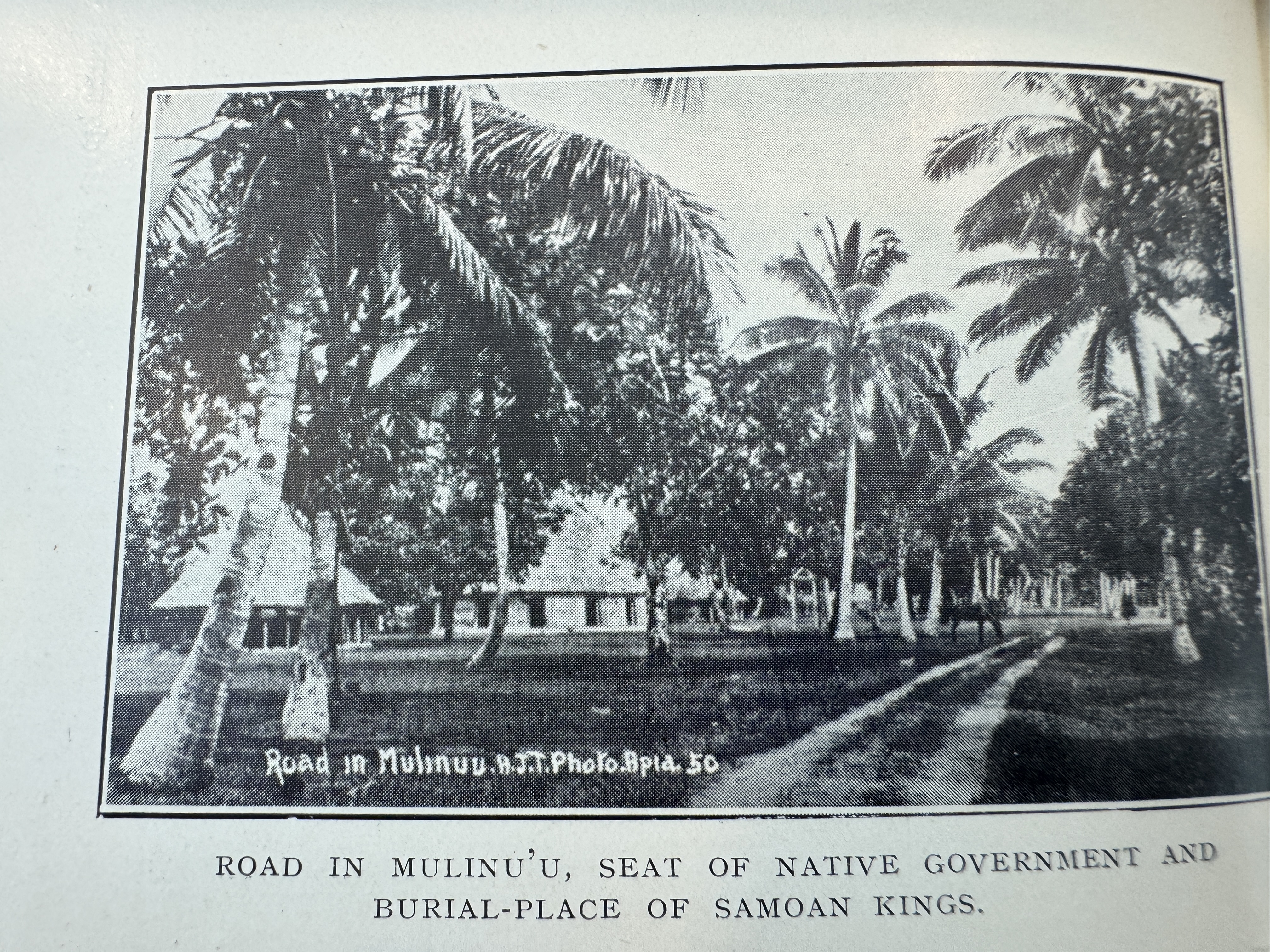
Since we're out here, I want to show you the tombs of the two Samoan leaders who you saw earlier and who Henry Adams and John La Farge so admired.
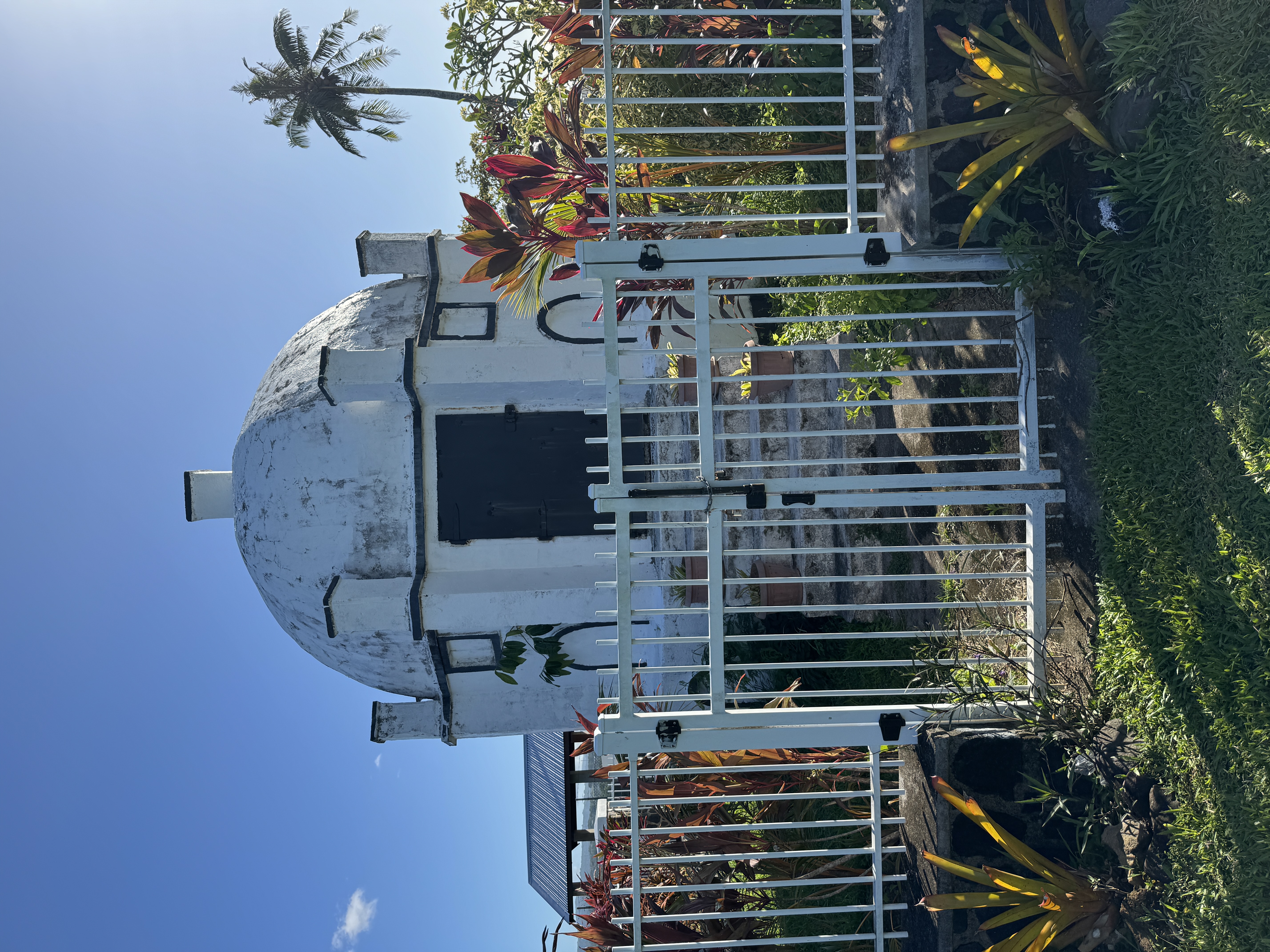
Tomb of Malietoa Laupepa. Apparently it's a reconstruction.
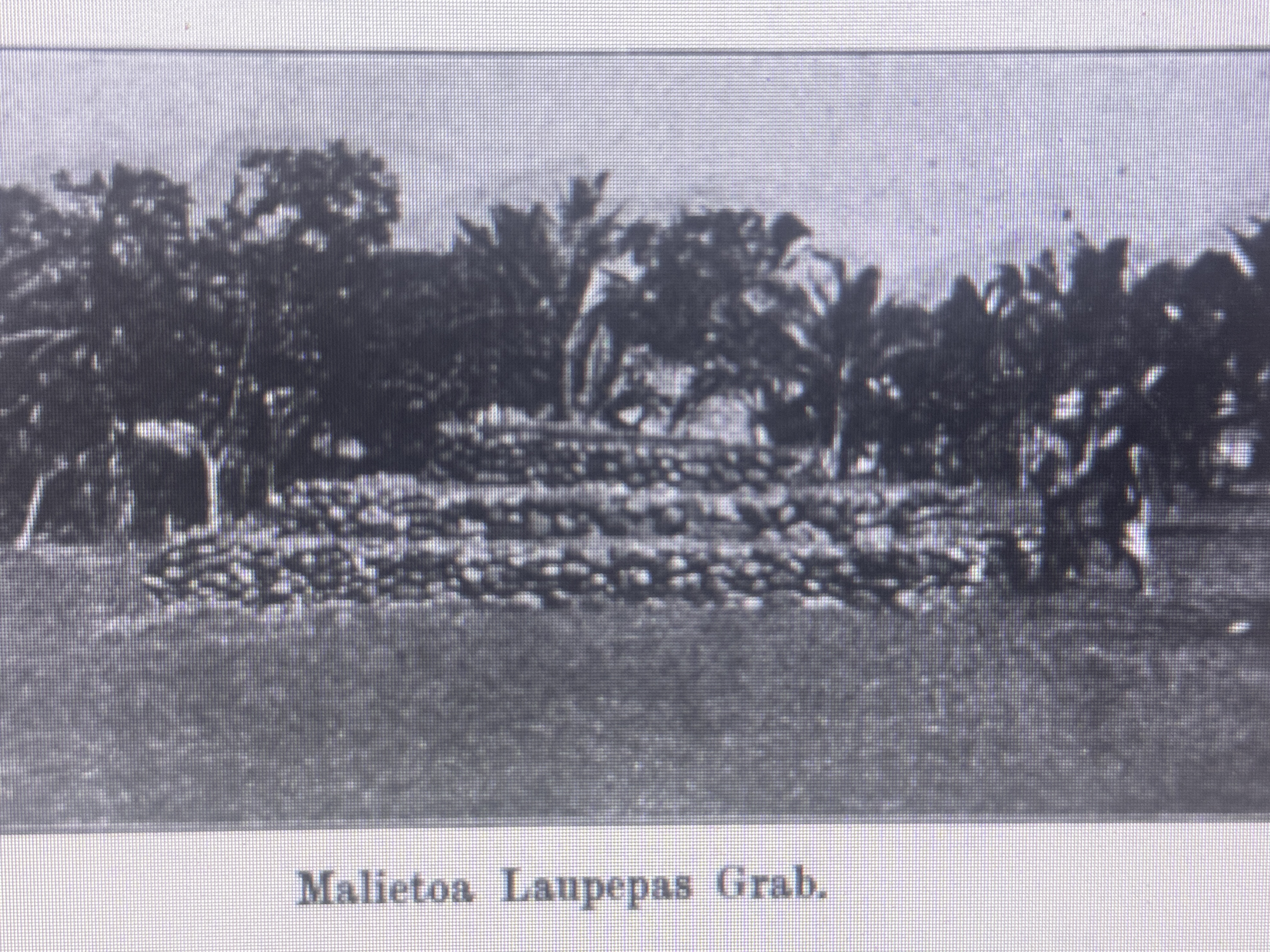
I say that because here it is as shown in a book from 1902.
(Reinecke, p. 70.)
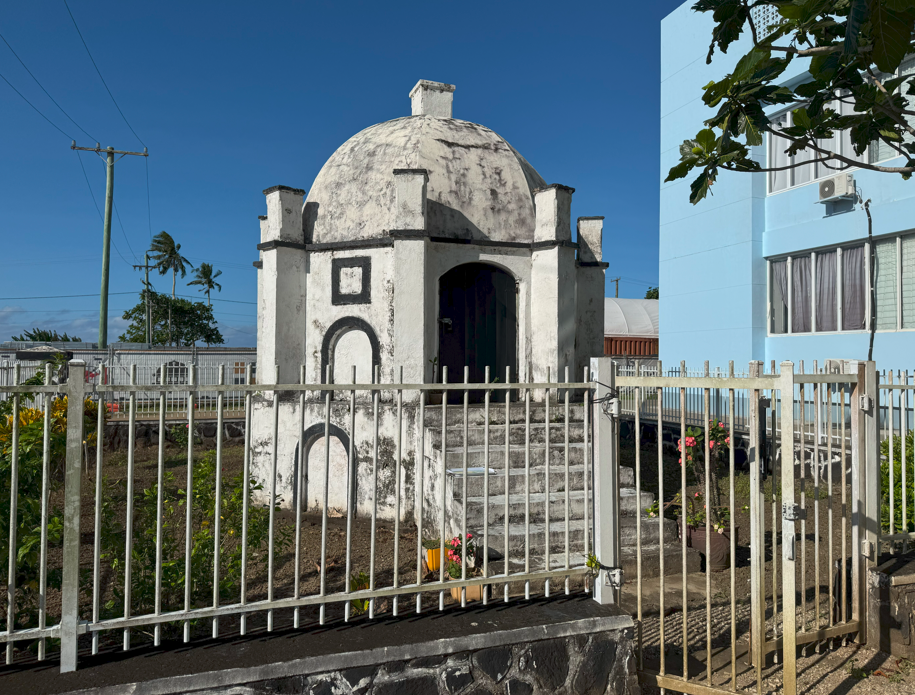
The grave of Mata'afa. It's likely also a reconstruction.
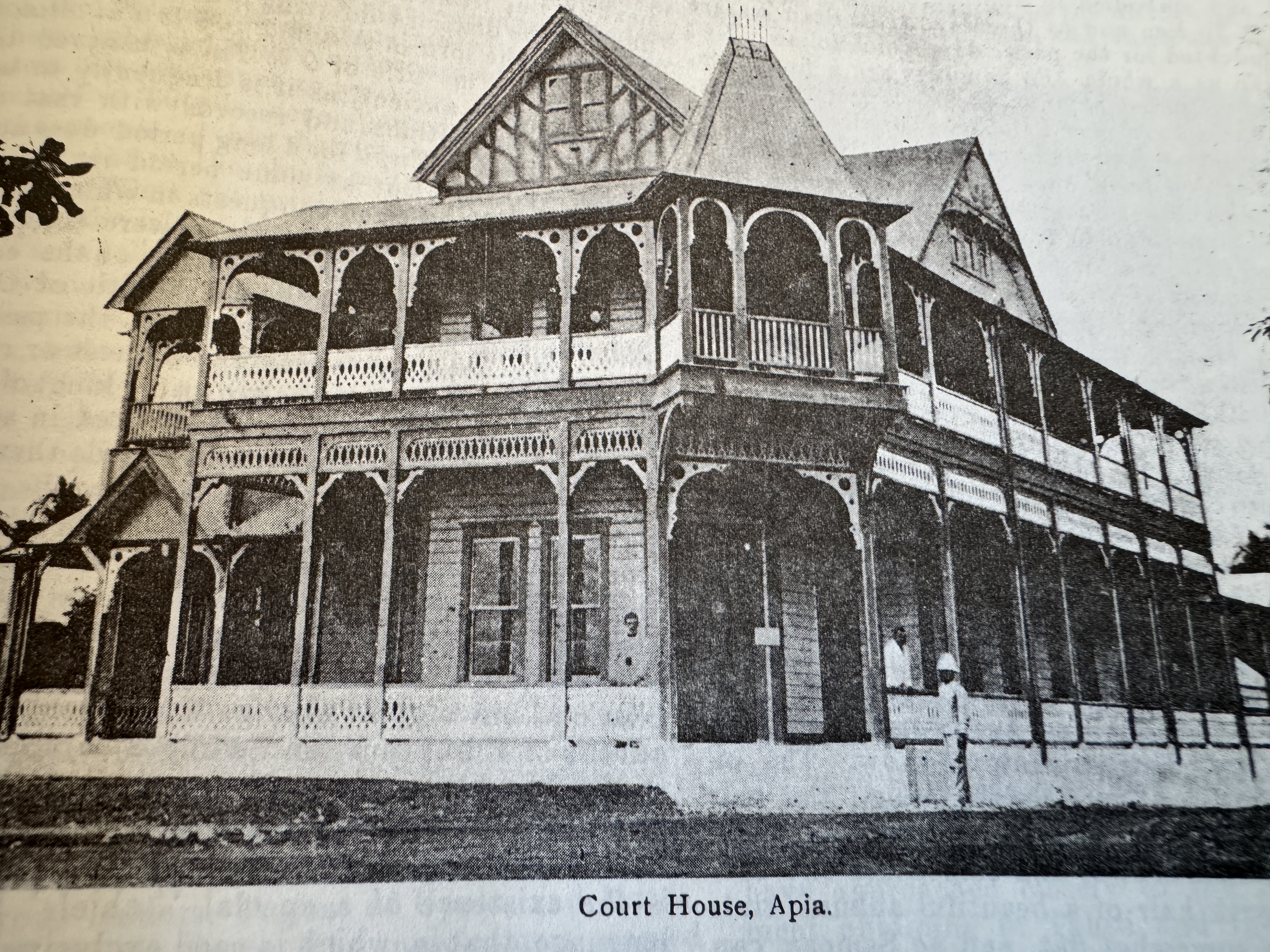
The Germans built a courthouse. The architect was the same Fritz St nzner who had designed the magnificent quarters for DHPG employees.
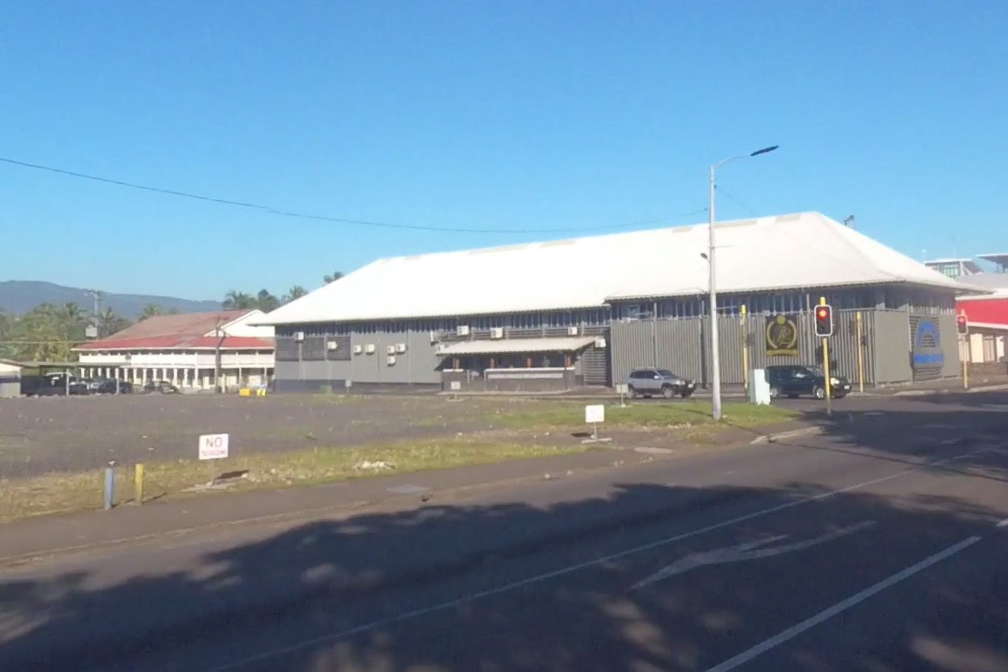
In a brilliant feat of heritage conservation, the courthouse was demolished in 2020. It stood here, on land vacant as of 2025. Across the street, disguised a bit, is the administration building built by the Germans and taken over by the New Zealand administration, which called it the Central Office.
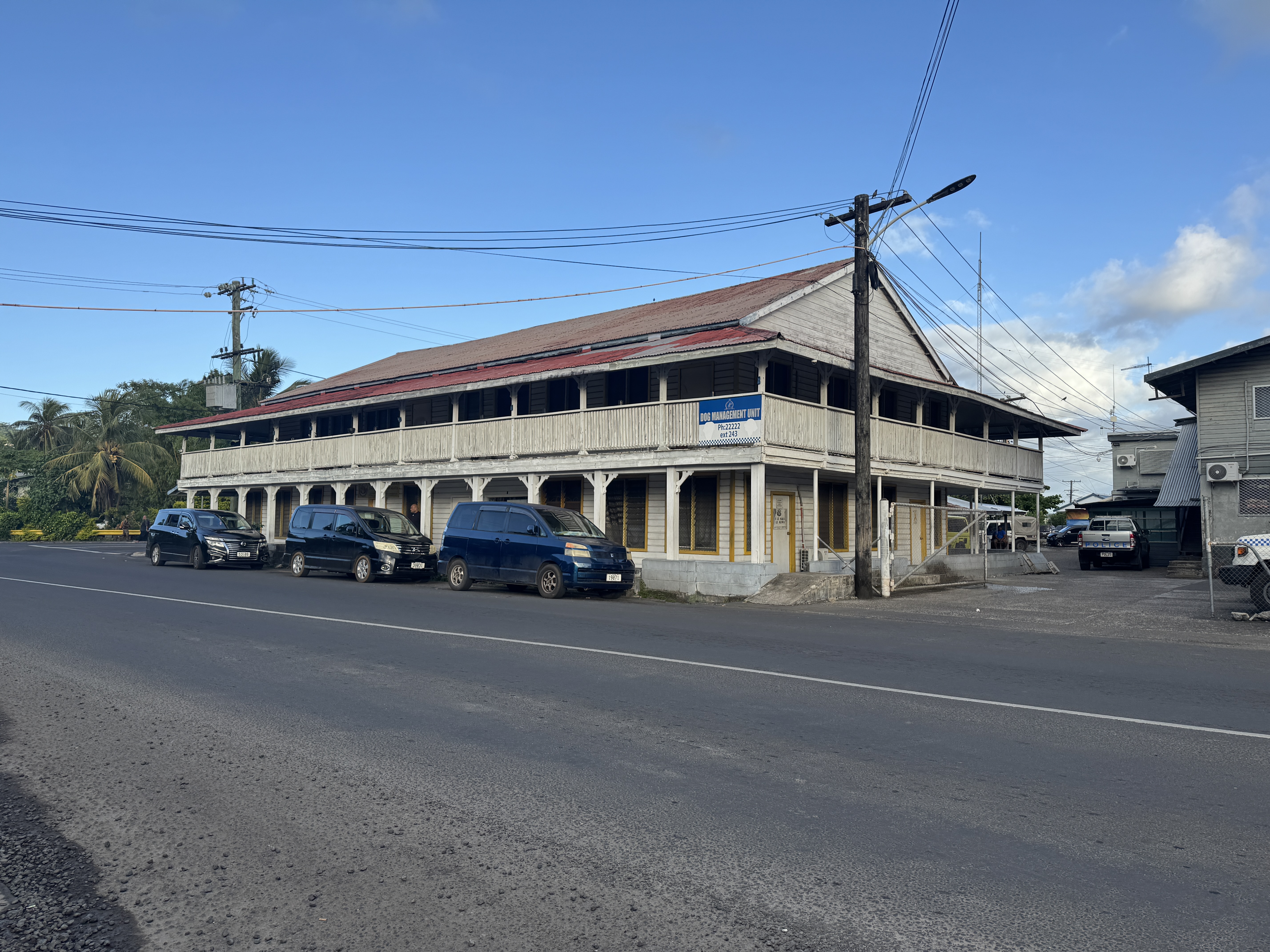
A closer view of the building behind it. I think we can assume that this was not St nzner-designed. At least it survives.
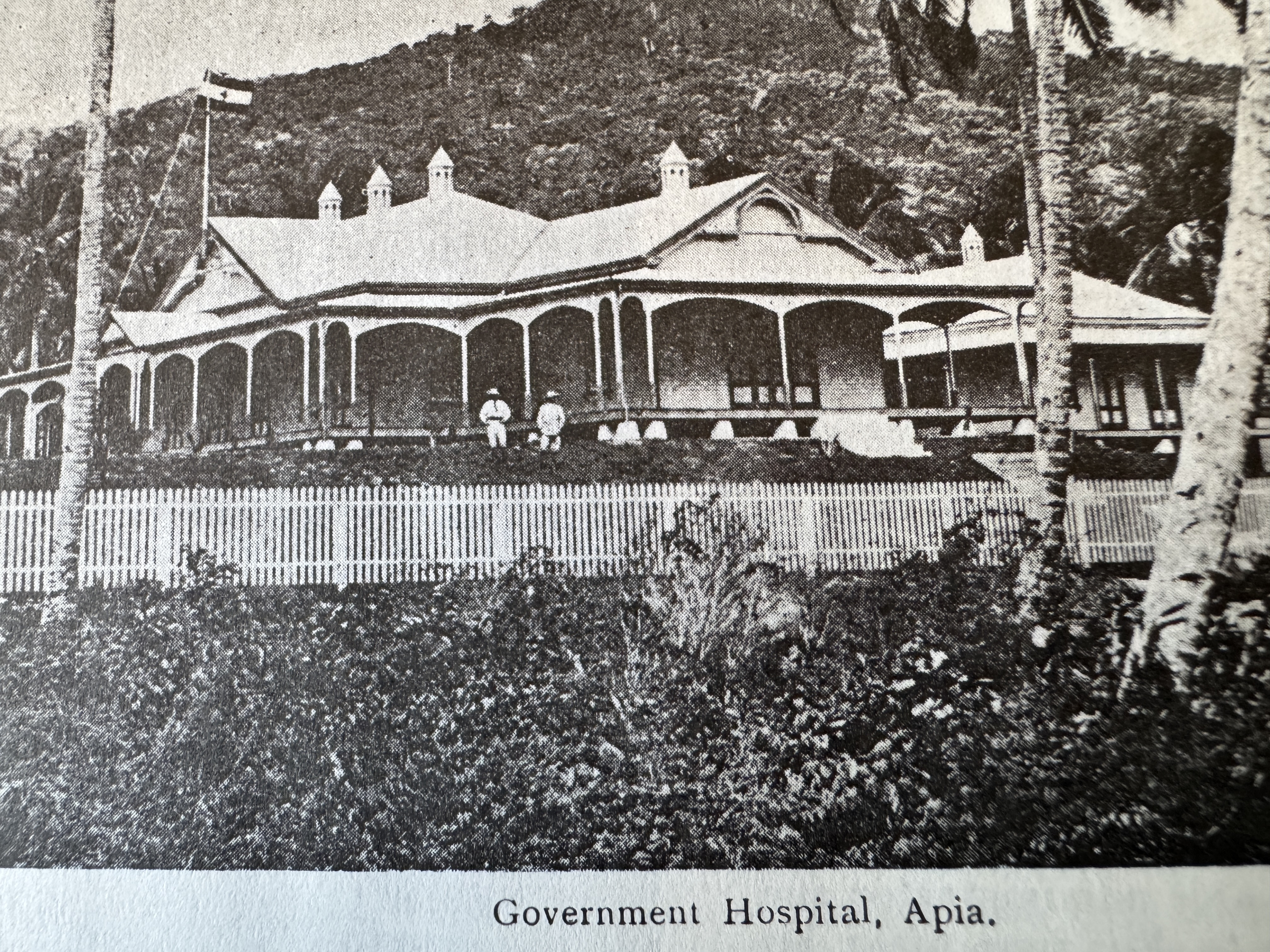
This, on the other hand, was his. It's the town hospital, demolished in 2013.
(Cyclopedia, p. 4.)
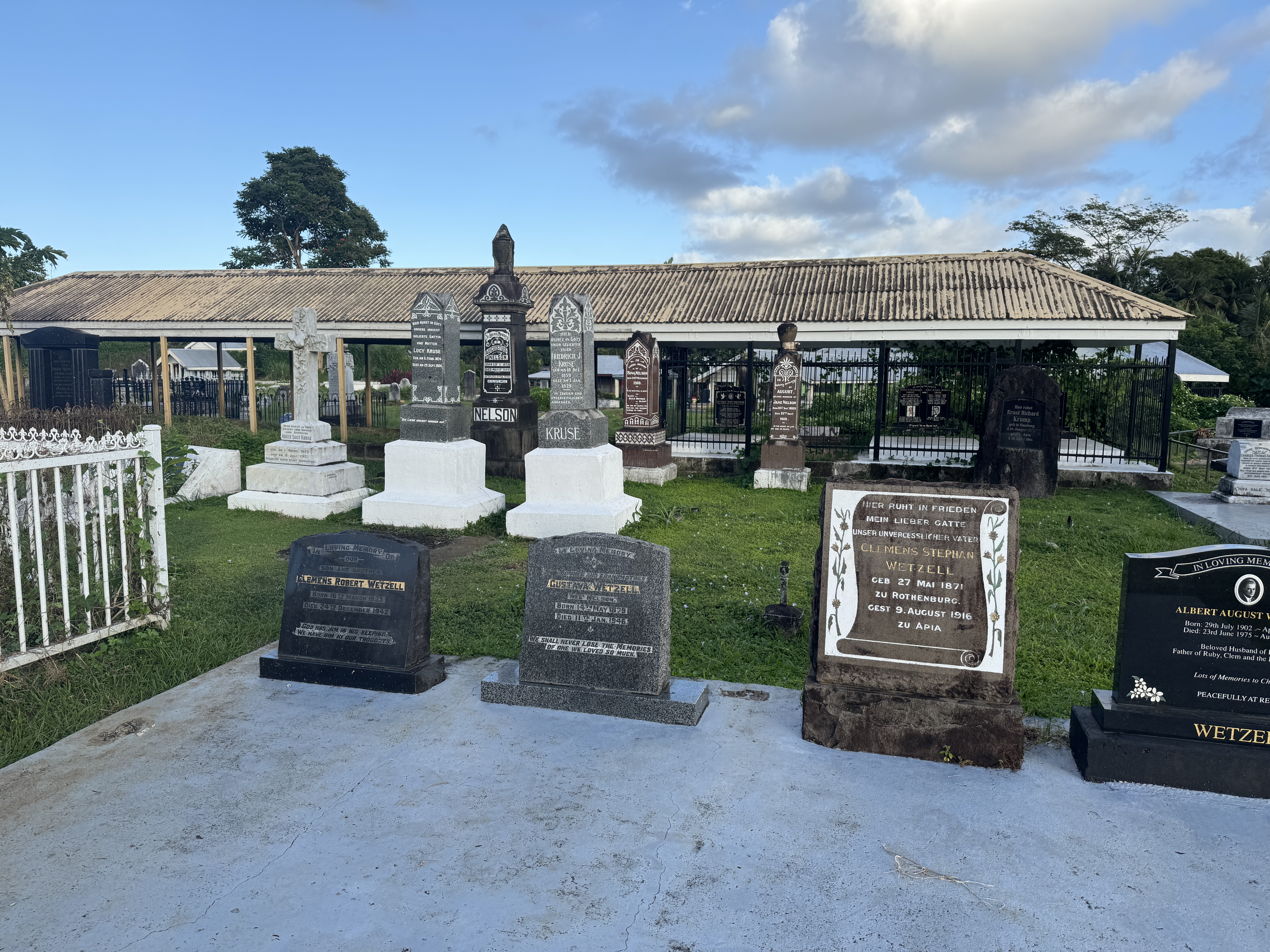
What else survives in this corner of the German Empire? For one thing, a foreigner's cemetery.
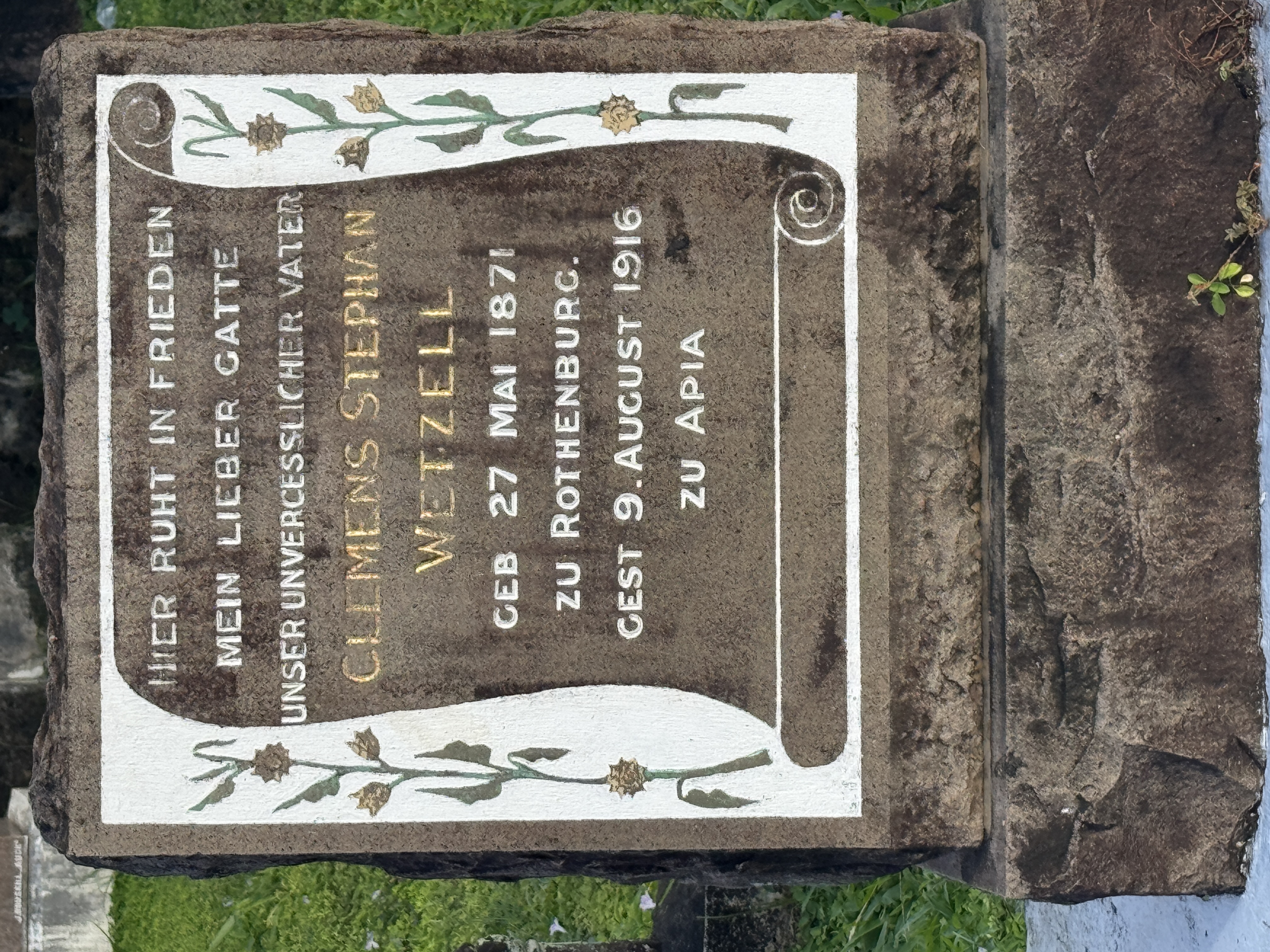
Clemens Wetzell owned a 258-acre cacao plantation in Siusega, now a built-up part of Apia.
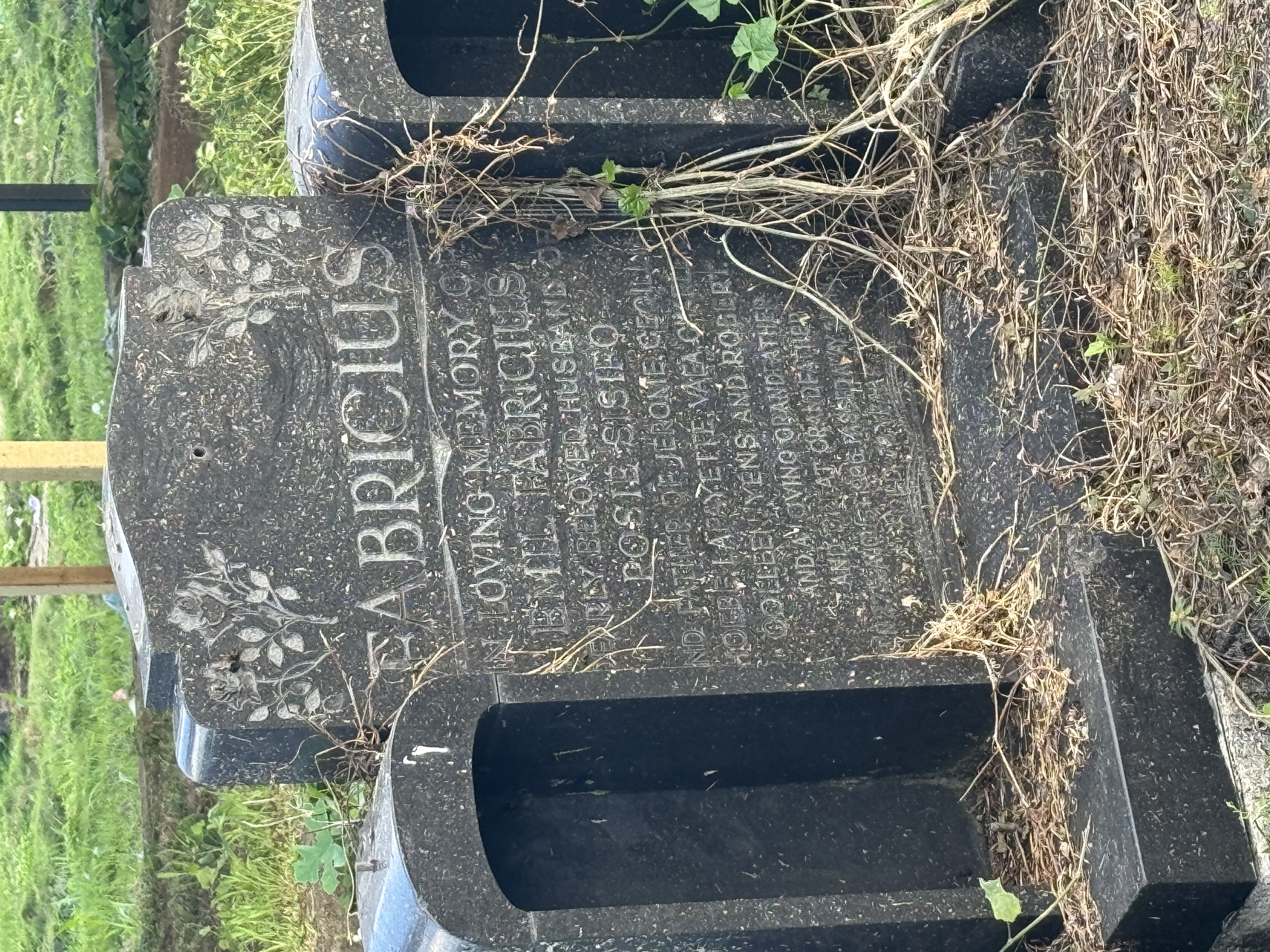
The cemetery wasn't just for Germans. Here's a Dane, Emil Fabricius, 1906-1978.
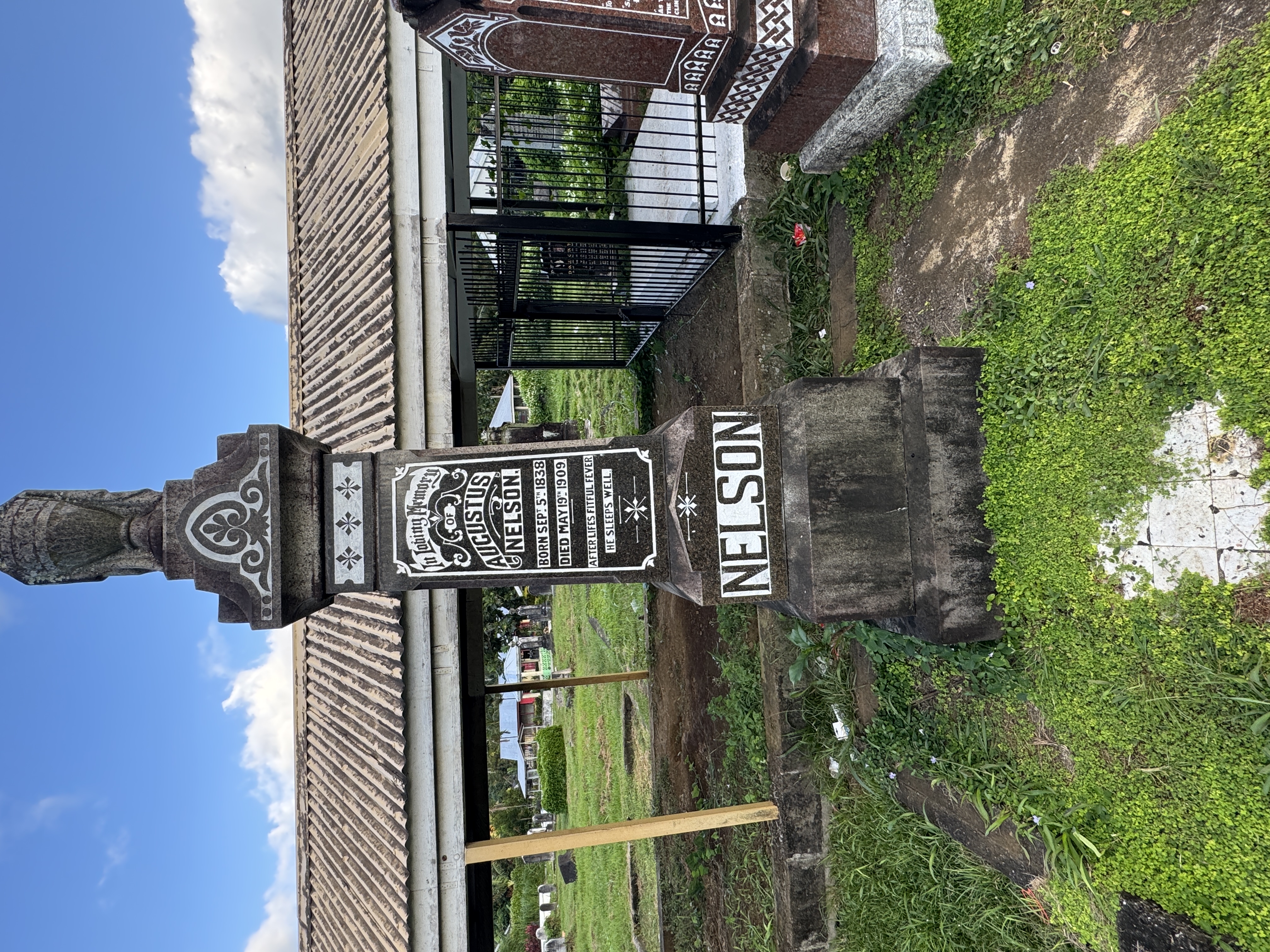
It also holds at least one ancestor of a major trouble maker. Augustus Nelson was a Swede who got rich on Savai'i. His first son, Olaf, became a leader in Samoa's fight for independence.
Between 1915 and 1962, New Zealand sent to Samoa seven Administrators and (after 1948) three High Commissioners. The longest-serving of them all was Guy Powles (1949-60), seen here. Everybody looks friendly, but Samoans wanted the New Zealanders gone.
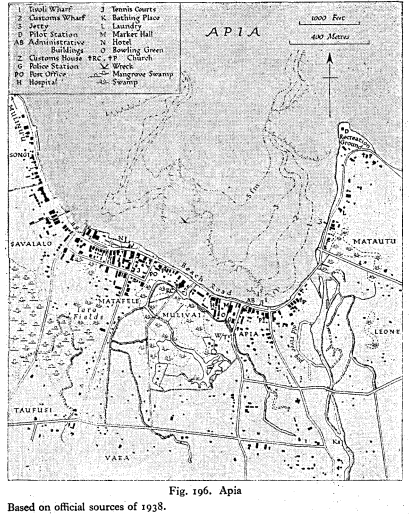
The town in 1936 was still hardly more than Beach Road.
(British Naval Intelligence, Pacific Islands Handbook, vol. 2, BR519b, 1943, p. 657.)
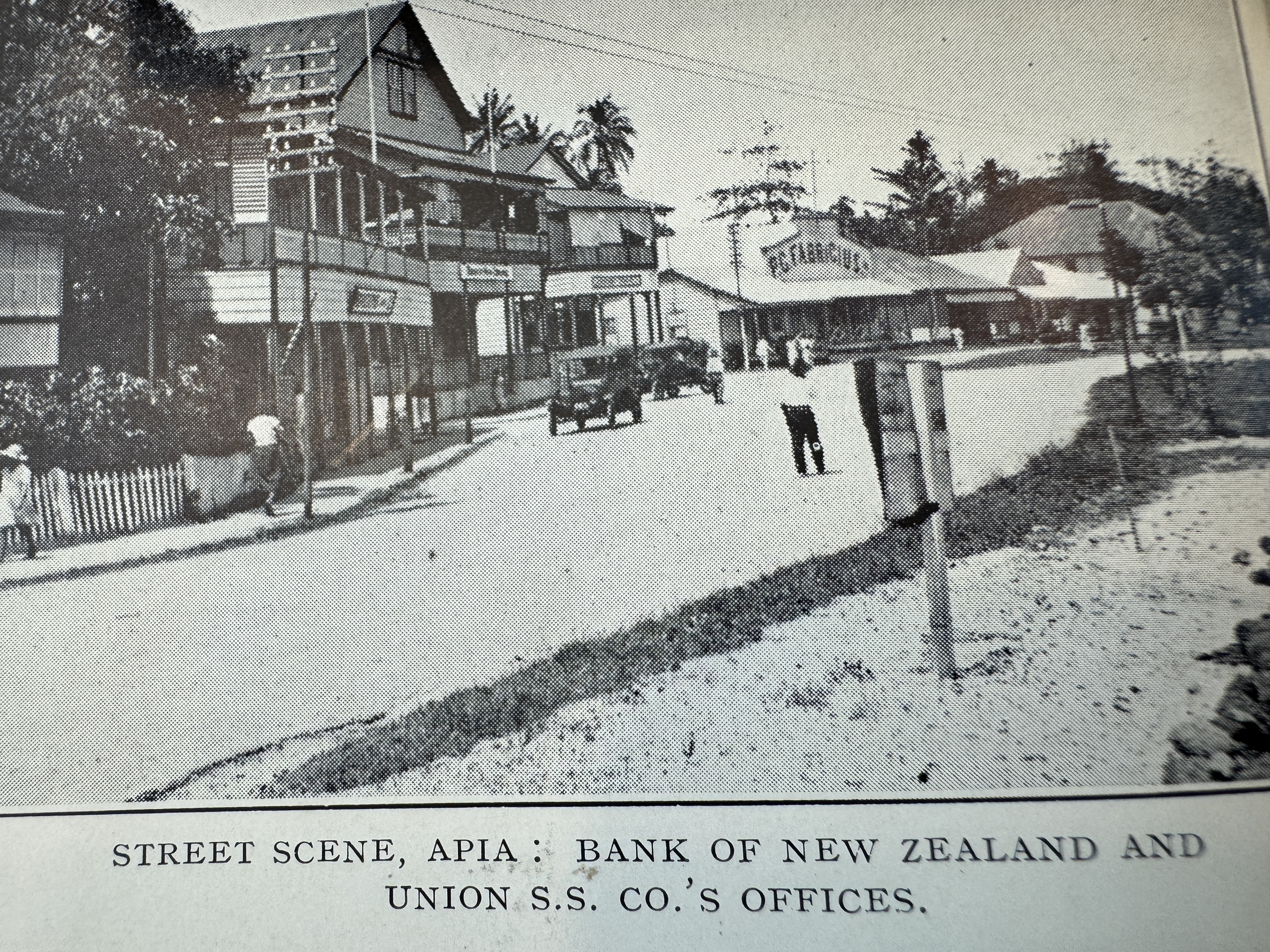
Here it is in the early 1920s. We saw that name Fabricius in the cemetery.
(Handbook of Western Samoa, 1925, p. 32.)
recognize this building? It's the old DHPG dormitory. Margery Perham visited in 1929 and wrote, "Apia made a very poor impression. The dirty, neglected beach, the semicircle of shabby buildings, above all the tattered, half-derelict hotel... once a fine block of offices for the main German planters' firm, had mostly been turned into flats for government officials" (Pacific Prelude, p. 93).
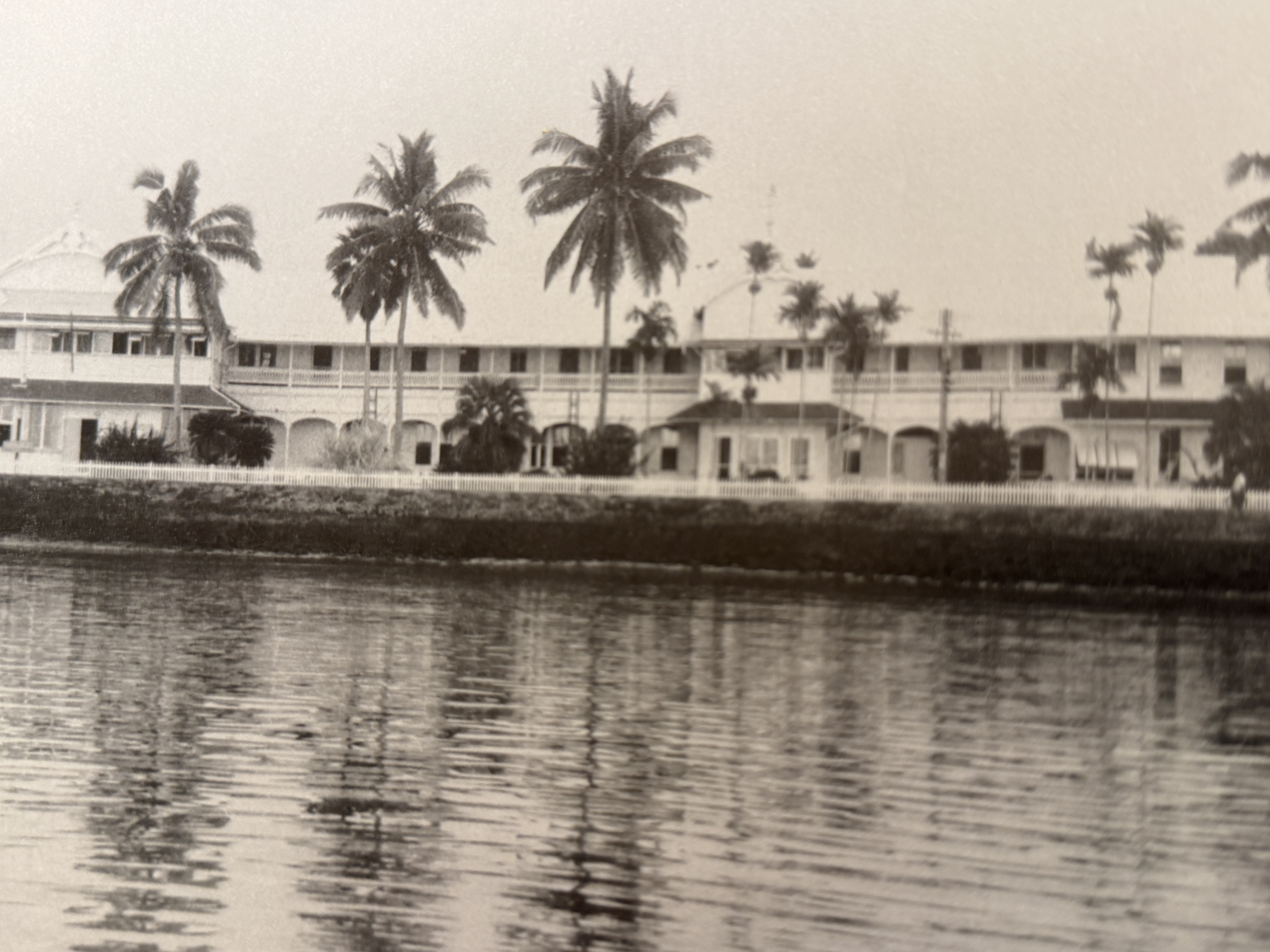
By the 1940s, the building had become the Casino Hotel and been given a coat of paint. Still, it was torn down in 1972. The site is now the Tusitala hotel.
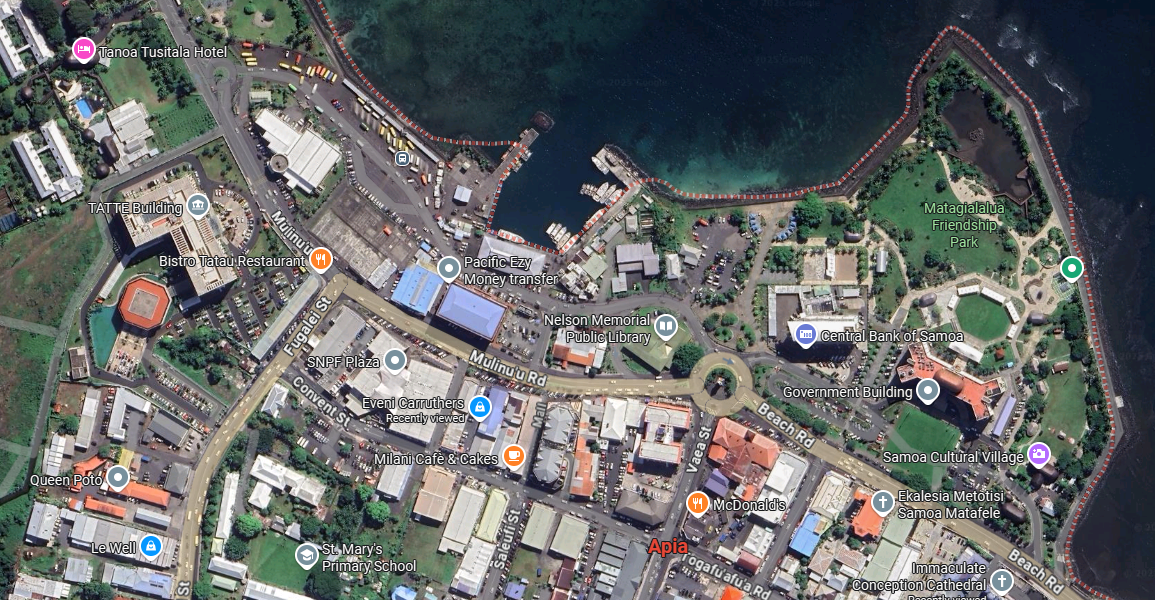
That hotel appears here at the upper left corner. The green triangle projecting into the sea is reclaimed land, separating Beach Road from the beach. At the center of the traffic circle there's a landmark clocktower.
Here's the clocktower again, before reclamation separated it from the beach.
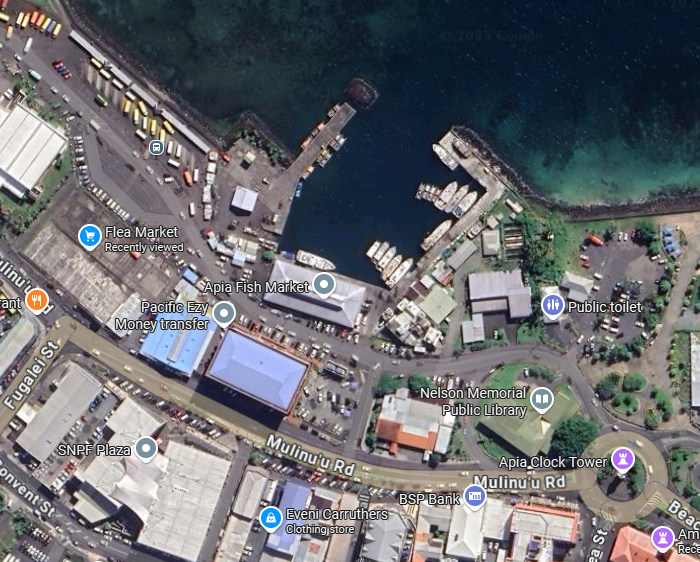
We'll walk out to the end of that wharf.
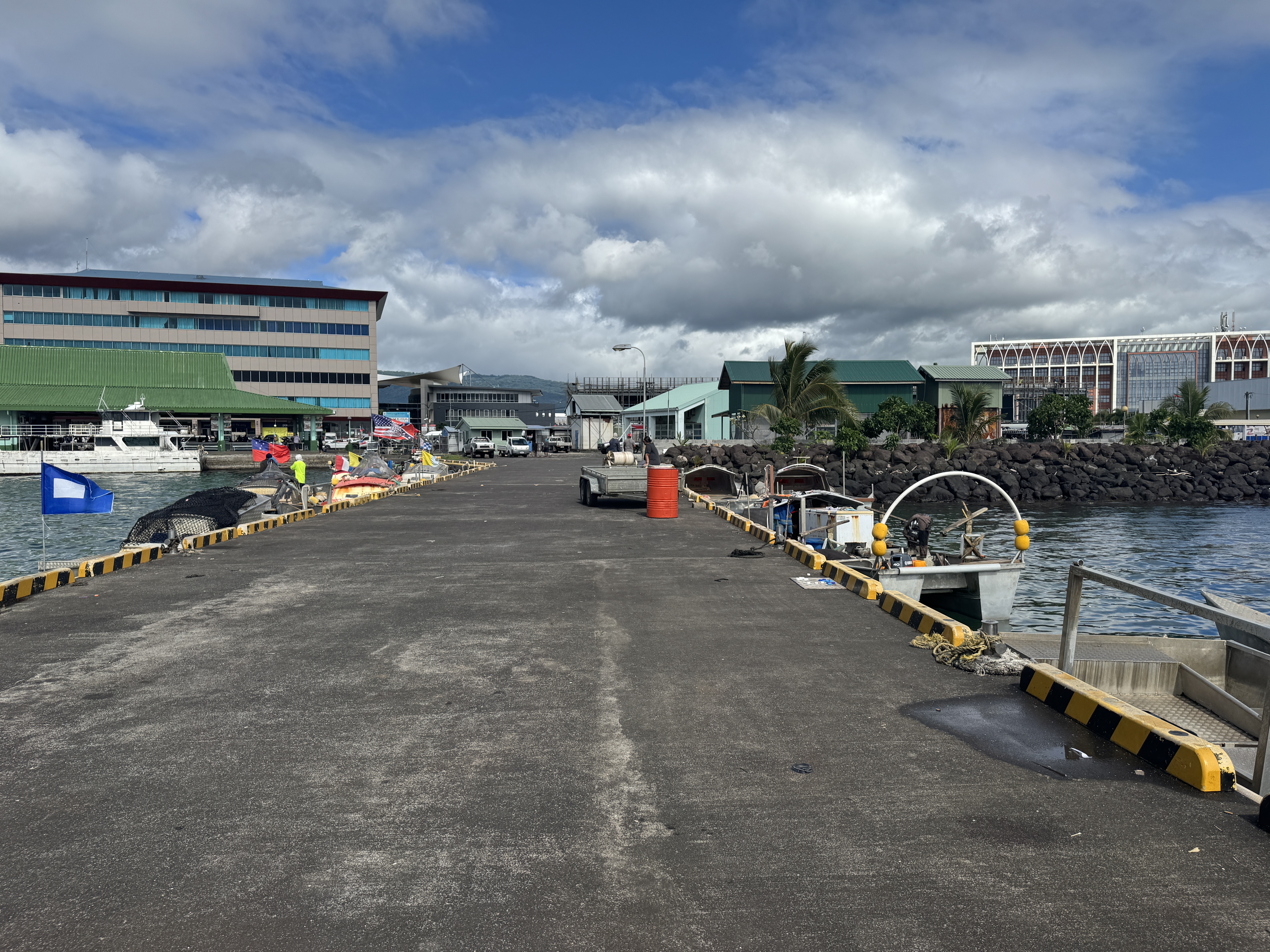
Looking back toward the city. The large buildings are the Customs Department and, on the right, the Attorney General's office. Apia has moved on from the colonial era.
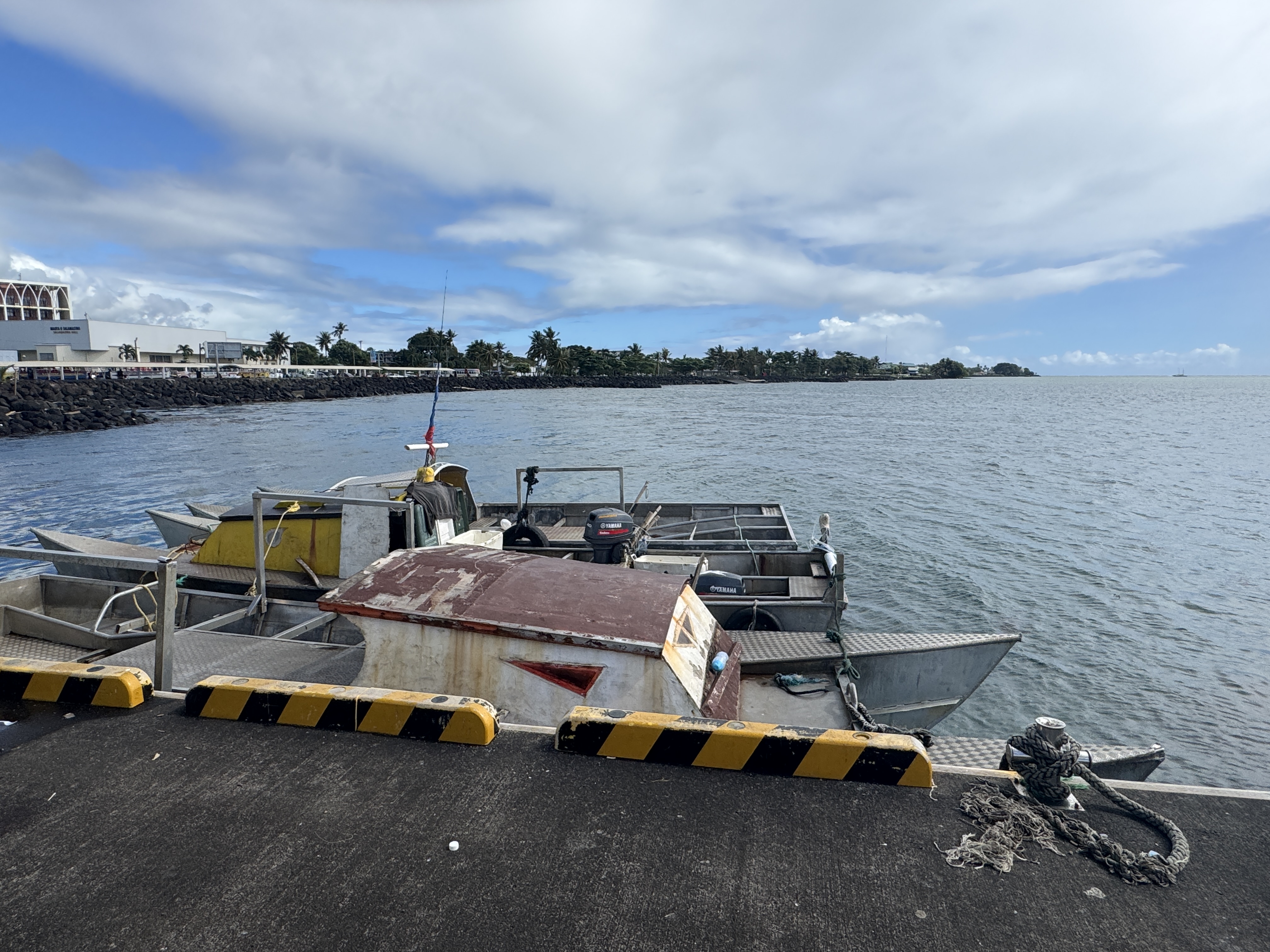
The Mulinu'u Peninsula, with the monuments and tombs shown earlier, is in the distance. See the faint line of buses on the waterfront?
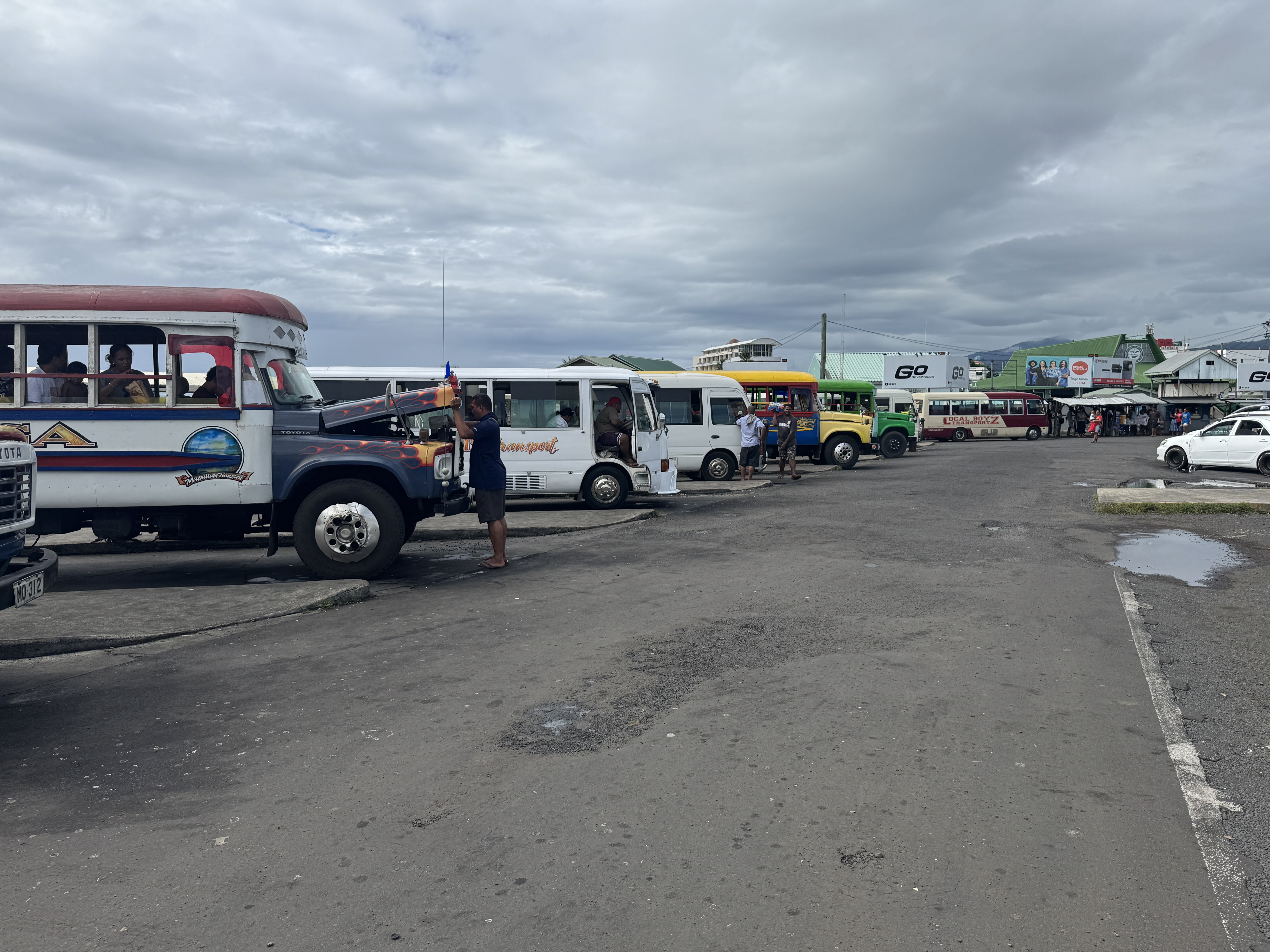
Waiting for business.
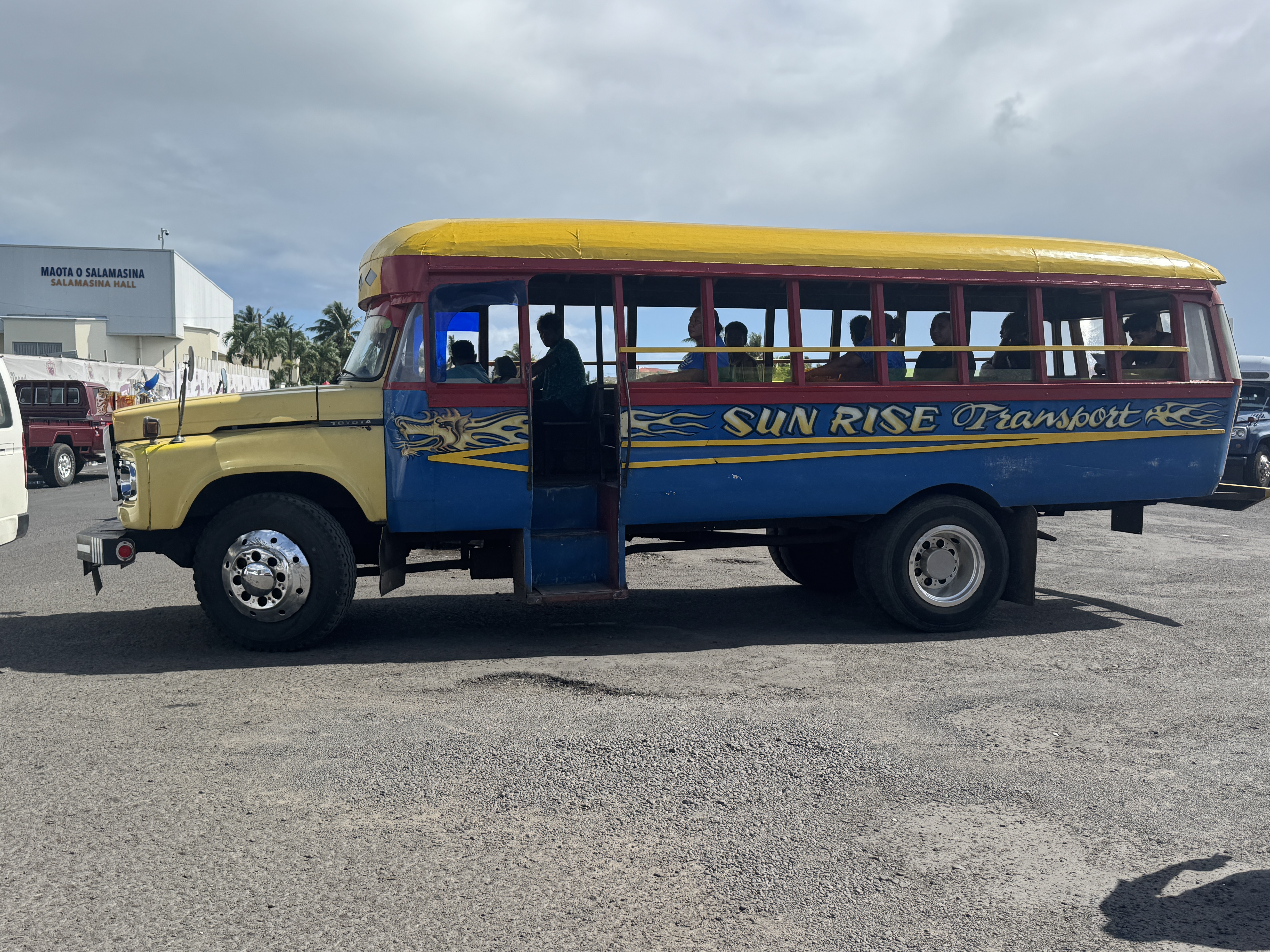
The chassis is Japanese.
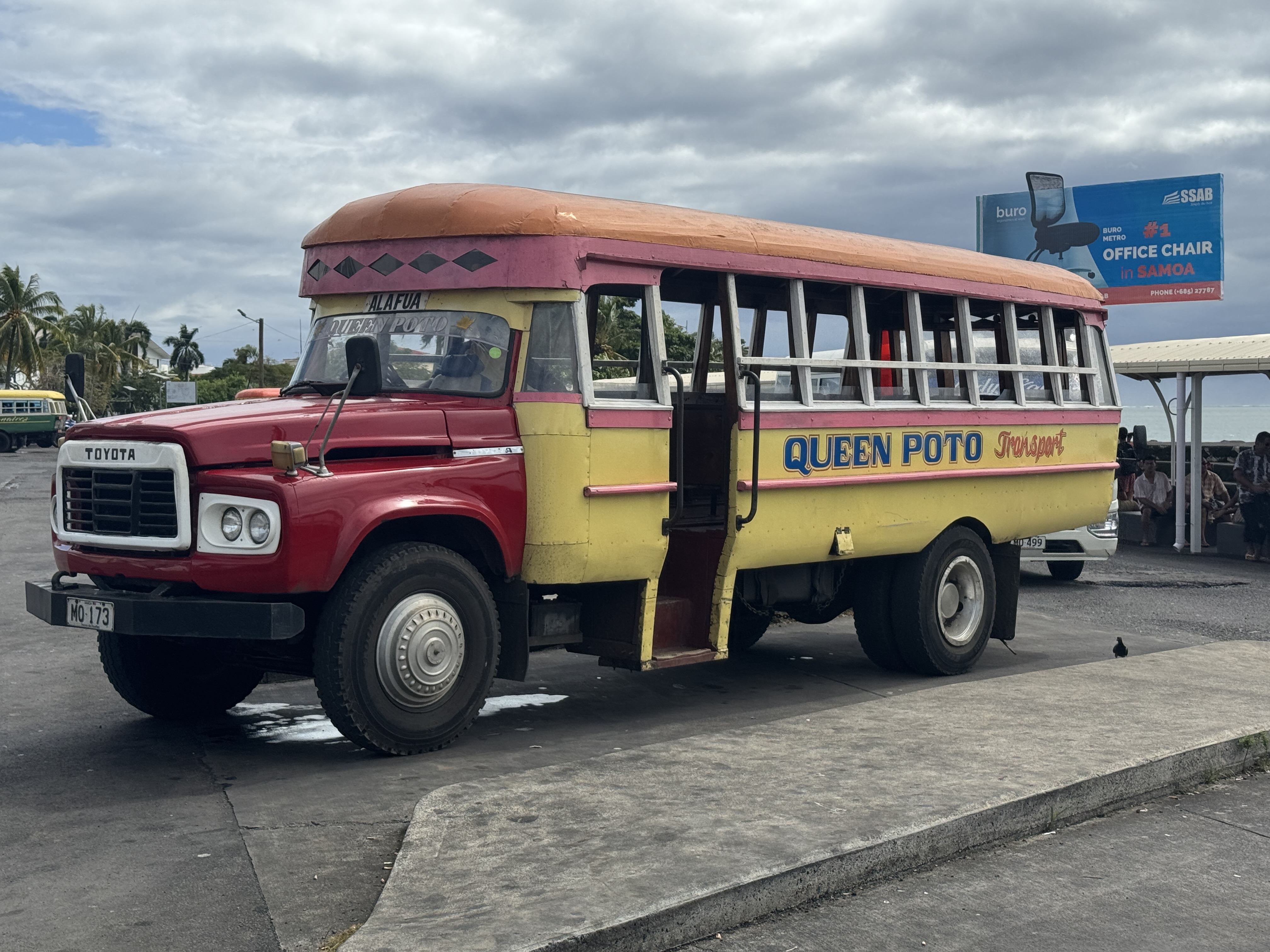
In American Samoa, the chassis would be a Ford.
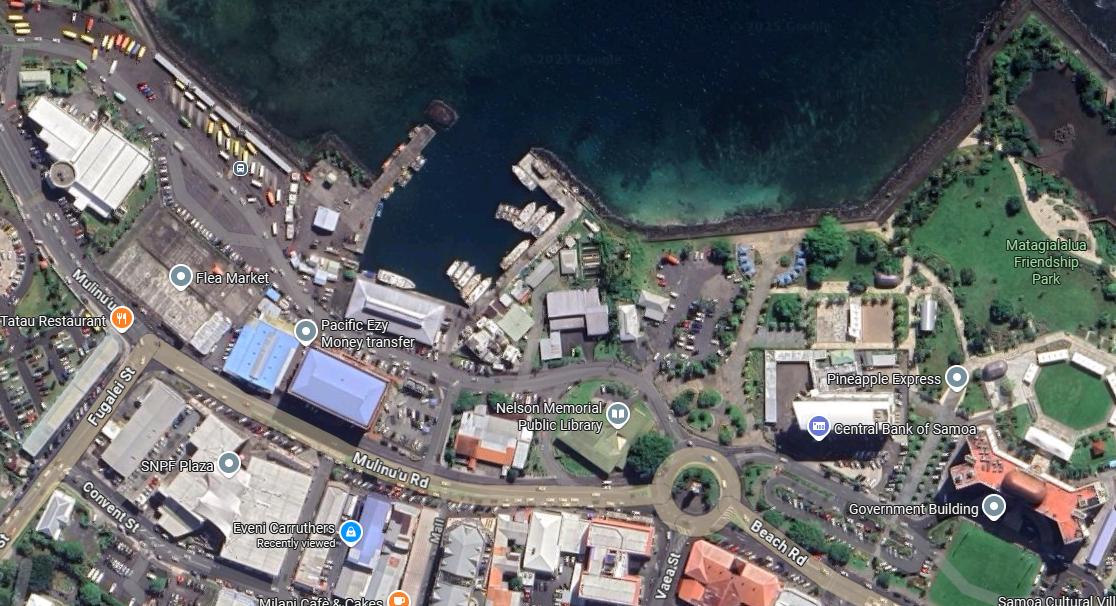
We'll head from the wharf to the traffic circle.
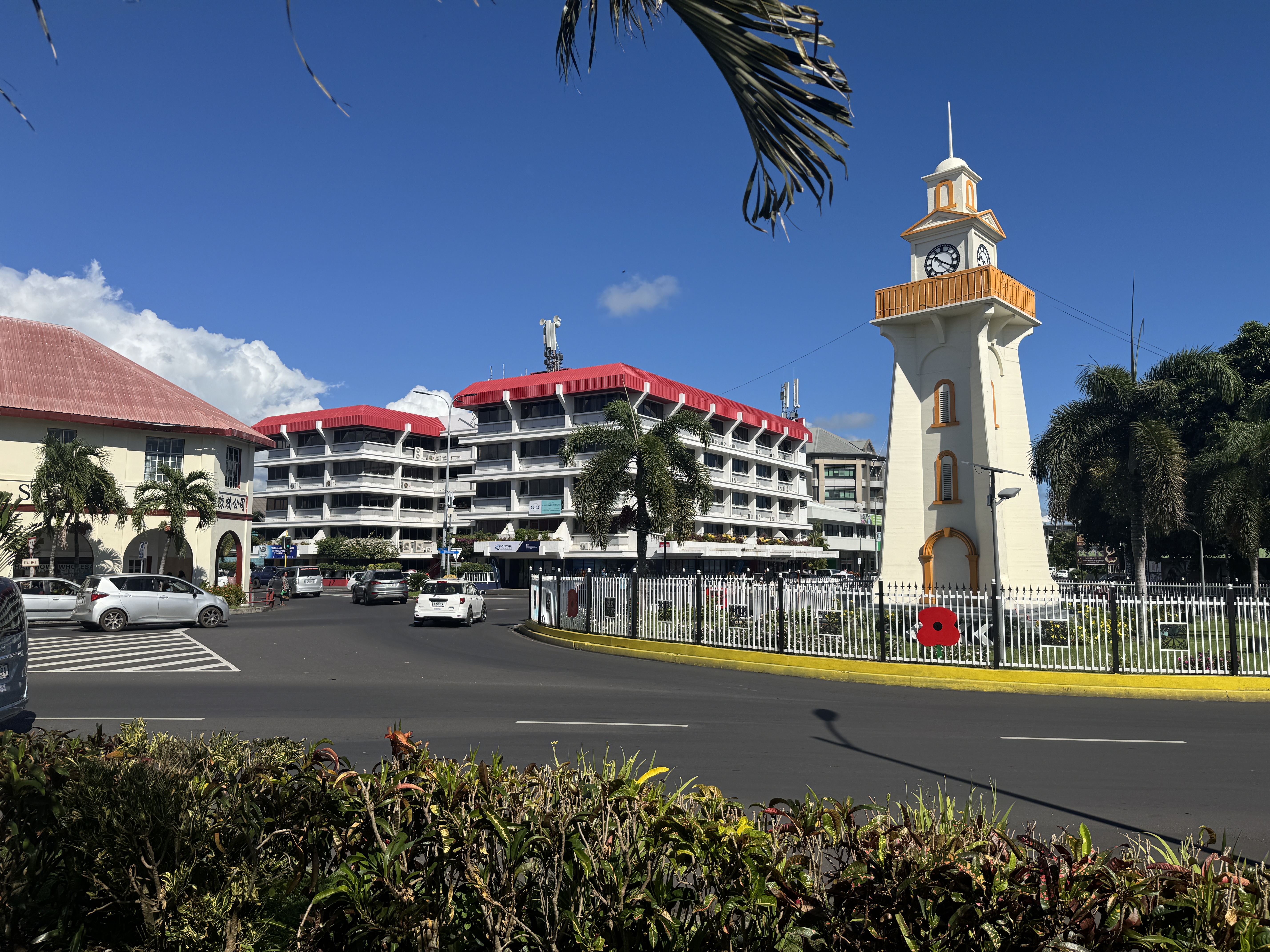
It was a donation from Olaf Nelson (1883-1944), whose father's grave we saw in the cemetery. And the townscape? Poor Henry Adams and John La Farge would be disgusted.
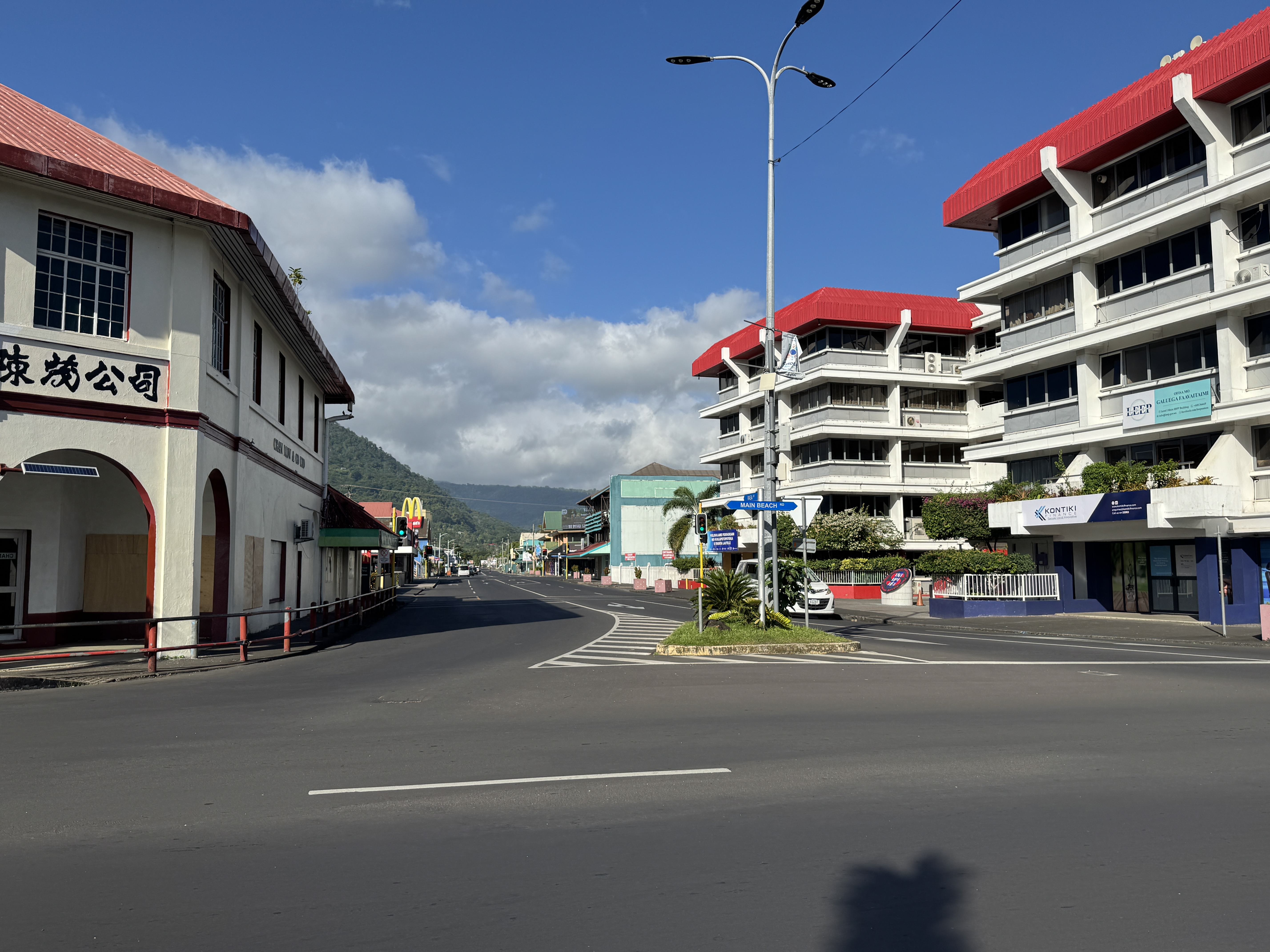
The bright red building is the National Provident Fund, which handles retirement accounts for about 30,000 people. See the Golden Arches?
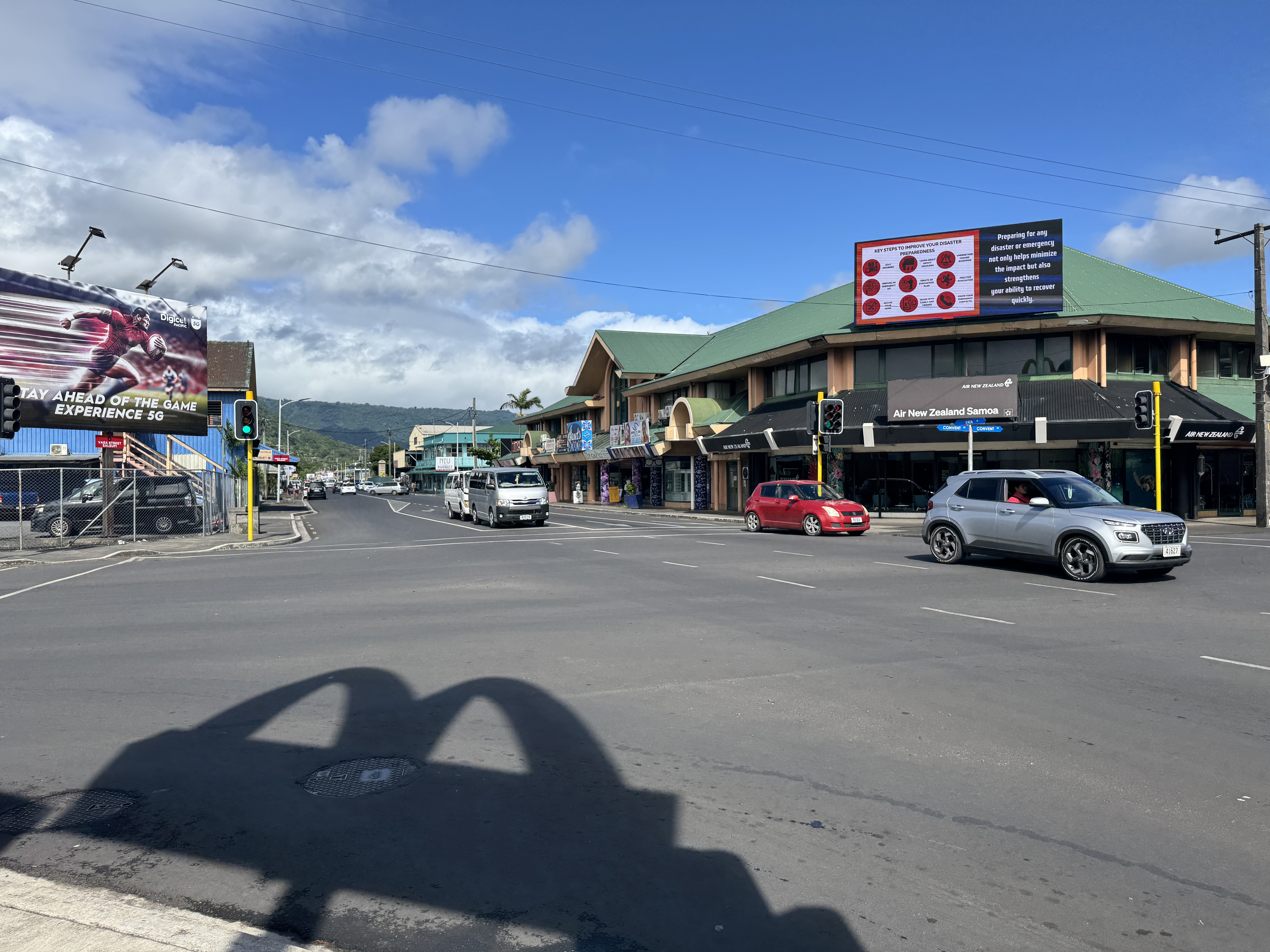
So we're in the sign's shadow and looking down the street that parallels Beach Road. Building height is way down.
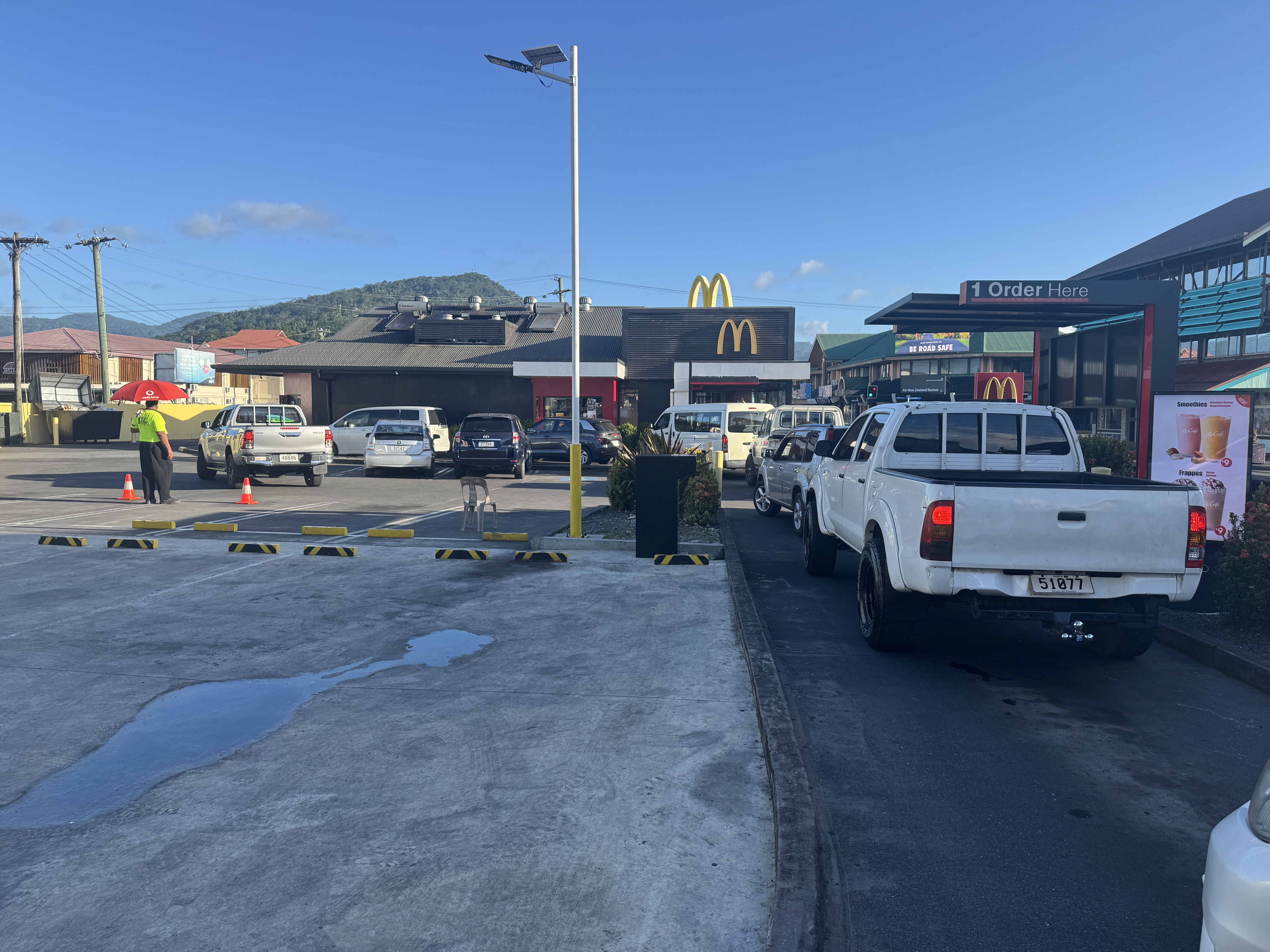
But enthusiasm for the Golden Arches is way high, with a dozen cars at the drive-thru.
John Dyson, visiting about 1980, wrote, "A subsistence living from the land and sea will not fulfil the aspirations of Samoa's middle class for Western-style bungalows, cars, kitchen and electronic gadgets. The taste for Western goods... started less than a decade ago when... foreign aid funded various development project brought money....The prime minister told me how deeply troubled he was about the desire for Western goods." (John Dyson, The South Seas Dream, pp. 150-151).
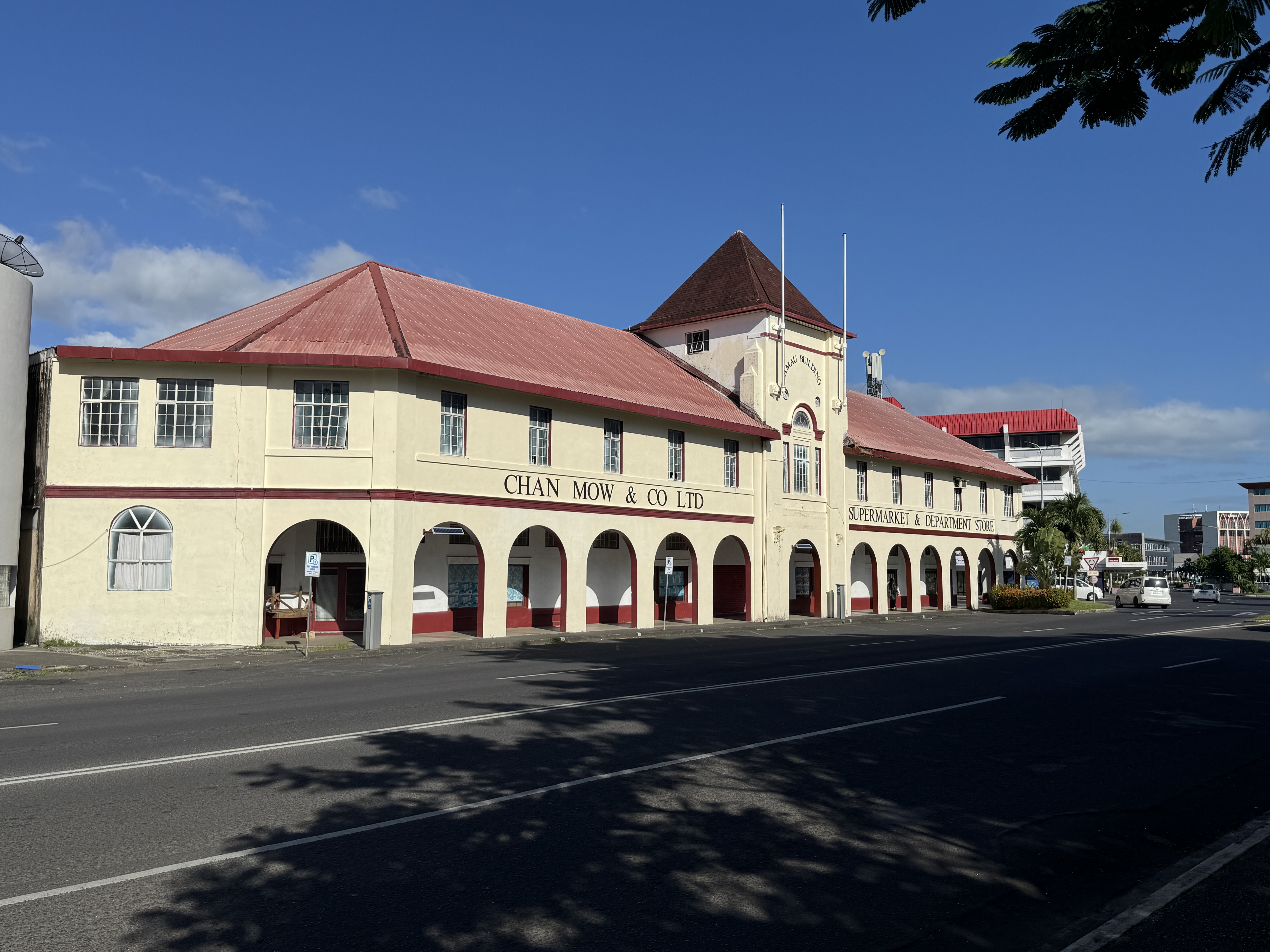
You can't miss National Provident's roof. Next to it is the Amau Building, from 1932. The Chan Mow family, which operates several stores in Samoa, bought it in 1950.

The seller was Burns Philp, an Australian shipping and trading company that had another building on this site as early as 1912.

Here's the original.
https://collections.tepapa.govt.nz/object/1452589?page=1&rtp=1&ros=1&asr=1&assoc=all&mb=c

Quiet as can be.
https://collections.tepapa.govt.nz/object/1452590?page=1&rtp=1&ros=1&asr=1&assoc=all&mb=c
The building next to it is the now-demolished post office.
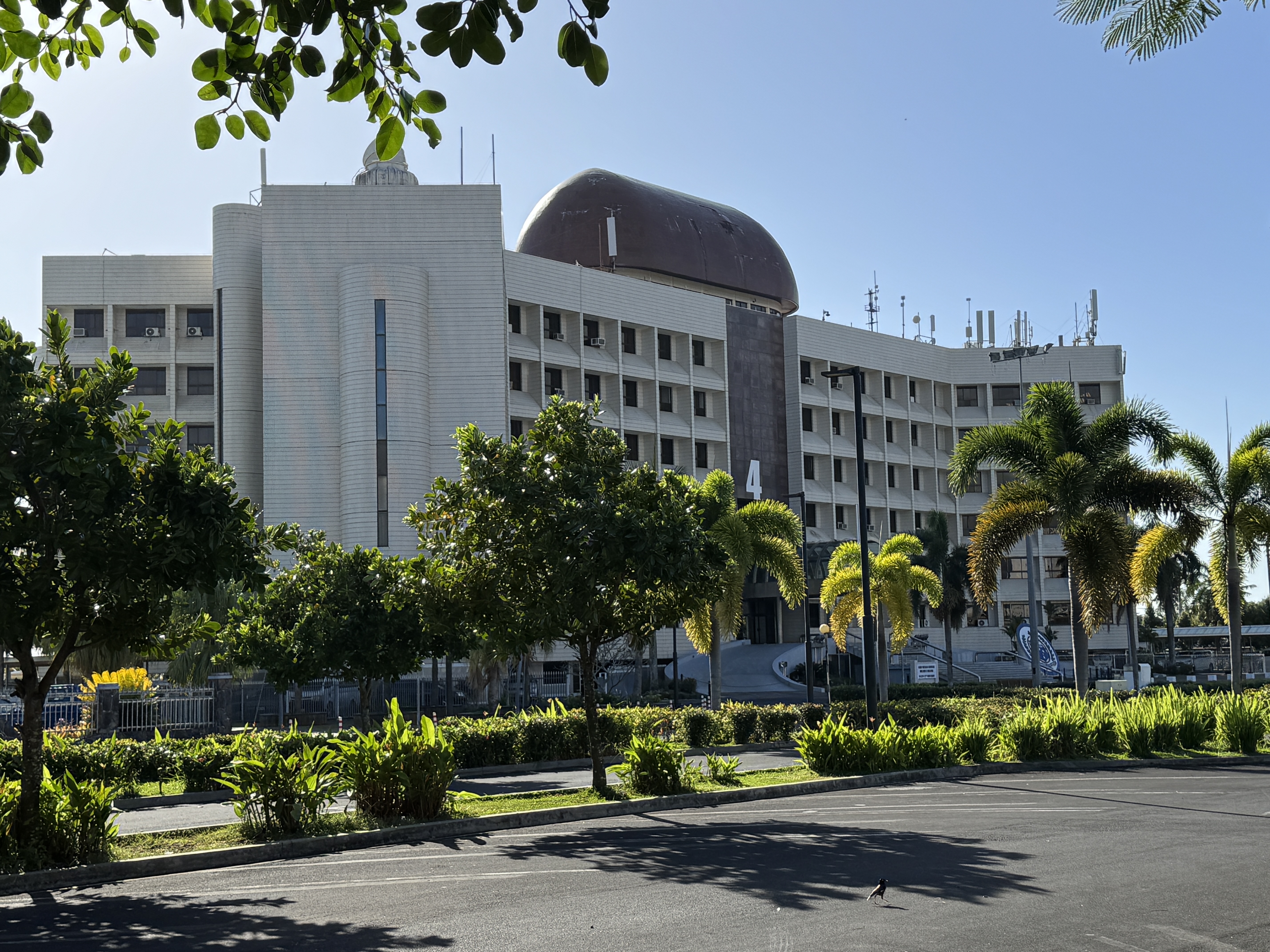
Across Beach Road and on the wedge of reclaimed land is 1994's Samoan Government Building. Gavin Bell, passing through in the previous year, wrote that "Chinese workmen were constructing a seven-storey government building in the post-Mao repressionist style" (Gavin Bell, In Search of Tusitala, p. 279.)
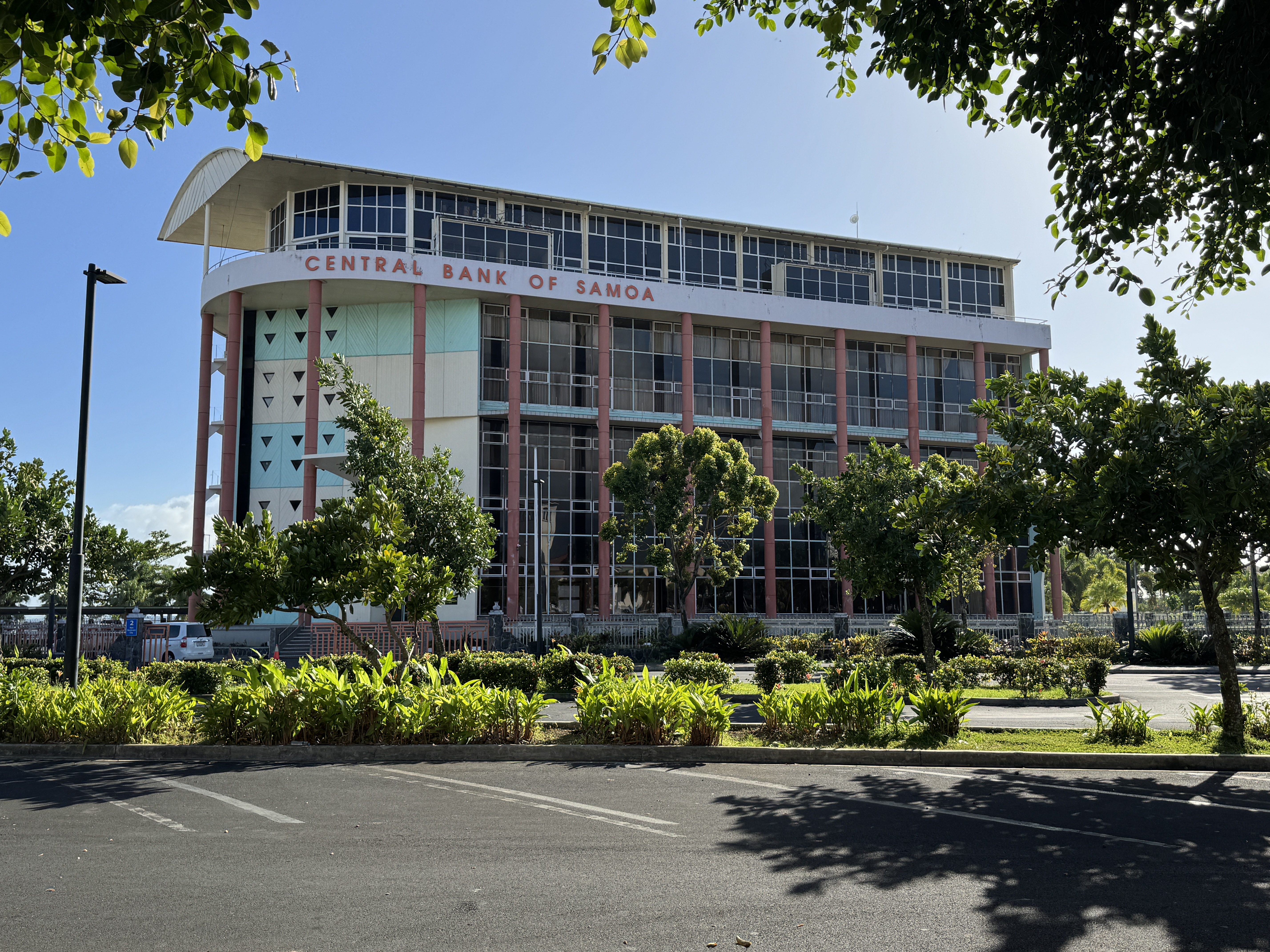
The central bank is next doors. Bell remains unimpressed: "I wondered what planet the architect had come from. They claimed the building was supposed to resemble a fale, or traditional Samoan house; all I saw was a monstrous cage of glass and lime-green concrete" (Bell, p. 279).
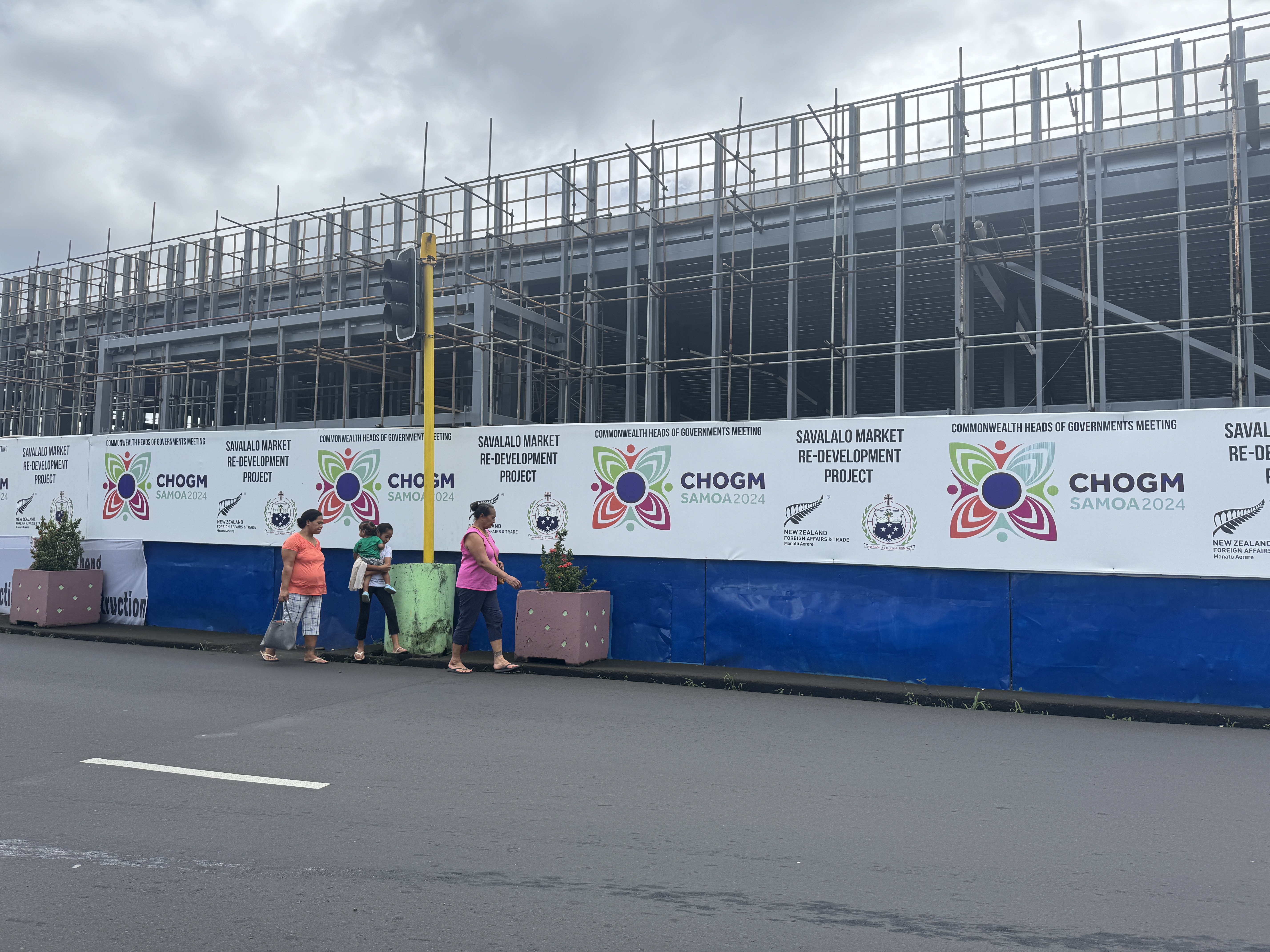
In 2025 a new craft market was being built with funding from New Zealand. The old market building had burned down in 2016.
CHOGM is the grotesque abbreviation of the Commonwealth Heads of Government Meeting, held here in 2024. King Charles and Queen Camilla came.
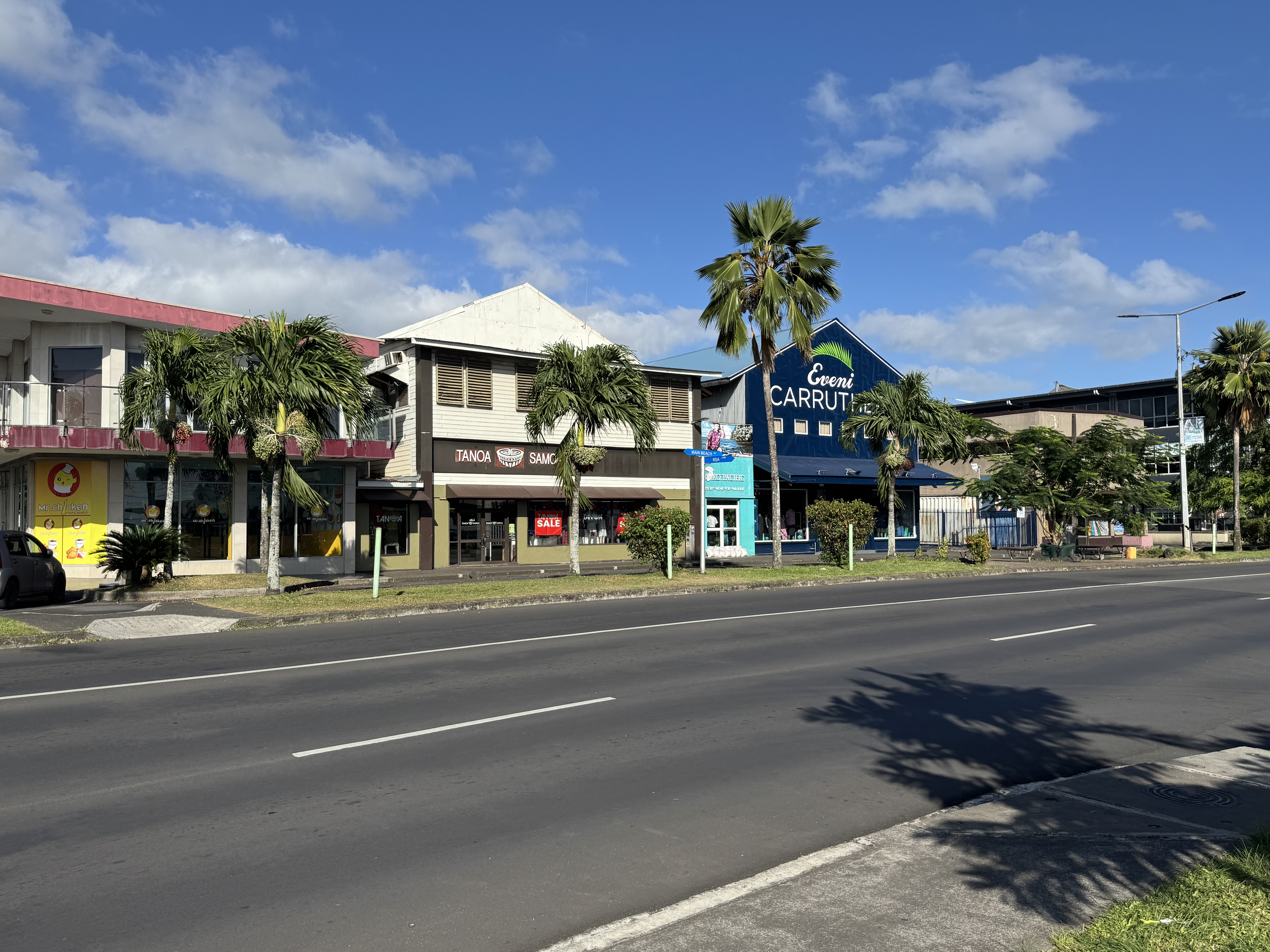
Squint a bit, and you can spot a few survivors from the old days. Irving ("Eveni") Carruthers (1884-1974) was originally a planter.
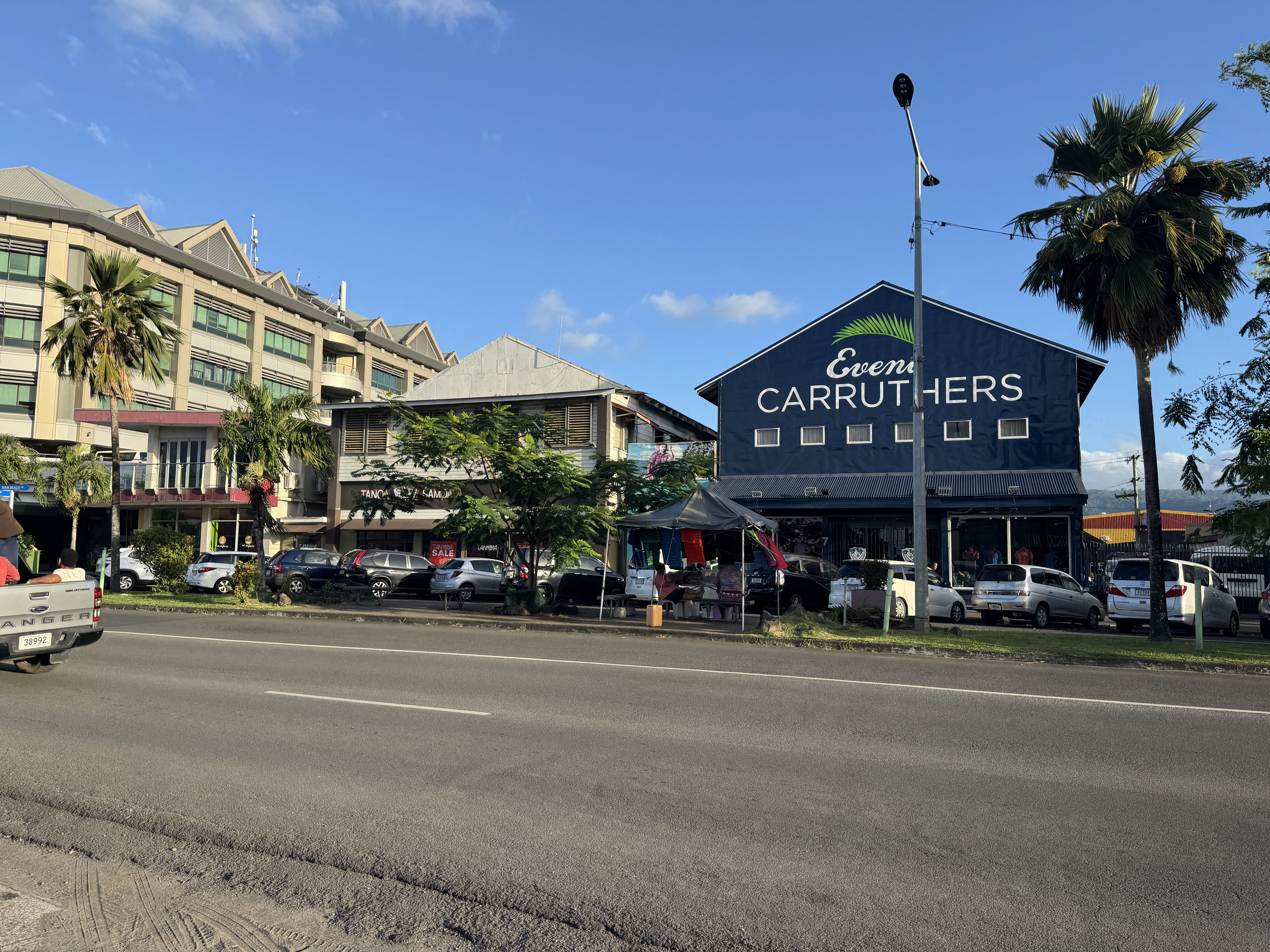
There are several Carruthers stores now, including one at the airport duty-free shop.
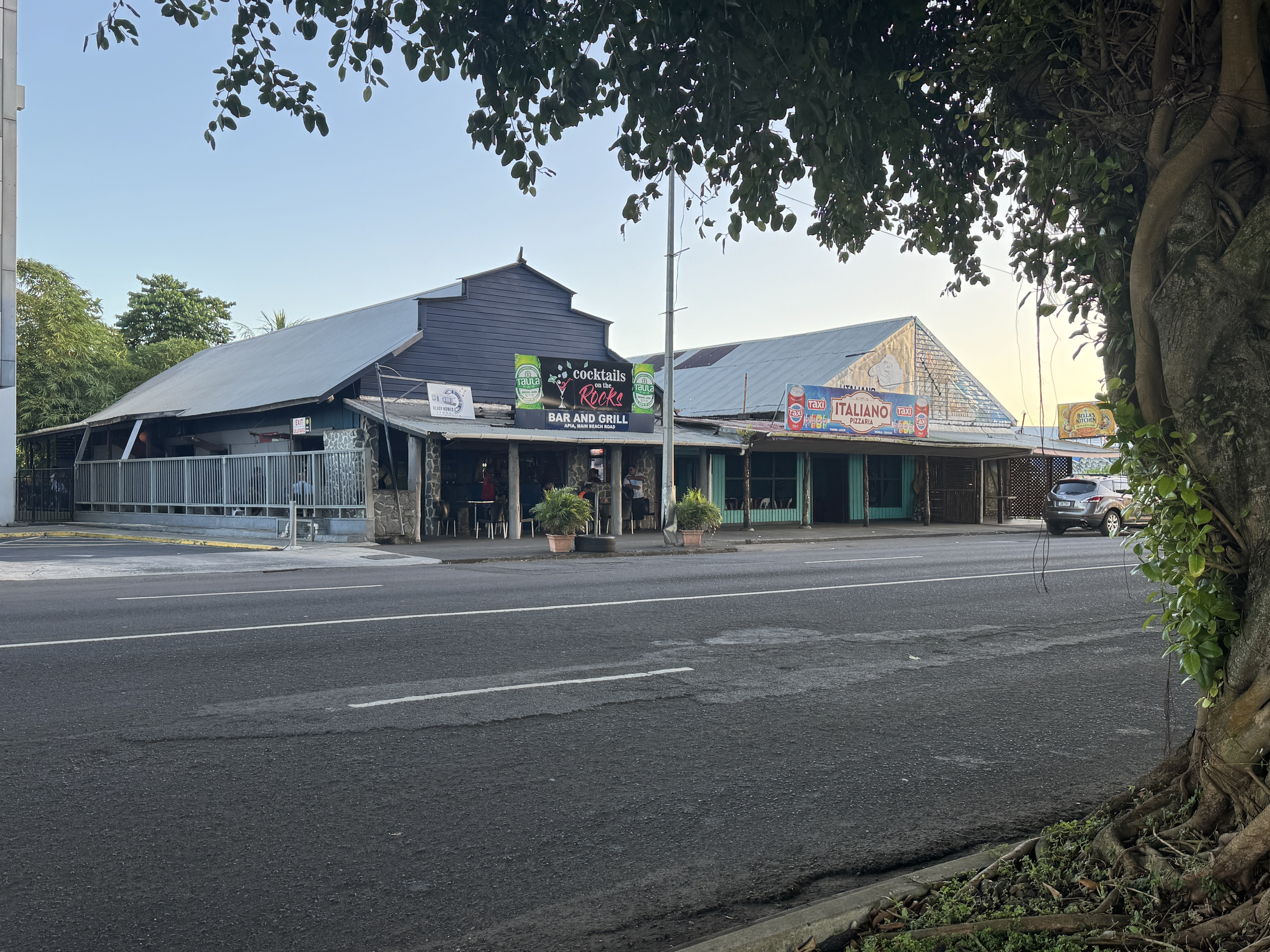
More relics.
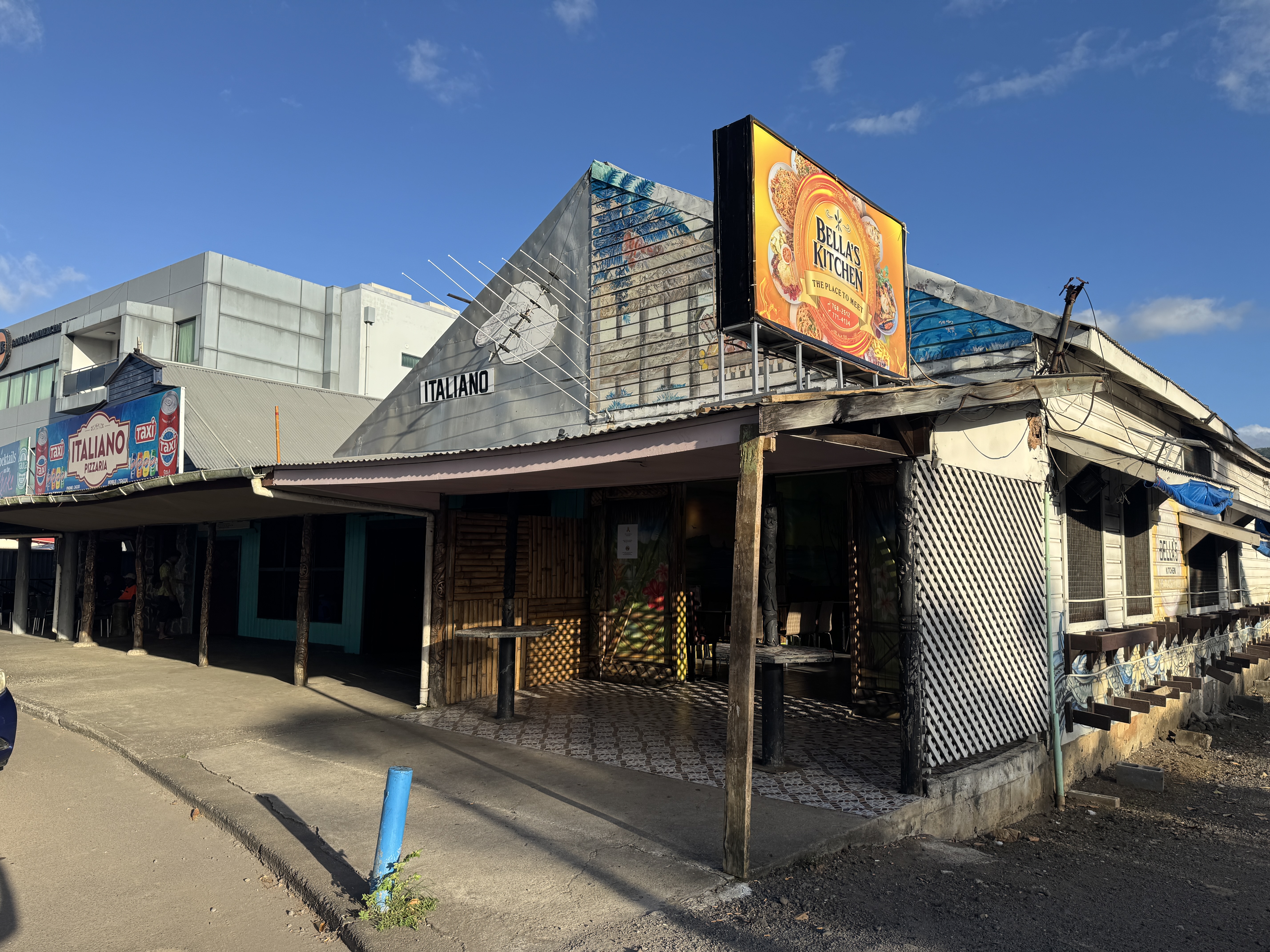
Another. I guess you don't have to squint as much as I thought.
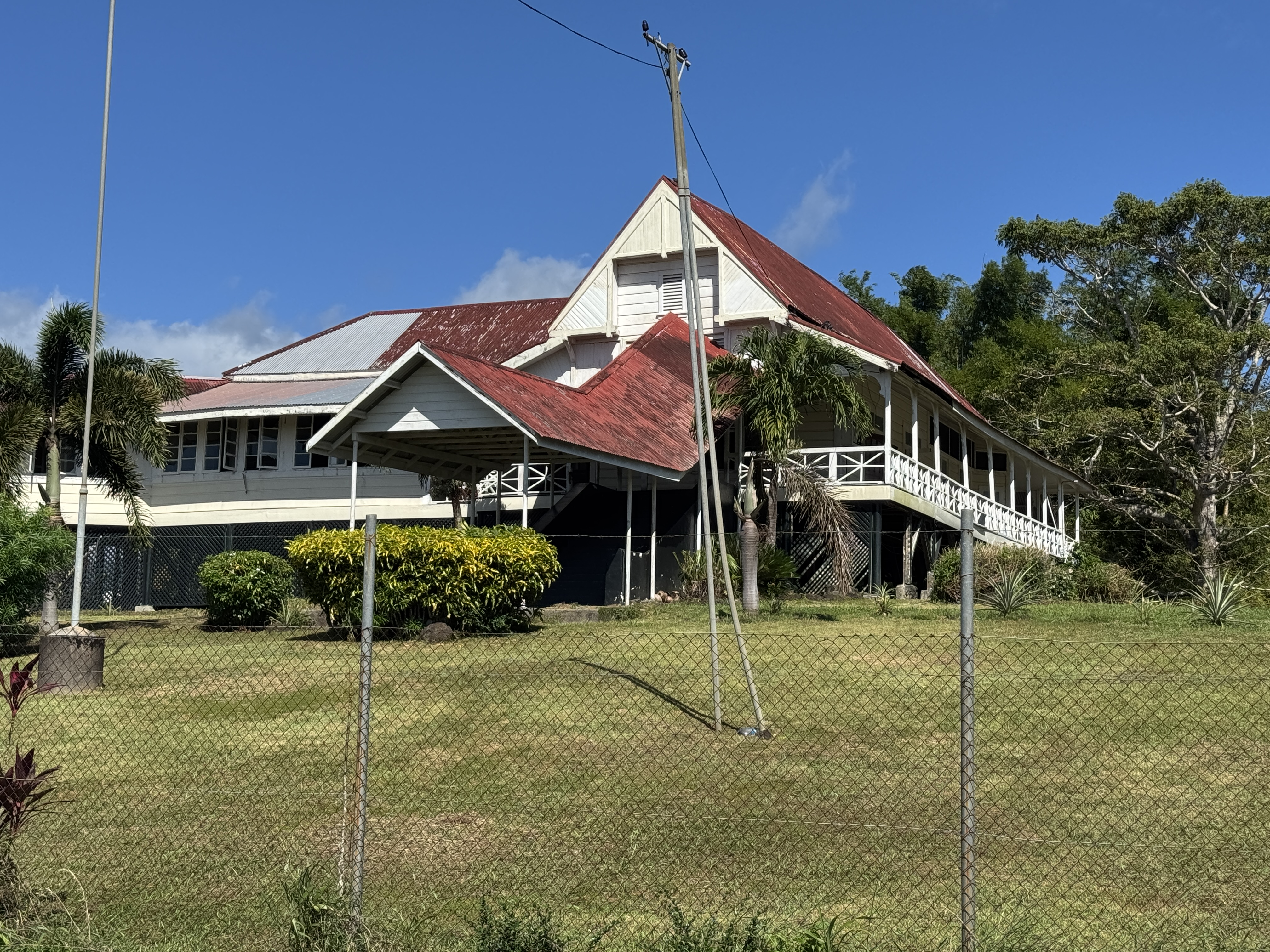
A rare residential survivor. Now vacant, it was built in 1914 for the German colonial government's agricultural expert. He didn't have much time to enjoy it or his position. (Architect: Richard Schoeneich)
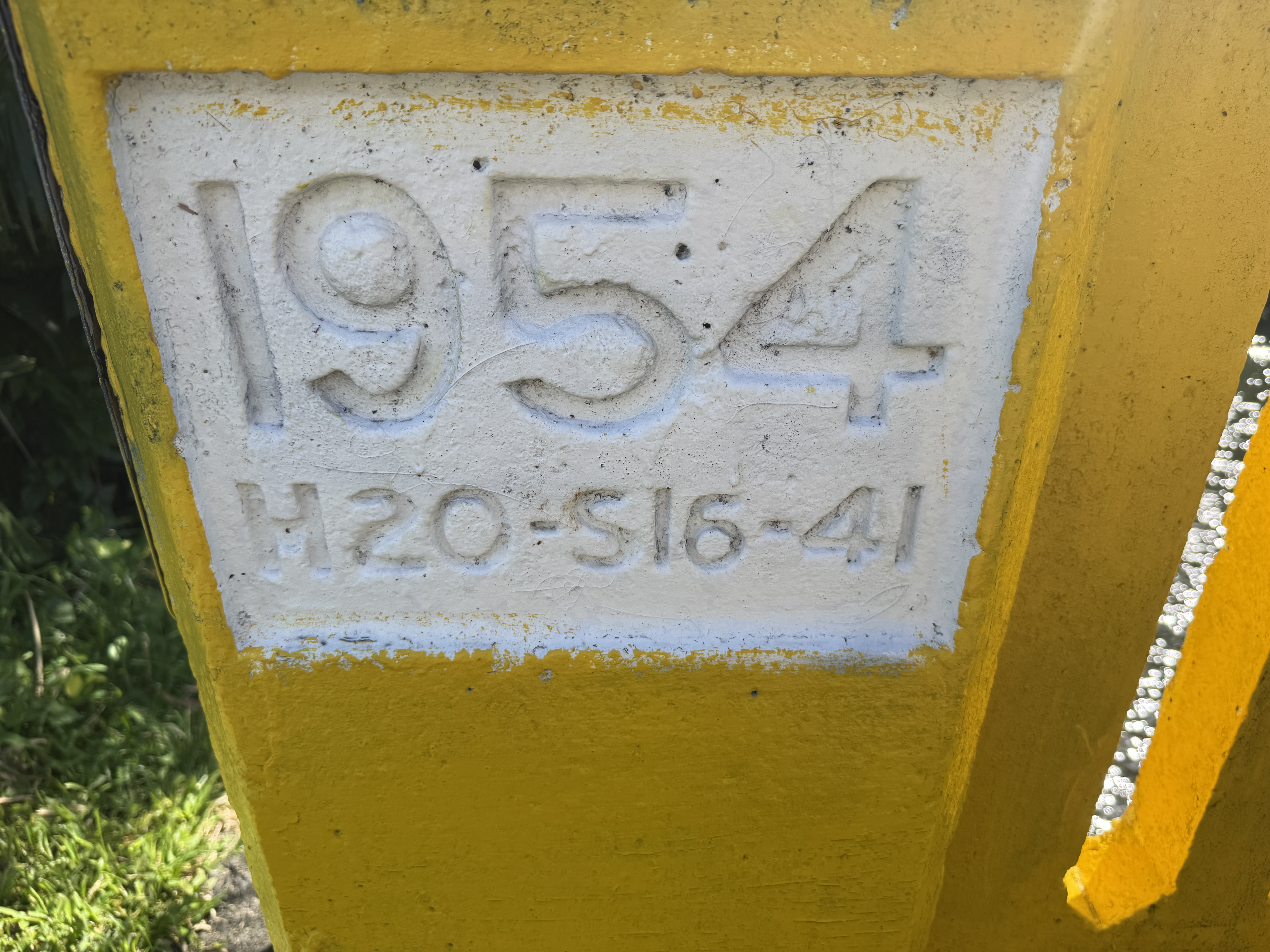
Let's get out of town, which we can do largely because of roads built by New Zealand. Here's a bridge abutment.
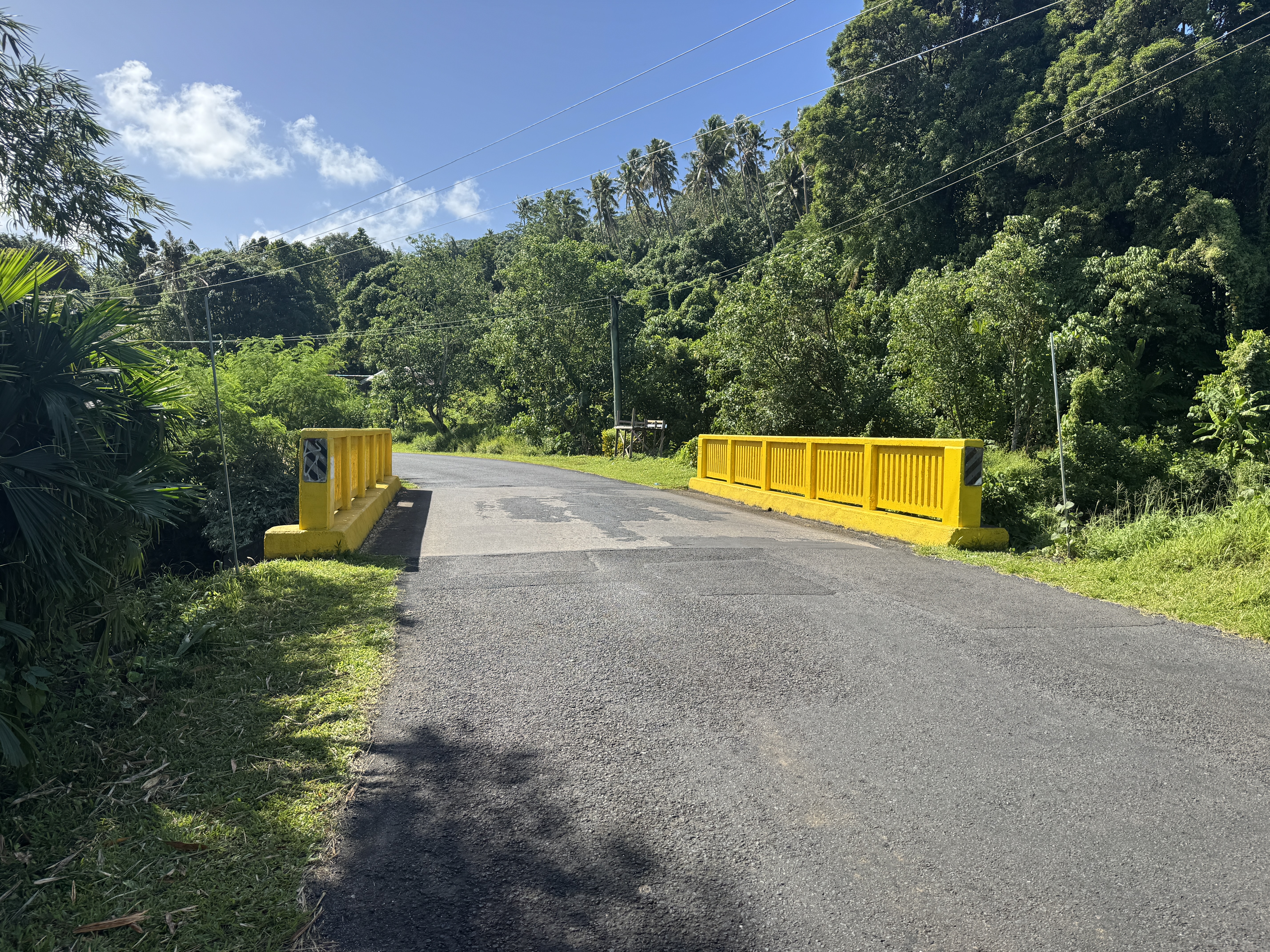
Here's the bridge, easy to take for granted. This is a typical view of Upolu's circumferential road.
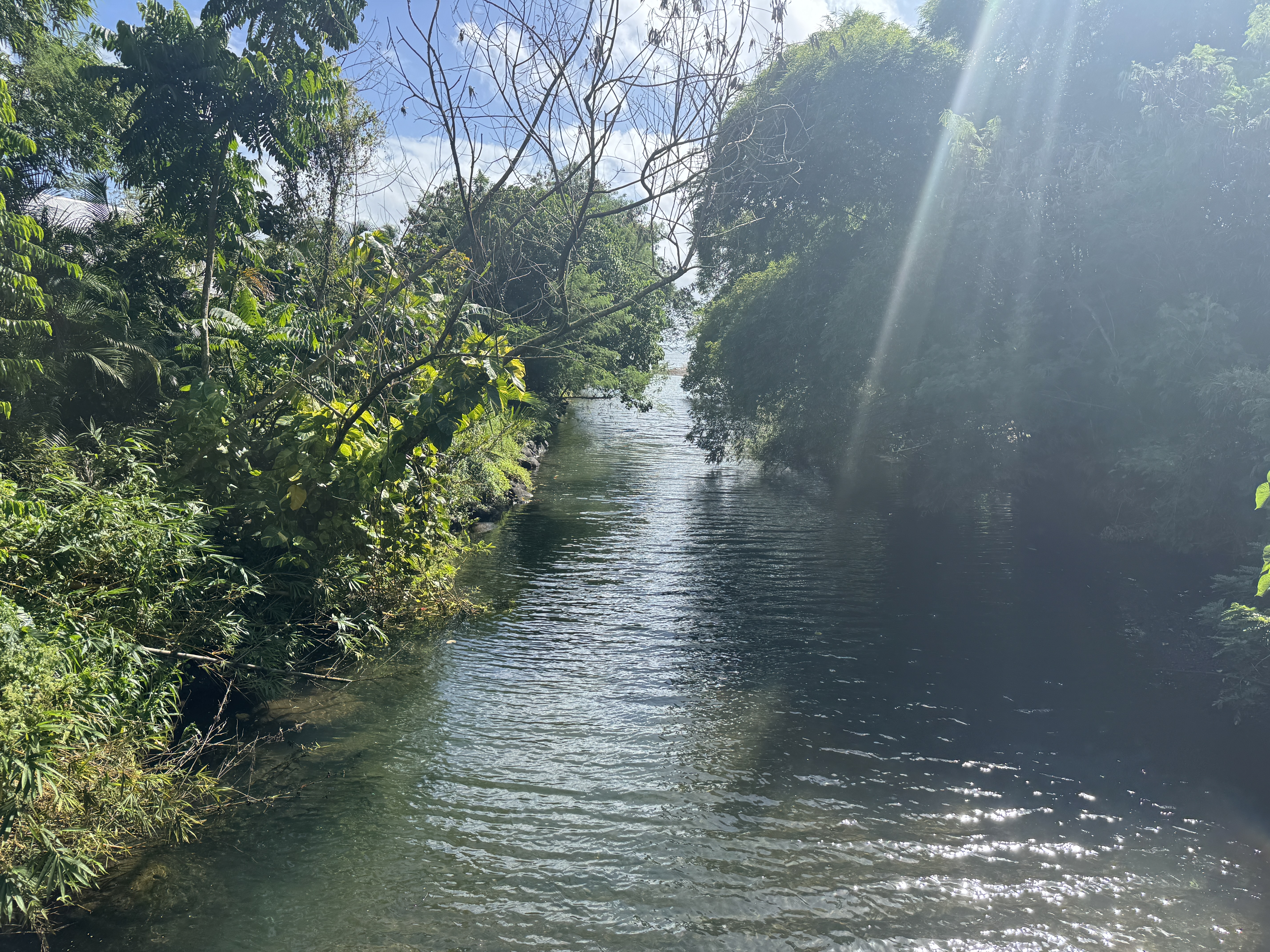
That bridge crossed this creek.
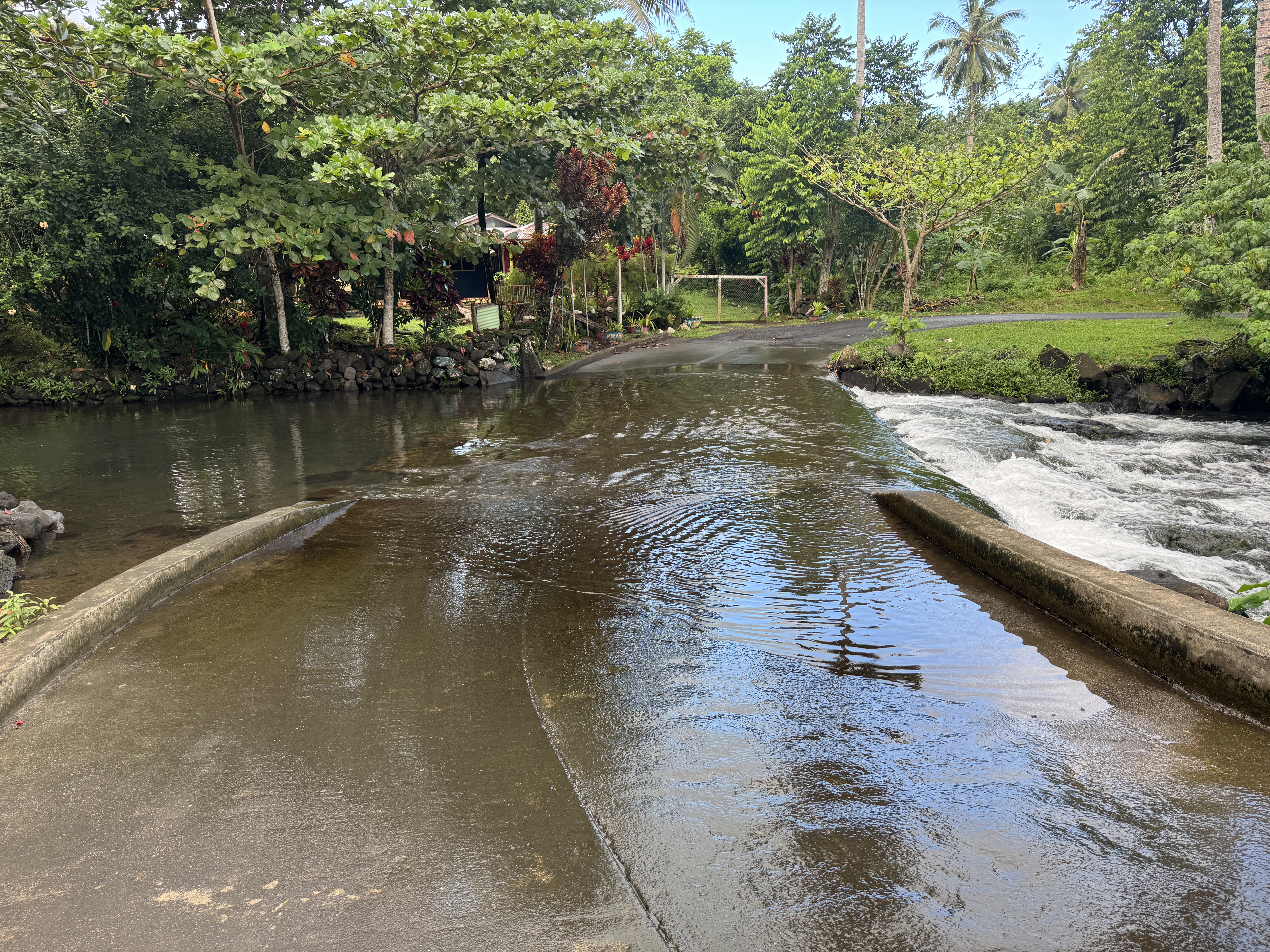
Sometimes there's no bridge, and you have to decide if you can make it across. (The answer in this case was yes.)
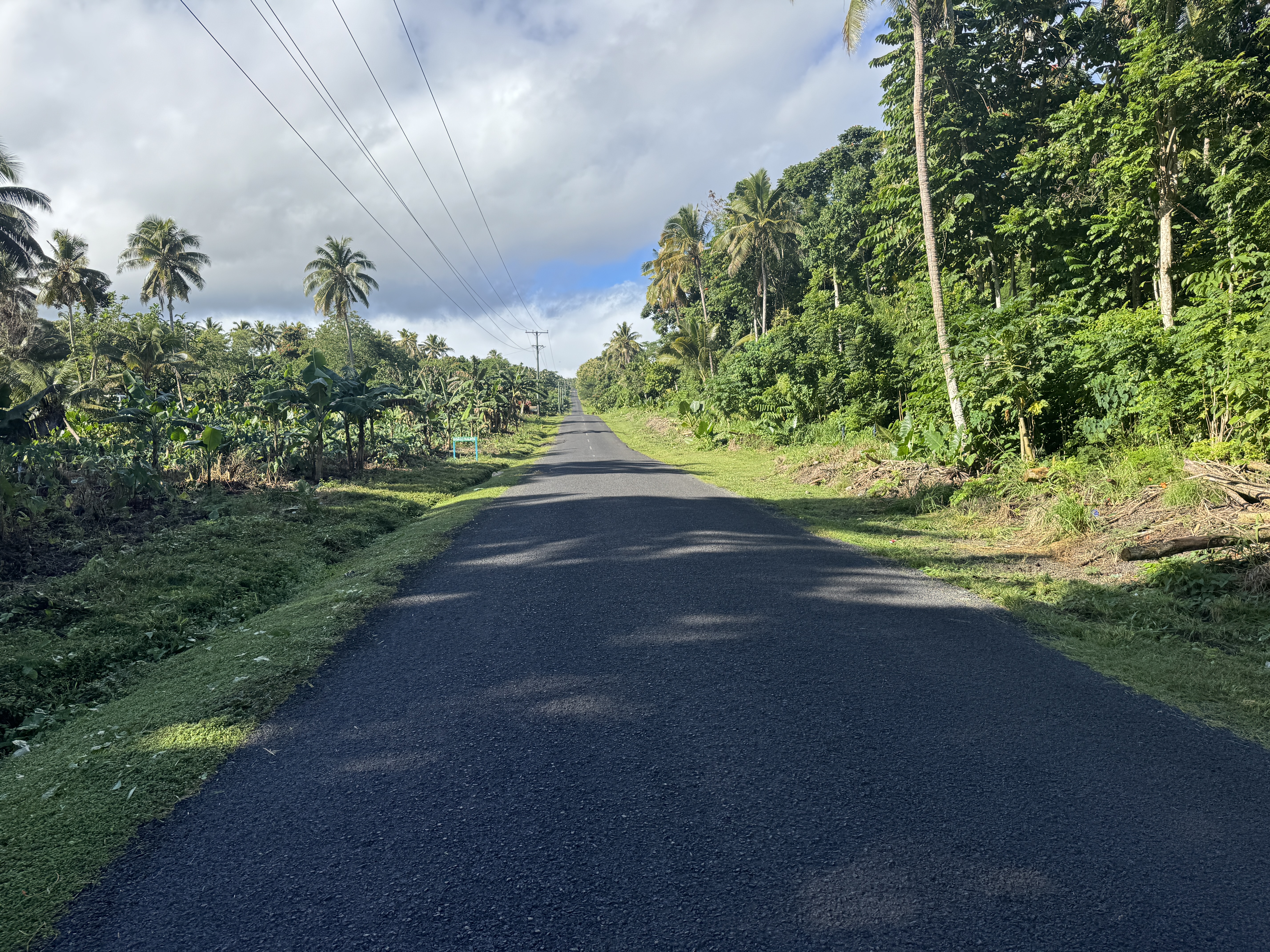
Here's one of the few roads running along the island's spine, this one in the western half of the island.
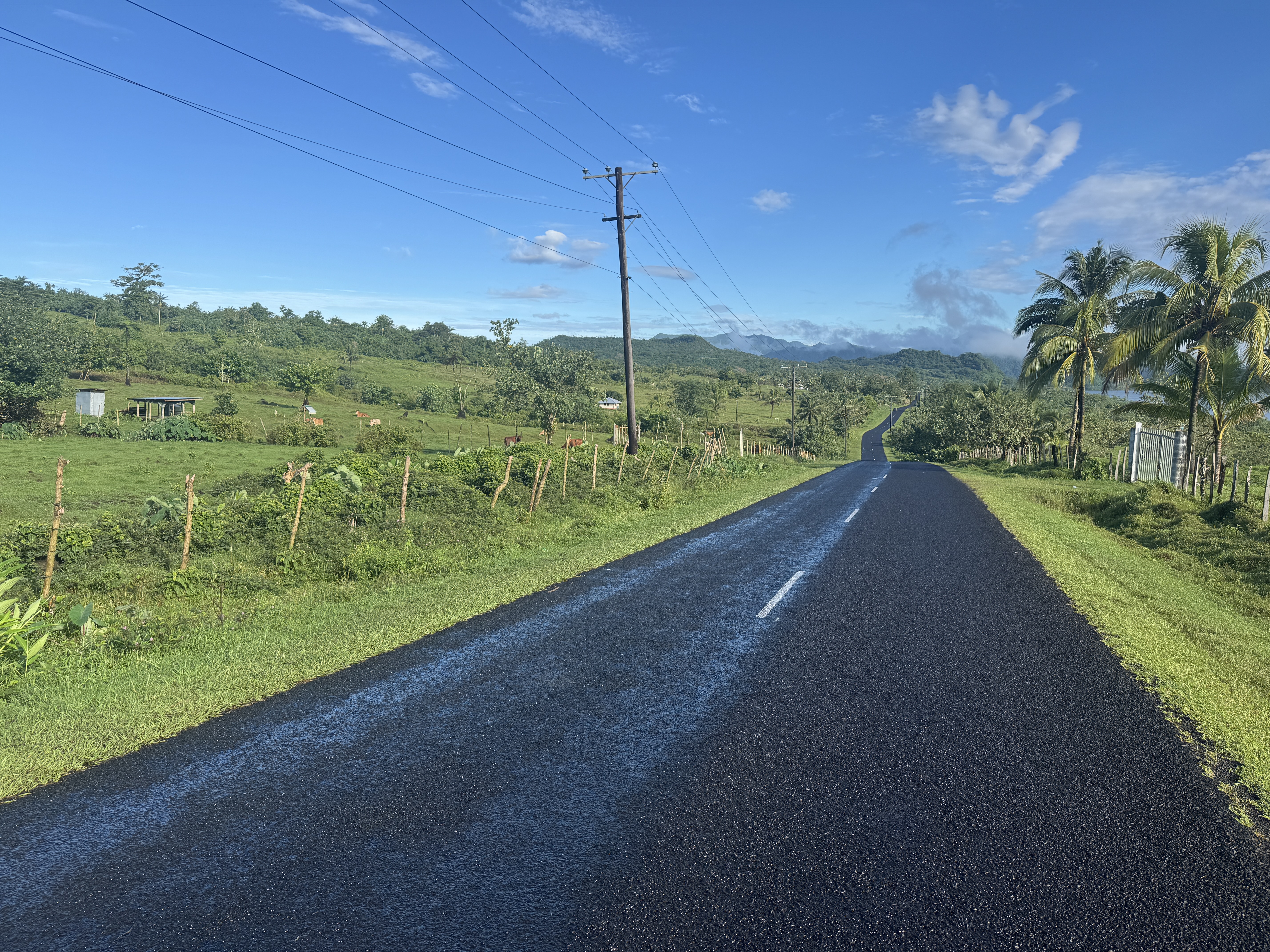
This one is in the eastern half.
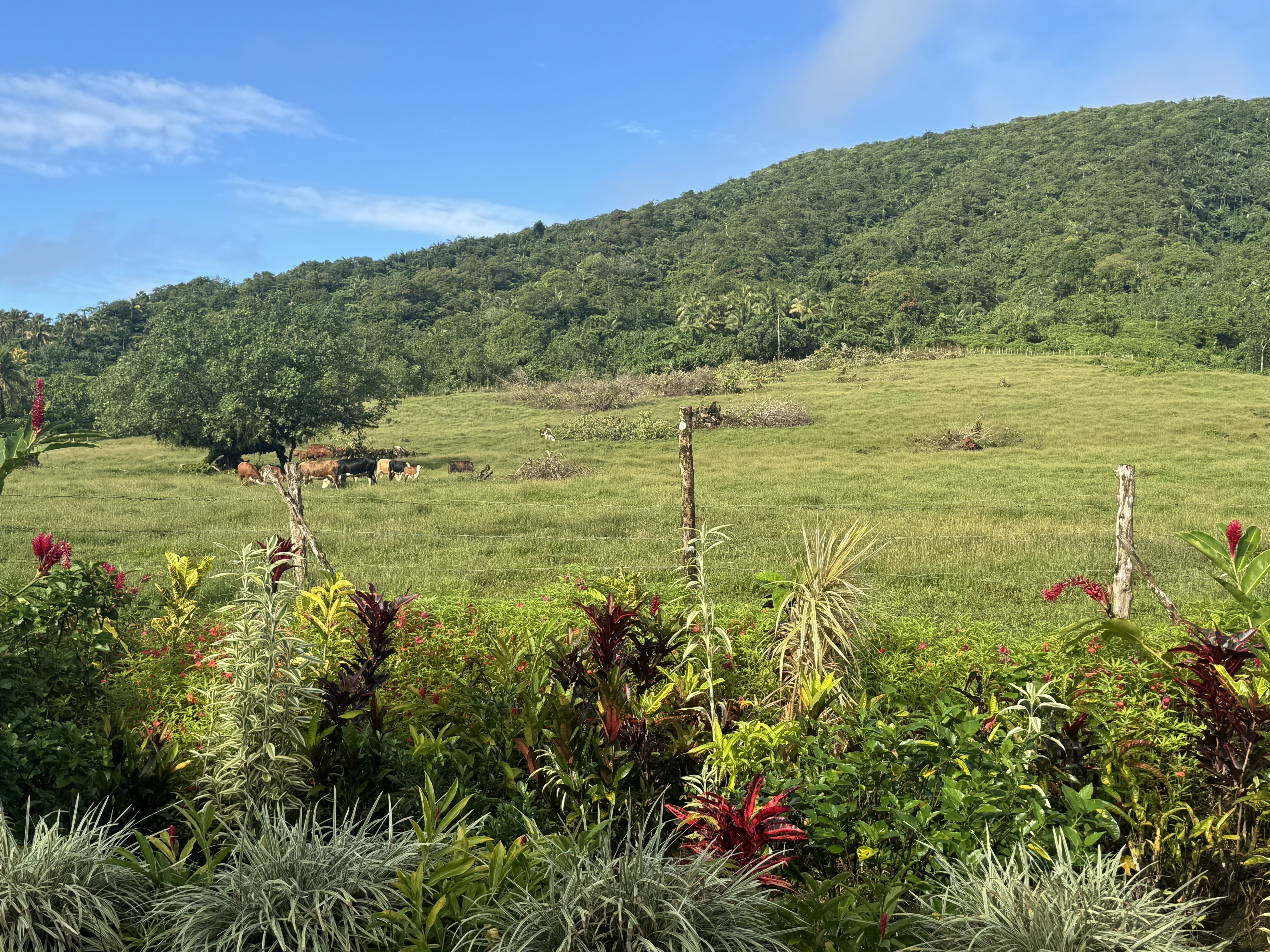
Both roads are recent, which gives the landscape a pioneer quality of spaciousness.
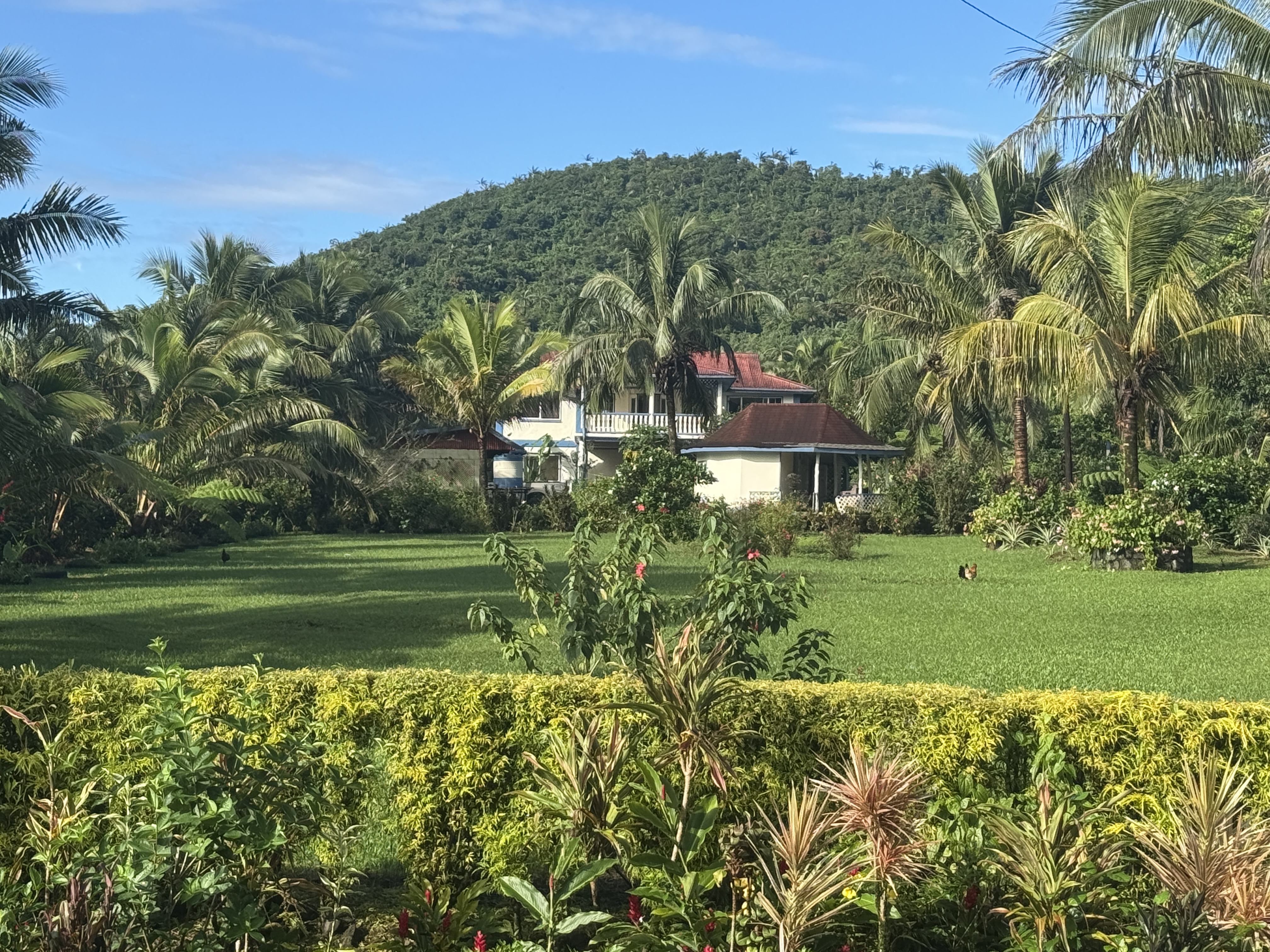
A new home along the eastern road (the Richardson Road).
No modern home here. The photo shows New Zealand officials on tour.
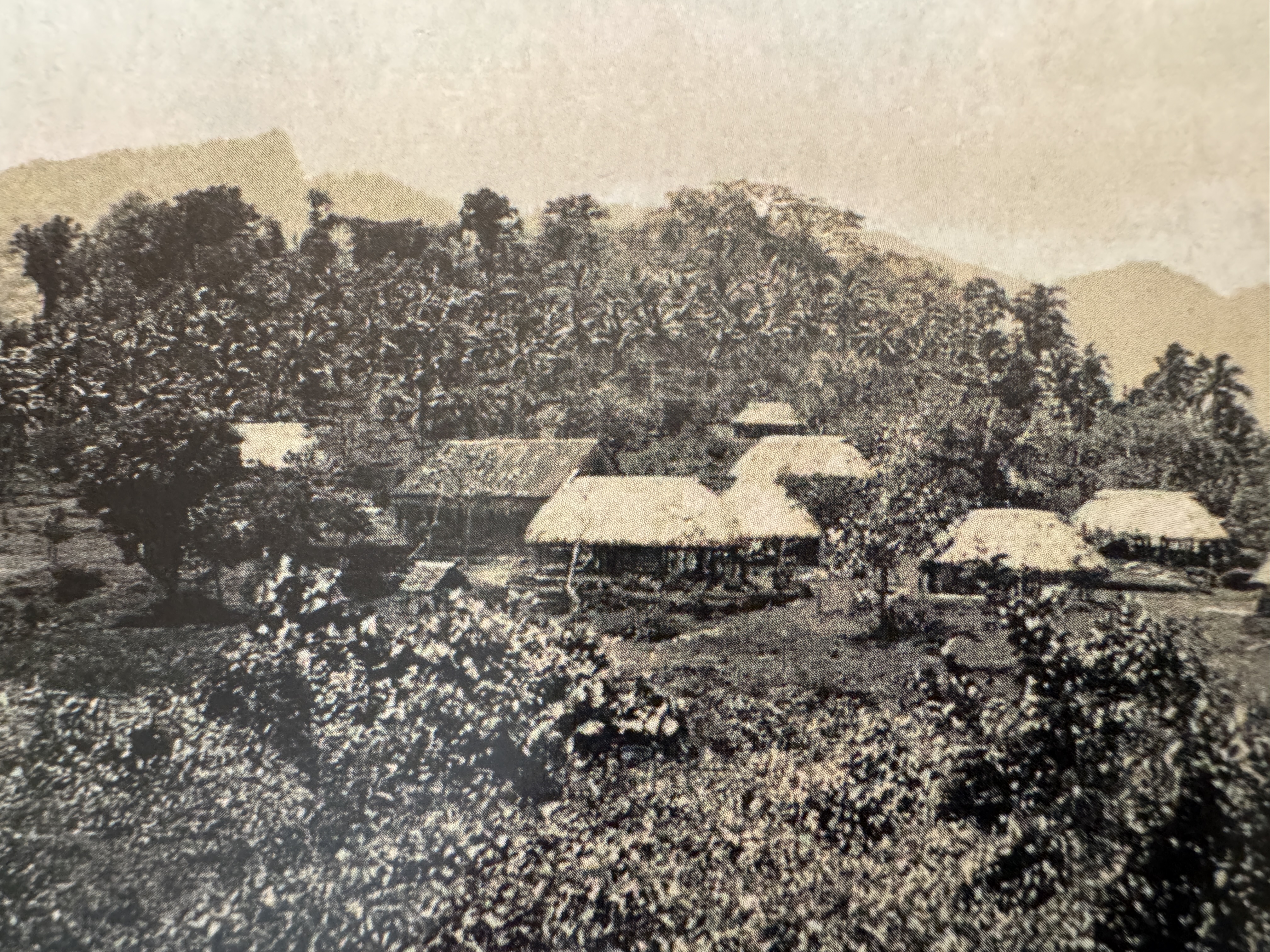
But see the sheet metal? It's Falevao Village, photographed in 1933. Why, why, why? After all, a missionary writing in 1861, pointed out that "zinc, felt, and other contrivances are being tried by European residents; but, for coolness and ventilation, nothing beats the thatch" (George Turner, Nineteen Years in Polynesia, p. 258). Still, the economy of sheetmetal won the day.
(Brunt, 182.)
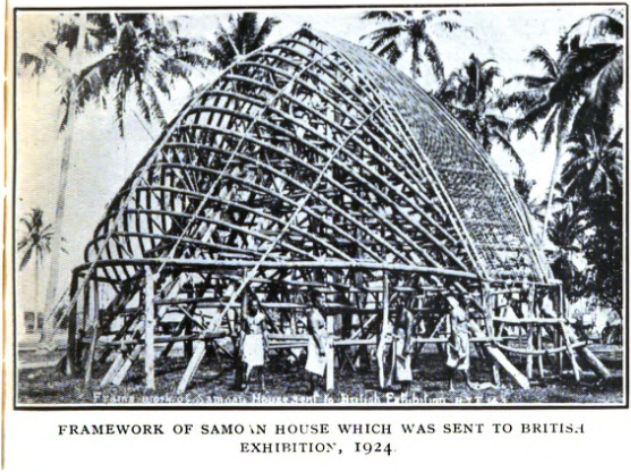
Ironically, at the same time as people began abandoning thatch, the New Zealand government sent a thatched house to Britain's Empire Exhibition in Wembley Park.
(Handbook, p. 49.)
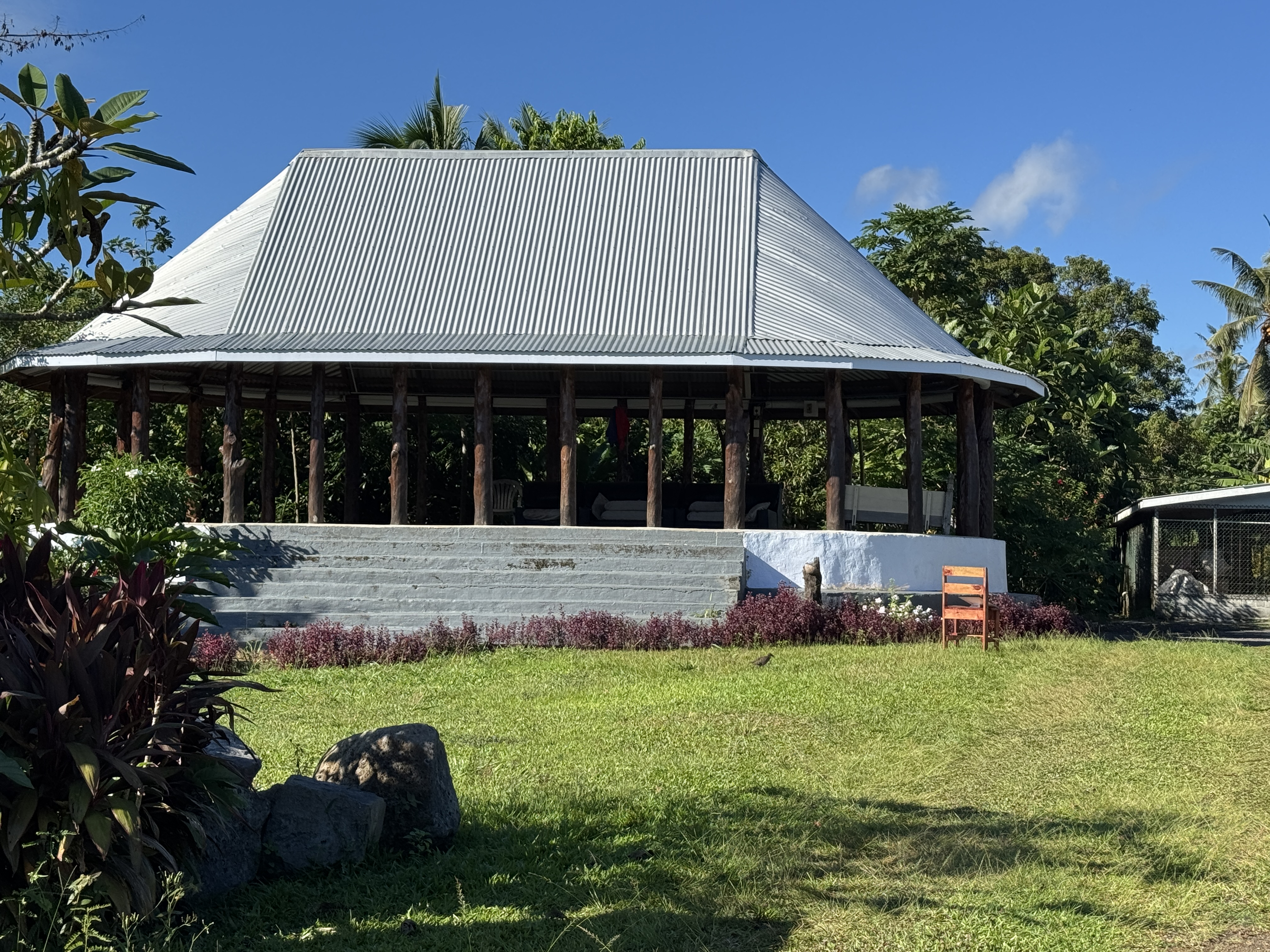
As late as 1990, however, thatch did survive. Gavin Young, travelling in 1982, wrote of "beehive houses, somnolent under their sunbaked thatch... mat walls rolled up now to catch the sea breeze." (Young, Slow Boats Home, p. 229.)Gavin Bell, travelling a decade later, could still write that "my first view of Samoa was a succession of brightly lit thatch houses without walls" (Bell, p. 277). Today, you'll see traditional houses built only as a ceremonial space and only in modern materials.
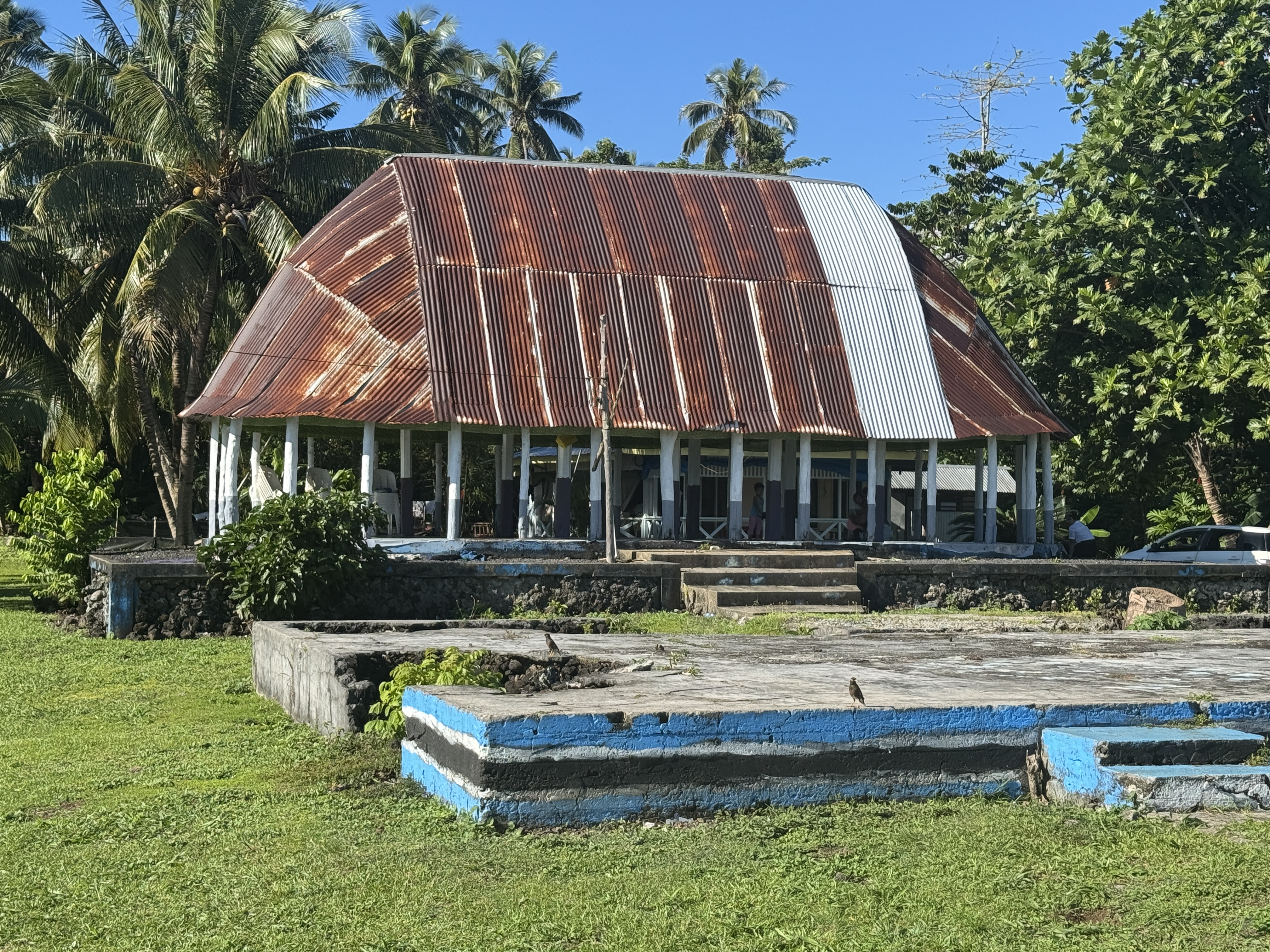
Concrete, sheet metal, rust.
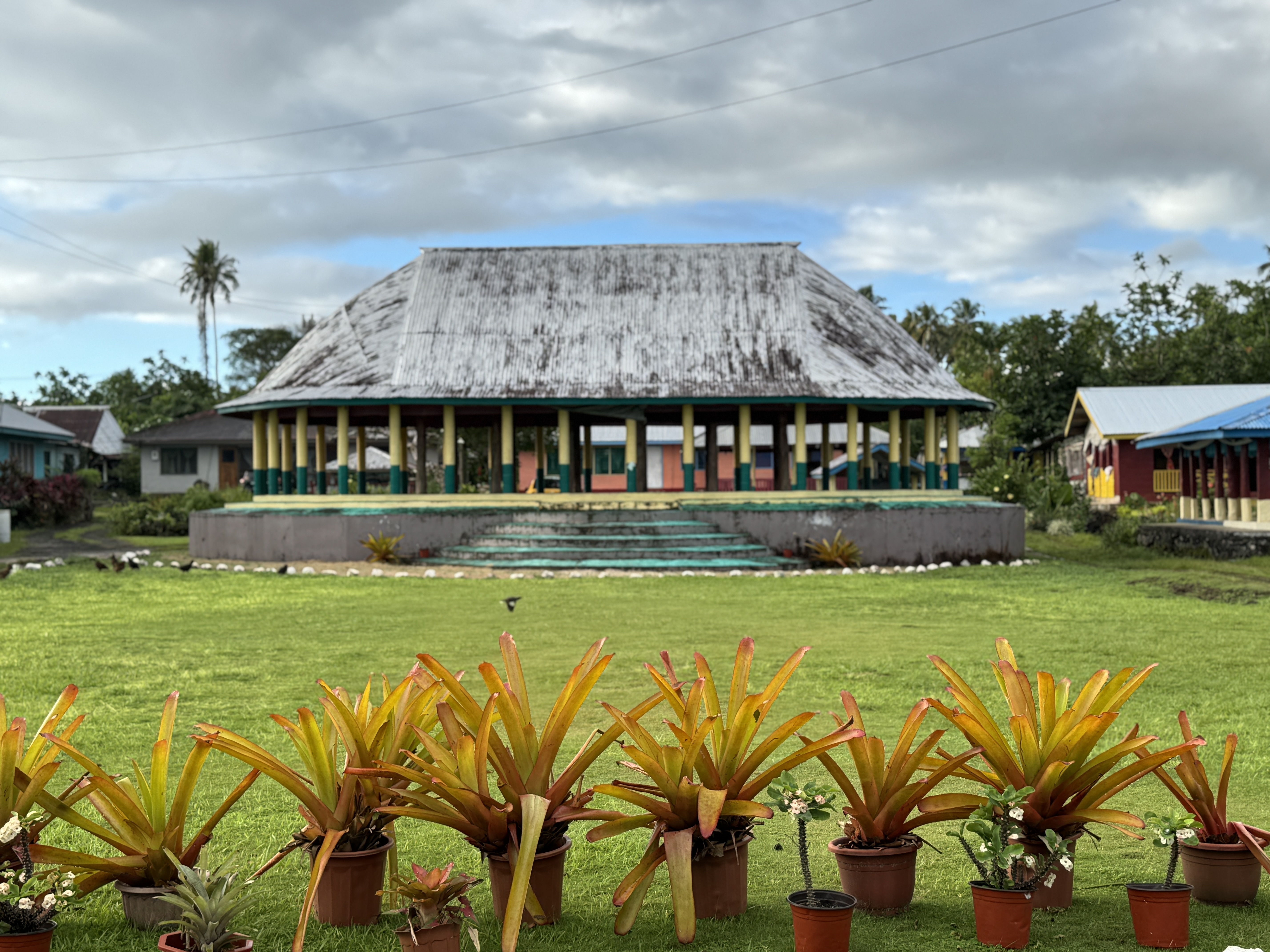
Sometimes these parlors get impressive.
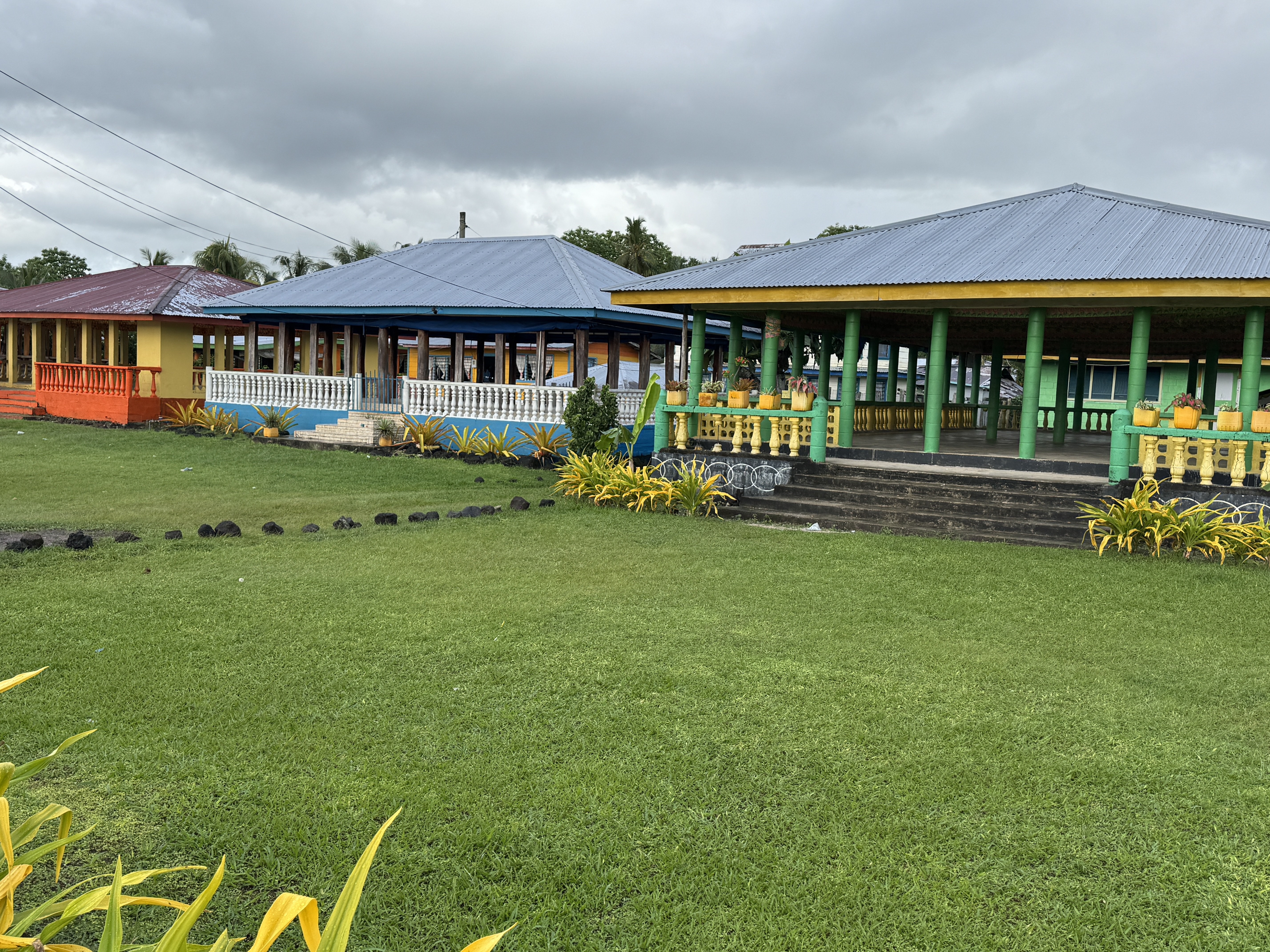
But the function has changed, the materials have changed, and even the shape has often changed.
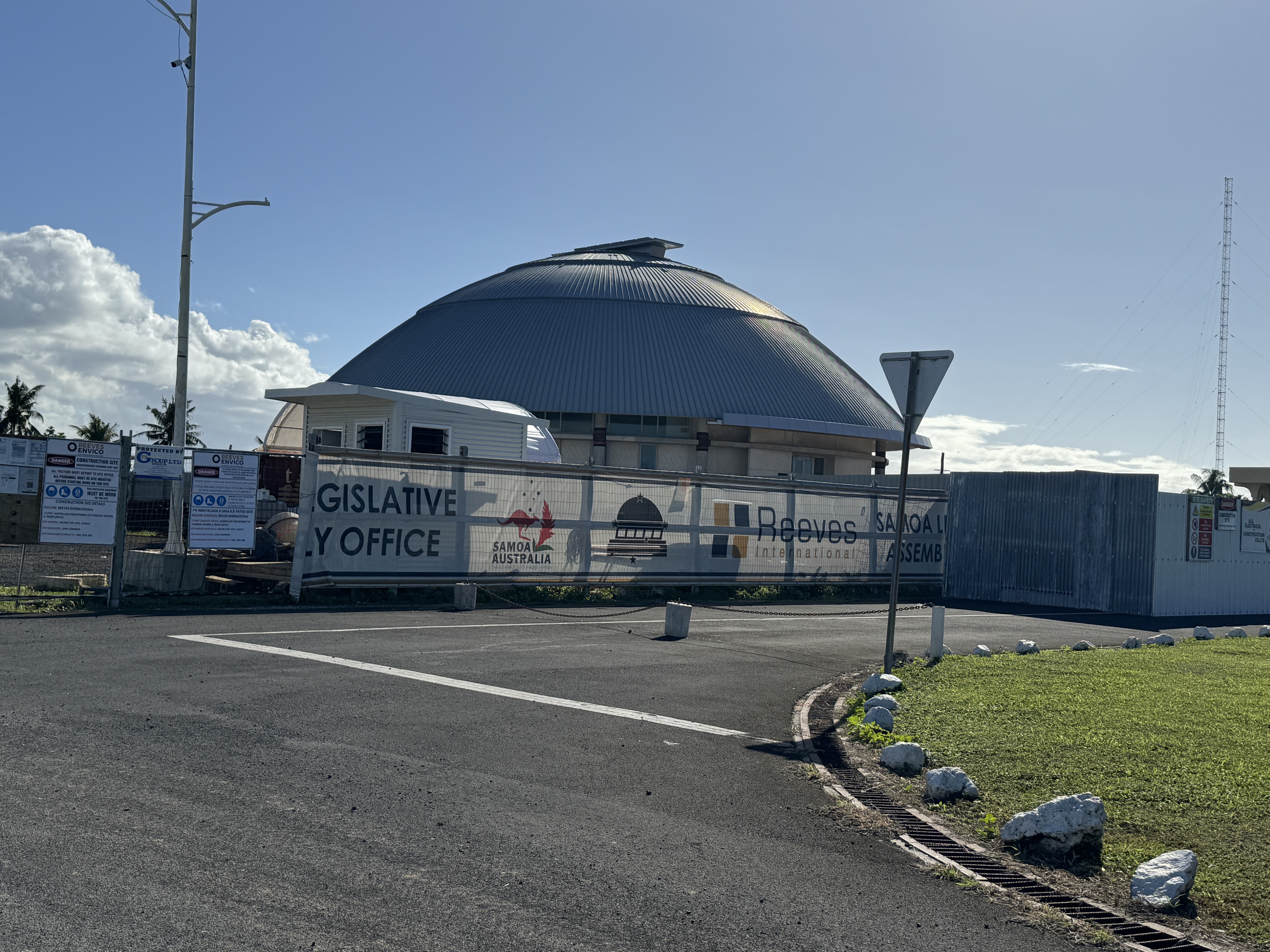
Here's Samoa's Parliament Building, completed in 2019 by Guida Moseley Brown, an Australian architect.
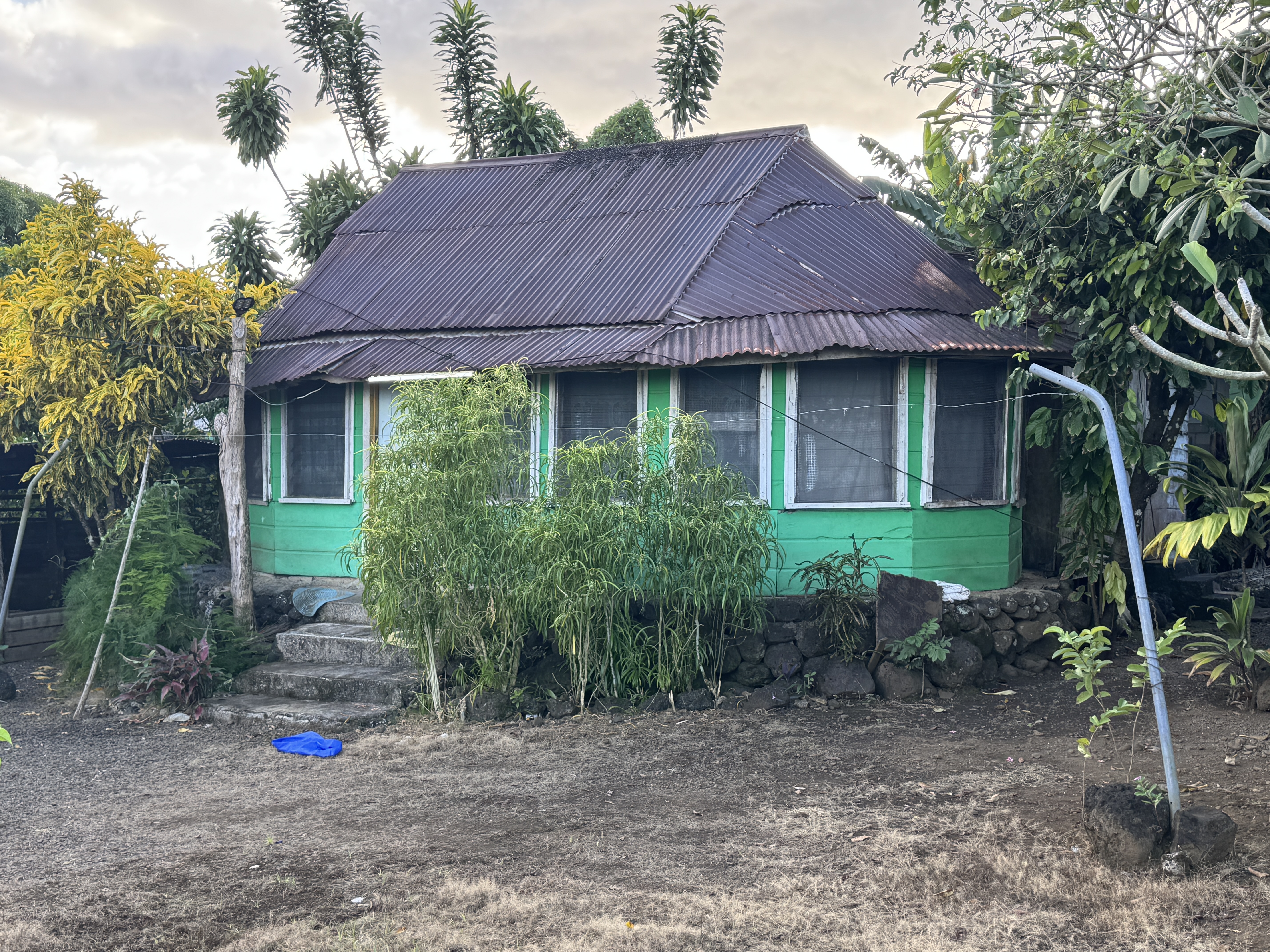
Here's a modern house with walls, a door, and windows, yet echoing the old shape.
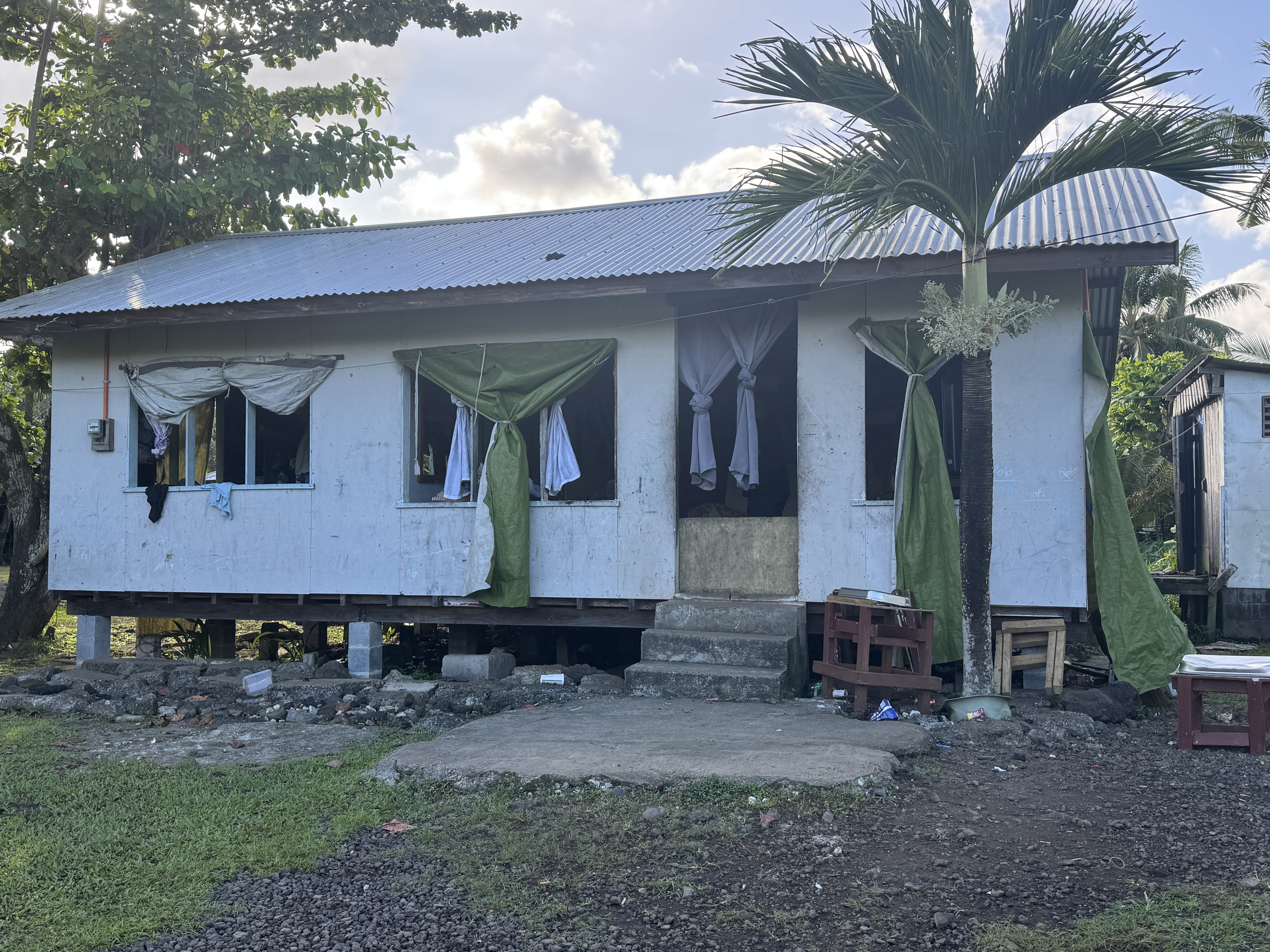
Not here.
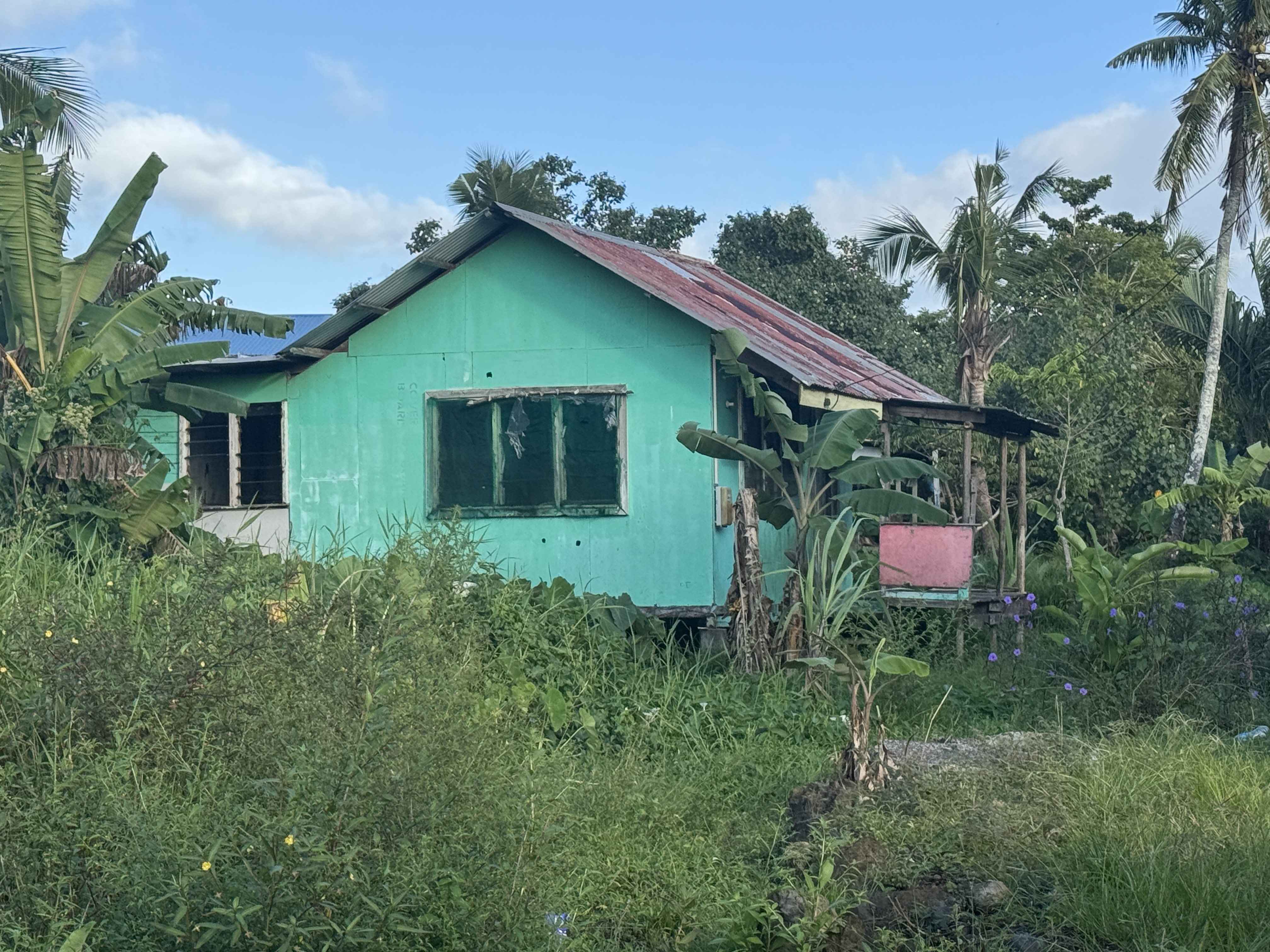
Or here.
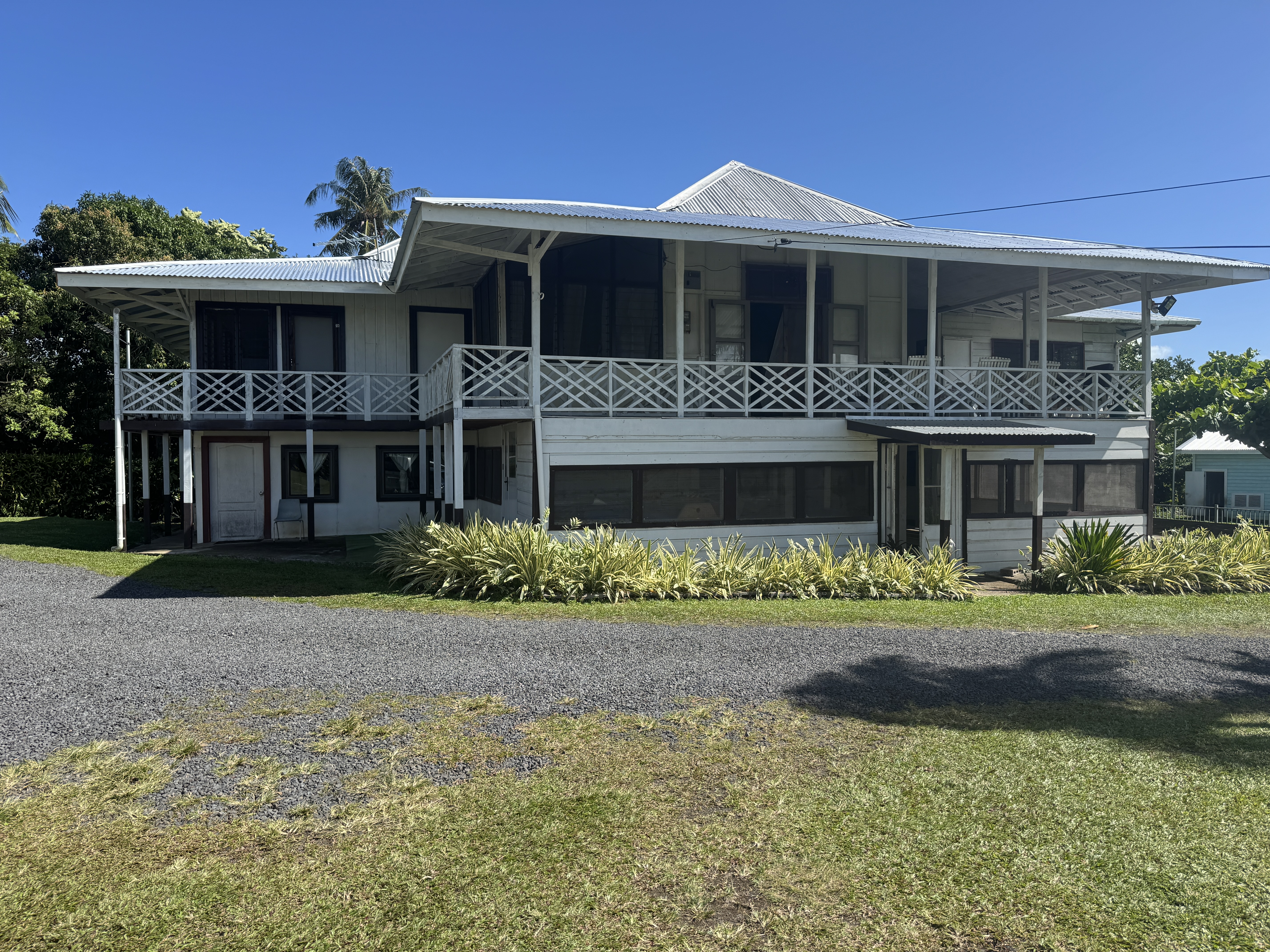
Or here.
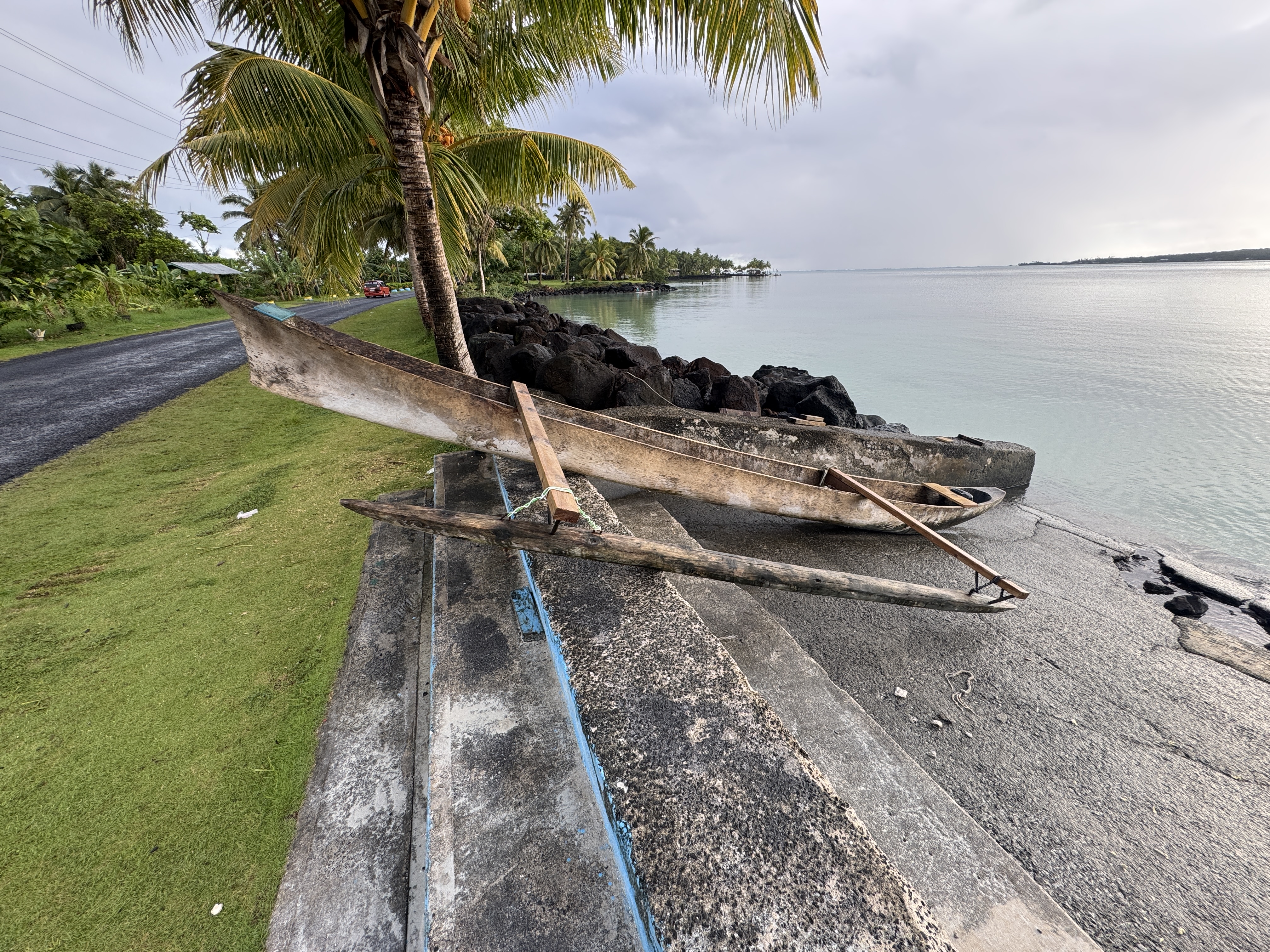
It's not just houses that have been turned upside down. Here's somebody devoted to the old dugout canoe, like the one shown almost at the top of this file.
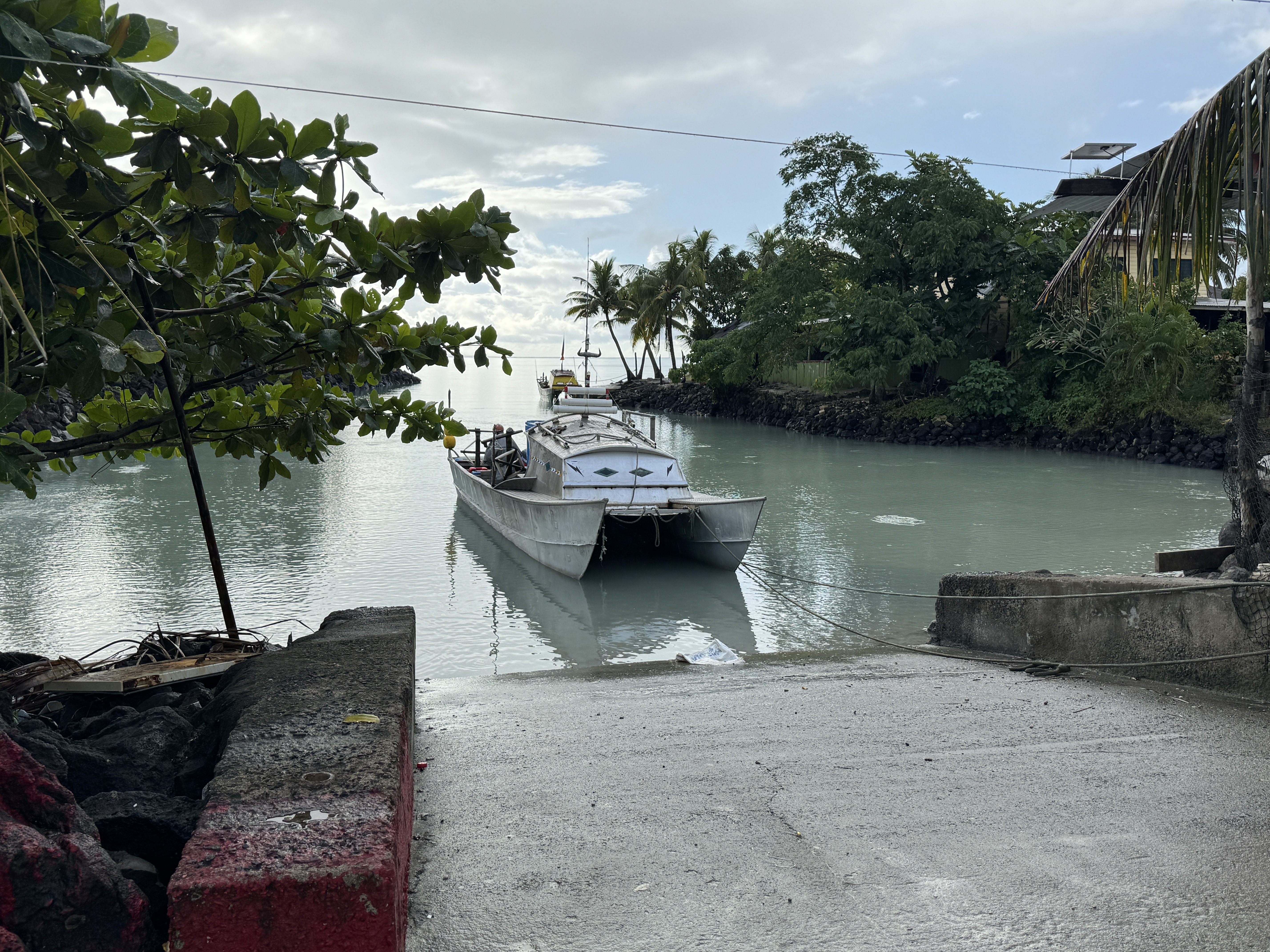
Serious fishermen use steel, not to mention a concrete slip.
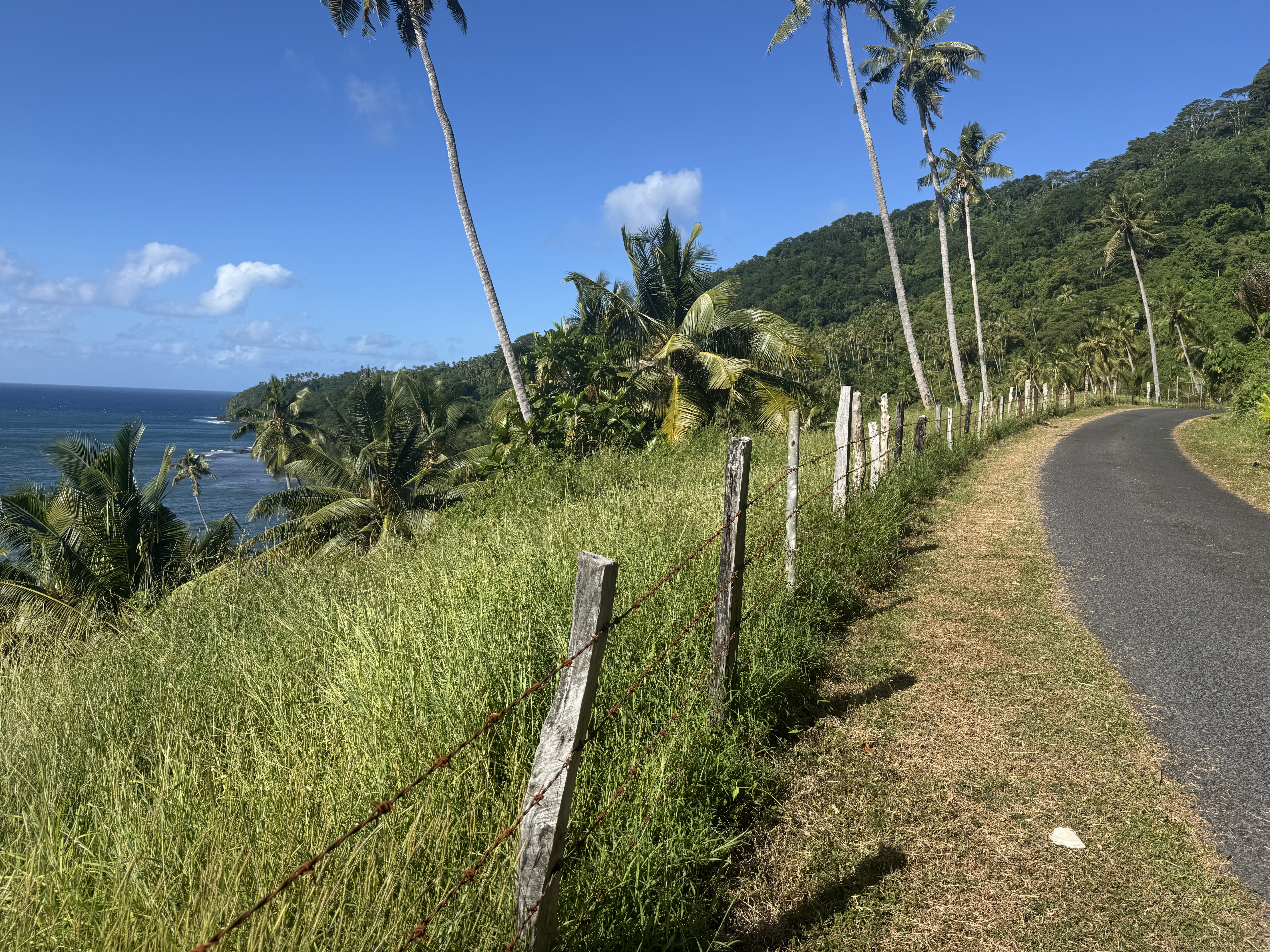
Want to go exploring for a traditional house?
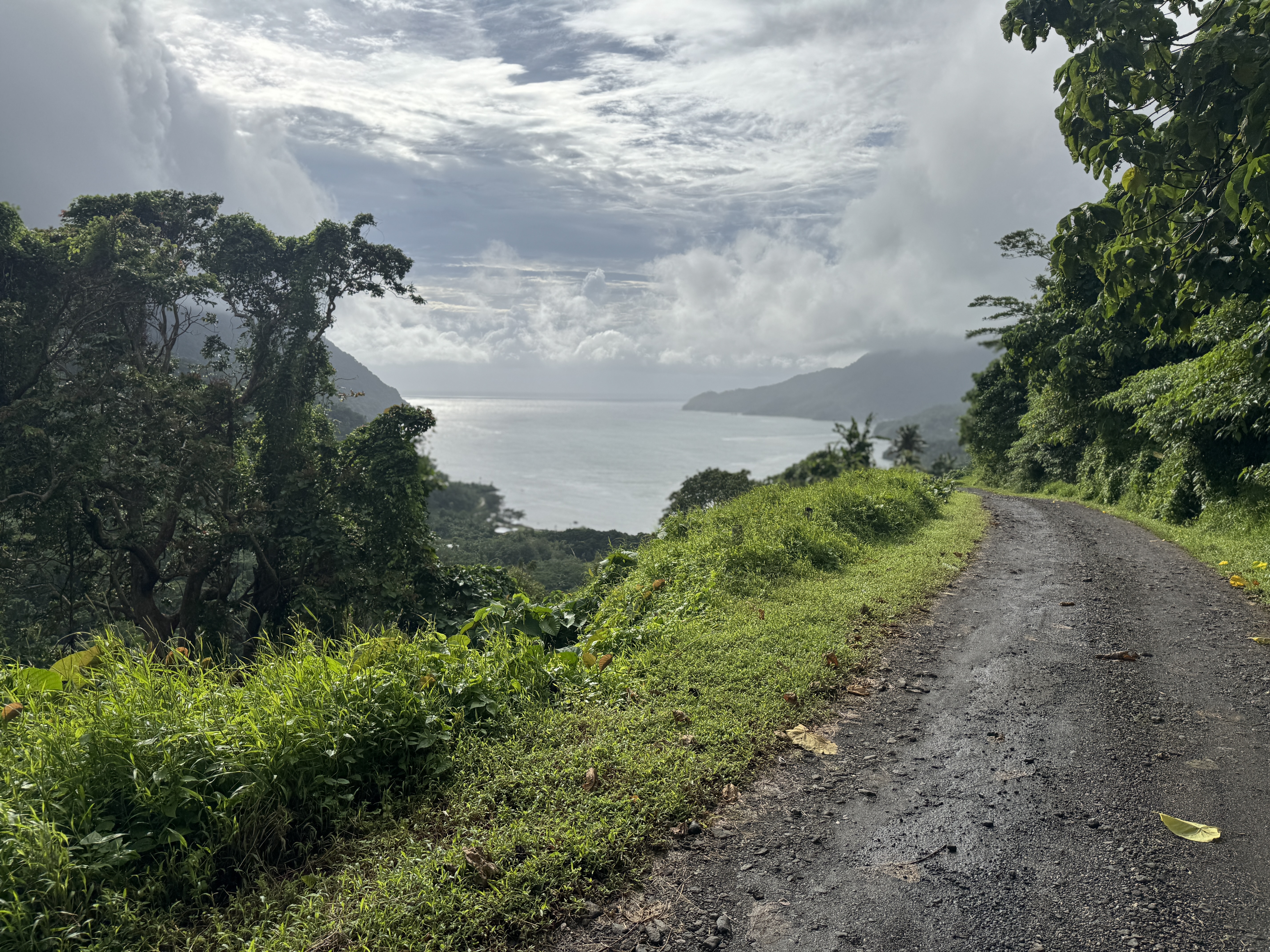
We're approaching Fagaloa Bay, which Adams called "the finest scenery I have seen in these islands... an exquisite spot" (Adams, pp. 353-354).
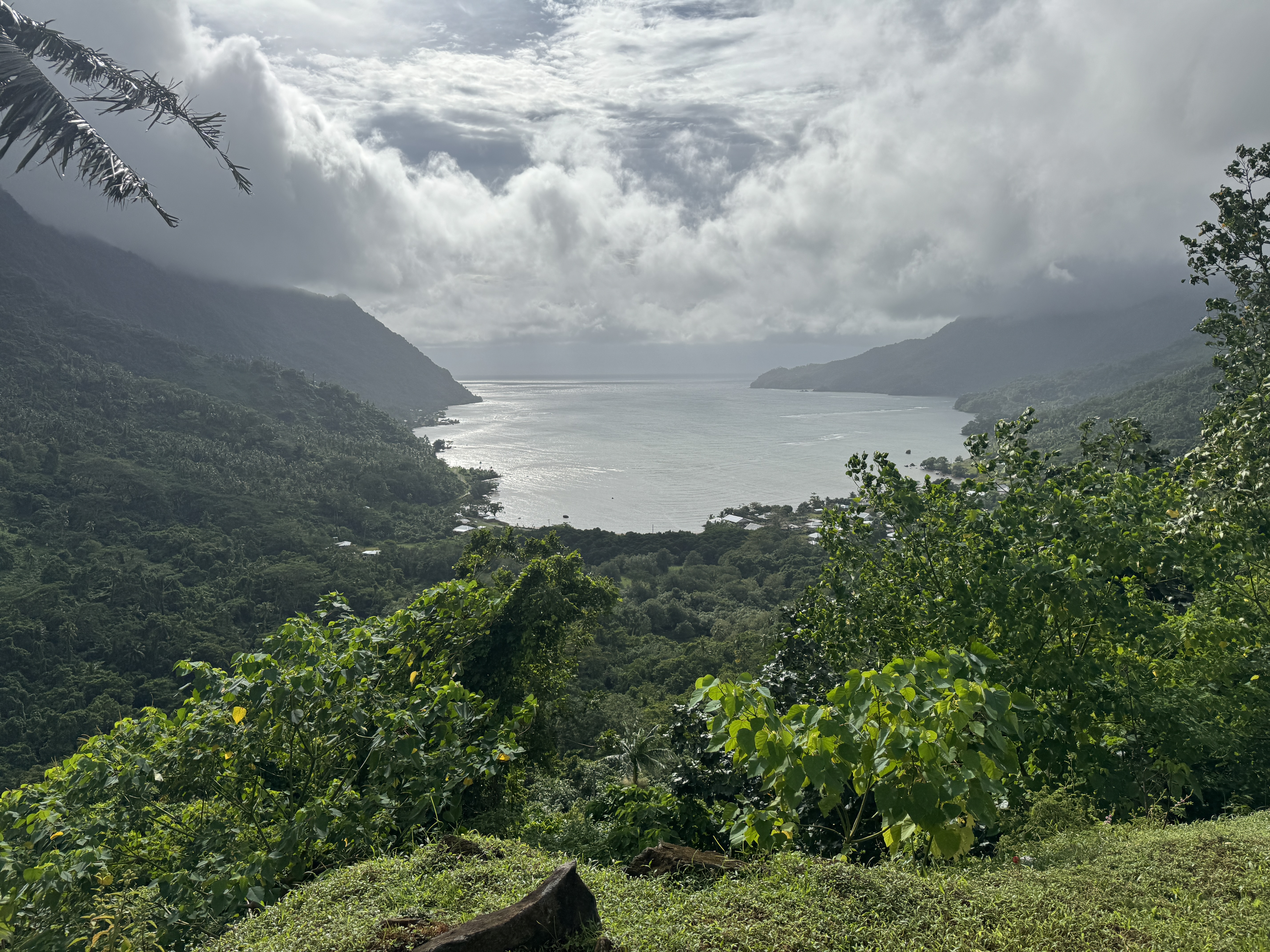
La Farge found the forest mysterious: "The vegetation never rests. The plants are always growing...." (La Farge, p. 128). It does have sci-fi potential.
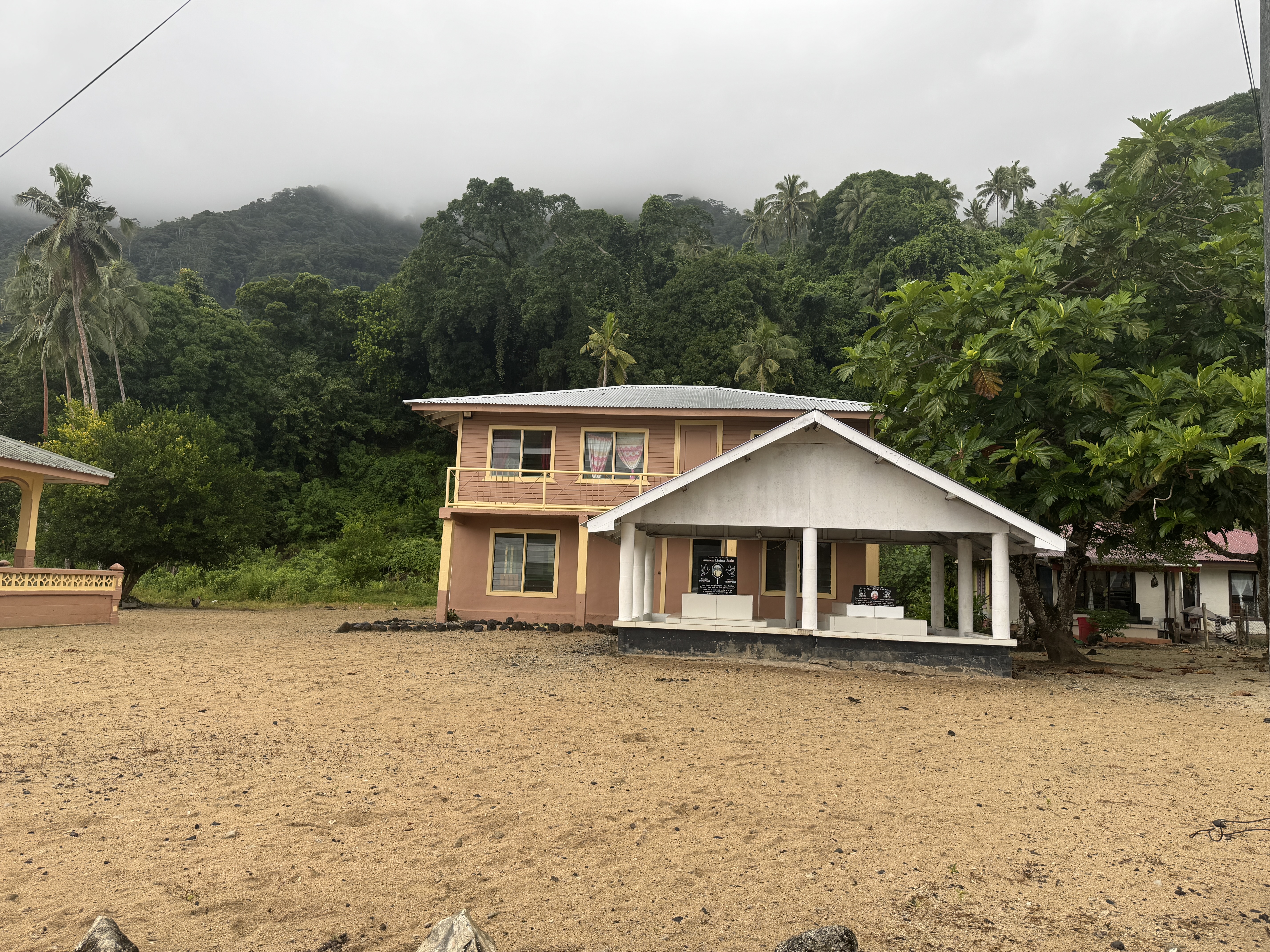
There aren't a lot of houses down here. Here's one, with a couple of family tombs.
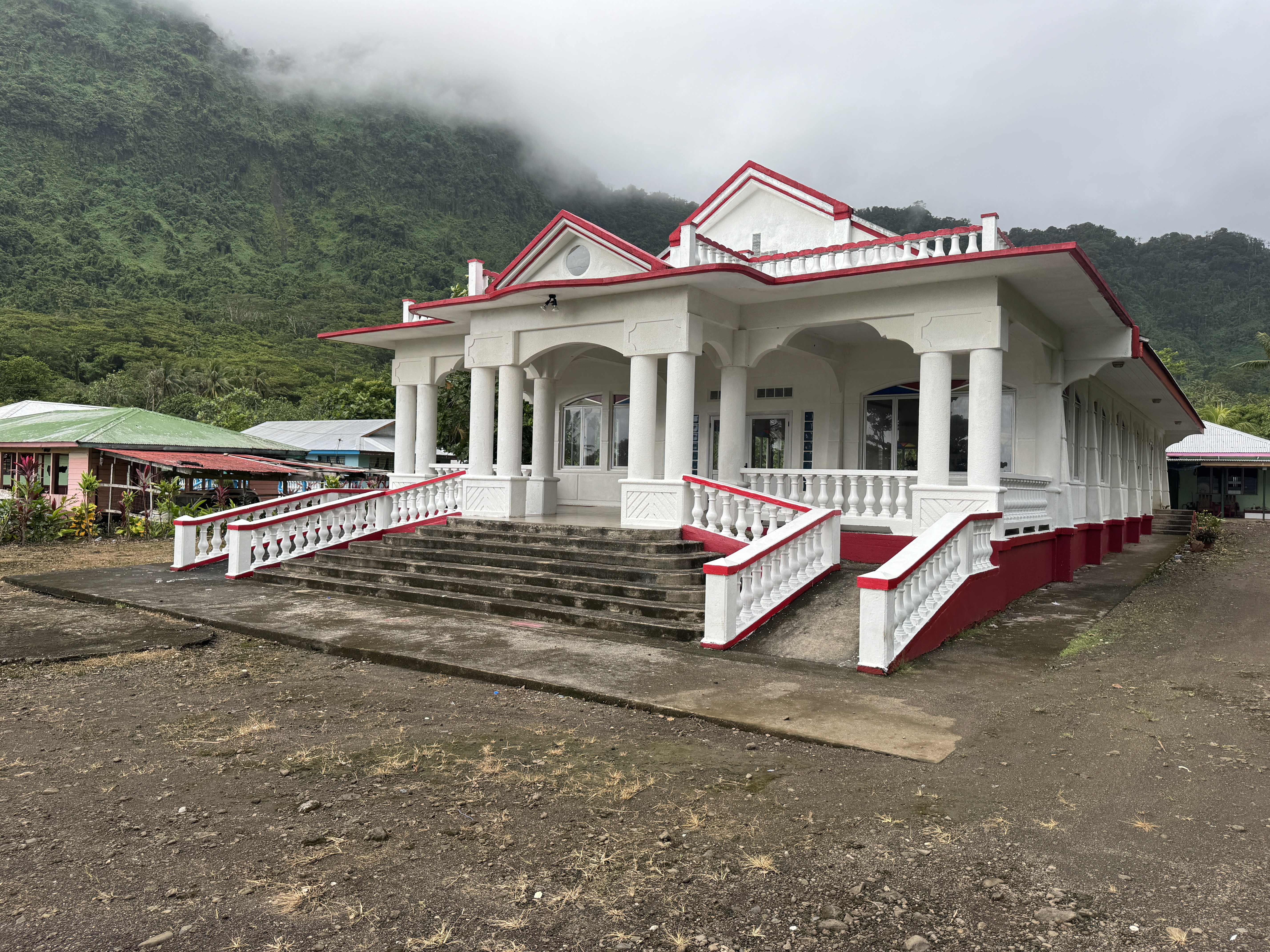
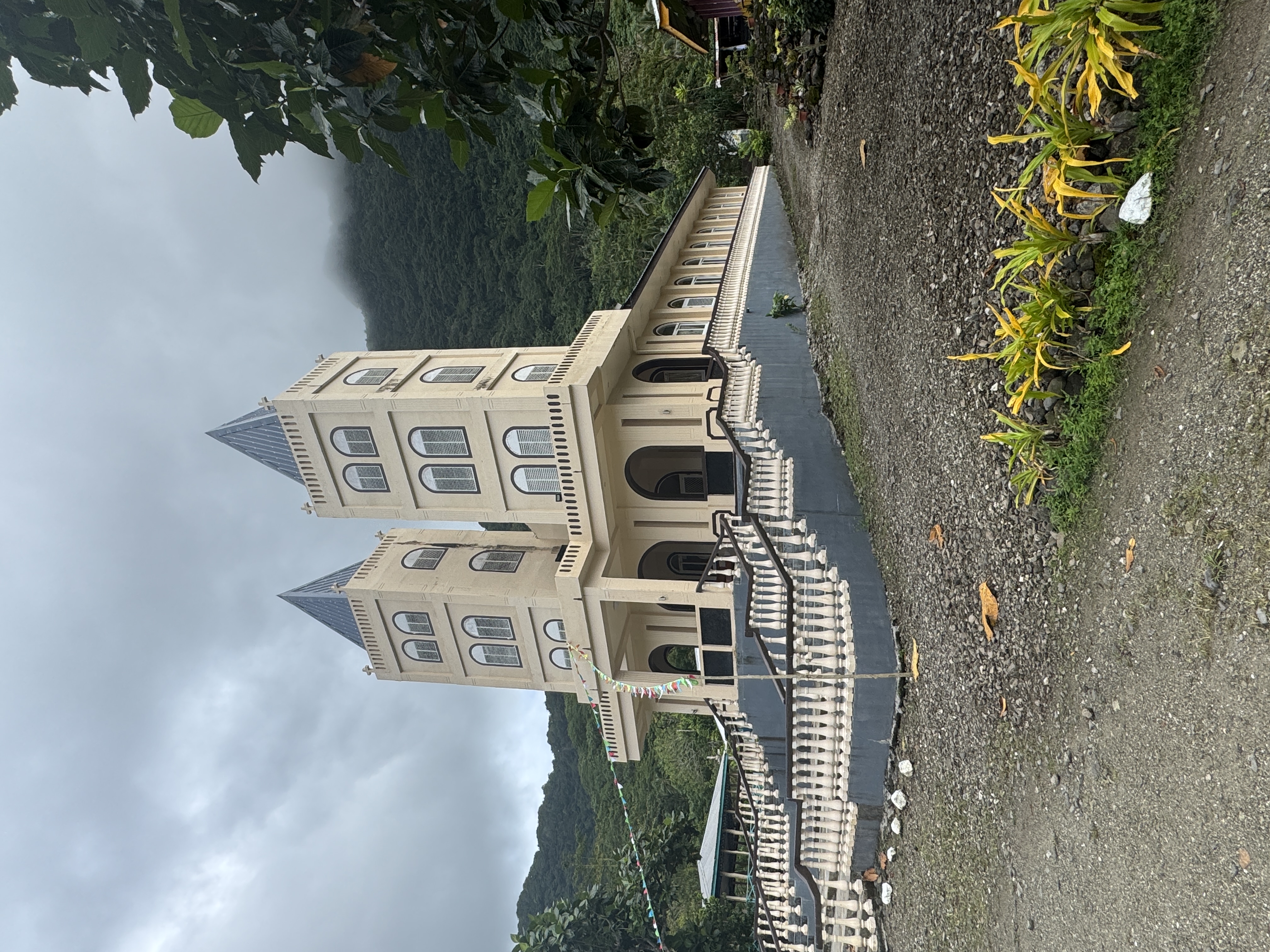
Speaking of eternity, here's a church.
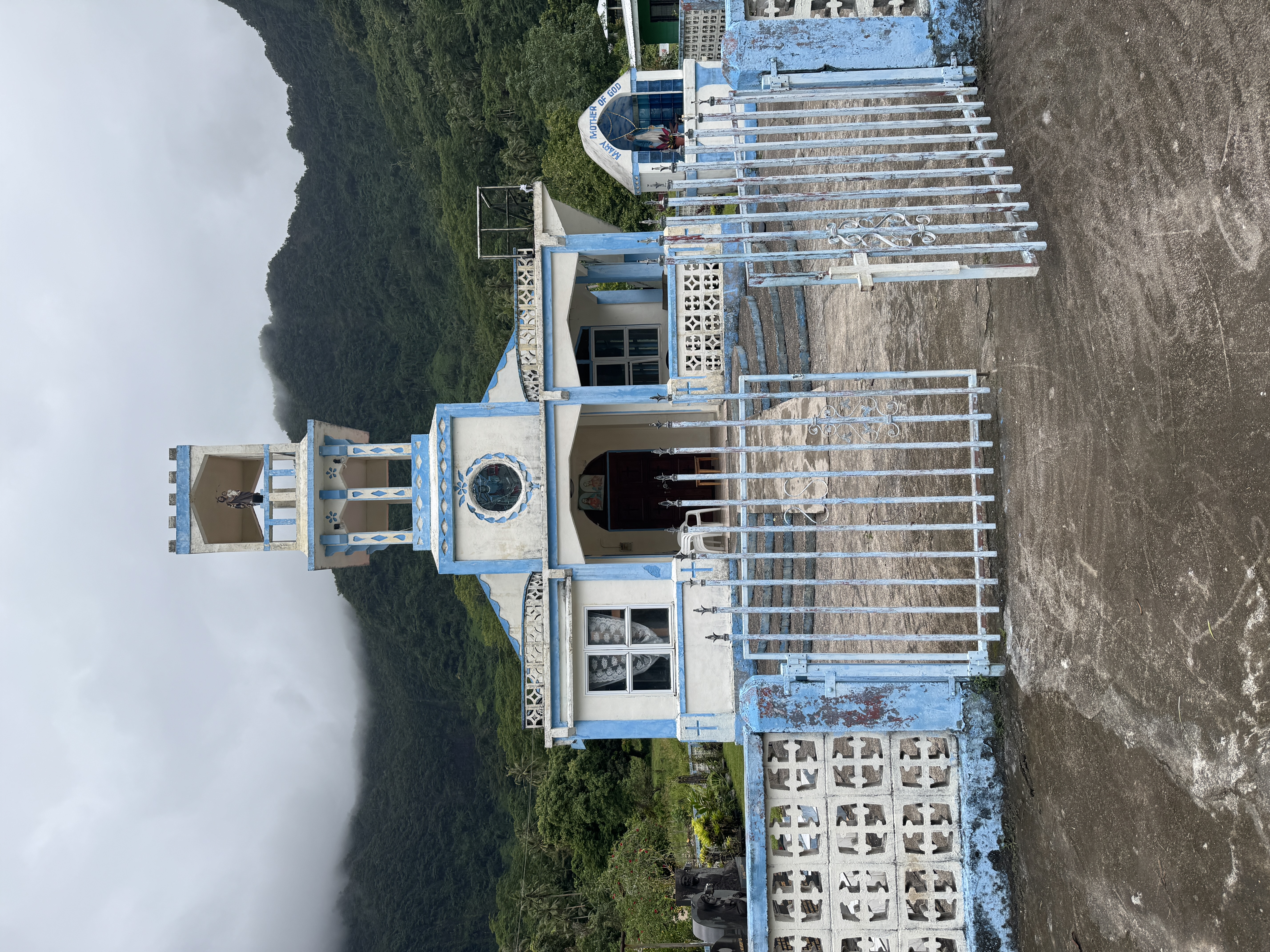
And another.
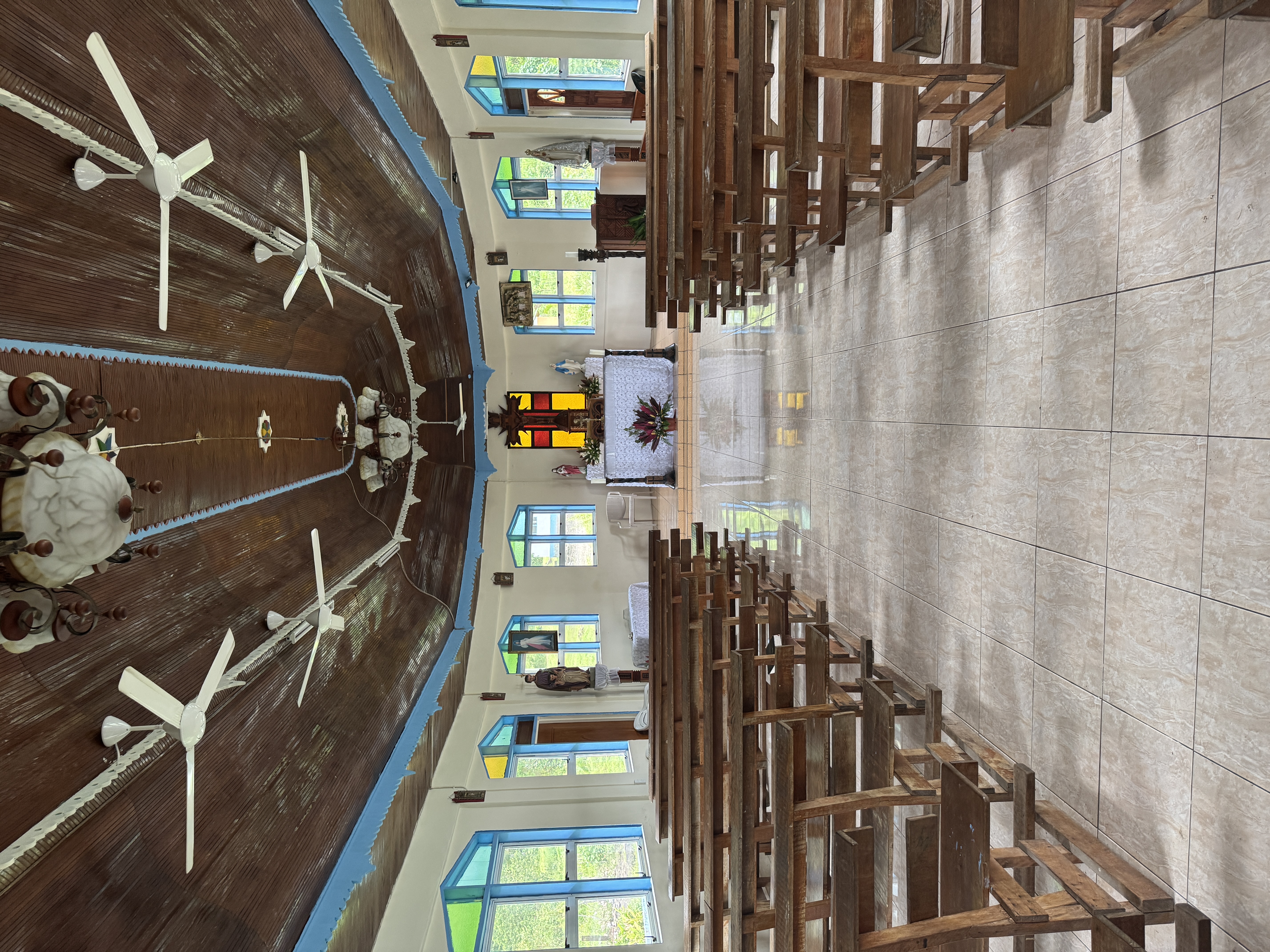
More pews than can be filled.
And another.
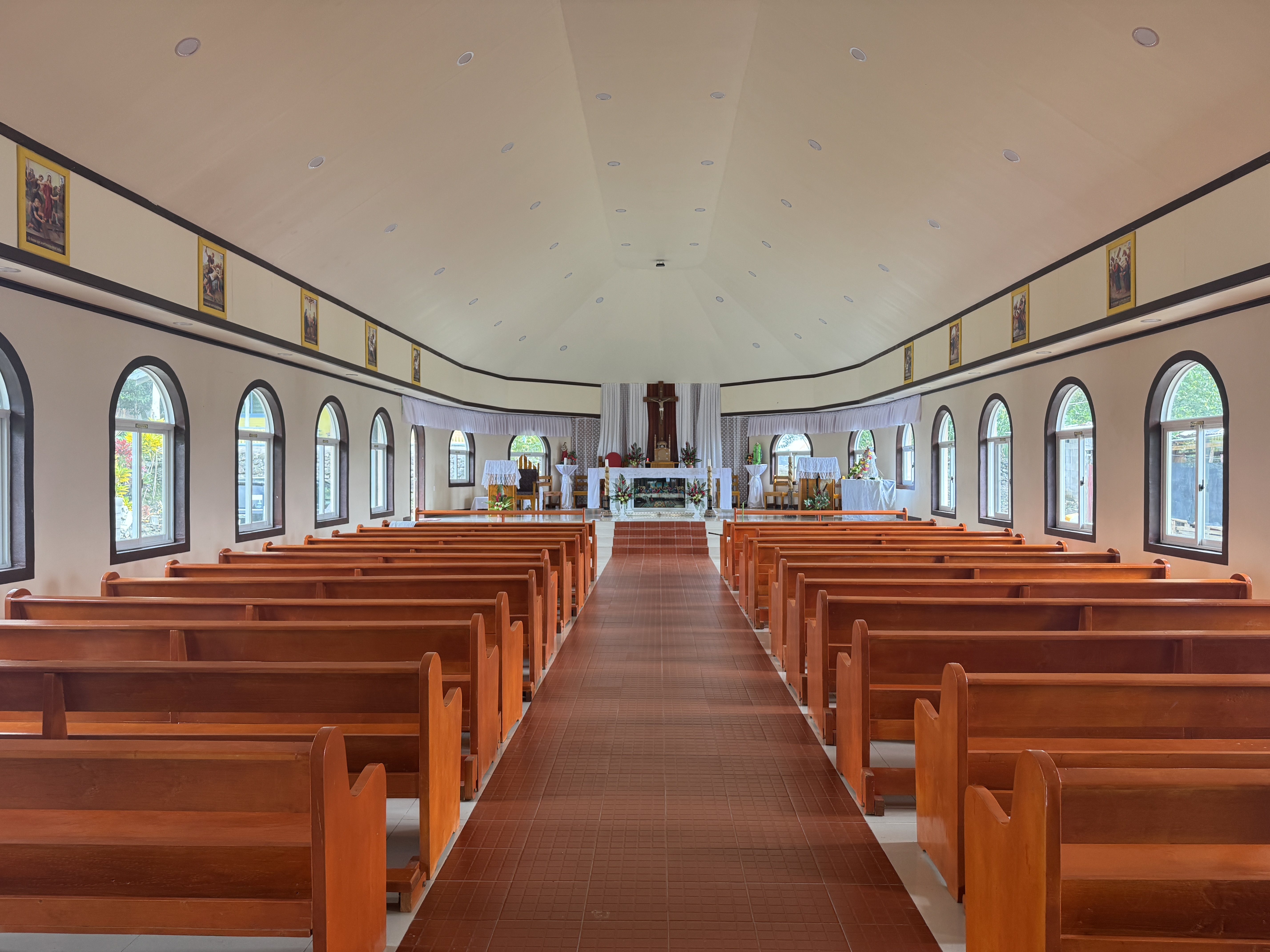
Ditto.
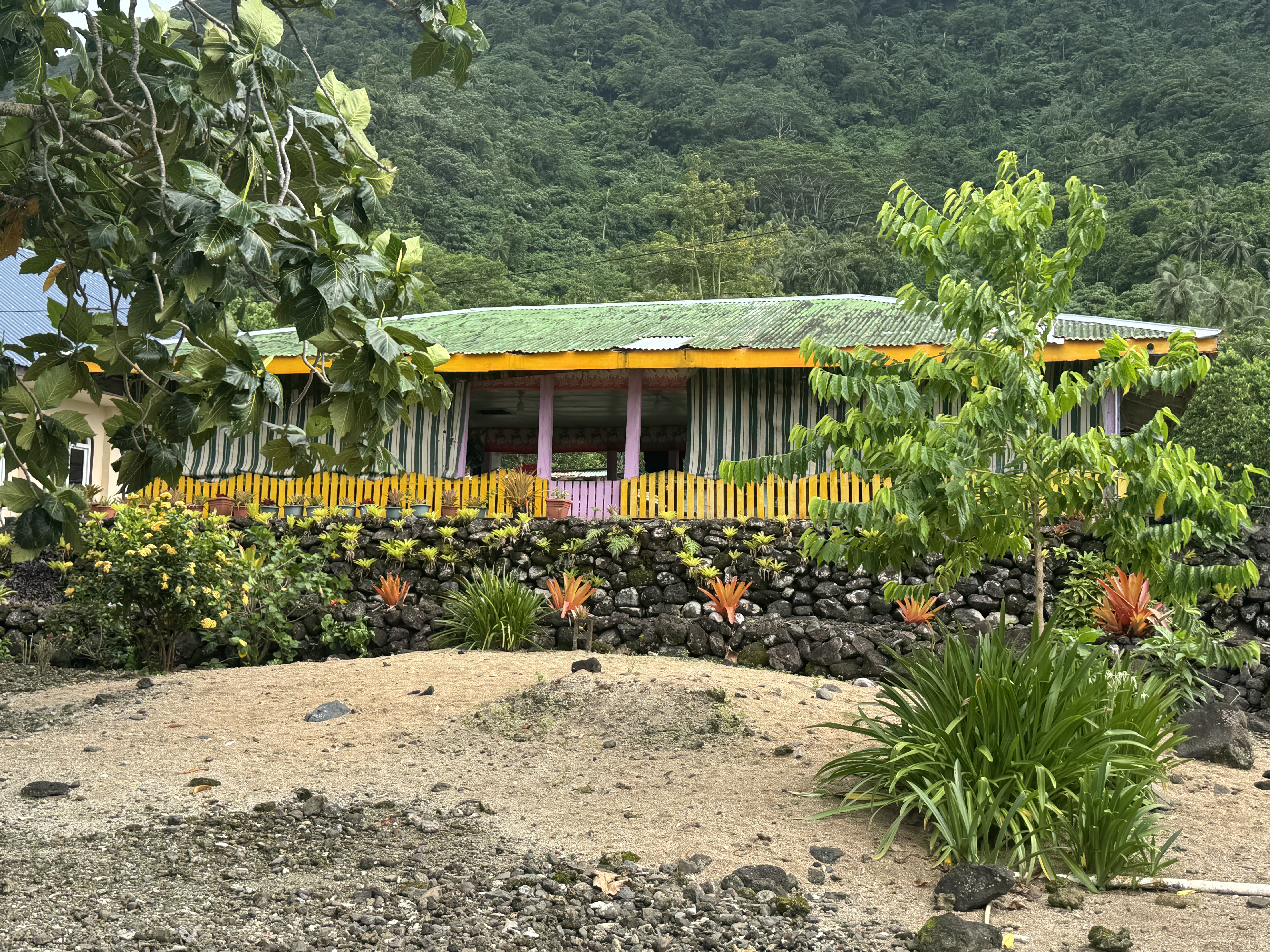
But here's a house with some memory of how people used to live.
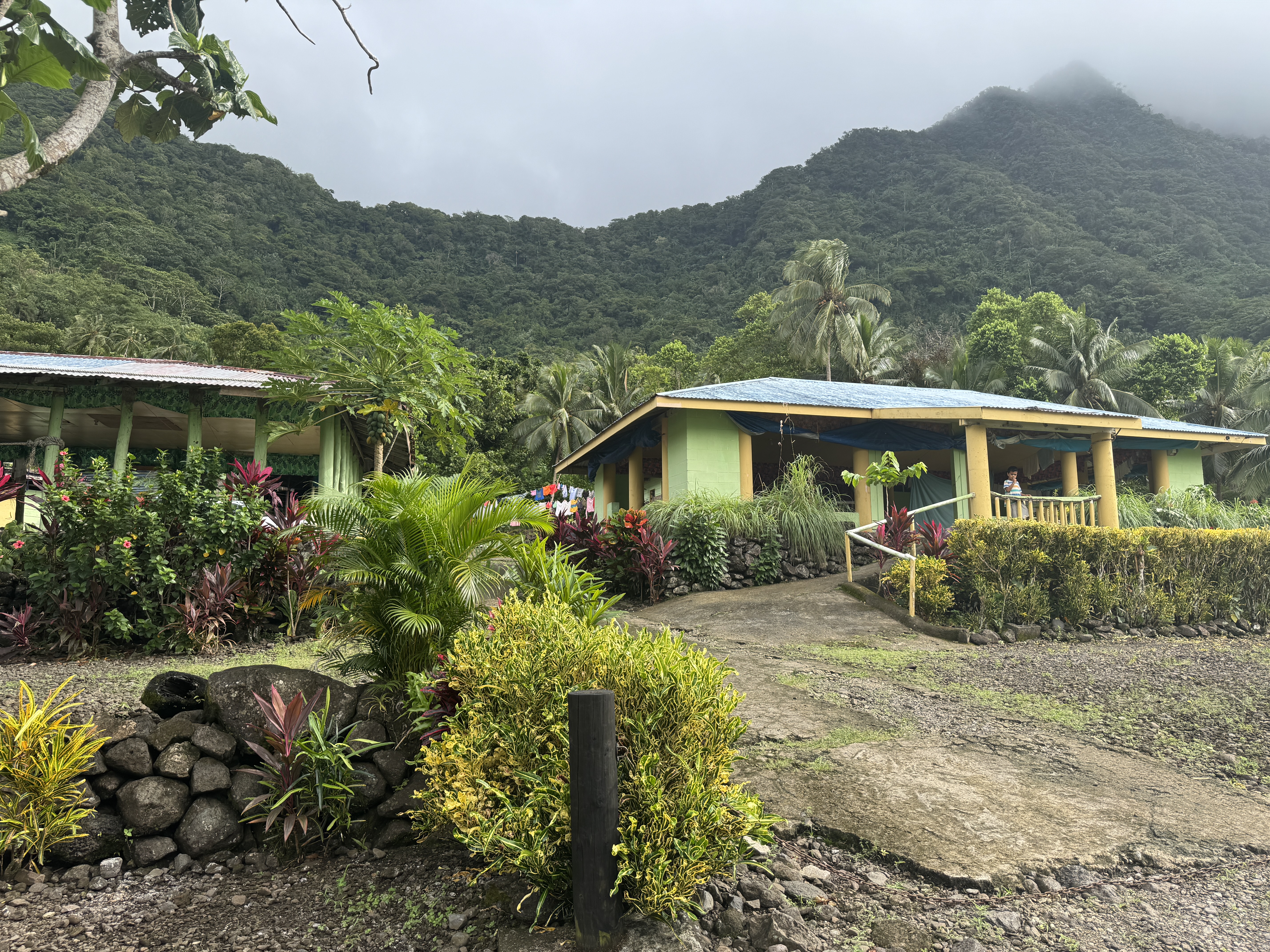
And here's another, or a couple of others. They're the same property.
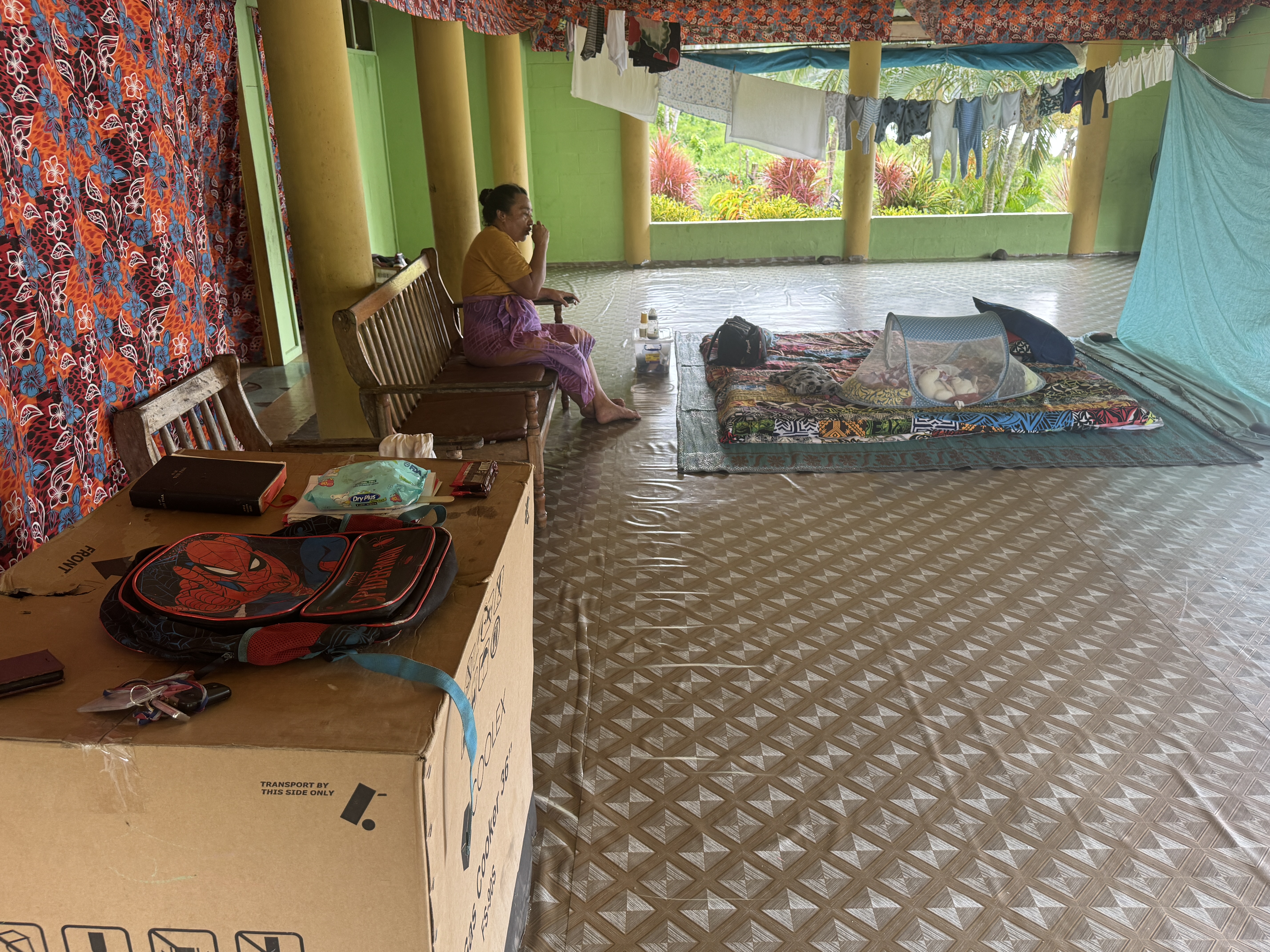
Quiet as can be. Ssshh! A baby is sleeping under that netting. Yes, the box is for a gas-fired stove.
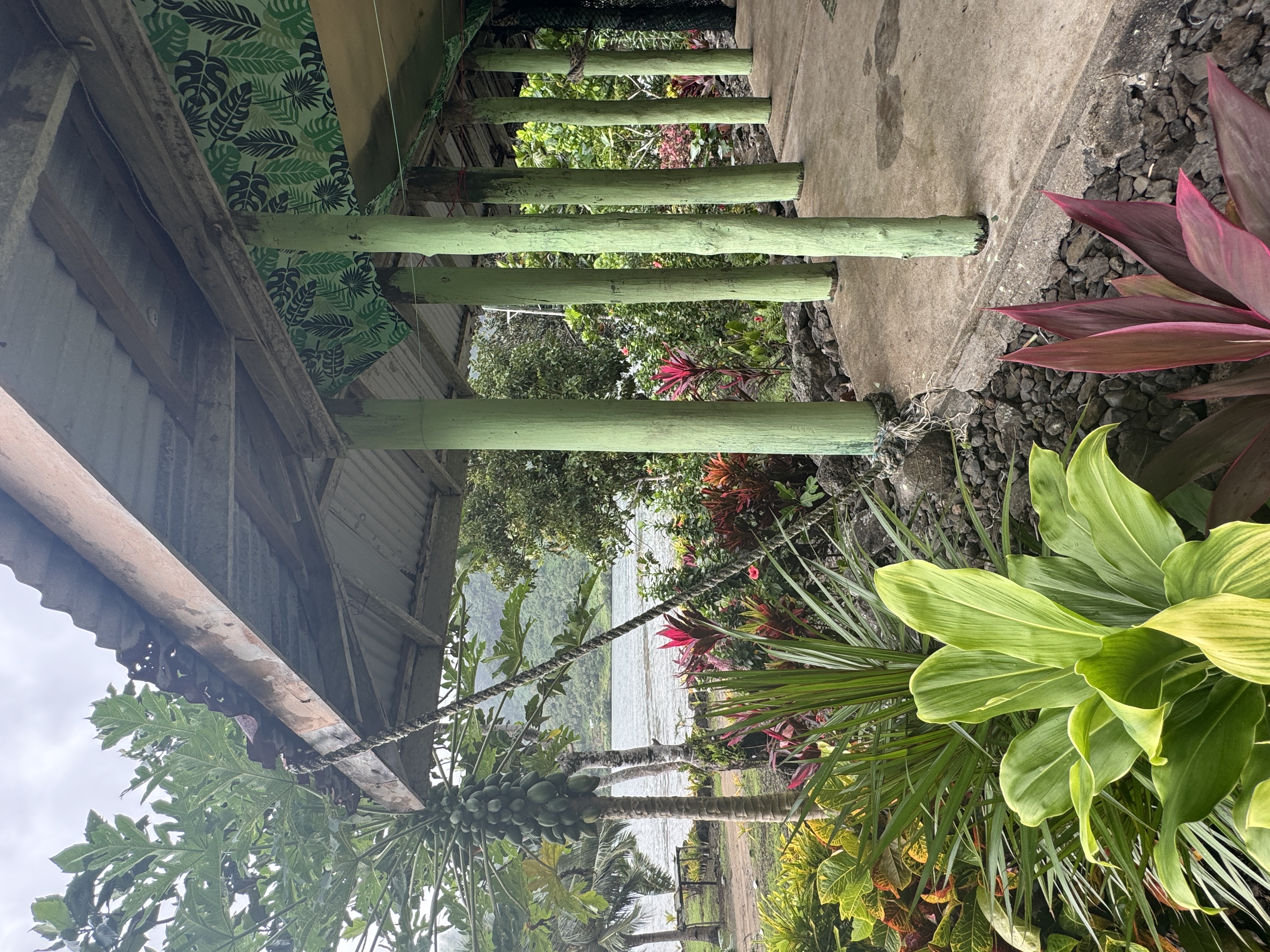
Here's the building next door.
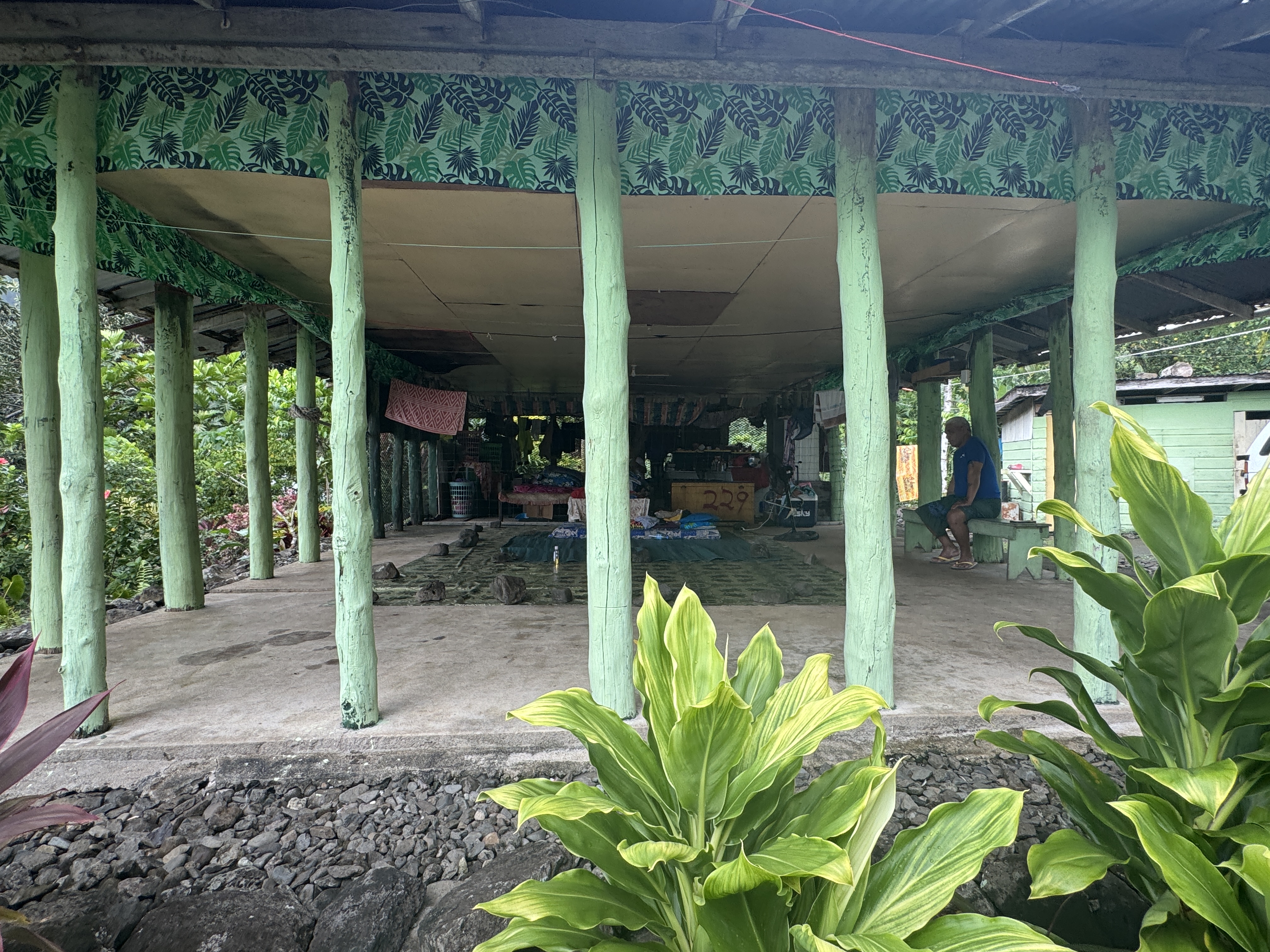
Even more basic.
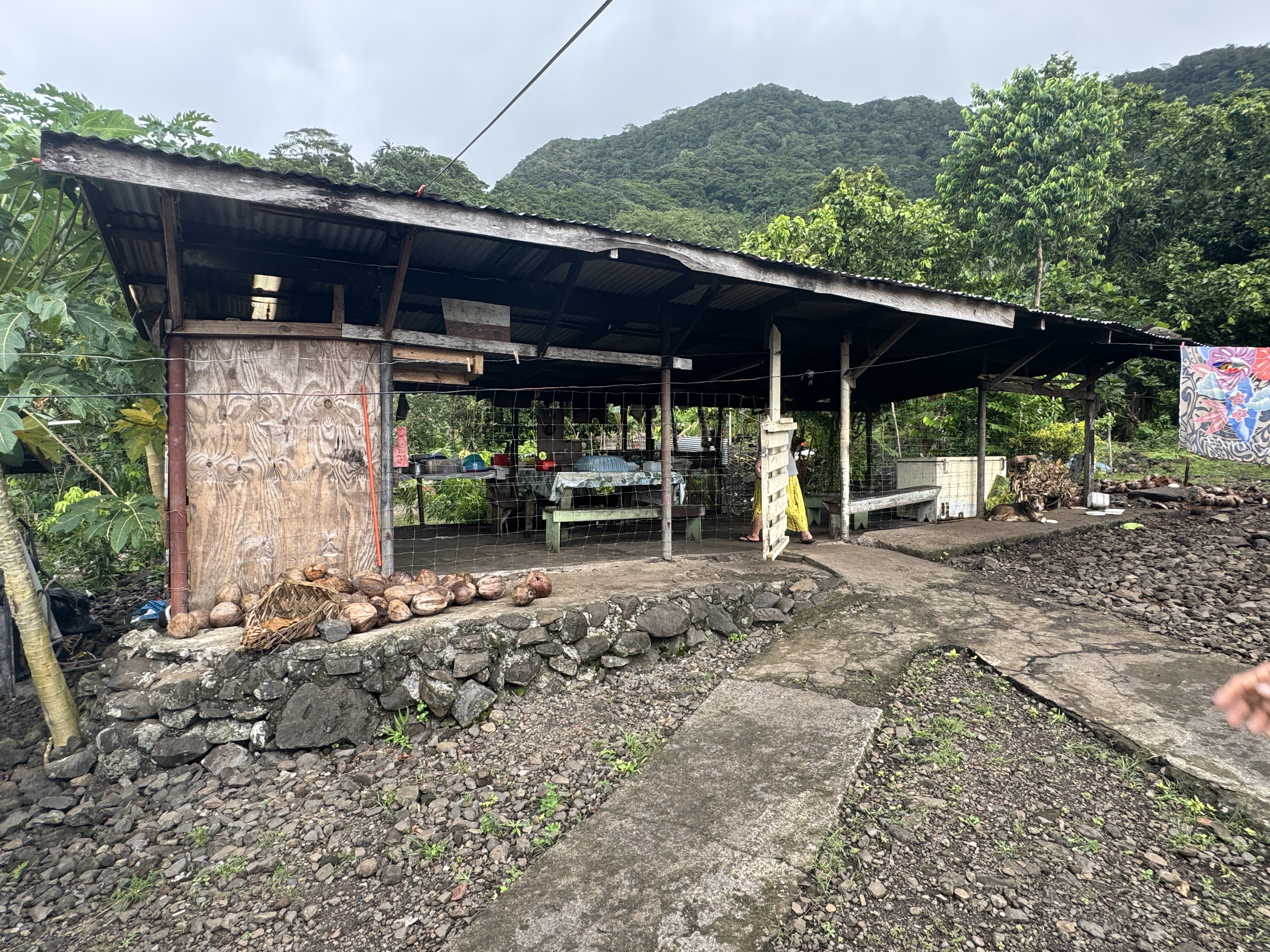
And a third, serving as a kitchen.
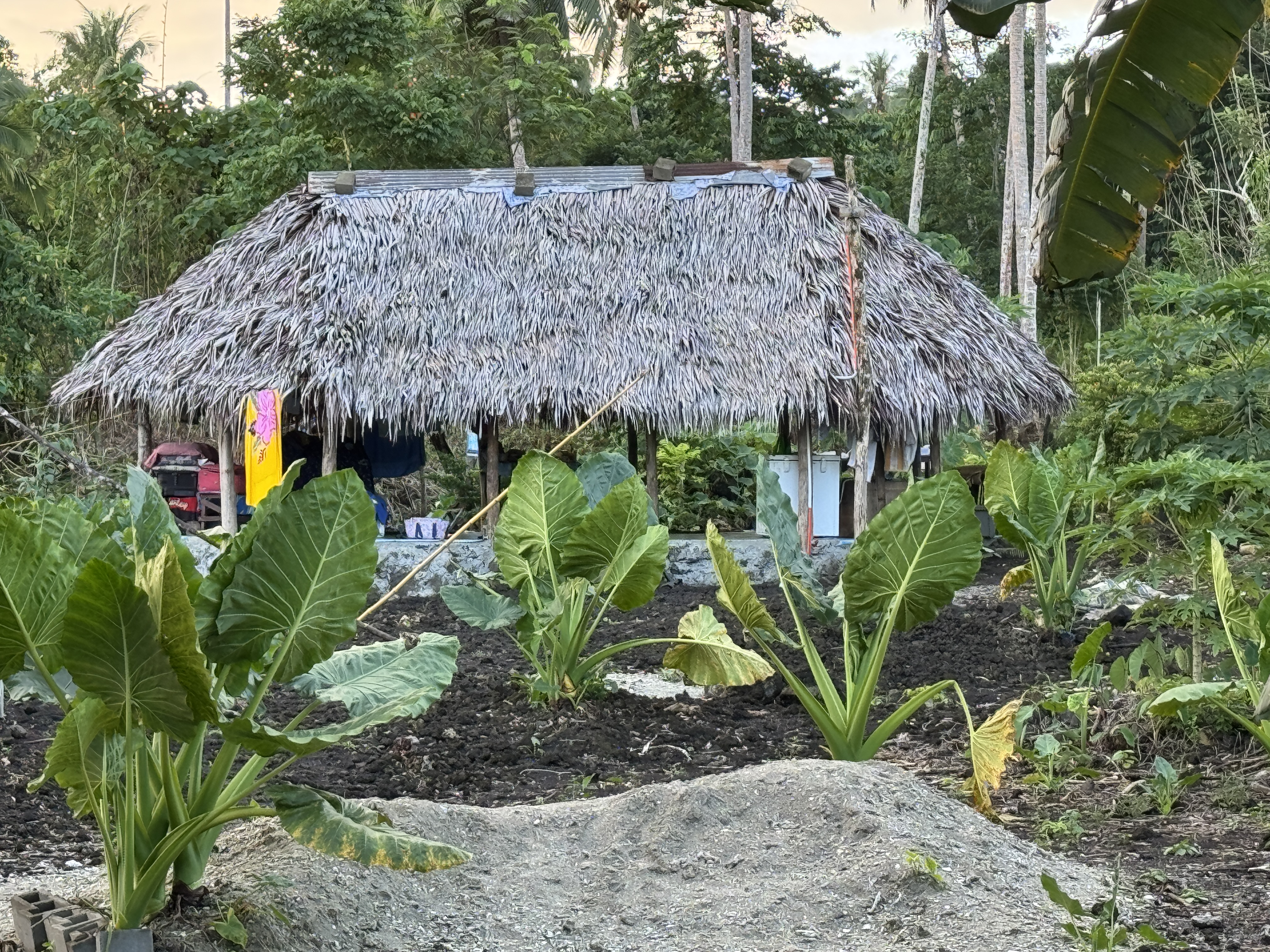
I just remembered: I also saw this along the road heading inland from the giant clam sanctuary, which you can find if you hunt. I should have stopped, right? My bad.
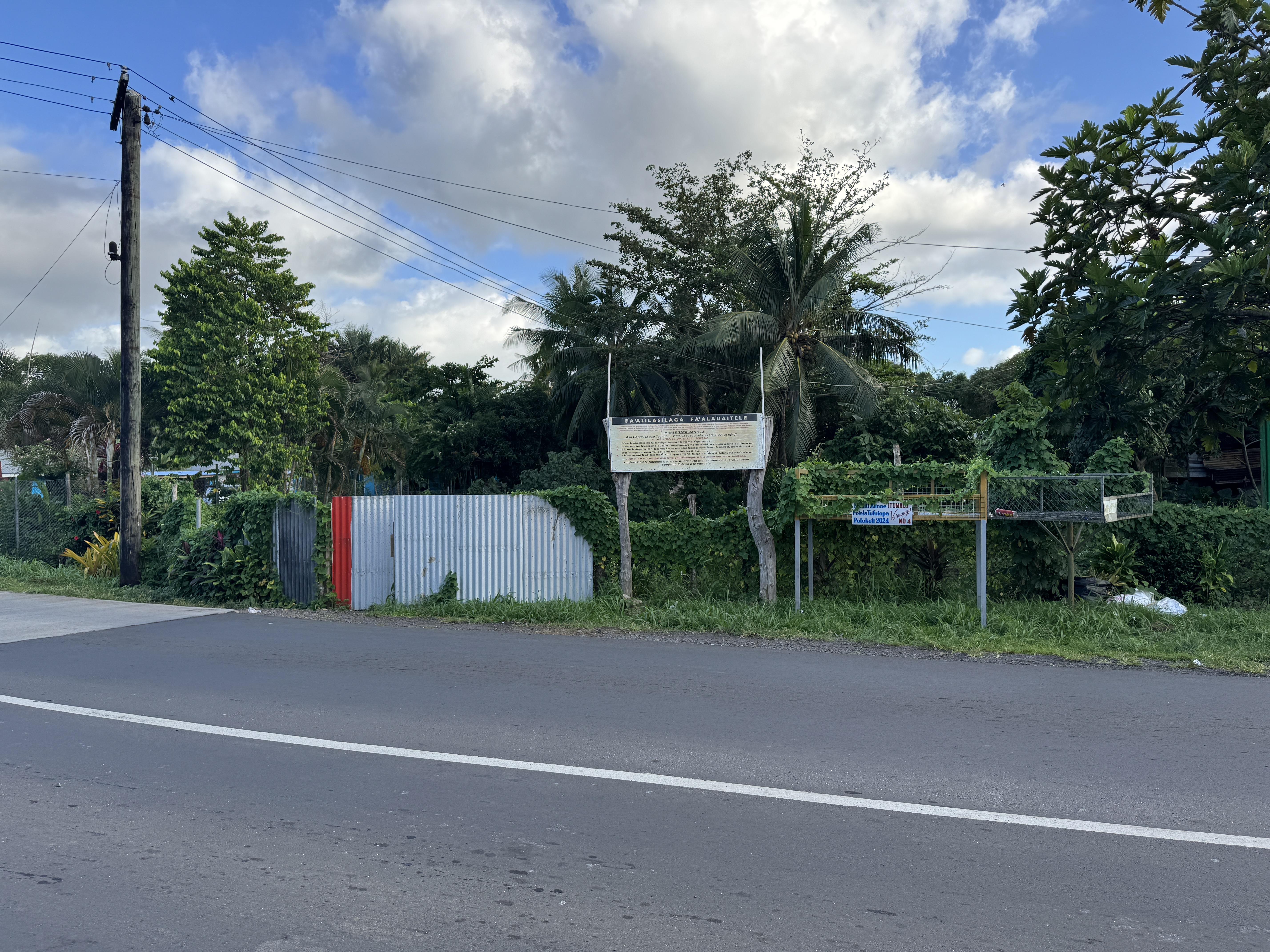
Here's something else that's traditional. The Samoans traditionally bathed in freshwater pools. Many survive. Here's one, half a mile from McDonald's.
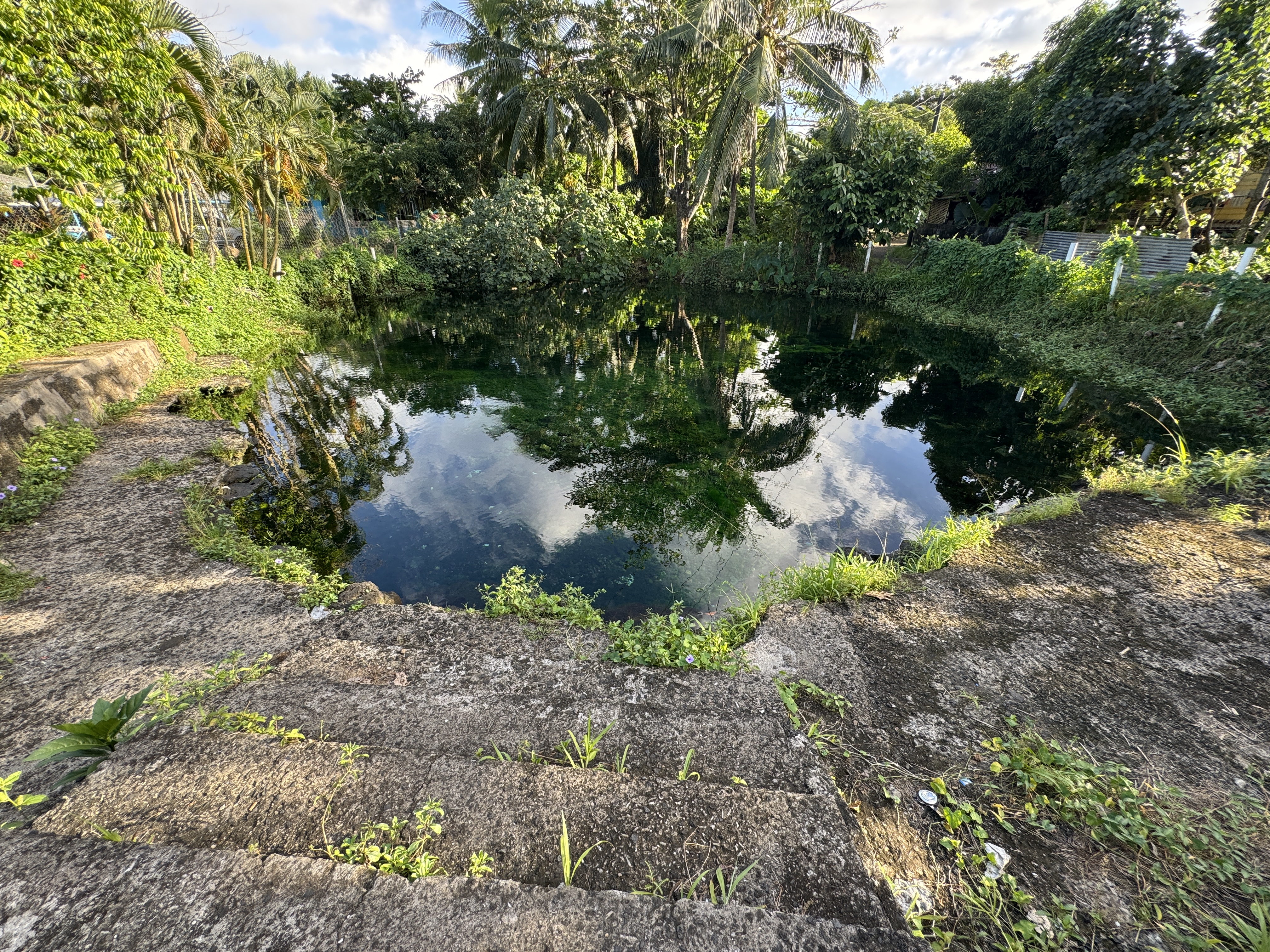
Nice, isn't it?
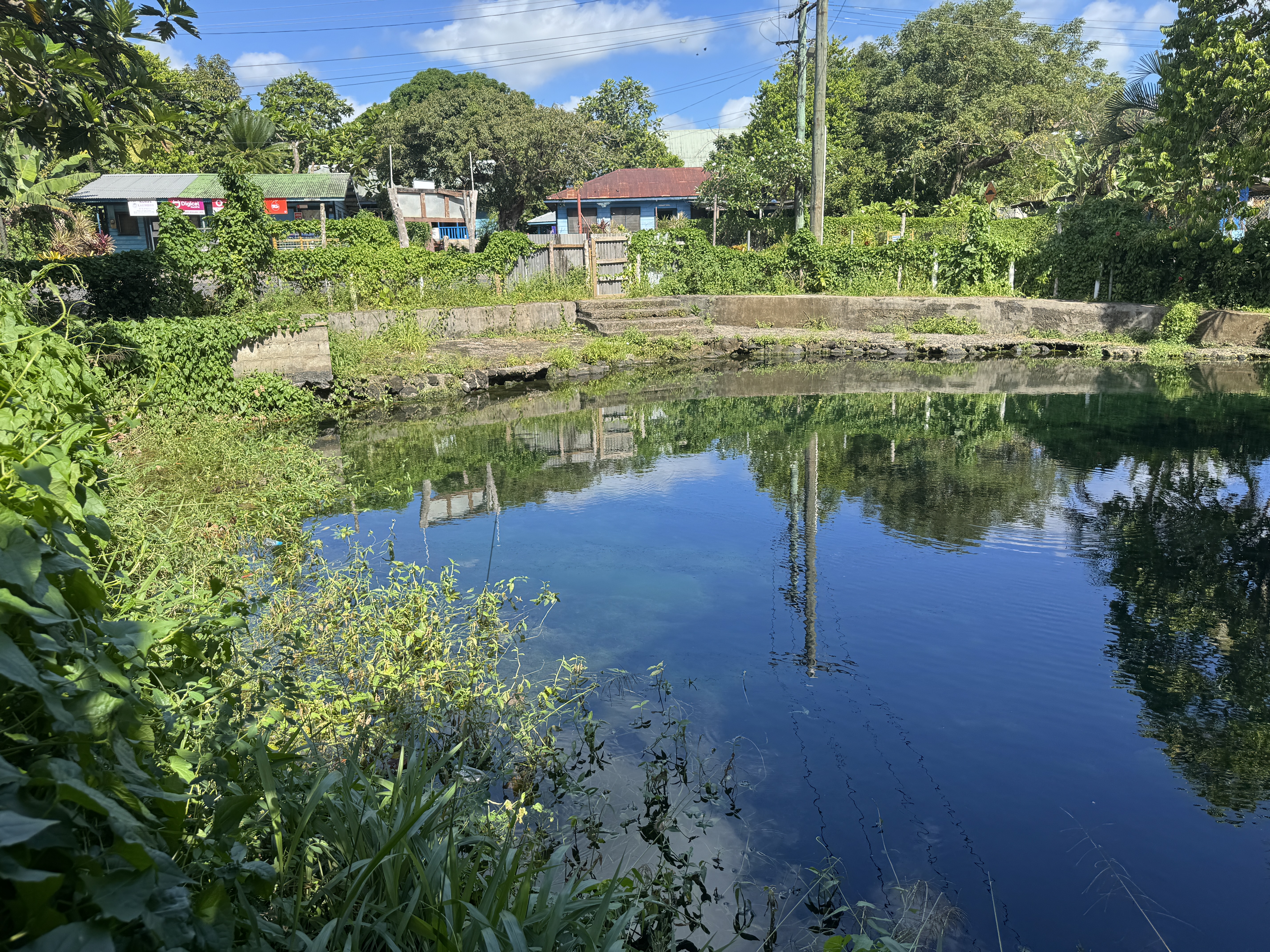
Here's another, not in such good shape.
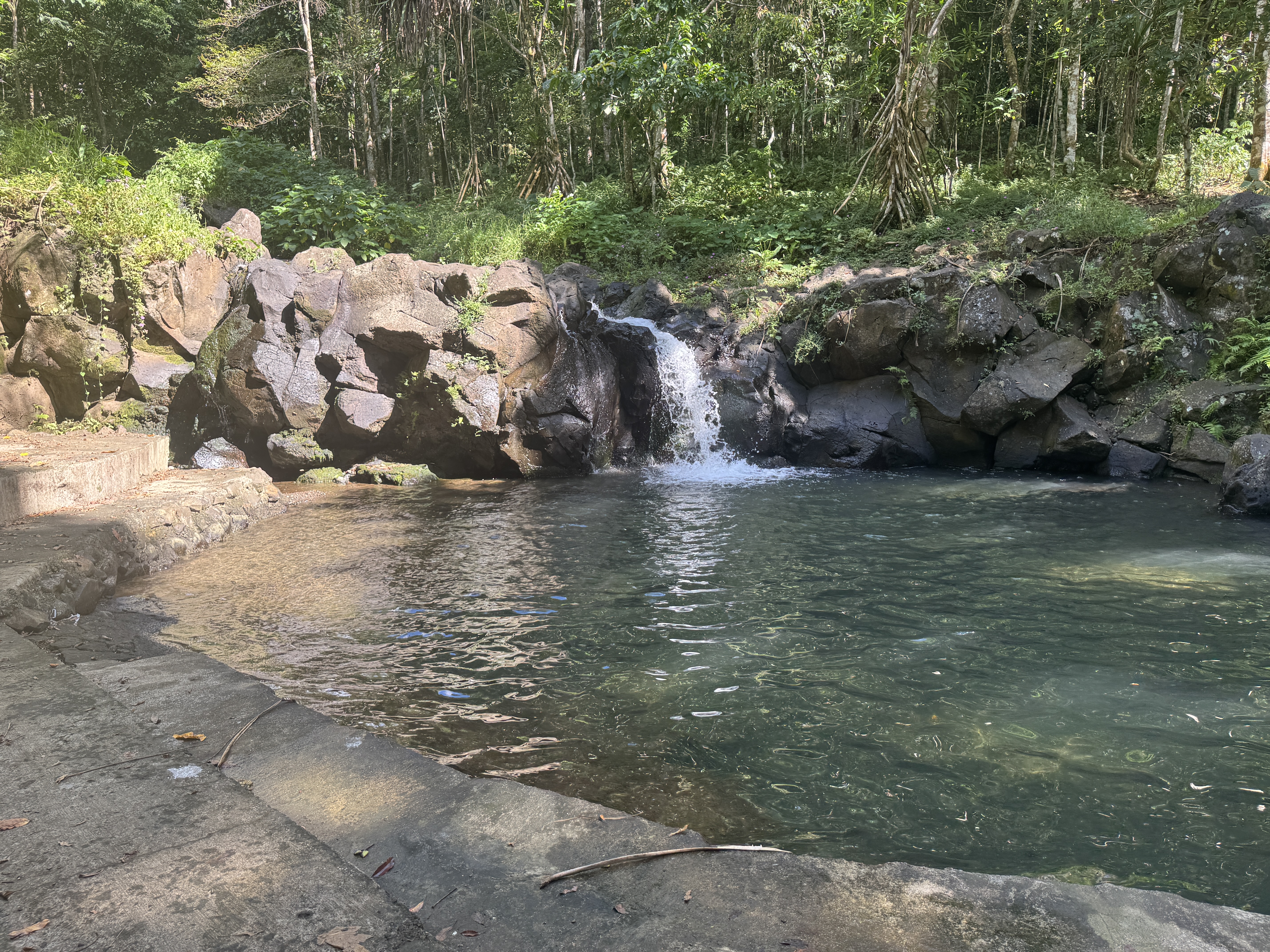
Here's one built not by Samoans but by Robert Louis Stevenson, who build a house nearby. Stevenson called the house Vailima, meaning "water" or "water in the hand," but this pond was literally his Vailima. You can swim in it today. So did Harry Luke, the visiting Governor of Fiji in 1940 (Luke, From A South Seas Diary, p. 162).
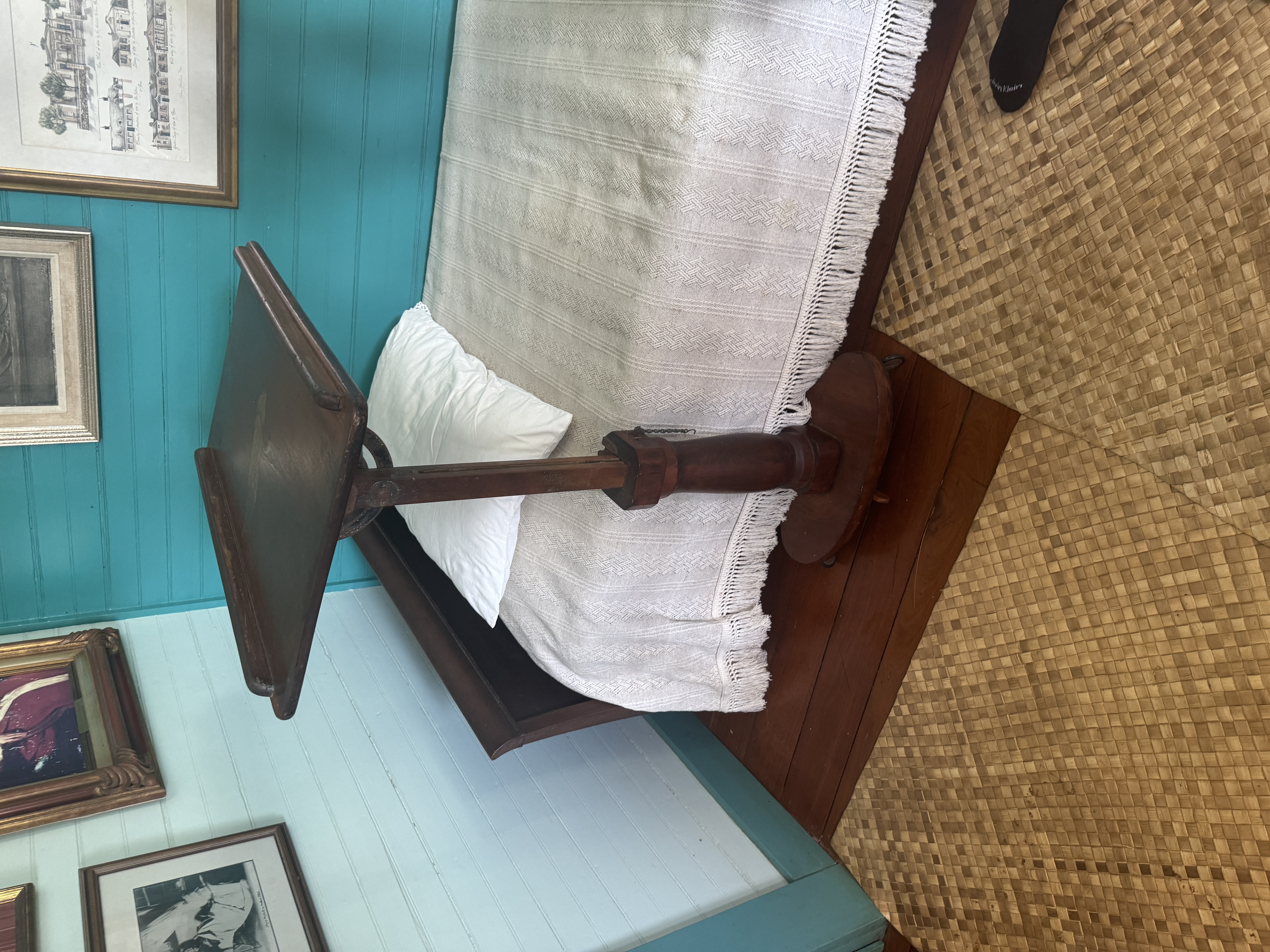
Since I've avoided pictures of Stevenson's house (they're a dime a dozen), I'll insert this picture of the nifty stand he used for writing in bed.
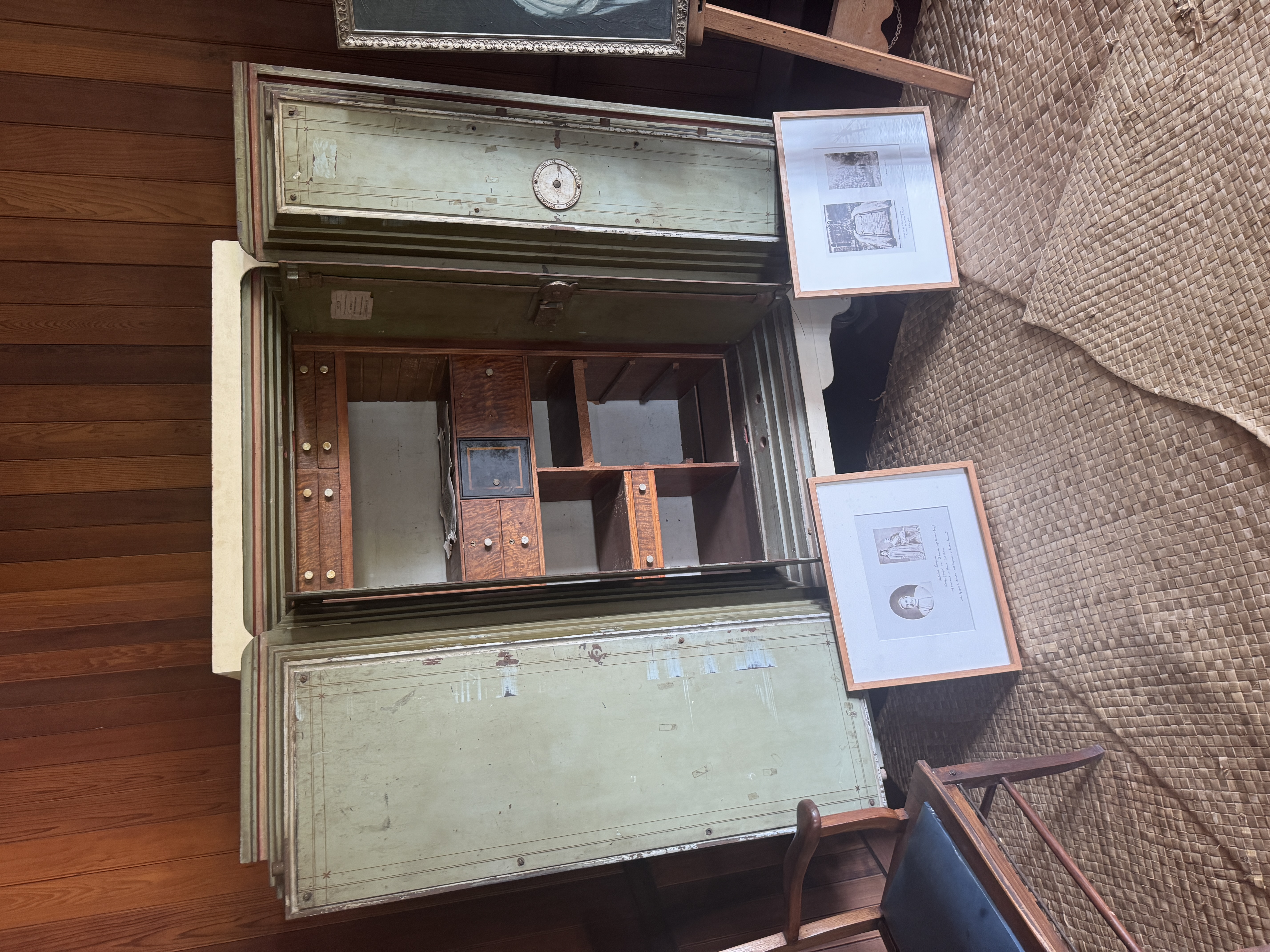
Here's Stevenson's safe, which a whole bunch of men lugged up the long hill from Beach Road to his house.
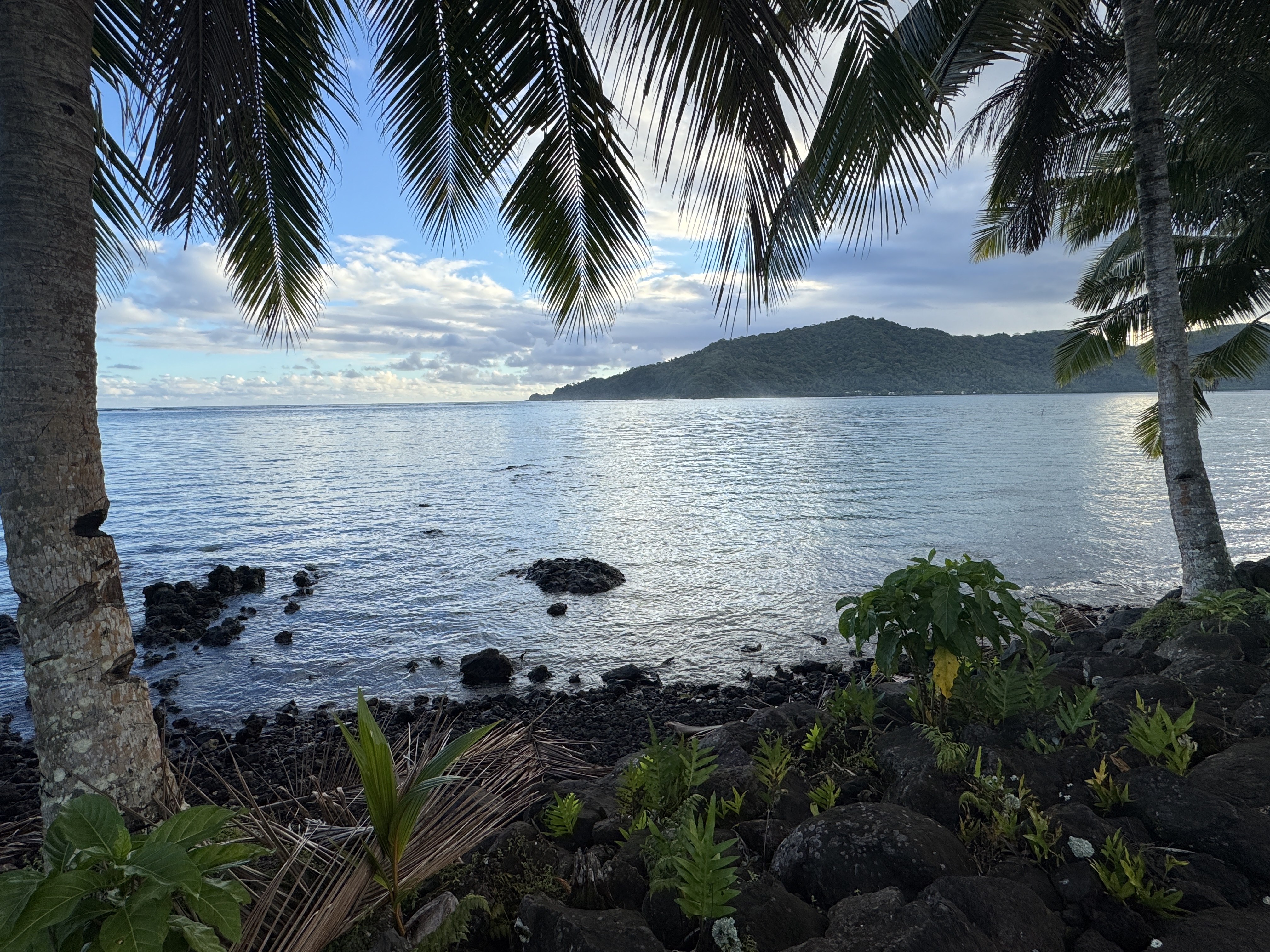
Are we done?
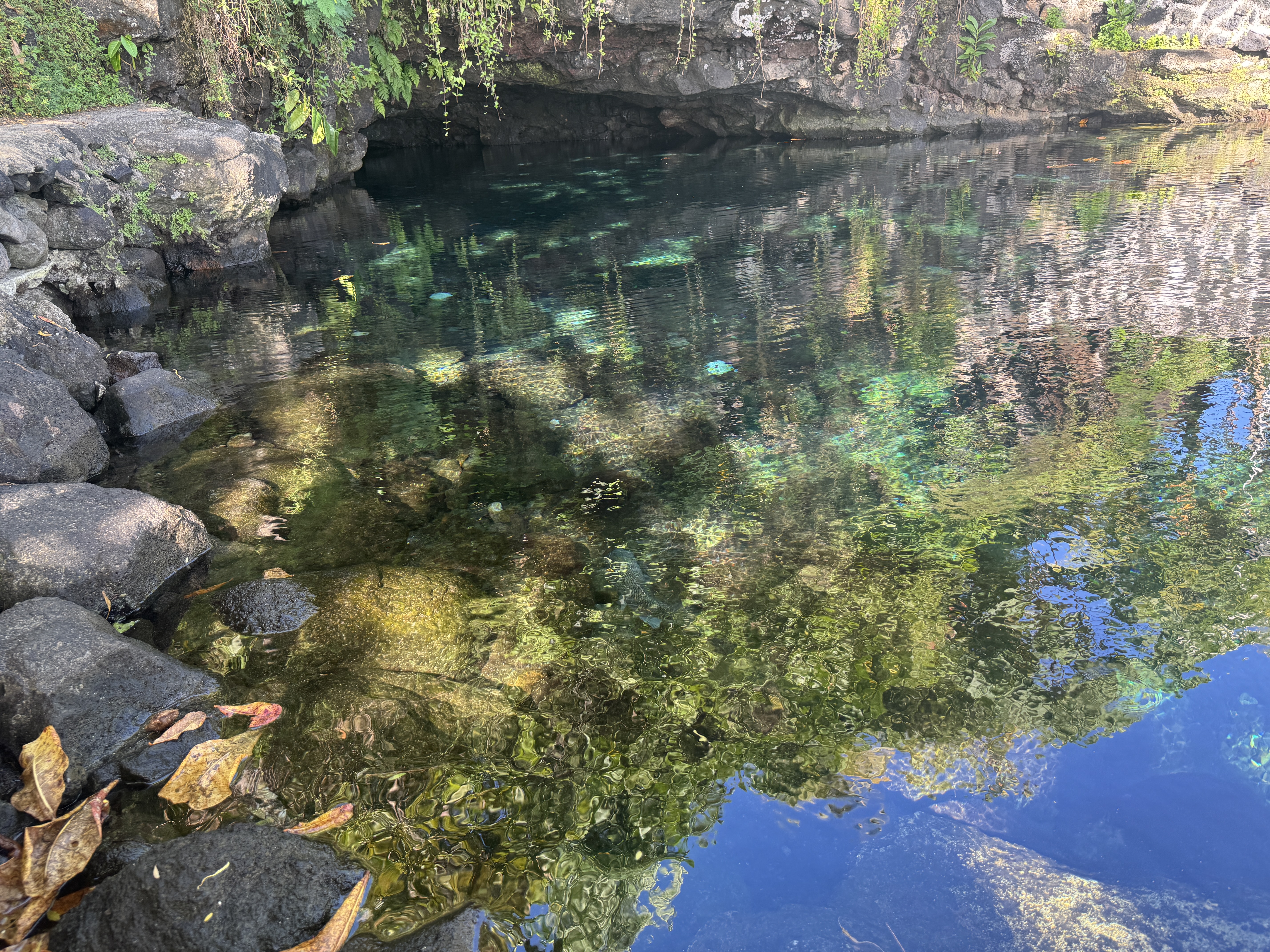
The pools remain among the most beautiful structures on the island. This one is just below the Piula Church, which we saw earlier.
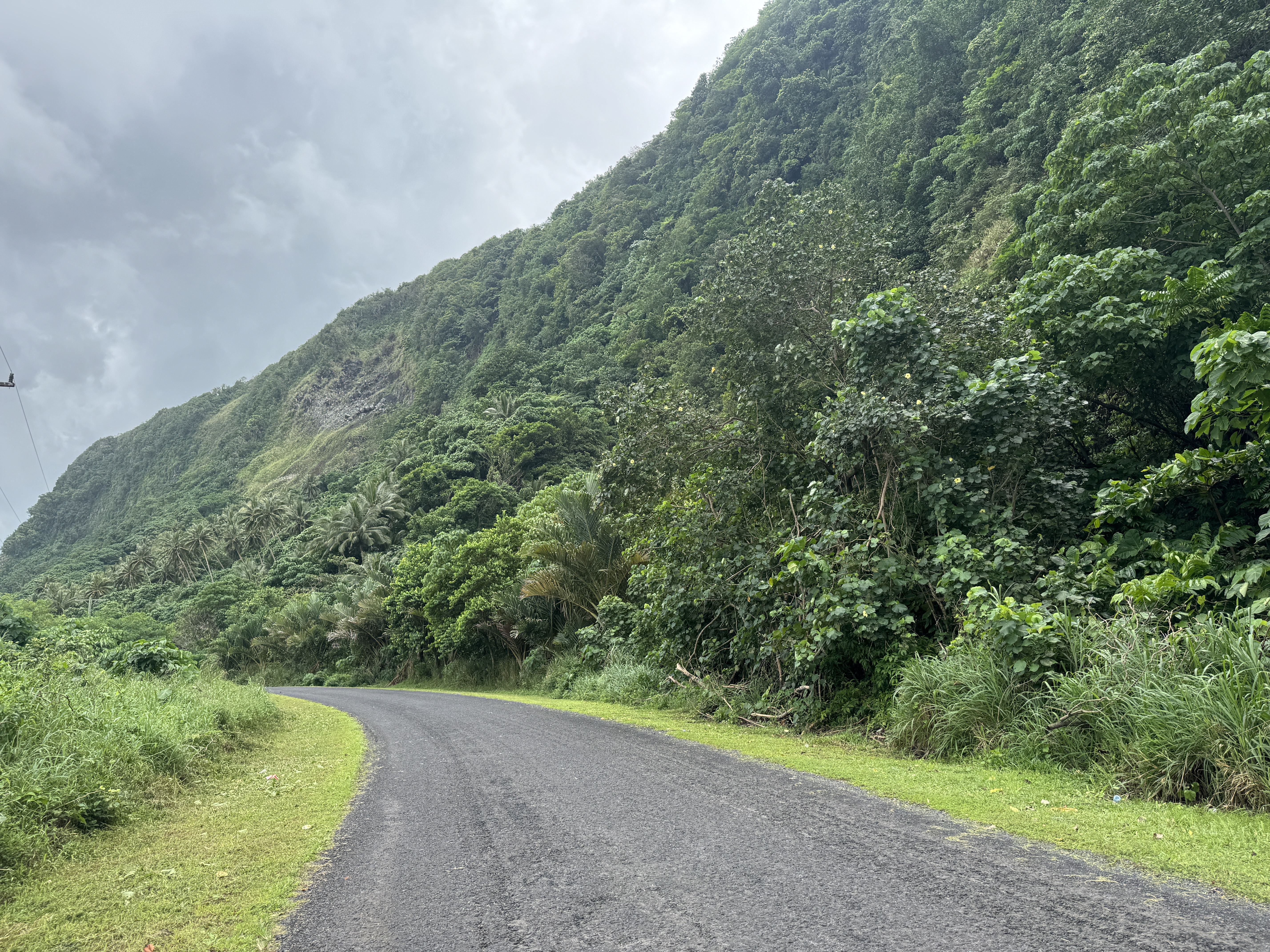
Never know what's around the bend, in this case along the South Coast Road.